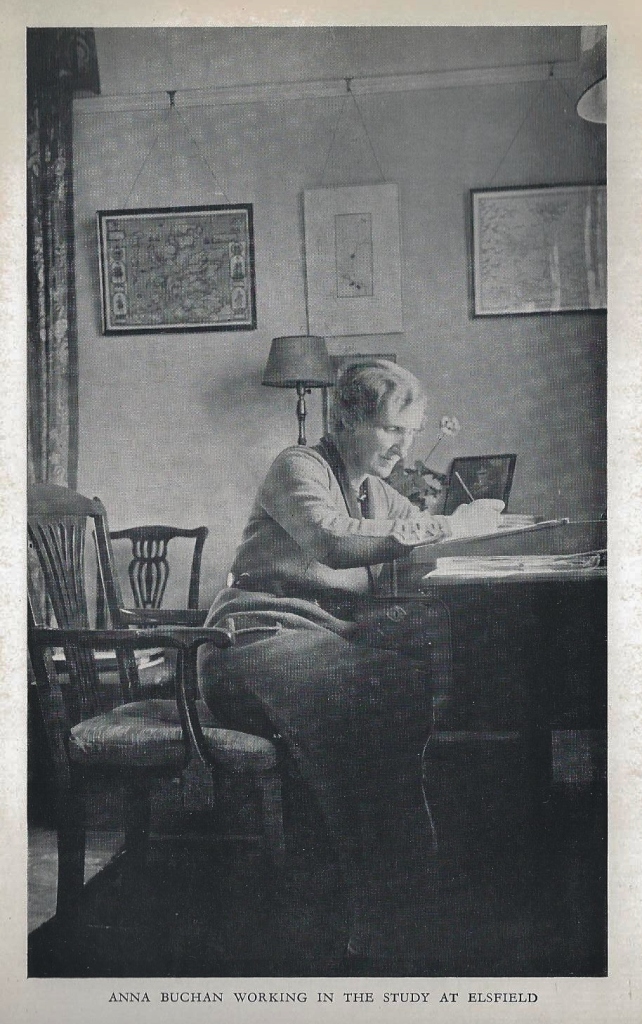
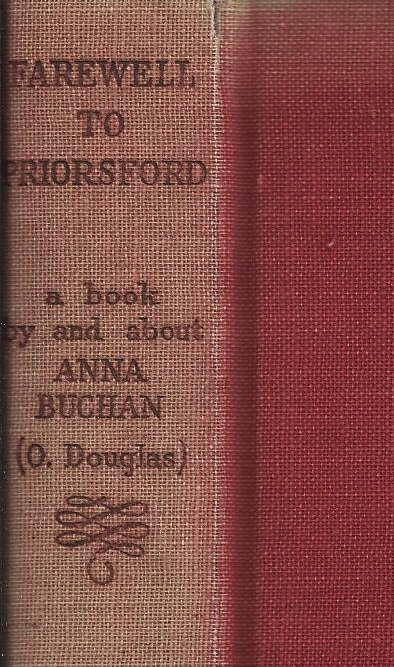
Farewell to Priorsford: a book by and about Anna Buchan (O. Douglas) ~ 1950. This edition: Hodder and Stoughton, 1950. Hardcover. With 5 photographs. 253 pages.

My rating: 10/10. Succeeds perfectly in its stated purpose, as noted in the Preface:

This book has been compiled at the request of the many who wish to know more about Anna Buchan by those privileged to enjoy her friendship.

This commemorative volume is presented in the hope that it will give to all who enjoy Anna Buchan’s books a share in the fun, the courage and the inspiration she gave to all who knew her.

*****

This book was published two years after Anna Buchan’s death, and is composed of several short biographical sketches, with the remainder a few collected short stories and anecdotes. There is also the fragment of the last novel Anna was working on, eight chapters of another Rutherfurd book, The Wintry Years.

This is a fascinating and enlightening glimpse into the world of this quiet yet eloquent author, and there are no surprises here for those who know the author through her fictional words, merely a confirmation of what we had hoped to find; that the author’s writings do indeed reflect her real life and her views that many people are indeed “good, gentle and scrupulous.” If this sounds too meek and wishy-washy, I hasten to add that Anna had a strong streak of cynical Scottish clear-headedness about her as well, and there is a leavening of wry humour and keen insight in her works to balance the goodness and gentleness.

The more I read of this author, the more I like her, both her works and the person she herself must have been. Farewell to Priorsford is a lovely memorial, and very much worth seeking out for O. Douglas fans. The eight chapters of The Wintry Years are an absolute treat to fans of the Rutherfurds, giving us a fleeting glimpse of their lives during the years of the second World War, and touching on many of the characters we came to know so well in The Proper Place, The Day of Small Things, and Jane’s Parlour, as well as teasingly introducing us to some new characters. Such a shame that Anna Buchan died so relatively young, at 71, and still very much at the peak of her writing years.

Here is what Farewell to Priorsford contains:

ANNA BUCHAN OF PRIORSFORD
 
I. A Biographical Introduction by A.G. Reekie
II. Anna by Susan Tweedsmuir
III. Olivia by Alice Fairfax-Lucy
IV. Author and Friend by Christine Orr
V. A Peebles Player by William Crichton
 
 
STORIES BY ANNA BUCHAN
 
I. Introductory Note
II. A Story for Young and Old:
          Jock the Piper
III. Broughton and Two Broughton Stories:
          An Upland Village
          An Echo
          Miss Bethia at the Manse
IV. Two Long Stories:
          A Tea-Party at Eastkirk
          Two Pretty Men
V. The First Eight Chapters of a Novel:
          The Wintry Years
 

*****

Highly recommended for O. Douglas – Anna Buchan fans.

Jane’s Parlour by O. Douglas (Anna Buchan) ~ 1937. This edition: Thomas Nelson & Sons, circa 1940s. Hardcover. 381 pages.

My rating: 9/10. Because I am now completely in thrall to Anna Buchan’s small but completely believable literary world, and I so greatly enjoyed spending time with the Rutherfurds and their ever-widening range of acquaintances.

*****

There was only one spot in the whole rambling length of Eliotstoun where Katharyn Eliot felt that she could be sure of being left at peace for any time. That was the small circular room at the end of the passage which contained her bedroom and Tim’s dressing-room; it was called for some unknown reason “Jane’s Parlour.”

No one knew who Jane was. There was no mention of any Jane in the family records: Elizabeths in plenty, Elspeths, Susans, Anns, Carolines, Helens, but never a Jane. But whoever she was Katharyn liked to think that she had been a virtuous soul, for there was always a feeling of peace, a faint, indefinable scent as of some summer day long dead in that rounded room with its three narrow windows (each fitted with a seat and a faded cushion), its satiny white paper, discoloured here and there by winter’s damp, on which hung coloured prints in dark frames. A faded Aubusson carpet lay on the floor, and in one corner stood a harp beside a bureau, and a beautiful walnut settee – these were Jane’s. A capacious armchair (Tim’s) was at one side of the fire, and opposite it, a large writing-table which was Katharyn’s. There was also an overcrowded bookcase, and a comfortable sofa: that was all there was in the room.

(…)

It was here she worked, for in the infrequent quiet times of a busy life Katharyn wrote – and published: it was here she read the writers she loved best, old writers like Donne and Ford and Webster from whom she was never tired of digging gloomy gems…

When Caroline was born Katharyn had made a rule that children and dogs were not to be admitted into Jane’s Parlour, and when Tim protested, replied with steely decision that there must be one peaceful place in the house. Before ten years had passed there were five children at Eliotstoun, and an ever-increasing army of dogs, so that, as Tim acknowledged, it was well to have one place where people’s feet were free of them.

And, because it was forbidden territory it naturally became the Mecca of the family, to enter it their most ardent desire…

This book interweaves a number of lives, most of which we are familiar with from The Proper Place and The Day of Small Things; Jane’s Parlour is very much a continuation of what has come before versus a stand-alone story; the three books belong together to give an ever-widening view of the living tapestry created by the author from her ever more intricately twined strands of individuals’ lives.

Here are Katharyn and Timothy Eliot, and their five children; Alison Lockhart and her beloved nephew George; Barbara and Andrew Jackson, Barbara in the role of antagonist and Andy smoothing down the feathers his wife continually ruffles; a cameo or two by Lady Jackson herself in all her vivid glory; Nicole and Lady Jane Ruthurfurd; and many more.

The main strand of this novel concerns a fairly typical love story, but there is much quiet activity going on at the same time, and we are treated to a series of interconnected vignettes which keep us up to date on what has happened since we last spent time in this lovingly created world. Virtue is rewarded, the wicked are put – for the most part – sternly in their place, joy is embraced and grief accepted. As usual, not much happens, but at the same time everything happens; much like most of our lives if we are lucky enough to live them in a peaceful country in between-great-events times.

The First World War is now long past, and is not often referred to, but the gathering clouds of what will be the Second World War are very much in evidence; this novel was published in 1937 and is a clearly and sensitively drawn period piece which captures the mood of those last few sunset years of relative peace before darkness once again descends.

If you enjoyed The Proper Place and The Day of Small Things, this is a definite must-read. The three novels belong together, and if you can get your hands on the posthumously published anthology-biography-memoir Farewell to Priorsford, you will find therein the first eight chapters of a fourth book, The Wintry Years, which follows the same characters into World War Two. Sadly, Anna Buchan died before that last novel was finished, but those chapters are perfectly composed, letting us turn away from our fictional friends with the feeling that their lives will continue somewhere even though out of our ken; truly the mark of a good author’s skill in world building.

The best-laid plans oft gang agley, and so also do the spontaneous ones. We’ve all been laid low, in beautiful synchronicity, by an evil virus our daughter brought home from her newly convened dance studio chums. Hacking and barking like a bevy of two-legged seals, we hiked about Pacific Rim Park with ever-lessening enthusiasm for several days, before blearily deciding to suffer the rest of the awful illness’ term at home in relative comfort.

It wasn’t all so bad – there were some quite good bits. We hit low tide in early morning on several beaches, all alone but for the sea creatures in the intertidal zones; we napped away two beautifully sunny afternoons in the warm sand, wakening to read for a bit, watch the surfers attempt to catch those obviously rare “perfect waves”, and doze again; we people-watched one morning in Tofino and had a grand brunch at The Common Loaf, the iconic local bakery; we sat around numerous campfires commiserating with each other and comparing symptoms; we visited the Ucluelet Aquarium and chatted with the ever-enthusiastic and knowledgeable biologists and volunteers; and even, on our last day, managed a side trip into the big city to visit the Cone Sisters Retrospective “Collecting Matisse” exhibition on loan from Baltimore, at the Vancouver Art Gallery.

We pulled out of the city and headed up the Sea-to-Sky Highway at 2:30 and made it home just before midnight – a marathon drive, but the reward was an enthusiastic greeting by our canine and feline crew, and our own cozy beds. Today we’ve been wandering about a bit lost and culture-shocked by the abrupt changes in our generally sedate lives this past week.

Newly topped up with sea air and a dash of culture, we’re thinking we’re now ready to face our getting-ready-for-winter chores with fresh enthusiasm. Or, to be honest, we will be ready soon, once we get a bit further along in our viral journey.

I only managed to read two short books, and I didn’t take too many pictures, but here are a few souvenirs of the lightning-fast trip. Next time…

*****

We arrived just in time for a rare clear evening and an awe-inspiring sunset over the ocean, next landfall Japan.

Long Beach, Pacific Rim National Park Reserve, Vancouver Island, British Columbia.

A very special place.

And a while later, the real celestial show began.

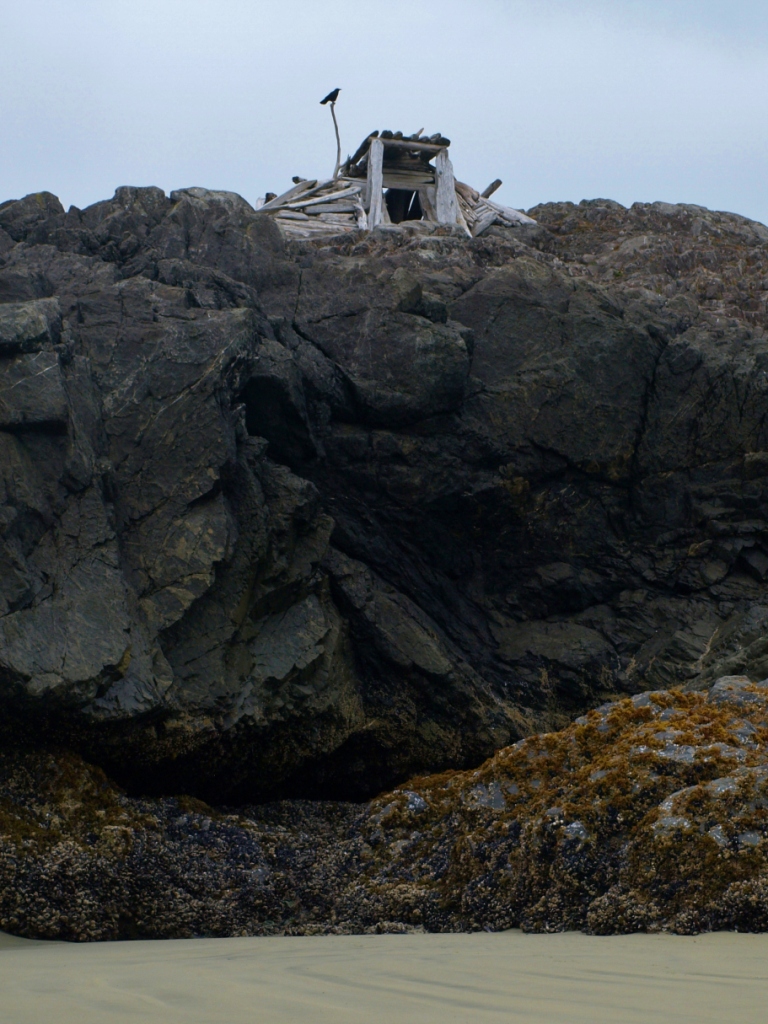
Early the next morning we enjoyed the company of ravens scouting for a low tide meal, and using a convenient driftwood structure as a lookout post.

Starfish. (But you knew that, didn’t you?)

 And many sea anemones.

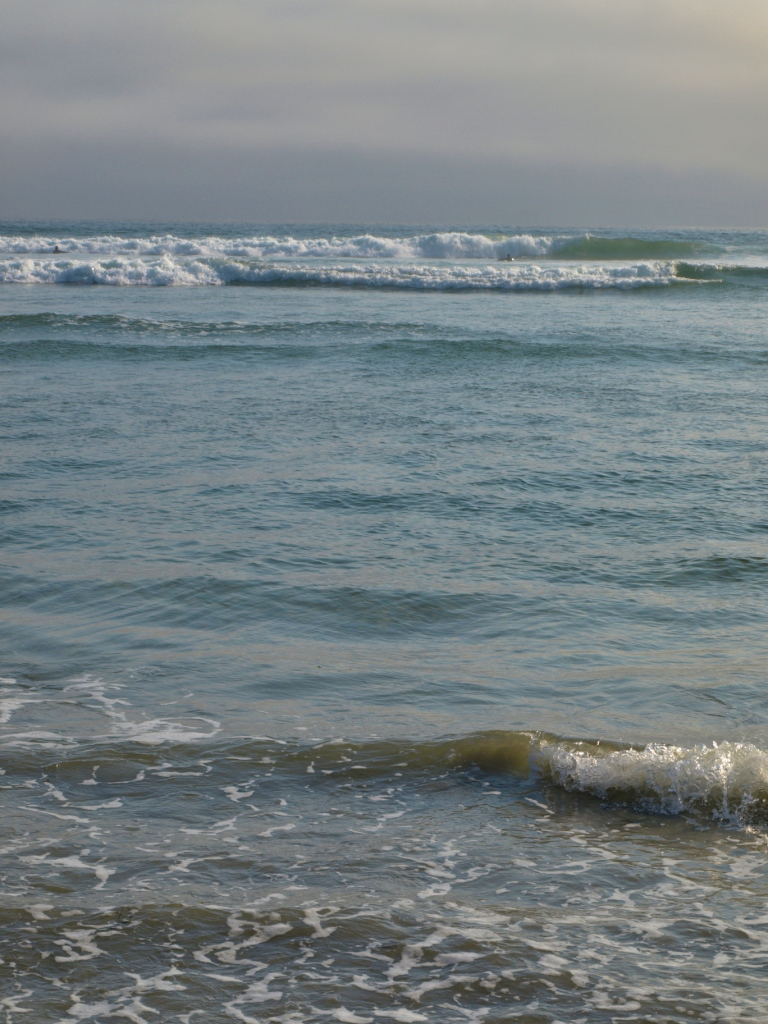
Waves at Incinerator Rock, a favourite surfer’s hangout. Can you see the two “Bobs” in the water? We decided that all surfers are named Bob, because that’s what they spent the vast majority of their time doing. Waiting on the perfect wave! This is wetsuit water, even in high summer. They hung around for hours out there, like seals in the surf, while we napped and watched from our warm and sandy nook among the washed up driftwood logs.

And on our last morning, we caught low tide and waited for the turning at the perfectly named Halfmoon Bay. Down a kilometre and a half of no longer sign-posted trail, ending in a precipitous ocean side staircase fast giving in to the elements, we were the only people here for hours. We met a few fellow trekkers coming in as we were leaving – perfect timing and a lovely way to end our too-short visit.

If you ever get a chance to visit this glorious area, do it! There’s never a bad time, summer or winter, rain or shine.

Greetings all – just a quick note to those of you so kind as to visit and especially comment on my postings. We have unexpectedly been blessed with a farm sitter, so have decided to take a rather spur of the moment trip to points south and west. In other words – so we’re shortly heading out on a camping/hiking trip to beautiful Long Beach on the west coast of Vancouver Island. We are leaving all electronics behind, so the blog shall fall silent for a while – maybe a week or a bit longer?

I’ve got a great big pile of books to take along for these ever-earlier-dark autumn evenings, and lots of batteries for my reading light, so will be back with an even longer “must review” list.

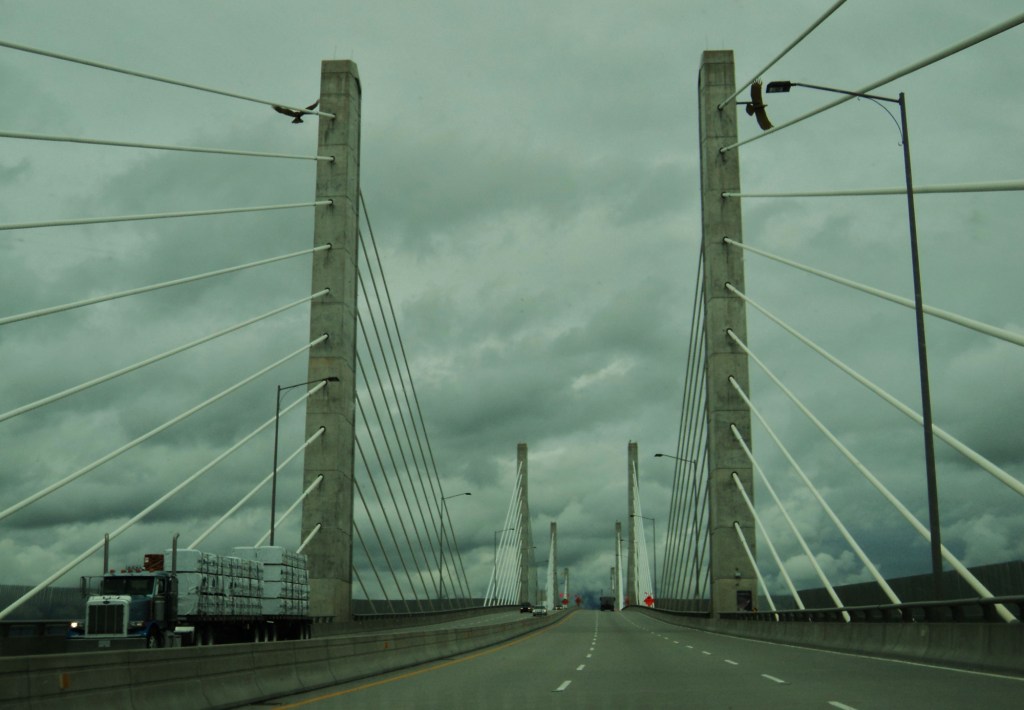
Leaving you all with a glimpse of one of my favourite new bridges, the soaring Golden Ears span over the Fraser River heading towards Vancouver, which we may or may not pass over this trip, depending on traffic levels and our ever-changing route plans. (It was also the only vaguely “coastal” image I could find quickly on my camera card this afternoon, before wiping it clean for the next go-round.)

Ciao!

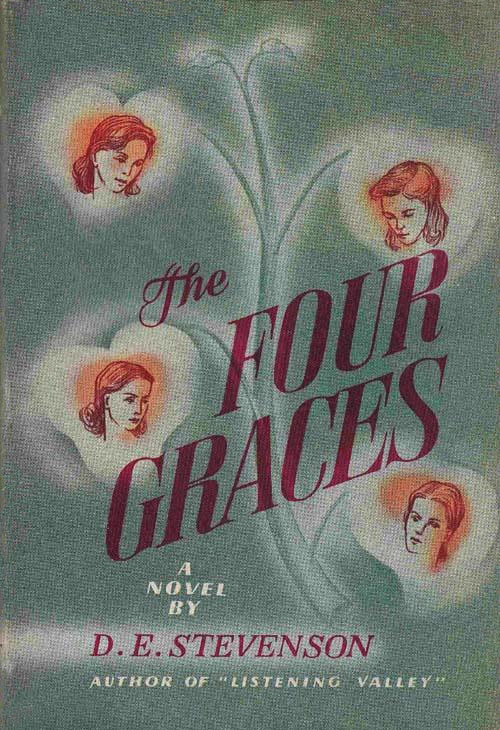
The Four Graces by D.E. Stevenson ~ 1946. This edition: Ulverscroft, 1975. Hardcover. Large Print – 370 pages.

My rating: For purely cozy, exceedingly nostalgic, “English village” escape literature, easily a 9/10. Literary merit – well, we won’t go there! I am actually quite impressed by the assumption that the author makes that her readers are very familiar indeed with the literary greats, as well as the current bestsellers of the day. References and quotations appear without any explanation, with, I’m quite certain, the belief that the reader as well as the characters of the story will “get it” immediately. Rather reminiscent of D.L. Sayers, and her own high-handed assumption that her readers are coming from the same erudite place as she is!

*****

This is my second D.E. Stevenson, after my initial introduction to this author’s esteemed Miss Buncle’s Book . I can understand how Dorothy Emily has garnered such a devoted following over the years. My elderly mother (87) would just love this one. I browsed ABE to see if I could perhaps pick it up for her, but was shocked at what  I thought were astronomical prices for this type of book – $22 and up for worn paperbacks to an unbelievable $246 for an ex-library hardcover. Who knew?!

Someone needs to get going on republishing this author – obviously there is a demand. I know Persephone has recently re-released, in 2009 and 2011 respectively, Miss Buncle’s Book and Miss Buncle Married, but those are the tip of a very large iceberg. According to my research – okay, to be honest, I looked at Wikipedia – this author’s career extended from 1923 to 1970, with a very respectable forty-six titles to her credit.

*****

The Reverend Mr. Grace is Vicar of a country parish, and is blessed with four now-motherless grown-up daughters. Adeline – Addie – the eldest, is a W.A.A.F. officer now living in London, but the three younger sisters remain at home. Matilda (Tilly), Sarah (Sal) and Elizabeth (Liz) all keep extremely busy, both by assisting their father in his many duties and helping with the war effort, for the story is set mid-World War II, and much of its charm is in seeing how the villagers live their lives and gamely make adjustments for the current reality.

Romance enters the sisters’ lives as two suitors suddenly appear – one quite traditionally, and the other much more insidiously. The reader never has a moment of doubt as to the eventual outcome, and though there are gentle setbacks to both romances everything inevitably works out as it should. A very sweet little story, which I found surprisingly appealing. Tiny touches of cynicism and humour kept it from being too saccharine, though it was a rather close thing.

From the Author’s Preface:

The author has been asked whether this is a funny book or true to life, and has some difficulty in answering the question, for life is a funny business altogether (both funny-peculiar and funny-ha-ha, as Elizabeth would say). The story covers less than a year in the life of a family and during this comparatively short period many things happen, some serious and important, others cheerful and gay. It is summertime – a summer during the greatest and most terrible f the wars – but the author felt disinclined to bring such a grave and desperate matter into a light-hearted tale; here, then, are to be found only the lighter side and the small inconveniences of Total War; the larger issues are ignored…

The Lady or the Tiger, and Other Stories by Frank Stockton ~ circa 1882. This edition: Airmont Publishing Co., Ltd., 1968. Paperback. 160 pages.

My rating: Of this collection, I give the two stories The Lady or the Tiger and The Discourager of Hesitancy both a strong 10/10. The other stories in this little collection, a reasonable 7/10, allowing for their time of writing. Definitely period pieces, with the expected style and tone. Gently pleasant literary diversions.

Frank Stockton (1834 – 1902), though best known as the writer of the title short story, initially worked as a wood engraver and an editor, before settling to his productive and successful writing career. He wrote many short stories besides The Lady,  and several humorous novels, none of which are in print today.

*****

The Lady or the Tiger is a classic short story written in the 1880s, and still anthologized today as a prime example of the unsolvable “puzzle tale”. I am sure most people have read this at some point or another, most likely in a high school English class, but in case you haven’t, here is a complete plot summary courtesy of Wikipedia. I don’t know if a spoiler alert is needed, but if you want to read this for the first time yourself, stop now, and go instead to East of the Web – The Lady or The Tiger .

The “semi-barbaric” king of an ancient land uses a unique form of trial by ordeal for those in his realm accused of crimes significant enough to interest him. The accused is placed alone in an arena before two curtain-draped doors, as hordes of the king’s subjects look on from the stands. Behind one door is a beautiful woman appropriate to the accused’s station and hand-picked by the king; behind the other is a fierce (and nearly starved) tiger. The accused then must pick one of the doors. If by luck (or, if one prefers, the will of heaven) he picks the door with the woman behind it, he is declared innocent and set free, but he is required to marry the woman on the spot, regardless of his wishes or his marital status. If he picks the door with the tiger behind it, the tiger immediately pounces upon him–his guilt thus manifest, supposedly.

When the king discovers that his daughter, the princess, has taken a lover far beneath her station, the fellow is an obvious candidate for trial in the arena. On the day of his ordeal, the lover looks from the arena to the princess, who is watching in the stands, for some indication of which door to pick. Even the king doesn’t know which door hides the maiden, but the princess has made it her business to find out, as her lover knew she would. She makes a slight but definite gesture to the right, which the young man follows immediately and without hesitation. As the door opens, the author interjects, “Now, the point of the story is this: Did the tiger come out of that door, or did the lady?”

The author then playfully sets out for the reader the dimensions of the princess’s dilemma, and of the reader’s dilemma in answering the question he has posed. The reader is reminded that the princess knew and “hated” the waiting maiden, one of her attendants, whom she suspected of being infatuated with the princess’s lover. The princess, the reader must remember, is “semi-barbaric,” too, or she wouldn’t have come to witness the ordeal at all; and though she has shrieked often at the thought of her lover torn to bits before her eyes, the thought of his dancing out of the arena with his blushing bride has afflicted her more often. In either case, the princess knows her lover is lost to her forever. She has agonized over her decision, but by the time she arrives at the arena, she is resolute, and she makes her gesture to the right unhesitatingly. The author denies being in a position to answer his question with authority, and the story ends with the famous line, “And so I leave it all with you: Which came out of the opened door – the lady, or the tiger?”

Great little story. And I too have no idea which one it was! Worth reading and mulling over.

Full Table of Contents:

  • The Lady or the Tiger ~ outlined above.
  • The Griffin and the Minor Canon ~ a fable about a fearful griffin befriending a cleric, and about how the inhabitants of the cathedral town reacted to the griffin’s presence in their midst.
  • Love Before Breakfast ~ a romantic interlude, sweet as cherry pie.
  • “His Wife’s Deceased Sister” ~ a writer discovers the unexpected drawbacks to writing a bestselling story. Ironic and humorous, and very likely a comment on the author’s own most successful piece and the difficulties it brought about in his working life.
  • Our Story ~ another romantic interlude, with a little twist at the end.
  • Mr. Tolman ~ a successful businessman goes incognito to gain himself an interesting holiday, and ends up acting as Cupid to a couple of mathematical music students.
  • Our Archery Club ~ a gentle satire on proper form versus successful results, plus another romance.
  • The Discourager of Hesitancy ~ a sequel of sorts to The Lady or the Tiger, which promises at first to resolve that quandary, but which actually adds another dilemma to be wrestled with.

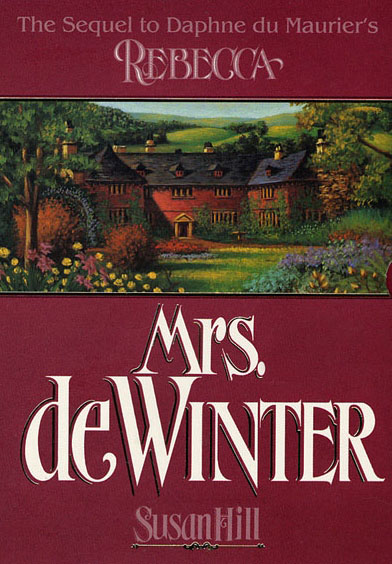
Mrs. de Winter by Susan Hill ~ 1993. This edition: William Morrow & Co., 1993. First edition. Hardcover. ISBN: 0-688-12707-x. 349 pages.

My rating: 3.5/10.

This is a book for fans of du Maurier’s now classic, noire-romantic-suspense novel Rebecca; I suspect anyone else would be completely bemused. Would this be what is termed as “fan fiction”?

Mrs. de Winter started off reasonably promisingly, but quickly got tedious. Susan Hill was very conscientious about channeling du Maurier’s voice as preserved in Rebecca, but in my opinion the greatest weakness of the book is that she stuck to that voice too strongly, instead of taking the characters to the next level.

I give Hill credit for trying, hence the (generous) 3.5 rating, and it is obvious that she holds Rebecca in great esteem, but I found this sequel ultimately boring and very depressing – wait! – no! – not merely depressing – downright sad is a better description. It was also about two hundred pages too long for the content, and very wordy and repetitive. The plot was contrived and unbelievable, and the ending, quite frankly, was deeply disappointing.

Rebecca ended on a tragic note, too, but it was a fitting conclusion to what had come before, and is likely one of the reasons why the story is so highly regarded. I tend to agree with those who say that Rebecca is du Maurier’s masterpiece. It is very much a polished and completed piece of work, and decidedly a stand-alone book, and a sequel written by another author should then at least be creative and take us in a new direction – “What if?” This just didn’t happen here. And that’s really too bad, because from what I’ve heard, Susan Hill can write.

*****

Mrs. de Winter continues the story that du Maurier so teasingly but perfectly tied up in 1938 in Rebecca. Fifty-five years later that book is still so widely read and admired that a sequel by a contemporary author comes in for much discussion and is greeted with high hopes. Interesting and cleverly imagined sequels are occasionally created on the coattails of classic novels, but they are rare creatures. Sadly this particular attempt was, in my opinion, quite decidedly a “miss”.

In Susan Hill’s take, Maxim and the first person narrator, his second wife so famously left unnamed in Rebecca, have not seemed to grow or emotionally develop in the ten years subsequent to the burning of Manderley. If anything, they have degenerated.

At the close of Rebecca, the second Mrs. de Winter has found a new maturity and confidence and faces her future with fortitude and a certain stubborn grace. Maxim himself has become a much more likeable character as he unbends enough to confess his failings to his new wife; their marriage looks like it may actually work, having weathered the storm of the murdered first wife and the malicious Mrs. Danvers and her revengeful arson.

In Mrs. de Winter, Maxim comes across as a boring, immature, moody manic-depressive, and his wife as just plain pathetic: still dowdy and unsure of herself, and acting much younger than her age. No wonder Maxim walks all over her, in this re-interpretation, even more so than in the original – she’s a true “Kick-Me-Charlie”.

Spoiler alert, for both Rebecca and Mrs. de Winter. If you want to be surprised, stop reading now.

Mrs. de Winter starts with a funeral in England. We don’t immediately know who has died; we find out on page 20, after much long-winded scene-setting and flashbacks, that it is Maxim’s sister, Beatrice.

It is now ten years after the burning of Maxim’s family estate, Manderley. As those of you who have read Rebecca will remember, Maxim has been emotionally scarred apparently beyond recovery by the whole saga of first having murdered his lovely but secretly treacherous first wife, Rebecca, and then narrowly escaping justice. Rebecca’s death has been officially recorded as a suicide, and Rebecca’s devoted ex-nanny, Mrs. Danvers, has set fire to Maxim’s beloved house in revenge – she knows the truth. Maxim has confessed all to his young second wife, and she in turn has forgiven him everything in her relief at finding out that Maxim is not still in love with his first wife, as she has been mistakenly thinking all along. (Interesting that Maxim can quite calmly deal with being a murderer, but the loss of his palatial estate sends him over the final edge. Not the most admirable of characters, when one steps back for some perspective, to put a house ahead of a human life, but in the original he shows enough character to allow us to conditionally forgive his numerous sins.)

The two have gone to live in Europe, to escape all the apparent gossip that is being generated by the complicated tragedy. Though Maxim is widely viewed as a bereaved husband and not a murderer, he is such a sensitive type that even a whisper about Manderley or Rebecca apparently gives him the jim-jams. His second wife meekly caters to his neuroses.

As the sequel begins, the second World War has just ended. Maxim and second Mrs. de Winter have apparently spent the war years safely ensconced in Switzerland. Maxim has no intention of going back to England, even for his sister’s funeral, but Mrs. de Winter convinces him that he must. It seems that she is dreadfully homesick and welcomes the chance to return to her homeland, even if the reason is the pathetically tragic death of a beloved wife and mother.

They get there, see Beatrice buried, and are reluctant spectators to her widower Giles’ deep distress. There is a terribly disfigured war hero son about as well. For a while I thought that was going somewhere, but it was a dead-end – he is merely part of the background colour. A mysterious funeral wreath appears, seen by Mrs. de Winter alone – the card is signed with dead(!) Rebecca’s signature initial. Oh my! What could this mean?! The note is hidden, but naturally not destroyed – and we know that it’s going to cause trouble later. (Cue foreboding music.)

Maxim is ready to head back to Europe, but Mrs. de Winter begs to stay in England for a while. He half-heartedly agrees, but pouts enough so that his wife starts viewing him with a certain distaste. After all, she has been a willing silent partner in his great deception, and has put up with his moody behaviour these past ten years. All she really wants to do is find a quiet corner in England, settle down and have a few babies.

Many pages pass. Eventually Maxim surprises his wife with the news that he has bought her a small country house. La la la – life is looking up! Mrs. de Winter sneaks away to London to inquire of a gynecologist why she’s not getting pregnant, which is kind of a strange little side story because I thought the implication in the original story was that Maxim chose to remain childless, so I’d assumed they were actively practising some sort of birth control. There were condoms in the 1940s, were there not? Well, according to Ms. Hill, Mr. and Mrs. de Winter were unable to have children due to bad luck, not from human preventative measures. The doctor tells the Mrs. that she’ll get pregnant once she learns to relax and be happy, and she is so thrilled by this she prances straight off home intending to break the good news.

But wait! Suddenly there appears on the scene the wicked Jack Favell, Rebecca’s cousin, who immediately announces his intention to blackmail Mrs. de W. With what I’m not quite sure. (My attention was wandering a fair bit at this point.) So much for less stress! Darn, no baby for you, Mrs. Maxim. (Yes, I’m being very facetious. I was strongly annoyed at the author by this point, and no longer enjoying the book in any way, shape or form.)

More pages about this and that. Shades of the Manderley costume ball in the original book – there is a party. Jack Favell shows up but is shot down. (Figuratively, not literally. Luckily for Jack, Maxim doesn’t have a firearm handy, as he did when Rebecca annoyed him severely in her turn.) Mrs. Danvers also shows up, but is coldly dismissed by Maxim. After the party, Maxim is all sad and angsty. “It is justice!” he moans, and proceeds to exit the scene and drive fatally into a tree.

The ashes are scattered, predictably, into the ocean off the coast of Manderley.

The book is gently put down, contrary to inner impulse. It is, after all, a library book, and we must return it in good condition.

Ick. Ick. Ick. Ick. Ick.

Why did I think this would be a desirable read?

Not recommended.
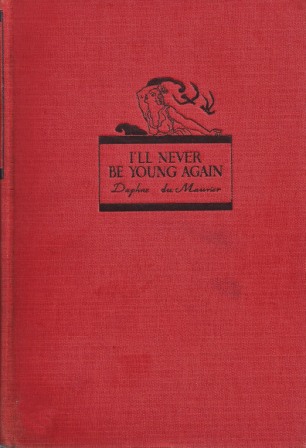
I’ll Never Be Young Again by Daphne du Maurier ~ 1932. This edition: Sundial Press, 1941. Hardcover. 336 pages.

My rating: 8/10 for most of the writing – the woman could certainly put words together, though she falters here and there – see the last paragraphs of the book which I’ve included at the very end of this review – and 4/10 for the plot and characterizations. Averaged out, that makes 6/10, which is still too high, so I’m going to give it a 5/10. Brutal, I know, but it is that hard to read.

I wanted to like this book so much, and was so thrilled when I found it. It starts off so very well, but soon turns into a long, very slow motion (think frame by frame slow) train wreck. I no longer wonder why this title is one of the unremarked silent members of Daphne du Maurier’s otherwise mostly stellar bibliography.

If it were anyone else but Dame Daphne, I would have pitched it about a quarter through, if not sooner. As it was, it took me a very, very long time to work my way through it. Only its nagging presence on my “What I’m Reading” sidebar kept me coming back for more punishment.

*****

The book, Daphne’s second (the first is The Loving Spirit, which I know I have somewhere but seem to remember having set aside many years ago as “unreadable” as well – I need to find it to refresh memory) was published when she was only twenty-four, so we have to give allowances for that. From my own advanced age – okay, I’m not that old, but twenty-four is half a lifetime away for me now – a book written by a twenty-four year old and titled I’ll Never Be Young Again is somehow more than a little ironic.

After finishing, I sat for a while thinking, “Was it the book or was it me? Did I just not get it?” So I did what I always do in cases such as this – I googled other bloggers’ reviews. And look what I found! I’m not alone! Someone else thought the very same thing. (Though she only gave it a 4/10. Ha! – take that, Doleful Dick, you whingy whiner.)

Therefore I have totally copped out and shamelessly stolen this review from Books I Done Read  (tagline: Reading books so you don’t have to) which is a totally awesome, very busy (in more ways than one – you’ll see what I mean when you visit it) little production. I love it. Raych forthrightly says what we’re all secretly thinking. Spend the time on her blog which you would’ve spent crawling through du Maurier’s non-opus, and you’ll be much happier. Says me, from first hand experience of both.

January 28, 2011

This was a difficult one to read.  It has those sort of circular, Catcher-in-the-Rye conversations where the point is not the content but the banality, which makes for good social critique but sloggery reading.  And it’s maybe 99% dialogue, because nothing happens.

Ok so.  Dick is the son of a famous author-slash-shitty father and, not having accomplished anything worthwhile by the ripe old age of maybe 21, Dick is on a bridge about to throw himself off when Jake happens by and is all, Don’t do that.  Exciting! you think.  And then on to page seven, where Jake and Dick go hire horses and ride through the mountains and the fjords for chapters and Jake tries to buck Dick up because Dick is sort of a whiner.  Somewhere in there Dick sleeps with a girl and it is disappointing for everyone involved.

Jake exits scene left about halfway through the book via Unexpected Oceanic Death and Hesta enters, with her large eyes and orange beret, and she and Dick shack up.  And this is where the whole thing gets seedy.  Daphne wanted to write about the uncomfortable relationships between men and women, and she nailed it because this is The Worst.  Dick spends ages trying to convince Hesta to let him nail her, complete with sulks and professions of love and more sulks.  After he finally wears her down he’s all *phew* Now that I’ve had you you can give up your music and come live in my flat with me and I will ignore you while I write the Great English Novel.

So it goes.  After a while (months, say) Hesta is like, I’m bored.  Remember how we used to…you know.  And Dick, who has been busily writing a novel (and a play!  Both sure to be hits!) all this time is like, ‘You mustn’t…you musn’t be like that.  It’s ghastly…it’s making a thing of it, it’s – it’s unattractive.  It’s all right for me to want you, but not for you – at least, never to say.’  Ugh, right?  So that when he goes to London to sell his novel (and play!) and his dad’s publisher is like, I’m sorry, but these are terrible, and he comes home to find that Hesta has left him for literally anyone else you’re all, Huzzah!  Oh and also, The end.

I feel like I need a shower.  It’s We Need To Talk About Kevin all over again.  Du Maurier succeeded in making me feel hideously uncomfortable which, while impressive, is also unpleasant.  I like my characters to be Good or Bad or a Mix but Something.  I don’t like for them to wander around listlessly with no real ideas and a too-large sense of their own importance alternated with a sort of whiny comprehension of how much they actually suck.

Very good, and very skillfully done, but I didn’t like it.

So there you have it. I will leave you with the closing lines of this story, which gives you a firsthand snippet of the banal monologue we’ve had to struggle through. Here’s Dick:

From my window I look down upon the little square. The trees are green in the garden opposite. There is the clean, fresh smell of an evening after rain. Somewhere, on one of the branches of the trees, I can hear a bird singing. A note that sounds from a long way off, sweet and clear, like a whisper in the air. And there is something beautiful about it, and something sad. At first he is lost, and then he is happy again. Sometimes he is wistful, sometimes he is glad.

He seems to be saying: “I’ll never be young again – I’ll never be young again.”

“I’ll never be young again.” Thank heaven for that. Because once she got this one out of her system, Daphne went on to write her next book, The Progress of Julius, which I absolutely adore, and then Jamaica Inn, and Rebecca

Growing pains. So glad she made it through!

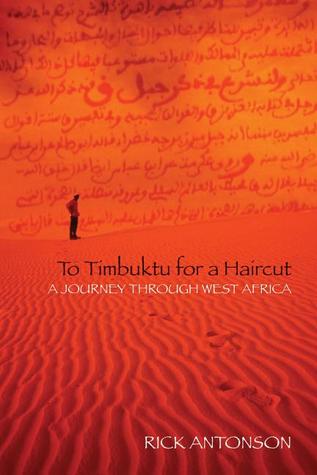
To Timbuktu for a Haircut by Rick Antonson ~ 2008. This edition: Dundurn, 2008. Softcover. ISBN: 978-1-55002-805-8. 256 pages.

My rating: 6/10.

Uneven. The cover blurb references Bill Bryson and Michael Palin, and Antonson himself refers to Paul Theroux an awful lot, but he’s not anywhere in their league. Travel lit lite. The navel gazing equals Theroux’s, but is not nearly as interesting to this reader as Paul’s deep and/or often twisted musings. Antonson is no Bryson, and he really is no Theroux.

*****

Rick Antonson, CEO of Tourism Vancouver, is absolutely exhausted by his grueling efforts working on the 2010 Vancouver Olympics bid. Desiring to get away from it all, he mulls over where he can escape to for a month or so. His wife Janice rather flippantly suggests Timbuktu, in reference to Rick’s childhood curiosity about the place his father often joked about. Apparently Antonson Senior, when questioned by his offspring as to where he was going each day, would retort: “I’m going to Timbuktu to get my hair cut!” So there you have it – a destination for the trip and a catchy title all rolled up in one neat package.

Doing his research as a good traveller should, Rick loads up on guide books and bones up on Mali and on West African history, in particular the history recorded by the early European explorers. He makes internet contact with a Malian travel service owner, one Mohammed, and arrangements are put in place for a fairly modest itinerary, with Timbuktu as the ultimate destination, with perhaps a bit of local exploring.

To condense the saga, Rick makes it to Mali, finds out that Mohammed is a bit of a shady character, eventually makes it to Timbuktu despite being annoyed by other pesky Caucasian tourists sharing his space and treading on his dreams of solitary travel. He stays there all of ONE WHOLE DAY and then goes hiking in the Dogon region for another week or so, accompanied by a mini entourage of local guide and personal cook. Everything costs way more than he has anticipated, and he goes on at great length about how Mohammed has ripped him off, and paradoxically, how darned generous he is being to the locals, scattering selective largesse as his whims take him.

If this sounds like I didn’t much care for Rick Antonson’s tone, you’re right. Something about him just rubbed me the wrong way. Maybe the word I’m looking for is “smug”? And his writing style is all over the map. Sometimes it was very readable, especially in the descriptive passages about present-day Mali, and when he discusses  the explorers’ experiences. When he focusses on his personal thoughts and feelings he writes like a cross between Hemingway and Bryson – monosyllabic sentences and witty asides mingled in a mish-mash of would-be literary exposition.

All of this panning aside, To Timbuktu is not exactly a bad book. I learned quite a lot about both present-day and historical Mali. Rick’s travelling adventures were entertaining, and he is general reasonably kind in his evaluations of his fellow travellers; he did look for – and often found – the best qualities of both the Europeans and the Africans whom he encountered and spent time with. He is very willing to give credit to the Malians for their good-natured tolerance of the tourists in their country, and, obviously because of his involvement in the tourism industry himself, has pragmatic and very sensible views on how the tourist trade affects the local way of life. He puts forth some observations on how an already mutually beneficial two-way traffic might be improved.

Rick does stay pretty hung up on the perfidy of Mohammed, though, which I thought was something of an over reaction from someone with, as he boasts several times, only one blank page remaining in his passport. Rick’s irritation was quite blatantly personal – he was never actually left high and dry – the promised arrangements were always more or less in place, though they ended up costing more than first negotiated.

There is something of a greater purpose to the book, which Rick claims was inspired by his desire to help save a large collection of native Malian munuscripts, and a portion of the book sales are dedicated to the conservation effort, but it felt like this was more of a manufactured excuse for the visit than a true passion for the project.

I soldiered on to the end of this self-congratulatory effort, enjoying it in a mild way between moments of wanting to howl in annoyance. I relieved my ambiguous feelings somewhat by reading the most obnoxious bits out loud, like the bit where Rick tells of how wonderfully choosy his wife Janice is – she apparently goes ftrom table to table when dining out to ensure she has the best seat in the house, and examines multiple hotel rooms to ensure hers has the best features – bet she’s a real treat to serve!

This one’s going in the giveway box. An okay effort, but for this reader, once through was enough.

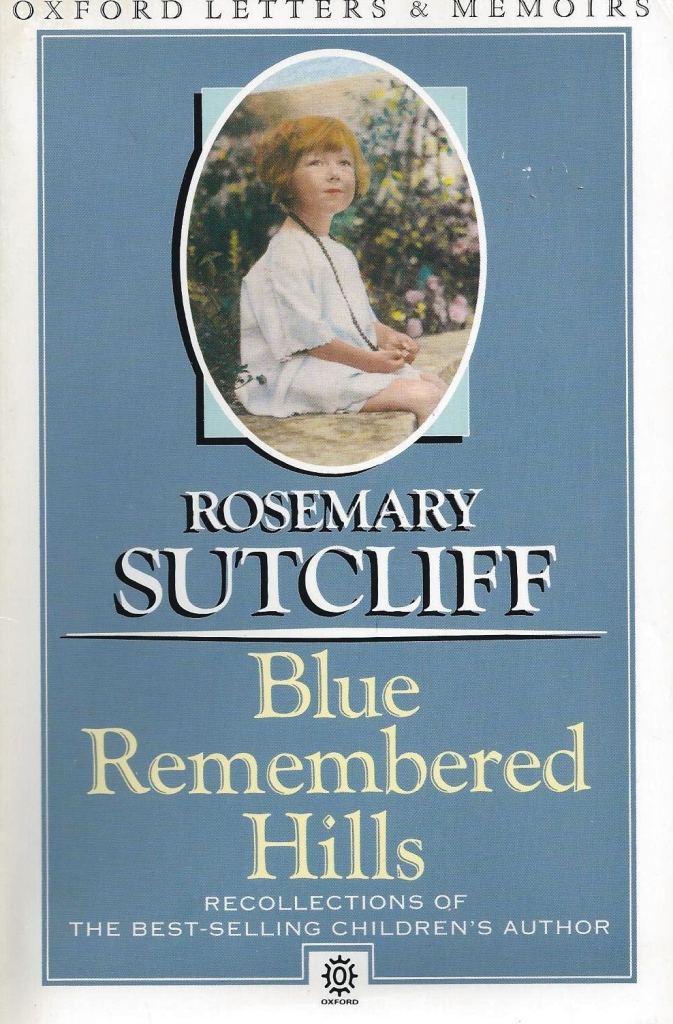
Blue Remembered Hills by Rosemary Sutcliff ~ 1983. This edition: Oxford University Press, 1988. Softcover. ISBN: 0-19-281420-6. 141 pages.

My rating: 10/10. Perfect. My only complaint is that it is too short. A stellar memoir by one of my favourite writers.

*****

Rosemary Sutcliff, 1920-1992, is still very much an icon of the historical fiction world. Author of something like fifty meticulously researched stories, many focussed on Roman-occupation-era Britain, Sutcliff created works which have lasting appeal and interest across a wide age range.

The Eagle of the Ninth (1954), The Silver Branch (1957), and The Lantern Bearers (1959) are possibly the best-known of her works, and have been continuously in print since their original publication.

Rosemary Sutcliff herself was a personality fully as fascinating as any of her fictional heroes and heroines. Her life was marked with great physical suffering, which she dealt with by immersing herself in her creative work. When she was only two years old, Rosemary developed Still’s Disease, a rare and extremely painful form of juvenile arthritis. After the disease subsided, the permanent damage to her joints severely curtailed Rosemary’s physical abilities. She spent most of her adult years dependent upon a wheelchair, and wrote using a modified pen to enable her hands to grasp it.

Her enforced inactivity made Rosemary a keen observer of the world around her, and a great seeker of solace in literature. To while away the long, bed-ridden hours, Rosemary’s mother actively read aloud to her, and Rosemary so enjoyed these dramatic performances that she resisted learning to read herself until she was nine years old. Rosemary’s first written works were retold versions of stories dramatically told to her by her mother.

Blue Remembered Hills is a remembrance of Rosemary’s earliest years, from her first memories until the publication of her first books, The Queen Elizabeth Story, and Robin Hood, in 1950, at which time she started keeping a written journal. These journals have never been published, though they are in the hands of Rosemary’s literary executor, her cousin and godson, Anthony Lawton. He curates a blog and has posted some of the entries from her diary here .

The memoir is wonderfully well written, and contains myriad details of Rosemary’s early life, with a frank sharing of her thoughts and feelings regarding her own situation and the people around her. Discussing her extended family, this passage rather made me chuckle, and is a good example of the subtle humour of Rosemary’s prose.

Aunt Edith was a handsome woman with straight thick brows which remained raven black even after her hair had turned swan’s-wing white, and the bitterest mouth that I have ever seen on anybody. She, alas for them both, had married Archie, weak-willed and amiable, who did not tell her beforehand that he was a quarter Indian – his mother being the product of an Indian Army colonel and a rajah’s daughter – what would have happened if he had told Aunt Edith before it was too late, there’s no knowing. Maybe she would still have married him, but I very much doubt it. As it was, finding out afterwards, she refused to have children – I very much doubt if she even allowed him into her bed! – and set out to make his life a cold hell to his dying day. I have been there at some family gathering myself, puzzled as a dog may be by stresses in the air, the electric discharge of things I did not understand, when he came into the room, and Aunt Edith sniffed loudly and said, ‘There’s a most peculiar smell in this room. One would almost think that somebody black had come into it.’

For many years, the family were quite seriously prepared for Uncle Archie to murder her one day, and prepared, if he did, to go into the witness-box on his behalf and swear that he did it under unendurable provocation.

Rosemary also refers to in the most poignant detail her doomed love affair with Rupert King; the true tragedy of their relationship not in Rosemary’s physical condition, but in Rupert’s polygamous nature. Already married to a much older woman, Rupert persisted in the love affair with Rosemary, and, upon achieving his divorce, immediately married a third woman, suggesting to Rosemary that they carry on some kind of platonic three-way relationship so he would not lose the pleasure of her company. Rosemary actually considered this, and went to London to meet Rupert’s new fiancée, but soon realized that this was not a feasible option for any of them, and the two permanently parted ways, with Rosemary thereafter directing her passion into her work. Though the affair brought her much emotional trauma, Rosemary insisted that she was glad that she had had the experience of being deeply in love, and being beloved in her turn, because it gave her a broader depth of experience and brought forward feelings which she had thought never to experience because of her disability. A gallant lady.

I do so wish that Rosemary Sutcliff had continued this memoir to discuss her later years; this is a teasingly slender though richly filled book. Very highly recommended.

*Edited November 18, 2012 to add a link to a wonderful review I’ve just happened upon, by Steve Donoghue at Steve Reads.