tip on a dead jockey irwin shaw 001Tip on a Dead Jockey and other stories by Irwin Shaw ~ 1957. This edition: Signet, 1957. Paperback. 176 pages.

My rating: 8/10. Very decent collection of mostly melancholic short stories about jaded Americans in post-war Europe and “back home”.

I found this disintegrating paperback on my dad’s workshop bookshelves when I was going through his papers after his death six years ago. Dad liked his reading straight-serious (think detailed war memoirs and biographies), and satirical-serious (John Steinbeck was a big favourite), and cynically humorous (Wilhelm Busch in the original German was there in a number of editions), and technical and creative (Popular Science and Popular Mechanics, heaps and heaps, dating back to the early 1950s – my son scooped these and they now reside in dusty, well-read, falling apart glory on the cabin bookshelves), and travel and historical (National Geographic, of course, another massive, complete collection. I think these start with the 1961 full year, though there are stray earlier ones.) The dramatic fictional bestsellers of the day were well-represented as well, lots of Irwin Shaw around when I was growing up, though I don’t remember this particular one. Must have been on a really high shelf!

This Shaw collection, from very early in the writer’s career – 1946 to 1957 being the publication dates mentioned on the copyright page – are crisp, clean, often cynically humorous, well written and definitely entertaining. Not all have conclusions, which while a bit cliffhangerish is not necessarily a handicap to appreciation. Good stuff. Thanks, Dad.

I’ve been reading other bloggers’ magnificent and thoughtful posts with great admiration recently, and am feeling decidedly sub-par in this regard tonight – I will not even try to get all deep and meaningful.

Here’s my review: I liked these stories. They were very readable. You may find yourself craving a glass of whiskey (with or without a mixer), or a bottle of harsh red French wine (glass optional). My usual beverage of choice, a “nice cup of tea”, felt rather too granny-ish; I was almost ashamed of myself. No, hang on – two of the stories had tea-drinking in them. Though one couple  added rum. Hm, that sounds fairly foul. Or maybe not?! Worked for the characters, apparently – it was followed by a night of passion!

*****

Tip on a Dead Jockey ~ In post-war Paris, pilot Lloyd Barber is offered a chance at some easy money, just one simple trip, flying a brand-new single-engine Beechcraft, from Egypt to Cannes.

“Alone?” Barber asked, trying to keep all the facts straight.

“Alone, that is,” Smith said, “except for a small box… When you take off from the airport in Cairo, the box is not on board. And when you land at the airport at Cannes, the box is not on board. Isn’t that enough?”

It’s not quite enough, or maybe it’s too much – Barber eventually turns the job down, but not before inadvertently introducing Smith to another pilot friend, the naïve and trusting Jimmy Richardson.

You didn’t have to speculate about Jimmy. If you bought Jimmy a drink, he was your friend for life. For all that he had been through – war and marriage and being a father and living in a foreign country – it had still never occurred to Jimmy that people might not like him or might try to do him harm. When you were enjoying Jimmy, you called it trustfulness. When he was boring you, you called it stupidity.

Choosing not to warn Jimmy about Smith’s “opportunities”, Barber is overwhelmed with guilt and unease when Jimmy’s distraught wife shows up begging for help in finding him; he’s been gone thirty-two days without a word. There’s a little twist in the tail of this tale.

This short story was worked up into a 1957 Metro-Goldwyn-Mayer movie, with loads of added elements; only the author’s original sketchy premise and a few of the names remained the same.

A Wicked Story ~ A wife’s unfounded  jealousy becomes a self-fulfilling prophecy.

In the French Style ~ Cynical Walter Beddoes, “career man in the foreign service”, returns to his home base in Paris from two months away in Egypt to find his reliable good time girlfriend has decided to move on to something more permanent. Beddoes had had his chance, but he’d ducked it:

It was lucky he was leaving, if she was moving into that phase. That was the pre-yearning-for-marriage phase, and you had to be on guard against it, especially late at night, in Paris, in darkened rooms where pianists and electric guitars played songs about dead leaves and dead loves and lovers who were separated by wars.

Beddoes had been married once, and he felt, for the time being, that that was enough. Wives had a tendency to produce children, and sulk and take to drink or other men when their husbands were called away to the other side of the earth for three or four months at a time on jobs.

Of course, there are regrets.

Peter Two ~ Thirteen-year-old Peter has a harsh foray into the fickleness of the adult world. This one almost cries out to be included in a high school short story anthology – maybe it has been? – I can imagine how joyfully an earnest teacher would pick it apart and spread out its “discussion points”! Lots of essay material here, oh yes indeed.

It was Saturday night and people were killing each other by the hour on the small screen, Policemen were shot in the line of duty, gangsters were thrown off roofs, and an elderly lady was slowly poisoned for her pearls, and her murderer was brought to justice by a cigarette company after a long series of discussions in the office of a private detective. Brave, unarmed actors leaped at villains holding forty-fives, and ingénues were saved from death by the knife by the quick thinking of various handsome and intrepid young men.

Peter sat in the big chair in front of the screen, his feet up over the arm, eating grapes. His mother wasn’t home, so he ate the seeds and all as he stared critically at the violence before him. When his mother was around, the fear pf appendicitis hung in the air and she watched carefully to see that each seed was neatly extracted and placed in an ashtray. Too, if she were home, there would be irritated little lectures on the quality of television entertainment for the young, and quick-tempered fiddling with the dials to find something that was vaguely defined as educational …

Suddenly, in the hall outside the apartment, a woman screams…

Age of Reason ~ A man’s repeated nightmare highlights uneasy aspects of his marriage, and forebodes a disaster which may or may not come to pass.

The Kiss at Croton Falls ~ Frederick Mull, trolley driver, “a huge rollicking man, with a russet mustache”, a drinking habit, and a supremely jealous wife who sneaks around spying on Mull’s lady passengers, dies at the height of his glory, leaving his wife to convene with his ghost, and his grown-up daughter Clarice to take a good hard look at her own husband. Grand little story, humorous and perfectly crafted.

Then We Were Three ~ American expatriates Munnie, Bert and Martha travel through France enjoying a platonic three-way friendship which lasts one day too long.

The Sunny Banks of the River Lethe ~ A man’s perfect memory dissolves. Irwin’s been reading Kafka.

The Wedding of a Friend ~ Ronny Biddell’s wedding brings back memories of his ill-fated, one-sided, first love affair during the war, with the duplicitous but delicious French Virginie. Light-hearted.

Voyage Out, Voyage Home ~ Lovely young American Constance is taking a quiet, solitary skiing vacation in Switzerland at her father’s expense, to mull over her prospective marriage to a much older man (Daddy doesn’t approve), when she meets the charming, reckless Englishman Pritchard. No surprises, but nicely done – a classic tale of  love and loss.

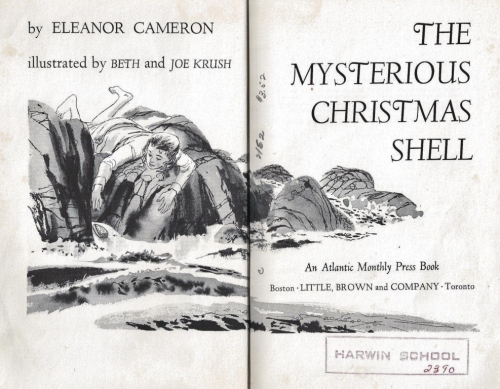
the mysterious christmas shell eleanor cameron 001The Mysterious Christmas Shell by Eleanor Cameron ~ 1961. This edition: Little, Brown & Co., 1961. First edition. Hardcover – Library Binding. Illustrated by Beth & Joe Krush. Library of Congress #: 61-9281. 184 pages.

My rating: 8/10. What a nicely written book this was! It restores my faith in the joys of reading juvenilia, sadly shaken by recent forays into several more modern disappointments in the youth-oriented fiction line.

This one was a recent impulse buy from the ever-changing and happily eclectic selection at the Bibles for Missions thrift store in Prince George. I try to get there once a month or so, and I always come away with a promising mixed bag of reading material. Some goes right back into the giveaway box, but there’ve been some small treasures found there, too.

The cover illustration was what grabbed my attention, though this grubby ex-school-library book showed much evidence of many readers, and was less than appealing at first glance. (It ultimately cleaned up nicely with a triple application of soapy cloth, rubbing alcohol and a tiny dash of benzene – not in combination, I hasten to add, but in delicately selective stages.)

“Those look like Krush children,” I thought to myself, and by golly, my instinct was right. Beth and Joe Krush were a husband-and-wife team of children’s book illustrators working industriously together from the 1950s through the following decades, and their marvelously detailed pen-and-ink-and-wash drawings perfectly depicted the characters of such classics as Mary Norton’s The Borrowers and its sequels, and Elizabeth Enright’s Gone-Away Lake books, among many others.

Here’s a sample. Isn’t this appealing?

the mysterious christmas shell frontispiece eleanor cameron 001

And Eleanor Cameron’s name chimed a little bell, too, though I didn’t really place it until I Googled her after I’d read the book. This is the famed Mushroom Planet creator, though those junior sci-fi fantasies were only one aspect of her widely varied output.

The Mysterious Christmas Shell is very much a plain and simple “domestic adventure” story, and it turns out that it is Cameron’s second book concerning the same brother-sister pair, Tom and Jennifer. Their earlier adventure, The Terrible Churnadryne, was published in 1959.

*****

Five days before Christmas, Jennifer and Tom arrive in the fictional town of Redwood Cove, California, on the Monterey Peninsula, to spend the holidays with their Grandmother Vining, and Aunts Vicky and Melissa. As soon as they walk into their aunts’ house, they realize something is terribly wrong. The tree hasn’t been decorated, the usual garlands are in a heap of green at the foot of the stairs, and everyone has a strained smile; occasionally they catch one or another of the adults huddled in a corner crying.

Turns out that the Vining family has had to sell its treasured piece of ancient redwood-forested seaside property, Sea Meadows, because of the year-ago death of the family partiarch, the children’s grandfather. Some investments have gone wrong, and outstanding debts needed to be paid. The purchaser, a boyhood friend of the family, was thought to want to keep the property unspoiled, to be the site of a single home, but recently troubling word has come that there will instead be major development. Hotels, a shopping centre, and a vacation community are planned; many of the ancient trees will be coming down, and No Trespassing signs will be going up barring the locals from their most pleasant seaside beaches and coves. The local townspeople are up in arms, and are angry at the Vinings for the sale; the Vinings are distraught at the prospective destruction of their well-beloved redwood forest.

An offer to re-purchase the property from the developer has been turned down, and a prospective reprieve of sorts has not come about. Grandfather Vining had intended to change his will to transfer Sea Meadows to the state as a nature reserve, but no one has any record of the will being registered, and no one knows if the envelope containing it was actually sent. If the will was indeed written, it would effectively cancel out the subsequent sale, and the property would go to the state once the buyer’s money was refunded. This seems like a way out of the dilemma, but where, oh where is the will?

As Jennifer and Tom ricochet around Redwood Cove looking for clues, we get a vivid picture of a large, loving family, each member trying to do the best for the others, though occasional misunderstandings occur.

The physical description of the California coastline, with its sea caves and pocket-handkerchief beaches, its tide pools and their glorious variety of sea life, is wonderfully well done; it is obvious that the author held the area in deep affection.

I do have an extra special reason for loving this story, having spent some weeks every year in California as a child, visiting grandparents, aunts, uncles and cousins in the Fresno area, and travelling out to San Jose, Monterey, and Carmel-by-the-Sea to visit family friends and to explore the still-unspoiled seashore along the more remote stretches of coastline. I even had my own similiar near-brush with death, once being washed out into the surf by a rogue wave; my father’s heroic rescue has become a piece of family folklore, and I blame my deep but reasonably well-disguised unease about any body of water much deeper than my knees on that terrifying childhood experience. Tom, Jennifer and Aunt Melissa’s being caught in the waves of the incoming tide sent chills down my spine! I could feel the sand burns …

The familiar setting was a marvelously unexpected surprise, but putting aside nostalgia and concentrating on the writing, I must say I was impressed by the quality of the prose, and by the author’s fine story-telling ability. While this is one of those stories where nothing huge really happens, with the adventures being small ones, and the solution to the mystery very apparent to the reader from early on – the Vinings, on the other hand, struggle on for strangely long time figuring out their clues – I found I couldn’t put the book down until the satisfyingly happy (though rather improbable) ending.

A grand vintage read for adults of a certain age wishing to revisit their youth through the pages of a book, though I’m not sure how much it would appeal to our more sophisticated 21st Century children.

Despite the Christmas-time setting, this is not really a Christmas book as such, though a glass tree ornament from Innsbruck plays a major part. Oops – just gave away a clue!

It was enjoyable to read about Christmas preparations in a place far from snow, and that brought back memories, too. We only spent one Christmas in California when I was a child, as most of our travelling took place in the early spring and the fall, but I remember how surreal it was that one time to be singing carols under the palm trees, with roses still blooming and lemons on the trees in my grandmother’s garden, while back at home, in interior British Columbia, icicles reaching the ground were our parting memory as we’d pulled out of the yard for the marathon three-day drive southwards. (Somewhere I have a picture from that trip of me and my sister standing, in our matching velvet-collared coats, in front of a huge Christmas tree at Disneyland, which was ornamented by coloured glass balls as large as our heads.)

This is an author decidedly worthy of further investigation. Investigating the titles and plots of some of her non-sci-fi “realistic” children’s/teens’ novels, I strongly suspect that I read some of those when I was in grade school, as two or three of the unusual plots sound very familiar, but The Mysterious Christmas Shell was an unfamiliar, unexpected and most welcome find, for all of the reasons detailed above.

*****

Oh – one more serendipitous thing. Eleanor Cameron turns out to be Canadian! She was born in Manitoba, and though she subsequently lived most of her life in California, she is widely identified in all of the material I was able to find online as a Canadian. So – another one, completely out of the blue, for the Canadian Book Challenge!

O

Ah, blessed Christmas break. Saturday’s twelve hours of living-at-the-theatre marked the last dance obligation of 2012 – we reconvene in 2013 – dancers a mite sluggish after several weeks off (all those good intentions to keep up the daily barre slipping a bit as the holiday takes over) – the parent support team steeling themselves for the push of the fast-approaching festival season – so much driving, extra practices – “could you please come in on Sunday, we need to work on that choreo some more”, parental fixes – “Mom, I think I need new shoes …”, “what do you mean, your solo costume ‘just won’t work’?”, “where’s an icepack? heating pad? ankle brace? band-aid?”, “can you help me wrap my legs, I think I have shin splints”, “how long do you think it’ll take this toenail to grow back?”, “but I like dancing barefoot, that’s the best part of Modern, Mom!”, “one-two-three-four…”, “I can’t do it!!!”, “I want to try again, it’s okay, that didn’t really hurt that much”, “look, look, LOOK – WATCH ME … ” <crash> “I’m okay!”, “Actually, I think I pulled something… bruised something … tore something…”, “you know, we should get a hot tub, it would be good for me, I’d really like that … why are you looking at me with your eyebrows raised like that, Mom?”

Hours, days, weeks, months, years of lessons, practice and performance – this is year thirteen of being a dance parent, and though I’m always proud and frequently amazed at what my very surprising child has accomplished, the annual winter break is most welcome, thank you kindly.

Propped up in bed this morning, reminding myself happily that I don’t have to drive anybody anywhere today – hurray! – sipping my cup of tea and getting in a little early morning reading time – I rise, or at least click my light on, at 5 AM when my husband’s work-day alarm rings – I found myself smugly regarding the freshly dusted glass book shelves across the room. Every so often, maybe once a year, or perhaps twice if all goes well, the shelves are emptied into sliding heaps on the dressers and bed, and the shelves are taken away into the bathroom for a good scrub and polish. Each book is dusted, and put back in sorted stacks – each author’s titles are rounded up and reunited, and for a brief few days I feel downright organized, until the migration starts again, and new additions are added willy nilly to any open space.

The bedroom is neat and tidy, all ready for Christmas. Today I’m going to tackle the kitchen, to clean off the long counter under the window, wash the curtains, scrub everything down nicely, maybe even pull out the stove and do a deeper clean there if the spirit so moves me (and I don’t peter out), in preparation for a baking day tomorrow. Lebkuchen and pfefferneuse to remind me of my German heritage, shortbread for my husband, gingerbread for the teens, hazelnut crescents, perhaps …

My domestically-gifted German Mennonite mother would bake for weeks and weeks in November and December, filling tin after tin after tin with delectable seasonal morsels, to be doled out to eager children and boxed up into lavish gifts for friends, neighbours, the mail lady, anyone else who needed a little holiday treat … I’m afraid my own efforts are a pale shadow of what she used to do, but it wouldn’t be Christmas without a few of the old favourites, and tomorrow we’ll all be home together, and the others are more than keen to get this little-bit-late cookery show on the road.

Tonight we’ll learn if my husband will be working his next shift (and beyond); his workplace is under strike notice, with a deadline of 5 PM tonight for a tentative agreement, or the picket lines go up. It’s completely up in the air, no inkling of which way this will go, as the employer’s continued refrain is that they want a peaceful resolution, while the union negotiators mutter, “not good enough, not good enough…”

Yesterday many of the men were loading up their tool boxes in anticipation of a strike; my husband is leaving his right there, as are a few of his cronies, as a show of optimism that an agreement will ultimately be reached. Emotions and stress levels are high, waiting for word from “above”, and feeling helpless is awful for morale, but as the job is close to home, exceedingly well paid, and reasonably stress-free, with a good group of co-workers, we’re hoping we can wait things out until “normal” is restored. Or move on to the next thing, if that’s what is needed. In the meantime, Christmas is coming, and though this shadow is looming in our sky, we fully intend to enjoy our holiday in our usual quiet way – music, reading, visits with friends, good food and a little gentle exercise in the form of meandering family strolls through our snowy fields and hillside forest. Or down the road, anyway, if the snow is too deep!

I’ve been doing a bit of Christmas-themed reading, to try to work up a suitable mood, so there will be some reviews coming along. The profuse posting on the blog the last few days has been, in great part, because I can’t concentrate on much right now and the focus of thinking about books and typing out some sort of review has settled me down considerably. I also want to tidy up my 2012 “what I read” pile, so as to start the new year looking forward rather than back; we’ll see how that goes!

It’s all good, our “challenges” pale in comparison to the real hardships of so many around the world, and of course of those much closer to home as well.

I’m sure I’ll be posting again, but just in case the blog falls silent – and, if it does, it will likely be because I am busy elsewhere – if my husband does get a longer-than-planned-for holiday we have some major farm projects we are keen to tackle together – I’d like to wish everyone a peaceful and happy winter holiday – whichever it is that you celebrate. Hoping you are all finding time for good companionship, and of course, lots and lots of reading!

O

the autobiography david suzukiDavid Suzuki: The Autobiography by David Suzuki ~ 2006. This edition: Greystone Books, 2006. Hardcover. ISBN: 1-55365-156-1. 404 pages.

My rating: 5/10. Interesting to get some of Suzuki’s back story, but sadly my personal regard for this enviro-icon took a small step downward after reading it. It seems like the ego displayed here is as large as the legend.

*****

There’s a little comment someone made in my hearing years ago, which comes to mind right now: “If you want to know how good he is, just ask him”.

Packing a whole bundle of firewood on his shoulder (and understandably so) stemming from his family’s mistreatment during the World War II Japanese-Canadian internments and appropriation of property, David Suzuki grew up feeling like he had something to prove, and he’s succeeded to do just that, in spades. The depth of love/hate public feeling regarding this one soft-spoken and absolutely brilliant man goes to show how influential he has become.

The political right wing hates him, the lefties have made him their god. I tend to swing left, and I deeply admire David Suzuki for the focus on environmentalism he has forced into the public eye, but this autobiography shows all too clearly the god’s feet of clay.

This book looks back briefly to Suzuki’s childhood in B.C. Born in 1936, David Suzuki was six years old when he, his mother and sisters were interned in one of the camps for Japanese-Candians in the Slocan Valley. His father spent the war in a separate labour camp. After the war, the Suzukis moved to Ontario, where David completed his high school education before attending university in the U.S.A., attaining a PhD in Zoology in 1961.

Returning to Canada, Suzuki worked as a professor and researcher in genetics at the University of British Columbia. Branching out to participate in public education, he founded the popular CBC Radio science program Quirks and Quarks in 1974, and the iconic television series The Nature of Things in 1979. David Suzuki was a household name by the mid-70s, and his profile has grown exponentially through the years.

The Autobiography is honest enough in that Suzuki frankly discusses his two marriages and his shortcomings as a less than involved husband and father. His deep dedication to his work and his increasingly hectic public life often separated him from his family, and he freely admits that this is something he now regrets.

Most of this book is a listing of various events Suzuki has been involved in during the past twenty years; plenty of name-dropping of the celebrities he rubbed elbows with – Sting! Buffy St. Marie! John Denver! – and plenty of slightly patronizing commentary on how he brought this, that and the next thing to the public attention. True, so true, but the tone doesn’t feel very kind-spirited at times.

The writing is not the strong point here, either. The subject matter would be much more enthralling if it weren’t dealt with in such a flat “Then I said, then I did, then I said, then I did” manner. There are some personal anecdotes, mostly concerning his parents, and the death of his father, where he lets himself go, and these are the most poignant and memorable of this rather dull book.

I would say “read it” just to get a deeper understanding of this fascinating and frequently self-sacrificing man, but be prepared to come away feeling something like a member of the great unenlightened, living in the dark and waiting for The Master to flick the switch. You really want to know how good David Suzuki is? Read The Autobiography. He’ll tell you.

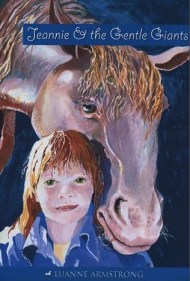
jeannie and the gentle giants luanne armstrongJeannie and the Gentle Giants by Luanne Armstrong ~ 2002. This edition: Ronsdale Press, 2002. Softcover. ISBN: 0-921870-91-4. 150 pages.

My rating: 4/10. A completely typical “problem novel” (single parenthood, mental illness, foster children) packed with contrived situations. An eleven-year-old heroine is placed in foster care after her mother has a mental breakdown.

Sadly this one didn’t quite fly. The horse bits were good – the best part of this novel, in my opinion –  but they couldn’t salvage the rest of the completely predictable, cookie cutter story. Despite the favorable back cover blurb by my up-the-hill neighbour, poet, writer, and horse-logger Lorne Dufour (aha! now here’s an interesting Canadian Reading Challenge author) it just didn’t click with anyone here. Too bad. Jeannie is set in Kelowna, B.C., and as a home-province, B.C. Interior-set youth novel I really wanted to love it. (Plus the cover image is fantastic.)

From the publisher’s website:

Jeannie and the Gentle Giants, a novel for readers eight to fourteen, deals with the problems experienced by children when they are taken from their parents and have to make a new life with foster parents in a new community. In Jeannie’s case, the problems begin when her mother falls ill and can no longer care for her. Taken from her home, placed with foster parents and unable to discover the whereabouts of her ill mother, young Jeannie withdraws into herself and can think only of running away.

Gradually her defences are breached by two immensely large and wonderful workhorses and their perceptive and humorous owner. Through the horses and her work on the farm, Jeannie develops new interests, learns to ride and becomes involved in the daily life of the farm, even helping with horse-logging. In turn, Jeannie learns about friendship, love and trust, and ultimately gains the maturity and self-confidence to accept the challenge of becoming herself a care-giver. In this sensitive and moving story, Luanne Armstrong draws us into a world of pain, growth and fulfilment.

Lorne Dufour’s back cover blurb:

In this story, the Gentle Giants slowly walk right through our hearts. We will forever remember their presence in Jeannie’s life and that the great Gentle Giants never forget.

 ~ Lorne Dufour, horse-logger & award-winning author

The author attempted an ambitious level of complexity here, by involving her young protagonist in a rather tangled combination of situations. We have: mentally ill mother, single-parent family with no father in sight, poverty, social stigma as child of mentally ill mother (handled quite well by author in providing heroine with staunch friends who immediately speak up in her favour to school bullies), foster parents who can’t have children, neighbour couple who find they are expecting a baby mid-way through book, heroine’s questioning as to what a family actually is and her conflicting desires to both be with her mother back in the city and to stay in her new, more fulfilling and interesting country life, doctors refusing to allow child to see ill mother – (this didn’t ring true – felt like a plot element to increase tension – mother was experiencing a psychotic episode, some mention of bipolar disorder/manic depression, but once the mother was capable of sending the first letters, why the heck WOULDN”T she be able to have visits from her daughter – wouldn’t that by emotionally beneficial to BOTH of them) – okay, moving on – learning to handle work horses, learning to ride, dealing with an injured horse all by herself, finding a lost child, guilt guilt guilt because heroine feels she has been the cause of the child being lost, feral stray dog tamed and made into pet …  My goodness, what a busy, busy girl.

As I said earlier, I really wanted to like this book, but it just didn’t ever feel “real”. Too much was chucked into the mix, Jeannie’s reactions were not very well portrayed – we were continually given the same set of outward clues that she was all bummed out – she had a “shy look”, “looked down”, “blinked to hold back tears”. The language throughout is overly simplistic, as if keeping it accessible to “poor readers” was a major goal.

Does this seem too critical? I feel like a big old meanie for picking this one apart, but, in all honesty, these were my thoughts as I read.

For the record, I really don’t care for “problem books”, for readers of any age, but in particular for young readers. “This is a book about DIVORCE! MENTAL ILLNESS! CEREBRAL PALSY! DOWN’S SYNDROME! BULLYING! ANOREXIA! ETHNICITY! PREJUDICE! BEING GAY! blah blah blah… If you, dear person/dear young child with a similar issue in your life, will only read this book you will feel so much better because you will see how this marvelous hero/heroine dealt with it in their fictional world and you won’t feel so alone.”

Dear youth authors: Write a STORY first. If there are side issues, so be it, for if naturally included those always interest, verisimilitude and richness to the mix. But don’t pick an “issue” and write a prescriptive “here’s how to deal with it, dear” contrived moral tale. Kids aren’t stupid. They don’t need to be told what to think in such a poorly written way. Yes, definitely acknowledge and include the issues, but don’t build a weak story around them, for the sake of marketing the book to the school library network! This whole “issue story” genre encourages sub-par story-telling.

In my opinion.

Jeannie and the Gentle Giants pushed a lot of my buttons, and not in a good way.

Rant over. (For today!)

Oh, hang on – not quite. “Foster” parents – I always thought that foster parents were those filling a long-term role in a child’s life. Jeannie is in what I would classify as “temporary care”, so the immediate (within days) placement of Jeannie with a new, albeit temporary, “mom” and “dad” didn’t ring true. It is continuously stated that Jeannie will be reunited with her mother once the doctors get her (mother’s) meds figured out. I mean, the actual family placement is okay, but the whole “this is your new family” thing felt rushed and phony. No wonder the poor kid is a basket case – “Here, Jeannie, meet your new mom!”

And another quibble, this with the publisher’s website and back cover plot outline. It sounds as though Jeannie doesn’t know where her mother is through all of this. She’s in the flipping hospital in Kelowna, people. Did you not read the book?!  Jeannie knows this, her social worker knows this, her “foster parents” know this – they make continual phone calls and Jeannie’s mom writes her letters, for crying out loud! So why is this presented in the promotional material as “child torn away from parent and searching for her”? The kid tries running away to go see her mother, but she knows where her mother is. She’s turned away as she tries to buy a bus ticket to Kelowna, to go to the hospital, to see her mother, because Jeannie knows she’s there.

Okay, now I’ll quit. I’d hesitated to review this book, because it let me down so sadly, but I did say I’d review and post every Canadian book I read, so here goes. There are a few more disappointing titles lined up for review, so a heads-up for those wondering why I’m so crabby today. I’ve just been pushing them back in the queue, but have decided to tick them off my deal-with list before 2013 hits.

the roaring girl greg hollingshead 001The Roaring Girl: Stories by Greg Hollingshead ~ 1995. This edition: Somerville House, 1995. Softcover. ISBN: 1-895897-53-X. 196 pages.

My rating: 4/10. These are cleverly written, but a little too far out there for me. I wouldn’t re-read any of these anytime soon, and if I’d never heard of Greg Hollingshead it wouldn’t break my heart.

This collection won the 1995 Governor General’s Award for English Fiction – Short Stories, and the contents are undeniably well-written, but most of the stories left me feeling more than a mite confused, and usually a whole lot disturbed. Hollingshead has a creative mind and a grand way with words – some of his phrases lift up off the page and vigorously come to life – but it’s all kind of kinky. Often humorous, but definitely dark. Lots of sex – mostly of the “ew!” nature – and deeply twisted thoughts.

I’m not going to spend any time deeply reviewing this one, because it would require me to spend more time in Greg’s head (as it were) and, quite frankly, I don’t want to.  I’ll be moving The Roaring Girl along to see if it can find a more suitable home.

*****

  • The Side of the Elements – A couple rents out their home for the year they must be away. Stuff goes on in their absence. This one I rather liked.
  • The People of the Sudan – A family is maneuvered into taking temporary care of a box full of Canadian Christian Relief “supplies” for someone going to the Sudan; the rendezvous goes awry and the situation goes surreal. Another good one; downright humorous.
  • Rose Cottage – A young man becomes involved in trying to fix what he believes is an abusive relationship between a nurse and her elderly charge.
  • The Roaring Girl – A transient girl is given temporary haven by a family, deeply affecting the adolescent son.
  • The Age of Reason – Some sort of dysfunctional family saga. I have no idea what this was all about!
  • Rat With Tangerine –  Ditto.
  • A Night at the Palace – This one was a complete nightmare – couldn’t finish it. People behaving strangely. And badly. Hallucinogenic.
  • The Appraisal – Oh, thank goodness – an actual narrative arc! Well, relatively speaking. A cottage appraisal turns into a conversation on the nature of civilization, and its impending collapse. Awesome – loved it.
  • The Death of Brulé – A young boy becomes involved with the older girl next door. Ick.
  • The Naked Man – Another absolutely surreal family tale.
  • How Happy They Were – Sad people; love gone wrong.
  • Walking on the Moon – The view from a roof overlooking the people next door. Odd.

So – out of these twelve there were four I kind of, sort of, almost enjoyed reading. The Appraisal is the only one I’d willingly seek out again. Goodbye, Roaring Girl!

the shape of a year jean hersey 001The Shape of a Year by Jean Hersey ~ 1967. This edition: Scribner’s, 1967. Hardcover. Library of Congress# 67-13158. 243 pages.

My rating: 6/10.

This is not at all a poor book, but rather an unexceptional one. Set in the author’s rural homeplace of Weston, Connecticut, here are month-by-month musings and reportings of the little incidents of her life. These definitely have a certain appeal, but there is a creeping banality clothed in florid description to some of what she judges worthy of note. Most of it is all very well and good, but while readable this does not promise to become a favourite.

As a personal record it seems just a bit too good to be true, a shade too sweet and optimistic; there is little record of any sort of frustration, annoyance, disappointment or anger; it is all very “nice”, as if the author decided ahead of time to only include the more inspiring incidents of her days. I think this would be a much stronger memoir if it showed a broader range of emotion.

Golly, these comments sound a little harsher than I had intended. Here, I’ll share some of the author’s words with you so you can get a better picture of what this one is all about. I suspect this author will appeal most to the Gladys Taber crowd. (For the record, I like Gladys Taber; my mother had a number of her Stillmeadow books and I read them with deep delight during my teen years.)

Jean Hersey, born in 1902 and living in the Eastern United States, in Pennsylvania and Connecticut, was a prolific writer of magazine articles for Woman’s Day and various gardening and houseplant periodicals. She also authored something like a dozen non-fiction books dealing with gardening, homemaking, and semi-rural life.

*****

From The Shape of a Year: January, 1965.

January mornings at seven are like opals, soft, milky white and pink around the edges. The January sun rises silvery white, bright but not warm, and a mist like an aura hovers over the south meadow.

One morning early as we ate breakfast, Bob was eyeing a cluster of many colored Christmas tree balls lying in one of the upholstered chairs. We had dismantled the tree the day before.

“They look,” said he sipping his coffee, “as if they were waiting for a goose to come along and hatch them.”

“It would have to be a golden goose,” I replied watching the stars laid on their shiny surfaces by the early sun streaming in the windows. Obviously no ordinary goose could sit on these bits of Christmas magic.

May, 1965:

May sweeps in on a theme of daffodils. I gather armfuls from the meadow and next day so many more unfold that I cannot see where I have picked. Along the roadside the willows are tumbled masses of pale green foam, and forsythia, in streaming fountains of flowers, reflects the sun’s golden rays. Here a dusky pink weeping cherry adds a soft note of color. There a magnolia tree is a bouquet of pink blossoms, and everywhere maples are shaking out their tight fists of green into lacy green leaves.

July, 1965:

Where is our grandson? I am waiting on the station platform for this young thirteen-year-old who will be carrying a suitcase and I don’t see him. Other people get off, but no Jeff. There is a boy down the platform – or is it a boy – it seems more like a thatched roof moving along.

“Hi, Grandma, here I am.”

“Why, Jeff,” I gasp. “Hello, how good to see you.”

I gasp because here we have the Beatles incarnate. I have no war with these young Englishmen beyond what they have done to the hairdos of America…

October, 1965:

The fragrance of burning leaves is another autumn delight. Their delicious rustle and the scent of their smoke invariably carries me back to the days when my father used to rake great piles to burn. Before he lit them my friends and I would burrow deep and hide ourselves in the slightly scratchy heaps. From here we would look out at the world through tiny odd-shaped chinks of light …

December, 1965:

These days the car is always filled with Christmas presents on the way in or the way out. One time we were in New York City with presents to deliver and we parked our convertible. When we returned the presents were gone and the top neatly slit with a little triangle just large enough to reach in and draw things out. The gifts did look rather festive with their gay paper and ribbons. I’ve often considered though, what their effect was on the person who appropriated them. He overlooked a suitcase and overcoat on the back seat, and took instead a package of wild bird food destined for my brother-in-law and a book called The Power of Constructive Thinking by Emmet Fox. I’ve never ceased to wonder about the reaction of this particular thief as he opened his haul.

*****

And there are recipes.

While I wouldn’t search this author out, I also wouldn’t turn down another of her books if it came to me cheap and easy, as this one did – on the bargain rack at a used bookstore this autumn.

underground to canada barbara smuckerUnderground to Canada by Barbara Smucker ~ 1977. This edition: Puffin (Penguin), 1999. Introduction by Lawrence Hill. Paperback. ISBN: 0-14-130686-6. 144 pages.

My rating: 9/10  – A very good historical fiction novel for its intended audience, middle grade to young teen readers. Older readers may notice the simplified plotting and some plausibility gaps, but in general a well-written story with a gripping main character and dramatic situations, well-researched and well-presented.

*****

Author’s Note:

The escape from Mississippi to Canada by two fictitious characters, Julilly and Liza, could have happened. It is based on first-hand experiences found in the narratives of fugitive slaves; on a careful study of the Underground Railway routes; and on the activities of two Abolitionists: Alexander M. Ross of Canada and Levi Coffin of Ohio.

Twelve-year-old June Lilly – Julilly – is a slave on Massa Hensen’s Virginia plantation. He’s not a bad slave owner, comparatively speaking, but when he gets ill and can no longer oversee his cotton farm, his slaves are offered to a buyer from Mississippi, where conditions are notoriously the worst in the slave-owning states of the South.

Night music droned through the slave quarters of Jeb Hensen’s Virginia plantation. The words couldn’t be heard but they were there beneath the rise and fall of the melody.

Julilly hummed them as she sat in the doorway of her cabin, waiting for Mammy Sally to come home from cooking in the Big House kitchen. She was as still and as black as the night. The words of the song beat in her head.

When Israel was in Egypt’s land
Let my people go
Oppressed so hard, they could not stand
Let my people go.

Old Massa Hensen didn’t like this song. He said it came when there were whisperings and trouble around. There were whisperings tonight. They murmured beneath the chirping of the crickets. They crept from ear to ear as soundless as the flickering of the fireflies.

When the slave trader does indeed come, Julilly is separated from her mother and is sent with a group of other young slaves to a much harsher owner in Mississippi. When an opportunity to escape arises, Julilly and her new friend Liza grasp their chance and set out on an epic trek north, finding help through the network of the “underground railway”, hoping beyond hope to one day reach the far off land called “Canada”, where slavery is outlawed.

They succeed, but not without many hardships.

The ending of the story was realistic though rather optimistically contrived in its reconciliation scene between Julilly and her mother; I found it hard to accept so much “coincidence” in such widely separated characters reuniting with such apparent ease. That was really my only objection, though. Oh – and the lack of complexity with the secondary characters. Even though others share the stage, this book is very much centered on one character only – Julilly.

Julilly is a quite beautifully drawn character, and I found myself completely engaged with her story, much as I already knew the plot line both from previous readings and from the inevitability of the stereotyped story arc.

One of Barbara Smucker’s best novels for young readers, and the one which made her reputation as a writer. A very Canadian novel, though most of the action takes place in the United States. Canada’s presence as a destination for the escaping slaves, and the involvement of real Canadian Abolitionist Andrew Ross are key plot elements.

This would be good for independent readers 10 and older. This would also make a good Read-Aloud, for all ages, though the subject matter is intense and might not be suitable for sensitive younger listeners. Era appropriate use of the derogatory term “nigger” throughout; Lawrence Hill’s short Introduction is a must-read for its discussion of this aspect. Fast paced and engagingly written.

Recommended.

All Passion Spent by Vita Sackville-West ~ 1931. This edition: Hogarth Press, 1965. Hardcover. 297 pages.

My rating: 8.5/10. Excellent. This book nudges me to remember that I should read more of Vita’s literary work. Her garden writing is already personally much prized, and frequently referred to in my “working” plant nursery library.

*****

An unusual piece of literary fiction about an elderly woman’s examination of her life, and her subsequent emancipation from the expectations of others. The emotional freedom thus obtained only lasts for a very short time, but the satisfaction it engenders both in the protagonist and the reader is quite glorious.

Often classified as an example of feminist literature – the Virginia Woolf parallels and comparisons are de rigueur – this novel transcends that earnest label and is also a very fine piece of story-telling, full of keen observation and humour. Vita Sackville-West was undeniably cynical, but stopped shy of coming across as bitter, at least not in this small gem of a tale.

*****

Henry Lyulph Holland, first Earl of Slane, had existed for so long that the public had begun to regard him as immortal. The public, as a whole, finds reassurance in longevity, and, after the necessary interlude of reaction, is disposed to recognize extreme old age as a sign of excellence. The long-liver has triumphed over at least one of man’s initial handicaps: the brevity of life. To filch twenty years from eternal annihilation is to impose one’s superiority on an allotted programme. So small is the scale upon which we arrange our values. It was thus with a start of real incredulity that City men, opening their papers in the train on a warm May morning, read that Lord Slane, at the age of ninety-four, has passed away suddenly after dinner on the previous evening. “Heart failure,” they said sagaciously, though they were actually quoting from the papers; and then added with a sigh, “Well, another old landmark gone.” That was the dominant feeling: another old landmark gone, another reminder of insecurity. All the events and progressions of Henry Holland’s life were gathered up and recorded in a final burst of publicity by the papers; they were gathered together in a handful as hard as a cricket ball, and flung in the faces of the public, from the days of his “brilliant university career,” through the days when Mr. Holland, at an astonishingly early age, had occupied a seat in the Cabinet, to this very last day when as Earl of Slane, K.G., G.C.B., G.C.S.I., G.C.I.E., etc. etc. – his diminishing honours trailing away behind him like the tail of a comet – he had drooped in his chair after dinner, and the accumulation of ninety years had receded abruptly into history. Time seemed to have made a little jump forward, now that the figure of old Slane was no longer there with outstretched arms to dam it back …

In Lord Slane’s imposing London house, his elderly widow – of no slight age herself – eighty-eight – contemplates his dead face with “thoughts which would have greatly surprised her children”, while downstairs in the drawing-room the six Slane “children” – rather elderly, with grandchildren of their own – wait for their mother’s inevitable breakdown, and tentatively feel each other out as to how best to arrange for “wonderful Mother’s” immediate future, for of course she will now need to be “stowed away; housed, taken care of.”

When Lady Slane refuses to be “cared for” and instead makes her own arrangements for her future without familial consultation, her offspring are at first shocked, and then, in most cases, highly resentful. Herbert, Carrie, Charles and William are stiff with disapproval; only the awkward family outsider Edith has an inkling that her mother might have more backbone and brain than the others realize; while Kay is most keenly interested in distancing himself from any conflict or fuss; he enjoys his bachelor existence in his flat crowded with his collection of compasses and astrolabes.

Lady Slane distributes her jewelry, her only private asset, with little regard as to fairness; rather she seems faintly amused at the egotistical frailties this gesture reveals among her offspring and their spouses. With only a small pension as income, she rents a small house in Hampstead which she has secretly been desiring to reside in for the past thirty years, to live alone with her elderly French maid, Genoux, who has been with her since her marriage some seventy years ago. She intends to limit her visitors severely:

“I am going to become completely self-indulgent. I am going to wallow in old age. No grandchildren. They are too young. Not one of them has reached forty-five. No great-grandchildren, either; that would be worse. I want no strenuous young people, who are not content with doing a thing, but must needs know why they do it. And I don’t want them bringing their children to see me, for it would only remind me of the terrible effort the poor creatures will have to make before they reach the end of their lives in safety. I prefer to forget about them. I want no one about me except those who are nearer to their death than to their birth.”

But Lady Slane’s life is not destined to be one of solitude, for she soon attracts a small group of friends, of “followers”. Three elderly men find their way into her life and add richness and a strange variety to her waning days. Mr. Bucktrout, owner of her house, Mr. Gosheron, the builder who has renovated it for her, and millionaire art collector Mr. FitzGeorge, who has retained a deep infatuation with Lady Slane from the time many years ago, when she was the wife of the Viceroy of India (one of Lord Slane’s many prominent postings) and FitzGeorge himself merely one of many anonymous young men who enjoyed the hospitality of the Regency, presided over by the young and very beautiful Deborah Slane.

These three men, along with Genoux and an unexpectedly appearing great-granddaughter, Lady Slane’s namesake Deborah, bring both confusion and reconciliation to Lady Slane’s mind and soul as she strives to put the meaning of her long life into a final context.

The novel ends with Lady Slane’s death, but that is in no way a tragedy, merely an inevitable ending which is kinder than it might have been, and happier than Lady Slane had once anticipated it might be.

*****

Vita Sackville-West portrays her characters with occasional affection and continuous insight mixed with irony. All Passion Spent is short in pages, but dense in thought-provoking passages and situations; love or despise the characters as we may, we find many parallels, often unexpected, between this upper-class “lady” with few “real” problems, and our own less exalted lives. Who has not denied personal ambition at some time or another? Made that difficult compromise between desire and duty? Wished to distance themselves from tiresome people, and be allowed, at the end of one’s days, to sit against the garden wall in the sun and muse?!

Of course, most of us have no Genoux to care for our less delectable functions, to wash and dress us, and minister to our ever-more-demeaning physical failings. If there was one sour note in all of this – and there are several, but this is the main one, to my mind – it was the thoughtless assumption by Lady Slane of Genoux’s infinite capacity for servitude; there is a brief moment of realization and appreciation, but after seventy years together, the servant-mistress position is still firmly in place, with selfishness a prominent quality in Lady Slane’s refusal to fully appreciate Genoux’s parallel existence and to consider her needs and her long-denied desires, whatever those may be.

Very evocative description of the Hampstead house and garden, and of the daily rituals of the elderly Lady Slane as she realizes her last ambition.

A book to re-read. Not without flaws, but those are outweighed by the many excellences of the writer’s narrative and descriptive skills.

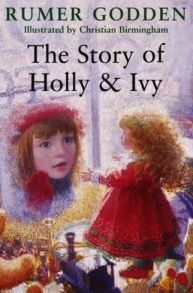
the story of holly and ivy rumer goddenThe Story of Holly and Ivy by Rumer Godden ~ 1958. This edition: Macmillan, 2005. Illustrated by Christian Birmingham. Softcover. ISBN: 0-330-43974-x. 58 pages.

My rating: 10/10. Pretty well perfect.

*****

This is a story about wishing. It is also about a doll and a little girl. It begins with the doll.

Her name, of course, was Holly.

It could not have been anything else, for she was dressed for Christmas in a red dress, and red shoes, though her petticoat and socks were green.

She was ten inches high and carefully jointed; she had real gold hair, brown glass eyes, and teeth like tiny china pearls.

The newest toy in Mr. Blossom’s shop in the village of Appleton, Holly is unpacked the day before Christmas Eve, and she is apprehensive as to what will happen next. The other toys are in a state of high excitement. “We must be sold today!” they whisper to each other, before the shop opens. “Wish, wish, wish!”

“What happens if I’m not sold?” wonders Holly.

“You will be put back into stock,” hisses Abracadabra, the sinister stuffed owl who broods over the store. “It is shut up and dark, and no one will see you or disturb you. You get covered with dust, and I will be there.”

Holly quivers in despair. “I wish, wish, wish for a little girl for Christmas!”

But Christmas Eve is here, and the shop is being closed up, and Holly is still on the shelf…

Meanwhile…

Far away in the city was a big house called St Agnes’s, where thirty boys and girls had to live together, but now, for three days, they were saying ‘Goodbye’ to St Agnes’s. ‘A kind lady – or gentleman – has asked you for Christmas,’ Miss Shepherd, who looked after them all, had told them, and one by one the children were called for or taken to the train. Soon there would be no one left in the big house but Miss Shepherd and Ivy.

Ivy was a little girl, six years old with straight hair cut in a fringe, blue-grey eyes, and a turned-up nose. She had a green coat the colour of her name, and red gloves, but no lady or gentleman had asked for her for Christmas. ‘I don’t care,’ said Ivy.

Sometimes in Ivy there  was an empty feeling, and the emptiness ached; it ached so much that she had to say something quickly in case she cried, and, ‘I don’t care at all,’ said Ivy.

‘You will care,’ said the last boy, Barnabas, who was waiting for a taxi. ‘Cook has gone, the maids have gone, and Miss Shepherd is going to her sister. You will care,’ said Barnabas.

‘I won’t,’ said Ivy, and she said more quickly, ‘I’m going to my grandmother.’

‘You haven’t got a grandmother,’said Barnabas. ‘We don’t have them.’ That was true. The boys and girls at St Agnes’s had no fathers and mothers, let alone grandparents.

‘But I have,’ said Ivy. ‘At Appleton.’

I do not know how that name came into Ivy’s head. Perhaps she had heard it somewhere. She said it again. ‘In Appleton.’

But Ivy is going to the Infants’ Home in the country, as Miss Shepherd must go to her sister, who has influenza. Ivy is loaded onto the train, with “a packet of sandwiches, an apple, a ticket, two shillings, and a parcel that was her Christmas present”, and on to Ivy’s coat was pinned a label with the address of the Infants’ Home.

As soon as Miss Shepherd leaves her, Ivy tears off the label and throws it out the window. ‘I’m going to my grandmother,’ she declares. ‘In Appleton.’ That is in just a few stops, a helpful lady tells her, and sure enough, as the train stops at Appleton station Ivy gets off, leaving her suitcase and her St Agnes-supplied gift – a pencil-case – on the seat, and, unnoticed by the busy ticket inspector, starts out on her quest.

Not far away, in the toyshop, Holly is wishing and wishing and crying out silently, ‘Stop. Stop. Oh, someone, stop.’ But in vain.

Only one person stopped, but it was not a boy or a girl. It was Mrs Jones, the policeman’s wife from down the street. She was passing the toyshop on her way home when Holly’s red dress caught her eye. ‘Pretty!’ said Mrs Jones and stopped.

You and I would have felt Holly’s wish at once, but Mrs Jones had no children and it was so long since she had known a doll that she did not understand; only a feeling stirred in her that she had not had for a long time, a feeling of Christmas, and when she got home she told Mr. Jones, ‘This year we shall have a tree.’

‘Don’t be daft,’ said Mr Jones, but when Mrs Jones had put her shopping away, a chicken and a small plum-pudding for her and Mr Jones’s Christmas dinner, a piece of fish for the cat, and a dozen fine handkerchiefs which were Mr Jones’s present, she went back to the market and bought some holly, mistletoe, and a Christmas tree.

The tree is decorated, but

‘Who is to look at it?’ asked Mr Jones.

Mrs Jones thought for a moment and said, ‘Christmas needs children, Albert.’ Albert was Mr Jones’s name. ‘I wonder,’ said Mrs Jones. ‘Couldn’t we find a little girl?’

‘What’s the matter with you today, my dear?’ said Mr Jones. ‘How could we find a little girl? You’re daft.’ And it was a little sadly that Mrs Jones put holly along the chimney shelf, hung mistletoe in the hall, tied a bunch of holly on the doorknocker, and went back to her housework.

*****

Need I go on? Of course not! You know what eventually happens, don’t you? But the path to wish-fulfillment is never so straight and easy …

This is a deliciously sweet story, perfect for a reasonably accomplished independent reader of 6 or 7 or maybe a bit older (my own daughter read it happily to herself for the first time at 10) and a marvelous Read-Aloud for all ages – it’s fairly text dense, so allow at least three good long sessions.

Ivy is a grand little heroine, misguidedly stubborn and with something of a temper, which makes her eventual fate even more emotionally satisfying. And because this is a fantasy – a Christmas fantasy – we do not worry about her wandering alone through a strange village; we know that she will come to no lasting harm, though an adventure or two may befall her.

Highly recommended, for the children in your life, and for a gentle treat for yourself, too!

*****

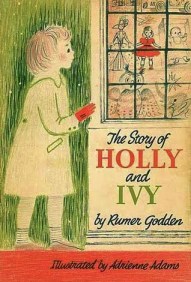
Holly-and-IvyIf you can, try to find the original, long out of print hardcovers illustrated first by Adrienne Adams, and then in another edition by Barbara Cooney. The currently in-print Christian Birmingham version is quite lovely, too, especially if gifting this book, where crisp and new is an issue, though it is without the vintage appeal of the older versions.Holly and Ivy