rhododendron pie margery sharp rebound 001Rhododendron Pie by Margery Sharp ~ 1930. This edition: D. Appleton & Co., 1930. 3rd American printing. Hardcover, rebound by library. 359 pages.

My rating: 9.5/10.

The standard set by this first novel is high; Sharp began as she was to go on, moving from strength to strength throughout her long writing career. Even her few “bobbles” in her later works are entertaining; her sheer writing skill and love and mastery of language make her a joy to read, even when the plotline falters. And it doesn’t do that here; this book is very well put together indeed.

This is the depressingly rare first ever Margery Sharp novel, long out of print, and extremely hard to come by. I finally tracked it down through inter-library loan; a complete search of the Canadian library database located one lone copy in Ontario. After paying a $20 borrowing fee, and waiting for what seemed like a terribly long time, it arrived in pieces, held together with several rubber bands, with a note asking me to use extreme caution when handling it.

Not knowing quite what to expect as a reading experience, but having very high hopes, I was more than rewarded for the time and trouble it took to get my hands on a copy of this book, at least temporarily, and I redoubled my efforts to find a copy of my own. This was something of a “take a deep breath” step,  as prices range from a low of $200 to a high of $600; the most copies I’ve ever seen on offer at one time are the current seven on ABE.

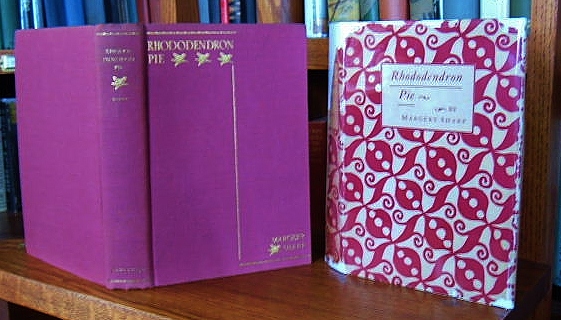
I won’t tell you what I ended up paying for my own copy, pictured above, but it was a major investment for someone of my relatively modest resources. Not the most expensive book I’ve ever purchased – that dubious honour goes to the even rarer Fanfare For Tin Trumpets, Margery Sharp’s second (and just a little less stellar) novel. What I will say is that I haven’t regretted it at all. Either of them. But most of Sharp’s later works – she wrote something like twenty-six novels for adults, and a dozen or so juveniles, many starring the mousy “Rescuers”, elegant white Bianca and common brown Bernard (“the Brave”) – are relatively easy to find. She was a best-selling author in her time, with a humourous inflection which transcends time. I love her writing; for me it simply “flows”, carrying me effortlessly along. Each re-reading reveals another layer; I’m far from finished with my exploration and enjoyment of her work.

I do so wish that someone in the publishing world would catch the Margery Sharp bug and reprint her early works! Rhododendron Pie is such an exquisite little gem, with the genuine clarity and sparkle. There are much more pedestrian works being brought back into the marketplace to feed the current hunger for such nostalgic period pieces! I live in hope.

In the meantime, we do what we can. For those of you who are also Margery Sharp fans, and who have not yet gotten your hands on this little prize, I am now posting, as promised way back in August or September, the entire Prologue to Rhododendron Pie. One day, if no publisher blesses us with a reprint, I might be tempted to scan the whole book and turn it into a pdf file, to share with fellow Sharp aficionados. (Or perhaps it might qualify for Project Gutengberg? I thnk it just might be old enough, and long enough after the author’s death.) In the meantime, here’s a sample.

If you enjoy the Prologue, let me assure you that the rest of the novel is ever so much better.

But first, a contemporary review from 1930:

Rhododendron Pie is something more than an amusing and good-natured gibe at literary and artistic snobbery, for all the Laventie family–including the mother, who comes in with a great burst of rhetoric on behalf of the bank clerk at the finish–and the various minor characters are far more than argumentative counters in the attack or defence of aestheticism.  They have all authentic lives of their own, and Miss Sharp is particularly successful in catching the accent of those inhabitants of the modern world who carry a magnificent undergraduate irresponsibility into the affairs of everyday life. – The London Times Literary Supplement
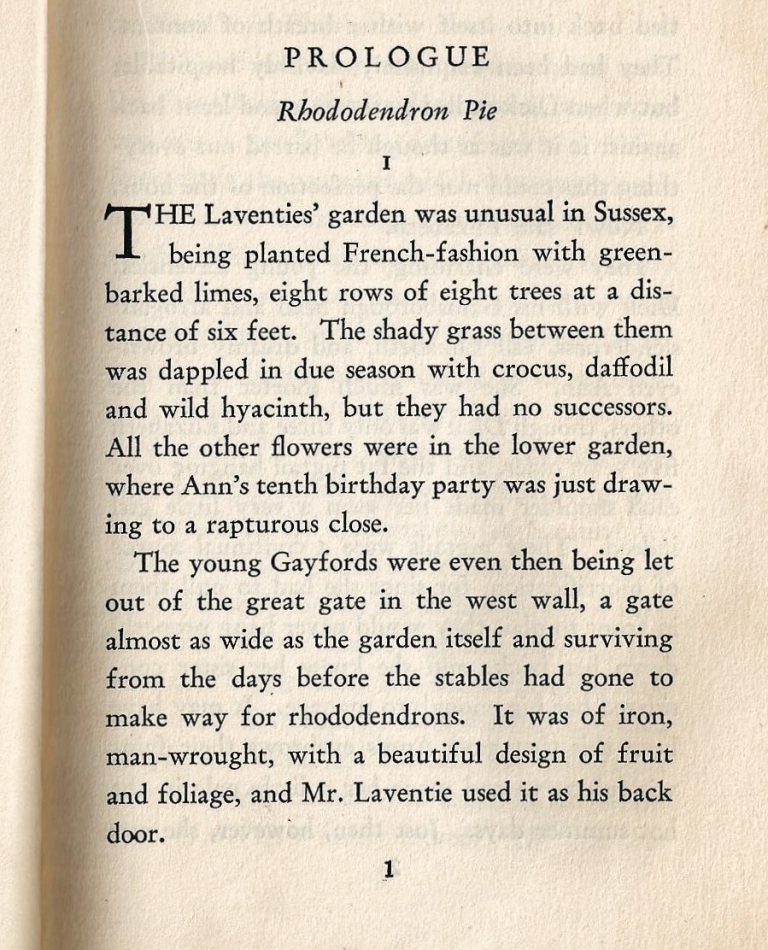
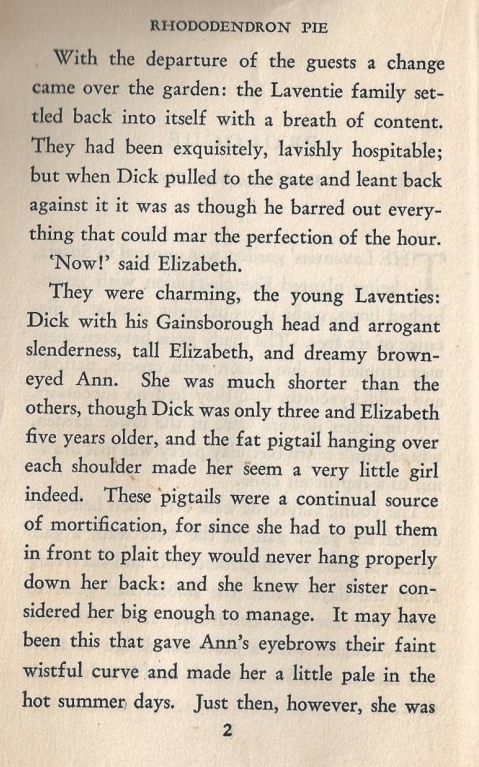
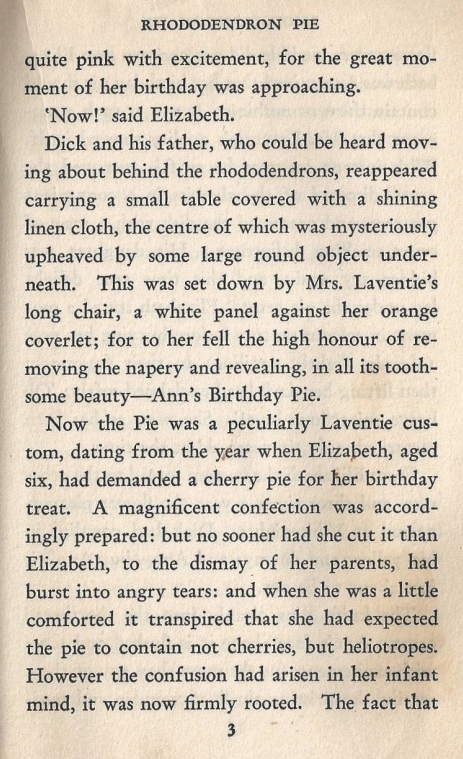
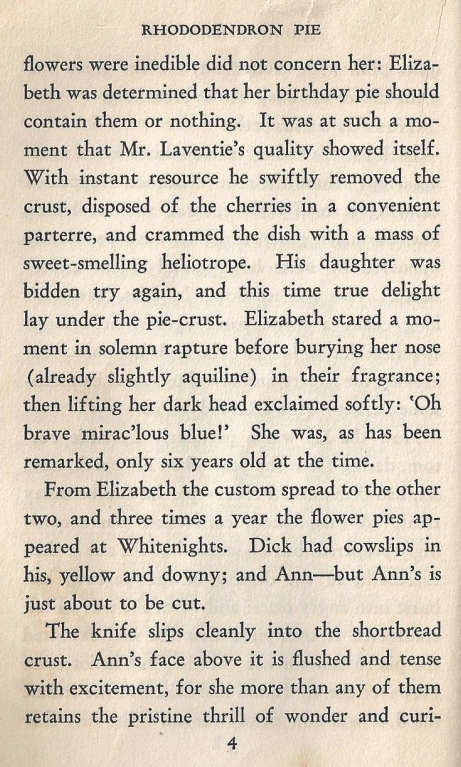
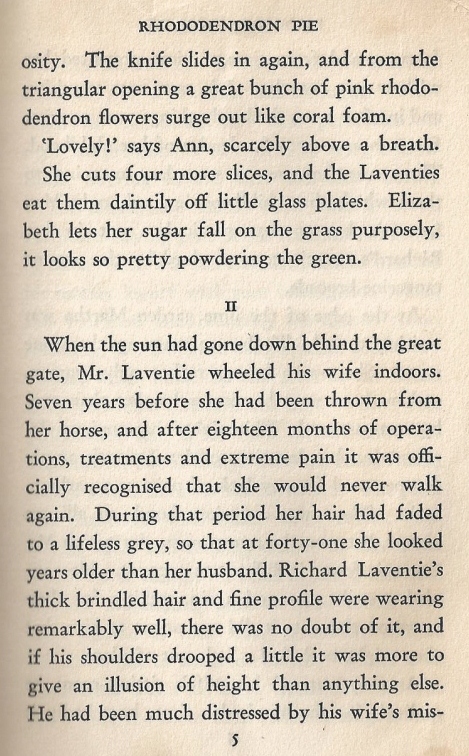
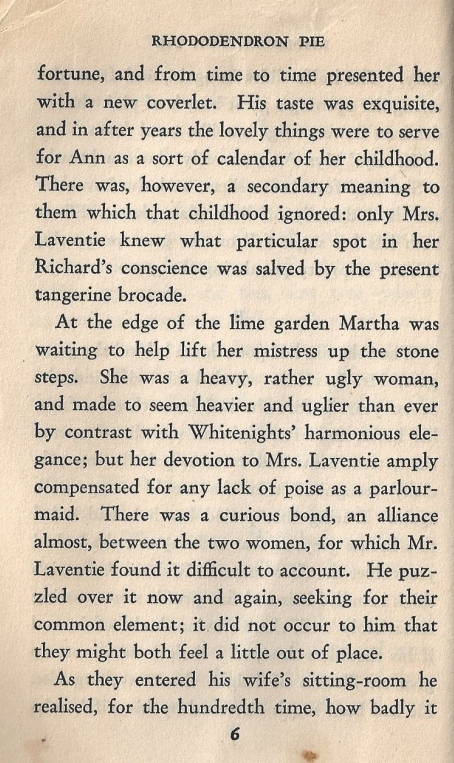
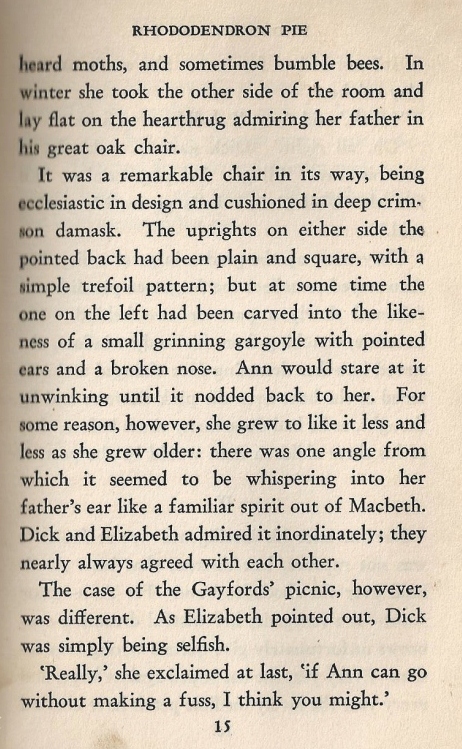
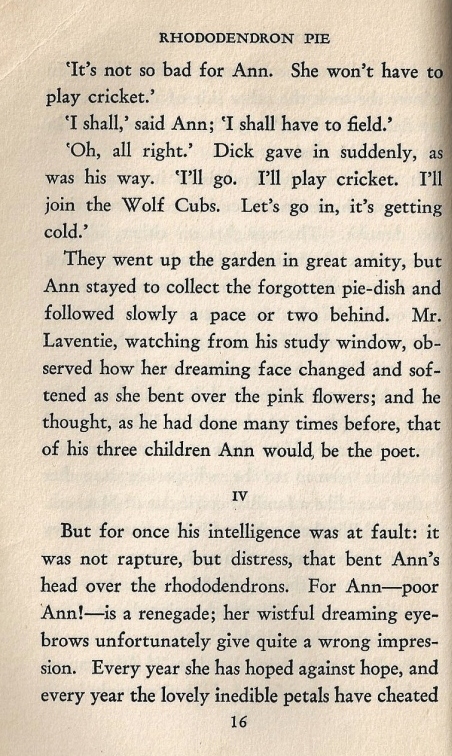
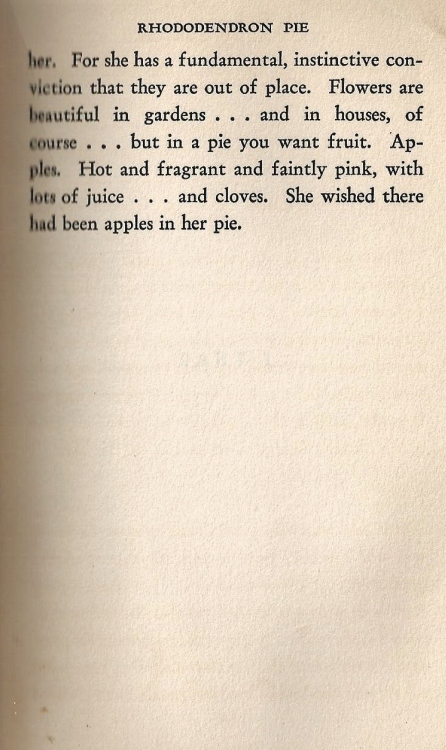
rhododendron pie sharp prologue pg 1 001rhododendron pie sharp prologue pg 2 001rhododendron pie sharp prologue pg 3 001 (2)rhododendron pie sharp prologue pg 4 001rhododendron pie sharp prologue pg 5 001 (2)rhododendron pie sharp pg 6 001rhododendron pie sharp pg 7 001 (2)rhododendron pie sharp prologue pg 8 001rhododendron pie sharp prologue pg 9 001 (2)rhododendron pie sharp prologue pg 10  001rhododendron pie sharp prologue pg 11 001 (2)rhododendron pie sharp prologue pg 12  001rhododendron pie sharp prologue pg 13 001 (2)rhododendron pie sharp prologue pg 14  001rhododendron pie sharp prologue pg 15 001 (2)rhododendron pie sharp prologue pg 16 001rhododendron pie sharp prologue pg 17 001 (2)

The story proper opens ten years later. Our heroine, Ann, is now twenty, and we find her dreaming the summer away, poised on the brink of life. Her brother Dick and sister Elizabeth are busy following their own intense pursuits – Dick as an art student and aspiring sculptor, and Elizabeth as a writer and editor – but Ann has so far found no particular artistic bent of her own to follow. She is mostly merely accomplished at being agreeable, and with her sophisticated family and their many visitors a listening ear and a pleasant, interested expression are much appreciated as the egoists expound and Ann takes it all in. But she has a rich inner life of her own, and she’s busy sorting it all out.

Ann settled down on the grass again with her chin on her fists and one shoe waving in the air. She wasn’t reading really, only pretending to, so that the others wouldn’t talk to her. It was too nice in the garden to talk. How queer to think she was lying on the surface of the world… an enormous warm green ball spinning slowly through space with somewhere, under a lime tree like a sliver of grass, a minute pink dot…

The Gayfords, ten years after we first meet them, are still persisting in being friendly to their uppish neighbours; continual delicate snubs are absorbed and ignored, and Ann has settled into her role as a liaison of sorts between the two worlds, which leads to occasional mockery by Dick, Elizabeth and Mr. Laventie, who assume that Ann is merely “collecting material” for reasons of her own.

But Ann is honestly fond of the happy Gayford clan, and this summer, with Peggy Gayford’s approaching marriage and John’s unchangeable good nature with every brief encounter, Ann is starting to wonder what is wrong with her, to find such healthy, hearty normalcy so attractive. For isn’t life meant to be an endless round of sensation-seeking, with the creation of an exquisite and “individual” persona for the edification of the other elite highbrows one’s chief occupation? So why is Ann having such difficulty working up a properly scornful attitude of her own to the Gayford’s enthusiastic embrace of the comfortable pleasures of upper-middle-class country life. (The Gayford patriarch is the local doctor; John has embarked on a career in banking, and his younger brother Nick is at medical school, in sharp contrast to the general Laventie bent for something more artistic and “fine” than mere useful “labour”.)

Avant-garde filmmaker Gilbert Croy appears on the scene, and with his languid courtship of her, which she warmly responds to, it seems that Ann will embrace the family tradition and rise above her delight in the everyday to take her place among the rarefied intellectuals. But circumstances and Ann’s innate common sense unite to turn things upside down …

Margery Sharp, though she does the conventional “happy ending” thing very well indeed, always seems able to put a twist into her story somewhere. Nothing is completely as it seems, and the clichés fall apart upon closer examination. There are some cleverly well-realized character sketches in Rhododendron Pie, as enjoyable to today’s reader as they would have been to those readers of the time more cognizant of the sly references Sharp has such a grand time making.

On re-reading what I’ve just written, I see that I haven’t done much in the way of detailing the plot, and I’ve completely ignored many characters who wander in and out of Ann’s widening orbit. There’s a lot in this little book; too much to share without giving things away completely, and too complex to detail without making this review even longer than it already is, what with all the images I’ve crammed in!

*****

Sound appealing? If so, this is what you’re looking for in your library book sale and flea market travels. This lovely (and exceedingly rare) first edition with an intact dust jacket will set you back a cool $600, at Old Scrolls. Right now, April 2013, there are 7 copies listed on ABE, from $212 to the aforementioned $600.

There must be a few more out there in dusty corners for the persistent (and lucky) searcher. Particularly in Great Britain, or possibly the U.S.A. Happy hunting!
 

One. Whole. Year.

I’m surprised it’s gone by so quickly, but yesterday marked the one year anniversary of the Leaves and Pages blog. It’s been fun, and I definitely want to keep going.

So many books, so many books …

So without any further ado, I am announcing a

BOOK GIVE-AWAY

in honour of the occasion, and as a small way of saying “Thank You” to all of the other blog readers and writers who have brought me so much enjoyment this neophyte year.

folio giveaway 2013 leaves and pages 001I have acquired three handsome Folio editions of books I’ve read and enjoyed, and much as I am tempted to hoard them away like a miser squirrelling coins, I am going to be all brave and noble and send them out into the world. (That’s why I bought them, after all. And I was thrilled when I found them – “Perfect for the Blog Birthday,” I thought immediately. They were all purchased as “second-hand” but they are crisp and clean and beautiful and all three seem to be unread. These are truly deluxe editions, and I hope they will find good homes where they will be opened up and properly READ.)

So here we go. To take part in the giveaway, simply leave a comment on this post, telling me which book you’d like to try for. I’ll do the draw the old fashioned way, names on slips of paper to be drawn “out of the hat” – the winners will be announced and then we can arrange about addresses to mail them to and so on.

Anyone from anywhere is welcome to participate.

And please do – the more the merrier!

Drumroll, please…

The Father Brown Stories

by G.K. Chesterton

Originally published in 1911 (The Innocence of Father Brown) and 1914 (The Wisdom of Father Brown)

This is the full text of both books, with an Introduction by Colin Dexter and many excellent pen-and-ink illustrations by Val Biro. Clothbound with slipcover. 358 pages.

The Folio Society, 1996

the father brown stories folio giveaway 2013 leaves and pages 001

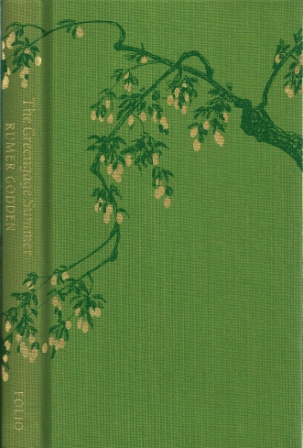
The Greengage Summer

by Rumer Godden

Originally published in 1958.

Includes a new Preface by the author added in 1993, a Foreword by Jane Murray Flutter, and an Introduction by Jane Asher (who played one of the children in the 1961 film of the novel), as well as illustrations by Aafke Brouwer. Clothbound with slipcover. 171 pages.

The Folio Society, 2000.

greengage summer folio giveaway 2013 leaves and pages 001

The Franchise Affair

by Josephine Tey

Originally published in 1948.

Introduction by Antonia Fraser. Illustrated by Paul Hogarth. Clothbound with slipcover. 254 pages.

The Folio Society, 2001.

franchise affair cover folio giveaway 2013 leaves and pages 001

Good Luck, everyone!

I’ll do the draw on May 1st, so you have a few weeks to enter.

Just a quick comment on this post, letting me know which of these grand books you’d like to own, and you’re in!

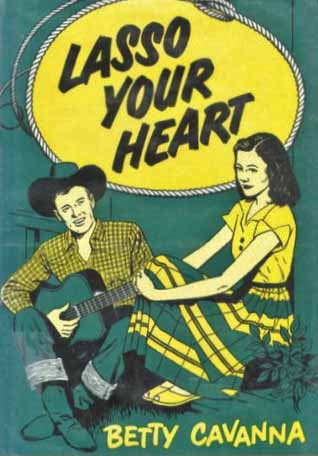
Lasso Your Heart by Betty Cavanna ~ 1952. This edition: The Westminster Press, 1952. 184 pages.lasso your heart betty cavanna

My rating: 5/10.

This one just squeaks onto the keeper shelf and therefore gets a “pass”, and I’ve made generous allowances for the genre and time of writing. The Kirkus review says it, too. Merely “adequate.”

*****

Kirkus Review, October 1952

A wholesome young love and how-to-be-natural-with-people-instead-of-just-horses-and-dogs novel, by a popular teen-age fiction author – about a young Texas girl and her adjustment problems with rich Philadelphia relatives. Sixteen year old Prue Foster and her family have moved to rural Pennsylvania where her father is managing a cattle fattening ranch. In Bryn Mawr live the Rowntrees, Mrs. Foster’s socialite family, and Prue is invited to her cousin Cissy’s debut. Her misgivings intelligently reasoned away, Prue enjoys herself with a young journalism aspirant Colin, until news is received of Cissy’s brother-in-law’s death in Europe. Mr. and Mrs. Rowntree fly to their elder daughter’s aid and Cissy goes out to the ranch with Prue where she falls in love with Mac, a Texas A. & M. student summering with the Fosters as a ranch hand. Prue averts a would be tragic elopement by enlightening Mac as to the evils of running away from temporary disapproval. So Cissy wins Mac the honorable way and Prue looks forward to a nice winter with Colin who will study at Penn. Adequate.

This is one of prolific “teen fiction” writer Betty Cavanna’s earlier books, and it is an exceedingly stereotypical “young romance” novel, though it is not at all a bad book – no groans of despair were emitted by this reader during the reading, which says something.

An interesting scenario in some ways, with the main character, Prudence – Prue – coming from a ranching family who has recently relocated from Texas to Pennsylvania. I appreciated that Prue’s father was not a ranch owner himself, but merely an employee of a large Texas holding. There is a complete acceptance by the author that agriculture was a more than respectable occupation for both Mr. Foster and the young “cowboy” love interest, Mac – much is made of the fact that they are well-educated professionals much respected in their fields – Mr. Foster is writing scientific articles for the U.S. Department of Agriculture’s Yearbook, and Mac is in his final years of study at Ag school (Texas A. & M. University), which is treated with as much respect as Harvard might be. I really liked those touches, and awarded an extra star for them. (Being an old aggie of sorts myself, from one of the venerable Albertan “cow schools.”)

Otherwise this is mostly just a typical 1950s’ teen romance, with the sweet, naïve, wholesome country girl falling in love with the cute city guy with the convertible, and wondering if he could ever be interested in her, and being oh-so-flushed-and-confused when it becomes apparent that yes, young love is in full delicious bloom. But though Prue and Colin are involved in a gentle teenage courtship (does he really read poetry to her under the trees by the brook? – I’m so jealous!) the situation between Prue’s cousin Cissy and the older Mac hints at something much more emotionally mature and physically passionate.

There is also a situation involving Cissy’s older sister Lea, living in Amsterdam with her pilot husband, Stewart. Stewart’s death in a flying accident on the evening of Cissy’s debutante ball injects a sombre overtone into what is otherwise a light and airy story, and the grief this brings to the families involved is handled well by the author, though she takes care to keep most of that aspect well off stage; Cissy is staying with Prue so Lea can go through the first months of her widowhood in private seclusion back at her childhood home without the fuss of Cissy’s busy social life trespassing on her mourning period. I thought this was an atypical scenario to include in a teen book of this period, and it definitely added another dimension to the story, beyond stereotypical “fluff.”

Betty Cavanna knows her horses, too, and includes a sweet interlude with Prue’s mare giving birth to an adorable foal; there is also the de rigueur “caught in wire” scenario with the young heroine single-handedly rescuing the entangled horse and being praised for her good sense and bravery etcetera etcetera etcetera.

The readers of the period liked this stuff just fine; the old library copy of Lasso Your Heart I’ve acquired (no idea where – it’s been around for years and I cannot remember where I got it, though I’m guessing it was cheap or even free, due to its decrepit condition) is literally falling to pieces, and has been repaired by conscientious librarian a few times – tape overlapping on tape!

I’m getting rather interested in this author in a low-key way, and will be on the lookout for more by her. She has surprised me a bit, in a good way, in each of her three books I’ve read over the past few weeks. I spent some time browsing her titles on ABE, and was quite surprised to see that some are in short supply and are indeed very high-priced; she’s been deemed as “collectible”, apparently, so my interest is not exclusive.

I’m sure I’ll have more to say about Betty Cavanna in the future.

The Unhappy People


Professor, may I introduce you

to two of the Unhappy People, whom you’ve described

as inhabiting a cultural vacuum

somewhere between the swamps of Frustration

and the salt sea of Despair.

May I present my wife’s cousins, Corey and Brent.

You will note immediately that their teeth are translucent,

the colour of reconstituted powdered milk,

which can be attributed to hereditary malnutrition,

as their lack of earlobes can be ascribed to inbreeding.

You are free to make notes, if you wish.

At worst, they’ll merely laugh at you.


Professor, I must ask you to forgive

the mandolin, the five-string banjo, the guitar, the fiddle

and the jew’s-harp. I must ask you to bear with

Brent when he dances – he prefers it to walking to

the refrigerator for another beer – and Corey when he

scratches

his groin in symbolic tribute to the girl in the yellow

bathing suit

playing with a frisbee on the grass across the street.

I know it’s distracting when, for no apparent reason,

they break into song. I can understand your not laughing

with them when they talk about driving

four-year-old cars at one hundred and ten

miles per hour down dirt roads with the police behind them,

of overturning and wondering drunkenly how to shut off

the headlights, until logic triumphed and they kicked

them out.

I beg you not to be disturbed when they whoop

at the tops of their voices – it’s in their blood,

I’m afraid, their way of declaring an instantaneous holiday

and, besides, Brent got out of jail this morning

or, as he puts it, got back from his annual vacation,

having been locked up this time because he didn’t

know his own strength, he says, and when he was refused

service

at the liquor store, being drunk, forgot he was carrying

nothing under his left arm to offset the force of his right

pushing open the door on his way out and so, purely by

accident,

drove his fist through the glass:

it could have happened to anybody, Your Honour,

he told the Court. You must excuse Corey, Professor,

like every other member of his family he walks in and out

of rooms without thinking it necessary to offer

any explanation. When they arrive at my house

or any other, they open the door, come in, sit down

and, perhaps, switch on the radio. They’d expect you to do

the same.

If you go to the window, Professor, you’ll see

that he’s talking with the girl in the yellow bathing suit

and already has her laughing. “Once you got them laughing,

you’re as good as in bed with them,” Brent says.

In celebration

he jumps up again and dances. They’ve brought venison

and wild rice and a half-dozen jars of their mother’s

homemade preserves and pickles, fresh loaves of her bread

two double cases of beer and a forty-ounce bottle

of dark rum, having shut down the cannery

where Corey works in honour of Brent’s homecoming.

“I said to hell with ‘er, let’s tie ‘er up.”

and with unanimous approval of his fellows,

conveyed without a word, he tied her up well

by making certain delicate adjustments to the machinery

when the bosses weren’t watching. His laughter and his

brother’s

laughter and the laughter of the girl in the yellow bathing

suit

mingle and rise like water from a garden hose, spraying the

windows

from inside and out. The passersby turn

and smile, a neighbour’s dog runs to see what’s happening,

a host of starlings take wing, the tiger lilies are in flower

at the edge of the parking lot next to this house.

Professor, I don’t suppose you’d care to arm-wrestle?


Alden Nowlan ~ Smoked Glass ~ 1977

This poem is dedicated to some guys I used to know.

Gone, most of them, flamed out and crashed and burned in (mostly) self-imposed self-destruction.

The hard living took its toll, but they had a grand time while it lasted.

And they made a lot of people laugh.

Gone, but definitely not forgotten!


my heart lies south elizabeth borton de trevino 001My Heart Lies South: The Story of My Mexican Marriage by Elizabeth Borton de Treviño ~ 1953. This edition: Thomas Y. Crowell, 1953. Hardcover. 248 pages.

My rating: 8/10.

*****

I found this book among my mother’s boxes in her attic which I was supposed to go through and “deal with” when she downsized from the too-many-staircases rambling family home to the tiny-but-manageable single-level house she’s in now. I almost put it into the Sally Ann box, but something stayed my hand. “Elizabeth Borton de Treviño…. I know that name, somehow,” I thought, and that was enough to put it into my keeper pile instead.

Some years passed (well, six years, to be exact, because Mom moved in 2007, and much of what I brought home is still in “temporary” storage here, still waiting to be “dealt with” – and honestly, the only boxes I’ve cracked open are the ones full of books) and then one day I looked at My Heart Lies South again. And the penny finally dropped.

Elizabeth Borton de Treviño. Of course! I, Juan de Pareja. The 1966 Newbery Award winning historical fiction about the Spanish painter Velazquez and his personal slave, Juan de Pareja. I’d read this some years ago, and found it a well-written juvenile historical fiction, and that was why the name of the author sounded so familiar.

I opened My Heart Lies South, as I should have done six years ago, and started reading bits here and there. Far from being the serious and sober biography I had expected from the rather unprepossessing dustjacket – (“Don’t judge a book by its cover” – I know, I know) –  the passages I read were wry and funny and interesting. And when I settled down to tread it cover to cover, it definitely did not disappoint. Another hidden bookish gem, I think we could safely say.

*****

Elizabeth Borton was born in 1904, in Bakersfield, California, and, encouraged by her parents, started writing at a very young age. After graduating from Stanford University in 1925 with a degree in Latin American History, Elizabeth went on to the Boston Conservatory of Music to study violin. She then worked as a reporter for the Boston Herald, and spent five seasons in Hollywood interviewing film personalities.

With her strong interest in all things Latin American, Elizabeth was continually talking about going to Mexico, and one day, in 1934, her editor broke down and sent her off with a handful of tickets, vouchers and contact lists, telling her to “just write something” once she got there. And with her eventual meeting with the representative of the Monterrey Chamber of Commerce, one Luis de Treviño, Elizabeth’s future, though she didn’t know it at the time, was about to take a very different turn from her life as an independent American career woman.

“Hello Luis!” said Bill. “This is Miss Borton. When you get to Vallecillo, buy her an ice-cold beer.”

Luis laughed nervously. There is nothing he likes better than a cold beer, but the lady he had taken across the border for the Chamber of Commerce two weeks before had resisted the beer with desperation as if it might be the first step in a seduction, and the lady last week had been Dorothy Dix, who was even then rather tired from pushing seventy or so and inclined to be tart with young men eager to waste her time in taverns.

I was turned over to the vaccination, immigration, and customs authorities, and at last, in a car which had been provided by the Chamber of Commerce, complete with chauffeur, we set out for Monterrey. I had my hair tied up in a scarf and I was wearing a large black hat as well as sun glasses. Now the sun began to go down and long violet shadows crept across the plain. I took off my hat.

“Ah,” breathed Luis.

I undid the scarf.

“So?” remarked Luis.

I took off the black glasses.

“Wonderful,” he decided, aloud. He leaned toward me and looked at me soulfully.

“Shall I sing you a song about love?” he asked.

“Why yes,” I agreed, thinking this must be a gag.

But he launched into “Palm Trees Drunk with the Sun,” went on to “The Sea Gulls,” and then sang “The Green Eyes,” in a light baritone voice.

“Very nice,” commented the chauffeur from the front seat. “Now sing ‘Farolito.'”

He sang it. After our beer in Vallecillo, Luis sang other songs. He sang all the way to Monterrey.

I didn’t realize it, but I was being courted.elizabeth borton de trevino 001

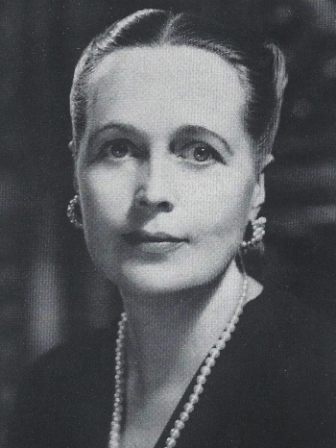
As you can see from the photo of the author, taken from the jacket of the book published eighteen years after her marriage, the initial attraction on looks alone is understandable!

Luis shows Elizabeth the attractions of Monterrey, including things definitely off the tourist track, such as his family ranchito, and, significance unknown to Elizabeth at the time, the private parlour of his beloved mother, Mamacita. He also takes her dancing, in company with a respectable engaged couple, a situation that made all of Monterrey society take note…

I was left at my hotel. But a sort of die had been cast. Luis had cast it and with his eyes open. He had taken a strange woman to dance. Just any strange woman, and the incident might have been passed over as a wild oat on the part of the fifth Trevino. But he had taken the strange woman in company with a pareja of his best friends, an engaged couple! Two plus two equals four. Dancing with one girl all evening, with an engaged pareja to make up the party, means something serious! Phones rang in Monterrey; the news went round. Only I was in the dark.

Formally on the afternoon of the next day, I was taken to call on Mamacita. While we sat in the sala, Luis disappeared, to return with a tray on which sat Mamacita’s best small silver liqueur glasses. In each was a thimbleful of sweet vermouth. On a plate there were some little yellow cakes that melted into a puff of flavour when bitten. These were Mamacita’s famous polvorones de maizena (cornstarch puff cookies), the engagement cake… They were a kind of symbol. All unknowing I ate the engagement cakes and tasted the engagement vermouth.

Later Luis brought me a small yellow-striped kitten and dropped it into my lap.

“Oh, the darling! I wish I could have him,” I cried. “But I am leaving tomorrow for Mexico City and I have lots of work to do. I won’t be home in California for weeks.”

Mamacita said calmly, “Galatea has kittens like these every four months. You will have a kitten.”

Paling visibly, Luis scooped up the kitten and left. I wondered what had happened, but it seemed he had only recognized his mother’s acceptance of me. Mamacita had decided that I was to come to Monterrey, marry Luis, and receive a kitten from the fecund Galatea. He had been working toward this, but it was serious, and it sobered him to realize he was practically a married man.

Elizabeth eventually catches on, and with the blessing of both sets of parents, the couple is married and sets up housekeeping in Monterrey, on a shoestring budget. Culture shock hits strong and hard, as Elizabeth is suddenly immersed in traditional Mexican society, and finds herself floundering more than a little in her new role as the wife of an established, upper class Mexican husband. Luckily Mamacita and Papacito, Elizabeth’s new parents-in-law, are firmly behind her, and guide Elizabeth through the maze of “proper” behaviour, and cover up her most blatant mistakes. Of which there are many, reported in full by the author.

I am afraid I am not at all familiar with Mexican society of the time period of the memoir – the 1930s – or even of the present day – but after reading My Heart Lies South I have a clear and mostly positive impression of a world in which family comes before all else, and in which women, though subject to the strictest of behavioural expectations from their menfolk, have an enormous influence and hidden power, which they can wield for either good or ill. Elizabeth’s family, visiting some years after her marriage, shake their heads in wonder and tell Elizabeth that she has wandered into a world frozen in the 1800s. Elizabeth, having carved out her domestic niche after significant struggle, agrees, but states that she is deeply happy, and that she now fully enjoys the more positive aspects of this steeped-in-tradition world.

This full acceptance of uber-traditional female roles may have modern-day feminists grinding their teeth in despair, and it also does appear, from the glowing reviews which this book receives on the “Godly womanhood” websites I’ve stumbled across while researching the author, that the more conservative “right-wing” types have embraced this memoir as an estimable example of true femininity.

I find that I fall somewhere in the middle of these two extremes. Elizabeth and Luis seemed, from all reports I’ve read, to have a most successful and happy marriage, which is an accomplishment worth celebrating, no matter in which society it is achieved. Elizabeth continued with her successful writing career after her marriage, managed to find time to keep up with her music, created a beloved home, and adapted very well to the expectations of her in-laws, while still staying in close contact with her American friends and relations. It seems to me that her life was most reasonably “fulfilled”; she certainly does not come across as downtrodden in any way, and she speaks of her integration into Mexican society with affection and sharp-eyed realism.

All of this to say that I enjoyed this book greatly.

There also exists an expurgated “Young People’s Edition” of My Heart Lies South, got up, I am sure, to piggyback on the perennial success of I, Juan de Pareja. Apparently all the more risqué bits are left out – and there are a few – so I can’t really see the point of that, as when Elizabeth shares some of her more “adult” anecdotes she’s really at her best. So look for the original version, which has been reprinted numerous times, instead. (And to add insult to injury, the cover of the junior version is not at all dignified, and hints at a jolly comedy, which, for all of its humour, this memoir is definitely not.)

My Heart Lies South has two companion memoirs, Where the Heart Is, and The Hearthstone of My Heart. I’m a bit taken aback by the Heart-y-ness of the titles – definitely working the theme to the utmost! –  but I’ll be keeping an eye out for these, as I’m sure they will be worth investigating.

We’re having a dreary day today. It’s raining down here by the river, but snowing higher up, reported by a friend during an early morning call. I really should be outside working in the greenhouses, but I think I’ll have another cup of tea instead, and share some of the photos my son took a few days ago, when the sun was shining and spring seemed much more committed to staying than it does this morning!

Right now the river is as low as it gets all year, and we're taking advantage of that to explore the sandy side channels which are usually full of water the rest of the year.

Right now the river is as low as it gets all year, and we’re taking advantage of that to explore the sandy side channels which are usually full of water the rest of the year.

Down along the main river bed itself, rockhounding bliss at low water - new territory to explore!

Down along the main river bed itself, rockhounding bliss at low water – new territory to explore!

And here's our quarry - glowing agates.

And here’s our quarry – glowing agates.

April 2013

Naturally polished Fraser River gems.

Naturally polished Fraser River gems.

Returning home on higher ground, the sagebrush buttercups are out in full force on the hillsides.

Returning home on higher ground, the sagebrush buttercups are out in full force on the hillsides.

This is the high point of the farm - the house in directly below this spot, though you can't see it for the trees - and looking upriver to the North.

This is the high point of the farm – the house in directly below this spot, though you can’t see it for the trees – and looking upriver to the North.

And from the same spot, a few days later, after some days rain, and enough warmth to result in melting snow in the high places. Our rockhounding grounds are seriously diminished; the river is on the way up once again.

And from the same spot, looking the other way, downriver to the South, a few days later, after some days of rain, and enough warmth to result in melting snow in the high places. Our rockhounding grounds are seriously diminished; the river is on the way up once again.

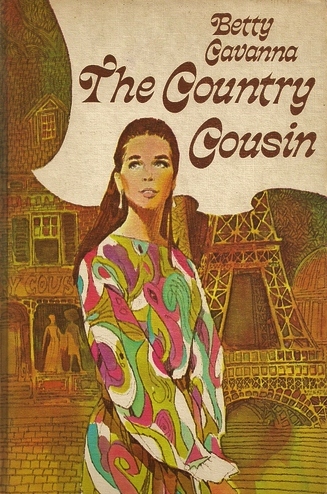
the country cousin betty cavannaThe Country Cousin by Betty Cavanna ~1967. This edition: William Morrow & Co., 1971. Hardcover. Library of Congress #: 67-21735. 222 pages.

My rating: 5/10.

An equal balance between interestingly vintage (Paris in the sixties!) and appallingly dated (chauvinistic boyfriends!) The author did her research for this slight little teen tome, and it shows, mostly in a good way. An interesting – if feather-weight – 40-year-old read.

Bonus – great cover! Tells you everything you need to know right there up front, doesn’t it?

*****

My reading is all over the map right now. It was a toss-up this morning whether to take a stab at reviewing Stephen Fry’s sex-and-bad-language-soaked novel The Hippopotamus, or this mild little vintage teen-girl romance. But since my last review was of a very contemporary (well, 1999 – not really that contemporary, though it seems but a moment ago in some ways), sex-filled book – Fits Like a Rubber Dress by Roxane Ward – I decided to keep things all mixed up; from one I wouldn’t dare to give my dear old mum to one she’s enjoyed with gentle enthusiasm. (As did I.)

Melinda Hubbard – Mindy – has grown up on a large farm in Pennsylvania, and now, recently graduated from high school and facing all the “next step” big decisions, is at a loss with how best to proceed. Her beloved older brother Jack, her opposite in almost every way – strong, intense, smart and focussed, where Mindy is soft, mild, merely average in academics and waffling – is studying medicine and has just married his college sweetheart, Annette.

Bridesmaid Mindy takes part in the wedding in a fog, brushing off inquiries as to her future plans with vague evasions; she’s done the proper thing and has applied to several colleges, but is ashamed to disclose that her applications have all been denied because she hasn’t met the academic standards. Her mother is pushing her towards taking a secretarial course, but Mindy is less than enthusiastic about that, not being able to picture herself sitting at a typewriter all day.

A saviour appears in the person of Mindy’s older cousin Alix. Recently widowed – we find out that her young husband was killed in Vietnam – Alix has taken the insurance money and opened a clothing store in Bryn Mawr, catering to the well-heeled college girls and their mothers. On an impulse, Alix invites her droopy cousin Mindy to come and live with her for the summer, to work in the shop – called “The Country Cousin” (after a real-life dress shop, as we find out in the author’s note at the end) – and gain some experience in the retail trade while considering her next move.

Mindy is agreeable – though one couldn’t call her “enthusiastic” – it’s really not in her nature, such a strong emotion, you know! – and soon is immersed in the retail clothing trade. If there’s one thing Mindy does enjoy, it’s pretty clothes, and we learn that she is something of an accomplished seamstress herself, designing and creating her own dresses and so on; a talent which will end up leading her to her true vocation.

Mindy meets several young men, and dabbles with romance for the first time in her life. Handsome Peter, a friend of Mindy’s brother Jack, is from a wealthy family, and has a succession of girls trailing after him, as he lackadaisically dallies with them while waiting for just the right one to come along. “I’m going to marry a rich girl,” he flat-out states to Mindy one day, letting her know that while she’s okay fun for a casual date or two, she shouldn’t get her hopes up. Realistic Mindy never really thought that Peter was for her, but she did daydream a bit, so rough and ready, definitely not wealthy and far from urbane Dana, another friend of Jack’s, on his way to study Oriental Languages at the Sorbonne in the fall term, looks very much like a second best in the boyfriend department.

Dana persists in his efforts to improve Jack’s sister’s intellectual capabilities, lending Mindy books on art, and carting her off to concerts and picnics in the country. He – and Peter, and Alix as well – all seem quite concerned with Mindy’s personal appearance. She is self-admittedly on the plump side, so with all of these people in her new life dropping comments to the effect that she’d be better-looking if she slimmed down, Mindy resolves to do just that, and tries to forget her butter-and-cream farm girl tastes, and to subsist on black coffee and a slice of toast for breakfast, and salad for lunch, and so on.

The pounds miraculously melt away, and everyone oohs and ahs about the improvement in her looks, and Mindy is quite smug with herself.  And this is where I had my biggest issues with this novel. The boys in her life, and her mentoring older cousin, mention to her that she’s too fat, and that she should slim down, so she unquestionably goes along with it, and does. She drops five pounds and everyone is all over her – “Good girl! Such an improvement!” Well, five pounds isn’t all that much, is it? I can’t imagine what their conception of “too plump” must have been if that made such a tremendous difference, and the fact that they were all so rude as to say such things to her rather floors me. It was obviously socially acceptable at the time to do so; Mindy takes it without a murmur. Anyway, this bit bothered me.

So, along goes Mindy, cooperating in her rather wishy-washy way with what everyone thinks she should be doing. Alix carts her along on buying trips to New York, and Mindy is introduced to the dress trade, and realizes for the first time that perhaps she might have a vocation after all, that of fashion design. She and Alix come up with a scheme to go to Paris on a selling trip, taking along clothing sample and taking orders from the community of Americans living there, who are desperate for well-made, reasonably priced clothes; Paris apparently offers only haute couture and shoddy department store dresses, nothing in the mid-range. This venture succeeds beyond their expectations, and of course they meet up with Dana, and romance predictably blossoms in the soft Parisian air.

A pleasant depiction of the time and place and people; the Paris of the “Americans abroad” is captured very well, as is the middle- and upper-class college town atmosphere of Bryn Mawr. As a “working girl”, Mindy is frequently reminded of her place in that society – at the lower end of the food chain – but she realizes that there is a dignity and self-satisfaction about doing whatever it is that you find yourself engaged in competently and cheerfully. A teeny bit preachy, with a Great Big Moral gently tromping about, elephant-in-the-room-style, but not offensively so. Betty Cavanna is so very genuinely earnest, and her heroines are so reasonably realistic, even to their modest goals and not-very-dreadful dilemmas, that it is hard to find much to object to. Middle-class girls are “people” too!

All in all, a typical bildungsroman of the era, which holds up well to a 21st Century nostalgic re-read, if you’re into dabbling with such stuff. I’m sure the junior high school girls of the time enjoyed it greatly; the old ex-library copy I have is very well read indeed.

Now, I wonder what I should read next …

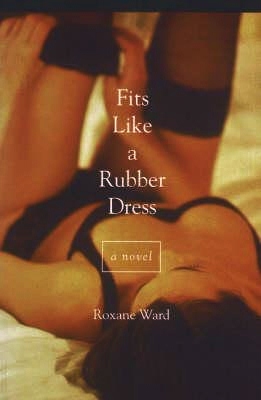
fits like a rubber dress roxane wardFits Like a Rubber Dress by Roxane Ward ~ 1999. This edition: Simon & Pierre, 1999. Softcover. ISBN: 0-88924-4. 303 pages.

My rating: 6.5/10.

*****

Great title and teasingly provocative cover. Didn’t realize it was Canadian until I got a page or two in, though the cover blurb by Timothy Findley should have been a major clue:

“It’s a glorious book! Roxane Ward is a sorceress – she transports you into a weird world of frantic characters dancing on the edge of the millennium. Then she lets you in on the secret: it is your own world, seen through the eyes of young, super-urban artists who are never satisfied with what they have or what they find. I warrant you will not forget Indigo Blackwell, in her pursuit of a life that fits like a rubber dress …”

– Timothy Findley

I raced through this one in a single sitting, staying up much too late last night to finish it, so that is an indication of its more than decent quality. This said, Fits Like a Rubber Dress is being added to the giveaway box as soon as I record this review, as I doubt it’s a re-reader for me.

Our heroine Indigo Blackwell is 29, on the cusp of leaving her youth behind, and she is obsessed with all of the usual angst-ridden baggage this entails. Her four-year-old marriage to a freelance writer/aspiring novelist, Sam, is happy enough, though Indigo loudly complains to her husband and her best friends (bartender Tim and television presenter Nicole) that her sex life is not as exciting as it once was in the “early days” of her marriage. She obsesses about this as much as she does about the incipient wrinkles she imagines are lurking, waiting merely for the flip of a calendar page to appear. Indigo wants to have sex, lots and often; Sam just isn’t that interested, citing stress, and preoccupation with finishing his novel, and gently ignoring Indigo’s increasingly desperate attempts to maneuver him into the bedroom.

“Frustrated” describes Indigo’s general state of mind. Not only is her marriage dull and her sex life stalled out, but her career is increasingly unsatisfying. Working for a Toronto public relations company, Indigo is modestly successful in her field, but when she receives a minor promotion, her feelings of dismay surprise her. Indigo needs to spice up her life …

All of this sounds most clichéd and rather yawn-making – oh, yes, we’ve read this story before – but author Roxane Ward managed to keep me engaged enough to follow Indigo on her quest for self-fulfilment, for a life that fits her and expands with her as she “grows” and makes her look and feel oh-so-good about herself, obliquely referencing the title. This first novel is more than competently written; Ward has oodles of talent, and I am curious as to what she did after getting Indigo out of her system, though I can find no evidence of a second novel in my brief internet search this morning. Which, if so, is a shame. But I digress.

Okay, back to Indigo. Her seems-so-serene marriage is about to founder, due to Sam’s own preoccupation with sex, or, rather, the sex lives of others. Researching the Toronto gay scene for material for his novel, Sam strikes up an increasingly deep acquaintance with a male escort, Graham, though he insists that there is nothing personal going on with his fascination with that parallel world. Indigo, having decided to dump her P.R. career and go to art school to study film-making, walks in on Sam and Graham in the midst of Sam receiving some firsthand experience with male-on-male sexual practices, and though Sam insists that it is all in the nature of research and that Indigo should basically get over it already, the marriage is, from that moment of we-could-all-see-it-coming-but-Indigo discovery, doomed.

Luckily Indigo has a cozy place to escape to, as her mother has just left for Bali for an extended artists’ retreat (what wonderful lives these people lead – no one is worried about the phone bill; it’s all about self-fulfillment; but how do they pay for it?! – I wish I knew!), leaving Indigo with the keys to her house. Indigo embarks on her own sexual explorations, taking up with bad boy, drug-dealing, sadomasochistic Jon, who introduces her to the world of fetish parties and anything-goes sex. This is cool for a while, but then things go a little bit sideways, and Indigo bails out, showing more sense than I had initially expected her to have. (She is described at one point in the novel as being “malleable” – very apt, as she appears willing to go with almost anything that comes her way – so it was a happy surprise when the girl found her spine at long last.)

So at the end of the tale – and here be spoilers, so look away now if you care to – Indigo is quite happily solo, Sam is off doing whatever comes next in his life, one friend is pregnant, and another is dead. Oh, and Indigo has a new tattoo. The end.

Did that sound rather bitchy? Yeah, I guess it did. On reflection, I realize that I didn’t ever really like Indigo. She was just too self-absorbed and navel-gazy and spent so much time worrying about the really obvious things in life – yes, Indigo, we’re all going to die, and no, Indigo, drug dealing, abusive artist types are not that into empathy and understanding. Go figure.

All that aside, a good first novel in a modern-urban, slightly satirical way. Well written, good characterizations. Nicely done, Roxane Ward. I hope you’re still out there writing away, because if Fits Like a Rubber Dress is any indication, you can say it well.

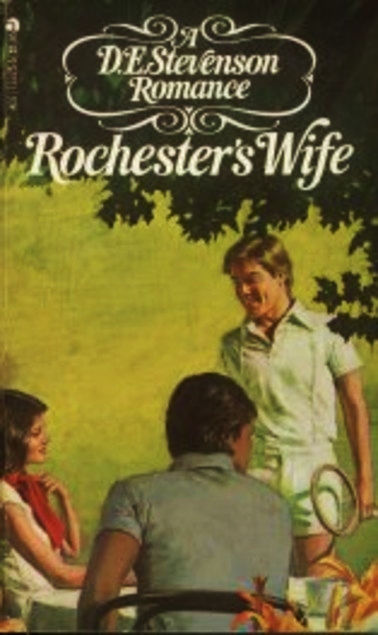
rochester's wife d.e. stevensonRochester’s Wife by D.E. Stevenson ~ 1940. This edition: Ace, circa 1970s. Paperback. ISBN: 978-0441733255. 335 pages.

My rating: 5/10.

*****

This is one of the “secondary” D.E. Stevensons, and, I believe, a “stand-alone” book, as none of the characters seem to reappear in any of the other stories. Though published in 1940, the time frame is pre-W.W. II, as there are only a few references to the “situation in Europe”, and, though the atmosphere is cloudy with foreboding, the focus is on the troubles of the individual characters, versus those of the wider world.

Young (in his late twenties) Dr. Kit Stone has returned to England after four years of travelling round the world seeking adventure. He had long cherished the ambition to become a sailor, but his (widowed) physician father had pressured him into studying medicine instead, with a view to taking over the family practice. The elder Dr. Stone died just as the younger Dr. Stone qualified, and the practice was instead sold, with the proceeds being split between the family’s two sons. The elder brother, Henry, had gone into business as a successful stockbroker and invested his share accordingly, while Kit, suddenly at loose ends, has decided to see something of the world.

Kit’s travels are touched on continually throughout the novel, and sound quite fascinating in and of themselves. He’s been in China, “looking for the war”, and has seen more of it than he had planned for. There is a reference, near the end of the book, to his standing in a marketplace when a shell fragment kills a mother and baby standing next to him; he is “spattered with their blood”, and there is a statement that he has seen quite a lot of blood in his travels. Strong stuff for this mild romance! Another incident, which has more bearing on the eventual plotline, is that Kit has had experience with diagnosing and treating a case of insanity while in America. One would rather like a full itinerary of his wanderings; he seems to have covered quite a lot of ground!

So now Kit is back in England, and though he still feels that he can’t bear to be “tied down”, he allows his brother to persuade him to try out steady employment for a while. Henry’s business partner, Jack Rochester, lives in the village of Minfield, just out of London. Jack’s wife, Mardie, is good friends with the elderly village doctor, who is getting overwhelmed with the demands of his practice, and when she hears of Henry’s brother’s sudden return, puts forward the idea that perhaps Kit might be interested in a position as assistant to the Minfield practice.

So Kit, rather reluctantly, agrees to try out life in an English village. Dr. Peabody welcomes him with gruff suspicion, which we (and Kit) immediately see as merely hiding hte proverbial heart of gold. The Peabody household consists of the elderly doctor, his bitter spinster daughter Ethel, and a grandson, precocious (and exceedingly likeable)young Jem, who is living in England for the “healthy climate” while his parents reside in Ceylon on a tea plantation. They are soon joined by another daughter, Dolly, recently married and, unbeknownst to her family, newly pregnant. Her husband, stationed in Malta, has asked her to stay in England because of her pregnancy, and Dolly’s reluctance to share this news with all and sundry has led to some speculation that perhaps her marriage is already in trouble, because otherwise why wouldn’t she be following her spouse?! Dolly and Ethel are the classic bickering sisters, and their feuding and continual cutting comments to each other add a lot of spice to this rather pedestrian tale.

The heart of the novel is an (apparently) doomed love triangle between Kit, the absolutely beautiful, charming and saintly Mrs. Rochester (Mardie), and her high-strung husband, Jack. Kit is immediately smitten with Mardie; Mardie is deeply in love with Jack; Jack depends on Mardie for emotional support as he deals with his stressful job, and much is made of how happy Mardie and Jack were in the first year or two of their marriage, though now, in year three, things are rather more difficult.

As young Dr. Stone is absorbed into the Minfield world, all seems to be going well with the “settling down” process, but for the unrequited love bit. Kit yearns for his unavailable love, and we start to see little hints that perhaps his passion isn’t exactly unappreciated and unreturned, but of course, there is that rather prominent husband in the picture. Jack, however, is showing signs of what could be charitably described as nervous tension; his personality is deteriorating by the day, and Kit and Dr. Peabody are soon looking up the characteristics of “insanity” in their medical books, and talking of bringing in a specialist.

The ending of this tale is a bit sloppy and unlikely, though everyone ends up neatly paired and with problems happily solved. I’m sorry to say that this is not one of D.E. Stevenson’s better efforts among those I’ve read so far, though there are many diverting situations throughout the book, mostly concerning secondary characters. We have the relationship between the Peabody sisters, young Jem with his brilliant talent for mimicry, an elderly Scottish housekeeper, Hoony, and her illegitimate grandson, Wattie, and, off in the background, the very happy marriage between Henry and his rather liberated wife, Mabel, who dabbles in the stock market quite successfully on her own, with her husband’s proud approval. The relationship between the two brothers, Kit and Henry, is nicely portrayed as well. They do seem a likeable family, with reassuringly human flaws fully recognized and easily forgiven by the reader.

A reasonably decent read, though I found myself groaning and figuratively smacking hand to forehead occasionally, especially regarding the whole “insanity” thing, and the remarkable (!) scenario the author has dreamt up for its resolution. Definitely worth reading as part of the D.E. Stevenson canon, though I’m afraid I closed the book and said farewell to the characters with a feeling more of relief than reluctance!

rochester's wife d.e. stevenson daylily detail 001And I must say something about the dreadful paperback cover. (Cover illustrations being, as some of you may have gathered by my continual harping on the subject, something of an issue with me.) Why, oh why do publishing companies insist on putting “current” illustrations on books set in past times? The characters illustrated on the Ace cover are obviously from the 1970s in dress and hairstyle; I cringe when I look at it. The only thing that that I found attractive (and here is the hort in me speaking) is the rather lovely inclusion of a border of tall orange daylilies (probably Hemerocallis fulva ‘Europa’ from the looks of them), in the foreground of the trio of tennis players and extending around the back of the cover.

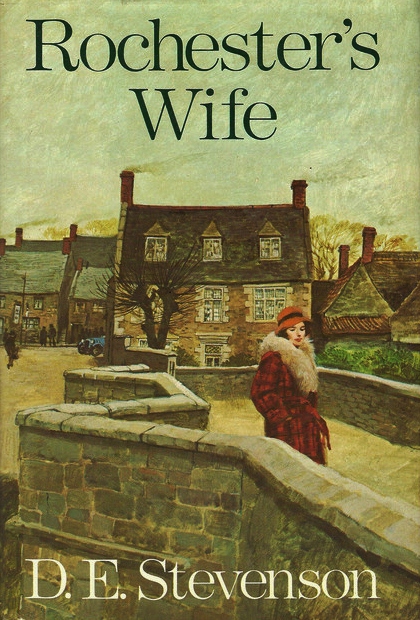
Much more appropriate is this other coverrochester's wife hc dj d.e. stevenson, which captures the mood and setting exceedingly well.

I am coming to the end of my personal stash of D.E. Stevensons, and the more I read of her the more eager I am to go on with building the collection. It’s going to be an expensive year, I fear. Even the tired old paperbacks are seriously overpriced, but I’m afraid I’m now hooked and will be playing the seeking game to the full extent that my pocketbook allows.

Part of the fun is the glorious awfulness of some of Stevenson’s scenarios – I just now have realized I’ve made no mention of the Jane Eyre references in this particular novel – nothing subtle about that, is there?!

D.E. Stevenson. When she is good, she is very, very good, but when she is bad … maybe she’s even more interesting!

A happy find yesterday while book-shopping! Two volumes of poetry by Edna St. Vincent Millay, Collected Lyrics and Collected Sonnets, both published by Harper & Row mid-2oth Century, with poems chosen by Millay herself. And while peacefully reading Lyrics this rainy, windy morning, the following struck me as almost too perfectly appropriate.

Enjoy.

Raindrops turn to icedrops as the wind comes from the north ... Hill Farm, April 5, 2013

Raindrops turn to icedrops as the wind comes from the north … Hill Farm, April 5, 2013

Northern April


O mind, beset by music never for a moment quiet, –

The wind at the flue, the wind strumming the shutter;

The soft, antiphonal speech of the doubled brook, never for a moment quiet;

The rush of the rain against the glass, his voice in the eaves-gutter!


Where shall I lay you to sleep, and the robins be quiet?

Lay you to sleep – and the frogs be silent in the marsh?

Crashes the sleet from the bough and the bough sighs upward, never for a moment quiet.

April is upon us, pitiless and young and harsh.


O April, full of blood, full of breath, have pity upon us!

Pale, where the winter like a stone has been lifted away, we emerge like yellow grass.

Be for a moment quiet, buffet us not, have pity upon us,

Till the green comes back into the vein, till the giddiness pass.


Edna St. Vincent Millay ~ 1928