Well, I made it through a truly challenging week involving having to be in way too many places on much too tight a schedule, and battling a wicked cold to boot. But here I am in Chilliwack, to accompany my daughter who is participating in the annual provincial Performing Arts Festival. We made it to registration with 20 minutes to spare, which was cutting it just a bit fine, but we’re here and she’s got all her stuff in order and we’ve had a late meal and the beds feel pretty comfy in our hotel room. I’m hoping to get some down time while she’s attending workshops, maybe even work on the sadly neglected blog for a bit.

It all feels a bit surreal. This morning I was working like a mad thing in the greenhouses, trying to prepare things to be left under my son’s willing but just slightly disinterested care; tonight I’m far away from it all, and enjoying the glories of the coastal spring. Rhododendrons are in full bloom, among so much else!

I brought three books along, two of them last-minute grabs from the tried-and-true shelf. Rumer Godden’s China Court is one of my favourites, and I’ve also read Monica Dickens’ The Winds of Heaven several times, but neither very recently, so they will be welcome diversions. I’ve also been saving Elizabeth von Arnim’s Elizabeth and Her German Garden for an auspicious time; this might at long last be it.

I understand there is a marvelous bookstore in Chilliwack, The Book Man, and sure enough, in my daughter’s “swag bag” full of goodies and promotional stuff, there is a bookmark with the store info on it. My free-time agenda for tomorrow is taken care of!

That bed is calling, so I’m going to log off now, but I’ll be back shortly, to chat a bit about books. Stand outs recently were The Sisters Brothers by Patrick deWitt, and No Love by David Garnett.

Good night, all.

Lilacs, evening, Hill Farm May 16, 2013The lilacs are once again blooming, bringing into sharp focus the swiftness of Time’s passing from year to year. Another spring – how can that be? Wasn’t it just yesterday that the lilacs faded away…? (And is it symbolic that this photo was taken in the fading light of evening, after I’d made my way past the fragrant clouds of bloom all day long, too busy to stop and appreciate their so-brief perfection? Oh my, did I just really write that?! Sounds a bit pathetic, doesn’t it? <sigh> Spring makes me just a tiny bit sad…)

It’s certainly been a while since I last posted, or at least it feels that way. The Annual Spring Crazy-Busy Time has completely taken over my life, and though I’ve been reading in snippets here and there the time to write about the books has been impossible to find.

As some of you know, I operate a small plant nursery, and the month of May is peak season in the green world. Added to this, my teen daughter, a dancer, has one more competition coming up in a very few days, and then, with only an afternoon and morning to catch our breath, a whirlwind trip to the provincial performing arts festival, so the juggling routine is in full hectic form. I barge around madly, from greenhouse to garden to prep area and into the car for chauffeur duties. It’s all getting done, but the extras are most definitely on hold. Like the book blog. Which is a shame, because I’ve read some good stuff lately, and I know by the time I can sit down to talk about it too much time will have passed for fresh and in-depth reviews.

So I’ll just mention a few of the highlights – both excellent and not so much –  here. I think the theme for May might well be “eclectic” – these are coming from every direction!

The Menace from Earth by Robert A. Heinlein – science fiction short stories from the 1950s. Heinlein at his vintage pulp fiction best. Some dark, some funny, all tremendously dated, but every one with the expected Heinlein twist. Most enjoyable! I do believe I have a review started, which I might get completed and posted at some point in the near future if I find myself in a hotel room with an hour or two to spare, which may well be the case as the dance road trip is looking good to go.

I Married the Klondike by Laura Beatrice Berton – an excellent memoir of the shadow side of the Klondike Gold Rush, of what happens when the boom fades away, and the people leave, and the once seething-with-life buildings start to collapse under the weight of winter snows. Why have I not read this before? It was very good reading indeed, both from a historical and a personal perspective. Laura Berton’s clean and concise style and her well drawn and frank descriptions of her twenty-five years in the north were fascinating. Reading this book helped to explain where the iconic Canadian writer Pierre Berton got some of his writing talent from; Laura is Pierre’s mother, and she was an aspiring writer long before her much more famous son ever came along. This one definitely deserves a proper review, which I hope to give it one day.

The Big Red Train Ride by Eric Newby – I’d tried hard to get into this one, but it felt way too much like Theroux-lite. Newby is full of snide little comments about pretty well everything he encounters in his 1970s journey into Russia, but can’t quite pull of Theroux’s trick of combining blatant bitchiness with fabulous writing. Newby’s literary talents are iffy at the best of times, but adequate for his more compelling memoirs, such as A Short Walk in the Hindu Kush, and When the snow comes, they will take you away, but in Train Ride and the recently read Around Ireland in Low Gear the contrived tone dominates. So why did you make these trips, Eric? Merely to provide frameworks for new books? Tough to pull off, and with these two Newby quite frankly doesn’t quite do it.

Roman Spring and other stories by Edith Wharton – a range of short stories, most with Wharton’s trademark poignant sadness. Some forgettable, some brilliant. Just the right thing for bedtime reading; a mix of engaging and soporific – a true lucky dip!

Mexican Days by Tony Cohan is a recent travel memoir, which started off reasonably well, but which deteriorated into the kind of navel gazing “what is my life all about anyway” stuff which I really can’t get my head around when all I really wanted was witty and thoughtful observations on the country and its people. A bit self-indulgent, I felt, though parts of it were excellent. I won’t write this author off by any means, but he has garnered a nebulous question mark in my brain. His other books could be more typically “travel writing”, in which case I’m all for him, or they could be all angsty and personal, in which case I’m not all that interested.  His personal “problems” – a complicated marital arrangement and the intrusions of other expatriates into his private Mexican paradise – are rather unrelatable to me. But I’m interested enough in him as an author to add him to my library list. A reserved “not bad” is what I’ve settled on. For now.

And right now I’m engaged – in 15 minute intervals, which is all I can mange before my eyes lose focus and I drop into that sudden sleep of the completely exhausted, waking briefly to remove my glasses and click off the light as the book drops from suddenly limp hands onto my face – in Laughing Gas by P.G. Wodehouse. I think I’m on page 65 or thereabouts, or about 3 nights worth of reading – rather pathetic for this usual book-a-dayer, isn’t it? – and I’m liking it. A lot.

In other news, the Fraser River reached an apparent 10-year-high water level (for this area of the province) just a few days ago, and we were modestly inundated on the lower level of our farm. The fields are suddenly full of Canada geese – complete with several lots of adorable brand-new goslings – and an assortment of wild ducks, all dabbling happily in the-muck-that-was-the-horse-pasture. The water has receded a bit since this photo was taken, and we’re hoping this was it for the year’s high water. The field’s-edge erosion does not bear thinking about; the downside to living beside the relentless Fraser. Last year’s high water came a few week’s later, and was quite a bit more severe, so I’m rather bemused by that “10 year high” designation, though I know it varies by how much run-off is swelling the many side rivers, creeks and streams that feed the arterial Fraser, and at what point in region the water level measurements are taken. (Does this picture look familiar? If so, it’s because I posted a similar one in this space a year ago, to mark the 2012 high water episode. This is definitely not the every-year norm, so two years in a row is rather noteworthy, though we’re getting increasingly casual about it after so many years here. It comes up, it goes down. How much property are we the poorer this time? Oh well, no sense to get too stressed out about it; the river does what it does and nothing we can do will change it!)

Oh! – one more thing. The Folio books from the anniversary book give-away are IN THE MAIL, so the winners should be receiving them fairly shortly, if they haven’t already.

Happy reading, all!

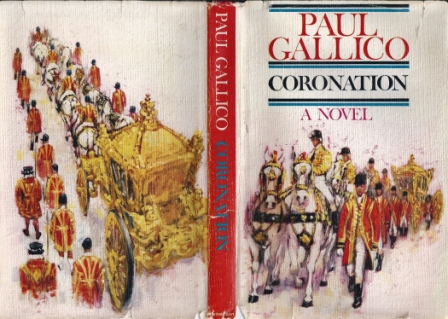
coronation paul gallico 001Coronation by Paul Gallico ~ 1962. This edition: Heinemann, 1962. First edition. Hardcover. 128 pages.

My rating: 6.5/10.

I struggled with this rating. It was a sweet, ultimately upbeat story, and my sentimental side wanted to put it higher, but I couldn’t quite bring myself to do it. The major reason is that while the cover trumpets “A Novel” this slight effort is, in reality, only an extended short story, a novella. The secondary reason is that the characters are so dreadfully clichéd that they never truly came to life for me, though there were glimpses of what made them all tick here and there. Perennially sour and cranky Granny was perhaps the most “real” of them all, the most believable.

A working-class family of five, mother, father, two children and grandmother – the mother’s mother – decide to forego their annual seaside vacation and instead spend their meager holiday savings on a day trip to London to view the Coronation procession of Queen Elizabeth II. By a great stroke of luck, they’ve been put on to a wonderful opportunity: window seats in a grand house situated on Hyde Park Corner, plus a buffet lunch. With champagne. All this for only 10£ each – the tickets were marked down from 25£ – an amazing stroke of luck! What a good thing it was that cousin Bert in London was able to make the bargain purchase through one of his “connections”!

Steel mill shift foreman Will Clagg is bestirred by patriotic pride and a deep affection for his young, beautiful Queen; his wife Violet pictures herself elegantly sipping champagne (which she’s never tasted) like one of the film stars she so idolizes; 11-year-old Johnny, who cherishes a deep ambition to one day become an officer in the British Service, is thrilled to be able to see the massive parade of troops from all corners of the Commonwealth; 7-year-old Gwenny has her own private image of what she’ll see, the fairy-tale princess from one of her storybooks, a personal infatuation about to be fulfilled; Granny, the last hold-out to the proposed excursion, swings into agreement when it is pointed out that she saw the Funeral Procession of the last Queen, Victoria; how fitting that she should see the Coronation Procession of this one. “A living link, you are!” her despised son-in-law cries, and Granny lets herself be swayed.

In to London on the Coronation Special from Sheffield, to join the masses of humanity streaming in from every corner of England, and beyond. But when they finally struggle through the crowds to the address of their front-row-seats-and-champagne-lunch, what greets their shocked and unbelieving eyes is something very different from what they had expected…

Things I Liked About This Story:

Granny – The author creates an unlikeable character, allows us to despise her, and then strips away the surface veneer just for a few moments to allow us to understand the source of her bitterness, after which we are fully on her side. This was a delicately balanced little episode, and Gallico played it just right.

No Miracle – We are expecting some magically positive resolution to the family’s bitter dilemma. We don’t get it. The worst happens. A brave move on the author’s part; he bucks the expected trend.

The Scene – The glimpses of the actual Coronation going on very much in the background of the family’s experiences on the street, as it were. A wonderful depiction of what it musty have been like to be in the crowd of that day. A grand little novella for this reason alone, even without the contrivances – and they were sometimes very contrived – of the sentimental plot.

Will Clagg – Gallico’s tribute to the British Working Class Everyman. Will is decent, hard-working, self-sacrificing, deeply patriotic, deeply paternal, and he loves his wife dearly. Awww, how wonderful! Seriously though, he is a very decent sort, and I liked him thoroughly, saddled as he was with meek and rather silly Violet, her shrewish mother, and rather soppy little Gwenny. Which leads to what I didn’t like about the story.

Things I Didn’t Like About This Story:

The cookie-cutter stereotypes of all of the characters, from wee Gwenny to nasty-but-ultimately-heroic Granny to the policeman at the parade barricade. Every single one was true to the clichéd type we’ve come to expect from that particular place and era; no surprises there at all, though I will admit that Gallico presented his characters well.

The general meekness of every member of the family to their bitter individual disappointments, and the sops which the author created to soothe their woes. Just a little too simplistic, I thought, and the acceptance was too pat. Just a bit. (Says my inner cynic.) Is anyone really that stoic? Little Johnny in particular seemed to be very stiff-upper-lip about, well, everything. A bit of an unnatural child, surely. (But this very stoicism is perfectly suited to Johnny’s ambition of one day being a Noble British Army Officer, I’ll give Gallico that.)

Will’s misogyny towards women. This struck a rather sour note with me. Sure, he loves his wife and the kiddies, and puts up with his sour mother-in-law with good grace, and generally maintains a mild good nature. But Gallico’s little aside near the end of the story, as the family is ordering their meal in the restaurant car, set my teeth on edge.

For all of the fact that Will was a heavy, thick-set, powerful brute of a man who had fought his way up from the ranks of men to command them, he had learned something of the little things that tickled women, an extra ribbon on a dress, or some chintz at a kitchen window. They were not like men, they were more like children. And from the very beginning he had understood that the item which had sold Violet on the whole Coronation scheme and had overcome whatever scruples she might have had, or dissents she could have cooked up, was the champagne, the drink of bubbly advertised with the lunch. He had not, of course, been able to get wholly into her mind and visualize how she saw herself holding the special glass in her hand, the little finger cocked most elegantly, while she contemplated the bubbles rising in the yellow fluid before knocking it back, but he did appreciate that somehow this was to be the focus of the day for her, just that little extra something which sells or captivates a woman.

Well, speaking as a woman, when I read that passage my immediate reaction was “Ouch!” Of course men are above such trivial enjoyments. Being all thrilled at the sight of your name in a minor article in the newspaper is of course something quite different and not nearly as silly as a longed-for taste of champagne, eh Will? Ha!

My husband, who read this book before I did, was completely right, though. He passed it over to me with the comment that it was an enjoyable little story, in a minor sort of key. Which it was. I wouldn’t necessarily recommend it to anyone, but if you come across it, it’s worth the hour or two of reading time it will take, if you are tolerant of deeply sentimental, “proud-to-be-an-Englishman”, and God Save the Queen goings on.

It was rather sweet.

And here are some other reviews, well worth checking out.

Stuck-in-a-Book liked it unreservedly.

Fleur Fisher shared my minor reservations, as did My Porch, but both nodded in appreciation to the good things that I also liked about this little tale.

Surfacing briefly from the May supreme busy-ness which only escalate in the coming weeks – I’m in the plant nursery business –  to talk a bit about a book. Much as I’d like to maunder on in-depth about everything I’ve been reading recently, there are those pesky time constraints…

A week ago it was below zero (Celsius) and snowing; today, in our region’s typical spring weather extremes fashion, it is forecast to hit the mid-plus-20s. The sun is coming across the valley (we’re nestled at the foot of the east side, tall hills behind us) so until it hits us directly I’m off-duty, as it were, from going out and tinkering with greenhouse ventilation systems. (Well, fans, windows, doors and roll-up hoop house side panels – not very fancy – but “ventilation systems” sounds much more professional, doesn’t it?) 😉

The second Sunday morning cup of tea is at hand – I’ve already consumed the first propped up in bed finishing a re-read of Tom’s Midnight Garden –  and I’ve a short but sweet guilt-free chunk of non-work-related computer time before I need to be really up and moving again. Here we go.

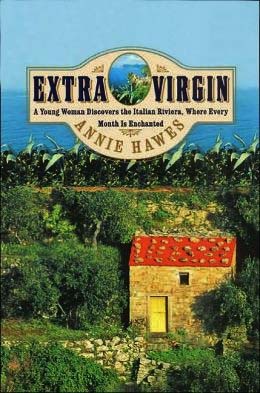
extra virgin annie hawesExtra Virgin: A Young Woman Discovers the Italian Riviera, Where Every Month Is Enchanted by Annie Hawes – 2001. This edition: Harper Collins, 2001. Hardcover, first American edition. ISBN: 0-06-019850-8. 337 pages.

My rating: 9/10.

I almost didn’t pick this one up, but was intrigued by the (presumably) Elizabeth von Arnim reference in the subtitle. What I found inside this densely written creative autobiography was a better reward than I deserved for my initial hesitation. It’s taken me a good week of hard-won reading breaks to get through it all, but I was never tempted to set it aside in exchange for something shorter and easier. This one was a quiet pleasure from Prologue to reluctantly-turned last page.

Back in the early 1980s, a young Englishwoman, recently turned down as a “poor risk” in her attempt to receive bank financing to buy her own home in England, is at loose ends and feeling rather sour about life in general. Her sister convinces her to come along on a working trip to Italy, grafting roses for a small commercial operation in the Ligurian hills, in the region of the “Italian Riviera”.

Annie is a rose-culture neophyte, but her obviously experienced sister coaches her through the first thorny weeks, after which, settled well into their temporary occupation, the two find themselves occasionally with time to explore the surrounding countryside. On one of their off-duty hill walks they come across a derelict stone house in a neglected olive grove, and when the local real estate entrepreneur scents their interest, they find themselves possessed of a rural Italian property for the unbelievably cheap sum of 2000 pounds. The facilities are primitive to the extreme – water is bucketed up from a shallow dug well, and an outdoor shower and “earth closet” are needed for sanitary purposes, but the two settle into their new life with optimistic tenacity.

This is a rather different tale from the usual “we bought a place in a foreign paradise and hired quaint locals to fix it up” lifestyle porn. Written several decades after the purchase, the tone is not at all cutesy and patronizing. The sisters go to and from England and Italy regularly for many years – England for the “real” jobs which earn the funds to return to Italy for the love of the place, and, increasingly, the people.

I’ll tease you by revealing that Annie is not all that forthcoming about personal details, but more than makes up for it in her portraits of others, and in her much too brief comments regarding her own family. As well as the sister of the Ligurian enterprise there are three brothers, several of whom chip in to provide much-needed labour and even fire-fighting assistance during the progressive slow Italian house and olive grove renovations which stretch over the years.

Other reviewers – I briefly scanned the book’s page on Goodreads – had issue with some of the stylistic devices the author used, but I found them to be a non-issue, personally. Extra Virgin is written from the “we” viewpoint throughout, only slipping into “I” near the end. Much ironic use of capitalized terms – the Sulky Bar, the Evil Sister, the Poor Stranger, and so on. Again, for me, not a problem. The Author stayed most consistently true to her Chosen Style.

I did just a bit of research on Hawes after finishing Extra Virgin, and was more than intrigued by what I found – Annie’s back story includes a teenage marriage and a residence in Portugal, a child of that (quickly dissolved) marriage, much travelling and a “real” career as a film editor. Not much of this comes out in the Italian tale, but apparently her succeeding books, Ripe for the Picking and A Journey to the South, are more personally revealing. There’s also a Moroccan memoir, A Handful of Honey.

Annie’s second career as a memoirist is a definite success, at least enough so that, according to an author interview which appeared on the Harper Collins website, she now has indoor plumbing in Liguria.

I enjoyed the author’s voice in Extra Virgin enough that I will be seeking out her other books as soon as I am able to. She writes with a wry, dry humour and a very individual style, just short of “travel writer” parody. In a very good way. Loved it.

Oh – one more point in favour. Annie Hawes can certainly write about food! Amazing descriptions of the wild-crafted, gardening and culinary abundance of Liguria. I absent-mindedly found myself lining out yet another flat of basil seedlings and potting up extra eggplant babies while musing on my ongoing reading of Extra Virgin while out in my own very earth(l)y paradise this past week. This book made me hungry. Again, in a very good way.

The Father Brown Stories – LISA

Greengage Summer – TRISH MEARS

The Franchise Affair – MELWYK

I’ve just emailed the winners to ask for mailing addresses, so keep an eye on your inboxes, you three.

Congratulations, and I hope you enjoy the books!

Everyone else who entered – I wish I could give each and every one of you something special in appreciation for your many kind and encouraging and thoughtful comments over the past year. In any event, a heartfelt “Thank You” must suffice for now. I’ll be doing this sort of thing occasionally, I think, so maybe next time…

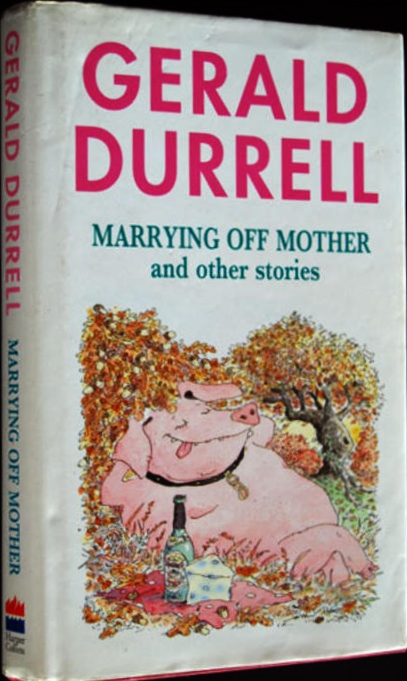
marrying off mother gerald durrellMarrying Off Mother and other stories by Gerald Durrell ~ 1991. This edition: Harper Collins, 1991. Hardcover. ISBN: 0-99-223808-X. 197 pages.

My rating: 8/10.

A quick, easy, and enjoyable read.

I have a strong fondness for Gerald Durrell’s self-aware, tongue-in-cheek, and humorously wry writings, stretching back to a childhood introduction to his books when my parents were given a copy of Catch Me a Colobus. My father had it on his night table, and was reading it with evident enjoyment, and when I asked him what it was about he handed it to me with a smile. I laboriously read it – I was of the tender age of 8 or 9 at the time – and was hooked.

Since then I do believe I’ve read every single thing the man wrote, with the exception of some of the juveniles of the writer’s last years. Obviously not an exclusive reaction, as Gerald Durrell was a best-selling author and eventually a household name in the English-speaking world –  right up there with the even more prominent David Attenborough –  though he (Durrell) bluntly stated in his later books that the income from his writing helped in great part to finance his pet project, the Jersey Zoo & Wildlife Preservation Trust , and that he continued to produce manuscripts only for the purpose of furthering his wildlife work.

Be that as it may, the man did have a decided literary talent, and in later years broadened his scope from the autobiographical to the more obviously fictional, with several novels and a number of short stories to his credit.  Many of Gerald Durrell’s fictional short stories show a decidedly macabre twist to the man’s mind; one in particular, The Entrance, the final story in The Picnic and Other Pandemonium – an otherwise quite light-hearted and delightful compilation – has the distinction of being one of the creepiest and most frightening tales I’ve ever read, and rather put me off Durrell completely for a while, giving an unwelcome insight into something other than the avuncular animal-loving anecdotist one innocently assumed. I got over it, though I still think of that particular book with a reminiscent shudder, and have studiously ignored it ever since. Though now that I’ve been reminded, I have the feeling that I should perhaps face my fears and re-read it and review it. Maybe. Or maybe not…

As usual, I’ve digressed. Back on track, then, with a rundown on this short story compilation, which, though a bit dark in places, was, as always, mostly just plain diverting reading, perfect for tea break consumption – engaging but not too challenging, and easy to take up and put down.

  • Esmeralda

Of all the many regions in La Belle France, there is one whose very name adds a lustrous glitter to the eye of a gourmet, a flush of anticipation to his cheeks, that drenches his taste buds with anticipatory saliva, and that is the euphonious name of Périgord. Here the chestnuts and walnuts are of prodigious size, here the wild strawberries are as heavily scented as a courtesan’s boudoir. Here the apples, the pears and the plums have sublime juices captured in their skins, here the flesh of chicken, duckling and pigeon is firm and white, here the butter is as yellow as sunshine and the cream on top of the churns is thick enough to balance a full glass of wine on. As well as all these riches, Périgord has one supreme prize that lurks beneath the loamy soil of her oak woods, the truffle, the troglodyte fungus that lives below the surface of the forest floor, black as a witch’s cat, delicious as all the perfumes of Arabia.

Enter one Esmeralda, a porcine lady graced with a delicate golden chain around her neck, and smelling delicately of the exclusive perfume Joy…

  • Fred – or A Touch of the Warm South

On a lecture tour of the American South, our author is hosted by a Traditional Southern Lady, and meets her butler Fred. By the by, the amount of ardent spirits consumed during this short foray into Tennessee give an insight into Durrell’s subsequent liver problems. The man did seem to enjoy tipping them back!

As the taxi drew up (the) handsome door was thrown open to the frame by a very large, very black gentleman with white hair in tail coat and striped trousers. He looked as though he might be the accredited Ambassador of practically any emerging nation. In the rich port-like tones that I remembered from the telephone he said, ‘Mr. Dewrell, welcome to Miz Magnolia’s residence.’ and then added as an afterthought, ‘Ahyam Fred.’

‘Glad to know you, Fred.’ I said. ‘Can you handle the luggage?’

‘Everything will be under control,’ said Fred.

The taxi driver had deposited my two suitcases on the gravel and driven off. Fred surveyed them as if they were offensive litter.

‘Fred,’ I said, interested, ‘do you normally wear that clothing?’

He glanced down his body with disdain.

‘No,’ he said, ‘but Miz Magnolia say ah was to greet yew in traditional costume.’

‘You mean that this is traditional costume here in Memphis?’ I asked.

‘No suh,’ he said bitterly, ‘it’s traditional costume where yew comes from.’

  • Retirement

A Scandinavian ship’s captain looks forward to his last voyage and retirement beside the sea, but his plans are tragically set at naught. A delicately appreciative tale with a chillingly memorable ending.

  • Marrying Off Mother

A return to the sunny Corfu of My Family and Other Animals, and an attempt by her children to bring some romance into Mrs. Durrell’s life.

‘I wonder if passion flowers would look nice on that east wall,’ said Mother, looking up from her seed catalogue. ‘They are so pretty. I can imagine that east wall just covered with passion flowers, can’t you?’

‘We could do with a bit of passion around here,’ said Larry. ‘Just recently, the place has been as chaste as a nunnery.’

‘I don’t see what passion flowers have got to do with nuns,’ said Mother.

Larry sighed and gathered up his mail.

‘Why don’t you get married again?’ he suggested. ‘You’ve been looking awfully wilted lately, rather like an overworked nun.’

‘Indeed I haven’t,’ said Mother indignantly.

‘You’re looking sort of shrewish and spinsterish,’ said Larry… ‘And all this mooning about passion flowers. It’s very Freudian. Obviously what you want is a dollop of romance in your life. Get married again.’

‘What rubbish you talk, Larry,’ said my mother, bridling. ‘Get married again! What nonsense! Your father would never allow it.’

‘Dad’s been dead for nearly twelve years. I think his objection could be overruled, don’t you? …’

Never fear. Mother competently turns the tables on her meddling family.

  • Ludwig

Do Germans, as a race,  have a sense of humour? The author attempts to answer this query with the cooperation of a willing-to-learn hotel manager, one Ludwig Dietrich.

  • The Jury

A former British public hangman is discovered to be living in a remote South American village. Though he has tried to make a new life for himself, he can’t outrun his past. An appropriately nasty ending awaits him, with our author as chief (fictional, one would hope and assume) witness.

  • Miss Booth-Wycherly’s Clothes

An ex-nun creatively and anonymously supports her old order’s orphanage, with the help of the bequest of the magnificent wardrobe of the deceased Miss Booth-Wycherly of Monte Carlo.

  • A Parrot for the Parson

The gift of a foul-mouthed parrot assists a defrocked vicar in his quest for replacements for the choirboys he longer has easy access to. Immensely politically incorrect, but rather funny in an “I shouldn’t be laughing at this” sort of way.

???????????????????????????????I’m not sure what’s going on with my reading this spring; I seem to have gotten stuck among the crinolines, as it were (though only one of the books I’ve read has actually had crinolines in it, this being the just-post-Civil-War Sea Jade), what with my newly discovered fondness for Georgette Heyer’s Regency heroines, and now these two similar but oh-so-different “American gothic” vintage romances. Maybe it’s just that I’ve run out of D.E. Stevensons, which made admirable escape reading through much of March.

April – unbelievable that it’s so close to over already! – has brought its usual share of real life busy-ness, what with being in the plant nursery business, and still providing taxi service to the dancer, and a mountain of paperwork relating to taxes, and even a little bit of lambing, though we’re presently down to a tiny vestige of our former flock, and sometimes I almost forget that they’re out there, what with the more-than-competent teens running things in the barnyard these days.

Spring does seem to have arrived, after dragging her heels rather reluctantly this year, and yesterday brought us a warm wind and the overnight emergence of leaves on the cottonwood trees down by the river – with associated heavenly aroma; the colloquial name for these trees is “Balm of Gilead”, and the fragrance of the sticky sap is indescribably spicy and fresh and green and evocative of every good thing about spring in the country. Our venerable (and almost completely non-productive) apricot tree has blessed us with blossoms this year and yesterday was alive with bees, and (hurray!) the hummingbirds are back. The harbinger of what will become a lively and prolific horde, a lone male Rufous, buzzed through the garden, hovered low to visit the first opening Pulmonaria blooms, and danced in front of the kitchen window, an action which brings forth the lady with the sugar syrup every year.

???????????????????????????????

Amazing that such tiny scraps of feathers and attitude make such long journeys twice a year on their migratory travels, and every year I wonder just how long each individual can survive for. I know we have some of the same birds year to year; how else to explain their immediate presence at the traditional feeder sites before I get the sugar water out, and the buzzing at the one window next to the door where I always emerge with the top-ups through the months when we host our demanding little visitors?

The mosquitoes are here as well, and this less welcome sign of spring was in evidence yesterday. Slapping mosquitoes with potting soil encrusted hands leads to embarrassing smudges on the face and dirt in the hair; luckily I had no human visitors to comment on my disarray! In the evening we built a fire out in the stone ring by our favourite sitting spot on the lawn and ate our supper in a cloud of smoke (welcome because it discouraged the mosquitoes), kept company by the two dogs, the two “barn” cats – big joke, that designation – they are in the house more than occasionally – plus the three “real” house cats, who are glorying in the present situation of open windows unblocked by screens. In and out at will all day long without needing a human hand on the doorknob – feline nirvana!

The teens, careless as only those in the second decade of life can be to the quiet joy of sitting out on a spring evening, were firmly planted in front of their laptops, cruising Facebook and doing whatever else it is that they do when enjoying their non-school-related screen time, though they did remember their filial duties enough (once reminded by loud calls from the father figure) to bring their parents a welcome cup of tea. (It wasn’t that warm out there, even with the fire.)

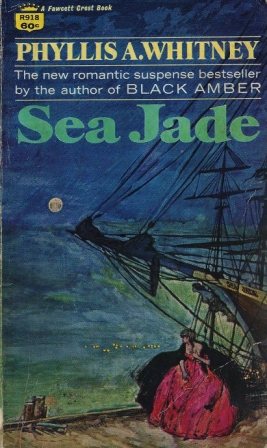
We sat and read until it was too dark to see the words, and I powered through the book I’d grabbed from the “recent acquisitions” pile in the porch, where I’d been going through them and making up a box full for my housebound elderly mother. Mom enjoys the occasional Phyllis A. Whitney, and I’d found an older one with a gorgeously gothic cover illustration, Sea Jade, which didn’t ring a bell as one she’d already read. “I should really try this,” I thought to myself. “Perhaps, like Heyer, Whitney is one of those authors I’ve ignored for too long. Perhaps she too has hidden qualities I’ve foolishly been depriving myself of…”

Short answer: nope.

I almost quit on Sea Jade very early in, but was too lazy to get up and go search for something else; and after a while the sheer awfulness exerted a hypnotizing effect, and I was driven to keep reading by the desire to see how many of the stock gothic romance situations the author was going to put her breathless heroine through. (I lost count.)

Which had me musing this morning on what makes a book a “good” read. Why two such books as these I’ve just read can have so many similarities in plot and character and setting, and why one can be so enjoyable, and one such a blatant mistake. Author’s voice is all I can come up with.

Well, if you made it this far, I’m about to get back on track and discuss some books. Both are vintage gothic romances, with American settings, and both are by accomplished and prolific authors. I found it rather interesting that my favourite was by the lesser-known and less popular author. Margaret Bell Houston is virtually unknown now, while Phyllis A. Whitney is still very much in evidence, both in online discussions and on the shelves of used book stores.

Houston’s gothic was very good indeed; Whitney’s was not. Rather disappointing, as I wanted to like Sea Jade so very much… there are so many Whitneys out there, and she’s so easy to acquire, while Houston’s titles, aside from the book I read, Yonder, are much more elusive.
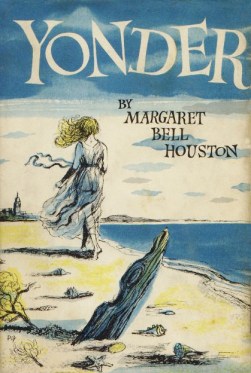
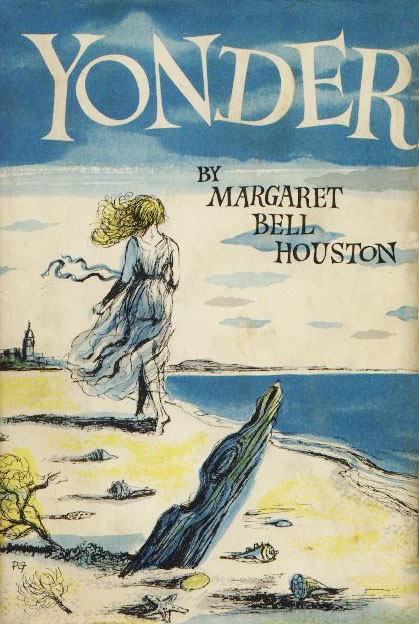
yonder margaret bell houstonYonder by Margaret Bell Houston ~ 1955. This edition: Crown Publishers, Inc., 1955. Hardcover. 242 pages.

My rating: 9/10.

This was one of those rewarding random acquisitions. I was attracted by the eye-catching dust jacket illustration by Paul Galdone, which led me initially to believe that this was a juvenile/teen book. It’s not. (Though any nowadays teen wouldn’t turn a hair at some of the content, which has a decidedly adult theme. Sex and illegitimate babies and so on, not to mention crimes of passion and plenty of psychological drama.)

Olive York, twenty-two years old and recently orphaned by the deaths of her beloved parents in a plane crash on their way to a church convention in California – Olive’s father was a parson – is at a rough point in her life. Her long-time friend-turned-romantic-interest, Dane Carrington, has just married another woman, and, though Olive is a sensible enough girl and does not believe her life is over or anything dramatic like that, she’s looking for a way to move on.

When she’s offered a job as a companion to an emotionally troubled relative of the Carringtons, she’s intrigued both by the vague explanation of Zoé Croome’s “insanity”, and by the descriptions of the Croome family’s estate on a remote Florida key, Yonder Island.

Arriving in an almost-hurricane, the setting is all Proper Gothic Romance, and when we meet the Croome family and their assorted associates, we recognize immediately that here is a group of people with more than a few deep dark secrets. Watch out, Olive!

There’s the immense, handsome, stone-faced and monosyllabic black houseman, Ezra; the white-uniformed nurse Nannine; Judge Croome, family patriarch, forceful and intense but obviously getting rather tired of life; the elder Croome daughter, Joanna, wheelchair bound, even more intense than her father and in charge of the operation of the household and Yonder Island citrus groves; and of course Zoé Croome herself.

Thirty years ago something happened, something that isn’t discussed within the bosom of the family, but which is speculated on by the rest of the neighbourhood at large. Whatever It was has affected Zoé so strongly that her mind has stayed locked in time; she speaks and acts as a young woman, repeating the days of her youth over and over again. “This is the day!” she greets every morning, emphasis on “the” day; obviously a day when something marvelous is about to happen. But what could it possibly be?

Not only is her mind stuck in its groove, but her body is as well. Though a woman of fifty, Zoé looks like a young woman – unaged and of an ethereal beauty. She is “crazy, but not violent”, and a delicate hand is needed in her management. She is constantly looking or someone or something, and if she is locked up she goes wild with self-destructive passion; her bedroom windows are barred to prevent her throwing herself out, as she once attempted to. Olive’s primary job will be to accompany Zoé on her daily meanderings down to the beach, where Zoé collects seashells and gazes longingly at the boats passing by. Occasionally she runs into the waves…

Of course Olive, being a typically forward-thinking person as gothic romance heroines frequently are, is keen to get to the bottom of the many mysteries of Yonder Key, and she is certain she can help Zoé move forward in time and find some sort of personal peace. In this she is strictly forbidden by bossy Joanna to “meddle”, and Ezra threateningly shadows Olive’s every move. Despite this discouragement, Olive persists in putting together Zoé’s back-story, with the increasingly interested assistance of Richard Lowrie, who lives alone in a little house across the island. Richard is working on one of his best-selling books about discoveries made while sailing the world’s seas in his one-man yacht. Richard is a long-time Croome family friend, hence his permission to inhabit his quiet corner of the Key, and is a confidante of both Judge Croome and, in her more lucid moments, Zoé. (Joanna keeps her distance.)

And of course, as Olive starts to investigate and ask awkward questions, things begin to happen.

This was an excellent read. Olive’s voice (the story is told in first person narration) is rather stoic and matter-of-fact, but that was a strength, rather than a weakness; the fantastical elements of the story are rather more believable when presented so dispassionately.  Olive paints vivid pictures of both the world of her own past, and of her new life on Yonder Key. The author has, in general, done well by her heroine in this story, allowing her scope to go about her clichéd path from mystery to resolution with reasonable motivations for everything she does. The romantic interests in Olive’s personal life are very well handled, and, as we discover the secrets of the Croomes, there is a certain plausibility to the tale which allows us to suspend our disbelief in the dramatic scenario which eventually unfolds.

Without going into spoiler mode, because this is a great little book and one which I’d recommend for further investigation to those of you who like a good du Maurier-like suspense novel – and yes, this one deserves to be mentioned in the same breath as the works of Dame Daphne – it is very well done, in a minor key of the genre – I’ll share with you my satisfaction in the ending. The Yonder mystery is solved, and both Zoé and Olive find places of peace after their trials and travails.

I’ll be re-reading this one, I know, as well as looking for other books by the author.

Oh yes, the author. She is (was) Margaret Bell Houston, granddaughter (as every mention of her I can find emphasizes) of Texas soldier and politician Sam Houston, who famously led the state to independence from Mexico in 1836. (“Remember the Alamo”, and namesake of the city of Houston, Texas, etcetera, etcetera.)

Margaret was born in Texas in 1877, and was a published poet at an early age, winning numerous awards for her verse throughout her lifetime. She went on to write short stories, and something like thirteen novels, some of them bestsellers. The one most often mentioned is this one, Yonder, and its more than decent quality makes me immensely curious to explore more of her work. If Yonder is the best thing she produced – it was published in 1955, when the author was 78 years old, and nearing the end of her long life – she died in 1966, at the age of 89 – it must have come from somewhere, and I’m thinking her earlier works would show a similar quality. Yonder is not “high literature” in any sense of the term, but it is a good American light novel.

Is anyone familiar with this author, or any of her other works?

Well, after my satisfaction with Yonder, I picked up Sea Jade with high anticipation. Sadly, I was doomed to disappointment. “Gothic” it was; “good” it was not.

Sea Jade by Phyllis A. Whitney ~ 1964. This edition: Fawcett Crest, 1966. Paperback. Library of Congress Number: 65-12605. 224 pages.sea jade phyllis a whitney 001
My rating: 3/10.

Phyllis A. Whitney. I read her occasionally while in high school, though I can’t remember a thing about any of the books. Seven Tears for Apollo is one that comes to mind; I’ve had that tattered paperback kicking around for a good thirty years, though I haven’t read it recently – for at least twenty of those years. My general impression, when I stop to think about it, is favorable. My mom likes it, and has read it a few times since I’ve been in charge of her reading material; I’ve picked up other Whitney novels – they’re quite  easy to come by – and she’s read them without comment and with every appearance of enjoyment.

But if Sea Jade is typical of Whitney’s work, I think I’ve perhaps personally outgrown this author.

Sea Jade is set in post-Civil War New England, on the shores of the crashing Atlantic, an ocean-side setting it shares with Yonder to some extent. There’s a similiar situation of massive family mansion inhabited by people with secrets, and the heroines of both enter the scene seeking physical and emotional refuge of sorts. In the accepted tradition of the Gothic Tale, both books even start with storms.

The heroine of Sea Jade, young, innocent and oh-so-lovely Miranda Heath, is uddenly desperately poor after the death of her lone surviving parent, a retired sea-captain. Despite an apparent deathbed warning by her father to avoid the Bascomb enclave, Miranda decides to seek help from her father’s old partner, wealthy Captain Bascomb, whom she’s heard so many romantic stories about, and whom she just knows will be happy to act as a surrogate father in her time of need.

It was fitting that I had my first glimpse of the house at Bascomb’s Point during the flash and fury of a violent thunderstorm.

The storm had not yet broken when my train from New York  stopped at the Scots Harbor station. As the conductor helped me to the platform, a gusty October wind whipped at my skirts and mantle. I clasped my portmanteau in one hand and stood looking about me – eagerly and without fear.

My father’s warnings had touched me not at all and my mind was filled with a romantic dream that I fully expected to become a reality. Since my father’s death some months before, the state of ny fortunes had grown very nearly desperate. Unless I threw myself on the charity of friends, I had nowhere to turn. Only Obadiah Bascomb could help me know. He had written to me in response to an appeal of my own, and I had come running, given wings by a sense of adventure, of expectancy, eager to meet the life counterpart of a legend with which I had grown up.

I know how I must have looked that day when I first set foot in the little New England town where my father, my mother, and I were born. Since I am no longer so tenderly, so disarmingly young, I can recall the look of that youthful Miranda Heath as if she were someone else. Slight and slender she was, with fair tendrils of hair, soft and fine, curling across her forehead beneath the peak of her bonnet. Her eyes were tawny brown, with quirked, flyaway brows above them. The wind undoubtedly added to the illusion of her flyaway look; the look of a fey, winged creature straight out of a make-believe world where love and pampering were taken for granted. A creature unaware that she was about to stray into dark regions for which nothing had prepared her…

That’s page one. I’m not sure why I even turned it to page two, but I did, to find much more of the same. Breathless, gushing Miranda goes on to have all the stock adventures of a gothic genre heroine. She’s immediately forced into an unwelcome marriage with the widowed son of Captain Bascombe, in circumstances which completely beggar belief. There are all sorts of family secrets, and of course her husband hates her and wants nothing to do with her, having married her under extreme duress. Dramatic deathbed scenes and mysterious Chinese wives and exotic swords and ill-begotten fortunes feature in the scenario. And there’s an intially-hateful-yet-ultimately-winsome child, a huge black dog named (of course) Lucifer, an unexpected will, a mysterious murder (or two)… In other words, the formula as usual.

The family secret is discovered and the villain is unmasked, and there is a last-minute rescue as the hero snatches the heroine from certain death; his arrival on a clipper ship with all sails set in time to rescue her from a fiery doom is improbable in the utmost. Luckily by the time we’ve made it this far we’re used to the author’s complete lack of attention to detail, and are taking her at her word that it’s all possible. Because she says so, right there in black and white.

Ha. This tale is so silly. Be warned!

The points I left this with were for a certain amount of creativity in the historical bits involving the tea trade and the brief glory of the Yankee clipper ships. And also because the author used every cliché in the romance writer’s book, completely (I’m quite sure) without irony. One of those “so bad it makes everything else look good by contrast” reading experiences – a necessary thing in every reader’s life. Occasionally.


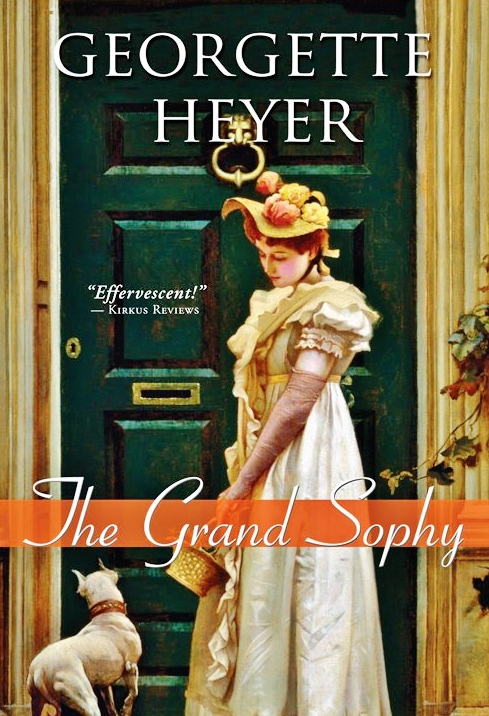
the grand sophy georgette heyerWell, I’ve finally done it. Georgette Heyer has been praised so often and so enthusiastically by so many of the book bloggers whose recommendations I have come to look forward to as decidedly reliable that I have taken the plunge.

I don’t really “do” romance novels as such, though of course most of the books I read incorporate some sort of romance, whether it be traditional male and female or some other sort of love affair (and by this I mean any sort of relationship – platonic friendships are love affairs, as are parent-child relationships, and all of the individuals emotionally invested in some way, whether it be with an idea, an occupation, a house, a garden, a country, a way of life… it’s all about passion and feelings and, yes, “romance” of some sort, isn’t it?)

(And did I just digress? Yes, I think I did!)

Anyway, bodice rippers in the good old Harlequin tradition aren’t really my thing, and the undoubted fact that Georgette Heyer has been republished by Harlequin – I have here on my desk a just-purchased (but as yet unread) copy of The Quiet Gentleman, Harlequin, 2006, with a publisher’s list of other Heyers in the back – was not a point in favor. I’d also read several of Heyer’s mystery stories – she famously wrote one romance novel and one mystery novel each year during a period of financial necessity – and found them no more than mildly diverting. But then there were all those Jane Austen comparisons, and the chatter about her being a seriously underrated writer, and all those comments about her undoubted mastery of her chosen literary period – England’s Regency era, the first few decades of the 19th Century – and all of the lavish praise in the blogosphere…

So I made the decision to give Heyer one more try. Pulling up her name on the library catalogue, I was impressed to see that there was a reasonably large selection of titles, arguing a current popularity (my present public library is very quick to cull and has very few older books in the stacks), some of which I remembered as having received glowing reviews from my blogging peers. Home came Sylvester and The Grand Sophy, as well as a third which appealed because of the plot description on the back, but which I haven’t yet read, Black Sheep. I’m a bit Heyer-saturated at the moment, after reading the first two almost back-to-back, but will definitely be reading the third book well within my alloted three weeks before it needs to be turned back in.

In other words, I liked these. A lot.

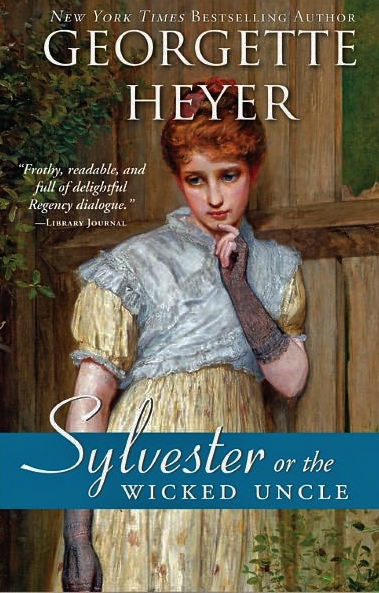
Sylvester: or the Wicked Uncle by Georgette Heyer ~ 1957. This edition: Sourcebooks, 2011. Softcover. ISBN: 978-1-4022-3880-2. 386 pages.sylvester or the wicked uncle georgette heyer

My rating: 9/10.

This story is an absolute hoot. It has everything. Misunderstood heroine – check. Highly intelligent and of an unconventional attractiveness, of course – check. Wicked stepmother – check. Fabulously handsome, wealthy and aristocratic love interest – check. Initial misunderstanding by chief couple and instant dislike of each other – check. Endless complications before true love finds its way – check.

It’s basically Pride and Prejudice with the added bonus of a botched kidnapping (literally), a surreal trip to France, and horses.

You know what? I’m going to stop right here and refer you over to this absolutely excellent blog post by Claire at Captive Reader. It’s the one that convinced me to give this author a go, and the post says absolutely everything I would like to. Anything I could come up with this morning would be a pale shadow of what Claire has said so well. (I am horribly pressed for writing time these days, but cannot let this book pass without a mention. It was so much fun!)

The Captive Reader – Sylvester or the Wicked Uncle

Sylvester more than met my own expectations. The point it lost was right at the very end; I thought the final romantic scene wasn’t quite up to the standard of the rest of the story. But endings are notoriously difficult, and it wasn’t terribly bad or anything. Just not quite… something

But all in all, a very enjoyable read. Great introduction to this author; I’m won over.

*****

the grand sophy yestermorrow georgette heyerThe Grand Sophy by Georgette Heyer ~ 1950. This edition: Yestermorrow, 1998. No ISBN found. 347 pages.

My rating: 9/10.

Gosh, where to start? Let’s see how good my condensation skills are this morning!

Sir Horace Stanton-Lacy, world-roaming diplomat, drops in on his aristocratic sister Lady Ombersley for a brief visit while en route from Lisbon to Brazil. After racing through the polite preliminaries (Sir Horace is excessively focussed on getting right to the point with the least amount of fuss and trouble to his self-indulged self) the object of his detour becomes apparent.

Could he possibly leave his (motherless) twenty-year-old daughter Sophy with her dear aunt? Brazil, in the early 1800s, is rather rough in places, and even careless Sir Horace has qualms about its suitability for an upper-class English girl’s place of residence, even under the auspices of her important Papa. Sophy – “Dear little soul: not an ounce of vice in her!” exclaims said Papa – is as good as “out”, though the formalities of a Court presentation have been unavoidably omitted, what with living on the Continent and all – and will be a lovely companion for her cousin Cecilia. And while she’s here, dear sister, Sir Horace goes on to say, how about fixing her up with a suitable husband? I’m sure you can manage to arrange that for me…

Lady Ombersley is shocked into agreement, and Sir Horace disappears as quickly as he came, leaving with a promise that Sophy shall be welcomed into the bosom of her extended family. The family, as far as I can remember – there’s a lot of characters in this hectic novel – consists of Lord and Lady Ombersley, their eldest son Charles Rivenhall – who is by way of being head of the family, financially speaking, as he is his recently deceased wealthy grandfather’s heir as Lord Ombersley is an incorrigible gambler who has virtually impoverished his own estate – sober Charles is busy doing damage control while his father continues his dissipated lifestyle on a much more modest scale – the beautiful aforementioned Cecilia, a younger brother, Hubert, at Oxford, another, Theodore, at Eton, and young sisters Amabel and Gertrude.

Sophy shows up quite soon, and far from being the meek and gentle niece and cousin the family was expecting, turns out to be positively Amazonian, a self-assured and shockingly outspoken young lady, looking on her English sojourn as something of an amusing lark, though she’s agreeable to being introduced to some interesting and suitable young men on matrimonial approval, as it were. She throws the household into a turmoil it has never known before, and soon it becomes apparent that Sophy is a born manager of other people for their own good, and that in her staid cousins she has found much scope for her personal hobby.

Charles is engaged to the most prim and proper Eugenia Wraxton, who is looking forward to her upcoming marriage and increase in social status with smug self-satisfaction; it soon becomes apparent that cousin Sophy does not meet with her approval, and Eugenia’s true nature as a sly, prying, manipulative scold is thereby revealed, though Charles appears blind to this, at least initially.

Cecilia has been presented with a suitable young nobleman, Lord Charlbury, as a potential spouse, but has instead become infatuated with Adonis-like Augustus Fawnhope, an aspiring poet. (He instantly reminded me of none other than P.G. Wodehouse’s Madeleine Basset, of “the stars are God’s daisy-chain” fame; subsequent events merely strengthened that comparison.) Hubert has gotten himself embroiled in gambling debts – shades of the paternal situation – and is too terrified to confess to his older brother, and has instead gotten into the clutches of an evil moneylender.

The younger children, luckily, are not much in need of sorting out, so Sophy busies herself with rearranging Charles’, Cecilia’s and Hubert’s lives for them.

Charles is immediately resistant to his lively cousin’s attempts to “manage” his family; he cleaves to the unpleasant Eugenia with commendable loyalty, but cracks soon appear in his iron-hard facade. Eugenia is quickly driven to open criticism of Sophy’s lack of propriety; Sophy seems to delight in shocking and annoying Eugenia; Sophy is marvelously clever at pushing all of Charles’ buttons, and seems to come out ahead in each of their encounters; her and Charles’ continued verbal sparring (and shared love of horses) gives the alert reader the key to the eventual outcome of that particular triangle of personalities!

Cecilia and her poet are all over each other, while Lord Charlbury mopes in the his lonely corner (he’s recovering from the indignity of having had the mumps at a crucial time in the progression of his courtship of Cecilia.) Sophy takes those three in hand as well, giving Lord Charlbury instruction on how best to woo his reluctant prospective spouse, and eventually exposing Augustus Fawnhope’s deep ineffectualness to the no-longer-quite-so-besotted Cecilia.

Hubert’s moneylender is confronted with aplomb, in a scene which received some negative press in the blog world for its deeply stereotypical depiction of a Shylock-like Jewish character. (See here for a fascinating and extended discussion of racial stereotyping in literature, centered on The Grand Sophy, and widening to Heyer in general, then bringing in Agatha Christie, Ngaio Marsh and Dorothy L. Sayers as well; the many comments following this post are thought-provoking; the whole exchange is well worth reading.)

This workaday plot summary leaves out the sparkling dialogue and the deep humour which infuses every page of this lively historical romance; it’s a grand read for a dull day; perfect escape literature, and not to be taken too, too seriously, I think. An amusing romp, with the bonus of being meticulously researched and full of era-correct dialogue, descriptions of food, dress, and the social world of upper classes of post-Waterloo England. If you appreciate Jane Austen and Thackeray’s Vanity Fair, you’ll find much to admire in Georgette Heyer’s detailed and very funny take-offs of the time.

As with Sylvester, The Grand Sophy was a whole lot of fun. More so, really – it is almost antic in its multitude of plot twists, turns and tangles, where Sylvester maintained a certain dignity even in its most absurd moments. But Sophy lost its point in the same place, right at the end. It was a good ending, a proper ending, with loads of predictability and a few (small) surprises, but there was something just a tiny bit rushed over how everything tied itself up so quickly, as if the author, with finish line in view, had pushed herself into one last full-speed-ahead dash of writing. But, as with Sylvester, not a big issue, and easy to forgive.

And I did forgive the author her moneylender; I mulled this over quite a bit, and have held back this review to consider how deeply I wanted to address this issue. I have come down on the side of letting it go in the interests of era-correctness. Yes, the book was published post-World War II, when the horrors of the Holocaust were well-known and fresh in memory, but the treatment of the character in question was completely in line with the 19th Century world it depicted. And The Grand Sophy is something of a parody in its treatment of all of its characters; I don’t believe we are meant to take any of them all that seriously. If one wants to be offended, there’s a lot of scope for that in more than the Jewish moneylender episode. I choose not to be offended, though I see where the offense lies, and will leave it at that. (At least for now. This is a topic which is never really dormant, whether reading vintage or contemporary fiction.)

At the end of the day, I must say that I enjoyed these books, and I’m looking forward to encountering more of Heyer’s delicious romances, but I suspect that they are best taken one at a time, as a sort of self-indulgent literary “rich dessert”; nice as an occasional treat but not really suitable for daily fare!

I’m drawing May 1st for three lovely Folio Society books, so if you haven’t done so already, check out the post and let me know which one you’d like to try for.

Everyone is welcome to enter, new blog readers or those who’ve been with me since the beginning, a whole twelve months ago. Just a little celebration of books and readers and the conversations we get into here in cyberspace.

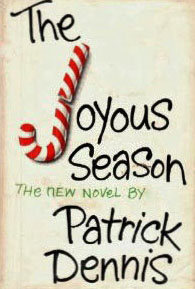
The Joyous SeasonThe Joyous Season by Patrick Dennis ~ 1964. This edition: Harcourt, Brace & World, 1965. Hardcover. 230 pages.

My rating: 9/10.

Ignore the candy cane on the dust jacket, and the internet references you may find to this being a “holiday book.” No, no, no. It is not. Christmas features, but only incidentally. The scope is much broader than that.

“Patrick Dennis,” you’ll possibly be saying to yourself. “Sounds familiar, but ???”

Auntie Mame, darlings!

Ten years after penning his highly successful social satire starring the exuberant Mame and her sedate nephew Patrick, author Edward Tanner – writing under the pseudonym Patrick Dennis – came up with this little  comedic gem. I wasn’t sure what to expect, having only ever previously experienced Mame, but The Joyous Season was absolutely marvelous, and better than I had anticipated. Such a treat!

10-year-old Kerrington – Kerry – is our narrator. He lives in a posh New York apartment with his 6-year-old sister Melissa – Missy – and his parents, both members of the New York “aristocracy”, though his mother’s family is higher up in the strata, and his maternal grandmother never lets his father forget that for a moment. Dad’s a successful architect, and Mom is most definitely one of the ladies-who-lunch, leaving much of the care of her two children to the fifth member of the menage, Lulu.

Lulu’s our nurse. We need a nurse like we need a case of mumps. I mean, hell, I’m ten and eleven twelfths years old and I’ve already smoked over two packs of Tareytons. (They’ve got that extra charcoal filter, you know, for cancer.) Even old Missy can take a bath and get dressed and wipe herself without any help, which is pretty good for six, I guess. But like Mom always said, we can’t go around New York alone because of kidnappers and Dirty Old Men (especially on East Eighty-sixth Street) and types like that. So Lulu drags us across town every day, me to St. Barnaby’s – although she turns me loose at the stationery store so the kids won’t think I’m being hauled around by a nurse at my age – and Missy two blocks further (or farther, whichever it is) to Miss Farthingale’s. Except for that, Lulu hasn’t got much to do except see we go to bed and get up and eat and don’t fight.

Lulu’s quite a character. She’s colored and elderly and has been with us ever since I was born. She’s kind of old fashioned and hates the N.A.A.C.P. and says she doesn’t want to integrate with any white people except Missy and me and that’s only because she gets paid to. Lulu says that after us she needs a rest, if we don’t kill her first, and she wants to retire and move back down South. Gadzeeks, South! I mean I don’t even like Palm Beach, which is supposed to be the next thing to heaven… Give me New York City and keep the rest. Crazy! Anyhow, Lulu tells us real interesting stories and knows every kind of poker there is – except strip – and always lets us have some of her beer and hates Gran’s place in East Haddock almost worse than we do. I mean Lulu is great, even if we don’t need a nurse.

Oh – I forgot one more family member. There’s also Maxl, the incontinent, prone-to-carsickness, full-of-mild-vice dachshund. His escapades run in a kind of sub fusc harmony to the ups and downs of Kerry’s and Missy’s lives, providing a counterpoint to the human drama of this gloriously dramatic tale.

So as the story opens, Kerry, Missy, Lulu and Maxl are reluctantly heading out the door to Gran’s place in East Haddock. Gran is Mom’s mother, and oh boy, is she ever a snooty piece of work! And she’s more or less the reason for the whole darned situation Kerry and Missy are in. To condense greatly, on Christmas morning there was a bit of a situation with Mom and Daddy which saw several kinds of shots fired, much broken glass, some physical violence and some exceedingly blunt words spoken. As a result, Kerr and Missy are poised to become Children of Divorce, much to the delight of meddling Gran. Everyone (except Gran, who openly gloats about the come-uppance of her despised soon-to-be-ex son-in-law) has decided to be Very Civilized About It All, and Not To Make The Children Suffer, but suffering they are indeed, though not perhaps in the way one would expect.

Kerry and Missy, despite all of the adult antics going on in their world, are the epitome of well-adjusted, though no one but Lulu seems to quite get that, and Kerry’s knowing-naive narrative exposes the follies of the grown ups, and New York upper crust society at large, to our appreciative eyes.

Mom is suddenly being courted by her own divorce lawyer, the social-climbing Sam Reynolds, while Daddy is pounced on by the predatory Dorian Glen, a self-invented fashion magazine editor. This gives much glorious scope for satirical commentary, and Kerry is well up to it. His descriptive passages are true works of art, and I found myself wearing a perpetual smile as I willingly gave myself up to the contrivances of the complicated plot.

For example, as this is New York in the 1960s, psychoanalysis is all the rage, and Kerry finds himself saddled with three hours a week with Dr. Epston. The adults in his life just want to ensure that he is coping well, and they are sure that he needs “fixing”, which if nothing else gives Patrick Dennis via Kerry an opportunity to get in some juicy digs at the world of the well-paid New York shrinks.

Dr. Epston’s consulting room is small and dim with a couch to lie on; two easy chairs; Kleenex, for crying into, I guess; a desk and a bookshelf with about a million copies of Tensions in the Metropolitan Adolescent by I. Lorenz Epston. I guess it wasn’t exactly what they call a best seller, but he’s getting rid of the supply bit by bit by making each patient’s family buy a copy (at ten bucks a throw). There are also some pictures on the wall that look like Missy painted them and a framed photograph of Dr. Epston’s three daughters. One is in the upper school at Dalton, one goes to Rudolf Steiner and the littlest one is in the School for Nursery Years – if that gives you some idea of what kind of kids he’s got. They also look like Eskimos. In fact, Dr. Epston’s first question was always, “What are you thinking about right now?” And my answer was always “Eskimos.” But when he’d ask me why, I just couldn’t tell him, because even if he is kind of a boob, I didn’t want to hurt the poor guy’s feelings. So I’d hem and haw and talk about igloos and blubber and wasn’t it interesting that the French spelled Eskimos Esquimaux and like that. So I always got kind of a demerit for being what Dr. Epston called “evasive” (when I was only trying to be polite) and at the end of the first week Mom sent off to Wakefield-Young Books for copies of Nanook of the North and Inyuk and some other suitable reading about the North Pole, when I didn’t care much one way or another.

The first day Dr. Epston made me lie down on the couch and darned if I didn’t drop right off to sleep while he was droning away about trusting him and telling him everything that came into my mind, no matter what. After he woke me up he kept asking me what I was trying to escape from and he wouldn’t believe me when I told him I’d stayed up late the night before watching “The Nurses” (it was all about this dope fiend) and it would have rude to say that also he was kind of a bore. But after that he let me sit up straight in a chair.

And so on, and so on. Kerry certainly does not suffer from lack of things to say; his self-confessed verbosity is what makes this satire such a delight. He’s a truly nice kid, for all the knowingness and the cynical tone he tries to maintain, and his relationship with the volatile Missy is just plain sweet, though they swap sibling-appropriate verbal digs and occasional blows.

Missy is a glorious character in her own right, and it would take me pages and pages to do her proper justice, so I’m not going to even try.

If you liked Auntie Mame, I’ll guarantee that you’ll love The Joyous Season. Highly recommended.

And here, as a bit of a bonus (because I do like to read reviews from the time of publication, and usually try to seek them out to see what those of the time had to say to compare it to my own years-further-on take), is the Kirkus review from October 14, 1965, because it sums things up quite well. I did edit to remove the spoiler; the ending is blatantly given away; that’s such a cheat in a commercial review, don’t you think? Liked the Holden Caulfield reference, because I thought that too, before I ever read the Kirkus review!

The people from the Auntie Mame strata are back under the snickersee of Patrick Dennis. The narrator is 10-year-old Kerrington, scion of a bloodline so inside Society that he yawns at the mere thought. After Daddy’s monumental Christmas hangover, Kerry and his 6-year-old sister, Missy, are slated to become Children of Divorce. Kerry’s prose style would make even a Holden Caulfield blanch, but his reportage is as complete. It seems Mommy and Daddy are going to do the Terribly Civilized bit. The demoniacally wholesome children are taken in on the divorce plans and exposed to the new interests of their wayward parents. Daddy falls victim to a voracious career woman (whose job allows P.D. to vivisect the fashion magazine sub-culture) and Mommy gets stuck with a stuffed shirt (who polarizes the P.D. thunderbolts directed at the nouveau riche). No tribal rite of the East Coast uppercrust, no Southern smarm and no mid-Western gaucherie is sacred … P.D. has picked their milieu to tatters. His full cast of credible caricatures are given dazzlingly funny dialogue. It’s a fair guess that this could easily go the Auntie Mame route — book to play to movie.

I honestly don’t know if this book did ever make it onto stage or screen, but it could well have. All I know is that I’d never heard of it before doing my bit of casual research on the author while reviewing Auntie Mame last year. He was well on my radar as one to watch out for, and when I came across The Joyous Season last week on the bottom shelf of the used book section of a secondhand furniture store in Prince George which I visit every few months “on spec” – for locals, that would be City Furniture right in the core of the scruffy old P.G. downtown on 3rd and Quebec – stacks and stacks of dusty books which I’ve now mined fairly thoroughly but which still contain some occasional vintage “finds” – I grabbed it with a silent shout of glee.

Young Kerry, narrator of the story, could have come across as either cloying or annoying, but Patrick Dennis has nimbly avoided either obnoxious extreme, to create a character whom I found I could completely relate too, after checking my own cynicism at the door, as it were. (Young Kerry’s dialogue occasionally slips to reveal the very adult puppet master handling the authorial strings, but it didn’t matter at all; I was happily and deliberately complicit in my own deception and looked away the few times it happened.)

I liked the likeability of Kerry’s whole family, for though Daddy and Mom were guilty of high tempers and hasty words to each other, they truly came across as loving parents, which was much appreciated; it could so easily have had a sour tone. The in-laws on both sides, and the assorted friends and hangers-on of each of the parents, gave loads of scope for Patrick Dennis to work with; he was bang on the mark with each and every one. Brilliant.

And though I saw the ending coming from just a few pages in, it never ruined things for me to find out I was right. Great “light” escape reading, and definitely a keeper.

I do believe this title is fairly easy to obtain, as it was republished in 2002, and looks to be available as a new softcover through Amazon, or, hopefully, your favourite local bookstore. There are a few vintage copies available through ABE, but these are priced a bit high, up into the $20s and $30s and beyond, so unless you’re a purist and need the original hardcover, I’d say go for the cheapest decent copy you can find, which might well be the 2002 reprint. Or perhaps try the library?