a breath of fresh air betty cavanna 001A Breath of Fresh Air by Betty Cavanna ~ 1966. This edition: William Morrow, 1975. Hardcover. 223 pages.

My rating: 4/10.

I had to look back and see how I rated the previous three Betty Cavanna vintage teen novels I reviewed, and I see I gave a 6 to the strongest one, Jenny Kimura, and a 5 to both The Country Cousin and Lasso Your Heart. A Breath of Fresh Air is definitely down a level from these already minor novels, both in plot and execution.

Despite the low rating, this book is already back on the keeper shelf, as it is a decent enough story for a quiet hour or two’s modest diversion.

Seventeen-year-old Brooke Lawrence and her thirteen-year-old brother Peter are reeling from their parents’ announcement that they are getting a divorce. In the staid middle-class circle the family inhabits in quiet Concord, Massachusetts, divorce is still a matter of whispers and concerned glances. Both Brooke and Peter feel horribly stigmatized by their situation, even though everyone (except the two young Lawrences) agrees that they could see the split coming.

Competent Harriet will be better off not saddled with her dreamy and ineffectual husband, Austin, and he in turn will be happier living with (and being supported by) his older sister, who truly appreciates his penchant for tinkering with hopelessly complicated inventions which never quite make it through the patent office to production. For some years now Harriet has taken on the role of family breadwinner with her antique store business, and Austin’s cleaning out of their joint bank account just as she’s written a (bounced) cheque for a stock order is the final straw in a long series of like episodes.

Brooke, “smart and very pretty”, is a scholarship student in her final year of high school at an exclusive girls’ school, and her pride is bruised and her confidence shaken by the failure of her parents’ marriage. She is questioning everything that she once took for granted, including her own budding romantic relationship with the quiet and loyal David Hale.

Brooke’s research project on author Louisa May Alcott, the local historical celebrity, brings the parallels in Brooke’s and Louisa’s lives into focus, and is the sub-theme of A Breath of Fresh Air. Impractical father, driven mother, and a strong desire for self-expression through writing are common grounds, and as Brooke muses over Louisa May Alcott’s teenage decision to eschew romance and marriage, she wonders if she should do the same. David, naturally enough, does not agree, nor does a charismatic Harvard student who pops up out of nowhere to actively pursue the delectable Brooke, and to add a bit of romantic tension to this rather dull story.

The details regarding the antique buying and selling business are the most interesting aspects of this novel, and the related humour relieves the earnest tone; I had to chuckle over Harriet’s classification of some of her casual browsers as “bathroom customers”. The main characters are (aside from Harriet, whom I quite related to) decidedly flat; I never got a sense of any of them being real people; they fulfilled every stereotype of their imposed roles. The plot is predictable and completely unsurprising; Brooke’s final decision regarding her own romantic life is absolutely no epiphany to anyone, including the patient and slightly patronizing David.

As the author did produce something like seventy novels in her prolific career, it seems reasonable that their quality would fluctuate. A Breath of Fresh Air has a potentially interesting theme, but it never really gets off the ground to fulfill that promise.

This “teen novel” is a lightning fast read and good for a momentary diversion, but, sadly, not much more. A period piece of mild interest and mild enjoyment, not bad enough for a toss into the discard box, but not good enough to wholeheartedly recommend either. Cavanna was a competent enough writer for her chosen genre, and I appreciate what she was trying to do with her themed storylines, but this particular story is not one of her best.

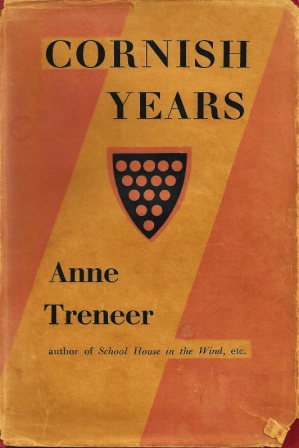
cornish years anne treneer 001Cornish Years by Anne Treneer ~ 1949. This edition: Jonathan Cape, 1949. Hardcover. 284 pages.

My rating: 8/10.

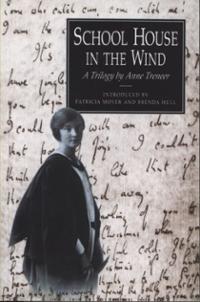
This is the second volume of Cornish writer and poet Anne Treneer’s trilogy of memoirs. The first, Schoolhouse in the Wind , was such an unexpected treat that I immediately decided to track this author’s other works down. I did all of the usual searches, and decided my best bet was to order the re-released trilogy published by the University of Exeter Press in 1998, under the (slightly altered) title of the first book, School House in the Wind.

Imagine then my delight upon finding this first edition copy of the second volume in a tiny antique store in the micro-community of Barriere, B.C. on a quickie road trip last week. We were out in our old Spitfire convertible, investigating promising narrow, winding (and must be paved – not a given in this part of the world) side roads in the Kamloops area, and were ready for a break from the wind and sun when a sign in the window captured our notice: “Used Books”. Well, that was irresistible, so I pulled a quick U-turn (an easy feat in a tiny little Triumph) and in we went. Lots of china and glassware, but the promised used books were only a shelf or two, quickly scanned and dismissed. However, as I made my way carefully out through the shelves of fragile treasures, something caught my eye in the showcase beside the cash register. There, side by side, were this book, and another, The Angels’ Alphabet by Hilda van Stockum, a first edition picture book by another author-illustrator I’m mildly interested in.

I’m guessing these were featured because of their intact dust jackets and general “vintage” appearance? Anyway, for well under twenty dollars I walked out of the store clutching my treasures with ill-disguised glee. And that proved to be the bookish highlight of the day, as our subsequent visit to our real destination, Kamloops’ excellent At Second Glance Used Books, source of so many wonderful finds over the past ten years, left us standing in bemusement peering through the windows of an empty store front.

“They’ve moved!” I said optimistically to my husband. Across the street to the Kamloops Art Gallery we trotted, and upon inquiry we were stunned to hear that the bookstore had indeed closed just a few months ago. “So many people are asking about it, and they’re all so disappointed,” said the helpful girls at the admissions counter.

Turns out that a steady decline in sales over the last few years had left the owner debating the state of the used book business. She sold off as much as she could in a series of escalating sales, and at the end had dumpsters brought in, and binned the remainder.

I am very sad. What a dismal ending to such a grand bookstore.

Two more of my local used book sources, Nuthatch Books in 100 Mile House, and The Final Chapter in Prince George, are also debating closure, as their margins are steadily decreasing. Every bookseller I’ve spoken to has blamed e-books for the decline in the print book business.

Meanwhile the charity shops are overflowing with books – most, admittedly, the epitome of “trashy” (in so many ways) – which may indeed be an indication of shelves being cleared as people embrace the new technology.

There is no adequate substitution for a well-established, well-organized used book store staffed by fellow book lovers. I tremble at the thought of more of these dying out, much as I understand the seduction of having your reading material to hand in a compact electronic format.

But used book sellers have grocery bills too, and once the point of too-little return is reached, what options do they really have? I know many are turning to internet sales, but to do that properly is a job in itself, and the competition is fierce unless you are prepared to vigorously establish a lucrative niche market of some sort, often not a very viable option for those in small communities with limited book-sourcing opportunities…

Ah, well. It is what it is. Back to this book.

*****

Cornish Years decidedly lived up to my high expectations. Ann Treneer continues her life story of the years between 1906 and 1932 with cheerfully pragmatic anecdotes about her own doings, and affectionate reminiscences of the places and people she rubbed up against. As in Schoolhouse, the narrative is never twee or gushing, but it is cheerfully positive in tone, and the mood feels genuine throughout.

As much as it is a personal narrative, Cornish Years is also a loving ode to place, both Treneer’s home region of Cornwall, and places farther afield. Anne Treneer spent time as an adult student pursuing studies at Lady Margaret Hall in Oxford, and her memories of those days are beautifully evocative and full of love and appreciation for her experiences there.

The snippets of Anne Treneer’s poetry in Cornish Years – she was a published poet from an early age – show much more style and polish than those in School House; I wonder if she has included these small samples of her work in some sort of chronological order? If so, I would be most interested to see what the third volume of memoir, A Stranger in the Midlands, contains, both in the way of poetry and in the continuation of Anne’s personal story.

school-house-in-wind-trilogy-by-anne-treneer-paperback-cover-artAs I can’t count on bookish serendipity to bring me the third book as it did the first and second, I have taken things into my own hands and ordered the 1998 trilogy. And if I do come across an old copy of Stranger, I will of course be more than happy to add it to the bookshelf.

In my internet travels, I came across an interesting reference to Anne Treneer at this blog, The After Life of Books, written by Gillian Thomas, an English literature teacher and resident of Cornwall. She writes about the experiences of her parents and grandparents in relation to the books they read. (Fascinating website, well worth a look-around.)

She (Gillian’s mother) was particularly proud of having a personal connection with another Cornish writer, Anne Treneer, author of the childhood memoir, Schoolhouse in the Wind, and Cornish Years, a reminiscence of her college education and early years as a schoolteacher. Treneer had been my mother’s English teacher at the local grammar school and, as well, had rented a cottage from my grandparents. They, along with other villagers, appear in one of the chapters of Cornish Years, and both my grandmother and mother often proudly mentioned these references. They were flattered to find their names in a book, even as faintly amusing village “characters.”

My mother’s pride in the Treneer connection may have originated in the prestige of a personal aquaintanceship with a published author, but it was sustained by her fascination with Anne Treneer’s apparent independence from conventional restrictions.  During the time the author taught at the grammar school she used a motorcycle to explore the area, a detail which always figured in my mother’s recollections of that time as well as in Treneer’s happy reminiscences about her Velocette in Cornish Years. Similarly, my mother recalled visiting her former teacher years later and finding her fuelling the fireplace in her rented seaside cottage with an enormous driftwood spar that she had just scavenged from the beach. In all these reminiscences Anne Treneer seemed to embody an insouciant air of independence, a relishing of her own solitary company and an unconcern about conventional behavior. In the letters and postcards from her that arrived from time to time throughout my childhood, she always seemed free to travel at will. We imagined, I think, that this apparently carefree independence, came with the role of being “an author.” It was, of course, mainly made possible  by Treneer’s generally frugal tastes and habits. Also, it’s likely that  travel funds came from the author’s older brother, Maurice, who had emigrated to the US and become senior chemist at Miles Laboratories in Elkhart, Indiana. He is credited with creating the original formula for Alka-Seltzer, a product whose launch was fortuitously timed to coincide with a flu epidemic as well as the end of Prohibition. While he does not seem to have personally owned the patent to that lucrative cure for hangovers and other malaises,a number of other patents in his name, as well as his salary as head chemist at Miles Laboratories, would have enabled him to be generous in funding holidays for his sister…

And here, as another side note, is the Wikipedia page regarding the Velocette motorcycle, one of which Anne Treneer tenaciously learned to master and rode about on with undisguised joy, which she so eloquently described in Cornish Years.

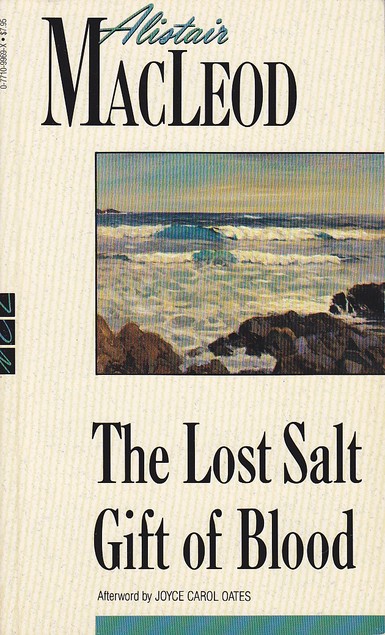
the lost salt gift of blood 2 alistair macleodThe Lost Salt Gift of Blood by Alistair MacLeod ~ 1976. This edition: New Canadian Library, 1989. Afterword by Joyce Carol Oates. Paperback. ISBN: 0-7710-9969-X. 160 pages.

My rating: 10/10 for the writing, no debate there. For reading “pleasure”, which of course is an extremely individual definition, I’m struggling with a rating. I’ll willingly put this on the keeper shelf, but I strongly suspect I may never read it again. The well-turned phrases are lovely in and of themselves, but the subject matter is so very bleak. This book makes me so glad I’m not in high school any more. What a godsend to keen Can-Lit teachers!

I started off reading this book with no foreknowledge of what the tone would be, though I suspected less than frivolous, what with the earnest back cover blurb:

The stories of The Lost Salt Gift of Blood are remarkably simple – a family is drawn together by shared and separate losses, a child’s reality conflicts with his parents’ memories, a young man struggles to come to terms with the loss of his father.

Yet each piece of writing in this critically acclaimed collection is infused with a powerful life of its own, a precision of language and a scrupulous fidelity to the reality of time and place, of sea and Maritime farm.

Focusing on the complexities and abiding mysteries at the heart of human relationships, the seven stories of The Lost Salt Gift of Blood map the close bonds and impassable chasms that lie between man and woman, parent and child.

These seven stories are intense and perfectly crafted; I can easily believe that Alistair MacLeod spent a year writing each one; they feel perfected, pared down, edited for maximum effect to the nth degree. Marvelous writing.

But I came away from my reading – which I spaced out over a week or so because this isn’t the sort of stuff one can take in all at one sitting – feeling so terribly sad, which may in itself be the strongest tribute I can give to the power of MacLeod’s writing.

*****

These are all stories of “place”, very specifically regional, focussed on Cape Breton. The sea and the land are characters as much as any of the sentient creatures that occupy their worlds.

  • In the Fall ~ The teenage narrator, the oldest of six children, remembers the autumn his father was forced to sell his beloved old horse to the knacker. Heart-wrenching.  I have a very low tolerance for betrayal of old animals scenarios – hence my real-life situation of supporting a number of geriatric creatures in various stages of decline – so I almost bailed on the book at this point, but doggedly kept on. Though it never got much more cheerful…people started dropping in the following episodes. But, oh! – the evocative writing!

It is hard to realize that this is the same ocean that is the crystal blue of summer when only the thin oil-slicks left by the fishing boats or the startling whiteness of the riding seagulls mar its azure sameness. Now it is roiled and angry, and almost anguished; hurling up the brown dirty balls of scudding foam, the sticks of pulpwood from some lonely freighter, the caps of unknown men, buoys from mangled fishing nets and the inevitable bottles that contained no messages. And always also the shreds of blackened and stringy seaweed that it has ripped and torn from its own lower regions, as if this is the season for self-mutilation – the pulling out of the secret, private, unseen hair.

  • The Vastness of the Dark ~ A boy leaves home on his eighteenth birthday, with little plan but that he must get away from his here and now, and travel forward into something different.

(After the Cumberland No. 2 coal mine explosion)… I remember again… the return of my father and the haunted greyness of his face and after the younger children were in bed the quiet and hushed conversations of seeping gas and lack of oxygen and the wild and belching smoke and flames of the subterranean fires nourished there by the everlasting seams of the dark and diamond coal. And also of the finding of the remains of men flattened and crushed if they died beneath the downrushing roofs of rock or if they had been blown apart by the explosion itself, transformed into forever lost and irredeemable pieces of themselves; hands and feet and blown-away faces and reproductive organs and severed ropes of intestines festooning the twisted pipes and spikes like grotesque Christmas-tree loops and chunks of hair-clinging flesh. Men transformed into grisly jig-saw puzzles that could never more be solved.

  • The Lost Salt Gift of Blood ~ A successful Toronto businessman returns to the Newfoundland community he has long left behind, to take a look at his illegitimate son who has recently been orphaned by the death of his mother and stepfather. Yearnings of fatherhood stir within him; should he tell the boy who he is?
  • The Return ~ A ten-year-old boy makes the trip from Montreal to visit his Cape Breton grandparents for the first time.
  • The Golden Gift of Grey ~ A teenage boy lives a secret life, visiting the pool hall after classes and forming a friendship with the man who was the cause of his father coming to Cape Breton from Kentucky ten years ago.
  • The Boat ~ An adult son remembers his father, and their life together on their fishing boat.
  • The Road to Rankin’s Point ~ This was the most personally moving and my favourite of all these seven stories. A terminally ill grandson returns to his elderly grandmother’s farm, seeking peace and a place to die.

I could easily have included excerpts from each of these stories – the most difficult task would have been deciding what to highlight among so many memorable passages –  but I will instead leave you to discover them for yourself, if you so choose.

A good review from another blogger is here: City Scrivener – The Lost Salt Gift of Blood

A very readable scholarly examination of the stories is here: SCL – Studies in Canadian Literature – The Lost Salt Gift of Blood

the shout & other stories robert graves 001The Shout and other stories by Robert Graves ~ 1965. This edition: Penguin, 1978. Paperback. ISBN: 0-14-00.4832-4. 300 pages.

My rating: 7/10.

A generous and widely eclectic sampling of Robert Graves’ short stories and personal anecdotes. While a bit uneven, as might be expected in an anthology spanning some forty years or so of one man’s writing career, but there is enough excellent reading in this book to make it a certain keeper.

The stories are grouped under three broad headings: English Stories, Roman Stories, and Majorcan Stories, but the first and third categories show quite a wide range in style, settings and topics. The three Roman Stories are the tightest grouping, theme-wise.

I enjoyed reading most of these, and came away feeling keen to continue to develop my acquaintanceship with the prolific Robert Graves. I do believe I might be ready to tackle his ambitious I, Claudius. If it is anything like the three Roman Stories in this collection, it will be very good indeed. I’ve been holding out for a better edition, as mine is a fat paperback with a cracked spine and tiny print (these unreliable middle-aged eyes are giving me grief lately), but I think I will dip in and see how it goes. If I like it I’ll upgrade to a physically nicer edition. Anyway, I’m straying off topic. Back to the volume at hand!

*****

From the author’s Introduction:

The first of these stories, The Shout, was written in 1924; and the last, Christmas Truce, in 1962. Most of them, including such improbable ones as Kill Them! Kill Them!, The Whitaker Negroes, Old Papa Johnson and A Toast to Ava Gardner, are true, though occasional names and references have been altered. Nor can I claim to have invented the factual details even of She Landed Yesterday, or An Appointment for Candlemas. In fact, a correspondent who read She Landed Yesterday reproached me for not mentioning the two French copper coins found in the coffin-doll’s pocket; and An Appointment for Candlemas brought members of the revived British witch cult to my door in search of information about flying ointments and such like. Pure fiction is beyond my imaginative range; I fetched back the main elements of The Shout from a cricket-match at Littlemore Asylum, Oxford.

ENGLISH STORIES: A variety of anecdotes and stories, most with some sort of “twist”.

  • The Shout ~ The otherwise seemingly normal resident of an insane asylum claims he has the power of the “terror shout”, which brings madness and even death to anyone within hearing range. Occultish and dark. Not one of my favourites, though it is memorable enough. 7/10.
  • Old Papa Johnson ~ “Old Papa Johnson” was once Crown Agent on Antarctica’s Desolation Island. His solitude is intruded upon by two uninvited guests, with dire consequences. 6/10.
  • Treacle Tart ~ In this short anecdote, eight-year-old Lord Julius Bloodstock unexpectedly descends upon a surprised prep school, but runs afoul of dietary rules, refusing his treacle tart and sparking something of a minor rebellion among the schoolboys. 6/10.
  • The Full Length ~ A portrait artist is asked to paint a picture of a recently deceased young lady whom he’s never seen, and who has never had her photograph taken. His solution is quite clever, and rather improbably lucky. 5/10.
  • Earth to Earth ~ A macabre little tale of an interest becoming an obsession. Dedicated composters, take warning! Queasily humorous; I laughed out loud with horrified glee at the ending. I *hope* this one was not true! This story would be right at home in a Roald Dahl (adult) story collection. 7/10.
  • Period Piece ~ A humorous little tale of a marital misunderstanding. 6/10.
  • Week-End at Cwm Tatws ~ Still channelling Roald Dahl at his darkest, Graves tells the story of a visit to a dentist gone very, very wrong. 6/10.
  • He Went Out to Buy a Rhine ~ A mysterious suicide turns out to have an esoteric explanation. 5/10.
  • Kill Them! Kill Them! ~ A poignant remembrance of a young man killed in the war. 6/10.
  • The French Thing ~ Gloriously funny tale of village life. Beware the vicarage daughter! Unexpected. Loved it. 10/10.
  • A Man May Not Marry His… ~ An odd little theological, medical and ethical debate about the implications of sex change operations. (I think.) 4/10.
  • An Appointment for Candlemas ~ An interview with a modern witch. Cheeky and funny. 8/10.
  • The Abominable Mr. Gunn ~ Memories of a sadistic schoolmaster. 6/10.
  • Harold Vesey at the Gates of Hell ~ An ironic little tale of village life. Nicely done. 7/10.
  • Christmas Truce ~ Christmas in the trenches, World War I. Enlightened commanders from the German and British sides arrange a temporary truce. 10/10.
  • You Win, Houdini! ~ The rise and fall and rise of a crooked minor magician turned army officer. 8/10.

ROMAN STORIES: That would be ancient Rome. These were all humorous in tone, and all excellent.

  • Epics Are Out of Fashion ~ Falling afoul of Emperor Nero is never a healthy idea, especially when one is a poet writing a thinly veiled mockery of that vindictive lord himself… 8/10
  • The Tenement: A Vision of Imperial Rome ~ This was my favourite story in the collection. An episode detailing daily life in ancient Rome. Brilliantly done; very funny, despite the tragic sudden ending! 10/10.
  • The Myconian ~ A provincial visitor from the island of Myconos is made acquainted with the dramatic and sporting diversions of Rome. Another 10/10.

MAJORCAN STORIES: Written during Graves’ long residence in Majorca, Spain.

  • They Say…They Say ~ gossip in the marketplace. 5/10.
  • 6 Valiant Bulls 6 ~ An epistolary episode detailing Spanish bullfighting, from “Margaret” to “Dearest Auntie May”. Not quite sure about this one; didn’t quite hit all its attempted high notes. 6/10.
  • A Bicycle in Majorca ~  The author’s personal anecdotal tale about civil bureaucracy in relation to the importation and retention of his sons’ British bicycles in Spain. Rather good. 8/10.
  • The Five Godfathers ~ Here’s Margaret gushing on to Auntie May again, this time detailing a confusing christening. Sort of amusing, but perhaps not as much as the author intended. 6/10.
  • Evidence of Affluence ~ A tale of revenge. This one works out very well, though I guessed the ending from a long way off. 8/10.
  • God Grant Your Honour Many Years ~ A misunderstanding and a happy resolution. Another amusing personal anecdote, well presented. 8/10.
  • The Viscountess and the Short-Haired Girl ~ A humorous tale of three Spaniards involved as witnesses in a slightly nefarious divorce case. In the end, everyone gets what they want. Complicated, but funny. 9/10.
  • A Toast to Ava Gardner ~ An appreciation of Ava Gardner, whom the author knew personally. Goes off on a divergent tangent or two. Rather sweet. 9/10.
  • The Lost Chinese ~ Another complicated tale, this time of playwrites and mistaken identities. Diverting. 7/10.
  • She Landed Yesterday ~ A nobleman commits suicide after dabbling in the occult. Love, betrayal and wounded pride move the narrative. 9/10.
  • The Whitaker Negroes ~ A horrifying portrait in an Irish antique shop leads back to America, and to a very strange story – part truth, part fable. 9/10.

*****

Note: Robert Graves is also the author of the recently reviewed Antigua, Penny, Puce, which I stumbled upon recently and subsequently found very diverting. A writer of broad range, well worth exploring.

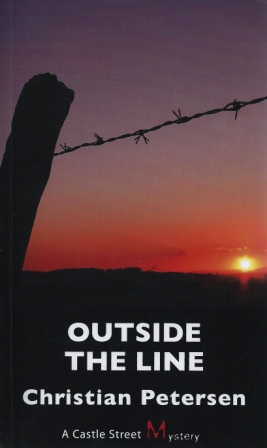
outside the line christian petersen 001Outside the Line by Christian Petersen ~ 2009. This edition: Dundurn Press, 2009. Paperback. ISBN: 978-1-55002-859-1. 213 pages.

My rating: 6/10. I must admit I gave this one an extra dash of “like” because it is by a hometown author. If it was by someone from somewhere else, it would likely only rate a 5. Maybe not even that high…

Christian Petersen has also had published two volumes of short stories. I read, greatly enjoyed, and subsequently reviewed the first collection, Let the Day Perish, so was eager to read Petersen’s first full-length novel.

*****

Middle-aged Peter Ellis is an auxiliary probation officer attached to a busy office in a small, unnamed city in the interior of British Columbia. (And though never named, it is very obviously Williams Lake, with a few creative liberties taken here and there; not quite sure why Petersen didn’t just go ahead and “locate” his place; the caginess is perhaps a self-protective measure by an author who lives and works in his own – though obviously slightly fictionalized – setting.)

As a former student of literature and lower-case communist who once attended rallies and freely signed all manner of petitions, (Peter) had never had any interest or intention of getting involved in the Justice System. When he first began working as a probation officer, a few of his friends questioned the move, and thereby his values. With these keen defenders of human rights he took an almost apologetic tone, claimed the job was a trial run, just a means of survival, certainly temporary. He chews gum at a range of paces, aggressively at the moment, while he swivels back and forth in his chair, prioritizing the work at hand. What he didn’t admit to anyone, even to himself for a long time, was that this job hooked him immediately. Every day it places him at the crisis point in someone’s life, tangent to a stupid mistake, a rage, an arrest.

Peter shies from judgement, despite or maybe partly to spite his Baptist upbringing. He suffers with imagination like vertigo lately, glimpsing life’s infinite heartbreaking scenarios. He wonders whether it is some errant part in himself, some piece askew, that enables his rapport with the probation clients, the offenders.

Then a client walks into Peter’s life whom he can find no common ground with, no sympathy or rapport.

Twenty-four-year-old Todd Nolin is, despite his relative youth, already washed up, and dealing with it badly. As a teenage hockey star and National Hockey League draft pick rookie player, Todd’s potentially brilliant career has gone sideways on him; he’s been quietly let go from the team with no real reason given, and he’s gone from being totally focussed on hockey and rolling in cash to working in the sports store in his old home town, where he’s come to lick his wounds after his ego-crushing letdown.

While Todd was flying high, he bought a lavish (well, lavish by small-town B.C. standards) house in the upper scale neighbourhood he grew up in, hosted wild parties, and took up with a gorgeous local girl, Marina Faro. Now, two years after the “big time”, all that remains of Todd’s fleeting time as an elite athlete is a hometown hero reputation, an appetite for alcohol and cocaine, a condo, and the lovely Marina. And he’s just screwed up the last two. The reason Todd is in Peter Ellis’ office is because of a recent enraged physical and sexual assault of Marina; one of the terms of Todd’s probation is a restraining order barring him from both his home and girlfriend.

Todd’s not taking it well at all. He takes an immediate dislike to his probation officer, and the feeling is more than mutual, especially once Peter meets Marina and feels stirrings of multiple emotions; a paternalistic protective instinct combined with admiration for her physical beauty, plus the unmistakable stirrings of sexual attraction.

Against his better judgement, Peter lets himself go with his feelings. You see, Peter’s own personal life is a bit of a mess, what with his beloved wife of eight years having walked out on him six months or so ago. She’s left Peter for another woman, and is now living in California, only connecting with Peter to inquire why their house, purchased several years ago with the idea of starting a family, hasn’t sold yet.

Facing personal bankruptcy both emotional and financial, Peter has been letting himself go in more ways than one, and when he breaks that ironclad taboo not to get personally involved with a client, he goes down hard. And Todd is on to him…

The rest of the story falls into predictable patterns, and the dramatic ending is par for the course with this type of novel; nothing out of the ordinary.

This is actually a very ordinary story, an ordinary drama. It’s a step back in some ways from Petersen’s edgy short stories, much more cliché-ridden and safer and tamer, despite attempts to keep it moving by tossing in references to the cowboy culture of the area, and a continuous scornful sub-theme of the bad attitudes and deep stupidity of the local “rednecks”.

That last term was what I found most troubling about this novel, because it shows up way too often. C’mon, Christian, is it you or your character Peter talking here? A few too many cheap digs at the less intellectual inhabitants of our “fictional” town, in my opinion.

That, and the totally stereotypical situation with the gorgeous Marina and Peter’s “urges” being too strong for him to control. No matter if she made reciprocal moves of her own, what was the man thinking?!?

Oh, right. Plot device.

*****

Outside the Line is billed as a mystery novel, but it isn’t any such thing. It’s more of a dramatic-suspense, noir-lite type of story. It also reads very much a “first novel”, a bit rough around the edges here and there, especially in the final dramatic scenes, as if the author was not quite sure how to handle his characters during the physical action. He does seem more at home with the cerebral stuff.

I think the word I’m looking for here is “promising”. What is good in Petersen’s writing is very good indeed, as his well-tailored short stories prove. This novel moves in a different direction, and Petersen occasionally falters along the way. I think I made allowances for the weaknesses in the narrative and especially the plot because I did so want to like this book, and I was curious as to what the author would make of a setting familiar to me from my own experience.

Petersen’s Peter Ellis kept reminding my vaguely of Kate Atkinson’s Jackson Brodie, in that even though he pulled off the most desperately stupid moves, I still liked him at the end. There’s some good writing going on here, and the characterization of Ellis was one of the better aspects of Outside the Line. (The plot, however, was the weakest bit.)

And as for that whole “first novel is autobiography” thing, it seems alive and well in this case. Christian Petersen is intimately familiar with the B.C. interior’s Cariboo-Chilcotin region, as he grew up in Quesnel, and currently lives in Williams Lake, where he works as a probation officer. Well, “write what you know” is good advice, and in this case it works out fairly decently. This novel was just good enough that I would readily read a second, if it ever makes it to the bookstore shelf.

Kudos to Mr. Petersen for his persistence in honing his writerly craft and branching out genre-wise. Here’s hoping that that more than abundant promise is refined even further in future books.

Note: I don’t personally know Christian Petersen, despite being the same age as he is and sharing the same communities. His author photos look darned familiar though; I’m sure we’ve crossed paths in our daily rounds. Williams Lake is really just a very small town at heart, despite its bold claim to cityhood. I’m looking forward to one day meeting the author in person, perhaps at his next novel launch, if and when that occurs. Despite this rather damning review, I have a genuine liking and admiration for his writing style.

Delphiniums in the nursery garden, Hill Farm, July 7, 2013

Delphiniums in the nursery garden, Hill Farm, July 7, 2013

FRAGMENTARY BLUE

Why make so much of fragmentary blue
In here and there a bird, or butterfly,
Or flower, or wearing-stone, or open eye,
When heaven presents in sheets the solid hue?

Since earth is earth, perhaps, not heaven (as yet)—
Though some savants make earth include the sky;
And blue so far above us comes so high,
It only gives our wish for blue a whet.

~ Robert Frost, 1920

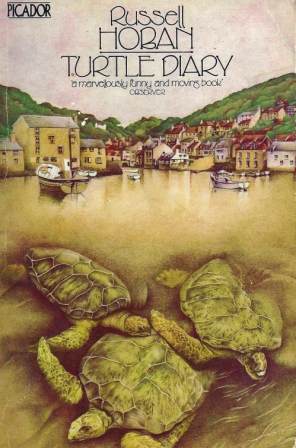
turtle diary russell hoban 001Turtle Diary by Russell Hoban ~ 1975. This edition: Picador, 1977. Softcover. ISBN: 0-330-25050-7. 191 pages.

My rating: 9/10.

The only thing better than looking forward to a read with a cozy preconception as to what the story will bring, and being satisfied with your expectation, is to be blanket-tossed up in the air by a book that tightens up and bounces you unexpectedly into a very different direction, leaving you to freewheel for a while, scrambling for a sense of where you’re going, then catching you and returning you, more or less gently, to solid ground. Turtle Diary is that second kind of book.

The plot is easily condensed. Two middle-aged and currently unattached Londoners, William G. and Neaera H., both struggling with a stagnant state of being, visit the Zoo and are, separately, attracted to the sea turtle tank and the stoic inhabitants within. Musing on the cosmic injustice of these far-roaming creatures being confined to a tiny volume of water, William and Neaera each consider the possibility of somehow freeing the turtles back into the sea. As each of them in turn carry on their separate narrations, we see that their thoughts are uncannily similar, both regarding the turtles and other aspects of their solitary existences, and their relationships (or lack thereof) to those around them. Inevitably William and Neaera meet, speak, share their turtle-liberation impulses, and formulate a practical plan to carry it out, helped by the like-minded zookeeper. Can you guess where we’re going from here? Two lonely people, sharing a joint goal, yearning desperately for love…?

Well, abundant blessings to Russell Hoban. He faces up to and jumps the clichés quite nicely, and while his characters do ultimately find themselves in a different and presumably better emotional place, it’s not their ultimate fate to rest in each others’ arms.

There is so much packed into these strange and wonderful book that the whole turtle thing turns out to be merely a unifying theme, a subplot. This is not as much a book about animal liberation as it is about human liberation. Or, as William G. would doubtless remind us, perhaps there isn’t any difference between the two, humans being just another sort of animal, after all. The trick being to find a state of existence where one can satisfy one’s biological and emotional needs, whether one is sea turtle (source of sea turtle soup) or William G. (source of William G. soup) or octopus or oyster-catcher or water beetle or zookeeper or Balkan expatriate…

It’s so strange (and wonderful) that I picked up an old edition of this book completely at random some weeks ago, merely on the strength of the author’s name. And yes, I already knew who Russell Hoban was – what reading parent could not miss the identity of the originator of the adorably contrary Frances? And of course The Mouse and His Child, which is, most emphatically, not a book for small children, or possibly any age of child, despite the repeated references to it as a “children’s classic”. Whoever has designated it as such has perhaps not read the actual book. But I digress.

As I was saying, I picked up Turtle Diary completely serendipitously, only finding out when another blogger mentioned that he too was reading it that it has been recently reissued by New York Review Books, and is currently receiving much popular press as literary readers “rediscover” Hoban-the-writer-of-adult-fiction.

Without further ado, and without wasting my words in attempted repetition of what Guy Savage of the excellent His Futile Preoccupations book blog has already said, I refer you to that review:

Turtle Diary by Russell Hoban

Guy states that this might well be one of his best books of the year. I know it will be high up on my own list.

And on the strength of Turtle Diary, I will be searching out my copy of The Mouse and His Child, which I acquired when my children were small, thinking that it was a children’s story – it was, after all, shelved in the juvenile section of the bookstore. It was tucked away when an initial reading showed a deep unsuitability for the highly imaginative, nightmare-prone younglings of the household, despite the message of unconditional love yadda yadda yadda. Now that the children in question are in their advanced teen years and decidedly bombproof in their reading habits they might even be interested in exploring Hoban’s adult works for themselves. The dystopian Riddley Walker sounds like something my son in particular might enjoy; must seek that one immediately.

Russell Hoban. If indeed his works are coming in for a time of resurgence, it is because they richly deserve it. Check him out.

Edited July 24, 2013 to add this link to another brilliant review: Seeing the World Through Books – Mary Whipple Reviews Turtle Diary

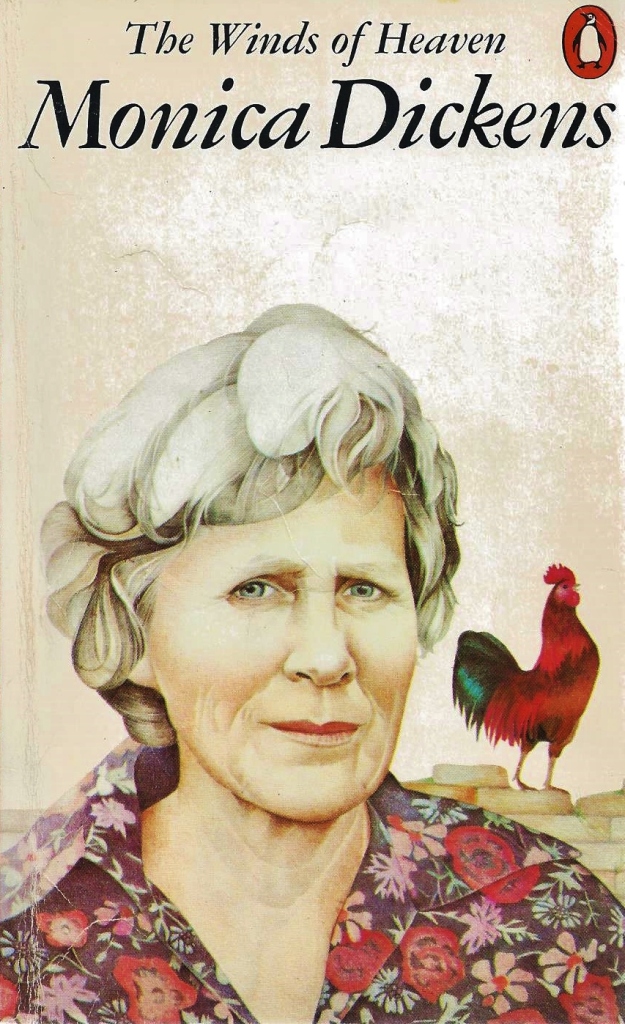
the winds of heaven monica dickens 001The Winds of Heaven by Monica Dickens ~ 1955. This edition: Penguin, 1977. Paperback. ISBN: 0-14-00.1917-0. 239 pages.

My rating: 7/10.

Monica Dickens is one of my pet authors; her books, despite their undoubted flaws, reside prominently on the bedroom bookshelves reserved for our favourite re-reads. And when one is so comfortable with a certain author, isn’t it sometimes hard to step back and realize that not everyone shares either their familiarity or enthusiasm?

I was quite surprised at my own passionate feelings of defensiveness regarding Monica Dickens recently when I read this review of The Winds of Heaven by blogger Rachel of Book Snob. I was half way through reading my own copy of the novel, and Rachel’s comments made me step back a bit and look at the story with new eyes. I’d read it several times previously over the years, and I didn’t really change my views on it with this reading, but it was truly interesting to read with a more critical eye, as if experiencing the novel as a “first” Monica Dickens, and to try to identify what exactly pushed Rachel’s buttons all wrong. Great discussion followed that post; worth reading, so please visit if you haven’t already.

So – taking a deep breath, stepping back, and trying to maintain some sort of distance so I’ll be able to give my own picture of the book in question.

First off, I must say that The Winds of Heaven isn’t, in my opinion, one of this author’s stronger books. Though well up to standard as far as the writing goes, there are others much, much better handled, both in plot and execution. The recent re-issue of this title by Persephone Books leaves me jut a bit bemused; there are others in this writer’s canon which are so much more worthy of that great honour. If this is your first exposure to Monica Dickens, it might well also be your last, and that would be an immense shame, as she has some rather good stories to tell.

I can only assume that Persephone chose this book because of its attention to women’s roles in the mid 20th century. Set in England in the post war years (The Winds of Heaven is set in 1951 and 1952, and was published in 1955), the characters are broadly representative of their time.

When the winds of Heaven blow, men are inclined to throw back their heads like horses, and stride ruggedly into the gusts, pretending to be much healthier than they really are; but women tend to creep about, shrunk into their clothes, and clutching miserably at their hats and hair.

To Louise Bickford, on this late April day, the wind that jostled through the London streets seemed a bitter personal enemy, turning to meet her no matter which way she turned, beating against her small figure in the open stretches, and calling in reserve cohorts to attack her afresh at every corner.

She had intended to walk to the Park and look at the spring flowers, but she was soon so tired of fighting the wind’s fiendish determination to pluck her clothes and hair awry that she turned into a teashop to resettle her hair and recover her breath, until it was time to meet Miriam and the children at Marble Arch.

Miriam was Louise’s eldest daughter. She had borne three daughters, to her surprise, for her husband had set his heart on a son, and Louise was in the habit of giving him everything he asked for. That she failed to give him a boy, with a long conceited nose like his own to look down on the world, had not helped to raise his opinion of his wife’s usefulness to society…

Louis, widowed for just over a year,  is on the cusp of sixty. Her late husband, the supercilious Dudley, has died unexpectedly after a short illness, leaving his financial affairs in a state of great turmoil. Instead of a sedate widowhood financed by a respectable income, Louise is startled to hear that she is, in fact, penniless. Her one resource is a small income from her parents’ estate, barely enough to keep her clothed and fed. Her home and possessions must be sold to repay Dudley’s many debts; Louise has become a bemused and helpless vagabond, thrown out into a world she has been increasingly insulated from during the long years of her difficult marriage.

Louise’s three daughters have stepped in to take on their mother in turn, a situation which all are unprepared for.

Miriam, married to an upwardly mobile barrister, is strongly focussed on the requirements of keeping up a suitable home, entertaining and being entertained by her husband’s business associates, and ensuring her three children are moving ahead in their school and social circles. The most financially prosperous of Louise’s children, it has fallen to Miriam to take on a major part of the responsibility of her mother’s care. Both Louise and Miriam are having a difficult time reconciling themselves to their new relationship. Louise would love to be a fond grandmother figure to Miriam’s three children, but this never quite works out as hoped for. Her closest relationship within the household is to Miriam’s eldest child, Ellen, a dreamy and ineffectual misfit in a household of high achievers. Louise and Ellen are kindred spirits, and Louise’s gentle defense of Ellen serves mostly to irritate, as Miriam sees this as unwarranted interference and an insidious criticism of her mothering skills.

Louise’s second daughter, Eva, an aspiring actress with a hectic personal life, maintains a small flat in London, and good-naturedly tucks her mother into her tiny spare room when it is her turn to host her mother, but her bohemian lifestyle is so at odds with Louise’s conventional nature that the two are never really comfortable together. Eva’s personal affairs are also made more difficult by the presence of her mother in her flat, especially now that she has fallen deeply in love with a married man, and faces her mother’s unspoken but very obvious horror at the situation her daughter has placed herself in.

Louise’s youngest daughter, Anne, has married a struggling market gardener and smallholder. Louise and her practical and kind-natured son-in-law get along well, and Frank has no objection to hosting his wife’s mother. Louise is even becoming rather handy with minor chores about the farm, and she and Frank work well together, with Louise showing increasing competence in practical things under Frank’s relaxed tutelage. Anne herself is the sore point here. Lazy by nature and downright slovenly about the house, Anne finds herself irritated by her mother’s attempts at housecleaning and cooking; those very small efforts at “helping out” seem to Anne to be a personal condemnation of her chosen lifestyle.

So Louise shuttles from daughter to daughter, with a brief respite as a winter resident – at extremely reduced rates –  at an old school friend’s seaside hotel. She increasingly desperately muses over what she should be doing to try to find some sort of solution to her poverty and homelessness. Never expecting to have to support herself, and ineffectual and self-effacing by nature, any initiative she once might have had has been quenched by the late Dudley’s continual verbal criticism. Though Louise has never been physically injured, she is as much a victim of abuse as any battered wife; the way out of her dilemma is lost to her, though well meaning friends try to pep her up and encourage her to find some occupation which might bring in enough income to enable her to maintain some semblance of an independent life.

Then, in a random meeting in a restaurant, Louise becomes friendly with a most unlikely character, department store bed salesman-slash-author of sex-and-murder pulp fiction, Gordon Disher. Gordon is hugely overweight, a severe diabetic who must be extremely careful of what he eats. He’s the never-married middle-aged son of a now-deceased, over-controlling mother, and he is a deeply likeable character, being soft-spoken, kind and deeply compassionate. Louise inspires affection and the longing to protect in Gordon, and their growing relationship winds through the book, increasing in importance until the startling  – but not surprising, given the increasingly melodramatic tone of this minor saga – conclusion.

The Winds of Heaven is “typical” Monica Dickens in that the characters are presented with all flaws fully intact. This is an author who sees every wrinkle, bump and character flaw, and doesn’t hesitate to share them with us. She is adept at showing us that those flaws don’t necessarily completely define her characters, and she generally shows us the positive aspects of each personality as well. She creates her characters, sets them on the stage to play out their various stories, and lets her readers make of everything as they will. I like “not liking” various of her players, and I like the grace that their creator gives by dropping hints of their deeper motivations, and their complex inner lives. Monica Dickens is occasionally sentimental, but only momentarily; her default tone is wryly observant, and her observations are frequently very amusing, in an “Oh my gosh, she’s right, that could be me!” or, “I know that person!” sort of way.

The book ends on a highly ambiguous note. Louise is about to change her life, and future happiness is a strong possibility, but there is a terrible price to pay.

One of my major issues with this novel is the rushed and superficial handling of the ending; after providing such micro-detail throughout, the sketchy handling of final events is something of a let-down, as if the author was really just ready to be done with the story, already.

I don’t personally feel that the author had any statements to make with this tale, much as it could be read as a critique of the treatment of the elderly (though Louise, at a hale and hearty sixty, isn’t really elderly, in the way that we interpret the term today). Every character is presented sympathetically in that we get to see all the facets of their personalities. We may not like how they behave, but we understand why they are like they are.

Yes, Louise’s daughters are selfish, but their creator does not condemn them for it. Louise is just as selfish in her own way, as is Gordon Disher. Everyone has something that they want, some vision that they’re chasing, which affects their relationships with those they are intimate with. It’s plain old human nature, and I appreciate Monica Dickens’ way of presenting each situation with glimpses of motivation and reasoning, and also those moments of reconciliation and affection which are so reflective of real life.

And this is why I love Monica Dickens. She is fully aware of the contradictory aspects of human nature, and forces them upon us in a way that is impossible to dismiss, all the while telling a diverting story. The Winds of Heaven, while not in her top rank, is full of good writing.

And that is all I have to say, at least for now.

I’m hoping to review more of this author’s work, but I find it is rather difficult to step back enough from someone I’ve read and re-read so much and really talk about the book in question while trying to remember that perhaps everyone else reading is not so familiar with the author’s canon. I read The Winds of Heaven quite a way along in my roster of Dickens’ titles; my response to the novel was definitely informed by that circumstance. If it was my first book by her, I very well might never have gone on.

Come to think of it, I’m not quite sure which was my first book by her. That’s sadly lost in the foggy mists of time. I think it was One Pair of Feet; I do remember picking that one up, in a vintage Penguin version, from a used book store in Calgary sometime in the 1980s, and not being quite sure what to expect. Obviously whatever it was that appealed still does!
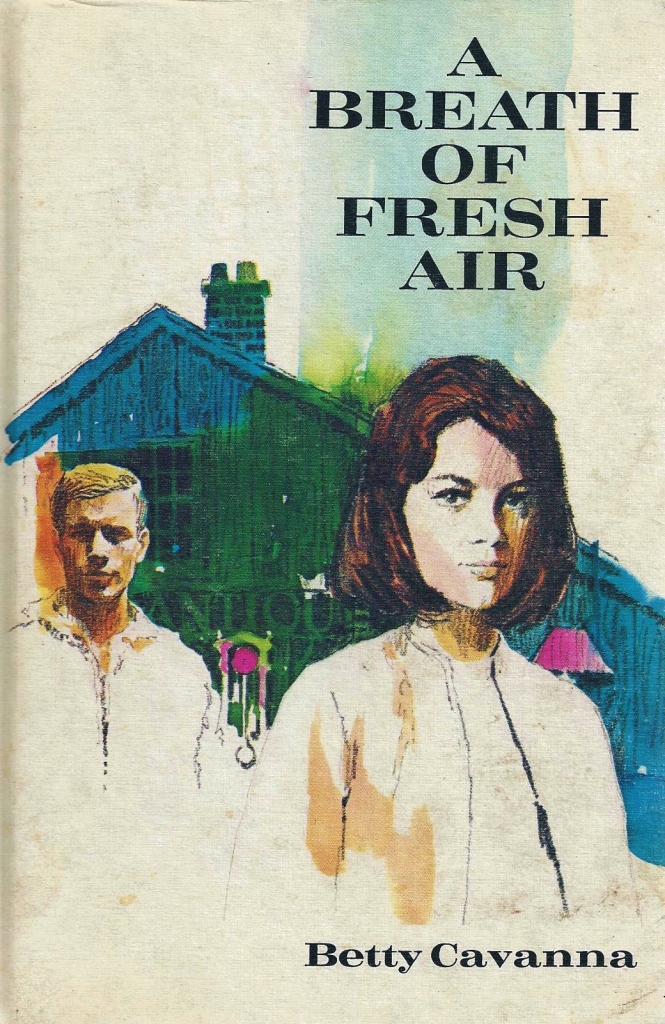
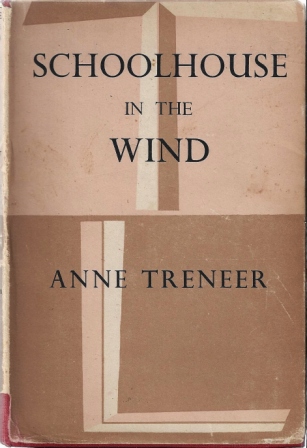
schoolhouse in the wind anne treneer 001Schoolhouse in the Wind by Anne Treneer ~ 1944. This edition: The Travellers’ Library, 1950. Hardcover. 221 pages.

My rating: 8/10.

A slight memoir which leapt into my hand as I was quickly browsing the back room bookshelves housing the “collectibles” during a recent visit to Hope’s lovely used book store, Pages. I’d never heard of Anne Treneer before, but I am so pleased to have made her unexpected acquaintance.

Intrigued initially by the title, and wondering rather why this volume had been shelved among the back room “treasures”, I had no idea what to expect, but a brief dipping-into let me know that this was one of those personal memoirs of childhood which can be such appealing reading, capturing as they do the very essence of an individual’s earliest memories, and frequently memorable glimpses of long-passed time and much-changed place.

*****

He panted to escape but I
As he was winding thin
And narrowly was slipping by
Gasped and drew him in.

~On Catching the Breath

Anne Treneer was born in 1891, in the small village of Gorran in England’s Cornwall (hotbed of so many writers and creative types), the very much unplanned-for sixth child of the family, born after the family of four boys and a longed-for daughter, Anne’s older sister Susan, was thought complete. The baby carriage had long been given away, so Anne was trundled about by her older brothers in whatever other conveyance was handy:

My brothers say they brought me up in a wheelbarrow, and that this accounts for certain bumps in my forehead and generally scrappy appearance. When I was small they used to tell me that old Mrs. Tucker brought me one winter night in a potato sack and left me on the front step; and that I squalled so loud that my father said to my mother, ‘For God’s sake bring the little Devil in and see if she’ll stop that noise’. So in I came and stayed…

Anne’s father was the local schoolmaster, and Schoolhouse in the Wind is an affectionate, humorous and occasionally poignant evocation of a small corner of Cornwall at the juncture of the 19th and 20th centuries.

Gorran School, with a house for ‘master’ glued to it, stood strong and symmetrical, without beauty but not mean, triumphantly facing the wrong way. It might have looked south over the distant Gruda and the sea; but this advantage was forgone in favour of presenting a good face to the road. Master’s room in school, the big room as we called it, caught the north wind while the closets at the back caught the sun. I have heard that Mr. Silvanus Trevail, the architect, who designed many Cornish schools, committed suicide in the end; but whether out of remorse for his cold frontages I do not know.

That last comment at the end of the book’s first paragraph filled me with quiet glee – obviously this was not to be a completely sweetly sentimental memoir, but something with a bit more bite! – and I read on with high expectations. Those expectations were well met and frequently exceeded.

a young Anne Treneer

A young Anne Treneer.

I could go on and quote many excerpts of Anne Treneer’s rather delicious writing, but I won’t. This book was recently (well, in the late 1990s, “recent” in the used book world, I feel) reissued along with its two companion memoirs, Cornish Years and A Stranger in the Midlands, as a one-volume trilogy. It should be fairly readily available in libraries – at least in British ones – and there are a number of copies available through ABE.

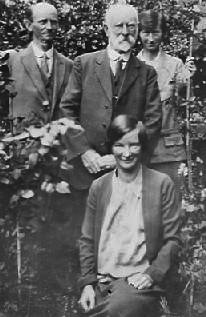
A young Anne Treneer (seated) with her father & sister Susan

A young Anne Treneer (seated) with her father & sister Susan

I recommend it on the strength of this first volume of the trilogy, and I will be buying the combined memoirs for my personal library. The first chapter of Schoolhouse in the Wind sets the stage, as it were, introducing the physical setting of the chapters of reminiscence to follow, and though it will perhaps be of greatest interest to those familiar with the area, even to me, a reader who has never visited England, the picture it draws is vivid and memorable. Also vivid are the character portraits the author paints of her family; with a few well chosen words they come alive on the page.

An internet search brought up a very few references to Treneer. Though she is described as a “prolific” writer, there appear to be few of her titles now available, aside from Schoolhouse in the Wind and the other two memoirs. Schoolhouse is also full of brief snippets of poetry; one assumes these are samples of the author’s work. Some are quite lovely; others seemingly aimed at perhaps a juvenile audience, which is understandable as Anne Treneer spent many years as a schoolteacher.

Anne Treneer

Anne Treneer

Anne Treneer never married, and seems to have led a happy and rather individualistic single life, pursuing her many interests with passion and good humour. She died in 1966.

I will leave the subject of Anne Treneer, at least for now, with this excerpt of a short biography from Maurice Smelt’s 2006 book, 101 Cornish lives.

 Anne Treneer pulled off a difficult trick; she wrote an autobiography that succeeds in enthralling despite its almost relentless happiness. Most writers would not even try, reminding themselves that ‘happiness writes white’. It came out as three books over a period of eight years – Schoolhouse in the Wind, Cornish Years, and A Stranger in the Midlands – and it runs from her earliest memories to a day in her late 50s when she went to America to visit her brother.

From her father’s village school she went to St Austell County School, then to a teacher training college in Truro and then taught in various schools in Cornwall. Ambitious to read deeper and wider she took an external course at London University during the First World War, later spent a year at Liverpool University, later still took a postgraduate degree at Oxford as a mature student. Her longest spell at any one school was a seventeen-year stint at King Edward’s in Birmingham, ending in 1946 with a year’s sabbatical leave. She had by then already written Schoolhouse in the Wind two years earlier, and her future was to be a writer, exiled but coming to her beloved Cornwall when she could. In those twenty post-war years she lived mostly in Devon. She was never married and died in 1966.

One reason why her life seems so tranquil is that she was so eccentric, and at the same time so commonsensical that she records what she did as if doing it were the most obvious thing. For example, she loved air with a passion. It is a word of power in her books, her poems especially; there it is, in slight disguise, in the title of Schoolhouse in the Wind. Hence her whizzing about the country in her young days on a Velocette motorbike, the air streaming past her nose like high-speed champagne. As a teacher in Birmingham she spent a summer term commuting (by Velocette) from a tent in Shropshire on Clent Hill. Tents also feature in later summer holidays in Gorran with her sister Susan – three tents, one for each of them and one for the saucepans… Her outdoorsness gave her the keenest eye for the particularity of place, and she could see several worlds in a single Cornish parish.

She claimed to hate crossings-out and third thoughts, but one would never know it as her books are easy reading, usually a sign of art concealing graft…

“Art concealing graft”… what an intriguing comment that one is, as well!

So, if you stumble upon anything by Anne Treneer in your travels, pick it up and peruse it. She has a lot – happily wry and generally unsentimental – to say.

This one gets a “hidden gem” tag.

 Happy summer, my fellow reading friends!

???????????????????????????????

Colors passing through us


Purple as tulips in May, mauve

into lush velvet, purple

as the stain blackberries leave

on the lips, on the hands,

the purple of ripe grapes

unlit and warm as flesh.


Every day I will give you a color,

like a new flower in a bud vase

on your desk. Every day

I will paint you, as women

color each other with henna

on hands and on feet.


Red as henna, as cinnamon,

as coals after the fire is banked,

the cardinal in the feeder,

the roses tumbling on the arbor

their weight bending the wood

the red of the syrup I make from petals.


Orange as the perfumed fruit

hanging their globes on the glossy tree,

orange as pumpkins in the field,

orange as butterflyweed and the monarchs

who come to eat it, orange as my

cat running lithe through the high grass.


Yellow as a goat’s wise and wicked eyes,

yellow as a hill of daffodils,

yellow as dandelions by the highway,

yellow as butter and egg yolks,

yellow as a school bus stopping you,

yellow as a slicker in a downpour.


Here is my bouquet, here is a sing

song of all the things you make

me think of, here is oblique

praise for the height and depth

of you and the width too.

Here is my box of new crayons at your feet.


Green as mint jelly, green

as a frog on a lily pad twanging,

the green of cos lettuce upright

about to bolt into opulent towers,

green as Grand Chartreuse in a clear

glass, green as wine bottles.


Blue as cornflowers, delphiniums,

bachelors’ buttons. Blue as Roquefort,

blue as Saga. Blue as still water.

Blue as the eyes of a Siamese cat.

Blue as shadows on new snow, as a spring

azure sipping from a puddle on the blacktop.


Cobalt as the midnight sky

when day has gone without a trace

and we lie in each other’s arms

eyes shut and fingers open

and all the colors of the world

pass through our bodies like strings of fire.


Marge Piercy ~ Southern California Anthology ~ 1999