TO A YOUNG WRETCH

(Boethian)

As gay for you to take your father’s ax
As take his gun – rod – to go hunting – fishing.
You nick my spruce until its fiber cracks,
It gives up standing straight and goes down swishing.
You link arm in its arm and you lean
Across the light snow homeward smelling green.

I could have bought you just as good a tree
To frizzle resin in a candle flame,
And what a saving it would have meant to me.
But tree by charity is not the same
As tree by enterprise and expedition.
I must not spoil your Christmas with contrition.

It is your Christmases against my woods.
But even where, thus, opposing interests kill,
They are to be thought of as opposing goods
Oftener than as conflicting good and evil;
Which makes the war god seem no special dunce
For always fighting on both sides at once.

And though in tinsel chain and popcorn rope
My tree, a captive in your window bay,
Has lost its footing on my mountain slope
And lost the stars of heaven, may, oh, may
The symbol star it lifts against your ceiling
Help me accept its fate with Christmas feeling.

OLYMPUS DIGITAL CAMERA

And here, to bookend “Christmas Trees”, as it were, is Robert Frost’s commentary on a tree that was cut down. This poem was sent out as his Christmas greeting  to his friends in 1937, and was included in A Witness Tree, published in 1942.

The subtitle “Boethian” refers to the Roman philosopher Boethius and his belief that humans often fail to recognize evil as part of a divine whole; we see only the immediate occurrence, and not its part in the greater scheme of things.  In this instance, Frost relates the immediate evil – the cutting down of the tree – to the greater thing, that of the celebration of the Christmas festival.

CHRISTMAS TREES

???????????????????????????????The city had withdrawn into itself
And left at last the country to the country;
When between whirls of snow not come to lie
And whirls of foliage not yet laid, there drove
A stranger to our yard, who looked the city,
Yet did in country fashion in that there
He sat and waited till he drew us out
A-buttoning coats to ask him who he was.
He proved to be the city come again
To look for something it had left behind
And could not do without and keep its Christmas.
He asked if I would sell my Christmas trees;
My woods—the young fir balsams like a place
Where houses all are churches and have spires.
I hadn’t thought of them as Christmas Trees.
I doubt if I was tempted for a moment
To sell them off their feet to go in cars
And leave the slope behind the house all bare,
Where the sun shines now no warmer than the moon.
I’d hate to have them know it if I was.
Yet more I’d hate to hold my trees except
As others hold theirs or refuse for them,
Beyond the time of profitable growth,
The trial by market everything must come to
I dallied so much with the thought of selling.
Then whether from mistaken courtesy
And fear of seeming short of speech, or whether
From hope of hearing good of what was mine,
I said, “There aren’t enough to be worth while.”
“I could soon tell how many they would cut,
You let me look them over.”

“You could look.
But don’t expect I’m going to let you have them.”
Pasture they spring in, some in clumps too close
That lop each other of boughs, but not a few
Quite solitary and having equal boughs
All round and round. The latter he nodded “Yes” to,
Or paused to say beneath some lovelier one,
With a buyer’s moderation, “That would do.”
I thought so too, but wasn’t there to say so.
We climbed the pasture on the south, crossed over,
And came down on the north.
He said, “A thousand.”

“A thousand Christmas trees!—at what apiece?”

He felt some need of softening that to me:
“A thousand trees would come to thirty dollars.”

Then I was certain I had never meant
To let him have them. Never show surprise!
But thirty dollars seemed so small beside
The extent of pasture I should strip, three cents
(For that was all they figured out apiece),
Three cents so small beside the dollar friends
I should be writing to within the hour
Would pay in cities for good trees like those,
Regular vestry-trees whole Sunday Schools
Could hang enough on to pick off enough.
A thousand Christmas trees I didn’t know I had!
Worth three cents more to give away than sell,
As may be shown by a simple calculation.
Too bad I couldn’t lay one in a letter.
I can’t help wishing I could send you one,
In wishing you herewith a Merry Christmas.

A Christmas circular letter

Sent out by Robert Frost to his friends, 1929

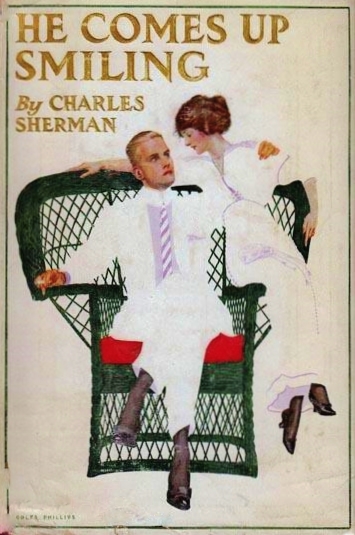
he comes up smiling charles shermanHe Comes Up Smiling by Charles Sherman ~ 1912. This edition: McLeod & Allen, 1912. Hardcover. 351 pages.

My rating: 5/10

Light as a feather and just as fluffy was this century-old bit of humorous fiction.

From the San Francisco Call, February 18, 1912 comes the following commentary.

Once begin this tale… and all thought of everything else will leave you. The tale is absorbing, exciting, clever, amusing and quite unusual… whimsical to a degree. It tells the story of a tramp—not a tramp in disguise, a real tramp, although he has a respectable ancestry and did have some “bringing-up,” though very poor.  He is a lazy, idle hound, and any amount of discomfort is preferable to work. Through a chapter of the most extraordinary occurrences a hero ever had he meets “the” girl, and the remainder of the story is fairly breathless in its excitement. After the reader is once acquainted with “Watermelon,” the affectionate nickname which other tramps call him, it is easy to see why he is a gentleman, though his hands are not clean and he is not above lying and stealing in a small way. He has the quaintest sense of humor and is forever making the most original remarks, always with the prefix “Father says.” A few follow:

  • ”Manners don’t count any more than the good apples on the top of the box to hide the rotten ones beneath.”
  • “If a man reached 40 without becoming a cynic, he was a fool and might never have reached 40.”
  • “A success can be a cynic, for cynicism is simply a pretty good idea of the meanness of human nature and no unfounded expectation of anything especially decent coming from it.”
  • “Nothing is more important than ourselves and what affects us.”
  • “Love is divine, hate devilish and meanness just cussed human nature, and a mixture of the three, in more or less degree, makes man.”
  • “A man who knows life never wrote about it. It would be too painful. It wouldn’t sell.”

Though the reviewer for the SF Call thought this was a grand bit of fiction, I am sorry to say that it did not travel through its ten decades with a whole lot of staying power. It has merit as a literary and cultural curiosity, and the first few chapters are quite delightful, but it petered out midway through and slid gently downhill to end in a well-cushioned and in no way fatal heap, rather like a slow speed accident with one of the vintage cars which the tale is so dependent on.

Three American tramps laze away a sunny summer Sunday morning, and in the course of conversation start a debate as to which of the two younger men would “clean up” better. They propose a beauty contest of sorts, to be judged by the corpulent Mike, and off go James and “Watermelon” (later found to be possessed of a proper name, Jerry, though it is as Watermelon that we follow him through his adventures) to town in search of a shave and brush-up and an upgrade in wearing apparel.

Watermelon is our unlikely hero from the very start, and we follow him into a barber shop where with a clever bit of smooth talking and a pinch of sleight of hand he obtains from the barber – who forks over quite willingly, which demonstrates the magic of Watermelon’s smooth patter – not only a shave, but the contents of the till.

Clothes are a bit more difficult to come by, but here luck is on Watermelon’s side, as he comes across a young man swimming in a small lake, with his elegant clothes placed neatly on the shore. Watermelon there and then “borrows” the improved apparel, hiding his own cast off garments nearby. He fully intends to come back and swap down, but he also wants to keep the naked swimmer in a position not to give pursuit once he returns to shore and realizes his predicament.

Proceeding on his way, now nattily attired in stylish new clothes, Watermelon happens upon a deserted car – obviously that of the oblivious swimmer – and climbs in to relax and daydream a bit. Along comes another car, carrying an elderly gentleman and his middle-aged daughter along with their chauffeur; they impulsively offer to rescue the “stranded” young man, and Watermelon, as is his phlegmatic way, goes along with the assumption that he is an unmechanical rich man out for a jaunt.

One thing leads to another, and when the time comes to make introductions, Watermelon hands over a card from the case in the borrowed suit, “revealing” himself as a certain young stock-broker who has just made a fortune on Wall Street, to great publicity. Taken off to dinner with his new friends, Watermelon is introduced to a “fellow” stock-broker and his lovely daughter, and once Watermelon sets eyes on the lovely Billy his fate is sealed.

Deciding that one afternoon with this angel on earth is worthy of continuing the masquerade for at least a few hours longer – he still intends to return the clothes and make all right with the swimmer – Watermelon makes himself agreeable to all. Little does he know that Billy’s father is hatching a mildly nefarious plot to kidnap the man whom he views as a business rival, and to carry him off for a week in the depths of the country, thereby leaving the coast clear for Billy’s father’s partner to triumph on Wall Street without interference.

And off we go on a farcical romp of mistaken identity, deliberate wrong directions, housebreaking, encounters with the law, much double entendre, hidden yearnings and unspoken but reciprocated love, as Billy has fallen just as hard for Watermelon as he has for her. (He does clean up rather well.)

The humour is relentless and the situations highly contrived, but Watermelon gently winkles his way into the hardest of readers’ hearts as well as that of susceptible Billy.

Billy herself was rather a waste of ink, being a completely frivolous rich girl with no evident depth to her. She’s cute as a button, but that’s about it. The older Henrietta, on the other hand, proves herself to be a witty foil to Watermelon’s quirky comments; I had high hopes that the two were going to dump the silly Billy and further develop their meeting of minds, but sadly this was not to be. (My opinion of the author took a nosedive when he let all three of us down in this way.)

The ending is broadly telegraphed from very early on; we fully expect to see Watermelon ‘fess up and buckle down to a life of honest toil in order to win the fair Billy’s hand. Though he does come clean, the honest toil bit doesn’t look to be in his future; the resolution is rather odd; it felt like the author cheated us of the expected rounding off of this ultra-light tale.

A  rather strange little reading experience, both more enjoyable than it sounds from my dismissive comments above, and less satisfying than it could have been if the author had been a bit braver with his character developments and multiple romantic interests. Definitely a throw-away sort of tale, a momentary diversion at best. Sort of a lightweight American P.G. Wodehouse of the B-list variety.

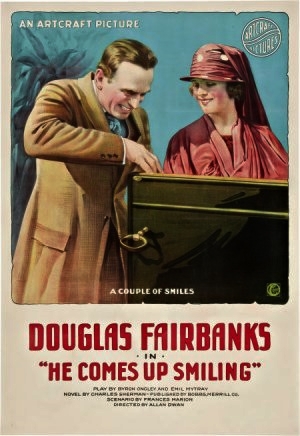
The story was made into a 1914 stage play, and then into a 1918 silent movie starring Douglas Fairbanks as Jerry Martin (the “Watermelon” of the book), though the plot was gingered up to make it more conventionally dramatic.

he comes up smiling 1918 movie poster

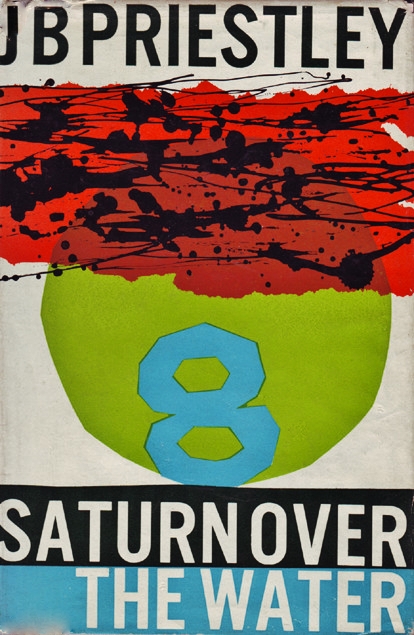
saturn over the water dj cbc j b priestleySaturn Over the Water by J.B. Priestley ~ 1961. This edition: The Companion Book Club, 1961. Hardcover. 255 pages.

My rating: I dunno. This is tough. It was a diverting read, but the ending was just too deus ex machine to swallow whole. What the hey, J.B.? Clairvoyants and psychics save the world at the eleventh hour?! Couldn’t they have stepped in a little earlier, like when the nefarious villains started their evil organization?

Oh. Right. No story.

Let me think. It was amusing in a campy sort of way, plus the hero was a moderately likeable sort. The action scenes were acceptable, though never with a fully developed edge. The women were a stumbling block, but I’ll waive objections to their overwhelming sexiness and sultry beauty because the author allowed them some competences. Okay, mostly that they were just good drivers. (And fireworks-inducing passionate kissers – does that count as a competence? In this novel, apparently so.) But he also made them just plain silly with men. Hm.

Full of goofy racial stereotypes; author Priestley/narrator Tim was particularly hard on the Germans; vestiges of the last war, obviously. And the Russians got some serious needling, too.

So with everything considered, and taking into account the other similar schlock that was being published at the time and the very real spy-versus-spy tenseness of the Cold War political situation, I think I can safely give this one a 7.5/10. Even with the cop-out ending. Because Priestley did an adequate job, and he had a few serious things to say hidden in the nonsense, and I appreciate his willingness to dabble in the genre. And it was rather a fun read, of the “so bad it’s good” school.

*****

So this was something unexpected. J.B. Priestley channels John Wyndham, with a dash of Ian Fleming, and a sprinkling of pure silliness. Here’s our story.

It all began with a call I had from Addenbrooke’s Hospital, Cambridge, where my cousin Isabel was dying of leukemia. The Hospital didn’t say she was dying of course – they never do – but I knew she was and she knew she was. The scientists who enjoy playing about with these filthy bombs tell us it’s all quite safe and have figures to prove it; but before these bombs came along I’d never known anybody who had died of leukemia, whereas now my cousin Isabel was the fourth person I’d known who had died of it.

saturn over the water dj 2 j b priestley

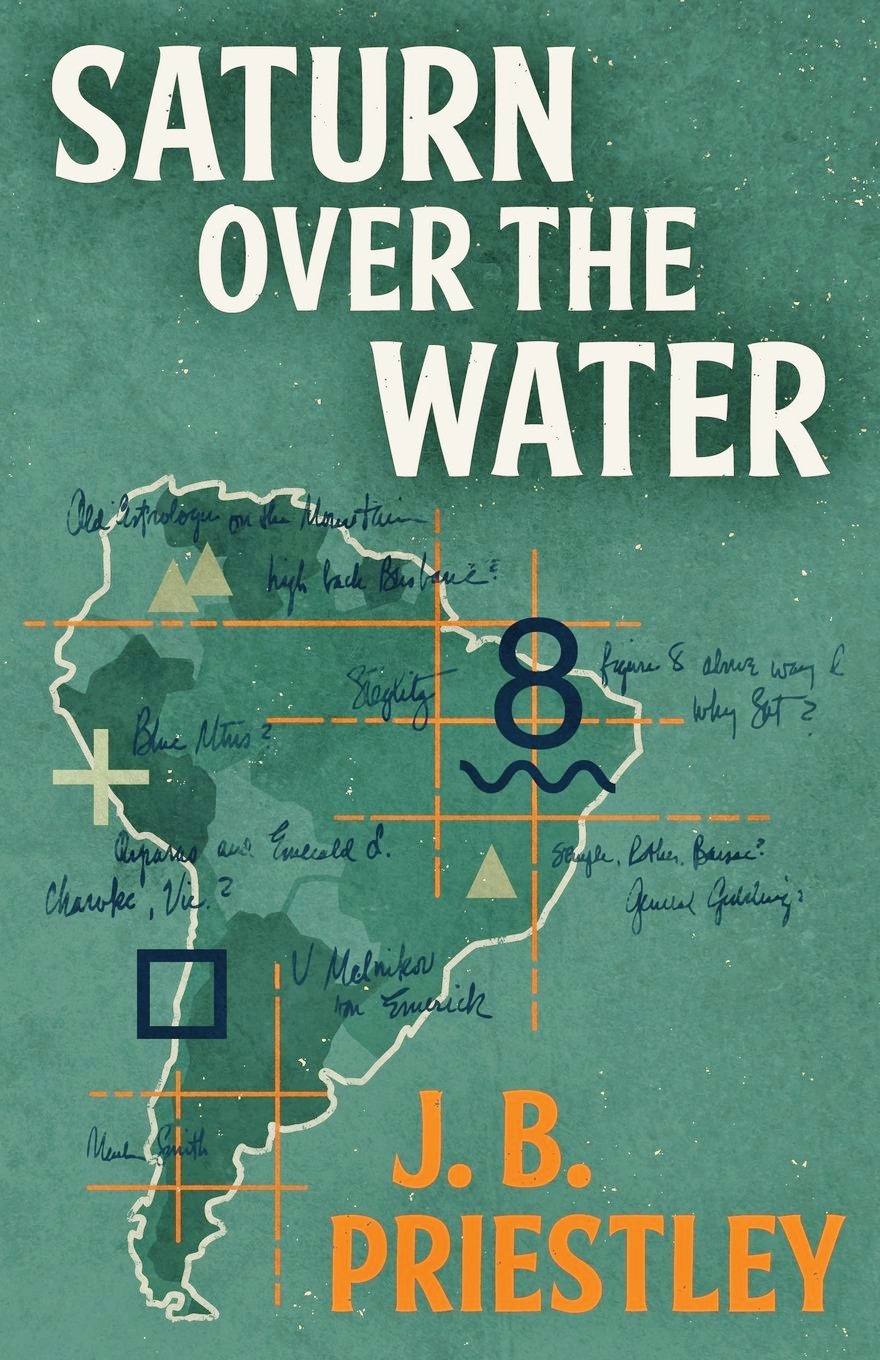
This handsome cover depicts Joe’s scribbled clues. Can you read his writing? If not, don’t feel too bad. Tim had trouble too.

Career artist Tim Bedford, standing by Isabel’s bedside, reluctantly takes on a commission for her. Some years ago her husband, Joe Farne, a biochemist, had gone out to Peru to work for the privately owned Arnaldos Institute, where research on various nebulous “beneficial projects” was being carried out. Isabel had stayed in England, because she and Joe were having marital issues, but they’d made up via letter and all was looking up when something disturbing occurred. Joe suddenly left his job at the Institute and vanished, Isabel’s letters started being returned unopened, and no one was able to say where he had gone.

Then another letter from Joe came, but from Chile, not Peru. Three pages of hastily scribbled reassurances that he loved her, and on the last page a collection of cryptic jottings, names and phrases that made no sense to Isabel at all, but that must have some meaning, otherwise why would Joe have sent them?

Could Tim please track Joe down, to see if he was all right, and to explain to him why Isabel herself was unable to come to him, and to give Joe her dying message of love? Well, what could Tim do, especially once he visited Isabel’s lawyer and found that there was a tidy sum of money for expenses at the ready.

Before departing England for South America, Tim does some intital groundwork by tracking down the widow of one of Joe’s fellow scientists at the Institute, and what she tells him gives him pause. Something deeply sinister was going on in Peru, and she urges him to start his search there, to find a clue to Joe’s departure and subsequent popping up several countries over.

Coincidences start to occur thick and fast, as Tim sets off on his quest, soon to encounter a stunning Russian countess, a wealthy English lord, a variety of Communist sympathizers, a beneficent New York art dealer, a Peruvian multimillionaire with a brooding and artistic granddaughter, pseudo-Nazis, evil scientists, corrupt policemen, and a motley crew of shady characters occasionally on his side in the ever-more-pressing race to discover what is going on in not only Peru, but the Emerald Lake in Chile and the Blue Mountains of Australia.

Will Tim find Joe, and incidentally help save the Northern Hemisphere from annihilation by the H-bomb?

Of course he will, and he’ll discover the cryptic meaning of the Wavy Eight symbol, too, and the significance of the mysterious phrase “Saturn Over the Water”. (It’s much more daft than you could ever imagine.)

A true period piece, this one. If you find it in your travels, give it a go. Says me.

saturn over the water dj j b priestley

Eye-catching first edition dust jacket.

Three quick reads this past few days ran the gamut from slightly-gosh-awful to thoughtfully-affirmative to poignantly-hilarious. All are deeply imbued with sense of place. Light reading, all three, easy to pick up and put down, though I must confess I read each one straight through. Without further ado, here they are.
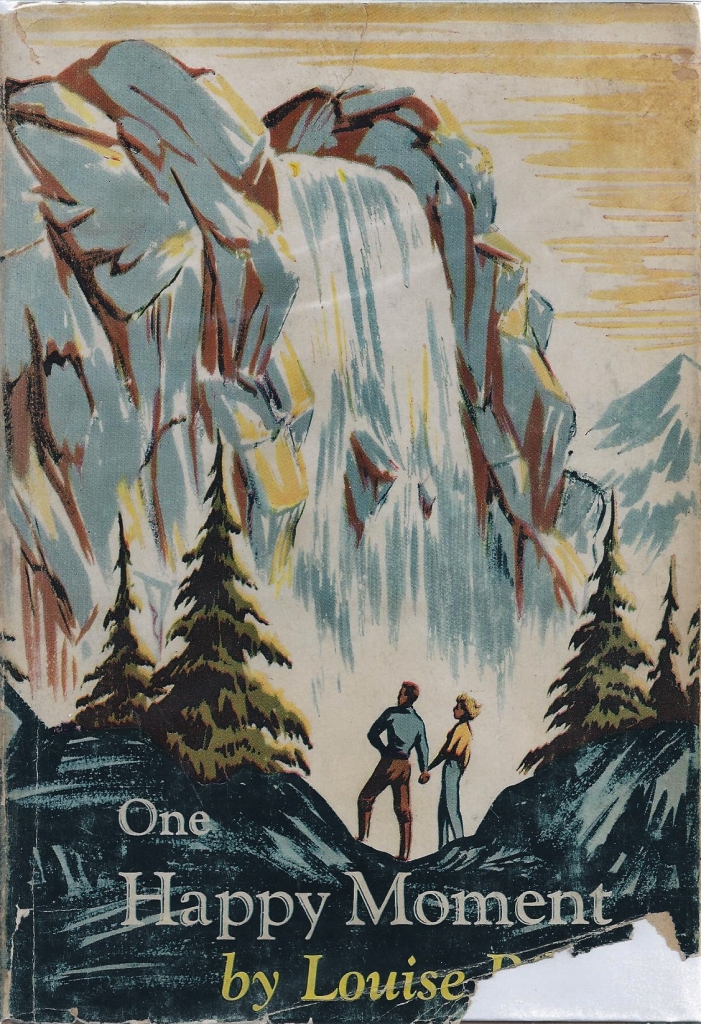
one happy moment dj louise riley 001One Happy Moment by Louise Riley ~ 1951.

This edition: Copp Clark, 1951. Hardcover. 212 pages.

My rating: 4.5/10

I’m glad to have read this obscure Canadian novel, for it made me stop and muse on what makes a style of writing either a hit or a miss with a reader. This one felt awkward to me, stylistically and plot-wise, and even its glowing portrayal of a landscape I have personally known well didn’t quite make up for the clunky prose and the rather cardboard characters. I opened it up prepared to enjoy it; I closed it no longer wondering why this was the author’s only adult novel, and why it (apparently) never made it past that first printing.

She lifted her arms and pulled off her grey felt hat, shaking her head like a young horse, freed from his bridle. She ran to the lakeshore and tossed the hat into the lake, laughing at it as it bobbed primly over the ripples. She tore off the jacket of the grey suit and hesitated about throwing it after the hat. Instead she ran back to her suitcase, snapped it open, and took out a pair of plaid pants and a yellow sweater. Taking a last quick look about her, she pulled down the zipper on her skirt and stepped out of it, kicking it aside. Quickly she unbuttoned her grey blouse and took it off, tossing it on top of the skirt. She pulled her slip over her head and, as she stooped to take off her shoes and stockings, the warm sun felt like a caress on her back. She pulled on yellow knitted socks and heavy shoes. When she was dressed in slacks and yellow sweater, with a scarlet handkerchief knotted around her throat, she pulled the pins out of her fair hair, shook it free, and tied it back with a yellow ribbon.

And in case you didn’t quite catch the symbolism, there’s more.

Into the suitcase Deborah shoved the clothes she had taken off, added a few rocks, hauled the suitcase to the shore, and tossed it into the lake. She watched it sink. Her hat had floated several yards away from the shore, and she waved good-bye to it. Then, slinging her rucksack onto her back, she looked for the path up the mountain side.

The young woman so anxious to dispose of her city clothes – and, by inference, her dull, grey, prim and proper former life – is one Deborah Blair, and she’s about to hike nine miles up a trail to a tourist camp somewhere between Lake Louise and Lake O’Hara, on the Alberta side of the Rocky Mountains.

Her first encounter with another person is an old man just up the trail; he pops out of the bush, startling her greatly, and then proceeds to tell her that he knows she is running away from something, and that she is like a young doe, “…frightened…by a hunter, maybe, out of danger now, taking time to be proud of her speed and to taste her freedom, but still wary, remembering her fright…”

But the mountains will give her sanctuary, he goes on to say, and Deborah parts from him, mulling over what he has said, rehearsing her new role in preparation for meeting her fellow guest camp residents.

These are a motley crew indeed. Evangeline Roseberry is her hostess, an uninhibited, provocative and sultry woman of a certain age. Young ranch hand Slim appears to be very close indeed to his employer, and when Slim is not in attendance the male guests are often to be found in “Vangie’s” cozy cabin. Middle-aged Dr. Thornton is holidaying without his wife and apparently finding his hostess a suitable substitute; downtrodden Mr. Nelson is at the beck and call of his own formidable wife, though he glances hopefully at Vangie’s lush charms when Mrs. Nelson’s focussed gaze is elsewhere, and teenage Sue Nelson cherishes a passion for handsome, red-haired, flashing-eyed yet taciturn geologist Ben Kerfoot. In the kitchen brusque Mrs. Horton reigns supreme, dispensing pithy criticisms to all and sundry along with the bacon and eggs.

Deborah gravitates toward avuncular Dr. Thornton, as nosy Mrs Nelson attempts to probe into “Mrs. Blair’s” past, which appears to be decidedly mysterious, especially when an RCMP officer appears asking questions about why a suitcase with the initials D.B. was found floating in the lake at the bottom of the trail. The plot thickens, with heaving bosoms and flashing eyes from the female contingent all round, and lusty glances and/or darkly passionate glares from the men.

One after another, the people from whom Deborah seeks to hide track her down to her mountain fastness, but she gains strength from the purity of the air and the pristine beauty of the surrounding peaks – not to mention Mrs. Horton’s hearty cooking – and stands up for herself at long last.

Though this novel started out promisingly enough, but ultimately didn’t take me where I hoped it would, and most of that was the fault of the writing, and the lack of a cohesive plot.

Deborah’s vaporings are overplayed, and her flip-flopping between men left me bemused. She is decidedly attracted to both Dr. Thornton and Ben-the-geologist, who in turn steal embraces from whichever woman is present and willing, and, when a manipulative cad from her past appears she mulls over throwing her lot in with his, before the mountain breezes blow some sense into her head. An über-controlling mother appears and is finally confounded, and Deborah prepares to set her sights on making her fortune in Vancouver, being as far away across the continent as she can get from her previous life as a meek librarian in Montreal.

The author was a Calgary librarian and storyteller, and her work with children resulted in the naming of a library branch after her in her native city; the wealthy Riley family was well-known for their philanthropy and social conscience, and Louise by all reports was a fervent advocate for childhood literacy.

Four of Louise Riley’s books were published between 1950 and 1960, the juveniles The Mystery Horse, Train for Tiger Lily, and A Spell at Scoggin’s Crossing, as well as her only adult book, One Happy Moment. Though Train for Tiger Lily received the  Canadian Library Association Children’s Book of the Year Award in 1954, a quick glance into my standard go-to children’s literature reference, Sheila Egoff’s Republic of Childhood, finds that perceptive literary critic dismissing Louise Riley’s juveniles as “insipid and contrived”, which I can sympathise with after reading One Happy Moment. Interesting though it may be in a vintage aspect, this is not in any way inspired writing.

Worth taking a look at is the commentary at Lily Oak Books , where I first heard of One Happy Moment. Lee-Anne’s review is well-considered and thoughtful, and she includes some gorgeous pictures.

My copy of the book is going on the probation shelf; I’ll share it with my mom and then decide if it gets to stay or go. The attractive dust jacket will likely tip the balance. As it arrived in fragile shape, I went ahead and put it into Brodart, and its vintage appeal might be too tempting for me to part with, though the words inside the book are not of the highest rank.
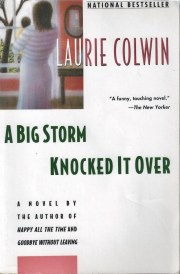
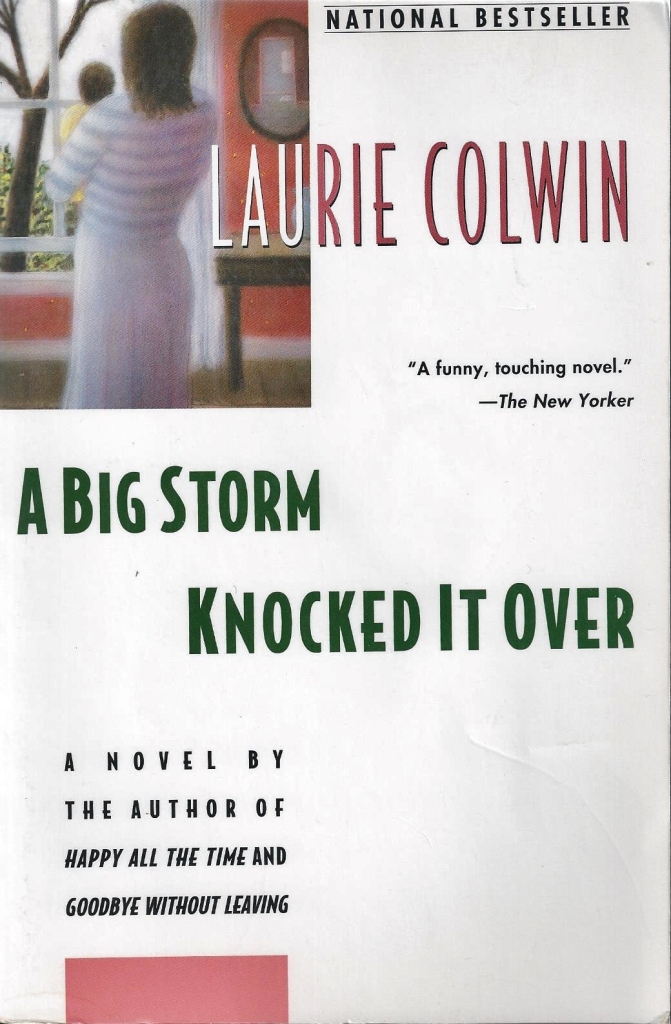
a big storm knocked it over laurie colwin 001A Big Storm Knocked It Over by Laurie Colwin ~ 1993.

This edition: Harper Collins, 1993. Softcover. ISBN: 0-06-092546-9. 259 pages.

My rating: 7/10

Moving right along to the other side of the continent and New England, for this gentle yet slyly cunning novel about love and friendship and transcending unhappy childhoods. It’s also about the terrifying act of bringing a child into the world, and an ode to the possibility of happiness, and our right to seek such out in an often unhappy world.

Does that sound impossibly twee and gaggingly chick lit? Well, it isn’t. (Okay, maybe just the tiniest bit. But it’s easy to get past. I liked this book.)

One Happy Moment has a stellar cover and ho-hum contents; A Big Storm Knocked It Over has a dreadful cover and a well-written inside. Ironically, for the protagonist of Big Storm is a graphic designer employed in the book trade, the blandness of the exterior presentation would not normally have received a second glance from me but for my previous encounter with this author. The late Laurie Colwin – she died suddenly in 1992, before this book was published – was a much-loved columnist for Gourmet magazine and  a bestselling cookbook author, novelist and short story writer. Big Storm was her fifth and last novel.

My first acquaintance with her was some twenty years ago, through Goodbye Without Leaving, about a white ex-backup singer for a black pop band – the token “White Ronette” on the tour bus – and her life after music. I read it just after my son was born, and it struck very close to home; Colwin perfectly captured that “now what?” atmosphere of the ultimate personal change of new motherhood and walking away from your past you, and I was comforted by the parallels between her fictional world and my own. It was also very funny.

In Big Storm, Jane Louise has just married her live-in boyfriend Teddy, and is surprised to find that marriage does indeed change things, even if all that is different is a piece of paper and a ring. We are introduced to an ever-widening circle of co-workers, friends and family, and watch with only slightly bated breath as Jane and Teddy find their new groove.

The gist of the novel is that sometimes family is rotten bad, but that you can always choose your friends. And that babies are quite amazing. And yes, life is terrifying, but if you can find someone to love, who also loves you, it still isn’t all shiny sparkly perfect, but it helps.

I don’t know what else to say. It was good. Not great, but definitely good. And there was a fair bit of to-ing and fro-ing from the countryside to the city, and a lot of emphasis is placed on where you’re from and ancestral homes and the clannishness of small New England towns, so I figure it counts in my vaguely themed geographical surroundings thing I’ve got going in this post.

Laurie Colwin was an interesting person and a more-than-just-good writer. I still feel sad when I think about her too-soon departure from our world.

mama makes up her mind bailey white 001Mama Makes Up Her Mind, and Other Dangers of Southern Living by Bailey White ~ 1993.

This edition: Addison Wesley, 1993. Hardcover. ISBN: 0-201-63295-o. 230 pages.

My rating: 9.5/10

The best is last, and what an unexpected book this turned out to be. I had picked it up along with a random selection of others at the Sally Ann one day, thinking it was a light novel suitable for dropping off with my mom for her entertainment, but not really intending to read it myself. (It reminded me of something by Fannie Flagg, from the title and the cover illustration and the blurbs about “absolute delight” and “like sitting on a porch swing.” Look away! my inner voice chirped, because I have to confess that Fannie Flag leaves me utterly cold, though Mom can handle her in well-spaced intervals.)

My husband was between books, picked it up off the stack by the door and chortled his way through it before pressing it on me. I sat down with it over dinner, and looked up two hours later after having read it through in one continuous session. Easy as picking daisies to prance through, this one was. And I must say a laugh or two escaped me as well.

This turned out to be a collection of short – some very short – anecdotes and vignettes, many centered on White’s mother, the “Mama” of the title, and others more concerned with Bailey White herself. They were originally presented on NPR in the United States, with the author reading her own pieces, but they work exceedingly well in print.

Bailey White was born in 1950 and still lives in her rural family home in Thomasville, Georgia. Until her mother’s death at the age of 80 in 1994, the two were close companions. Their joint adventures as  “a widow and a spinster” are the focus of some of these lively vignettes, but Bailey White’s scope is wide and she draws inspiration from a vast range of experiences. Bailey White worked as a Grade One teacher for over twenty years in the Thomasville school she herself attended as child, after returning to Georgia when her eleven-year-old California marriage ended in 1984.

Between the covers of this delectable smorgasbord of a book you will find tales of an antique spyglass, the best movie ever made (Midnight Cowboy, according to Mama), Road Kill (and how to decide if it’s edible), Pictures Not of Cows, an Armageddon of a storm and how prayer proved not all that useful, feral swans, an alligator which bellowed on cue, snakes lethal and benign, Great Big Spiders, the perfect wildflower meadow, how to travel unmolested by men (involving a maternity dress and a fake wedding ring), D.H. Lawrence as a life-saving substitute for The Holy Bible, and tales from the classroom.

And much, much more. Something like fifty little stories are stuffed into this book, and they are, without exception, quite excellent.

Apparently based on real people and incidents, there is likely a bit of embellishment to some of these; they have the well-polished feel of anecdotes often told, but that in no way lessens their deep charm.

Passionate, deeply revealing, kind, maliciously humorous – all of these can and do describe the author’s voice. Loved this.

And to think I almost missed it!

A great quick read for the bedside table, or to tuck into a pocket for a waiting room stint. Or to read at coffee break, or over a solitary lunch. Watch out for those spontaneous moments of glee, though. You might get some odd looks. (Or even get in trouble with your beverage.)


D.E. Stevenson’s 1961 novel Bel Lamington, featuring a young woman thrust out unprepared into a harsh world, Miss Beatrice Elizabeth Lamington – the “Bel” coming from her initials – left me just slightly underwhelmed.

I had first read the sequel to Bel’s titular saga, 1962’s Fletchers’ End, and references to Bel’s previous stint as a downtrodden secretary rather intrigued me. My eagerness to discover her prior story sent me off to the internet to purchase the book, and though I can’t say I’m disappointed by my latest D.E.S. acquisition, I’m not as thrilled as I’d hoped to be.

Bel Lamington links up with the earlier Vittoria Cottage/Music in the Hills/Shoulder the Sky (a.k.a. Winter and Rough Weather) trilogy, and the last third or so of the book concerns a number of characters whom the author assumes we have already met. Doubtless this was so for most readers at the time of Bel Lamington‘s publication; D.E.S. had her staunch following, and a nod to the readers-already-in-the-loop was doubtless the author’s intention here. But for those of us coming newly to the D.E.S. world some half-century after her heyday it can be a little disconcerting, though I must say it is fairly easy to pick up and follow the story threads.

It never seems like the author intends to leave things out, just that she assumes that we know the histories of the cameo role stars she features beside the up-and-coming ingénues. And Bel is very much a charming ingénue, in every sense of the word. Luckily her stellar qualities are recognized by just enough people to soften the blows that fall upon her tentative entry into a working girl’s world.

bel lamington d e stevensonBel Lamington ~ 1961.

This edition: Collins, 1961. Hardcover. 255 pages.

My rating: 6.5/10

Bel was orphaned at the tender age of three when both parents perished together in an automobile accident –  a “terrible motor smash” – but luckily she was taken in by a loving aunt and raised and cared for with tender affection. Her aunt has now died, and with it the small income they both lived on; there is nothing for it but for Bel to go out into the world and find employment.

She trains as a secretary and finds a job as a typist in a London shipping firm, and is soon promoted to private secretary to the firm’s chief partner, Ellis Brownlee. For Bel is one of those quietly competent types who excels at everything she attempts, and the author gets some digs in at the lackadaisical sorts whose office ambitions are more to do with flirtation and gossip than in dedication to their employers’ interests. Bel is definitely not cut from that pattern, and this inevitably leads to her being ostracized by the other female staff members, in particular the bullying Miss Goudge, who finds meek Miss Lamington a perfect target for her sarcastic jabs.

Bel’s private life is emotionally fraught as well. She is finding London exceedingly lonely, and has not made friends with anyone at all in the eighteen months she has been there. Her one comfort is the tiny rooftop garden she has created outside her top floor window, and lo and behold, this garden brings her into contact with a handsome young man.

Mark is an artist, and his discovery of Bel’s garden when he is scrambling about on the roofs outside his own top floor studio-flat leads to his painting of Bel’s portrait, and his impetuously offhand courtship of this hidden flower, this “charming little mouse” of a girl. Bel is initially bowled over, but soon finds that Mark’s enthusiasms wane as fast as they sprout up, and she sensibly keeps herself out of trouble when Mark’s casual advances become too forceful.

But it is hard to keep smiling, and Bel is descending into the depths of despair when a chance encounter with an old school friend at the exhibition of Mark’s painting of Bel brings her a happy respite, as she and Louise discover that they are kindred spirits.

Back at the office things are not going well at all. Bel’s mentor and protector Mr Brownlee has left on an extended overseas business trip, leaving Copping, Wills and Brownlee under the supervision of the over-emotional and verbally-abusive Mr Wills. Hand in glove with the manipulative Miss Goudge, Mr Wills ensures that Bel’s office days are numbered, and when the inevitable happens, she flees to Louise for refuge, ending up in Scotland, where everything gets itself all sorted out.

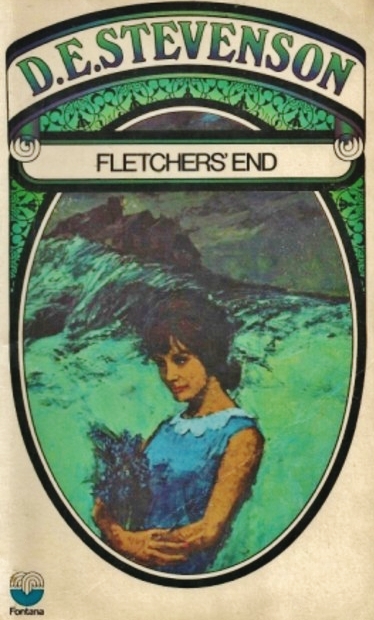
Fletchers’ End ~ 1962.

This edition: Fontana, 1971. Paperback. 256 pages.

My rating: 7.5/10

Spoiler alert: If you want to read Bel Lamington without knowing the results of her romance in book one, you should read no further. Here, I’ll pop in the cover illustration of Fletchers’ End to give you a chance to click away.

fletchers' end d e stevenson

Still here? Excellent. Here’s the next installment.

Bel and Ellis Brownlee are wed, and are now living in Bel’s tiny London flat and both working at Ellis’s office. They are also looking for a proper place of their own, preferably in the country but within easy commuting distance of London so Ellis can be handy to his shipping firm. Nothing suitable can be found, until Bel’s friend Louise sees potential in a dilapidated old house in a jungle of weeds, one Fletchers’ End in the village of Shepherdsford.

The absentee owner is desperate to sell, and Ellis and Bel purchase the house for a bargain price, though they are destined to make up for the initial savings in the ensuing renovation costs. This now becomes one of those “house books”, where the building is a character in its own right, and ultimately rewards its rescuers by becoming a warm and welcoming haven.

Bel’s adventures in renovation and restoration keep her occupied for the better part of the narrative, though there are side plots in the romance of Bel’s dear friend Louise, carried forward from the first installment, and the sudden appearance of the house’s previous owner, a young and handsome naval officer.

Mark-the-philandering-artist from Bel Lamington makes a brief appearance as well, as does the younger Copping from Ellis’s firm.

But not much really happens in this one, unless, of course, one appreciates the overwhelming busy-ness and architectural challenges and intrinsic rewards involved in a house renovation. The romance gets sorted out most satisfactorily, and all seems set for a happy ending when Bel and Ellis are suddenly faced with the possibility of having to walk away from Fletchers’ End: a will has been discovered which puts into question the legality of the house’s sale. Oh dear, whatever will happen now?!

Yes, it all comes out all right in the end.

(Was there ever any question?)

Nice parallel story of the elderly Mrs Warmer (what an apt name) who has been caretaking Fletchers’ End, and who stays on to provide a motherly presence in Bel’s kitchen, to the envy of all and sundry.

In both of these novels much is made of Bel’s timidity, her gentleness, and her overwhelming humility. D.E. Stevenson puts forward the argument that humility – true humility of spirit – is a worthy trait and should be viewed with respect. She therefore endows her heroine with appropriate rewards for her goodness and meekness. Though Bel occasionally shows that her inner core is of the toughest steel, her continual mildness is sometimes just the tiniest bit irritating; I can understand why Miss Goudge of the first book found her such a fitting target for perpetual scorn.

A very moralistic pair of tales, Bel Lamington and Fletchers’ End, with the author making very clear her opinions of how virtue and innate goodness should be rewarded, and how those who offend against the meek and well-meaning should be cast off into the outer darkness. All in all, a satisfying sort of point of view for this sort of blissfully simple fiction, for aren’t we all, fellow readers, on the side of the angels ourselves? 😉

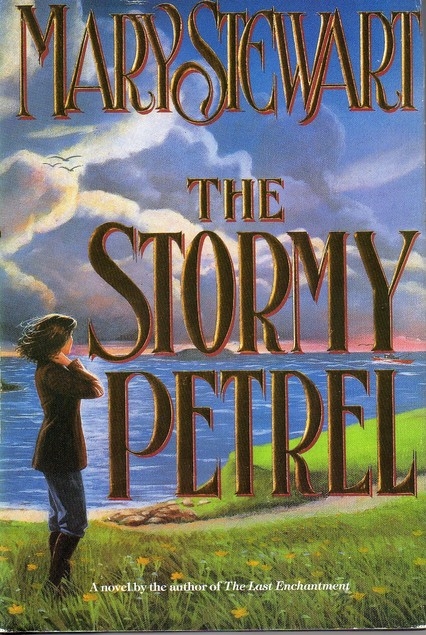
the stormy petrel mary stewartThe Stormy Petrel by Mary Stewart ~ 1991. This edition: William Morrow & Co., 1991. Hardcover. ISBN:  978-0-688-11035-2. 176 pages.

My rating: 8.5/10

Short and refreshingly sweet, this pleasant contemporary romance reads like the author was in a confident and relaxed mood when she dashed it off. It’s smooth and seamless, and a fast and effortless read. I enjoyed it.

Twenty-seven-year-old Cambridge don Rose Fenemore is ready for a break from her busy life; as well as lecturing and tutoring, she is a published poet as well as a writer of popular science fiction – the poetry under her own name, the sci fi under a pseudonym. When she sees an ad for an “ivory tower” retreat, a cottage on a remote Scottish island, she is intrigued enough to convince her physician brother to join her there for a holiday. Crispin is an avid bird watcher and photographer in his rare free time, and he and Rose have a marvelous relationship, each allowing the other plenty of space on their trips together, but also happy companionship when their interests merge.

Off to the tiny (and apparently fictional) isle of Moila, then, where Rose finds a small community of welcoming villagers, a recently renovated seaside cottage, and a stunningly beautiful natural world. Steep cliffs, shingle beaches, a few sandy coves, stands of seagrass and wildflowers, tiny rockbound lochs, a ruined Iron Age stronghold (a “broch”), and an abundant population of seabirds, seals and otters all unite to make Moila a very special place indeed. The finest part of this likeable book is Mary Stewart’s very evident delight in describing all of the previous; if Moila is a fictional place, then it must be based on a reality which the author is very familiar with. Her descriptive prose has the authentic ring, from the scent of the sedums growing on the tumbled stones of the broch to the iniquities of the “Defenders of the Highlands”, the vicious clouds of biting midges which swarm in their thousands when the breeze dies down.

But no sooner has Rose settled into her quaint cottage than things begin to go sideways; her peaceful retreat is suddenly a hive of activity. Rose wakens one night to the sound of someone in her kitchen; and stumbling down to welcome her brother – she assumes he has unexpectedly arrived in the night – she finds a handsome and charming young man making tea as if he owns the place. Which, he claims, he does. Or did. The cottage was apparently his foster parents’, and he has no idea that they have moved away, as he himself has been out of touch in an unspecified location for several years. Many apologies and all the rest, but surely Rose will forgive his unwitting intrusion?

No sooner have Rose and the smooth-talking Ewen made tentative friends over tea than another young man tumbles in out of the rain. This arrival claims he is a camper chased out of his tent by the rising wind; he has seen the lights in the cottage and seeks refuge from the storm. He identifies himself as a visiting geologist, John Parsons, but there is something about the cold and calculating glances the two men exchange which suggests something may be up. Rose sensibly retreats to her room, leaving the two young men to make do as best they can on sofa and floor, and when she awakes to find them gone, she thinks she’s seen the last of them.

She hasn’t.

I admired this heroine. She is most sensible and cool as a cucumber when things begin to tumble down around her ears. She deeply appreciates the place she has found herself in, and her rhapsodies on nature are sincere and unsentimental. She is properly cynical regarding the things that require such a view, and her musings on integrity, artistic and otherwise, are well stated and generally spot on.

A slight novel, with little in the way of true suspense; we never really fear for our capable heroine, as emotionally and physically she proves she is able to fend for herself. The romance aspect is low key as well, but comfortably there; we don’t quite know where our characters are all going to end up, but we’re pretty sure at that last page that their futures bode well.

Bonus portrayals of Rose’s two visiting students, and an intriguing glimpse into Crispin’s world and his “his life-her life” marriage. What the author doesn’t follow up is as telling as what she includes.

Nicely done. Thank you, Mary Stewart.

This is one of the most lovely book jackets I've ever seen, a wrap-around illustration by Antony Groves-Raines, from my 1965 Doubleday "Book Club Edition".

This is one of the more attractive vintage book jackets I’ve yet seen, a wrap-around illustration by Antony Groves-Raines, from my 1965 Doubleday “Book Club Edition”. This is the front.

And this is the bag. Try to imagine them together. I tried scanning it as one section, but my scanner is just a bit too small for the whole thing.

And this is the back. Try to imagine them together. I wanted to include it as one continuous illustration, but my scanner bed was just a bit too small for the whole thing.

How Far to Bethlehem? by Norah Lofts ~ 1964. This edition: Doubleday, 1965. Hardcover. 246 pages.

My rating: 5.5/10

I’d decided to try to read some seasonal literature to go with the upcoming Christmas season, and what better way to start, I thought, than with this one, going right back to the source, as it were.

As you can see from my rating, it was an adequate though not an astounding success. I mildly enjoyed Norah Lofts’ attempt, but found that I could not fully enter into this creative re-imagining of the story of the birth of Christ, for reasons touched on below.

The narrative abruptly jumps around from character to character, which, though initially confusing, actually turned out to be a good thing, as the side characters were much the most interesting, with completely invented backstories, unlike Mary and Joseph, who were constrained by the traditional story.

We start out with the young Mary, imagined by Lofts as an enthusiastic lover of both lilies and donkeys – themes which tenaciously follow the girl throughout the tale – and the Annunciation, with the Angel Gabriel appearing to her and then to Joseph. Mary is portrayed as a very lovely, rather dreamy girl, much prone to episodes of introspection when she seems to be communicating with a greater power, which of course she is, if we accept her special status as Mother-of-God-to-be. She accepts the angel’s visit as the nebulous “big thing” she has been waiting for all of her life, and surrenders herself fully to her fate, though she has moments of great inner turmoil when she considers her baby’s eventual torment and death according to the ancient prophesies concerning the Messiah.

And this was were my first moments of readerly disconnect came in, as the author insisted on discussing the popularly accepted details of the end of Christ’s earthly life. It’s been a good many years since I attended a Bible Study class, but I don’t recall that much detail in the Old Testament prophecies concerning the Messiah; it was all rather mysterious in a soothsayers’ sort of way, and didn’t really get in to details such as how long the Messiah would be here on earth for, or the manner of his demise, even that he would be born of a virgin. Mary and Joseph both discuss the role that the coming Messiah will play in sacrificing himself for mankind’s sins; the expectation among the Hebrews of the day was more in the nature of a military leader. Though it is lovely of the author to provide Mary with this insight, it didn’t feel all that convincing. And more was soon to come.

The three wise men/three kings share the spotlight with Mary, and they are imagined in rather untraditional ways, made possible because their mention in the actual Bible narrative is superficial at best, and their place in the Nativity story more folkloric than theologically based. In Lofts’ version, Melchior is a Korean astronomer, Gaspar is a Mongol chieftain, and Balthazar is a runaway African slave, and their coming together and subsequent travels make up the better part of the book. It generally works, and some of their escapades are nice little novellas all on their own.

Highlights toward the end of the book which I thought interesting and well written as the author rather let herself go away from the constraints of clinging to the skeleton of the Biblical framework were a visit by the three “kingly” travellers to Herod’s palace in Jerusalem, and a night at a Roman military barracks; both episodes had some creative detailing which sparked them to life rather more than some of the other vignettes.

The innkeeper at Bethlehem gets his own mini-history as well, some of which was quite enthralling. In Norah’s imagination he is a Greek ex-sailor, and her description of his perilous voyage on a tin ship through the mist-shrouded ocean to the barbarous isles on the other side of the Pillars of Hercules was a fascinating and convincingly written inclusion which had me wanting more.

Her version of the shepherds was less than stellar, though. It felt highly contrived, with the chief shepherd being a grieving father of a son recently crucified by the Romans for a minor infraction; the author just wouldn’t quit with the meaningfulness of all of this, and it was another jarring note; much better if it would have been played a bit softer. Oh, and that very shepherd is represented as being the father of Lazurus, Martha and Mary – key players of an incident some years later in the New Testament narrative, and another glaring coincidence which annoyed the heck out of me by its total improbability. (If one can use “probable” in the context of any of the events in this re-imagined tale!)

Though there was much to like in this ambitious and creative retelling of the Nativity story, I found that the sections which worked well fictionally were overwhelmed by the less frequent but awkward attempts at bringing in Biblical quotations, and in the excessive use of coincidence in the creation of incidents. What might have been an excellent piece of creative fiction instead turned out to be a slightly off-key homage to a story we already know in its earlier form. The King James version very adequately stands alone and I would have been much happier if Norah Lofts had let herself go a little more and not tried to incorporate so much of the Gospel narrative in her own work.

Does that make any sort of sense? I mean, we already know how it goes, so letting the reader do the work in mentally making it click with the original would have worked, and given us the pleasure of the “Aha!” moment, instead of being bludgeoned by the exceedingly obvious “taken from the Bible” parts. And if one isn’t familiar with the original, it would be a more accessible read, and might well lead one to investigate the source. Perhaps?

I’m a bit grumpy about this, because some of this was, as I already said, quite excellent, and I felt cheated in that it all could have been that way.

Norah Lofts appears to be a firm believer in the Biblical versions of the Nativity which inspired her book, and one must respect that. This is an unusual novel, and rather brave in its attempt to fictionalize such an iconic religious tradition, while remaining true to the source. And her writing is always more than competent, and occasionally inspired.

Damning with faint praise, this feels like, but I could not completely give myself over to the tale, and I was fully willing to when I started. I do wonder how much having a previous knowledge of the King James version of the story influenced my reading pleasure, or lack thereof. While it definitely helped me to appreciate the author’s use of narrative nuances and connections between characters, it made me continually stop and try to make Norah Lofts’ version jive with my memory of what was contained in the books of Matthew, Mark, Luke and John. I did come away with a strongish desire to reread the originals as a sort of refutation to Lofts’ tale, so I’m not quite sure if that is a point in favour or against How Far to Bethlehem?!

But please don’t let my personal response put you off giving this book a whirl. It is much beloved by Norah Lofts’ many dedicated followers for good reason, and it was definitely not at all a chore to read. I easily got over my annoyed moments and followed it through to the end; I will be keeping it around for future personal perusal, and because my mother enjoys reading it now and again.

But am I at least more in the Christmas mood now?

Honestly, not really. I think I need to revisit some old favourites, the Margot Benary-Isbert stories (The Ark, Rowan Farm and A Time to Love, all set in wartime and post-war Germany) and Pilgrim’s Inn by Elizabeth Goudge, for its sweet Christmas-time finale. And of course Beatrix Potter’s The Tailor of Gloucester, and Rumer Godden’s The Story of Holly and Ivy, from the children’s bookshelf of annual re-reads.

And Heavenali’s post on Christmassy books gives much scope for exploration of some titles I haven’t yet read, and reminded me of a few I’d forgotten, like Susan Cooper’s The Dark is Rising.

Other Christmas reading suggestions always welcome!

the street mordecai richler 001The Street by Mordecai Richler ~ 1969. This edition: Panther Books, 1971. Paperback. 142 pages.

My rating: 8.5/10

It’s been a good many years since I’ve read anything by Mordecai Richler, and reading The Street reminded me why: a little goes a long way. And I mean that in the very best way.

The Street was just long enough, at 142 pages, to be a quick one-evening read, a bracingly rude and somewhat startling experience which balanced the well-meant inanity of my other recent reading. The naïve earnestness of D.E. Stevenson’s rather silly Miss Buncle and the good natured ramblings of Georgette Heyer’s handsome dilettantes are decidedly mild pleasures in contrast to Richler’s sly, cheeky, say-anything Montreal ragamuffins and their bluntly outspoken elders. And I find that the mixing of genres here adds piquancy to all, with Richler’s pungent acidity emphasizing the good brown bread and airily sweet meringue of the others.

The Street is a collection of ten linked stories-slash-memoirs – fictionalized memoirs? – mostly following the narrator – Richler himself, one assumes – from childhood to adulthood. The anecdote here is everything, and Richler’s authorial voice is perfectly suited to these short pieces.

From the author’s Foreword:

‘Why do you want to go to university?’ the student counsellor asked me.

Without thinking, I replied, ‘I’m going to be a doctor, I suppose.’

A doctor.

One St. Urbain Street day cribs and diapers were cruelly withdrawn and the next we were scrubbed and carted off to kindergarten. Though we didn’t know it, we were already in pre-med school. School starting age was six, but fiercely competitive mothers would drag protesting four-year-olds to the registrarion desk and say, ‘He’s short for his age.’

‘Birth certificate, please?’

‘Lost in a fire.’

On St. Urbain Street, a head start was all.  Our mothers read us stories from Life about pimply astigmatic fourteen-year-olds who had already graduated from Harvard or who were confounding the professors at M.I.T.  Reading Tip-Top Comics or listening to The Green Hornet on the radio was as good as asking for a whack on the head, sometimes administered with a copy of The Canadian Jewish Eagle, as if that in itself would be nourishing.  We were not supposed to memorise baseball batting averages or dirty limericks.  We were expected to improve our Word Power with the Reader’s Digest and find inspiration in Paul de Kruif’s medical biographies.  If we didn’t make doctors, we were supposed to at least squeeze into dentistry.  School marks didn’t count as much as rank.  One wintry day I came home, nostrils clinging together and ears burning cold, proud of my report.  ‘I came rank two, Maw.’

‘And who came rank one, may I ask?’

The Jewish mothers in The Street fulfill every stereotype, being supremely ambitious for their children, yet never letting them get too full of themselves; chicken soup and sharp cuffs being administered with equal enthusiasm as maternal whim decides. To get ahead, to make good, to get away from St. Urbain Street and its taint of poverty-ridden struggle and the worst lingering despairs of the “Old Country” is what they wish for their children, and their self-imposed self sacrifice is both the bane of their families’ existence and the driving force which propels them all onward. In adulthood the children of those ubiquitous mothers begin at last to understand this and give homage; in childhood they merely endure and dodge the good advice and the blows with equal agility.

These stories are full of a sense of a very particular place and time, Montreal of the early 1940s, captured in microscopic detail of sight, sound and smell in Richler’s steel-trap memory. His boyhood companions are familiar to us from similar narrators and from Richler’s previous works; Duddy Kravitz is present, spouting off his knowing comments, and the author assumes we know who he is, assumes that his readers already know the context and are willing participants in the narrative. And while the scene here is unmistakeably this very small corner of Montreal, it is evocative of similar boyhoods and experiences in New York and London and any of the other key locales in the continual global diaspora and resettling of the Hebrew race.

For this is, above everything else, a very Jewish book, as well as being a Montreal book, and a Canadian book; Richler makes no bones about the uniqueness of this aspect of his own experience and of the importance of it in the scenes he so meticulously describes. His Jewishness is at the core of his very being; everything else is layered on top.

Heads up, gentle readers expecting a mildly humorous memoir, for this author is proud of his outspokenness and his humour has a cutting edge; it is also frequently bawdy, and full of the smuttiness of guffawing enclaves of adolescent boys. That hoary old dirty joke, “Bloomberg’s dead!”, is here on page 23, told with especial glee, and more of the same is scattered liberally throughout.

Mordecai Richler can be terribly rude, but he is also very, very good. I had forgotten quite how good. I do believe it is time for another visit with the one and only Duddy Kravitz.

Here are some other thoughts on The Street.

Kevin from Canada: The Street

Humanities 360: Erin Yorke reviews The Street

cranford cover elizabeth gaskellCranford by Elizabeth Gaskell (Mrs Gaskell) ~ 1851-53. (It appeared as a serial before being published in book form post-1853.) This edition: Everyman’s Library, 1942. Hardcover. 255 pages.

My rating: 9/10

What a joy this little book was. I cannot believe it has taken me so very long to read it, such an essential part of the “English novel” canon!

Our narrator is one Mary Smith, a young lady of good family, who visits and corresponds with the good ladies of a small (fictional) English village, Cranford, in the early years of the 19th century. Round about the 1830s, to be more exact, from the references to Charles Dickens’ Pickwick Papers being then newly released in their serial form. King William IV and his Queen, Adelaide, reign over the land, soon to be succeeded by the young Victoria. The ladies of Cranford, though far from London in more ways than distance, keep a keen eye cocked on the doings of high society and the nobility, and form their own society accordingly.

In the first place, Cranford is in possession of the Amazons; all the holders of houses above a certain rent are women.  If a married couple come to settle in the town, somehow the gentleman disappears; he is either fairly frightened to death by being the only man in the Cranford evening parties, or he is accounted for by being with his regiment, his ship, or closely engaged in business all the week in the great neighbouring commercial town of Drumble, distant only twenty miles on a railroad.  In short, whatever does become of the gentlemen, they are not at Cranford.  What could they do if they were there?  The surgeon has his round of thirty miles, and sleeps at Cranford; but every man cannot be a surgeon.  For keeping the trim gardens full of choice flowers without a weed to speck them; for frightening away little boys who look wistfully at the said flowers through the railings; for rushing out at the geese that occasionally venture in to the gardens if the gates are left open; for deciding all questions of literature and politics without troubling themselves with unnecessary reasons or arguments; for obtaining clear and correct knowledge of everybody’s affairs in the parish; for keeping their neat maid-servants in admirable order; for kindness (somewhat dictatorial) to the poor, and real tender good offices to each other whenever they are in distress, the ladies of Cranford are quite sufficient…

The Amazons referred to are a select group of upper class ladies who rule Cranford’s restricted society. Spinster sisters Miss Deborah and Miss Matilda (Matty) Jenkyns (rather elderly daughters of the some-years-deceased rector), the know-everything Miss Pole, snobbish Mrs Jamieson (sister-in-law to the late Earl of Glenmire, she’ll be happy if you’ll remember), and quiet Mrs Forrester (genteelly poverty stricken but held locally in highest regard due to her familial ties to the aristocracy) – all these ladies take the leading roles in Cranford’s major occasions.

Mary Smith frequently comes to stay with the Jenkyns sisters, and she is able to comment on the occasional village tempests. A certain Captain Brown and his two daughters, Mary and Jessie, settle in Cranford, and Captain Brown’s attendance at the previously all-female tea parties keeps the ladies on their toes, though he deeply offends Miss Deborah by his preference for the up-and-coming young writer Charles Dickens over the stately Dr. Johnson.

As the years slide by, reports from Cranford show us a peacefully microcosm in a gentle state of flux. Several characters move on or pass out of the worldly sphere altogether, several marriages occur, and a birth or two. Lady Glenmire arrives to the initial glee of her hostess, Mrs Jamieson, but soon confounds that lady by demonstrating some rather “low” tastes; nouveau-riche Mrs Fitz-Adam comes into her own at long last; a burglar alarm has the ladies all in a tizzy; and the failure of Miss Matty’s investments rallies the ladies to new heights of beneficent plotting.

It’s all very low key, but it is gloriously funny, and occasionally deeply pathetic (in a traditionally fictional way), and I am looking forward with interest to reading more of Mrs Gaskell, now that I’ve at last made her first-hand acquaintance.

And, last but not least, the Cranford references I continually come upon in my other reading will no longer leave me feeling quite so dreadfully ignorant of the original. Oh, happy day, indeed!

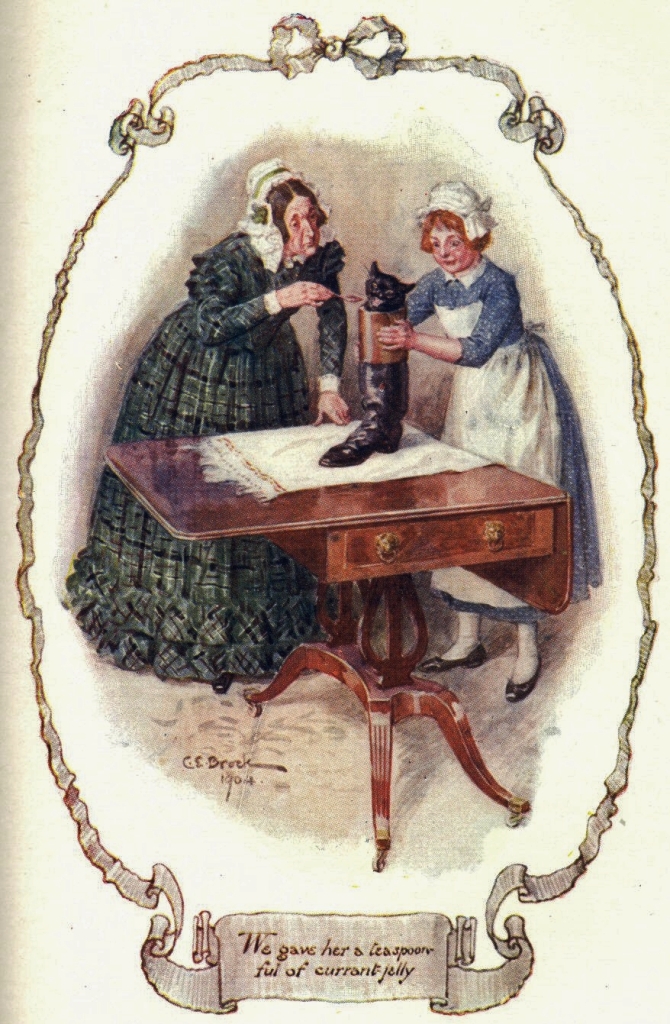
Yes, these women are stuffing a cat into a boot. I shan't tell you why; you will have to read the novel yourself to find out. But I assure you that Kitty comes to no harm, and the "operation" is a decided success! (You'll never guess it; it's a uniquely Cranfordian situation!)

Yes, these women are stuffing a cat into a boot. I shan’t tell you why; you will have to read the novel yourself to find out. But I assure you that Kitty comes to no harm, and that the “operation” is a decided success. (You’ll never guess it; it’s a uniquely Cranfordian situation!)
Illustration is from the 1904 J.M. Dent edition, illustrations by C.E. Brock.
http://www.gutenberg.org/files/394/394-h/394-h.htm