
More than a catbird hates a cat,
I love you more than a duck can swim,
As a shipwrecked sailor hates the sea,
I love you more than a wasp can sting,
I swear to you by the stars above,
Posted in My World, Poetry | Tagged Happy Valentine's Day!, Ogden Nash, Poetry, To My Valentine | 2 Comments »
 A Safety Match by Ian Hay ~ 1911. This edition: Penguin, 1938. Paperback. 256 pages.
My rating: 3/10
Oh, Century of Books. You are leading me down some strange byways of reading…
Some days ago I wrote with some enthusiasm about a rather charming vintage book by Herbert Jenkins, Patricia Brent, Spinster. I was careful in my review not to reveal the key plot points and the ending, because I felt that this was a book that would reward discovery by a modern-day reader. I am very sad to say that today’s book will not be rewarded the same treatment, because it disappointed me immensely.
Sharp-eyed readers will notice the mending tape on the bottom left hand corner of the book pictured here. That was me. Usually I am very careful about my mending of older books, aiming for non-obtrusive fixes, but in this case I just slapped a piece of Magic tape on there and called it good enough. The whole spine is loose and the text block only just hanging on by a whisp or two of paper – almost as if at some point a previous reader gave this one the toss across the room. Hmmm… (Okay, maybe I’m just being really snarky.)
So, yes, there will be spoilers in the next few paragraphs. (And I’m keeping it shortish, because it’s really not worth spending any more time on.)
It all starts off promisingly enough. Here we have a vicarage family, the widowed Rector Brian Vereker, and his lovely children – literally lovely, as they are famed for their good looks among the local villagers – nineteen-year-old Daphne, doorstepping down through Sebastian Aloysius (“Ally”), Monica Cecila (“Cilly”), Stephen (“Stiffy”), Veronica Elizabeth (“Nicky”) to to the youngest, eleven-year-old Tony. A lively lot they all are, and we are treated to a prolonged domestic interlude which sets up the characters quite nicely, and gives a rather charming picture of English upper-middle-class home life – for the Rector is the youngest son of a youngest son of a peer of the realm – in the early years of the 20th Century.
Then an abrupt change of scene to a room full of coal mine owners as they meet with labour union leaders in order to negotiate a way out of a possible workers’ strike. Here we become acquainted with our main masculine character, one Lord Carr, also known by his nickname of “Juggernaut” for his overbearing success in always proving his point and coming out on top. In this case Juggernaut succeeds in quelling the potential strike, knocking down the ineffectual union leaders and getting in a few digs about free enterprise and every-man-for-himself-ism which sound forbiddingly close to the spoutings of the far-Right political parties of our current age – not much doubt as to our author’s feelings throughout this book, I’ afraid – he does rather slant towards his brusque hero’s view.
The set-up is to introduce the rather-much-older (forty-five-ish) Lord Carr to the eldest vicarage daughter, the sweet-nineteen Daphne. For of course Lord Carr and Rector Vereker are old school chums, and after squashing the labour uprising in the area, Lord Carr is quite happy to spend a few weeks relaxing among the Vereker clan, where he falls in inarticulate but sincere love with Daphne.
The two marry, Juggernaut for love and Daphne for money – she is motivated by a desire to secure the futures of her brothers and sisters – and for a few years all is quite content. A son is born to Lord and Lady Carr, but as the child grows it becomes apparent that the marriage is, if not actively struggling, becoming a rather pathetic thing. Lord Carr is unable to speak his feelings of devotion to Daphne; she in turn is starting to turn to other companions for amusement, including Lord Carr’s devoted right hand man.
This gets us in quite decent style to the latter bit of the book, where the author completely goes to pieces and gets all darkly dramatic. Daphne and Juggernaut part ways, Daphne fleeing to the old family home with the baby and Juggernaut staying broodingly in London. While they are parted, it dawns on Daphne that perhaps she really does love her masterful though stoic husband, and a reconciliation is affected by way of the right hand man’s revealing that Juggernaut is really just a big softie, supplying food and comforts to the wives and children during the last coal mine strike. “I never knew!” cries Daphne, and she flies to her husband’s sturdy breast, to be clasped there with fervor.
But wait! There’s more!
The workers at the local coal mine go on a wildcat strike, and as a result the workings are sabotaged, resulting in a cave-in which traps a number of our side characters, including Right Hand Man. Juggernaut is front and centre of the rescue mission, and (sob!) is blinded by an explosion after he has personally seen all of the rescued men to safety.
Fast forward a year or two to a scene of domestic bliss, Juggernaut and Daphne all sappily happy with their adorable wee children, love restored and blind Pappa the centre of a scene of cozy cuteness.
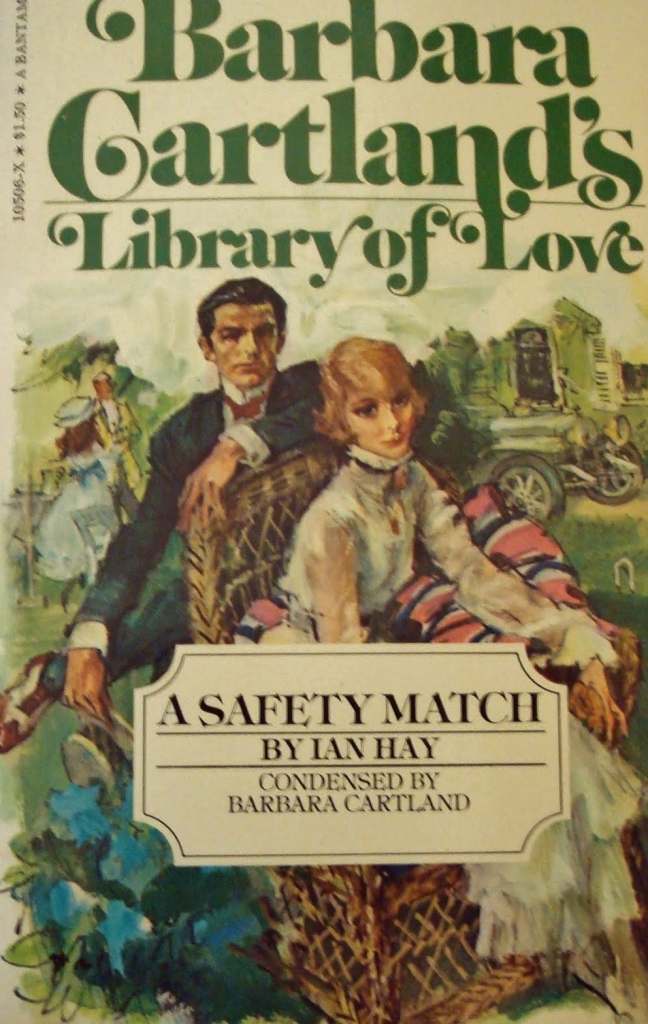
66 years after its first publication, the one-and-only Barbara Cartland decides that “A Safety Match” is a good addition to her 1977 “Library of Love”. I am saddened, but not surprised.
What a dreadfully clichéd story. No wonder it was picked up and condensed by Barbara Cartland for her 1977 “Library of Love.”
This novel made me prickly all over. It started out so well, and had so many nice domestic and period details, that I hoped right up until those last few chapters that it would go in a different direction, but nope! – no such luck. It just dissolved into mushy sweetness. Absolutely, deeply, offensively, sugary, syrupy adorableness. Argh.
Not recommended, but if you are very brave and wish to look for yourself, here it is on Gutenberg.
Ian Hay, by the way, was quite a well-respected writer of his time. Here is his biography, pasted directly in from Wikipedia. As the man could undoubtedly write, in a modestly competent way, I do find myself curious as to some of his other works, in particular the war-themed The First Hundred Thousand. But as for The Safety Match, I wouldn’t open that again at gunpoint.
Major General John Hay Beith, CBE, (17 April 1876 – 22 September 1952), was a British schoolmaster and soldier, but he is best remembered as a novelist, playwright, essayist and historian who wrote under the pen name Ian Hay.
After reading Classics at Cambridge, Beith became a schoolmaster. In 1907 he published a novel, Pip; its success and that of several more novels enabled him to give up teaching in 1912 to be a full-time author. During the First World War, Beith served as an officer in the army in France. His good-humoured account of army life, The First Hundred Thousand, published in 1915, was a best-seller. On the strength of this, he was sent to work in the information section of the British War Mission in Washington, D.C.
After the war Beith’s novels did not achieve the popularity of his earlier work, but he made a considerable career as a dramatist, writing light comedies, often in collaboration with other authors including P. G. Wodehouse and Guy Bolton. During the Second World War Beith served as Director of Public Relations at the War Office, retiring in 1941 shortly before his 65th birthday.
Among Beith’s later works were several war histories, which were not as well received as his comic fiction and plays. His one serious play, Hattie Stowe (1947), was politely reviewed but had a short run. In the same year he co-wrote a comedy, Off the Record, which ran for more than 700 performances.
I did a fairly thorough internet search, and came up with only one other blog review, from Only Two Rs, whose take was similar to my own.
Posted in 1910s, Century of Books - 2014, Read in 2014 | Tagged A Safety Match, Century of Books 2014, Ian Hay, Light Fiction, Relationships, Romance, Vintage Fiction, Yawn | 3 Comments »
 Patricia Brent, Spinster by Herbert Jenkins ~ 1918. This edition: Herbert Jenkins, circa 1918. Hardcover. 312 pages.
My rating: 6.5/10
I keep forgetting about this book, even though I only read it a week or so ago. It’s already had the ignominy of being shuffled away into the hall closet with a stack of miscellaneous already-reviewed books, only being rescued several days later when I was delving around in there looking for Christopher and Columbus by Elizabeth von Arnim, which I was hoping would be as great a treat as other bloggers have promised. (It was.)
High expectations were inspired by this opening passage:
“She never has anyone to take her out, and goes nowhere, and yet she can’t be more than twenty-seven, and really she’s not bad-looking.”
“It’s not looks that attract men,” there was a note of finality in the voice; “it’s something else.” The speaker snapped off her words in a tone that marked extreme disapproval.
“What else?” enquired the other voice.
“Oh, it’s—well, it’s something not quite nice,” replied the other voice darkly, “the French call it being très femme. However, she hasn’t got it.”
“Well, I feel very sorry for her and her loneliness. I am sure she would be much happier if she had a nice young man of her own class to take her about.”
Patricia Brent listened with flaming cheeks. She felt as if someone had struck her. She recognised herself as the object of the speakers’ comments. She could not laugh at the words, because they were true. She was lonely, she had no men friends to take her about, and yet, and yet——
“Twenty-seven,” she muttered indignantly, “and I was only twenty-four last November.”
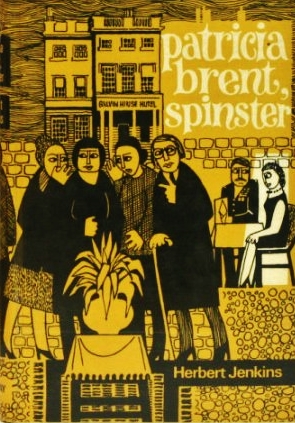
A rather handsome later edition cover. This playful novel has maintained its popularity well since its publication in 1918.
And by this back-cover précis:
Patricia Brent is a guest, damned by the prefix “paying,” at the Galvin House Residential Hotel. One day she overhears two of her fellow “guests” pitying her for her loneliness and that she “never has a nice young man to take her out.”
In a thoughtless moment of anger she announces that on the following night she is dining at the Quadrant with her fiancé.
She wasn’t, and she hadn’t, but she did.
When in due course she enters the grill-room she finds some of the Galvin House-ites there to watch her. Rendered reckless by the thought of being found out, she goes up to a table at which is seated a young staff-officer, and asks him to help her by “playing up.”
This is how she meets Lieut.-Col. Lord Peter Bowen, D.S.O. Then follow the complications that ensue from Patricia’s thoughtless act.
Patricia’s fast-on-her-feet rescue of her situation definitely sets off a tangle of complications, especially when her “pick-up” proves to be something a little bit different than anything she could have imagined.
I won’t say too much more, plot-wise, because I’m sure some of you will be keen to read this one for yourself, as I was. Already something of a fan of Herbert Jenkins – I cherish a thick compilation of the famous Bindle stories – I was keen to see what he would do with a feminine lead. Not too badly, though I must say that Patricia reads rather like a woman written by a man; there were occasional odd notes, especially to do with clothes.
For Patricia is not a dowdy spinster – oh, no, not at all! She dresses well and with exquisite care, rather surprisingly so, considering her obviously straitened means. Herbert Jenkins tries his hand at this description of Patricia primping to go out on her first adventure, to what she thinks will be a solitary visit to the Quadrant Grill-Room, the “major-man” being at this point merely a figment of her imagination.
As she stood before the mirror, wondering what she should wear for the night’s adventure, she recalled a remark of Miss Wangle’s that no really nice-minded woman ever dressed in black and white unless she had some ulterior motive. Upon the subject of sex-attraction Miss Wangle posed as an authority, and hinted darkly at things that thrilled Miss Sikkum to ecstatic giggles, and Mrs. Mosscrop-Smythe to pianissimo moans of anguish that such things could be.
With great deliberation Patricia selected a black charmeuse costume that Miss Wangle had already confided to the whole of Galvin House was at least two and a half inches too short; but as Patricia had explained to Mrs. Hamilton, if you possess exquisitely fitting patent boots that come high up the leg, it’s a sin for the skirt to be too long. She selected a black velvet hat with a large white water-lily on the upper brim.
“You look bad enough for a vicar’s daughter,” she said, surveying herself in the glass as she fastened a bunch of red carnations in her belt. “White at the wrists and on the hat, yes, it looks most improper. I wonder what the major-man will think?”
Swift movements, deft touches, earnest scrutiny followed one another. Patricia was an artist in dress. Finally, when her gold wristlet watch had been fastened over a white glove she subjected herself to a final and exhaustive examination.
“Now, Patricia!”—it had become with her a habit to address her reflection in the mirror—”shall we carry an umbrella, or shall we not?” For a few moments she regarded herself quizzically, then finally announced, “No: we will not. An umbrella suggests a bus, or the tube, and when a girl goes out with a major in the British Army, she goes in a taxi. No, we will not carry an umbrella.”
She still lingered in front of the mirror, looking at herself with obvious approval.
Would a young lady of such obviously strong self-esteem really be so humiliated by the gossipings of some of the nasty old biddies sharing her residential hotel? Apparently so, and once we’ve accepted this slightly shaky premise we might as well go ahead and abandon ourselves to the whole happily romping thing.
It’s all very fluffy, and definitely a farce, though it has its moments of poignancy here and there. Set in the early years of the Great War, some of the characters are present because they are home on leave while recovering from their injuries; the sombre background of affairs in Europe and the bombings in England are a fascinating backdrop to the frivolous antics of the foreground players.
I was fortunate enough to track down a vintage copy of the book, though it took several long months to arrive from the bookseller in England, but here it is in digital format courtesy of the fantastic Project Gutenberg, for your reading pleasure.
Project Gutenberg: Patricia Brent, Spinster
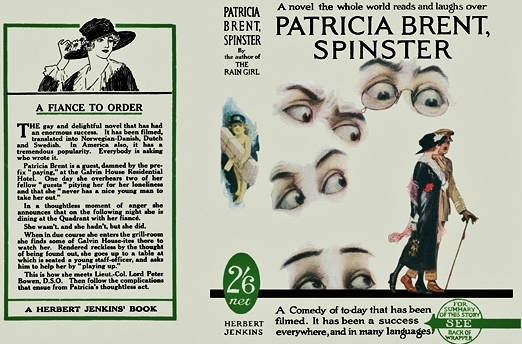
Dust Jacket, early edition.
Posted in 1910s, Century of Books - 2014, Read in 2014 | Tagged Century of Books 2014, Herbert Jenkins, Humour, Light Fiction, Patricia Brent, Romance, Social Satire, Spinster, Vintage Fiction, World War I | 7 Comments »
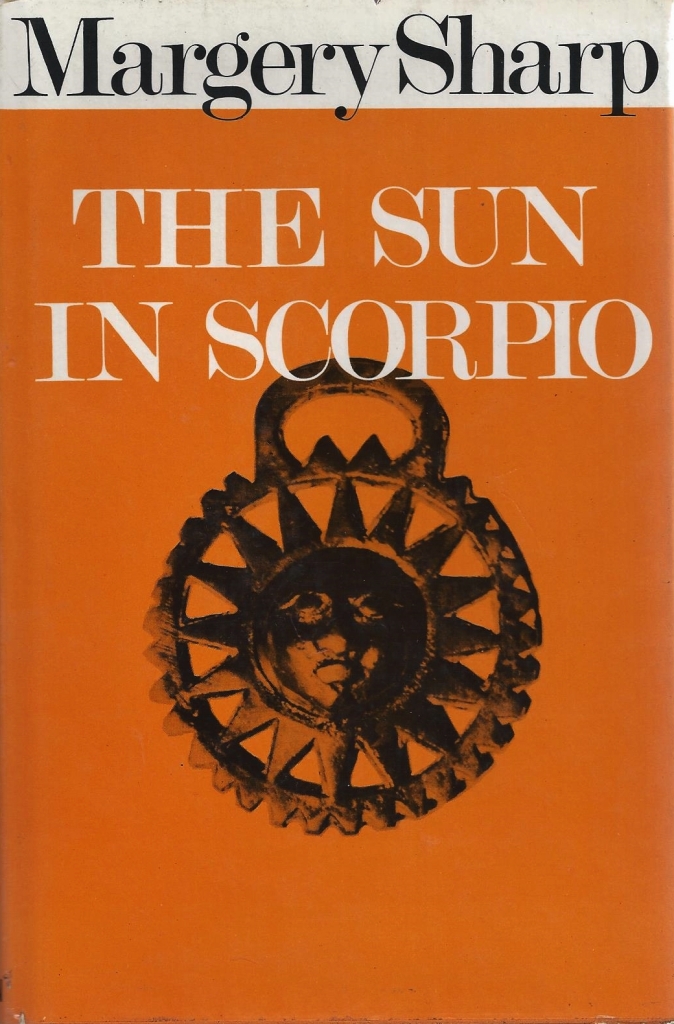 The Sun in Scorpio by Margery Sharp ~ 1965. This edition: Heinemann, 1965. Hardcover. 231 pages.
My rating: 10/10.
She does it again.
Just when I thought I knew everything there was to know about Margery Sharp’s eclectic style, she pulls something new out of the hat. This is an absolutely crisp, clean and elegantly written novel, by a master of her craft, with some attention-catching stylings. I suspect the author was enjoying herself quietly and deeply while working this out, based as it is on her memories of her childhood years in Malta.
Nice. Very, very, nice.
I’ve been sitting on this post for a few weeks now, waiting for an inspired moment to sit down and really delve into this book, but things are picking up speed in my real life and computer time for blogging is getting a bit pinched, so it’s looking like now or never. A quickie review it will have to be.
Everything sparkled.
Below the low stone wall, beyond the rocks, sun-pennies danced on the blue Mediterranean; so dazzlingly, they could be looked at only between dropped lashes. (In 1913, the pre-sunglass era, light was permitted to assault the naked eye.) Opposite, across the road called Victoria Avenue, great bolts of sunlight struck at the white stone buildings and richocheted off the windows. A puff of dust was a puff of gold-dust, an orange spilled from a basket like a wind-fall from the Hesperides…
Young Cathy Pennon, middle child of three growing up on an outpost of the grand British Empire, on the small island “next-door” to Malta, glories in the sun and basks in its rays. She is soon to leave the scene of her young years, as the growing winds of the Great War unsettle her civilian parents enough to urge a return to safer England. Cathy is soon to discover that she never will be truly warm again; the rainy isle of “Home” being resistant in its mists to the heat of that lost-and-mourned Mediterranean sun.
We follow Cathy, and to a lesser degree, her older sister Muriel and younger brother Alan, as they grow up in England, move into their adult years, and go their separate ways. Muriel is to find a comfortable niche in married domesticity; Alan settles into a happy bachelor existence while dedicating himself to the banking business – he is, ultimately tragically, of just the age to be destined to fight in the next great war – and Cathy drifts into a loosely-defined position as companion-lady’s maid to the aristocratic Lady Jean.
The book is a delicious moving picture of the years of and between the wars; our author touches delicately but succinctly on the many personalities and types of those years of tremendous flux, when the world is continually shaking itself and forming itself again as its inhabitants struggle, with various degrees of success, to come to grips with every new normal.
Cathy survives, though not without some scars, and we leave her at the end of the Second Great War poised for what looks to be the greatest change yet in her four decades of life, contemplating with wild surmise and growing joy the possibility of a return to the sun.
What a very good book this is. Margery Sharp is in absolutely fine form, having created a crisp, clean narrative with beautiful styling and more than a little cynically black ink in her accomplished pen. Cathy is a most human protagonist; full of flaws and not at all likeable a certain amount of the time; she tends to stand back a step from those around her, never fully entering in to the lives of those she bumps up against. A girl and then a woman of unexpected responses, and a few hidden talents…
Posted in 1960s, Century of Books - 2014, Read in 2014, Sharp, Margery | Tagged Century of Books 2014, Hidden Gem, Sharp, Margery, Vintage Fiction, War, World War II | 19 Comments »
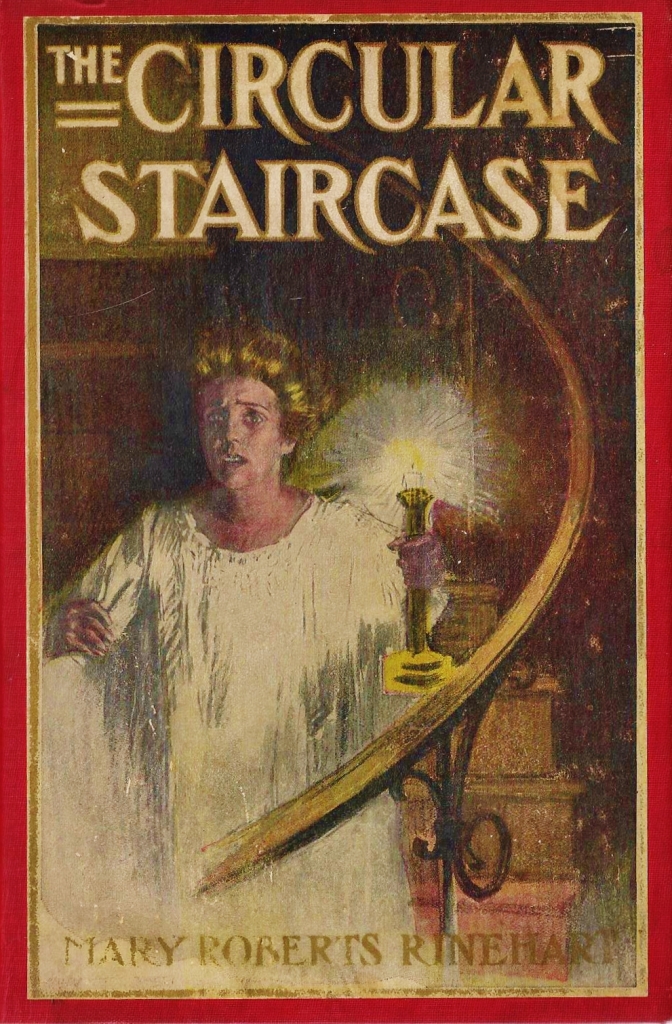 The Circular Staircase by Mary Roberts Rinehart ~ 1908. This edition: Grosset & Dunlap, 1908. Hardcover. 362 pages.
My rating: 5.5/10
A decade and a half before Agatha Christie penned her first murder mystery in England, Mary Roberts Rinehart had a stunning success with this book, which established her as bestselling mystery and dramatic fiction writer in North America. It is sometimes claimed that she was the best-paid American author of her time; her book sales were in the millions. So I was looking forward to The Circular Staircase with great anticipation, having read enough of Mary Roberts Rinehart’s work over the years to know that she can indeed spin an engaging tale, usually including a nicely independent and outspoken female lead or two, in keeping with the author’s suffragette and proto-feminist leanings.
And, by and large, The Circular Staircase mostly pleased me, in a low-key way, though it took me absolutely forever to work through. It has an unusual and most engaging narrator, the charmingly independent and opinionated Miss Rachel Innes. It helps with the independent and opinionated character traits that Rachel also seems to be quite wealthy and therefore able to indulge in letting herself speak freely – for who will argue with the lady who pays the bills? She also can be rather high-handed in her dealings with family members and subordinates, though her gently cynical self-mockery keeps us on her side, along with her obvious affection for her adopted niece and nephew and her personal maid Liddy.
This is the story of how a middle-aged spinster lost her mind, deserted her domestic gods in the city, took a furnished house for the summer out of town, and found herself involved in one of those mysterious crimes that keep our newspapers and detective agencies happy and prosperous. For twenty years I had been perfectly comfortable; for twenty years I had had the window-boxes filled in the spring, the carpets lifted, the awnings put up and the furniture covered with brown linen; for as many summers I had said good-by to my friends, and, after watching their perspiring hegira, had settled down to a delicious quiet in town, where the mail comes three times a day, and the water supply does not depend on a tank on the roof.
Having adopted her orphaned young niece and nephew some thirteen years ago, this summer finds all three of them preparing to settle down in a rented country house for a few months. Rachel has resigned herself to a disturbance in her long routine in order to indulge the wishes of the younger members of her establishment; she brings along her long-time companion and personal maid, Liddy, against that retainer’s grumbling resistance. Twenty-year-old Gertrude and twenty-four-year old Halsey are expected to flit in and out at will, being popular and well-heeled young people with many friends. Halsey has just purchased an automobile; it will play an important role in the summer of mystery and peril they are all about to embark on.
For Rachel and Liddy are horrified to find, their very first few days in residence, that their idyllic country house has an unsavory reputation among the locals. Belonging to an absent banker, it has been empty for some months, and it turns out that strange noises have been heard and strange lights seen at night. Almost immediately upon arrival Liddy has managed to offend the few servants who were brave enough to take on employment, and Rachel is left servant-less and alone in the house but for jittering Liddy. Luckily she is able to acquire an ally in the person of Thomas.
Liddy wanted to go back to the city at once, but the milk-boy said that Thomas Johnson, the Armstrongs’ colored butler, was working as a waiter at the Greenwood Club, and might come back. I have the usual scruples about coercing people’s servants away, but few of us have any conscience regarding institutions or corporations—witness the way we beat railroads and street-car companies when we can—so I called up the club, and about eight o’clock Thomas Johnson came to see me. Poor Thomas!
Ah! Note the “Poor Thomas.”
This does not bode well, for Mary Roberts Rinehart in this book is abundantly generous with her broad hints of disaster to come, in what was to become her signature “Had-I-But-Known” mystery writing style. Now this is rather cute when used sparingly, but MMR has her narrator Rachel pop these foreboding hints in way too frequently for readerly comfort. There you are, caught up in the thread of the story, when the insertion of a “HEY! IMPORTANT CLUE COMING RIGHT UP” aside stops you dead in your tracks. Okay then, you think to yourself, what is she talking about? And you tiptoe carefully in to the next few paragraphs, wondering all the while where the clue is hidden. Sometimes it is quite obvious, and you sigh with relieve and get on with things. Other times it is pages – nay, chapters! – ahead, and so many other meaningful asides have been made in the meantime that you are completely lost as to which thing was important to what incident before and what did knowing this have to do with that and on and on and on. Sometimes the clue fails to materialize at all, leading to retrospective confusion as one tries to link it all together, and fails dismally.
And this is what stopped me from loving this book. It is too darned long, and too darned illogical. It had its charms, for certain sure, but it was hard work to keep straight, and it took me well over a week to work through, as I kept putting it down in mild irritation and true confusion and turning to other things much more straight-forward.
Without revealing the mystery of the summer place and its circular staircase (which is really not at that important to the tale in my opinion, and, I thought, something of a red herring supplied by the author) may I just say that the plot involves embezzled money, hidden/mistaken identities (multiple), a wicked doctor, a secret(ish) child, a hidden room, shots fired in the night, and a whole lot of people rushing about and missing their chances to clear important elements of the mystery up by keeping their odd little secrets for just a bit too long. Among other developments I’m already erasing from my short-term memory bank.
Four deaths (at least I think it was four – that bit left me a bit bemused, too – corpses in this novel not always being reliable identified), including that of “poor Thomas” early on, tried my patience severely, mostly because of the generally nonchalant attitude of the survivors. There’s a bit of horror at the thought that “just yesterday a man lay dead right over there beside the table where the tea tray now sits” but by and large the expected reactions are underplayed. Or overplayed. There’s some of both.
Would I recommend this book? Only to the very patient, and those willing to work through the confusion of the twisty and illogical plot to delight in the witty and self-contained running commentary of our opinionated narrator Rachel.
For further edification, there’s a nice review which echoes my own feelings, from Melody at Redeeming Qualities. (A very cool blog featuring mostly vintage out-of-print books. Take a look around when you’re there – I’ll guarantee that your personal look-for list will get much longer!)
Posted in 1900s, Century of Books - 2014, Read in 2014, Rinehart, Mary Roberts | Tagged Century of Books 2014, Mystery-Suspense, Rinehart, Mary Roberts, The Circular Staircase, Vintage Fiction | 8 Comments »
 The English Air by D.E. Stevenson ~ 1940. This edition: Farrar and Rinehart, 1940. Hardcover. 317 pages.
My rating: 9/10
I liked this novel a lot. It’s hard to believe it was written at the roughly the same time as the melodramatic Crooked Adam (1942), as it is a much more sober and thoughtful sort of thing, reflective no doubt of the author’s own musings in the years leading up to the start of World War II. It is wonderfully atmospheric from start to finish, and the characters pleased me greatly, from the gorgeous blonde Aryan “super-man” and ex-Hitler Youth Franz to fluffy-but-ultimately-wise Sophie and fragile-seeming but tough-as-nails Wynne.
This book is fairly common, and I don’t want to spoil it for those of you still to read it, so I’ll keep this review brief and avoid any spoilers.
It is the spring of 1938, and half-German, half-English Franz has suddenly invited himself to stay with his English semi-cousins, the Braithwaites. No one is quite sure what to make of Franz’s out-of-the-blue advances, and when he arrives their initial reaction is uneasy. Franz is a tall young golden-haired “Greek god” figure of a man, with stiffly formal manners and no apparent sense of humour. After the initial whispered consultations: “I wonder if he’s a Nazi? Don’t talk about politics!” everyone unbends a bit, and as the days pass Franz is seen to make a real effort to find common ground with his English hosts.
Especially lovely Wynne, the Braithwaite daughter, who has been tenaciously trying to get through Franz’s Teutonic reserve while educating him in the niceties of the English sense of humour, common slang, and recognition of and appropriate responses to friendly teasing.
But Dane Worthington, Wynne’s uncle, who has been her legal guardian since her father’s untimely death, cocks a cynical eyebrow in Franz’s direction. Why is he really so keen to immerse himself in English domestic life? For Dane knows, through certain connections of his own, that Franz’s father is a highly-placed official in the Nazi party, and one of Hitler’s personal advisers.
There are many secrets afoot, this golden last summer of peace before the start of the war…
A rather nicely plotted story – though we do get some major clues throughout as to what is really going on – and well up there in D.E. Stevenson’s oeuvre. The themes are serious and treated with respect without being dreary; in places this one reads rather like an O. Douglas novel, unsensational and matter-of-fact, and deeply appealing in a quietly memorable way. Occasionally things slip into melodrama, but all in all the author does a grand job here; it is one of my new favourites of the many DES stories I’ve now read.
I particularly enjoyed the author’s discussion of patriotism, and thought it well-balanced and insightful, though by the time of the writing of Crooked Adam in 1942 the mood had obviously changed to something much more reactive and extreme, on both sides of the ongoing conflict.
The English Air was finished in February, 1940, and, as well as being a diverting light novel, is an intriguing eyewitness snapshot of a specific time and place in the last year of peace and the first year of war.
Posted in 1940s, Century of Books - 2014, Read in 2014, Stevenson, D.E. | Tagged Century of Books 2014, Romance, Stevenson, D.E., The English Air, Vintage Fiction, World War II | 10 Comments »
 Mamma by Diana Tutton ~ 1955. This edition: Macmillan, 1955. Hardcover. 218 pages.
My rating: 8.5/10
Remember the buzz a year or so ago here amongst the book bloggers about Diana Tutton’s Guard Your Daughters?
Many people enthused over this forgotten novel by an elusively obscure writer; a few didn’t feel the love. I fell somewhere in the middle of these reactions, for while the book intrigued me I didn’t outright adore it, but it did make me curious about what else this writer could do. I’ve been watching for copies of her only other two books, 1955’s Mamma and 1959’s The Young Ones, for over a year, and lo and behold, I found one recently through an online book dealer. Mamma is now mine.
And what a happy gamble this was – I enjoyed it greatly. I had expected something either brittle or dreary, and possibly a bit smutty, for I knew ahead of time that it concerned a middle-aged mother plotting a love affair with her daughter’s husband – but in reality it is a rather more delicate thing, and well handled, and full of sly humour, and ultimately more than a little heart-rending. It has an intriguing ending as well, which could go any which way, leaving our main character poised on the verge of the next bit of her life.
Where it lost its 1.5 points – for it came close to being a 10 on my personal rating scale – was in its occasional outspoken snobbishness, something which also disturbed me in Guard Your Daughters. And, as in that novel, I am having a hard time deciding whether it is meant to be a tongue-in-cheek joke by the author, or a real reflection of her feelings, putting her thoughts into her character’s heads. It was just frequent and mean-spirited enough to take the bloom off this otherwise highly diverting concoction.
41-year-old widow Joanna Malling has just bought a house in a country village, a rather decrepit, unattractive house, with potential masked by neglectful decay. With her furniture unloaded, Joanna sinks into a momentary depression, wondering what she has done, and wishing desperately that she had someone to lean on, someone like her beloved husband Jack, who had died suddenly in the first year of their happy marriage, leaving the 21-year-old Joanna utterly bereft and a new mother to boot.
That baby, Elizabeth – Libby – is now a young woman herself, and a lovely, competent, and accomplished one. And also newly engaged. For the very day Joanna moves into her new house, a letter arrives from Libby in London announcing her intent to marry Steven Pryde, a career army officer, fifteen years Libby’s elder.
Joanna is apprehensive, wondering if she and Steven will make friends, and her first meeting with him leaves her cold. Stoic and expressionless, Steven is brusque and almost rude, and Joanna is less than impressed. But as she helps the young couple prepare for their wedding, and as Steven starts to show glimpses of manly chivalry, glints of a sense of humour, and a hidden taste for serious poetry, Joanna starts to see what has caught her daughter’s attention. Steven is also self-centered and frequently brusque, and occasionally dismissive of Libby’s interests and whims, though it is obvious that he also deeply admires her and loves her dearly.
Through a series of unplanned-for occurrences, Steven and Libby end up moving into Joanna’s house several months after their marriage, and the inevitable adjustment period of a brand new marriage finds Joanna caught between her beloved daughter and her enigmatic son-in-law.
I found myself sympathizing most ardently with fictional Joanna. Here she is, trying to make the best of things, and striving to keep out of the newlyweds’ way and allow them privacy, while at the same time dealing with the unexpected upsurge of feelings of grief at her own long-ago loss in her own early days of her marriage. After the first stages of grief had passed, the young Joanna had expected that she would meet another man and would remarry; this has not happened. But Joanna is not soured or embittered by this; she has steadfastly gotten on with her life. For twenty years Joanna has competently coped with her widowhood and single parenthood, sublimating her very real emotional (and sexual) needs in caring for her daughter, housework, and serious gardening. It has been an occasionally fragile balance, though, and it is about to tip, with potentially disastrous consequences.
Steven in only six years younger than Joanna, and the two inevitably find common ground in gently humouring just-out-of-her-teens Libby’s occasionally juvenile enthusiasms, heedless pronouncements, and occasional mood swings. Their shared appreciation of literature and poetry leave Libby far behind; she is not by any stretch an intellectual. Constant propinquity allows even stronger feelings to develop, and Joanna is horrified to realize that she is falling in love with her daughter’s husband, while he is watching her with something more than dutiful regard.
When Libby at last realizes that the building tension in the three-person household is not her imagination she blazingly accuses Joanna of attempted seduction, which scenario is very close to the truth. In Joanna’s defense Steven has been allowing himself the same burning glances at his “Mamma”-in-law as she is sending his way, though neither had so far made an overt move to bring their growing mutual attraction to the next stage.
Libby is soothed down and the potentially explosive situation is delicately defused by unspoken agreement between Joanna and Steven. He and Libby move on into their own establishment, but the experience has made Joanna take a deeply introspective look at how closely she allowed herself court disaster. Still a relatively young woman, she must rethink her future and how best to proceed into the second half of her life.
An unusual novel with some mildly unconventional characters. Steven perhaps gets the least authorial attention of the three main protagonists; he remains something of an enigma throughout, despite our glimpses at his secret self. Confident and competent Libby is shown in some detail, though mostly through her mother’s affectionate eyes.
It is Joanna who stands out, and her depiction is sensitive and deeply moving. Having several too-young widowed friends myself, Joanna’s agonizing internal dilemma as to how to best cope with her own needs when all about her prefer to conveniently view her as “beyond all that” strikes true indeed. Joanna has absolutely no one to confide in, and when her own daughter blithely and rather cruelly speculates on the psychological twists of those who are deprived of a satisfactory sex life, without grasping the obvious fact that her own mother is one of those so deprived, we cringe for both of them, but mostly for proud and stoic Joanna.
The gardening references – very important, as Joanna spends a lot of time working away her many frustrations at the end of a trowel – are impeccably plausible; a decided point in favour as this is something I am alert to, and I’ve frequently caught authors out on their lack of detailed horticultural knowledge. Diana Tutton appears to have been a gardener, or at least a garden lover.
Several lower-class characters, namely the two daily helps employed by Joanna, and the unmarried mother-to-be employed as a cook-companion by Steven’s mother, are depicted in the broadest of caricatures and here the Snob Factor again raises its ugly head, leading me to speculate that the dismissive and critical attitude which the upper-class – or, to be more accurate, upper-middle-class – characters show reflects the author’s personal views and is not merely a fictional device. Several scenes concerning these characters degenerate into broad farce; a jarring note in an otherwise well-constructed tale.
That last caveat aside, I’ll repeat that I liked this novel a lot, and am now very keen indeed to get my hands on the third of Diana Tutton’s elusive novels, The Young Ones. Apparently it concerns a woman’s dealing with the incest of her brother and sister. A decidedly eyebrow-raising scenario, but if Mamma is anything to go by, perhaps intriguingly plotted. I’m up for the gamble, but so far have not come across a copy for sale at any price anywhere, despite diligent online searching.
I’ve also been inspired to re-read Guard Your Daughters, and though the annoying bits still make me grit my teeth a bit, I’m enjoying it much more this time round, and may at some point need to revise my review to reflect the second-time-round reading experience.
Back to Mamma, has anyone else read this, and, if so, what did you think? I do believe Simon tackled it at one point, but didn’t write up a review. Any comments most welcome. 🙂
And has anyone come across The Young Ones? And, if so, what’s the word? Worth the hunt?
Posted in 1950s, Century of Books - 2014, Read in 2014, Tutton, Diana | Tagged Century of Books 2014, Domestic Drama, Hidden Gem, Light Fiction, Love Triangle, Mamma, Relationships, Tutton, Diana, Vintage Fiction | 13 Comments »
 The Gilded Ladder by Laura Conway ~ 1945. This edition: Collins, 1970. Originally published under author’s name Hebe Elsna. Hardcover. ISBN: 00-233272-8. 159 pages.
My rating: 5/10
Found recently among my mother’s stored-away books was this mildly engaging relationship novel. (One can’t really slot it neatly into the romance category as it has larger ambitions, and the love affairs are off on the sidelines as compared to the niece-aunt partnership at the centre of the drama.)
It is just good enough to get a pass from me, though I doubt it will be high on the re-read list. A keeper, I think, though one for the bottom shelf. It pleasantly helped while away the time I spent in the orthodontist’s waiting room yesterday while my son was getting his braces tightened up a few more notches.
Young Lucy Erskine, ten years old in 1888 when this novel opens, is slightly in awe of her Aunt Madelon. Lucy’s mother is dead; her father’s new wife has produced two step-siblings, and Lucy feels rather out of things and appreciates the occasional attention she receives from her father’s rather glamorous unmarried sister who resides in a small suite of antique-furnished rooms in the Erskine family home.
Lucy has a small but genuine talent for music, both for playing the piano and for composing original little melodies, which Madelon notices and files away for future reference as a trait worthy of further encouragement. Madelon herself is fully occupied with hoisting herself up on the social scale – the “gilded ladder” of the title – and she gains each rung by strenuous though hidden exertions and more than a little single-minded plotting.
In Lucy’s tenth summer, all are agog at the upcoming marriage of Madelon’s old school chum, Lady Pamela, to a wealthy young man who cherishes an altruistic interest in slum projects. Lady Pamela hesitates at the thought of David’s plans to turn the major part of their prospective home into a convalescent hospital for ailing factory girls and as Pamela momentarily bobbles, Madelon slinks in and scoops away the fiancé. Marrying in haste, the two decamp on a honeymoon in France, but tragedy strikes and David is killed in a railway accident, leaving Madelon a devastated widow, albeit an exceedingly wealthy one.
Back then to the Erskine family home, where yet more tragedy has occurred, for Lucy’s father has suddenly died. Bereft Madelon, looking about for a new interest to assuage her grief, offers to give a home to young Lucy, and our story is off and running.
Madelon is truly fond of her niece, but can’t resist speculating about the possibilities of Lucy’s mild accomplishments as a minor musical prodigy to gain entry into noble drawing rooms. Tea for auntie, and a command performance from pretty little Lucy is the unspoken “deal” Madelon makes with her acquaintances in the social strata directly above her own, for Madelon’s new wealth, and, ironically, her past friendship with Lady Pamela, have given her a renewed taste for the joys of class climbing.
The novel wends on its way following Madelon’s steady social progress, and detailing Lucy’s growing awareness of her aunt’s manipulative ways, which Lucy starts to quietly confound when they touch upon herself. Lucy’s growing self-awareness and her rather clever provisioning for an life independent of her aunt’s control were rather admirable and renewed my interest in the plot, which had started to flag just a little.
This is a shortish novel, so things do keep moving at a respectable pace right up until the last chapter, where Lucy’s love affair, originally sabotaged by jealous Madelon’s manipulations, promises to finally come out all right. Madelon herself gets a brutally permanent comeuppance: she perishes rather dramatically just as she reaches the pinnacle of her social ambitions.
More irony here, for, as the author delicately informs us, Madelon’s bitterly hard-won ascent up the social scale is about to be rendered obsolete, as mere wealth alone is now becoming the golden ticket to social status. Madelon was born a generation too early; her long-sought-for prize is merely gilded base metal, and her tragedy is only appreciated by Lucy, who has loved her manipulative aunt for the good qualities of her personality, and by Lady Pamela, who has forgiven Madelon for the long-ago treachery of the stolen husband-to-be.
The writing is far from stellar, being rather pedestrian, more tell than show, full of awkwardly-written dialogue from the lower-class characters, and with the characters remaining at arm’s length from the reader. Despite the flaws, it was well-paced and just good enough to hold my interest, though as the climax of the story approached the strands of plot were increasingly predictable. No surprises there, but I have encountered much worse in some of the “bestsellers” of our present day (Rosemary Pilcher, your name springs to mind), and it was a mostly painless reading experience, though I cringed at the pat predictability of the last few pages.
Though The Gilded Ladder is decidedly a formula story, it is a well-polished one. A search of the internet to find out more about the author yielded little in the way of biographical insight, but it did produce some rather startling information.
Laura Conway was one of the pseudonyms of the terrifically prolific Dorothy Phoebe Ansle, who published, between 1928 and 1982, something like one hundred (!) popular novels under a variety of names, including Hebe Elsna, Vicky Lancaster and Lyndon Snow.
A long list appears on the Fantastic Fiction – Hebe Elsna web page, and the titles are surprisingly intriguing. Now I don’t recommend you rush out and acquire any of these. If The Gilded Ladder is a fair example of the author’s output then it is a very average sort of casual romantic fiction aimed at the housewife market (forgive my using that phrase – it’s not meant to be derogatory of actual housewives, of whom I myself am one, merely descriptive of a certain cliché) and certainly not “literary”.
But don’t some of these sound quite fascinating in an “Oops, I didn’t do the dishes as I was too wrapped up in my latest dime novel” sort of way?
What could This Clay Suburb concern? What is a Receipt for Hardness? Is it really true that Women Always Forgive? What happened The First Week of September? Are Marks Upon the Snow as sinister as they sound?
I sadly suspect that the titles may be the best part of many of these…
Child of Passion (1928) The Third Wife (1928) Sweeter Unpossessed (1929) Study of Sara (1930) We are the Pilgrims (1931) Upturned Palms (1933) Half Sisters (1934) Women Always Forgive (1934) Receipt for Hardness (1935) Uncertain Lover (1935) Crista Moon (1936) You Never Knew (1936) Brief Heroine (1937) People Are So Respectable (1937) Like Summer Brave (1938) Strait-Jacket (1938) This Clay Suburb (1938) The Wedding Took Place (1939) The First Week in September (1940) Everyone Loves Lorraine (1941) Lady Misjudged (1941) None Can Return (1942) Our Little Life (1942) See my Shining Palace (1942) No Fields of Amaranth (1943) Young and Broke (1943) The Happiest Year (1944) I Have Lived To-Day (1944) Echo from Afar (1945) The Gilded Ladder (1945) Cafeteria (1946) Clemency Page (1947) The Dream and the World (1947) All Visitors Ashore (1948) Midnight Matinee (1949) The Soul of Mary Olivane (1949) The Door Between (1950) No Shallow Stream (1950) Happy Birthday to You (1951) The Convert (1952) A Day of Grace (1952) Gail Talbot (1953) A Girl Disappears (1953) Catherine of Braganza (1954) Consider These Women (1954) A Shade of Darkness (1954) The Sweet Lost Years (1955) I Bequeath (1956) Strange Visitor (1956) The Marrying Kind (1957) My Dear Lady (1957) The Gay Unfortunate (1958) Mrs. Melbourne (1958) The Younger Miss Nightingale (1959) Marks Upon The Snow (1960) Time Is – Time Was (1960) The Little Goddess (1961) Lonely Dreamer (1961) Vicky (1961) Beyond Reasonable Doubt (1962) Take Pity Upon Youth (1962) A House Called Pleasance (1963) Minstrel’s Court (1963) Unwanted Wife (1963) Too Well Beloved (1964) The Undying Past (1964) The Brimming Cup (1965) The China Princess (1965) Saxon’s Folly (1966) The Queen’s Ward (1967) The Wise Virgin (1967) Gallant Lady (1968) Heir of Garlands (1968) The Abbot’s House (1969) Pursuit of Pleasure (1969) The Mask of Comedy (1970) Sing for Your Supper (1970) Take Heed of Loving Me (1970) The Love Match (1971) The King’s Bastard (1971) Prelude for Two Queens (1972) Elusive Crown (1973) Mary Olivane (1973) The Cherished Ones (1974) Eldest Daughter (1974) Distant Landscape (1975) Link in the Chain (1975) Cast a Long Shadow (1976) Family Duel (1979) Bid Time Return (1979) Long Years of Loving (1981) Red Headed Bastard (1981) Heiress Presumptive (1981) My Lover – The King (1982)
Posted in 1940s, Century of Books - 2014, Read in 2014 | Tagged Century of Books 2014, Dorothy Phoebe Ansle, Hebe Elsna, Historical Fiction, Laura Conway, Light Fiction, Relationships, Romance, Social Commentary, The Gilded Ladder, Vintage Fiction | 4 Comments »
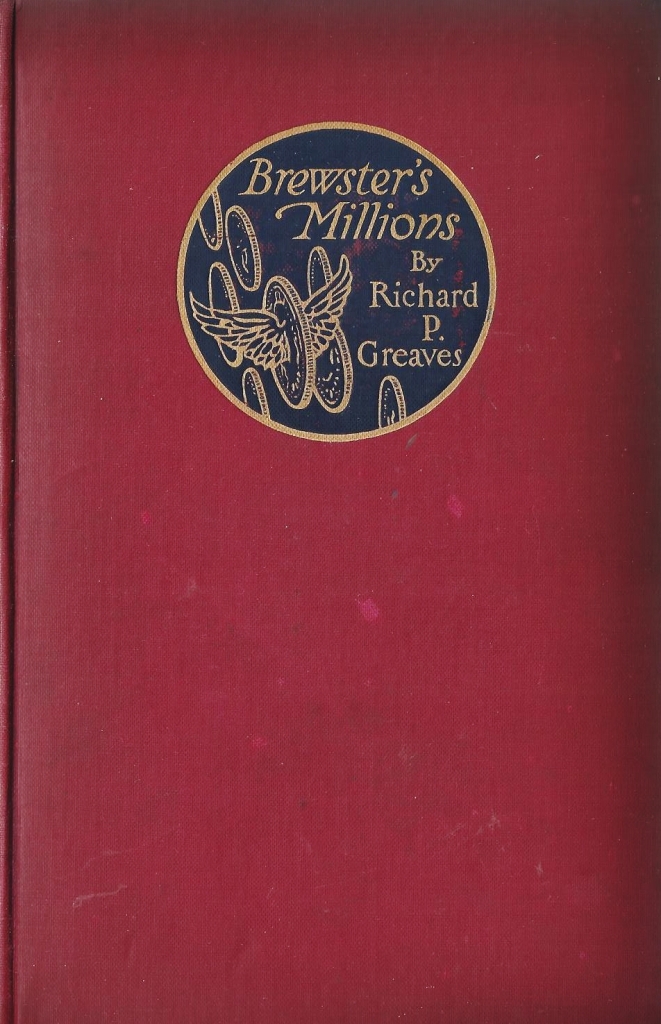 Brewster’s Millions by Richard P. Greaves, pseudonym of George Barr McCutcheon ~ 1903. This edition: Herbert S. Stone & Co., 1903. Hardcover. 325 pages.
My rating: 7.5/10
This was a pleasant light novel which was easily breezed through in several sittings. Nothing here to challenge one; purely diversionary.
Montgomery Brewster is one of the set of young men with expectations, “The Little Sons of the Rich”, who form an informal club for card-playing, wining and dining in turn-of-the-century New York. In Monty’s case, it is his paternal grandfather who provides the expectations; Monty is widely believed to be the millionaire’s heir. This proves to be the case, and Monty’s natural sorrow at his relative’s demise – for Monty has been a ward of the old man since his parents’ untimely deaths – is salved by the news that he has been set down in the will for one million dollars.
Now Monty is gently pleased at this, the more so because he has been a hard-working young man and is not that desperate for the money, though there is no doubt that it will make life much more pleasant. Monty has been working in banking, and is pulling down a respectable salary; he boards with a widowed lady who has been something of a foster mother to him since childhood, and he is good friends with the household’s daughter, Margaret Grey. He is also romantically involved with a vivacious young woman who herself has good prospects, banker’s daughter Barbara Drew. An engagement is expected by both of them – Monty and Barbara – in due course, and all in all life looks fair to be peaceful and prosperous, with no clouds on the horizon.
Then, mere days after the Brewster will is proved, Monty receives a surprising communication from another lawyer. Monty’s late mother’s brother, his Uncle Sedgwick, has just shuffled off into eternity, and he has appointed Montgomery Brewster, son of his beloved sister, his sole heir. With a condition.
Seems that when Monty’s parents were married, a feud of sorts was started between Brewster senior (Monty’s grandfather) and the Sedgwick clan. Unforgivable words were spoken on both sides, and James Sedgwick was left with a bitter hatred towards the Brewsters, Monty excepted. As a sort of twisted revenge, he wanted to turn Monty into his chief heir but without mingling any of his (Sedgwick’s) hard-earned money with that of his enemy’s. Monty must divest himself of the Brewster fortune in a prescribed time, to be left with only the clothes on his body, in order to inherit the Sedgwick cash. And the amount of that legacy makes Monty sit up and take notice: $6,345,000! With projected interest, something like seven times the fortune already in hand.
Will Monty take the gamble?
Well, of course he will! For that is the entire premise of this rather silly story.
The conditions set for divesting himself of the Brewster fortune are stringent. Monty is not allowed to confide in anyone as to why he is ridding himself of his grandfather’s cash, with the deadline being Monty’s twenty-sixth birthday, just under a year in the future.
There was also a clause in which he (Sedgwick) undertook to dictate the conduct of Montgomery Brewster during the year leading up to his twenty-sixth anniversary. He required that the young man should give satisfactory evidence to the executor that he was capable of managing his affairs shrewdly and wisely,—that he possessed the ability to add to the fortune through his own enterprise; that he should come to his twenty-sixth anniversary with a fair name and a record free from anything worse than mild forms of dissipation; that his habits be temperate; that he possess nothing at the end of the year which might be regarded as a “visible or invisible asset”; that he make no endowments; that he give sparingly to charity; that he neither loan nor give away money, for fear that it might be restored to him later; that he live on the principle which inspires a man to “get his money’s worth,” be the expenditure great or small.
So Monty sets out to spend Grandfather Brewster’s cash, which he will need to do, as his calculations have shown him, at an average of almost $3,000 per day. He must demonstrate that he is receiving “value for money”, and he’s not allowed to tell anyone what he’s doing. Let the farcical fun begin!
For Monty’s friends, the other “Little Sons of the Rich”, prove surprisingly unwilling to let Monty squander his cash, and they go to great lengths to limit his expenditures. Early on in the proceedings, Barbara Drew is disgusted by Monty’s profligacy, and withdraws from their informal engagement, giving him pause, but only for a moment. As the year races on, Monty finds it harder and harder to spend fast enough, even adding to his fortune completely unwillingly by several freak occurrences – a second-rate prize fighter knocking out a champion (Monty had bet on the second-rater); a foray into stock trading on a “sure loss” which was turned around due to Monty’s investment; a visit to Monte Carlo ends with a bizarre winning streak – the fellow just can’t lose! Or, as the true case would be, win.
Luckily a financially disastrous yacht trip helps with the final disposal of Monty’s funds, as well as showing him that he has started to develop romantic feelings towards the young woman whom he had previously thought of as a platonic foster-sister, his old chum Margaret Grey. But Monty’s birthday is fast approaching, and suddenly Sedgwick’s executor disappears, and the Sedgwick millions with him. Could Monty have gambled and won, only to have ultimately lost everything through a cruel twist of fate?
Well, what do you think will happen?
I enjoyed this humorous period piece, and I was quite amused as well to learn some of the history behind its writing. I will pass you over to this excellent article by Nathaniel Rich, American Dreams: Brewster’s Millions, from which I’ve excerpted this back story of the author’s own gamble. (And please click over and read the full article; it is excellent.)
Brewster’s Millions, a novel about a bet, was written on a bet. George Barr McCutcheon was visiting his publisher when the subject of bestselling novels came up in conversation.
“The name of the author is what sells the book,” remarked the publisher.
McCutcheon, who the previous year had written his first bestseller—the initial volume in the Graustark series of romantic adventure novels—disagreed.
“I will bet you $100 that it does,” said the publisher.
“I will take that bet,” replied McCutcheon, “and I will write you a story to show you that I am right.”
Six weeks later McCutcheon submitted a manuscript. It was the story of a young man named Monty Brewster who, in order to inherit $7 million, must spend $1 million in a single year. There are, however, strings attached. At the end of the year Monty cannot possess any assets; he is forbidden from telling anybody why he’s spending all his money; and he may only donate a piddling amount to charity. Monty is free to reject the challenge and keep the $1 million, but he accepts the bet without hesitation. He begins his year of spending dangerously by renting the most expensive apartment in Manhattan and leasing four Monets, three cars, two horses, and a chef from Paris.
McCutcheon, needless to say, won his publisher’s bet—in fact he made off nearly as well as Monty Brewster. Brewster’s Millions sold 150,000 copies in its first three months of publication, despite the fact that the author was listed as “Richard Greaves.” (A clerk at the publishing house posed for the press photo.) The novel remains in print 110 years later, and has been adapted for film at least 10 times.
*****
Note: I originally purchased a copy of the book in order to fill in the 1902 spot in my Century of Books reading project, but it appears to me that the book was actually published in 1903. My copy is a first edition, showing the author’s name as Richard P. Greaves on the front cover (later editions replaced the pseudonym with George Barr McCutcheon), and the publication date on the copyright pages states: Issued April 20, 1903. Not a big deal, but it did leave me feeling a bit uneasy about using it for 1902, so I filled that space with Rudyard Kipling’s Just So Stories instead. So if you’re looking for inspiration for this time frame for your own Century project, just an alert that the copyright date of 1902 which appears in almost every reference to Brewster’s Millions that I’ve seen may be slightly incorrect.
Posted in 1900s, Century of Books - 2014, Read in 2014 | Tagged Brewster's Millions, Century of Books 2014, George Barr McCutcheon, Humour, Light Fiction, Richard P. Greaves, Romantic Comedy, Social Satire, Vintage Fiction | 2 Comments »
Header Image
-
These “Reviews” and Ratings
-
Recent Posts
- Ontario Gothic: Morgan’s Castle by Jan Hilliard (1964)
- Mistaken Identities: The Goodbye Look by Ross Macdonald (1969)
- Pan Takes a Trip: Mrs. Demming and the Mythical Beast by Faith Sullivan (1985)
- Cowtown Interlude: Never Shoot a Stampede Queen by Mark Leiren-Young (2008)
- Young adulting in the boondocks: British Columbiana: A Millennial in a Gold Rush Town by Josie Teed (2023)
Archives
- January 2025 (5)
- December 2024 (1)
- February 2024 (2)
- January 2024 (4)
- February 2022 (8)
- January 2022 (9)
- November 2021 (1)
- April 2021 (1)
- May 2020 (1)
- December 2019 (2)
- March 2019 (1)
- January 2019 (1)
- November 2018 (11)
- October 2018 (27)
- September 2018 (6)
- July 2018 (1)
- May 2018 (4)
- April 2018 (3)
- March 2018 (5)
- February 2018 (11)
- January 2018 (20)
- December 2017 (1)
- November 2017 (1)
- October 2017 (5)
- September 2017 (2)
- August 2017 (2)
- July 2017 (3)
- April 2017 (4)
- March 2017 (5)
- February 2017 (14)
- January 2017 (7)
- December 2016 (1)
- November 2016 (7)
- October 2016 (11)
- September 2016 (1)
- August 2016 (2)
- July 2016 (3)
- June 2016 (2)
- April 2016 (1)
- March 2016 (1)
- February 2016 (1)
- January 2016 (5)
- December 2015 (4)
- November 2015 (5)
- October 2015 (1)
- September 2015 (2)
- August 2015 (4)
- July 2015 (8)
- June 2015 (12)
- May 2015 (1)
- April 2015 (1)
- March 2015 (5)
- February 2015 (6)
- January 2015 (9)
- December 2014 (18)
- November 2014 (9)
- October 2014 (7)
- September 2014 (4)
- August 2014 (15)
- July 2014 (12)
- June 2014 (5)
- May 2014 (8)
- April 2014 (11)
- March 2014 (17)
- February 2014 (7)
- January 2014 (23)
- December 2013 (21)
- November 2013 (19)
- October 2013 (18)
- September 2013 (10)
- August 2013 (12)
- July 2013 (22)
- June 2013 (11)
- May 2013 (5)
- April 2013 (17)
- March 2013 (12)
- February 2013 (15)
- January 2013 (20)
- December 2012 (37)
- November 2012 (28)
- October 2012 (28)
- September 2012 (22)
- August 2012 (23)
- July 2012 (22)
- June 2012 (16)
- May 2012 (15)
- April 2012 (11)
Blogroll
A Century of Books ~ 1925-2024

Progress Report: 6/100
12th Annual Canadian Book Challenge

11th Annual Canadian Book Challenge

10th Annual Canadian Book Challenge

9th Annual Canadian Book Challenge

8th Annual Canadian Book Challenge

7th Annual Canadian Book Challenge

6th Annual Canadian Book Challenge

Categories
- 1840s (2)
- 1850s (1)
- 1880s (2)
- 1890s (2)
- 1900s (34)
- 1910s (29)
- 1920s (54)
- 1930s (77)
- 1940s (84)
- 1950s (104)
- 1960s (103)
- 1970s (57)
- 1980s (46)
- 1990s (47)
- 2000s (37)
- 2010s (32)
- 2020s (1)
- Aldrich, Bess Streeter (7)
- Allan, Mabel Esther (1)
- Antonson, Rick (1)
- Ardizzone, Edward (2)
- Arkell, Reginald (2)
- Armitage, Ethel (2)
- Ashley, Bernard (1)
- Atkinson, Kate (2)
- Atwood, Margaret (1)
- Babbitt, Natalie (1)
- Bachman, Randy (1)
- Bagnold, Enid (1)
- Baker, Frank (1)
- Baker, Louise (1)
- Banks, Lynne Reid (3)
- Barrie, J.M. (1)
- Bates, H.E. (2)
- Bawden, Nina (1)
- Beaty, David (1)
- Bell, Mary (1)
- Benary-Isbert, Margot (1)
- Bennett, Arnold (1)
- Benson, Ben (1)
- Berckman, Evelyn (1)
- Birney, Earle (1)
- Bjarnhof, Karl (1)
- Blake, Quentin (1)
- Bloom, Ursula (1)
- Bor, Eleanor (2)
- Borden, Mary (1)
- Bosanquet, Mary (1)
- Boston, L.M. (1)
- Boston, Lucy M. (1)
- Bowen, Elizabeth (2)
- Bowers, Dorothy (1)
- Bowling, Tim (2)
- Bracken, Peg (1)
- Bradbury, Ray (3)
- Brazil, Angela (1)
- Brent, Madeleine (1)
- Brinsmead, H.F. (1)
- Bromfield, Louis (1)
- Bronte, Charlotte (1)
- Bronte, Emily (1)
- Brookner, Anita (1)
- Brown, Joe David (1)
- Brown, Margaret Gillies (1)
- Brunt, Carol Rifka (1)
- Bryson, Bill (2)
- Buck, Pearl S. (1)
- Buell, John (1)
- Burgess, Anthony (1)
- Burnford, Sheila (1)
- Cadell, Elizabeth (1)
- Cambridge, Elizabeth (6)
- Cameron, Anne (1)
- Campbell, Patrick (1)
- Canadian Book Challenge #10 (3)
- Canadian Book Challenge #11 (7)
- Canadian Book Challenge #12 (3)
- Canadian Book Challenge #6 (68)
- Canadian Book Challenge #7 (20)
- Canadian Book Challenge #8 (10)
- Canadian Book Challenge #9 (4)
- Canning, Victor (5)
- Carswell, Catherine (1)
- Caspary, Vera (1)
- Cavanna, Betty (5)
- CBC Ideas (1)
- Century of Books – 2014 (110)
- Century of Books – 2017 (34)
- Century of Books – 2018 (83)
- Century of Books – 2022 (15)
- Century of Books – 2025 (11)
- Channon, E.M. (2)
- Chatwin, Bruce (1)
- Christie, Agatha (5)
- Christopher, John (1)
- Church, Richard (1)
- Chute, B.J. (1)
- Clampitt, Amy (1)
- Classics Club (16)
- Clavering, Molly (1)
- Clive, Mary (1)
- Cobb, Irvin S. (1)
- Cohen, Leonard (1)
- Colette (1)
- Connell, Vivian (1)
- Contemporary Fiction (24)
- Cooper, Thomas C. (1)
- Craven, Margaret (1)
- Creighton, Luella (1)
- Cronin, A.J. (1)
- Czajkowski, Chris (1)
- Daly, Maureen (2)
- de la Roche, Mazo (4)
- de Lint, Charles (1)
- Delafield, E.M. (2)
- Dell, Ethel M. (1)
- Dennis, Patrick (1)
- Devine, Harriet (1)
- deWitt, Patrick (1)
- Dickens, Monica (4)
- Douglas, O. (pseudonym of Anna Buchan) (13)
- du Maurier, Daphne (5)
- Duncan, Sara Jeannette (3)
- Eggers, Dave (1)
- Ellison, Harlan (1)
- Estoril, Jean (1)
- Fabre, D.G. (1)
- Farjeon, Eleanor (1)
- Faviell, Frances (2)
- Ferber, Edna (2)
- Ferguson, Rachel (3)
- Ferguson, Will (2)
- Fey, Tina (1)
- Fisher, Dorothy Canfield (1)
- Fisher, M.F.K. (1)
- Fitzgerald, F. Scott (1)
- Forster, E.M. (1)
- Franken, Rose (1)
- Fraser, Antonia (1)
- Fraser, Sylvia (1)
- Frater, Alexander (3)
- Furse, Celia (2)
- Gaiman, Neil (2)
- Gallico, Paul (4)
- Garner, Alan (1)
- Garnett, Eve (1)
- Gates, Doris (1)
- Ghomeshi, Jian (2)
- Gilbert, Elizabeth (1)
- Gildiner, Catherine (1)
- Gilman, Dorothy (1)
- Glyn, Elinor (1)
- Godden, Rumer (20)
- Goldman, James (1)
- Goodwin, John (1)
- Goudge, Elizabeth (5)
- Graham, Gwethalyn (1)
- Graham, Winston (2)
- Grahame, Kenneth (2)
- Grant, Hilda Kay (1)
- Grant, Robert (2)
- Graves, Robert (3)
- Gremillon, Helene (1)
- Grove, Valerie (1)
- Hamilton, Donald (1)
- Hawes, Annie (1)
- Hawthorne, Nathaniel (1)
- Heine, William C. (3)
- Heinlein, Robert A. (3)
- Herriot, James (1)
- Heyer, Georgette (9)
- Highsmith, Patricia (3)
- Hill, Susan (2)
- Hilliard, Jan (1)
- Hilton, James (1)
- Hoban, Russell (2)
- Hobson, Laura Z. (1)
- Hodge, Jane Aiken (1)
- Hodgins, Jack (3)
- Holding, Elisabeth Sanxay (1)
- Holt, Victoria (1)
- Horwood, Harold (1)
- Houston, James (1)
- Houston, Margaret Bell (1)
- Hudson, W.H. (1)
- Hull, Helen (Rose) (1)
- Hull, Maureen (1)
- Humble, Nicola (1)
- Hunt, Irene (1)
- Hutchinson, R.C. (1)
- Hutchison, Margaret (1)
- Huygen, Wil (1)
- Ibbotson, Eva (1)
- Innes, Hammond (2)
- Isherwood, Christopher (1)
- Jackson, Shirley (1)
- James, Henry (1)
- Jerome, Jerome K. (2)
- John Barnsley (1)
- Johnston, Velda (2)
- Jones, Diana Wynne (3)
- Jordan, Elizabeth (1)
- Joyce, Rachel (1)
- Kaye, M.M. (1)
- Kennedy, Des (1)
- Keyes, Frances Parkinson (1)
- Kimbrough, Emily (1)
- King, Clive (2)
- Klickmann, Flora (1)
- Konigsburg, E.L. (2)
- La Farge, Christopher (1)
- Lambert, Gavin (1)
- Laski, Marghanita (1)
- Lawrence, Josephine (1)
- Lee, Harper (1)
- Leiren-Young, Mark (1)
- Levin, Ira (1)
- Lewis, Sinclair (2)
- Lofting, Hugh (1)
- Lofts, Norah (7)
- Loomis, Ruth (1)
- Lothar, Ernst (1)
- Lyon, Annabel (2)
- Macaulay, Rose (3)
- MacAvoy, R.A. (3)
- Macdonald, Ross (1)
- MacInnes, Helen (6)
- MacLean, Alistair (1)
- MacLeod, Alistair (2)
- Mankowitz, Wolf (1)
- Mantel, Hilary (1)
- Marchetta, Melina (1)
- Markham, Beryl (1)
- Marsh, Ngaio (2)
- Martin, Shane (1)
- Matthews, Carola (1)
- Maugham, W. Somerset (1)
- McGraw, Eloise Jarvis (2)
- McKinley, Robin (7)
- McLennan, Wayne (1)
- McMinnies, Mary (1)
- Meredith, George (1)
- Milne, A.A. (1)
- Mitford, Nancy (2)
- Monsarrat, Nicholas (1)
- Montgomery, L.M. (6)
- Moody, Ralph (1)
- Moore, Lisa (1)
- Moran, Caitlin (3)
- Moriarty, Laura (1)
- Morley, Christopher (6)
- Mortimer, John (2)
- Morton, H.V. (1)
- Murphy, Dervla (1)
- Murphy, Sylvia (2)
- My World (100)
- Nathan, Robert (1)
- Nesbit, E. (2)
- Newby, Eric (4)
- Nichols, Beverley (2)
- Nicol, Eric (1)
- Norris, Kathleen (4)
- O'Grady, Rohan (1)
- Olivier, Edith (1)
- Oppenheim, E. Phillips (1)
- Orange, Ursula (1)
- Orczy, Baroness (1)
- Orwell, George (1)
- Other People's Words (3)
- Panter-Downes, Mollie (1)
- Park, Ruth (1)
- Parrott, Ursula (1)
- Patchett, Ann (1)
- Patterson, Kevin (1)
- Pearson, Kit (1)
- Peden, Rachel (1)
- Pedler, Margaret (1)
- Peggy Holmes (1)
- Penelope Mortimer (1)
- Perrault, E.G. (1)
- Perrin, Noel (1)
- Peter Blackmore (1)
- Peter Curtis (Pseudonym of Norah Lofts) (1)
- Peter Mayle (2)
- Peter O'Donnell (1)
- Petersen, Christian (1)
- Peyton, K.M. (1)
- Philip Croft (1)
- Phyllis A. Whitney (3)
- Pierre Berton (1)
- Pierre Boulle (1)
- Poetry (43)
- Poortvliet, Rien (1)
- Portis, Charles (1)
- Poulin, Jacques (1)
- Priestley, J.B. (9)
- Proulx, E. Annie (1)
- Prouty, Olive Higgins (1)
- Raban, Jonathan (1)
- Rainer Maria Rilke (2)
- Read in 2012 (174)
- Read in 2013 (150)
- Read in 2014 (111)
- Read in 2015 (32)
- Read in 2016 (22)
- Read in 2017 (35)
- Read in 2018 (84)
- Read in 2019 (1)
- Read in 2022 (1)
- Read in 2025 (5)
- Read, Miss (Dora Saint) (1)
- Reben, Martha (1)
- Reed, Myrtle (1)
- Reeves, James (1)
- Renault, Mary (2)
- Richardson, Bill (1)
- Richler, Mordecai (3)
- Richter, Conrad (1)
- Riley, Louise (1)
- Rinehart, Mary Roberts (4)
- Robertson, Heather (1)
- Robinson, Eden (1)
- Rosoff, Meg (1)
- Rowling, J.K. (1)
- Roy, Gabrielle (1)
- Russell, Sheila MacKay (2)
- Rybot, Doris (1)
- Sackville-West, Vita (3)
- Salih, Tayeb (1)
- Sayers, Dorothy L. (1)
- Scarlett, Susan (1)
- Schabas, Martha (1)
- Seeley, Mabel (1)
- Shannon, Dell (1)
- Sharp, Margery (19)
- Shaw, George Bernard (1)
- Shepard, Ernest H. (1)
- Short Stories (24)
- Shute, Nevil (5)
- Smith, Alexander McCall (1)
- Smith, Dodie (9)
- Smith, Neil (1)
- Smucker, Barbara (2)
- Spark, Muriel (4)
- Spring, Howard (3)
- St. Pierre, Paul (1)
- St. Vincent Millay, Edna (1)
- Steen, Marguerite (1)
- Stegner, Wallace (2)
- Steinbeck, John (1)
- Stevenson, D.E. (26)
- Stewart, Mary (15)
- Stockton, Frank (1)
- Strachey, Julia (1)
- Stratton-Porter, Gene (5)
- Strayed, Cheryl (1)
- Streatfeild, Noel (2)
- Sullivan, Faith (1)
- Sutcliff, Rosemary (1)
- Taber, Gladys (1)
- Taylor, Elizabeth (3)
- Taylor, Joanne (1)
- Taylor, Rosemary (1)
- Teed, Josie (1)
- Tey, Josephine (1)
- Thane, Elswyth (1)
- Theroux, Paul (1)
- Thirkell, Angela (1)
- Tickell, Jerrard (1)
- Tracy, Honor (1)
- Trueman, Stuart (1)
- Tutton, Diana (3)
- Ullman, James Ramsey (1)
- Uncategorized (11)
- von Arnim, Elizabeth (8)
- Wagamese, Richard (1)
- Walker, Joan (1)
- Wallop, Douglas (1)
- Walpole, Hugh (8)
- Ward, Mary Jane (1)
- Warner, Sylvia Townsend (2)
- Watson, Sally (1)
- Waugh, Evelyn (1)
- Wells, H.G. (1)
- Wesley, Mary (1)
- Wharton, Edith (3)
- Whipple, Dorothy (4)
- Whishaw, Lorna (2)
- Whistler, Rex (1)
- White, Fred M. (1)
- White, T.H. (2)
- Wilder, Thornton (1)
- Wilenski, Marjorie (1)
- Wilson, Ethel (4)
- Wodehouse, P.G. (1)
- Wright, Eric (1)
- Wynd, Oswald (2)
- Wyndham, John (4)
- Youd, Samuel (1)
- Ziner, Feenie (2)
 Leaves & Pages
The Shuttle by Frances Hodgson Burnett
January 26, 2014 by leavesandpages
My rating: 8.5/10
Coming late to the party with this book, I am. I had added it to my Century of Books must-acquire list because of numerous enthusiastic recommendations from other bloggers, and I am thrilled to be able to report that those who gave it the nod were completely correct. It’s an absolutely grand read.
I understand that the currently in-print edition published by Persephone has been edited somewhat, and I can’t help but wonder what they cut out. I’m not terribly concerned that it would have ruined the story – this is a very long book with abundant authorial wanderings just slightly off-topic here and there – but it was intriguing to read the early, as-published text in this lovely vintage edition and speculate as to where it could be gently trimmed.
And golly, I just realized that the book I’m holding in my hands (well, it’s actually sitting on top of the printer beside the computer, but it was just being held in my hands) is a genuine antique. One hundred and seven years old. That’s rather a pleasant thought. It’s travelled through the decades very well indeed, both in physical condition and in staying power of contents.
If you are one of the few of my readers who hasn’t yet tackled The Shuttle, here is a plot summary of sorts.
There were once, in the later years of the 19th century, two American millionaire’s daughters, eighteen-year-old Rosalie (Rosy) and ten-years-younger Bettina (Betty) Vanderpoel. It was just at the time of the first awareness by impoverished English gentlemen of the nobility – second, third and fourth sons, as it were – that here was a rather well-stocked hunting ground for well-dowered wives, who would be willing to exchange the country of their birth and a goodly portion of their fathers’ wealth for an English title and a stately ancestral home. In the best of these transactions, gone into with eyes wide open, both parties benefitted and a certain degree of happy felicity resulted, but occasionally the meeting of American feminine independence and English masculine traditionalist views on the necessity for a wife to submit to her husband’s superior judgement ended in disaster.
Guess which kind of marriage sweet, frail, loving and deeply innocent Rosy Vanderpoel made?
Falling for the seductive wiles of Sir Nigel Anstruthers, Rosy trots innocently off to England, but the honeymoon voyage is not even half over before she realizes that she has yoked herself to a malicious and sadistically abusive man. Sir Nigel is a rotter through and through. He despises not only his new wife, but her family and her country and her ideas and her expectations of at least a modicum of domestic happiness. His bitter disappointment at Rosy’s father’s insistence at leaving the control of her fortune in her own hands and not in her husband’s has Sir Nigel seething; he has hidden his true nature well, but now that the shores of the new world are receding he is preparing to gain control of Rosy’s share of the Vanderpoel millions for himself.
Competently reducing meek Rosy to a grey shadow of her former self, Sir Nigel succeeds in cutting her completely off from her American family, but for the occasional letter requesting more funds. Three babies are born; the first a son, who is born crippled due to his pregnant mother being physically assaulted by Sir Nigel; two little daughters die young.
Ten years pass.
Back in America, Betty Vanderpoel has never forgotten her beloved older sister, and can’t quite believe that the cessation of relations is by Rosy’s wish. (Betty had never liked Sir Nigel, and he returned the scorn she viewed him with in spades.) Taking her father into her confidence, Betty announces that she is going to go to England and see for herself how Rosy is faring. And off she goes, with her father’s blessing and his millions behind her.
What she finds is beyond her worst expectations. Rosy, aged beyond her years, lives a dreary life shut up in a decrepit mansion staffed by sullen servants, her only companion her hunchbacked ten-year-old son, Ughtred. (Aside to author re: “Ughtred”. What the heck, Frances Hodgson Burnett? That is absolutely bizarre. What were you thinking???!) Anyway, the estate is mouldering away while Sir Nigel pursues his merry way a-spending Rosy’s money on mistresses and riotous living abroad; he returns only to indulge himself in spousal abuse and to browbeat Rosy into sending another brief letter to Papa requesting more money to maintain his little grandson’s estate.
Betty, made of much sterner stuff than Rosy, swoops in like an avenging goddess, and the majority of the rest of the book consists of the rehabilitation of Rosy, Ughtred, the estate and the attached village full of grateful rurals. Sir Nigel reappears to find his despised sister-in-law very much in control of things, and their ensuing battle of wills, Rosy’s deeply good against Sir Nigel’s blackly wicked, is a gloriously entertaining thing.
Oh, and there is a further development. The next estate over belongs to another impoverished nobleman, this one the sole survivor of a long succession of bad eggs. But is Lord Mount Dunstan really as deeply black as his spendthrift, now-deceased elder brother, and the heedless ancestors before him, or is he sullen merely because he feels so darned bad about the decrepit state of his hereditary acres? Any guesses?
I will stop right here, because you can now likely guess the ending from what I’ve just said. Nope, no surprises here. But how the author gets us to the inevitable conclusion is deeply diverting. And how genuinely engaging and interesting her various characters are, from meek Rosy to divinely competent Betty to nasty Sir Nigel and his equally nasty old mother to misunderstood-but-really-deeply-noble Mount Dunstan to random American typewriter salesman G. Selden (who makes up a merry little sideplot himself, what with his precipitous entry via bicycle wreck at the very door of the Anstruther mansion) to busy millionaire Reuben Vanderpoel – what a glorious cast!
I loved this story! It’s a proper saga. Such a treat to have a black and white, good-versus-evil, you know who to root for and who to boo and hiss at sort of thing!
And it does reflect some very real historical happenings, such as the astounding trans-Atlantic traffic in (relatively) poor English noblemen and wealthy American heiresses which took place from the 1860s well into the early 1900s. Fictional Rosy Vanderpoel is represented as being one of the earlier of the transplanted rich girls, and her story is based solidly on fact, though with artistic license in her particular details.
A grand exposition on both American and British social structure of the late nineteenth century, with abundant detail and a whole lot of humour. What a good book, in an old-fashioned novel-ish sort of way. If you haven’t read it already, may I suggest that you consider adding it to your Must-Read list, in any edition you can get your hands on? As the publisher’s poster claims, it is a masterpiece.
Edited to add this note on the heroine’s wee little nephew’s name, Ughtred. At first I thought, “No way! This can’t be a real name.” But then a commenter said something about old Saxon names, and the penny dropped. Of course. A bit of internet research (what did we do before Google?!) turned up just a few references, enough to show that Frances Hodgson Burnett did indeed know her stuff. Here we are, then, references from several genealogy websites. (And I did not bookmark the references; bad researching practice, I know. Don’t tell the teens in my family, as this is a constant refrain from me when they are doing online research: “Reference your sources!”)
and
So there it is. A name with a genuine and quite fascinating history. But I still pity the poor kid in The Shuttle. Crippled from before birth by his wicked father, and then saddled with this. It’s even more eyebrow-raising than Little Lord Fauntleroy’s Cedric. Wonder what his (Ughtred’s) middle name (names) is (are)?
The publisher’s American publicity poster from 1907.
Posted in 1900s, Century of Books - 2014, Read in 2014 | Tagged American-British Relations, Century of Books 2014, Frances Hodgson Burnett, Nobility & Commoners, Social Commentary, The Shuttle, Vintage Fiction | 23 Comments »