pomp and circumstance noel coward 001Pomp and Circumstance by Noël Coward ~ 1960. This edition: Pan, 1963. Paperback. 287 pages.

My rating: 9/10

Havoc under the sun…

Samolo – a lazy, sun-drenched island in the South Pacific where nothing ever really happens…
Until suddenly it is announced that the Queen and Prince Philip are to pay a state visit. From then on chaos reigns. And the arrival of the curvaceous Duchess of Fowey, who brings out the beast in every male, only adds confusion to confusion.

Here we have an easy candidate for the most unexpected book of 2014.

I can’t quite recall where I acquired this tattered and very well read paperback; it just sort of appeared one day at the top of a book stack, like the frothy sort of thing that it is, effortlessly rising above the (comparative) heavyweights below.

As this seems to be my year of reading mostly lightweight novels, and its year of publication was so-far blank in the Century of Books list, what could I do but succumb?

I was initially a little uneasy as to whether I could sustain my interest for the whole thing, as it started off at frenetic high speed, all very much a-laugh-a-minute, and that sort of style can get tiresome early on, especially if the writer bobbles, but Coward, old pro that he was by his point in his career, kept up the pace marvellously well, and completely won me over.

“Charming” is an overused term in describing the light novel, but in this case it is most apt. With a bit more consideration, charming isn’t complex enough, for there is a lot of snark here, too, of the most readable sort.

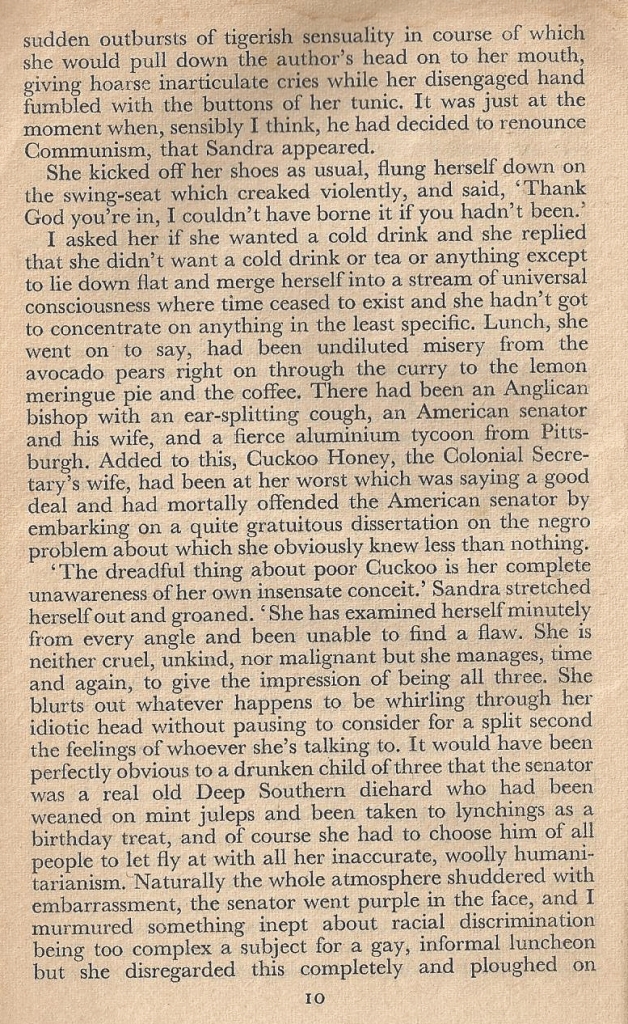
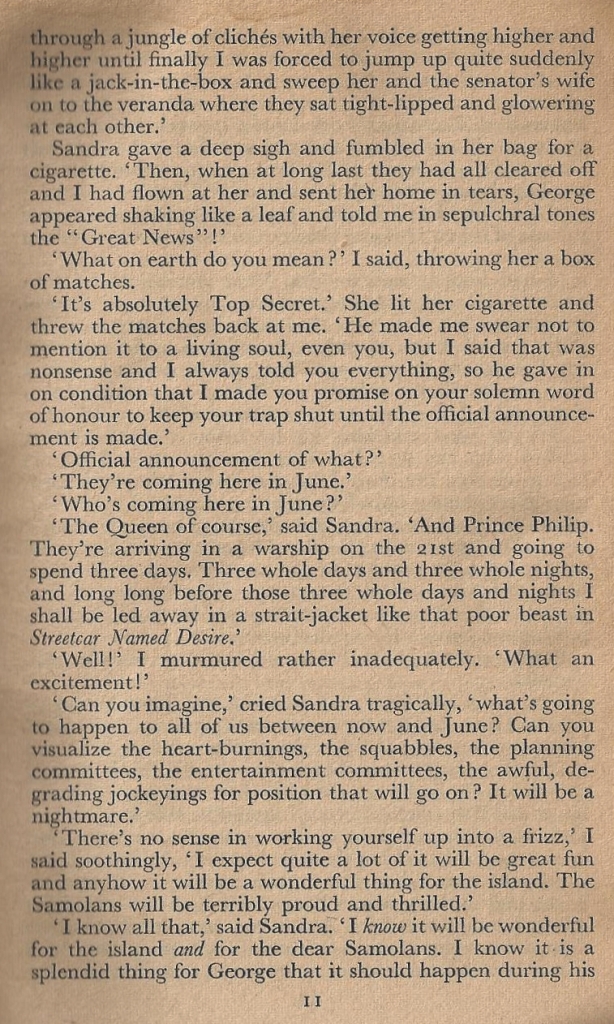
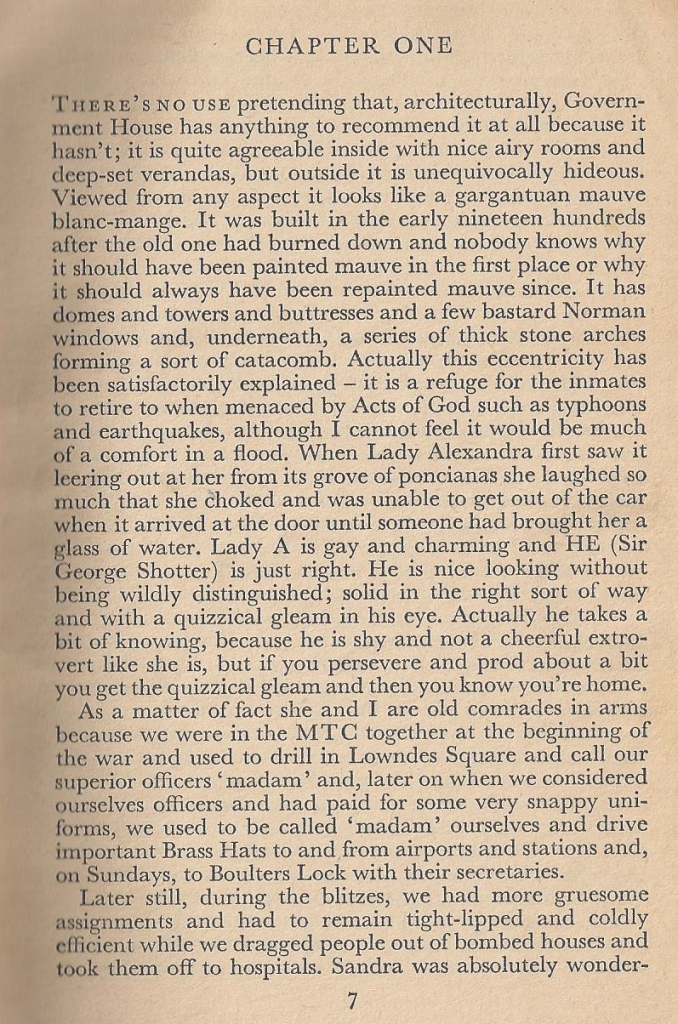
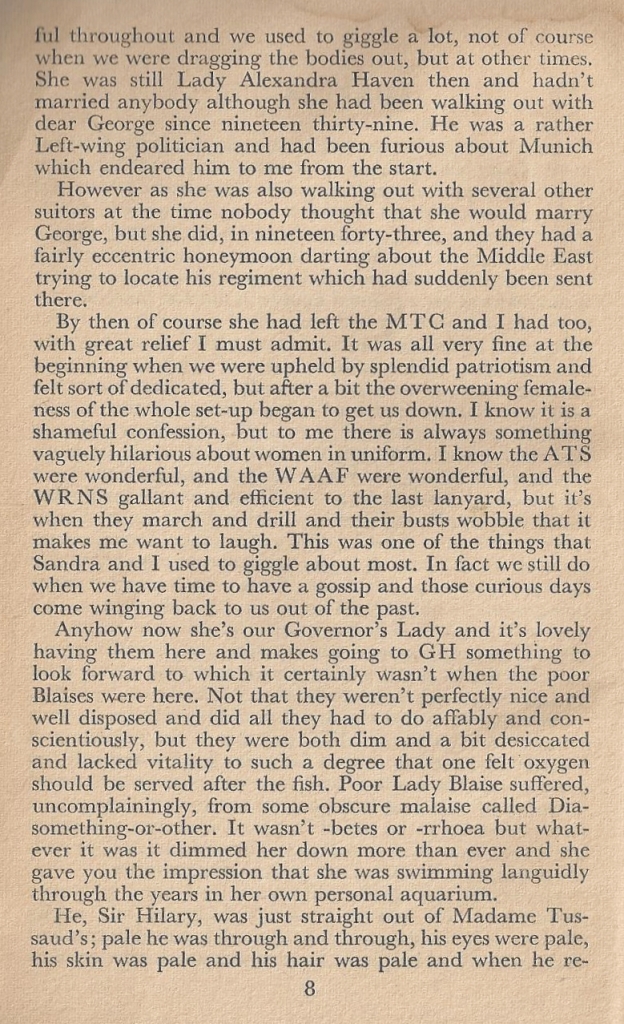
Maybe a page scan is in order, to give one a sample of the contents.

First, an overview.

The curtain rises over the (completely fictional) small South Sea island of Samolo, an idyllic tropical paradise populated by a happy-go-lucky native population and a large colony of British nationals who make up the bulk of the government. For Samolo was never conquered in the warfare sense of the word; the inhabitants merely welcomed the superior managerial style of the inhabitants of that other, colder isle and gladly made way for a dual society of semi-equality. The native upper classes mingle easily with the Brits; the ones a bit farther down the social scale are apparently quite thrilled to provide staffing for the expatriates in their various cottages, villas and stately homes. Everyone is very hail-fellow-well-met, with a bit of resigned-but-not-bitter bitching about the occasional laziness of the servants and their tendency to wander out of paid employment when the mood strikes them providing reliable tea table and cocktail party conversation. (Yes, this is most definitely a fantasy.)

Our narrator, one Grizelda Craigie (Grizel), is the happily married forty-something wife of banana grower Robin. Coward sustains the first-person voice of his female narrator beautifully, something I had serious qualms about when I realized that this was what he was undertaking.

Grizel moves in the upper social circles of Samolo, being on best-friends basis with the British Governor’s wife, Lady Alexandra (Sandra), so of course is the first person to be confided to when the news of the impending Royal Visit breaks.

This is just the start of the drama, for in quick succession Grizel must cope not just with the professional stresses (so to speak) of her highly placed friend, but with an incident in which her small son is mixed up in a very below-the-belt assault on a schoolmate (either triggering or in retaliation for a sharp knock on the head by the other party; the parents on both sides predictably receive conflicting stories from the superficially wounded lads), by the sudden confession of a bachelor friend that he has used her name in telegrams inviting his latest (aristocratic and very prominently married) paramour for a visit, with the intent that the lady actually spend her nights with said bachelor while pretending to occupy Grizel’s guest room, and by involvement in the island’s amateur dramatic association as it plans an elaborate aquatic pageant to be presented to the Queen and her consort, despite prognostications of squally weather soon to come.

Mix in an assortment of Samolan and expatriate characters of all walks of life – from gardener to Prime Minister to journalist to ex-secret-service-agent-turned-sugarcane-planter to aristocratic Duke, and add for good measure a brusque English nanny, numerous beloved-but-high-maintenance visitors, maddening letters from Mummy back home in England who always seems to know the latest Samolan news well before there-at-the-source Grizel, an intense lesbian who is openly smitten with our narrator, the various clashing personalities of the Dramatic Society members, and an epidemic of chicken pox striking in the most unexpected quarters.

It’s all highly silly, but increasingly enthralling. There are moments of sincerity here and there: the portrayals of both Griselda’s and Sandra’s marriages are warm and believably true-to-life, and the family scenes with the children are hugely enjoyable. Most of the sarcasm – which is in relentless but in general quite gentle – is reserved for Grizel’s outer circle of friends and acquaintances, with some deep digs being got in here and there at anti-monarchists both in Samola and back home in England; Noël Coward’s staunchly pro-monarchy patriotism is unabashedly on view.

Several homosexual couples play significant roles, with stereotypical behaviour paraded in full technicolour. I felt just a bit ashamed to find these characters and episodes so amusing, but comforted myself with the thought that the depictions were coming from a writer of that persuasion himself, for Noël Coward was well known to be gay, though always politely reticent about his private affairs.

Pomp and Circumstance was Coward’s one and only attempt at novel writing. One rather wonders what inspired this project, amidst all of the plays and musical compositions. It definitely works, and in my opinion deserves to be shelved alongside the older but similarly giddy Wodehouse tales, as more than slightly goofy, cheerfully amiably, decidedly literary entertainment.

I had a difficult time deciding where to take a page scan from, as much of the joy in this thing is in the building of the story and the connections and contexts of each succeeding episode, so perhaps a bit of Chapter One will be best. This will give a taste of what is going on here; it definitely gets better.

And keep your era-appropriate sense of humour dusted off. One can find much which might be viewed as potentially offensive and politically incorrect these five decades on. Disturbingly vast quantities of alcohol are consumed, mostly in cocktails with oddly evocative names – the “Horse’s Neck”, presumably a long sort of drink, seems exceedingly popular – though sometimes straight from the bottle. Cigarettes are prominently smoked during every emotional and romantic moment, too.  If these sorts of things bother you, best to stay clear. Everyone else, it’s a richly glorious vintage romp.

Pomp and Circumstance has been reissued numerous times since its first appearance in 1960, though it appears to be out of print at present. A quick look online shows it easy to find, and I’m guessing the larger library systems will still have copies. Enjoy!
pomp circumstance pg 1 noel coward 001

pomp circunstance pg 2 noel coward 001

 pomp circunstance pg 3 noel coward 001 (2)pomp circumstance pg 4 noel coward 001pomp circumstance pg 5 noel coward 001 (2)

SNB-logo-small-e1393871908245Shiny New Books

Issue #3 is up!

As Autumn rolls in and the days shorten, what better than to use the longer dark time for a little more reading?

Once you’ve browsed through the wonderfully eclectic array of recent releases highlighted in SNB#3 – sorted neatly into Fiction, Non-Fiction, and Reprints (quite predictably my favourite!) – click over to the BookBuzz page for author interviews, profiles, and a wide array of original and pertinent-to-this-issue bookish articles.

Good Stuff.

Leaves and Pages has even contributed two reviews – see if you can find them.

Big hint: think gardens. 🙂

No uniting theme here, unless it is that of gently engaging but not wow-inducing works by quite decent writers, quickly consumed and just as quickly set aside. Nothing really wrong with any of these, but I must admit that I almost forgot I’d not-that-long-ago read them until I unearthed them from one of the book piles mushrooming on my perennially overcrowded desk.

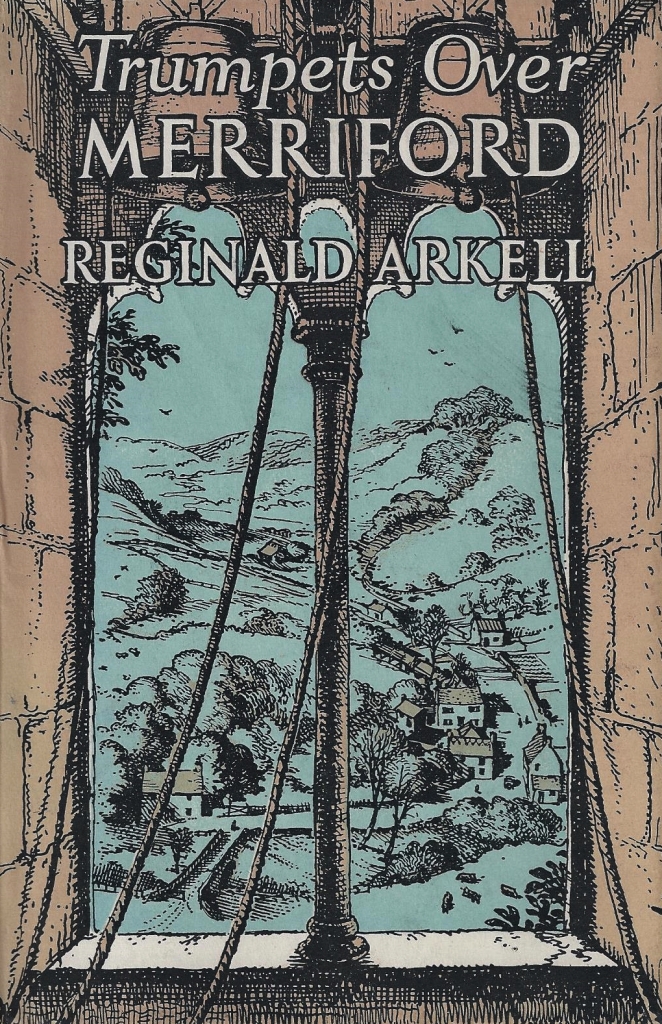
trumpets over merriford reginald arkell 001Trumpets Over Merriford by Reginald Arkell ~ 1955. Published in the United States as The Miracle of Merriford, 1956. This edition: Michael Joseph, 1955. Hardcover. 175 pages.

My rating: 6.5/10

I’d heard of Reginald Arkell before, author of the gardening ode Old Herbaceous and other humorous depictions of English rural life, but this was my first time reading him.

Quick verdict: Quaint. Almost painfully so, in fact, but salvaged by the abundance of good humour and the general likeability of the characters.

It is several years post-World War II, and the tiny English village of Merriford has subsided back into its centuries-old peace. But world affairs keep moving right along, and to prove it Merriford is unexpectedly invaded by a military force from another country. An American Air Force base, strategically located within striking distance of those increasingly pesky Russians, is erected with stunning speed, wiping out farm fields and ancient common grounds with no advance warning.

No more mushroom patch, no more wildflower meadow, just acres of runway and a small city of rambunctious young airmen. Needless to say, the locals are shocked to the core, and react in their various ways. Most find some degree of acceptance, some few are deeply hostile, while others predictably haunt the base gates, hoping to catch the attention of lonely (and well-paid) young men far from home and missing feminine company.

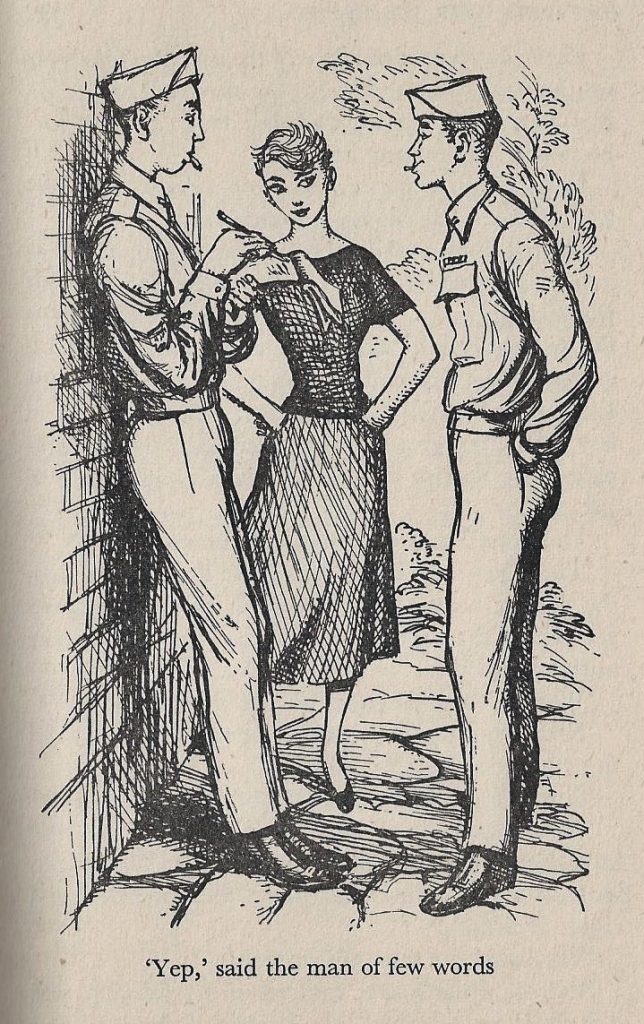
trumpets over merriford illustration reginal arkell js goodall 001The elderly vicar of Merriford takes it all in stride – for he takes the long view, back through the centuries, and an enthusiastic American or two in the here-and-now is no cause for undue alarm – until he is informed by the American work party affixing a warning light to the church steeple that there is something of an emergency concerning the venerable church bells. Or, rather, the bell tower. The support beams are rotten – riddled with wood-worm! – and could tumble down at any time, with dire results to any unlucky congregants in the church below. The vicar orders the bells silenced and the bell tower off limits, and casts about for some way to raise the substantial funds required for repairs, a dauntingly difficult prospect in cash-strapped post-war England.

Meanwhile the vicar’s lovely young housekeeper, the war-orphaned Mary, has caught the eye of one Johnny Fedora, lately of Texas. Mary is much too busy mothering her beloved employer to dally with anyone, let alone one of the forward Americans cheekily camped on her very doorstep, but Johnny is well smitten despite his initial resistance to the charms of rural Britain. He woos the fair Mary with a certain individual style and a noteworthy persistence which eventually brings the vicar round to his side, even if Mary is primly accomplished at keeping her feelings to herself.

Of course there is a charming happy ending, all full of Anglo-American goodwill. Very nice, very sweet. Almost too nice. (But not quite.)

This reminded me quite a lot of similar efforts by Miss Read, though Reginald Arkell writes with considerably more dash, and much more obvious humour. The two also share an illustrator, which served to highlight the resemblance, and I felt that the cheerful line drawings by J.S. Goodall were a marvelous embellishment of a very light sort of village tale.

every living thing james herriot 001Every Living Thing by James Herriot ~ 1992. This edition: McClelland and Stewart, 1993. Paperback. ISBN: 0-7710-4093-8. 374 pages.

My rating: 6/10

Quick verdict: Pleasant enough, but perhaps just a titch too obviously written for the existing fan base.

Between 1970 and 1981 Yorkshire veterinarian James Alfred Wight wrote a number of fantastically successful fictionalized memoirs under the pseudonym James Herriot. Anthologized in compilation volumes, these are All Creatures Great and Small, All Things Bright and Beautiful, and All Things Wise and Wonderful, and their popular success spawned movie and television productions and a thriving tourist industry in Thirsk, Yorkshire, where Wight settled and practiced.

I have read all of them with great enjoyment, and tattered copies remain on our shelves, providing pleasant re-reading for those times when quiet good humour is required. Nominally about the animals the authorial vet comes across in the course of his rounds, the books are at heart most appealing because they are all about human interactions.

Wight/Herriot was a master at capturing the moment; he is one of those writers whose words create vivid snapshots of time and place. The fact that he was fifty years old when he penned the first of his memoirs perhaps leads to their strong appeal. By this time the author had been involved in veterinary medicine for three decades, and his sometimes quite deliberate documentation of the post-war shift of small British farms with their work horses and diverse range of small herds and flocks to a machine-powered, amalgamated, single-enterprise system gives his work a certain importance far beyond the charm of the worked-over anecdotes which comprise them.

When I came across Every Living Thing, I was quite thrilled. Here was a new(ish) work by an author I already held in high regard. And in many ways, the book was well up to par with its predecessors, full of charmingly poignant stories of the animals and people the vet bumps up against.

Some way into the book, though, I started to feel vaguely uncomfortable. Though many of the vignettes are well portrayed, and the glimpses of Wight/Herriot’s family life are most intriguing – he speaks with great feeling about his young children and the joys of their company on his rounds; his son went on to become a vet and his daughter a “human” physician – the book as a whole is slightly unsatisfying. The vignettes are short, frequently unrelated, and often dependent upon one having already read the original books, bringing in references to the best known of the stories and characters of the previous bestsellers.

Preaching, perhaps, mainly to the choir.

For something fairly substantial, 374 reasonably dense pages, Every Living Thing was a very fast read, being smoothly written and engaging. I definitely wouldn’t recommend this as a first experience of James Herriot to one who has not yet read him, but for those who are already fans, the book adds a little something to the other works. Herriot was 72 years old when it was published in 1992, and as he had publically announced back in 1981 that he would no longer be adding to the memoirs, it reads rather like a tacked-on addition to the earlier works, versus a seamless continuation. Not without merit, but a lesser thing, comparatively speaking.

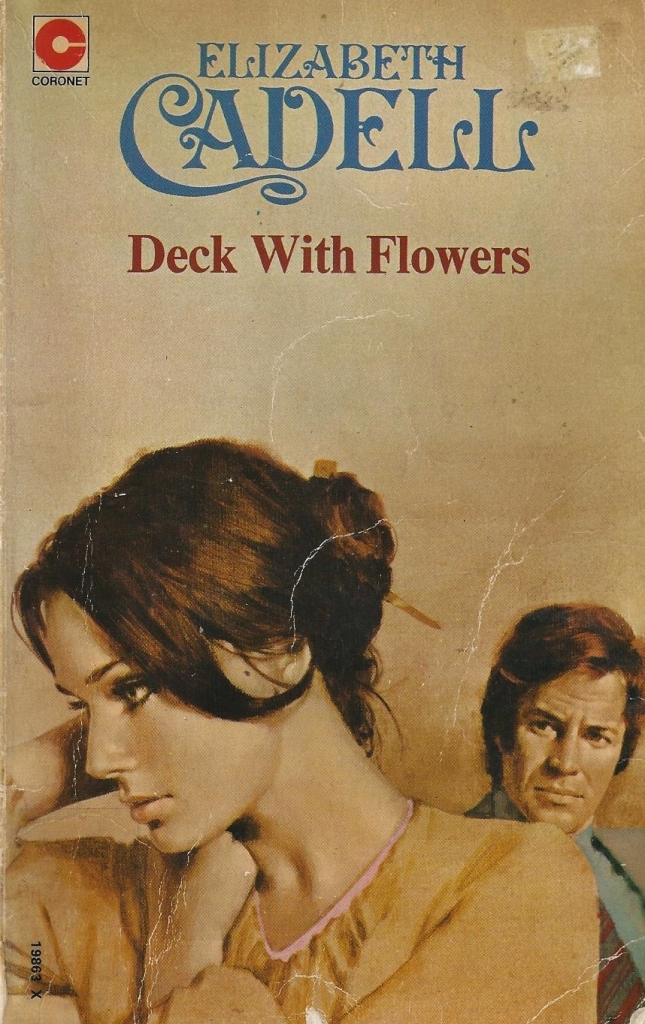
deck with flowers elizabeth cadell 001Deck with Flowers by Elizabeth Cadell ~ 1973. This edition: Coronet, 1976. Paperback. ISBN: 0-340-19863-X. 192 pages.

My rating: 7/10

Quick verdict: Pure fluff, but fun.

I vaguely recall Elizabeth Cadell being ranked with D.E. Stevenson among writers of vintage “women’s fiction” – a designation perhaps even more damning than my beloved mid-20th Century “middlebrow” fiction – but I had not paid too much attention, being at the time still a rank neophyte in the Dessie world, as it were, and not quite convinced of its merits.

Of course, that was then, and this is now, and these days every time I am in a second hand bookstore with even the slightest pretension to an organizational system I do an automatic scan of the appropriate shelves for serendipitous D.E.S. titles. (I’ve found her most frequently in Romance, in Vintage, in Pulp, downright expensively in Collectible, rather surprisingly in Classics, and once in the rather all-embracing Brit Lit.) During one of these generally fruitless scans, this slender paperback caught my eye, with its typically romantic cover and slightly familiar author’s name.

“Oho! What have we here?!” was my immediate response, and a quick scan of the back cover blurb confirmed me in my suspicion that I had stumbled across a classic example of this gentle genre.

Madame Landini’s memoirs promised to be sensational. Rodney, who was publishing them, and Oliver, his literary business agent friend, congratulated themselves on a brilliant coup. But having covered her childhood as a Russian princess, her exile in Paris, and the discovery of her phenomenal voice, the prima donna reached her first husband’s death – ‘man overboard’ – and declared she would write no more.

Rodney suspected that there was more to her change of heart than a display of temperament. He hoped that perhaps Nicola Baird, Madame Landini’s dismissed secretary, could help solve the mystery. But Nicola was beautiful as well as elusive and Rodney found himself becoming romantically entangled with her…

Kirkus is mildly dismissive, and I won’t argue with this 1973 review as it pretty well sums this thing up:

Another soft-centered entertainment of light mystery and lighter romance in London, where Mme. Landini, a once formidable diva, whose autobiography editor Rodney is publishing, literally screeched to a halt in mid-memoir. Some fairly casual sleuthing reveals that Mme. Landini had been spooked by the watch of Nicola, her pretty secretary. And did that have something to do with the disappearance, years ago, of the singer’s husband, who was last seen on shipboard with an armload of flowers? By the time this tangle is gently untangled, Rodney and Nicola have discovered pleasant things about one another and Rodney’s charmingly scatterbrained sister hooks her man. For the lounge library.

Pure chocolate box reading, this was, and quite guiltily delicious as a treat among more wholesome fare.

I thought it not quite up to D.E. Stevenson standard in plotting, at least not that of her best attempts. Though perhaps Cadell is a mite more technically proficient? Deck with Flowers was smooth as smooth, with some grand characters – loved the elderly head of Rodney’s publishing house in particular – but I’ll have to read more examples to be able to pass a fair judgement in this area.

Elizabeth Cadell is an author whom I am as of now adding to my standard look-for list, albeit one of those whose covers I will automatically conceal when reading out in public. 😉


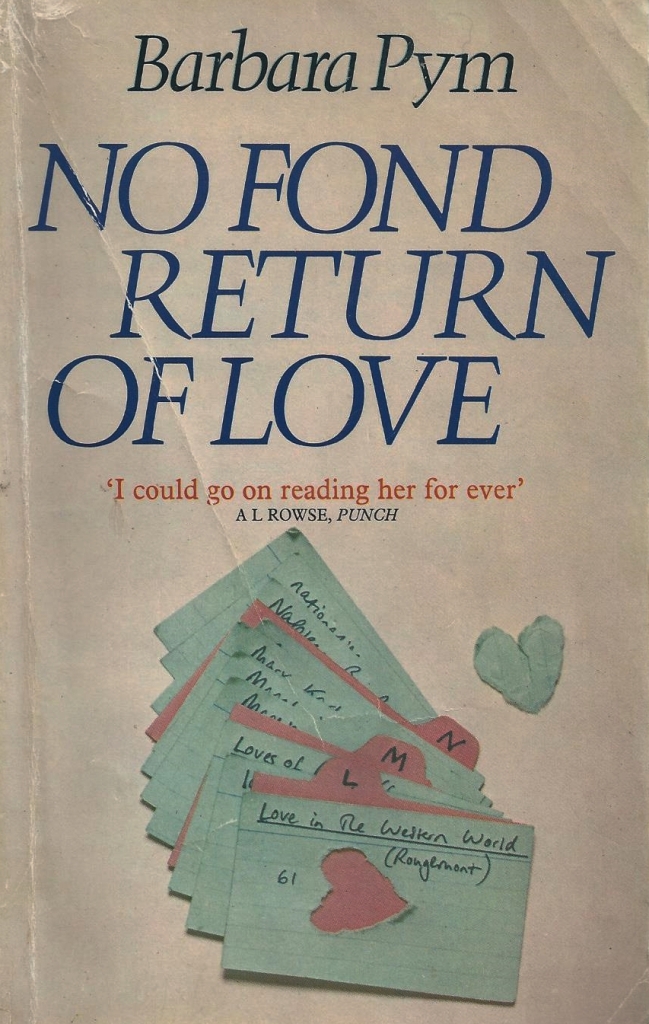
no fond return of love barbara pym 001

Great cover on this 1981 Granada edition, designed by someone who has obviously read and “got” the book.

No Fond Return of Love by Barbara Pym ~ 1961. This edition: Granada, 1981. Paperback. ISBN: 0-586-05371-9. 287 pages.

My rating: 8/10 on a first reading. Perhaps to be elevated after a future re-read. This author is always better the second time around.

Barbara Pym is in rather fine form with this further delving into the complex lives of a number of single women in various stages of contentment (or otherwise) with their unpartnered state.

As with the stellar Excellent Women, and most of her other stealthily pithy novels, No Fond Return of Love has twin strands: the inner voice of a quiet spinster of the keenly-watching-from-the-shadows type, and the omnipotent authorial observation (not always uniformly benign) of various relationships playing out in that spinster’s sphere.

The set-up is familiar to the Pym reader. A single, upper middle class lady of no-longer-young vintage, engaged in some sort of quasi-intellectual undertaking, encounters a number of new people, including a man who both repels and attracts her. The man may or may not look upon the spinster with equal interest; the interest, if piqued, may or may not be romantic. Pym then shines an illuminating light on her chosen small segment of society; she dances her puppets about in increasingly bizarre postures until at last pairing them up in sometimes unexpected partnerships, which frequently feel less than wholly satisfactory, though cleaving to the traditional pattern of a tidy, “happy” ending.

Dulcie Mainwaring is our key character here, though she occasionally steps aside to allow others to have their moment in the dusty spotlight of Pym’s regard. A pleasantly attractive and undeniably intelligent women in her early thirties, Dulcie has just been given her walking papers (in the most tactful way) by her long-time fiancé – he has recently informed her, in acceptably clichéd terms, that he is “not worthy of her love” – and though Dulcie unprotestingly goes along with this charade, her inner confidence is badly shaken.

Pulling herself together, Dulcie decides to divert herself with attendance at a conference designed to address some of the various complexities of her particular line of work. Dulcie belongs to that of the vast network of poorly paid, unseen people (mostly female) who proofread, fact-check, do minor research, tidy up footnotes, and compile indexes and bibliographies for scholarly works of research and biography, and the conference is highlighted by lectures on such arcane topics as “Some Problems of an Editor”, by presenters mildly well-known amongst their peers.

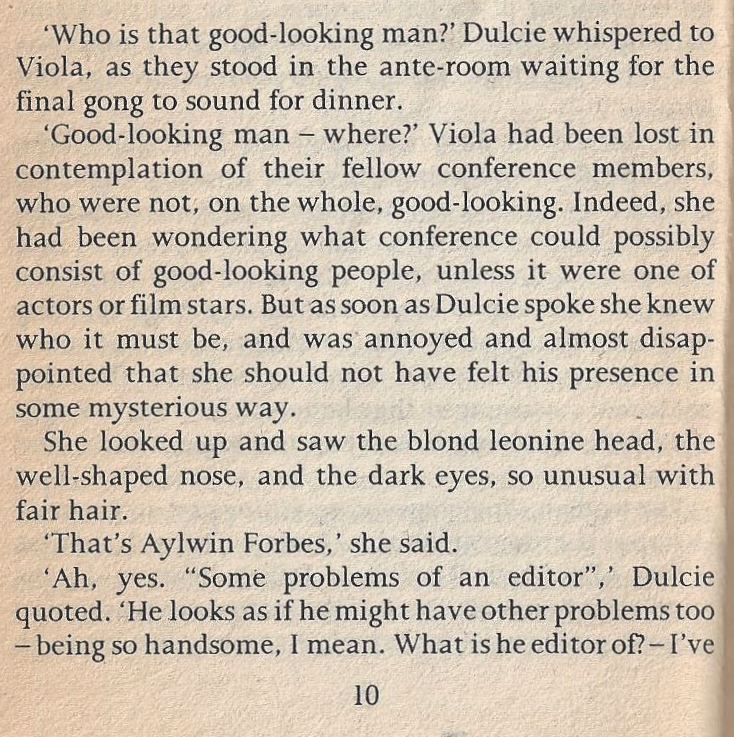
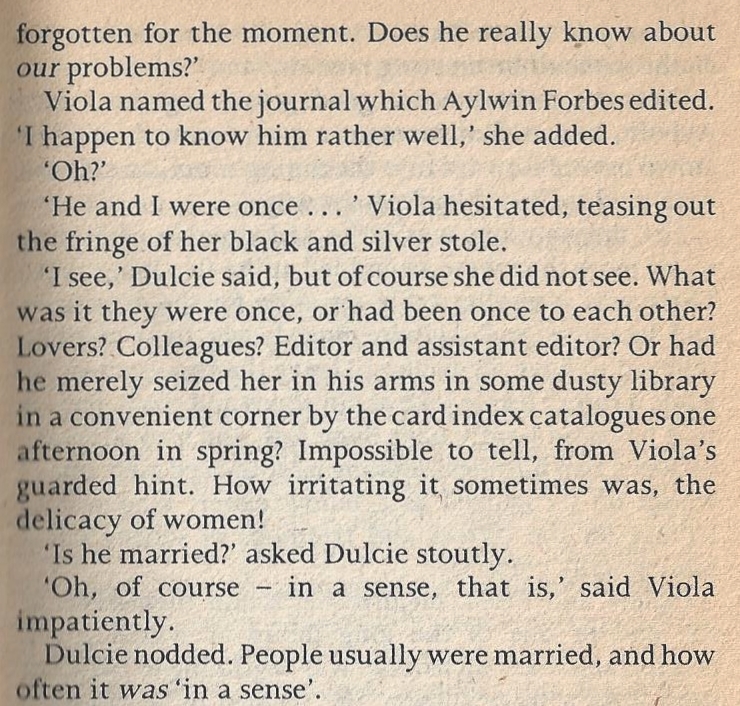
As anyone who has been to this sort of a limited-interest conference may have found, the really interesting networking happens during coffee breaks and over evening drinks, and this event is no exception. Making a deliberate effort to shake off her post-broken-engagement gloom, Dulcie winds herself up to approach a fellow attendee, the slightly younger, slightly more experienced-in-the-arena-of love, and more than slightly patronizing Viola Dace. Though not exactly kindred spirits at first encounter, the two find themselves sharing an interest in one of the conference’s key speakers, the handsome and apparently charming Aylwin Forbes.

no fond return of love barbara pym excerpt 001no fond return of love barbara pym excerpt 001 (2)

Aylwin Forbes effortlessly repulses Viola’s attempts to renew their nebulous relationship with well-practiced urbanity; Dulcie watches their wary exchanges with an eyebrow secretly cocked; she catches every nuance. There is something about Aylwin which piques her interest, and after the conference is over and Dulcie is back home in the over-large house she has inherited from her late parents, she finds him popping back into her field of awareness.

Well, what else to do but research the man, then? Which Dulcie proceeds to do, with a tenacious thoroughness which does credit to her meticulous skill in tracking down elusive references and firmly knitting up tenuous connections. Dulcie’s technique, which involves much trudging about and putting herself into situations where she can inquire as to her subject without causing undue alarm to the interviewee, might well be what we refer to nowadays as stalkerish, but Dulcie, though obsessed with the minutiae of Aylwin’s life and the state of his troubled marriage, somehow manages to stay just on the sane side of this sort of behaviour. We view her actions as manifestations of her innate desire to acquire and organize information, even as her curiousity leads her into some exceedingly unlikely situations, in which the author’s sense of humour is fully indulged.

Dulcie is joined in her home by her eighteen-year-old niece Laurel, and then, in an odd plot twist, by the perennially sulky Viola Dace. Aylwin himself shows up, still vaguely attracted to/repulsed by Viola, and mildly interested in Dulcie in a platonic sort of way – she might be useful to him in a professional sense, Aylwin practically muses – and then increasingly infatuated with the oblivious (and half his age) Laurel, who has herself become romantically interested in the florist-shop-owning son of the family next door.

Meanwhile Dulcie has scraped acquaintance with Aylwin’s clergyman brother, Neville, who himself is having romantic problems with the aging spinsters of his flock, and with Aylwin’s rather soppy but ultimately likeable estranged wife Marjorie, with his matter-of-fact mother-in-law, and eventually with his surprisingly “common” mother, who owns a not-very-good guesthouse (complete with moulting taxidermied eagle in the lobby) in a seaside town, where most of the characters converge for what one fears will be a tremendous confrontation. This never materializes, though Dulcie has a bad moment or two as she crouches behind a piece of guesthouse furniture while Aylwin and Marjorie emotionally discuss the dissolution of their marriage, thinking they are alone.

The tale has strong elements of farce, as you may have gathered from this sketchy outline of some key points, but Pym’s dry tone, and the ever-apt inner thoughts of Dulcie kept me quite enthralled, even while I was mildly annoyed with myself for my collusion in such a nonsensical sort of thing. Dare I say that this reminded my of something which David Lodge might have dreamed up? Or even Robertson Davies, on one of his lighter-hearted days? Full of in-jokes which leave the reader feeling slightly on the fringes of the intellectual circle in which the author has placed his/her characters, and coming close to outright vulgarity with some of the more outlandish developments.

I didn’t much care for the ending, which seemed to argue that any man is better than none, after a book’s worth of practical examples of why a spinster’s fate might not be such a bad one. I thought that after going to great pains to demonstrate her character’s rich inner life, Barbara Pym let Dulcie down. Perhaps, writing at the end of that “happy housewife”-focussed decade, the author caved in to the 1950s’ ideal of marriage always being better than the alternative?


This space has been very quiet lately, and there is the happy reason why, as mid-September brought a rare chance to get away from work and the farm for a few weeks, and with that escape, a time away from the computer.

My husband and I are, as some of you already know, the proud possessors of a 1971 Triumph Spitfire (among a number of other vintage “project cars”, of which the less said perhaps the better, the old sports car interest being something of a joint secret life which we try to keep a low profile about, as it bemuses most of our friends) and once in a while we go all out and take her for a serious run.

Abandoning numerous pressing projects, we took part in a 3-day vintage sports car rally which started in Kelowna, progressed through southern interior B.C.’s Monashee Mountains, and ended southwest of Kamloops at the Quilchena Hotel on the Douglas Lake Ranch.

We had a well-timed breakdown on travel-to-the-rally-start day, and with the aid of a serendipitous series of exceedingly helpful old-British-car buffs and an early morning mechanical session in our hotel parking lot, we got Baby put back together again. That out of her system, she ran like a charm for the next 3 days, bringing us home again after better than 1000 miles of top-down driving under mostly sunny skies.

Sometimes things are better than anticipated. This trip was one of those. It was utterly perfect.

One of my favourite views - looking out over the Spitfire bonnet. The only better place is behind the wheel! Here we are heading towards Vernon, B.C., on Day 1 of a vintage car rally we participated in September 19-21.

One of my favourite views – looking out over the Spitfire bonnet. The only better place is behind the wheel. Here we are heading down the highway towards Vernon, B.C., on Day 1 of our 3-day rally. On the other side of Vernon we head off into the mountains, onto frequently narrow, highly scenic, beautifully curve-filled rural roads – perfect for our treasured cars to show off what they were really built for. Completely frivolous creations, but a whole lot of fun.

Day 3, with our Spit in the foreground as we all converge for a final meet-up and meal before going our separate ways.

Day 3, with our Spit in the foreground in the parking area of Douglas Lake Ranch’s historic Quilchena Hotel as we all begin to converge for a final meet-up and meal before going our separate ways, to points throughout B.C, with a few hardy souls heading home to Alberta and down into Washington State. (This is less than a third of the group – sadly I did not get a shot of all of us together – and it was a nicely eclectic group, with our working-class, 4-cylinder Spitfire on the lower end of the sports car hierarchy and a stunning 1955 Jaguar – red car, 5th in line – representing the posher end of the scale.)

We made it home, hastily parked the Spit without giving her the usual post-run wash-and-brush-up, and spent the next day frantically packing up our old camper in order to take our daughter on the trip to the ocean we’d promised her in the spring. “C’mon, let’s do this, it may be my last trip with you,” she kept saying, piling on a bit of the kids-all-grown-up angst on our parental heads, and though it was rather odd being a trio in the camper instead of a quartet – her older brother, now mostly moved out, came home and kindly farm-sat for us – it ended up being a very pleasant trip.

The weather had turned, bringing wind, cool weather, and rain, but we forged on regardless, and though we came home rather more exhausted than when we left, we’re glad we made the effort.

Beach walks, conversation, peaceful evenings, books. We then left the ocean more or less behind, and spent a day in Victoria, where we took in the Swedish History Museum’s touring Viking exhibit at the Royal B.C. Museum, and joined the tourist throng queuing for chocolates at the venerable Rogers Family confectionary store, before heading for the ferry line-up, and the long trek home.

It was great fun to get away, but it feels very good to be back. All of our projects are here still waiting for us – darn! – why couldn’t those have done themselves while we were gone?! – but we’re all the happier for our two weeks away.

And here are some photos from the trip, a very small sampling of where we went and what we saw.

The next post will be back to books – the pile of to-be-talked-about has grown to ridiculous proportions. I think a round-up post or two may be in order.

Pacific Ocean at Long Beach, western side of Vancouver Island. Next landfall, Japan.

Pacific Ocean at Long Beach, western side of Vancouver Island. Next landfall, Japan.

A storm just passed, and the setting sun appears briefly.

Same stretch of beach. A storm has just passed, and the setting sun appears briefly. The swell is immense; we are being very careful, as the day before another beach walker was almost swept away by a rogue wave.

Pink sea urchins, tide pool, upper Long Beach. No sea stars, though the rocks show grazed areas where they were abundant on all of our previous visits to this particular group of rocks and pools, a sad disappointment. Over 95% of the sea star population between Alaska and California has suddenly died off since late winter, 2014, due to a suspected viral disease thought to be exacerbated by warmer-than-usual ocean temperatures.

Pink sea anemones, tide pool, upper Long Beach. No sea stars, though the rocks show grazed areas where they were abundant on all of our previous visits to this particular group of rocks and pools, a sad disappointment. Over 95% of the sea star population between Alaska and California has suddenly died off since late winter, 2014, due to a suspected viral disease thought to be exacerbated by warmer-than-usual ocean temperatures.

Empty beaches, just us and the birds most days...a storm system out at sea has just passed, leaving the wave danger rating at extreme, and keeping the hardy wet-suited surfers who generally frequent these shores holed up in their various retreats.

More empty beaches, just us and the birds most days…a major storm system out at sea has just passed, leaving the wave danger rating at extreme, and keeping the hardy wet-suited surfers who generally frequent these shores holed up in their various retreats.

Finally the waves subside enough for some surfer action. This brave soul was up a few times, but never for long. Hard work for a few moments of catching the wave!

Finally, several days after the highest storm surges of the year to date, the waves subside enough for some surfer action. This brave soul was up a few times, but never for long. Awfully hard work for a few moments of catching the wave!

Misty morning sunrise.

Misty morning sunrise.

Blue heron, low tide.

Blue heron, low tide.

As inland dwellers, this sort of thing leaves us thrilled to the core: what an incredibly rich thing is the sea!

As inland dwellers, this sort of thing leaves us thrilled to the core: what an incredibly rich thing is the sea!

And then there's wonderful stuff like this: urchins and anemones at Ucluelet.

And then there’s wonderful stuff like this: urchins and anemones at Ucluelet.

Sea isles off Ucluelet, seen from a viewpoint on the Wild Pacific Walking Trail.

Sea isles off Ucluelet. Rather makes one dream of setting up a hermitage on one of those to escape the woes of the human world…or, thinking a little harder of the lack of arable land for even a wee garden, and the constant rain and sea roar, maybe not…

Mildly eerie but decidedly cheery: dwellers in the rainforest at Tofino Botanical Garden.

Mildly eerie but decidedly cheery: dwellers in the rainforest at Tofino Botanical Garden.

Heading down island, into some welcome sunshine, which lights up the evening waves at French Beach, near Jordan River. We sat on the rocks in the sunset and watched three sea otters frolicking in the kelp beds as the tide turned and started rolling in.

Heading down island, into some welcome sunshine, which lit up the evening waves at French Beach, near Jordan River. We sat on the rocks in the sunset and watched three sea otters frolicking in the kelp beds as the tide turned and started rolling in.

Into the city, to do the tourist thing in Victoria, our province's capitol city. Totem poles in Thunderbird Park, with the stately Victorian Empress Hotel in the background.

Into the city, to do the tourist thing in Victoria, our province’s capitol. Totem poles in Thunderbird Park, with the stately Victorian-era Empress Hotel in the background.

City botanizing: fall-blooming cyclamen in a quiet corner of Victoria's Beacon Hill Park.

City botanizing: fall-blooming cyclamen in a quiet corner of Victoria’s Beacon Hill Park.


solomons seal hammnd innes 1980Solomons Seal by Hammond Innes ~ 1980. This edition: The Book Club, 1981. Hardcover. 320 pages.

My rating: 5.5/10

At one point in my reading life (late teens) I read a fair bit of Hammond Innes, mostly because I had read everything else handy and he was still “there”. I must say that I found his dramatic, testosterone-infused stories acceptable enough, though ultimately easy to re-shelve. This renewal of my acquaintance with Innes reminds me of just how readable-but-not-great he can be.

Please forgive that “astounding breasts” reference in the post header. Coupled with my last post featuring an almost-nude woman on a book cover, you might think I’m reading some pretty risqué stuff these days, but as with Dodie Smith’s allusive-but-not-explicit sex scenes, Hammond Innes avoids most of the details. He does, however, go on at some length about his female character’s physical attributes. Those breasts are mentioned numerous times; the hero describes them as astounding both before and after he has had some hands-on investigation. As a female reader I must say I found this rather off-putting. Hey, dude, what colour are her eyes?

This is merely a digression, though, a side note of personal annoyance regarding what is actually quite an initially promising story of mystery, suspense, and manly derring-do.

Trying to sort out the many plot strands to present them in logical order – more difficult than you’d think, as Innes has obviously decided that more is better in this case – and I am going to refer you to the Kirkus Review of 1980. Whoever penned this summation has neatly separated out the main points. I left the Big Plot Spoiler in, such as it was. See if you can make sense of this:

An improvement over Innes’ recent, dullish adventures – with stamps and sorcery (instead of, as usual, wildlife and armaments) helping to give a lift to at least the first half of the proceedings. Ex-naval officer Roy Slingsby, a temperamental property appraiser for a law firm is sent out to size up the auctionable holdings of the Holland family – and native-looking beauty Perenna Holland (whose twin brother Timothy is supposedly dying of sorcery) shows him the family treasures: carvings and stamps from Papua New Guinea. But before Slingsby can decide how much the stamps are really worth, Perenna disappears…and Slingsby himself quits his job, accepting an offer to relocate to Australia and settle a huge estate down there. Once Down Under, however, the Slingsby/Holland paths will merge again: in Sydney Slingsby meets Jona, a part-native Holland relation who captains an LCT (WW II landing-craft transport), and goes on a cruise with him to Bougainville in the Solomons, working as a navigator for his fare. Re-enter Perenna, of course, who is soon Slingsby’s shipboard bedmate – and the lovers then discover that Jona is delivering a cache of arms to rebels in Bougainville (where the Holland family has a long history). They all become involved in this insurrection (which fails) – and, while in the ancestral area, they uncover family secrets. Above all: grandfather Holland fathered Perenna on his own daughter-in-law – which is partly responsible for the family curse…The stamp stuff is fine, the rest is familiar and foolish but reasonably atmospheric – and none of it is as soporific as The Big Footprints or other Innes super-duds…

Do I detect more than a whiff of damning with faint praise in those first and last lines? If so, I must agree. This was a bit of a dog’s breakfast, and I notice that the Kirkus reviewer left out the cargo cult stuff, which Innes tosses in to justify the mindless actions of his “indigene” characters – the “fuzzy haired” (which epithet occurs as often as the breast reference, and is as equally irritating – did the man not have access to a thesaurus?) natives of Australia, Papaua New Guinea, and the Solomon Islands who, in a mostly amorphous mob, get to play the crowd scenes during the bizarre and hardly believable “political insurrection” bits.

Here’s another excerpt from a contemporary review, this one more openly annoyed.

Anatole Broyard, writing in the December 12, 1980 issue of The New York Times, has this to say:

Everyone, even V.S. Pritchett, praises Hammond Innes. But I wonder what they will say about Solomons Seal. It did not work for me, but then perhaps I have the wrong attitude in reading suspense novels. Since they are supposed to be entertainments, I refuse to work very hard in reading them. I tend instead to sit back and wait for the book to come to me, to manipulate me as a skillful masseur might… Mr. Innes’s ambitions, apparently, are of a higher order. Solomons Seal is a heavy stew of voodoo death, cargo cult, family curses, philately and South Pacific politics – plus a dash of Joseph Conrad’s Heart of Darkness and a soupçon of The Ancient Mariner… Much of the action occurs off stage, and we are given huge chunks of plot in summary. I think it was novels like Solomons Seal that inspired Edmund Wilson’s famous attack on the detective story, in which he said that reading them was like looking for a rusty nail in a crate of straw…

Well, this isn’t much of a review so far, dear readers, being mostly a presentation of other people’s words with me fervently nodding in agreement off in the wings.

I liked the set-up, and greatly enjoyed the details of the stamp collecting sub-world, as well as the introspective passages during the at-sea times, as multi-talented Slingsby contemplates the ocean during his solitary time on the bridge of the sturdy but wallowing Landing Craft Transport he finds himself piloting. There was also a short but good description of open pit copper mining which I greatly appreciated for its verisimilitude, for my husband works in just such a mine here in the interior of B.C. and Innes has obviously paid close attention during his research visit to a similar late 1970s mine site. He even references the many Canadians working in the mine, which I appreciated as evidence of the author’s keen eye for scene-setting detail. (Innes famously travelled for six months of every year, examining story settings and taking notes, then spent the next six months writing up his latest adventure tale. He also had a soft spot for Canada, and was warmly appreciative of the Canadians he met on his research journeys here, as portrayed in his autobiography, Harvest of Journeys, which I think I must really re-read some time soon, since he’s back on my radar.)

Where Innes lost me (setting aside the trying-to-be-sexy bits and the pervasive offhand racism) was in his failure to bring all of the story strands together in an interesting and understandable way. There is a Great Big Secret, which men are prepared to kill (and to die) for – this turns out to be some sort of muddly your-father-betrayed-my-father-therefore-I-don’t-like-you-very-much-and-oh-yeah-if-I-can-I’ll-do-you-down melodrama. The lone female character turns out to have a slightly complicated ancestry (see the Kirkus excerpt), but I was never quite clear on why that really mattered. There is a convenient maybe-suicide of the conflicted primary bad guy, who is really a mix of admirable initiative and evil genius – our hero admires him as much as fears and hates him. The two “native sorcerers” at the heart of the mostly-off-stage insurrection have a weird mental showdown; one mysteriously wins and the other “wills himself to die.” The few stray bodies (all of expendable bit players) are apparently easily disposed of with no apparent qualms or consequences – “These country bumpkin black fellas are continually bumping each other off, no need to interfere” seems to be the attitude of both the local and post-colonial management level and police types. The cargo cult and voodoo elements are continually mentioned but never really detailed, almost as if Innes expects his readers to be completely au fait with this sort of arcane knowledge and able to figure out these references by themselves.

As a plus point, the book title is a neat triple entendre, as the stamps which start the story-ball rolling are actually shipping company business seals versus true postage stamps, and they are embellished with an actual seal-on-an-ice-floe picture cribbed from a Newfoundland postage stamp design, and much of the action concerns the Solomon Islands.

This wasn’t a painful read, but it wasn’t great, either. It was, in fact, resoundingly okay-ish.

I’m eyeing the other Hammond Innes books tucked away on the “B-List” cabin bookshelves with mild surmise; we are about to head out on a longish road/camping trip and much not-too-hard-going reading matter will be required. Solomons Seal was needlessly convoluted, but some of Innes’ earlier works were much more linear in construction, if memory serves. Perhaps I should take along The Wreck of the Mary Deare (ghost ship!), or The Doomed Oasis (Arab chieftans and oil!), or The Land God Gave to Cain (murder and meanderings in desolate Labrador!) Or maybe the autobiographical Harvest of Journeys, which I remember from a long-ago read as being a very good memoir, with the bonus element of being eligible for inclusion on my Canadian book list, as it is much concerned with Innes’ travels in Canada.

Keep an eye on this space, and in the meantime, consider that you’ve been given the heads-up on how well (or not well) Hammond Innes travels through time from his heyday as a bestselling “blue collar” action-suspense writer.

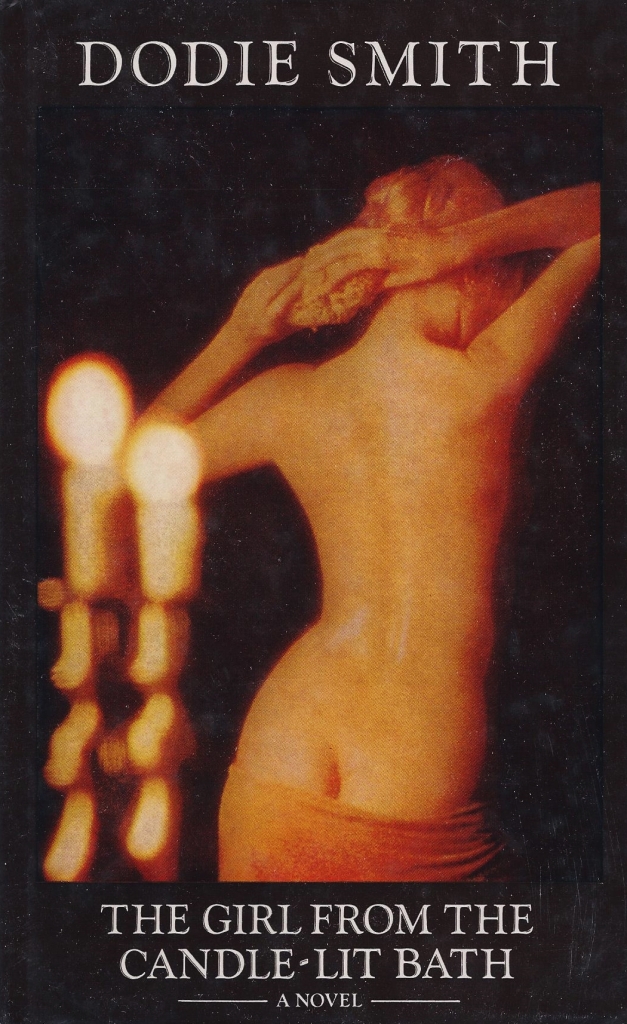
the girl from the candle-lit bath dodie smith 1978 001The Girl From the Candle-Lit Bath by Dodie Smith ~ 1978. This edition: W.H. Allen, 1978. Hardcover. ISBN: 0-491-0-2113-5. 155 pages.

My rating: 3/10

Oh, dear.

I was warned ahead of time that this book was a huge disappointment (see what Nan has to say here, and Elizabeth here) but I thought to myself, “Surely it can’t be that bad?”

I was wrong.

It is dreadful.

Great title, gorgeous cover. Very titillating to the readerly imagination, kind of like our heroine’s soap commercial was to the TV-viewing masses in this thankfully short novel, which explains the reference which the title makes. For our heroine is a not-very-successful actress, who was engaged to perform in a soap commercial which showed her nude but with the naughty bits always just concealed, and she is therefore famous enough to be recognized for this years later.

So, did her many fans concentrate solely on her face? I can see some credence in her being continually recognized if she were wandering around nude, but as her fans instantly recognize her when she is fully clothed there is something weird going on with this premise.

Oh, heck. The whole thing is weird. And not in a good way, either.

Dodie Smith was 82 years old when this was published, part of an all-at-once 1978 three-book release by her publisher, along with the second volume of her autobiography, Look Back with Mixed Feelings (which is utterly excellent), and a juvenile, The Midnight Kittens (beautifully illustrated by Anne and Janet Grahame-Johnston, and appearing quite promising from my recent browse-through), and all I can assume is that her elderly energies were mostly being engaged with her journals and memoirs. The Candle-Lit Girl is a sketchy creation, paper-thin and not terribly engaging. In fact, I found myself wishing someone had left her in that notorious bathtub, well submerged.

But here she is, undeniably on paper, and wafting about the vintage book world tempting those seduced by the excellence of Dodie Smith’s masterpiece I Capture the Castle into exploring her other novels. I speak from experience; I was one of those seeking something of the same quality of Castle, and I must agree with all of those who have quested before me that there is nothing in this particular book for us.

The other Dodie Smith novels I’ve read, The Town in Bloom and The New Moon with the Old, are quite acceptable as minor diversions, containing as they do a lot of genuine charm and reasonably cohesive narrative threads, but The Girl From the Candle-Lit Bath is an utter dud, not even up to the standard of these mild but amusing second-raters.

So – have I made my point yet? I think I have. Stay away!
Do we need a plot description? I guess we do, after this opening rant.

From the flyleaf:

When Nan Mansfield arrives home to hear her husband, Roy, on the telephone arranging a clandestine meeting in Regent’s Park, she is determined to find out what he is involved in. Is there another woman – or can it be blackmail, drugs, or even treason?

Roy is a Member of Parliament who was helped into politics by Cyprian Slepe, a brilliant eccentric who lives with his sister, Celina, in a decaying Stately Home. Nan comes to believe that Cyprian is connected with Roy’s mysterious activities. Helped by an enigmatic taxi-driver, she delves deeper and deeper, while her love and loyalty war with her ever-increasing suspicions, until at last she discovers that her own life is in jeopardy.

This starts off quite well, with a mysterious meeting and exchange of a small package in Regent Park between respectable Roy and a shady-looking man with long, “obviously dyed” hair. In fact, Nan thinks Roy’s meet-up is a woman, though taxi-driver Tim insists the stranger is a man.

Tim insists on quite a number of things, come to think of it. He goes well beyond the call of taxi-driverish duty, escorting Nan up to her apartment after the witnessed rendezvous and examining every nook and cranny, and warning Nan that she well may be up against more than she knows. For while Nan is still thinking that Roy is engaged in a purely personal complication, Tim is spouting off about the possibilities of Evil Russian Involvement (Roy is an M.P., after all,  although very much an innocuous backbencher) and Political Espionage. Of course, Tim claims to be a (and actually is) a thriller writer, so these sorts of plots come quite naturally to his mind.

Not so Nan, who is exceedingly dim and unimaginative for someone whose métier is the theatre. Can’t help but think (rather meanly) that this might explain why her career was so second-rate, and why she was so willing to drop out of the theatre world to play tame political wife to ambitious Roy.

Anyway, Nan starts dictating her experiences into a tape recorder, the transcripts of which recordings we are now reading. At first I thought that might explain the curiously flat tone of the writing, that it was a deliberate attempt by Dodie Smith to represent Nan’s monologue, but after a while I gave up on that idea, concluding instead that the author really wasn’t that engaged with her story, hence the droning prose.

The plot is as full of holes as a piece of Swiss cheese, and the analogy doesn’t stop there. As well as being embarrassingly cheesy, this thing is capital-L Lame. Poor Dodie proves herself to be something of a one-trick pony, repeating all of the theatrical clichés we’ve already seen in her other non-Castle novels. Sure, she had some great youthful experiences in her own time as an aspiring actress, but we can only hear them so many times before we turn away in boredom. And her rather promising villain, Cyprian Slepe, is never properly developed, nor is his ditzy sister Celina, who is actually rather intriguing, what with her habit of painting portraits all in swirls of colour with one pertinent feature rendered with artistic precision. I liked that bit, and thought it showed promise. But nope, Dodie drops it and wanders away, into poorly-thought-out Communist Plot Land. Well, more like British-Right-Winger-Mulling-Over-Getting-Involved-With-The-Russians Plot Land. Or something. It’s a bit nebulous as to what the whole conspiracy is actually about. Gar.

Well, I’m going to point you to those other two reviews, because they go into more detail and are well worth reading if you’re wondering if you want to hunt down this very obscure novel for yourself.

My advice to you: Don’t do it. And if you do do it, go for a library copy and don’t shell out your hard-earned cash for a personal copy. (Speaking from rueful experience. Oh, well, looks grand on the shelf. I do like that cover.)

Here you are:

Fleur Fisher’s Review of The Girl in the Candle-Lit Bath

Strange and Random Happenstance’s Review of The Girl in the Candle-Lit Bath

Thank you, ladies. Next time I’ll believe you and not go forging ahead in optimistic disregard of your assessments!



the black stallion water farleyHere’s a quick Sunday morning diversion.

I was just visiting around some of my favourite blogs last night, and on one of them (was it Moira’s?) I read a fascinating list of books which influenced the reader in some way, and which were instantly memorable without trying too hard. I found her list intriguing, and it got me to wondering about my own “Aha!” book moments.

So rattling off the ones which instantly spring to mind, and without any sort of attempt at deep analysis, here’s my version of an absolutely snap Top Ten of personally imagination-influencing books, from my pre-teen years to now. Vaguely chronological. Coming back to add that as I can’t narrow it down to just ten, I’ve made up two lists, one of adolescent/teen memorable books, and one for the adult years.

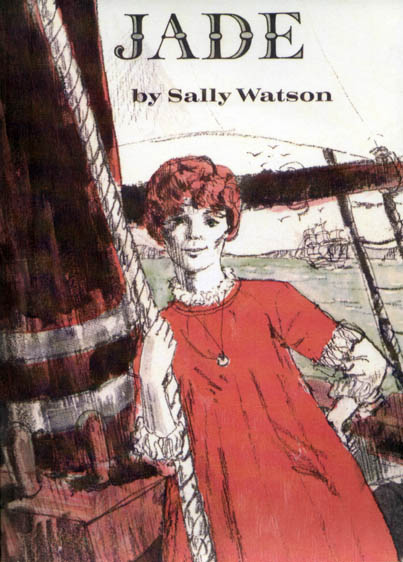
Schoolgirl Choices:jade sally watson

  • The Black Stallion by Walter Farley
  • Big Red by Jim Kjelgaard
  • The Borrowers by Mary Norton
  • Jade by Sally Watson
  • The Ark by Margot Benary-Isbert
  • Little Women by Louisa May Alcott
  • The Secret Garden by Frances Hodgson Burnett
  • The Martian Chronicles by Ray Bradbury
  • A Canticle for Leibowitz by Walter M. Miller, Jr.
  • Claudine at School by Colette
  • The Lord of the Rings by J.R.R. Tolkien (okay, this one makes 11. But how could I not include it? I read it over and over and over.)

Adult Choices:monkey wrench gange edward abbey 1st edition dj

  • The Door Into Summer by Robert A. Heinlein
  • The Monkey Wrench Gang by Edward Abbey
  • Another Roadside Attraction by Tom Robbins
  • Pilgrim’s Inn by Elizabeth Goudge
  • One Pair of Feet by Monica Dickens
  • Gaudy Night by Dorothy L. Sayers
  • I Capture the Castle by Dodie Smith
  • The Good Companions by J.B. Priestley
  • The Lens of the World by R.A. MacAvoy
  • China Court by Rumer Godden

the door into summer robert a heinleinI’m not quite sure what this says about me. Maybe that I’m irretrievably middlebrow in my default reading tastes? With a dash of fondness for fantasy/sci-fi? Not a Russian or a Big Important Book in the lot…

Isn’t it revealing what floats at the top of our consciousness? This feels…dare I say it… rather humbling…none of these are particularly deep or intellectual; most are pop culture standards of their eras. Could it mean that I’m merely….well…average?! In a stuck-in-the-past sort of way – none of the ones on the adult list are particularly current, either. 😉

What about your list? Anyone else want to share?

Write ’em down quick; don’t think about it too hard. Even if you don’t feel inclined to share (I almost didn’t post this) the exercise is revelatory.


Prefacing this sure-to-be-rambling post with this information, for those of you who wonder what I’m actually talking about way down below. As different as can be in time periods and settings, but all at heart clinging to a similar traditional structure, that of the Gothic Romance Novel. The three books under discussion will be:

  • Cousin Kate by Georgette Heyer
  • Tregaron’s Daughter by Madeleine Brent
  • Nine Coaches Waiting by Mary Stewart

All of these are velvety dark, thrillingly romantic (for the most part), highly predictable (ditto), and guiltily enjoyable tales.

Perhaps this won’t be the most sober-minded book discussion, which would indeed be fitting, for these books are not High Literature in any sense of the term, and are therefore free game for a little bit of mild mockery, all in good fun, because I did read them willingly and with general pleasure, though occasionally that pleasure was all about their fulfillment of stereotypical Gothic Romance Scenarios.

I have had recourse to our ever-handy Wikipedia to quickly define the main elements of a proper traditional gothic novel, and by applying the criteria to the books in question we can get a nice overview of how well the authors fulfilled the requirements of this assigned genre.

So, cribbing from the article and adding some of my own descriptive notes to those provided, we generally must have:

  • Virginal Maiden – young, beautiful, pure, innocent, kind, virtuous and sensitive. Usually starts out with a mysterious past, and later discovered that she is the daughter of an aristocratic or noble family.
  • Older, Foolish Woman – who often has charge of or advises the Virginal Maiden, or acts as an Awful Warning due to past errors of judgement, which Virginal Maiden may or may not take into consideration
  • Hero – who may or may not be misrepresented as The Villain for the earlier stages of the plot
  • Tyrant/villain – who may or may not be disguising his (her) True Evil Nature for the earlier stages of the plot. Usually male, occasionally female.
  • The Stupid Servant – acts as comic relief by asking seemingly stupid questions, transitions between scenes, brings news, messenger, moves plot forward. Sometimes takes on form of Humble Social Inferior or Female Friend of Virginal Maiden, well-meaning but ignorant of darker designs of Villain.
  • Ruffians – always under the secret (or not so secret, depending on if he is the Disguised or the Obvious species) control of the Villain
  • Clergy – always weak, usually evil (says Wikipedia, but in more modern gothics I have noticed that the Clergy figure is often absent, being replaced by a Doctor or Lawyer or other Figure of Social Authority, acting under the influence of the Villain)
  • The Setting – The setting of the Gothic Novel is a character in itself. The plot is usually set in a castle, an abbey, a monastery, or some other, usually religious edifice, and it is acknowledged that this building has secrets of its own.
  • And, if I may add to this list, The Secret. There is generally some Great Big Secret which the heroine – er, Virginal Maiden – either sets out to investigate or unwittingly stumbles upon. Sometimes (frequently) The Secret is, of course, that of her own mysterious past.
  • Also added by me: The Forced Marriage. Another common element I’ve noticed in my own perusal of gothics. So many times the heroine faces matrimonial peril, either by being forced to marry the Disguised Hero (who she then realizes she loves in Chapter Ten), or by a Weak Male Character under the control of the Villain, or by the Villain himself.

So, let’s see how these measure up. I’m going to present these in order from my least to most favourite.

Warning: There may well be some significant spoilers here and there, but as the plot twists are all highly predictable by anyone with the least bit of experience with the genre, I doubt if having these confirmed ahead of time will lessen one’s reading pleasure. 😉

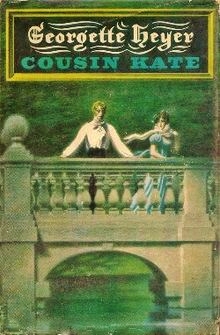
Cousin Kate georgette heyer 1968Cousin Kate by Georgette Heyer ~ 1968. This edition: The Bodley Head, 1968. Hardcover. 318 pages.

My rating: 6/10.

Front flyleaf blurb, Bodley Head edition:

Finding that her youthful appearance and the lack of accomplishments caused by a childhood spent following the drum prevent her from securing a position as governess, Kate Malvern, recently orphaned, gratefully accepts an invitation from her unknown aunt Minerva to make her home at Staplewood, the seat of Sir Timothy Broome, Minerva’s elderly and invalid husband.

On arrival at Staplewood, Kate finds herself in beautiful and luxurious surroundings, and is treated by her aunt with a kindness which is regarded by those best acquainted with Minerva with considerable surprise. At first grateful, Kate gradually becomes uneasy, and with the arrival on the scene of Sir Timothy’s nephew, Mr. Phillip Broome, the plot rapidly thickens. Minerva’s motive for bringing Kate to Staplewood is revealed, and her machinations are brought to a dramatic conclusion.

Okay, let’s see how Cousin Kate does on the Elements of Gothic Fiction scale.

  • Virginal Maiden – check! No secrets as to origin, as Kate is legitimately accepted as a family connection. She is an orphan, reasonably young (24), beautiful (“a flower-like countenance”), appears younger than her age, is sexually pure but well aware of the “facts of life” from her experience as a soldier’s daughter, and is definitely kind and sensitive, though she also fearless and well able to stand up for herself in socially awkward situations.  A most promising heroine.
  • Hero – check! Our Hero turns out to be one of the disguised ones, who operates under a cloud of misunderstanding engineered by the Villain, or, in this case, the Villainess.
  • Villainess – check! No mystery here, though it takes a while to reveal her true nature. It is, of course, suspiciously friendly Aunt Minerva.
  • Humble Social Inferior – Moving the plot along is Kate’s old nurse, Mrs Nidd, who bring’s Kate’s need of succour (she’s just been fired from her first job and has little prospect of finding another due to lack of training or experience) to Aunt Minerva, setting things in motion. Mrs Nidd reappears later in the story to aid Kate in unravelling The Secret.
  • Doctor – weak rather than deliberately evil, and under the complete influence of the Villainess, the Doctor plays here merely a supporting role
  • The Setting – It is 1817, mid-Regency. Most of the action occurs at a stately country home, Staplewood, with Aunt Minerva established at the centre of things controlling all of the domestic strings, and separate wings housing the frail Sir Timothy and the family son and heir, beautiful, erratically-mannered Torquil, who is under the fulltime care of the Doctor, for reasons no one is prepared to elaborate on. Mysteriously locked doors, male screams in the night, random shots being fired, a suicide-worthy lake, a lonely country setting leading to easy isolation of characters not wanted to be out in public circulation by the Villainess.
  • The Secret –  Insanity! Torquil’s. Kate has been tagged by the Villainess to be a suitable wife for her mentally unstable son. She (Kate) is to produce a son and heir to the Broome family fortune, after which Torquil will be put into ever-deeper seclusion as his insanity worsens (the Doctor is quite sure it will), and Kate will be allowed to discreetly seek consolation elsewhere.
  • The Forced Marriage – see The Secret.
  • Great Big Climax – Revelation of Secret! Murder! Suicide! Horror-stricken Virginal Maiden flees to arms of Hero! And once all of the details of The Secret are revealed, a blissful future is embarked upon via Glorious Holy Matrimony between the two who have suffered so many setbacks to the progress of their romance through initial misunderstanding and deliberate machinations of the Villainess, who has now had her ultimate comeuppance.

My verdict: While Cousin Kate had its appeal, and was quite nicely written and full of Heyer’s dependably engaging Regency slang. Kate is a likeable enough heroine, but the whole thing dragged on just too long for my interest to be sustained completely; the plot was desperately predictable, and the whole thing became rather depressing, what with its dependence on a mysterious insanity and the ditherings of all those concerned regarding the proper treatment of the sufferer.

The ending is rather brutal, as Heyer fatally disposes of two of her characters under horrific circumstances. The imagination of this reader was boggled regarding the possibility of a happy future for the heroine and hero with that sort of emotional baggage to deal with.

I rated Cousin Kate at 6 because of Heyer’s competent handling of her setting and the quality of her writing. Some serious themes (position of women/class distinctions/treatment of the mentally ill) were touched upon but never thoroughly examined – not really to be expected in this sort of light novel. But for a light novel it had some desperately dark strands.

Hard to classify, really. I know I said “boring” in the header, and that seems to be my ultimate feeling. Rather flat. Heyer could do much better.

tregaron's daughter madeleine brent 1971 001Tregaron’s Daughter by Madeleine Brent ~ 1971. This edition: Doubleday, 1971. Hardcover. 251 pages.

My rating: 7/10. I bumped it down just a bit because of the inclusion of Young Man with Symptoms of Insanity, a plot strand which I found exceedingly annoying for some reason. (Perhaps because a similar character plays a major role in Heyer’s Cousin Kate?)

Flyleaf says:

Excitement, drama and suspense were only part of Cadi Tregaron’s new life. It had been a sunny afternoon when she glanced from the cliff where she sat reading and saw below her in the sea a sight that would change her life.

Set in England and Italy in 1910, this is the story of a young English girl who by accident starts to unravel the unknown elements in her grandmother’s past and is brought by the mystery to the faraway city of Venice. There, among the gondolas and canals, she slowly comes to comprehend the meaning of two strange and puzzling dreams – dreams that seem to hold the an eerie and menacing prophecy of the future.

Elements of Gothic Fiction included:

  • Virginal Maiden – check! Our heroine, Caterina (Cadi), daughter of a half-Italian mother and sturdy Cornish fisherman father, is young (late teens), beautiful, pure, innocent, kind, virtuous and sensitive. And (spoiler alert!) she does turn out to be the descendent of the Italian nobility. No doubt because of this innate blue blood, our heroine has just naturally developed far beyond the expectations of her humble place in the world. Her language is surprisingly upper class (due to the convenient society of a cultured retired governess in the neighbourhood, who has taken the bright young Cadi under her tutorial wing), and she is fluent in Italian (learned from her grandmother), which comes in handy later. And she starts the story off as a half orphan, mother dead some years (fell off a cliff with grandmother in a tragic accident – sob!) and loses her father as well soon after we enter the story, which precipitates the now-fully-orphaned Cadi into the next stage of her saga.
  • Hero – check! This one is the conflicted type, and is disguised (occasionally deliberately) as a villain. Classically gothic  introduction of hero and heroine involving heroine being pulled up onto horse and forced to cling closely to rock-hard-muscled hero as they gallop to rescue of hero’s uncle who is caught in a dangerous current in his borrowed sailboat. (This is the life-changing thing which Cadi saw from the cliff.) Bonus first-meeting episode: as Cadi, her father, and the hero row out to the rescue, the bodice of Cadi’s dress rips, leaving her lily-white skin exposed in a rather delicate area, and causing the hero to take a deep breath and force his gaze away, manfully resisting the surge of testosterone this incident inspires. Predictably, hero’s taciturn silence is misunderstood by heroine – “He thinks I am below his notice!” Oh, no, darling, that ain’t it.
  • Villain – check!  Disguised variety. Cadi’s Italian relation, Count Chiavelli, who is surprisingly warm and welcoming to the little English chit who is apparently going to bump him from both his title and his fortune – unless, of course, she can be enticed into a marriage with the Count’s weak-natured son – shows another side to his nature as this plan fails to advance.
  • Hero’s Sidekick – not at all stupid, though a slight social inferior, the Sidekick keeps things moving by his unexplained presence at key points of the saga. He is eventually assisted in his efforts by Female Friend of Virginal Maiden, as they join forces to assist Hero in rescue of Virginal Maiden from the Villain’s foul clutches.
  • Ruffians – check! The Villain has a full complement of brutish henchmen, but as bad guys in gothic novels are always slightly slower (and much more stupid) than good guys, these particular ruffians are continually foiled by the Hero, Sidekick and Maiden.
  • Lawyers – These People of Social Authority – we have an English and an Italian version – are in general full of good intentions and quite helpful to Heroine, though they are completely hoodwinked by the Villain. I would like to put forward that a too-trusting lawyer = weakness, so this element is included, albeit in a very minor role.
  • The Forced Marriage – The Virgin is pressured to marry the Villain’s weak-willed son, in order for the Villain to get his hands on the fortune the Virgin is coming in for, and also to keep the title in the family.
  • The Setting – Gorgeous settings, full points for those. We start out in a humble cottage in a little Cornish fishing village – towering sea cliffs above it, treacherous currents swirling offshore – progress to turn-of-the-century London as the heroine is adopted by the beneficent and wealthy family whose patriarch she helped save back in chapter one, and end up in Italy in a gloomy Venetian palazzo, with a final nighttime chase scene by boat through mist-shrouded canals.
  • The Secret – Hmmm, aside from the confusion around the true nature of the Hero-disguised-as-Villain, the only other secret of major import was that Granny was almost murdered by the Villain’s sister, and that honestly came as no surprise, being telegraphed strongly right from chapter one. Young Man with Symptoms of Insanity was also something of an obvious twist, and quite wonderfully similar to the same figure as depicted in Cousin Kate. (Do we need to add him to our list of shared elements?)

My verdict: A better-than-average modern gothic, and an excellent first-novel-in-the-genre by – drumroll! – a male author writing under a female pseudonym.

For “Madeleine Brent” was actually Peter O’Donnell, British mystery novel and comic strip writer, and creator of the pop culture character Modesty Blaise.

O’Donnell’s publisher, Ernest Hecht of Souvenir Press, pleased by the success of O’Donnell’s thrillers, asked his author to try his hand at writing gothics under a female pseudonym. The Madeline Brent novels were a decided success, and Peter O’Donnell eventually wrote nine. All are set in the Victorian or immediately post-Victorian era, and feature young women in exotic locations seeking the truth about their identity. O’Donnell’s authorship was kept secret until after the publication of the last one, Golden Urchin (featuring a Caucasian girl raised in isolation from mainstream society among Australian Aborigines), in 1986.

An interesting side-note, this revelation of the gender of the author, and one which sheds some light on the structure of the Tregaron’s Daughter. Do I dedict a technically-minded male slant in – just one example – the inclusion of the details about construction of gondolas which allow them to be operated from one side by a single person?

Great details in the setting throughout, and the action was well maintained. The plot was (predictably) groaningly predictable, but my interest was held despite the lack of surprises. Good job, Mr. O’Donnell!

nine coaches waiting by mary stewart 1958 001Nine Coaches Waiting by Mary Stewart ~ 1958. This edition: Coronet, 1973. Paperback. ISBN: 0-340-01439-3. 317 pages.

My rating: 10/10. Now this is how you write a gothic! Mary Stewart, after her previous year’s rather dire first attempt, 1957’s Thunder on the Right, pulls up her authorial socks and takes another run at the genre, this time succeeding brilliantly.

Chicago Review Press blurb:

A governess in a French château encounters an apparent plot against her young charge’s life in this unforgettably haunting and beautifully written suspense novel. When lovely Linda Martin first arrives at Château Valmy as an English governess to the nine-year-old Count Philippe de Valmy, the opulence and history surrounding her seems like a wondrous, ecstatic dream. But a palpable terror is crouching in the shadows. Philippe’s uncle, Leon de Valmy, is the epitome of charm, yet dynamic and arrogant—his paralysis little hindrance as he moves noiselessly in his wheelchair from room to room. Only his son Raoul, a handsome, sardonic man who drives himself and his car with equally reckless abandon, seems able to stand up to him. To Linda, Raoul is an enigma—though irresistibly attracted to him, she senses some dark twist in his nature. When an accident deep in the woods nearly kills Linda’s innocent charge, she begins to wonder if someone has deadly plans for the young count.

Applying the Gothic Fiction checklist yields some promising results:

  • Virginal Maiden – Check! Our heroine Linda is indeed young, beautiful, pure, innocent, kind, virtuous and sensitive. And orphaned, too, which should really be one of the traits listed alongside young, beautiful, etc. etc. etc. No mysterious past, unless one counts Linda’s own concealment of her French heritage in order to pass for a strictly-English governess as required by her new employer.
  • Older Woman – Check! Elegant Madame de Valmy, who acts as an extra set of eyes and legs for her wheelchair-bound spouse, brings Linda into the household and complicates the plot by her alternating moments of warm we’re-all-women-here-together friendliness and cold putting-the-help-in-her-place slap-downs to our heroine.
  • Hero – Check! We actually have a choice of two Heroes, either or both possibly of the disguised variety, and in the interests of not spoiling the ending for those of you who haven’t read this, I will not say any more. Just that both are perfectly perfect for their chosen roles, and I was up in the air guessing as to which one was going to be the ultimate winner of the lovely Linda’s heart.
  • Villain – Check! The debauched old nobleman now confined to his wheelchair, of course. And he is masterful at disguising his True Evil Nature, though our heroine catches a disturbing gleam in his eye when he looks at his hapless nephew, the young Heir to the Family Fortune who has tied up the riches which the Villain would like to further his own ambitions.
  • The Servants – Linda finds herself associating with several useful servant-figures who fill her in on all the gossip and aid in her attempts to discover why her young charge, The Endangered Heir, is having so many close brushes with death. We have a chatty English housekeeper, who came to France some decades ago, and a sprightly local maid who has rather tragically (but usefully, as he drops some hints which can then be related to the heroine) fallen in love with the Wicked Henchman.
  • Wicked Henchman – One is indeed in residence, and he is secretly under the control of the Villain.
  • The Setting –  Time: The early 1950s. Place: A vast French château, isolated from all neighbours and tucked away in its own private forest among the craggy hills of the High Savoy in France. A steep, narrow, twisting road leads to the château, ideal for those sorts of engineered “accidents” where one’s automobile brakes unexpectedly fail, or where a pedestrian can be “inadvertently” run down on a one-lane bridge over a rushing torrent.
  • The Secret – How far will someone go out of personal and family pride, and for love for a piece of land?

This is one of the very best of Mary Stewart’s romantic suspense novels. Decidedly well written, with abundant clever humour, and an ongoing literary thread as revealed in the title, for the Nine Coaches Waiting reference comes from a rather obscure Renaissance play by Cyril Tourneur, The Revenger’s Tragedy, in which a poor but pure and beautiful young woman is tempted with the luxuries of palace life to yield up her virtue.

The parallels between the Tourneur scenario and the Mary Stewart gothic are not particularly apt, but as a poet’s daughter herself (did I mention that bit? – I don’t think I did) our heroine in the novel is of course a highly imaginative (and literate) type, and the snippets of the play included by Mary Stewart are most intriguing and set the mood of rushed passion and moral unease very well indeed.

Oh, think upon the pleasure of the palace!
Secured ease and state! The stirring meats
Ready to move out of the dishes, that e’en now
Quicken when they are eaten…
Banquets abroad by torchlight! music! sports!
Nine coaches waiting – hurry – hurry – hurry –
Ay, to the devil…

My verdict: Hands down, Nine Coaches Waiting was the best of these three novels, but they all had their moments, and are all nice diversions for those times when one doesn’t want to think too hard, and wishes to recapture those long-ago (for many of us – I know a number of my regular readers are my generational compatriots) days of teenage summer reading, wrapped up in these darkly sensuous – but really quite chaste, kisses being as far as our heroines go – gloriously suspenseful, absolutely predictable romances.

(Ha! Grammar police, sort out that last paragraph. I dare you! It boggles me, rather, but I will let it stand, as a challenge to those of you who would perhaps like to dissect it and see of it actually works.) 😉

Queen Anne's Lace - end of summer - two years ago at White Rock, B.C.

Queen Anne’s Lace – end of summer – two years ago at White Rock Beach, B.C. Seems like that particular road trip happened only just yesterday… insert desired cliché about the ever-more-swift passage of time here…only four more months of this particular year left now – where did it go?!


This second completed decade in my 2014 Century of Books Project consists of books which are, predictably because of the era, either directly concerned with World War II, or refer to it as an off-stage plot element. Only two make no reference to it at all, namely Edgar Rice Burroughs’ The Deputy Sheriff of Comanche County (published in 1940 as pulp magazine serial – pure entertainment), and Miles Franklin’s My Career Goes Bung (written several decades before its 1946 publication.)

There were so many books to choose from in reading for this decade; the difficulty was not in finding likely candidates but in deciding which ones to set aside. As it is I have doubled up (and in some cases tripled and quadrupled) on many of the years; I have had to say firmly to myself: “No more!”

Digression alert! Regarding the ratings out of 10 – these are merely a reflection of my personal response to what I am reading, and how satisfying an experience it turns out to be for me. The ratings in no way represent “literary merit”, for Hugh Walpole’s novel The Blind Man’s House, rated below at 5.5, is decidedly superior in every literary sense to D.E. Stevenson’s The English Air (9) and Crooked Adam (6.5). But I expected more from Walpole, and his relatively lesser rating means merely that I didn’t feel that my readerly desires were fully satisfied compared to how well they they could have been from a writer of his calibre. Not meaning to pick on Hugh Walpole, and to audaciously celebrate D.E. Stevenson – merely using them for examples as they are handily first on the list.

Now we may proceed. 🙂

I’ve again highlighted a few as worthy of extra notice – scroll down to the bottom for another award lists.

???????????????????????????????

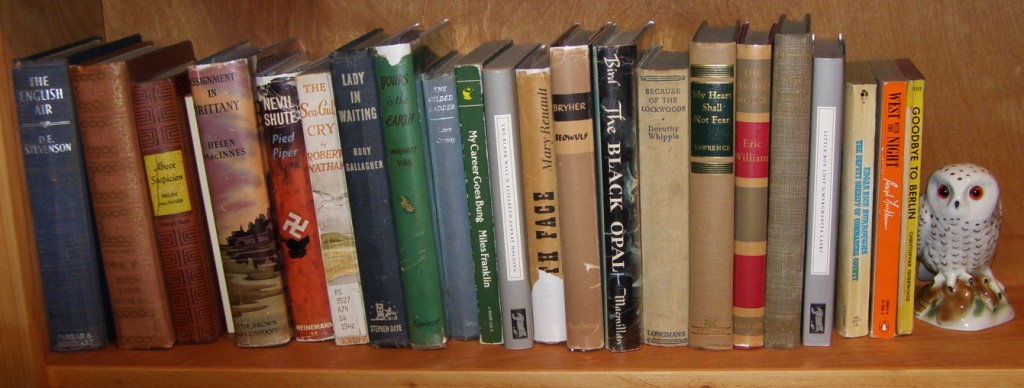
And here they are, in their (mostly) tattered and well-read glory.

1940 ~ The English Air by D.E. Stevenson ~ A half-German, half-English young man visits England in the year before the start of World War II. Is his visit strictly social, or something more sinister? A rather low-key storyline compared to 1942’s super-dramatic Crooked Adam, but quite lovely in its character portraits. (9/10)

1941 ~ The Blind Man’s House by Hugh Walpole ~ A complex psychological drama concerning the effects of the blindness of  Sir Julius Cromwell on his wife, his friend, and the many characters who make up the Cromwell household and social circle. I thought it reminiscent of Lady Chatterley’s Lover, though – I hasten to add – without the “John Thomas” scenes. Walpole’s Ladyship doesn’t indulge in such extra-marital escapades. (5.5/10)

1942 ~ Crooked Adam by D.E. Stevenson ~ Schoolmaster Adam Southey, refused entry into the Services due to a childhood injury, instead proves his patriotism by chasing down Nazi spies in the wilds of Scotland. Highly contrived, and hugely unlikely, but a good example of a “Hurray for our side!” wartime entertainment. (6.5/10)

1943 ~ Lady in Waiting by Rory Gallagher ~ A frothy and light satire about an upper-middle-class American pregnancy, with few of the details spared. Vintage Mommy-Lit, in other words, and really rather fun in its own way, though the relentlessly chirpy voice of the narrator occasionally has me wanting to (temporarily, not fatally) smother her with one of her voluminous pregnancy smocks. (6.5/10)

1944 ~ Yours is the Earth by Margaret Vail ~ Non-fiction/personal account. A sober yet impassioned personal account of an American woman’s wartime experience in France. Married to a member of the French upper class and left alone to care for their young daughter and the family estates when he is interned by the German forces, Margaret must decide for herself how to proceed, which she does with steadfast resolve and an immense contempt for the enemy race. (10/10)

1945 ~ The Gilded Ladder by Laura Conway ~ A formulaic historical fiction/domestic drama about a social climbing Victorian and her musically adept young niece. By the prolific author Dorothy Phoebe Ansle, who published 100 novels between the 1920s and 1980s, under various pseudonyms including Laura Conway and Hebe Elsna. Well-written for its genre but ultimately forgettable. (5/10)

1946 ~ My Career Goes Bung by Miles Franklin ~ Another version of My Brilliant Career’s Sybylla rants against the misunderstanding her teenage bestseller has attracted, as she finds her way into and out of Sydney literary society. Published several decades after its completion, and a bit dated in its references, but nonetheless a diverting read with a gloriously full-of-herself heroine. (9/10)

1947 ~ The Blank Wall by Elisabeth Sanxay Holding ~ A cleanly written noir novel centered on a devoted mother’s protection of her teenage daughter from a blackmailer after an inconvenient man turns up very dead. (9.5/10)

1948 ~ North Face by Mary Renault ~ A gloomy post-World War II novel concerning the emotional traumas of Neil and Ellen, and their coming to terms with their tragic pasts and gleam-of-hope futures. A rock climbing theme prevails, all Freudian and symbolic. (6/10)

1949 ~ The Wooden Horse by Eric Williams ~ Non-fiction/personal account. A clever and dangerous escape from Stalag Luft III is described by one of the participants. Enthralling! (8.5/10)

And the “bonus” books:

1940 ~ The Deputy Sheriff of Comanche County by Edgar Rice Burroughs ~ The epitome of pulp “western” fiction, by the creator of the immortal Tarzan. Wrongly accused of the murder of his romantic interest’s father, rancher/deputy sheriff Buck Mason seeks the real killer while visiting a dude ranch disguised as an Eastern polo player. He sorts everything out, nails the real villains, and finds true love. Did we ever doubt the outcome?! (4/10)

1941 ~ Above Suspicion by Helen MacInnes ~ An Oxford don and his wife undertake a secret spying mission in Europe as the clouds of war gather overhead. (8.5/10)

1942 ~ Assignment in Brittany by Helen MacInnes ~ An English officer is sent to Brittany on a spying mission, with the lucky coincidence of being able to masquerade as a convenient double who was evacuated to England at Dunkirk. Much drama and a fair bit of bloodshed. (9/10)

1942 ~ Pied Piper by Nevil Shute ~ Shute’s fast-moving and exceedingly likeable propaganda novel, starring a stoic elderly Englishman rescuing an eclectic group of endangered children from Nazi-occupied France in the early years of World War II. Not very believable, perhaps, but a good yarn nonetheless. (9.5/10)

1942 ~ The Sea-Gull Cry by Robert Nathan ~ An über-light novella concerning a winsome pair of Anglo-Polish war refugees shoehorned into a dreadfully upbeat formula romance between the eldest sibling, 19-year-old Louisa, and a middle-aged history professor, Smith. The 7-year-old brother Jeri provides cuteness and pathos. (3/10)

1942 ~ West with the Night by Beryl Markham ~ A slightly uneven but overall excellent memoir telling of the author’s youth in Africa and her experiences training racehorses and later learning to fly small planes. Beryl eventually became the first person to solo-fly the Atlantic from East to West. An amazing woman; a very readable personal account of her earlier days. (9.5/10)

1945 ~ Goodbye to Berlin by Christopher Isherwood ~ A series of linked episodes gleaned from Isherwood’s own experiences in mid-wars Berlin, 1930-33. Utterly chilling from our historical perspective; utterly fascinating for the character portraits the author produces. This is the “I am a camera book”, and one of those character portraits is off the now-ubiquitous Sally Bowles. (Made famous by Liza Minnelli, and now a staple turn in every small town triple-threat dreamer’s stage-struck repertoire.) (10/10)

 1946 ~ The Sudden Guest by Christopher La Farge ~ A bitter, deeply egotistical elderly woman copes with a rising hurricane at her Rhode Island summer home and mulls over the differences between now and the last great storm only a few years earlier. Perhaps a metaphor for American and her stance regarding world politics of the time? (7/10)

 1948 ~ Beowulf by Bryher (Annie Winifred Ellerman) ~ A London teashop in the Blitz is at the heart of this linked series of vignettes and character portraits. This is fantastic, in a beautifully subfusc way. A writer to explore further. (9.5/10)

1949 ~ The Black Opal by Dorothy Maywood Bird ~ A sweetly charming period piece aimed at the teen girl set of its day. Laurel heads off to co-ed college and mixes her studies with a full social life, the acquisition of a beau, and the solving of an old murder mystery. Pure fluff; great fun! (6/10)

1949 ~ Because of the Lockwoods by Dorothy Whipple ~ The tale of two families and their unequal relationship, due in large part to a secret wrong perpetrated by the father of one family upon the widowed mother of the other. (9/10)

1949 ~ Little Boy Lost by Marghanita Laski ~ Verging just the tiniest bit on bathos is this suspenseful tale of an English officer returning to France immediately after the end of WW II to seek for the little boy he saw only once as a newborn baby, child of a tragically brief wartime marriage with a French Resistance worker. (7.5/10)

1949 ~ My Heart Shall Not Fear by Josephine Lawrence ~ A complicated domestic drama following a number of characters through times of challenge in post-World War II America. Domesticity and the roles of women are key features here. The writing is nothing special, but acceptable; the plot has moments of interest but the author tends to over-emphasize her key points, driving them home with a sledgehammer – a certain lack of finesse. (5/10)

 Most Beautiful Writing Award:

  1. West with the Night by Beryl Markham ~ 1942
  2. Goodbye to Berlin by Christopher Isherwood  ~ 1945

Marshmallow Award (for purest fluff):

  1. The Deputy Sheriff of Comanche County by Edgar Rice Burroughs ~ 1940
  2. The Black Opal by Dorothy Maywood Bird ~ 1949
  3. Lady in Waiting by Rory Gallagher ~ 1943

Don’t-Expect-Many-Smiles Award:

  1. The Sudden Guest by Christopher La Farge  ~ 1946
  2. The Blank Wall by Elisabeth Sanxay Holding ~ 1947
  3. North Face by Mary Renault ~ 1948

Sturdy British Manhood (Fictional) Award:

  1. Crooked Adam by D.E. Stevenson ~ 1942

Karma-is-Grand Award:

  1. Because of the Lockwoods by Dorothy Whipple ~ 1949

Waste-of-Precious-Reading-Time Award:

  1. The Sea-Gull Cry by Robert Nathan  ~ 1942