2-an-aspidistra-in-babylon-h-e-bates-1960An Aspidistra in Babylon by H.E. Bates ~ 1960. This edition: Penguin, 1964. Paperback. 191 pages.
My rating: 9/10.

This man could write. His stories read absolutely effortlessly.

So, what have we here, behind that curious title?

Four brief novellas, all about – universal theme! – the human desire to be loved. And, very much to the point in these four tales, the human tendency to allow that desire to cloud one’s better judgement.

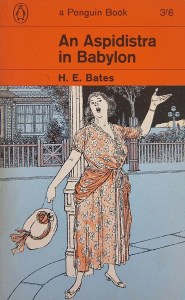
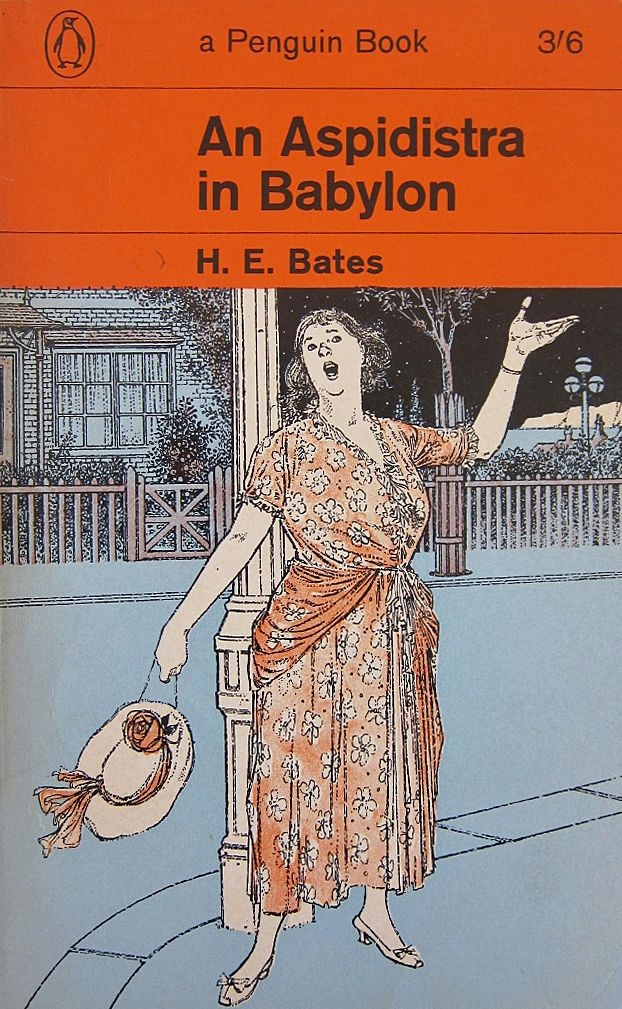
The cover drawing by Robin Jacques rewards closer examination; the background detail utterly accurate of its time and place, an English seaside garrison/resort of the 1920s. Note the white chalk cliffs, upper right. It both intrigues and misleads with its depiction of the singing woman, blowsily out on the town.  She’s actually a side character of the title novella, a casually promiscuous hotel chambermaid who serves to rescue the “real” heroine from her youthful folly.

Occasionally this collection is touted as “comic” by booksellers who haven’t actually read the works within, for though not without a delicate balance of ironic humour, these are not funny stories in the accepted sense.

Prosaically tragic might be a better description, as long as it doesn’t put you off reading them. (Well, they’re not all tragic; some do come out on the optimistic side.)

Paradoxically, I myself find Bates’ sometimes-dark scenarios rather comforting, pointing out as they do that all of us are emotionally fallible in certain circumstances, and that most of us survive our lapses, coming out the other side older in spirit but wiser in mind, to alter an appropriate cliché.

The first two novellas are the best, in my opinion, but all four are worth reading for the sheer pleasure of how H.E. Bates puts together his words. He is very strong on description, something which I thoroughly enjoy, but which may be a bit of a deterrent to those of you with no patience for detailed scene setting. Give these a go anyway, I say.

An Aspidistra in Babylon

An eighteen-year-old girl lives with her widowed mother in the boarding house they keep in a small coastal city. The nearby cliffs house a large army garrison; the constant ebb and flow and of soldiers, sailors on shore leave, and their hangers-on and followers leads Christine’s mother to shudderingly label the place as “Babylon”, and she warns her as-yet naïve daughter against it.

Christine herself finds the warning unnecessary, for she hasn’t yet had any meaningful encounters with the roistering Babylonians.

As to the men, the soldiers and all the rest, I simply didn’t exist for them. This is not entirely surprising, however, since I was clearly infinitely and terribly dull myself. The best description of myself that I can think of is to say that I was as dull as one of the many aspidistras that cluttered up the rooms, the hallway and even the dining-tables of our little boarding-house. I was just that – a female aspidistra and nothing more.

A female aspidistra, perhaps, but one with a luscious body under those shapeless frocks and black woolen stockings. A body which catches the eye of the dissolute Captain Blaine, who shows up on the doorstep in quest of a room for his wealthy aunt, and gazes upon Christine’s hidden charms with an experienced and lascivious eye. Not only her virginity but her very moral sense is soon to be in danger of worldly corruption…

A Month by the Lake

Holiday makers staying at an Italian lake resort mingle peacefully, middle-aged but still active and attractive Miss Bentley finding herself mildly drawn to slightly older, determinedly suave, and rather handsome Major Wilshaw.

To Miss Bentley the most remarkable feature about Major Wilshaw were his small flat pink ears. They were not only exceptionally small for a man who was thickish, upright, and rather tall. They were very delicately, very intricately fashioned. Nothing in the entire human body, Miss Bentley would tell herself, had quite the same fascinating quality as ears. All the attraction of mood and response and character and emotion lay, of course, in the mouth and eyes: everybody knew that. But ears were, Miss Bentley thought, far more wonderful. Ears were unchanging and undying. They remained, in some strange way, uncoarsened, undepraved, unwrinkled and unaged by time. In the ears of the aged you could see the flesh of youth; in a sense they were immortal and never grew old.

Major Wilshaw isn’t particularly taken with Miss Bentley in a sexual sort of way. Though he enjoys her company and her tart turn of phrase, he considers her past her prime, decidedly on the shelf, whereas he is still very much in the romantic running.

When a young English governess enters the picture, very cool and collected and confident in her sexual powers, an unexpected and silent rivalry erupts between the two women. Major Wilshaw, suddenly very aware of the very different qualities of each, turns first this way and then that.

Which will prove the strongest draw? Warmly ripe age? Cooly beautiful youth?

And do either of the woman actually want Major Wilshaw, or is he merely symbolic in his maleness of the prize which society insists all women are incomplete without?

A Prospect of Orchards

Many years ago I belonged to a young men’s club where I used to play chess, read magazines and also box quite frequently, though not very seriously, with a man named Arthur Templeton. We must have been, I think, eighteen or nineteen at the time.

Templeton was a shortish leaden-footed man with weak brown eyes whose responses were those of a duck with its legs tied. His jaw was babyish, smooth and hairless, like a pale pink egg. I had taken up boxing because once, at school, in a playful scuffle, a young ox of a farmer’s son had struck me on the chest with a blow of such short-armed ferocity that I was convinced my heart had stopped beating. Soon afterwards I found a friendly ex-policeman who gave me lessons, taught me that the essential art of the game lay in footwork and in a maxim of six short words: hit, stop, jab, and get away. Presently I was practising these principles on Arthur Templeton, to whose pink hairless jaw I sent so many unresisted straight lefts that it became intolerably embarrassing – so embarrassing indeed that I presently became profoundly sorry for him and gave up boxing altogether.

Losing track of Templeton as life goes on, the narrator is surprised to run into him on a train many years later.

Templeton is still of a pale pink unresisting type. He now gentleman-farms in a haphazard sort of way, raising pigs and attempting to create a new kind of pear-like apple, while his bossy wife Valerie is the loud leader of the local arts community, going in for amateur orchestras and the like.

As the narrator observes the Templeton ménage through a number of visits, his sympathy for his long-ago boxing partner grows as he realizes the man’s deep loneliness. He watches as a second woman now enters Arthur Templeton’s life. For a while it looks as though the feeble striver will at last take a step forward in confidence, and, presumably, happiness.

But can anyone ever change how one’s fundamental psychology, and what type of lover one attracts?

The Grapes of Paradise

On leave from his Vancouver banking firm, Harry Rockley travels the South Pacific, fetching up at Tahiti, which immediately repels him with its unexpectedly grim and sordid industrial decay, and its hostile natural features.

(H)e went back to the hotel, stripped off, put on his swimming trunks and went down to the sea. The beach of
black sand, such as there was of it, looked like a foundry yard. The lagoon of black water illuminated by the flares of mysterious midnight fishing-boats had become a stretch of tidal junk-yard, one foot deep, filled with countless black clusters of sea-birds and lengths of what looked like yellow intestine.

At the end of fifty yards of jetty  sprouted a lump of coral rock. On the rock a French girl with a figure as flat as a boy’s and legs like white peeled sticks sat staring down into forty feet of dark blue water from which rose shadowy mountains of rust-brown coral, murderous as steel.

‘I’m glad you came,’ she said. ‘If there’s someone watching, the sharks don’t follow me.’

Harry decides against swimming, and returns to the hotel bar, where he starts drinking, and doesn’t stop for weeks, until on a whim he tags along on a schooner travelling to a nearby island. There he finds something more closely approximating the South Seas paradise of his former expectations, including a single-minded native girl who throws herself at him in wanton desire.

But love isn’t always reciprocated, and shunned would-be lovers may prove dangerous to trifle with, especially when the elemental sea and its creatures become part of the set of Harry’s idyll-turned-nightmare…

*******

Oh, yes. Here's a little bonus for those of you who, like me, were a bit hazy on what the heck an aspidistra actually looks like. I suspect they are still very much around, but I couldn't pull up a mental picture to go with the name. Now I can.

Oh, yes. Here’s a little bonus for those of you who, like me, were a bit hazy on what the heck an aspidistra actually looks like. I suspect they are still very much around, but I couldn’t pull up a mental picture to go with the name. So there we are!

 

the-swordsman-william-c-heine-2The Swordsman by William C. Heine ~ 1980. Alternate title: Sea Lord. This edition: McClelland and Stewart, 1980. Paperback. ISBN: 0-7704-1570-9. 246 pages.

My rating: 2/10

Boo, hiss.

Yes, my dears, this is a deeply baaaaad novel.

So why (I am sure you are asking yourselves) did I read it?

Good question.

And to answer it I must refer you back to this little episode from 2015: .

So, if you followed that link, you will notice mention way down in the comments of William C. Heine’s second (and, small mercy, last) novel, The Swordsman/Sea Lord, which fellow Canadian reader-of-eclectica Brian Busby and I have been discussing tackling for the past year or so. He pulled it off first, and has just posted his own bang-on review, so I’ve had to follow through with my own promise to read the thing as well.

I did, and I conquered it, and I’m now feeling a little bit dirty all over, because it was a nastyish piece of work from one end to the other. And just as stupid as The Last Canadian. Unexpectedly boring, too, because one became hardened to the unlikely sex and gruesome violence early on, and soon came to view the continual bedding and blood-letting with an increasingly jaded eye.

I’m going to pass you over to Brian for a bit: The Sea Lord Unsheathes His Sword.

Got that? Good. I can therefore be brief in my own précis, without having to include any excerpts. (Thank you, Brian.)

We meet our hero Merand as he nearly succumbs to an assassin’s knife in a back alley in old Tyre. Oh, what the heck, here’s an excerpt. It gives a telling sample of Heine’s deeply pedestrian writing style.

Merand soon gained consciousness, but couldn’t shout for help; he was choking on a warm salty liquid he recognized vaguely as his own blood. He crawled, coughing blood, to the nearest door and hit it with his fist before collapsing. The slave who answered took one frightened look and called for his master. The two men dragged Merand to an inner room and lit a candle.

As the blood coagulated in Merand’s lungs, the worst of his coughing and choking stopped. He managed to tell the two men he was a slave of Tehemil, Tyre’s builder of ships. They exchanged glances over the wounded man’s body…

I always thought that once the blood coagulated in your lungs you pretty well stopped breathing, but hey! – Heine’s reality isn’t ours, so there you go.

So Merand is soon up and about, working for his rescuer, a Jewish ironworker with a gorgeous daughter. Merand instantly forms lustful designs upon her as she leans over his bed-of-pain, and, once recovered, he seduces and then marries her, either before or after he receives his freedom from the local ruler. (Some details are a merciful blur.)

There is a long flashback, describing how Merand learned to read, write, murder those who annoy him, stash himself some stolen gold, and become a master ship designer, in between sleeping with a fellow slave girl, and sacrificing his first-born child to Baal in a much-too-detailed episode describing how the wee infant is tipped into the fire to be burned alive. Apparently (in Heine’s version of history), it was mandated that every family’s firstborn be so sacrificed in Olde Tyre. Huh. Who knew?

Moving on.

Merand falls in love with a sword his new master has forged for a disgraced prince. He acquires it, learns to become a stellar swordsman, travels about gaining stunning riches, takes on a beautiful red-headed mistress (because his wife is always pregnant and a man has needs, you know), and eventually sails off into the really wild blue yonder, right across the Atlantic, it appears, fetching up on the shores of South America, where he is welcomed as a god by the local ruler and subsequently given the chief princess as a reward for being big and blonde.

Small digression into vivid descriptions of Heine’s version of Mayan (Aztec? Toltec?) human sacrifice.

Back to the old country goes Merand, lots of gold and doomed-to-die-in-childbirth new babe in tow, where he finds he is persona non grata with the king for various reasons, so he packs up his household, faithful wife Naomi still in the picture, plus Jewish father-in-law, and various offspring by assorted partners (Merand’s), and sets sail back to South America.

The end. With an epilogue describing the imaginary discovery of Merand’s tomb, complete with detailed carvings depicting his adventures, which is how we know the whole story.

Sure.

I truly believe that regrettable books like this only exist to provide a contrast to well written things.

Kind of like never truly appreciating the sun until you’ve had rain for weeks on end. Or how good a simple green salad tastes after having had to subsist on corner store deep-fried thingamajigs for a week or two. (That last bit being strictly imaginary, based on occasional exposure to the scary 7-11 food display when fuelling up late at night when it’s the only gas station open.)

Where am I going with this?

Nowhere, really, so I’ll quit.

William C. Heine: avoid like the plague. (Or a large, blood-dabbled swordsman wearing a skimpy loincloth over a suspicious bulge. Run away!)


Here’s another entry for The 1947 Club. This one doesn’t give any sort of portrait of the year, being strictly inventive historical fiction, but it does have a telling author’s note which serves to highlight the difficulties of the researching writer during wartime.

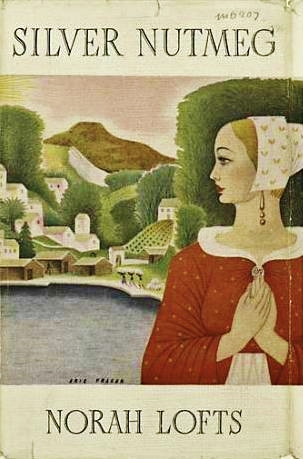
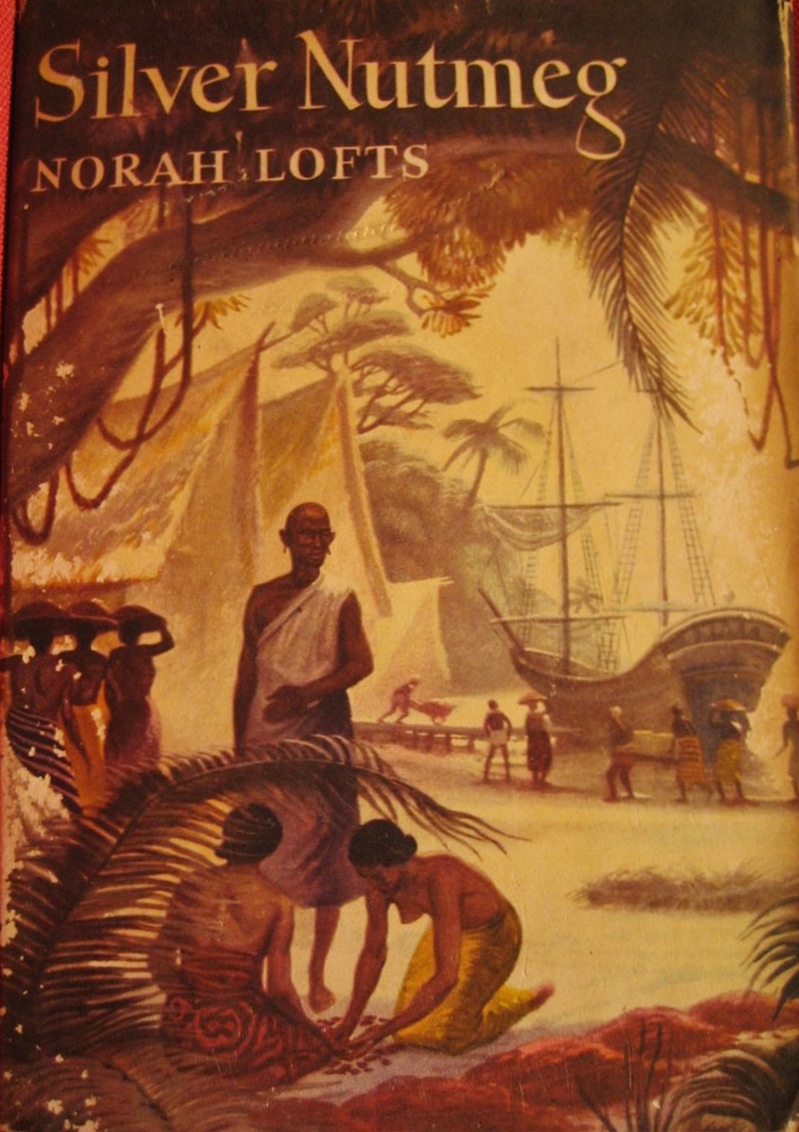
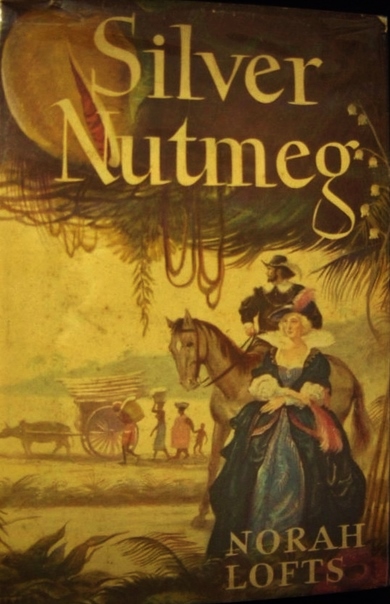
silver-nutmeg-norah-lofts-1947From Norah Lofts:

Apology and Acknowledgement

The irresistible desire to write a book about the nutmeg island of Banda came upon me when I was reading H.W. Ponder’s book, In Javanese Waters. There, in one short chapter, was outlined a romantic, bloodstained history that called for exploration. But, like all exploration, it presented great difficulties. The Dutch East Indies were in Japanese hands, all contact broken; Banda itself is no more than a speck, the size of a fly dirt on the map; no book that came my way gave any idea of the island’s layout. So my geography is the geography of the imagination.

Silver Nutmeg by Norah Lofts ~ 1947. This edition: Doubleday, 1947. Hardcover. 368 pages.

My rating: 4/10

Some centuries ago, in the 1600s, shrewdly businesslike and sensibly adventurous Dutch merchants sailed the southern seas, creating trading empires for themselves in direct competition with their British counterparts. One area both factions set their sights on was the group of tiny island just off Indonesia, on one of which, Banda, grew the world’s only known population of nutmeg trees.

The Dutch having attained possession of the nutmeg isle, they jealously guarded their monopoly.  Spice trading being a big deal way back then, the export of fertile nuts or tree seedlings was strictly prohibited, transgression being punishable by imprisonment or worse. Needless to say, some of the Dutch spice plantation owners became fabulously wealthy, and herein lies the nucleus of this absolutely over written story.

(There will now be spoilers galore.)

Look, a pretty little Dutch girl!

A nice Dutch girl of good family. (Don’t do it, Annabet!)

Two Dutch half brothers, one a wealthy nutmeg plantation owner (Evert), the other a moderately successful sea-captain (Piet), meet on Banda after many years apart.

Says Evert to Piet, “Oh, dear half-brother, good to see you and everything, though we were never very close as children, my mom hating yours and all. Never mind all that, for I am now fantastically wealthy and have progressed  so far from our shared childhood as middle class nobodies in Holland. All I need now is a lovely wife to grace my fabulous house. A nice Dutch girl of good family, preferably aristocratic, so I can rub it in to those back home how far I’ve come.”

Says Piet to Evert, “Hey, what about one of the daughters of the Van Goen family? They used to be so high and mighty, scorning our family as not worthy of notice, but they’ve now gone bankrupt. I’ll bet they’d be willing to marry off one of their daughters if one flashed a few guilders their way. Annabet’s a good looker, just seventeen and blond and lovely…”

“Oh, ho!” says Evert. “Just what I’m looking for. Dear half-brother, how about you take this casket of jewels and gold and head back to Holland to convince Mama van Goens to part with her daughter in return for the fixings? You can go ahead and arrange a marriage by proxy for me, and then arrange to ship me my luscious bride.”

Done.

Small problem, however. Lovely Annabet has suffered an illness and is now no longer the beauty she once was, being emaciated and scraggly. Ah, well, the long sea voyage should put her right.

Nope.

Shal Ahmi, keeping an eye on things. (Cue foreboding music.)

Shal Ahmi, lurking about keeping an eye on things. (Cue foreboding music.)

Though Annabet proves to have a winning way about her, enslaving other men’s hearts after just a few moments of conversation despite her hideous appearance, proud Evert is instantly appalled. Calling up his pet native fixer, the shady Shal Ahmi, Evert hints that he’d be thrilled if his new wife could be eliminated from the picture.

“No worries”, says Shal Ami. “I’ll get rid of your problem.”

Which he does, by using his many connections to have Annabet massaged and herbal-cured back to her original beauty.

Evert comes home, expecting to find his marriage bed empty, all ready to start anew, and instead finding a tempting beauty in residence. “Oh, wow! My luck is in”, he gloats.

Not so fast, Evert-me-lad. For Annabet has given her heart away to another, and not just any another, but the rogue Englishman who is Evert and Shal Ahmi’s partner in a highly secret nutmeg smuggling scheme.

So that’s the set-up.

xx

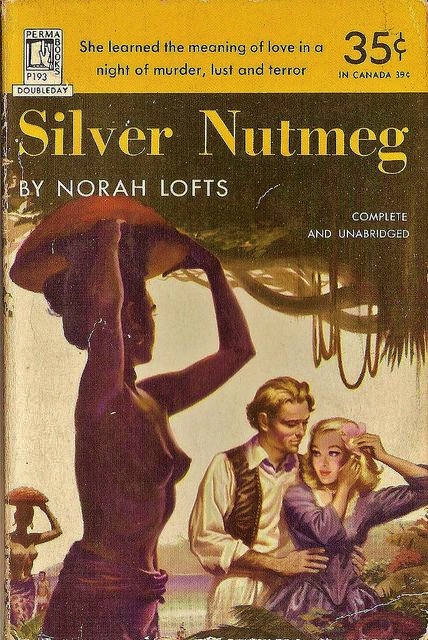
“She learned the meaning of love in a night of murder, lust and terror.” Not quite sure if the possessively groping guy is husband Evert or lover what’s-his-name. That’s quite the foreground image, isn’t it?! Reminds me that I never mentioned the native mistress thing.

It goes on for 368 long, long pages, of heart-wringings and bodice heavings, and sullen scenes, and bitter revenge scenarios, culminating in a bloody native rebellion led by Shal Ahmi, which results in the nasty demises of every single one of the key players, except Piet (remember him?) who sails into the Banda harbour just as Annabet is breathing her last after being knifed by one of Shal Ahmi’s disciples, just after she herself has done in Shal Ahmi with a handily wielded wine bottle.

Husband Evert is also messily dead, as is, presumably, the true love Englishman. (“True love”, though Annabet only actually saw him for a few hours total, with a single stolen kiss their only amorous memory) Can’t remember his name. Maybe it was John? Something like that. He’s offstage for 99.9 percent of the saga, living mostly in Annabet’s head, so we never really get to know him in person.

Norah Lofts could be and frequently was a very good writer, and I find her stuff generally quite entertaining – she had a lovely dark sense of humour and indulged in it on numerous occasions – but this book isn’t one of her winners. On the contrary, it’s truly crappy, because the love stuff is so darned unrealistic that I just couldn’t get my head around it – first sight this, first sight that, unlikely ailments miraculously cured – bah, humbug! – and the historical part is just barely sketched in.

(For those really wish to know, a bit about the real world Banda and the nutmeg trade. It’s truly interesting; I can see why Norah Lofts was intrigued.)

Let’s blame it on the war, and move along, shall we?

Silver Nutmeg had okay sales, most likely (I’m assuming) due to Lofts’ prior bestsellers, in particular Jassy (1944), a very dark, gorgeously crafted gothic-ish novel which does make the cut as far as this reader is concerned. From Kirkus, 1945, with the spoilers removed:

Once again, an experienced period romance as the story of Jassy who lived and loved too much, and was xxxxxx for it in the 19th century, is related by four who knew her. Half gypsy, with an ugly-beautiful fascination, an ungovernable temper, and the gift of second sight, Jassy is first recorded by Barney Heaton, the boy next door; next by a Mrs. Twysdale whose young ladies’ school was to be disrupted by Jassy; next by Dilys Helmar, her friend at that school, who took Jassy home with her to the ruined estate – Mortiboys – and to her amorous, wine-sodden father, Nick… (Lots of plot details removed here.) …Intricately contrived imbroglio, elemental passions for a story that keeps one reading. In the Lady Eleanor Smith tradition.

I’ve also just found a rather lovely post by author Katharine Edgar on  Norah Lofts and Why You Should Read Her which I really liked because it pinned down Lofts’ peculiarly unique style most cleverly: The Queen of Gritty, Dark, Agricultural Histfic With Lots And Lots Of Murders.

Yup.

I concur.

I’m pro-Lofts in general, despite the times I want to pitch her books across the room, but I must say you can safely give Silver Nutmeg a miss.

But please do find yourself a copy of Jassy. It’s very available. A candidate for fireside reading these gloomy autumn evenings, with the dead leaves rustling in the cold wind outside…

the-1947-clubI’m notoriously not much of a joiner, here in blog-world as much as in my introverted real life, but I do make exceptions from time to time, especially when the thing-to-be-joined is so interesting as this.

The 1947 Club is the third year-specific “read-in” which Simon and Karen have hosted; previous years featured were 1924 and 1938. The idea is to read and post about writing published during the year, and by doing so sharing a glimpse at what was being read and talked about at the time.

The resulting assortment of books read and reviewed is wonderfully varied, and does indeed paint a literary portrait of a year. It is rather fascinating to see which books are still very much in circulation and in public awareness. Others are rather more obscure; some were never particularly successful; some are bestsellers which have fallen into obscurity.

Deciding at last minute to jump into the project, I looked over my shelves and happily found a number of likely prospects. Here is the first.

gentlemans-agreement-1947-laura-z-hobson-001Gentleman’s Agreement by Laura Z. Hobson ~ 1947. This edition: Simon and Shuster, 1947. (First edition, third printing.) Hardcover. 275 pages.

My rating: 6/10

Serialized in Cosmopolitan in 1946, Laura Z. Hobson’s second novel, Gentleman’s Agreement, was published in book format in 1947. It had an enthusiastic reception, spending five months on the New York Times bestseller list.

Later that year, Gregory Peck – against his agent’s advice due to the sensitive subject matter – was asked to fill the leading role in a Hollywood movie adaptation of the novel. (Cary Grant had already turned it down.) The movie was a decided success, and it went on to receive five Academy Award nominations. It won three of those, including Best Picture, Best Director for Elia Kazan, and Best Supporting Actress for Celeste Holm.

Despite – or perhaps because of – its success, the film attracted the attention of the House Un-American Activities Committee, with charges of subversive and quite possibly “communist” points of view being promoted. The director, Elia Kazan,  producer Daryl Zanuck, and two of the film’s actors, Anne Revere and John Garfield,  were called upon to testify before the committee. Revere refused to participate, and Garfield refused to name names; both were subsequently blacklisted and barred from employment with Hollywood movie studios. John Garfield died of a heart attack a year later, rumoured to be caused by his stress over the blacklisting and his call to a second hearing. Anne Revere, a quietly renowned character actress, did not appear in another mainstream film for twenty years.

By now you may be wondering what Gentleman’s Agreement was about to cause all this brouhaha.

The answer: antisemitism in American society.

No question that this was a genuine issue of the time, and that the subject stirred up strong feelings. Hobson’s book no doubt had much of its success because of the righteous audacity of her hero, new-in-New York investigative journalist Phil Green, a gentile who decides to outspokenly claim to be a Jew in various situations, and then cannily identifies each embarrassed shift of gaze or cover-up of language slip in those who assumed that Phil was “one of us”, because his name isn’t a tip-off, and his appearance is basic-white-caucasian.

It works the other way, too, once Phil’s feigned “ethnicity” becomes common knowledge. His Jewish contacts react in various ways, most often – how ironic! – warning Phil off from acting too outwardly Jewish, because he is endangering the chances of other Jews who share Phil’s ambiguous appearance to “pass” as gentile, or, worse yet, if all Jews were accepted as completely equal to gentiles, that the “wrong element” would climb in society. You know, the beak-nosed Yids fresh from Old Europe, and the crass social climbers dead keen to sign up at the country clubs and buy into the housing projects where there is no written policy excluding those with the Hebrew taint, but which operate on the “gentleman’s agreement” that everyone will be really careful whom they introduce into the secretly closed society.

This just after the end of the war, with the country full of returned servicemen who saw firsthand the results of Hitler’s Final Solution, smoke just barely dispersed from the death camps. American is full of bleeding heart liberals who insist that there is no racial prejudice in their brave new world, but who flinch when the Jacob Finkelsteins move into the apartment next door.

Liberal, broad-minded Americans like Phil Green’s fiance Kathy, who truly thinks she is prejudice-free, but who freezes for a moment when Phil states that he is Jewish. She’s stated loudly that she deplores any sort of bigotry, but her first response to Phil is a cry of, “But you’re not Jewish, really, are you?!” Phil, who was about to explain his charade to her, decides in a flash to let the misunderstanding go on. Kathy becomes an unwitting subject in Phil’s social experiment, and she doesn’t present very well.

Gentleman’s Agreement is a novel with a Great Big Message, and the author pounds that message home with a sledgehammer, somewhat to the detriment of her novel as a novel. Her characters are relentlessly one-dimensional; the good guys are too good; Phil’s mother and son (Phil is a widowed single father whose mother cares for his eight-year-old child) are well nigh unbelievable in their moral perfection and their unerring ability to say the right thing in every situation, always on the side of the angels.

Kathy, on the other hand, isn’t nearly good enough to merit heroic Phil’s ardent infatuation. She’s a smugly self-regarding bit of goods, who divorced her first husband basically out of boredom, because the man would keep insisting on coming home and going on and on and on about his work. The nerve of the guy, couldn’t he see how tiresome Kathy found it?!

I kept hoping that Phil would get it together with much more interesting and worthy-of-devoted-love Anne, who is an independent and successful fellow writer, smart as a whip, who unhesitatingly says what she thinks. There’s enough chemistry between Phil and Anne to set a good size New York walk-up on fire, and Phil is seriously attracted, because who the heck wouldn’t be, but in the end, after several break-ups and reconciliations with Kathy, each one seeing her get a bit more of a clue as to where she is falling short in the moral worthiness department, he returns to her arms, leaving Anne all stiff-upper-lip over at stage left.

The love story in this novel was deeply annoying, but there was enough other stuff going on to keep me interested, and on the author’s side. Discussions of religion, mostly, and its un-relation to race, a self-evident truism which to this day is a hard thing for most people to grasp. Phil and his mother are also agnostic, and the passages where they think about and discuss death, and “what happens after”, are likely the finest bits of the book.

Is Gentleman’s Agreement a portrait of its time?

You bet it is.

Is it worth reading now in 2016?

Yes, I think so.

Not so much for its merits as a novel, because it falls short in many ways – most obviously in its many over-simplifications to prove the author’s thesis – but for its well-thought-out and timeless discussion points concerning race, religion, and the often unintentional hypocrisy of the civilized human being.

Here’s another excellent travel memoir from Lorna Whishaw, re-posted from October 2012 specially for my long-distance friend Susan. One to search out once you’ve gone with Lorna to Alaska!

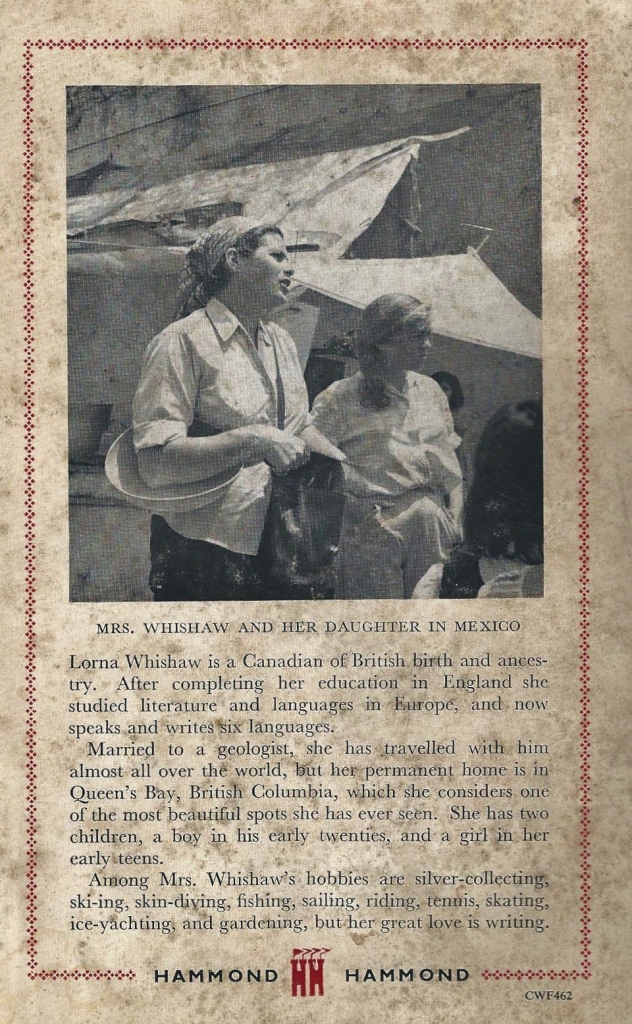
Mexico Unknown by Lorna Whishaw ~ 1962. This edition: Hammond and Hammond, 1962. Hardcover. 256 pages.

My rating: 9.5/10 for sheer admiration of the cheek of this mid-20th-century intrepid traveller, plus for the extreme readability of her prose. If even half of this is true – and apparently, it all is, with some allowances for dramatic presentation – Lorna Whishaw gets my nod for the “Forge Ahead Regardless and Don’t Make a Fuss” award. Shaking my head and smiling, thinking of her adventures – in this case not an exaggeration of term. She loses .5 for not telling more. Infuriating book, because it’s such a teaser.

Lorna Whishaw only wrote two books – this one plus the earlier (published in 1958)  As Far as You’ll Take Me . She barely lifted the veil on her fascinating life and many travels. Probably too busy living to sit down and write about most of it!

I did find record of a third piece of Lorna’s writing, her Master’s Thesis for the University of British Columbia Department of Creative Writing, a 1212 page (really? possibly a pagination misprint) work titled Blue Kootenay, published 1985. Most intriguing. I wonder what the possibilities of somehow accessing that one are? I’m thinking fairly slim.

*****

Of my own free will I would not choose to live in Mexico, any more than I would take up residence at the bottom of a tropical sea, because I do not belong there, because I am not wanted there, and because Mexico can get along very well without me. But because through the Will of God I live in Mexico, I shall write of it, of day-by-day living in a land of vast beauty, of violence, and savage extremes, where the struggle of maintaining life is more terrible than death; a land which is trampled by the tourist with sightless eyes.

I have heard Lorna Whishaw’s two memoirs referred to, in her B.C. BookWorld biographical entry*, as creative non-fiction, and I suspect that she distanced herself somewhat from her narratives by tweaking names and certain personal details, and in her portrayal of order of events. There is no question that she was a real person, that she did travel widely and adventureously and that she based her books solidly in fact.

Lorna Whishaw’s perspective is at once soberly analytical and deeply personal. I am finding her writing intelligent and vivid; Mexico Unknown in particular is a unique work which rewards the reader in multiple ways. Sincerely passionate, continually smile-provoking, and unusually thought-provoking. Plus she was just a damned good writer, and not one mite afraid to voice her opinions in print, though it appears she was capable of maintaining a tactful silence when required in her real life.

On October 4, the day of the sputnik, we left the sanitary tranquility of the American way of life, and in total ignorance of things Mexican we plunged into the uneasy atmosphere where anything goes, where yes and no are as high as the sky and as deep as hell, and where nothing you can conceive of is impossible.

The Mexican experience starts with the culture shock of the border towns, and then the physical shock of the amenity-less workers’ community of a struggling Sierra Madre mine. The first half of the book is a dramatic tale of love and death, corruption and betrayal, nobility of character and inner joy found in the most unlikely people.

The portraits of the Mexicans and the American and European mine foremen, technicians and investors are generously but ruthlessly drawn with an artist’s flair for capturing personality and mood in a few well chosen words. The physical descriptions of the land and people are as good as photographs; I find myself perfectly able to picture each face and scene; an unusually difficult authorial feat to pull off as well as Whishaw consistently does.

Disaster strikes La Fortuna Mine, and the scene abruptly changes to Mazatlan, where the suddenly unemployed and quite broke family reassess their situation. The geologist husband goes off with the last of the ready money to attend job interviews, while the wife and daughter camp on the deserted beaches, invisible to the lavish tourist enclaves just down the coast.

A new job is found in a silver mine in Zacatecas in central Mexico,

…a rolling land, arid and beautiful, a vast panorama of golden grass rimmed by oil blue mountains; of joshua trees, lovely in scant clumps, but frightening assembled as they are sometimes to cover the land…as they march to the horizon black with their myriads…

and a life of relative luxury is settled into; school for the daughter, and endless days of lounging by the swimming pool, gossiping with fellow expatriate wives, and riding out in the surrounding countryside.

On to Guadalajara and then Mexico City, where the family experiences the major July 28, 1958 earthquake, then the geologist goes on to Nicaragua, while the other two return briefly to Canada, where a new car, a British-built Ford Zephyr convertible, is purchased and driven from British Columbia through the U.S.A., through Mexico and, over a technically “non-existent” road through the jungle,  into central America. That trip is a saga all of its own, tacked on to this crowded tale as almost an afterthought.

The family is reunited yet again, only to discover that the Nicaragua job is being curtailed, and though by this time Canada is looking wonderfully attractive, Mexico is again the next destination…

And here I should end this story, but something happened on our drive to the mine on that black and silver night, that should be told. On the trail, lying insolent and beautiful under the headlights we saw two jaguars. Tony stopped the truck a few feet from them, and we watched in ecstasy as they rose and moved slowly away into the bush, throwing flaming glares towards us as they went.

‘Fancy’, Mary said. ‘Jaguars in driving distance from Canada.’

The End

*****

Fancy.

Indeed!

Did I saw “highly recommended” yet? I’m sure I did, but I’ll say it again. This is why I love used book stores, and glorious vintage books.

*****

* B.C. BookWorld, 1992:

Born in Riga, Latvia to British parents in the diplomatic corps, Lorna Whishaw grew up in England and came to B.C. in 1947. She has lived in many countries, including South Africa where she worked on behalf of the civil rights movement. She speaks six languages and has published two books of creative non-fiction, As Far as You’ll Take Me (New York: Dodd, Mead, 1958) and Mexico Unknown (London, 1962). With degrees in French, English and Philosophy, she has taught for East Kootenay Community College in Golden and Cranbrook. She lives in Windermere.

Lorna Whishaw died in 1999.

A commentor has just referred to this grand travel memoir which I first read and wrote about in 2012. Re-posting, because it is an enthralling account, as unique as the woman who lived it and wrote about it.

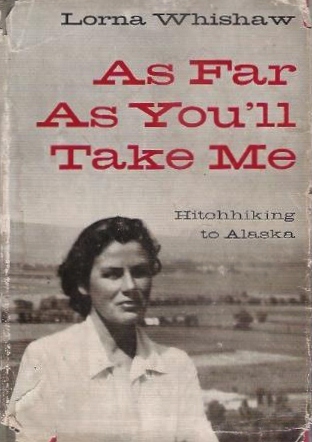
As Far As You’ll Take Me by Lorna Whishaw ~ 1958. This edition: Hammond, Hammond & Co., 1959. Hardcover. 222 pages.

My rating: 8.5/10

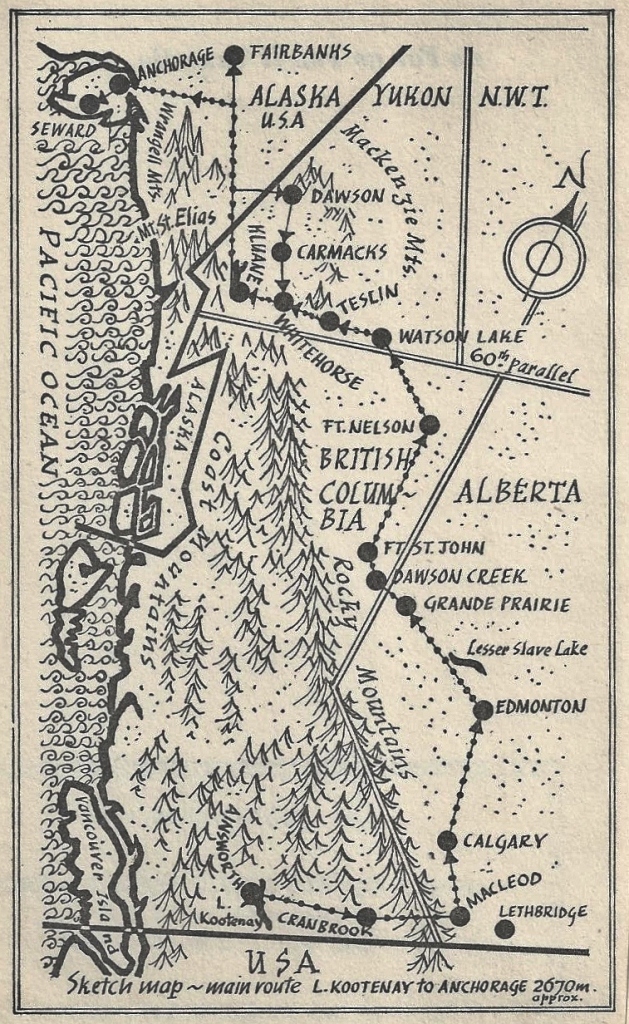
One summer in the 1950s, while her geologist husband was off an a 3-month, “no wives allowed” prospecting trip, Lorna Whishaw left her Kootenay Lake farm and her 10-year-old daughter and 15-year-old son in the care of a neighbour’s retired ex-nanny mother and hitch-hiked to Alaska and back. This is the account of that journey, and of some of the people Lorna met.

Her husband, apologetic that Lorna could not accompany him on this trip as she had on many others, suggested that she go on an adventure of her own, until the time of his return when they could go off on a family trip together. She mulled over his suggestion, and went so far as to engage the efficient Mrs. Clements (to whom the book is dedicated), but then dreams the weeks away until…

One morning, as I lay watching the dawn on the mountains, I knew that the time had come. And that it had to be a hiking trip. Naturally, I was unprepared. I had expected to take weeks making plans and packing, but suddenly it was time to go and I had not even been into town to the bank.

I scoured the house for money until I had collected thirty-six dollars, mostly from winter pockets. I filled a packboard and a huge sack with all sorts of unsuitable effects. Anything, in fact, I could lay hands on without waking Mrs. Clements. In the end I had collected: two pairs of jeans, one pair of faded blues and some shorts, two cotton shirts, two short-sleeved sweaters, one fisherman’s sweater, three pairs of woollen socks, some crimson skijamas, three changes of underwear, a short fisherman’s slicker and four coloured kerchiefs to tie around the neck.

From the kitchen I stole a small Revere saucepan and frying pan, a silver spoon and fork, an aluminum pie plate, a plastic mug, two pounds of coffee, two pounds of rice, some bacon, salt, pepper and a huge chunk of cheese.

On top of this I stuffed in my sleeping bag, which weighed as much as the cheese, and a ground sheet…

After bidding goodbye to Mrs. Clements, and peeking in on her still-sleeping children, Lorna heads down the road, picking up a ride almost immediately with a well-wisher who warns Lorna about the dangers of the road, but ends with a “Wish I was going with you!” good luck parting. Into the line-up for the Kootenay Lake ferry, and Lorna picks up her first real ride, with a trucker headed to Vancouver. He gets her as far as the MacLeod junction, giving her tips on truck driver-passenger etiquette which will stand her in good stead her whole trip. Past the point of no return, Lorna mulls over her next move.

I turned northward, up the long straight road which seemed to touch the horizon and climb into the pink evening sky. Till that moment I had not really given much thought to the direction I would take. For many years I had dreamed of the far north. It was a dream which I had never allowed to take hold, but it was always with me. Standing in the golden sunset at the start of the flat grey road, I felt an overwhelming desire to go north. I had the time and I had thirty-six dollars. With luck I might actually realize my dream – Alaska and the Yukon!

And, by golly, she does indeed realize her dream. Cadging a series of rides with truckers and tourists and farmers and other good-hearted souls, she makes it all the way to Alaska, where she finds further adventure in trips into the wilderness through the kindness of strangers who quickly become friends. It is not all fun and laughter; many of her drivers and hosts have tragic pasts and difficult presents; Lorna herself has several brushes with disaster and makes some very poor decisions, which she pays for in real danger and frequent discomfort. She always pushes through, though, with a combination of luck and bull-headed resolve.

This was an understated but nicely written road trip saga. I found myself fully engaged and reluctant to put the book down, reading far into the night until my eyes closed on their own. Lorna’s voice is cool, calm and collected, and her dry sense of humour is apparent throughout. I am so glad I stumbled upon this memoir; this is my second reading of it and it is even better the second time around, as I found I slowed down in my reading and really savoured her descriptions and impressions of the country she was travelling through.

Lorna herself must have been as much of a unique character as any of the long-distance truck drivers, game wardens, and Yukon and Alaskan prospectors, lodge owners and fellow adventurers she met. According to scant but intriguing biographical information I tracked down, Lorna Hall was born in 1912 in Riga, Latvia, to British diplomatic corps parents. She grew up in England, but travelled widely, marrying pilot and mining engineer Quentin Whishaw and living in many countries, including South Africa, where she apparently worked on behalf of the civil rights movement, and also as a linguist for the “secret service”, according to her son Ian’s biographical notes. Lorna spoke six languages, and had degrees in French, English and Philosophy.

She moved to the Kootenay Lake region of British Columbia with her family in 1947, and lived in Windermere until her death in 1999. Apparently she only wrote two books, both travel memoirs: As Far As You’ll Take Me in 1958, and Mexico Unknown, in 1962. A real shame; I wish she had published more of her memoirs; from the glimpses of her life she shares in As Far As You’ll Take Me she is definitely a person whom I’d like to hear more from.

There were a few copies of both books on ABE, most quite reasonably priced the last time I checked. If you see a copy of either travel memoir in a second-hand bookshop, I would recommend you grab it, if you think you might enjoy reading of the solo travels of a strong, independent woman with a deep appreciation of other people and the natural world.

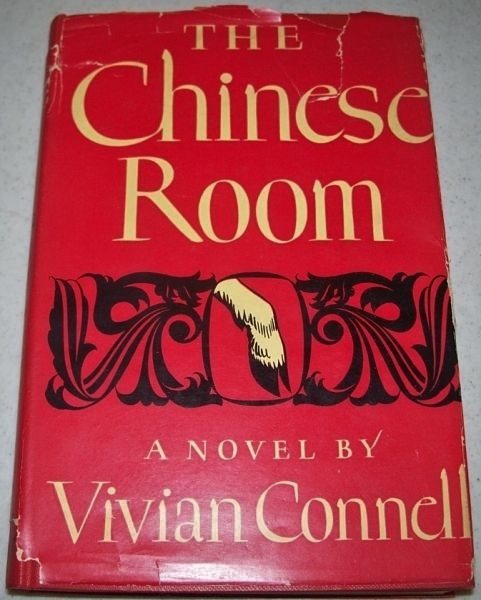
the chinese room 2 vivian connell 1942The Chinese Room by Vivian Connell ~ 1942. This edition: Citadel Press, 1942. Hardcover. 344 pages.

My rating: 3.5/10

And all this time I thought it was merely a garden variety murder mystery!

The book’s been sitting on the shelf for a few years now. I’d heard it referenced as a mystery novel, and I was sort of saving it for the right time for such a mental amusement. I guess I’m just a little out of the loop.

Here’s Kirkus, from 1942, with the review I read after I put down the novel in bemusement partway through to do some further research.

Deep purple, in an uninhibited novel largely about sex, which wanders now and again into perversion, psychiatry, and Oriental eccentricities. The publishers claim affinity with D. H. Lawrence, which might be recognisable only in the very obviously exerted efforts of the characters to find physical passion. They are Nicholas, an English banker, whose wife Muriel had been consistently frigid; Sidonie, his secretary and paid mistress, who is aloof, baffling, and is revealed to have a cloven hoof; Saluby, a psychiatrist, who “awakens” Muriel, the result of which ricochets on Nicholas so that by the close, husband and wife find complete satisfaction in each other. Can only see one type of market – and one reason for reading it.

What an odd novel this one turned out to be.

It starts of traditionally enough, following staid English banker Nicholas Bude as he goes off home to the country for the weekend, only to discover things in a state of turmoil, due to the unexpected suicide of an estate employee’s daughter. Seems there was some sort of mental aberration going on, with the young woman apparently writing abusive anonymous letters to herself before her fatal breakdown.

Nicholas and the doctor in attendance – the saturnine Dr. Saluby – spend quite some time discussing this, with the result that Nicholas is prompted by Saluby to try a similar experiment upon himself.

We’re not quite sure what these fellows are actually trying to prove, but it sets the narrative up for some strenuous navel gazing on the part of Nicholas, while Dr. Saluby lurks stage left, rubbing his hands with glee for reasons a bit murky, though they might have something to do with Nicolas’s beautiful and (apparently) sexually frigid wife Muriel, who has become the focus of Dr. Saluby’s seductive gaze.

So far, so good. I was still thinking that the suicide would prove to be a key element in the puzzle, and that a clever whodunnit was yet in the offing, especially when Nicholas starts receiving his own series of anonymous letters, which may or may not be written to him by himself.

I couldn’t be more wrong. Instead, the novel abandons the sedate mystery format and morphs instead into an increasing torrid series of sexual situations. It’s a dirty novel!

Nicholas turns out to be having a long-running affair with his brilliant Oxford-educated secretary, Sidonie, a stunningly beautiful and deeply secretive blond with a strange physical deformity. He and Sidonie indulge in a rough sexual interlude every Monday evening, reaching “mutual satisfaction” after each bedroom encounter involving Sidonie refusing to let her hair down or (hint, hint!) reveal her bare feet. She bites Nicholas arousingly – and apparently quite viciously, for she frequently draws blood! – and he always leaves her an envelope of money on his way out, which she then mails off to an orphanage.

Surely there is some mystery plot developing with this scenario? Is there some clue in Sidonie’s habit of serious nipping? In the orphanage connection?

Nope. Not at all. Purely random.

Meanwhile, back in the country, Muriel finds herself the target of Dr. Saluby’s amorous advances. She experiences a sexual awakening of sorts, leading to much discussion about the emotional dangers of repressing one’s erotic desires in order to adhere to societal expectations. Apparently Muriel and Nicholas should have let their passions flow early on in their engagement, instead of waiting for the marriage ceremony.

The premise is that Muriel has buried her natural impulses so deeply that she is unable to access them when she finally has official permission to do so. But once these come to the surface, thanks to Dr. Saluby’s selfishly chauvinistic love-making, the newly aroused Muriel starts looking around with wild surmise.

After a brief interlude with another doctor, a gorgeous Scottish he-man sort who is quick to seize the opportunity of an afternoon’s lovemaking with the newly receptive Muriel, she spurns Dr. Saluby and sets her sights on seducing her own husband, whom she was initially attracted to by his passionate nature and “powerful hands”. (There is a whole sub-plot involving Nicholas’s hands which I won’t get into here, as this is already getting too darned long.)

With the help of a homemade pair of green silk, crotchless leggings and the lavish application of red lipstick to various key bits of her body, Muriel catches Nicholas’s attention and husband and wife finally find their sexual groove after ten years of disappointing marital “duty sex”.

Nicholas, Muriel, and Sidonie then get together in a mutual reconciliation session, followed by explanations of all the bemusements. Though I rather expected them all to end up in bed together, the author spares us this. Thank you, Mr. Connell.

The anonymous letter thing gets cleared up, sort of, though we never do get a satisfactory explanation regarding the original suicide which set the wheels of this novel in motion.

Still with me, and still curious about this odd little period piece?

Here’s a link to the only other review I could find in my not-very-strenuous internet search. Dan Stump writes a good review in Mystery File , referencing The Chinese Room‘s  subsequent movie adaptation, and its status as something of a cult classic of its erotic-pulp-fiction genre.

Another link to the 1966 film, with a brief biographical note on the author at the very bottom.

Remember the reference to D.H. Lawrence in the Kirkus review? Vivian Connell deserves a mildly favourable comparison to DHL, as The Chinese Room did contain a fair bit of decent writing and some interesting musings on the inner lives of its characters, but, sadly, the gratuitous and increasingly frequent semi-explicit sex scenes ruined what might instead have been something of a higher literary standing.

The Chinese Room was surprisingly successful, going into numerous editions and selling over three million copies. Perhaps this had something to do with its instant notoriety due to its American recall in 1942 by the Society for the Suppression of Vice, who demanded the censorship of a certain phrase before it could be allowed back into general circulation.

My particular edition is the original, and I would be hard pressed to identify which particular phrase that was. There’s quite a lot of questionable stuff herein, blush-inducing, indeed, though mostly because of the awkwardness of the writing and the ridiculousness of the scenarios versus anything too wildly explicit in the way of sexual detail. Pornographic it isn’t, if one applies the dictionary definition.

The Chinese Room was Vivian Connell’s most commercially successful book, though he was also a playwright, and was apparently involved in the Hollywood movie industry. He did go on to write a number of other, apparently even more risqué novels. I rather think, from the “serious” bits of The Chinese Room, that he would have liked to be viewed as a more mainstream writer, and he might indeed have made it, for there is evidence of a certain competence of thought and phrasing and even flashes of brilliance here and there. Doomed by those intrusive sex scenes, though.

Ah, well. So close, but yet so far…

by Howard Coster, half-plate film negative, 1942

Vivian Connell, Irish writer and playwright. Image from the collection of the National Portrait Gallery. Photographed in 1942 by Harold Coster.

Though The Chinese Room ultimately disappointed me, I suspect I’d snap up any reasonably-priced Connells found while browsing the pulp fiction shelves in future. (Say, $5 maximum, though $2 would be better.)

Don’t you find these representative covers strangely curiousity-inducing?! “A lost weekend – of women”. Huzzah!

Other titles to be aware (or beware) of:

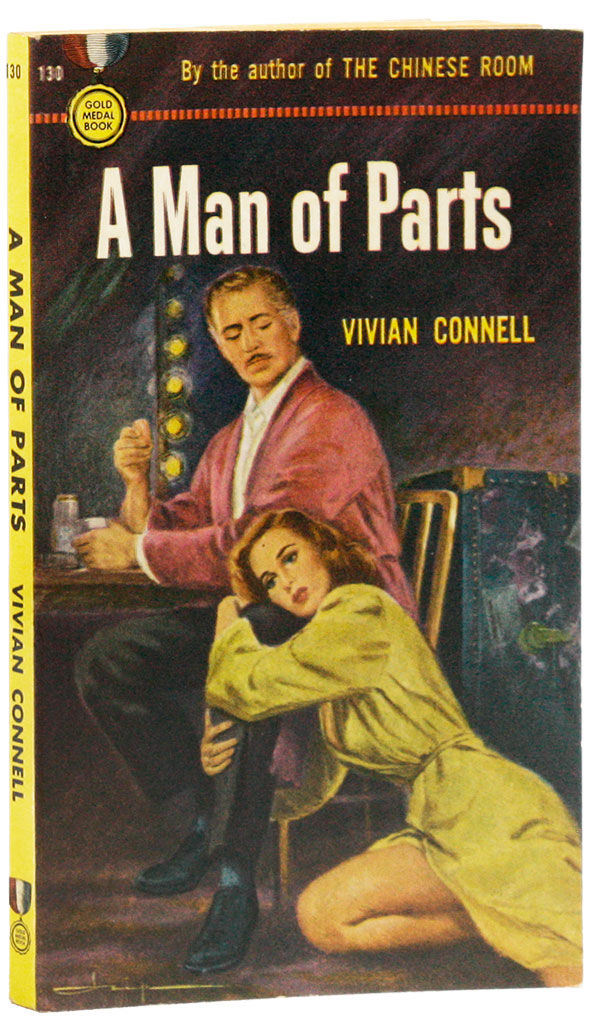
A Man of Parts, 1950. “A tempestuous novel of the London stage, its greatest lover, and the women caught in the tempest.”

a man of parts vivian connell 1950

Bachelors Anonymous, 1956. “For David Young, life was a lost weekend of dames. In a word, he was a love lush. He could fake out the boss on most hangovers, until ‘one too many’ happened to be a client’s wife. And then it was go on the wagon or else. But how, when a guy can’t break the habit? And then the club came to the rescue…”

bachelors anonymous vivian connell 1956

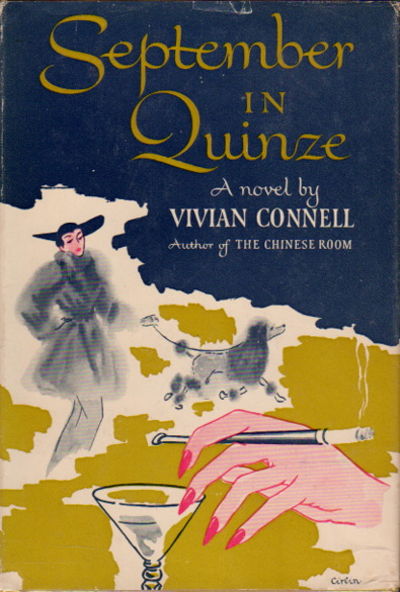
The Love Lush - illus Ron Lesser.2September in Quinze, 1952. Published later in paperback as The Naked Rich. “Set on the French Riviera, a world of sybaritic luxury, violence, self-indulgence, loneliness and sometimes even love.” Bonus dust jacket blurb:

He stood in the street disguised in a pair of old trousers and a shirt that bared his massive chest. His eyes dwelled feverishly on the woman standing beneath a lampost. Of all the women in France tonight he desired only this tawny-haired, dark-eyed female. “Do you know what I want from you?” he asked. She nodded and led him silently to her apartment. From the window they could see the yacht of the fabulous King Sadook, its royal flag fluttering. “Do you want a king tonight?” he whispered. She shook her head. Her single garment fell away. “I want a man,” she told him simply. He laughed and said “I’ll give you both!”.

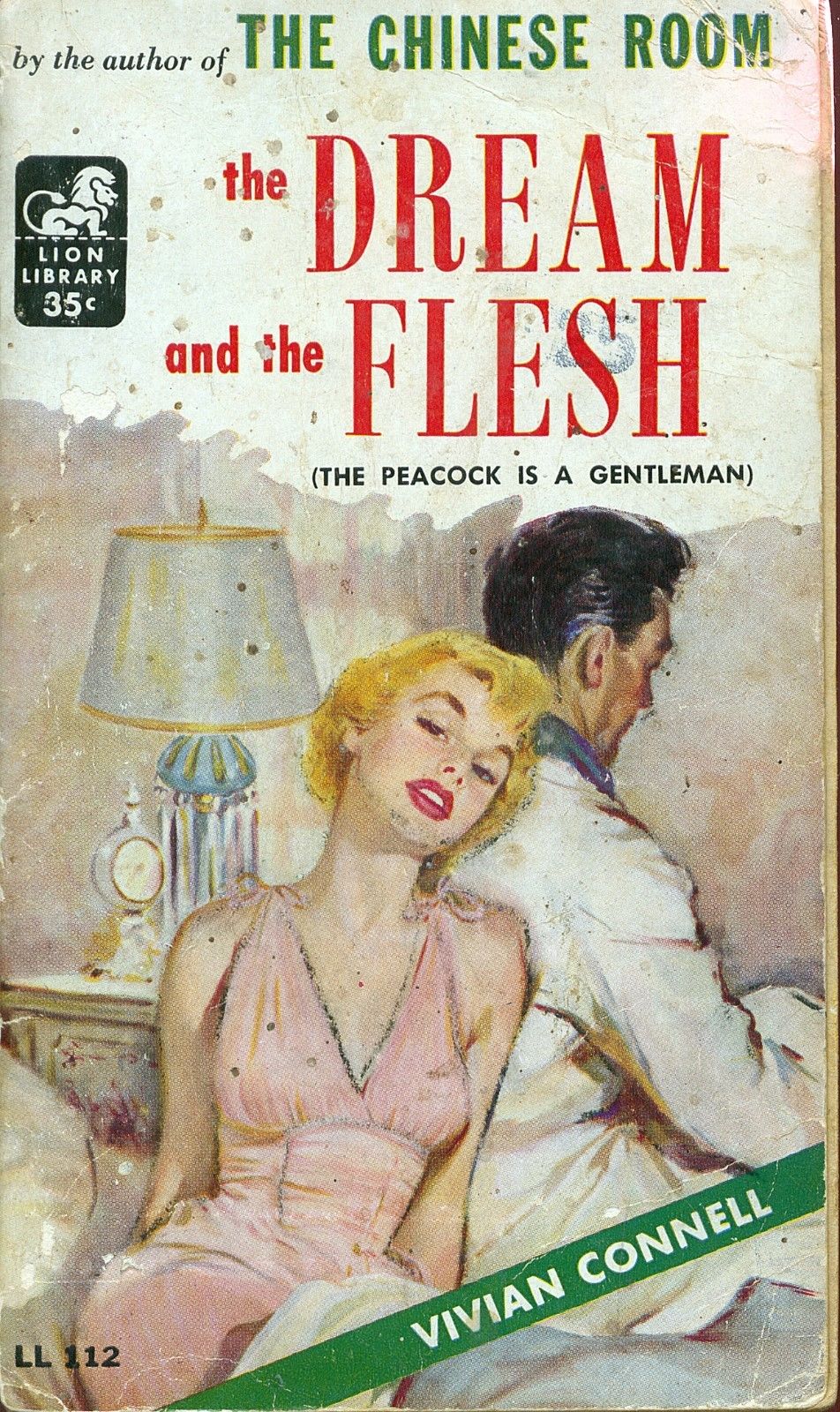
september in quinze 1952 vivian connellThe Dream and the Flesh, originally published as The Peacock is a Gentleman, 1959. “Paris was his – and so were its women!”

the dream and the flesh vivian connell 1959

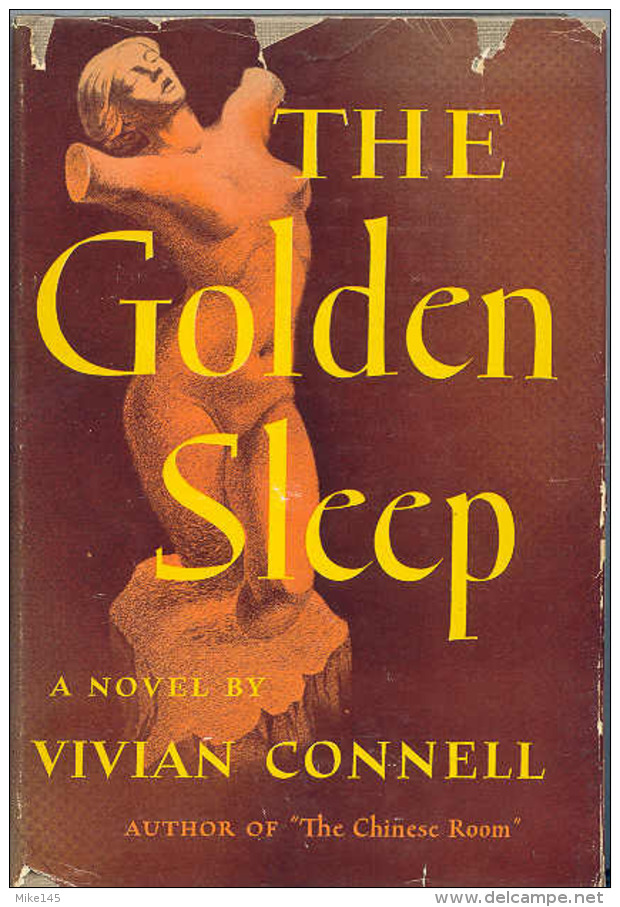
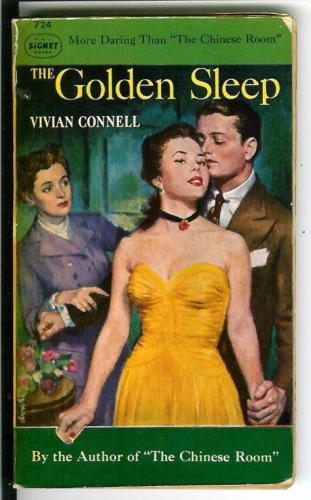
The Golden Sleep, 1948. “More daring than The Chinese Room!”

the golden sleep 2 1948 vivian connell

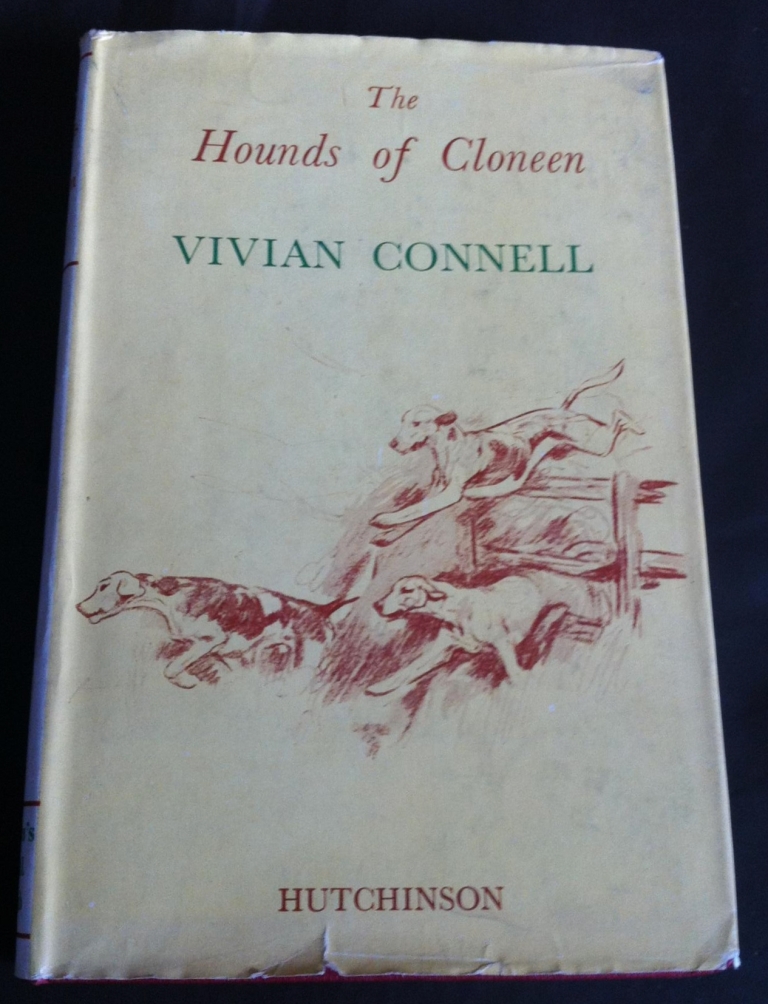
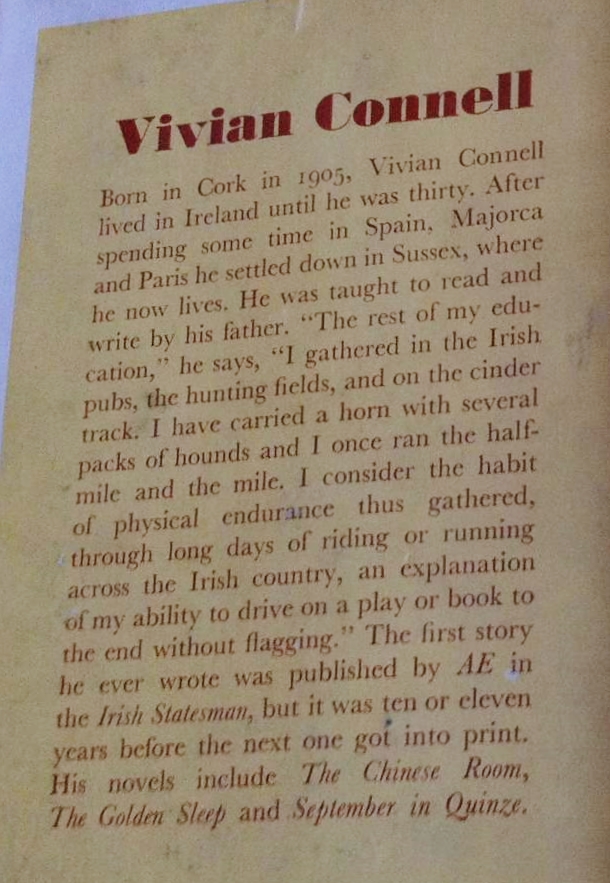
the golden sleep vivian connell 1948The Hounds of Cloneen, 1951. Hey, check this out. An author bio on the back cover!

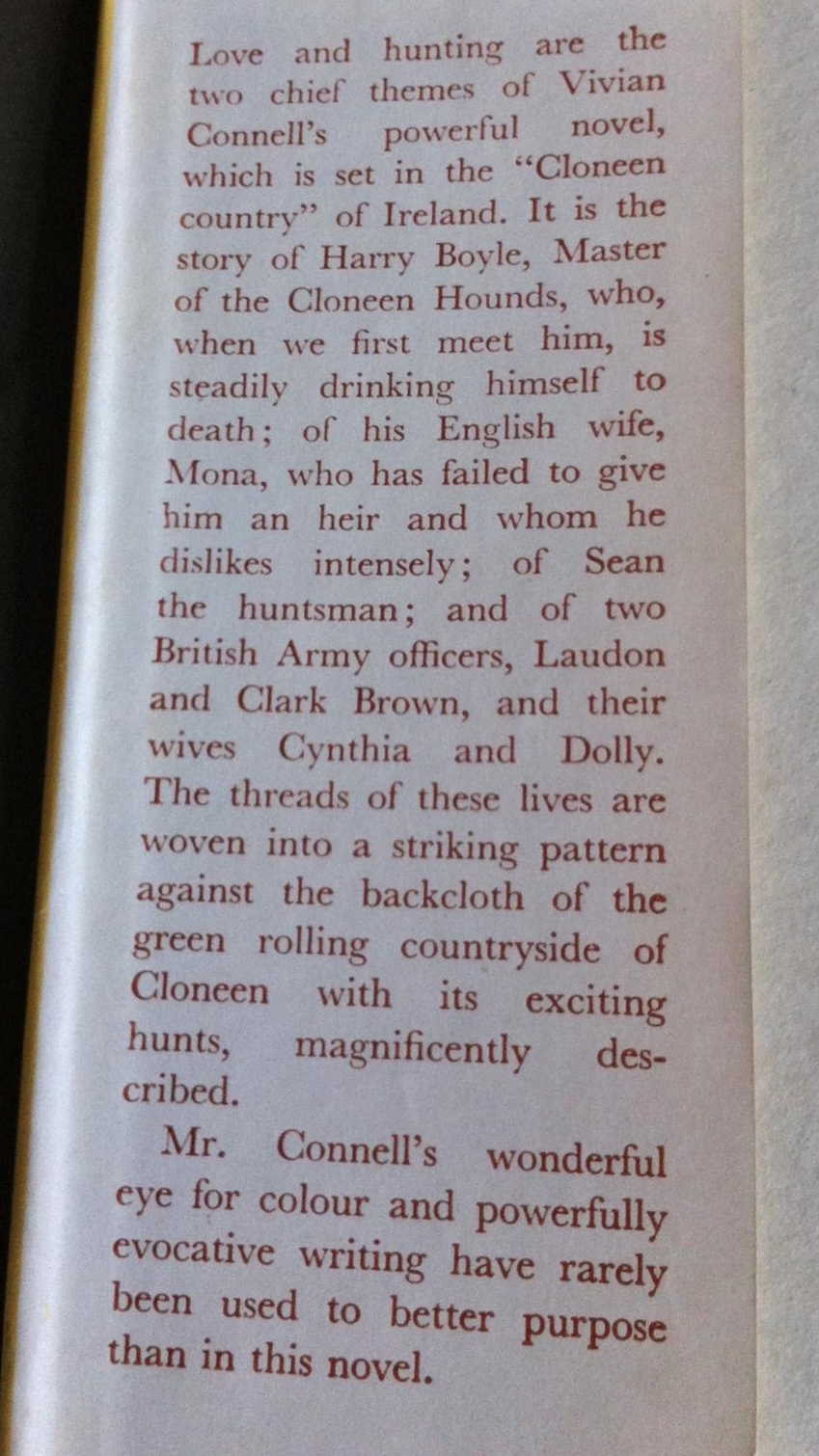
the hounds of cloneenhounds of cloneen dj blurbvivian connell bio, back dj the hounds of cloneenThe Stolen Pearls, 1961.

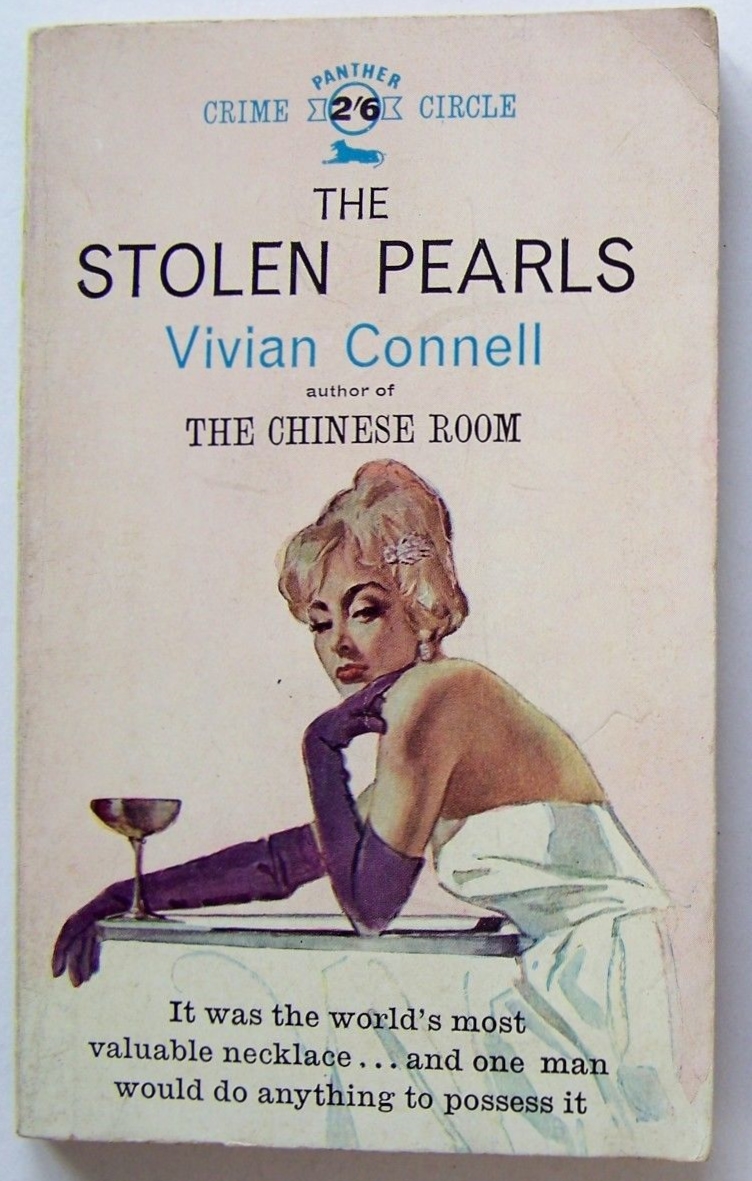
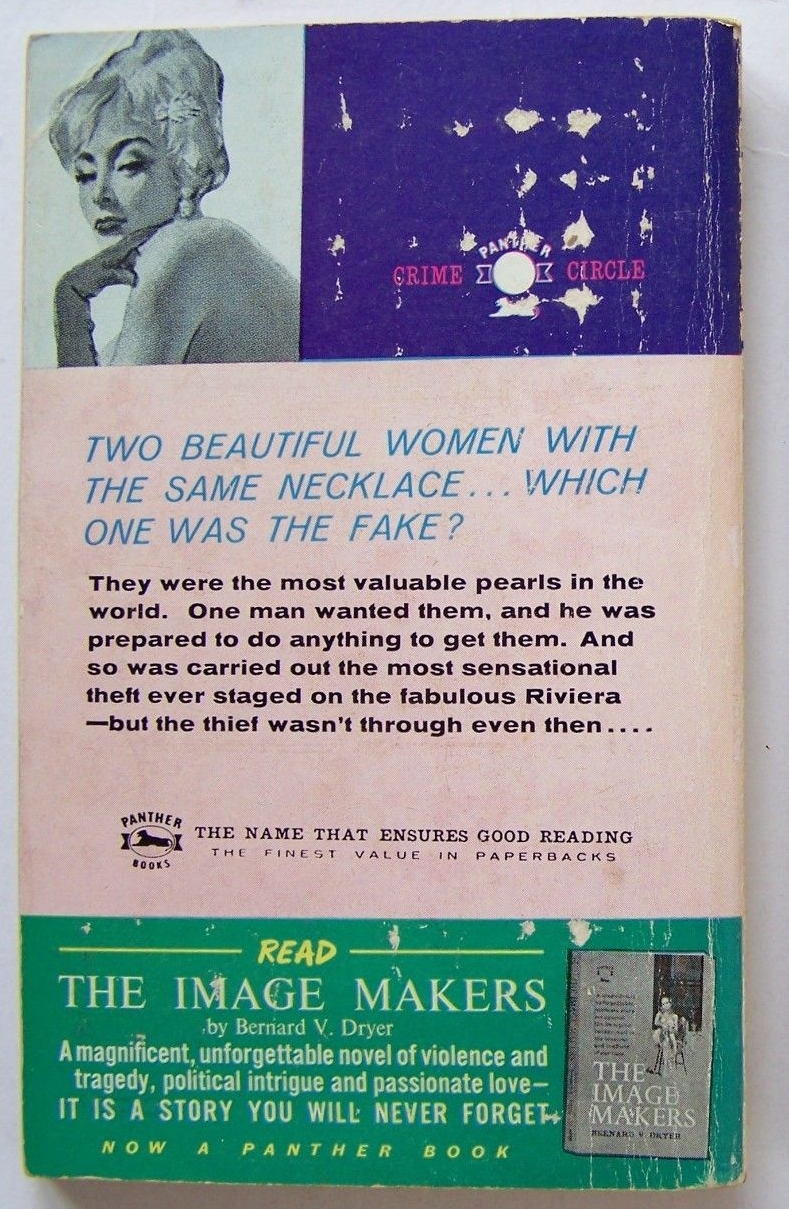
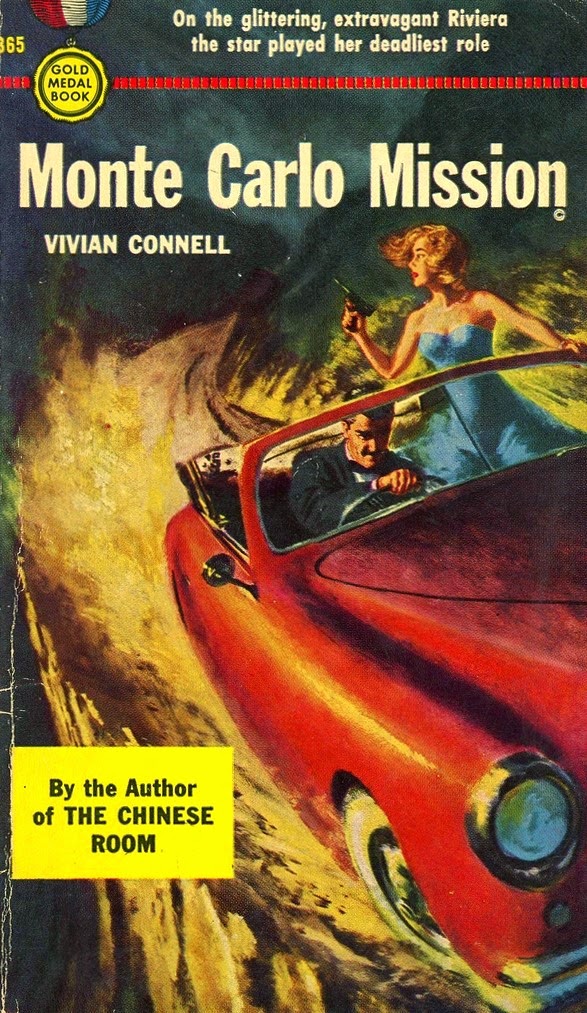
VIVIAN-CONNELL-Stolen-PearlsVIVIAN-CONNELL-Stolen-Pearls back coverMonte Carlo Mission, 1954. “Vivian Connell, master of the sophisticated suspense novel, brings you his finest in Monte Carlo Mission. Meet Corinna Lang, a goddess of the movies, who was bored with mammoth swimming pools, small MGs, fat directors, and slim leading men. Bored with the whole great golden illusion of Hollywood, this smart cookie decides a mere vacation in Monte Carlo would be just too tame. She’s looking for adventure, and has the right amount of moxie and courage to take advantage of it when she finds it! Take a journey with this enchanting heroine to the wicked, extravagant Riviera where the golden Corinna, undertaker of a top secret mission, lives in the shadow of international intrigue, and matches her quick wit with the most dangerous men in Europe.”

Monte Carlo Mission.2

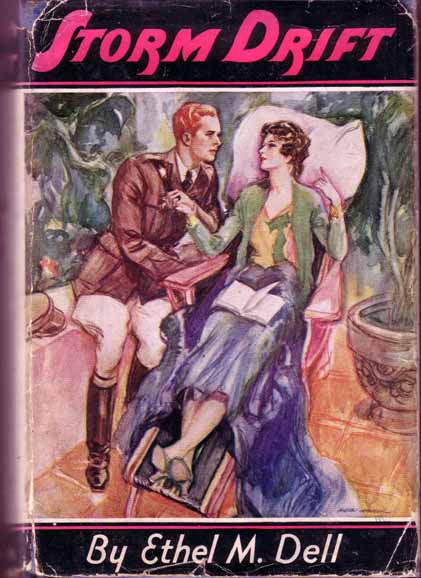
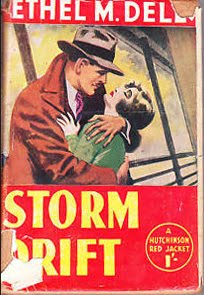
storm drift ethel m dell 1930Storm Drift by Ethel M. Dell ~ 1930. This edition: Ryerson Press, 1930. Hardcover. 376 pages.

My rating: 3.5/10

Picture yourself on a boat on the ocean, just out of Bombay, heading to England…

Here’s Tiggie, our hero. He’s a wealthy bachelor looking forward to a few months of convalescence from his latest bout of some tropical ailment.

Tiggie can’t keep his eyes off a fellow passenger, the ethereally beautiful and frantically anxious Mrs. Viola Norman, whose husband appears to have missed the sailing. Tiggie steps up to soothe the perpetually shrinking Viola, and discovers that her nervous condition is apparently well justified, for not only is she pretty well stone broke and bereft of her (apparent) spouse, she is also in the family way.

The overwrought Viola attempts to end it all by taking a dive off the ship’s railing, but Tiggie intervenes in a dramatic rescue. As he pulls the frail Mrs Norman to safety, he is suddenly overwhelmed by a rush of feelings for her. Full on, instant infatuation. He’s on fire!

Confined as they are to the first class deck of a ship at sea, Tiggie and Viola can’t avoid each other, and Tiggie focuses his ever-more-fevered gaze on the trembling little grass widow. He is rewarded when Viola reveals herself to be a woman with an unexpectedly passionate inner core, as Tiggie discovers when he manages to corner her one post-rescue night on a secluded corner of the deck. As his lips meet hers, and she yields meltingly to his masterful embrace, fireworks go off, volcanoes erupt, etcetera. (Too bad she’s MARRIED. And PREGNANT.)

Storm-Drift

Viola looks a bit green in this cover depiction. Could it be the combined queasiness of pregnancy, the rolling ship, and her recent suicide attempt, or merely the overwhelming effect of the masterful Tiggie’s manly grip and burning lips?

Tiggie belatedly gets a grip on himself and does the Correct Gentleman’s Thing. He pulls himself off with an apology, which Viola whisperingly accepts. They mustn’t see each other once they reach England! Viola, having confessed to being abandoned by the father of her coming child, insists that she will be able to find employment and care for herself, and that she will quickly repay the money which Tiggie forces upon her to tide her over. He’ll never see her again; she won’t be beholden to him; their mutual smoldering passion will just have to be firmly quenched. They must forever part!

Need I go on? (I will, of course. The question is purely rhetorical; I could stop right there and let you guess the rest quite successfully yourself.)

For of course their paths reconnect, and through an elaborately coincidence-ridden plot, the two tortured lovers almost immediately reunite. Viola has a rather convenient miscarriage, just to neaten things up on that end. A whole bunch of stuff happens regarding Viola’s shady past as a cabaret dancer, her surprising familiarity with Tiggie’s artist brother-in-law, and the re-surfacing Mr Norman, who turns out to be not so imaginary as once thought.

The key players in the story – Tiggie, Viola, the lost husband, the artist brother-in-law – all find themselves together in a small coastal village, well-furnished with cliffs convenient for adding an element of potentially fatal danger to the ongoing action. No prizes for guessing the sad fate of Viola’s rejected husband.

Yup. He’s doomed.

Now rid of both incipient unwanted baby and pesky previous relationship, Viola is fully Tiggie’s own. The curtain falls on their happy ending.

My word. I can’t quite believe I made it through this thing. I feel like I deserve a prize. It was, increasingly, a slog, though I do have to give Ethel M. Dell credit for writing just well enough to keep me at it. There was certainly a lot of action, which helped.

I do have to say that if I’d been there in any capacity, I would have happily pushed the whole cast of characters off that tall, tall cliff. By the time their romance came right, I warmly hated both Tiggie and Viola, and Harvey-the-eccentric-genius-artist was push-worthy just by association.

The only character I liked by the end was Harvey’s wife – Tiggie’s sister Janet – who avoids being involved with any of this nonsense by staying sensibly home and running her chicken farm while her male connections are off making idiots of themselves. (Ha! Didn’t expect that little detail, did you? I immediately gave Dell an extra point for the hens. It was so darned unexpected, and really kind of sweet.)

So there you have it. Me and Ethel M. Dell. Oh boy.

A bit of background stuff.

Ethel M. Dell was a highly successful romance novelist of her time – thirty novels from 1911 to 1938 – and her target markets were under-employed spinsters whiling away their long afternoons, and working class women looking for a titillating read for their infrequent leisure hours.

Dell specialized in semi-exotic locations, masterful men, trembling women, and sex-soaked situations. She stopped just short of explicit in her descriptions of romantic encounters, but the veil she left drawn was rather on the thin side.

Those of us who read any amount of early and mid 20th Century middlebrow fiction are very familiar with Dell’s name, and by extension her genre, even if we’ve never cracked the covers of one of her passion-filled productions. Other writers of the time loved to scorn her; occasionally there is the tangy whiff of sour grapes, for Dell did financially very well with her particular  line, one suspects much more so than many of the “serious” writers of her day.

Contemporary fellow writer (and professional literary critic) Rebecca West famously condemned Ethel M. Dell’s work as decidedly “tosh”. (The exact quote, in reference to another of Dell’s torrid romances, 1922’s Charles Rex, was this: “(I)n every line that is written about him one hears the thudding, thundering hooves of a certain steed at full gallop; of the true Tosh-horse”.)

On the abundant evidence of this particular novel, I must agree.

Storm Drift was my first and possibly last Dell, though I may succumb to curiosity and explore this writer some more, just to fill in the details in some of those references. I have a few more specimens of Dell’s work on hand, and, much as I hate to say it, I’ve read worse. Not much worse, but occasionally one is desperate for something – anything! – to read…


Crossing the Skeena River by 2-car reaction ferry, Usk, B.C.

Crossing the Skeena River by 2-car reaction ferry, Usk, B.C.

Since my last post a good two weeks ago quite a lot has happened in my world. The most exciting thing being an immensely enjoyable week-long road trip to Alaska in our old Triumph Spitfire. Top down all the way, though we were pretty chilly those cool northern British Columbia summer mornings!

An overwhelming magnitude of most excellent scenery. Glaciers and totem poles, the tock-tock of ravens everywhere we went, and the fragrance of sweet clover from the hayfields and roadsides overcoming our little car’s perpetual miasma of Old British Car over-fuelled exhaust.

It was grand.

Bear Glacier, near the Canada-U.S.A. border towns of Stewart, B.C. and Hyder, Alaska

Bear Glacier, near the Canada-U.S.A. border towns of Stewart, B.C. and Hyder, Alaska

Lichen-covered lava flow at the Nisga'a Memorial Lava Bed Park near Terrace, B.C., site of Canada's last volcanic eruption in the mid-1700s.

Lichen-covered lava flow at the Nisga’a Memorial Lava Bed Park near Terrace, B.C., site of Canada’s last volcanic eruption in the mid-1700s.

Totem poles near Kitwanga, B.C. These are memorial poles erected over the graves of band chiefs. The figures depict clan memberships and significant connections of the people they memorialize.

Totem poles near Kitwanga, B.C. These are memorial poles erected over the graves of band chiefs. The figures depict clan memberships and significant connections of the people they memorialize.

So. Books.

Just before we took off on our drive, a kind neighbour passed on to us three boxes full of dusty vintage hardcovers she’d been shuffling from shelf to shelf for years. In between the collections of sermons and prayers-for-the-day, the moralizing children’s tales, and the expected classics were some now-obscure popular novels which were bestsellers in their day. E. Phillips Oppenheim, John Buchan, and Ethel M. Dell, anyone? Or how about Kathleen Norris?

I packed a random handful of the most promising along on our trip, but was so exhausted each night from the miles of windy driving and the glorious sightseeing (and possibly the brisk northern air combined with those afore-mentioned exhaust fumes) that I only managed to make my way through one of them.

An Apple for Eve by Kathleen Norris, 1942, was a contemporary romance novel by the prolific San Francisco writer. If you’re not familiar with the name, here’s a brief biography, courtesy of Wikipedia:

Kathleen Thompson Norris (July 16, 1880 – January 18, 1966) was a popular American novelist and newspaper columnist. She was one of the most widely read and highest paid female writers in the United States for nearly fifty years, from 1911 to 1959. Her stories appeared in the Atlantic, The American Magazine, McClure’s, Everybody’s, Ladies’ Home Journal and Woman’s Home Companion, and she wrote 93 novels, many of which were best sellers. She used her fiction to promote values including the sanctity of marriage, the nobility of motherhood, and the importance of service to others

An Apple for Eve by Kathleen Norris, 1942. This edition: P.F. Collier and Son, 1942. Hardcover. 340 pages.

My rating: 5.5/10

an apple for eve kathleen norris 1942An Apple for Eve was the fourth novel by this writer that I’ve read, and based on past experience I assumed it would be a readable, well-detailed, decidedly earnest though not off-puttingly preachy, easy to take up and put down light read. And it was all of that.

Teenage Loveday, daughter of a much-respected family of once-wealthy California Quakers, falls tempestuously in love with a young man of not quite top-drawer origins. She promises eternal faithfulness, and sends her fiance off to flight school with the promise to marry him as soon as he can finish his training and set up a modest starter home.

Much drama then ensues. Loveday becomes orphaned; we learn of a mysterious family fortune possibly hidden somewhere in the decaying family mansion; Loveday is semi-adopted by a wealthy family and introduced to high society and rich living; Larry-the-fiance stops writing; Loveday finds herself in a mutually-attracted relationship with an already-married playwright; heart rendings all round!

Eventually Loveday and Larry reunite and marry, but things go swiftly downhill. For Larry is something of a ne’er-do-well. He can’t keep a job, he argues with any sort of authority figure he comes across, he’s deeply jealous of Loveday’s affection for her adopted family, who keep swooping in with welcome cash donations to ease Loveday’s continual financial woes, for she and Larry and their three small children are sliding ever deeper into a lower strata of society than either of them started out in.

Re-enter Loveday’s other lover, the wealthy playwright Chris. His wife has just died, and he feels himself free to woo the still-lovely Loveday, as her husband is obviously unwilling to man up and support her in the way which she deserves. And Loveday must admit that she returns the illicit passion. But will she be able to set aside her marriage vows and divorce her sad-sack spouse? Larry, though continually inadequately employed, occasionally sullen, and generally slightly mopey, is quite a sweet guy at heart, who has never done anything to deserve spousal desertion.

Hmmm…

Take a peek up to the bit about Kathleen Norris’s championship of the sanctity of marriage vows and the nobility of motherhood for a Great Big Clue as to what our heroine eventually decides.

I’ve occasionally seen this author’s work classified as “Christian Romance Fiction”, and while I wouldn’t go that far myself – she seldom directly references God or religion, and her characters get up to some rather worldly shenanigans – I can see why that is a tidy and appropriate categorization in this current anything-goes age.

This not particularly top rate novel is redeemed by its generous period detail and its depiction of rural California life in the early World War II years, when America was poised on the brink of committing to the overseas conflict. There is ongoing discussion of the situation in Europe and the role which America should play in the escalating war; some characters go north to Canada to join the R.A.F.; during the course of the novel the Japanese attack on Pearl Harbor takes place, precipitating the U.S.A.’s decision to jump into the fray. Back on the home front, wives and mothers scramble to compensate for breadwinners heeding the call to arms, and, just a little later on, to deal with the inevitable deaths of loved ones and the return of the wounded.

By 1942 Kathleen Norris had honed her writerly craft to a very competent level, and working one’s way through this melodramatic tale some 75 years after its publication is no great hardship, with the expected allowances for era-expected attitudes, as well as a soupçon of bigotry and racial slurs. Those of Chinese ethnicity come in for most of the little digs, as Loveday’s household staff (for of course our heroine has devoted family retainers despite her desperate poverty) are descendents of the California Gold Rush “coolies” of a generation or two before. A typical off-the-cuff comment from Loveday, in reference to her housekeeper: “The Chinese are trustworthy because they find it pays better to be honest.”

As in the other Norris novels I’ve read, the chief heroine is almost impossibly beautiful, universally admired, and stunningly competent at everything she does. Though she temporarily allows herself to be tempted – remember that clue-providing title? – “Eve”, “apple”? – I couldn’t work up any surprise upon finding out that she ultimately does the morally right thing. And of course earthly rewards follow thick and fast, though Norris pleased me by not tying up quite every loose end.

Some years ago I read and reviewed 1937’s The American Flaggs. My opinion of the writer’s style engendered by that first experience of her work have not changed in my subsequent readings; I’ve since acquired and read The Venables (1941), Bread Into Roses (1936), and, just the other day, Butterfly (1923). Good summertime books, not too deep, and the annoying bits are easily brushed aside. Next in the queue is The Heart of Rachael (1916), which I may dip into this evening, before setting aside Norris’s all-of-a-pattern heroines for something with a bit more oomph.