Tamarac by Margaret Hutchison ~ 1957. This edition: Macmillan, 1957. Hardcover. 282 pages.

A show of hands, please – who has heard of Margaret Hutchison?

I hadn’t, and it saddens me.

This novel was a pleasant surprise, and it appears to be the writer’s only one, though I found a reference to her working on her “next novel” in a snippet of a Margaret Laurence biography I stumbled on online. Apparently Margaret Hutchison – “Hutch” – was mentoring Margaret Laurence in the writerly sense when they both met in Vancouver back in the 1950s.

Intriguing.

Google draws an utter blank, beyond the secondhand copies of Tamarac for sale. And there aren’t too many of those out there, either.

So was there ever a second novel? I am exceedingly curious, because this first one, rather obviously autobiographical in the way of so many first novels, is beautifully written. Margaret Hutchison is comfortable with her words; it’s a smooth, engaging read, even in the most angst-ridden passages. Which takes some doing, doesn’t it?

Note I mentioned the presence of angst. It’s in there, in spades. Well, expectedly so, regarding the subject and its era.

Sometime between the two world wars, young Janet Cameron grows up with her two sisters in an isolated (and fictional) sawmill town named Tamarac located somewhere in the (real) British Columbia Kootenay region. Her childhood was a golden time; she looks back on it with fond nostalgia and true grief for its passing.

For not only has her childhood vanished, the town itself is disappearing. With the advent of the Second World War and the natural attrition of a resource extraction based industry – the loggers have harvested all the available trees and the most prominent town structures are torn down as the sawmill equipment is removed for installation elsewhere – Tamarac is doubly doomed.

Janet, now grown up and working as a schoolteacher, returns to the area to attend her father’s funeral, and the journey back triggers cascades of memory of her life to date: that golden childhood, and then the harsh reality of working for a living in a career she feels forced into, and eventually a brutally disappointing love affair. The mixture as seen so often, in fact.

Margaret Hutchison handles her saga well; it moves along quite briskly most of the time, with occasional slowings-down to dwell on particularly meaningful episodes.

Tamarac is hard on the heels of novels such as those created by Ethel Wilson; there is a similar concentration on the landscape as a crucial influence on the characters’ psyches. Hutchison approaches Wilson’s style without exactly copying it – the two were in fact writing at much the same time – but falls just the slightest bit short. As a developing writer, what might have been her voice in subsequent works?

Hutchison’s strengths as a more-than-competent writer outweigh her occasional lapses as a plot developer. I liked this novel a lot, and I would be thrilled to find that there is more out there from this thoughtful and articulate author. Sadly, I suspect that she may have been a one-book wonder. I wonder what the rest of her personal story was?

To sum up:

  • Not exactly a bildungsroman; our protagonist experiences most of her growing pains as an adult dealing with adult issues – love and loss and all that deep stuff. Her adolescence is challenging in places but is passed over without wallowing in teen sadness; she grows up fast but not because of any particular trauma; much is asked of her early and she steps forward to shoulder her responsibilities.
  • Tamarac is a thoughtful and appreciative evocation of a particular place and time; the author makes it very clear that she has a keen eye for natural surroundings, as well as the human places – and people – which encroach upon the wild.
  • Much of the melancholy of this novel comes from the time of its setting: Great Depression-era rural Canada, and then the bitter onset of what we all know – characters and readers alike – will be another horrible war.
  • The ending is something of an anticlimax, just a little too perfectly rounded. But it works in the greater context of what comes before it in the story, and is on the whole fairly satisfying. We are certain that Janet will calmly find her own way into whatever is coming next for her; she has proven herself tenacious and resilient so far, and we wish her well in her future.
  • My rating: 7.5/10. (Not a perfect novel, but well on its way, and I liked it.)

And here is our mysterious writer. Does anyone know what happened after Tamarac?

 

The Stepford Wives by Ira Levin ~ 1972. This edition: Fawcett Crest, 1973. Paperback. 191 pages.

Score a great big point for cultural saturation for this one.

Even those of us who haven’t read Ira Levin’s original novel or watched the 1975 (horror) and 2004 (dramatic comedy) movie versions have a darned good idea of what calling someone a “Stepford Wife” is all about: a scornful put-down right up there with “Little-Suzy-Homemaker” and “June Cleaver”, referring to the unemancipated females who are letting down The Sisterhood by really caring if their floors are glossy and their toilets really clean.

The Stepford Wives is a slight novel, despite its broad fame and its description on the back cover of my edition as a “chiller [with a] clincher of such hard-edged horror as to make his Rosemary’s Baby seem a drawing room comedy” – at least according to Mary Ellin Barrett of Cosmopolitan.

I do vaguely remember reading Rosemary’s Baby way back in the 1970s – I had a school friend who was into “horror” novels and she pressed it upon me – but I must say that the experience was underwhelming. And despite the promise of hard-edged horror from that long-ago Cosmo reviewer, I must say that this one is, on a superficial level, much the same.

After my reading of The Stepford Wives, as I shuddered gently at its implications, I mused that perhaps a tandem reading of the book might be a revealing conversation starter with your nearest and dearest.

Your partner’s response might well be worth noting, particularly if you are the wife in the equation. Will your spouse secretly envy the husbands of Stepford their sudden acquisition of sexually compliant, traditionally shapely, sweet-smelling underlings who don’t mess around with time-wasting outside interests? Who, incidentally, make the very best coffee?

Okay, backing up a bit to run ever-so-briefly over the plot, just in case any of my fellow readers have missed the gist of  this tale.

Joanna Eberhart, her husband Walter, and their two young children have just moved to the pleasant suburb of Stepford, and all are glad to be out of the ever-more-dirty-and-dangerous big city.

Joanna, self-proclaimed Women’s Liberationist and semi-professional photographer, admittedly hasn’t been too impressed by her first experiences with her polite but dull hausfrau neighbour ladies, but she hopes to find some like-minded, “liberated” friends in the area. And so she does, a couple of new arrivals like herself. They shake their heads over the boring house-proudness of their Stepford peers, and speculate on why all of the other women are so unambitious, so boringly polite, so compliant to their husbands’ smallest whims. Could it be something in the water? How about in that wonderful coffee? Are the ladies of Stepford being quietly drugged?

Turns out the truth is a mite more sinister.

Disclosure:

There isn’t a happy ending.

I think The Stepford Wives truly deserves its status as a classic of pop culture. It’s certainly representative of its time, and, for all its slightness, it’s a fantastic sleeper of a pro-feminist piece of literature. Even the most loving of the novel’s “enlightened” husbands eventually show their baser natures, much to my dismay. (I had highish hopes for at least a few of them. Nope. Ira Levin doesn’t pull any punches: all the Stepford men are evil.)

Final thoughts:

If you bump into it in your travels, you should read it, if only to clarify the basis for the pop culture “Stepford Wife” references all around us.

On the plus side, it’s a lightning fast read, a couple of hours at the most.

It’s also quite funny. Levin strikes an amusingly satirical note here, alongside his darker imaginings.

This one gets a shiny gold-plated star. Or, quantified in numbers, a rating of 7/10 from me.

Oh! One last thing. You, dear reader, if you make it through this novel, will never feel quite comfortable with a certain Disneyland attraction again…


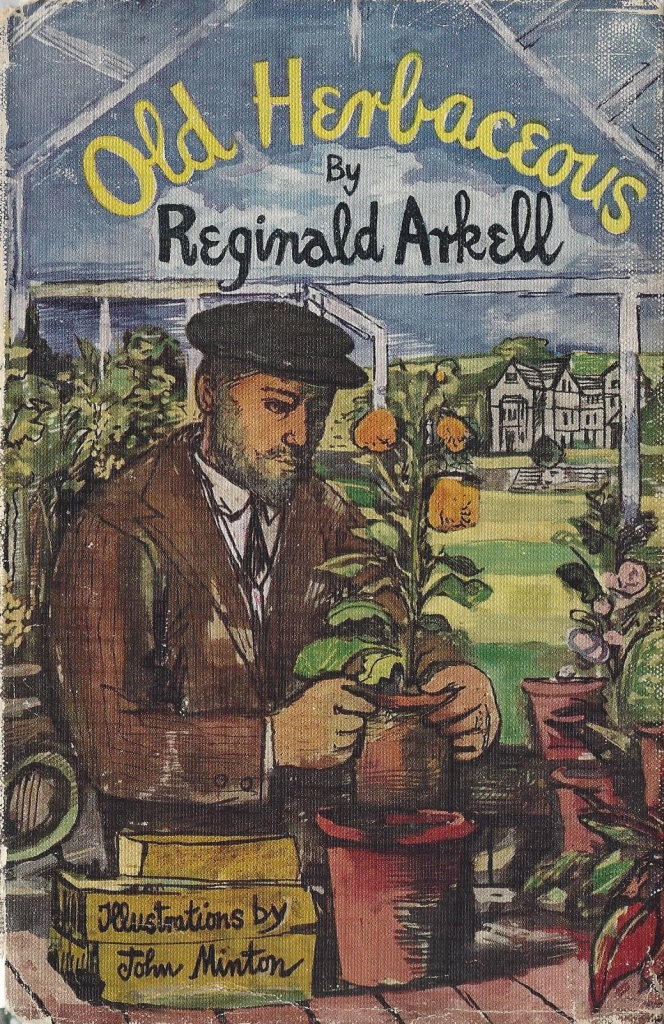
Old Herbaceous by Reginald Arkell ~ 1950. This edition: Michael Joseph, 1951. Illustrated by John Minton. Hardcover. 155 pages.

The second book of 2018 was something of a soft landing after my hair-straight-back initiation into the somewhat frenetic world of Elizabeth Bowen.

This next one is as straightforward as it gets; pure narrative of the simpler sort. I hasten to say it has all of the merits of its genre, that of the nostalgia piece, vide Miss Read and her ilk.

Elderly Bert Pinnegar, lifelong gardener at the “Big House” of his quiet English village, sits at his cottage window musing over his past, from humble beginnings through the stages of promotion from garden boy to head gardener, and on into retirement and inevitable physical decline of old age.

It all started so long ago…

Opening her cottage door, on a May morning some eighty-odd years ago, Mrs. Pinnegar, the cowman’s wife, had received a shock, and no mistake. There, on the door-step, wrapped in an old cotton skirt, was a baby, as newly-born as made no difference. Mrs. Pinnegar, a kindly soul, with six children of her own, passed the village maidens in review. Several of them were ‘expecting,’ but Mrs. Pinnegar, unofficial midwife and friend of all families, knew their dates to a nicety and the problem was not so easily solved. There had been no gipsies through the village for weeks. . . . Being a practical woman, the cowman’s wife picked up the parcel the fairies had brought her; christened it Herbert, after an uncle who was killed in the Crimea, and set about her Monday’s wash. When you had six of your own, one more didn’t matter.

Naturally, there was a bit of chatter at the time, but unexpected arrivals never made front-page news in an English village. A rick fire and talk of the Prussians in Paris were much more exciting. Young Herbert settled down in his new home; seasons came and went; the new self-binder started tying the sheaves with string . . .

Still, being picked up on a door-step did take the gilt off the gingerbread a bit; especially when you’d got along in the world and become someone in the village. True, there was nobody left to throw his birth in his teeth. Everybody was dead—every man Jack of them! Old folk went and new folk came, until you couldn’t find a single soul who remembered anything. Very soon he’d go, too, and then there’d be nothing left but houses—and gardens.

Funny, that! You planted a tree; you watched it grow; you picked the fruit and, when you were old, you sat in the shade of it. Then you died and they forgot all about you—just as though you had never been. . . . But the tree went on growing, and everybody took it for granted. It always had been there and it always would be there. . . . Everybody ought to plant a tree, sometime or another—if only to keep them humble in the sight of the Lord.

I don’t have a whole lot to say about this gentle story which can’t be imagined from the excerpt above. Arkell rambles along, documenting the highs and lows of his invented countryman’s life. There is some garden lore tucked in here and there, but not enough to take it to anything like a “garden” book. It’s a nostalgia piece, pure and simple, and the author makes no attempt to take it beyond that level.

Pleasant enough in its own way, and I passed an evening with Our Bert in mild enjoyment. Engaging enough to keep one entertained. If you like Miss Read, you’ll like Reginald Arkell.

I think I mentioned something of the same regarding the other of Arkell’s bucolic novels which I read during my 2014 Century of Books, Trumpets Over Merriford. And I believe I used the term “quaint” for that one, and it applies equally aptly to Old Herbaceous.

Looking at my rating of Trumpets Over Merriford, I see I gave it a 6.5 rating. I’m feeling rather more generous regarding the tale of the gardener. Let’s say 7.5/10. Because it’s a nice little thing, relaxing to read in between bouts with the seed catalogues this planning time of year for those of us with horticulture as part of our lives.


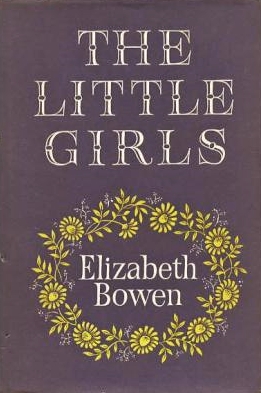
The Little Girls by Elizabeth Bowen ~ 1964. This edition: The Reprint Society, 1966. Hardcover. 256 pages.

The verdict is in regarding me and Elizabeth Bowen.

I do believe she gets the nod.

Though I found The Little Girls rather hard going at times, I came out the other side of this sometimes confusingly complex novel a convert. I can see why she’s such a polarizing writer; people seem to either love her or find her needlessly convoluted.

After this particular reading experience, I have to agree with the convolution-critics, but the end result is a rather compelling thing. Memorable in the longer term, I suspect it will be. And definitely one to re-read, if only to come to it with a questing eye to all of the clues the author provides in relation to its nebulous ending.

Dinah Piggott, a comfortably well-off widow in late middle-age, has embarked upon a project to assemble a collection of objects representing the people of her nowaday, to be sealed up in a cave at the bottom of her garden with a view to eventual discovery by a future race, once this one has vanished. Her friends and family are on the whole cooperative in each donating the requested twelve expressive objects, though Dinah has just come to the realization that her amassing collection contains a discouraging number of duplicates: strings of artificial pearls and pairs of nail scissors (some broken) are conspicuous by their frequency.

No matter, she is firm in her resolve to create her message to the future, though when she is confronted with the logistics of actually sealing the cave up and not being able to mull over the objects, she is taken aback by her own feeling of reluctance to let it all go into the dark, never to be seen (by her) again. Which triggers another train of thought, related to the time capsule concept.

Fifty years ago, Dinah – “Dicey” –  was an 11-year-old schoolgirl at St. Agatha’s, and she and her two closest cronies – accomplices? – had, at Dinah’s instigation, buried (in dead of night) a coffer containing a secret personal object from each of them, a collection of animal bones, and a letter in an invented language written in its creator’s blood.

Now Dinah has had a sudden compulsion to reach back into the past, to find her two friends, to engineer a reunion, and to disinter that long-buried coffer together, as a way to recapture the close companionship of their shared youth.

Dinah posts a series of deliberately provocative newspaper advertisements (…”if alive but in hiding, the two should know they have nothing to fear from Dicey, who continues to guard their secret…”) in five different newspapers which have readership throughout England, hoping for a bite.

And yes, indeed, both old friends respond, though with caution rather than full-out enthusiasm. For fifty years have passed since their shared school days; the Great War and the Hitler War have taken place in the meantime, with subsequent societal reorderings. The headstrong and occasionally wicked “little girls” of 1914 are now sedate older women with certain positions to uphold in their respectable social circles. Whatever they were then has not carried through to the now.

Or has it?

The centrepiece of this multi-layered novel is a flashback sequence to those schooldays, when clumsy, imaginative Diana(Dinah/Dicey), talented and indulged dancer Sheila(Sheikie), and academically gifted Clare(Mumbo), were a triumvirate to be watched with slightly horrified caution by their elders as well as their peers.

Dinah was something of the ringleader in schoolgirl exploits, though the others were hardly follow-blindly types; all contributed something vital to their partnership, and none were afraid to bluntly dismiss anything that approached each girl’s definition of “nonsense”.

This is not a gentle tale, though there are episodes of great tenderness. Dinah, for all of her apparent aggressiveness of character, surprises us by the amount of dedicated love she inspires in those she in turn holds dear, though we don’t find this out until the final episode, after an unwitnessed and undescribed near-tragic mishap befalls one of the key characters.

The novel’s ending is ambiguous, though I chose to interpret it as hopeful. Peace, if not entirely made, is seen as becoming ultimately possible between those of our characters most at odds.

The Litte Girls, for all its challenges to the reader – that sentence structure! – is brilliantly written, frequently humorous, occasionally off-putting, and ultimately deeply poignant. Great gaps are left here and there in the narrative, causing the reader a certain amount of discomfort as one struggles to realign the narrative, but it does all fall into place as episode builds upon episode, and those disparate clues I referred to early on show their importance to the whole.

Ah, yes, and there is a garden, wherein some key scenes take place. It is Dinah’s, and it is one of our clues to her particular character. (This passage also serves as an example of Bowen’s writing style. See if you can get through it all in one go, without backing up here and there to try to find where you’ve strayed outside the lines!)

On each side, the path was overflowed by a crowded border. Mauve, puce and cream-pink stock, double, were the most fragrant and most crushingly heavy: more pungent was the blue-bronze straggling profusion of catmint. Magnificently gladioli staggered this way and that – she was an exuberant, loving, confused and not tidy gardener; staking and tying were not her forte. Roses were on enough into their second blooming to be squandering petals over cushions of pansies. Flowers in woolwork or bright chalk, all shades of almost every colour, zinnias competed with one another. And everywhere along the serpentine walk where anything else grew not, dahlias grew: some dwarf, some giant, some corollas like blazons, some close-fluted, some velvet, some porcelain or satin, some darkening, some burning like flame or biting like acid into the faint dusk now being given off by the evening earth.

Gorgeous, yes?

An auspicious way to start of 2018’s reading year.

The personal rating: 8.5/10


Well, here we are again.

Is it just me, or did 2017 go past in a special kind of blur? I suspect a lot of us feel rather battered by the twelve months now drawing to a close. This year has been a challenging one in ways large and small for so many in our circle and beyond. That elusive “balance” which we strive for has been a hard thing to maintain, as the losses mount up and deep griefs are endured.

Personally speaking, I’m quietly joyful to be greeting the New Year tomorrow morning, though I suspect I will be in bed sleeping as the clock ticks over at midnight tonight. Which in itself will be a good thing, as sleep has often been elusive this past year, and starting 2018 well rested will surely be an auspicious thing!

I don’t generally do much in the way of making resolutions with the start of each new year, but it is nonetheless a time of reflection, and one tends to analyze what did and didn’t go as planned, and what one wishes one had done.

In relation to this blog, I do wish I had posted more often, as I genuinely miss the interaction with fellow readers of (mostly) older books. No promises, but instead a quiet “intention” to get on here more. Even if the posts are mere snippets, a sentence or two versus longer-winded essays, because I certainly do enjoy reading other people’s brief posts as much as I do their longer ones. And pictures are always a real pleasure to view, so I will try to share glimpses of my world a little more frequently.

Not sure if I can muster up a year-end book list to share – my reading year is also something of a blur! – but we’ll see what tomorrow brings, as I am likely to be enjoying a measure of solitude as my family will all be off elsewhere on New Year’s Day. They’ll be home in the evening, and that will be lovely, but earlier on there will be time for solitary reading and writing, and I may just have some thoughts to share.

I am reading my way into 2018 with an engaging bit of vintage literature, Elizabeth Bowen’s 1963 novel, The Little Girls.

I’m a Bowen neophyte, having sampled her on occasion but never quite being drawn in, but I’m well on my way with this one and enjoying it. It’s not nearly the nostalgically melancholic thing I thought it might be with its old-school-friends-meeting-after-many-years-apart theme; there’s instead a sardonic wryness going on which I am finding paradoxically appealing.

Shades of Rose Macaulay, perhaps? Another writer who must be tackled when the mood is just right, and when one has patience enough to slow down and savour the complexities of the writing. For so far I have been spending a fair bit of time re-reading sentences, as Bowen is a bit of a twisty writer, in a pleasurably artful sort of way.

I hope you have all been having a happy holiday season. Belated Merry Christmas to those of you who are of that faith and culture, and best wishes to everyone else at this time of contemplation and celebration as the year turns over with the Solstice. A full moon will be shining tonight, which seems a good omen for the year to come, lighting our way forward into the unknown.

Warm wishes from me to all of you, fellow readers. May 2018 bring you the best books and peaceful times to read them!

New Canadian Library paoperback, circa 1990. Another inappropriate NCL cover illustration – who the heck was in charge of selecting these? The E.J. Hughes painting depics Shawnigan Lake, on Vancouver Island. Sure, it’s a lake, and it’s even in British Columbia, but it’s a far, far way away from the Kamloops bush and the interior lake where most of the action of Swamp Angel takes place.

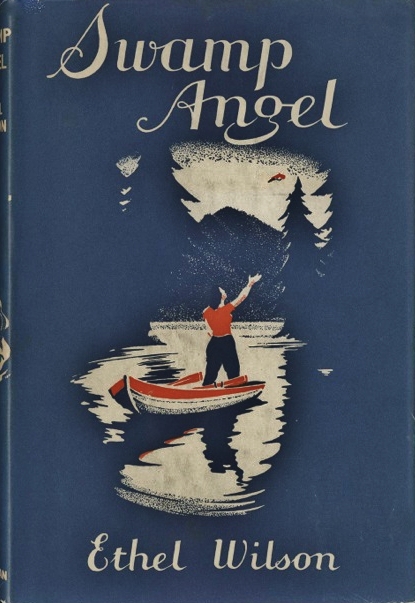
Swamp Angel by Ethel Wilson ~ 1954. This edition: McClelland and Stewart, 1990. Afterword by Georger Bowering. Paperback. ISBN: 0-7710-8958-9. 216 pages.

Maggie walks away from her deplorable second marriage, and goes to earth at a remote fishing lodge northeast of Kamloops.

Nell, with the help of a small pearl-handled revolver, puts Maggie’s abusive husband absolutely in his place.

Hilda, Nell’s daughter, watches from the sidelines, taking it all in, storing it all up.

And Vera, reluctant resident at the fish camp, sees Maggie both as a saviour and as a very personal devil.

Intrigued? Good.

Find it. Read it. The book is probably Ethel Wilson’s most well-known; copies from its multiple printings are easy as pie to come by, at least in every used book shop I’ve been in here in the writer’s home province.

Grand stuff from the brilliant and not nearly prolific enough British Columbian writer Ethel Wilson. What can I say that hasn’t already been said about this gem of a small novel, this delicate and complex story of suffering and personal redemption? (A quick online search brings an embarrassment of riches in the way of scholarly discussion.)

Maggie Lloyd, our main character in that the story follows her most intimately, is a woman of uncompromising integrity, and though that may sound dull, it’s not, not at all. Her moral sense drives her actions, her intelligence makes those actions generally successful, and her wry sense of humour – well-tamped down for understandable reasons (Maggie’s had more than her share of personal tragedy) but still active – keeps her likeable.

Maggie rescues herself from an unbearable situation, and proceeds to remake her life as a solo operator, making this something of a feminist manifesto. But while most of Swamp Angel’s main characters are women, the men in Ethel Wilson’s cast are memorable, too, whether swinish or heroic or stoic or just plain decent.

Early edition (first edition?) dust jacket. Those who’ve read the novel will know immediately what this depicts; I won’t give it away to those who still have to experience the quiet joys of Ethel Wilson’s little masterpiece of personal redemption.

Wilson paints her word pictures with brushes both broad and finely delicate; her pacing might well be described as variable (uneven sounds like a critique, so I won’t use that term, though it is also apt); her frequent descriptive passages sometimes stray into sentiment; but mostly it all clicks.

As a native British Columbian, I found an extra piquancy in the place descriptions, which Ethel Wilson made something of a specialty of, portraying mood as much as scenery. Very much about genius loci, as I touched on in my recent post on Hetty Dorval. Not sure if these passages will appeal quite so strongly to those not from here, but I am deeply appreciative of this element in her work.

A good strong 9/10.


The 1990 New Canadian Library edition of Hetty Doval has an inapt cover illustration. Its reproduction of an E.J. Hughes painting depicts coastal Ladysmith, B.C., a rather different locality (though they share a water’s edge location) to arid inland Lytton and its rivers descending from the mountains.

Hetty Dorval by Ethel Wilson ~ 1947. This edition: McClelland & Stewart, 1990. New Canadian Library edition. Afterword by Northrop Frye. Paperback. ISBN: 0-7710-8953-8. 104 pages.

Canadian-by-circumstance writer Ethel Wilson – born in South Africa, orphaned at the age of ten and brought to Vancouver, B.C. to live with her grandmother – produced a sadly meager handful of very well regarded novellas, novels and short story collections, all sharing themes of strong female protagonists and distinct senses of place.

In Hetty Dorval the place is the tiny Fraser Canyon community of Lytton, British Columbia. Ethel Wilson captured its unique essence perfectly, as I can affirm to, having spent some time there myself, the latest occasion being a day-and-night stay just a month ago. Though I didn’t consciously choose to read the novella in response to that recent experience, I found it added a definite piquancy to my reading.

Twelve-year-old Frances Burnaby – “Frankie” – is a ranch child boarding in Lytton during the week to attend school. She rides the fifteen miles to and from her home with calm competence, quietly revelling in her good fortune of having a loved and loving family, congenial friends and acquaintances, and physical surroundings of immense natural beauty.

The blue Thompson meets the silt-laden Fraser at Lytton, viewed from the bridge over the Thompson, where Frankie would have stood. The joining of the two rivers is used as a strongly symbolic metaphor throughout Hetty Dorval, its most obvious representation being the meeting and melding of innocence and its opposite.

Coming into Lytton from the north, a view much as our fictional Frankie would have had almost a century ago; the village hasn’t changed all that much; its setting not at all.

Not much happens in quiet little Lytton. Life for Frankie follows a predictable pattern of school and after school ramblings with best friend Ernestine. When the train pulls into the village’s tiny station, Frankie and Ernestine are there to watch as often as they can get away with it, “hanging out” by the train station being gently frowned on by the adults in the girls’ lives. (Social mores are predictably strict as the novella’s start is set in the early 1930s.)

So there they are at the train station, standing among the lounging bystanders, and there they see the household effects of newcomer Mrs. Dorval being unloaded – crates and crates of household effects, a grand piano, and a large Newfoundland dog. These are collected by a quiet grey-haired woman; the girls assume she is Mrs. Dorval, but they are wrong.

The real Mrs. Dorval turns up a few days later, and she proves to be quite the stunner. Young, beautiful, an accomplished horsewoman, musician and singer, both Frankie and Ernestine find her fascinating enough to mildly stalk in their adolescent way, collecting what information the local gossips can provide (not much) and trailing by the isolated bungalow Mrs. Dorval has rented and staffed with a housekeeper, the elderly Mrs. Broom (nicknamed by Hetty “Mouse”), and has turned into a retreat from the world. She does not encourage callers.

Frankie meets Mrs. Dorval one day while both are out riding, a spark is struck between the two of them, and while Frankie’s emotion is that of a garden variety schoolgirl crush, we’re not quite sure why Mrs. Dorval encourages her company. “Call me Hetty”, orders Mrs. Dorval, and though Frankie can’t quite bring herself to breach social etiquette between children and adults to this degree, she is happy enough to be plied with tea and treats and to provide an audience for Hetty’s musical performances. Frankie falls in with Hetty’s request to not tell anyone about her on-the-sly visits to the bungalow, and the infatuated Frankie complies, but inevitably someone catches on and word gets out, and Frankie comes home one weekend to a stiff grilling by her concerned parents.

An “unsavoury story” has followed Hetty Dorval from her last port of call – exotic Shanghai, a long way indeed from Lytton – and Frankie’s parents are appalled that their daughter has been co-opted into Hetty Dorval’s questionably moral establishment. Frankie’s mother won’t divulge the nature of Mrs. Dorval’s past history to her innocent daughter, but she is adamant in her condemnation, calling Hetty, with dry almost-humour, “The Menace”, and when she asks Frankie to break off the acquaintance, Frankie reluctantly complies, going back just once to say goodbye, which seems to be harder on her than on the jaded Mrs. Dorval, who sighs and takes it all in stride.

She looked at the fire a minute and then went on. “I know what they’ve told you, Frankie. They’ve told you I’m bad. You must try to believe,” she turned her brilliant look on me, “that I’m not bad, and that if you knew a little more you’d understand about it. Can you believe that? . . . Do you think I’m bad, Frankie?” she said, laughing a little.

I almost whispered, “No.”

“Try and stay my friend,” she said. “Even if you can’t come to see me, try and stay my friend . . . Very well . . . Good-bye . . . ” and with as little emotion as she would have shown in saying good-bye to the postman she got up – she did not come over to touch me – and went into her bedroom and shut the door. It made it easier and harder that she did not come and touch me. She left me standing in the suddenly withdrawn intimacy of the firelit room, with only Sailor sleeping there on the hearth.

I had stood only a moment when Mouse, who must have been listening, came into the room. She opened the front door. “You’d best be going,” she said. And I went.

As Frankie matures and moves out into the wider world – boarding school for a year in Vancouver, then off to England and the Continent – she finds herself once more crossing paths with Hetty Dorval, and the true nature of the woman at the centre of that childhood infatuation becomes ever more apparent, to Frankie’s growing dismay.

Is Hetty truly the menace that she seems to be? The label of “Narcissist” seems to fit perfectly, but how did Hetty get this way? What emotional scars (if any) has she hidden behind her beautifully emotionless face? Esther Wilson gives what might be telling clues, but denies a final judgement, leaving the reader to ponder possibilities…

Hetty Dorval is a memorable example of the novella form, and it is no wonder that it was chosen by the esteemed Persephone Press for reprinting in 2015.  Persephone’s expanded review is well worth reading, though it does contain a number of “spoilers” – first time readers may wish to wait till after to peruse this one.

An easy 9.5/10 for Hetty Dorval from me. Very close indeed to perfect. (I’m still mulling over what exactly Hetty was after regarding the childish Frankie. Was it merely moral predation, or something more sexually sordid? The author leaves a lot unsaid, but my 21st century mind speculates and wonders…  Fellow readers, what did you think?)

I have had a similarly positive response to two other of the writer’s novels, Swamp Angel – read in 2016 but not yet written about –  and The Innocent Traveller, posted about in 2013 here.

I do love the settings, because I know them so very well in real life, and though my Captive Reader friend Claire might differ regarding long passages of description (she’s not keen!) I’m always a sucker for a good word-picture of a place. The stories transcend their setting; for a native British Columbian it’s merely an added bonus. We agree on the essentials: good stuff from Ethel Wilson!

The view from behind the railway station at Lytton taken in mid September, 2017, looking northward up the Fraser River. All symbolism aside, Ethel Wilson’s vivid descriptions of the setting of her story demonstrate the strong emotional appeal of certain geographies on susceptible human emotions. Genius loci is discussed at some length, and the term is most apt.

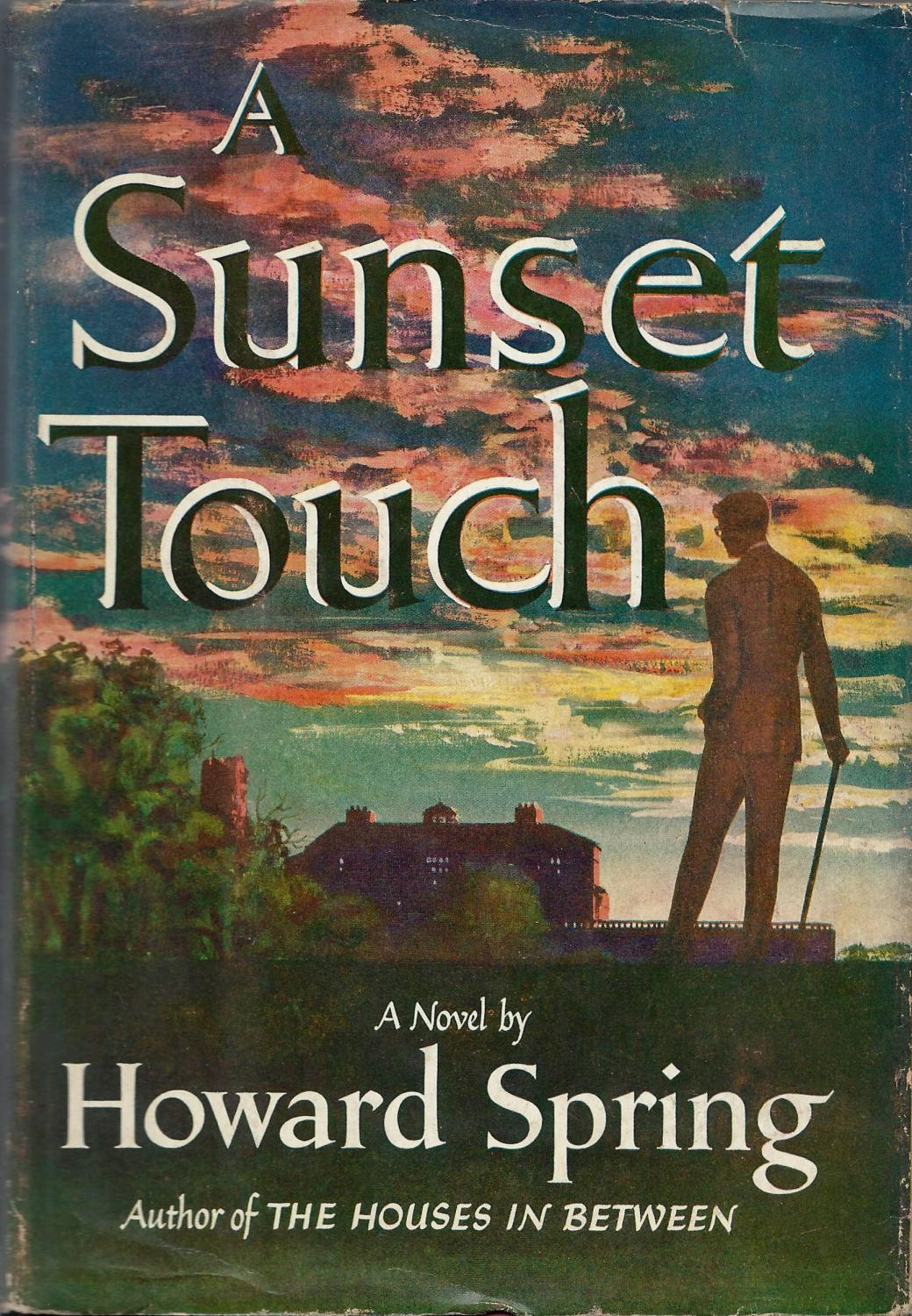
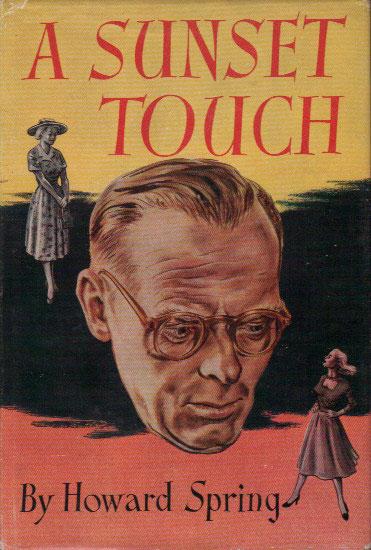
A Sunset Touch by Howard Spring ~ 1953. This edition: The Companion Book Club, 1955. Hardcover. 288 pages.

Just when we are safest, there’s a sunset-touch,
A fancy from a flower-bell, some one’s death,
A chorus-ending from Euripides,–
And that’s enough for fifty hopes and fears
As old and new at once as nature’s self,
To rap and knock and enter in our soul,
Take hands and dance there.

Robert Browning ~ Bishop Blougram’s Confession

Middle-aged London bank clerk Roger Menheniot, son of a respectable Cornish cobbler, considers himself the last offshoot of a noble Cornwall family. He stumbled upon knowledge of his ancestry in teenagerhood, and has subsequently spent all of his spare time in researching Menheniot family history, and furnishing his modest rooms in the style of the glory days of Rosemullion, the stately country home of his ancestors. A Sheraton bookcase here, an engraved snuffbox there. The estate itself has fallen on hard times, but Roger dreams of it at night, plotting how he can one day return to it, perhaps in retirement as a tenant of the little lodge at the gates, because he knows there is no way he’ll ever be able to afford the estate itself.

He’s visited Rosemullion, a golden moment of his life, and he’s writing a history of his family, knowing full well it’s not likely to ever see publication. No mind, it’s a true labor of love.

He began by calling it A Cornish Family, but changed that to The Menheniots. He loved the sound of his own name. He loved the look of it as the letters formed under his pen. He liked to turn it over on his tongue in company with other famous names from the county he had never lived in: the Carews, the Elyots, the Killigrews, the Menheniots. He was becoming a crank and a recluse, living with imaginations. He knew it, and he gloried in it. After all, how many men belonged to a family like his?

No: it was not likely that he would ever shake it off now. He had spent too many hours in the Public Record Office and the British Museum, boring like a wood-beetle into the decayed and moldy fabric of the family that had not for a long time lived on ancestral acres and that now, as far as he knew, had no living member but himself. But never had the Menheniots produced a more fanatical Menheniot, a bank clerk by day, Menheniot of Rosemullion by night.

Roger despises his real life; he despises London. Even more so now that it is a city torn by war, for it is 1944, and Roger, shaken out of his fantasy world, has had to take notice of the greater world, and even to take part in civic duties, fire-watching in his neighbourhood as the bombs rain down.

The war changes everything, as it brings into Roger’s miniscule orbit a person whom he had no inkling of at all, an American serviceman who shares his name, and who proves to be another offshoot of the almost-extinct family.

Phillip Menheniot – Phil – is intrigued by his new-found relation, and likes him quite a lot, though he smiles at Roger’s infatuation with their shared ancestry. Over the course of several meetings, the two men become friends, until Phil is swept away by the war, never to be seen again.

Then, in September of 1945, two things happen. The first is that Roger stumbles upon a house-agent’s ad for the estate of Rosemullion. And the very next night he receives a lawyer’s letter, informing him of an unexpected legacy.

Roger and his first love.

Need I tell you what happens next? Yes, Roger’s fantasy is now within his grasp, and he seizes the day. Rosemullion is his!

And with it comes an enlargement of Roger’s life, as he is forced to step outside the comfort zone of his reclusive London life, to move in a wider circle in his new Cornish home. He makes the acquaintance of the local vicar, Henry Savage, an elderly gentleman (in every sense of both words) with a shocking back story, and of young Dr. Littledale, and the doctor’s spinster sister, Kitty.

Kitty and Roger find themselves falling into step, acquaintance ripening to something warmer and deeper, until the shocking day when Kitty attempts to interest Roger in a physical manifestation of their mutual attraction – she kisses him!!! – and Roger, overwhelmed by he’s not quite sure what emotions, finds himself in equal measures repelled by what he sees as her shameful advances, and suddenly aware that the kiss has stirred feelings (yes, those feelings) which he never realized he had within him.

Roger is torn between good girl Kitty and bad girl Bella. What’s a 45-year-old virgin to do?!

While Roger is engaged in the turmoil of his new self-awareness, along comes pretty wanton Bella, and Roger discovers at long last the joy of sex.

What of Kitty, then? Where is she? Waiting in the wings, she is, patiently watching Roger struggle with his metamorphosis into Fully Awakened Manhood. And when Bella comes to grief (poor doomed thing!), Kitty is still there…

Well, well, well.

In my readerly opinion, the early part of the novel was much the most promising, and when Roger heads to Cornwall my curiosity was deep indeed as to what he would make of the rehabilitation of Rosemullion.

Howard Spring instead goes off on a completely different tangent, abandoning the whole scion-of-an-ancient-house theme and instead descending into plain old titillating romance novel territory. It’s more Norah Lofts-style gothic there at the close (we even have a mysterious death), versus Daphne du Maurier-style psychological drama. I found it slightly – okay, more than slightly – disappointing, as our author changed his generical horses in midstream.

If The Houses in Between and Shabby Tiger are A-list examples of what this writer was capable of, A Sunset Touch, while still eminently readable, is one level lower.

My rating: 6/10


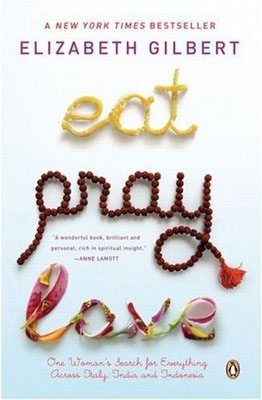
Afer years of glancing at Elizabeth Gilbert’s ubiquitous 2009 bestseller out of the corner of my cynical eye, I had a “What the heck!” moment in the Sally Ann the other day and invested my 50 cents in a pristine paperback copy.

Someone read it, because it’s dog-eared here and there, but its crispness tells me they only did so once, with care, before boxing it up for giveaway. It’s going into my giveaway box in much the same condition; I’ve decided to abandon it in the first third of reading; we’re still in Italy with Elizabeth making mildly lustful glances at the twin brown-eyed Italian boys she’s supposed to be learning conversational Italian with.

What can I say that hasn’t been said? For every one gushing reader who swears this thing has changed her life (and interestingly enough, most of the online commenters are female), there seems to be another in full sneer mode. Love it or hate it, the book has sold in the millions, so Liz Gilbert (as she styles herself on her self-promotional website) isn’t about to get too bent out of shape by her detractors.

I took a deep breath as I delved in to the thing – “Be fair”, I cautioned myself, “maybe you’ll find it life-changing, too” – but sadly I am immune to whatever magic so many of my fellow middle-aged sisters have found therein. My spouse can rest quiet in our marital bed – I told him this and he took it with his usual stoic aplomb; he’s well-used to my book-inspired monologues; the bait has to be tempting indeed to get him to engage – undisturbed by a restless wife yearning for more inner fulfillment than she’s already getting living her modestly interesting life in her modestly comfortable home in her modestly beautiful and not very exotic part of the world. No guru calls my name alluringly across the ether; no gorgeous lover is waiting in the wings to open his arms if I do decide to take my departure from my marriage; no $200,000 advance is sitting in my bank account to finance my escape to Europe and the trendier bits of Asia.

Aha! That last bit’s the real rub, I think. And it got me thinking about “manufactured” memoirs, of which there are a fair few out there, and their spin-master authors, who’ve convinced their publishers to finance their travels, in order that they can collect material to weave into some sort of palatable narrative to woo the stay-at-homes with vicarious “it could be me” dreams.

Nice work if you can get it, and in this particular case I’ll be leaving our Liz to it. I’m sure she won’t be sobbing on the bathroom floor if she catches wind of my dismissal, no worries there for either, provider of vicarious thrills and judgemental sometimes-consumer of the same.

Is it a real memoir if someone’s paying your way to collect material before you even set out? Don’t you need to include that bit in the narrative? Many do, and their dialogues with their backers can add considerable interest to the tale, and win us over because we utterly get it, and are cheering the traveller on.

Eat, Pray, Love is just too coy about its true background for me to feel the love. The author is too shifty-eyed; it doesn’t ring true, and didn’t before I found out about the advance. I felt vindicated when I learned of it; my gut-reaction reluctance to buy in suddenly made perfect sense.

Your thoughts, as always, are most welcome, whichever side of the Eat, Pray, Love divide you find yourself on.

“Dear Ones, come buy into my journey…” Elizabeth Gilbert with well-staged backdrop, photographed in Two Buttons, her “Eastern accessories” retail store in New Jersey, opened after her return from her fortunate travels, second sexy husband in tow. The shop closed in 2016, after Gilbert’s second divorce.


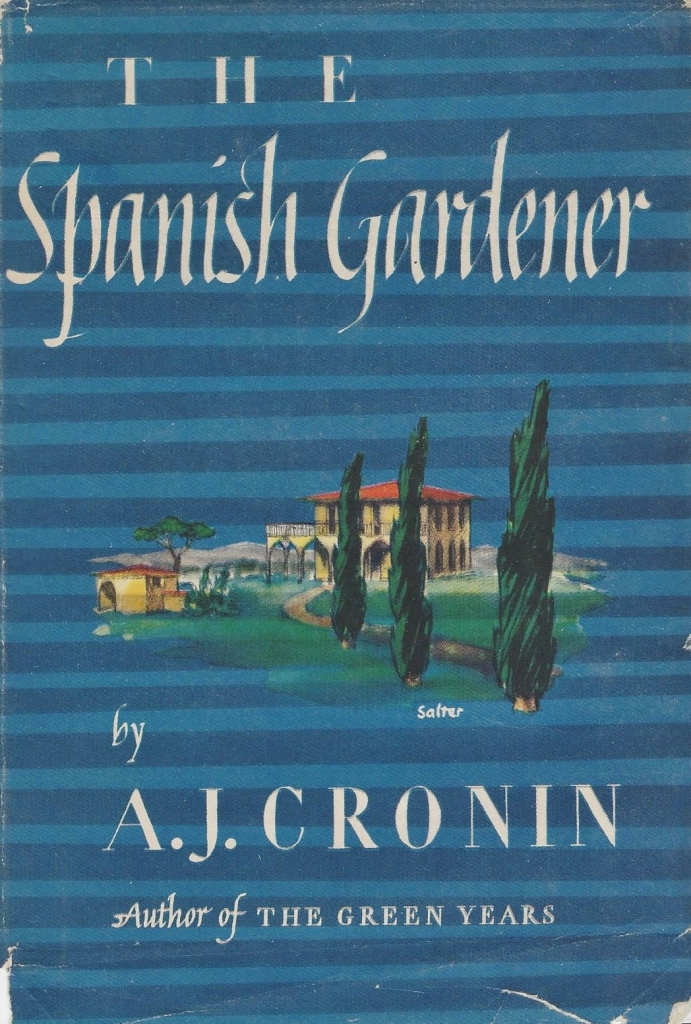
The Spanish Gardener by A.J. Cronin ~ 1950. This edition: McClelland and Stewart, 1950. Hardcover. 263 pages.

A fast, intense read, full of palpable foreboding, which builds to a bitter climax.

An American diplomat, estranged from the mother of his young son, frets in the stagnation of his career as he is continually passed over for promotion, being instead shifted from one backwater European consulate to another. He consoles himself that one day he will be vindicated, when he finds a publisher for his ambitious life-work, a biography of obscure 17th Century French philosopher Nicolas Malebranche, and with misguided anticipation of the resulting fanfare, dreams of being able to retire from his not very stellar career to a life of acclaimed authorship.

Harrington Brande is obsessed by his own standing in the complicated hierarchy of the foreign diplomatic service, and his immense ego is as fragile as it is blind to its possessor’s deep and well-deserved unpopularity with everyone whom he comes in contact with. The one exception is 9-year-old Nicholas – the name no coincidence – who returns his father’s clinging and jealous infatuation with innocently filial love.

The pair fetch up in a quiet coastal Spanish town, and Brande is relieved to find that both his residence and his official offices are in much better condition than some previous postings have led him to fear. An overgrown garden leads to the engagement of a teenage gardener, a young man of poor family but esteemed local reputation due to his intelligence, happy nature, competence at his work, and stature as an accomplished athlete.

Gardener José and semi-invalid Nicholas are deeply attracted to each other in the most purely platonic of ways, and a deep friendship springs up between the two, flourishing until the father notices the son’s gaze turning to José too often. Steps must be taken to break up this most unsuitable of friendships – added to Harrington Brande’s other unlikable personality traits is one of deep snobbishness – and the tighter he clings to his son the more tenuous his position becomes as the sole possessor of Nicholas’s affection.

A sinister chauffeur-butler, an unscrupulous psychiatrist, and Brande himself manufacture a situation in which José finds himself entrapped in a false accusation. Nicholas remains steadfast to his friend, but all pleas for mercy serve merely to intensify the father’s desire for revenge on his supposed supplanter.

There is a strand of sexual frustration and homoerotic obsession running through this dark and disturbing little novel; one can’t help but feel that Nicholas’s mother has done the wise thing by leaving her husband to his own devices. The child is protected by his tender age from understanding the nuances of his father’s self-torturing motivations, but he is growing up, and becoming aware that all is not as it could and should be.

Tragedy inevitably strikes, as we have known it will all along.

The author allows the slightest gleam of redemption in his final scenes, but makes no firm promises.

Though the scenarios are laid out with perfect clarity, I feel that The Spanish Gardener’s narrative strength lies more in nuance than salacious detail. Definitely a work of its time, a sober post-war character portrait and an emotionally involving though rather subfusc drama. I found it impossible to look away from and read it all in one go this cold fall evening.

My rating: 7.5/10.

Initially a qualified doctor who started writing during a long convalescence from illness in 1930, A.J. Cronin was a Scottish writer of novels, novellas and short stories, and his work was both popular and critically acclaimed. His dramatic stories were a natural for film adaptation; Cronin went on to add successful and lucrative careers as a film and television writer to his other accomplishments.