Archive for the ‘Stevenson, D.E.’ Category

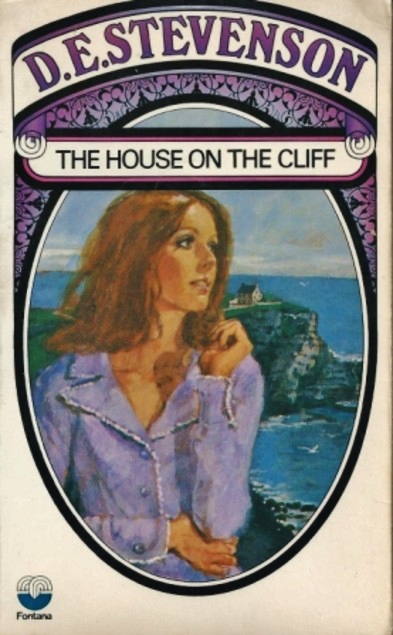
the house on the cliff pb cover d e stevensonThe House on the Cliff by D.E. Stevenson ~ 1966. This edition: Fontana, circa 1960s. Paperback. 224 pages.

My rating: 7.5/10

What a blissfully easy read, second time around this year for The House on the Cliff. Looking at my handy-dandy reading list, I see that I first read it way back in March of this year, while in the throes of dance festival season (my teen daughter was a competitive dance troupe member until this autumn) which seems aeons ago now, as we’re as close as touching to mid-November.

And though I still retained a reasonably accurate memory of the plot line, many of the details were completely erased from my brain. Not such a bad thing in a comfort read, I maintain, because much of the charm in those is their re-readability. I see I rated this one quite highly back in March, and I’ll keep it there, for though it is a slight thing, it is very pleasant, and that has merit enough for me.

Young Elfrida Jane Ware – twenty-one-ish, I believe – is having a rough time of it. Elfrida has grown up as a child of the theatre, accompanying her second-rate actor father and third-rate (despite beauty and intelligence) actress-mother-turned-seamstress from posting to posting, knowing only the backstage world as she grew up, until one day her father disappears, leaving Elfrida to eventually scramble into an acting career herself, in order to help support herself and her frail mother. “Dead”, her mother claims; “Run off!” whispers the theatre community; but no matter which is was, Elfrida has been popped in at the deep end. She’s been working bit parts here and there, but she’s not exactly star stuff herself, though she’s managed to snag a key role in a failing comedy, along with theatre star Glen Siddons, whom she has a serious (though, she thinks, hidden) crush on.

Now her ailing mother has quietly died, and through her grief Elfrida gamely soldiers on, until one day when her benevolent landlady shows her an advertisement in the newspaper asking for news of Marjory Thistlewood – her mother’s maiden name. When Elfrida visits the lawyer’s office named in the advert, she is astounded to find that she has inherited her grandparents’ country house, Mountain Cross, a not-so-shabby two-storey stone-built gentleman’s home on a sea cliff in Devonshire.

the house on the cliff dj d e stevenson

Here is someone’s vision of Elfrida’s house. In the book it is surrounded by neglected gardens, which appear to be missing here, though it does have the appropriate stunning view of the sea. At least there are no couples clinching on this dust jacket, or on the Fontana cover above. For this heroine is very good at standing alone, and avoiding passionate advances with firm grace. Some other covers I’ve seen in my internet travels are rather more trashy, showing the heroine in full embrace with an unspecified male companion. (Coming back to add that there is one passionate embrace, but as it is very much a last page sort of thing, it doesn’t necessarily represent the heroine’s usual habits.)

The search for her mother was meant as an attempt at reconciliation from her estranged parents – Marjory had eloped with Elfrida’s father against all parental advice – and since both of Marjory’s parents and Marjory herself are no longer living, Elfrida gets the estate.

Unluckily there is only the tiniest of cash inheritances, but Elfrida decides to go off anyway and try living in her new possession, hoping to scrape by on her meagre inherited income. In this she is encouraged by one of the junior partners in the law firm, one Ronnie Leighton, who knows Mountain Cross well from his own childhood. Ronnie and Elfrida get along like old pals from the first time they meet; the reader may draw what inference they like from this convenient kindred spirithood!

To Mountain Cross goes our heroine, abandoning her life on the stage with only the briefest moment of regret, and that for the glamorous Glen. She falls in love with her ancestral home, and everyone about falls in love with sweet Elfrida, relieved that she is not some flighty actress, but a new version of her gentle mother, whom everyone remembers fondly.

Everything goes most swimmingly, in fact, until the visit of a cousin from Canada, who has lost out on the inheritance through his own carelessness. Walter Whitgreave is on the hunt for a stamp album which he claims is off sentimental value only, but a search is unsuccessful, and Walter wanders away muttering forebodingly. (Cue dramatic music.)

Then who should show up on Elfrida’s doorstep but Glen Siddons himself, along with his eight-year-old son from his tragically ended youthful  marriage. The child, Patrick, has been fostered out since his mother’s death, but Glen has collected him at last. Though Glen is playing the doting father and  promises to take an interest in Patrick at long last, we sense that this is not going as well as it could be.

The cast of characters includes a slightly fantastical married couple who decide to stay on at Mountain Cross for love alone (Elfrida cannot afford their wages), a handsome local bachelor who has checked out his new neighbour and found her most appealing, and various local characters (“characters” in every sense of the word) who bend over backwards to ease Elfrida into country life. What with the three young men (Ronnie, Glen and neighbour Lucius), not to mention the adorable Patrick – also smitten with our heroine – Elfrida’s retreat is becoming rather full of male presence; we know romance is inevitable, but which one will it be?

I’m not telling, though I did drop a rather obvious clue early on. Oh, and the stamp album reappears, with prefect timing. The villains wander away, leaving Elfrida in possession of her house on the cliff, and her happy new life.

(And there are pigs. And a friendly milk cow. Though no ducks. Read the book, and you’ll get the reference to ducks. A minor note, but I’m rather fond of ducks myself, so their mention piqued my interest.)

How very sweet! <happy sigh>

I wonder if some of the appeal in this not-very-complex story is Elfrida’s gallant disposition, her quiet but witty sense of humour, and her refusal to make a complete fool of herself even while enmeshed with forthcoming and handsome young men? One gets the feeling that this young lady knows a lot more than her swains (bar one) give her credit for. We wish Elfrida well from first to last, enjoying with quiet vicarious pleasure her acquisition of lovely house, thoroughly nice new friends, and well-deserved romantic partner.

Shall I read another, or should I go for something a bit more intellectually demanding? It’s been hectic round here lately – all in a good way – just dreadfully busy – so I suspect another easy-on-the-tired-brain D.E.S. may be coming to bed with me tonight. Which one, though? Hmmm…
Read Full Post »

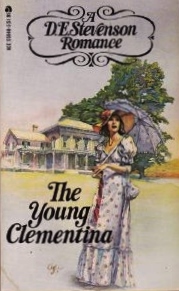
the young clementina d e stevensonThe Young Clementina by D.E. Stevenson ~ 1935. Original/alternate titles: Divorced From Reality and Miss Dean’s Dilemma. This edition: ACE, 1975. Paperback: 0-441-95048-5. 320 pages.

My rating: 9/10.

Completely met expectations, up to and including the blush-inducing ending, which lost the story its single “you’ve got to be kidding!” point. Golly, D.E. Stevenson often bobbles in those last few pages, doesn’t she?!

Well, really, the ending’s not that bad. Just…hmm…maybe just a little bit rushed? And a little too good to be true? But hey! – that’s why I’ve come to quite adore D.E. Stevenson. This story in particular is escape literature at its delicious, romantic, improbable, suspend-your-disbelief for hundreds of pages, period-piece-vintage best.

Okay, here’s a brief overview of the set-up of this novel. It’s very nicely done indeed; one of the author’s melodramatic (versus her more placid and thoughtful) minor masterpieces.

I wonder how a hermit would feel if he had spent twelve years in his cell and were called back to the world to take up the burden of life with its griefs and worries and fears; if he had passed through the fire of rebellion and achieved resignation; if his flesh had been purged by sleepless nights and his mind had found the anodyne of daily work. Would he feel afraid of the world, afraid of the pain awaiting him, afraid of his own inadequacy to deal with his fellow men after his long, long years of solitude? Would he refuse to listen when the world called, when his conscience whispered that his duty lay outside his cell, or would he gird up his loins and go forth, somewhat reluctantly, into the world which had turned its back upon him for twelve years?

My mythical hermit is standing at the parting of the ways, and so am I. Two roads are open to me, one lonely but well known, peaceful and uneventful; the other full of dangers and difficulties which I cannot foresee…

Our narrator is middle-aged Charlotte Dean, inhabitor of a dreary London flat, efficient and self-effacing librarian at a quiet geographical library – repository of “any book that adds to the geographical knowledge of the world” – recluse from that very world. Her only friend, aside from her kind employer, Mr. Wentworth, and her dedicated charwoman, Mrs. Cope, is her diary, in which she records her daily doings as she has done from childhood.

Ah, childhood. Happy days, indeed, when Charlotte was the beloved child of the Parsonage in green and flowery rural Hinkleton, running wild with her bosom friend, Garth Wisdon, equally beloved child of the Manor. Charlotte and Garth were inseparable, and their friendship was not at all disturbed by the advent of Charlotte’s small sister, Clementina – “Kitty”, as she was soon named. Not then, not in childhood. But as the years passed and friendship ripened to something deeper, Kitty had her part to play in the dissolution of the bonds that held Charlotte and Garth together…

The Great War tore Garth away from Hinkleton, and upon his return it is, unexpectedly, Kitty who becomes the new lady of the Manor, while Charlotte remains at home to care for her failing father, and then creeps off to London when his death leaves her alone and penniless.

For some strange reason Charlotte and Kitty are no longer the close friends that they were in childhood, and Garth openly sneers at his once-beloved “Char”. She meets them only occasionally, and so is rather surprised to be asked to act as godmother to her young niece Clementina  – named after her vivacious mother – and to visit at Hinkleton Manor for the occasion. But Garth is still dismissive and sarcastic, and Kitty disturbingly self-centered and complaining, so Charlotte returns to her quiet life with no thought but to regain her hard-won peace of mind, and to leave the dead past buried.

Then, twelve years after her flight to London, Charlotte’s world is turned topsy-turvy by the dramatic re-entry of Kitty into her life, and she faces the dilemma referred to at the start of the story…

For another look at the story, and an enthusiastic recommendation, a visit to Fleur Fisher‘s review will be in order.

I greatly enjoyed this grandly melodramatic and deeply romantic tale. Most engaging and deeply readable, and for that I’ll even forgive the rushed and too, too predictable “surprise” ending, my one perennial gripe with this author’s style. She builds up her story wonderfully well, rockets it along in fine style, and then chops it off with a hurried ending, almost every single time. Grrr. (And do please ignore this complaint; it’s a very minor one, and in no way puts me off reading these books with genuine enjoyment.)

I can see why this novel is so highly thought of by D.E. Stevenson devotees; she’s in fine form throughout. I do believe this one has just been re-released on July 2, 2013, so it should be readily available, just in time for your summer reading pleasure. Here’s the Amazon.com link, which includes an excerpt of the first chapter.

And I’ll say once more, this is a very vintage romance, written in the 1930s, with all of the expected clichés. It is, perhaps, even a bit old-fashioned for its time; it rather reads like something out of the closing years of the century before. With that in mind, enjoy!

Read Full Post »

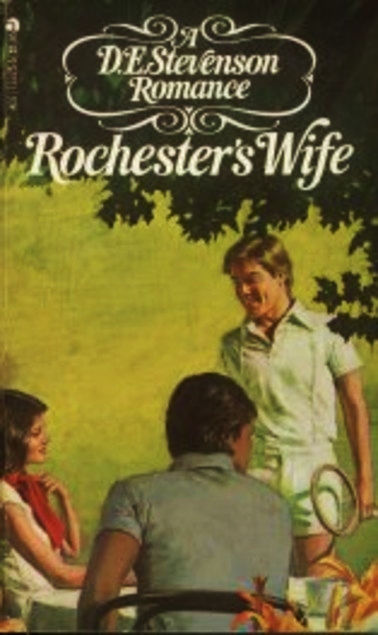
rochester's wife d.e. stevensonRochester’s Wife by D.E. Stevenson ~ 1940. This edition: Ace, circa 1970s. Paperback. ISBN: 978-0441733255. 335 pages.

My rating: 5/10.

*****

This is one of the “secondary” D.E. Stevensons, and, I believe, a “stand-alone” book, as none of the characters seem to reappear in any of the other stories. Though published in 1940, the time frame is pre-W.W. II, as there are only a few references to the “situation in Europe”, and, though the atmosphere is cloudy with foreboding, the focus is on the troubles of the individual characters, versus those of the wider world.

Young (in his late twenties) Dr. Kit Stone has returned to England after four years of travelling round the world seeking adventure. He had long cherished the ambition to become a sailor, but his (widowed) physician father had pressured him into studying medicine instead, with a view to taking over the family practice. The elder Dr. Stone died just as the younger Dr. Stone qualified, and the practice was instead sold, with the proceeds being split between the family’s two sons. The elder brother, Henry, had gone into business as a successful stockbroker and invested his share accordingly, while Kit, suddenly at loose ends, has decided to see something of the world.

Kit’s travels are touched on continually throughout the novel, and sound quite fascinating in and of themselves. He’s been in China, “looking for the war”, and has seen more of it than he had planned for. There is a reference, near the end of the book, to his standing in a marketplace when a shell fragment kills a mother and baby standing next to him; he is “spattered with their blood”, and there is a statement that he has seen quite a lot of blood in his travels. Strong stuff for this mild romance! Another incident, which has more bearing on the eventual plotline, is that Kit has had experience with diagnosing and treating a case of insanity while in America. One would rather like a full itinerary of his wanderings; he seems to have covered quite a lot of ground!

So now Kit is back in England, and though he still feels that he can’t bear to be “tied down”, he allows his brother to persuade him to try out steady employment for a while. Henry’s business partner, Jack Rochester, lives in the village of Minfield, just out of London. Jack’s wife, Mardie, is good friends with the elderly village doctor, who is getting overwhelmed with the demands of his practice, and when she hears of Henry’s brother’s sudden return, puts forward the idea that perhaps Kit might be interested in a position as assistant to the Minfield practice.

So Kit, rather reluctantly, agrees to try out life in an English village. Dr. Peabody welcomes him with gruff suspicion, which we (and Kit) immediately see as merely hiding hte proverbial heart of gold. The Peabody household consists of the elderly doctor, his bitter spinster daughter Ethel, and a grandson, precocious (and exceedingly likeable)young Jem, who is living in England for the “healthy climate” while his parents reside in Ceylon on a tea plantation. They are soon joined by another daughter, Dolly, recently married and, unbeknownst to her family, newly pregnant. Her husband, stationed in Malta, has asked her to stay in England because of her pregnancy, and Dolly’s reluctance to share this news with all and sundry has led to some speculation that perhaps her marriage is already in trouble, because otherwise why wouldn’t she be following her spouse?! Dolly and Ethel are the classic bickering sisters, and their feuding and continual cutting comments to each other add a lot of spice to this rather pedestrian tale.

The heart of the novel is an (apparently) doomed love triangle between Kit, the absolutely beautiful, charming and saintly Mrs. Rochester (Mardie), and her high-strung husband, Jack. Kit is immediately smitten with Mardie; Mardie is deeply in love with Jack; Jack depends on Mardie for emotional support as he deals with his stressful job, and much is made of how happy Mardie and Jack were in the first year or two of their marriage, though now, in year three, things are rather more difficult.

As young Dr. Stone is absorbed into the Minfield world, all seems to be going well with the “settling down” process, but for the unrequited love bit. Kit yearns for his unavailable love, and we start to see little hints that perhaps his passion isn’t exactly unappreciated and unreturned, but of course, there is that rather prominent husband in the picture. Jack, however, is showing signs of what could be charitably described as nervous tension; his personality is deteriorating by the day, and Kit and Dr. Peabody are soon looking up the characteristics of “insanity” in their medical books, and talking of bringing in a specialist.

The ending of this tale is a bit sloppy and unlikely, though everyone ends up neatly paired and with problems happily solved. I’m sorry to say that this is not one of D.E. Stevenson’s better efforts among those I’ve read so far, though there are many diverting situations throughout the book, mostly concerning secondary characters. We have the relationship between the Peabody sisters, young Jem with his brilliant talent for mimicry, an elderly Scottish housekeeper, Hoony, and her illegitimate grandson, Wattie, and, off in the background, the very happy marriage between Henry and his rather liberated wife, Mabel, who dabbles in the stock market quite successfully on her own, with her husband’s proud approval. The relationship between the two brothers, Kit and Henry, is nicely portrayed as well. They do seem a likeable family, with reassuringly human flaws fully recognized and easily forgiven by the reader.

A reasonably decent read, though I found myself groaning and figuratively smacking hand to forehead occasionally, especially regarding the whole “insanity” thing, and the remarkable (!) scenario the author has dreamt up for its resolution. Definitely worth reading as part of the D.E. Stevenson canon, though I’m afraid I closed the book and said farewell to the characters with a feeling more of relief than reluctance!

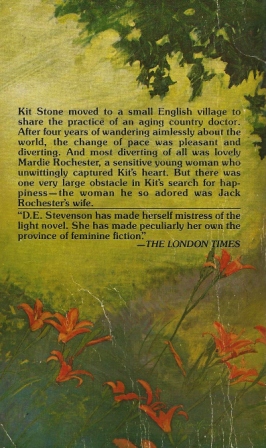
rochester's wife d.e. stevenson daylily detail 001And I must say something about the dreadful paperback cover. (Cover illustrations being, as some of you may have gathered by my continual harping on the subject, something of an issue with me.) Why, oh why do publishing companies insist on putting “current” illustrations on books set in past times? The characters illustrated on the Ace cover are obviously from the 1970s in dress and hairstyle; I cringe when I look at it. The only thing that that I found attractive (and here is the hort in me speaking) is the rather lovely inclusion of a border of tall orange daylilies (probably Hemerocallis fulva ‘Europa’ from the looks of them), in the foreground of the trio of tennis players and extending around the back of the cover.

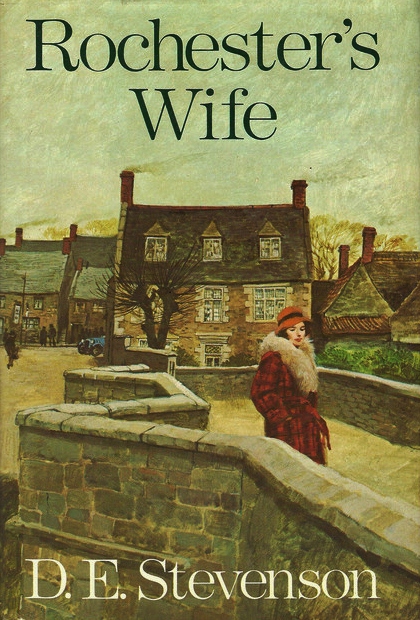
Much more appropriate is this other coverrochester's wife hc dj d.e. stevenson, which captures the mood and setting exceedingly well.

I am coming to the end of my personal stash of D.E. Stevensons, and the more I read of her the more eager I am to go on with building the collection. It’s going to be an expensive year, I fear. Even the tired old paperbacks are seriously overpriced, but I’m afraid I’m now hooked and will be playing the seeking game to the full extent that my pocketbook allows.

Part of the fun is the glorious awfulness of some of Stevenson’s scenarios – I just now have realized I’ve made no mention of the Jane Eyre references in this particular novel – nothing subtle about that, is there?!

D.E. Stevenson. When she is good, she is very, very good, but when she is bad … maybe she’s even more interesting!

Read Full Post »

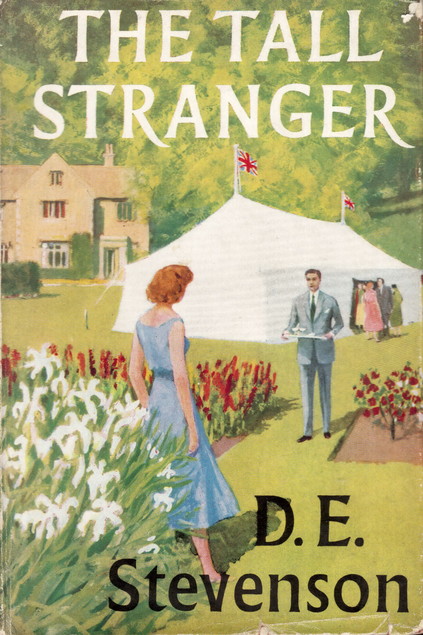
Tthe tall stranger d e stevenson hc djhe Tall Stranger by D.E. Stevenson ~ 1957. This edition: Ace, 1978. Paperback. ISBN: 0-441-79621-4. 252 pages. (Note: This is not the cover of the paperback, but of the original hardcover dustjacket. The Ace paperback illustration is quite a different thing! I will spare you it.)

My rating: 8/10.

Yes, it’s a very high rating for what is basically a “fluff” book, but it was what I needed last night, after a very trying day (condensed version – an unexpected visit to the vet with our 13-year-old dog and $2000 in emergency surgery fees, prognosis a guarded “fair”, upgraded to “good” when it was apparent that she handled the surgery very well indeed, all things considered) and it (the story) made me forget our combined woes for a bit, and made me happy. Maybe I should even put it up a point or two more for that!

Postscript – the dog is back home and looking most happy to be here; though rather sore and stiff after her internal surgery. Feeling optimistic this morning that all will be well with her for at least the near future, because, realistically, at 13, the inevitable final parting is not all that far away. This is the dreadful bit about sharing your home and heart with pets…

*****

This is one of D.E. Stevenson’s minor romantic novels which doesn’t get much press – I don’t think I’ve ever read anything about it at all. And probably for good reason – it’s a slight little thing, and the characters are nothing if not “stock”. But I loved it!

So here we have two roommates in a London flat. Barbara – Barbie – works for an interior decorating firm, while Nell is a secretary to a doctor. As the story opens, Barbie is in hospital with a mysterious virus, exceedingly ill. To cut a long story short, she recovers, due to timely intervention by Nell’s employer, and the loving care of Barbie’s Aunt Amalie and her companion-housekeeper Miss Penney.

Now toss in a charming but shifty love interest for Barbie, Aunt Amalie’s handsome stepson Edward, and a mysterious “tall stranger” met briefly at a crowded wedding. Relocate the action to a rather shabby castle on the Scottish border, garnish with a lovable child (and one not quite so immediately lovable), various charming clients-cum-friends, a basket of kittens, a dramatic storm and a rescue from an island, another love interest for Nell (looks aren’t everything in a man, you know), and there you go. One trials-and-tribulations-overcome-with-a-very-happy-ending double (quadruple?) romance.

Not very realistic, but lovely to escape into. Nicely done, Dorothy Emily!

I promised myself I’d just post and run with this one, because it’s really not the material for any sort of deep analysis, but I feel like sharing this snippet from midway through, because of course spring is, by the calendar at least, here; my life (and nursery greenhouse) is full of plants and my mind is full of gardening plans, and I too have a fondness for, but, sadly, no luck with, the lovely willow gentian.

The garden was now at its best; wistaria rioted over the south wall, its branches bowed down with their weight of blossom, and the willow-gentian in its cool shady spot was beginning to come into flower. Soon the little bushes with their slender stems would bear narrow bells of deep blue flowers, and the corner of the garden where they grew would look like a pool of blue water. Amalie was very fond of these gentians, she had grown them herself from a few seeds gathered on a visit to Switzerland. She had been told that they would not grow here in the Cotswolds but they had liked their new home and had thriven and multiplied under her care.

Amalie was in no hurry for them to flower. She would have held back the garden if she could … for, as each plant flowered and faded, she knew that it was gone for a whole year. The longest day was long past … Next year was such a long time to wait … all through the dead winter. Summer days passed too quickly, thought Amalie, and then she thought, but there are still the chrysanthemums to come and the dahlias and the proud upstanding gladioli and the gold of the ripe corn in the garvest fields and the flames ofthe autumn leaves!

The years do pass so swiftly, as do the days of the garden and the moments of each flower’s particular glory, but (apt thought with Easter coming and all) there is at least the eternal resurrection of plant life each year to look forward to. For every thing there is a season, if you’ll forgive the overused but most appropriate quotation, though (increasingly, it seems with the passing years) the season in question is often too brief. Would I freeze time if I could? Perhaps occasionally…

I’m going to my sister’s 50th birthday party today, so please forgive my rather angsty ramblings. Half a century. No matter how casual we are about joking that 50 is the new 40, it’s a slightly sobering milestone!

gentiana asclepiadeae hf 2013 x

Read Full Post »

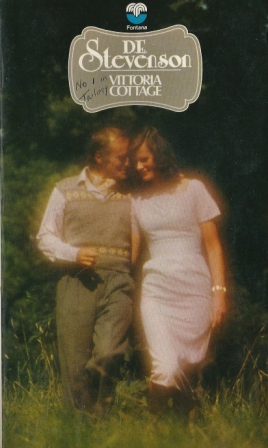
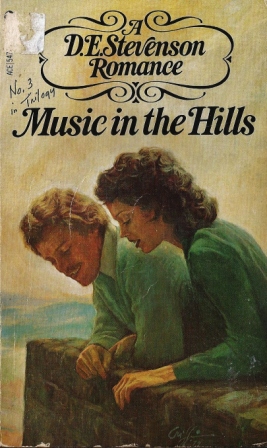
I’m going to review these together. They were both quite wonderful, so much so that, pressed for time as I am this week, I cannot let them pass onto the “have read” list without mention. In my opinion, this trilogy, Vittoria Cottage, Music in the Hills, and Shoulder the Sky, have the Miss Buncle books beat all hollow. Good stuff! I can see these going on my treasured keeper shelf.

Please try to ignore the desperately ugly covers on these re-released paperback editions. I find them quite embarrassingly inappropriate to the content, which, while “romantic” enough to please the most sentimental, is not cloyingly so as these would lead one to believe. I had some explaining to do to family members who saw me reading these – “What the heck is that?! You’re slipping, old girl …!”

*****

vittoria cottage d e stevensonVittoria Cottage by D.E. Stevenson ~ 1949. This edition: Collins-Fontana, 1974. Paperback. ISBN: 0-00-613-444-0. 191 pages.

My rating: 8.5/10.

Middle-aged Caroline Dering has just been widowed, and, aside from her genuine and seemly sorrow at the death of someone who has shared her life for many years, she is not at all steeped in sorrow. Her lately departed spouse, Arnold Dering, was of a complaining and perpetually malcontented disposition. While  his wife and three children were accepting of his character – Caroline thought that he always meant well, and suspected that at rare moments Arnold recognized and truly regretted his deep pessimism – but by and large enjoyed themselves much more in his absence.

The scene is set for what is to become a series of three novels by descriptions of the village of Ashbridge and the far from cottage-like Vittoria Cottage, ancestral home of the Derings. Though she has merely “married into” the local family, Caroline fits into the local hierarchy almost immediately, and by and large leads a deeply contented life, caring for her children, volunteering for various worthy causes, keeping house and gardening. The children are all grown up, with James away in Malaya, and lovely but discontented Leda (she takes after her father in full) and boisterous Bobbie making their way out into the larger world from the safe haven of their village nest.

To-day Caroline Dering was not working in her garden. She had taken a basket and gone up the road to the gravel-pit to pick blackberries. There was a thicket of brambles, there, and Caroline knew it well. Every year she made this pilgrimage and every year she returned with her harvest of big, black, juicy berries to make into jelly and to bottle for the winter. It was curious (thought Caroline, as she began her task) how the years seemed to telescope when you looked back. Surely there were less than three hundred and sixty-five days between each picking! She remembered the first time she had come. She and Arnold had come together – they had just returned from their honeymoon and settled at Vittoria Cottage – but Arnold had not enjoyed picking blackberries, he had got a thorn in his finger and had torn his trousers on a wild-rose bush and he had suggested that in future they should employ some of the village children to undertake the task. After that Caroline had come alone until James was old enough to help … and then the little girls had joined the party and blackberrying had become an event, a yearly picnic, which took place, weather permitting, upon James’s birthday.

Now, once again, Caroline came alone. The girls had other things to do and Caroline had no use for reluctant assistants. Next year … would James be here? And if he were here would he want to come and pick blackberries on his birthday?

World War II has been over for several years, but England is still very much in coping and recovery mode. Society is fast changing into some sort of new normal, and though things are steadily improving, there is still food and fuel rationing, and a strong atmosphere of “making do”, which makes for some quite fascinating scenarios as we progress through the book and look over Caroline’s shoulder as she goes about her days.

Life in Ashbridge gets suddenly quite interesting with the arrival of the mysterious Mr. Shepperton, who is apparently very reluctant to discuss his past, and who arouses even more suspicion because he appears to have no old belongings or clothing, a real rarity at that place and time, immediately post-war – “everything new!” the village gossips whisper with raised eyebrows.

Caroline’s lovely younger sister Harriet, a successful actress ducking away to her sister’s home for a respite from a difficult and failed recent stage production in London, brings some ex-urban dash and sparkle to village gatherings, and with the unexpectedly sudden return of James from Malaya, and the trials and tribulations of Leda and her fiancé Derek, the local squire’s son, there is plenty of scope for complications, dilemmas, surprises and sometimes unexpected resolutions.

I thought the characters were very well drawn and (mostly) very believable. Caroline is our heroine, but she is not a perfect person by a long shot; her flaws are well on display, but we forgive her them because she is ultimately exceedingly likeable, as is her sister and most of the other players in this excellent domestic drama. It ends quite abruptly, but this served merely to make me keen to get my hands on the next episode in this extended tale, which I was fortunate enough to acquire along with its sister novels recently.

On to Music in the Hills.

________________________________________

Music in the Hills by D.E. Stevenson ~ 1950. This edition: Ace Books, circa 1970. Paperback. ISBN: 0-441-54725-7. 282 pages.music in the hills d e stevenson

My rating: 8/10.

Having more or less settled the fates of Caroline Dering and her sister Harriet Fane in the previous novel, Vittoria Cottage, this next one follows Caroline’s son James, who, at loose ends after his military service and several years spent “chasing terrorists” in Malaya, is looking towards his future.

Deeply in love with his childhood companion Rhoda, he is struggling with her rejection of his marriage proposal. While we suspect that she is in love with James in her own way, Rhoda fears that, as a rising professional painter, marriage would spell the end of her career goals, and that she would be a discontented wife as well as a poorer artist, having to split her focus between two roles, doing neither well.

James takes it very well, all things considered, and hies himself off to the community of Drumburly in Scotland, where he has been invited by his aunt and uncle to reside at the remote Mureth House, a prosperous sheep farm. Jock and Mamie Johnstone have no children of their own, and are hoping that their nephew might be interested enough in farming life to take over Mureth some day. James has always cherished a desire to be a farmer himself, so the situation looks like a success all around; the story follows some of James’s apprenticeship and details the day-to-day occupations of a hill farmer of mid-2oth century Scotland; quite nicely detailed and striking true in the telling.

We have sheep rustlers and romantic entanglements and, of course, more than a few misunderstandings between various parties, all neatly tidied up as the story progresses. Perhaps not as strong a narrative as the preceding Vittoria Cottage, but definitely engaging. I enjoyed it greatly.

The characterizations of the local inhabitants are often well drawn; we all know people just like these.

I’m looking through the book for a snippet to share with you, but am finding nothing really suitable – everything is so enmeshed with the  rest of the story that to take a bit out of context would do it no justice, so you’ll have to take my word for it that this is a well-written post-war domestic drama, with much to recommend it as escape reading in our hectic modern age.

Music in the Hills is followed by a third book to form a trilogy, Shoulder the Sky, also published as Winter and Rough Weather. I’d read this one some months ago, liked it a lot, and reviewed it here: Shoulder the Sky

Reading this trilogy has made me into a confirmed D.E. Stevenson fan. This is good stuff, for which I am ready to forgive some of the less than stellar output by this writer. She definitely had highs and lows in her output, but the Vittoria Cottage trilogy is quite decently lofty.

Read Full Post »

Well, here we are. Our regional Performing Arts Festival is all set to go; in less than 24 hours I’ll be back once again in the velvet blackness of the dark theatre, losing myself – for brief moments, in between my official duties as one of the organizers – in the magical world of music and dance. This is one of the high points of my year, and one of the glorious circumstances of parenting a dancer.

Said dancer is keyed up but calm; her solos are as ready as they’re going to be, costumes are coming together but for a few titchy little details we’ll figure out today – sewing gaps together and fixing safety pins in strategic places and double-, triple- and quadruple-checking all the gear we’ll be toting along for the next four days. (Gotta love the farm girl all dolled up with her stage makeup on and her long, gorgeous false eyelashes! – so different from the reality of the other part of her life…)

It’s been stupid-busy this week, and I’ve been dipping into the D.E. Stevenson stash. I started with Kate Hardy, which was enjoyable but not fabulous, pretty standard stuff. Then I chose Anna and Her Daughters – and wow! – so good! – I loved it! I swear there was a tear in my eye at the perfectly lovely ending. <sniffle>

Taking a deep breath, the next grab from the lucky dip brought out Spring Magic. This one started off a bit ho-hum-ish, but I’m now mid-way through, it’s picked up steam, the complications are thrillingly complicated, and I’m completely at a loss as to how it will end. Perfect.

I was mildly interested in D.E. Stevenson before; I do believe I am now becoming something of a fan. Some of these are really very lovely.

I am hoping to get a review or two done up, but no promises. After the dance component of our festival is completed, we have a few days to catch our breath and then another big one – seven days worth – in the big city to the north, so I’ll be living in the theatre and on the road for some time to come. I’ll be back in the daylight the last week of March, frantically transplanting in the nursery and playing catch up as the plant sale season approaches like a freight train …

No big, deep, heavy books for me this month; it’ll be escape lit all the way!

Read Full Post »

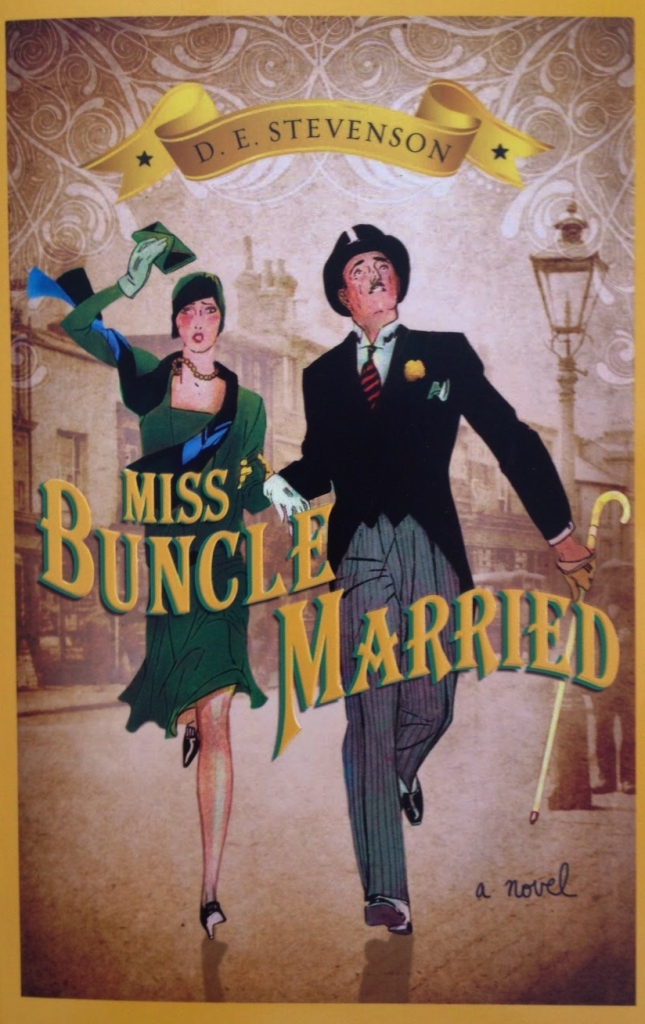
miss buncle married d e stevensonMiss Buncle Married by D.E. Stevenson ~ 1936. This edition: Sourcebooks, 2012. Softcover. ISBN: 978-1-4022-7253-3. 330 pages.

My rating: 6/10.

Readable enough, with a few reasonably memorable moments, but not quite up to the original Miss Buncle’s Book to which this is the sequel. Definitely recommended to those who enjoyed the first Miss Buncle book, and anyone who’s a D.E. Stevenson aficionado, but perhaps not the best place to start with this author. As I explore her works – she’s a very new author to me – I am struck by the wide variance in quality of her plots and prose.

*****

And now for something completely different!

The literary hoopla of Canada Reads 2013 is just over, and my tolerance for angsty Canadiana has been tested fairly stringently. Ending up rather unexpectedly “on the road” for several days this week, I grabbed, on my way out the door, something much more in the way of “light” reading than the sincere Canada Reads candidates: Miss Buncle Married, by D.E. Stevenson.

I had ordered this one, along with Miss Buncle’s Book, and Mrs. Tim of the Regiment, from Book Closeouts just after Christmas, with some of my Christmas “buy yourself a nice book” money. I’d opened the box, briefly admired the crisp new softcovers – that lovely “new book smell”, and the physical pleasure of handling crisp, clean and unworn pages – a very different pleasure from that of handling older books with their unknown histories and traces of prior readers – signatures on the flyleaf, dog-eared pages, marginal notes, the odd old letter, business card, receipt etc. used as a bookmark – now wouldn’t that make a grand post? – the things found in secondhand books!

Oi! I’ve gone completely off track. What was I posting about? Ah, yes. Miss Buncle Married. So, what I started out to say was that D.E. Stevenson was again at the forefront of my awareness, after my recent windfall of a lovely stack of her vintage paperbacks, and after sharing that news of my good luck with my husband, and pressing Mrs. Tim upon him as a “try this author, she’s rather amusing” recommendation, Miss Buncle seemed a logical choice for a light diversion for hotel room reading.

I haven’t yet had a chance to read the first Mrs. Tim myself, though I did read and enjoy one of the follow-up books to that one some time ago, Golden Days: Further Leaves from Mrs. Tim’s Journal, so I’m interested to see what my husband’s reaction will be. I suspect he’ll return a tactful “it was all right”, which, I regret to report, is all that I’m I’m able to give to my own D.E. Stevenson of the moment.

Miss Buncle Married was merely “all right”. It certainly wasn’t an improvement on the original. And though my expectations weren’t terribly inflated, as Miss Buncle’s Book was a pleasant diversionary read and not much more, I was disappointed at how slight this next one turned out to be, despite its hefty 330 pages of physical presence.

Middle-aged (“nearing forty”) though perpetually young-at-heart (in other words, slightly gauche and secretly insecure) Miss Barbara Buncle, after her unexpected success as an author, has married her publisher, Mr. Arthur Abbott. Though the two are deeply in love, and the married state is most satisfactory to both of them, there are thorns becoming most evident in the rose garden of their new life together. An active round of teas, dinners and bridge parties has become the norm, and peaceful evenings by their own fire are few and far between. Neither Barbara nor Arthur want to say anything, each believing the other to be well suited with the social whirl, and, when the penny drops, the two decide that the only thing to do is to move house, to a fresh location, where they can establish themselves anew in a more congenial lifestyle.

After much to-ing and fro-ing, Barbara finds a lovely though exceedingly rundown house in the village of Wandlebury, and she occupies herself for months with the restoration of Archway House and the creation of the ideal habitat for herself and her beloved Arthur. In the meantime, she becomes deeply enmeshed in local happenings. She inadvertently becomes privy to the will of the village’s most wealthy woman, makes friends with the outspoken artist next door and his precocious children, and meets a kindred spirit in the person of young Jeronina Cobbe, the potential recipient, all unbeknownst to her and everyone else except for Barbara and the local lawyers, of the riches to be distributed in the aforementioned will.

There are, of course, numerous twists and turns to the narrative before everyone ends up in a state of bliss, with all dilemmas nicely straightened out, and much optimism for the future.

I felt that Miss Buncle Married started out quite strongly, with much promise, and sadly faded as it went along. It settled into a predictable and very clichéd romance involving Jeronina – Jerry – and Arthur Abbott’s nephew Sam, with every development of their courtship and romantic setbacks telegraphed loud and clear.

Not a bad book, but definitely not as wonderful as it might have been. D.E. Stevenson has her moments of brilliance, but in this case those ran out early on.

I am wondering what the third book in the Miss Buncle saga, The Two Mrs. Abbotts, will be like. Though not eagerly awaiting it, I do look forward to acquiring it at some point once it becomes available, as I hear that it is due to be re-released in softcover by Sourcebooks in 2014.

And here, from Shelf Love, is a much more thoughtful review than my rather scatterbrained assessment  – I plead lack of sleep during this very hectic week – of Miss Buncle Married:

Shelf Love: Miss Buncle Married

Read Full Post »

This week has ended on a nicely high note. As you may have noticed, I’ve been very quiet on the blog posting front recently, because I’ve been deeply involved elsewhere. No worries, the involvement has been with good and enjoyable things, but oh my goodness, time consuming things, they all were.

This week I’ve put in an uncountable number of hours on the upcoming Performing Arts Festival preparations – I’m a member of the organizational committee – plus another 24 hours on the road driving the dancer of the family to classes (twice to Prince George and back, 5 hours driving each time), plus another 5 hours each day waiting around in town for her. That time was spent sitting at the laptop working on Festival stuff, so was not a complete waste of time. Yesterday off we went down to Vancouver to work with her choreographer – more hours waiting around tip-tapping on the laptop in between being summoned to watch progress – and then back home again this afternoon/evening – 14+ hours of driving for that little episode, of the 36 hours we were away. (I’m still moving. Must find my land legs …)

I was rewarded for my Super-Mom-ism when, on our single non-dance-related stop, in Hope for a flying visit to the great little secondhand bookstore there, I scored a tall stack of D.E.Stevenson paperbacks. And even better, guess what I paid? Listen to this. Two dollars each. Unbelievable. They’re all well-read, but in really decent condition.

Where should I start? I’ve read only a few of these before, and though I know these will vary widely in quality, I suspect the process of exploration will be highly enjoyable.

So the first thing I’m doing upon entering my own house and sitting down at the computer, even before checking my stacked-up email, is gloating to you, dear blog readers. I know there will be a few of you who will understand my deep inner thrill at this romantic little jackpot!

Here’s what I brought home:

  • The Baker’s Daughter (read it – loved it)
  • Vittoria Cottage
  • Crooked Adam
  • Shoulder the Sky (read it – very good)
  • Fletcher’s End
  • Rochester’s Wife
  • Green Money (read it – ho-hum)
  • The House on the Cliff
  • The English Air
  • Celia’s House
  • Katherine Wentworth
  • Spring Magic
  • Amberwell
  • Kate Hardy
  • The Four Graces (read it – liked it a lot)
  • Anna and Her Daughters
  • Music in the Hills
  • Smouldering Fire
  • The Tall Stranger

Logging off now, to go to bed. Not to sleep, though. I’ll be dallying for a while with a book, of course. Though not one of the new acquisitions quite yet. Still trying to make it through the Canada Reads books before the debates start on Monday. So far I’ve read Indian Horse and The Age of Hope, am halfway through the brutally tedious Two Solitudes, well into Away, and am frequently glancing hopefully at as-yet-unopened February, which, from all reports by fellow bloggers whose tastes I share, may well be the best of the bunch.

I’m thinking of dumping Two Solitudes unfinished, and concentrating on the other two. I think I’ve got McLennan’s theme figured out in Solitudes, and I honestly don’t really care what happens to any of his boring characters. Might be different in a less busy time, but right now the reading hours are even more precious than usual, and I’m resenting time spent on dullness. Engage me, authors, oh please!

Read Full Post »

What an easy list to put together, after all! The hardest part was ranking them.

I simply scanned over my book reviews index, and these titles popped right out at me. Memorable for the most compelling reason I read – pure and simple enjoyment. My long-time favourites which I reviewed this year and which should really be included were left off the list, because if I noted those down there’d be no room for the marvelous new-to-me reads I discovered in 2012.

*****

BEST NEW-TO-ME READS 2012

Who could rank them?! Well, I’ll try.

A classic countdown, ending with the best of the best – the ones joining the favourites already resident on the “treasures” bookshelves.

Unapologetically “middlebrow”, most of my choices, I realize.

The jig is up. Barb is an unsophisticated reader at heart!

*****

10. Mother Mason (1916)

by Bess Streeter Aldrich

I know, I know – two titles by Aldrich are on my “Most Disappointing” list. But Mother Mason was marvelous, and I loved her. Molly Mason, happily married and with a normal, well-functioning, healthy, active family, is feeling jaded. So she runs away. But without telling anyone that that’s what she’s doing, and covering her tracks wonderfully well. She returns refreshed, to turn the narrative over to the rest of her family, though she remains in the picture, sending her family members off into the world and receiving them back with love, good humour and anything else they need when they return. A very sweet book; a happy hymn to domesticity at its best, with enough occasional real life angst to provide counterpoint. Nice.

9. Death and Resurrection (2011)

by R.A. MacAvoy

I deeply enjoy MacAvoy’s rather odd thrillers/sci fi/time shift/alternative reality/fantasy novels, and was thrilled to get my hands on this latest book, the first full-length new work the author has published in almost 20 years – she’s been otherwise occupied by dealing with some serious health issues, now happily manageable enough for a return to writing. MacAvoy’s new book is just as wonderfully off-key as her previous creations. I love how her mind works, though I experience quite a few “What did I just read?” moments when reading her stuff. Makes me pay attention!

Ewen Young is a pacifist Buddhist with a satisfying career as a painter, and absorbing side interests such as perfecting his kung fu technique and working with his twin sister’s psychiatric patients, and at a hospice for the terminally ill. When Ewen is inadvertently faced with a violent encounter with the murderers of his uncle, strange powers he never realized he had begin to develop. Factor  in a new friend and eventual love interest, veterinarian Susan Sundown, and her remarkable corpse-finding dog, Resurrection, and some decidedly dramatic encounters with the spirit world, and you have all the ingredients for a surreally mystical adventure. Friendship, love, and the importance of ancestors and family join death and resurrection as themes in this most unusual tale. Welcome back, Roberta Ann.

8. Parnassus on Wheels (1917)

by Christopher Morley

Another escaping homemaker, this one thirty-nine year old spinster Helen McGill, who decides to turn the tables on her rambling writer of a brother, much to his indignant dismay. A boisterous open road adventure with bookish interludes, and a most satisfactory ending for all concerned.

7. Fire and Hemlock (1985)

by Diana Wynne Jones

An intriguing reworking of the Tam Lin legend. Polly realizes she has two sets of memories, and that both of them are “real”.  DWJ at her strangely brilliant best.

And while we’re on the subject of Diana Wynne Jones, I’m going to add in another of hers as a sort of Honourable Mention: Archer’s Goon (1984). Gloriously funny. Don’t waste these on the younger set – read them yourselves, dear adults. Well, you could share. But don’t let their home on the Youth shelf at the library hinder your discovery of these perfectly strange and strangely attractive fantastic tales. Think of Neil Gaiman without the (occasionally) graphic sex and violence. Same sort of kinked sense of humour and weird appeal.

6. Miss Bun, the Baker’s Daughter (1939)

 and

Shoulder the Sky (1951)

by D.E. Stevenson

Two which tied for my so-far favourites (I’ve only sampled a few of her many books) by this new-to-me in 2012 by this vintage light romantic fiction writer. Both coincidentally have artistic backgrounds and sub-plots.

In Miss Bun, Sue Pringle takes on a job against her family’s wishes as a housekeeper to an artist and his wife; immediately upon Sue’s arrival the wife departs, leaving Sue in a rather compromising position, living alone with a married man. She refuses to abandon the most unworldly John Darnay, who is so focussed on his painting that he forgets that bills need to eventually be paid, let alone considering what the gossips may be whispering about his personal life. An unusual but perfectly satisfying romance ensues.

Shoulder the Sky takes place shortly after the ending of World War II. Newlyweds Rhoda and James Johnstone settle into an isolated farmhouse in Scotland to try their hand at sheep farming. Rhoda, a successful professional painter, is struggling with the dilemma of compromising her artistic calling with the new duties of wifehood. Her husband never puts a foot wrong, leaving Rhoda to work her priorities out for herself. Though things came together a little too smoothly at the end, I was left feeling that this was a most satisfactory novel, one which I can look forward to reading again.

5. All Passion Spent (1931)

by Vita Sackville-West

Elderly Lady Slane determines to spend her last days doing exactly as she pleases, in solitude in a rented house (well, she does keep her also-elderly maid), thereby setting her family in an uproar by her 11th hour stand for self-determination. This short episode ends in Lady Slane’s death, but it is not at all tragic; the escape allowed Lady Slane to find her place of peace with herself, and it also served as a catalyst for some similar actions by others. Definitely unusual, full of humour, and beautifully written.

4. A Time to Dance, No Time to Weep (1987)

by Rumer Godden

A brilliant autobiography which reads like one of Godden’s novel, only way better, because she’s in full share-the-personal-details mode here, and there are pictures. Beautifully written and absolutely fascinating. Reading this breathed new appreciation into my reading of Godden’s fiction. Followed by a second volume, A House With Four Rooms (1989), but the first installment is head-and-shoulder above the other – much the best.

3. The Benefactress (1901)

by Elizabeth von Arnim.

Anna Estcourt, “on the shelf” as an unmarried young lady at the advanced age of twenty-five, unexpectedly inherits an uncle’s estate in Germany. Full of noble ideas, and relieved at being able to escape her life as a dependent and portionless poor relation – orphaned Anna lives with her elder brother and his high-strung and managing wife – Anna visits the estate and decides to stay there, to build a new life for herself, and to share her good fortune with some deserving ladies who have fallen on hard times. Needless to say, things do not go as planned. A quite wonderful book, clever and observant and often very funny; serious just when needed, too. Excellent.

2. The Proper Place (1926)

The Day of Small Things (1930)

 Jane’s Parlour (1937)

by O. Douglas

These novels about the Scottish Rutherfurd family belong together on the shelf. Of these The Proper Place is my definite favourite, but the others are also must-reads if one has become engrossed with the world of the stories, rural Scotland between the two world wars. What a pleasure to follow the quiet ways of  likeable protagonist Nicole Rutherfurd, her mother, the serene Lady Jane, and Nicole’s perennially dissatisfied cousin Barbara. At the beginning of The Proper Place the Rutherfurds are leaving their ancestral home; Lord Rutherfurd has died, and the family’s sons were lost in the war; it has become impossible for the surviving women to make ends meet as things are. So off they go to a smaller residence in a seaside town, where they create a new life for themselves, shaping themselves uncomplainingly to their diminished circumstances, except for Barbara, who connives to set herself back into the world she feels she deserves. Many “days of small things” make up these stories. I can’t put my finger on the “why” of their deep appeal – not much dramatic ever happens – but there it is – a perfectly believable world lovingly created and peopled by very human characters.

1.  The Flowering Thorn (1933)

 Four Gardens (1935)

by Margery Sharp

These were my decided winners – the ones which will remain on my shelves to be read and re-read over and over again through the years to come. The Flowering Thorn is the stronger work, but Four Gardens has that extra special something, too.

In The Flowering Thorn, twenty-nine-year-old socialite Lesley Frewen is starting to wonder if perhaps she is not a lovable person; she has plenty of acquaintances, and is often enough pursued by young men professing love, but those she views as emotional and intellectual equals treat her with perfect politeness and fall for other women. Acting on a strange impulse, Lesley one day offers to adopt a small orphaned boy, and then moves to the country with him, in order to reduce her expenses – her London budget, though perfectly managed, will not stretch to a second mouth to feed, and her elegant flat is in an adult-only enclave. Quickly dropped by her shallow city friends, Lesley sets herself to fulfill the silent bargain she has made with herself, to bring up young Patrick to independence and to preserve her personal standards. But as we all know, sometimes the way to find your heart’s desire is to stop searching for it, and Lesley’s stoicism is eventually rewarded in a number of deeply satisfying ways. An unsentimental tale about self-respect, and about love.

Caroline Smith has Four Gardens in her life. The first is the gone-to-seed wilderness surrounding a vacant estate house, where she finds romance for the first time. The next two are the gardens of her married life; the small backyard plot of her early married years, and the much grander grounds surrounding the country house which her husband purchases for her with the proceeds of his successful business planning. The fourth garden is the smallest and most makeshift – a few flowerpots on a rooftop, as Caroline’s circumstances become reduced after her husband’s death, and her fortunes turn full circle. A beautiful and unsentimental story about a woman’s progress throughout the inevitable changes and stages of her life – daughter-wife-mother-grandmother-widow. Clever and often amusing, with serious overtones that are never sad or depressing.

Margery Sharp was in absolutely perfect form with these two now almost unremembered books.

This is why I love “vintage”. I wish I owned a printing press – I’d love to share books like these with other readers who appreciate writerly craftsmanship, a well-turned phrase, and a quietly clever story. They don’t deserve the obscurity they’ve inevitably fallen into through the passage of time.

*****

So there we are – I’ve made it to midnight – the only one still awake in my house. I’m going to hit “Post”, then off to bed with me as well.

HAPPY NEW YEAR!

Read Full Post »

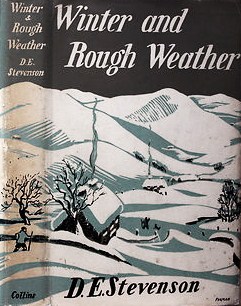
Shoulder the Sky: A Story of Winter in the Hills by D.E. Stevenson ~ 1951. Original British title: Winter and Rough Weather. This edition: Thorndike Press, 1992. Hardcover. Large Print. ISBN: 1-56054-343-4. 407 pages.

My rating: 8.5/10, for the majority of this story. I found myself very keen to get back to it and find out what was about to happen next, the most compelling of D.E. Stevenson’s books in this respect so far.

*****

A few years after the conclusion of the Second World War, a young, newly married couple, Rhoda and James Dering Johnstone, arrive at their isolated farmhouse near the fictional Scottish village of Mureth. Rhoda is an accomplished professional painter, and her husband worries, with some reason, as to how she will adjust to a life as a sheep farmer’s wife, far from the stimulating world she has happily abandoned for true love.

Rhoda drifts for a while, mulling over the dilemma of what she sees as a black and white choice between her perceived role as a wife versus personal fulfillment as an artist. The author handled this theme sensitively and sensibly, though I couldn’t help but think that childless Rhoda, overseeing a small house with the help of a live-in cook-general, had a luxury of a “domestic support system” impossible for those of us in a similar societal-economic position to attain today.

With her husband’s full support, Rhoda returns to the studio, and proceeds to paint a portrait which has far-reaching consequences among the local residents.

Add in several on again-off again love affairs, a missing wife, a bullying neighbour, a misunderstood child, and the challenges of winter storms in an isolated locale, and you have a quietly dramatic novel, and my favourite DES to date. There are two prequels/companions to this title: Vittoria Cottage and Music in the Hills, but Shoulder the Sky works well as a stand-alone; I never felt like I was out of the loop, though there were references to previous events throughout.

My only complaint is the ending seemed a bit rushed. Everything fell into place a little too neatly, and though things were obviously set up for happy resolution, too many plot strands were left hanging.  We were told that everything was now set to work out, so there were no real cliffhangers, but the novel’s abrupt ending felt very unfinished after some of the detail given earlier on. (This seems to be a common failing with most of the D.E. Stevenson books I’ve read to date.)

I greatly enjoyed this novel, aside from its minor but forgivable imperfections. The author has set it up beautifully, and the details she gives both of farm life and the art world appear to come either from personal experience or detailed research. I thought this particular novel was a relatively strong work for this “light romance” author, rather reminiscent of O. Douglas at her best.

Definitely recommended.

Oh! I must make one more comment. The edition I read was the Thorndike Press Large Print version, with a cover of lovely SPRINGTIME honeysuckle flowers. This story is decidedly wintry – a hugely important plot twist is centered on a winter storm, and the atmosphere throughout is shaped by the freezing weather. No mention of honeysuckle or springtime anywhere within – and I was watching for a clue. So a slap on the wrist to Thorndike’s design staff!

This cover is much more appropriate.

And now I must abandon my own cozy nook in the Prince George library, put on my winter jacket, and venture forth into our suddenly frozen world. It’s minus 10 (Celsius) out there and quickly getting colder; clear and crisp with a just-full moon shining on the newly fallen snow.

Grocery shopping, and the long drive home, and then a quiet day at home tomorrow, part of which will most likely be spent constructing the huge bonfire pile which has become a family All Hallows tradition. Or at least providing cocoa and other sustenance for the teens who’ve been plotting the construction of the pyre ever since last year’s spectacular display. (They’re running out of things to burn, having picked up sticks and collected scrap lumber so diligently in previous years that little remains anywhere within easy dragging distance. There was some mention of wanting a chainsaw and the use of a truck. We’ll see what happens. The weather forecast is dismal for October 31st – cold and snowy.)

There might even be a few Roman candles let off, which will shock the complacency of our own farm’s sheep – they definitely do not approve of such changes in routine, and generally wait out the human noisemaking in the shelter of their shed, gently baaing in ovine astonishment at all the fuss.

Happy Hallowe’en to those of you who celebrate it!  And to everyone at the mercy of the present widespread bitter weather, I wish you a respite from the storms, and a chance to catch your breath and regroup before winter sets in in earnest.

Read Full Post »

« Newer Posts - Older Posts »