Archive for the ‘Short Stories’ Category

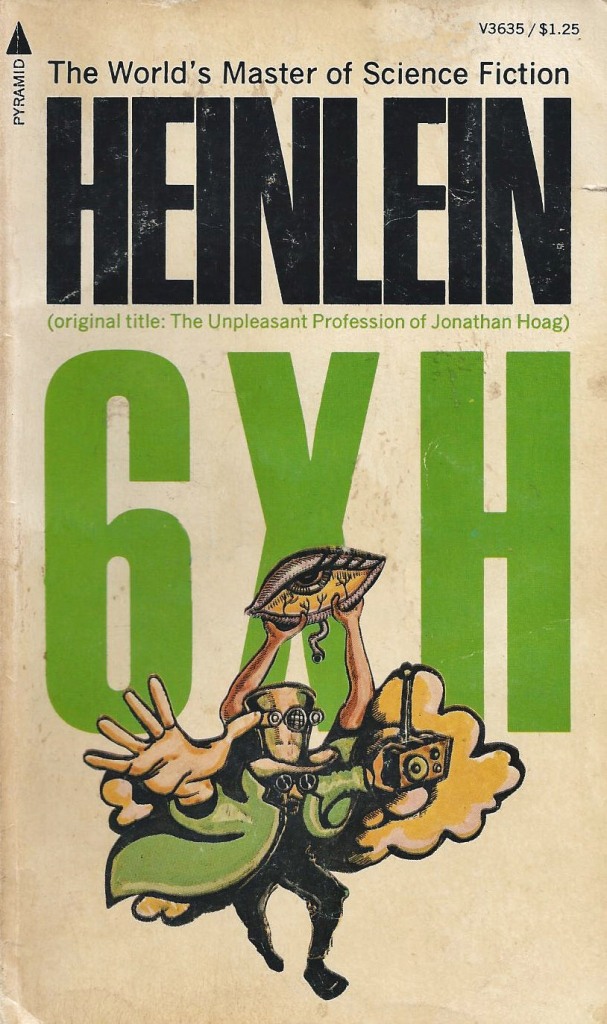
6 X H – Six Stories by Robert A. Heinlein ~ 1959. Original Title: The Unpleasant Profession of Jonathan Hoag. This edition: Pyramid Books, 1975. ISBN: 0-515-03635-0. Paperback. 219 pages.

My rating: 5/10. More or less.

I discovered the vast, strange, swirling ocean of science fiction in high school, and have dabbled happily along the edges of that varied genre ever since. That time being in the 1970s, the prolific Robert A. Heinlein was still front and centre of the revolving sci-fi paperback rack in the school library, and his books were readily available at our town’s rather dingy little secondhand bookstore, located down a precipitous set of stairs in the cramped basement of a main street store.

This volume is a relic of that era. Definitely not built to last, the pages are yellowing and loose in the binding, the glue having long since reached its expiry date. The smell of the dusty pages takes me instantly back to those high school days. Newly employed at a part-time job waiting tables at our town’s Chinese restaurant, I had money of my own for the first time in my life, and after putting aside most of it into a savings fund targeted for buying my own car, I splurged my tips on books, books, books –  a few new, but most secondhand; you could get more for your money that way, and the selection, then as now, was vastly superior.

That first car, a bright red ’72 Mustang, was purchased the summer I turned 15, for $800 cash, from a quiet young man with a highly pregnant wife (looking back over the years, I suddenly realize the significance of that situation, and my heart bleeds a bit for both of them, but at the time all I felt was sheer selfish desire, no room for empathy in my egotistical teenage heart) – and, oh! – how many hours of sore feet and cigarette smoke and ever-greasy uniforms – remember the hideous waitress garb of the time? – none of this “wear your own clothes” stuff that today’s “servers” get away with – how many early morning and late night hours at $2.65 an hour (before deductions) did this translate to?! – always doing homework frantically during a much-too-short meal break…

My father co-signed the papers for me (I was underage for a legal transaction) against my mother’s most strenuous objections, and after that most of my money went for gas, for despite not yet having a driver’s license I managed to put a lot of miles on that beautiful beast. Different times, different times…

My sweet first ride is sadly long gone, but many of the books of those halcyon teenage summers remain in my now-massive book collection, triggering little episodes of nostalgia which I savour for a moment before turning back to my present-day world. (Which happens to include this book blog, so here I go, digression over,  with my review.)

This is an odd collection even for all-over-the-map Heinlein, and it’s probably been a good thirty years since I read it; I had no memory of most of the stories and it’s definitely not in the favourites pile. Sorting out the last few boxes of my old possessions from my mom’s attic, I found this and immediately put it aside, thinking my sci-fi buff teenage son might like it; he read it and passed it back to me with that current expression signifying mild disinterest – “Meh!”

“No way, it’s Heinlein, must be something good in there!” I declared, and promptly read it myself. And, sorry to say, I guess this time he was more or less right. As he usually is. Quite a lot of fun, actually, having a teen sharing some of my reading tastes. Great excuse to pick up yet more books, equipping the kid with his own library, for when he moves out, you know… For what it’s worth, he’s already on his second car. Nowhere near as cool (hot?) as his mom’s first one, though.

Okay – FOCUS.

Six short stories, more fantasy than science fiction.

  • The Unpleasant Profession of Jonathan Hoag. At 120 pages, more of a novella than a short story. Originally published in the pulp magazine Unknown Worlds, in October of 1942, under one of Heinlein’s pseudonyms, John Riverside.

It starts promisingly enough:

“Is it blood, doctor?” Jonathan Hoag moistened his lips with his tongue and leaned forward in the chair, trying to see what was written on the slip of paper the medico held.

Dr. Potbury brought the slip of paper closer to his vest and looked at Hoag over his spectacles. “Any particular reason,” he asked, “why you should find blood under your fingernails?”

“No. That is to say – Well, no – there isn’t. But it is blood – isn’t it?”

“No,” Potbury said heavily. “No, it isn’t blood.”

Hoag knew that he should have felt relieved. But he was not. He knew in that moment that he had clung to the notion that the brown grime under his fingernails was dry blood rather than let himself dwell on other, less tolerable, ideas.

The fastidious Mr. Hoag has a problem. His evenings, nights and mornings are normal enough; he arrives home from work, socializes normally enough, goes to bed, sleeps and risess – but he has absolutely no memory of how he spends his days; no idea what his profession is; the only clue is the brownish-red residue under his fingernails, and a deep sense of foreboding that he is involved in something terrible.

After being turned away with no satisfactory answer by the brusque Dr. Potbury, Mr. Hoag decides to have himself followed. He contacts the firm of Randall & Craig, Confidential Investigators, who turn out to be a husband and wife team working out of their home. Edward and Cynthia (Craig) Randall are well experienced in everyday investigations; after some debate they agree to take on Mr. Hoag’s case, and the plot immediately thickens.

Up to this point the story is engaging and very nicely written; the mood is very 1940’s noir; we’ve all been there before, and we look forward with anticipation to the next logical step. And this is where Heinlein mixes things up. A straightforward “tailing” apparently is successful but goes strangely awry; Edward easily follows Jonathan Hoag to his workplace, a commercial jeweler’s workshop on the 13th floor of a city office building, and talks to Mr. Hoag’s employer. The mysterious red powder turns out to be jeweler’s rouge; Mr Hoag polishes gemstones. Case closed.

But hang on… why did Cynthia see Edward stop and talk to Jonathan, and why does Edward insist they never made contact? Why, when they both retrace Edward’s steps, do they find that there is no 13th floor in the building, and no record of a jeweler’s workshop? And why do none of Jonathan’s contacts and references seem to exist, and why doesn’t he have fingerprints?

Not content to those questions unanswered, to give Mr. Hoag the easy and plausible explanation of the jewel polishing job, and take his hefty fee, Cynthia and Edward decide to push further. And this is where things get really odd. Suddenly things are far from normal in the Randall & Craig world. Mirrors become portals into another reality; strange men with other-worldly powers enter and leave and drag Edward and Cynthia along. The threatening “Sons of the Bird” warn them to drop Mr. Hoag’s case and forget they ever heard about him, or face dire consequences.

After much hocus pocus and mumbo jumbo, Edward and Cynthia more or less get to the bottom of the strange situation, which is more than this reader ever really did. I had to go back and reread the last half of the story, and I was still confused. Something about alternative worlds improperly erased, with Mr. Hoag as a sort of unwitting Nemesis controlling rogue members of a previous world. I think.

Some great writing in this story; Heinlein struts his storyteller’s stuff here, but the plot was crazy-confusing for better than half of it, and the whole thing dragged on way too long. The main characters, aside from the mysterious Mr. Hoag, are Cynthia and Edward, and their close relationship is very well handled; their offhand manner to each other and continual wise cracking hide a deep and abiding love for each other which ultimately allows them to escape from the disaster their meddling has precipitated.

The ending of the story is as mysterious as the beginning, and I won’t really give too much away by sharing it here.

When he goes out to the vegetable patch, or to the fields, she goes along, taking with her such woman’s work as she can carry and do in her lap. If they go to town, they go together, hand in hand – always.

He wears a beard, but it is not so much a peculiarity as a necessity, for there is not a mirror in the entire house. They do have one peculiarity which would mark them as odd in any community, if anyone knew about it, but it is of such a nature that no one else would know.

When they go to bed at night, before he turns out the light, he handcuffs one of his wrists to one of hers.

Good work, front and back of this novella. Some slippage there in the middle, Mr. Heinlein!

I would be interested to hear from anyone else who has their own ideas about this tale.

  • The Man Who Traveled in Elephants. Written in 1948, and published in the magazine Saturn in 1957 under the title The Elephant Circuit.

This is a rather sweet, very nostalgic, Ray Bradbury-ish tale of a retired traveling salesman and his ultimate destination. Something of an ode to the mid-century tradition of local exhibitions and fairs, and all the best things about them. I won’t say too much about this one; there’s not much to it, just a gently sentimental little fantasy. Not a masterpiece, but rather enjoyable in its own small way. There’s an old dog, too. Need I say more? It works.

  • “-All You Zombies-“. Originally published in the pulp magazine Fantasy & Science Fiction, March, 1959.

Time travel and a sex change operation and some cheeky acronyms – see if you can get the connection between the “service” organizations Women’s Emergency National Corps, Hospitality & Entertainment Section, and Women’s Hospitality Order Refortifying & Encouraging Spacemen. (I know – GROAN. This is why, despite his many flaws, I like Heinlein – he makes me laugh despite my better judgement! The guy sure had a thing for acronyms – he was my introduction to TANSTAAFL, among others.)

A weird little “future tale”; pure Heinlein fantasy. Rather offensive and not as funny as the author obviously thinks it is, but it has a few points. A temporal agent on a recruiting mission with the cover profession of bartender – cute concept. For 1959. This one shows its age. And I’m surprised it wasn’t first published in Playboy. Definitely adult in theme!

  • They. Published in 1941, in the pulp magazine Unknown.

A rather Kafkaesque story concerning a man who is being held in confinement of some sort (mental institution? hospital?) because of his extreme paranoia – he insists that he is surrounded by a conspiracy to deceive him as to the true state of the world, and that his is the only “reality” he can be sure of. But is it paranoia if it’s true? One of Heinlein’s experiments in defining solipsism – the philosophy that one can only be sure of one’s own mind; everything else may only be a creation of that mind.

A bit too deep for me. Well written, with a good twist in the end, but overall – “Meh.”

  • Our Fair City. Published in Weird Tales, 1949.

An odd little urban fantasy. A sentient, apparently feminine whirlwind – yes – the kind of whirlwind that swirls about picking up dust and bits of rubbish – named, of all things, “Kitten” by “her” friend Pappy, an old parking lot attendant, plays a part in bringing corrupt city officials to justice. A playful farce of a story; I’ll grant points in that it’s kind of a fun concept; but my reaction was “read it quick and move on”.

“-And He Built a Crooked House-“. Astounding magazine, February, 1941.

A uncategorizable story (probably closer to sci-fi than fantasy… or vice versa – can’t decide!) about a California architect who designs and builds a three-dimensional house based on a four-dimensional tesseract. The whole concept made my head hurt; math and science geeks will no doubt fully “get” this, though. Anyway, an earthquake shifts the house fully into the fourth dimension, while being toured by the architect and his clients.

Heinlein, a quite brilliant mathematician in his own right, obviously indulged his arcane sense of humour here. Farcical and clever and probably best appreciated by like-minded sorts. I mildly chuckled, but mostly was just happy the book was finally over.

*****

So – final verdict? It was an interesting excursion into the long-ago world of Heinlein’s literary B-sides, but it can safely go back into the box. Maybe in another thirty years it will bring my grownup kid some $$$ as he flogs the excess of my book collection on the future equivalent of eBay!

If you see it cheap cheap cheap in the used book by-the-door bins, go ahead & pick it up. In my opinion, not really worth more than a dollar or two, unless you’re a dedicated Heinlein collector.
Read Full Post »

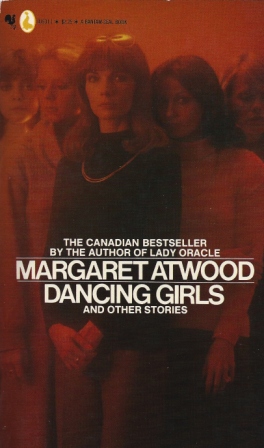
Dancing Girls by Margaret Atwood ~1977. This edition: Bantam Seal, 1978. Paperback. ISBN: 0-7704-1531-1. 245 pages.

My rating: 5.5/10. A few too many misses for a really high rating.

*****

A collection of short stories written early in the career of Canadian icon Atwood.

I have an ambiguous relationship with Margaret Atwood, or, rather, her work. I greatly admire the real person; Atwood has become an outspoken and lucid critic of much of what is troublesome about Canadian societal, political and environmental issues. I have heard many of her interviews and lectures via our venerable CBC Radio, lifeline of many Canadian rural dwellers far from the bright lights of the cities which have absorbed the majority of the population in this vast and still-wilderness-filled land. Just thinking about her, Atwood’s distinctive voice fills my head; nasal, cynical, with a deadpan delivery that would make her a knock-out stand-up comic if she were ever to desire to switch careers at this late date.

But… I am not completely comfortable with much of her written work. I’ve read all the novels dutifully as they’ve appeared through the years, as a typical middle-aged, literate, Canadian liberal feminist (as good a description of my demographic as any) should. I can nod and smile knowingly during literary discussions with the local intelligentsia, though I add little to the conversation myself; I am very aware of my value as an audience to my much more vocal acquaintances and have no real desire to step into the conversational limelight myself much of the time; it’s simpler to stand by and listen…but I digress.

Atwood. How to describe my feelings? Well… ambiguous… I guess. There is no doubt that the woman can write. Her words flow, dance, surprise, shock – grand stuff indeed! But too often I put down the latest Atwood feeling a vague dissatisfaction. Are things really that bad? Are all of our relationships – friendly, familial, societal and particularly sexual and marital – as deeply flawed as Atwood continually portrays? A course of Margaret Atwood often drives me to the other extreme; to the literary arms of, say, Elizabeth Goudge, with her encouragements of perseverance and sacrifice rewarded, versus Atwood’s cynical view that it doesn’t really matter how hard you try, you’re pretty well screwed from the get-go. (I rather agree, but all in all, it’s not that bad; most of us muddle along with a fair amount of happiness despite the inevitable rough bits. Don’t we?)

But this woman can write.

Here is what you’ll find in Dancing Girls.

***  =  the ones I greatly enjoyed.

*  =  Worth reading.

The rest I rather wish I hadn’t subjected myself to, though opinions obviously will differ.

  • The War in the Bathroom – A week in the life of a woman who has apparently descended into some form of mental illness; she has split into two personalities; the intellectual (controlling) and the physical (responding). Typically depressing; not one of the gems of this collection.
  • ***The Man From Mars – An unattractive student is targeted by a stalker, “a person from another culture”.  I liked this one. Melancholy (of course!) but very well presented; cynically amusing; I can hear Atwood’s best voice loud and clear.
  • Polarities – A woman goes slowly mad. Dreary as the winter setting and the doomed relationships it describes.
  • Under Glass – Another doomed love affair. Sad, sad, sad.
  • The Grave of the Famous Poet – A journey becomes a metaphor for another imploding relationship.
  • ***Rape Fantasies – This one story is probably worth buying the book for. Four young women discuss rape fantasies. Atwood at her wickedly humorous best.
  • ***Hair Jewellery – Beautifully written. Another relationship unravelling, but the protagonist moves successfully on. Or at least so we think.
  • ***When It Happens – An elderly woman prepares for the end of the world. Haunting.
  • A Travel Piece – A travel writer on a trip that goes terribly wrong. Taps into all of my worst-case flight scenario fears. Wish I hadn’t read this one – personal nightmare stuff!
  • The Resplendent Quetzal – Too many details about an unhappy marriage and the petty meannesses that bitter people resort to.
  • *Training – A young man examines his motivations and innermost feelings as he deals with his family’s and his own expectations for his future.
  • *Lives of the Poets – This one feels autobiographical. Another relationship tragedy, enhanced by the futility of struggling artistic careers.
  • *Dancing Girls – Culture clashes in a rooming house.
  • ***Giving Birth – The ambiguities of expectant and new motherhood. Excellent.

Read Full Post »

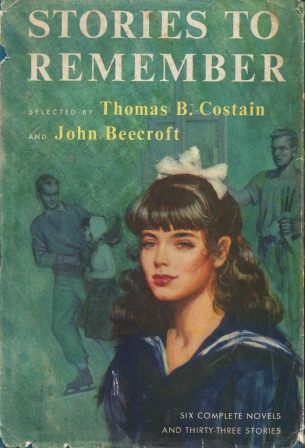
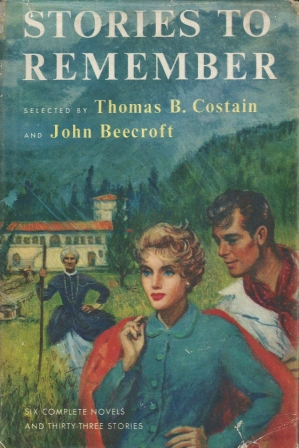
Stories to Remember, Volumes I & II, selected by Thomas B. Costain & John Beecroft ~ 1956. This edition: Doubleday, 1956. Hardcover. Volume I – 409 pages. Volume II – 504 pages.

My rating: 10/10. Excellent anthologies; something for everyone.

I have read the companion Stories to Remember  volumes many times over the years. This anthology was purchased new by my mother in 1956, likely through her long-time Doubleday Book Club involvement, and was some of the first “adult” material I dipped into as I expanded my childhood reading horizons. I still have the original books, and now my own family, adults & teens, re-read and enjoy them. And yes, I remember most, if not all, of the selections with deep fondness!

Looking at this collection with a critical eye 56 years after its publication, I fully suspect that some of the selections might no longer appeal to the average modern audience – would a typical 2012 teenager even “get”, or more to the point, even want to “get” many of the societal and historical references in Alexandre Dumas’ Man Who Lived Four Thousand Years, or Maugham’s Lord Mountdrago? –  but there is enough good stuff in here to keep any reader engaged for quite some time, even if one cherry-picks their way through the collection. Overall, an interesting vintage read containing a number of familiar authors & stories, as well as an introduction (or a remembrance?) of several writers now fallen out of public notice.

I have seen these volumes numerous times in 2nd hand bookshops, generally priced very reasonably. Worth picking up for dipping into, and for leaving on the guest room nightstand, if your guests are the type to appreciate a non-electronic reading experience.

The double-column format and smallish print takes a bit of adjustment on the part of the reader; it appears that the publisher tried to squeeze as much text as possible onto each page to limit the ultimate length of the book while still providing generous content. Occasional nicely rendered realistic line drawings throughout are an attractive feature.

A nice balance of dramatic, humorous and “darker” stories; not at all a depressing collection, which cannot be said for many other short story anthologies of more recent vintage!

Volume I

  • The General’s Ring (complete novel) – Selma Lagerlöf, 1925Written by the first woman to receive the Nobel Prize for Literature, in 1909. This is the first installment in a trilogy concerning a ring given to General Bengt Löwensköld by King Karl VIII of Sweden. After requesting that the very valuable ring be buried with him, it is soon discovered that the ring has been stolen from the General’s grave, with tragic consequences to everyone who subsequently comes in contact with it. A morality tale, a ghost story, and at least one love story make up this intriguing and well-paced novella, set in eighteenth century Sweden.
  • Mowgli’s Brothers Rudyard Kipling, 1894From The Jungle Book. A lost woodcutter’s child is adopted by a wolf family in the Indian jungle.
  • The Gift of the Magi O. Henry, 1906. Most of us will remember this one, stock story of countless anthologies! Della and Jim both sell the thing they love best to buy the perfect Christmas present for each other.
  • Lord Mountdrago W. Somerset Maugham, 1939. Lord Mountdrago consults a psychiatrist to help him deal with disturbing dreams. But are they really just dreams, or is something much more sinister going on?
  • Music on the Muscatatuck and The Pacing Goose (excerpts from The Friendly Persuasion) – Jessamyn West, 1945. Quietly humorous stories concerning Quaker fruit tree nurseryman Jess Birdwell and his Quaker minister wife Eliza.
  • The BirdsDaphne du Maurier, 1952. What if all the birds in the world banded together to revenge themselves on humans for the harm done to their kind throughout their shared history? Chilling. 
  • The Man Who Lived Four Thousand Years (excerpt from The Queen’s Necklace) – Alexandre Dumas, 1850. Count Cagliostro, who claims to have lived four thousand years, predicts the “unbelievable” futures of a group of royals and nobles gathered to dine with Maréchal de Richelieu in 1784.
  • The Pope’s Mule Alphonse Daudet, c. 1894. The humorous fable of a good Pope’s pampered mule, who gets her revenge on a tormentor after seven years’ patient waiting.
  •  The Story of the Late Mr. ElveshamH.G. Wells, c. 1911. The sinister Mr. Elvesham seeks immortality by continually switching bodies. 
  • The Blue CrossG.K. Chesterton, 1938. Clever but often underestimated Father Brown brings a jewel thief to justice. 
  • Portrait of Jennie (complete novel) – Robert Nathan, 1940. A struggling young artist encounters and adopts as a muse a mysterious girl who apparently has been travelling through time.  A ghostly love story.
  • La Grande Bretêche Honoré de Balzac, c. 1831. A convoluted telling of the tragedy of a grand old ruined house and its history regarding a Spanish nobleman, a jealous husband and a betraying wife.
  • Love’s ConundrumAnthony Hope, 1899. An ironically humorous, very short story concerning a self-absorbed scholar who completely misunderstands a confession of love and proposal of marriage.
  • The Great Stone FaceNathaniel Hawthorne, 1889. A young boy, inspired by a legend concerning a cliff resembling a strong human profile, waits his entire life for the human embodiment of the noble edifice to appear. It does, but in a way he has not suspected. (The Great Stone Face was an actual New Hampshire rock formation, known widely as “The Old Man of the Mountain” until its collapse in 2003. This story is one of the more dated tales in this anthology, though it is classic Hawthorne and enjoyable as such.)
  • GermelshausenFriedrich Gerstäcker, c. 1850. A wandering artist stumbles into a remote German village, the cursed Germelshausen; doomed to sink beneath the earth for eternity, only to arise for one day in each century. (This is one of my personal favourites in this anthology.) This story has been credited as the inspiration for the musical Brigadoon, though the setting in that case was changed to Scotland.
  • I am Born (excerpt from David Copperfield) – Charles Dickens, 1850. The title character describes his coming into the world. Irresistable – your next step will be to read the whole novel.
  • The Legend of Sleepy HollowWashington Irving, 1820. Itinerant schoolmaster Ichabod Crane sets his romantic sights on the lovely Katrina and meets a harsh fate for his folly in aiming too high.
  • The Age of MiraclesMelville Davisson Post, 1918. Injustice and retribution. A wronged heiress, a sudden death, and a clever onlooker who sorts it all out.
  • The Long Rifle (excerpt from The Long Rifle, a novel) – Stewart Edward White, 1932. Fictionalized account of the life of the legendary Daniel Boone.
  • The Fall of the House of UsherEdgar Allan Poe, 1939. A gothic horror tale. Roderick Usher and his sister Madeleine are the last of their family; they fulfill a prophecy which predicts their dramatic demise.
  • The Voice of Bugle Ann (complete novel) – MacKinlay Kantor, 1935A very short novella set in contemporary Missouri about an unjust conviction for murder and its surprising resolution. Fox hounds feature strongly.  

Volume II

  • The Bridge of San Luis Rey (complete novel) – Thornton Wilder, 1928. A suspension bridge in the Peruvian Andes gives way, sending a group of travellers to their demise. Who were they, and what chances of fate led them to their rendezvous with death at San Luis Rey? Excellent story.
  • Basquerie – Eleanor Mercein Kelly, 1927.   A lovely, not-so-young American girl in Europe must decide between love and (possibly?) a more financially wise match. This author is worth further investigation.
  • JudithA.E. Coppard, 1927. Aristocratic Judith meets  and dallies with a handsome young schoolmaster, to his eventual tragic downfall.
  • A Mother in Mannville – Marjorie Kinnan Rawlings, 1936. Touchingly poignant short story about an orphan boy and his integrity and pride.
  • Kerfol Edith Wharton, 1916. The tragic tale of a jealous French nobleman and his faithless wife. Supernatural elements – something of a ghost story.
  • The Last LeafO. Henry, 1905. Platonic love among a group of artists. Touching nd memorable.
  • The Bloodhound Arthur Train, 1923. Shrewd New York lawyer Mr. Tutt defends a client. Badly dated, one of the less memorable stories in this collection.
  • What the Old Man Does is Always RightHans Christian Andersen, 1861. Clever Danish peasants get the better of a condescending Englishman.
  • The Sea of Grass (complete novel) – Conrad Richter, 1936. Feuding between cattlemen and incoming small farmers in New Mexico at the turn of the century. Told from the point of view of the nephew of one of the most outspoken cattlemen, and with a crucial role played by Lutie Cameron, newly arrived from St. Louis to marry into the cattle-baron hierarchy.
  • The Sire de Malétroit’s Door Robert Louis Stevenson, 1877. In cavalier France of 1429, a case of mistaken identity and the equivalent of a shotgun wedding. Vintage Stevenson.
  • The NecklaceGuy de Maupassant, 1884. Vanity and social ambition lead to a young French couple’s downfall. An ironic small masterpiece of a story.
  • By the Waters of BabylonStephen Vincent Benet, 1937. Post-apocalyptic America seen through the eyes of a young man on a quest. A “rebirth of civilization” theme; definitely a precursor to the many similar stories which are hitting high popularity today.
  • A.V. Laider – Max Beerbohm, 1920. A palm-reader forsees the death of four friends, but chooses not to warn them. Or at least that’s his story… Nicely done! 
  • The Pillar of FirePercival Wilde, 1925. A clever method of cheating at cards is discovered and nipped in the bud. A bit rambling.
  • The Strange Will (excerpt from The Man With the Broken Ear) – Edmond About, 1862. The rather macabre tale of bringing a mummified murdered man back to life.
  • The Hand at the Window (excerpt from Wuthering Heights)- Emily Brontë, 1847. A short, decidedly gothic episode from the novel.
  • “National Velvet” (complete novel) – Enid Bagnold, 1935. 14-year-old Velvet Brown wins a horse in a raffle and decides to race him in the Grand National steeplechase. Beautifully written portrait of family life; the horses play second string to the human relationships. Excellent.

Read Full Post »

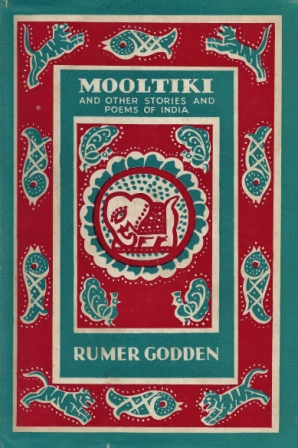
Mooltiki and Other Stories and Poems of India by Rumer Godden ~ 1957.    This edition: Macmillan & Co., 1957. Hardcover. 136 pages.

My rating: 7/10. Rather uneven collection of fair to excellent stories and mostly merely fair poems.

A slender volume of poems and short stories set in India.

BENGAL

  • Bengal River a poem
Nothing can mollify the sky,
the river knows
only its weight and solitude, and heat, sun-tempered cold,
and emptiness and birds; a boat; trees; fine white sand,
and deltas of cool mud; porpoises; crocodiles;
and rafts of floating hyacinth; pools and water-whirls
and, nurtured in blue mussel shells, the sunset river pearls.
                                                                                                            … … …
  • Possession

The rice field lay farthest from the village, nearest the road. On all sides the plain unrolled in the sun with a pattern of white clouds, white pampas grass in autumn and white paddy birds, and glimpses of sky-reflecting water from the jheels or shallow pools. The sky met the horizon evenly all the way round in the flatness of the plain, an immense weight of sky above the little field, but the old peasant Dhandu did not look at the sky, he looked at his field; he did not know that it was little; to him it was the whole world. He would take his small son Narayan by the wrist and walk with him and say, ‘This field belonged to my grandfather and your great-grandfather; to my father and your grandfather; it is mine, it will be yours.’

But life-plans may go horribly awry; Dhandu’s does not follow its anticipated path; in an ironic ending, which I somehow found reminiscent of W.W. Jacob’s The Monkey’s Paw, the field stays with Dhandu but is forever lost to his son.

  • Sister Malone and the Obstinate Man

Sister Malone is a nun in charge of a charity hospital in Calcutta; she is unshaken by the horrible sufferings all around her and does great good with her nursing abilities, but her continual effort to share her religious faith with those she heals goes unheeded. One day Sister Malone meets a man who has truly put all of his trust in God, but she cannot reconcile this with her own conception of what faith should be.

  • The Oyster

Gopal, a Bhramini Hindu student who has travelled abroad to study in England, visits Paris with a friend and is forced to examine the role of compromise in the formation of his own developing character.

HIMALAYAN NOMADS

  • The Goat PeoplePastoral Poems

Nine poems inspired by the nomadic peoples of the Himalayas of Northern India.

The tribes pass all through the spring, pitching their camp at night and lighting their fires under a boulder, a fir tree, or by an ice stream; moving on again at dawn, driving with a peculiar trembling whistle that is their own, something between a hawk’s cry and a flute, harsh, sweet and wild…

… I have tried to make these poems like the people, rough and rhythmical … without symbolism or image, simple and pastoral.

The Meadow

The Caravan

Flowers for the Animals 

The Elders

The Goat Women

The Animals

The Goat Children

The Goat Baby

Moving Downwards

  • Red Doe

A vignette of a young nomad riding up the mountain to fetch his unseen new wife. Sensitive and poignant.

  • The Little Black Ram

An orphan boy, Jassoof,

… a young thief, a bully, noisy, quarrelsome and turbulent, against everyone with everyone against him…

finds his place in the world through his care of a black ram lamb.

KASHMIR

  • The Wild Duck

Another vignette piece, about a young Kashmiri hunter, Khaliq, who, longing for winter to be over, thinks of his time the previous year among the high  mountains hunting ibex.

  • Two Sonnets

Just that; two sonnets. A regretful ode to winter; a joyful ode to spring.

Kashmiri Winter

Spring Sonnet

JUNGLE

  • Mooltiki

This first-person short story (24 pages)  is the jewel of this slight collection. Rumer Godden tells of her experiences in her sister and brother-in-law’s winter camp on the borders of Bhutan. Mooltiki, a small, opinionated elephant, is the “maid-of-all-work” of the camp, fetching firewood and providing transport for odd jobs, such as Rumer Godden’s small jungle explorations. Godden writes an amusing and appreciative ode to Mooltiki and her elephant kin, as well as an extremely evocative description of what if feels like to be involved as an observor in several “blinds” for problem tiger kills.

*****

Mooltiki is an interesting though quite slight collection of fictional short stories (except for the autobiographical title piece, decidedly the best part of the collection) and personal poems; after reading it through several times I must confess that my conclusion is that Godden was a much stronger writer of prose than of poetry!

Nicely done overall, with Godden’s trademark of strong, eloquent characterizations and descriptions of place. Definitely a work any Rumer Godden collector will want to have on the shelf; probably worth a purchase for Mooltiki alone, if it can be found for a reasonable sum.

The biggest fault is the shortness of the book; about an hour`s worth of reading, even if taking one`s time and savouring the beautifully nuanced style of most of the pieces. I thought the poems were the weakest point; some of the stories were excellent (Mooltiki, Red Doe, The Little Black Ram, and possibly Possession, stood out for me), while the others are merely good.

Recommended, with those reservations.

Read Full Post »

« Newer Posts