Archive for the ‘Sharp, Margery’ Category

What an easy list to put together, after all! The hardest part was ranking them.

I simply scanned over my book reviews index, and these titles popped right out at me. Memorable for the most compelling reason I read – pure and simple enjoyment. My long-time favourites which I reviewed this year and which should really be included were left off the list, because if I noted those down there’d be no room for the marvelous new-to-me reads I discovered in 2012.

*****

BEST NEW-TO-ME READS 2012

Who could rank them?! Well, I’ll try.

A classic countdown, ending with the best of the best – the ones joining the favourites already resident on the “treasures” bookshelves.

Unapologetically “middlebrow”, most of my choices, I realize.

The jig is up. Barb is an unsophisticated reader at heart!

*****

10. Mother Mason (1916)

by Bess Streeter Aldrich

I know, I know – two titles by Aldrich are on my “Most Disappointing” list. But Mother Mason was marvelous, and I loved her. Molly Mason, happily married and with a normal, well-functioning, healthy, active family, is feeling jaded. So she runs away. But without telling anyone that that’s what she’s doing, and covering her tracks wonderfully well. She returns refreshed, to turn the narrative over to the rest of her family, though she remains in the picture, sending her family members off into the world and receiving them back with love, good humour and anything else they need when they return. A very sweet book; a happy hymn to domesticity at its best, with enough occasional real life angst to provide counterpoint. Nice.

9. Death and Resurrection (2011)

by R.A. MacAvoy

I deeply enjoy MacAvoy’s rather odd thrillers/sci fi/time shift/alternative reality/fantasy novels, and was thrilled to get my hands on this latest book, the first full-length new work the author has published in almost 20 years – she’s been otherwise occupied by dealing with some serious health issues, now happily manageable enough for a return to writing. MacAvoy’s new book is just as wonderfully off-key as her previous creations. I love how her mind works, though I experience quite a few “What did I just read?” moments when reading her stuff. Makes me pay attention!

Ewen Young is a pacifist Buddhist with a satisfying career as a painter, and absorbing side interests such as perfecting his kung fu technique and working with his twin sister’s psychiatric patients, and at a hospice for the terminally ill. When Ewen is inadvertently faced with a violent encounter with the murderers of his uncle, strange powers he never realized he had begin to develop. Factor  in a new friend and eventual love interest, veterinarian Susan Sundown, and her remarkable corpse-finding dog, Resurrection, and some decidedly dramatic encounters with the spirit world, and you have all the ingredients for a surreally mystical adventure. Friendship, love, and the importance of ancestors and family join death and resurrection as themes in this most unusual tale. Welcome back, Roberta Ann.

8. Parnassus on Wheels (1917)

by Christopher Morley

Another escaping homemaker, this one thirty-nine year old spinster Helen McGill, who decides to turn the tables on her rambling writer of a brother, much to his indignant dismay. A boisterous open road adventure with bookish interludes, and a most satisfactory ending for all concerned.

7. Fire and Hemlock (1985)

by Diana Wynne Jones

An intriguing reworking of the Tam Lin legend. Polly realizes she has two sets of memories, and that both of them are “real”.  DWJ at her strangely brilliant best.

And while we’re on the subject of Diana Wynne Jones, I’m going to add in another of hers as a sort of Honourable Mention: Archer’s Goon (1984). Gloriously funny. Don’t waste these on the younger set – read them yourselves, dear adults. Well, you could share. But don’t let their home on the Youth shelf at the library hinder your discovery of these perfectly strange and strangely attractive fantastic tales. Think of Neil Gaiman without the (occasionally) graphic sex and violence. Same sort of kinked sense of humour and weird appeal.

6. Miss Bun, the Baker’s Daughter (1939)

 and

Shoulder the Sky (1951)

by D.E. Stevenson

Two which tied for my so-far favourites (I’ve only sampled a few of her many books) by this new-to-me in 2012 by this vintage light romantic fiction writer. Both coincidentally have artistic backgrounds and sub-plots.

In Miss Bun, Sue Pringle takes on a job against her family’s wishes as a housekeeper to an artist and his wife; immediately upon Sue’s arrival the wife departs, leaving Sue in a rather compromising position, living alone with a married man. She refuses to abandon the most unworldly John Darnay, who is so focussed on his painting that he forgets that bills need to eventually be paid, let alone considering what the gossips may be whispering about his personal life. An unusual but perfectly satisfying romance ensues.

Shoulder the Sky takes place shortly after the ending of World War II. Newlyweds Rhoda and James Johnstone settle into an isolated farmhouse in Scotland to try their hand at sheep farming. Rhoda, a successful professional painter, is struggling with the dilemma of compromising her artistic calling with the new duties of wifehood. Her husband never puts a foot wrong, leaving Rhoda to work her priorities out for herself. Though things came together a little too smoothly at the end, I was left feeling that this was a most satisfactory novel, one which I can look forward to reading again.

5. All Passion Spent (1931)

by Vita Sackville-West

Elderly Lady Slane determines to spend her last days doing exactly as she pleases, in solitude in a rented house (well, she does keep her also-elderly maid), thereby setting her family in an uproar by her 11th hour stand for self-determination. This short episode ends in Lady Slane’s death, but it is not at all tragic; the escape allowed Lady Slane to find her place of peace with herself, and it also served as a catalyst for some similar actions by others. Definitely unusual, full of humour, and beautifully written.

4. A Time to Dance, No Time to Weep (1987)

by Rumer Godden

A brilliant autobiography which reads like one of Godden’s novel, only way better, because she’s in full share-the-personal-details mode here, and there are pictures. Beautifully written and absolutely fascinating. Reading this breathed new appreciation into my reading of Godden’s fiction. Followed by a second volume, A House With Four Rooms (1989), but the first installment is head-and-shoulder above the other – much the best.

3. The Benefactress (1901)

by Elizabeth von Arnim.

Anna Estcourt, “on the shelf” as an unmarried young lady at the advanced age of twenty-five, unexpectedly inherits an uncle’s estate in Germany. Full of noble ideas, and relieved at being able to escape her life as a dependent and portionless poor relation – orphaned Anna lives with her elder brother and his high-strung and managing wife – Anna visits the estate and decides to stay there, to build a new life for herself, and to share her good fortune with some deserving ladies who have fallen on hard times. Needless to say, things do not go as planned. A quite wonderful book, clever and observant and often very funny; serious just when needed, too. Excellent.

2. The Proper Place (1926)

The Day of Small Things (1930)

 Jane’s Parlour (1937)

by O. Douglas

These novels about the Scottish Rutherfurd family belong together on the shelf. Of these The Proper Place is my definite favourite, but the others are also must-reads if one has become engrossed with the world of the stories, rural Scotland between the two world wars. What a pleasure to follow the quiet ways of  likeable protagonist Nicole Rutherfurd, her mother, the serene Lady Jane, and Nicole’s perennially dissatisfied cousin Barbara. At the beginning of The Proper Place the Rutherfurds are leaving their ancestral home; Lord Rutherfurd has died, and the family’s sons were lost in the war; it has become impossible for the surviving women to make ends meet as things are. So off they go to a smaller residence in a seaside town, where they create a new life for themselves, shaping themselves uncomplainingly to their diminished circumstances, except for Barbara, who connives to set herself back into the world she feels she deserves. Many “days of small things” make up these stories. I can’t put my finger on the “why” of their deep appeal – not much dramatic ever happens – but there it is – a perfectly believable world lovingly created and peopled by very human characters.

1.  The Flowering Thorn (1933)

 Four Gardens (1935)

by Margery Sharp

These were my decided winners – the ones which will remain on my shelves to be read and re-read over and over again through the years to come. The Flowering Thorn is the stronger work, but Four Gardens has that extra special something, too.

In The Flowering Thorn, twenty-nine-year-old socialite Lesley Frewen is starting to wonder if perhaps she is not a lovable person; she has plenty of acquaintances, and is often enough pursued by young men professing love, but those she views as emotional and intellectual equals treat her with perfect politeness and fall for other women. Acting on a strange impulse, Lesley one day offers to adopt a small orphaned boy, and then moves to the country with him, in order to reduce her expenses – her London budget, though perfectly managed, will not stretch to a second mouth to feed, and her elegant flat is in an adult-only enclave. Quickly dropped by her shallow city friends, Lesley sets herself to fulfill the silent bargain she has made with herself, to bring up young Patrick to independence and to preserve her personal standards. But as we all know, sometimes the way to find your heart’s desire is to stop searching for it, and Lesley’s stoicism is eventually rewarded in a number of deeply satisfying ways. An unsentimental tale about self-respect, and about love.

Caroline Smith has Four Gardens in her life. The first is the gone-to-seed wilderness surrounding a vacant estate house, where she finds romance for the first time. The next two are the gardens of her married life; the small backyard plot of her early married years, and the much grander grounds surrounding the country house which her husband purchases for her with the proceeds of his successful business planning. The fourth garden is the smallest and most makeshift – a few flowerpots on a rooftop, as Caroline’s circumstances become reduced after her husband’s death, and her fortunes turn full circle. A beautiful and unsentimental story about a woman’s progress throughout the inevitable changes and stages of her life – daughter-wife-mother-grandmother-widow. Clever and often amusing, with serious overtones that are never sad or depressing.

Margery Sharp was in absolutely perfect form with these two now almost unremembered books.

This is why I love “vintage”. I wish I owned a printing press – I’d love to share books like these with other readers who appreciate writerly craftsmanship, a well-turned phrase, and a quietly clever story. They don’t deserve the obscurity they’ve inevitably fallen into through the passage of time.
*****

So there we are – I’ve made it to midnight – the only one still awake in my house. I’m going to hit “Post”, then off to bed with me as well.

HAPPY NEW YEAR!

Read Full Post »

Martha, Eric and George by Margery Sharp ~ 1964. This edition: Collins, 1964. First Edition. Hardcover. 160 pages.

My rating: 9/10

From the flyleaf:

‘Why should it always be the woman,’ asked Martha, ‘who’s landed with the little illegit?’

Putting principle into practice, she thus deposited a two-weeks-old infant on the paternal door-step and returned carefree to her proper business of painting masterpieces: vanishing so successfully, indeed, from the lives of both lover and son, that ten years elapsed before the consequences of her misbehaviour caught up with her…

Why, indeed?

Martha strikes a blow for her sex as she neatly turns the tables on her partner in procreation. Her child, result of a brief dalliance with the illicit pleasures of physical passion (and not to be repeated, as, though most enjoyable,  it makes her too tired to get up early and paint) has safely entered the world. Providing him with a layette, a carry-cot and a recipe for formula, Martha proceeds to take her ex-lover Eric at his word – “I want to shoulder all your burdens for you,” Eric has declared in his (scorned) proposal of marriage – and drops this small burden off on the Parisian doorstep of British expatriate Eric and his doting mother.

Eric Taylor, returning home to lunch, after the French fashion, from his morning’s work at the City of London (Paris branch) Bank, paused as usual outside the concierge’s lodge. The flat occupied by himself and his mother was on the fourth floor; tradespeople in a hurry frequently left parcels below – also Mme Leclerc the concierge seldom troubled to carry up a letter unless she suspected it to contain bad news. The pause at the lodge was part of Eric’s routine, his words ritual.

“Anything for me to take up, Mme Leclerc?”

For once, a rare smile curved the thin lips. Employing all her fine Gallic gifts of drama, irony and concision –

“Apparently yes, monsieur,” replied Mme Leclerc; and issuing burdened from her lodge planted in his arms a carry-cot containing a two-weeks-old infant.

Poor Eric! One does feel for him in his sudden comeuppance, though of course he had no idea that his brief dalliance with Martha had had fruitful results; he did inquire as to Martha’s state once the fling was over, and she brushed him off in typical Martha-manner, so I rather think his disgruntled reaction is justified. If we weren’t clear on the farcical nature of this series before, we certainly get the full picture in this last installment. Eric carries the baby up to his mother, who is, quite naturally, completely blindsided.

Out from the covers pushed a tiny, grasping fist like a very small octopus. The nearest object at hand being Mrs. Taylor’s ring-finger, about it the small octopus twined.

Now it was her turn to be struck dumb. For what seemed like an age, while the clock on the mantelshelf ticked, while on the table the liver-and-bacon congealed, mother and son gazed at each other in equal silence, equal consternation, indeed equal incredulity. (Disbelief: the instinctive, protective human reaction before disaster.) But the small octopus-hand insisted. Mrs. Taylor stooped; pulled a lap of blanket aside; and raised a face white as her son’s.

“Eric!” breathed Mrs. Taylor. “Whose is it?” 

Actually the question was superfluous. It is an accepted if inexplicable fact that an infant during the very first weeks of its existence may show a marked resemblance to one or other parent. In this case, the tiny countenance now revealed was an uncanny, crumpled miniature of Eric’s own. It simply looked much older: an image of Eric in toothless senility. – Not that the latter more than glanced: by this time he was … sure.

“It’s mine all right,” agreed Eric Taylor.

Now Mrs. Taylor surprises us by her reaction. Rather than being appalled by this incontrovertible evidence of her son’s amorous activities, she is instead thrilled to the core “Oh, my darling, it’s a boy!” she cries in delight. And, “Gran’s little treasure!” she croons, to Eric’s deep disgust and abiding dismay. Here we get another glimpse of Margery Sharp’s cynical wit.

The moment was far too delightful to spoil by thinking about Martha, so Mrs. Taylor didn’t. This involved no particular feat of will-power, merely a complete if unconscious surrender to wishful thinking. To possess a grandchild without the encumbrance of a daughter-in-law is many a grandmother’s unadmitted dream. “Dear Anne, dear Lucy, dear Susan!” cry the grandmothers – happy to welcome with small bottles of Chanel No. 5 at Christmas each necessary transmitter of a family face; but even happier to water with easy tears a rose-bush on an early grave…

Certainly Mrs. Taylor didn’t hope Martha was dead, even though she’d never really liked the girl. (In any case, as she’d learned from Mme Leclerc, Martha was obviously alive that morning. It would have had to be a very sudden accident.) Mrs. Taylor simply forgot Martha: indeed, so all-absorbing was the sheer physical pleasure of holding a baby again…

So the stage is set. Martha’s baby, quickly named George, is well provided for. His father becomes very much a background figure; in a turning of tables, the unmarried father takes on a role usually reserved for the mother in such a situation. A figure of mildly ribald amusement among his compatriots, Eric faces social ostracism, and, worse yet, is passed over for his expected promotion. He is no longer seen as quite so “above reproach” to qualify for a higher position in the Bank of London (Paris branch), though fortunately for him there is no thought of terminating his employment entirely.

Martha has returned to England, there to hone her artistic skills and single-mindedly  become an accomplished mistress of her art. Still sponsored and nurtured by paternal Mr. Joyce, Martha’s genuine genius blossoms. Ten years of hard, creative work pass by, and at last Martha is deemed ready to risk a solo exhibition in that mecca of the art world, Paris.

The reunion of Martha and Eric, and young George, fully meets our expectations, but there are a few surprises in store. The ending is delicately poignant; Martha redeems herself, emotionally speaking, by showing that she does have a certain sensitivity hidden by her brusque exterior. A most satisfying conclusion, despite the deathbed scene.

I hugely enjoyed this trilogy. (I still think this should be published as an omnibus; too cruel if you can’t get your hands on the complete set!) Highly recommended for the Margery Sharp fan, or anyone desiring a cleverly satirical literary diversion.

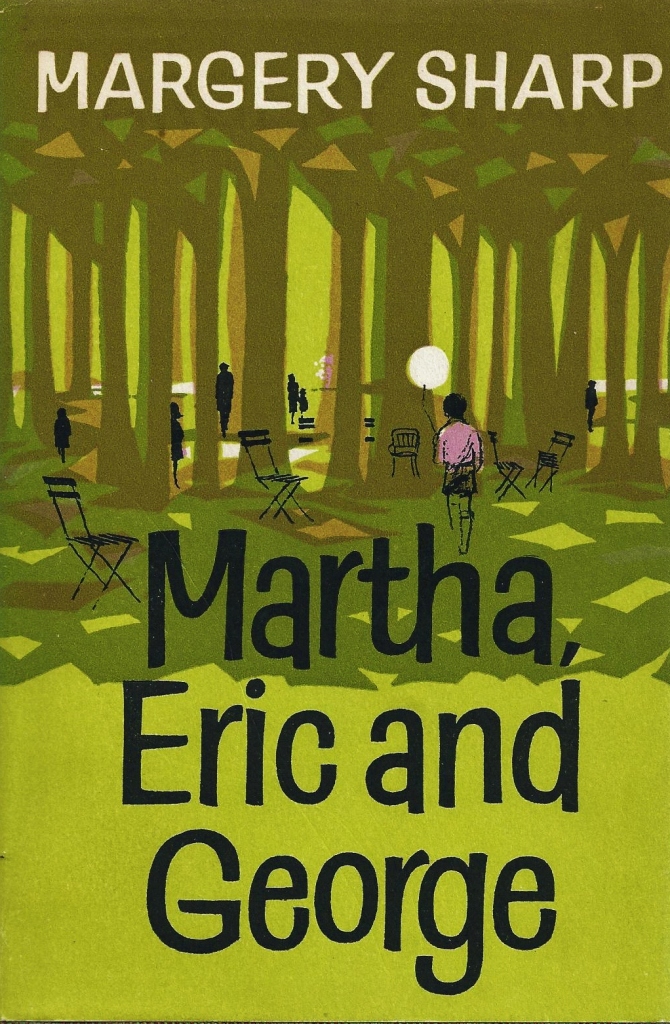
Side note: I love the cover illustration of this edition. Jillian Willet captures perfectly a rather mysterious and moody feeling of foreboding; the child in the foreground (young George?) strides sturdily towards the vaguely menacing figures partially obscured by the park’s trees. The geometric shadowing pays homage to Martha’s vision of the world as a series of shapes; the whole is a deeply satisfying composition.

Read Full Post »

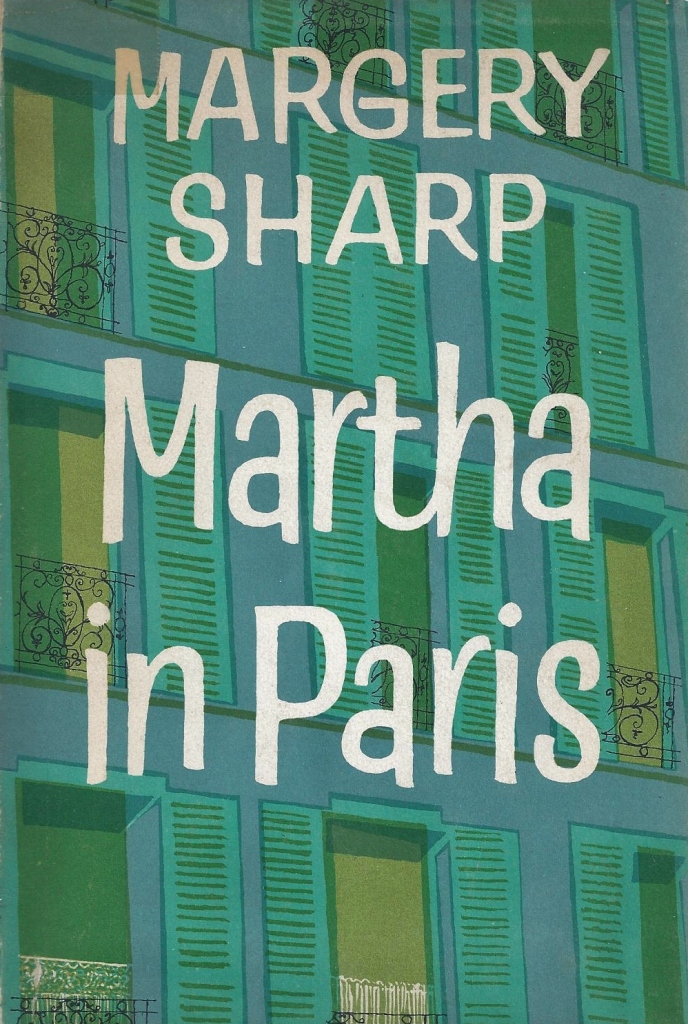
Martha in Paris by Margery Sharp ~ 1962. This edition: Little,Brown, 1962. Hardcover. First American Edition. 166 pages.

My rating: 9/10

From the front flyleaf:

In this “portrait of the artist as a young woman,” Margery Sharp uses all her individual observation – humorous, tender and astringent – to recount a climacteric twelve months in the life of eighteen-year-old Martha, who was sent to Paris to learn to paint, and learned a great deal else besides.

Readers who first met Martha as the stolid, matter-of-fact and altogether memorable child  in The Eye of Love and wondered what would happen to this truly independent spirit when confronted with Life now have an opportunity to find out.

Oblivious to the glamour and temptation of Paris, Martha’s single-minded pursuit of creativity and her matronly appearance seem to protect her from her Aunt Dolores’s delicately-put fear that “Martha might come to some harm…” Once called the Young Pachyderm by a friend back home near Paddington Station, perhaps because he glimpsed something tough-carapaced about her even then, Martha is now Mother Bunch to her fellow art students. Apparently the threat of Paris is to be lost ton her as she at once sets herself up in a doggedly methodical routine of working, eating and sleeping.

But Paris has an outrageous joke to play on Martha. It all begins with her somewhat unconventional adoration of deep, hot baths, after which she always looked her most attractive, or as the French say, “appetizing.” Nice hot baths involve Martha in an experience with a young Englishman (City of London Bank, Paris Branch) which would challenge the resources of a far more sophisticated girl than Martha. How she triumphantly copes with the resulting situation is the them of this engaging novel.

That about sums it up. I greatly enjoyed this next installment in Martha’s life-journey. Margery Sharp has settled into her story nicely; she champions Martha’s artistic cause and incidentally tramples over the gender-based lines of common behaviours; Martha is a true feminist, or perhaps we should say humanist; she has zero tolerance for the conventions which govern the behaviours of more conventional beings. Such as, for instance, her would-be lover Eric, and his doting mother. Their persistence in viewing Martha through their own rose-tinted spectacles of wishful thinking as to her personality and motivations lead to an ironically comedic situation, which Martha single-handedly sorts out in a most pragmatic way.

Martha is a deeply unusual heroine; regardless of her lack of sentiment and socially acceptable behaviour I found myself fully on her side in her Parisian adventures, and have no doubt that her ambitions will be fulfilled.

Highly recommended. If you can at all manage to find these three titles, read them in order. This is the middle book of a trilogy. The preceding book is The Eye of Love; the following book is Martha, Eric and George.

The Eye of Love is presently in print, in softcover from Virago Press. Martha in Paris and Martha, Eric and George are readily available and generally reasonably priced through ABE.

Read Full Post »

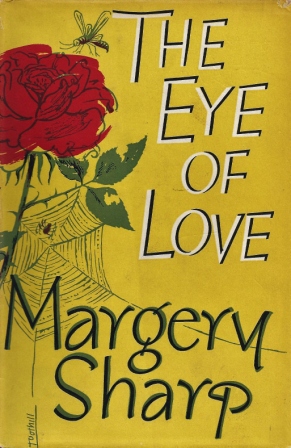
The Eye of Love by Margery Sharp ~ 1957. This edition: Collins, 1957. Hardcover. 1st Edition. 256 pages.

My rating: 9/10

I have been on an unapologetic reading binge these past few days; waking at my husband’s 5 AM alarm to blink the sleep from my tired eyes and reach groggily for the book I laid down the night before –  or, technically, earlier in the morning; too many times it’s been past midnight – foolish me!  A perfectly made cup of tea is always delivered to my bedside or chairside table by a man who values silence above conversation on workday mornings, and is himself stealing some precious reading time over his breakfast before heading out the door at the last possible moment. Our morning exchanges are brief; after thirty years together the pattern is predictably set, and it suits us very well. “What’re you reading?” and “Here, I’m done. You give it a try. Not bad…” and, so often,  “Hey, did you steal my book? I was still working on that one…”

Lately I have had an extravagant number of book-shaped packages from far-flung purveyors, so that like the proverbial child in the candyshop I am overwhelmed by choices and am greedily consuming each treat with an anticipatory eye on the next one. All are light fiction; summer reading at its best.

Trickling in much too slowly are a number of new-to-me vintage books by my beloved Margery Sharp. Margery wrote a trilogy of sorts between 1957 and 1964: The Eye of Love, Martha in Paris, and Martha, Eric and George. Naturally, the third book came first, then the second, with a dreadfully long lag before the first one showed up just a few days ago. I had been nobly holding off on reading them out of sequence, and I’m glad I did. These definitely need to be read in order to get a full appreciation of the journey of our unlikely heroine Martha. I am surprised that these do not appear in an omnibus edition; that would be kindest to the reader, and not unmanageable, as the three books are individually short and quick reads. Having gobbled them up, I will now review them in order, with a probably doomed attempt at brevity, and place them together on my dedicated Margery Sharp shelf in our bedroom (where all the “chuck out the window in case of house fire” treasures reside) to await happy re-reading in future.

Ladies of ambiguous status have by convention hearts of gold, and Miss Diver was nothing if not conventional; but a child in an irregular household is often an embarrassment. It had been wonderfully kind of Miss Diver to save her brother’s child from an orphanage, but not surprising; what was surprising was how well the arrangement had worked out.

It is 1929; Miss Dolores Diver’s widowed brother Richard Hogg has just died, leaving behind nothing of worldly value to his six-year-old-child, Martha, now a bona-fide orphan with an uncertain future. Miss Diver gallantly steps in.

She had never seen the child until an hour earlier; she had never before visited the shabby Brixton lodging-house in whose shabby parlour the thinly-attended wake was being held. – A dozen or so of Richard Hogg’s ex-colleagues from the post office stared inquisitively; this meeting between the two chief mourners provided a touch of drama, something to talk about afterwards, otherwise conspicuously lacking. (As Doctor Johnson might have said, it wasn’t a funeral to invite a man to: only one bottle of sherry and fish-paste sandwiches. Richard Hogg, with his motherless daughter, had lodged two full years in Hasty Street; but a landlady never does these things so wholeheartedly as relations, even with the Burial Club paid up and the next week’s rent in hand.)

Several years pass in complete amiability; young Martha is a rather odd but markedly placid child, and the Diver ménage, financed and patronized by Harry Gibson, head of a small furrier’s establishment, absorbs her without a hitch. Things are about to change, though. Harry’s business is struggling in the depths of the financial depression, and to save it he has contracted to marry one Miranda Joyce, hitherto-unmarriageable daughter of a very successful, upper-end furrier. Her father, in return for getting his daughter finally settled, is willing to re-finance Gibson’s. Harry decides to do the right thing by his prospective fiancé and renounce his mistress and his comfortable routine: five days of the week living quietly with his doting mother, with the weekend secretly spent in the little house with faithful Dolores and a tactful Martha, with the story to the rest of the world that he has continual weekend business in Leeds.

Since their meeting ten years earlier, at a Chelsea Arts Ball, Dolores and Harry have grown even more deeply in love. Now, on the eve of their parting, they cling together and reminisce.

“I’m sorry, Harry, but I can’t bear it,” said Dolores.

She huddled closer against his solid chest. It was his solidness shed always loved, as he her exotic fragility. For ten years they’d given each other what each most wanted out of life: romance. Now both were middle-aged, and if they looked and sounded ridiculous, it was the fault less of themselves than of time.

To be fair to Time, each had been pretty ridiculous even  at the Chelsea Ball. Miss Diver, in her second or third year as a Spanish Dancer, was already known to aficionados as Old Madrid. Mr. Gibson, who had never attended before, found the advertised bohemianism more bohemian than he’s bargained for. To the young devils from the Slade, unwrapping him, [Harry has come dressed as a brown paper parcel],his humiliated cries promised bare buff rather than pyjamas. Naked, indeed, he might have made headlines by being arrested; in neat Vyella, he was merely absurd.

Dolores, Old Madrid, not only pitied his condition but also lacked a partner. She’s have been glad to dance with anyone, all the rest of the night. But though rooted in such unlikely soil their love had proved a true plant of Eden, flourishing and flowering, and shading from the heat of day – not Old Madrid and Harry Gibson, but King Hal and his Spanish rose.

So they had rapidly identified each other – he so big and bluff, she so dark and fragile: as King Hal and his Spanish rose. Of all the couples who danced that night in the Albert Hall, they were probably the happiest.

Off Harry goes, to reluctantly propose to the very willing Miranda.

A quarter of an hour passed long as a century. To an impatient lover it would no doubt have seemed longer: Mr. Gibson was impatient only as a man about to be shot might be impatient. (Why hadn’t he been shot, in ’17?) The bitter parenthesis, by the memories it evoked, nonetheless helped his courage: when at last the door opened, like an officer and a gentleman Mr. Gibson clutched his carnations and stood bravely up to meet the firing squad.

Curiously enough, Miranda Joyce bore a marked physical resemblance to Miss Diver. Both were tall, black-haired, and bony. They were about the same age. Miss Joyce had even certain advantages: her make-up was better, she hadn’t Dolores’ slight moustache, and she was far better dressed. But whereas Mr. Gibson saw Dolores with the eye of love, he saw Miss Joyce as she was, and whereas the aspect of Old Madrid made his heart flutter with delicious emotion, the aspect of Miss Joyce sunk it to his boots.

But Harry Gibson soldiers on. The proposal is duly made and predictably accepted; the necessary conventions are observed.

Kissing her had been like kissing a sea-horse. Mr. Gibson knocked back his drink thankfully. (“I shall turn into a sozzler,” thought Mr. Gibson – dispassionate as a physician diagnosing the course of a disease.)

Fortunately Harry finds consolation in a growing friendship with his father-in-law to be. Mr. Joyce becomes a kindred spirit, and the one bright spot in Harry’s dark night of the soul.

Meanwhile Martha and Dolores are also soldiering on gamely. Dolores soon finds that she is unemployable; her only resource seems to be to let out rooms in her house. Fortunately for aunt and niece, Martha is quick to seize a chance while visiting her old home, and is instrumental in bringing home the perfect boarder. Bachelor Mr. Phillips, clerk of an insurance company, is at first innocuously quiet and reliable with the rent money. However, Dolores’ broken heart and subsequent stand-offish attitude soon have the effect on her boarder of rousing in him a great curiosity as to her personal situation, and, quite soon, a desire to wed this woman whom he very wrongly perceives to be financially independent and a property owner to boot.  What Mr. Phillips doesn’t know is that the house is merely leased, with the term coming up; hence Dolores’ desperate need for Mr. Phillips’ financial contribution, and her reluctance to snub his distasteful though so-far polite advances

The games of in-and-out and false pretences escalate, and while her elders are torturing themselves with emotional gymnastics, young Martha is single-mindedly pursuing her one interest. She is teaching herself to draw. Martha sees the world as a series of shapes; capturing images, fitting them into those categories, and transferring them from her eyes to her mind to paper takes up every waking moment.

Dismissed as merely a scribbling child, Martha stolidly ignores the adult world, and it in turn takes little notice of her. Until one day Mr. Joyce, through a series on coincidences, happens upon Martha drawing a tree. He is a connoisseur of the arts; he recognizes a budding young talent when he sees it. He offers Martha his patronage, and buys her much-desired paper, charcoal and chalks, which she unemotionally accepts while refusing the offer of  a longer-term artistic relationship and sincere, friendly interest which Mr. Joyce extends.

These complicated relationships get more tangled as time goes on; their multiple resolutions are a typically Margery Sharp juggling act. The tale winds up with a combination of most satisfactory endings, and we leave Martha in particular with the hopeful idea that her future, if not exactly easy, will be extremely interesting.

A cleverly written, very smart, satirical, darkly amusing novel. On par with Something Light, though not quite as gentle; the humour of The Eye of Love is decidedly savage at times.

I’m not at all sure if Margery Sharp planned at first to continue Martha’s saga, as The Eye of Love is a decidedly stand-alone novel, but I am so glad she did. Very highly recommended. Next book in the trilogy: Martha in Paris.

Read Full Post »

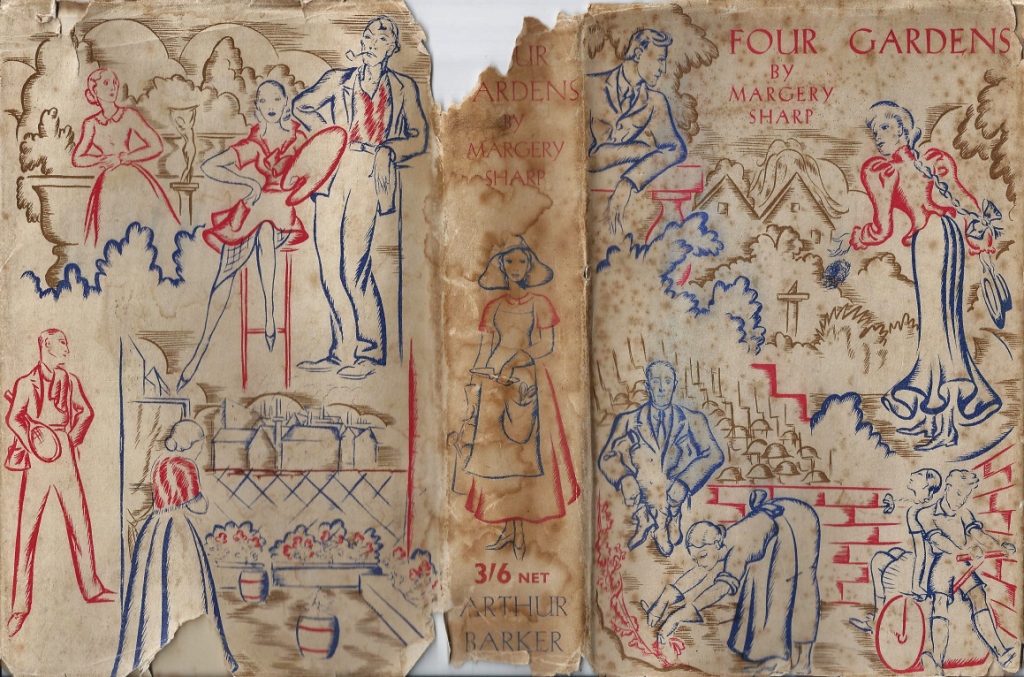
Four Gardens by Margery Sharp ~ 1935. This edition: Arthur Barker Ltd., 1935. Hardcover. 297 pages.

My rating: 10/10

In the early years of the 20th Century, Caroline Smith lives the quiet life of a dutiful middle class daughter with her widowed mother. Walks on the Common, occasional tea parties and church bazaars, helping with the housekeeping and pursuing quiet amusements; such is her life. Occasionally Caroline muses about her place in the world, and wistfully thinks of what her future may hold, but all in all she is of an accepting nature.

Caroline’s one weakness is gardens; on her strolls with her mother she peers through gates and quietly and deeply absorbs what she sees. We pick up Caroline’s story during her seventeenth year, as she takes possession of her first garden; the abandoned wilderness of an empty estate house. Caroline finds a secret way in, and there in the garden she has her first innocent encounter with romance.

Time moves on, and that first garden is lost to Caroline, but after some secret mourning she accepts it as something that must be. She marries a good (though not romantic) man, has two children, and does her duty in all of her relationships even though they are not always what she’d hoped for. The second garden, very different from the first, is a balm to Caroline’s sometimes troubled soul, and is the backdrop of her early wifehood and motherhood, darkly overshadowed by the Great War.

Circumstances change for the better; Caroline is presented with a chance at a new life and a rise in her social position; she gracefully takes it all in stride, though she quietly remains the same thoughtful, uncomplaining soul. Her third garden is one in which a didactic gardener holds sway; Caroline secretly mourns her new distance from physical contact and a real relationship with the plants and the soil, but she does  the correct thing as always and goes forward into this newer, more luxurious world as staunchly as she faced adversity in her younger days.

The fourth garden is the one Caroline creates for herself when her situation again changes; though the smallest and most makeshift, it is perhaps the most satisfying. Life has come full circle, and there is a strong sense of the fitness of things.

This is a gentle but not sentimental book; Margery Sharp keeps it crisp and interesting by allowing us to hear the ongoing commentary of Caroline’s innermost thoughts. Though I continually call Caroline gentle and accepting (and rightly so), she is also keenly perceptive of both her own and others’ motivations and reactions; her inner voice is wry and quietly witty. We are therefore thoroughly on her side as she copes with difficult social situations, troublesome relationships, a well-meaning but emotionally distant husband, and confusingly complex and progressively minded (but by-and-large loving) children.

Not as full of parody as some of Margery Sharp’s works, Four Gardens is a touch more serious and thought-provoking. Beautifully written; often very funny; occasionally very poignant. By the end, the story has become something of a celebration of the quiet satisfaction of dealing well with the not always exciting commonplace life one is dealt by fate, keeping one’s head up, and carrying on.

Very highly recommended.

***

Updated to add a contemporary review I have just discovered, from the New York Times Saturday Review of Books, February 1, 1936

FOUR GARDENS. Margery Sharp. Putnams. 1935. $2.50.

There is refreshment in this book of Margery Sharp’s, a cool sanity that is infinitely restful. She has by nature something of the Jane Austen touch, springing from a detached, quiet power of observation, a delicious, satirical way of relishing affectation, and a respect for sensible, genuine people.

It is a quiet book, the life-story of a woman to whom very little ever happens, a woman as undistinguished as her name of Caroline Smith. But it is a pleasure to read about her and her great good sense; she is lovable in her simplicity, and because of the gentle, irrepressible spark of humor that she possesses. But for all her simplicity she has maturity and wisdom. There is a note of high comedy, rare enough in these days, in the deftness with which she copes with her two ultra-modem children.

All the details are so right and neat, the shades of social difference in the little English town where Caroline lives shown to such nicety, the varying relationships between people set forth with so much exactness and delicacy, that the book makes delightful reading.

***

NoteFour Gardens may be a bit hard to come across, as it was published early in Margery Sharp’s long career and was eclipsed by her later, much more highly publicised works. A few copies show up on AbeBooks, but be prepared to pay a premium price, $40 into the hundreds, for a hardcover in good condition. There appears to have been at least one reissue in paperback in the 1960s, so there should be reasonably priced editions out there in the used book world for a patient collector to track down.

Read Full Post »

The Rescuers by Margery Sharp ~ 1959. Illustrations by Garth Williams. This edition: New York Review of Books, 2011. ISBN: 978-1-59017-460-9. 149 pages.

My rating: 7.5/10 for the story, 10/10 for the illustrations.

This is the first story in what eventually became a series of nine about the mice of the Prisoners’ Aid Society, and in particular the aristocratic white mouse Miss Bianca, and her admirer and co-adventurer, Bernard.

Everyone knows that the mice are the prisoner’s friends – sharing his dry bread crumbs even when they are not hungry, allowing themselves to be taught all manner of foolish tricks, such as no self-respecting mouse would otherwise contemplate, in order to cheer his lonely hours; what is less well-known is how spendidly they are organized. Not a prison in any land but has its own national branch of that wonderful, world-wide system…

In the un-specified (and purely imaginative) country these particular mice live in,

…(a country) barely civilized, a country of great gloomy mountains, enormous deserts, rivers like strangled seas…

… there exists the greatest, the gloomiest, prison imaginable: The Black Castle.

It reared up, the Black Castle, from a cliff above the angriest river of all. Its dungeons were cut in the cliff itself – windowless. Even the bravest mouse, assigned to the Black Castle, trembled before its great, cruel, iron-fanged gate.

And inside the Black Castle, in one of the windowless dungeons, is a prisoner that the Prisoners’ Aid Society has taken a special interest in.

“It’s rather an unusual case,” said Madam Chairwoman blandly. “The prisoner is a poet. You will all, I know, cast your minds back to the many poets who have written favorably of our race – Her feet beneath her petticoats, like little mice stole in and out – Suckling, the Englishman – what a charming compliment! Thus do not poets deserve especially well of us?”

“If he’s a poet, why’s he in jail?” demanded a suspicious voice.

Madam Chairwoman shrugged velvet shoulders.

“Perhaps he writes free verse,” she suggested cunningly.

A stir of approval answered her. Mice are all for people being free, so they too can be freed from their eternal task of cheering prisoners – so they can stay snug at home, nibbling the family cheese, instead of sleeping out in damp straw on a diet of stale bread.

“I see you follow me,” said Madam Chairwoman. “It is a special case. Therefore we will rescue him. I should tell you that the prisoner is a Norwegian. – Don’t ask me how he got here, really no one can answer for a poet! But obviously the first thing to do is to get in touch with a compatriot, and summon him here, so that he may communicate with the prisoner in their common tongue.”

Now, getting to Norway is a bit of a challenge, but the mice have a solution. They decide to call on the famous Miss Bianca, the storied white mouse who is the pamperd pet of the Ambassador’s son. Miss Bianca lives in a Porcelain Pagoda; she feeds on cream cheese from a silver dish; she is elegant and extremely beautiful and far, far removed from common mouse-dom. She also travels by Diplomatic Bag whenever the Ambassador and his family move – abd they have just been transferred to Norway. Perfect!

A pantry mouse in the Embassy, one young Bernard, is assigned the task of contacting Miss Bianca and enlisting her aid in the cause. She is to find “the bravest mouse in Norway”, and send him back to the Prisoners’ Aid Society so he may be briefed on the rescue mission.

Bernard successfully convinces Miss Bianca to assist, and then the real action starts. By a combination of careful planning, coincidence and sheer luck, the Norwegian sea-mouse Nils, Bernard and Miss Bianca venture forth to bring solace and freedom to the Norwegian poet.

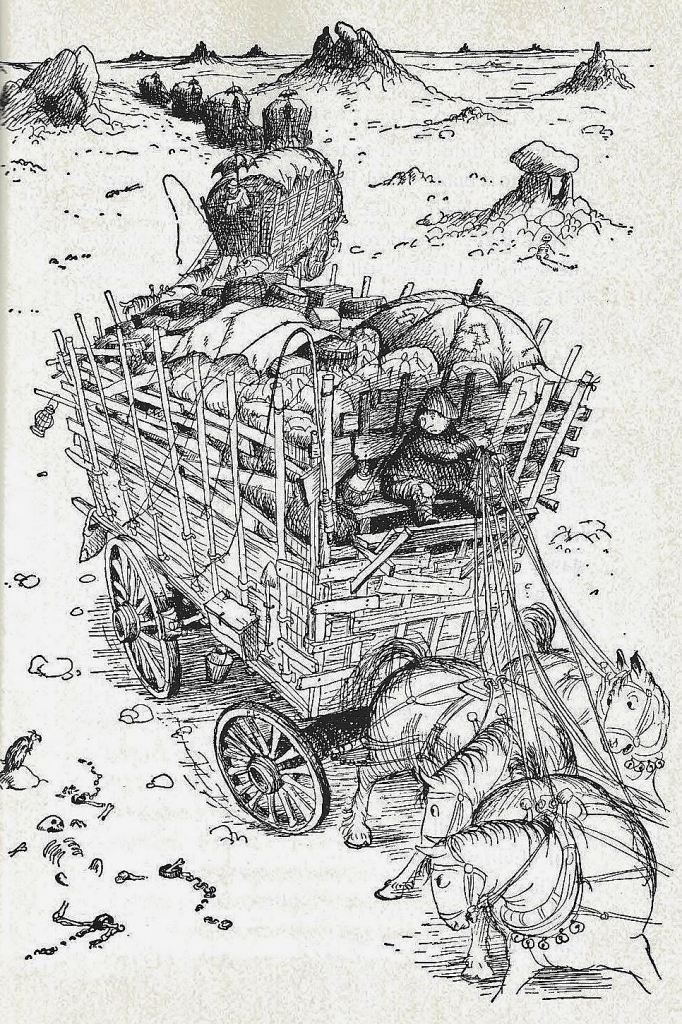
The illustrations by Garth Williams are absolutely perfect. Here is one of my favourites, of the journey to the Black Castle. Look carefully at the expressions on the horses’ faces, the fetters on the skeleton. Brrr! Danger lurks!

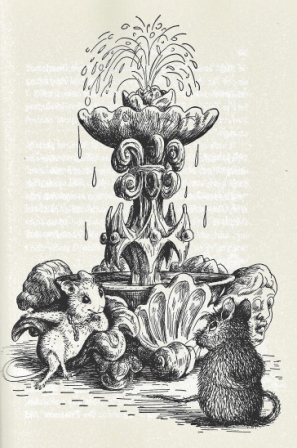
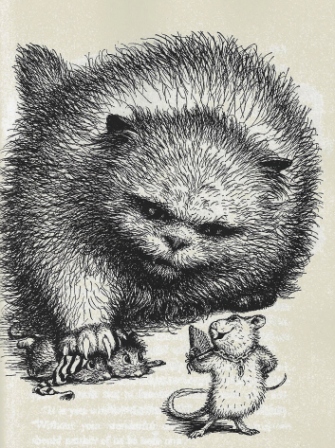
And here is Mamelouk, the Head Jailer’s wicked black half-Persian cat, whose favourite pasttime is spitting at the prisoners through the bars, and of course catching and tormenting any mouse who ventures into his dark domain.

Miss Bianca proves herself more than a match for Mamelouk, utilizing her special bravado and charm. Needless to say, the mission is successfully accomplished, though not without setbacks.

A light, rather silly (in the best possible way), rather enjoyable story.

Miss Bianca is a very “feminine” character, in the most awfully stereotyped way possible, but there are enough little asides by the author that we can see that this is not a reccomendation for behaviour to be copied but rather a portrait of a personality who uses the resources at hand (her charm, her beauty, her effect on others) to get things done.

Bernard is typical yeoman stock, earnest striving and quiet bravery in the face of adversity. He is attracted to Miss Bianca as dull and dusty moth to blazing flame, but quietly accepts that their places in the world are too far apart to ever allow him the audacity to woo her. Or possibly not…

Nils galumphs through the story in his sea boots, “Up the Norwegians!” his Viking cry. A reluctant (or, more appropriately, unwitting) hero, who has had his adventure thrust upon him, Nils typifies dauntless.

Read-Alone: I’m thinking 8 and up. Margery Sharp has written a children’s tale with completely “adult” language and references; a competent young reader will find this challenging but rewarding. Be prepared to clarify occasionally, if your reader is of an inquiring mind. (Hint: Better bone up on Lloyd’s Register of Shipping.)

Read-Aloud: I think this would be a very good read-aloud. Ages 6 and up. Reasonably fast-paced. The first few chapters set the scene and may be a bit slow going, and the dialogue will require careful reading; you’ll need to pay attention while performing this one – no easy ride for the reader! – but I think it could be a lot of fun.

Definitely worth a look. If this is a hit, there are eight more stories in the series. I have previously reviewed the second title here:    Miss Bianca

Read Full Post »

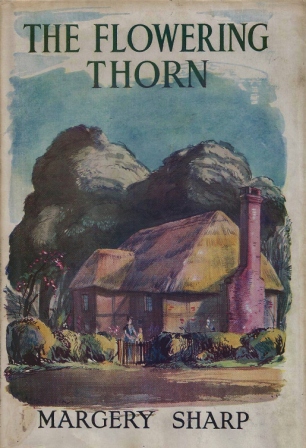
The Flowering Thorn by Margery Sharp ~ 1933. This edition: Little, Brown & Co., 1952. Hardcover. 345 pages.

My rating: 10/10

Margery Sharp’s fourth novel, The Flowering Thorn,  first appeared in England in 1933, with an American edition appearing in 1934, but it attracted little attention in North America until almost twenty years later. The later novels Cluny Brown (made into a 1946 movie of the same name, starring Jennifer Jones and Charles Boyer) and The Nutmeg Tree (used as the inspiration for the popular 1948 movie Julia Misbehaves starring Greer Garson, Walter Pidgeon, Nigel Bruce and a young Elizabeth Taylor) brought Margery Sharp  to the attention of the North American public, who happily bought her books and asked for more.

The reason I mention this is that there are two sets of “first editions” of The Flowering Thorn out there. The first “first” would be the original British 1933 edition published by Arthur Barker, Ltd. Putnam’s American edition followed in 1934. Then in 1952 appears another “first”, so stated in the book, with a stated copyright date of 1934, published by Little, Brown and Co. The dustjacket and front flyleaf of the 1952 Little, Brown edition refers to a number of the Sharp titles published after 1932, and up to 1951 – The Nutmeg Tree, The Stone of Chastity, Cluny Brown, Britannia Mews, The Foolish Gentlewoman, and Lise Lillywhite – giving the game away – but it can be confusing. There were several paperback editions as well. This title is fairly scarce; if you can find a decent-condition hardcover of any edition under $30, grab it. A 1933 true first in good condition will set you back $100 +, going by the May 2012 AbeBooks listings.

(Vintage book collector’s digression now over!)

I would like to call this a gentle, slow-moving examination of a woman’s progress towards true fulfillment and happiness, but Margery Sharp’s always analytical and occasionally tart tone, as well as protagonist Lesley Frewen’s no-nonsense attitude, make “gentle” a somewhat inadequate description.

Lesley is a twenty-nine year old socialite living in London in 1929. Her life is perfectly organized; she lives well, and just within her income, in a high-end, most desirable flat; her interests are the theatre, modern art, literature and music; she moves among the Bright Young Things of the day with aplomb and style. What Lesley suddenly realizes she is missing, after a tactful brush-off by a man she highly admires and has delicately offered herself to, is love.

…there slipped into her mind, already bodied in words, a strange and dreadful notion. She thought,
‘Perhaps I am not a woman that men do love.’
She thought,
‘There are women like that. Attractive women…. And if that is so, and if…that is what I have been waiting for, what am I to do now?’
The intricate daily patchwork was still there to work at, the innumerable dovetailing fragments still lay ready to hand: but it now seemed to her, and for the first time, that her work had no pattern.
‘I want something new,’ said Lesley aloud.
 

And it is in this frame of mind, struggling with her sudden inner turmoil, that Lesley goes to tea with her elderly aunt, who is embroiled of a turmoil of her own: her recently hired companion, a young, widowed Scotswoman, has suddenly died, leaving behind a four-year-old child. There are no relations in sight, and the orphanage looms.

Lesley, who has been watching young Patrick playing on the floor as the conversation regarding his future goes on above his head, is impressed and intrigued by the child’s tenacious attitude and sober demeanour. On a whim, she offers to take him on herself, much to her aunt’s consternation. Lesley immediately regrets her rash offer, but before she can backtrack the child catches her eye; to renounce him would be a betrayal, she suddenly feels. The immediate and very vocal opposition to her proposal by the elderly women present has the contradictory effect of  stiffening Lesley’s resolve, and the wheels are set in motion.

Lesley suddenly finds herself in the position of having to leave her flat (no children allowed) and to take on extra expenses in regards to Patrick’s care. Her careful budget is in tatters, and she decides, on another not particularly well thought out whim, to move into a cottage in a country village in order to live more cheaply. After all, it is only going to be for four years, until Patrick is old enough to send to boarding school, and then Lesley can slide back into her well-organized town life. Her social butterfly friends will surely understand…

Lesley’s new life is not what she had anticipated, but she takes it well in stride, attempting at first to keep up her strict London standards, but, ever-so-slowly, a new Lesley is born, a much more human and ultimately more lovable one.

Something I deeply appreciated about this story was Sharp’s total avoidance of sentiment regarding the relationship between Lesley and Patrick. Lesley is, almost immediately, deeply resentful of Patrick’s demands – both the physical demands of a small child, and the moral demands his presence in her life place upon her stern conscience. Confronted by a friend pushing the option of backing out of the situation, Lesley examines her innermost soul and comes to a surprising conclusion:

She thought, ‘If I don’t see this thing out I shall have something rotten inside me for the rest of my life.’ Rotten like an apple – the brown decaying core under the firm red skin…

Nevertheless, she does not initially feel any sort of affection for the child; to the contrary

…she looked at him with an intensity of dislike so nearly bordering on hatred that her own features, could she have seen them at that moment, would have seemed completely strange to her.  And even without seeing, it was as though she guessed: for in all their enforced companionship she never once spoke to him without consciously masking her face. It was a hatred to be ashamed of, ignoble and unjust: but she did not love him the more for making her ashamed.

The development of a much more positive relationship between the two is the thread that winds through the story, though Lesley in no way concentrates solely on the nurturing of Patrick; she is even more so concerned with working through her own emotional and intellectual growth as her self-imposed exile from her previous world gradually brings her an awareness of the unexpectedly rich and satisfying reward of relationships based on mutual affection and respect versus social expediency.

A thought provoking, often humorous, rather surprising story. Highly recommended.

Read Full Post »

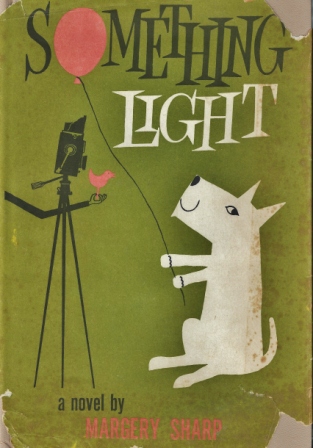
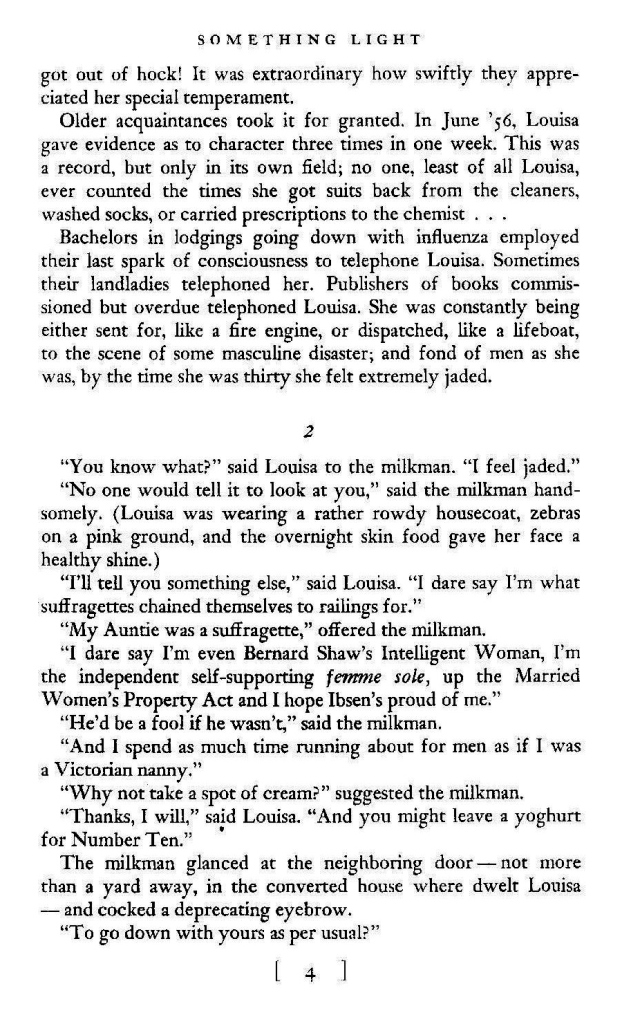
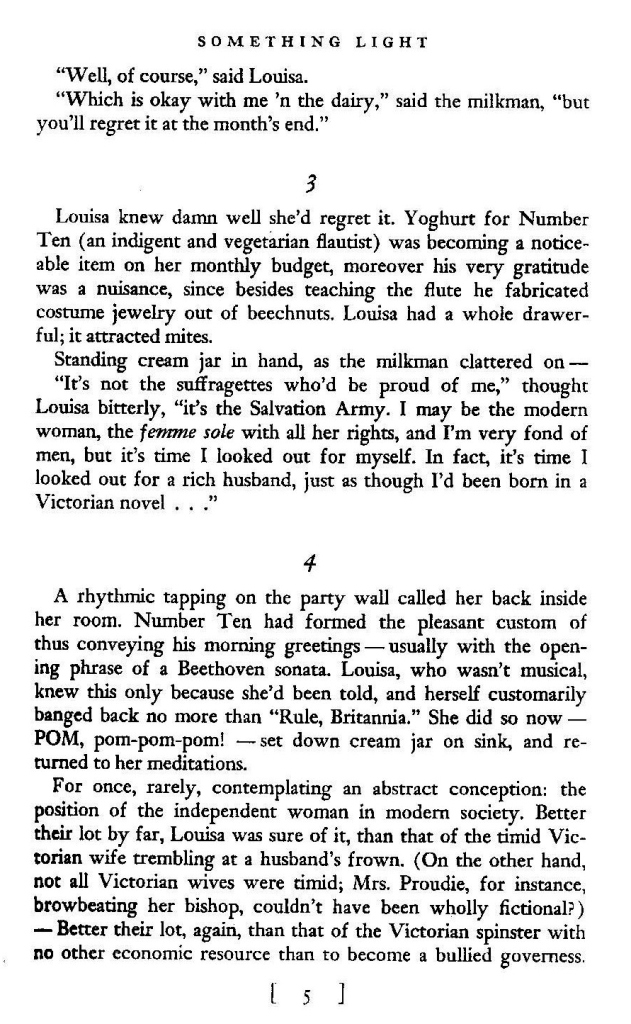
Something Light by Margery Sharp ~ 1960. This edition: Little, Brown & Co., 1960. Hardcover. No ISBN. 216 pages.

My rating: 10/10.

I love the works of Margery Sharp. No exclamation mark needed, merely a sober statement of fact. I am slowly and with deep pleasure building up a collection of her works. In every “Definition of Happiness” there is included “something to look forward to”; I am therefore a happy woman as I look forward with pure anticipation to sitting down with each hard-won out-of-print title by this most excellent forgotten author.

Luckily Margery Sharp was popular enough in her day that her titles are for the most part reasonably available with a bit of on-line searching, though her first two novels, Rhododendron Pie (1930) and A Fanfare For Tin Trumpets (1932),  fetch rather high prices in the used book world; well into the hundreds of dollars. In the meantime I haunt second-hand bookstores at every opportunity, peering hopefully at the faded titles of scruffy vintage hardcovers in eternal hopefulness. I did find two of her works this way, at the same most-excellent used bookstore in Kamloops, on separate occasions several years apart. I paid the princely sum of $5 each and controlled my great glee with difficulty until I was well away from the store. This also freed me up, as I gloatingly explained later to my slightly skeptical husband,  to be able to shell out for several of her other works at much higher prices, because then they all averaged out, and each one of the others wasn’t so ridiculously expensive, etcetera, etcetera.

But I digress.

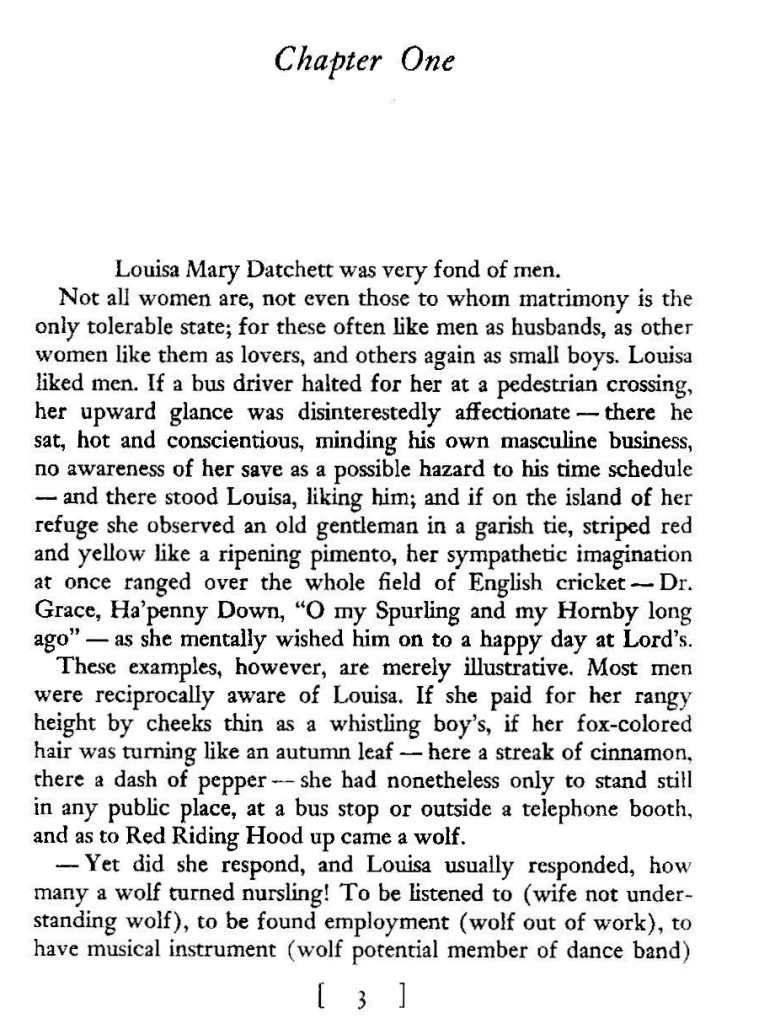
Something Light was my very first Margery Sharp, picked up on a whim at a little second-hand store I occasionally visit to scan through the modest book section. I noticed the book early in my shelf scan, but the faded and foxed dust jacket spine was less than appealing, and it wasn’t until my second pass around the stacks that something made me pull it out for a closer look. Here’s what I saw:

Hmm, I thought to myself. What’s all this, then? And I opened it up, noting that the pages easily turned as though it was used to being handled by a loving owner, and started to read. One, two, three pages. Then I quietly closed the book, walked up to the cash register, paid over my one dollar, tactfully ducked out of a conversation with the chatty proprietor, went out to my car, settled down and kept reading, completely neglecting my grocery and town chores list and stopping reading only when I was overdue to collect my daughter from her dance class. Definitely hooked.

Louisa Datchett likes men. No, not in the way that you’re thinking from that bald statement. Louisa likes men.

Here, read it yourself. A romp of a book,  something light indeed among Sharp’s delicious oeuvre.

Read Full Post »

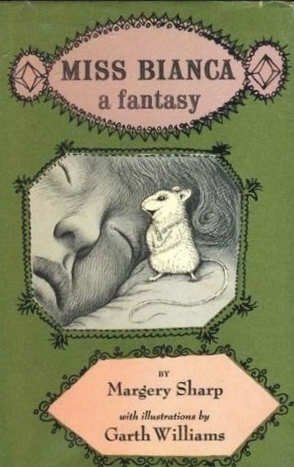
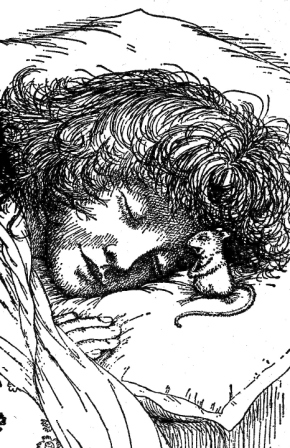
miss bianca margery sharp vMiss Bianca by Margery Sharp ~ 1962. Original title: Miss Bianca: A Fantasy. This edition: Fontana 1977. Paperback. Grand illustrations by Garth Williams. ISBN: 0-00-67-1235-5. 124 pages.

My rating: 7/10. The excellent illustrations raised it a few points.

I have a lot of good things to say about Margery Sharp, and her adult novels are among my most treasured books, but I must admit I have never previously read her once-popular children’s series about the little white mouse, Miss Bianca. The first two stories in the series were the inspiration behind the well-known Disney animated film The Rescuers (voiced, for those of you interested in such trivia, by Eva Gabor in the role of Miss Bianca and Bob Newhart as her partner Bernard) and its sequel. The paperback edition of Miss Bianca I have before me is the movie tie-in edition, with a cover still from the movie and this telling note on the title page:

Featuring characters from the Disney film suggested by the books by Margery Sharp, The Rescuers and Miss Bianca, published by William Collins & Co Ltd.

Don’t you just love that “suggested by” comment? So true! For the record, I am not a fan of the Disney bowdlerizations of otherwise excellent books. Several generations of children have now grown up with the Disney imagery of classic stories such as The Jungle Book, The Little Mermaid, and, heaven help us – The Hunchback of Notre Dame! – firmly in their heads versus the authors’ intended word-pictures.

So my beloved Margery Sharp is among the ranks of Disney’s “suggested” inspirations! I hope she got a generous settlement! It has just occurred to me that many of their take-off-of-classic stories authors were already dead at the time of the movie-making; Margery Sharp was very much alive in 1977, though I remember reading a quotation by her about not really being too interested in what happened during filming of her works (several of her adult novels were made into popular films); that her job was to write and that filmmakers were fine on their own without her input.

Back to the book at hand. A little way in I realized that Miss Bianca has a back story; so many references to what has “just happened” made me scratch my head until I realized that this is the *second* story in the series. The Rescuers is the first. I am thinking I need to get my hands on that one to fill in the gaps, and luckily that shouldn’t be a problem. New York  Review Books has just re-issued The Rescuers in hardcover, after its being out-of-print for ten years; I have several of their other beautifully rendered re-issues and I highly recommend them. Here’s the link: http://www.nybooks.com/books/imprints/childrens/the-rescuers/

So – Miss Bianca, Chairwoman of the Prisoners’ Aid Society (a charitable mousey organization dedicated to the comfort of incarcerated humans), has a new project to suggest. The last daring adventure, the rescue of a Norwegian poet from the infamous Black Castle (pause for ominous music) was obviously a great ego boost to the mice, and they are consequently quite boisterous and full of themselves. Miss Bianca, waiting for the Society’s latest meeting to come to order, muses that

“…their common adventure had given mice an unfortunate taste for flamboyance in welfare work. Not one, now, thought anything of sitting up to beg a prisoner’s crumb – in the long run one of the most useful acts a mouse can perform. Crumb-begging, like waltzing in circles (even with a jailer outside the door), was regarded as mere National Service stuff, barely worth reporting on one’s return from the regulation three weeks’ duty…”

The new mission is the rescue of a little girl who is being held in an abusive situation by the wicked Grand Duchess in the magnificent but icy-cold Diamond Palace. Miss Bianca appeals to the Ladies Guild of the Society to assist her in the daring rescue, and of course things do not go as planned. Miss Bianca is left behind in the general rout of the rest of the mice when the Duchess’ ladies-in-waiting, far from being tender creatures terrified of mice, turn out to be much more “hardened” than planned for!

This is a playful book; Margery Sharp indulged herself with a full flow of flowery and elaborate language, rather a challenge for young readers (but not necessarily a drawback), and the references are aimed rather at their elders over the heads of the child-audience; perhaps this was a book meant to be read aloud, with a nod to the parent as well as the child?

The villains in this little saga are properly villainous; the Duchess’ black-hearted Major-Domo, Mandrake, has committed “…a very wicked crime, of which only the Duchess now had evidence…” and he is her willing (though cringingly obsequious) partner in crime. Even her two unkempt carriage horses “…had criminal records; each having once kicked a man to death…” And so on.

If the story has a flaw (and it does have a few, being a slight work in every sense of the word) it is that the parody and melodrama are a bit too “over the top” for perfect comfort. The wee prisoner, the aptly named Patience,  is the latest in a long line of small children the Duchess has enslaved and apparently killed (!) –  though most children will shiver deliciously at the peril their two heroines find themselves in, my motherly brain says “Killed! Was that really necessary, dear author?!” And I don’t think we ever do get the full story on how the Duchess obtained Patience in the first place.

Ah, well. To sum up: a diverting little parody of an adventure story. I think it should definitely follow The Rescuers to make more sense to the reader; it has a very sequel-ish feel to it, though it could stand alone if need be. Quite nicely written in a very flamboyant voice (to use Miss Bianca’s own word); definitely not dumbed down to a younger audience vocabulary or style-wise.

This book #2 in a series, the first four of which are illustrated by the incomparable Garth Williams. I believe all except the newly re-released The Rescuers (New York Review Books, 2011) are out-of-print. Some are very easy to find second-hand, but the more obscure later titles may require some serious online sleuthing.

  • The Rescuers (1959)
  • Miss Bianca (1962)
  • The Turret (1963)
  • Miss Bianca in the Salt Mines (1966)
  • Miss Bianca in the Orient (1970)
  • Miss Bianca in the Antarctic (1971)
  • Miss Bianca and the Bridesmaid (1972)
  • Bernard the Brave (1977)
  • Bernard into Battle (1978)

Read-Aloud: I think so. Ages 6 and up, perhaps? The prisoner Patience is eight; much is made of her sad life and deceased predecessors and bleeding fingers, but the tone is optimistic – this is, after all, why the child very much needs a heroic rescue! Neatly tied up happy ending, with the mice going off to their next adventure.

Read-Alone: Hmmm. Maybe 8 and up? Or a very strong younger reader. Definitely can be appreciated by an older readership (including adults); Margery Sharp was an accomplished social satirist and this story is full of her wry observations, though they often escalate into full-blown parody much more so than in her adult novels.

Read Full Post »

« Newer Posts