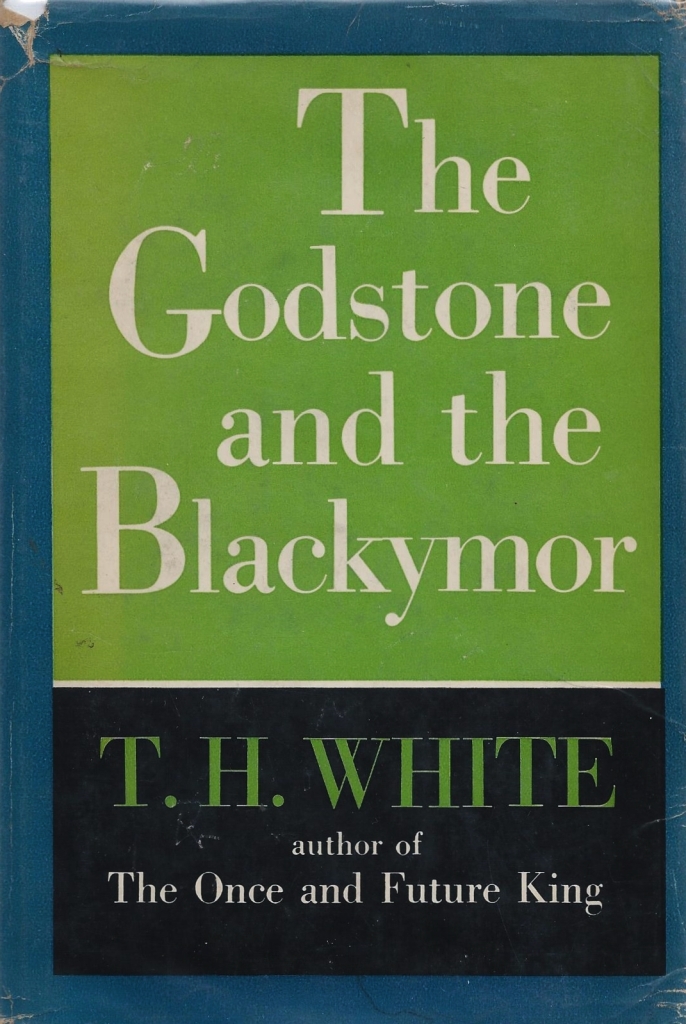
 The Godstone and the Blackymore by T.H. White ~ 1959. This edition: Putnam, 1959. Hardcover. Illustrated by Edward Ardizzone. 225 pages.
My rating: 10/10
T.H. White and Edward Ardizzone together – what a superbly unexpected partnering.
This is a rather unusual book, and hard to categorize. From the dust jacket rear flyleaf, here is what the author himself had to say:
God knows what this book is about. I suppose it’s a bit of autobiography really. But it’s about living on the West Coast of Ireland, in ‘the parish nearest to America’ – they all are, I mean the parishes – and it is about the people and things there, more than about me. I stumbled across what Protestants had said was an idol still being worshipped by the Catholics, and a coal-black Negro selling patent medicines, and a real Fairy Fire which lit our footsteps over the infinite bog – no whimsy. I did a lot of goose-shooting and falconry and salmon fishing. I went on pilgrimages and drank a lot and made friends and found out what I could and thought about it. I got ashamed of killing things. It seems to me a complicated sort of book about a complicated place, which I loved, and anyway it has pictures by Ardizzone, who loved it too.
In the 1940s, White travelled about in Western Ireland, seeking what he could find, whether it was game birds for hunting, or folklore for documenting and unravelling. He was met with suspicion by some – rumour occasionally had it that he was up to no good – a spy, no less, with his secret maps and documents hidden in a pocket of his red setter Brownie’s cloth coat – for this was during the World War II years. White, refusing to countenance taking part in the fighting, arrived in Ireland on the day the war broke out, and spent much of the next decade there, in informal conscientious objector status.
But White’s local hosts were more helpful and friendly than antagonistic, and The Godstone and the Blackymor is a quietly passionate appreciation of the place and people who gave him refuge, and whose stories and lives fed his voracious writers’ curiousity.
The Godstone of the title turns out to be a mysterious stone shape, the naomhóg, which was rumoured to have special powers, though whether pagan or Christian being up for debate. White spent months tracking down the lore related to the image, and interviewed historians, clerics, and local residents (the silent-on-the-subject elders being approached through the schoolchildren, under guise of an essay-writing competition) and eventually coming up with a plausible history of the object.
The Blackymor was one Mr. James Montgomery-Marjoribanks, from Nigeria by way of England, who travelled from small village fair to small village fair flogging patent medicines and practising his formidable skills in healing massage. White encounters him unexpectedly in the dining room of a small inn, and is struck by the extreme contrast of Mr. Montgomery-Marjoribanks’ physical appearance and sheer exoticism compared to the local Celts. White’s vivid description of this “coal-black cannibal” – “utterly, Nigerianly black…not a brown man, or a coloured man, or a crooner…absolutely a sable savage, a strong, bony, black, cannibal Negro.” After this first vivid impression, the two spend some time in conversation over several days, enough so that T.H. White is able to capture the essence of the brutally lonely life of a man so very far from whatever home he might have had, stoically making his way in the world earning his pitiful shillings, and never being accepted by anyone as really quite equally human. (The Irish innkeepers refuse to give him sheets, apparently believing his colour to be dirty – to be liable to come off on the linens, as it were.)
White writes with passionate clarity about episodes of falconry and hunting in the marshes and by the seashore, travelling to the coastal islands in various small craft, including traditional curricles (which he did not feel terribly comfortable in), and driving about where there were suitable roads – and sometimes where there weren’t – with his constant companion Brownie in his Jaguar car.
The last chapters are robustly philosophical in tone, examining the Irish way of religion, and White’s own troubled agnosticism, and the many complexities of the true Irish character, as opposed to the popular legend of “shamrocks and shillelaghs” of comic writers and films.
Ardizzone’s illustrations are a vivid enhancement of the text, capturing both the stark beauty, undoubted dignity and frequent quiet humour of the situations and people White portrays in words.
After randomly picking The Godstone and the Blackymor off of my shelf of 2014 TBR acquisitions, I realized that I was not alone in my current reading of his work, though he is not a new discovery here, but an old favourite.
T.H. White, so it seems from my very brief online researches into the provenance of Godstone, is suddenly on everyone’s radar, owing in great part to his role in Helen Macdonald’s prize-winning 2014 memoir, H is for Hawk, which includes references to White’s unusual life, as well as to his own falcon-focussed memoir, 1951’s The Goshawk.
I asked for Macdonald’s book today in my local independent bookstore, only to find that it is not available in Canada until March. I wonder if I will wait till then, or if I will send off to England for a copy?
In the meantime, I am considering a re-read of T.H. White’s Malory-inspired masterpiece of Arthurian reimagining, the four volumes which make up The Once and Future King. I read and re-read these times without number in my teenage years, and several times in adulthood, and I suddenly feel a deep urge to delve into that world once again, for The Godstone and the Blackymor reminds me what a grand wordsmith T.H. White was. His prose style has a lilting cadence which perhaps owes something to his time in Ireland, or perhaps it was there along. No matter which it is, it works.
T.H. White. If you haven’t already, may I suggest you turn your attention his way?
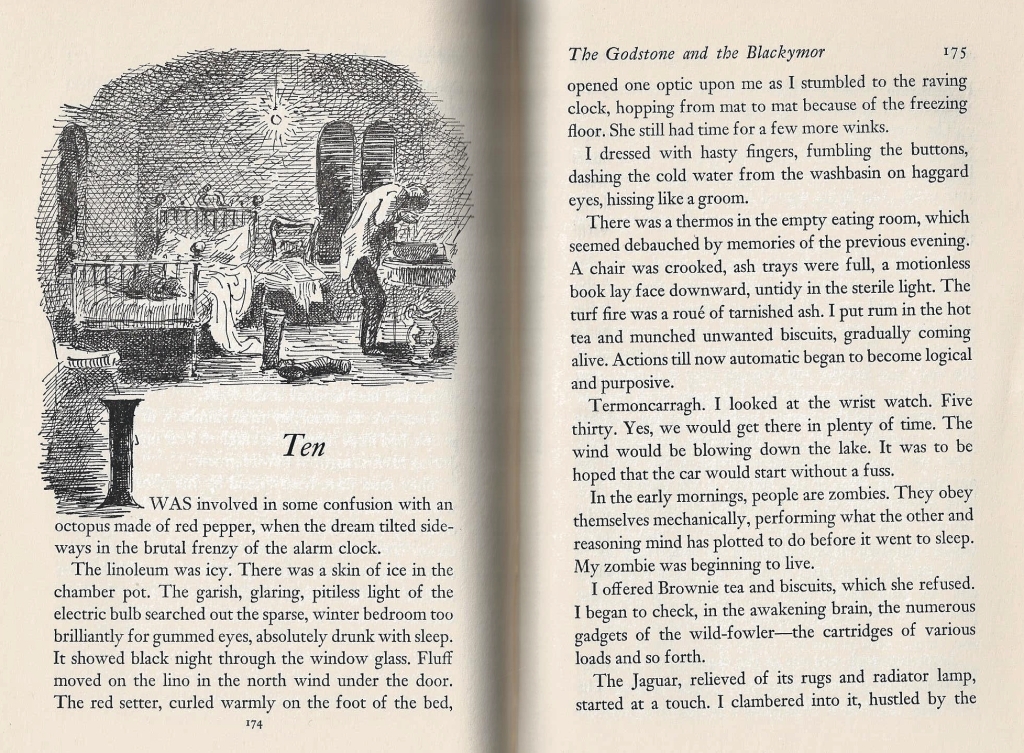
An excerpt from The Godstone and the Blackymor. Click to enlarge for ease of reading.






 Leaves & Pages