 The Case of the Shoplifter’s Shoe by Erle Stanley Gardner ~ 1938. This edition: Pocket Books, 1945. Paperback. 230 pages.
My rating: 6/10
Checking out several of the websites dedicated to Erle Stanley Gardner and his lifework, I made a quick count of the Perry Mason titles listed and came up with an incredible 85+, dating from 1933 to 1969, with several published posthumously – ESG died in 1970 – all with names prefixed The Case of – the Fan Dancer’s Horse, the Black Eyed Blonde, the Drowsy Mosquito, the Crying Swallow, the Vagabond Virgin… you get the drift.
Add to these the numerous other short stories published in the pulp fiction periodicals of the first half of the 20th Century, and the books written under various pseudonyms – A.A. Fair, Kyle Corning, Charles M. Green, Carleton Kendrake, Charles J. Kenny, Les Tillray, Robert Parr – plus various novelettes, compilations and non-fiction articles, guides and memoirs, and suddenly the designation “prolific” seems to not be quite accurate enough. This guy was hyper-prolific.
And with that comes the all-too-understandable label of the “formula” writer, which there is no doubt applies accurately here.
I had once or twice dipped into ESG’s mysteries – or perhaps more accurately, “procedurals” – but they never really took. However, using the excuse of the Century of Books project and the serendipitous acquisition of this wartime issue Pocket Book – “Share this book with someone in uniform” requests a blurb on the back cover; “Books are Weapons in the War of Ideas” on a front endpaper – I decided to give Gardner one more chance, to see if I dismissed him too readily before.
Nope. Still not a fan. Though I can see the appeal, and it wasn’t a chore to read, exactly. Just a bit boring, and not very “deep”, even for something of this “light entertainment” genre.
Here’s the plot description of this particular episode in the ongoing adventures of Perry Mason, lawyer and self-styled investigator and champion of the wrongly-accused:
Perry Mason’s chance encounter with the benign looking, white-haired shoplifter, Sarah Breel, involved him in one of the strangest murder cases of his career. The mysterious disappearance of Mrs. Breel’s brother, of five valuable diamonds, and then of Sarah Breel herself, set Mason to some investigating that didn’t please the police. Then Mrs. Breel reappeared, victim of an automobile accident, with an unaccounted-for blood stain on her shoe, and a gun in her bag. When Austin Cullens, who knew about the diamonds, was found murdered by a bullet from this gun, the police discovered that in addition to a broken leg, Mrs. Breel was suffering from amnesia, and Perry Mason became attorney for the defense with a client who could not – or would not – give him any clues at all.
Luckily Mr. Mason has a wide circle of dedicated helpers who are willing to go to any lengths to assist our fearless investigator, such as his luscious secretary Della Street, pet detective Paul Drake, and tame doctor Charles Gifford, all of whom go above and beyond at the mere crook of Perry Mason’s finger.
Several bodies pop up, a hysterical woman or two, a cool sophisticate with a secret, stray gamblers and jewel thieves, to supply the story with a lavish amount of pinkish herrings and some sketchy side plots which are never really developed. It all ends in a big courtroom scene, where Perry Mason hypnotizes his opposition with his keen wit and suddenly revealed secrets.
Yawn.
I’m sticking with Rex Stout and his creations Nero Wolfe and Archie Goodwin for my fallback formula mystery/investigator stories. (And even those are rather uneven, I’ll readily admit.)
The Perry Mason saga has its merits, not least of all the snippets of period detail, the slang and the clothes and the food and the drink and the MANY references to tobacco products throughout – these people went through a lot of the Demon Leaf – no wonder the men all have hoarsely sinister voices and the women husky whispers.
I had a giggle at the descriptions of the meals, too, and a bit of a blush for Della Street’s forthright concern for her lovely figure. Here are Della and Perry bantering as they sit down for an unplanned lunch at a department store tea room, where they’ve gone to shelter from a sudden rain storm.
“Well, Mr. Mason, since you’re buying the lunch, I’m going to make it my heavy meal.”
“I thought you were going on a diet,” he said, with mock concern.
“I am,” she admitted, “I’m a hundred and twelve. I want to get back to a hundred and nine.”
“Dry whole wheat toast,” he suggested, “and tea without sugar, would…”
“That’ll be fine for tonight,” she retorted, “but as a working girl, I know when I’m getting the breaks. I’ll have cream of tomato soup, avocado and grapefruit salad, a filet mignon, artichokes, shoestring potatoes, and plum pudding with brandy sauce.”
And she does.
Aha! – that’s it! Nero and Archie have rather better sounding food!
Now I’m just being silly…
Well, that’s that for Erle Stanley Gardner. I doubt I’ll be seeking any more of these out, though I’ll happily read them in anthologies and if stuck somewhere with no other reading matter handy.
Onward.
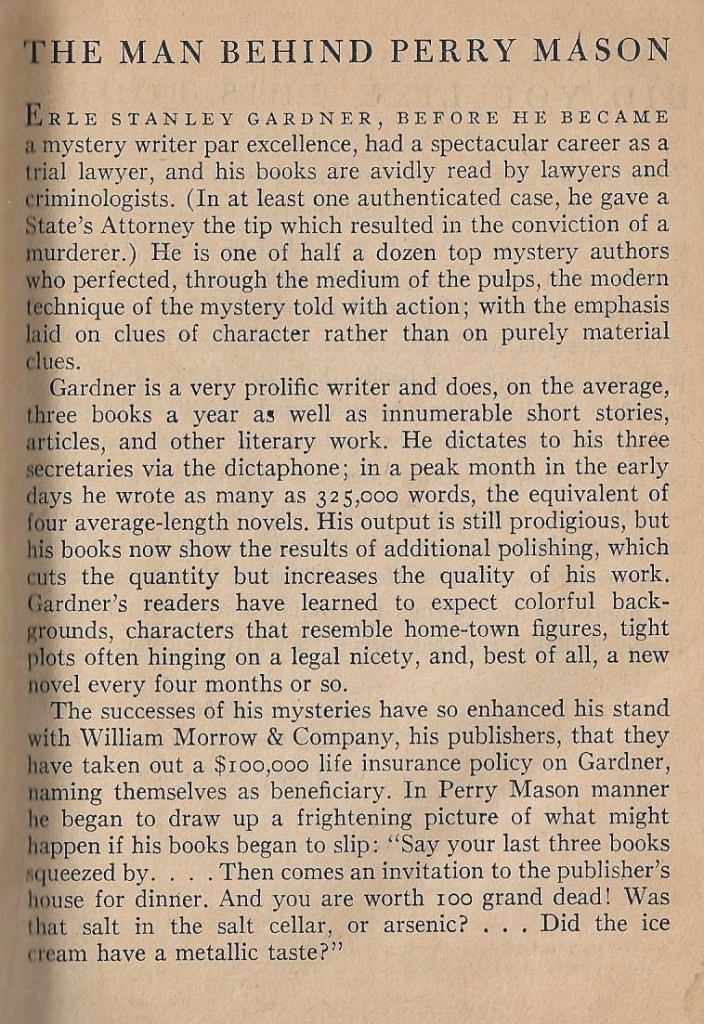
One last thing. Here is the page scan from my old Pocket Book with the publishers being all clever and smugly humorous about their best-selling author:













 Leaves & Pages
Slighty Soporific: The Shapes of Sleep by J.B. Priestley
Posted in 1960s, Century of Books - 2014, Priestley, J.B., Read in 2014, tagged 1962 Novel, Century of Books 2014, Cold War Paranoia, Mystery-Suspense, Priestley, J.B., Social Commentary, Social Engineering & Brainwashing, The Shapes of Sleep on March 24, 2014| 4 Comments »
My rating: 5/10
Close call, J.B. You almost didn’t make that 5, but my enduring fondness for your many years’ worth of earnest and good-humoured novels and essays and memoirs tipped the balance.
This is not so much a baddish book as a terminally undecided one. It reads like the author can’t quite decide on some rather major plot developments so has decided to make it up as he goes. Which can work, but in this case means false starts, dropped threads, and a general lack of a sturdy backbone to build the story upon.
And J.B. Priestley has tried his hand here at writing sexy, but it reads very much like the author is extremely uneasy with the style, and the hands-on-breasts and rigid (or not rigid) nipple descriptions are much more embarrassing for the reader than titillating. At least I found them so. I absolutely cringed, and mostly because it made the writer look inept and out of his comfort zone, style-wise. This is Priestley, after all, and you’d expect a higher level of capability in handling a scene. Any sort of scene.
Following closely on the heels of 1961’s uneven “suspense-thriller” Saturn Over the Water, Priestley further experiments with the genre, using the action to sugar coat some intellectual musings about the continual deterioration of societal mores, the dangers of state-sponsored paranoia (this is smack dab in the middle of the Cold War), and the status of women inside and outside of marriage. There are some fairly substantial shades of proto-feminism here, with Priestley trying his darnedest to articulate his support and appreciation for the “other side” from his masculine point of view.
So, regarding the actual story.
Here we have a freelancer journalist, Ben Sterndale, on the declining end of what was apparently a stellar career. He is offered a small job which will require him to use his investigative skills rather than his writing ability. A pale green piece of paper covered in mysterious figures and foreign handwriting has gone missing from an advertising agency office. Strayed or stolen, it is wanted back. Luckily there is a tiny corner of the paper left behind, with a few word ends which Ben interprets to be of German origin, and the investigation is on.
People with guns and sinister accents pop in and out, as well as a female person who is rather obviously not what she seems. Ben tenaciously follows every little lead, and by a combination of sheer bullheadedness and a fair bit of luck (courtesy our old fictional friend, the blissful coincidence) tracks down the secret behind the green paper as well as the girl.
A Helen MacInnes-like hectic tour of Germany plays a central role in the story; Ben-voiced-over-by-Priestley does not care for the Germans much – as I already sort of had gathered from his (Priestley’s) jibes in Saturn Over the Water – which adds an uneasy element to his adventurings in that country.
The mysterious paper and the secret it holds the key to are the least important thing going on here; so much so that even when we get a firsthand description of the “shapes of sleep” and their sinister inferences (spoiler: this would apparently be brainwashing and social engineering, to be delivered via subliminal messaging/advertising), we can’t quite believe that they are worth killing and being killed for, and they fade away completely in the last scene of Ben/Priestley mulling over the deteriorating state of the world and the changing status of women and their vital importance to future “peace and prosperity.”
I couldn’t help but wonder how much of this was due to Priestley’s private life influencing his writing. When The Shapes of Sleep was written, Priestley was sixty-eight years old, and just a few years into his third marriage, with archeologist/researcher and fellow writer (and Priestley’s co-writer in their 1955 collection of travel and opinion essays, Journey Down a Rainbow) Jacquetta Hawkes.
All in all, a rather unsatisfactory book, mostly interesting to this “fan” to enable me to check off another entry in Priestley’s widely-varied oeuvre. I may read it again one day to see if my impressions can be revised; then again, I may not.
Here, see Kirkus for its take, from June 15, 1962. I was amused to read this briefly cynical review after I had formulated my own, and to see that I was not alone in my disenchantment regarding this novel.
Read Full Post »