These next two books are proving to be something of a challenge to me.
Well, not actually the books themselves. Reading Miles Franklin’s teenage bestseller, My Brilliant Career, and her publisher-suppressed sequel (and apology to her parents) My Career Goes Bung, has been a fascinating process. My dilemma lies in how best to express what these books are really all about, and how they reflect the strong ideals of their author in her own life, while still inhabiting the fictional realm.
I will try to keep things brief(ish); one could go on for pages and pages and pages. Luckily there are others who have covered this ground before, and I think that if I succeed in piquing your interest in this writer and her books I will have to say, “Good enough.” Biographies and resources are definitely available for further study.
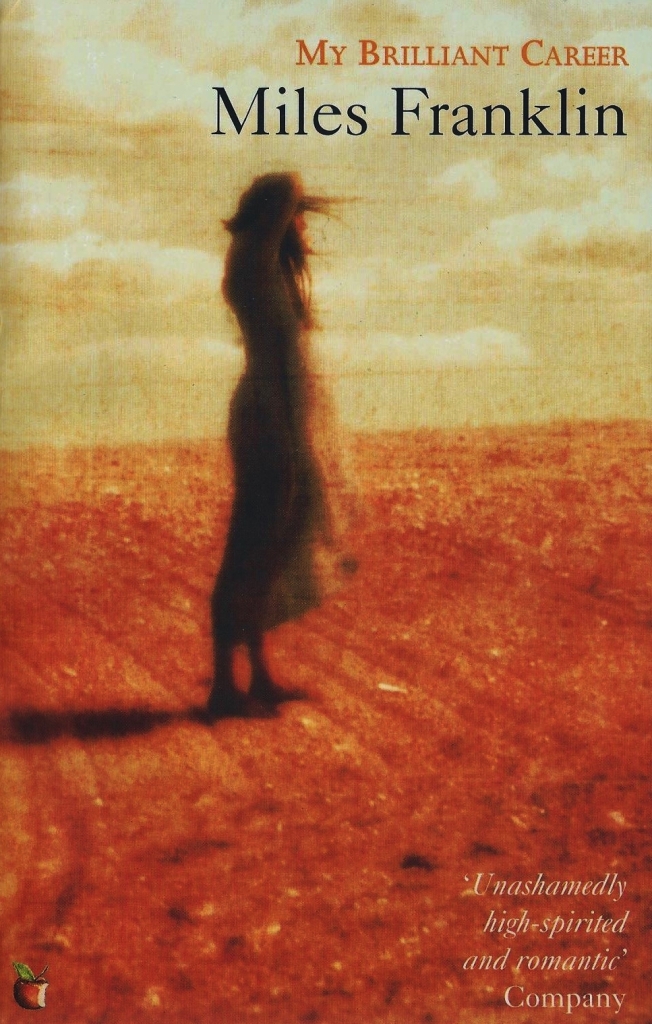
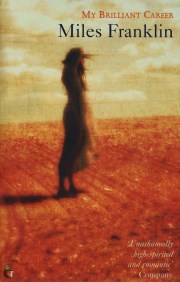 My Brilliant Career by Miles Franklin ~ 1901. This edition: Virago, 2002. Introduction by Carmen Callil. Paperback. ISBN: 0-86068-193-9. 232 pages.
My rating: 8.5/10
My sphere in life is not congenial to me. Oh, how I hate this living death which has swallowed all my teens, which is greedily devouring my youth, which will sap my prime, and in which my old age, if I am cursed with any, will be worn away! As my life creeps on for ever through the long toil-laden days with its agonizing monotony, narrowness, and absolute uncongeniality, how my spirit frets and champs its unbreakable fetters—all in vain!
Whoa, steady on, there!
These emotions, from the introduction of My Brilliant Career, written in the voice of fictional autobiographer, almost-seventeen-year-old Sybylla Melvyn, absolutely sob teen angst. Appropriately so, for their real author, Australian Stella Maria Sarah Miles Franklin, was just sixteen herself when she dashed these words off in the late 1900s, and the youth of the author is very evident throughout the story.
The fictional Sybylla starts life as the indulged child of a successful New South Wales landholder and an aristocratic mother. When Sybylla is eight years old, a prolonged drought inspires her father to change his occupation, to that of a stock dealer in nearby dairy-farming region, and the landholdings are sold and the family relocated to a much smaller farm. Sybylla’s father proves to be a very poor businessman, and his escalating failures start him drinking to excess, until the family’s circumstances become reduced to the point of bankruptcy. Sybylla’s mother is predictably soured by all of this, and her frustration with her declining lot in life and with her continually sulking eldest daughter comes to a head. Sybylla is told to get out into the world and earn a living, as the family cannot support either her careless ways or her continued financial drain on family resources. A reprieve comes through an offer by Sybylla’s well-off maternal grandmother to come and live on the family estate.
Sybylla finds life at her grandmother’s very congenial, and she blossoms into something of a local belle, eventually attracting the attention of the district’s wealthiest bachelor, the dashing Harry Beecham. Harry and Sybylla come to a tentative agreement – tentative, anyway, on Sybylla’s part, though ironclad on Harry’s – that she will marry him once she turns twenty-one. As she is just seventeen when this takes place, anything might happen in the ensuing years, and of course it does.
Harry loses his estate and leaves the district in order to re-establish himself; Sybylla’s parents send for her to take on a post as a governess with a family friend who has loaned the Melvyns money; Sybylla’s labors will count towards the interest. This proves to be a squalid and humiliating experience; Sybylla ends up having a nervous and physical breakdown, and returns to her parents’ home to recuperate, much to their combined dismay.
Harry returns, with fortune well on its way to being restored, but Sybylla has developed a deep antipathy to the married state, having observed the brutal physical and emotional effects of even a happy marriage on the women she has been observing as she becomes ever more acquainted with the wider world. Though Harry offers her a deep respect and swears that he will allow her the freedom to pursue her own interests (writing and music), and she is herself more than a little in love with him, she is ultimately unable to commit herself to him, and there Sybylla’s story abruptly ends.
This novel was an immediate bestseller, and brought the young author – Miles Franklin was twenty-one when it appeared – much fame and notoriety, as it was claimed by the publisher to be autobiographical, and the parallels between aspects of the lives of fictional Sybylla and real-life Miles were too obvious to dismiss. Teenage girls thrilled to Sybylla’s emotional outpourings and her desire to make something of herself, to have a “brilliant career”. The melodramatic tone of the tale caught adult readers’ attention, while family friends and neighbours raised querying eyebrows at the “Franklin girl’s” manipulation of the facts, and eagerly purchased the book for its curiousity value.
Despite the welcome income her debut novel brought, Miles Franklin was appalled at how it was received, and by the assumption that her family was accurately portrayed; she had meant it as a fiction. When her publisher inquired as to whether she would allow a second edition, Miles Franklin staunchly refused, and the book went out of print, until it was finally reissued in 1966, twelve years after her death.
The emotions expressed in the novel, chiefly those of frustration at the lack of opportunities for education and professional development for women, resonated with the modern feminists of the 1960s, and My Brilliant Career has been in print ever since, a highly regarded piece of early feminist literature, and a blazing example of a young woman’s refusal to bow to the status quo.
So much for the “meaningful” aspect of this book. Was it a “good” read?
Well, yes. It really was. I enjoyed it greatly.
Sybylla, for all of her over-the-top rantings about the woefulness of her life, early on turns into a very real and relatable character. I found that I was completely drawn in to her rather heart-rending little saga, and though I had moments of wanting to shake her vigorously – my “mother” side coming to the fore, I’m sure – I was completely on her side throughout. I sighed a bit when she turned down Harry Beecham at the very last; he was a wonderful catch, especially for the time and place. It was touch and go there for a bit, until Sybylla’s deeply entrenched intention of lifelong single womanhood got the upper hand!
Fascinating, then, to read the “sequel” to My Brilliant Career, which was written soon after the first book was published, but which was turned down by the publisher because of fear of scandal. More below.
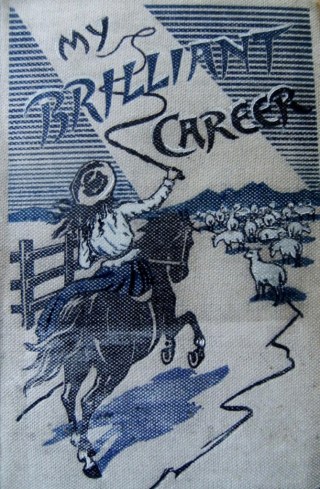
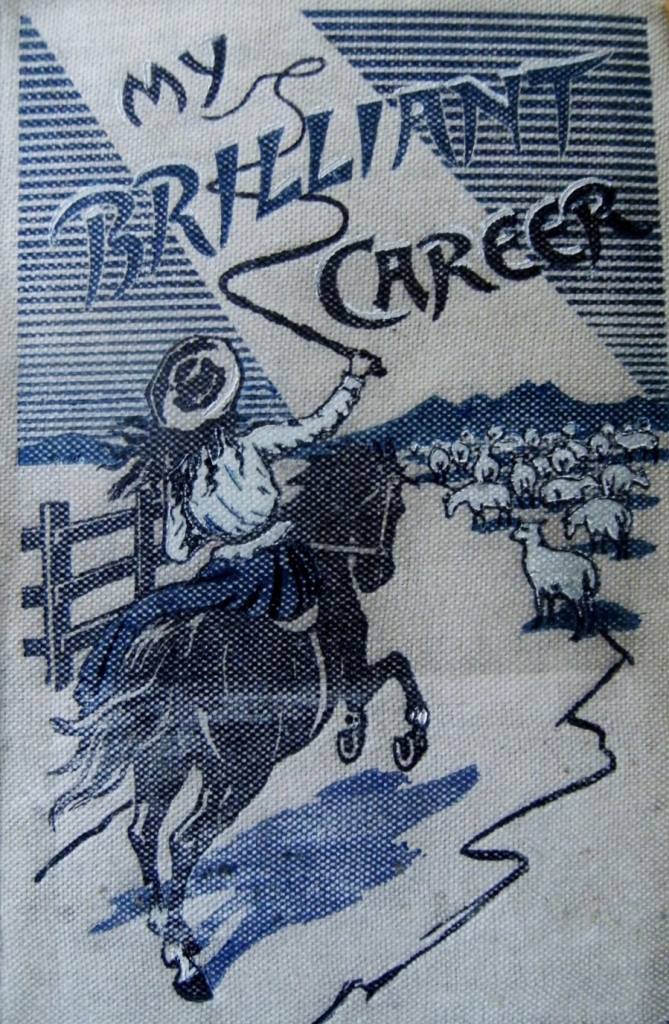
First edition cover of “My Brilliant Career”, showing the illustration which is gently mocked in the author’s sequel/rebuttal, “My Career Goes Bung”.
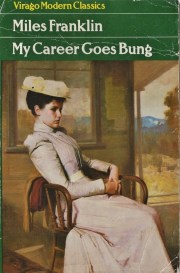 My Career Goes Bung by Miles Franklin ~ 1946. This edition: Virago, 1981. Foreword by Verna Coleman. Paperback. ISBN: 0-86068-220-X. 234 pages.
My rating: 9/10
I bless the serendipity which brought this book to me just before Christmas, when I was assembling books for the Century reading challenge. The name “Miles Franklin” was in the forefront of my awareness, having just purchased her first novel, My Brilliant Career, to represent 1901, and that in combination with the green Virago cover caught my eye.
While My Brilliant Career is something of a curiousity, a teenage writer’s attempt at dramatic fictional autobiography, My Career Goes Bung shows a polish and maturity which make me eager to explore more of this writer’s work.
The back story behind the delayed publication of the novel is fascinating as well. Written in 1902, concurrent with the author’s brief social success in Sydney as an up and coming young writer due to the instant popularity of My Brilliant Career, this next novel was returned by Franklin’s publisher with a terse, “No, thanks!”, citing fears of libel suits as well as concerns about its audacious and “advanced” views on sexuality and women’s rights. Miles Franklin then packed the manuscript away, and for decades believed it to have been destroyed, until the discovery of a second copy in an old trunk of her mother’s led to its publication in 1946.
In My Career Goes Bung, we are introduced to the “real” Sybylla, the young woman who has penned a bestseller based very loosely on fact, but which has been accepted as strictly autobiographical. In My Brilliant Career the fictional Sybylla’s parents and associates are portrayed as much less than admirable, and it is not at all surprising that the young author finds herself humiliated by the whole experience, and deeply apologetic to her parents, who were in actuality supportive of the young Sybylla’s literary strivings.
Peeling away the layers then, we have three characters to consider while reading these books. At the core, the very real person, Miles Franklin. Then her sympathetic alter-ego, the Sybylla Number Two of My Career Goes Bung, and lastly the teenage creation of excessive emotion and high imagination, Sybylla Number One, of My Brilliant Career.
Got that? It’s not all that complicated once one is immersed in the books; it all falls into place quite neatly. (Trust me!)
Sybylla Number Two goes off to Sydney to attempt to take advantage of the hubbub around her bestselling novel and to meet some of the literary stars of the day, with an eye to advancing her writing career. She is greeted with enthusiasm as the novelty of the moment, the little “bush girl” in her simple frocks, very much the innocent abroad, fending off the wolves by her impermeable naïvety in regards to their social manipulations, and in the case of many of the men, their sexual advances.
Sybylla attracts the eye of the handsome, calculating and immensely successful Goring Hardy, a thinly disguised version of the real-life “Banjo” Paterson (Waltzing Matilda, The Man From Snowy River, et al), who finds the virginal Sybylla a tempting prospect for conquest. Sybylla submits to his caresses, but allows no further liberties than some hot and heavy fondling and kissing; at the end of a week of secretive meetings, both parties realize that the relationship is not about to progress any further, and politely part ways. (Miles Franklin did have a short-term relationship of some sort with Paterson, hence the libel suit fears in regard to the fictional version.)
Sybylla is apparently something of a “babe” – in the most modern sense of the term – attracting the lavicious attentions of every many she meets. Another suitor, one Henry Beauchamp, assumed by all to be the original of the dashing Harry Beecham of My Brilliant Career, appears to vigorously woo Sybylla, but she spurns his frequent marriage proposals with steadfast determination. Sybylla then rather scornfully dismisses Sydney society as an artificial and fickle atmosphere antipathetic to true creativity, and returns to her family home more than ever determined to live the life of an independent woman, unshackled by the chains of marriage and childbearing, to pursue her ideals alone.
The End. (With the sound of enthusiastic feminist cheering faintly off on the sidelines.)
The real Miles Franklin stood by her convictions as firmly as did her fictional alter-ego. Though courted by many men, she never married. She continued to further develop her unique literary voice, supporting herself while writing by a variety of occupations, including nursing, housemaiding, and working as a secretary. She adopted the unlikely and picturesque nom-de-plume “Brent of Bin Bin”, avoiding her (modified) real name in order to sidetrack unfavourable comparisons of her subsequent work to My Brilliant Career, and had a modest success in her lifetime as a writer of Australian historical sagas and slightly quirky fictions.
Miles Franklin. I don’t think I’m quite done with her yet. What an interesting writer. Century of Books, you’ve already introduced me to a number of new-to-me mind-broadening reading experiences, of which this one stands out, so early along. I wonder what other happy surprises this reading year will bring?
Project Gutenberg Australia has a number of Miles Franklin’s works represented online, well worth looking at. My Brilliant Career and My Career Goes Bung are widely available in physical book form, in some cases as a combined edition, which I highly recommend. The second book enhances the first, and they greatly reward being read together.
Read Full Post »
 The English Air by D.E. Stevenson ~ 1940. This edition: Farrar and Rinehart, 1940. Hardcover. 317 pages.






 Leaves & Pages
The Shuttle by Frances Hodgson Burnett
Posted in 1900s, Century of Books - 2014, Read in 2014, tagged American-British Relations, Century of Books 2014, Frances Hodgson Burnett, Nobility & Commoners, Social Commentary, The Shuttle, Vintage Fiction on January 26, 2014| 23 Comments »
My rating: 8.5/10
Coming late to the party with this book, I am. I had added it to my Century of Books must-acquire list because of numerous enthusiastic recommendations from other bloggers, and I am thrilled to be able to report that those who gave it the nod were completely correct. It’s an absolutely grand read.
I understand that the currently in-print edition published by Persephone has been edited somewhat, and I can’t help but wonder what they cut out. I’m not terribly concerned that it would have ruined the story – this is a very long book with abundant authorial wanderings just slightly off-topic here and there – but it was intriguing to read the early, as-published text in this lovely vintage edition and speculate as to where it could be gently trimmed.
And golly, I just realized that the book I’m holding in my hands (well, it’s actually sitting on top of the printer beside the computer, but it was just being held in my hands) is a genuine antique. One hundred and seven years old. That’s rather a pleasant thought. It’s travelled through the decades very well indeed, both in physical condition and in staying power of contents.
If you are one of the few of my readers who hasn’t yet tackled The Shuttle, here is a plot summary of sorts.
There were once, in the later years of the 19th century, two American millionaire’s daughters, eighteen-year-old Rosalie (Rosy) and ten-years-younger Bettina (Betty) Vanderpoel. It was just at the time of the first awareness by impoverished English gentlemen of the nobility – second, third and fourth sons, as it were – that here was a rather well-stocked hunting ground for well-dowered wives, who would be willing to exchange the country of their birth and a goodly portion of their fathers’ wealth for an English title and a stately ancestral home. In the best of these transactions, gone into with eyes wide open, both parties benefitted and a certain degree of happy felicity resulted, but occasionally the meeting of American feminine independence and English masculine traditionalist views on the necessity for a wife to submit to her husband’s superior judgement ended in disaster.
Guess which kind of marriage sweet, frail, loving and deeply innocent Rosy Vanderpoel made?
Falling for the seductive wiles of Sir Nigel Anstruthers, Rosy trots innocently off to England, but the honeymoon voyage is not even half over before she realizes that she has yoked herself to a malicious and sadistically abusive man. Sir Nigel is a rotter through and through. He despises not only his new wife, but her family and her country and her ideas and her expectations of at least a modicum of domestic happiness. His bitter disappointment at Rosy’s father’s insistence at leaving the control of her fortune in her own hands and not in her husband’s has Sir Nigel seething; he has hidden his true nature well, but now that the shores of the new world are receding he is preparing to gain control of Rosy’s share of the Vanderpoel millions for himself.
Competently reducing meek Rosy to a grey shadow of her former self, Sir Nigel succeeds in cutting her completely off from her American family, but for the occasional letter requesting more funds. Three babies are born; the first a son, who is born crippled due to his pregnant mother being physically assaulted by Sir Nigel; two little daughters die young.
Ten years pass.
Back in America, Betty Vanderpoel has never forgotten her beloved older sister, and can’t quite believe that the cessation of relations is by Rosy’s wish. (Betty had never liked Sir Nigel, and he returned the scorn she viewed him with in spades.) Taking her father into her confidence, Betty announces that she is going to go to England and see for herself how Rosy is faring. And off she goes, with her father’s blessing and his millions behind her.
What she finds is beyond her worst expectations. Rosy, aged beyond her years, lives a dreary life shut up in a decrepit mansion staffed by sullen servants, her only companion her hunchbacked ten-year-old son, Ughtred. (Aside to author re: “Ughtred”. What the heck, Frances Hodgson Burnett? That is absolutely bizarre. What were you thinking???!) Anyway, the estate is mouldering away while Sir Nigel pursues his merry way a-spending Rosy’s money on mistresses and riotous living abroad; he returns only to indulge himself in spousal abuse and to browbeat Rosy into sending another brief letter to Papa requesting more money to maintain his little grandson’s estate.
Betty, made of much sterner stuff than Rosy, swoops in like an avenging goddess, and the majority of the rest of the book consists of the rehabilitation of Rosy, Ughtred, the estate and the attached village full of grateful rurals. Sir Nigel reappears to find his despised sister-in-law very much in control of things, and their ensuing battle of wills, Rosy’s deeply good against Sir Nigel’s blackly wicked, is a gloriously entertaining thing.
Oh, and there is a further development. The next estate over belongs to another impoverished nobleman, this one the sole survivor of a long succession of bad eggs. But is Lord Mount Dunstan really as deeply black as his spendthrift, now-deceased elder brother, and the heedless ancestors before him, or is he sullen merely because he feels so darned bad about the decrepit state of his hereditary acres? Any guesses?
I will stop right here, because you can now likely guess the ending from what I’ve just said. Nope, no surprises here. But how the author gets us to the inevitable conclusion is deeply diverting. And how genuinely engaging and interesting her various characters are, from meek Rosy to divinely competent Betty to nasty Sir Nigel and his equally nasty old mother to misunderstood-but-really-deeply-noble Mount Dunstan to random American typewriter salesman G. Selden (who makes up a merry little sideplot himself, what with his precipitous entry via bicycle wreck at the very door of the Anstruther mansion) to busy millionaire Reuben Vanderpoel – what a glorious cast!
I loved this story! It’s a proper saga. Such a treat to have a black and white, good-versus-evil, you know who to root for and who to boo and hiss at sort of thing!
And it does reflect some very real historical happenings, such as the astounding trans-Atlantic traffic in (relatively) poor English noblemen and wealthy American heiresses which took place from the 1860s well into the early 1900s. Fictional Rosy Vanderpoel is represented as being one of the earlier of the transplanted rich girls, and her story is based solidly on fact, though with artistic license in her particular details.
A grand exposition on both American and British social structure of the late nineteenth century, with abundant detail and a whole lot of humour. What a good book, in an old-fashioned novel-ish sort of way. If you haven’t read it already, may I suggest that you consider adding it to your Must-Read list, in any edition you can get your hands on? As the publisher’s poster claims, it is a masterpiece.
Edited to add this note on the heroine’s wee little nephew’s name, Ughtred. At first I thought, “No way! This can’t be a real name.” But then a commenter said something about old Saxon names, and the penny dropped. Of course. A bit of internet research (what did we do before Google?!) turned up just a few references, enough to show that Frances Hodgson Burnett did indeed know her stuff. Here we are, then, references from several genealogy websites. (And I did not bookmark the references; bad researching practice, I know. Don’t tell the teens in my family, as this is a constant refrain from me when they are doing online research: “Reference your sources!”)
and
So there it is. A name with a genuine and quite fascinating history. But I still pity the poor kid in The Shuttle. Crippled from before birth by his wicked father, and then saddled with this. It’s even more eyebrow-raising than Little Lord Fauntleroy’s Cedric. Wonder what his (Ughtred’s) middle name (names) is (are)?
The publisher’s American publicity poster from 1907.
Read Full Post »