Archive for the ‘Read in 2013’ Category

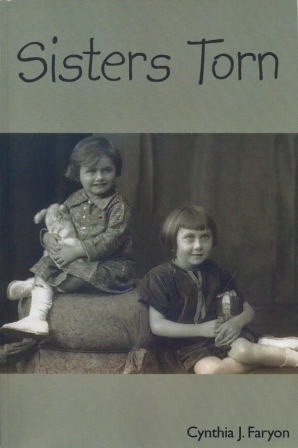
sisters torn cynthia faryon 001Sisters Torn by Cynthia J. Faryon ~ 2001. This edition: Caitlin Press, 2001. Softcover. ISBN: 0-920576-92-3. 297 pages.

My rating: 4/10.

A tragic family story, and much as I respected the author’s desire to record it, it didn’t quite come to life as it might have. Perhaps the attempts at dialect and dialogue didn’t really work out?

This has a small press, “self published” feel to it. It definitely could have used a stronger editorial presence, to clean up grammar, punctuation and proof reading errors, all of which were much too frequent, and got in the way of my fully appreciating the narrative.

*****

From the back cover:

“I promise I will always look afta’ my sista’ no matter what, I will never let go of her hand.”

Little did young Simone realize, as she made this promise to her aunt, that she and young Catherine would spend the next 65 years trying to reconnect.

Abandoned by their parents and separated by the British adoption system, these two young girls would face impersonal orphanages, brutal boarding-out homes, a world war, and separation by an ocean and two continents before they finally met again – in Victoria, B.C.

This is their story as told to the daughter of one of them. It is a story of pain and courage – and hope.

Born to a mismatched couple in the 1920s – their mother “married beneath her” – young Simone and Catherine were placed with relatives when their baby brother tragically died in a gruesome accident (vividly – perhaps too vividly! – recreated by the author) and the marriage dissolved. After a few years, the relatives were unable to financially manage the care of the sisters, so they were placed in a series of children’s homes, always with the proviso that they remain together.

Sadly, this request was not respected, and Catherine and Simone were separated suddenly and without explanation. Though they both attempted to find each other through the years to follow, they were completely unsuccessful, and all attempts at gaining information from the British children’s care ministry were met with stark refusals and, eventually, threats of prosecution.

A damning condemnation of the conditions and attitudes of the time which made such an abusive (and just plain wrong) situation possible.

The story does have a happy, late-in-the-day reunification. Both sisters were also fortunate in finding caring spouses and creating satisfying lives for themselves, but the thread of sadness at the loss of their “true family” wound through their lives, and influenced the lives of their children.

This is a work of creative non-fiction which works reasonably well; it is the author’s first published work. Cynthia Faryon originally wrote it as a family document, but at the request of the her mother, the “Simone” of the story, the author sought and found a publisher for it, Prince George, B.C.’s Caitlin Press.

Sadly, the publisher did not edit and polish the manuscript to the extent which it deserved; I feel that a much stronger editorial hand would have resulted in a more smooth and successful presentation of a fascinating and poignant family saga.

I will be passing this book along via a BookCrossing.com release sometime in the near future.

Read Full Post »

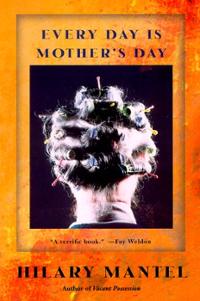
every day is mother's day hilary mantelEvery Day is Mother’s Day by Hilary Mantel ~ 1985. This edition: Owl Books (Henry Holt), 2000. Softcover. ISBN: 0-8050-6272-6. 225 pages.

My rating: 10/10 for the writing, and 5/10 for the grim plot. Averaging out to 7/10.

Will I ever read this one again? No time soon – too dark and icky, fabulous writing aside. Though I’m tempted to seek out the sequel, Vacant Possession, to see what Muriel gets up to once freed of her mother’s smothering influence.

*****

So here I am this week concurrently struggling with a stupidly busy schedule and battling a vicious virus, and I’m looking for a really good read to escape into in the few bits of down time I’m able to snatch to escape from the chaos of a week-long, much-too-far-from-home dance festival, and I page through the few library books I impulsively grabbed on my last quick visit a few weeks ago, and I tuck this one into my attaché case, because right there on the cover it tempts me with this:

Evelyn Axon is a medium by trade; her daughter, Muriel, is a half-wit by nature. Barricaded in their crumbling house, surrounded by the festering rubbish of years, they defy the curiosity of their neighbors and their social worker, Isabel Field. Isabel is young and inexperienced and has troubles of her own: an elderly father who wanders the streets, and a lover, Colin, who wants her to run away with him. But Colin has three horrible children and a shrill wife who is pregnant again–how is he going to run anywhere? As Isabel wrestles with her own problems, a horrible secret grows in the darkness of the Axon household. When at last it comes to light, the result is by turns hilarious and terrifying.

And I power through this book compulsively, because though the subject matter is grossly unpalatable – unhappy people doing unspeakable things to themselves and to each other, things intimately detailed by the unflinching author – because dark as it is, and much as I want to just put it down and look away, I can’t.

This was Mantel’s first novel, and she must have torn up a lot of first drafts, because it is absolutely excellent; beautifully crafted.

But bleak – oh, so terribly, bitterly bleak! In retrospect, probably not the best choice for cheer-myself-up, forget-that-I’m-ill reading, especially after a course of  engagingly inane D.E. Stevensons with their neat and tidy happy endings. Hide the kitchen knives and the sleeping pills, because I’m just now looking at life through grimy, smoke-coloured glasses, and finding it unutterably futile.

Just kidding.

This isn’t really a review, is it? I’m sitting here pecking away at the keyboard and sniffling, much too sick and tired to form a series of cohesive thoughts, so I’m cheating big time now and referring you over to  Dove Grey Reader – Every Day is Mother’s Day for a really interesting review with lots of personal connections.

And this one, too, which gives more details on the plot: Being Obscure Clearly – Every Day is Mother’s Day.

Also on the library stack is Mantel’s novel Fludd, which my husband just finished and plunked down with a quizzical eyebrow twitch. “Interesting” is all he’ll say when questioned, which could mean almost anything. He did read it all in one sitting, which argues in its favour; this is not a man who hesitates to put a book aside partway through when it ceases to enthrall.

The numerous comparisons between Hilary Mantel and Muriel Spark are apt. And here I must confess that I’ve a rather low tolerance to Spark. Good to read occasionally, for the bitterness of the humour and the deliciously jaded worldview, but I never go on a binge of book after book by her. Mantel joins Spark on this section of my bookshelf, right there beside Margaret Atwood, Elizabeth Taylor, Rosamund Lehmann and others of that sisterhood. “To be taken in small doses.”

Read Full Post »

I’m going to review these together. They were both quite wonderful, so much so that, pressed for time as I am this week, I cannot let them pass onto the “have read” list without mention. In my opinion, this trilogy, Vittoria Cottage, Music in the Hills, and Shoulder the Sky, have the Miss Buncle books beat all hollow. Good stuff! I can see these going on my treasured keeper shelf.

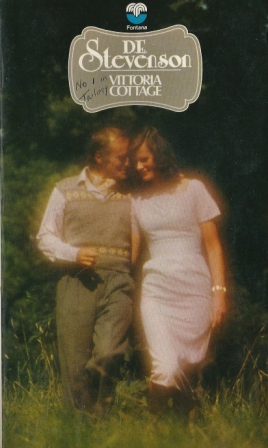
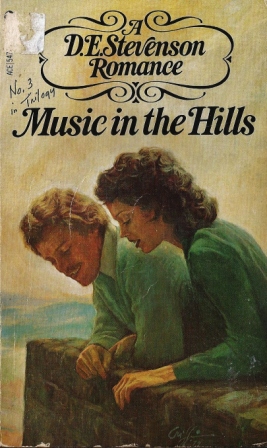
Please try to ignore the desperately ugly covers on these re-released paperback editions. I find them quite embarrassingly inappropriate to the content, which, while “romantic” enough to please the most sentimental, is not cloyingly so as these would lead one to believe. I had some explaining to do to family members who saw me reading these – “What the heck is that?! You’re slipping, old girl …!”

*****
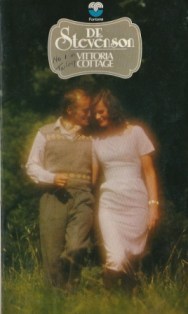
vittoria cottage d e stevensonVittoria Cottage by D.E. Stevenson ~ 1949. This edition: Collins-Fontana, 1974. Paperback. ISBN: 0-00-613-444-0. 191 pages.

My rating: 8.5/10.

Middle-aged Caroline Dering has just been widowed, and, aside from her genuine and seemly sorrow at the death of someone who has shared her life for many years, she is not at all steeped in sorrow. Her lately departed spouse, Arnold Dering, was of a complaining and perpetually malcontented disposition. While  his wife and three children were accepting of his character – Caroline thought that he always meant well, and suspected that at rare moments Arnold recognized and truly regretted his deep pessimism – but by and large enjoyed themselves much more in his absence.

The scene is set for what is to become a series of three novels by descriptions of the village of Ashbridge and the far from cottage-like Vittoria Cottage, ancestral home of the Derings. Though she has merely “married into” the local family, Caroline fits into the local hierarchy almost immediately, and by and large leads a deeply contented life, caring for her children, volunteering for various worthy causes, keeping house and gardening. The children are all grown up, with James away in Malaya, and lovely but discontented Leda (she takes after her father in full) and boisterous Bobbie making their way out into the larger world from the safe haven of their village nest.

To-day Caroline Dering was not working in her garden. She had taken a basket and gone up the road to the gravel-pit to pick blackberries. There was a thicket of brambles, there, and Caroline knew it well. Every year she made this pilgrimage and every year she returned with her harvest of big, black, juicy berries to make into jelly and to bottle for the winter. It was curious (thought Caroline, as she began her task) how the years seemed to telescope when you looked back. Surely there were less than three hundred and sixty-five days between each picking! She remembered the first time she had come. She and Arnold had come together – they had just returned from their honeymoon and settled at Vittoria Cottage – but Arnold had not enjoyed picking blackberries, he had got a thorn in his finger and had torn his trousers on a wild-rose bush and he had suggested that in future they should employ some of the village children to undertake the task. After that Caroline had come alone until James was old enough to help … and then the little girls had joined the party and blackberrying had become an event, a yearly picnic, which took place, weather permitting, upon James’s birthday.

Now, once again, Caroline came alone. The girls had other things to do and Caroline had no use for reluctant assistants. Next year … would James be here? And if he were here would he want to come and pick blackberries on his birthday?

World War II has been over for several years, but England is still very much in coping and recovery mode. Society is fast changing into some sort of new normal, and though things are steadily improving, there is still food and fuel rationing, and a strong atmosphere of “making do”, which makes for some quite fascinating scenarios as we progress through the book and look over Caroline’s shoulder as she goes about her days.

Life in Ashbridge gets suddenly quite interesting with the arrival of the mysterious Mr. Shepperton, who is apparently very reluctant to discuss his past, and who arouses even more suspicion because he appears to have no old belongings or clothing, a real rarity at that place and time, immediately post-war – “everything new!” the village gossips whisper with raised eyebrows.

Caroline’s lovely younger sister Harriet, a successful actress ducking away to her sister’s home for a respite from a difficult and failed recent stage production in London, brings some ex-urban dash and sparkle to village gatherings, and with the unexpectedly sudden return of James from Malaya, and the trials and tribulations of Leda and her fiancé Derek, the local squire’s son, there is plenty of scope for complications, dilemmas, surprises and sometimes unexpected resolutions.

I thought the characters were very well drawn and (mostly) very believable. Caroline is our heroine, but she is not a perfect person by a long shot; her flaws are well on display, but we forgive her them because she is ultimately exceedingly likeable, as is her sister and most of the other players in this excellent domestic drama. It ends quite abruptly, but this served merely to make me keen to get my hands on the next episode in this extended tale, which I was fortunate enough to acquire along with its sister novels recently.

On to Music in the Hills.

________________________________________

Music in the Hills by D.E. Stevenson ~ 1950. This edition: Ace Books, circa 1970. Paperback. ISBN: 0-441-54725-7. 282 pages.music in the hills d e stevenson
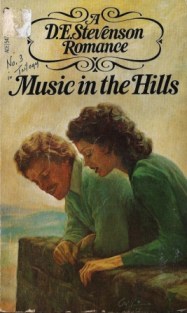
My rating: 8/10.

Having more or less settled the fates of Caroline Dering and her sister Harriet Fane in the previous novel, Vittoria Cottage, this next one follows Caroline’s son James, who, at loose ends after his military service and several years spent “chasing terrorists” in Malaya, is looking towards his future.

Deeply in love with his childhood companion Rhoda, he is struggling with her rejection of his marriage proposal. While we suspect that she is in love with James in her own way, Rhoda fears that, as a rising professional painter, marriage would spell the end of her career goals, and that she would be a discontented wife as well as a poorer artist, having to split her focus between two roles, doing neither well.

James takes it very well, all things considered, and hies himself off to the community of Drumburly in Scotland, where he has been invited by his aunt and uncle to reside at the remote Mureth House, a prosperous sheep farm. Jock and Mamie Johnstone have no children of their own, and are hoping that their nephew might be interested enough in farming life to take over Mureth some day. James has always cherished a desire to be a farmer himself, so the situation looks like a success all around; the story follows some of James’s apprenticeship and details the day-to-day occupations of a hill farmer of mid-2oth century Scotland; quite nicely detailed and striking true in the telling.

We have sheep rustlers and romantic entanglements and, of course, more than a few misunderstandings between various parties, all neatly tidied up as the story progresses. Perhaps not as strong a narrative as the preceding Vittoria Cottage, but definitely engaging. I enjoyed it greatly.

The characterizations of the local inhabitants are often well drawn; we all know people just like these.

I’m looking through the book for a snippet to share with you, but am finding nothing really suitable – everything is so enmeshed with the  rest of the story that to take a bit out of context would do it no justice, so you’ll have to take my word for it that this is a well-written post-war domestic drama, with much to recommend it as escape reading in our hectic modern age.

Music in the Hills is followed by a third book to form a trilogy, Shoulder the Sky, also published as Winter and Rough Weather. I’d read this one some months ago, liked it a lot, and reviewed it here: Shoulder the Sky

Reading this trilogy has made me into a confirmed D.E. Stevenson fan. This is good stuff, for which I am ready to forgive some of the less than stellar output by this writer. She definitely had highs and lows in her output, but the Vittoria Cottage trilogy is quite decently lofty.

Read Full Post »
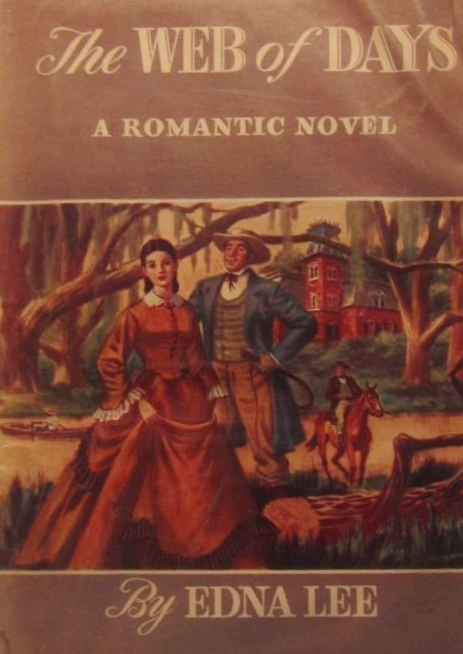
the web of days edna leeThe Web of Days by Edna Lee ~ 1947. This edition: D. Appleton-Century, 1947. Hardcover. 1st edition. 276 pages.

My rating: 3/10. The 3 points is for, um,  something.

Let’s see, now.

The best I can come up with is that it was engaging in that I read it to the end, hoping for some sort of unpredictable plot twist to crank it up a notch. (Sadly, that never happened.)

*****

Every once in a while I read a real clunker, which serves to remind me that all vintage books are not really worth saving.

The Web of Days was mesmerizing in its awfulness; I read it cover to cover, with increasing queasiness. Like the proverbial train wreck, I just couldn’t look away.

In a phrase: Melodramatic Gothic Southern Romance.

Prim, virginal, stunningly beautiful Yankee governess Hester Snow is engaged by the master of the derelict Georgia plantation called Seven Chimneys to care for his young son. The boy’s mother is a hopeless alcoholic, and Miss Snow finds the plantation to be an absolute disaster – the house is filthy, the servants sullen, and the master’s wife and mother viciously scornful of the new governess’s insistence on tidying up and tackling jobs for herself.

Hester immediately sets about fixing everything. Single-handedly she whips the house servants (ex-slaves, as this story takes place just after the end of the American Civil War, in Georgia) into shape, tames her sullen young charge, Rupert, and attempts to save the self-destructive mistress, Lorelie, from herself. She catches the attention of every man who sees her, from the riverboat captain who has delivered her to her new home, to the master of the Seven Chimneys plantation himself, Saint Clair LeGrand. More importantly, she has herself fallen in love with Saint Clair’s estranged half-brother, Roi LeGrand, who gallops in and out of the story on his fiery steed, Sans Foix.

Lorelie conveniently wanders out into the swamp and drowns herself one night, leaving the field open for Hester to marry the new widower, which she promptly does. Roi gallops in, chews on the scenery for a bit, and gallops off, leaving Hester deeply embroiled in a deep dark situation wherein her new husband schemes against her and attempts to engineer the death of young Rupert. It’s all to do with inheritances and such; Hester was assigned under the late Lorelie’s will the care of Seven Chimneys and Rupert, cutting out Saint Clair. (It’s complicated.)

Hester resurrects the plantation by master-minding a return to profitable farming; she also gets pregnant and eventually gives birth to young David, Saint Clair’s son, but widely suspected by all, including Saint Clair, to be Roi’s child. The plot sickens, er, thickens, ending in the violent demise of Saint Clair and the reunion of Hester and true love Roi. (That’s the condensed version. Now you won’t have to read the book! You may thank me for saving you that.)

As an orphan tumbling about in the world trying to make her own way, one would think Hester Snow would be a somewhat sympathetic character, but author Edna Lee has created an absolutely unlikable protagonist, whom I increasingly despised as the book progressed.

My biggest “queasy-making” issue was that the character Hester Snow is viciously misogynistic towards to the many black characters she encounters; I couldn’t help but wonder if this was a reflection of the author’s personal feelings as well. She (Hester Snow) is also very full of herself; self-confidence is an admirable trait, but add to it deep smugness and ruthless ambition, and you get a Scarlett O’Hara-type figure, but with less likeability. Scarlett had her moments where the reader could “get” why she was like she was and sympathize somewhat with her attempts to maintain control of her own life in an unkind world, but I’m afraid Hester never inspired such a feeling in me, much as I wanted her to.

The writing style itself is rather interesting, in that it is has a very nineteenth century feel to it in the phrasing. If deliberate, this is a good conceit on the part of the author, as the story is written in first person narration by Hester Snow herself, and the voice sounds authentic. There’s a fair bit of bodice-rippingly bad sex in a 1940’s style, in that we never really get a description of the act itself, just the prologue and epilogue; the velvet stage curtain swishes shut at the bedroom door.

A real period piece, but “of an inferior period, m’lord”, to paraphrase Bunter in one of the Lord Peter Wimsey tales – a quotation which I adore and use much too much.

Debating the fate of this book, I’m tempted to chuck it onto the giveaway pile, but while doing an internet search on the author I see she has several other “bestsellers” of her time which receive a fair bit of discussion: The Southerners, The Queen Bee, and All That Heaven Allows, among others. The Queen Bee was made into a 1955 film starring Joan Crawford, while All that Heaven Allows was made into a 1955 film starring Jane Wyman and Rock Hudson. (1955 was a good year for Edna Lee, apparently.) Both received a fair bit of popular, if not critical, acclaim, which just goes to show I’m not sure what – maybe that melodrama sells?!

I may tackle Edna Lee again in future. It was an interesting experience, and greatly highlighted the excellence of much of my other vintage reading in comparison to The Web of Days‘s deeply schlocky shlockiness.

Read Full Post »

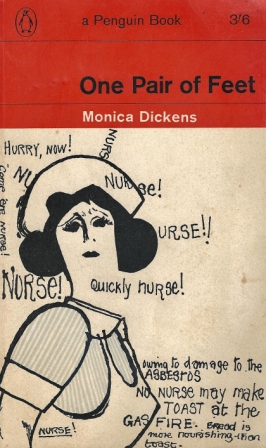
one pair of feet monica dickens 001One Pair of Feet by Monica Dickens ~ 1942. This edition: Penguin, 1964. Paperback. 221 pages.

My rating: 10/10.

One had got to be something; that was obvious. But what? It seemed that women, after having been surplus for twenty years, were suddenly wanted in a hundred different places at once. You couldn’t open a newspaper without being told that you were wanted in the Army, the Navy, or the Air Force; factory wheels would stop turning unless you rushed into overalls once; the A.F.S. could quench no fires without you, every hoarding beckoned you and even Marble Arch badgered you about A.R.P.

The Suffragettes could have saved themselves a lot of trouble if they had seen this coming. Men’s jobs were open to women and trousers were selling like hotcakes in Kensington High Street.

I could not make up my mind what to be. A lot of fanatics rushed into the most uncongenial jobs they could find, stimulated by a glow of self-sacrifice that lasted until the novelty wore off or the cold weather set in, but it seemed to me that, provided it was useful, it was no less patriotic to do something enjoyable. At first sight, the choice seemed so enormous that the trouble was to decide what not to be, but a closer inspection revealed so many snags that in the end the trouble was to find something to which I had a hope of sticking.

The Services? I didn’t think my hips would stand the cut of the skirt and I wasn’t too sure about my legs in wool stockings. Besides, I’d never been much good at drilling and all that. My school reports used to say: ‘Not amenable to discipline; too fond of organizing,’ which was only a kind way of saying: ‘Bossy.’ I might have been a success as a general but not as a private.

The A.F.S.? I did try that for a while, but at the beginning of the war there was not much doing and I got discouraged with sitting all day in the back room of a police station knitting and eating sticky buns with six assorted women and a man with a wooden leg. At the end of the week, we all knew each other’s life histories, including that of the woodenleg’s uncle, who lived at Selsey and had to be careful of his diet. Messenger Dickens had once been down to Roehampton to fetch the Commandant’s handbag and a small tube of soda-mints from the shelf in her bathroom.

A bus conductress? … The W.V.S.? … I worked in a canteen for a while, but had to leave after a terrible row with Mrs Templeton-Douglas, who could never subtract one-and-ninepence from half-a-crown. I sold some of her jam tarts for a penny instead of twopence, thinking they were the throw-outs we had bought at the back door of the A.B.C.

The Land Army? One saw oneself picking apples in a shady hat, or silhouetted against the skyline with a couple of plough horses, but a second look showed one tugging mangel-wurzels out of the frozen ground at five o’clock on a bitter February morning.

Ministries and Bureaux? Apart from the question of my hips again (sitting is so spreading), they didn’t seem to want me. Perhaps it was because I can only type with three fingers and it always keeps coming red.

The Censor’s Office I knew was in Liverpool, and I’d been there once.

Nursing? The idea had always attracted me, even in peace-time, but I suppose every girl goes through that. It’s one of those adolescent phases, like wanting to be a nun. It was reading Farewell to Arms, I think, that finally decided me, though what sort of hospital allowed such goings on, I can’t imagine. However, that was the last war…

So nursing it is, and Monica Dickens edgily and wittily documents the year she spent as a probationer at Queen Adelaide Hospital, and life on and off the wards, and the personalities she rubbed up against.

It is terribly difficult, I find, to write critically about an author whom one has read so often and with so much enjoyment, as I have read Monica Dickens. I will merely say that this book more than lives up to the first few pages excerpted above, and that it does not disappoint.

The author’s voice is two-thirds world-wearily cynical – as only a twenty-something writer can be! – and one-third completely sincere; “readable” is a mild recommendation, but very apt. Many of her sharper observations feel initially rather cruel, but Dickens is as hard on herself as on anyone, and often her most maligned characters are revealed to have redemptive qualities which the author displays with as much clarity as their failings.

Highly recommended.

Caveat lector: Several era-correct racial slurs in this one which may bring the modern reader up short. One character’s nickname is N_____, due to his curly hair, and several times the same term is used descriptively. There appears to be no intention to offend; I believe the usages here were completely accepted at the time of writing. I only mention them because it is a sensitive point with some modern readers.

Read Full Post »

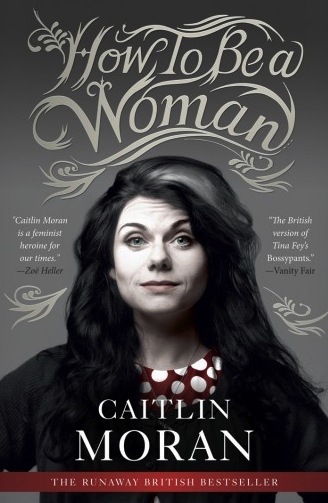
how to be a woman caitlin moranHow to Be a Woman by Caitlin Moran ~ 2011. This edition: Ebury Press, 2011. Softcover. ISBN: 978-0-06-212429-6. 305 pages.

My rating: This one was unrateable.

What can I say? It’s all been said. Multiple times.

Outspoken, thought-provoking, vulgar, romantic, profane, profound, controversial, brave, rude … and very, very funny. This is not a book I would give my mother! But I would leave it where my teenage daughter could find it.

I actually did just that, and she (the teenage daughter) dipped into it, and basically said “Ew. Too much information. And swearing. She’s a bit scary, Mom.” So that didn’t take. Which is just fine. We’ve already had all of the conversations that Caitlin missed with her mother. A lot of this one reads like a cautionary tale, a what-not-do-do manual, at least until Caitlin gets herself all grown up and out in the big world. Though even then her decisions aren’t exactly stellar one hundred percent of the time.

This is a big, bold, brassy memoir of British newspaper columnist and generally funny lady Caitlin Moran’s teenage years right up until the present. She has zero barriers; she discusses everything there is to discuss about being born with on the double X-chromosome side of the human sexual spectrum. This is Caitlin’s take on what it means to be a woman. While frequently prescriptive, it’s best taken with a good dash of salt. As one reviewer quipped, this one should perhaps have been titled How to be Caitlin Moran, because it certainly doesn’t apply – or appeal –  universally. Many are – and will be – sceptical, if not downright appalled, at Moran’s Technicolor rantings.

Menstruation, masturbation, obesity, body hair, pregnancy, childbirth –  full coverage of the biological range. Then there are drugs and alcohol and the over-the-top excesses these can lead too. Bad relationships. Good relationships. Marriage. Children. Abortion. Right along with the ethics of employing a cleaner.

And this is what seems to be getting all the attention in the reviews I’ve been reading. Capital-F Feminism. What it looks like today, and what Caitlin Moran thinks it should look like. In a nutshell, good old Golden Rule stuff. Do as you would be done by. Treat each other well.

I’ve been thinking about how to present this review for a few days now, ever since finishing the book, and since reading fellow blogger Claire’s take over on Captive Reader – How to Be a Woman . What I’ve decided is to not really say all that much about this one. The internet is crowded to overflowing with reviews; this one has received capital-H Hype, and some people are taking it really, really seriously.

Here’s the Goodreads – How to Be a Woman page. 2500 reviews. Go wild!

I’m not taking this one terribly seriously. I found it amusing, and I agreed with Caitlin Moran on her various opinions a good majority of the time. I particularly liked her chapters on marriage and motherhood, and the abortion chapter was something very unusual in its sincerity and refreshing lack of sensationalism. I don’t think I could be so detached and unemotional as Moran was, if it were me facing the same scenario, and my decision would likely have been the exact opposite, but her forthright acceptance of what she did felt genuine.

But I’m not about to bow down to her as our newest Feminist leader, our Womanly Great White Hope, as some enthusiastic fans seem to be. She’s not really breaking any new ground here, just repeating what’s already been said with a lavish dash of shazzam.

Moran is a very funny writer. I literally laughed out loud – a rarity for me when reading –  more than once – most notably during the bra and breastfeeding discussions – spot on! Loved it. I’ll likely purchase the book one day, but I’m in no rush. If I never read it again, no big deal. I’d never heard of the woman until a few weeks ago, and I strongly suspect I’ll not hear too much from her in future, but I’ve at least placed her in my personal “cultural literacy” file and can now nod knowingly if her name comes up.

And that’s good enough for me.

As a parting gift, here are some quotes I lifted from How to Be a Woman, courtesy of Goodreads. If anything here resonates, you’ll probably like this book.

*****

If you want to know what’s in motherhood for you, as a woman, then – in truth – it’s nothing you couldn’t get from, say, reading the 100 greatest books in human history; learning a foreign language well enough to argue in it; climbing hills; loving recklessly; sitting quietly, alone, in the dawn; drinking whisky with revolutionaries; learning to do close-hand magic; swimming in a river in winter; growing foxgloves, peas and roses; calling your mum; singing while you walk; being polite; and always, always helping strangers. No one has ever claimed for a moment that childless men have missed out on a vital aspect of their existence, and were the poorer, and crippled by it.

*****

I cannot understand anti-abortion arguments that centre on the sanctity of life.  As a species we’ve fairly comprehensively demonstrated that we don’t believe in the sanctity of life.  The shrugging acceptance of war, famine, epidemic, pain and life-long poverty shows us that, whatever we tell ourselves, we’ve made only the most feeble of efforts to really treat human life as sacred.

*****

Overeating is the addiction of choice of carers, and that’s why it’s come to be regarded as the lowest-ranking of all the addictions. It’s a way of fucking yourself up while still remaining fully functional, because you have to. Fat people aren’t indulging in the “luxury” of their addiction making them useless, chaotic, or a burden. Instead, they are slowly self-destructing in a way that doesn’t inconvenience anyone. And that’s why it’s so often a woman’s addiction of choice. All the quietly eating mums. All the KitKats in office drawers. All the unhappy moments, late at night, caught only in the fridge light.

Read Full Post »

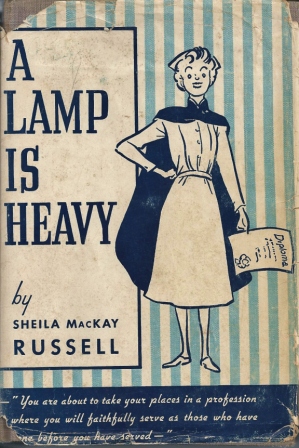
a lamp is heavy sheila mackay russell 001A Lamp is Heavy by Sheila MacKay Russell ~ 1950. This edition: J.B. Lippincott, 1950. Hardcover. 256 pages.

My rating: 5/10.

This one just sneaks (on quiet rubber soles, perhaps?) into the “keeper” pile. It did have its moments, though it was mostly just a milder North American version of the stellar Monica Dickens life-as-a-British-nursing-student classic, One Pair of Feet.

Here’s a bit of trivia I discovered while trolling about for a bit of background info on author Sheila MacKay Russell. According to writer Julia Hallam in Nursing the Image: Media, Culture and Professional Identity, a critical examination of nursing as portrayed in popular culture, A Lamp is Heavy was adapted into a movie titled The Feminine Touch in 1956, with the setting changed to England from North America – I originally had said “The United States” here, but it turns out that the author is from Alberta and likely based it on her experiences nursing in Edmonton – and – much to my surprise! – with Monica Dickens herself contributing as a screenwriter.

I can see how A Lamp is Heavy would transfer well to film; it is equally as concerned with a romance between the main character, nursing student Sue Bates, and a handsome young intern, Doctor Alcott, as it is with the events of hospital life.

But I’m getting a bit ahead of myself here. I’ll let the author speak for herself. Though the main character in the novel is named pseudonymously “Sue Bates”, she is based strongly on the author’s own experiences; the book is strongly autobiographical, though details have been changed to obscure the people and places it is based upon.

It was my long-standing and persistent longing to be a nurse … [and this] impelled me to take the most portentous step in my life, in spite of the discouragement heaped upon me by all and sundry of my friends, including my mother. Mother, in her own way, was a realist. Nurses in her mind were synonymous with fallen arches, varicose veins, questionable language and backaches, and only the fact that she discovered, quite by accident, that Florence Nightingale was a lady of cultured family tended to reconcile her to what seemed to her to be my unnecessarily earthy inclinations.. She wasn’t really reconciled until the day came when she could comfort herself with the possibility of my salvaging a doctor husband out of the fiasco. She even kept all of my relatives in a similar state of doubt. This included my father. Where I was concerned, he reflected Mother’s attitudes as faithfully as a full-length mirror, and as I was an only child, he insisted on having a serious talk with the Mayor of the town before I was allowed to set foot on hospital soil. What he expected to get, or what he did get, from the Mayor, I don’t know, but he seemed happier. He came home and said that the board members of the city hospital were all Chamber of Commerce men, and perhaps I would be safe enough if I trained there.

Sue enters the hospital with her class of eleven other eager probationers; the twelve manage to stay the course and finish out their three years of training to graduate together; tales of their goings-on, trials and tribulations make up the majority of this memoir, with time out here and there for more serious discussions of some of the tragedies – and, to be fair, some of the more than occasional joys – of dealing with patients and their woes, as well as sidelights on the plight of the poverty-stricken members of the population who could not afford to avail themselves of proper medical care despite the efforts of a developing medical outreach service led by several of the hospital’s doctors.

Handsome, charismatic and manipulative Doctor Alcott provides romantic interest; he and Sue have an on-again, off-again love affair throughout Sue’s hospital years, which seems to end quite satisfactorily for all concerned. (Including, incidentally, Sue’s mother!)

A decently readable word portrait of a North American hospital in the just-prior-to World War II years, with likeable characters and enough drama to keep one interested start to finish.

I don’t recommend that you rush out and search this one down, though. Instead, invest your hard-earned dollars in Miss Dickens’  grand tale, unless A Lamp is Heavy absolutely leaps off a used bookstore shelf at you – in that case, it would repay a small investment, returning a few hours of interesting reading.

*****

After I published this review, I received a comment from Susan (see comments, below) to the effect that she thought the author was Canadian. I searched around a bit more and came across this mention on pages 9-10 of Volume 2 of Literary History of Alberta: From the End of the War to the End of the Century, by George Melnyk, 1999, University of Alberta Press.

Sheila Mackay Russell (1920-?) published two novels, A Lamp is Heavy (1950) and The Living Earth (1954). Russell was born in Airdrie, Alberta, went to school in Calgary, and attended university in Edmonton, where she took a degree in public health nursing. After her marriage to a doctor in 1947, she continued to live in Edmonton. A Lamp is Heavy is a first-person account of a nurse during the Second World War. [L&P note: A sharp-eyed reader has mentioned that this is slightly inaccurate, as the novel takes place prior to the start of the war.] This popular novel sold 75,000 copies over five years, including a Dutch translation, and was made into a film called The Feminine Touch with wartime Britain as the setting.

Russell’s character captured an exposed feminine sensibility:

“Witnessing childbirth had a strange effect on me. I can’t explain the close, proud kinship with other women which it seemed to bring me. I only knew, as I watched them, that they were performing a tremendous and elemental act of living.”

Russell’s second novel, The Living Earth,also had a nurse for a protagonist. Set in an isolated settlement in the north of the province (Alberta), the novel tells the story of two women who come from the south to  seek new lives. “It was spring in Mud Creek. Sun and earth, uniting, had thrown off the shackles of winter; the earth steamed from its effort and the sun lingered triumphantly a few minutes longer each day …”

The Living Earth won the Toronto Womens’ Canadian Club prize. The commercial success of Russell’s first novel reflected a need among women readers for literary work that captured their experiences and sensibilities during World War Two. Her second novel dealt with a more specialized topic and a return to an agrarian setting, which did not have the wider appeal of the first book.

Read Full Post »

one native life richard wagameseOne Native Life by Richard Wagamese ~ 2008. This edition: Douglas & McIntyre, 2008. Hardcover. ISBN: 978-1-55365-364-6. 257 pages.

My rating: 6.5/10.

*****

After reading Wagamese’s Indian Horse recently, one of the prominent Canada Reads 2013 finalists, I was curious enough about the author to search out what I could find of his other works. The library proved generously supplied, and I chose two biographies, One Native Life, and For Joshua, and have mentally checkmarked two fictions, Ragged Company and Dream Wheels, for a future time.

One Native Life is a collection of short, three to four page reminiscences, anecdotes and mini essays on First Nations identity. Richard Wagamese was removed from his home in childhood due to physical abuse by adults in his birth family, and lived with non-Native families as a foster child and then as an adopted child until he reached his mid teens, when he left home to live independently, with varied success.

Often the only First Nations person in his school and social circle, Wagamese, especially as he matured, frequently wondered about his “differences”, and pondered his inability to feel fully whole with his First Nations heritage treated either as a curiousity or a non-issue by his adoptive family and his friends.

Serious substance abuse, alternating with periods of sobriety, and career and social success, eventually took its toll, laying Wagamese so low that a complete rebuild of his life was essential to his survival. Richard Wagamese looks to have survived his crash to rock bottom, and has more than successfully rebuilt his life into something new and good, though it is obvious that he views this very much as an ongoing process, and not a “done deal” by any means.

One Native Life addresses the healing process of Wagamese coming to terms with his individual circumstance. He seldom comes across as angry or resentful; he is very ready to excuse the actions and attitudes of those in his life by looking at the reasoning – or, often, lack of thought – behind each situation. This is both a memoir and an attempt to address current social conflicts between Native and non-Native ways of thinking and being. From someone who has walked all of these paths, and who has experienced life as a member of both social groups, the thoughts laid out here are definitely deserving of respect and consideration.

Very nicely written, too, as I expected after the more-than-decent quality of Indian Horse. My one nagging problem with this book, the one that kept me from buying into it one hundred per cent, is that it is perhaps a bit too conciliatory and understanding. Wagamese is so darned nice. But he excuses this himself by stating throughout that he wants to see bridges built, not more barricades erected, hence the tone. But it might be easy to dismiss this one because of its gentleness, which is, paradoxically, one of its main strengths.

And I’m also reading another of Wagamese’s memoirs, For Joshua, written five years earlier than One Native Life, and addressed as an open letter to his young son, whom he became estranged from due to his alcoholism, which is plenty full of tragedy and anger and strong emotion. One Native Life, coming as it does later in the sequence, shows evidence of a further healing and a few more years of thinking things through.

An interesting memoir, from an interesting man.

For a much more specific review, go here:   The British Columbian Quarterly – One Native Life

Read Full Post »

the alpine path l m montgomeryThe Alpine Path: The Story of My Career by L.M. Montgomery ~ 1917. This edition: Fitzhenry & Whiteside, 1975. Hardcover. ISBN: 0-88902-019-1. 96 pages.

My rating: Probably an 8/10 – it’s a slender little thing, and tells nothing very new, deep, or startling, but it is nonetheless an enjoyable excursion into the life of the renowned author, written in the relatively early years of her successful career.

A must-read for the L.M. Montgomery aficionado, just to say you’ve read it; a gentle, happy overview of the author’s life for those new to her; a pleasant “light” memoir with only a few mentions of the very real and frequently tragic difficulties the author faced in her childhood, teen and adult years.

The book is a compilation of a series of six autobiographical essays which L.M.M. wrote for the Toronto magazine Everywoman’s World in 1917, ten years after the stunning success of Anne of Green Gables had made her a worldwide household name.

Many years ago, when I was still a child, I clipped from a current magazine a bit of verse, entitled “To the Fringed Gentian”, and pasted it on the corner of the little portfolio on which I wrote my letters and school essays. Every time I opened the portfolio I read one of those verses over; it was the key-note of my every aim and ambition:

“Then whisper, blossom, in thy sleep
How I may upward climb
The Alpine path, so hard, so steep,
That leads to heights sublime;
How I may reach that far-off goal
Of true and honoured fame,
And write upon its shining scroll
A woman’s humble name.”

It is indeed a “hard and steep” path; and if any word I can write will assist or encourage another pilgrim along that path, that word I will gladly and willingly write.

The first half of this slender book is devoted to childhood reminiscences, many of which the author mentions as having been used as inspiration and worked-over anecdotes for her personal favourite of her novels, The Story Girl. Then follows some discussion of the years when she attempted to establish herself as a published, and more importantly, paid author, and of course, the story of the manuscript of Anne, which was flatly rejected numerous times, and laid away

in an old hat-box in the clothes room, resolving that some day when I had the time I would take her and reduce her to the original seven chapters of her first incarnation. In that case I was sure of getting thirty-five dollars for her at least, and perhaps even forty.

The manuscript lay in the hat-box until I came across it one winter day while rummaging. I began turning over the leaves, reading here and there. It didn’t seem so very bad. “I’ll try once more”, I thought. The result was that a couple of months later an entry appeared in my journal to the effect that my book had been accepted. After some natural jubilation I wrote: “The book may or may not succeed. I wrote it for love, not money, but very often such books are the most successful, just as everything in the world that is born of true love has life in it, as nothing constructed for purely mercenary ends can ever have.”

And then there’s this comment, which I rather smiled at; the author having too-late second thoughts after killing off a character:

Many people have told me that they regretted Matthew’s death in Green Gables. I regret it myself. If I had the book to write over again I would spare Matthew for several years. But when I wrote it I thought he must die, that there might be a necessity for self-sacrifice on Anne’s part, so poor Matthew joined the long procession of ghosts that haunt my literary path.

After the evocative descriptions of her Prince Edward Island childhood, the part of the book I enjoyed the very most was the selection of journal entries from L.M.M.’s winter in 1901 of working on the staff of the Halifax Daily Echo, where she performed all sorts of different roles, from chasing down advertisers for copy – once unexpectedly scoring a new hat from a satisfied client – to proof-reading, and making up endings for serials whose manuscripts are inexplicably incomplete. Grand training for an aspiring writer, as L.M.M. points out, with much good humour!

Read Full Post »

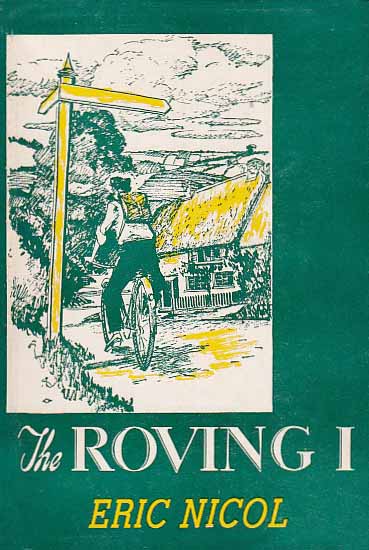
the roving i eric nicolThe Roving I by Eric Nicol ~ 1950. This edition: Ryerson Press, 1951. Hardcover. 134 pages.

My rating: 7/10, after some inner debate.

I  am rather sad to have to say that much of the humour is groaningly dated in this one, but despite that single failing, I have a strong affection for Eric’s comic tale of his year on The Continent, some phrases of which are ingrained deeply into my memory. The more eloquent passages obviously resonated deeply when I first read this at an impressionable age.

The Roving I won the Stephen Leacock Medal for Humour in 1951, which is commendable but not necessarily a guarantee of, well, of anything! The bits of Roving I which I am fondest of are the more serious bits, hidden beneath the sometimes-forced playfulness of the narrative.

Do I date myself when I assume that everyone knows who Eric Nicol is? As a middle-aged, mostly lifelong British Columbia resident, Vancouverite Nicol has somehow always been there, always on the edges of my awareness, a cultural constant. Exceedingly prolific throughout his writerly life, which began in college – he famously started his career by writing in the Ubyssey under the pen name of Jabez – Nicol went on to write more than 6000 newspaper columns for The Vancouver Province, as well as 40-odd books and a number of mostly-comic plays. Eric Nicol died in 2011, at the age of ninety-one, writing up until the end, despite battling the onset of Alzheimer’s. His last book, Script Tease, a collection of typically whimsical articles, was published in 2010.

But we’re going to go way back, to the early days, to Eric’s more youthful days as a young man after his WW II military service – three years in a non-combat role in the R.C.A.F. –  when he was taking advantage of an opportunity to pursue post-graduate studies for a year at the Sorbonne.

Here’s a sampling, from Chapter One: Debut of a Vagrant, at the start of the long train journey eastward to the embarkation point for ship travel to Europe.

The train lurches forward heavily, trying to take us all out by the roots at once. Mine hang on. Mine and those of the old couple across the aisle, who never thought of buying a newspaper because the news of the day was their being on the train, with a rope around their world.

Another good jerk does it. The station begins slowly to glide out under a full sail of flapping handkerchiefs. No, it’s us. We’re rolling. I and the fat lady sitting opposite me, reluctant to admit one another to the sudden vacuum of our existence, stare out the window at a grey and indifferent Vancouver. Oh, Vancouver, that I’ve given the best years of my life to, how can you dismiss me as though I were just another can of salmon? Is this how I’m to remember you, this motorist stymied by the crossing gate and glad to see the last of us? Couldn’t that woman stop hanging out her laundry for a minute? Is there no one to wave to us, on behalf of the city of Greater Vancouver?

Yes, by heaven! There she is. A little girl, a delegate at large, patting the air slowly and solemnly, making it last for the whole train. The fat lady and I wave back, and, relinquishing Vancouver, smile at each other, having in common someone we both said goodbye to…

That’s a fair sampling of Nicol’s style. Though occasionally it drops into sheer silliness, it is usually redeemed by clever, often very funny phrasings; the man did have – overused cliché fully applicable here – a way with words.

Eric Nicol’s books are quite easy to come by here in B.C., and are – here’s another cliché – well worth dipping into if you come across them in your travels, though some I find more enjoyable than others. The more hectic ones do seem to be trying a bit too hard, but there are little gems of delicious prose in each and every one. The Roving I is one of my personal favourites, a slight little period piece which captures a moment of time in a fast-moving world and frequently makes us smile at the infinite absurdities of life.

Read Full Post »

« Newer Posts - Older Posts »