Archive for the ‘Read in 2013’ Category

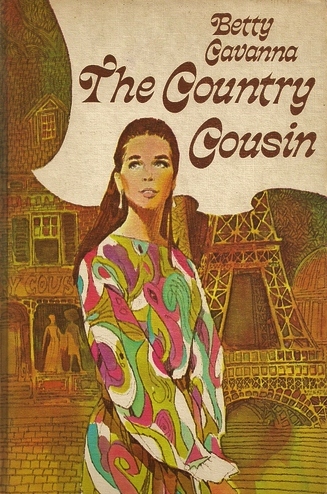
the country cousin betty cavannaThe Country Cousin by Betty Cavanna ~1967. This edition: William Morrow & Co., 1971. Hardcover. Library of Congress #: 67-21735. 222 pages.

My rating: 5/10.

An equal balance between interestingly vintage (Paris in the sixties!) and appallingly dated (chauvinistic boyfriends!) The author did her research for this slight little teen tome, and it shows, mostly in a good way. An interesting – if feather-weight – 40-year-old read.

Bonus – great cover! Tells you everything you need to know right there up front, doesn’t it?

*****

My reading is all over the map right now. It was a toss-up this morning whether to take a stab at reviewing Stephen Fry’s sex-and-bad-language-soaked novel The Hippopotamus, or this mild little vintage teen-girl romance. But since my last review was of a very contemporary (well, 1999 – not really that contemporary, though it seems but a moment ago in some ways), sex-filled book – Fits Like a Rubber Dress by Roxane Ward – I decided to keep things all mixed up; from one I wouldn’t dare to give my dear old mum to one she’s enjoyed with gentle enthusiasm. (As did I.)

Melinda Hubbard – Mindy – has grown up on a large farm in Pennsylvania, and now, recently graduated from high school and facing all the “next step” big decisions, is at a loss with how best to proceed. Her beloved older brother Jack, her opposite in almost every way – strong, intense, smart and focussed, where Mindy is soft, mild, merely average in academics and waffling – is studying medicine and has just married his college sweetheart, Annette.

Bridesmaid Mindy takes part in the wedding in a fog, brushing off inquiries as to her future plans with vague evasions; she’s done the proper thing and has applied to several colleges, but is ashamed to disclose that her applications have all been denied because she hasn’t met the academic standards. Her mother is pushing her towards taking a secretarial course, but Mindy is less than enthusiastic about that, not being able to picture herself sitting at a typewriter all day.

A saviour appears in the person of Mindy’s older cousin Alix. Recently widowed – we find out that her young husband was killed in Vietnam – Alix has taken the insurance money and opened a clothing store in Bryn Mawr, catering to the well-heeled college girls and their mothers. On an impulse, Alix invites her droopy cousin Mindy to come and live with her for the summer, to work in the shop – called “The Country Cousin” (after a real-life dress shop, as we find out in the author’s note at the end) – and gain some experience in the retail trade while considering her next move.

Mindy is agreeable – though one couldn’t call her “enthusiastic” – it’s really not in her nature, such a strong emotion, you know! – and soon is immersed in the retail clothing trade. If there’s one thing Mindy does enjoy, it’s pretty clothes, and we learn that she is something of an accomplished seamstress herself, designing and creating her own dresses and so on; a talent which will end up leading her to her true vocation.

Mindy meets several young men, and dabbles with romance for the first time in her life. Handsome Peter, a friend of Mindy’s brother Jack, is from a wealthy family, and has a succession of girls trailing after him, as he lackadaisically dallies with them while waiting for just the right one to come along. “I’m going to marry a rich girl,” he flat-out states to Mindy one day, letting her know that while she’s okay fun for a casual date or two, she shouldn’t get her hopes up. Realistic Mindy never really thought that Peter was for her, but she did daydream a bit, so rough and ready, definitely not wealthy and far from urbane Dana, another friend of Jack’s, on his way to study Oriental Languages at the Sorbonne in the fall term, looks very much like a second best in the boyfriend department.

Dana persists in his efforts to improve Jack’s sister’s intellectual capabilities, lending Mindy books on art, and carting her off to concerts and picnics in the country. He – and Peter, and Alix as well – all seem quite concerned with Mindy’s personal appearance. She is self-admittedly on the plump side, so with all of these people in her new life dropping comments to the effect that she’d be better-looking if she slimmed down, Mindy resolves to do just that, and tries to forget her butter-and-cream farm girl tastes, and to subsist on black coffee and a slice of toast for breakfast, and salad for lunch, and so on.

The pounds miraculously melt away, and everyone oohs and ahs about the improvement in her looks, and Mindy is quite smug with herself.  And this is where I had my biggest issues with this novel. The boys in her life, and her mentoring older cousin, mention to her that she’s too fat, and that she should slim down, so she unquestionably goes along with it, and does. She drops five pounds and everyone is all over her – “Good girl! Such an improvement!” Well, five pounds isn’t all that much, is it? I can’t imagine what their conception of “too plump” must have been if that made such a tremendous difference, and the fact that they were all so rude as to say such things to her rather floors me. It was obviously socially acceptable at the time to do so; Mindy takes it without a murmur. Anyway, this bit bothered me.

So, along goes Mindy, cooperating in her rather wishy-washy way with what everyone thinks she should be doing. Alix carts her along on buying trips to New York, and Mindy is introduced to the dress trade, and realizes for the first time that perhaps she might have a vocation after all, that of fashion design. She and Alix come up with a scheme to go to Paris on a selling trip, taking along clothing sample and taking orders from the community of Americans living there, who are desperate for well-made, reasonably priced clothes; Paris apparently offers only haute couture and shoddy department store dresses, nothing in the mid-range. This venture succeeds beyond their expectations, and of course they meet up with Dana, and romance predictably blossoms in the soft Parisian air.

A pleasant depiction of the time and place and people; the Paris of the “Americans abroad” is captured very well, as is the middle- and upper-class college town atmosphere of Bryn Mawr. As a “working girl”, Mindy is frequently reminded of her place in that society – at the lower end of the food chain – but she realizes that there is a dignity and self-satisfaction about doing whatever it is that you find yourself engaged in competently and cheerfully. A teeny bit preachy, with a Great Big Moral gently tromping about, elephant-in-the-room-style, but not offensively so. Betty Cavanna is so very genuinely earnest, and her heroines are so reasonably realistic, even to their modest goals and not-very-dreadful dilemmas, that it is hard to find much to object to. Middle-class girls are “people” too!

All in all, a typical bildungsroman of the era, which holds up well to a 21st Century nostalgic re-read, if you’re into dabbling with such stuff. I’m sure the junior high school girls of the time enjoyed it greatly; the old ex-library copy I have is very well read indeed.

Now, I wonder what I should read next …
Read Full Post »

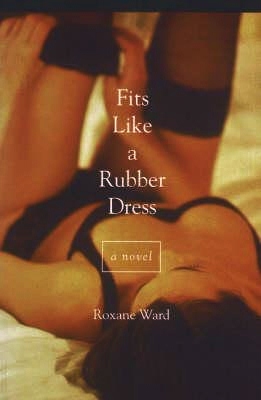
fits like a rubber dress roxane wardFits Like a Rubber Dress by Roxane Ward ~ 1999. This edition: Simon & Pierre, 1999. Softcover. ISBN: 0-88924-4. 303 pages.

My rating: 6.5/10.

*****

Great title and teasingly provocative cover. Didn’t realize it was Canadian until I got a page or two in, though the cover blurb by Timothy Findley should have been a major clue:

“It’s a glorious book! Roxane Ward is a sorceress – she transports you into a weird world of frantic characters dancing on the edge of the millennium. Then she lets you in on the secret: it is your own world, seen through the eyes of young, super-urban artists who are never satisfied with what they have or what they find. I warrant you will not forget Indigo Blackwell, in her pursuit of a life that fits like a rubber dress …”

– Timothy Findley

I raced through this one in a single sitting, staying up much too late last night to finish it, so that is an indication of its more than decent quality. This said, Fits Like a Rubber Dress is being added to the giveaway box as soon as I record this review, as I doubt it’s a re-reader for me.

Our heroine Indigo Blackwell is 29, on the cusp of leaving her youth behind, and she is obsessed with all of the usual angst-ridden baggage this entails. Her four-year-old marriage to a freelance writer/aspiring novelist, Sam, is happy enough, though Indigo loudly complains to her husband and her best friends (bartender Tim and television presenter Nicole) that her sex life is not as exciting as it once was in the “early days” of her marriage. She obsesses about this as much as she does about the incipient wrinkles she imagines are lurking, waiting merely for the flip of a calendar page to appear. Indigo wants to have sex, lots and often; Sam just isn’t that interested, citing stress, and preoccupation with finishing his novel, and gently ignoring Indigo’s increasingly desperate attempts to maneuver him into the bedroom.

“Frustrated” describes Indigo’s general state of mind. Not only is her marriage dull and her sex life stalled out, but her career is increasingly unsatisfying. Working for a Toronto public relations company, Indigo is modestly successful in her field, but when she receives a minor promotion, her feelings of dismay surprise her. Indigo needs to spice up her life …

All of this sounds most clichéd and rather yawn-making – oh, yes, we’ve read this story before – but author Roxane Ward managed to keep me engaged enough to follow Indigo on her quest for self-fulfilment, for a life that fits her and expands with her as she “grows” and makes her look and feel oh-so-good about herself, obliquely referencing the title. This first novel is more than competently written; Ward has oodles of talent, and I am curious as to what she did after getting Indigo out of her system, though I can find no evidence of a second novel in my brief internet search this morning. Which, if so, is a shame. But I digress.

Okay, back to Indigo. Her seems-so-serene marriage is about to founder, due to Sam’s own preoccupation with sex, or, rather, the sex lives of others. Researching the Toronto gay scene for material for his novel, Sam strikes up an increasingly deep acquaintance with a male escort, Graham, though he insists that there is nothing personal going on with his fascination with that parallel world. Indigo, having decided to dump her P.R. career and go to art school to study film-making, walks in on Sam and Graham in the midst of Sam receiving some firsthand experience with male-on-male sexual practices, and though Sam insists that it is all in the nature of research and that Indigo should basically get over it already, the marriage is, from that moment of we-could-all-see-it-coming-but-Indigo discovery, doomed.

Luckily Indigo has a cozy place to escape to, as her mother has just left for Bali for an extended artists’ retreat (what wonderful lives these people lead – no one is worried about the phone bill; it’s all about self-fulfillment; but how do they pay for it?! – I wish I knew!), leaving Indigo with the keys to her house. Indigo embarks on her own sexual explorations, taking up with bad boy, drug-dealing, sadomasochistic Jon, who introduces her to the world of fetish parties and anything-goes sex. This is cool for a while, but then things go a little bit sideways, and Indigo bails out, showing more sense than I had initially expected her to have. (She is described at one point in the novel as being “malleable” – very apt, as she appears willing to go with almost anything that comes her way – so it was a happy surprise when the girl found her spine at long last.)

So at the end of the tale – and here be spoilers, so look away now if you care to – Indigo is quite happily solo, Sam is off doing whatever comes next in his life, one friend is pregnant, and another is dead. Oh, and Indigo has a new tattoo. The end.

Did that sound rather bitchy? Yeah, I guess it did. On reflection, I realize that I didn’t ever really like Indigo. She was just too self-absorbed and navel-gazy and spent so much time worrying about the really obvious things in life – yes, Indigo, we’re all going to die, and no, Indigo, drug dealing, abusive artist types are not that into empathy and understanding. Go figure.

All that aside, a good first novel in a modern-urban, slightly satirical way. Well written, good characterizations. Nicely done, Roxane Ward. I hope you’re still out there writing away, because if Fits Like a Rubber Dress is any indication, you can say it well.

Read Full Post »

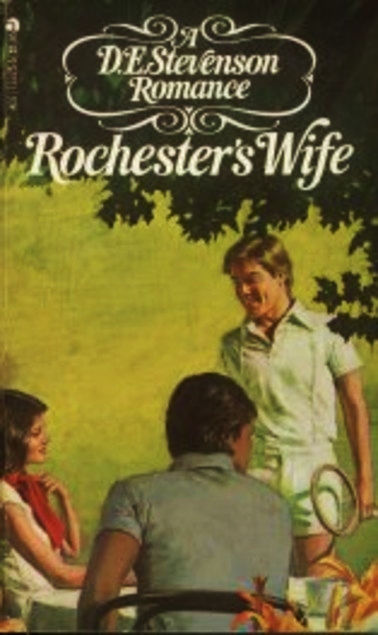
rochester's wife d.e. stevensonRochester’s Wife by D.E. Stevenson ~ 1940. This edition: Ace, circa 1970s. Paperback. ISBN: 978-0441733255. 335 pages.

My rating: 5/10.

*****

This is one of the “secondary” D.E. Stevensons, and, I believe, a “stand-alone” book, as none of the characters seem to reappear in any of the other stories. Though published in 1940, the time frame is pre-W.W. II, as there are only a few references to the “situation in Europe”, and, though the atmosphere is cloudy with foreboding, the focus is on the troubles of the individual characters, versus those of the wider world.

Young (in his late twenties) Dr. Kit Stone has returned to England after four years of travelling round the world seeking adventure. He had long cherished the ambition to become a sailor, but his (widowed) physician father had pressured him into studying medicine instead, with a view to taking over the family practice. The elder Dr. Stone died just as the younger Dr. Stone qualified, and the practice was instead sold, with the proceeds being split between the family’s two sons. The elder brother, Henry, had gone into business as a successful stockbroker and invested his share accordingly, while Kit, suddenly at loose ends, has decided to see something of the world.

Kit’s travels are touched on continually throughout the novel, and sound quite fascinating in and of themselves. He’s been in China, “looking for the war”, and has seen more of it than he had planned for. There is a reference, near the end of the book, to his standing in a marketplace when a shell fragment kills a mother and baby standing next to him; he is “spattered with their blood”, and there is a statement that he has seen quite a lot of blood in his travels. Strong stuff for this mild romance! Another incident, which has more bearing on the eventual plotline, is that Kit has had experience with diagnosing and treating a case of insanity while in America. One would rather like a full itinerary of his wanderings; he seems to have covered quite a lot of ground!

So now Kit is back in England, and though he still feels that he can’t bear to be “tied down”, he allows his brother to persuade him to try out steady employment for a while. Henry’s business partner, Jack Rochester, lives in the village of Minfield, just out of London. Jack’s wife, Mardie, is good friends with the elderly village doctor, who is getting overwhelmed with the demands of his practice, and when she hears of Henry’s brother’s sudden return, puts forward the idea that perhaps Kit might be interested in a position as assistant to the Minfield practice.

So Kit, rather reluctantly, agrees to try out life in an English village. Dr. Peabody welcomes him with gruff suspicion, which we (and Kit) immediately see as merely hiding hte proverbial heart of gold. The Peabody household consists of the elderly doctor, his bitter spinster daughter Ethel, and a grandson, precocious (and exceedingly likeable)young Jem, who is living in England for the “healthy climate” while his parents reside in Ceylon on a tea plantation. They are soon joined by another daughter, Dolly, recently married and, unbeknownst to her family, newly pregnant. Her husband, stationed in Malta, has asked her to stay in England because of her pregnancy, and Dolly’s reluctance to share this news with all and sundry has led to some speculation that perhaps her marriage is already in trouble, because otherwise why wouldn’t she be following her spouse?! Dolly and Ethel are the classic bickering sisters, and their feuding and continual cutting comments to each other add a lot of spice to this rather pedestrian tale.

The heart of the novel is an (apparently) doomed love triangle between Kit, the absolutely beautiful, charming and saintly Mrs. Rochester (Mardie), and her high-strung husband, Jack. Kit is immediately smitten with Mardie; Mardie is deeply in love with Jack; Jack depends on Mardie for emotional support as he deals with his stressful job, and much is made of how happy Mardie and Jack were in the first year or two of their marriage, though now, in year three, things are rather more difficult.

As young Dr. Stone is absorbed into the Minfield world, all seems to be going well with the “settling down” process, but for the unrequited love bit. Kit yearns for his unavailable love, and we start to see little hints that perhaps his passion isn’t exactly unappreciated and unreturned, but of course, there is that rather prominent husband in the picture. Jack, however, is showing signs of what could be charitably described as nervous tension; his personality is deteriorating by the day, and Kit and Dr. Peabody are soon looking up the characteristics of “insanity” in their medical books, and talking of bringing in a specialist.

The ending of this tale is a bit sloppy and unlikely, though everyone ends up neatly paired and with problems happily solved. I’m sorry to say that this is not one of D.E. Stevenson’s better efforts among those I’ve read so far, though there are many diverting situations throughout the book, mostly concerning secondary characters. We have the relationship between the Peabody sisters, young Jem with his brilliant talent for mimicry, an elderly Scottish housekeeper, Hoony, and her illegitimate grandson, Wattie, and, off in the background, the very happy marriage between Henry and his rather liberated wife, Mabel, who dabbles in the stock market quite successfully on her own, with her husband’s proud approval. The relationship between the two brothers, Kit and Henry, is nicely portrayed as well. They do seem a likeable family, with reassuringly human flaws fully recognized and easily forgiven by the reader.

A reasonably decent read, though I found myself groaning and figuratively smacking hand to forehead occasionally, especially regarding the whole “insanity” thing, and the remarkable (!) scenario the author has dreamt up for its resolution. Definitely worth reading as part of the D.E. Stevenson canon, though I’m afraid I closed the book and said farewell to the characters with a feeling more of relief than reluctance!

rochester's wife d.e. stevenson daylily detail 001And I must say something about the dreadful paperback cover. (Cover illustrations being, as some of you may have gathered by my continual harping on the subject, something of an issue with me.) Why, oh why do publishing companies insist on putting “current” illustrations on books set in past times? The characters illustrated on the Ace cover are obviously from the 1970s in dress and hairstyle; I cringe when I look at it. The only thing that that I found attractive (and here is the hort in me speaking) is the rather lovely inclusion of a border of tall orange daylilies (probably Hemerocallis fulva ‘Europa’ from the looks of them), in the foreground of the trio of tennis players and extending around the back of the cover.

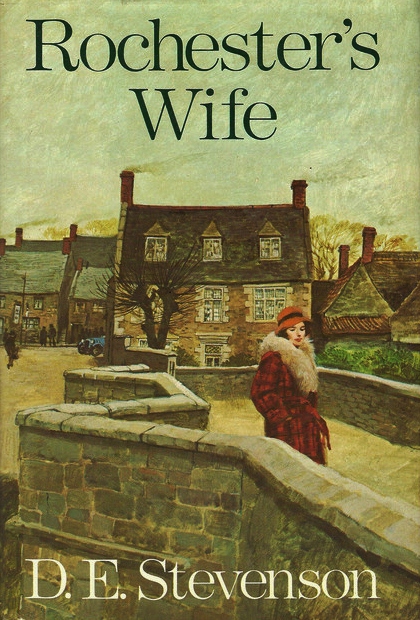
Much more appropriate is this other coverrochester's wife hc dj d.e. stevenson, which captures the mood and setting exceedingly well.

I am coming to the end of my personal stash of D.E. Stevensons, and the more I read of her the more eager I am to go on with building the collection. It’s going to be an expensive year, I fear. Even the tired old paperbacks are seriously overpriced, but I’m afraid I’m now hooked and will be playing the seeking game to the full extent that my pocketbook allows.

Part of the fun is the glorious awfulness of some of Stevenson’s scenarios – I just now have realized I’ve made no mention of the Jane Eyre references in this particular novel – nothing subtle about that, is there?!

D.E. Stevenson. When she is good, she is very, very good, but when she is bad … maybe she’s even more interesting!

Read Full Post »

some buried caesar rex stoutSome Buried Caesar by Rex Stout ~ 1939. This edition: Contained in All Aces: A Nero Wolfe Omnibus, Viking Press, 1958. Hardcover. Also published as The Red Bull in some editions. 153 pages.

My rating: 8/10.

*****

What with the immense number to choose from, with over seventy novels and novellas to the author’s credit, I’m nowhere close to having read all of Rex Stout’s clever and generally complicated tales starring private investigator Nero Wolfe (the more than slightly eccentric orchid aficionado, world-class gourmet, and superior thinker, with a most well-functioning brain residing in a body famously weighing, as we are often informed, a full one-seventh of a ton – a much rarer bulk back in the 1930s when Wolfe was created by Stout than we are used to today; I am quite sure I have seen a few gentlemen of this poundage and beyond in our nearest large city, though Wolfe would no doubt eschew the shopping mall food courts where many of my sightings have take place) and his trusty Man Friday – as well as Saturday, Sunday, Monday, Tuesday, Wednesday and Thursday – Archie Goodwin. (Note to eagle-eyed readers and red-pencil holders, please forgive this complicated run-on sentence. I bemuse myself sometimes … punctuation scattered at will, stream-of-consciousness posting going full speed ahead …)

I am going to assume everyone reading this is at least generally familiar with Nero Wolfe, by reputation if not from personal experience, and from his rock solid position in the American mystery fiction canon, so I won’t go into too much background detail. Suffice it to say the Nero Wolfe is a superior thinker, doing all of his detective work sitting down, usually with eyes closed after a gourmet meal created by his private chef, Fritz. (Shades of Hercule Poirot’s “little grey cells”, but infinitely more cerebral, if that is possible.) Live-in employee Archie is the legs of the outfit, and, frequently, the eyes, ears and hands as well, especially when a female client calls. While Wolfe has a definite misogynist streak, Archie appreciates all things feminine, though he doesn’t allow a pretty figure and face to distract him from his duties. Well, most of the time, that is …

One thing for certain about Nero Wolfe is that he strongly dislikes having to leave his comfortable 4-story brownstone house in New York. He strongly distrusts the internal combustion engine, and assumes the worst of any vehicle, ascribing a sentient malevolence to the machinery, which mistrust is occasionally borne out, as in Some Buried Caesar. We are rather shocked to realize that not only is Nero Wolfe out and about in a car, but that the occurrence has satisfied his deepest misgivings, and the vehicle has indeed been involved in a crash. Archie is, as always, the narrator of the tale.

That sunny September day was full of surprises.

The first one came when, after my swift realization that the sedan was still right side up and the windshield and windows intact, I switched off the ignition and turned to look at the back seat. I didn’t suppose the shock of the collision would have hurled him to the floor, knowing as I did that when the car was in motion he always had his feet braced and kept a firm grip on the strap; what I expected was the ordeal of facing a glare of fury that would top all records. What I saw was him sitting there calmly on the seat with his massive round face wearing a look of relief – if I knew his face, and I certainly knew Nero Wolfe’s face. I stared at him in astonishment.

He murmured, “Thank God,” as if it came from his heart.

I demanded, “What?”

“I said thank God.” He let go of the strap and wiggled a finger at me. “It has happened, and here we are. I presume you know, since I’ve told you, that my distrust and hatred of vehicles in motion is partly based on my plerophory that their apparent submission to control is illusory and that they may at their pleasure, and sooner or later will, act on whim. Very well, this one has, and we are intact. Thank God the whim was not a deadlier one.”

Did you catch the obscure word  in this passage? Reading Rex Stout is an education all in itself, if you stop to take the time to investigate Nero Wolfe’s arcane terminology. I’ve never come across this one before: plerophory. According to my highly intellectual (ahem) search for a definition (I Googled it), plerophory means “a fullness, especially of conviction or persuasion; the state of being fully persuaded.”

All right, digressions aside, and on to the story. I’ll try to be as concise as possible. (The nice thing about writing up a post about a mystery novel, in my opinion, is that the reviewer shouldn’t really give too much away, so as to preserve the pleasure of discovery for those new to the tale.)

After crashing their car, Archie and Nero head off cross country to look for assistance. (They’re on their way to the big state fair, with a collection of rare albino orchids which Wolfe is planning on showing.) Crossing a pasture, they are distracted by a shouting man brandishing a shotgun, and, moments later, a large and very irate Guernsey bull.

The bull in question is the key player in the mystery to follow. He’s a prize herd sire raised by a neighbourhood farmer from a pup (okay, calf) and purchased by the present owner, entrepreneur owner of a highly successful restaurant chain, for the unheard-of sum of $45,000, as a publicity stunt. The bull is destined to be killed and barbecued and served to a large party of prominent people who are preparing to converge on the country estate in a few days. Needless to say, there is an upswelling of outrage among the farmers of the area, that an animal of such value as a breeder should be sacrificed at such a whim.

The plot gets really messy (literally) when the son of the next-door estate holder, a vocal opponent of the prospective barbecue, who has just advanced a $10,000 bet to the effect that the bull will NOT be killed and eaten, is found dead on the ground in the pasture being pushed around by the bull. Ah – but did the bull actually kill the young man? Nero Wolfe, reluctant witness to the scene, thinks not, and details his reasons.

As well as the (possibly) murderous bull, there are a pair of star-crossed lovers, an anthrax epidemic, a glorious description of a big state fair, and a second mysterious death – this one by pitchfork, so at least the bull is off the hook. This novel, only the sixth in the Nero Wolfe/Archie Goodwin canon, also introduces beautiful, witty, and wealthy socialite Lily Rowan, who figures prominently from here on in as our Archie’s soon-to-be close friend and love interest.

This is a classic vintage mystery read. Rex Stout stands alone; he’s in his own class entirely, though sometimes his stuff can be rather hit-and-miss.  Some Buried Caesar, good though it is, is far from my personal favourite of the Nero Wolfes I’ve read (I think The Mother Hunt might get that designation) – but this is an author worthy of exploration for any mystery lover. If your choice of book falls flat, try another; it may take an attempt or two to really get involved in Wolfe’s world, but once you’re won over, you’ll be a fan for life.

And this is what inspired me to pick up this book, after a Rex Stout hiatus of years. My sister, who recently celebrated a milestone birthday, is fond of orchids and has quite decent luck in keeping them happy and blooming, which can be something of a challenge. As a birthday gift, I gave her this handsome Cymbidium in full bloom, and, as I photographed it against the aqua walls of our newly painted enclosed porch, its temporary home awaiting the birthday party, I suddenly thought of orchidphile extraordinaire Nero Wolfe.

???????????????????????????????

Read Full Post »

hurray for me s j wilsonHurray for Me by S.J. Wilson ~ 1964. This edition: Pocket Cardinal, 1965. Paperback. 264 pages.

My rating: 5/10.

*****

This is a rather interesting book, written by an author I’d never heard of before. A first novel, very autobiographical in tone, which shows a lot of promise, and is a quite decent read.

The reviews on the back cover are glowing:

“A rare and refreshing book. It is a strong story gently told and I found it a delight to read…”  (Betty Smith, author of A Tree Grows in Brooklyn)

and

“…rings with character and the rhythms of young life. It stays with you for days after you’ve read the last page.” (New York Herald Tribune)

and

“Its innocence and freshness are like a breeze from the sea. What lends it magic is the way it is told, its highly original viewpoint, and the subtle shifts in mood and emotion …” (Saturday Review)

On the front flyleaf of this vintage paperback is this note from a previous owner:

Lake of Bays, July 13/66. Left under my pillow by Mary.

Intriguing!

And from Kirkus, 1963:

A five-year-old’s world which begins and ends with his mother and seem stable is viewed through the eyes of young Bobby Hirshman and told accordingly and lubly. For Bobby is a very verbal child whose tongue is given to twisting (“You’re crazy like a daisy, Fifi-la-la-Libby”). But once you get used to all these nonsense words and name calling, you may share in these scenes of Lower East Side, N.Y.C. and its good-natured schreierei; Mrs. Greneker whose feud with the landlord leads to further protest (garbage, out the window); the expansive Carmella; and the other familiars of the neighborhood. For Bobby, there’s first day at school and the new friend he meets, Johnny Schaefer. This brings many “”tsores”” (troubles) into his own life since Johnny’s mother is very sick, and, at her death, Bobby loses his own immunity to the intimations of mortality. With the loss of that childish certainty – mothers don’t die – Bobby grows up a little and the book closes…. A first novel, true to a time – the early ’30’s, and close to experience – guessably the author’s …

The story is told in first person narrative by young Bobby Hirshman, five years old and learning about life the hard way. Growing up Jewish in Depression-era New York is a theme which we’ve seen fairly frequently, and this poignant tale has the familiarity of repetition, but it is unique in its own way. Occasionally the author breaks character, but by and large the voice is authentic; the child’s-eye view feels true and strong.

I enjoyed this book, but not enough to shelve it with my “keepers”. In my internet browsing, looking for more information about the author, I have seen several comments to the effect that this is a rather hard to come by title. So I’ve decided, instead of just trusting to fate and releasing it via BookCrossing or the Sally Ann box, to pass it along more directly to anyone who wishes to try it. It’s a fairly slender paperback, crisp and clean despite some age-toning and a bit of weakness at the lower spine, and I’d be happy to mail it postpaid to anyone, anywhere. My treat!

This is by way of being an advance on my plan to give away some more books this month in honour of April being my one-year “Blog Birthday”. It’s a bit hard to believe the year has come full circle; I had no real expectations that I would still be so involved with the project, but here I am. Still interested, and hugely enjoying the conversations with other readers from all around the world!

So – if you think you’d like to own Hurray for Me, just drop me a note in the comments, and I’ll message you for your address and send it on its way.

It’s a neat little read, and deserves a good home. My other giveaways will be “draw” style, I think, but this one will be first come-first served.

Thank you, wonderful readers and writers, for a year of pure pleasure. I’m looking forward to what this next year will bring with happy anticipation!

Read Full Post »

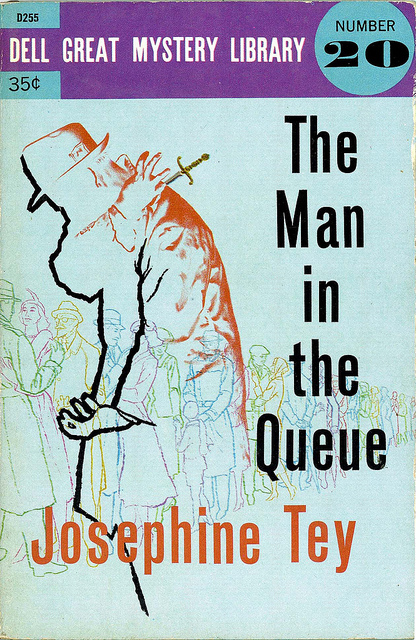
the man in the queue josephine tey b001The Man in the Queue by Josephine Tey ~ 1929. This edition: Berkely Medallion, 1971. Paperback. ISBN: 425-01873-3. 223 pages. Originally published as The Killer in the Crowd by Gordon Daviot, and released with the new title under the Josephine Tey pseudonym after author Elizabeth Macintosh’s death in 1959.

My rating: 7.5/10.

*****

This was Josephine Tey’s (to use the author’s best-known pseudonym, though she apparently preferred “Gordon Daviot”) first full-length book, written very quickly, reputedly in two weeks, according to this internet source,  Josephine Tey: A Very Private Person:

Tey started writing almost as soon as she could walk, according to a note from her literary agent, which also states that “writing was always her greatest amusement.” She published short stories and poems during the late 1920s in Scottish newspapers and in the English Review. Her first novel, The Man in the Queue, was published in 1929. It was reportedly written in two weeks for a competition sponsored by the publisher Methuen.

Tey’s first detective novel, The Man in the Queue – dedicated ‘To Brisena, who actually wrote it’ – Brisena was a nickname she gave to her typewriter – was a highly accomplished piece of work for a beginner.   Winning the Dutton Mystery Prize, it was published in 1929 under the pseudonym of Gordon Daviot—the name by which she preferred to be known, in both public and private.

Considering the time in which it was written, and the time frame it was written in, this novel is an accomplished piece of work, though it is far from flawless. I easily forgive the inconsistencies, because the writing is very good indeed, and I love seeing how the author progresses in her novels from the slight occasional awkwardnesses of this one to the sophistication of something like Brat Farrar, which I’ve just read as well, written twenty years later. This was a writer who continually honed and improved her craft; an admirable – and far from universal – thing.

The Man in the Queue starts out in front of popular London theatre, with a crowded line of hopeful people waiting for hours for a chance to see the most popular musical comedy show of the season, Didn’t You Know?, starring the lovely actress and dancer Ray Marcable (say it out loud – yes, it is what it looks like, though I didn’t twig myself until much later on in the story, when it was explained to me) in her last week of appearing in England before setting sail to try her luck in America.

It was between seven and eight o’clock on a March evening, and all over London the bars were being drawn back from pit and gallery doors. Bang, thud, and clank. Grim sounds to preface an evening’s amusement. But no last trump could have so galvanized the weary attendants on Thespis and Terpsichore standing in patient column of four before the gates of promise. Here and there, of course, there was no column. At the Irving, five people spread themselves over the two steps and sacrificed in warmth what they gained in comfort; Greek tragedy was not popular. At the Playbox there was no one; the Playbox was exclusive, and ignored the existence of pits. At the Arena, which had a three weeks’ ballet season, there were ten persons for the gallery and a long queue for the pit. But at the Woffington both human strings tailed away apparently into infinity. Long ago a lordly official had come down the pit queue and, with a gesture of his outstretched arm that seemed to guillotine hope, had said, “All after here standing room only.” Having thus, with a mere contraction of his deltoid muscle, separated the sheep from the goats, he retired in Olympian state to the front of the theatre, where beyond the glass doors there was warmth and shelter. But no one moved away from the long line. Those who were doomed to stand for three hours more seemed indifferent to their martyrdom. They laughed and chattered, and passed each other sustaining bits of chocolate in torn silver paper. Standing room only, was it? Well, who would not stand, and be pleased to, in the last week of Didn’t You Know? Nearly two years it had run now, London’s own musical comedy, and this was its swan song …

As the theatre doors finally open and the surging queue moves forward, another swan song is played out. A man gently slumps to the ground, having been held up by the press of the crowd. “He’s fainted!” is the murmur from the bystanders, until one of them noticed that between his shoulder-blades gleams the hilt of a silver dagger!the man in the queue josephine tey

And we’re off. For the man in undeniably very dead indeed, and it appears that he has been so for some time. But who could have stabbed him in front of so many potential witnesses, and why didn’t he cry out? Who is the man, anyway, and why is he carrying no identification? And is that a loaded revolver in his pocket?!

Scotland Yard immediately takes charge, and it is up to Inspector Grant, guaranteed dependable and with a certain flair for successfully solving his cases, to identify the victim and inexorably hunt down the missing killer.

An excellent piece of “Golden Age” mystery writing, chock full of appalling-to-the-modern-sensibility racial profiling and sexist commentary, but great fun to any lover of this most engaging genre. I must say I was completely stumped by the surprise ending; I was completely taken with the huge, stinking red herring which the author paraded about to confuse the plot; I did NOT guess the murderer until the final denouncement and explanation.

Inspector Grant, in his first appearance on the page, is rather Holmesian in style, consulting with the examining surgeon and coming up with some rather surprising assumptions, based on appearances alone. “Scientific”? Oh, dear …

“Can you tell me anything about the dead man himself?” asked Grant, who liked to hear a scientific opinion on any subject.

“Not much. Well nourished – prosperous, I should say.”

“Intelligent?”

“Yes, very, I should think.”

“What type?”

“What type of occupation, do you mean?”

“No, I can deduce that for myself. What type of – temperament, I suppose you’d call it?”

“Oh, I see.” The surgeon thought for a moment. He looked doubtfully at his interlocutor. “Well, no one can say that for a certainty – you understand that?” And when Grant had acknowledged this qualification: “but I should call him one of the ‘lost cause’ type.” He raised his eyebrows interrogatively at the inspector and, assured of his understanding, added, “He had practical enough qualities in his face, but his hands were a dreamer’s. You’ll see for yourself.”

Together they viewed the body. It was that of a young man of twenty-nine or thirty, fair-haired, hazel-eyed, slim, and of medium height. The hands, as the doctor had pointed out, were long and slim and not used to manual work …

Nice “scientific” work, you two. And if you thought this was a little too good to be true, just wait until you read about the assumptions made once the murder weapon is considered…

Very good stuff, in a completely “vintage read” sort of way. A definite must-read for the Tey fan, to track where the author came from, as it were, and to realize the huge strides she made in her writing career. Decidedly decent indeed for a first book; the others only get better.

And here, for your enjoyment and further enlightenment, are some grand reviews by other bloggers:

Fleur Fisher – The Man in the Queue

Stewartry ( A Gold of Fish) – The Man in the Queue

Read Full Post »

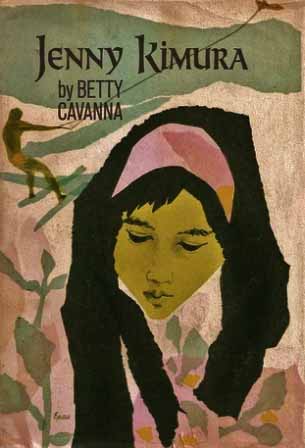
jenny kimura betty cavannaJenny Kimura by Betty Cavanna ~1964. This edition: William Morrow & Co., 1965. Hardcover. 217 pages.

My rating: 6/10.

All things considered, a slight little period piece, but a very good example of its genre: “teen girl” fiction of the 1950s and 60s, with a thought-provoking and rather brave theme for the time, that of racial prejudice.

*****

Jenny Kimura Smith, 16 years old, has lived her whole life in Japan. Her mother is Japanese, and her father is an ex-U.S. serviceman now working in banking. The Smiths live in Tokyo, and the portrait we are given is of a quietly happy family, enjoying, as Jenny’s father likes to say, the best parts of being both Japanese and American.

Jenny goes to an all-girls high school, and her interests are the same as those of her friends: study hard enough to get decent marks, spend time on your wardrobe, polish up your tennis game, and, increasingly, speculate about boys and romance and your fast-approaching adult life.

But Jenny’s life is about to change quite drastically from that of her schoolmates. Her American grandmother has invited her to spend the summer in Kansa City, and has sent money for airfare.

The invitation is something of a surprise, as Jenny’s father is vaguely estranged from his widowed mother since his Japanese marriage, and also, as we soon learn, because of his mother’s resentment towards the Japanese for the death of her second son during combat in the Pacific theatre in the Second World War. Jenny is excited to have this unexpected opportunity to travel, and is looking forward to experiencing life in exotic America.

On arrival in the States, Jenny is rather bewildered at the lack of open affection shown her by her grandmother, a wealthy, upper class, Kansas City society matron. She wonders why her grandmother has invited her to visit, as Mrs. Smith seems slightly cold and more than a little critical of Jenny’s very Japanese appearance, and some of her mannerisms. However, Grandmother does all of the proper things, and Jenny is introduced to a group of suitable teenagers, and is welcomed warmly into their social circle. It is soon apparent that she has caught the eye of one boy in particular, Alan, who begins squiring her about.

Could Jenny and Alan be falling in love? Not if Alan’s mother has anything to say about it! Once she realizes the increasing intensity of the situation, she whisks Alan away on a sudden holiday trip to remove him from the vicinity of “foreign” Jenny.

The plot takes another twist as Jenny and her grandmother travel to Cape Cod for a seaside holiday, and Jenny meets another young man, a Nisei (American-born Japanese), George Yamada, who was born in a California internment camp in 1944, but who considers himself completely American, despite his Japanese ethnicity and his family’s negative experience during the war.

Jenny immediately likes and is attracted to George, and soon realizes that the two of them are much more readily acceptable as a couple to their acquaintances because of their shared ethnicity, despite the differences in their actual backgrounds, than she and Alan were. She ponders this, and sees its “wrongness” – with her own parents as examples, Jenny realizes that love and “suitability” are more than skin deep – but she also realizes that appearances do matter to all concerned, much as they shouldn’t.

It also becomes very apparent that it is the older generation, the parents and grandparents, who are really resistant to anything like a “mixed race” relationship, while the younger generation is much more accepting, and openly discuss the issues raised by Jenny’s “foreign” appearance in a mostly non-judgemental way, though Jenny notices that she has a certain “novelty” appeal, especially when she appears in a kimono at a social function.

One of the key plot points is that Mrs. Smith deeply resents her son’s Japanese wife and has a hard time accepting and loving her own granddaughter, despite the attempt at reconciliation which inspired the invitation to America. She feels shame that her son has “demeaned” himself so far as to both marry a woman of a different race, and to live quite happily in a foreign country, far from “home”. Though Jenny tries to do everything right during her visit, her grandmother deep down is ashamed of her granddaughter and her “foreign” appearance and behaviours, only coming around when Jenny is snubbed by Alan’s family, when her pride is hurt, and her rage at their prejudice causes her to face her own feelings at last, and makes her realize how unfair her attitude has been in the years since her son’s marriage.

Similarly, from the Japanese viewpoint, Jenny’s mother has been shut out of her own family because of her insistence on marrying a foreigner, and Jenny’s maternal grandparents are cold and bitter towards both their daughter and granddaughter because of the “mixed” marriage which has caused the family to lose face. There is no reconciliation here, though, and it is implied that Jenny’s future relations will be much more positive with her father’s family than her mother’s.

The story ends with Jenny poised on the brink of her next step in life. She is about to return to Japan, but she has the promise from her grandmother that there will be a further family reconciliation, and she has had romantic experiences with two young men, George and Alan, which both look like they might possibly turn into something more serious depending upon Jenny’s future decisions. The idea of Jenny attending college in America has been raised, and she rather likes it, but nothing is yet decided, and that is where the story ends.

Despite the rather sober themes for a book of this genre, it is well padded with the usual happenings in a “teen girl” story: parties, shopping, lovely clothes, beach picnics and waiting by the phone for that special someone to call.

Jenny is realistic, likeable, delicately sensitive young heroine, and the author has done a better than average job in her portrayal of Jenny’s life both in Japan and the U.S.A. There are, of course, the expected clichés and stock situations, and many era-correct comments, which are a bit jaw-dropping when viewed from five decades further along.

This is no masterpiece, but it is a quite likeable book, and one I have happily re-read from time to time since my first acquaintance with it back in the 1970s, when I first checked it out of my high school library. The copy I own is that very copy I once signed out, found years later at a library discard sale, and the popularity of its heyday is borne out by the velvet softness of its well-thumbed pages and the many dog-eared corners throughout.

*****

Betty Cavanna was a prolific writer of “teenage” stories from the 1940s through the 1970s, publishing something like seventy titles, ranging from romance novels such as Jenny Kimura, to juvenile mysteries, horse-and-dog stories, and non-fiction “life in other lands” books. While many of her works are viewed as merely “average”, she was known for her meticulous research and wide variance of plots. Unlike many other novelists working in the same genre, Cavanna avoided series books; most of her stories are “stand-alone”.

I doubt that we will ever see this author re-published, but those of us nostalgic for revisiting the reading of our teen years will be happy to occasionally find her titles in secondhand bookstore and book sale rambles. Their value lies mainly in recording the attitudes and vignettes of a time now past, but those are reason enough for their preservation and occasional exploration, in my opinion.

Read Full Post »

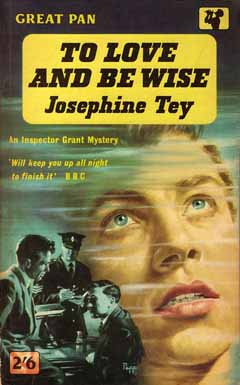
to love and be wise josephine teyTo Love and Be Wise by Josephine Tey ~ 1950. This edition: Pan, 1973. Paperback. ISBN: 0-330-10381-4. 191 pages.

My rating: 8/10.

*****

Who is the unusual young man who catches Inspector Grant’s attention during a brief encounter at a literary cocktail party? Slender and soft-spoken, rather negligible but for his white-blond fairness, Leslie Searle professes to be a professional American photographer on a private trip to England.

Why has Searle insinuated himself into best-selling author Lavina Fitch’s household, focussing his charm on Lavinia’s niece Liz Garroway, and partnering up with Liz’s fiance Water Whitmore, the well-known radio broadcaster, on a suddenly conceived book project?

And why is Mrs. Garroway, Liz’s super-maternal stepmother, so immediately hostile to the personable and perfectly well-mannered Mr. Searle, and why does the local vicar murmur about other-worldly demons after making Mr. Searle’s acquaintance over a placid dinner?

Walter and Leslie head off on their spontaneously planned canoe trip down the twisting Rushmere River, which they are co-documenting in words and photographs, and all seems well until the night when Walter storms out of the pub where he’s been sitting with Leslie. Laughing off Walter’s departure, Leslie is in no hurry to follow, and when he does leave, he placidly walks down the street and out of the village on his way back to the riverside camping spot. And then he disappears into the night. Leslie Searle is never seen again…

What really happened that night, and what dark secrets are hiding behind the many blank, superficially cooperative faces of so many respectable people? Nothing is as it seems, and Inspector Grant of Scotland Yard has his work cut out in attempting to unravel the mysteries surrounding what may just be an exceedingly well-planned murder.

A most satisfactory vintage mystery story, with a traditionally English countryside setting – though what is it with these (purely fictional, I’m always hoping) sedate British villages and their exceedingly high rates of murder and other such mayhem?!  With its nicely detailed character development, and reasonably believable plot twists, Tey’s novel still stands up well more than a half-century after publication, and will provide an evening or two of diverting reading to the modern connoisseur of the genre. If you have not yet discovered Josephine Tey, I recommend her to you with admiration and enthusiasm.

I frequently find it a lot harder to sensibly talk about why I like a book, especially one I’ve read and re-read numerous times with pure enjoyment, than to pan something I’ve reacted to unfavourably and have no intention of ever reading again, as I did in my last review, of Mary Wesley’s The Chamomile Lawn. So though I’ve spent some time mulling over how best to analyze  the appeal of this author, I will merely say that something about her writing just “clicks” in a deeply satisfying way.

If I can compare Josephine Tey to anyone, it would be Ngaio Marsh at her very best, hybridized with the intellectual superiority of D.L. Sayers. This writer treats her readers as full equals, never for a moment talking down to us, and always assuming we are well able to catch all of the nuances of the characters, settings and plots she has created and presented for our enjoyment.

And Tey has a deliciously sly sense of humour as well, which shows that the author had a very keen observational eye on the society and personalities of her time, much as she seems to have been personally rather reclusive in nature. She did move in some interesting circles – the theatre, literary and upper-class society worlds of her time – though she quite cleverly evaded the attentions of the press once her work became widely popular.

I do admire and enjoy Josephine Tey’s clean, intelligent style, especially in her later books, and I deeply regret that her body of work is so slight. There exist only eight mystery novels, of which To Love and Be Wise is the sixth, as well as several “straight” novels, and a number of stage and radio plays.

“Josephine Tey” is a pseudonym, that of Scottish writer Elizabeth Mackintosh. She also published under the pen name “Gordon Daviot” – several of the novels and the dramatic works originally appeared under this name. This accomplished writer died tragically, much too young, of cancer at the age of fifty-six in 1952. For more information on this famously reclusive writer, check out this dedicated website: Josephine Tey.net

It’s been a few years since I’ve read this particular mystery novel, To Love and Be Wise, but now that I have indulged myself by escaping into her fictional world, and renewing my acquaintance with the most likeable Inspector Grant of Scotland Yard, key investigator in five of the mysteries, I am eyeing the rest of the Teys sitting here on the “special books” shelf with anticipation. Time perhaps for yet another single-author reading jag, now that I’ve gleefully polished off most of the D.E. Stevensons I was saving for a treat for myself during this most hectic time of the year.

I believe that Josephine Tey’s mysteries are being currently reprinted in handsome modern editions, but even if you are unable to find new volumes, her most popular titles are in wide abundance in the secondhand book world.

Edited to add this link to an exceedingly excellent review which I’ve stumbled upon in marvelous serendipity while looking for info on the story around the publishing of Tey’s very first mystery, The Man in the Queue. I beg of you, if you’re interested in Tey, please click over here:  A Gold of Fish – To Love and Be Wise

I wish I could write reviews like this. Thank you, Stewartry ! I anticipate much happy reading as I further explore your EXCELLENT blog!

Read Full Post »

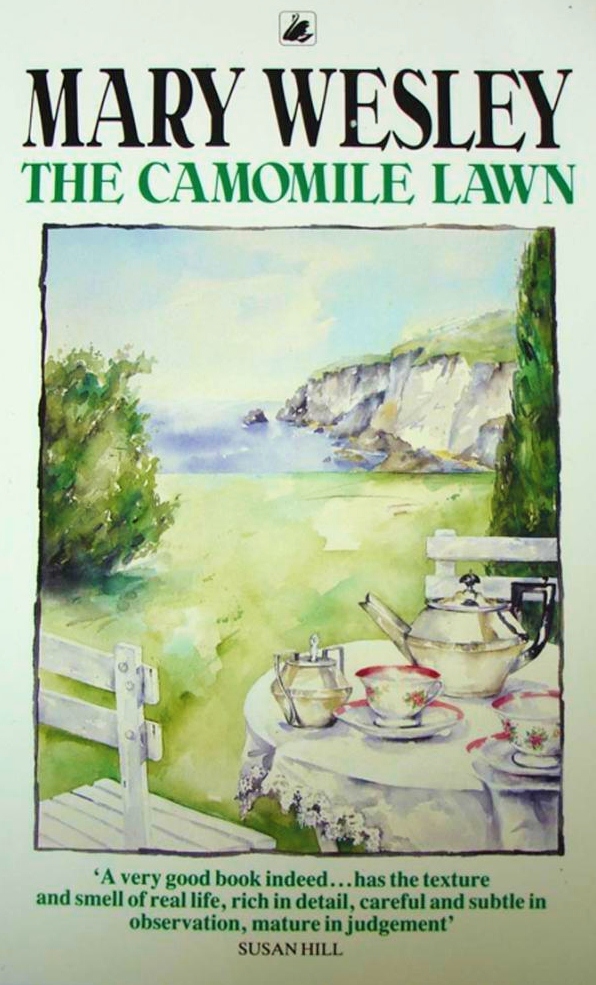
the chamomile lawn mary wesleyThe Chamomile Lawn by Mary Wesley ~ 1984. This edition: Black Swan, 1989. Softcover. ISBN: 0-552-99126-0. 336 pages.

My rating: 4/10.

It had its moments, but not enough to make it a keeper. Into the giveaway pile, to try its luck with other readers.

*****

In the summer of 1939, just before the start of the Second World War, a group of cousins assemble at a Cornish cliff side house. Lazing in the sun, lounging on the fragrant chamomile lawn, they are poised for whatever the future brings. Mary Wesley’s narrative follows them through the war, in a series of extended flashbacks triggered by the surviving cousins preparing to attend the funeral of a mutual acquaintance, a key figure in the family’s  fortunes.

That summer Oliver, newly returned from fighting in the Spanish Civil War, is in love with beautiful Calypso, who professes not to love anyone; 10-year-old Sophy is in love with Oliver. Kind Walter, his indolent sister Polly, and the twins from the nearby rectory, David and Paul, round out the cast of characters lounging the days away and enjoying the hospitality of Aunt Helena and Uncle Richard. When war is declared, the scene shifts to London, where the various marriages, affairs and misalliances of the cousins, the twins, Helena, Richard and Jewish refugees Max and Monika Erstweiler form a complicated and vaguely incestuous moving picture of lust, yearning and self-indulgence.

The Chamomile Lawn became a bestseller when it was first published in the 1980s, and much was made of the fact that the author, Mary Wesley, who apparently based much of the wartime narrative on her own experiences, was over seventy when it was released. A popular television mini-series broadcast in 1992 brought the novel to a much wider notoriety.

I can understand the popularity of the novel, as it does have an ambitious scope, a tangled, soap-opera-like storyline, and a generous enough amount of sexual goings-on to pique the interest of the most reluctant and jaded of readers, but I’m afraid I did not embrace it fully. This might be partly editorial, as the phrasing often seemed awkward to me, and I never entered fully into the story, remaining very much an onlooker as the author soberly and without much flair matter-of-factly related the action with an abundance of smutty detail which couldn’t help but leave me squirming – and not in a good way.

Little girls running about with no underwear and “respectable” gentlemen who should know better putting their hands up under those juvenile skirts; continual references to flatulence and erections and various other bodily functions seemed, after a while, to be over-telling; much too much information! The thing just felt smutty to me, and the story, though reasonably engaging, was completely unrelatable. None of the characters came to life for me, and I couldn’t drum up enough interest to really keep track of who was sleeping with who after a while, let alone try to get inside their rather nasty little heads long enough to work up some personal empathy.

It was hard work to finish this one. Perhaps because right before reading it I had just experienced Vita Sackville-West’s The Edwardians, which is a gorgeously written specimen of this sort of novel, an example of what it could be?

Mary Wesley isn’t even in the same city, let alone the same ballpark, as Vita Sackville-West and her ilk! Apples to oranges, or, rather, an overripe, sickly sweet, partly decayed banana (phallic pun fully intended, inspired by Wesley’s fixation on the male naughty bits) to an opulent bunch of hothouse grapes.

This is a damning review, and I’m sitting here having second thoughts about even posting it, but I think I will go ahead and just put it out there as an example of something which sounded great, received lots of positive press, but just didn’t click with this particular reader.

I didn’t hate the book, and I truly enjoyed some of the details the author shared about life and attitudes in wartime England, but the sexual stuff put me off. Not the fact that there was sexual content in this novel, but how it was portrayed.

Nothing was terribly graphic; I’ve read and happily tolerated – more than that – enjoyed – much more detailed portrayals of people’s fictional sex lives, but this one just felt off somehow. I’d hoped to be able to give The Chamomile Lawn to my elderly mother to read, but I don’t feel comfortable with doing so after reading it; something which seldom happens, as she quite happily tolerates a fairly broad range of “intimate” detail in some of the modern fiction we share and discuss.

I’m open to investigating some of the author’s other titles if they cross my path, because the story itself showed some creativity, but not planning on seeking them out in the near future. I will, however, be making a determined search for Sackville-West’s The Heir, which I know is around here somewhere, and which I desperately want to re-read, because reading All Passion Spent some months ago, and The Edwardians a day or two ago have reminded me what a stylish and clever writer Vita was, and how enjoyable really well-written “personality” fiction can be.

Edited to add: I’ve just registered The Chamomile Lawn with BookCrossing, and will be sending it back out into the big wide world on one of my next trips to town.

Read Full Post »

Tthe tall stranger d e stevenson hc djhe Tall Stranger by D.E. Stevenson ~ 1957. This edition: Ace, 1978. Paperback. ISBN: 0-441-79621-4. 252 pages. (Note: This is not the cover of the paperback, but of the original hardcover dustjacket. The Ace paperback illustration is quite a different thing! I will spare you it.)

My rating: 8/10.

Yes, it’s a very high rating for what is basically a “fluff” book, but it was what I needed last night, after a very trying day (condensed version – an unexpected visit to the vet with our 13-year-old dog and $2000 in emergency surgery fees, prognosis a guarded “fair”, upgraded to “good” when it was apparent that she handled the surgery very well indeed, all things considered) and it (the story) made me forget our combined woes for a bit, and made me happy. Maybe I should even put it up a point or two more for that!

Postscript – the dog is back home and looking most happy to be here; though rather sore and stiff after her internal surgery. Feeling optimistic this morning that all will be well with her for at least the near future, because, realistically, at 13, the inevitable final parting is not all that far away. This is the dreadful bit about sharing your home and heart with pets…

*****

This is one of D.E. Stevenson’s minor romantic novels which doesn’t get much press – I don’t think I’ve ever read anything about it at all. And probably for good reason – it’s a slight little thing, and the characters are nothing if not “stock”. But I loved it!

So here we have two roommates in a London flat. Barbara – Barbie – works for an interior decorating firm, while Nell is a secretary to a doctor. As the story opens, Barbie is in hospital with a mysterious virus, exceedingly ill. To cut a long story short, she recovers, due to timely intervention by Nell’s employer, and the loving care of Barbie’s Aunt Amalie and her companion-housekeeper Miss Penney.

Now toss in a charming but shifty love interest for Barbie, Aunt Amalie’s handsome stepson Edward, and a mysterious “tall stranger” met briefly at a crowded wedding. Relocate the action to a rather shabby castle on the Scottish border, garnish with a lovable child (and one not quite so immediately lovable), various charming clients-cum-friends, a basket of kittens, a dramatic storm and a rescue from an island, another love interest for Nell (looks aren’t everything in a man, you know), and there you go. One trials-and-tribulations-overcome-with-a-very-happy-ending double (quadruple?) romance.

Not very realistic, but lovely to escape into. Nicely done, Dorothy Emily!

I promised myself I’d just post and run with this one, because it’s really not the material for any sort of deep analysis, but I feel like sharing this snippet from midway through, because of course spring is, by the calendar at least, here; my life (and nursery greenhouse) is full of plants and my mind is full of gardening plans, and I too have a fondness for, but, sadly, no luck with, the lovely willow gentian.

The garden was now at its best; wistaria rioted over the south wall, its branches bowed down with their weight of blossom, and the willow-gentian in its cool shady spot was beginning to come into flower. Soon the little bushes with their slender stems would bear narrow bells of deep blue flowers, and the corner of the garden where they grew would look like a pool of blue water. Amalie was very fond of these gentians, she had grown them herself from a few seeds gathered on a visit to Switzerland. She had been told that they would not grow here in the Cotswolds but they had liked their new home and had thriven and multiplied under her care.

Amalie was in no hurry for them to flower. She would have held back the garden if she could … for, as each plant flowered and faded, she knew that it was gone for a whole year. The longest day was long past … Next year was such a long time to wait … all through the dead winter. Summer days passed too quickly, thought Amalie, and then she thought, but there are still the chrysanthemums to come and the dahlias and the proud upstanding gladioli and the gold of the ripe corn in the garvest fields and the flames ofthe autumn leaves!

The years do pass so swiftly, as do the days of the garden and the moments of each flower’s particular glory, but (apt thought with Easter coming and all) there is at least the eternal resurrection of plant life each year to look forward to. For every thing there is a season, if you’ll forgive the overused but most appropriate quotation, though (increasingly, it seems with the passing years) the season in question is often too brief. Would I freeze time if I could? Perhaps occasionally…

I’m going to my sister’s 50th birthday party today, so please forgive my rather angsty ramblings. Half a century. No matter how casual we are about joking that 50 is the new 40, it’s a slightly sobering milestone!

gentiana asclepiadeae hf 2013 x

Read Full Post »

« Newer Posts - Older Posts »