Archive for the ‘Read in 2012’ Category

The Way of a Gardener: a life’s journey by Des Kennedy ~ 2010. This edition: Greystone Books, 2010. Softcover. ISBN: 978-1-55365-417-9. 271 pages.

My rating: 8/10. Beautifully written, but I found myself occasionally tuning out – just a tiny bit – in the later chapters. The author’s life has been so full that he just barely touches on many of the events in his later years. I would love to have seen this as a volume one of a multi-volume biography, ending at his leaving the seminary, or settling on Denman Island (one of the Gulf Islands in British Columbia’s Georgia Strait, between southern Vancouver Island and the mainland), because I think the last four decades on Denman plus all the environmental involvement could easily fill a book of its own.

*****

I remember when Des Kennedy first blipped onto my radar, through his 1990s columns in Gardens West magazine, a Canadian publication which is de rigueur reading in my fellow gardeners’ social circle. This was soon followed by my purchase of Kennedy’s first book, a collection of essays on unloved creatures – think rats, slugs, spiders and their ilk – called Nature’s Outcasts: Living Things We Love to Hate (1993),and the rest of his gardening books as they were published, the most recent, before this one, being 2008’s An Ecology of Enchantment, which hints at some of the backstory detailed in this current memoir.

He popped up here and there, speaking at a garden show, authoring an article in a gardening magazine, leading a well-advertised garden tour to Ireland – an instantly recognizable figure with his halo of unruly red hair, and his confident gaze straight into the camera.

Much has been made of his time spent as a Catholic seminarian and novice monk; Kennedy left the monastery before he took full vows after continually clashing with his superiors in matters concerning involvement with the secular and artistic world. (Kennedy was in favour of a degree of inter-mingling between the seminarians and the local population of artists, poets and musicians; his immediate supervisors were not.)

From the Greystone Books website:

A personal and revealing exploration of a life lived close to the earth, from one of Canada’s best-loved gardeners.

Called “a green-thumb rogue” (Star Tribune, Minneapolis), accomplished novelist, satirist, and garden writer Des Kennedy describes his life journey from a childhood of strict Irish Catholicism in Britain to a charmed existence amid the gardens of his Gulf Island home in British Columbia.

From his appearance as an innocent dressed in white for his First Holy Communion to his days as a young seminarian in black habit, through the Beat poetry scene in New York City and the social upheavals of the 1960s, this monk-turned-pilgrim pursues a quest for meaning and purpose.

After leaving monastic life and moving west, Kennedy takes up a new vocation in what has been called the Church of the Earth. On a rural acreage, he and his partner build their home from recycled and hand-hewn materials and create gardens that provide food as well as a symbiosis with the earth that is as profoundly spiritual as past religious rituals. Spiced with irreverence and an eye for the absurd, The Way of a Gardener ranges over environmental activism, Aboriginal rights, writing for a living, amateur wood butchery, the protocols of small community living, and the devilish obscenity of a billy goat at stud.

This book describes Kennedy’s childhood years in Liverpool, before his emigration with his family to Canada at the age of ten in 1955. Growing up in a strongly religious Roman-Catholic family, Kennedy convinced himself that a religious career was his vocation; he spent eight years studying and working towards this goal, and eventually graduated with a degree in Philosophy from the Passionist Monastic Seminary in New York in 1968.

He then left the religious life and drifted and travelled for a time, ending in Vancouver as a school teacher and social worker. There he met the love of his life, Sandy Lesyk, who has been his companion and partner ever since. In 1972 the couple moved to a rural acreage on quiet Denman Island, where they proceeded to pursue the not-terribly-simple “simple” life, building a house from salvaged materials and clearing the land to establish a large garden. The couple still live there today, and still pursue the same lifestyle, though the vegetables now share space with a unique and individualistic mature ornamental garden which has received many praises and was the site of a weekly television show in the 1990s.

Despite the title, this is most emphatically not a book about gardening. It is a highly personal memoir about the time before the gardener emerged, and a look backwards at the sometimes rough and twisted path the author travelled, before the arrival at the gates of the present very earthly “Eden”.

Those coming cold to this book, without knowing who the heck Des Kennedy is now, may wonder what it’s all about. I must confess that if I had not already had the context of knowing about the writer, I might not have found this partial autobiography as interesting as I did.

Definitely recommended for those already familiar with this author, as it gives a marvelous insight into the background of this mesmerizing British Columbia gardening and environmentally “green” figure.
Read Full Post »

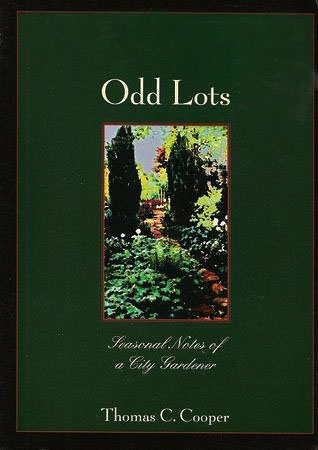
Odd Lots: Seasonal Notes of a City Gardener by Thomas C. Cooper ~ 1995. This edition: Henry Holt, 1995. Hardcover. ISBN: 0-8050-3741-1. 218 pages.

My rating: 5/10. I felt rather brutal giving this rating, because the author writes well, sometimes exceedingly so, and his subject matter is dear to my heart. But somehow this book just didn’t feel like a “keeper” – I had to push myself quite firmly to go on with it after the third chapter or so, and as I did so I found myself skimming much too much, between the bits worth slowing down for and more deeply savouring.

*****

This book of twelve monthly themed garden essays began life as editorials in Horticulture magazine. Thomas Cooper is a passionate and literate gardener, and he writes a perfectly readable style of prose, but for the most part there was nothing here to really stick with this particular reader. A pleasant one-way conversation. I mentally nodded and smiled, while one half of my mind was appreciating Cooper’s thoughts on peonies, mulch and the joys of examining a crocus at child’s eye level. The other half – well – it was thinking about my own garden much of the time, or the progress of the dinner roast, or how I really need to sweep down the cobwebs on the ceiling fan. Oops, bad sign.

This review from Kirkus says it well:

A devoted gardener offers a meandering collection of brief essays that may hold some charm for others of the same ilk.

As the editor of Horticulture magazine, Cooper contributes a regular column whose intent, he says, is “to capture the world in and around a garden.” This translates into fragmentary and scattered musings, mainly about his own backyard gardens in Massachusetts, so don’t look for practical assistance or even the occasional clever idea here. Although the columns are not dated or presented chronologically (for example, the reader sees Cooper’s daughter age eccentrically from three to two to six), they are grouped by month. January finds the author poring over nursery catalogs and drafting resolutions (“Stop accepting plants as gifts, no mater how tempting . . . just imagine they are offering a tray of zucchini seedlings”), while by April he is yearning for a spiffier potting shed and delighting over the arrival of packages from mail-order nurseries. A number of columns are little more than the verbal equivalent of puttering, but then, as Cooper says, gardeners do “raise puttering to the state of high art.” Occasionally, pieces that were written to be read one at a time are diminished by being crowded together: Although July’s articles on water and watering, musing on a watering can, noting the desirability of an efficient soaker hose, and admonishing readers to learn from water shortages out West are separated by forays into other matters, they lose some of their effect when read within the space of half an hour.

This one is for people who nod sagely at the line, “There is only so much Geranium endressii one person can handle,” and whose hours not spent in the garden are spent talking about being in the garden.

What else can I say? Good effort, nice production, but just a titch more miss than hit, at least in this garden veteran’s opinion. And yes, I did read many of T.C.C.’s columns in Horticulture during his 22-year stint as editor which ended in 2001, and enjoyed them in a mild way, as one does when reading the editorial as a sort of appetizer for the much anticipated main course of the longer articles to come.

Tom Cooper knows his stuff, and can turn a neat phrase, and in his time at the helm he oversaw a marvelous gardening magazine, my prized back-issue collection of which I frequently re-read. But when it comes right down to it, I can’t in good conscience wholeheartedly recommend this book. I truly wish I could – it’s that close.

Read Full Post »

The Story Girl by L.M. Montgomery ~ 1911. This edition: 1st World Library, 2007. Hardcover. ISBN: 978-1-4218-4202-8. 312 pages.

My rating: 9/10. What a delicious period piece. Loved it! Why have I not read this one before?

Beautifully evocative of golden childhood summers in a faraway time. Sweet, but never cloying; the very human children keep it real.

*****

An absolutely charming set piece about a group of cousins and friends spending a mostly idyllic summer together on Prince Edward Island.

The narrator is a grown man, Beverley King, looking back on his childhood, when he and his brother Felix travelled from their home in Toronto to spend the summer on the old family farm while their widowed father travelled to Rio de Janeiro on business. They are to stay with their Aunt Janet and Uncle Alec, and cousins Felicity, Cecily and Dan. Nearby is another motherless cousin, Sara Stanley, living with her Uncle Roger and Aunt Olivia, with a father in Paris. Uncle Roger’s hired boy, Peter Craig, and a neighbourhood friend, Sara Ray, round out the group of children.

Nothing much happens in this book, but the days are nonetheless filled to the brim with interesting incidents. The cousins and friends do their chores, play, squabble and run wild as often as they are able. They are generally good children, but not unreasonably so, and their numerous falls from grace drive the narrative, along with the endless succession of tales told by cousin Sara Stanley, the self-named Story Girl, who has an endless collection of anecdotes from a myriad of sources – local and family fables, legends, fairy tales and Greek myths – something for every occasion. Gifted with a natural dramatic ability, Sara Stanley could “make the multiplication table sound fascinating”, as she does on one memorable occasion.

Observant, restless Bev; chubby, sensitive Felix; self-confident, proud Dan;  beautiful, bossy, domestically talented Felicity; sober, stubborn, peace-loving Cecily; plain, imaginative Sara Stanley; over-protected, tear-prone Sara Ray; self-sufficient, passionate Peter – these are the eight personalities which make up the core group, though other family members and friends – and a few animals – take their part as well. Ranging in age from eleven up into the early teens, glimpses of the young men and women the children will become are very much in evidence, though childhood emotions and interests still hold sway.

Tragic (and joyful) family love affairs, a mysterious locked blue chest filled with a disappointed bride’s prize possessions, magic seeds, poison berries, various “hauntings”, a neighbourhood “witch woman”, reports of the end of the world, a competition regarding dreams, adolescent crushes, a brush or two with death – all of these (and more) serve to add spice to this halcyon summer, looked back on with fond memory by the adult narrator. A few clues as to what the future holds are given – hired boy Peter is deeply in love with beautiful, scornful Felicity; the Story Girl will perform before royalty in Europe – but by and large the narrator stays focussed on that brief time between heedless childhood and care-filled adult life.

*****

This book, along with The Golden Road, The Chronicles of Avonlea and The Further Chronicles of Avonlea, was the basis for a highly successful CBC-Disney television series co-production, Road to Avonlea, which was widely broadcast from 1990 to 1996. I completely missed this one, having by then entered my “no television” years, but reports by L.M. Montgomery aficionados claim that the show departed drastically from the books, both in characters and plot. Canadian actress (and now screenwriter and film director) Sarah Polley played the Story Girl in the series.

The Story Girl is followed by The Golden Road, another Montgomery book which has been on my shelf for some time, but which I have also not yet read – I will be remedying that this winter. If it is as charming and amusing as The Story Girl, I am in for another nostalgic literary treat.

Read-Aloud: The Story Girl would likely work well as a Read-Aloud for ages about 8 and up – there will be some rather long-winded parts here and there as episodes as set up, so you may need to self edit depending on your listeners. A few of the stories are a wee bit gruesome – in one reference a lost child is found the following spring as only a “SKELETON –  with grass growing through it”; ghosts are often referred to; there is a neighbourhood eccentric thought by the children to be a witch – if you are at all concerned over such themes it would be best to read ahead a bit to see if the material is acceptable to your listener’s sensibilities. Many references to and some plots centered on religion. All very era-appropriate. Nothing too extreme, in my opinion, but you may want to preview, especially before starting this with younger children.

Read-Alone: For reading alone, this one is most likely best for older children, say 11 or 12, to adult.

The largest challenge the reader will find themselves faced with, though, is envisioning, or, in the case of a Read Aloud, replicating the Story Girl’s magical talent for tale telling. Good luck! (And enjoy.)

Read Full Post »

419 by Will Ferguson ~ 2012. This edition: Viking, 2012. Hardcover. First Edition. ISBN: 978-0-670-06471-7. Winner: 2012 Giller Prize, for best Canadian novel or short story collection published in English. 399 pages.

My rating: 8/10. Quite a lot better than I had anticipated. Ferguson’s last few efforts have left me mildly disappointed, but this new novel encouragingly shows that he is still growing as a writer. I haven’t yet read any of the other Giller Prize nominees, but 419‘s win a few nights ago no longer seems so far-fetched. This is a well-written and ambitiously plotted novel, and the writer exceeded my personal expectations this time around. I didn’t love this book, but I did like it – very much. Though I do have more than a few critiques, some of which I’ll address below.

*****

I like being pleasantly surprised, and this book did just that. I’d read quite a few reviews, and I’d heard that it was nominated for the Giller, but I wasn’t particularly eager to delve in, as I’d earlier found Will Ferguson’s last book, Canadian Pie, disappointing. It felt rather repetitive, with some of what seemed like reworked material from earlier books, though some bits were excellent entertainment, as always.

But the distinctive cover of 419 caught my eye on the “New Books” display as I was heading out of the library on Tuesday evening, so I impulsively stopped and added it to my pile. When I got to car, I heard the announcement on CBC that Ferguson had indeed just won the $50,000 Giller for 419, and I mentally shuffled it to the top of my to-read pile, and started it that same night.

I found the narrative initially confusing, as the author has a number of different storylines on the go from page one, but it soon started to jell, though I didn’t ever shake the feeling that I occasionally had too many windows open on my mental computer screen.

The first lines, the literal importance of which become clear later on, are suitably foreboding and mysterious:

Would you die for your child?

This is the only question a parent needs to answer; everything else flows from this. In the kiln-baked emptiness of thorn-bush deserts. In mangrove swamps and alpine woods. In city streets and snowfalls. It is the only question that needs answering…

And we are suddenly at a car accident scene in a snowy Canadian city. Then in a sweltering African airport. In a mangrove swamp with a fisherman and his son. Back to Canada as a family learns of their father’s sudden death. Africa. Canada. Africa. Canada. What’s the connection here?

Longer stretches of narrative are interspersed with mysterious vignettes, as the stage is set for the characters’ and events’ inevitable connections and intertwinings, and separate strands start to stand out.

  • In Calgary, a retired school teacher has died in a troubling car accident. Was it an accident, or something more sinister? A daughter seeks the truth, and justice.
  • In the same city, a police investigator tries to determine the truth about that death, and others, as he mulls over his own personal future.
  • In Nigeria, a self-confident young man haunts the internet cafés, sending out thousands of tempting emails, waiting for the inevitable but rare “bite”.
  • From peaceable beginnings in a fisherman’s family on the Niger Delta, a young boy becomes a man, moving into a vastly changed world as multinational companies start to extract the oily treasure hidden under the dense mangrove swamps.
  • A mysterious scar-faced young woman stumbles through the sub-Saharan desert, hiding a secret and searching for a refuge as yet unknown.
  • In Lagos City, a crime lord plays his victims like an obscene stage director, evil but ultimately doomed himself.

The plot is driven by the ubiquitous presence of the infamous Nigerian internet scam, the titular “419”, so named for the number of the article of the Nigerian Criminal Code dealing with fraud, which turns out to be a key – but not the only – plot element.

419 is a total departure from Ferguson’s usual shtick of out-and-out parody, folksy anecdotes, and very Canadian self-mockery, but there are still abundant traces of the “old” Ferguson throughout. Though the subject matter is often starkly tragic, there are laugh-out-loud moments of rather twisted humour, as here on an African road ferrying a tanker trunk filled with stolen fuel:

Nnamdi was gripping the wheel, eyes on the road, barely blinking, barely breathing. His first time driving.

“Speed up,” said Joe. “A baby crawls faster.”

Nnamdi swallowed down his nervousness, pushed a little harder on the accelerator.

“And don’t swerve for goats like that,” Joe said. “Go through them. It’s the only way. We can hose off the grill later…”

All in all, a blackly comedic suspense novel, but not to be taken too seriously, Giller Prize or not.

The reader absolutely must suspend personal disbelief, and here I give away a bit of a plot spoiler. (Though not more so than any of the other reviews I’ve read.)

What is the likelihood of a modern, middle class, apparently well-educated family being so totally unaware of the sophisticated nature of internet fraud? I could buy into the innocence of the father – sort of – because obviously people do fall for these scams or they could not continue to proliferate, and I know how trusting certain individuals can be, but the naïveté of the adult children, one an apparently financially savvy businessman, tests the reader’s credulity a little too far. The revenge element, the reverse fraud, the involvement of the now highly pregnant Saharan girl – these plot twists, and numerous others, had me shaking my head as the story reached its conclusion.

Viewed as a semi-farcical novel, the flaws of logic smooth out and the “hang on a minute” moments are much more forgivable, but I didn’t ever get the feeling that this was the Big Important Serious Novel that some mainstream reviewers have made it out to be. Sure, there are some serious elements, and those lend poignancy to the tale, but to me it seems just another diversionary read, to be consumed with a certain gusto and set back on the shelf among all of the other well-wrought entertainments of the semi-serious sort.

With this in mind, recommended.

Good job, Mr. Ferguson, and congratulations on your prize.

Read Full Post »

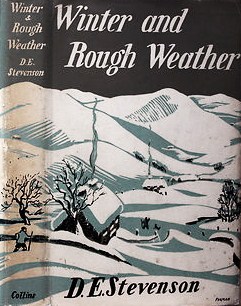
Shoulder the Sky: A Story of Winter in the Hills by D.E. Stevenson ~ 1951. Original British title: Winter and Rough Weather. This edition: Thorndike Press, 1992. Hardcover. Large Print. ISBN: 1-56054-343-4. 407 pages.

My rating: 8.5/10, for the majority of this story. I found myself very keen to get back to it and find out what was about to happen next, the most compelling of D.E. Stevenson’s books in this respect so far.

*****

A few years after the conclusion of the Second World War, a young, newly married couple, Rhoda and James Dering Johnstone, arrive at their isolated farmhouse near the fictional Scottish village of Mureth. Rhoda is an accomplished professional painter, and her husband worries, with some reason, as to how she will adjust to a life as a sheep farmer’s wife, far from the stimulating world she has happily abandoned for true love.

Rhoda drifts for a while, mulling over the dilemma of what she sees as a black and white choice between her perceived role as a wife versus personal fulfillment as an artist. The author handled this theme sensitively and sensibly, though I couldn’t help but think that childless Rhoda, overseeing a small house with the help of a live-in cook-general, had a luxury of a “domestic support system” impossible for those of us in a similar societal-economic position to attain today.

With her husband’s full support, Rhoda returns to the studio, and proceeds to paint a portrait which has far-reaching consequences among the local residents.

Add in several on again-off again love affairs, a missing wife, a bullying neighbour, a misunderstood child, and the challenges of winter storms in an isolated locale, and you have a quietly dramatic novel, and my favourite DES to date. There are two prequels/companions to this title: Vittoria Cottage and Music in the Hills, but Shoulder the Sky works well as a stand-alone; I never felt like I was out of the loop, though there were references to previous events throughout.

My only complaint is the ending seemed a bit rushed. Everything fell into place a little too neatly, and though things were obviously set up for happy resolution, too many plot strands were left hanging.  We were told that everything was now set to work out, so there were no real cliffhangers, but the novel’s abrupt ending felt very unfinished after some of the detail given earlier on. (This seems to be a common failing with most of the D.E. Stevenson books I’ve read to date.)

I greatly enjoyed this novel, aside from its minor but forgivable imperfections. The author has set it up beautifully, and the details she gives both of farm life and the art world appear to come either from personal experience or detailed research. I thought this particular novel was a relatively strong work for this “light romance” author, rather reminiscent of O. Douglas at her best.

Definitely recommended.

Oh! I must make one more comment. The edition I read was the Thorndike Press Large Print version, with a cover of lovely SPRINGTIME honeysuckle flowers. This story is decidedly wintry – a hugely important plot twist is centered on a winter storm, and the atmosphere throughout is shaped by the freezing weather. No mention of honeysuckle or springtime anywhere within – and I was watching for a clue. So a slap on the wrist to Thorndike’s design staff!

This cover is much more appropriate.

And now I must abandon my own cozy nook in the Prince George library, put on my winter jacket, and venture forth into our suddenly frozen world. It’s minus 10 (Celsius) out there and quickly getting colder; clear and crisp with a just-full moon shining on the newly fallen snow.

Grocery shopping, and the long drive home, and then a quiet day at home tomorrow, part of which will most likely be spent constructing the huge bonfire pile which has become a family All Hallows tradition. Or at least providing cocoa and other sustenance for the teens who’ve been plotting the construction of the pyre ever since last year’s spectacular display. (They’re running out of things to burn, having picked up sticks and collected scrap lumber so diligently in previous years that little remains anywhere within easy dragging distance. There was some mention of wanting a chainsaw and the use of a truck. We’ll see what happens. The weather forecast is dismal for October 31st – cold and snowy.)

There might even be a few Roman candles let off, which will shock the complacency of our own farm’s sheep – they definitely do not approve of such changes in routine, and generally wait out the human noisemaking in the shelter of their shed, gently baaing in ovine astonishment at all the fuss.

Happy Hallowe’en to those of you who celebrate it!  And to everyone at the mercy of the present widespread bitter weather, I wish you a respite from the storms, and a chance to catch your breath and regroup before winter sets in in earnest.

Read Full Post »

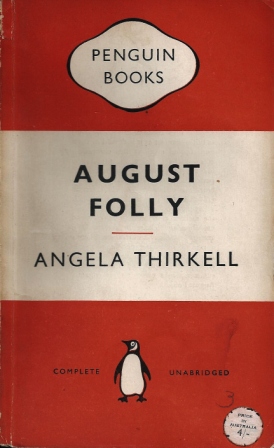
August Folly by Angela Thirkell ~ 1936. This edition: Penguin, 1954. Paperback. 250 pages.

My rating: 7.5/10. Possibly subject to move a bit higher after I’ve had a chance to mull it over more deeply, and have read some more of the author’s other books. Not bad at all, nicely diverting, but it didn’t immediately GRAB me. I have a feeling these might grow on one, though. We’ll see. I’m open to the possibility. I quite enjoy the hunt for obscurish vintage books, as long as there is a reasonable possibility of success, both in finding the quarry, and in finding it worth the trouble once it has been captured.

I have been watching for Thirkell for years in my rambles – as you may have gathered by now I am a used-book enthusiast – but this is the first one I’ve ever stumbled upon. Obviously not terribly popular in our region of B.C.! Must see what the library system offers, now that I’ve dipped my toe in and found the water temptingly warm. Or I could just be brave and go ahead and order some more from the various vendors on Abe, though some of the prices made me gasp a bit when I browsed them this morning, on spec as it were.

*****

Like D.E. Stevenson, whom I’d never even heard of in pre-book-blog-reading days, Angela Thirkell has a deeply devoted following among lovers of the vintage “middlebrow” genre. I’d also read a certain number of negative reviews – “shallow”, “fluff”, “just couldn’t get into them”, “you know the author just whipped these off for the income and rather despised her readers, don’t you?” – stuff like that. So I was cautiously optimistic.

Well, I’ve finally gotten my hands on a Thirkell to sample for myself, and with mixed (but rather high, as the fans decidedly outweighed the critics in blog world)expectations I carefully delved in. Carefully, because the old Penguin I now possess has had a long career already and is gently but persistently shedding pages, as old Penguins are wont to do. It’s been around. The price sticker on the front is from Australia, and inside the front cover the original bookseller has rubber stamped “Angus & Robertson, Melbourne”. It’s now a long way from home, here in the northern interior of British Columbia.

I was initially rather put off by the author’s parody of English village names in the first chapter – we are introduced to these improbabilities: Worsted (that was all right), shortly followed by Winter Overcotes (ack!), Shearings, Winter Underclose (oh, for heaven’s sake, stop already!), Lambton, Fleece, Woolram, Skeyne, Staple Park, and Lamb’s Piece. Rocked me a bit. I hope it’s not going to be one of those books, I thought to myself, a laboured and dated farce full of punning and “in” jokes. But after the starting jolt to get the thing in motion the author settled down to her story, and I settled in to enjoy it.

From The Angela Thirkell Society Website, here is a quick condensation of the plot, with a bonus reading recommendation. I would add, also ideal for reading in a warmly cozy chair with snowflakes drifting down outdoors, which is our present situation. Most conducive to reading about summer!

August Folly. Takes place in Worsted in East Barsetshire.  Most of the plot centers around the rehearsing and production of Euripides’ Hyppolyta, directed by Mrs. Palmer and involving the Deans, Tebbens, and many of the villagers. Highlights: Richard Tebben is infatuated with Rachel Dean, in addition to pouting about his poor showing at Oxford; Betty Dean, Oxford-bound, drives everyone crazy with her know-it-all attitude; Helen Dean is jealous of her favorite brother Laurence’s attentions to Margaret Tebben; Rachel Dean worries about her heart murmur; Charles Fanshawe fears he is too old for Helen Dean; Mrs. Tebben remembers her long-ago and never-expressed fondness for Mr. Fanshawe, who was her tutor; Jessica Dean is rescued from a bull by Richard Tebben. Richard gets a job with Mr. Dean, Laurence wins Margaret, Charles wins Helen.  Outstanding light entertainment, ideal for reading on a shady porch on a hot afternoon in July with strawberry ice cream and tea – which is how I read it!

I must add a note as to how much I appreciated the several brief vignettes featuring Modestine the donkey and Gunnar the tomcat in the midnight pasture. Totally unexpected, but most welcome.

A few minutes earlier Modestine, lounging about in the little shed down in the field that was his summer quarters, saw two points of fire approach.

‘I suppose that’s you as usual,’ he said ungraciously. ‘What’s the news?’

‘Nothing particular,’ said Gunnar, settling himself on some old sacks. ‘The usual dull evening. Some people from the Dower House came to dinner. Now, there they do keep a good kitchen. Chicken nearly every day, so the cat there tells me, young Kitty Dean.’

‘I daresay,’ said Modestine. ‘Some like chicken, some don’t. I don’t.’

‘Know what I did tonight?’ asked Gunnar.

Modestine only went on chewing some grass.

‘Drank all their sherry,’ said Gunnar, who needed no encouragement to talk about himself. ‘They left it in the drawing-room while they ate chicken in the dining-room. Never offered me chicken, so I drank their sherry.’

‘Was it good?’ asked Modestine. ‘I don’t hold with sherry. Give me a nice pail of water, or a good green pond, and I’m perfectly satisfied.’

‘Ignorant, that’s what you are,’ said Gunnar, ‘and prejudiced. Vegetarians always are …’

So there you have it. A restrained enthusiasm for my first Angela Thirkell. Quite curious about the next experience. Any recommendations, those of you who are old Barsetshire hands?

Read Full Post »

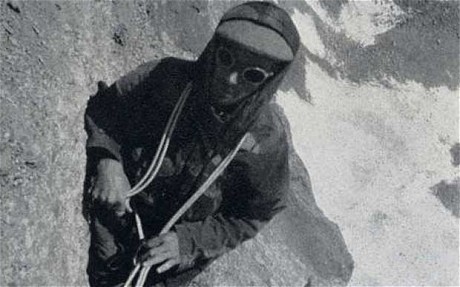
A Short Walk in the Hindu Kush by Eric Newby ~ 1958. This edition: Harper Collins, 2010. Introduction by Evelyn Waugh, Epilogue by Hugh Carless. Softcover. ISBN: 978-0-00-736775-7. 288 pages.

My rating: 8.5/10, after some inner debate. I have decided to overlook the more blatant “Eurocentric” passages, and to view this book as a product of its times, despite a vast change in standards of political correctness in the ensuing fifty-some years since its first publication. Very readable, in a dryly witty British way.

*****

In 1956, 37-year-old Englishman Eric Newby, having received a publisher’s advance to write a travel book, contacted his friend, career diplomat Hugh Carless, and floated the idea of travelling to Afghanistan and trekking in the Hindu Kush mountains, an area where few Europeans had previously ventured. The two decided that the trek should have some definite aim, in part to enable them to request grants from various organizations to assist with expenses, so, without letting their lack of mountaineering experience stand in their way, they decided to focus on ascending 20,000 foot Mir Samir, which had not yet been climbed to its summit.

After a two-day crash course in basic alpine climbing at Snowdonia in Wales, the two felt they were marginally more prepared for the rigours ahead, and the trip was on. Each man brought a certain experience to the expedition.

Newby, though having spent the previous ten years working in his family’s ladies’ fashion business, had strong credentials as an outdoorsman. At the tender age of 19, he had spent time on a four-masted Finnish sailing ship, voyaging from Australia to Europe via Cape Horn, and his eventual book about this experience, The Last Grain Race, was responsible for the publisher’s advance which initiated the Hindu Kush journey. With the start of World War II, Newby served in the famous Black Watch regiment, and was involved in the Special Boat Section, making lightning commando raids on enemy airfields and the like. One of these expeditions went awry, and Newby was captured off Sicily and interned for the rest of the war, barring a brief period of freedom in the Italian mountains, where he met his future wife, a Slovenian village girl, Wanda, who aided him in an escape attempt. This period was also written about, in Love and War in the Apennines, published in North America as When the Snow Comes, They Will Take You Away. (I am currently reading this memoir, and it is fascinating, and helps put Eric Newby the Hindu Kush “explorer” into context.) Wanda wrote her own memoir, Peace and War: Growing Up in Fascist Italy, in 1992. Always strongly and competently athletic, and with a strong sense of humour and a forthright readiness to embrace new experiences, Newby’s intent to venture into the forbidding mountains of a somewhat hostile Afghanistan is more understandable than it appears from his account of the initial decision in A Short Walk, where it appears to be merely a whim of the moment.

Hugh Carless himself, while on one of his official postings in Kabul, had previous experience in the area, and it was his accounts of trekking in the region with Tajik guides which got Newby thinking about the possibilities of a more ambitious expedition. The 31-year-old Carless brought knowledge of local languages and on-the-ground diplomacy to the partnership, as well as a strong inclination to adventure which more than matched Eric Newby’s.

The entire adventure, the “short walk”, lasted only a month, but what a marathon that month was. The book details the trials and tribulations, as well as the rewards, of the journey first to Afghanistan, and then, after engaging local guides, into the mountains. Mir Samir was reached, and the climb attempted, but both Newby and Carless were so weakened by continual dysentery and altitude sickness that they were forced to turn back a mere 700 feet from the summit. (A German party of experienced climbers was the first to reach the summit, only three years later, in 1959.)

After descending Mir Samir, bloodied and bruised, the trekkers continued around the foot of the mountain, as Newby and Carless thought they would like to see it from the “other side”, which entailed the party entering the neighbouring province of Nuristan, to the trepidation of their guides; regional rivalries were intense and deadly, and there was a very real danger of violence to trespassers.

A safe return was made, and the two men were thereby provided with anecdotes for a lifelong series of dinner parties, not to mention a whole book. The guides returned to their normal lives, grateful, one would assume, that the whole darned thing was so quickly over.

Much is made of Newby’s playful, ironic tone in this book, and while I did appreciate the bantering tone, as it made for an enjoyable reading experience on a purely diversionary level, I did continually keep thinking to myself, “Why?” Why risk life and limb, not only of themselves but of their guides, on such a pointless journey? Because it was “there”? That does seem to be the chief motivation set forth in the book, and I am not sure whether learning from the afterword by Hugh Carless, special to the 50th anniversary edition of A Short Walk, that the trip was contrived at least partly in order to have an experience to write a book about, that I am any happier with that reasoning. I suppose it is no different from the contemporary trips in search of material by the likes of Michael Palin and Bill Bryson, and even the revered Paul Theroux. We do tend to love a good traveller’s tale, whether we are fellow adventurers or merely armchair voyeurs.

A Short Walk in the Hindu Kush is often referred to as the book that started that successful genre, but I must differ on that point, as the traveller’s tale form stretches back in popularity to pre-history. Think of The Odyssey, and the Nordic journey tales, and Marco Polo, and the countless accounts since then. This book is a worthy successor of its historical ancestors, but it very much walks in the shadow of what came before, versus branching out in any significant way.

Newby and Carless ultimately come across as being a wee bit arrogant (okay, in Carless’ case, hugely arrogant), with their snide comments on the personal habits of the natives of the area. To balance this they do poke continual fun at themselves, and there are numerous appreciative comments regarding the region and the people, so perhaps it is merely a case of the author being more honest than most in that he records his negative thoughts, rather than submerging them in the interests of political correctness as more modern writers have been trained to do. Whatever my criticism, the fact remains that these two men ventured where few others dared, and, in the face of overwhelming discomfort and very real danger, pushed forward to pursue their stated goals, with a great degree of success.

To sum up, I quite enjoyed reading this book, am eager to read more of Newby’s work, and would happily recommend A Short Walk to others, with the note that it represents the attitudes of the time it was written, and may jar the sensibilities of a more tactful and possibly better educated (in a worldly aware sense) time.

Read Full Post »

Let the Day Perish by Christian Petersen ~ 1999. This edition: Beach Holme Publishing, 1999. First Edition. Softcover. ISBN: 0-88878-400-7. 136 pages.

My rating: 9/10. Strong, vivid and eloquent. “Beautifully crafted”  and “Powerful” may have become clichéd descriptions, but they apply in their most sincere sense to these punchy short stories.

*****

From the back cover:

Christian Petersen beautifully reins in the confusion and displacement of a diminishing band of men facing the daily spectre of an unforgiving land, men enslaved to the grind of the sawmill, hunkered on bar stools, high in the saddle of a John Deere, or wild behind the wheel speeding down dirt roads to the Fraser. Here are fathers, brothers, lovers in search of forsaken children, bygone loves, and memories long faded in the wash of fast-running streams and firelight. Here are the unpardoned, raging against what they might have been, what they are now, and where their paths have led them. Yet Petersen’s characters hollow out a quiet dignity, gentle in the silent truth that they are small in the face of pain – and of change.

Regional literature set in areas familiar to the reader is difficult to view in perspective. I find that I am often so caught up in nodding in recognition of places and people that a crucial distance is hard to maintain in attempting to judge merit of story and style. And this is a very local collection of stories, by a writer who closely shares my own experience of time and place in his formative years, growing up in Quesnel in the 1960s and 70s, leaving the Cariboo for a time, and eventually resettling in Williams Lake, where he has worked (is still working?) as a probation officer. He is obviously a keen observer of local “types” – they are instantly recognizable – but he looks past the superficial surface of the stereotypes to the turmoil within.

A quotation on the opening page gives a clue to the content within:

If a story is not to be about love or fear, then I think it must be about anger.

  • The Look of the Lightning, The Sound of the Birds ~ Diane Schoemperlen

Love, fear and anger are all represented here in their deepest intensity.

A very readable collection of stories, definitely for British Columbians familiar with the Cariboo-Chilcotin settings, and with a broader appeal to universal emotions which should resonate with readers everywhere.

  • Heart Red Monaco ~ Two unlikely friends search for some kind of meaning in their treading-water lives.
  • The Next Nine Hundred Years ~ Vignettes of “working at the mill.”
  • Horseshoes ~ Two brothers: rivalry, conflict and resolution.
  • Come Evening ~ A day with one of the fringe-dwelling “troopers” of Williams Lake.
  • Scout Island ~ From her house overlooking the nature reserve, a horse trainer deals with “getting by”, and a troubling situation initiated by her young son and her elderly great-aunt.
  • Country Boys ~ The brutal world of the high school bully, his victims and, ultimately, his tormenters.
  • Taseko ~ A boy goes moose hunting in the Chilcotin with his father and his father’s friend.
  • Let the Day Perish ~ Life, love and death on the ranch.
  • This is How It Is ~ A divorced father yearns for his young daughter.
  • Thibeau’s Crossing ~ Betrayal changes everything in a peaceful valley.
  • Charity ~ A sincere Baptist Church minister gives in to passion with far-reaching consequences.
  • Men’s Wear (after a fashion) ~ The venerable owner of the town’s “upper crust” men’s wear store is challenged by changed times, and undergoes an epiphany. Great ending note to this collection – left me smiling. Nice to quit on a high point; some of these stories (though not all) were dark.

Petersen has also written a mystery novel, Outside the Line (2009), and another collection of short stories, All Those Drawn to Me (2010). He is currently working on another book, a novel. I will be watching for it. Keep an eye out for this author. This first collection is excellent.

Read Full Post »

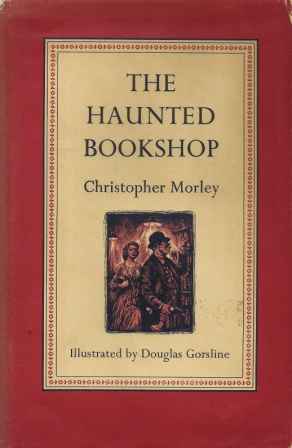
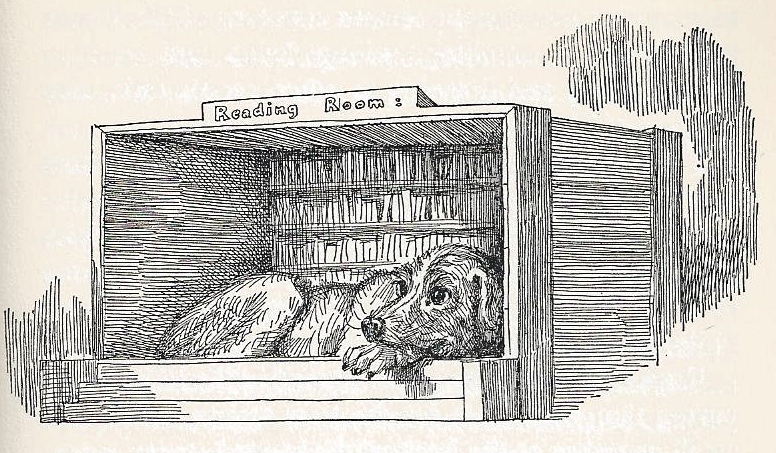
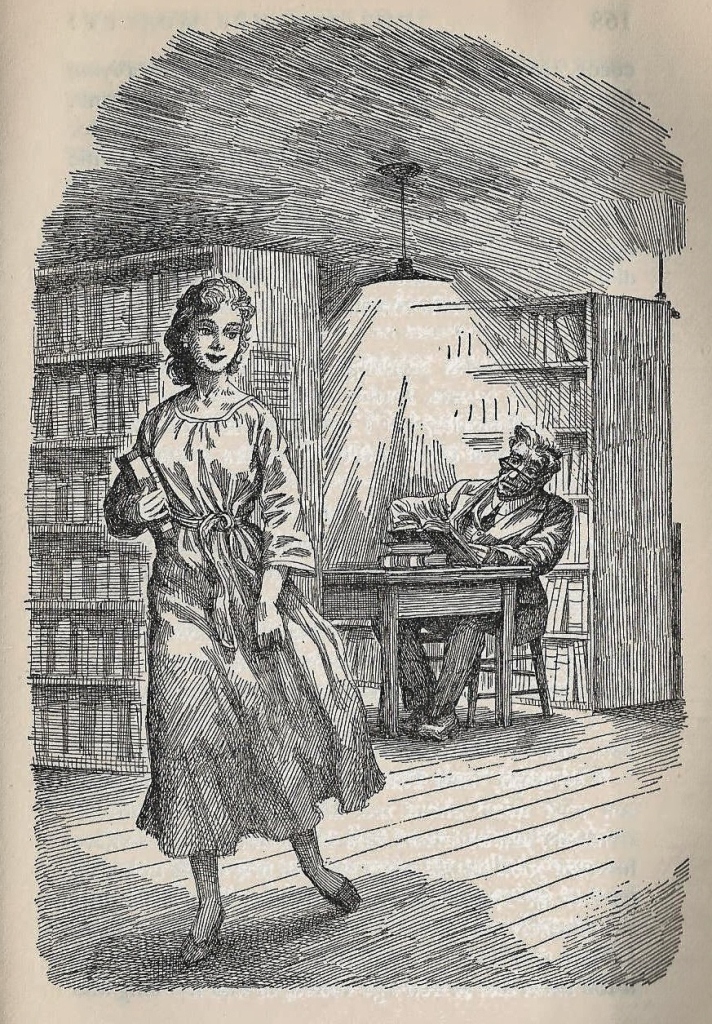
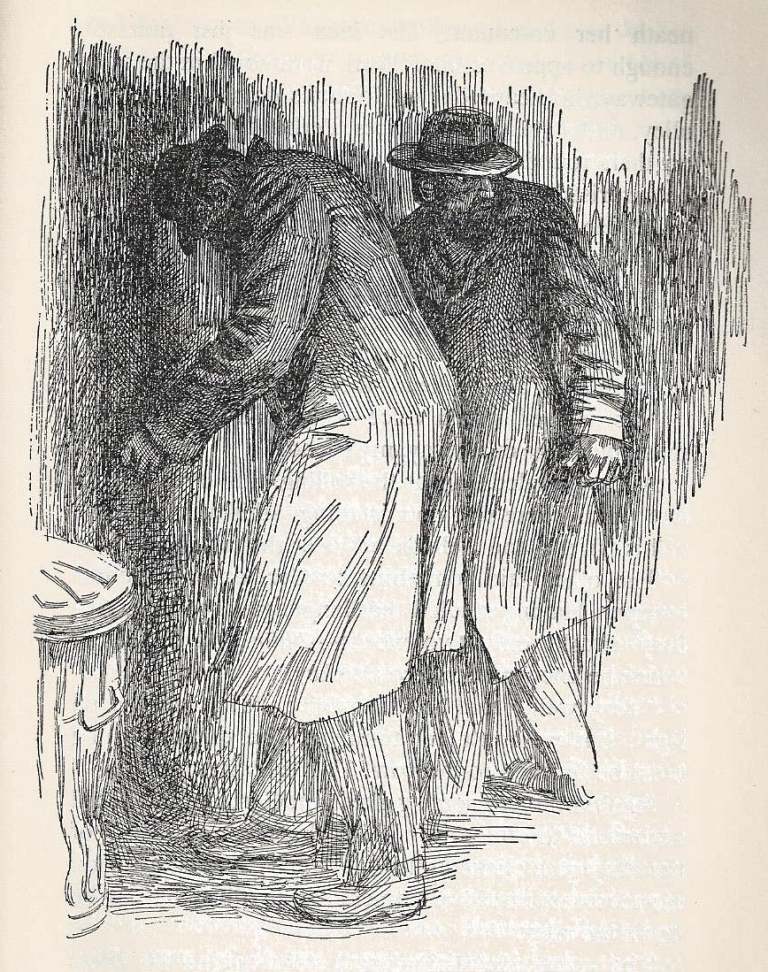
The Haunted Bookshop by Christopher Morley ~ 1919. This edition: Lippincott, 1955. Illustrated by Douglas Gorsline. Hardcover. 253 pages.

My rating: The bookish bits are an easy 10/10. The mystery bits, pretty bad, so only a 5/10. Okay, maybe a 6. Reflecting the time of writing and all that. The romance between the married couple, definitely a 10/10. Aubrey and Titania, hmm, they can have a 9. Another 10 for Bock the dog. It’s looking pretty good, here. Grand illustrations, too. How about an enthusiastic 9/10, with the note that this is very much a period piece, so proceed to read with that caveat in mind.

*****

If you are ever in Brooklyn, that borough of superb sunsets and magnificent vistas of husband-propelled baby-carriages, it is to be hoped you may chance upon a quiet by-street where there is a very remarkable bookshop.

This bookshop, which does business under the unusual name “Parnassus at Home,” is housed in one of the comfortable old brown-stone dwellings which have been the joy of several generations of plumbers and cockroaches. The owner of the business has been at pains to remodel the house to make it a more suitable shrine for his trade, which deals entirely in second-hand volumes. There is no second-hand bookshop in the world more worthy of respect.

It was about six o’clock of a cold November evening, with gusts of rain splattering upon the pavement, when a young man proceeded uncertainly along Gissing Street, stopping now and then to look at shop windows as though doubtful of his way. At the warm and shining face of a French rotisserie he halted to compare the number enamelled on the transom with a memorandum in his hand. Then he pushed on for a few minutes, at last reaching the address he sought. Over the entrance his eye was caught by the sign:

PARNASSUS AT HOME R. AND H. MIFFLIN BOOKLOVERS WELCOME! THIS SHOP IS HAUNTED

He stumbled down the three steps that led into the dwelling of the muses, lowered his overcoat collar, and looked about.

It was very different from such bookstores as he had been accustomed to patronize. Two stories of the old house had been thrown into one: the lower space was divided into little alcoves; above, a gallery ran round the wall, which carried books to the ceiling. The air was heavy with the delightful fragrance of mellowed paper and leather surcharged with a strong bouquet of tobacco. In front of him he found a large placard in a frame:

     THIS SHOP IS HAUNTED by the ghosts
     Of all great literature, in hosts;

     We sell no fakes or trashes.
     Lovers of books are welcome here,
     No clerks will babble in your ear,

     Please smoke--but don't drop ashes!
                             ----
     Browse as long as you like.
     Prices of all books plainly marked.
     If you want to ask questions, you'll find the proprietor
           where the tobacco smoke is thickest.
     We pay cash for books.
     We have what you want, though you may not know you want it.

     Malnutrition of the reading faculty is a serious thing.

     Let us prescribe for you.

     By R. & H. MIFFLIN,
                                     Proprs.

The shop had a warm and comfortable obscurity, a kind of drowsy dusk, stabbed here and there by bright cones of yellow light from green-shaded electrics. There was an all-pervasive drift of tobacco smoke, which eddied and fumed under the glass lamp shades. Passing down a narrow aisle between the alcoves the visitor noticed that some of the compartments were wholly in darkness; in others where lamps were glowing he could see a table and chairs. In one corner, under a sign lettered ESSAYS, an elderly gentleman was reading, with a face of fanatical ecstasy illumined by the sharp glare of electricity; but there was no wreath of smoke about him so the newcomer concluded he was not the proprietor.

As the young man approached the back of the shop the general effect became more and more fantastic. On some skylight far overhead he could hear the rain drumming; but otherwise the place was completely silent, peopled only (so it seemed) by the gurgitating whorls of smoke and the bright profile of the essay reader. It seemed like a secret fane, some shrine of curious rites, and the young man’s throat was tightened by a stricture which was half agitation and half tobacco. Towering above him into the gloom were shelves and shelves of books, darkling toward the roof. He saw a table with a cylinder of brown paper and twine, evidently where purchases might be wrapped; but there was no sign of an attendant.

“This place may indeed be haunted,” he thought, “perhaps by the delighted soul of Sir Walter Raleigh, patron of the weed, but seemingly not by the proprietors.”

His eyes, searching the blue and vaporous vistas of the shop, were caught by a circle of brightness that shone with a curious egg-like lustre. It was round and white, gleaming in the sheen of a hanging light, a bright island in a surf of tobacco smoke. He came more close, and found it was a bald head.

This head (he then saw) surmounted a small, sharp-eyed man who sat tilted back in a swivel chair, in a corner which seemed the nerve centre of the establishment. The large pigeon-holed desk in front of him was piled high with volumes of all sorts, with tins of tobacco and newspaper clippings and letters. An antiquated typewriter, looking something like a harpsichord, was half-buried in sheets of manuscript. The little bald-headed man was smoking a corn-cob pipe and reading a cook-book.

“I beg your pardon,” said the caller, pleasantly; “is this the proprietor?”

Mr. Roger Mifflin, the proprietor of “Parnassus at Home,” looked up, and the visitor saw that he had keen blue eyes, a short red beard, and a convincing air of competent originality.

“It is,” said Mr. Mifflin. “Anything I can do for you?”

*****

So begins this charming story, which was literally forced upon me by the proprietor of Murdoch’s Bookshoppe  in Mission, B.C., during a recent visit. “Have you read that?” he demanded of me as I browsed through it at the front desk while he was totting up my other purchases, giving me a stern look after he plunked each tempting hardcover down after noting the pencilled-in price. “No!? What do you mean, you’ve heard of it? You must READ it. Buy it!”

So I did. And I have. Bought it and read it.

How to describe this? Well, first off, it’s a stand-alone sequel to an earlier book, Parnassus on Wheels, in which our hero apparently operates a kind of travelling bookshop. Haven’t read that one yet, but it’s on my to-acquire list. (Though I see it is recently available via Project Gutenberg, as is The Haunted Bookshop itself and a number of Morley’s other works. I still prefer a physical book, after having experimented with a friend’s e-reader, and after reading a number of works online through Gutenberg. Print on the paper page, please, though I firmly believe that Gutenberg is providing a crucial resource by making available so many out of print gems. I occasionally do some proofreading for Gutenberg projects, which is an incredibly satisfying volunteer pastime. Maybe I should write a post about that one day.)

I am digressing, which is appropriate, as The Haunted Bookshop is a great series of digressions itself.

It is also a love story (or two), a mystery story, an ode to the printed page and the ideas found between covers, and, most vividly, an anti-war tirade, being published immediately post World War I, when the world was still reeling from the brutality of that event.

Roger Mifflin and his wife Helen have settled down in New York to pursue the bookselling trade from a fixed location. They are about to take into their household the daughter of a wealthy friend, who wishes young Titania to sober herself from her frivolous ways by learning what it is to toil and earn her living by her labour. Titania turns out to be a true treasure, and she soon attracts a swain – a certain Aubrey Gilbert, who has come into the shop to attempt to sell advertising to Mr. Mifflin, and, though turned down on this front, becomes attached to happily eccentric Roger and makes the shop something of a second home

A mystery regarding the continual disappearance and reappearance of a Thomas Carlyle’s Oliver Cromwell on the shop’s shelves leads to encounters with sinister Germans, and a plot to assassinate Woodrow Wilson on his way to a Peace Conference. All’s well that ends well (except for a casualty or two in the final dramatic scene.)

This is quite the period piece, as I mentioned earlier, but is more than redeemed by the glorious bits of rambling prose. I will leave you with another sample, which made me laugh out loud – not sure what that says about the nature of my sense of humour, but I found this very funny.  I won’t force this book upon anyone in the forthright way of Mr. Murdoch, but I will give it a cheerful recommendation. And here is the author describing one of Roger’s domestic weaknesses.

I hesitate to touch upon a topic of domestic bitterness, but candor compels me to say that Roger’s evening vigils invariably ended at the ice-box. There are two theories as to this subject of ice-box plundering, one of the husband and the other of the wife. Husbands are prone to think (in their simplicity) that if they take a little of everything palatable they find in the refrigerator, but thus distributing their forage over the viands the general effect of the depredation will be almost unnoticeable. Whereas wives say (and Mrs. Mifflin had often explained to Roger) that it is far better to take all of any one dish than a little of each; for the latter course is likely to diminish each item below the bulk at which it is still useful as a left-over. Roger, however, had the obstinate viciousness of all good husbands, and he knew the delights of cold provender by heart. Many a stewed prune, many a mess of string beans or naked cold boiled potato, many a chicken leg, half apple pie, or sector of rice pudding, had perished in these midnight festivals. He made it a point of honour never to eat quite all of the dish in question, but would pass with unabated zest from one to another. This habit he had sternly repressed during the War, but Mrs. Mifflin had noticed that since the armistice he had resumed it with hearty violence. This is a custom which causes the housewife to be confronted the next morning with a tragical vista of pathetic scraps. Two slices of beet in a little earthenware cup, a sliver of apple pie one inch wide, three prunes lowly nestling in a mere trickle of their own syrup, and a tablespoonful of stewed rhubarb where had been one of those yellow basins nearly full—what can the most resourceful kitcheneer do with these oddments? This atrocious practice cannot be too bitterly condemned.

I do believe I will print that passage off and attach it to my fridge, in the hopes that my own domestic affairs will see an improvement in this area!

Read Full Post »

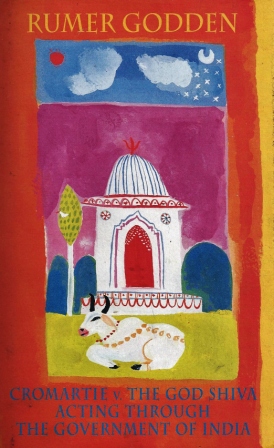
Cromartie v. The God Shiva Acting Through the Government of India by Rumer Godden ~ 1997. This edition: Macmillan, 2007. First edition. Hardcover. ISBN: 0-333-71548-9. 170 pages.

My rating: 5/10. Workmanlike, but lacking any sort of the old Rumer Godden magic. If it were by any other author I would have set it aside unfinished, but as the celebrated writer’s last published work, I felt the need to see it through to the end. Not recommended, except to those wishing to round out their Godden collection.

*****

Publisher’s Weekly Review, November 1997:

Based on a real incident that occurred a decade ago, this assured novel by 89-year-old Godden (Black Narcissus, etc.) concerns a sensational case brought by the Hindu god Shiva, “acting through the government of India,” against a wealthy Canadian, Sydney Carstairs Cromartie, who buys a small, 11th-century bronze statue of Shiva in Toronto. Cromartie takes the figurine to a highly reputable London art dealer, where a staff member informs the Indian government that the priceless artifact has likely been stolen. The partners in a prestigious set of chambers in London’s Inns of Court overcome their fear of appearing ridiculous and assign the case to young Michael Dean, who was born and raised in India. Dean returns to his homeland to investigate and stays at Patna Hall, a quaint beachfront hotel in South India, seen before in Godden’s Coromandel Sea Change. Although Dean soon falls for a visiting archeologist, love is not allowed to get in the way of the pursuit of justice; the denouement, however, brings one of the lovers a broken heart. Liberally dabbed with local color, the book is fast-paced–so much so that its concise prose sometimes seems hasty, its simple characterizations verging on the glib. Yet Godden’s fans will probably welcome yet another of this veteran novelist’s tales of India.

I am definitely a Godden fan, but I like to think that this designation does not blind me to the fact that her output can be, on occasion, charitably described as uneven. When she’s good, she’s very, very good,but when she’s bad … well, you know the rest of that tagline.

This book, her last adult novel, and indeed her last published work of any sort, was written at the very end of her long career. Though it is more than competently written, it feels sadly stiff and flat. I did not care for a single one of the characters; they moved behind a wall of smoked glass, with occasional glints of sparkle and colour, but nothing more. The ending was dreadfully contrived, like something out of one of Agatha Christie’s lesser efforts. I can’t help but feel the author shipped this one off to the publisher with a sigh of relief before turning to the fireside and tea-tray, much deserved after so many industrious years. Rumer Godden died a year after the publication of Cromartie v. The God Shiva, at the venerable age of ninety.

I will be reading Coromandel Sea Change, in order to compare the two. Godden refers to that work as the “Siamese twin” of Cromartie, sharing the setting and some of the characters, but diverging in plot. I have heard that Coromandel is the better book. I hope that this is true. I readily forgive Godden and allow her the odd miss, but I’m not going to hide my disappointment about this one.

Read Full Post »

« Newer Posts - Older Posts »