Archive for the ‘Read in 2012’ Category

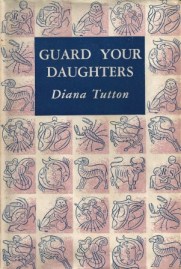
guard your daughters diana tutton 001Guard Your Daughters by Diana Tutton ~ 1953. This edition: The Reprint Society, 1954. Hardcover. 246 pages.

My rating: This is one of the more difficult ratings I’ve had to mull over in the eight months since I’ve started this blog. I’m going to say, after much consideration, 6/10.

That rating may change if I can get my hands on some of the author’s other works; I am curious to see her next developments as a writer.

I thought this was an ambitious and strongly written first novel. There were a few rough patches here and there, and I bogged down a bit about a third of the way through, but the narrative then picked up speed, and I had no trouble staying engaged until the bitter end.

The following review is divided into two sections, the first for those who haven’t yet read the book, and the second for those who have; I have some comments to add to the recent online discussion regarding Guard Your Daughters and, of course, its inevitable comparison to Dodie Smith’s I Capture the Castle.

*****

I’m very fond of my new friends, but I do get angry when they tell me how dull my life must have been before I came to London. We were queer, I suppose, and restricted, and we used to fret and grumble, but the one thing our sort of family doesn’t suffer from is boredom.

So speaks this novel’s narrator, Miss Morgan Harvey, looking back on the circumstances of her nineteenth year, the year when everything changed, and when she and her sisters finally emerged from their mother-woven cocoons and ventured out into the larger world.

“Queer” and “restricted” are apt descriptions of the Harvey ménage. Father is an immensely successful mystery story writer, distantly busy in his study churning out his manuscripts and emerging occasionally to pay the bills and blink short-sightedly at his daughters. Mother is an oddly attractive though emotionally needy and mentally fragile creature whom the other six treat with extreme care tinged with apprehension – “What if something should set her off?” they all whisper to each other – every word and action weighed with care to ensure the avoidance of a quivering, wailing breakdown. Friends are forbidden the house, and indeed the girls do not appear to even have friends; they were not allowed to attend school, and their last governess left four years ago. There is no telephone –  “it worried mother” – and no outings but for the necessary trips to the village shops and to the next door farm for illicit black market acquisitions of butter, cream and eggs (the story is set in post-World War II England, when food rationing was still in effect). And there are, most emphatically, no opportunities to meet young men.

The oldest sister, twenty-two-year-old Pandora, has unexpectedly escaped and been recently married. Now living in London, she’d caught the eye of a visiting young man, grasped her rare opportunity, and speedily carried out a courtship whilst officially occupied teaching Sunday School. To everyone’s surprise, the marriage was accepted relatively quietly by Mrs. Harvey, but the rest of the sisters are now even more aware of their restrictions, and are beginning to cast their glances speculatively around for their own chances to blossom forth.

Thisbe, second eldest, is twenty-ish, Morgan is nineteen, Cressida eighteen, and Teresa fifteen, but they all have the dual personality of the overly sheltered but mentally bright child, a combination of beyond-their-years intellectual sophistication and total social naïvety. Snobbishly proud of their status as daughters of a best-selling author, their good looks, their various “arts”, and above all their determined and deliberate “eccentricity”, they play these points up for all they’re worth when they do have their rare social interactions.

As the narrative starts, Morgan has just captured (apt term!) a young man whose car has broken down at the Harvey gate, and his enforced stay to tea allows us to sum up each sister’s particular persona.

Pandora is absent, though she arrives that evening for a visit and turns out to be wonderfully “normal”; bloomingly happy in her marriage and eager for her sisters to share in her good fortune. Thisbe is proud of her own witty tongue, and delights in shocking people with her cutting comments; she privately pursues the muse of poetry, shutting herself up to write with little care of the boring logistics of helping with household chores. Morgan is musical; she has occasional piano lessons and works away on her own, though not strenuously enough to gain the skill needed for her talked-of concert pianist’s career. Cressida is the handy sister, the practical one; yearning after normalcy and highly aware of her family’s general oddness, she cooks and cleans and mends and tries to keep her careless sisters as decent as she possibly can, to their frequent mild scorn. Teresa is a very young fifteen, and thrilled to have reached the age when the visits of the country education inspector need no longer be feared. She has surrounded herself with books and lives in an intellectually precocious world of her own, while clinging to her mother and indulged by her older sisters; a true baby of the family, talked of and treated as if she were five or six versus on the cusp of young womanhood.

The eventual implosion of the Harveys’ private little world and the true nature of their mother’s “ailment” forms the climax to which this hectic story builds. And though billed as a “social comedy”, there is a much darker undercurrent to the facetious surface story; I was uncomfortable as often as I was amused.

*****

This next bit is addressed to those who’ve read the book – alert to others –  there may be spoilers.

I did enjoy the actual reading of this book; I was drawn into the story and I was decidedly curious as to what was going to happen next; my expectations changed drastically as the narrative moved on, and I began to pick up on darker elements of what initially seemed like merely an amusing “light” novel.

Paradoxically I did not like or admire most of the characters in any sort of personal way, and I found myself getting more and  more uncomfortable as the comically brittle farce turned into something much darker. I think this was a deliberate ploy by the author; in which case she deserves high marks – this novel, if viewed as a dawning-of-an-awful-light portrait of a severely dysfunctional family, is, in my opinion, decidedly a success.

If, on the other hand, I’m reading the author’s intentions completely wrong, and this was indeed meant to be an amusing romp, it fails utterly and dismally. This is not a feel-good book. I felt that the frenetic posturings of the narrator serve initially to hide, and later to sharply accentuate, the misery of her life and the psychological damage to all five of the siblings and their father by the emotional malfunctioning of the family’s mother. In turn, the mother has been deeply emotionally injured in her own earlier life; the five sisters of Guard Your Daughters are classic cases of victims of the victim; the “spiral of abuse” – that handy modern catch-phrase – applies most appropriately here. That the abuse is prompted by love – albeit love gone terribly wrong – in no way lessens its effects on the many victims, though it may excuse the perpetrators of deliberate viciousness and leave them guilty only of the lesser crime of thoughtlessness.

Though some reviewers (see links at the bottom of this post) have felt that this novel is strongly derivative of other stories, I felt that though it may have shared a few vague similarities of plotting with other “classics” of similar genre (and yes, I’m referring here to Dodie Smith’s I Capture the Castle), by and large I felt that it was an original work by a creative mind, not a copycat work by any stretch. There are only so many situations out there; the repetitive themes of young people (in this case young women) yearning after both romantic love and “suitable” mates, and, indeed, the struggle to break free of parental influence and to escape from childhood into the wider world of true maturity, are universal and repeated time after time after time, because writers and readers so strongly identify with them, whatever the era.

The frequent humourous situations were well portrayed, and they did make me smile; but my final impression of Guard Your Daughters is that this was not a happy book; the humour is not the point here, it merely fulfills the part of the curtain that refuses to stay drawn over the utter awfulness of the understory.

The Harvey sisters did not gain my instant affection as did Castle‘s Mortmains; Morgan as narrator was not nearly as charming and individualistic as Cassandra; I never could shake the feeling that I was being overtly manipulated into accepting Morgan’s point of view, while Cassandra’s narrative became an effortlessly absorbed voice in my head for the entire time of the reading of the novel.

While both sets of fictional sisters are snobbish, the Mortmains recognize this and admit it as a failing, while the Harveys revel in their snobbishness and deliberately mock anyone of lower social status who draws their attention, from their departed governess to their lone domestic to the farmer’s wife who sells them their black market eggs to the bookstore owner who promotes their father’s bestsellers.

This continual self-regard and deep snobbishness was what prevented me from embracing the Harvey sisters as truly “lovable” characters. All five had some good points, some complexity of character, but I never felt like we were equals. In their world, I fear very much I would be one of the mocked commoners, with boringly bourgeois views and the wrong ancestors and accent.

The continual selfishness of all of the Guard Your Daughters protagonists is the most difficult trait standing in the way of my sympathy for them; while they occasionally acted in a disinterested way towards the members of their inner circle, their inward-facing focus added to their greater problems; at some point in the story I felt like shaking each and every one of them and hissing “reality check, you fool!” in their silly faces. Morgan most of all!

I’m glad I read Guard Your Daughters, and I’m very curious to read more by this writer, though this novel will definitely not join the “comfort reads” in my personal stacks. I think it might best be placed with the ones on my “love-hate” shelf, alongside Muriel Spark, Margaret Atwood, Jeanette Winterson and their ilk, to be taken in small doses when the need for an emotional shake-up of sorts is desired; literary bitters to add piquancy to a milder, more easily digestible, dare I say, generally more enjoyable everyday reading diet.

*****

I’m not completely happy with my review above; it seems that my after-midnight thoughts have not all quite made it to the page, but I’ll leave it there for now – a new midnight is fast approaching! The following reviews are the ones that started me on this very interesting examination of Guard Your Daughters. If you haven’t already, please visit these for a wider discussion of this slightly controversial read.

Stuck in a Book – thought it was grand!

Jenny’s Books – generally enthusiastic with some reservations.

The Captive Reader – decided it wasn’t her thing.

Book Snob – loved it.

*****

And here, by way of a little bonus, are two teaser reviews for Diana Tutton’s second and much harder to locate novel, Mamma, published in 1955.

From Kirkus, April 1955:

A pleasant autumnal blooming for Joanna Malling has its problems which are fortuitously solved. For Joanna moves to a new house, after a widowhood of twenty years, only to find that she must ready it for her daughter’s (Elizabeth aged 20) wedding to Stephen Pryde, 35 and a Major expecting to be stationed abroad. Joanna, at 41, finds him stolid and slightly inimical. But when his orders do not come through and she must do the necessary and provide a home for them when he is assigned to her locality, she begins to find many things in common with Stephen which Elizabeth can never achieve. Stephen, too, is not unaware. The impasse is resolved when Stephen’s mother dies and there is a home of their own for Elizabeth, now pregnant, and Stephen, so Joanna, rid of her temptation, faces an undisturbed future. A British blend of feminine frailty and domesticity provides an amiable amble.

And from Jet, May 1955:

Attractive Joanna Malling, who at 41 had been a widow for 20 years, is appalled (and pleased) when she finds herself falling in love with the husband of her 20-year-old daughter Libby.

This is the core of Mamma, a novel by Diana Tutton (Macmillan, $3.50). It is a lean English novel that attempts to be “modern” in facing a basically tragic problem that Miss Tutton strains to solve as a “social comedy”.

Before she even met him, Joanna was prepared to dislike Steven Pryde, an English army major, primarily because Libby’s affection for her would be deflected. But when Steven and Libby visited Joanna at her little cottage outside of London, Joanna found her 35-year-old future son-in-law more than attractive. After the marriage, pneumonia felled Steven and Joanna had Libby bring him to her home to recover.

Proximity drew Joanna and Steven together but he never quite gave in to his impulse to take her into his arms. Joanna, on the other hand, plotted to culminate an affair, her conscience all the time reminding her that Steven was her own flesh and blood’s husband. Aching for one last fling, after so many barren years, Joanna almost gives in to indiscretion.

With a woman’s infallible intuition in these matters, Libby is not unaware of what is transpiring, but she makes no over moves, except to conveniently become pregnant before she can tell Joanna that she strongly suspects her of being in love with Steven and trying to steal him.

In what is described as a “social comedy”, Miss Tutton solves this three-pronged problem with cool English efficiency, but the reader is led to expect more than Mamma offers.

Well, are you as curious as I am to investigate this one? Methinks Diana Tutton may have had some “mother issues” of her own which she was working out on the page!
Read Full Post »

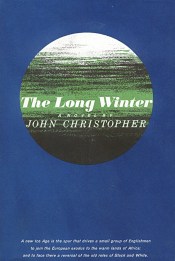
the long winter john christopherThe Long Winter by John Christopher (pseudonym of Samuel Youd) ~ 1962. Alternate British Title: The World in Winter. This edition: Simon & Schuster, 1962. Hardcover. First American edition. Library of Congress #: 62-12411. 253 pages.

My rating: 7.5/10. This fifty-year-old post-apocalyptic novel was much more gripping than I had expected; the premise of a new ice age is chillingly depicted (pun intended). I thought this one was right up there with John Wyndham’s similarly themed works. I started it last night as a casual bedtime dip-into-and-check-it-out read, and I was quickly hooked and soldiered on until well after midnight to finish it, to my slightly groggy detriment today.

Good period piece and a fine example of the vintage speculative fiction genre, though with the expected true-to-the era misogynist attitudes and opinions. This would make an excellent film, in the right hands.

*****

Andrew Leedon rubbed his hands against the antique Victorian muff-heater Madeleine had given him. She had found it in an antique shop and presented it to him on his birthday, along with a supply of the small charcoal by which it was fueled. But even charcoal had become impossible to obtain, and its brief usefulness, after so many years, was almost at an end. He blew through the small holes on the side and watched the red glow brighten. A chair scraped and he turned his attention back to his fellow readers. He felt pity for them, but it was mixed with envy. The future was a current which soon, very soon now, must drag them down into the maelstrom; for the moment they bobbed like corks in this eddying backwater, but the deep tug of the undersurge was there and none would escape it. Yet they were indifferent. The red-eyed, gray-haired man across the aisle with his pile of volumes on King Arthur – he had always been there, in the same place, with the same books. When the end came to him, in however strange and incalculable a form, it would be irrelevant, as irrelevant as the pneumonia or heart attack or cancer which would otherwise have rendered his seat vacant. Soon all the seats would be vacant together until, as must happen, marauders broke in to rip up the wood and carry away the books that were left for fuel. Some of the rarest books had already gone, to the libraries in Cairo and Accra, in Lagos and Johannesburg, and more would go in the next few weeks; but there would still be enough to draw the mob. The people reading here were not so foolish as to expect a reprieve – for the library of for themselves. It was that he envied.

The main lights were off, conserving electricity. There were only the small reading lights, and, high up, the grayness that filtered in from outside. He thought of Africa; of sunshine, long beaches by a blue ocean, the green of trees and grass …

In the middle of the 20th Century a worldwide environmental catastrophe is occurring: the sun’s radiation is decreasing, and a new ice age is looming in the temperate zones. British television producer Andrew Leedon, happily married with a lovely wife and two young sons, catches a glimmer of the story as it first starts to break, but he, along with everyone else, pays little attention. Even if the predictions are correct, what would a degree or two difference in temperature really mean? Surely nothing to worry about; winters in England might even be more traditionally enjoyable again; skating on the Thames would make a pleasant Christmas diversion…

As the true impact of the swift and ever more severe solar cooling begins to be felt, Andrew’s marriage echoes the collapse of his planet’s future. His wife confesses that she has been continuously unfaithful since the first days of their marriage and is now leaving him for his good friend David Cartwell; as a consolation prize Andrew is thrown together with David’s discarded wife, the gentle Madeleine.

Those fortunate enough to have been able to plan ahead and liquidate their assets are moving towards the equatorial regions; Andrew’s now-estranged wife and sons leave for Nigeria without his initial knowledge. Stubbornly refusing to flee in his turn, Andrew is finally convinced to leave by Madeleine, and with David’s assistance the two obtain seats on one of the last air flights out of England. David himself remains behind, counting on his high position in the government to enable his escape if and when it becomes necessary. But for now he intends to stay and see England through this crisis to the best of his considerable ability.

In Africa, Andrew and Madeleine find themselves immersed in a society very different from that which they know. White-skinned Europeans and Britons are the new working class; their currency is worthless, their academic and professional qualifications ignored. Serving the ruling class Nigerians in the former British colony, the whites scrub toilets and wait tables and prostitute themselves to pick up enough money to eke out a precarious existence. Andrew and Madeleine settle into one of the worst of the slums, until a chance encounter with an African student whom Andrew had patronizingly but kindly treated to a dinner at his club back in the old days in London elevates him socially and professionally by making him a personal assistant.

This turn-about relationship leads to a morally challenging situation, when Andrew is asked to join a Nigerian military expedition force planned to explore England by Hovercraft, to assess the possibility of re-colonizing that now nearly abandoned territory under an African flag.

The first part of this post-apocalyptic tale is, in my opinion, the best-written, where Andrew struggles with the ethics and morality of his own behaviour in this unprecedented crisis, and keenly observes the reactions of those around him. As the novel progresses, and as the conditions in the frozen lands worsen, to martial law, brutal violence by the few elites with guns against the many without, and survival of the fittest by any means, including cannibalism, the story becomes much more intellectually shallow and far distant from the complex inner musings of the earlier days. To be fair, this might echo the increasing callousness of the strong as they jettison their finer feelings to ensure their own continued survival; ethics are a luxury no one can afford to indulge in any more.

The racial situation of blacks versus whites and their role reversals is cleverly presented; the tone remains “white” racially superior though, as the Africans ultimately are undone by their own “inborn” weaknesses, at least in the eyes of the staunchly patriotic Britons defending their frozen homeland.

This is indeed a very British book; the author assumes a strong familiarity with English landmarks and history, and knowledge of London neighbourhoods and architectural and physical features. The narration itself is very stiff-upper-lip, in the best stereotypical tradition.

I thought that Andrew lost some of his credibility as a character towards the latter part of the book; his continual fixation on his personal life while the world itself is crashing down around him strikes a false note.

Or does it? How would you react? Would you focus ever more inward, or would you harden your soul to pursue sheer survival over sentiment?

The ending of this epic is left open and vaguely optimistic, but though we may speculate on Andrew’s future, we are not at all assured that he will even survive, let alone thrive, in the changed world he is struggling to adapt to.

*****

John Christopher was the pseudonym of the late (1922-2012) prolific sci fi and speculative fiction writer Samuel Youd. His best-known works are perhaps the teen/young adult “Tripod Trilogy” concerning an alien invasion of Earth: The White Mountains (1967), The City of Gold and Lead (1968), and The Pool of Fire (1968). I read all three of these some years ago, and though I felt that they were often technically over-simplistic, they were emotionally gripping, thought-provoking and generally memorable.

This is an author worth investigating for the frequent excellence of his creative ideas and his sober examination of human emotional motivations, though his writing can be occasionally uneven, varying in quality even within the same book.

If you are a John Wyndham fan, you will find much to enjoy in John Christopher’s stories. In that case, recommended.

A note: The Long Winter was intended as an adult novel, even though this writer also wrote widely for teens.

Read Full Post »

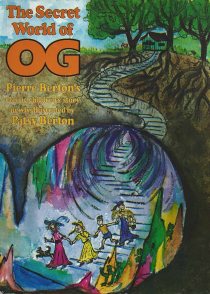
The Secret World of Og by Pierre Berton ~ 1961. This edition: McClelland & Stewart, 1984. Softcover. Illustrated by Patsy Berton. ISBN: 0-7710-1386-8. 159 pages.secret world of og cover pierre berton 001

My rating: 6/10. It has its moments, hence the rather generous “6” rating, but I’ve been exposed to Og three times now and I’m still not a complete convert. Sorry, Pierre. And Patsy. This one is a cute Berton family in-joke, and I appreciate your sharing it with the country at large, but my personal enthusiasm for Og and its viridian denizens remains restrained.

*****

My first exposure to this Canadian children’s “classic” was back in the early 1970s, when a keen grade school teacher read it out loud to our class over a series of afternoon reading breaks.

This tweaks my memory – does anyone else from B.C. remember those after-lunch U.S.S.R. periods – Uninterrupted Sustained Silent Reading? Occasionally these would morph into read-aloud sessions, to the great joy of most of the students in the class, except for those few of us hardcore bookworms who would really have preferred to be left alone to focus openly and with official permission on our own reading choices.

I even remember the book I was sneakily perusing as the teacher read Og. I was deeply engrossed in Jade by Sally Watson – an absolutely marvellous book about an upper-class teenage girl who ends up crewing on a pirate ship, with a desperately swoony captain <ah, sigh>  – a saga which I remember with great fondness and which I always meant to track down for sentimental reasons and to share with my own daughter, but which I haven’t yet gotten my adult hands on. Gosh, Sally Watson was (is! – now in her eighties, she’s still writing away, last time I heard) a wonderful writer. But I totally digress. Back to Mr. Berton’s fantasy-land.

I caught bits and pieces of Og but nothing that made me close my own book and listen with great attention. Little green people in a tunnel. And some dead rabbits. That’s about all that stuck.

Years later, as a mother gleefully equipping a children’s library for my own book-loving youngsters, The Secret World of Og kept showing up on all the “best books to share with your Canadian kids” lists I came across. “Well, why not?” I thought. “So many recommendations can’t be wrong.” So Og was duly acquired, in the great big edition illustrated profusely and with more enthusiasm than finesse (Camberwell Art School regardless) by Pierre Berton’s now grown up daughter Patsy.

secret world of og pierre patsy berton 001

Our own attempted Og read-aloud session died an early death, as the book was replaced after only an evening or two by Kipling’s Just So Stories, which were a much greater hit with the listeners. Og was soon buried in the stacks, and eventually packed away out of sight. I found it again just last week when I was nostalgically going through boxes of children’s artwork and old lesson papers, preparatory to discarding most of them. Og was a the very bottom of a pile of Grade 3 math worksheets, which was quite a few years ago now. We hadn’t even missed it, or thought about it in the meantime, which is a rather telling state of affairs concerning a book in this household.

“Aha!” I thought. “This will be perfect for the Canadian Reading Challenge! Classic Canadian author, quickie-reading kid’s story – how can I go wrong?”

So, third time lucky, I have finally read The Secret World of Og with my full attention focussed on it, fully prepared, after Captive Reader Claire’s enthusiastic review, to find it at long last quite wonderful myself.

Oh, dear. It wasn’t to be. I liked it well enough, and I can see why others love it, but it still didn’t totally 100% click with me.

I happily admit that I laughed out loud at the best bits: the hilarious Lucy Lawless titles, the marvelous relationship between Paul (the Polliwog), his Pablum, and Earless Osdick the cat, and Yukon King, the small dog who thinks he’s a huge husky. A continually witty commentary comes very obviously straight from Father (our Mr. Berton himself), but I just couldn’t bring myself to much very care for those darned annoying children. And Og itself isn’t a much of a fantasy world, nothing like Alice’s rabbit hole, or the secret rooms of Mary Norton’s Borrowers, both of which seem to have influenced this Berton family fairy tale.

Here’s the story in brief.

The five Berton children – Penny, Pamela, Patsy, Peter, and Paul (aka the Pollywog) – have a playhouse in the woods. One day Pamela looks up from her comic book to see a very small, very sharp saw outlining a trapdoor in the playhouse floor. A small green creature pops up, looks at her, and promptly disappears. Pamela, living in a world of imagination most of the time, and well used to the scornful dismissal of those around her to her observations about unlikely things, neglects to tell anyone about this.

Until, that is, the afternoon when the Polliwog is left alone in the playhouse for a few moments, and vanishes, along with Osdick, into what seems to be thin air. Pamela remembers the trapdoor then, and the siblings manage to worry it open and descend into what turns out to be a tunnel leading underground, to a land surrounding a luminescent river and forests of coloured mushrooms, and populated by hundreds of little green people whose only word appears to be “Og”. Pause for much rambling on about the details of all of this.

The cat is destined for the butcher block; the locals think he is some sort of exotic rabbit, (which quadruped they much love to eat, having discovered the gourmet glories of mushrooms with rabbit sauce); the Polliwog is, as usual, in jail. Needless to say a rescue is effected and everyone returns to the surface in one piece. And that is that.

*****

Some of you might remember the headlines a few years ago, shortly before the revered Pierre Berton’s death at the age of 84 in 2004, when he stated, in a CBC television interview, that he had been recreationally smoking marijuana “since the sixties”. Though he insisted that he didn’t use it when he was “working”, the trippy aspect of the World of Og suddenly looks a little suspicious of something more than mere fatherly imagination!

Okay, okay, I apologize for casting such aspersions. (If you could see me, you’d know that I’m grinning like mad in a conciliatory way right now.) Pierre Berton was awesome; he wrote great books, and by and large was a worthy Canadian literary icon. But you have to kind of wonder… 😉

Some bits of this book are absolutely brilliant; much of it is truly very funny. Give it a look, decide for yourself. Me, maybe I’ll pack it far away again and bring it out to try on the (very much speculative at this point in time) grandchildren. Or maybe not. 🙂

Read Full Post »

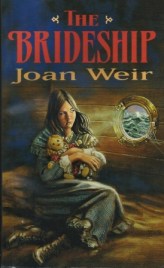
the brideship joan weir 001The Brideship by Joan Weir ~ 1998. This edition: Stoddart, 1998. Paperback. ISBN: 0-7736-7474-8. 218 pages.

My rating: 4.5/10. This one gets a “just missed” from me. It was marred by a seemingly unlikely but at the same time groaningly predictable plot, and a selection of overly stereotyped characters.

I initially questioned the historical accuracy, which didn’t quite ring true to me: a group of teenage girls is apparently sent by the Anglican Church to be prospective brides in the female-starved British Columbia and Vancouver Island colonies in the 1860s. This was indeed correct; I obviously do not know quite as much B.C. history as I like to think I do!

The writing is competent enough but the whole package didn’t do much for me. Some teens may find this an acceptable read, but I would hesitate to recommend it, except for its dramatic focus on a little-known chapter of British Columbia and Cariboo Gold Rush history.

*****

Fifteen-year-old Sarah is an orphan in England in 1862. Uncooperative and outspoken, she is a disruptive presence in the orphanage where she has ended up after the death of her parents and then her uncle, so is recommended with great relief by the orphanage head to join a group of teenage girls who are being sent to the western Canadian gold fields as prospective brides for the miners. This arbitrary emigration is presided over by a (hopefully atypical!) prospective Anglican Church minister, the sinister and vicious Mr. Dubonnet. Sarah’s frail older cousin Maud is also part of the group, as are a number of the usual variety of orphans in this type of fiction, including Lizzie, the cockney ex-pickpocket with a heart of gold, and Arabella, the mean-spirited snooty beauty.

Sarah makes the trip in fine fettle, despite continual run-ins with Mr. Dubonnet and various adventures on board. Poor Maud makes it only as far as the Falkland Islands, before succumbing to her constant cough, as we’ve expected from very early on in the narrative – the girl very obviously has the cloud of doom hanging over her right from the first chapter, with her meek disposition and delicate consitution. The surviving orphans weather the rest of the voyage, which is marked with melodramatic incidents to keep things interesting. They eventually arrive at Vancouver Island, are off-loaded at Esquimalt, and are then shipped up the Cariboo Road to Barkerville.

Sarah refuses to accept her prospective husband, and teams up with Lizzie to start an enterprise of her own as a laundress. Justice in the form of Judge Begbie nails Mr. Dubonnet, true love arrives for Lizzie and Sarah, and everything is looking up as we close the last page.

I was curious as to the verity of the “bride ship” angle, so I did a bit of research, and found that the author did base this tale on true events. See Victoria History – the British Columbia Emigration Society, for a brief discussion.

I’ve included several articles from other sources to balance my not terribly enthusiastic review. The Brideship isn’t a bad book, but compared to other similar works in the genre it is on the lower end of the spectrum, in my one-person’s opinion.

I’ve just been reading Marianne Brandis’ stellar 1830s’ Ontario trilogy of The Tinderbox, The Quarter-Pie Window, and The Sign of the Scales (reviews pending), as well as Suzanne Martel’s The King’s Daughter, following a French fille du roy sailing to Canada from France among a similar shipment of “brides to be” in the 1600s. These other books stand head and shoulders above Weir’s Brideship, at least for this reader, reading like properly engaging novels which just happen to be set in historically important and interesting times versus a packaged up collection of “teachable moments” clothed in stereotype and unlikely melodrama.

*****

In a University of Manitoba author profile, Kamloops, B.C. writer and retired college creative writing instructor Joan Weir talks about some aspects of the process of writing The Brideship.

“Usually when I start, I feel very strongly that, when the whole thing is over, I want to have made some sort of comment that is worth making. (I)n Brideship, I wanted very much to get across the idea for modern kids that, no matter where you find yourself, life’s an adventure and you’ve got to seize the moment and take it and go with and make something out of it… I start with that, and from there I go to character, but I have to know ‘why’ I’m writing the book before I start. I don’t know the ending. I think the ending has to grow out of what happens as your characters suddenly take on a life of their own which is greater than you thought when you started. It’s out of their growth that the ending grows, and very often the ending isn’t what you thought, even in a sort of vague way, that it was going to be at all. It surprised me very much what happened to Lizzie in Brideship. Lizzie becomes almost the strongest character in the book, something I didn’t intend at all when I started. I thought she was going to be very much a secondary character. So many readers, when they talk about Brideship, say, ‘Oh, I really liked Lizzie.’

“In the actual historical story of those girls who came over on the Tynemouth, one girl did die, and I felt committed to put that in because I felt so badly about that poor little orphan, Elizabeth Buchanan, who was buried at sea. Sarah’s cousin, Maud, in Brideship is patterned on Elizabeth. I didn’t dare use Elizabeth’s name because this is fiction, and I didn’t want to get involved in ‘this is true and this isn’t true,’ for Elizabeth didn’t have a cousin with her or someone back in England to marry, as my Maud character does. The Anglican Church organized and sent over three boatloads of girls from orphanages, but the first trip is the only one that there was any sort of information about at all. The conditions were absolutely like I’ve described them in the book. I’ve got an artist’s sketch of the ship which was drawn from pictures on file in the museum. It was a tiny little craft that had over 300 people on it. The girls really were housed down below in the hold compartment with only these little tiny portholes.

“The book’s cover was interesting because often publishers don’t give authors any input at all on covers. Kathryn Cole was wonderful because she sent me sketches of what they wanted to do with the cover which was a picture of Lizzie and Sarah dolled up in Mrs. Worthing’s clothes, with parasols and fancy hats, smiling and tripping around the ship’s deck. When Kathryn asked, ‘What do you think of it?’ I replied, ‘We’ll, it’s a very pretty picture, but I’m afraid that it sets the wrong tone for the book. When you look at it, you’ll think it was a happy journey, and it wasn’t.'” Kathryn then asked Joan for her cover ideas. “‘I would like a picture of Sarah below decks in the storage compartment in which they’re living, looking out that one little porthole. And, if possible I’d like her holding her doll.’ Even though that detail makes Sarah look younger than she is, that doll was the only thing that she owned. I was delighted because the artist did exactly what I wanted. The cover sets the tone, and it was not a happy trip. But, if you’d have had the title Brideship and these girls on the original cover dancing around, you would have thought it was like a Love Boat.

And here is an edited excerpt from the CanLit.ca review of The Brideship.

Four dozen orphans, some of them as young as sixteen, are sent off to the West Coast of Canada on the vague promise that they will find work there. Sarah eagerly volunteers to go; she will do anything to get out of the hated orphanage. An Anglican clergyman has organized the emigration, and this fact alone seems to guarantee that the promised positions will materialize, and that the four dozen girls are in good hands.

Appearances, however, deceive. A few days before their arrival in Canada, the girls find out that “there aren’t as many jobs available” as had originally been thought, and that they are to be “brides instead.” The clergyman, too, is not what he seems: aside from being responsible for deceiving the girls, he is also a thief. He triumphs in the short run, but his dishonesty eventually catches up with him. Sarah, however, never gets to meet the man intended for her. She escapes to Barkerville, sets up a laundry business there, and falls in love with someone she chooses for herself.

The Brideship concentrates more on action than on emotion. Sarah gets somewhat pushed into the background by the question of whether the Anglican Church really did organize shiploads of female orphans under the pretense of getting them positions as governesses, then offering them as brides to the miners working in British Columbia instead. And if, as Weir contends, the answer is “yes,” then one wonders why the author neglects to show some outrage in at least one of the unfortunate “brides.” Not even the heroine expresses any offense at such a monumental deception; she is worried that the husband the clergyman has chosen for her might be a brute, but it does not seem to enter her mind that the clergyman had no right to choose a husband for her in the first place. Although The Brideship has a lot of action, it is short on psychological realism.

Read Full Post »

farewell summer ray bradburyFarewell Summer by Ray Bradbury ~ 2006. This edition: Harper Collins, 2007. Paperback. ISBN: 978-0-06-113155-4. 198 pages.

My rating: 8/10. The old Bradbury magic was still in fine working order, in this the last of his published full-length novels. It is really more of a novella; a sequel of sorts to 1957’s Dandelion Wine, picking up with young protagonist Douglas Spaulding in that famously faraway October of 1929.

It took a few pages to settle into Bradbury’s randomly rambling narrative, but once I found the groove the journey was smooth and honey-sweet.

*****

Doug Spalding is thirteen, and poised rebelliously on the edge of a looming maturity, digging his heels in desperately against the advance of time. The old people of the town (barring Grandmother and Grandfather, exempt from their joining their peers in the minds of Doug and younger brother Tim by reason of long familiarity and familial love) are seen as the enemies of the young; especially the four ancient members of the school board, who plot to steal Youth’s time and force the golden boys and girls into the ranks of the elders in their turn.

A war erupts between Doug and his cohorts, and the staid elders of the town, headed by Mr. Calvin C. Quartermain, eighty-one and hanging on to life with both hands even more fiercely after the sudden death of one of his fellow school board members, triggered (possibly) by the actions of one of the boys. The battle takes on epic proportions (though mostly in their collective minds, young and old alike) and is fought with and amongst chessmen and clock towers and haunted houses, until Doug is unexpectedly undone by that age-old adversary of careless youth, the siren song of love.

The very essence of a magical boyhood is conjured up in Ray Bradbury’s vivid words. Visiting the town’s candy shop to prepare for a sacrificial ceremony, the boys find

… honey … sheathed in warm African chocolate. Plunged and captured in the amber treasure lay fresh Brazil nuts, almonds, and glazed clusters of snowy coconut. June butter and August wheat were clothed in dark sugars. All were crinkled in folded tin foil, then wrapped in red and blue papers that told the weight, ingredients and manufacturer. In bright bouquets the candies lay, caramels to glue the teeth, licorice to blacken the heart, cherry wax bottles filled with sickening mint and strawberry sap, Tootsie Rolls to hold like cigars, red-tipped chalk-mint cigarettes for chill mornings when your breath smoked on the air …(D)iamonds to crunch, fabulous liquors to swig. Persimmon-colored pop bottles swam, clinking softly, in the Nile waters of the refrigerated box, its waters cold enough to cut your skin…

Meanwhile, among the old men, Bleak says to Quartermain:

“You remind me of the perceptive asylum keeper who claimed that his inmates were mad. You’ve only just discovered that boys are animals? … We live in a country of the young. All we can do is wait until some of these sadists hit nineteen, then truck them off to war.  Their crime? Being full up with orange juice and spring rain. Patience. Someday soon you’ll see them wander by with winter in their hair…”

The young and old battle with their various metaphorical and actual weapons and eventually make a truce of sorts, as disguises are penetrated and eyes meet and recognize each other under the superficial masks which time has imposed.

An unusual and beautifully written book, likely best appreciated by those whom, at whatever age, have been brought up short by the stranger’s face in the mirror and the sudden realization that the eyes alone are as remembered.

This writer is often thought of as an author for youth, but I think his older readers will appreciate the true poignancy which lies behind the surface stories. This book is for the already-converted, and for those I will say highly recommended.

New to Ray Bradbury? I’d advise you to perhaps start instead with The Martian Chronicles, or some of the short story collections. You’ll need to adjust your brain to his unique voice and way of thinking to make sense of the kind of coloured crystal envisionings which he occasionally indulged in, and which Farewell Summer is a prime example of.

Read Full Post »

the best thing for you annabel lyon 001The Best Thing for You by Annabel Lyon ~ 2004. This edition: McClelland & Stewart, 2004. Softcover. ISBN: 0-7710-5397-5. 322 pages.

My rating: 10/10

Annabel Lyon is absolutely fearless in where she’s willing to go with these novellas, and there wasn’t a single jarring note anywhere. I am in awe.

I liked this collection in the same way I liked her high-profile Giller and Governor General’s Award nominee, and Rogers Writers’ Trust Fiction Prize winner, 2009’s The Golden Mean – sometimes I was deeply disturbed – and occasionally almost offended – by the images she conjured up, but I never, ever – even briefly – looked away. She kept me fully engaged the whole breathless trip.

This woman can write, people. If you haven’t already, you need to check her out.

Highly recommended.

*****

The Best Thing For You is a collection of three novellas. This is a form which I don’t see used much any more, but in this case it works wonderfully well, allowing an ambitious complexity of content and keeping the pace fast without the inevitable fluctuation in energy which occurs in a longer novel.

All three stories are set in Vancouver, British Columbia, the home of the author. The first two are set in contemporary times and the third is set during the ending days of World War II; the celebration triggered by the announcement of the end of the war plays an important part in the narrative.

Be prepared to pace yourself when reading through this one. Each novella deserves as much attention as a novel would; I found that I stopped cold after each one and only was able to turn my full attention to the next after digesting what I’d read for a few days. I wouldn’t recommend reading these in one fell swoop; I personally would have found that overwhelming. This is a collection that deserves – demands! – the reader’s full attention.

  • No Fun – A conventional enough narrative about a respectable middle class family, mother a doctor, father a university professor, well-adjusted, perfectly normal teenage son in high school. That’s the surface picture. When the son is involved (possibly? probably?) and criminally charged in connection with the brutal beating of a mentally handicapped man, the picture perfect impression dissolves into a dramatically realistic portrait of three people in personal crisis. As the mother of a teen boy myself, this novella (cliché alert!) touched me deeply in a very personal way. It made me smile in recognition, it frequently made me laugh, and it made me feel less alone in my occasional confused dismay at what our beautiful babies evolve into without our maternal permission (damn it anyway!) Lyons gets it so very right; how does she do that? The portrait of a marriage going on behind the issues brought about by the child is exceedingly well drawn as well.
  • The Goldberg Metronome – a young couple find a mysterious package taped to the pipes under the bathroom sink in their newly rented apartment. In it is a midnight blue, broken antique metronome. The story of the metronome’s history interweaves with the stories of the lives of the people it has joined tenuously in a thread of possession, passion, desire and loss. Gorgeous story.
  • The Best Thing For You – The strongest (of a strong three) and most elaborately plotted (of a beautifully complex three) of these novellas. A discontented young married woman involves a teenage delivery boy first in an adulterous affair and then in something much deeper and darker. Another teenager in the periphery of the events becomes deeply involved in a very different way. Cleverly noir, I thought as I read; I was vindicated in this assessment by reading in an interview here that film noir was indeed Lyon’s inspiration for the story:

I like film noir, and was interested in creating a femme fatale who’s both less and more than she seems.  Anna is a black-eyed adulteress who murders her husband for his life insurance, but she’s also bookish and melancholy and doesn’t really enjoy sex with her lover.  She’s also curious.  That’s one of her defining characteristics for me.  She doesn’t want to close her eyes and act as though everything’s all right when clearly–as a young woman with little formal education, no job, and no prospects, who is perceived basically as a sexually precocious child by everyone around her–her life looks quite grim.  She doesn’t want to play along, to pretend.  She wants to confront.

I guess the tone of the novella came about because I was constantly thinking about film.  I tried to keep the action quite external, to start scenes in the middle, to cut, to use dialogue in the slightly stylized manner of movies from the forties, and also to convey a sense of black and white through the prose yet with a complexity of texture that is a hallmark of some of the great movies from that era.

Again, here’s the interview link: Book Clubs. ca. Short, but well worth a read after you’ve enjoyed the collection. It added another dimension to my respect for the depth and general excellence of this author’s work.

Read Full Post »

the daring game kit pearsonThe Daring Game by Kit Pearson ~ 1986. This edition: Puffin(Penguin), 1987. Paperback, ISBN: 0-14-031932-8. 225 pages.

My rating: 6.5/10. Rather pedestrian writing, but a decent “school story” with a strongly depicted Canadian setting. The intended audience would likely be preteen girls.

*****

Eleven-year-old Elizabeth – Eliza – Chapman has always dreamed of going to boarding school. She’s been reading English school stories for years, and thinks that wearing a uniform, living in a dormitory, and eluding Matron while having midnight feasts would be much more exciting than going to her boring old Edmonton day school. Her parents’ transfer to Toronto for a year seems like a grand opportunity to fulfill her dream. After much persuasion, Eliza is enrolled in Vancouver’s Ashdown Academy for her Grade Seven year, and with only a minor bout of homesickness enters into communal life with great enthusiasm.

Her fellow roommates are a widely varied lot: prim and bossy Pam, meek and gentle Jean, friendly Carrie and rambunctious, unpopular Helen. Alternately horrified by and attracted to Helen, Eliza finds herself drawn into a friendship which will have some serious consequences before the year is out. The “Daring Game” of the title is invented by Helen, and though some of the dares are simple enough to carry out, the last one goes very wrong and embroils Eliza in an impossible dilemma: stand up for a friend, or tell strict the Headmistress, Miss Tavistock, what is going on.

This was B.C. librarian and veteran kidlit author Kit Pearson’s first novel, and was inspired by her own teenage years at a Vancouver private school. It’s a decent enough middle grade novel, though my own daughter set it aside after the first chapter when I brought it home for her to read during her own Grade Seven year. I read it then and wasn’t terribly enthralled either, and this second reading for the purposes of writing this review (and possibly culling the book from our shelves) hasn’t really changed my mind.

Published in 1986, but set in 1964, The Daring Game attempts to reflect the scene of twenty years earlier, and though all the references are indeed correct, perhaps not enough time had passed to make it truly interesting from a historical point of view. The characters and the situations are competently presented, but this novel remained, to my mind, rather unexceptional from first page to last. Eliza goes through all the motions, but at the end of the story I found I was more than ready to bit her an easy farewell with nary a thought about what was to come next for her.

Kit Pearson has gone on to write a number of other well-regarded juvenile novels, including  the “Guests of War” trilogy involving British children sent to Canada during World War II: The Sky is Falling, Looking at the Moon, and The Lights Go On Again, which I’ve dipped into but not read in their entirety, and a time travel story, Awake and Dreaming, which I read and enjoyed. She’s an author worth keeping in mind if you have middle grade readers looking for something with strong Canadian content and thoughtfully (but not graphically depicted) challenging situations.

While I’m not tremendously enthusiastic about The Daring Game, I will give it a mild “okay”. Worth a try; might be just what your own young reader is looking for. I’m not quite ready to pitch it yet – see why our shelves are groaning! – but will try to read a few other titles by this author before deciding if she’s indeed a general “keeper”. The B.C. connection makes it hard to be heartless, though Pearson’s titles are abundant in local libraries and bookstores, and should be easy to find for the forseeable future even if I relinquish ownership of my personal copies.

Read Full Post »

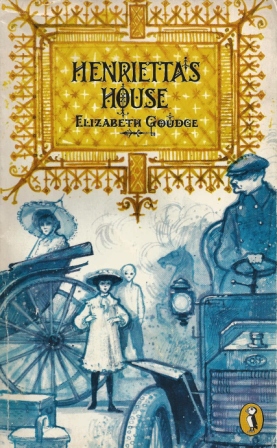
henrietta's house elizabeth goudge 001Henrietta’s House by Elizabeth Goudge ~ 1942Alternate American title: The Blue Hills. This edition: Puffin (Penguin), 1972. Illustrated by Anthony Maitland. Paperback. ISBN: 0-1403.0520-3. 191 pages.

My rating: 8.5/10. I’ve been playing amidst the juvenilia these past few days, and last night settled in to read this much-anticipated slender story. No surprises here, but no disappointments, either. Elizabeth Goudge lets herself go in full imaginative flight in this gentle and beautifully written juvenile adventure/fairy tale/moralistic tale.

Contains elements of her other two better-known juveniles, The Little White Horse, and especially Linnets and Valerians. Best approached with a willingness to surrender disbelief and just go with it! The usual Goudge theological and philosophical debate is present, but in this case makes more sense and is easier to digest than in some of her other books; two statues/church carvings, a laughing imp and a crying child, appear and reappear as analogies to the “mockery of Providence and the cringing human soul”, which sounds rather deep but which makes complete sense as one works one’s way through this multi-layered story.

This is a less common Goudge title, and I went to some trouble to acquire it. I suspect it is much more abundant in British used bookshops and libraries; used paperback copies on ABE start at $20 (with shipping) and hardcovers climb steeply into the $60s and $70s.

A must-read for the Goudge collector; one to share with a bookish child who is open to a good old-fashioned story. The fictional children are gloriously real, all expected flaws and faults fully present, though they are supremely fortunate in the adults in their lives!

This edition has extremely well drawn pen-and-ink illustrations by Anthony Maitland; I’d love to find this in a larger hardcover one day.

*****

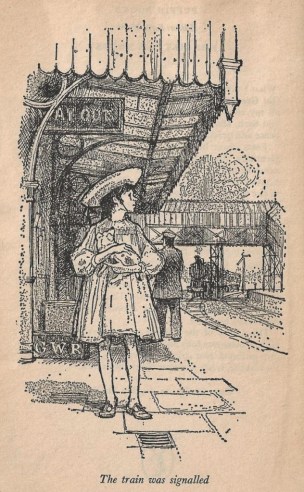
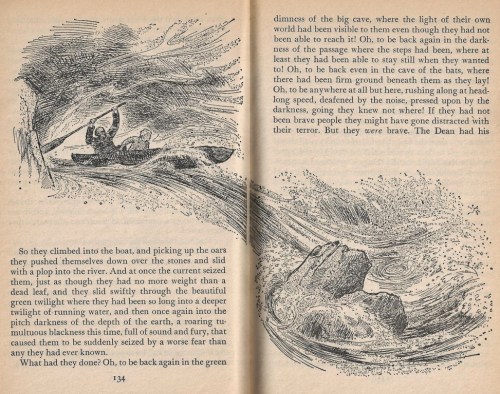
henrietta's house elizabeth goudge 5 001Young Henrietta, first introduced in The City of Bells as a poet’s daughter living with her adopted family in the cathedral city of Torminster – her father is alive and well, but is off roaming the world unencumbered by such prosaic details such as the housing, feeding and clothing of his offspring – is waiting on the railway platform for her beloved companion, Hugh Anthony, to return from his first term at boarding school.

Hugh`s birthday is impending, and a gala rural picnic is planned; what happens on the way to the picnic is told, in vivid detail, in this novel.

The birthday party leaves Torminster in five different equipages, and due to their varying rates of speed, soon lose sight of each other. Only one arrives at the designated rendezvous; the other four parties take the long way round and have some strange adventures before everyone finds each other in a completely unplanned-for common destination. Several extra guests add an unexpected dimension.

And that’s all I’m going to tell you, as the details of the adventures and the reference of the title are best discovered by the reader. Because this is, as the author declares at the close, a fairy tale, everything works out perfectly and a happy ending for all is assured.

Elizabeth Goudge is not for everyone, but if you’ve been exposed and find that she has “taken”, you will appreciate this slightly fantastical outing. A prior acquaintance with the characters (who also appear in The City of Bells and The Sister of the Angels) will add to your appreciation, but is not at all necessary; the story works beautifully as a stand-alone as well.henrietta's house elizabeth goudge 1 001

*****

I am here including a slightly edited review of Henrietta’s House from the Elizabeth Goudge Society website, which gives some background information on the author and the inspiration for the book. This is best read after reading the novel, so the references will make sense.

The dedication reads: ” For Dorothy Pope. There were once two little girls, and one had fair hair and lived in the Cathedral Close of Torminster and the other had dark hair and lived in the Blue Hills above the city, and they were friends. And now that they are grown up they are still friends, and the one who lived in Torminster dedicates this book to the one who lived in the Blue Hills, because it was she who saw the White Fishes in the cave. ”

The fair-haired child who lived in the city is obviously Elizabeth herself, and her friend Dorothy the template for Henrietta. I find it comforting to think that they remained in contact throughout their lives. It is an indication of Elizabeth’s loyalty and commitment. Elizabeth herself says that she never revisited any of the places she lived in because she wanted to remember them how they had been and not how they had become. So perhaps they corresponded with each other as she did with so many friends and admirers, a habit inherited from her Father.

It is a gentle story, a sequel to Sister of Angels and City of Bells, a tapestry woven with words around the charm of an Edwardian summer, when, as Elizabeth says “this story is set at the beginning of the present century, and in those days the world was often silent and sleepy, and not the bustling, noisy place that it is today.” (She is of course referring to the 20th century and not the 21st.)

In 1941 as the story was being written, British troops were fighting in the desert against Rommel, the Germans were taking on the might of Russia and the Americans were about to enter the war after the massacre at Pearl Harbour. A gloomy time, with no end of the war in sight and on the home front the introduction of clothes rationing. What better place and time to escape to than the opulence of Wells in a time before either World Wars had blighted her generation’s life.

The story starts with Henrietta waiting on the platform for Hugh Anthony to return for the holidays from boarding school ending their first separation from each other, and chronicles the delights of a summer in the countryside surrounding the tiny city where Elizabeth lived out the first few years of her life.

It contains many of her childhood memories from the way that hat elastic hurts the chin, to stately picnics in the hills. The story is as pedestrian as the procession of carts that convey the party to the picnic, and therein lies its charm. We are not hurried on to the next piece of drama, but have time to observe that “(t)he canterbury bells, and sweet williams, the roses and the sweet peas, the delphiniums and the syringa were a blaze of colour and scent in the gardens and all the birds were singing.”

Hills for Elizabeth were, as for so many of us, a place of heightened spirituality. They house the gods, myths and legends. They are the place of the solitary, the Hermit, the Wise Man. We ascend above the valleys and plains of every day life and looking back and down are able to see the bigger picture, to view where we have come from and how far we have travelled to get here: “Looking back he could see the great grey rock of the Cathedral and the old twisted roofs of Torminster, dwarfed by distance into a toy town that a child might have played with, and looking ahead, far up against the sky, he could see the blue hills growing in power and might as they drew nearer to them. He felt for a moment gripped between the grey rock of the Cathedral and the grandeur of the hills, two mighty things that time did not touch.”

All of the people invited on Hugh Anthony’s birthday picnic end up getting “lost”.  None of them with the exception of Grandmother’s party arrive at their preordained destination. But all of them are enriched by their experiences, they all attain something vital to their well-being, even if, like the Dean, they didn’t at first know that this was necessary.

henrietta's house elizabeth goudge 2 001

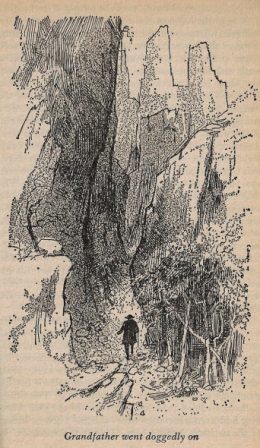
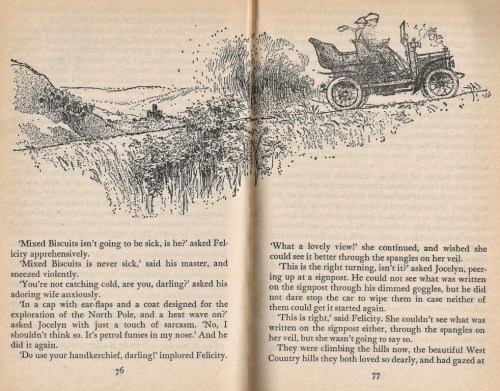
The Dean recaptures his innocence and love of his fellow man, Hugh Anthony loses some of his pride and arrogance. Grandfather rescues another soul in distress, Jocelyn and Felicity lose their car and find fairy land, and Henrietta, well – Henrietta finds her heart’s desire.

The strange figures sitting on top of the gateposts are explained as they come from the Cathedral at Wells and must have captured the young Elizabeth’s imagination. The explanation of their meaning given in the story by Henrietta’s Grandfather sounds as if it had originally been told to Elizabeth by her father. “Replicas of those two figures in the chantry in the south choir aisle … the cringing human soul and the mockery of Providence.” Elizabeth herself was to call her future Devonshire home Providence Cottage, so the Symbology obviously stuck with her.

I thought at first that the caves Elizabeth writes about so vividly were the ones at Wookey Hole, especially as the Old Man in the ruined house could have been a metaphor for the Witch of Wookey. with his wax figurines and pins. But there are no recorded sightings of cave fish in Wookey, and the caves themselves weren’t open to the public in the time that Elizabeth lived here.

henrietta's house elizabeth goudge 3 001

Cheddar gorge however is close and one of the caves there is actually called the Cathedral cave for its stunning similarity to a cathedral interior. I love the idea of being able to look up inside rabbit burrows and see the rabbits looking back at you in astonishment, a picture an imaginative child would conjure up. Cheddar too has its underground river complete with little rowing boat, its vast system of unseen caves riddling the Mendip hills like a honeycomb.

I have been unable to find the fish, all sources telling me that the lead content in the water, (the hills have been mined for lead since before the Romans arrived,) is too high for fish to survive. So maybe, the fish were flashes of light reflected back by a carried lamp, a code between friends for a shared magical experience. But I like to think the girls saw them on that long ago Edwardian afternoon. “Look!” cried Hugh Anthony excitedly, kneeling beside the still, inky pool, “There are white fishes here. Quite white. Like Ghosts.” The Dean put his oil lamp on the ground and knelt beside him and together they watched fascinated as the strange white shapes swam round and round in the black water, their ghostly bodies rippling back and forth as though they were weaving some never-ending pattern upon the black loom of the water.”

The story was written at a time when the bells of all the churches and cathedrals of England were silenced, only to be rung in a time of national emergency. They were to signal the devastating news that we had been invaded by Germany. How people must have dreaded the thought of hearing them ring. It would have been an especial sadness for Elizabeth, whose life so far had been lived and to a large extent regulated by the bells of the cathedrals her father worked in. No wonder she wanted to transport herself and her readership back to a time of innocence, when the bells would have rung out for worship and celebration as they were intended to be.

Read Full Post »

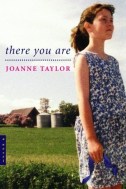
Tthere you are joanne taylorhere You Are by Joanne Taylor ~ 2004. This edition: Tundra Books, 2004. Softcover. ISBN: 0-88776-658-7. 199 pages.

My rating: 4.5/10. Well researched and competently written, but missing that special spark.

*****

Almost-twelve-year-old Jeannie Shaw lives with her family in the Margaree Valley of Cape Breton, Nova Scotia in 1952. School is about to start, and this year Jeannie hopes and prays that there will be a friend for her, another girl who she can walk with and talk with, share secrets and dreams with; someone to heal the deep loneliness that Jeannie has had for far too long.

There are several other girls at Jeannie’s small rural school, but they are a grade older and as far as they are concerned that year or two might well be a century. Word is out that a new family has arrived, with a child Jeannie’s age; but to her dismay the longed for girl turns out to be just another boy.

Jeannie and Cap Parker get off very much on the wrong foot together, a situation made worse by their sharing of the same desk in school. And things at home aren’t going well either. Jeannie’s pesky four-year-old sister Pearl is always getting into her things, and their pregnant mother merely pleads for peace and quiet rather than administering any sort of punishment to Pearl.

When Pearl and her small friend Ella disappear while being in Jeannie’s care, she reluctantly finds herself grateful for Cap’s quick wits and good nature in dealing with the days of uncertainty which follow.

While this was a book which tried really hard, it just never really got off the ground for me. The characters were one-dimensional and predictable in all of their thoughts and actions. A certain success was achieved in the description of the time and setting: 1952 in a peaceful, beautiful, rural Cape Breton Valley. Little historical snippets are distributed throughout.  A few horses still share the roads with cars in this peacefully backwoods part of the world; Cap’s father died in World War II, and Jeannie’s father is a returned veteran; the polio epidemic is widely known and deeply dreaded, and is a key part of an incompletely developed plot twist.

There is not enough historical content to make this a proper historical fiction, or enough character development to make this a satisfactory personality-driven novel; the climax is artificially sustained and unrealistically resolved. A very cookie cutter story, imposed on a potentially unique setting.

This is not so much a bad juvenile novel as it is a disappointing one, at least to this reader. I felt it was missing that elusive spark which truly brings a story to life.

This appears to be a minority opinion. There You Are was nominated for the Canadian Library Association’s Children’s Book of the Year Award for 2005, and was a finalist for the 2005/2006 Hackmatack Award, an Atlantic Canadian “Children’s Choice” award.

An acceptable story for the target audience of eight to twelve suggested by the publisher’s promotional blurb, but not recommended by me with any sort of enthusiasm, though Jeannie’s situation will likely garner some sympathy from younger, less critical readers.

Purchased at a recent library book sale, and going back into circulation to try for another home; it’s just been placed gently in the giveaway box.

Read Full Post »

the cutters bess streeter aldrichThe Cutters by Bess Streeter Aldrich ~ 1922. This edition: Grosset & Dunlap, 1926. Hardcover. 276 pages.

My rating: 7.5/10

This novel bookends Mother Mason; both are episodic individual and family portraits; I read them back to back and there were decided similarities of style and content, though each book has enough variation to keep things fresh.

I rated Mother Mason higher; though The Cutters is a charming read as well. However, in this novel, the morals in the little stories within are laid on with a much broader brush.

Motherhood, Home, Family – yes – we understand their importance, dear author, to the fabric of a happy nation, but the insistence that these are the only things which bring fulfillment to a womanly heart jars a bit with our modern-day emancipated female reality!

A tiny bit preachy, and very much a period piece; most obvious perhaps in the chapter on alternative ways of child discipline which ends with the family’s mother soundly thrashing her two naughty sons, with the author’s blatant assumption that this will meet with her readers’ full approval!

*****

This novel depicts a short period in the life of the Cutter family of the fictional small town of Meadows in an unspecified mid-western U.S. state. Father Ed, a successful lawyer; Nell, a busy hausfrau; 12-year-old Josephine; Craig and Nicolas, 7 and 9; baby Leonard; and mild matriarch Grandma Cutter make up the seven points of the Cutter family star.

The time is the early years of the 1920s; the shadows of the coming Depression are faint but ominously lurking. The Cutters struggle financially, and much of Nell’s part of the narrative is driven by her wistful yearnings for things which she can’t quite afford. Her husband teases her with a running joke about champagne tastes on a beer budget; Nell inwardly bristles while admitting to herself that this is indeed one of her personal Waterloos.

The incidents which make up the book are mild and domestically based for the most part. A wealthy client and his wife come to stay for  a few days, throwing the Cutter household into turmoil top to bottom; The Woman’s Club invites a speaker on “Perfect Parenthood, or Trained Motherhood”, whose ideas Nell tries to emulate with less than stellar success; a decision to take a family “dream vacation” reveals some surprising preferences; Josephine’s schoolgirl crush disrupts her young world; Nell’s ambitions for a newer, better, bigger house look like they will finally be realized; Grandma Cutter looks forward to a reunion with all of her far-flung sons; Nell enters a contest to try to win some “easy money”.

Likeable characters; relatable situations, a lot of humour and some very wise words coming from unexpected quarters – Aldrich is truly in fine form here. She bobbles a bit with the last chapter, which jumps ahead several years to the time of Josephine’s wedding, and hurriedly fills us in on how everyone else is turning out. Aldrich didn’t need to do that; she could have left us in the here and now, and it would have been just fine, but I suspect she couldn’t quite resist tidying things up.

Though not quite up to its predecessor, Mother Mason, The Cutters is an ideal nostalgic comfort read. I liked it a lot.

Read Full Post »

« Newer Posts - Older Posts »