Archive for the ‘Read in 2012’ Category

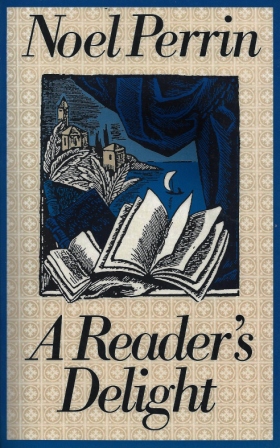
A Reader’s Delight by Noel Perrin ~ 1988. This edition: University Press of New England, 1988. Softcover. ISBN: 0-87451-432-0. 208 pages.
My rating: 10/10

I hold the late Noel Perrin (1927-2004) in very high regard ever since reading several of his thoughtful essay collections (First Person Rural, Second Person Rural) some years ago.

A Reader’s Delight is a high-spirited, and – dare I say – playful collection of writings about literature and the pleasures of reading. Perrin turns his attention to under-appreciated literary gems, or, as he terms them, “possible classics”. His criteria: books published more than (roughly) fifteen years earlier (that is, prior to 1973), and books which no more than two or three of his colleagues had read. (Perrin was a highly respected Professor of English at Dartmouth University, as well as a book reviewer and columnist with the Washington Post.)

Perrin enthusiastically promotes forty books (actually thirty-eight books and two poems),  which he thought deserved greater circulation. His essays are passionate, most often humorous, and exceptionally convincing. A true joy to read all on their own,  with promise of future reading pleasure if one can track these titles down. Some will definitely entail a “quest”, while others are still in general circulation and relatively easily found.

I greatly enjoyed and highly recommend this essay collection. I had already read and appreciated a few of the titles on the list but most were unknown to me. I will be seeking many of these out, or at least keeping them in mind while used-book searching in the future.

Here are the books Perrin recommends, with his essay titles in quotation marks:

  • Indian Summer by William Dean Howells, 1886. “A Nearly Perfect Comedy.”
  • The Valleys of the Assassins by Freya Stark, 1934. “To Awaken Quite Alone.”
  • Kai Lung’s Golden Hours by Ernest Bramah, 1922. “A Thousand and One Chinese Nights.”
  • The Bottom of the Harbour by Joseph Mitchell, 1960. “A Kind of Writing for Which No Name Exists.”
  • The Journal of a Disappointed Man by W.N.P. Barbellion, 1919. “A Book That Could Cure Suicide.”
  • Watch the North Wind Rise by Robert Graves, 1949. “A Future Ruled by Magic.”
  • Fables in Slang by George Ade, 1899 “The Fables of George Ade.”
  • On Love by Stendhal, 1822. “Falling in Love with Stendhal.”
  • Period Piece by Gwen Raverat, 1953. “Moving in Eccentric Circles.”
  • Poem: “The Exequy” by Henry King, 1624. “Lament For a Young Wife.”
  • Wild Animals I Have Known by Ernest Thompson Seton, 1898. “Thinking Rabbits and Talking Crows.”
  • All Hallows Eve by Charles Williams, 1944. “Taking Ghosts Seriously.”
  • Roman Wall by Bryher, 1954. “The Decline and Fall of Switzerland.”
  • Democracy by Henry Adams, 1880. “Gulliver Goes to Washington.”
  • The Blessing of Pan byLord Dunsany, 1928. “Lords and Pagans.”
  • Guard of Honor by James Gould Cozzens, 1948. “The Best American Novel about World War II.”
  • The Semi-Attached Couple by Emily Eden, 1860. “After Jane Austen, Who?”
  • The Diary of George Templeton Strong edited by Allan Nevins and Milton Thomas, 1952. “America’s Greatest Diarist.”
  • The Walls Came Tumbling Down by Henriette Roosenburg, 1957. “The Night-and-Fog People.”
  • The Silver Stallion by James Branch Cabell, 1926. “Irreverence in the Year 1239.
  • The Maker of Heavenly Trousers by Daniele Varé, 1935. “A Tale of Many Virtues.”
  • Many Cargoes by W.W. Jacobs, 1896. “Sailing to London.”
  • Riding the Rails by Michael Mathers, 1973. “Men in Boxcars.”
  • The Best of Friends: Further Letters to Sydney Carlyle Cockerell edited by Viola Meynell, 1956. “A Man of Many Letters.”
  • A Fine and Private Place by Peter S. Beagle, 1960. “Love, Longing and Death.”
  • Poem: “Church Going” by Phillip Larkin, 1955. “Phillip Larkin’s Greatest Poem.”
  • The Three Royal Monkeys by Walter de la Mare, 1910. “Quest of the Mulla-Mulgars.”
  • When the Snow Comes, They Will Take You Away by Eric Newby, 1971. “Prisoner in Wartime Italy.”
  • Bridgeport Bus by Maureen Howard, 1965. “Ugly Ducklings and Unhappy Swans.”
  • Essays in Idleness by Kenko, 1332. “In Medieval Japan.”
  • The Green Child by Herbert Read, 1935. “A Novel About Nirvana.”
  • A Casual Commentary  by Rose Macaulay, 1925. “In an Offhand Manner.”
  • The Adventures of Jonathan Corncob, Loyal American Refugee by Anonymous, 1787; edited by Noel Perrin, 1979. “Two Hundred One Years Old and Still Impudent: The First Novel about the American Revolution.”
  • Instead of a Letter by Diana Athill, 1962. “Over Forty and Just Beginning: An Englishwoman’s Brilliantly Recorded Life.”
  • Islandia by Austin Tappan Wright, 1942. “The Best of all Imaginary Islands.”
  • They Asked for a Paper by C.S. Lewis, 1962. “A C.S. Lewis Miscellany.”
  • Born to Race by Blanche C. Perrin, 1959. “A Girl, a Horse – and for Once a Good Book.”
  • A Genius in the Family by Hiram P. Maxim, 1936. “A Genius Grows in Brooklyn.”
  • My Father’s Glory and My Mother’s Castle by Marcel Pagnol, 1960. “Huck Finn’s French Counterpart.”
  • Far Rainbow by Arkady and Boris Strugatsky, 1964. “Tanya Must Die.”

And there you have it.

Happy hunting, and happy reading!
Read Full Post »

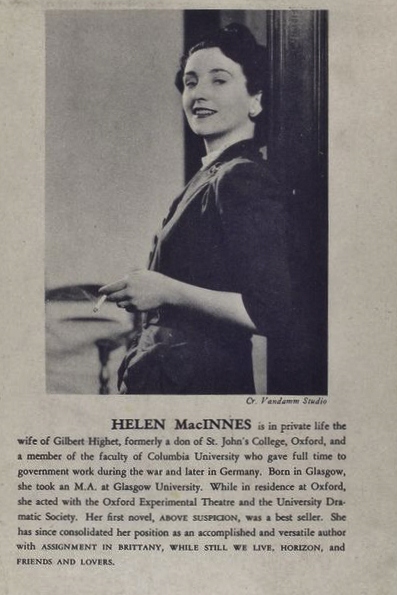
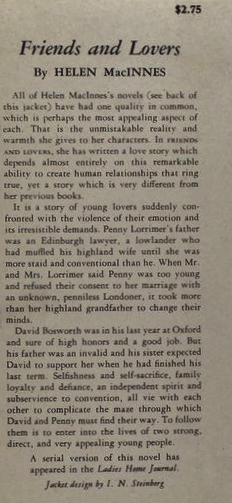
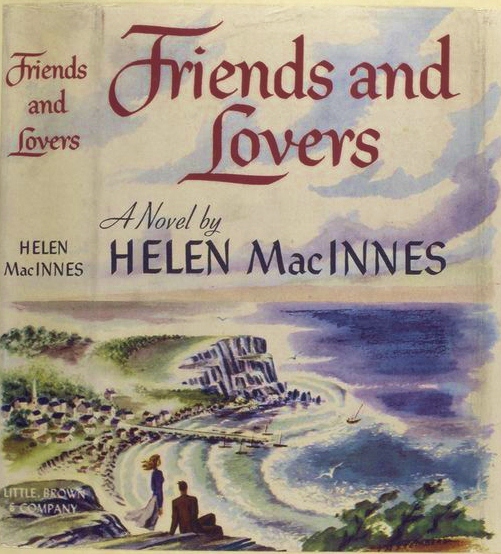
Friends and Lovers by Helen MacInnes ~ 1947. This edition: Little, Brown & Co., 1947. Hardcover. 367 pages.

My rating: 6/10.

*****

I met this author, figuratively speaking, one long, hot teenage summer in the 1970s. With the high school library closed to me and everything else in print in the house already devoured, I was desperate for something new to read. I was half-heartedly digging through boxes of old Reader’s Digests in our sultry attic when I found a stash of  hardcovers packed away in a pile of string-tied cardboard boxes, relics of my mother’s previous life in California before her marriage and relocation to the interior of British Columbia.

Mother was born in 1925, and as a lifelong avid reader collected as many titles as she could with her limited budget as a single “working girl”, a career which spanned almost 20 years before a late-for-the-time marriage at age 36.  A browse through my mother’s collection was a snapshot of middle class bestsellers of the 1950s and 1960s, when my mother did the majority of her book buying. If I made a list of authors I’ve been introduced to through my mother’s personal library, Helen MacInnes would be solidly on there.

Best known for her suspenseful espionage thrillers set in World War II and the Cold War, Helen MacInnes also wrote several romance novels, Friends and Lovers in 1947, and Rest and Be Thankful in 1949. The latter title was one on my mother’s shelf, and I read it and quite enjoyed it in a mild way, so when high school resumed in September and I came across another MacInnes title in our well-stocked school library, Above Suspicion, I added it to my sign-out stack. Already a fan of Eric Ambler and John LeCarre,  the political thriller immediately appealed, and Helen MacInnes was added to my mental  “authors to look out for” list.

Over the years I eventually read most of MacInnes’ titles, with varying degrees of interest and enjoyment. At her best she wrote a gripping, fast-paced, suspenseful story that held my interest well; occasionally I found my attention straying. When I recently came across Friends and Lovers, I picked it up and leafed through it, trying to remember if I had previously encountered it. The title was familiar, but darned if I could remember the storyline – never a good sign! When I started reading, I knew immediately that at some point I had read the book, but I had absolutely no memory of the plot. Was this a spy novel? A romance? A few chapters in I concluded that it was a pure romance, albeit one that attempted to address some larger issues.

David Bosworth is an academically brilliant though financially struggling student entering his last year of studies at Oxford in the early 1930s. In Scotland for the summer, employed as a tutor with a wealthy family, he meets 18-year-old Penelope (Penny) Lorrimer and, rather to his dismay, falls in love at first sight. He had always thought that intellect could govern emotion; his feelings for Penny turn this long-held theory on its head, and, when it becomes apparent that Penny has been similarly smitten, a clandestine relationship ensues.

David is the sole prospective support of a troubled family. His widowed father, seriously injured in the Great War, is a helpless invalid on a small pension. His sister Margaret, who has some talent as a pianist, refuses to take on a paying job to help support her father and herself, as she feels her musical training towards a career as a concert pianist is too important to compromise. David has financed his own university education by attaining a series of scholarships; now with his degree in sight he is agonizing over his future and his family responsibilities. A wife and family of his own have no place in his plans, and Margaret, once she realizes David’s attraction to Penny, is openly resentful of what she sees as a threat to her own future reliance on David’s earning power. David, emotionally fastidious, refuses to entertain the notion of a relationship other than marriage with the woman of his choice; his emotional and sexual frustration are frankly and sympathetically described by MacInnes.

Penny is also faced with family opposition to the relationship. Her well-off, upper-middle-class parents are and suspicious of the designs of a financially struggling university student on their daughter. A romantic entanglement is unthought of; a marriage even more ridiculous to consider – David will obviously be in no position to support a wife of Penny’s background “in the style to which she is accustomed” for quite some years, if ever. The only reason Penny is not out-and-out forbidden to see more of David is that the idea of her seeing anything in him is so ridiculous to her parents that he is dismissed as a momentary indiscretion, not deemed worthy of further notice by Penny as well as themselves.

Penny manages to get to London to study at the Slade Art School; David visits her on his free Sundays and the relationship progresses through its many difficulties to its inevitable conclusion.

Did I like this novel? Yes, and no.

It was very much a period piece in its portrayal of the two main characters. David, to my modern-day sensibilities, is much too chauvinistic and jealous to be admirable; Penny is much too ready to conform to David’s masculine expectations. Stepping back from that knee-jerk reaction to their fictional personalities, I realize it is a bit unfair to judge them by present-day standards. As products of their environment, possibly drawn from real-life characters, (I have read that this may indeed be a semi-autobiographical story, as the two protagonists resemble MacInnes and her husband in many key ways), David and Penny do seem generally believable, if a mite annoying at times, in their stereotypical behaviour.

Their friends and families were never given as much attention in character development throughout as they could have been, a definite flaw in this novel. Things tend to fall into place a little too neatly on occasion; Penny’s throwing off of her family’s protective embrace and her establishment as a gainfully employed London working girl comes out as a bit too pat and good to be true; David is offered opportunity after wonderful opportunity and enjoys a great luxury of choice as to his own working future; one sometimes wonders what all the fuss and angst is about.

A big point in favour is the discussion of attitudes in England towards the Great War veterans. MacInnes lets her very definite political opinions (liberal, anti-fascist) show throughout. The brooding situation of the “Germany problem” is well-portrayed; the story is set in the 1930s but was written and published in the 1940s, so the author’s portrayal of the characters’ apprehensions as to their and their country’s future must certainly have been influenced by the author’s own pre-World War II experiences and thoughts. Overall an interesting glimpse into the time, written by someone who lived what she wrote about.

Absolutely honest personal opinion: One of Helen MacInnes’ weaker novels. I much prefer Rest and Be Thankful, the other of her “pure romances”, which I regularly re-read.  It also discusses the after-effects of war and subsequent political attitudes, and is a stronger, more cohesive story overall with much better character development and a strong vein of humour, something I feel Friends and Lovers generally lacks. Friends and Lovers often feels forced, as if the author were rather abstracted while writing it; given the times it was written in, I will forgive her that but it does show in the final result.

Would I recommend it? Yes, with reservations. I will keep it on my shelves as a re-read, though for far in the future; no hurry! Has merit as a vintage novel, but not a favourite.

Read Full Post »

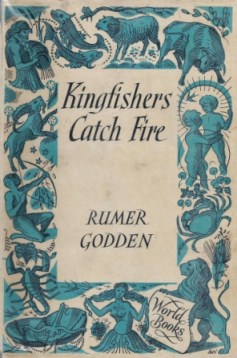
Kingfishers Catch Fire by Rumer Godden ~ 1953. This edition: Reprint Society, 1955. Hardcover. 280 pages.
My rating: 8.5/10.

*****

As kingfishers catch fire, dragonflies draw flame;
As tumbled over rim in roundy wells
Stones ring; like each tucked string tells, each hung bell’s
Bow swung finds tongue to fling out broad its name;
Deals out that being indoors each one dwells;
Selves – goes itself; myself it speaks and spells,
Crying What I do is me: for that I came.


These lines by Gerard Manley Hopkins head the prologue of this disturbing and haunting story.

This vintage Godden novel was new to me. I recently read the first volume of Godden’s autobiography, A Time to Dance, No Time to Weep, and was intrigued by the account of Godden’s three years in retreat in the Kashmir hill country, initially with only her two young daughters and later joined by several other women and children. Kingfishers Catch Fire was inspired by this time, and though the author states that this novel is not autobiographical, many of the incidents are those that Godden herself experienced, living in the actual house Dilkusha, in the Kashmir hills, operating a herb farm and employing the local people in the enterprise.

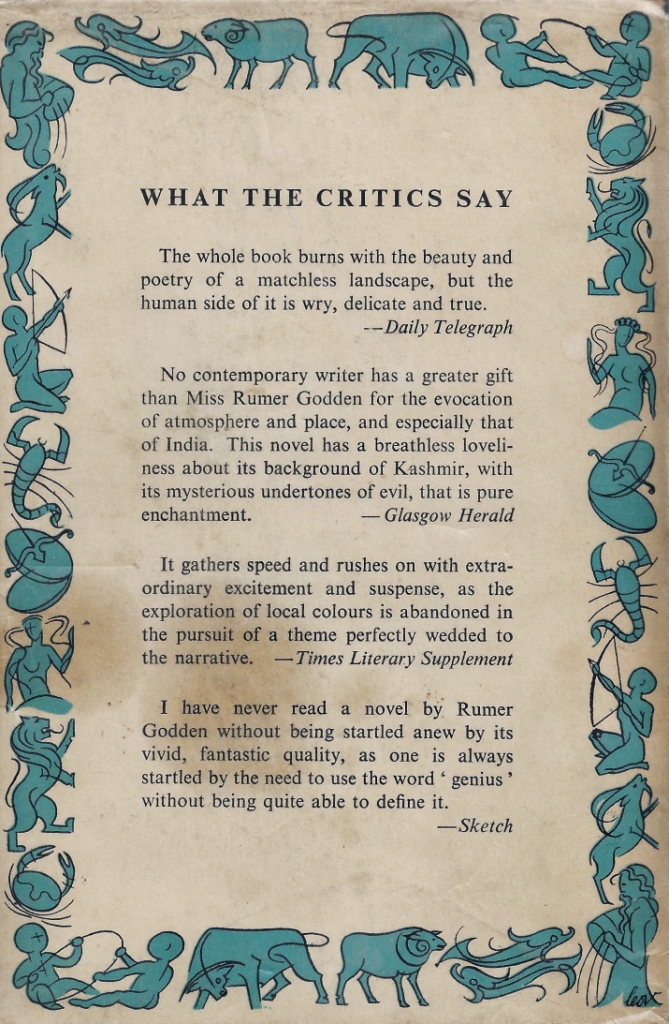
In one of those satisfying occurrences of bookish serendipity, soon after I expressed a desire to find this novel, it came to me all by itself, and in the form I most enjoy – an older hardcover, in its original dust jacket. I had casually ducked into the Salvation Army store to give the book section a quick scan, and had cherry-picked a Rohinton Mistry paperpack (Tales from Firozsha Baag) out from among the mix of ex-bestsellers and inspirational religious books that fill the racks in this particular location. I was turning away to leave when something turquoise-blue and white caught my eye – a promising “older book” dust jacket peeking out from behind the fat paperbacks.  My pulse quickened; after many years of second-hand book searching one seems to develop a sixth sense of when a find is at hand, and this time I was more than right – not only a good book, but  the particular book recently on my mind. I gently pulled it out from the shelf, and there it was, in its gorgeous World Books (Reprint Society) zodiac-themed jacket. About as perfect as it gets!

The story is typical Rumer Godden fare. An Englishwoman living in India (Sophie Barrington-Ward, long separated from her husband and recently widowed) gets herself into an impossible situation, behaves badly, finds redemption and emerges changed for the better; all of the action witnessed and brought into critical focus through the eyes of a child, in this case the Sophie’s young daughter, 8-year-old Teresa. Like a stone thrown into still water, the ripples of each action spread far and touch things on all sides, with unintended and often tragic consequences.

When news of her husband’s death reaches her, Sophie and her two young children are living on a houseboat on the lake at Rawalpindi in the Kashmir region of what would be present-day Pakistan. At first she is conventionally sad but not particularly upset; after all, she has a comfortable private income and her widow’s pension will be coming now as well. She has made a rather unique life for herself where she is, rejecting the British-European social life of the region and instead fraternizing almost exclusively with the locals – the picturesque boatmen, vendors and shopkeepers –  who see in Sophie a well-off patroness who spends generously and lives exclusively to please herself.

Sophie soon finds out that her husband has left huge debts; she manages to settle these but is left impoverished. Rather than returning to England in what she sees as defeat, Sophie ekes out an existence teaching “English to Hindu and Mohammedan ladies and Urdu to English people”.  As the bitter winter goes on, Sophie falls ill and is taken in by the local Mission hospital. When she recovers, she decides to simplify her life even further, to “live local” as a peasant (better a “peasant” than a “poor white”, she tells herself), and moves into a tiny house farther up the mountain.

Sophie’s idea of living like a peasant clashes with the reality of the local population, who are truly poor. Her continual blunders lead to a tragic incident that brings her “simple life” dream crashing down. Her daughter Teresa is a hapless witness to Sophie’s decline into chaos, and is a key player in the climactic ending of the story.

Sophie does wake up from her dream; she does confront her weaknesses; she does at least begin to change, and by the end of the story we have come to view her with a certain admiration if not with whole-hearted affection. Sophie’s initial emotional neglect of Teresa and her younger brother Thomas (“Moo”) is a key factor in making her such an unlikeable protagonist; she is an egotistical reverse-snob who makes snap judgments based on what she’d wish people’s personalities to be, and she sticks firmly to those opinions, even while being repeatedly shown how wrong they are. Sophie’s progression from that person to someone much more unsure of herself is the real drama of the novel.

For a while near the end of the story I thought I was going to be disappointed in my author – it was all coming out a bit too pat – a white knight who has been lurking in the background the whole book reappears to “rescue” Sophie just as she is sorting things out for herself, and Sophie falls into his arms with relief, but Godden ultimately allows Sophie (and Teresa) to walk out of the book with head held high.

An ultimately satisfying story, though not what I would consider a comfort read; the windows it opens into human foolishness and frailty strike close to home, and we are very aware throughout that there is no such thing as a universally happy ending; the most any of us can hope for is reaching some sort of compromise with life, if we are indeed one of the lucky ones.

As always, beautiful descriptions of place; Rumer Godden paints word pictures like no other. The children, Teresa and Moo, are very sympathetically handled; Godden is ever firmly on the side of innocence, though she never hesitates to let her innocents suffer in the interest of moving the narrative along.

This is, in my opinion, one of Godden’s better novels.

Read Full Post »

Something Light by Margery Sharp ~ 1960. This edition: Little, Brown & Co., 1960. Hardcover. No ISBN. 216 pages.

My rating: 10/10.

I love the works of Margery Sharp. No exclamation mark needed, merely a sober statement of fact. I am slowly and with deep pleasure building up a collection of her works. In every “Definition of Happiness” there is included “something to look forward to”; I am therefore a happy woman as I look forward with pure anticipation to sitting down with each hard-won out-of-print title by this most excellent forgotten author.

Luckily Margery Sharp was popular enough in her day that her titles are for the most part reasonably available with a bit of on-line searching, though her first two novels, Rhododendron Pie (1930) and A Fanfare For Tin Trumpets (1932),  fetch rather high prices in the used book world; well into the hundreds of dollars. In the meantime I haunt second-hand bookstores at every opportunity, peering hopefully at the faded titles of scruffy vintage hardcovers in eternal hopefulness. I did find two of her works this way, at the same most-excellent used bookstore in Kamloops, on separate occasions several years apart. I paid the princely sum of $5 each and controlled my great glee with difficulty until I was well away from the store. This also freed me up, as I gloatingly explained later to my slightly skeptical husband,  to be able to shell out for several of her other works at much higher prices, because then they all averaged out, and each one of the others wasn’t so ridiculously expensive, etcetera, etcetera.

But I digress.

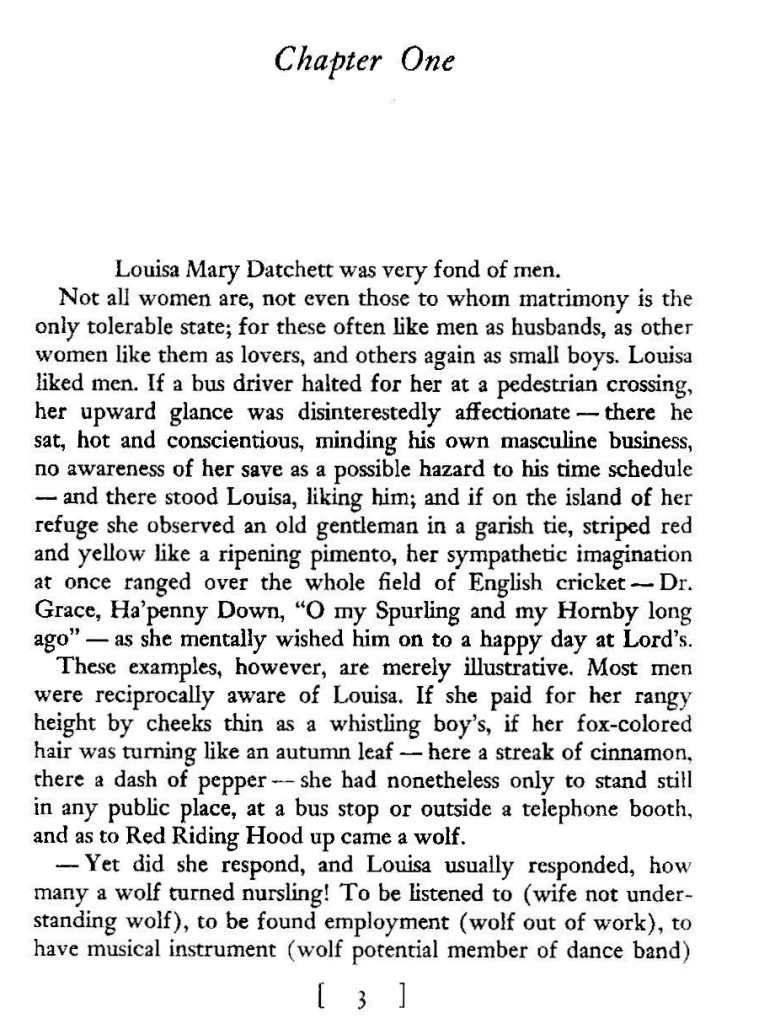
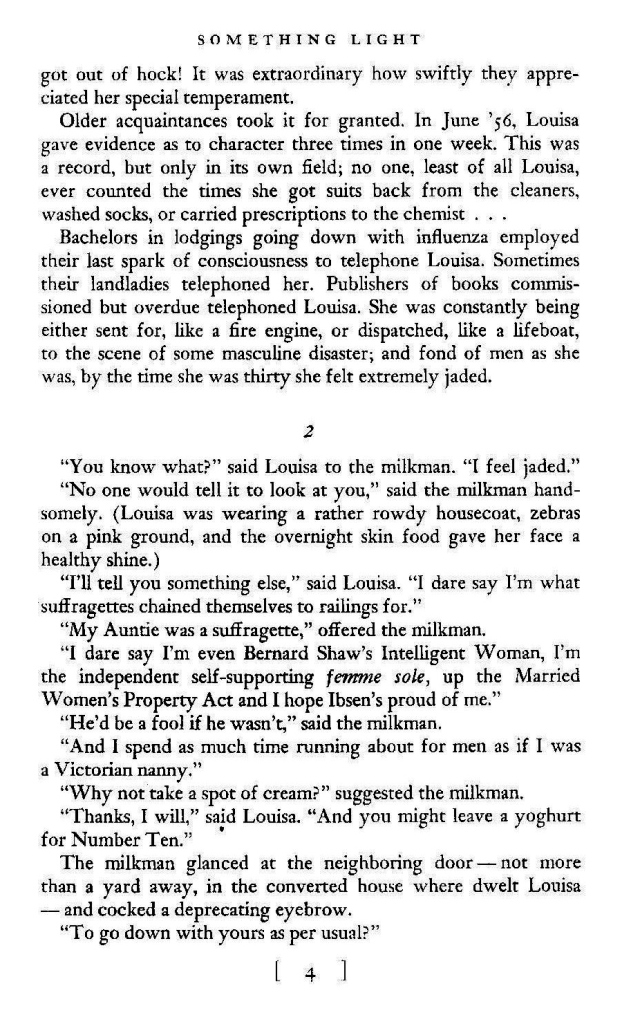
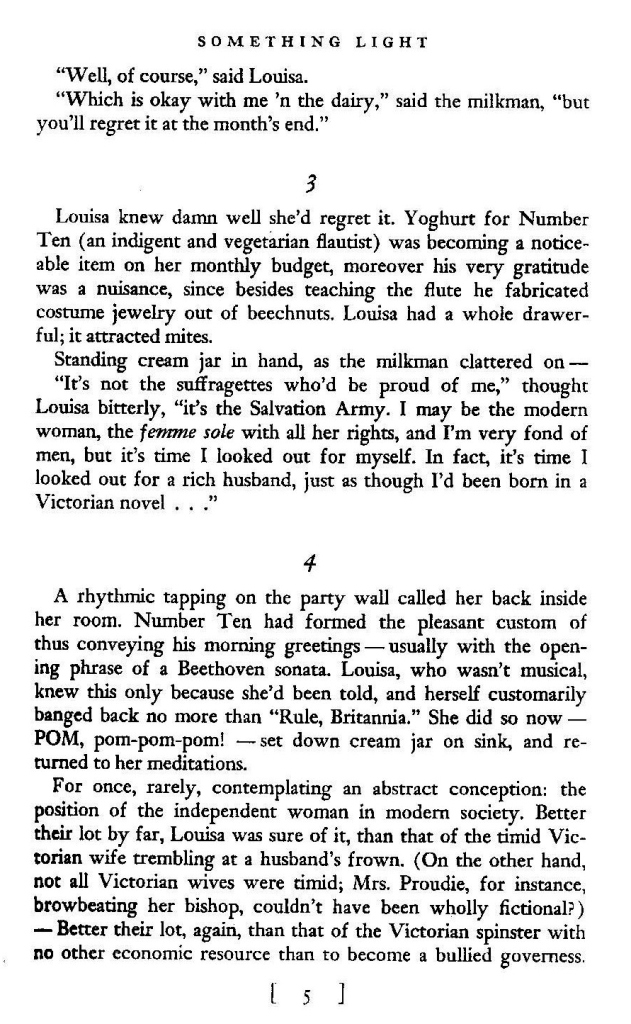
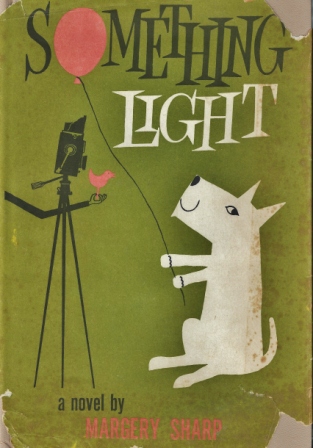
Something Light was my very first Margery Sharp, picked up on a whim at a little second-hand store I occasionally visit to scan through the modest book section. I noticed the book early in my shelf scan, but the faded and foxed dust jacket spine was less than appealing, and it wasn’t until my second pass around the stacks that something made me pull it out for a closer look. Here’s what I saw:

Hmm, I thought to myself. What’s all this, then? And I opened it up, noting that the pages easily turned as though it was used to being handled by a loving owner, and started to read. One, two, three pages. Then I quietly closed the book, walked up to the cash register, paid over my one dollar, tactfully ducked out of a conversation with the chatty proprietor, went out to my car, settled down and kept reading, completely neglecting my grocery and town chores list and stopping reading only when I was overdue to collect my daughter from her dance class. Definitely hooked.

Louisa Datchett likes men. No, not in the way that you’re thinking from that bald statement. Louisa likes men.

Here, read it yourself. A romp of a book,  something light indeed among Sharp’s delicious oeuvre.

Read Full Post »

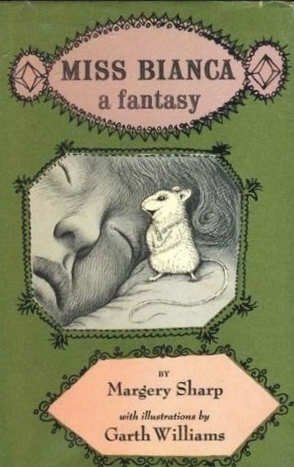
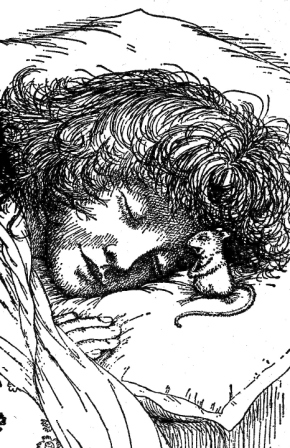
miss bianca margery sharp vMiss Bianca by Margery Sharp ~ 1962. Original title: Miss Bianca: A Fantasy. This edition: Fontana 1977. Paperback. Grand illustrations by Garth Williams. ISBN: 0-00-67-1235-5. 124 pages.

My rating: 7/10. The excellent illustrations raised it a few points.

I have a lot of good things to say about Margery Sharp, and her adult novels are among my most treasured books, but I must admit I have never previously read her once-popular children’s series about the little white mouse, Miss Bianca. The first two stories in the series were the inspiration behind the well-known Disney animated film The Rescuers (voiced, for those of you interested in such trivia, by Eva Gabor in the role of Miss Bianca and Bob Newhart as her partner Bernard) and its sequel. The paperback edition of Miss Bianca I have before me is the movie tie-in edition, with a cover still from the movie and this telling note on the title page:

Featuring characters from the Disney film suggested by the books by Margery Sharp, The Rescuers and Miss Bianca, published by William Collins & Co Ltd.

Don’t you just love that “suggested by” comment? So true! For the record, I am not a fan of the Disney bowdlerizations of otherwise excellent books. Several generations of children have now grown up with the Disney imagery of classic stories such as The Jungle Book, The Little Mermaid, and, heaven help us – The Hunchback of Notre Dame! – firmly in their heads versus the authors’ intended word-pictures.

So my beloved Margery Sharp is among the ranks of Disney’s “suggested” inspirations! I hope she got a generous settlement! It has just occurred to me that many of their take-off-of-classic stories authors were already dead at the time of the movie-making; Margery Sharp was very much alive in 1977, though I remember reading a quotation by her about not really being too interested in what happened during filming of her works (several of her adult novels were made into popular films); that her job was to write and that filmmakers were fine on their own without her input.

Back to the book at hand. A little way in I realized that Miss Bianca has a back story; so many references to what has “just happened” made me scratch my head until I realized that this is the *second* story in the series. The Rescuers is the first. I am thinking I need to get my hands on that one to fill in the gaps, and luckily that shouldn’t be a problem. New York  Review Books has just re-issued The Rescuers in hardcover, after its being out-of-print for ten years; I have several of their other beautifully rendered re-issues and I highly recommend them. Here’s the link: http://www.nybooks.com/books/imprints/childrens/the-rescuers/

So – Miss Bianca, Chairwoman of the Prisoners’ Aid Society (a charitable mousey organization dedicated to the comfort of incarcerated humans), has a new project to suggest. The last daring adventure, the rescue of a Norwegian poet from the infamous Black Castle (pause for ominous music) was obviously a great ego boost to the mice, and they are consequently quite boisterous and full of themselves. Miss Bianca, waiting for the Society’s latest meeting to come to order, muses that

“…their common adventure had given mice an unfortunate taste for flamboyance in welfare work. Not one, now, thought anything of sitting up to beg a prisoner’s crumb – in the long run one of the most useful acts a mouse can perform. Crumb-begging, like waltzing in circles (even with a jailer outside the door), was regarded as mere National Service stuff, barely worth reporting on one’s return from the regulation three weeks’ duty…”

The new mission is the rescue of a little girl who is being held in an abusive situation by the wicked Grand Duchess in the magnificent but icy-cold Diamond Palace. Miss Bianca appeals to the Ladies Guild of the Society to assist her in the daring rescue, and of course things do not go as planned. Miss Bianca is left behind in the general rout of the rest of the mice when the Duchess’ ladies-in-waiting, far from being tender creatures terrified of mice, turn out to be much more “hardened” than planned for!

This is a playful book; Margery Sharp indulged herself with a full flow of flowery and elaborate language, rather a challenge for young readers (but not necessarily a drawback), and the references are aimed rather at their elders over the heads of the child-audience; perhaps this was a book meant to be read aloud, with a nod to the parent as well as the child?

The villains in this little saga are properly villainous; the Duchess’ black-hearted Major-Domo, Mandrake, has committed “…a very wicked crime, of which only the Duchess now had evidence…” and he is her willing (though cringingly obsequious) partner in crime. Even her two unkempt carriage horses “…had criminal records; each having once kicked a man to death…” And so on.

If the story has a flaw (and it does have a few, being a slight work in every sense of the word) it is that the parody and melodrama are a bit too “over the top” for perfect comfort. The wee prisoner, the aptly named Patience,  is the latest in a long line of small children the Duchess has enslaved and apparently killed (!) –  though most children will shiver deliciously at the peril their two heroines find themselves in, my motherly brain says “Killed! Was that really necessary, dear author?!” And I don’t think we ever do get the full story on how the Duchess obtained Patience in the first place.

Ah, well. To sum up: a diverting little parody of an adventure story. I think it should definitely follow The Rescuers to make more sense to the reader; it has a very sequel-ish feel to it, though it could stand alone if need be. Quite nicely written in a very flamboyant voice (to use Miss Bianca’s own word); definitely not dumbed down to a younger audience vocabulary or style-wise.

This book #2 in a series, the first four of which are illustrated by the incomparable Garth Williams. I believe all except the newly re-released The Rescuers (New York Review Books, 2011) are out-of-print. Some are very easy to find second-hand, but the more obscure later titles may require some serious online sleuthing.

  • The Rescuers (1959)
  • Miss Bianca (1962)
  • The Turret (1963)
  • Miss Bianca in the Salt Mines (1966)
  • Miss Bianca in the Orient (1970)
  • Miss Bianca in the Antarctic (1971)
  • Miss Bianca and the Bridesmaid (1972)
  • Bernard the Brave (1977)
  • Bernard into Battle (1978)

Read-Aloud: I think so. Ages 6 and up, perhaps? The prisoner Patience is eight; much is made of her sad life and deceased predecessors and bleeding fingers, but the tone is optimistic – this is, after all, why the child very much needs a heroic rescue! Neatly tied up happy ending, with the mice going off to their next adventure.

Read-Alone: Hmmm. Maybe 8 and up? Or a very strong younger reader. Definitely can be appreciated by an older readership (including adults); Margery Sharp was an accomplished social satirist and this story is full of her wry observations, though they often escalate into full-blown parody much more so than in her adult novels.

Read Full Post »

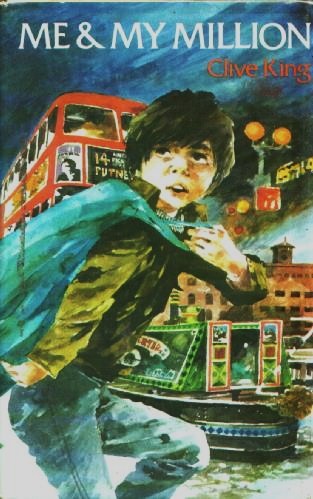
Me and My Million by Clive King ~ 1976. This edition: Kestrel (Penguin) 1979. Ex-lib hardcover. ISBN: 0-7226-5185-6. 133 pages.

My rating: 9/10.

From the front flyleaf:

Ringo knew he was carrying more in his laundry bag than just old socks. Whatever it was, his part in the job was a cinch – his brother Elvis had told him to leave it at the laundrette at the end of the 41 bus route. So how come Ringo found himself on the other side of London with a million pound picture in his bag and not so much as 10p in his pocket? Lost, broke, stuck on the pitch-black underground platform for the night – and scared witless by Angel Jim, all hairy and hippy, padding up beside him. Ringo’s troubles were just beginning…

Angel Jim took him home to his squat in the fire-station – all peace-loving and sharing. But sharing meant they wanted their cut of the million pound picture. And so did Uncle, the big dealer, and his chauffeur Eugene, and Glasses and his gang, not to mention Elvis! It looked like Ringo was cornered – until he fooled an old lady into holding onto the goods, and slithered down her drain-pipe to the canal – right onto Big Van’s barge – and what does he find? Big Van’s got the million pound picture, or one exactly like it. Big Van was just about to explain, when a copper knocks at the barge door. Ringo’s troubles were beginning again…

Cheerfully unrepentant  young delinquent Ringo tells of his part in the gone-wrong art heist master-minded by his junior-criminal brother Elvis. (Regretfully, we never get to meet the rest of their family.)

“Well, Elvis, he’s only half my brother really. So he’s half at home and half somewhere else. He’s old, more than twenty. They gave him this soppy name after some old pop star… Ringo, that’s what they call me. I think it’s some other old pop star that my mum liked…”

Clive King must have had a good time writing this fast-paced adventure story. Young Ringo, from the first sentence onward, never breaks character for an instant. Though we’d best not trust him alone for a minute with anything valuable around, his heart is nonetheless good deep down.

We willingly surrender our disbelief early on, when Elvis and his cohort Shane manage somehow to steal a valuable painting from a museum; Ringo is drafted as the receiver of the goods, and manages to totally mess up the hand-off to the next member of his brother’s gang. Ringo’s downfall is his obvious dyslexia – he struggles to read the simplest words, and numbers turn themselves around in his mind – hence his initial mistake in getting on the 14 bus versus the 41.

“It’s like this… It’s along of those figures and letters and words. I mean, like the buses. Elvis says forty-one and I get on a fourteen. But a forty-one coming towards you, and a fourteen going away, they look the same!”

Luckily Ringo’s mix-ups save his skin more than once as he careens through London bouncing off the most eclectic bunch of characters – a group of more-than-mellow peace-and-love hippies, a wealthy “picture collector” with less-than-legal connections, an artist-turned-(somewhat)-art-forger living on a canal boat, and a sinister group of animal liberationists with a dark agenda.

Happily everything turns up okay in the end. Ringo saves the day, and – water off a duck’s back – gets on with his life, which would appear to have taken a turn in a decidedly more positive (and distinctly more legal) direction due to his lively adventures and new acquaintances.

What a cheerfully loopy story this is! While it was written for a young(ish) audience, it is such a strong portrait of a certain kind of person at a certain point in time in a certain place that I suspect a young reader today would be rather at sea as to what’s going on and why the funny bits are so funny. The hippies in particular are such a period piece, gleefully and sympathetically portrayed by King. Or maybe there’d be no problem. My own offspring often surprise me by how sophisticated their understanding of the past sometimes is. And those of us who were young in the 1960s and 70s will “get it” completely. This book’s humour reminds me strongly of the classic 1969 British crime-and-car-chase movie The Italian Job, starring Michael Caine; Charlie Croker could have been Elvis’s role model!

Definitely share Me and My Million with your kids – it’s a neat little diversion of a book – but try it for yourself too. Enjoyable quick read.

Read-Aloud: I would say probably a “yes”, I’m thinking for 8 years old or so & up.  Definitely worth a try. 14 shortish chapters; fast paced. I think once you figured out a narrative “voice” it would be great fun to do, though we never tackled this one as a read-aloud ourselves.

Read-Alone: Probably 10 & up, and well into the teens. Depends on the individual reader and how good they are at catching inferences and figuring things out from prior knowledge; written in a bit of a challenging style; the reader has to fill in the blanks.

Read Full Post »

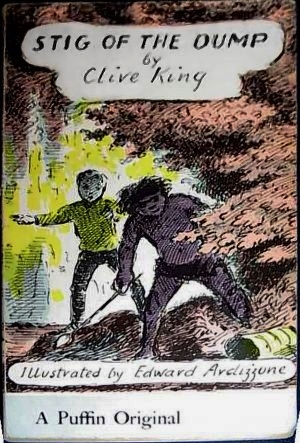
Stig of the dump clive kingStig of the Dump by Clive King ~ 1963. This edition: Puffin, 1993. Softcover. Illustrations throughout by Edward Ardizzone. Afterword by Kaye Webb. ISBN: 0-14-036450-1. 159 pages.

My rating: 10/10.

Probably the best-known of British author Clive King’s respectable list of interesting and well-written children’s books, this great little story is still in print forty years after its first publication.

A happy little story, touched with snippets of history, but mostly just a fun read. We willingly suspend our disbelief and embrace the “what if” world Clive King has created for Barney. Make sure you look for a copy with the Ardizzone pen-and-ink illustrations; these add greatly to the enjoyment of this story.

Young Barney and slightly older sister Lou are visiting their grandparents in the English countryside. Barney, exploring, becomes fascinated by an old chalk quarry used by the local inhabitants as a rubbish tip for unwanted items. While venturing too close to the edge, the crumbly chalk cliff gives way, tumbling Barney down into the midst of a concealed shelter built out of branches, rusty sheet iron and pieces of old carpet. He has found the den of the mysterious Stig, a “cave man” unexpectedly living in 20th Century Devon. Barney and Stig hit it off immediately, and various adventures ensue. Eventually Lou is drawn into the partnership, and the story culminates with a Midsummer Night time-travel back to Stig’s time.

Read-Aloud: Yes! A wonderful read-aloud. King’s writing flows beautifully, making life easy for the narrator. The 9 chapters are fairly long but are nicely episodic so each session ends off neatly while keeping the listener wanting more. Interest level probably 5-6 to 10-11, maybe even older, depending on the individual child(ren).

Read-Alone: Great early chapter book for developing and fluent readers 6-ish/7-ish and up. The author wrote this book to be read by his 8-year-old son, so it is fairly simply written, though not at all “dumbed-down”.

Read Full Post »

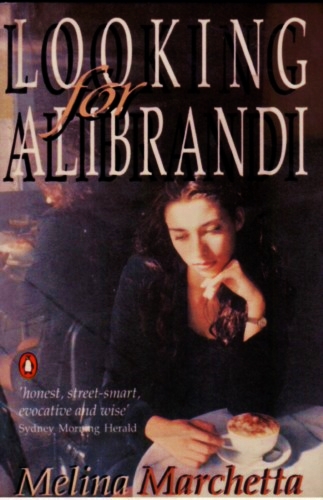
looking-for-alibrandi melina marchettaLooking for Alibrandi by Melina Marchetta ~ 1992. This edition: Penguin Australia, 1993. Softcover. ISBN: 0-14-023613-9. 261 pages.

My rating: 6.5/10.

This jumped of the shelf at me while used-book browsing the other day – one of my quick-shelf-scan rules is that anything with an orange spine and a penguin gets the pull-and-look. What I found this time round was this appealing first novel by Australian writer Melina Marchetta.

The plot is fairly standard stuff; no surprises here. Yet another coming-of-age story, but one well written with a distinctive and believable voice.

17-year-old Josephine is in her last year as a scholarship student in an exclusive Catholic girl’s school in Sydney. Josie fiercely negotiates a difficult year touched by social and racial prejudice: “Australian” versus “ethnic” – no, not Aboriginal “ethnic”, but first and second generation European immigrant “ethnic”.  Also academic challenges, difficult friendships, tragedy, first love, and family secrets revealed – most notably the unexpected discovery and entry into her life of her father, who had disappeared from her unwed pregnant 16-year-old mother’s life before Josie’s birth.

I appreciated the author’s matter-of-fact handling of Josie’s Catholic religion and the way that it played into her family dynamics, as well as that of the larger Australian-Italian community she has grown up in. The frank depiction of teenage (and adult) romantic and sexual yearnings, and how religion and social mores influenced behaviours in those areas was also well portrayed.

Josie is a sympathetic character, with all of her varied flaws, ambitions and ideals, and I enjoyed her relationships with her mother and grandmother – a realistic mix of impatience, resentment, and love. The setting is (naturally) dated (early 1990s urban Australia), and the pop culture references went right over my head for the most part, but those are not necessarily drawbacks – this is a very much a “slice of life” picture of a very specific time and place. It’s also a very Australian book; very matter-of-factly “this is where and how we live”.

I did some research on Marchetta, and was pleased to see that after a ten-year hiatus following the publication of Looking for Alibrandi she has strongly re-entered the YA scene with several more acclaimed “realistic” novels as well as a fantasy series. I will be keeping my eyes open for her other titles in my book browsing.

Check out this link:

http://www.melinamarchetta.com.au/main/page_home.html

Read Full Post »

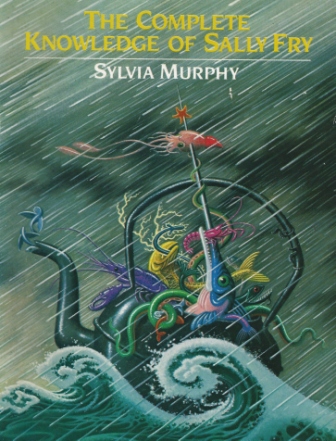
The Complete Knowledge of Sally Fry by Sylvia Murphy ~ 1983This edition: Black Swan, 1984.  Softcover. ISBN: 0-552-99094-9. 174 pages.

My rating: 9/10.

I grabbed this book on a whim during a Sally Ann sweep over a year ago. I was attracted by the intriguing cover, and when I opened the book to the middle for my standard never-heard-of-this-author-before-should-I-gamble-on-this book-30-second-random-excerpt-test it passed quite nicely.

Not quite sure why it’s taken me this long to get around to reading it. The cover blurb might be the reason – a quote from Susan Hill  (which vaguely rings a bell – dark short stories? – or ???)  promises “…no difficulty in laughing out loud….a new, original comic writer…tremendous fun”. I dislike being told I’m going to laugh, and in inner protest I then tend not to. ( “Take that, effusive cover copy writer!” This goes double, no, TRIPLE, for video cover blurbs. Especially foreign films. Never trust the blurb. Just saying.)

Well, shame on me. Picked it up last night, was immediately pulled into Sally Fry’s complicated little world, stayed up way too late reading it, and got up way too early to finish it.

Verdict – very nice indeed. This one’s a keeper. (Though I didn’t laugh out loud. Continual appreciative smiling better describes my response. Maybe I would have laughed out loud – occasional passages are very wryly funny – but I was reading in bed next to my slumbering spouse so I tempered my behaviour accordingly.)

So – how to describe Sally Fry?

Still smiling as I try to condense the essence of this little gem of a story. In brief – here’s the scene. Sally Fry, single mother, behavioural therapist and college lecturer, is working on her PhD thesis. Hoping for a few quiet months of seclusion in her mother’s rented Cornwall cottage, her plans go quickly awry. Her troubled teenage son Sebastian disappears, leaving behind a cryptic note; a sister’s sudden operation means the arrival of Sally’s rather  sweet though boisterous young niece and nephew; another sister shows up on the cottage doorstep on the run from the implosion of her marriage with a Swedish filmmaker, who himself appears shortly thereafter and proceeds to spend his time alternately spying on the household through field glasses and enjoying the generous favours of Sally’s mother’s neighbour’s wife.

The thesis does not progress. What does get done is Sally’s own quirky autobiography, written in passages triggered by alphabetical dictionary-style entries; a form of therapeutic self-expression Sally herself developed and then had scooped by her lover-at-the-time to further his own career. Oh yes, Sally has a back story, and more than a bit of baggage!

If I had the inclination (and, more to the point, the time) I could type in a few of the entries here, but as they really must be read as part of the narrative flow I’ve decided that would be pointless. (Plus the time thing.) So you need to take this on faith. Not a particularly warm and fuzzy book – Sally’s voice is too matter-of-fact and cynical for that – but it made me very, very happy. Good stuff.

I Googled Sylvia Murphy this morning, and  – oh joy! – after this first novel (Sally Fry) she has a nice little collection of subsequent titles which I shall be searching down, though most appear to be out of print. I found Murphy’s personal blog, and the last postings are from 2010; she talks about the difficulties of getting published in the increasingly competitive world of mainstream books as publishers concentrate on potential mega-bestsellers versus a broader catalogue of titles. Though her first works were released by Houghton-Mifflin, it appears that she was dropped at some point; her later works are self-published and she comments that she is now looking at print-on-demand as well. Her bibliography includes several other contemporary novels, memoirs of restoring and ocean-sailing a 1930’s wooden ketch, Nyala, with her late husband, several “cat” tales, and two non-fiction works on coping with death and grieving; in her other life Sylvia Murphy is an administrator in a bereavement counselling service.

More on Sylvia Murphy in the future, I sincerely hope. She’s on my quest list as of right now. I would like to start with her 2008 novel, Candy’s Children.  The description of the plot  is promising: an elderly Palestinian-born Englishwoman dies in a terrorist bombing during a mysterious visit to Tel Aviv; at her funeral five of her children assemble. The catch is that none of them know that they have siblings. I’ll bite; after Sally Fry I have high hopes for Sylvia Murphy; I look forward to spending some more time in her literary company.

Sylvia Murphy. Here she is: http://www.sylviamurphy.co.uk/

Read Full Post »


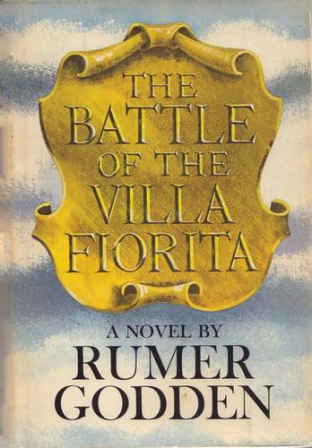
The Battle of the Villa Fioritaby Rumer Godden ~ 1963. Viking Press. This edition: Book-of-the-Month Club hardcover, 1963. Library of Congress #: 63-14677. 312 pages.

My rating: 8.5/10

Middle-aged Englishwoman Fanny Clavering is by and large content with her life. Competent mistress of a stately country house and beloved garden, dependable wife to an affectionate husband, and devoted mother to three adolescent children, her greatest stress is in occasional mild conflicts with her managing mother-in-law and her rather bossy and condescending friends.

That is, until the day Fanny turns from the counter of the village shop to meet the admiring gaze of an unknown man. An acclaimed film director has just arrived with his entourage to shoot scenes for his latest work in the local countryside, and he falls in love, literally at first sight, with the gentle Fanny.

Fanny immediately recognizes an answering attraction in herself for the charismatic Rob. She means to do the right thing, to deny herself the romance that she has not encountered in her life until this point, but circumstances work against her and Fanny, torn between duty and growing passion, falls hard.

Fanny’s subsequent divorce and loss of custody of her children to her husband shocks her circle of friends and the staid village society; it also turns her children’s lives upside down. 16-year-old Philippa and 14-year-old Hugh are worldly enough to understand and somewhat accept what has happened, but 12-year-old Caddie is torn out of her self-involved dream-world to the reality that her future means no more dependable, alway-there mother, no more sanctuary of a country home, and no more beloved pony Topaz.

Philippa takes the changes in stride. After all, Rob Quillet is wealthy and influential, and as an aspiring model she may well benefit by his connections. She quite happily goes off to spend the summer in France with a school friend, leaving Caddie and Hugh trapped in the depressing London flat which is their new home. The country house is in limbo – soon to be sold with no Fanny to look after it. The pony Topaz is being boarded at a farm, with his ultimate fate in question, and the two languish the summer away.

The difficulties of trying to organize themselves for their fall terms at boarding school without their mother’s overseeing presence becomes the final straw. “Why must children of a divorce be made to put up with all of this? I won’t be a victim!” the suddenly aroused Caddie cries, and she comes up with an audacious plan. She and Hugh will go to Italy where Fanny and Rob have retreated to await their planned marriage, they will make Fanny “see reason” and they will bring her back home.

Needless to say, things do not turn out to be anything like so simple. In the battle for the possession and future of Fanny – and a brutal conflict it turns out to be – no one emerges a clear winner; all have lost something precious by the end. What is gained is elusive, and every one of our protagonists is left facing an uncertain future.

This is one of Rumer Godden’s “A”-list novels, and an accomplished piece of writing. The characters of Fanny and Caddie are in particular are beautifully portrayed; Godden’s strength is definitely in depicting girls and women working through challenges and coming to terms with their conflicting needs and desires.

The male characters are also handled well. Complex Rob Quillet is a contradictory yet single-minded personality; he is shockingly chauvinistic, to our 21st Century eyes, in his attitude towards women and children, but we also see his softer side, which ironically leads to his moral defeat. Hugh is seething with adolescent yearnings and moodiness, while the bemused Darrell Clavering gets credit for refusing to be the victim in his marital betrayal; his daughter Caddie comes by her surprising rebellion honestly.

Godden shows her usual genius at portraying place; she brings to full life the world of the English countryside as well as the more exotic Italian setting of the antique-filled villa and its lush gardens, set on the shores of Lake Garda.

Nicely done, Rumer Godden. This is why I keep a shelf full of your books.

Read Full Post »

« Newer Posts - Older Posts »