Archive for the ‘Read in 2012’ Category

Golden Days: Further Leaves from Mrs. Tim’s Journal by D.E. Stevenson ~ 1934. This edition: Isis Publishing, 2006. Hardcover. Large Print. ISBN: : 0753176139. 241 pages.

My rating: 8.5/10. I must say I liked this one a lot. Total cozy comfort read, and exceedingly predictable in its outcome. Some days that’s a good thing, a little break from thinking too hard!

I found it very similar to one my long-time go-to reads, E.M. Delafield’s Diary of a Provincial Lady. I don’t suggest that the gadabout adventures of Hester Christie (Mrs. Tim Christie) in any way echo the stay-at-home ways of Delafield’s unnamed heroine, but the tone, style and format are exceedingly familiar. I compared publication dates, and see that Delafield’s Provincial Lady was published (and became an immediate bestseller) in 1930-31 (England-U.S.A.), while Stevenson’s first Mrs. Tim book, Mrs. Tim of the Regiment, appeared in 1932, followed by this installment, Golden Days, in 1934. I would have to assume that Stevenson was aware of Delafield’s popular work?

No worries – there’s room in my heart for the two, though until I read more of the Mrs. Tim stories (and they are very much on my wish list), I still hold the Provincial Lady in higher esteem. The humour is more wry – more savage – and the inner examinations much closer to home. Hester is a bit too uniformly “nice”, though she has her moments of critical insight.

Apparently Golden Days is a rather hard to find stand-alone title, as it was only published as a separate title in the very early editions. In later years it was added to Mrs. Tim of the Regiment, with that title comprising both the 1932 and 1934 installments of Mrs. Tim’s diary.

The edition I found through the public library was a very recent (2006) large print edition from Isis (Ulverscroft); there appear to be quite a few D.E. Stevensons in the system in large print format, which perhaps says something about the age, or in any event the perceived age <ahem> of the D.E.Stevenson-readers’ demographic.

*****

This will be a sketchy review; the book has just been returned to the library so is not here in front of me to double-check details and names.

This is, as I already mentioned, the second Mrs. Tim story. It is usually included with the first installment, Mrs. Tim of the Regiment, in the 1940 and later editions, including the currently available reprint from Bloomsbury (2009). There are three more books in the series: Mrs. Tim Carries On (1941), Mrs. Tim Gets a Job (1947), and Mrs. Tim Flies Home (1952), all currently out of print, as far as I am aware.

Here we go.

Mrs. Tim, as our heroine Hester Christie is commonly styled, is married to a an army officer, and the impression we get from Golden Days is that she is often called upon to move house, to “follow the regiment.” At this particular time, Mr. Tim is occupied with his job, Mrs. Tim’s eldest child is off at boarding school, and she and her young daughter are invited on a Scottish holiday, with a dual purpose. First, to relax and enjoy themselves far from home responsibilities, and secondly, to try to bring sense to Mrs. Tim’s hostess’ son who has become involved with an unsuitable girlfriend. Apparently Mrs. Tim has some sort of special influence on the young man in question; in any event, he is prone to listen with flattering attention to what she has to say.

Much loch-fishing, glen-wandering and tea-drinking ensue. The love affair is brought to a satisfactory solution, and Mrs. Tim herself picks up an ardent admirer, though she is too innocent and too much in love with her absent husband to take much notice of her tenaciously persistent swain.

A slight book, and a very quick little read. I’m guessing not more than 150 pages or so if it were in standard-print format. Amusing and very pleasant in all regards. Perhaps just a mite too pleasant? Right there on the borderline, but Mrs. Tim gets a nod and a pass. I’m liking her even better than Miss Buncle , who got a decided pass as well, after some consideration.

I am persisting in making a broader acquaintanceship with D.E. Stevenson, as a number of fellow readers have been singing her praises, and I do see her appeal. But I am not one hundred percent onside quite yet. I am currently gingerly tackling Stevenson’s first novel, Peter West – also in large print, re-published 2007 or thereabouts for those of you wondering how I got my hands on it, as apparently this one is also hard to come by. It is rather too sentimental and flowery for my taste, and I do believe I already know the outcome, and I’m only a few chapters in. But I’ll soldier on, and report at a future date.

Side note: I really don’t care for the wishy-washy watercolour covers of the Isis editions. Too sweetly bland, and a bit embarrassing to be carrying around openly. The lady on the current cover of Golden Days bears no resemblance to my personal imaginary vision of Mrs. Tim – another minor annoyance!

Read Full Post »

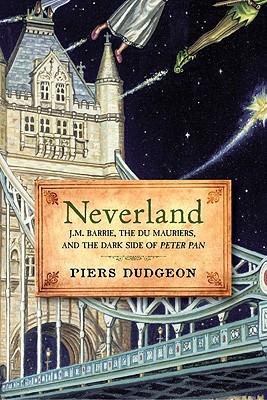
Neverland: J.M. Barrie, the Du Mauriers, and the Dark Side of Peter Pan by Piers Dudgeon ~ 2009. Originally published as Captivated: J.M. Barrie, the du Mauriers and the dark side of Neverland in Great Britain, Chatto and Windus, 2008. This edition: Pegasus Books, 2009. Hardcover. ISBN: 333 pages.

My rating: This is tough. I think 4.5/10. It certainly held my interest, but I have some issues with how the author presented some of his more far-fetched speculations as fact, without any of the language needed to make it clear that some conclusions were very much fabricated by the biographer. Not “good science”, if you get my meaning. Extra points for the vast amount of research that obviously went into this project. Points off for the blatant speculation, sometimes admitted to by the author, that makes “truth” out of shreds of fact.

*****

This was a recent library loan, picked up on a whim because of the du Maurier reference. I hadn’t realized there was any sort of connection, so was quite intrigued by the subtitle. And oh my gosh – what a can of worms this turned out to be.

It’s on the library stack for return today, so this will be a very brief summary.

In short, the author, Piers Dudgeon, has detailed the secret (or maybe not so secret?) obsession by the esteemed and exceedingly successful J.M. Barrie for the family of Arthur Llewelyn Davies and his wife, the former Sylvia du Maurier, and especially their five sons: George, John, Peter, Michael, and Nicholas. Whether the attraction was merely that of fascination for a vibrant and beautiful family, or whether the eventual focus on the five young boys was more sinister in nature, there was a decidedly – how shall I put it? – “focussed” situation going on there. After Arthur’s death of cancer in 1907, Sylvia leaned heavily on the family friend Barrie; her own tragic death three years later left the five children, then aged approximately from seven to seventeen, under the guardianship of Barrie, who, as “Uncle Jimmy”, became even closer in the pre-existing relationship to something of a foster-father.

All of this is clearly documented and not particularly newsworthy, but Dudgeon goes deeply into speculation and conjecture here about Barrie’s infatuation with the Llewelyn Davies family and the du Mauriers. Aside from the predictable insinuations about pedophiliac tendencies in Barrie, something that I was aware of, having read numerous references over the years to his infatuation with the real-life model(s) of his never-aging creation Peter Pan, Dudgeon goes even further into the murky psychological waters, claiming a sort of extra-sensory perception and an ability for “ill-wishing” that spelled doom to anyone upon whom Barrie became fixated. Dudgeon openly implies that Barrie had a hand in the deaths of Arthur and Sylvia L-D, as well as in the suicide of one of the boys as a young man, the death in action of another in World War I, and the suicide of a third as a middle-aged man.

Dudgeon goes out even further on his shaky limb and seems to claim that Daphne du Maurier in particular was deeply influenced by Barrie’s role in her life, and that her books reflect his deep (claimed by Dudgeon) importance in her world. Barrie did indeed come into (occasional) quite close contact with Daphne in her younger years, but I feel that Dudgeon has strongly overstated his influence, seeking to justify his own obsession with the “demonization” of Barrie.

I can easily believe Barrie was a man of morbid and unhealthy obsessions, though the muted accusation of  pedophilia has been emphatically denied by the very people who should know, the Llewelyn Davies sons themselves.

All in all, a rather disturbing read, in more ways than one. I’m not sure how reliable Piers Dudgeon’s conclusions are, though much of his research is quite fascinating when viewed with a disinterested eye. I certainly can’t recommend this book as the definitive account of Barrie and the Llewelyn Davies family, and definitely not as a Daphne du Maurier reference – I felt this was the most contrived part of the whole production. All I can say is that if you’re interested (and it is interesting to speculate and delve into Barrie’s dark world, behind the glitter of the stage productions) you should perhaps look into some more reviews – lots to choose from out in the cyberworld –  to get a clear idea of Dudgeon’s own infatuation with his theory, and then read away with an open mind.

A good place to start is here, the New York Times book review by Janet Maslin from October 25, 2009.

Read Full Post »

Small Stories of a Gentle Island by Ruth Loomis ~ 1986. This edition: Reflections, Ladysmith, British Columbia, 1986. Illustrated by Carol Evans. Softcover. ISBN: 0-9692570-0-7. 96 pages.

My rating: 7.5/10. I enjoy re-reading up this slight volume of memoirs every few years, and I suspect it will always remain in my permanent collection of British Columbia books. I do wish it were a bit longer; many of the stories stop short, leaving the reader yearning for more. Ruth Loomis doubtless has a fount of knowledge and stories of this area; I would be thrilled to read a longer, more in-depth volume going into more detail. A very personal memoir, this one, and one almost feels as if one were eavesdropping on a private conversation. Well done.

*****

In 1952, young and newly married Ruth Loomis moved with her husband from bustling Seattle to small Pylades Island in the Strait of Georgia, between Vancouver Island and mainland British Columbia. Here an alternative lifestyle moved from dream to reality. A home and garden were established, two babies born, and the challenges and joys of a life intimately connected with the sea and nature were embraced.

Time moved on, and twenty years later the marriage dissolved and the island was left behind. This was shortly followed by the tragic death of Ruth’s eldest daughter, and, after trying to cope with her multiple sorrows by immersing herself in the busy mainland world, Ruth decided to go back to the island alone.

She lived there until 1985, when she left for the last time. Pylades was sold, and Ruth moved to Vancouver Island. This book is a collection of reminiscences and a loving farewell to the dream and the reality.

A slender volume, only ninety-six pages, but it captures the essence of one woman’s thoughts and feelings about a very unique time and place. Having recently returned from a Vancouver Island visit, and after having leaned on the railings of the ferry crossing the Strait, yearning romantically for a chance to explore those wave-surrounded rocky isles glimpsed all too briefly in the ship’s swift passage, I sought out this book on my return. The smell of sea and cedar seem to waft from its pages, among other evocative aromas.

The Gulf Islands are famous for their free spirits and willing experimenters with various relaxants and hallucinogens, and it is apparent from this memoir that Ruth was no exception; some of the vignettes are very much tinted with a haze of unreality, though most are straightforward stories. There is a strong vein of melancholy and sorrow throughout, though it is balanced by remembrances of joy and healing.

In her Introduction, Ruth says

I survived, discovering that life has a healing balm alongside its searing forces. I needed time, time to feel my past dissolve into the present. That love of now Pylades gave, with its interplay of seasons and sea-life. The fantasy that I controlled my life vanished. I became interested in the essence of creation, slowly realizing I was not separate but part of it. Others occasionally came to this gentle island who needed time too, whether a few hours, days or months which Pylades gave.

The stories follow a chronological path, from 1957 to 1986, allowing brief and vivid glimpses of moments now lost in time. Along with the poignancy and the regrets there is plenty of humour and thoughtful musing. This is a slender little volume, an hour or two’s reading, but the stories stay in one’s head long after the book is put back on the shelf.

The Visitor ~ 1957

Butter Money ~ 1959

Today, Tomorrow and the Brother ~ 1961

Fog ~ 1968

Five Days of Nina ~ 1970

Appointment with God ~ 1974

Squatters ~ 1975

Susanne ~ 1978

Mushrooms and the Renaissance Man ~ 1979

Play with the Dolphin ~ 1980

Eagles ~ 1984

The Last Season ~ 1985

B.C. readers, keep an eye out for this one in secondhand book stores. If you find it, open it up and spend a few minutes in Ruth’s lost world, and perhaps give it a home on your own shelves among other records of our past.

A postscript. We were curious about the eventual fate of Pylades Island, and did a bit of internet research. Pylades was on the market again  in 2009, and a lot comprising half of the island, with Ruth’s derelict old home on it, had just sold for something like $2,400,000. I hope Ruth profited to a like degree upon her departure. Here are several picture taken at the time of that sale. Dream away!

Read Full Post »

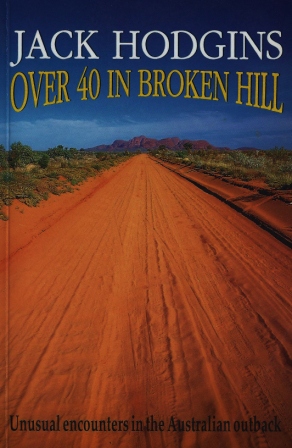
Over 40 in Broken Hill by Jack Hodgins ~ 1992. This edition: McClelland and Stewart, 1992. Softcover. ISBN: 0-7710-4192-6. 197 pages.

My rating: 8.5/10. Unpretentious and good-humoured, without stooping to farce. Jack can, as needed, poke a bit of fun at himself, but he keeps his self-respect and extends that regard to others.

*****

This is a book without a Great Big Purpose, which is too often rare in a travel book, into which category this work mainly falls. Over 40 is a rather elegantly presented account of two writers on the loose in Australia. One, Australian novelist Roger McDonald, is researching his next book, a non-fiction account of the politics and conflicts between New Zealand and Australian sheep shearers working the vast outback flocks, and the other is our own British Columbian Jack, tagging along with his friends and colleague for the four-week trip.

Jack finds himself taking notes throughout the journey, and ends by writing his own account of the fascinating people and unique places the two encounter. Quirky, often humorous, fair-minded and very readable. I enjoyed this travel memoir.

Jack Hodgins is well-known in B.C. literary circles for his fiction, from his now-iconic short story collection Spit Delaney’s Island in 1976 to his most recent novel, The Master of Happy Endings in 2010. Over 40 in Broken Hill was something of a departure from the fictional norm of this author, but it worked for me.

I’ve read a number of this author’s works over the years, and think very highly of his distinctive style. (He reminds me a bit of Robertson Davies, but without the aura of intellectual snobbery that Davies sometimes projects.) I am not alone in this regard, as Jack Hodgins was awarded an Order of Canada in 2010 for his lifetime contribution to Canadian literature. An author well worth exploring, if you are not already familiar with him.

Side note: The “40” referred to in the title has a double meaning. Think age, and then think degrees Celsius. There is a chapter midway through the book that clarifies the reference most engagingly.

Read Full Post »

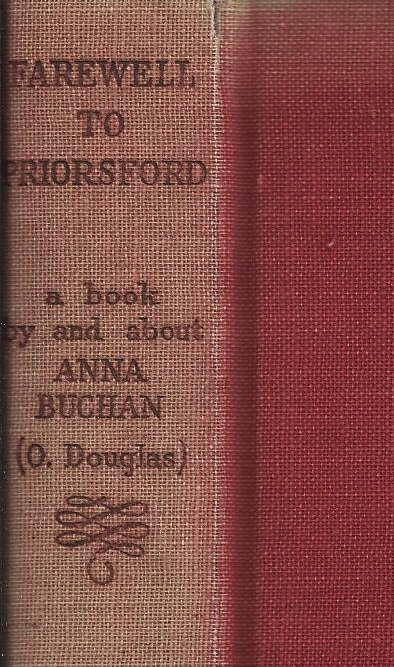
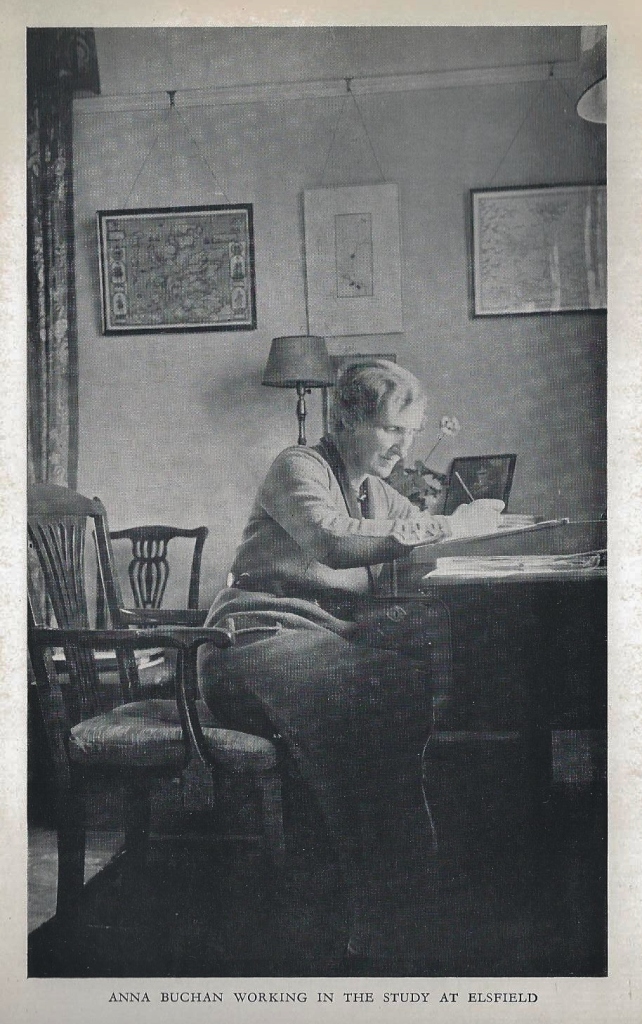
Farewell to Priorsford: a book by and about Anna Buchan (O. Douglas) ~ 1950. This edition: Hodder and Stoughton, 1950. Hardcover. With 5 photographs. 253 pages.

My rating: 10/10. Succeeds perfectly in its stated purpose, as noted in the Preface:

This book has been compiled at the request of the many who wish to know more about Anna Buchan by those privileged to enjoy her friendship.

This commemorative volume is presented in the hope that it will give to all who enjoy Anna Buchan’s books a share in the fun, the courage and the inspiration she gave to all who knew her.

*****

This book was published two years after Anna Buchan’s death, and is composed of several short biographical sketches, with the remainder a few collected short stories and anecdotes. There is also the fragment of the last novel Anna was working on, eight chapters of another Rutherfurd book, The Wintry Years.

This is a fascinating and enlightening glimpse into the world of this quiet yet eloquent author, and there are no surprises here for those who know the author through her fictional words, merely a confirmation of what we had hoped to find; that the author’s writings do indeed reflect her real life and her views that many people are indeed “good, gentle and scrupulous.” If this sounds too meek and wishy-washy, I hasten to add that Anna had a strong streak of cynical Scottish clear-headedness about her as well, and there is a leavening of wry humour and keen insight in her works to balance the goodness and gentleness.

The more I read of this author, the more I like her, both her works and the person she herself must have been. Farewell to Priorsford is a lovely memorial, and very much worth seeking out for O. Douglas fans. The eight chapters of The Wintry Years are an absolute treat to fans of the Rutherfurds, giving us a fleeting glimpse of their lives during the years of the second World War, and touching on many of the characters we came to know so well in The Proper Place, The Day of Small Things, and Jane’s Parlour, as well as teasingly introducing us to some new characters. Such a shame that Anna Buchan died so relatively young, at 71, and still very much at the peak of her writing years.

Here is what Farewell to Priorsford contains:

ANNA BUCHAN OF PRIORSFORD
 
I. A Biographical Introduction by A.G. Reekie
II. Anna by Susan Tweedsmuir
III. Olivia by Alice Fairfax-Lucy
IV. Author and Friend by Christine Orr
V. A Peebles Player by William Crichton
 
 
STORIES BY ANNA BUCHAN
 
I. Introductory Note
II. A Story for Young and Old:
          Jock the Piper
III. Broughton and Two Broughton Stories:
          An Upland Village
          An Echo
          Miss Bethia at the Manse
IV. Two Long Stories:
          A Tea-Party at Eastkirk
          Two Pretty Men
V. The First Eight Chapters of a Novel:
          The Wintry Years
 

*****

Highly recommended for O. Douglas – Anna Buchan fans.

Read Full Post »

Jane’s Parlour by O. Douglas (Anna Buchan) ~ 1937. This edition: Thomas Nelson & Sons, circa 1940s. Hardcover. 381 pages.

My rating: 9/10. Because I am now completely in thrall to Anna Buchan’s small but completely believable literary world, and I so greatly enjoyed spending time with the Rutherfurds and their ever-widening range of acquaintances.

*****

There was only one spot in the whole rambling length of Eliotstoun where Katharyn Eliot felt that she could be sure of being left at peace for any time. That was the small circular room at the end of the passage which contained her bedroom and Tim’s dressing-room; it was called for some unknown reason “Jane’s Parlour.”

No one knew who Jane was. There was no mention of any Jane in the family records: Elizabeths in plenty, Elspeths, Susans, Anns, Carolines, Helens, but never a Jane. But whoever she was Katharyn liked to think that she had been a virtuous soul, for there was always a feeling of peace, a faint, indefinable scent as of some summer day long dead in that rounded room with its three narrow windows (each fitted with a seat and a faded cushion), its satiny white paper, discoloured here and there by winter’s damp, on which hung coloured prints in dark frames. A faded Aubusson carpet lay on the floor, and in one corner stood a harp beside a bureau, and a beautiful walnut settee – these were Jane’s. A capacious armchair (Tim’s) was at one side of the fire, and opposite it, a large writing-table which was Katharyn’s. There was also an overcrowded bookcase, and a comfortable sofa: that was all there was in the room.

(…)

It was here she worked, for in the infrequent quiet times of a busy life Katharyn wrote – and published: it was here she read the writers she loved best, old writers like Donne and Ford and Webster from whom she was never tired of digging gloomy gems…

When Caroline was born Katharyn had made a rule that children and dogs were not to be admitted into Jane’s Parlour, and when Tim protested, replied with steely decision that there must be one peaceful place in the house. Before ten years had passed there were five children at Eliotstoun, and an ever-increasing army of dogs, so that, as Tim acknowledged, it was well to have one place where people’s feet were free of them.

And, because it was forbidden territory it naturally became the Mecca of the family, to enter it their most ardent desire…

This book interweaves a number of lives, most of which we are familiar with from The Proper Place and The Day of Small Things; Jane’s Parlour is very much a continuation of what has come before versus a stand-alone story; the three books belong together to give an ever-widening view of the living tapestry created by the author from her ever more intricately twined strands of individuals’ lives.

Here are Katharyn and Timothy Eliot, and their five children; Alison Lockhart and her beloved nephew George; Barbara and Andrew Jackson, Barbara in the role of antagonist and Andy smoothing down the feathers his wife continually ruffles; a cameo or two by Lady Jackson herself in all her vivid glory; Nicole and Lady Jane Ruthurfurd; and many more.

The main strand of this novel concerns a fairly typical love story, but there is much quiet activity going on at the same time, and we are treated to a series of interconnected vignettes which keep us up to date on what has happened since we last spent time in this lovingly created world. Virtue is rewarded, the wicked are put – for the most part – sternly in their place, joy is embraced and grief accepted. As usual, not much happens, but at the same time everything happens; much like most of our lives if we are lucky enough to live them in a peaceful country in between-great-events times.

The First World War is now long past, and is not often referred to, but the gathering clouds of what will be the Second World War are very much in evidence; this novel was published in 1937 and is a clearly and sensitively drawn period piece which captures the mood of those last few sunset years of relative peace before darkness once again descends.

If you enjoyed The Proper Place and The Day of Small Things, this is a definite must-read. The three novels belong together, and if you can get your hands on the posthumously published anthology-biography-memoir Farewell to Priorsford, you will find therein the first eight chapters of a fourth book, The Wintry Years, which follows the same characters into World War Two. Sadly, Anna Buchan died before that last novel was finished, but those chapters are perfectly composed, letting us turn away from our fictional friends with the feeling that their lives will continue somewhere even though out of our ken; truly the mark of a good author’s skill in world building.

Read Full Post »

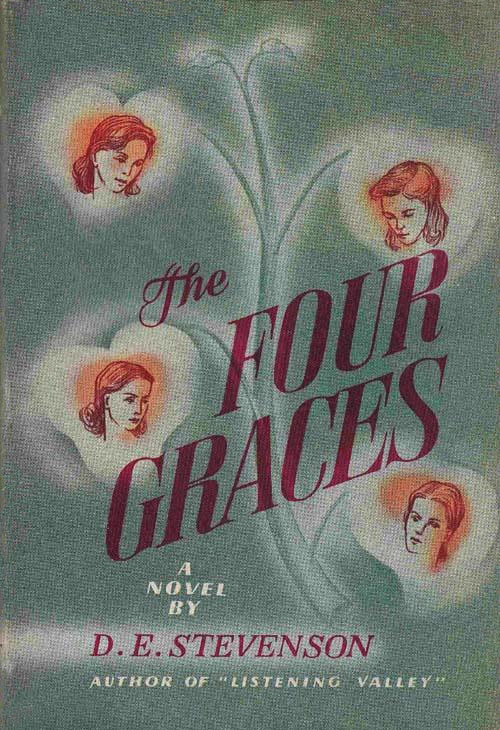
The Four Graces by D.E. Stevenson ~ 1946. This edition: Ulverscroft, 1975. Hardcover. Large Print – 370 pages.

My rating: For purely cozy, exceedingly nostalgic, “English village” escape literature, easily a 9/10. Literary merit – well, we won’t go there! I am actually quite impressed by the assumption that the author makes that her readers are very familiar indeed with the literary greats, as well as the current bestsellers of the day. References and quotations appear without any explanation, with, I’m quite certain, the belief that the reader as well as the characters of the story will “get it” immediately. Rather reminiscent of D.L. Sayers, and her own high-handed assumption that her readers are coming from the same erudite place as she is!

*****

This is my second D.E. Stevenson, after my initial introduction to this author’s esteemed Miss Buncle’s Book . I can understand how Dorothy Emily has garnered such a devoted following over the years. My elderly mother (87) would just love this one. I browsed ABE to see if I could perhaps pick it up for her, but was shocked at what  I thought were astronomical prices for this type of book – $22 and up for worn paperbacks to an unbelievable $246 for an ex-library hardcover. Who knew?!

Someone needs to get going on republishing this author – obviously there is a demand. I know Persephone has recently re-released, in 2009 and 2011 respectively, Miss Buncle’s Book and Miss Buncle Married, but those are the tip of a very large iceberg. According to my research – okay, to be honest, I looked at Wikipedia – this author’s career extended from 1923 to 1970, with a very respectable forty-six titles to her credit.

*****

The Reverend Mr. Grace is Vicar of a country parish, and is blessed with four now-motherless grown-up daughters. Adeline – Addie – the eldest, is a W.A.A.F. officer now living in London, but the three younger sisters remain at home. Matilda (Tilly), Sarah (Sal) and Elizabeth (Liz) all keep extremely busy, both by assisting their father in his many duties and helping with the war effort, for the story is set mid-World War II, and much of its charm is in seeing how the villagers live their lives and gamely make adjustments for the current reality.

Romance enters the sisters’ lives as two suitors suddenly appear – one quite traditionally, and the other much more insidiously. The reader never has a moment of doubt as to the eventual outcome, and though there are gentle setbacks to both romances everything inevitably works out as it should. A very sweet little story, which I found surprisingly appealing. Tiny touches of cynicism and humour kept it from being too saccharine, though it was a rather close thing.

From the Author’s Preface:

The author has been asked whether this is a funny book or true to life, and has some difficulty in answering the question, for life is a funny business altogether (both funny-peculiar and funny-ha-ha, as Elizabeth would say). The story covers less than a year in the life of a family and during this comparatively short period many things happen, some serious and important, others cheerful and gay. It is summertime – a summer during the greatest and most terrible f the wars – but the author felt disinclined to bring such a grave and desperate matter into a light-hearted tale; here, then, are to be found only the lighter side and the small inconveniences of Total War; the larger issues are ignored…

Read Full Post »

The Lady or the Tiger, and Other Stories by Frank Stockton ~ circa 1882. This edition: Airmont Publishing Co., Ltd., 1968. Paperback. 160 pages.

My rating: Of this collection, I give the two stories The Lady or the Tiger and The Discourager of Hesitancy both a strong 10/10. The other stories in this little collection, a reasonable 7/10, allowing for their time of writing. Definitely period pieces, with the expected style and tone. Gently pleasant literary diversions.

Frank Stockton (1834 – 1902), though best known as the writer of the title short story, initially worked as a wood engraver and an editor, before settling to his productive and successful writing career. He wrote many short stories besides The Lady,  and several humorous novels, none of which are in print today.

*****

The Lady or the Tiger is a classic short story written in the 1880s, and still anthologized today as a prime example of the unsolvable “puzzle tale”. I am sure most people have read this at some point or another, most likely in a high school English class, but in case you haven’t, here is a complete plot summary courtesy of Wikipedia. I don’t know if a spoiler alert is needed, but if you want to read this for the first time yourself, stop now, and go instead to East of the Web – The Lady or The Tiger .

The “semi-barbaric” king of an ancient land uses a unique form of trial by ordeal for those in his realm accused of crimes significant enough to interest him. The accused is placed alone in an arena before two curtain-draped doors, as hordes of the king’s subjects look on from the stands. Behind one door is a beautiful woman appropriate to the accused’s station and hand-picked by the king; behind the other is a fierce (and nearly starved) tiger. The accused then must pick one of the doors. If by luck (or, if one prefers, the will of heaven) he picks the door with the woman behind it, he is declared innocent and set free, but he is required to marry the woman on the spot, regardless of his wishes or his marital status. If he picks the door with the tiger behind it, the tiger immediately pounces upon him–his guilt thus manifest, supposedly.

When the king discovers that his daughter, the princess, has taken a lover far beneath her station, the fellow is an obvious candidate for trial in the arena. On the day of his ordeal, the lover looks from the arena to the princess, who is watching in the stands, for some indication of which door to pick. Even the king doesn’t know which door hides the maiden, but the princess has made it her business to find out, as her lover knew she would. She makes a slight but definite gesture to the right, which the young man follows immediately and without hesitation. As the door opens, the author interjects, “Now, the point of the story is this: Did the tiger come out of that door, or did the lady?”

The author then playfully sets out for the reader the dimensions of the princess’s dilemma, and of the reader’s dilemma in answering the question he has posed. The reader is reminded that the princess knew and “hated” the waiting maiden, one of her attendants, whom she suspected of being infatuated with the princess’s lover. The princess, the reader must remember, is “semi-barbaric,” too, or she wouldn’t have come to witness the ordeal at all; and though she has shrieked often at the thought of her lover torn to bits before her eyes, the thought of his dancing out of the arena with his blushing bride has afflicted her more often. In either case, the princess knows her lover is lost to her forever. She has agonized over her decision, but by the time she arrives at the arena, she is resolute, and she makes her gesture to the right unhesitatingly. The author denies being in a position to answer his question with authority, and the story ends with the famous line, “And so I leave it all with you: Which came out of the opened door – the lady, or the tiger?”

Great little story. And I too have no idea which one it was! Worth reading and mulling over.

Full Table of Contents:

  • The Lady or the Tiger ~ outlined above.
  • The Griffin and the Minor Canon ~ a fable about a fearful griffin befriending a cleric, and about how the inhabitants of the cathedral town reacted to the griffin’s presence in their midst.
  • Love Before Breakfast ~ a romantic interlude, sweet as cherry pie.
  • “His Wife’s Deceased Sister” ~ a writer discovers the unexpected drawbacks to writing a bestselling story. Ironic and humorous, and very likely a comment on the author’s own most successful piece and the difficulties it brought about in his working life.
  • Our Story ~ another romantic interlude, with a little twist at the end.
  • Mr. Tolman ~ a successful businessman goes incognito to gain himself an interesting holiday, and ends up acting as Cupid to a couple of mathematical music students.
  • Our Archery Club ~ a gentle satire on proper form versus successful results, plus another romance.
  • The Discourager of Hesitancy ~ a sequel of sorts to The Lady or the Tiger, which promises at first to resolve that quandary, but which actually adds another dilemma to be wrestled with.

Read Full Post »

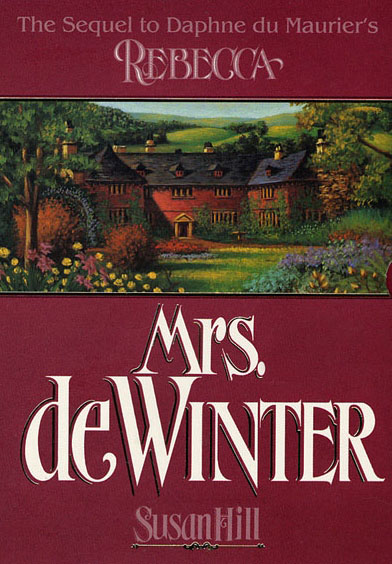
Mrs. de Winter by Susan Hill ~ 1993. This edition: William Morrow & Co., 1993. First edition. Hardcover. ISBN: 0-688-12707-x. 349 pages.

My rating: 3.5/10.

This is a book for fans of du Maurier’s now classic, noire-romantic-suspense novel Rebecca; I suspect anyone else would be completely bemused. Would this be what is termed as “fan fiction”?

Mrs. de Winter started off reasonably promisingly, but quickly got tedious. Susan Hill was very conscientious about channeling du Maurier’s voice as preserved in Rebecca, but in my opinion the greatest weakness of the book is that she stuck to that voice too strongly, instead of taking the characters to the next level.

I give Hill credit for trying, hence the (generous) 3.5 rating, and it is obvious that she holds Rebecca in great esteem, but I found this sequel ultimately boring and very depressing – wait! – no! – not merely depressing – downright sad is a better description. It was also about two hundred pages too long for the content, and very wordy and repetitive. The plot was contrived and unbelievable, and the ending, quite frankly, was deeply disappointing.

Rebecca ended on a tragic note, too, but it was a fitting conclusion to what had come before, and is likely one of the reasons why the story is so highly regarded. I tend to agree with those who say that Rebecca is du Maurier’s masterpiece. It is very much a polished and completed piece of work, and decidedly a stand-alone book, and a sequel written by another author should then at least be creative and take us in a new direction – “What if?” This just didn’t happen here. And that’s really too bad, because from what I’ve heard, Susan Hill can write.

*****

Mrs. de Winter continues the story that du Maurier so teasingly but perfectly tied up in 1938 in Rebecca. Fifty-five years later that book is still so widely read and admired that a sequel by a contemporary author comes in for much discussion and is greeted with high hopes. Interesting and cleverly imagined sequels are occasionally created on the coattails of classic novels, but they are rare creatures. Sadly this particular attempt was, in my opinion, quite decidedly a “miss”.

In Susan Hill’s take, Maxim and the first person narrator, his second wife so famously left unnamed in Rebecca, have not seemed to grow or emotionally develop in the ten years subsequent to the burning of Manderley. If anything, they have degenerated.

At the close of Rebecca, the second Mrs. de Winter has found a new maturity and confidence and faces her future with fortitude and a certain stubborn grace. Maxim himself has become a much more likeable character as he unbends enough to confess his failings to his new wife; their marriage looks like it may actually work, having weathered the storm of the murdered first wife and the malicious Mrs. Danvers and her revengeful arson.

In Mrs. de Winter, Maxim comes across as a boring, immature, moody manic-depressive, and his wife as just plain pathetic: still dowdy and unsure of herself, and acting much younger than her age. No wonder Maxim walks all over her, in this re-interpretation, even more so than in the original – she’s a true “Kick-Me-Charlie”.

Spoiler alert, for both Rebecca and Mrs. de Winter. If you want to be surprised, stop reading now.

Mrs. de Winter starts with a funeral in England. We don’t immediately know who has died; we find out on page 20, after much long-winded scene-setting and flashbacks, that it is Maxim’s sister, Beatrice.

It is now ten years after the burning of Maxim’s family estate, Manderley. As those of you who have read Rebecca will remember, Maxim has been emotionally scarred apparently beyond recovery by the whole saga of first having murdered his lovely but secretly treacherous first wife, Rebecca, and then narrowly escaping justice. Rebecca’s death has been officially recorded as a suicide, and Rebecca’s devoted ex-nanny, Mrs. Danvers, has set fire to Maxim’s beloved house in revenge – she knows the truth. Maxim has confessed all to his young second wife, and she in turn has forgiven him everything in her relief at finding out that Maxim is not still in love with his first wife, as she has been mistakenly thinking all along. (Interesting that Maxim can quite calmly deal with being a murderer, but the loss of his palatial estate sends him over the final edge. Not the most admirable of characters, when one steps back for some perspective, to put a house ahead of a human life, but in the original he shows enough character to allow us to conditionally forgive his numerous sins.)

The two have gone to live in Europe, to escape all the apparent gossip that is being generated by the complicated tragedy. Though Maxim is widely viewed as a bereaved husband and not a murderer, he is such a sensitive type that even a whisper about Manderley or Rebecca apparently gives him the jim-jams. His second wife meekly caters to his neuroses.

As the sequel begins, the second World War has just ended. Maxim and second Mrs. de Winter have apparently spent the war years safely ensconced in Switzerland. Maxim has no intention of going back to England, even for his sister’s funeral, but Mrs. de Winter convinces him that he must. It seems that she is dreadfully homesick and welcomes the chance to return to her homeland, even if the reason is the pathetically tragic death of a beloved wife and mother.

They get there, see Beatrice buried, and are reluctant spectators to her widower Giles’ deep distress. There is a terribly disfigured war hero son about as well. For a while I thought that was going somewhere, but it was a dead-end – he is merely part of the background colour. A mysterious funeral wreath appears, seen by Mrs. de Winter alone – the card is signed with dead(!) Rebecca’s signature initial. Oh my! What could this mean?! The note is hidden, but naturally not destroyed – and we know that it’s going to cause trouble later. (Cue foreboding music.)

Maxim is ready to head back to Europe, but Mrs. de Winter begs to stay in England for a while. He half-heartedly agrees, but pouts enough so that his wife starts viewing him with a certain distaste. After all, she has been a willing silent partner in his great deception, and has put up with his moody behaviour these past ten years. All she really wants to do is find a quiet corner in England, settle down and have a few babies.

Many pages pass. Eventually Maxim surprises his wife with the news that he has bought her a small country house. La la la – life is looking up! Mrs. de Winter sneaks away to London to inquire of a gynecologist why she’s not getting pregnant, which is kind of a strange little side story because I thought the implication in the original story was that Maxim chose to remain childless, so I’d assumed they were actively practising some sort of birth control. There were condoms in the 1940s, were there not? Well, according to Ms. Hill, Mr. and Mrs. de Winter were unable to have children due to bad luck, not from human preventative measures. The doctor tells the Mrs. that she’ll get pregnant once she learns to relax and be happy, and she is so thrilled by this she prances straight off home intending to break the good news.

But wait! Suddenly there appears on the scene the wicked Jack Favell, Rebecca’s cousin, who immediately announces his intention to blackmail Mrs. de W. With what I’m not quite sure. (My attention was wandering a fair bit at this point.) So much for less stress! Darn, no baby for you, Mrs. Maxim. (Yes, I’m being very facetious. I was strongly annoyed at the author by this point, and no longer enjoying the book in any way, shape or form.)

More pages about this and that. Shades of the Manderley costume ball in the original book – there is a party. Jack Favell shows up but is shot down. (Figuratively, not literally. Luckily for Jack, Maxim doesn’t have a firearm handy, as he did when Rebecca annoyed him severely in her turn.) Mrs. Danvers also shows up, but is coldly dismissed by Maxim. After the party, Maxim is all sad and angsty. “It is justice!” he moans, and proceeds to exit the scene and drive fatally into a tree.

The ashes are scattered, predictably, into the ocean off the coast of Manderley.

The book is gently put down, contrary to inner impulse. It is, after all, a library book, and we must return it in good condition.

Ick. Ick. Ick. Ick. Ick.

Why did I think this would be a desirable read?

Not recommended.

Read Full Post »

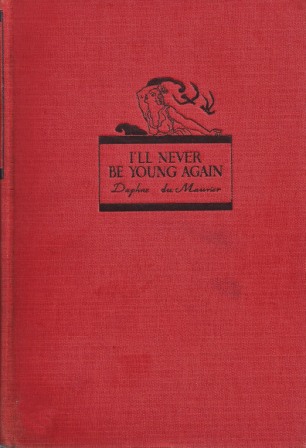
I’ll Never Be Young Again by Daphne du Maurier ~ 1932. This edition: Sundial Press, 1941. Hardcover. 336 pages.

My rating: 8/10 for most of the writing – the woman could certainly put words together, though she falters here and there – see the last paragraphs of the book which I’ve included at the very end of this review – and 4/10 for the plot and characterizations. Averaged out, that makes 6/10, which is still too high, so I’m going to give it a 5/10. Brutal, I know, but it is that hard to read.

I wanted to like this book so much, and was so thrilled when I found it. It starts off so very well, but soon turns into a long, very slow motion (think frame by frame slow) train wreck. I no longer wonder why this title is one of the unremarked silent members of Daphne du Maurier’s otherwise mostly stellar bibliography.

If it were anyone else but Dame Daphne, I would have pitched it about a quarter through, if not sooner. As it was, it took me a very, very long time to work my way through it. Only its nagging presence on my “What I’m Reading” sidebar kept me coming back for more punishment.

*****

The book, Daphne’s second (the first is The Loving Spirit, which I know I have somewhere but seem to remember having set aside many years ago as “unreadable” as well – I need to find it to refresh memory) was published when she was only twenty-four, so we have to give allowances for that. From my own advanced age – okay, I’m not that old, but twenty-four is half a lifetime away for me now – a book written by a twenty-four year old and titled I’ll Never Be Young Again is somehow more than a little ironic.

After finishing, I sat for a while thinking, “Was it the book or was it me? Did I just not get it?” So I did what I always do in cases such as this – I googled other bloggers’ reviews. And look what I found! I’m not alone! Someone else thought the very same thing. (Though she only gave it a 4/10. Ha! – take that, Doleful Dick, you whingy whiner.)

Therefore I have totally copped out and shamelessly stolen this review from Books I Done Read  (tagline: Reading books so you don’t have to) which is a totally awesome, very busy (in more ways than one – you’ll see what I mean when you visit it) little production. I love it. Raych forthrightly says what we’re all secretly thinking. Spend the time on her blog which you would’ve spent crawling through du Maurier’s non-opus, and you’ll be much happier. Says me, from first hand experience of both.

January 28, 2011

This was a difficult one to read.  It has those sort of circular, Catcher-in-the-Rye conversations where the point is not the content but the banality, which makes for good social critique but sloggery reading.  And it’s maybe 99% dialogue, because nothing happens.

Ok so.  Dick is the son of a famous author-slash-shitty father and, not having accomplished anything worthwhile by the ripe old age of maybe 21, Dick is on a bridge about to throw himself off when Jake happens by and is all, Don’t do that.  Exciting! you think.  And then on to page seven, where Jake and Dick go hire horses and ride through the mountains and the fjords for chapters and Jake tries to buck Dick up because Dick is sort of a whiner.  Somewhere in there Dick sleeps with a girl and it is disappointing for everyone involved.

Jake exits scene left about halfway through the book via Unexpected Oceanic Death and Hesta enters, with her large eyes and orange beret, and she and Dick shack up.  And this is where the whole thing gets seedy.  Daphne wanted to write about the uncomfortable relationships between men and women, and she nailed it because this is The Worst.  Dick spends ages trying to convince Hesta to let him nail her, complete with sulks and professions of love and more sulks.  After he finally wears her down he’s all *phew* Now that I’ve had you you can give up your music and come live in my flat with me and I will ignore you while I write the Great English Novel.

So it goes.  After a while (months, say) Hesta is like, I’m bored.  Remember how we used to…you know.  And Dick, who has been busily writing a novel (and a play!  Both sure to be hits!) all this time is like, ‘You mustn’t…you musn’t be like that.  It’s ghastly…it’s making a thing of it, it’s – it’s unattractive.  It’s all right for me to want you, but not for you – at least, never to say.’  Ugh, right?  So that when he goes to London to sell his novel (and play!) and his dad’s publisher is like, I’m sorry, but these are terrible, and he comes home to find that Hesta has left him for literally anyone else you’re all, Huzzah!  Oh and also, The end.

I feel like I need a shower.  It’s We Need To Talk About Kevin all over again.  Du Maurier succeeded in making me feel hideously uncomfortable which, while impressive, is also unpleasant.  I like my characters to be Good or Bad or a Mix but Something.  I don’t like for them to wander around listlessly with no real ideas and a too-large sense of their own importance alternated with a sort of whiny comprehension of how much they actually suck.

Very good, and very skillfully done, but I didn’t like it.

So there you have it. I will leave you with the closing lines of this story, which gives you a firsthand snippet of the banal monologue we’ve had to struggle through. Here’s Dick:

From my window I look down upon the little square. The trees are green in the garden opposite. There is the clean, fresh smell of an evening after rain. Somewhere, on one of the branches of the trees, I can hear a bird singing. A note that sounds from a long way off, sweet and clear, like a whisper in the air. And there is something beautiful about it, and something sad. At first he is lost, and then he is happy again. Sometimes he is wistful, sometimes he is glad.

He seems to be saying: “I’ll never be young again – I’ll never be young again.”

“I’ll never be young again.” Thank heaven for that. Because once she got this one out of her system, Daphne went on to write her next book, The Progress of Julius, which I absolutely adore, and then Jamaica Inn, and Rebecca

Growing pains. So glad she made it through!

Read Full Post »

« Newer Posts - Older Posts »