Archive for the ‘Century of Books – 2014’ Category

please don't eat the daisies jean kerr 001Please Don’t Eat the Daisies by Jean Kerr ~ 1957. This edition: Doubleday, 1957. Illustrations by Carl Rose. Hardcover. 192 pages.

My rating: 8/10.

I’ve had this book kicking around for years, as you can see from the sad state of its dust jacket pictured over there on the left (now covered with crinkly, shiny Brodart Just-a-Fold, one of my happier recent personal library improvement initiatives), and I re-read it with pleasure every so often. The only thing keeping it from a 10/10 rating is that it is too darned short; we never really get to settle down into it; it’s over and done with much too soon.

Jean Kerr lightly channels Shirley Jackson (the domestically-focussed SJ of Life Among the Savages versus the darker fictions, I hasten to add) and shines a cheerful and mildly sarcastic light on her own marriage and the goings-on of her four young sons.

Jean was always interested in the theatrical arts, and upon graduation from college, married one of her drama professors, Walter Kerr, who later became a prominent stage and film critic. The Kerrs dabbled in playwriting, producing a series of not terribly successful efforts, but having much more success with writing material for revues.

Jean Kerr did eventually have a hit, with the 1961 Broadway comedy Mary, Mary. She also wrote humorous essays which were published in various periodicals, such as the Ladies’ Home Journal and The Saturday Evening Post. Please Don’t Eat the Daisies is a compilation of these essays, and was followed some years later by other collections: 1960’s The Snake Has All the Lines, 1970’s Penny Candy, and 1978’s How I Got to Be Perfect.

Somewhere in the middle of Daisies, the Kerrs buy a house. Not just any house, but an eccentrically designed and decorated Larchdale, New York mansion formerly owned by a compatriot of Henry Ford, one retired inventor, world traveller and stuff collector, Charles B. King. King incorporated such features into his “fairy tale home” such as carved ceiling beams and a dining room floor made of planks from a retired paddlewheel steam ship, the door of ST. Gabriel’s Church, a clock tower, and a thirty-two bell courtyard carillon (connected to a clock in said clock tower) which played the duet from Carmen every day at noon.

The Kerrs found the house bizarrely irresistible, and persisted in their efforts to buy it from the trustees of the King estate, who could not agree on a reasonable asking price, until a fire destroyed one of the wings, and the price dropped to a level the Kerrs could manage.

For anyone interested in taking a peek at the house of the book, here is a link to an article and a slide show of a tour of the building prepared when Jean Kerr’s sons put the building up for sale in 2003, after it had been in the family for 58 years:

http://larchmontgazette.com/2003/features/20030318kerrhouse.html

Please Don’t Eat the Daisies caught the spotlight in 1960 as it was used as the basis of a romantic-comedy movie by the same name starring David Niven and Doris Day, and then a 1965-67 television sit-com based very loosely on the Kerr ménage and their unique home.

While I enjoy Jean Kerr’s on-page persona as a harassed mother of many (she eventually had six children, including one set of twins) I think my favourite essays in Please Don’t Eat the Daisies are the parodies of literary works. Stephen Vincent Benét’s sombre poem John Brown’s Body is presented as a readers’ theatre piece entitled Don Brown’s Body (starring Mike Hammer and set amongst the gangsters), while Francoise Sagan’s  A Certain Smile inspires Jean Kerr’s brutally funny mockery, Toujours tristesse. These two essays make the book for me; the Kerrs’ revues, if they were anything like these, must have been an absolute joy to attend.

A very clever lady, behind that “I’m just a harried mom who happens to write on the side” literary disguise.


Read Full Post »

case of the shoplifter's shoe erle stanley gardner 001The Case of the Shoplifter’s Shoe by Erle Stanley Gardner ~ 1938. This edition: Pocket Books, 1945. Paperback. 230 pages.

My rating: 6/10

Checking out several of the websites dedicated to Erle Stanley Gardner and his lifework, I made a quick count of the Perry Mason titles listed and came up with an incredible 85+, dating from 1933 to 1969, with several published posthumously – ESG died in 1970 – all with names prefixed The Case of –  the Fan Dancer’s Horse, the Black Eyed Blonde, the Drowsy Mosquito, the Crying Swallow, the Vagabond Virgin… you get the drift.

Add to these the numerous other short stories published in the pulp fiction periodicals of the first half of the 20th Century, and the books written under various pseudonyms – A.A. Fair, Kyle Corning, Charles M. Green, Carleton Kendrake, Charles J. Kenny, Les Tillray, Robert Parr – plus various novelettes, compilations and non-fiction articles, guides and memoirs, and suddenly the designation “prolific” seems to not be quite accurate enough. This guy was hyper-prolific.

And with that comes the all-too-understandable label of the “formula” writer, which there is no doubt applies accurately here.

I had once or twice dipped into ESG’s mysteries – or perhaps more accurately, “procedurals” – but they never really took. However, using the excuse of the Century of Books project and the serendipitous acquisition of this wartime issue Pocket Book – “Share this book with someone in uniform” requests a blurb on the back cover; “Books are Weapons in the War of Ideas” on a front endpaper – I decided to give Gardner one more chance, to see if I dismissed him too readily before.

Nope. Still not a fan. Though I can see the appeal, and it wasn’t a chore to read, exactly. Just a bit boring, and not very “deep”, even for something of this “light entertainment” genre.

Here’s the plot description of this particular episode in the ongoing adventures of Perry Mason, lawyer and self-styled investigator and champion of the wrongly-accused:

Perry Mason’s chance encounter with the benign looking, white-haired shoplifter, Sarah Breel, involved him in one of the strangest murder cases of his career. The mysterious disappearance of Mrs. Breel’s brother, of five valuable diamonds, and then of Sarah Breel herself, set Mason to some investigating that didn’t please the police. Then Mrs. Breel reappeared, victim of an automobile accident, with an unaccounted-for blood stain on her shoe, and a gun in her bag. When Austin Cullens, who knew about the diamonds, was found murdered by a bullet from this gun, the police discovered that in addition to a broken leg, Mrs. Breel was suffering from amnesia, and Perry Mason became attorney for the defense with a client who could not – or would not – give him any clues at all.

Luckily Mr. Mason has a wide circle of dedicated helpers who are willing to go to any lengths to assist our fearless investigator, such as his luscious secretary Della Street, pet detective Paul Drake, and tame doctor Charles Gifford, all of whom go above and beyond at the mere crook of Perry Mason’s finger.

Several bodies pop up, a hysterical woman or two, a cool sophisticate with a secret, stray gamblers and jewel thieves, to supply the story with a lavish amount of pinkish herrings and some sketchy side plots which are never really developed. It all ends in a big courtroom scene, where Perry Mason hypnotizes his opposition with his keen wit and suddenly revealed secrets.

Yawn.

I’m sticking with Rex Stout and his creations Nero Wolfe and Archie Goodwin for my fallback formula mystery/investigator stories. (And even those are rather uneven, I’ll readily admit.)

The Perry Mason saga has its merits, not least of all the snippets of period detail, the slang and the clothes and the food and the drink and the MANY references to tobacco products throughout – these people went through a lot of the Demon Leaf – no wonder the men all have hoarsely sinister voices and the women husky whispers.

I had a giggle at the descriptions of the meals, too, and a bit of a blush for Della Street’s forthright concern for her lovely figure. Here are Della and Perry bantering as they sit down for an unplanned lunch at a department store tea room, where they’ve gone to shelter from a sudden rain storm.

“Well, Mr. Mason, since you’re buying the lunch, I’m going to make it my heavy meal.”

“I thought you were going on a diet,” he said, with mock concern.

“I am,” she admitted, “I’m a hundred and twelve. I want to get back to a hundred and nine.”

“Dry whole wheat toast,” he suggested, “and tea without sugar, would…”

“That’ll be fine for tonight,” she retorted, “but as a working girl, I know when I’m getting the breaks. I’ll have cream of tomato soup, avocado and grapefruit salad, a filet mignon, artichokes, shoestring potatoes, and plum pudding with brandy sauce.”

And she does.

Aha! – that’s it! Nero and Archie have rather better sounding food!

Now I’m just being silly…

Well, that’s that for Erle Stanley Gardner. I doubt I’ll be seeking any more of these out, though I’ll happily read them in anthologies and if stuck somewhere with no other reading matter handy.

Onward.

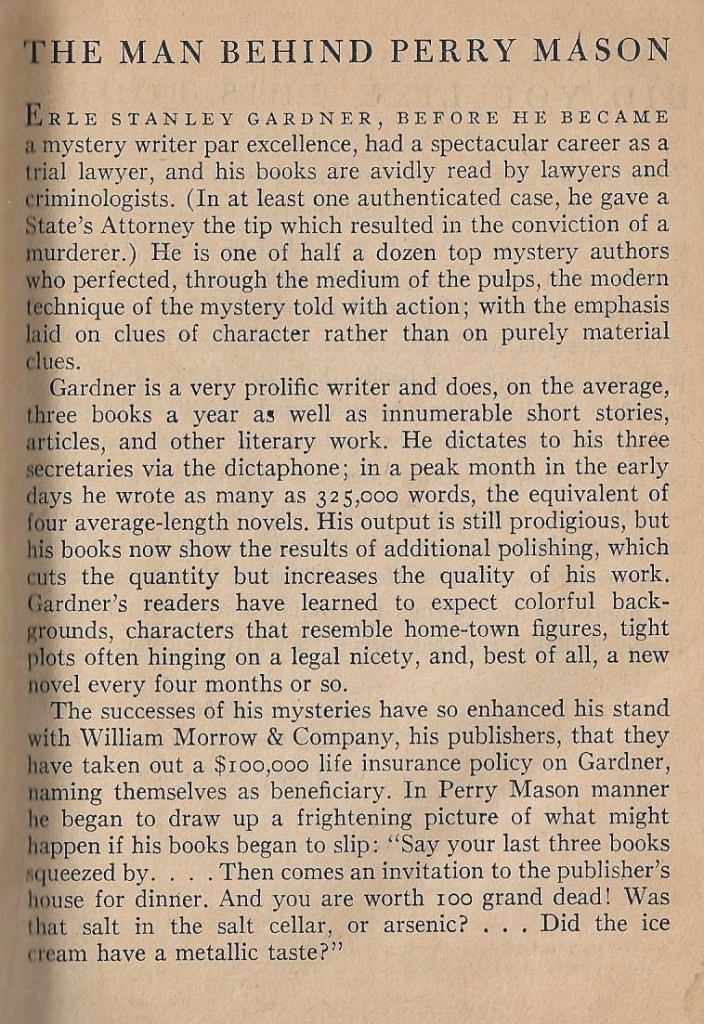
One last thing. Here is the page scan from my old Pocket Book with the publishers being all clever and smugly humorous about their best-selling author:

case of the shoplifter's shoe author bio erle stanley gardner 001


Read Full Post »

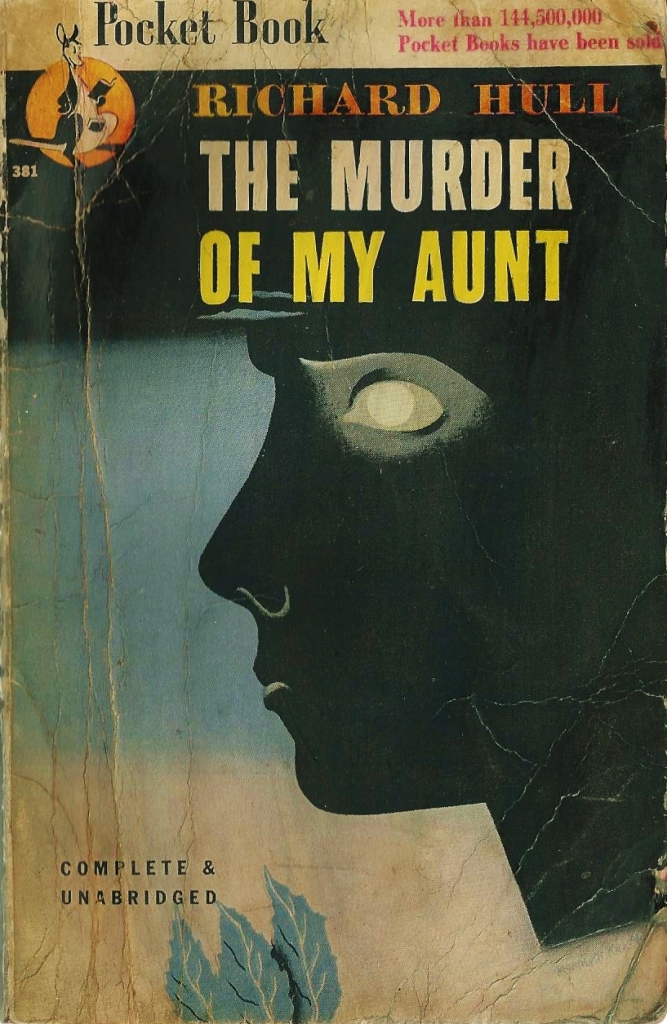
the murder of my aunt (v2) richard hullThe Murder of My Aunt by Richard Hull ~ 1934. This edition: Pocket Books, 1946. Paperback. 184 pages.

My rating: 8.5/10

Absolute piffle, but great fun. If I might be so bold, I propose this as a “must read” for lovers of vintage crime fiction and Wodehousian-style humour alike. A deliciously nasty little tale which defies fitting neatly into its possible genres in much the same way as its narrator dodges attempts to save him from himself.

Edward Powell has been raised by his aunt since the unfortunate (and apparently scandalous) double demise of his parents when he was but a wee tot. Childless Aunt Mildred is happily established at the family estate in rural Wales, but Richard has a hankering for a more sophisticated lifestyle, and is increasingly impatient with his aunt’s attitude that he should find an occupation and become self-supporting, rather than relying on her support.

Now, as spinster Aunt Mildred has no other heirs, Edward can one day expect to inherit her estate, which he fully intends to dispose of as quickly as possible, to facilitate departure for some place more appealing to his sensibilities. Perhaps the Riviera…

But pesky Aunt Mildred looks to be good for quite a few more years. What if her nephew were to hasten her inevitable demise, combining it with a spot of revenge for all of her patronizing comments regarding his dilettante leanings?

As Edward attempts to bring about the “accidental” demise of his sole relative, he confides all in great detail to his private journal, which he keeps locked up between episodes of writing in a small safe in his bedroom. A safe which his aunt has given him. (Hint: Richard isn’t as bright as he thinks himself.)

And never doubt that Aunt Mildred may have a few tricks up her own sleeve…

A nice fast read, and a fine vintage diversion for a quiet evening or a blustery day.

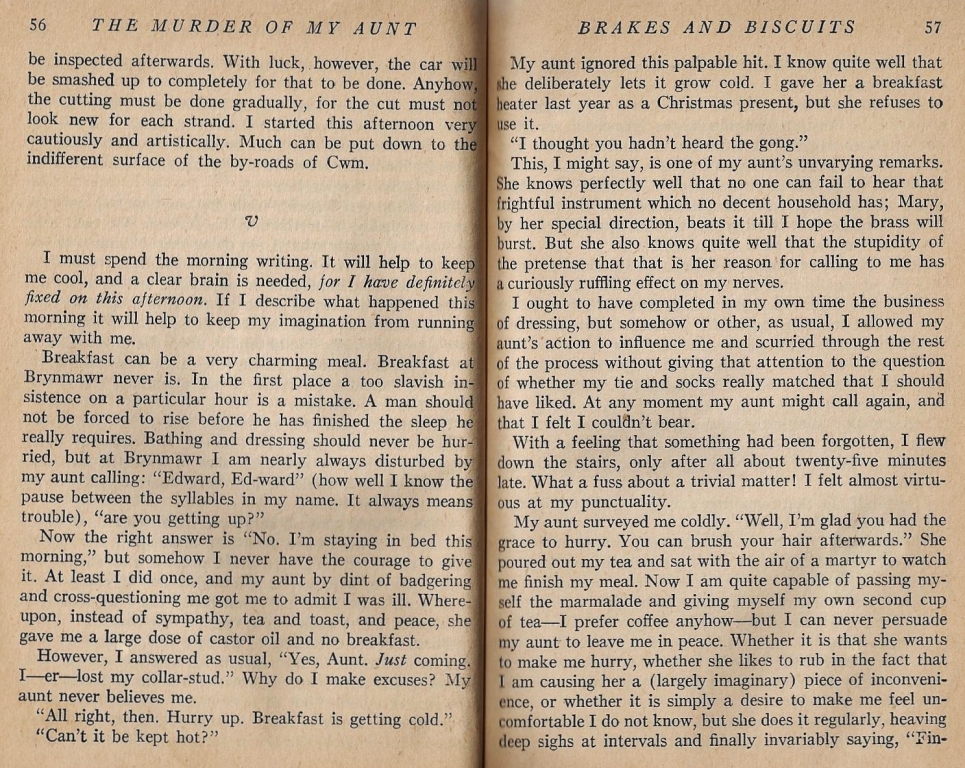
Here’s a sample. (Click the image to enlarge in a new window.)

the murder of my aunt excerpt richard hull 001


Read Full Post »

the shapes of sleep j b priestley 001The Shapes of Sleep by J.B. Priestley ~ 1962. This edition: Granada, 1981. Paperback. ISBN: 0-586-05201-1. 190 pages.

My rating: 5/10

Close call, J.B. You almost didn’t make that 5, but my enduring fondness for your many years’ worth of earnest and good-humoured novels and essays and memoirs tipped the balance.

This is not so much a baddish book as a terminally undecided one. It reads like the author can’t quite decide on some rather major plot developments so has decided to make it up as he goes. Which can work, but in this case means false starts, dropped threads, and a general lack of a sturdy backbone to build the story upon.

And J.B. Priestley has tried his hand here at writing sexy, but it reads very much like the author is extremely uneasy with the style, and the hands-on-breasts and rigid (or not rigid) nipple descriptions are much more embarrassing for the reader than titillating. At least I found them so. I absolutely cringed, and mostly because it made the writer look inept and out of his comfort zone, style-wise. This is Priestley, after all, and you’d expect a higher level of capability in handling a scene. Any sort of scene.

Following closely on the heels of 1961’s uneven “suspense-thriller” Saturn Over the Water, Priestley further experiments with the genre, using the action to sugar coat some intellectual musings about the continual deterioration of societal mores, the dangers of state-sponsored paranoia (this is smack dab in the middle of the Cold War), and the status of women inside and outside of marriage. There are some fairly substantial shades of proto-feminism here, with Priestley trying his darnedest to articulate his support and appreciation for the “other side” from his masculine point of view.

So, regarding the actual story.

Here we have a freelancer journalist, Ben Sterndale, on the declining end of what was apparently a stellar career. He is offered a small job which will require him to use his investigative skills rather than his writing ability. A pale green piece of paper covered in mysterious figures and foreign handwriting has gone missing from an advertising agency office. Strayed or stolen, it is wanted back. Luckily there is a tiny corner of the paper left behind, with a few word ends which Ben interprets to be of German origin, and the investigation is on.

People with guns and sinister accents pop in and out, as well as a female person who is rather obviously not what she seems. Ben tenaciously follows every little lead, and by a combination of sheer bullheadedness and a fair bit of luck (courtesy our old fictional friend, the blissful coincidence) tracks down the secret behind the green paper as well as the girl.

A Helen MacInnes-like hectic tour of Germany plays a central role in the story; Ben-voiced-over-by-Priestley does not care for the Germans much – as I already sort of had gathered from his (Priestley’s) jibes in Saturn Over the Water – which adds an uneasy element to his adventurings in that country.

The mysterious paper and the secret it holds the key to are the least important thing going on here; so much so that even when we get a firsthand description of the “shapes of sleep” and their sinister inferences (spoiler: this would apparently be brainwashing and social engineering, to be delivered via subliminal messaging/advertising), we can’t quite believe that they are worth killing and being killed for, and they fade away completely in the last scene of Ben/Priestley mulling over the deteriorating state of the world and the changing status of women and their vital importance to future “peace and prosperity.”

I couldn’t help but wonder how much of this was due to Priestley’s private life influencing his writing. When The Shapes of Sleep was written, Priestley was sixty-eight years old, and just a few years into his third marriage, with archeologist/researcher and fellow writer (and Priestley’s co-writer in their 1955 collection of travel and opinion essays, Journey Down a Rainbow) Jacquetta Hawkes.

All in all, a rather unsatisfactory book, mostly interesting to this “fan” to enable me to check off another entry in Priestley’s widely-varied oeuvre. I may read it again one day to see if my impressions can be revised; then again, I may not.

Here, see Kirkus for its take, from June 15, 1962. I was amused to read this briefly cynical review after I had formulated my own, and to see that I was not alone in my disenchantment regarding this novel.

An uneven writer is our Mr. Priestley; one scarcely knows what to expect. This time as in last year’s Saturn Over the Water he has turned to suspense and an international spy story, but has fallen down in two aspects that made Saturn engaging reading. He never in this new book sets his scene so that the reader becomes absorbed in atmosphere and mood. Nor – on the story line – does he hold to a central thread that, intricate as the windings may prove, goes from Point A to Point B. This time he substitutes motion for action. His newspaperman, with a keen scent for the unusual, jumps from London to the Continent, from town to town and back again in Germany; but somehow he seems to be chasing his own tail, and even the near misses of danger peter out. Finally, there is a touch – just a touch – of the element of mysticism, which characterized his The Other Place back in 1955. And this too somehow dissipates the effect. And the injection of some random sex and a romance in which one cannot feel too involved does not add to the sense of unity demanded.

Read Full Post »

greenwillow hc no dj b j chute 001Greenwillow by B.J. Chute ~ 1956. This edition: E.P. Dutton, 1956. Illustrated at chapter headings by Erik Blegvad. Hardcover. 223 pages.

My rating: Oh, what the heck. It was unexpected, but I mostly loved this one. 9.5/10.

A novel being the story of a village beyond the boundaries of time, no exact location, where people who are kinder and happier than we can be, and whose lives are linked to the rhythm of the seasons…

In the nebulously located village of Greenwillow, the Reverend Lapp preaches hellfire, damnation and the eternal loss of the souls of babies who die before being baptised, and though they stick a bit on that last concept, by and large his congregation puts up with him reasonably cheerfully. And when a certain Reverend Birdsong shows up, sent, so he says, “by the Bishop”, and accompanied by an upside-down umbrella full of hawthorn blossoms, the two preachers compromise by sharing the church, though they cannot bring themselves to share doctrine.

Reverend Lapp sees the Devil everywhere and is an authority on his pervasive influence; Reverend Birdsong is a bit vague on such details, preferring instead to concentrate on the God-given wonders of nature, and by extending encouraging approval to young lovers, kittens and the cultivation and appreciation of flowers.

Both Reverends take an interest in the family of Amos Briggs, famously of a wandering nature, who appears every year or so for a few days, just long enough to give a start to the next addition to the ever-increasing family of young Briggs who scrabble about on their poor but promising farm. The eldest Briggs child, Gideon, lives under the cloud of the family curse: that the first son of the first son will at some point in his young life hear the mysterious “call” and will drop everything and head off into the unknown, abandoning family, friends and livelihood to roam the wide world over –

…hoeing man laid down his hoe, digging man laid down his spade, reaping man laid down his scythe…

Gideon is working frantically to have the farm in a viable condition to leave in the care of his younger siblings when his call comes. He’s also determined to break the family curse once and for all, for though he’s resigned himself to his own fate, he is firmly determined not to marry. He’ll not to leave behind a wife as his own dear mother has been left, though she is gently complaisant with her fate, never losing her original love for her wayward spouse and welcoming him with eager arms for the few days he reappears every year or two. Most of all, Gideon is determined not to have any children of his own.

Which complicates things exceedingly when Gideon meets the eyes of a sterling-natured village maid, one Dorrie – an accomplished cook from a tender age, lover of the afore-mentioned kittens, and of children, in particular the Briggs young ones, which aids in moving the mutual attraction up a notch or two. ) Dorrie is more than ready for a home of her own, and when the two admit their love to one another, we are almost convinced that Gideon will break his personal vow not to ever wed.

Lapp preaches thunder and damnation to Gideon, warning him against heeding the call of the Devil; Birdsong cocks his head sideways and doesn’t say much but exudes encouragement; neither appears to have any influence on Gideon, to sway him from his stubborn (and rather tiresome) insistence that his fate is sealed.

But we have an inkling that it will all come round right in the long run, and it does, though not without a lot of side plots and interferences by all and sundry of the (mostly) well-intentioned villagers and rural folk.

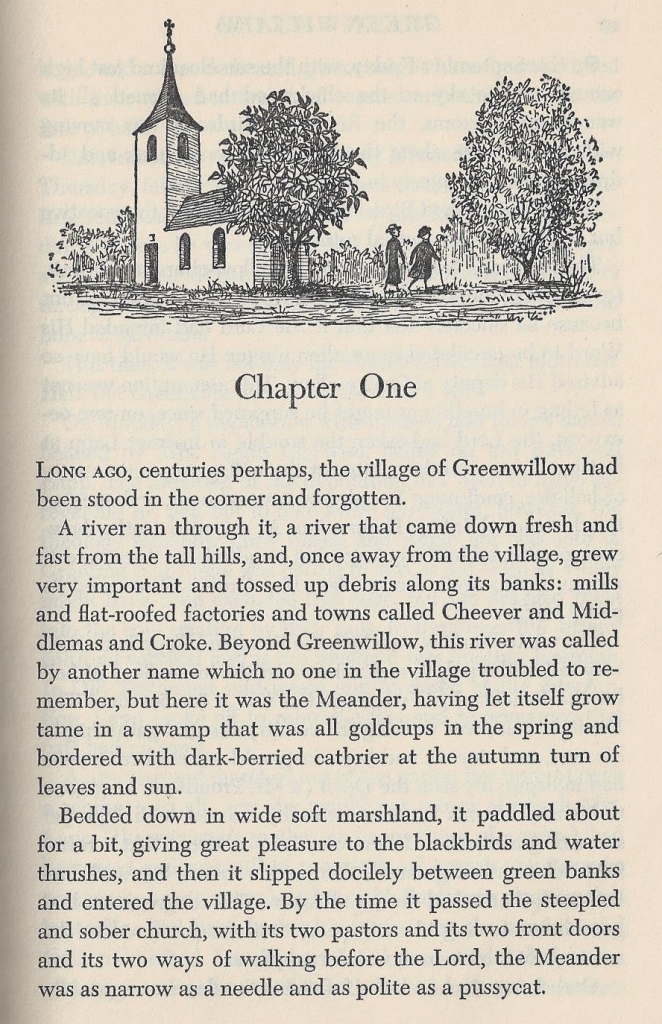
greenwillow page scan page 1 b j chute 001

Did I say “charming” yet? Well, it is. And deeply so. A book I had no previous knowledge of, and which surprised me by its likeable fairy tale atmosphere, and by its assortment of stock rural characters – both human and animal – all with unexpectedly diverting quirks.

This B.J. Chute is rather an amusingly lyrical writer, I concluded well before the happy end of Greenwillow. And this is what I discovered about her. For it turned out to be a her, not a him, as I had somehow assumed. And it also turned out also that I was already acquainted with one of the family, as it were, for B.J.’s sister turns out to be Marchette Chute, historical biographer and children’s author and poet. Who knew?!

From the dust jacket of the first edition of Greenwillow, found pictured online. (My copy is sadly missing its jacket.)

B.J. Chute was born of an American father and an English mother, and she spent most of her life at a country home in Minnesota named “Hazelwood.” There she and her two sisters became familiar with animals and birds and trees., and in their spare time they all made a hobby of writing. In the end all three became professional writers, for one sister, M.G. Chute, is well known for her Saturday Evening Post stories, and the other, Marchette, for her biographies of Chaucer, Shakespeare and Ben Jonson.

B.J. Chute, who is Joy to her family and friends, has written many short stories for major magazines, and this is her third novel. She wrote Greenwillow in a style that would not tie it down to any country or any period, but it was because she was brought up with woods and fields and country people that she knows them so intimately and can write about them so well. Her delight in people is just as evident now that she lives in New York, and in her spare time she does volunteer work with the Police Athletic League and in a shelter in Harlem for temporarily homeless babies.

And from her obituary in the New York Times, September 15, 1987:

Beatrice Joy Chute, a novelist and short-story writer who was also a past president of the PEN American Center and taught for many years at Barnard College, died of a heart attack Sept. 6 at Bellevue Hospital Center. She was 74 years old and lived in Manhattan.

Miss Chute, who was born in Minneapolis in 1913, published her first story in 1931. She wrote many stories for and about adolescent boys for Collier’s, The Saturday Evening Post and other magazines during the 1930’s, and her first book, ”Blocking Back,” was published in 1938. Many of her early works, such as ”Shattuck Cadet” (1940) and ”Camp Hero” (1942), were realistic tales of sports and camp life that captured the relationships and slang of her primarily male teen-age heroes.

Although she continued to write short stories for children and adolescents in the 1940’s, Miss Chute began to concentrate on adult fiction with ”The Fields Are White,” a 1950 book about marriage and manners.

discovery. It was made into a Broadway musical in 1960. Subsequent works included a 1957 anthology called ”The Blue Cup and Other Stories,” ”The Story of a Small Life” (1971) and ”Katie: An Impertinent Fairy Tale” (1978). Her most recent novel, ”The Good Woman” (1986), was a parable about a lonely woman who abandons her home for a journey of spiritual awakening while living on the streets.

Miss Chute – who preferred to be called Joy and signed her books B. J. Chute – moved to New York in the early 1940’s with her mother and two sisters. Over the years, she did volunteer work with poor children and the Police Athletic League. She became an adjunct professor of English at Barnard College in 1964, and taught creative writing there until her death.

She was also director of Books Across the Sea, a division of the English-Speaking Union that promoted American books overseas, and was an active member and one-time president of the American chapter of PEN, the writer’s association.

Provenance, my edition: Rotary Club Book Sale, Williams Lake, B.C., February 2014. Inscription: “Irene Ringland”. First edition, no dust jacket.

Read Full Post »

lady in waiting rory gallagher 001Lady in Waiting: An Intimate Journal of a Labor of Love by Rory Gallagher ~ 1943. This edition: Stephen Daye, 1943. Hardcover. 243 pages.

My rating: 6.5/10

My oldest child turned twenty yesterday, and it gave me a surprisingly sharp shock to realize that two decades had passed since that white-knuckle after-midnight drive to the hospital an hour away where our first-born was ushered into the world in a memorable – at least to me! – fashion.

All those clichés are true, by the way, especially the one about the instant rush of love one feels upon holding your newborn child, and even more so the one about you never being free from a continual background hum of worry ever again. Not to mention the whole “time passing like the blink of a moment” thing…

So this book was an apt choice for some light reading last night, after the person-in-question casually breezed in to eat his cake, deposit his laundry in a heap beside the washing machine, and honour us with his welcome presence for a few days, before his next jaunt off into the wild blue yonder.

Oh, twenty…  For with all of the very reasonable angsty worries of today’s “young adults”, they still have that marvelous thing, youth itself, and that’s a rather grand advantage in the great scheme of things, thinks me from my middle-aged perspective.

Well, enough about my own Mother Musings, and on to Rory Gallagher’s. Lady in Waiting is a 1940s version of the Mommy-lit of today’s jogging-stroller set, though it concentrates solely on the nine months of expectation and comes to a screeching halt upon arrival of Baby.

It’s funny enough, though the author works a bit too hard here and there as she plays out every twinge for maximum laugh-appeal, but there are enough moments of genuinely relatable ironic glee to keep it on my too-good-to-part-with shelf. A period piece, most definitely. Set in the eastern United States, where the author lives (as her story opens) in a pleasant (rented) two-hundred-year-old rural home along the Saugatuck River, during the mid years of World War II, with the expected adventures of coping with less than satisfactory maids and other upper-middle-class domestic mini-crises.

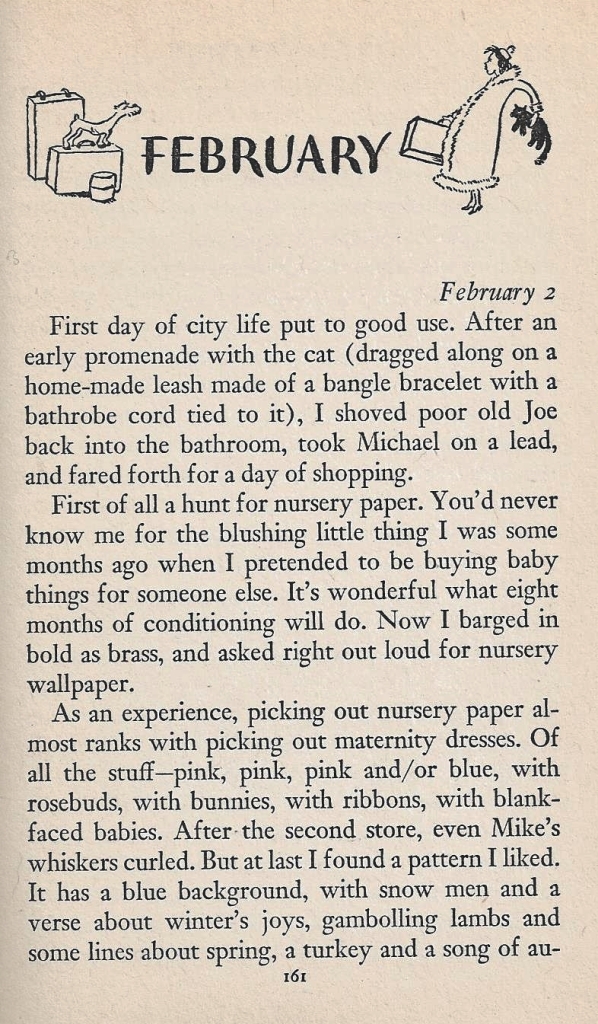
And that is all I’ll be saying about it, but I will add in several random page scans, plus this archived newspaper article I found in my internet cruise looking for more on the author. (I didn’t find much – the Rory Gallagher most recognized by Google being the Irish folk-rock singer.)

From The Times Recorder, (apparently) someplace in Ohio, July 19, 1943:

“LADY IN WAITING” by Rory Gallagher (Stephen Daye; $2.50.) Apparently the first baby is an experience from which no parent ever recovers. Each thinks of it as a unique experience, even as he talks over the impending event with neighbors who undoubtedly are going through the same experience exactly..For all the conversation, it seems true that no woman has recently put down a day by day account of the mystical nine months–none until Rory Gallagher came along with her “Lady in Waiting.”

Just why the author chose to use a pseudonym is a little vague, and since she has put her neighbors and friends in under their correct names (including me) I see no reason why Rory Gallagher should not be identified as Mrs. Patrick Dolan, Ruthie for short. The Dolans lived a mile and a half down the Lyons road from us, in Weston, Conn., while all of the events of “Lady In Waiting” were laid. If I had time, I should write a book of my own on having a neighbor have a baby. It would be almost as funny as Ruthie’s.

For “Lady in Waiting” is funny as well as physiological. It is brash, too, and has a swing that is peculiarly like its author. Mrs. Dolan-Gallagher has a terrific sense of humor, which might seem odd to the superficial, because she happens to be half Scottish and half German. She is tall and slender, and this provided her first difficulty–she was afraid she would “show.” She did, eventually. I doubt whether anybody ever broke the news to papa from a sitting posture in a parking lot but Ruthie did. Most gals take the pills the doctor proffers, but Ruthie didn’t. Mama is presumably the second to know the news, but Ruthie’s mama was not. The business of the morning horrors, the strange yearnings and so forth usually run a pretty definite course –but Ruthie’s did not. Prospective mothers, as a rule, pick inconspicuous places for their fainting spells, but “Jake’s” mother chose a Philadelphia dinner table manned by various butlers and such. So the last, and exciting day. I don’t think old ladies in tippets will approve, but a lot of people will think “Lady in Waiting” a row.

And here is the Kirkus Review take, June 21, 1943

With the birth rate running a high fever, this just might catch on. (I)t is a nine months’ diary, composite of the trepidations, small concerns and humiliations, and its share of girlish laughter. Daily cares and changes; the husband’s refusal to consider her as fragile as she thinks he should; the monstrousness of the paraphernalia; the Mein Kampf between morning sickness and appetite; the bluff nonchalance of the doctor; the small worries and large; and finally the advent of Jake, with no trouble at all, just as friend husband is off to the wars. Light handling of prenatal preconceptions and preoccupations.

lady in waitng exerpt 2 rory gallagher 001

lady in waiting excerpt brory gallagher 1 001

Read Full Post »

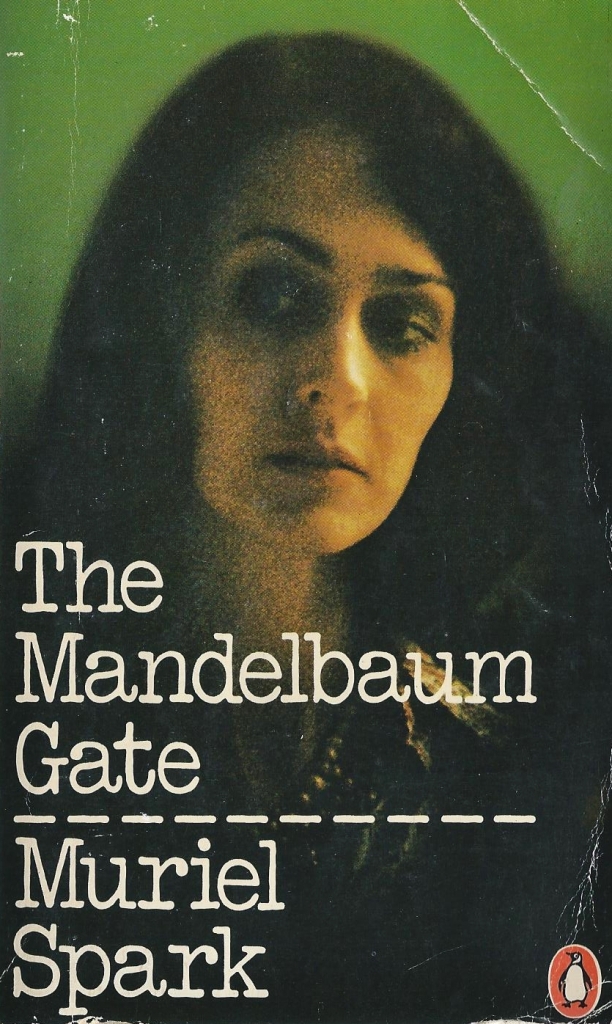
the mandelbaum gate muriel spark 001The Mandelbaum Gate by Muriel Spark ~ 1965. This edition: Penguin, 1977. Paperback. ISBN: 0-14-00-2745-9. 304 pages.

My rating: 7.5/10

Well, now, this one started out rather slowly but became increasingly enjoyable as I sorted out the many story strands the author tossed out and put names to characters and figured out how everyone knew everyone else and what the significance of all of the confusing references were. But it was toughish going for the first third or so. I’m glad I persevered – I almost didn’t.

For a long time I was afraid this was going to turn out to be one of those dismal and fatal tragedies, hearts all broken and dismal suicides and arbitrary deaths-by-misadventure – well, check out the sad face on the cover of my Penguin! – but the author graciously pulled a quickie on me there, resolving everything mildly and without bloodshed, except for one background character who perishes awfully far from the scene of the novel, and who we rather think deserves her nasty fate from what we’ve heard of her.

I liked this book. A lot. Which surprised me, because my expectations were low, after reading a number of dismissive comments regarding its place in the Muriel Spark canon on book blogs which are generally highly reliable indicators of “good” and “bad”.  Which just goes to show that one should remember that taste in books remains a nebulously personal thing.

I must be off and away again this morning, but I wanted to post something about this book and move on – my stack of “want to write abouts” is intimidatingly tall and I hesitate to add yet another. Drawing something of a blank on how best to frame this review, so I am going to refer you over to this excellent précis at Vulpes Libris, where Sharon Rob concisely identifies all of the important bits of this nicely complex novel.

A tiny excerpt here:

Protagonist Barbara is in her thirties, a Catholic convert from Judaism, (whose) status as a woman and a Jewish-Catholic one at that is one way in which Spark takes the thriller genre in hand and gives it a good shake. Barbara is gutsy, bloody-minded and heedless of other people’s opinions, but also committed to her own strong moral code. She is closer to the ideal of the intrepid hero than Freddie Hamilton, the novel’s central male protagonist…a fifty-something diplomat (who) in some ways is more of an archetypal female character than Barbara …who is bound by nothing she didn’t choose…

Barbara has decided, against all advice, to cross over from the Israeli-held side of Jerusalem to the Jordanian side through the titular Mandelbaum Gate, the “Checkpoint Charlie” of its place and time, in order to continue on a personal religious pilgrimage of the Holy Land. The fact that her fiancé, an archeologist working on the Dead Sea Scrolls dig in Jordan, is also “across the line” may or may not be a factor in her determination to put herself at serious risk (as a “person with Jewish blood”) and venture into forbidden territory.

Throw in Freddie’s well-intentioned attempts to save Barbara from herself, a Jordanian family of “fixers”, a couple of turncoat British spies, nuns, disguises, a scarlet fever epidemic, varied sexual liasions, the Catholic Church’s policy on valid marriages for its members, the sudden appearance of Barbara’s ex-roommate and ex-boss Ricky-the-scary-English-girls’-school-headmistress hot on Barbara’s trail, and – with chilling reminder of the atrocities of the Holocaust just past – the Eichmann trial (which Barbara attends as a spectator for a sobering afternoon), and you have a glorious muddle which eventually settles out into separate-though-interrelated strata and against all odds works.

Perhaps not a “typical Spark”, but as I haven’t read enough of her work to have a really good handle on what that even is – I have previously read with enjoyment The Prime of Miss Jean Brodie, though I failed to get more than a few pages in with Robinson – it struck me as quite good enough to make me keen to read some more of her novels and fill in the Muriel Spark-shaped gaps in this region of my reading history.

Read Full Post »

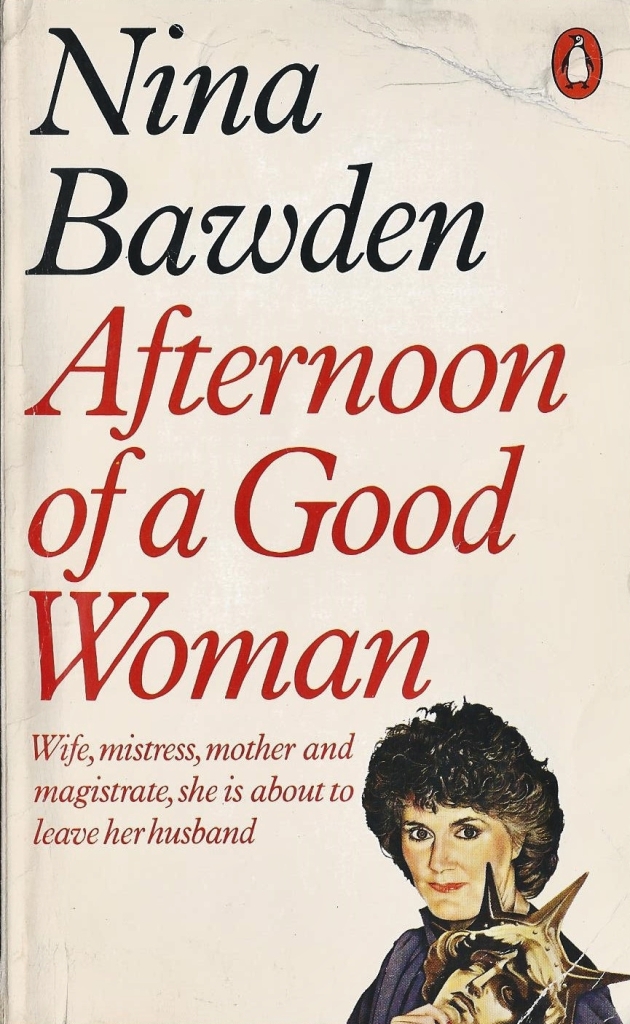
afternoon of a good woman nina bawden 001Afternoon of a Good Woman by Nina Bawden ~ 1976. This edition: Penguin, 1976. Paperback. ISBN: 0-14-00-4674-7. 142 pages.

My rating: 5.5/10

Yesterday I did something I seldom get a chance to do: I sat in my favourite armchair with my feet up and I read all day long.

My husband was unexpectedly home from work, and as he was feeling generally tired and rather in between projects – all of the carpentry jobs too big to start on a “spare” day; still too much snow on the ground for planned farm jobs; some before-convertible-season needful work on the pet sports car (our old Triumph Spitfire) stalled because of waiting for parts to arrive; too windy and blustery for an enjoyable walking excursion – he encouraged me to join him in a “proper” day off.

So I did, completely guilt-free. And it was good.

The reading itself ended up not being as purely pleasurable as it could have been, as I was finishing up Ann Patchett’s increasingly annoying The Magician’s Assisstant (see my last grumpy post) and finding it lacking. I then picked up this slender novel by Nina Bawden which I had just acquired on the my Vancouver trip, along with a copy of The Birds on the Trees. Not quite what I had expected – I thought from the cover text that it would be a bit “lighter” than it turned out to be – but definitely an engaging read, and very “1970s”. A perfect Century of Books entry, in other words, as it is very much of its era.

Lots of spoilers in this post, but I left much out as well. Onward!

Back cover blurb:

Penelope has always tried to be a good woman: as wife, mistress, mother and magistrate. But today – the day she has decided to leave her husband – she sits in the Crown Court listening to a short, sad case of indecent exposure and a long, involved incident of theft, and mentally reviews her own convoluted private affairs. And wonders how they would stand up in court.

Penelope, in her day-long musing about how she got to the point of leaving her husband for her long-time lover, (her step-brother Steve – and, oh, yes, the almost-incest of this relationship is a slight thing compared to the rest of Penelope’s complicated personal connections), reflects on the irony of her name. Patient wife though she has been for many years, her own Ulysses – her ineffectual husband Eddie – is not the adventuresome type, unless you consider his habit of painting his face with Penelope’s lipstick and chasing her about the bedroom with a real hatchet (!) as a precursor to sexual arousal.

Eddie has some serious baggage, as his first wife has gone insane and is incarcerated in a facility for the mentally troubled just a few blocks over. Handy for visiting, mind you, and Penelope occasionally sees her predecessor as she visits her own off-kilter stepmother, Eve – her lover Steve’s mother – in the same building.

There’s also a stepsister with a disastrous personal life – separated from an abusive husband (with Penelope’s help – a complex saga detailed in one of the many flashbacks this short novel contains) and continually fighting for custody of a young son. The ex-husband was involuntarily involved in the death of Penelope’s father, and the situation was not improved by Penelope making an untoward advance to him (the stepsister’s ex-husband) as he tries to soothe her as her (Penelope’s) father’s body lies sprawled at the bottom of the stairs he has just crashed down.

Still with me?

Isn’t this utterly too too much? Over-the-top, as a matter of fact, and Nina Bawden includes way too much information on everyone’s bedroom habits.

The point which I believe Bawden is trying to make is that her protagonist is very much on her way to becoming a modern liberated woman, free to live her (sex) life as she so chooses, and the heck with the staid conventions. Penelope has done the marriage thing, and raised two rather gormless daughters who are now at college. She loves her children but doesn’t particularly like them, having no rose-tinted illusions as to their intelligence or ambitions. Now she is ready to strike out on her own, to openly join her long-time secret lover, a decision just possibly triggered by Penelope’s fear that she is pregnant by him.

Ha ha – didn’t see that last bit coming, did you?

Anyway, bleakly absurd and mildly dirty soap opera plot aside, this book is cranked up a notch by Bawden’s more-than-competent writing, and by her under-handed style of sly humour. This is a rather funny book, once one gets over the initial shock of (for example) hearing the state of a flasher’s naughty bits described in analytical detail – it’s all part of the evidence, you see. Penelope is not at all a prude, though she acts in a publically circumspect manner. Her mind is always examining all the possibilities, and she doesn’t miss much.

Or does she?

As we follow Penelope through her day serving as a magistrate in the Crown Court, we become increasingly aware that her analytical tendencies are just a trifle askew here and there. Her assumptions of guilt and innocence prove not to be quite so crystal clear as she at first thinks. (And perhaps Penelope is a wee bit distracted by the proximity of the handsome and mildly flirtatious judge whom she is assisting…)

And then there is that unnerving incident of a threatening anonymous letter some weeks ago, and today, as she prepares to drive off to the station for her big gesture of freedom, the discovery that the brake system on her car has been tampered with. Someone else has apparently been doing some heavy thinking, too.

To sum up, an interesting read, once one comes to terms with the various ick factors. But I am thinking it will ultimately be just a blip on my readerly radar, for it’s rather a light thing when all is said and done.

I think I will tuck it up on the D.H. Lawrence shelf, for though DHL is rather more “literary”, this Bawden left me with the same after-reading impulse to put the book up high where I don’t have to see it, and then go and have a long hot shower.

A keeper, with reservations.

Oh – one last thing. This is indeed the same Nina Bawden who has written a number of highly esteemed children’s books, such as Carrie’s War, and The Peppermint Pig. If you have young readers in the household, you’ll likely be wanting to keep the two strands of her writing well separated. Just a thought.

Read Full Post »

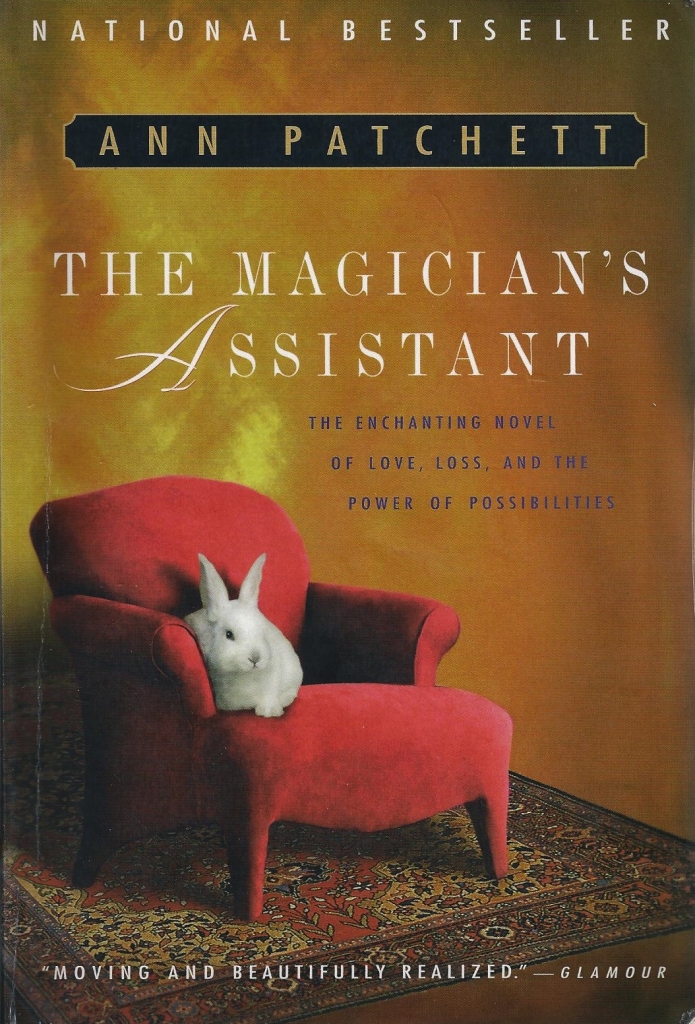
the magician's assistant ann patchett 001The Magician’s Assistant by Ann Patchett ~ 1997. This edition: Harcourt Brace and Company, 1997. Softcover. ISBN: 0-15-600621-9. 357 pages.

My rating: Tough call. Loved the lead-in; increasingly despised the last half. It declined from an 7-ish sort of thing in the first 100 pages to maybe a 2 or thereabouts, with the nadir being the screamingly predictable lesbian kiss scene. So averaging the two together, I offer you a rather generous 4.5/10.

Another Century of Books novel, chosen because I’d not yet read an Ann Patchett title and I keep seeing them everywhere and I needed to find some 1990s candidates.

Caution: I may not be able to avoid including a spoiler or two down below.

Well now. I’m all conflicted about this one. It started off quite brilliantly – so much so that I stayed up into the wee hours last night because I couldn’t put it down. I forced myself to leave our heroine just as she was heading from sunny L.A. to wintry Nebraska, and when I picked it up again a few hours later, everything had changed. On multiple fronts.

Using the handy “Life’s too short” cop-out, I’m going to dodge discussing this one in too much depth. Because after a quick internet review search, I realize I’m apparently the only person who found this one less than fabulous. I’m going to refer you instead to one of many glowing reviews, this one from Publishers Weekly of October, 1997.

An excerpt here:

… Sabine had been assistant to L.A. magician Parsifal for 22 years when they finally married. She knew he was homosexual; both had mourned the death of his gentle Vietnamese lover, Phan. What she didn’t know until Parsifal’s sudden death only a short time later was that Parsifal’s real name was Guy Fetters, that had he lied when he claimed to have no living relatives and that he has a mother and two sisters in Alliance, Nebraska. When these four women meet each other, their combined love for Parsifal helps Sabine to accept the shocking events in  Parsifal’s life that motivated him to wipe out his past. In finding herself part of his family, she discovers her own desires, responsibilities and potential, and maybe her true sexual nature…

Good enough?

The initial depiction of Sabine’s grief at the loss of her partner Parsifal was poignant and believable; the details Ann Patchett emphasized were heart-rendingly real. The sudden insertion of unsuspected relations moved things up a notch, and I was truly curious as to where the author was planning to take us all. The possibilities seemed intriguing. I even bought into the magical-realism dream sequences where Sabine makes contact with Phan in the ever-shifting afterworld; it seemed like these were going to go somewhere as well.

But all of the interesting leads fizzled out, leaving us with a common old relationship drama once Sabine left exotic L.A. and forayed forth into the depths of Middle America in the 1990s, where Wal-Mart is the only place to shop in town, and they don’t seem to carry Perrier, and where all the folks are pasty white in ethnic monotone.

A major sticking point that really soured the second part of the book for me was the over-simplified and patronizing depiction of the Nebraskans. Sabine’s new in-laws are completely awed by her sophistication and readily bow down to her California cool; she in turn is completely thrown out of kilter at their drab lives of blue-collar jobs, modest bungalows, and pitiful acceptance of their wife-beating redneck spouses.

But it all comes out sweet and life-affirming in the end, because luckily Sabine has plenty of dollars from her inheritance of software genius Phan’s legacy through her late husband Parsifal/Guy Fetters, so she can scoop everyone away from their drab Nebraska lives to sunny L.A. At least that is what I gathered at the end, though the details were pretty fuzzy at that point, what with the burgeoning (?) relationship between Sabine and Parsifal/Guy’s sister Kitty.

Moving on, I am. I suspect this writer can do better, for she has all the technical tools in her toolbox and her writing ability is undoubtedly well developed.

Thoughts?

Am I being too mean? Should I give Ann Patchett another go? Or are the rest of her tales of a muchness to this one?

Read Full Post »

main street sinclair lewisMain Street by Sinclair Lewis ~ 1920. This edition: Penguin, 1991. Afterword by Mark Schorer. Softcover. ISBN: 0-14-018124-5. 432 pages.

My rating: 8/10

This is decidedly one of those books which deserves sober consideration and scholarly discussion. Luckily it has been so treated by so many people that I can justify this very casual review of it by referring anyone eager to delve deeper to the many other discussions which abound in print and online.

I had read Main Street several times before, though not very recently, so was wondering if my impressions would change this time around. And the answer to my musings was no, not at all. I still feel exactly the same about Carol Kennicott’s emotional journey, even though I am now at the far end of the arc myself in regards to age and situation in relation to Carol, compared to our shared optimistic youth the first time I made her acquaintance.

Carol Milford, college girl, strides eagerly forward into her future. Anything might happen, and the world is full of potentially wonderful things – art, literature, poetry, travel!

Contemplating but reluctant to commit to a career as a teacher, Carol ends up spending a year in Chicago hobnobbing with the local bohemians, then moves on to a position as a librarian in St. Paul, Minnesota, with her lofty ideals slightly rattled though not at all dulled. She meets Dr. Will Kennicott, some years older than herself, rising young physician in the (fictional) prairie town of Gopher Prairie, and is wooed both by handsome Will’s physical appeal and by his readiness to bow down before Carol’s intellectual superiority.

Come to Gopher Prairie, pleads Will. Show us how to bring culture into our lives. You could do such good…

Already rather jaded by the workaday routines of her not-very-exciting job, Carol allows herself to be romanced, and off she goes to Gopher Prairie, as Mrs. Doctor Kennicott, full of ideas and ideals.

Gopher Prairie raises a collective eyebrow at Carol and her effervescent cultural improvement projects, and sturdily attempts to put her in her place, an enterprise which takes some years but which is eventually mostly successful.

I found Main Street to be rather slow going this time round, and I found myself putting it down for a day or two here and there and turning to other diversions. But I always returned, and towards the end of the extended read, I found myself wondering if the long, slow tone were in fact a deliberate attempt by Sinclair Lewis to demonstrate the long, slow taking down of Carol Kennicott from her uppity ideals to a state of intellectual dullness acceptable to her fellow Gopher Prairie-ites.

Carol Kennicott is very much a woman written by a man, and though Sinclair Lewis did a stellar job in putting himself in his character’s shoes, there are authorial lapses here and there, as Lewis conveniently skips over the time around Carol’s pregnancy and new motherhood with a few (admittedly apt) paragraphs:

The baby was coming. Each morning she was nauseated, chilly, bedraggled, and certain that she would never again be attractive; each twilight she was afraid. She did not feel exalted, but unkempt and furious. The period of daily sickness crawled into an endless time of boredom. It became difficult for her to move about, and she raged that she, who had been slim and light-footed, should have to lean on a stick, and be heartily commented upon by street gossips. She was encircled by greasy eyes. Every matron hinted, “Now that you’re going to be a mother, dearie, you’ll get over all these ideas of yours and settle down.” She felt that willy-nilly she was being initiated into the assembly of housekeepers; with the baby for hostage, she would never escape; presently she would be drinking coffee and rocking and talking about diapers.

… She alternately detested herself for not appreciating the kindly women, and detested them for their advice: lugubrious hints as to how much she would suffer in labor, details of baby-hygiene based on long experience and total misunderstanding, superstitious cautions about the things she must eat and read and look at in prenatal care for the baby’s soul, and always a pest of simpering baby-talk. Mrs. Champ Perry bustled in to lend “Ben Hur,” as a preventive of future infant immorality. The Widow Bogart appeared trailing pinkish exclamations, “And how is our lovely ‘ittle muzzy today! My, ain’t it just like they always say: being in a Family Way does make the girlie so lovely, just like a Madonna. Tell me—” Her whisper was tinged with salaciousness—”does oo feel the dear itsy one stirring, the pledge of love? I remember with Cy, of course he was so big——”

… Then the baby was born, without unusual difficulty: a boy with straight back and strong legs. The first day she hated him for the tides of pain and hopeless fear he had caused; she resented his raw ugliness. After that she loved him with all the devotion and instinct at which she had scoffed… For two years nothing else existed…

The baby grows, life steadily grinds on. Carol loses one of her best friends – her ex-maid Bea – to typhoid, and finds her neighbours casually dismissive of her emotional pain. Will strays into a casual relationship with a neighbour’s wife, though Carol is unaware of it; she herself goes through a period of infatuation with a beautiful younger man, a Swedish farm boy with high aspirations working as a tailor’s apprentice. Gopher Prairie sees all, and files it all away for future reference. The Great War creates a few ripples; Carol eventually uses it as an excuse to break away with Hugh and take on a job in Washington, DC, while Will remains in Gopher Prairie.

main street 1st edition sinclair lewisIs the Kennicott marriage dissolving? Is Carol on the path at last that she was forced off of so many years ago? Apparently not, as her return to Gopher Prairie in a sleet storm with her husband at her side brings her full circle, back again to the place she could not change, and which has done its stolid best to change her into the acceptable pattern of a Gopher Prairie matron.

We end with Carol looking to her child – sorry, children – she does pop out another baby right at the very end of the saga, this one too without much obvious effort or appreciable comment by Lewis – with speculative eyes. Surely he/she will go out into the world and bring about the change which Carol herself has so far been unable to pull off…

For all of its hype as one of the Great American Novels – so often a foreboding designation of excessive earnestness – Main Street is a very readable thing, cynically amusing and cleverly analytical in its satire of Every Town, U.S.A. And though Carol fails to fully engage me as a relatable heroine – she never becomes quite real, for she is as terminally misguided as the rest of the Gopher Prairie characters and as stereotyped in her way as they are – her struggles are thought provoking and her situations cleverly staged.

What does Carol really want? We never do find that out, for she doesn’t know herself, and that is perhaps the most real and relatable thing about Main Street.

This remains to me a book not so much about the mythical Carol Kennicott as it is about the real man Sinclair Lewis, based as it is on his own experiences of growing up in Sauk Center, Minnesota. Discussing Lewis this morning with my husband, we both agreed that cynically enjoyable though his writings are, there is a certain spirit of – well – meanness showing through, as though Lewis never really got over some slight of his early days, and is always hitting back at the place he came from. Escaped from, is the implication. (In our joint opinion, anyway.) Too much of that kind of thing rather gets the reader down; I’ll be taking a breather before going on to another of Sinclair Lewis’s eminently readable but slightly depressing tomes.

And there I will leave you. A worthwhile read for its detailed portrait of a time and (generic) place; a fascinating piece of Americana.

Read Full Post »

« Newer Posts - Older Posts »