Archive for the ‘Century of Books – 2014’ Category

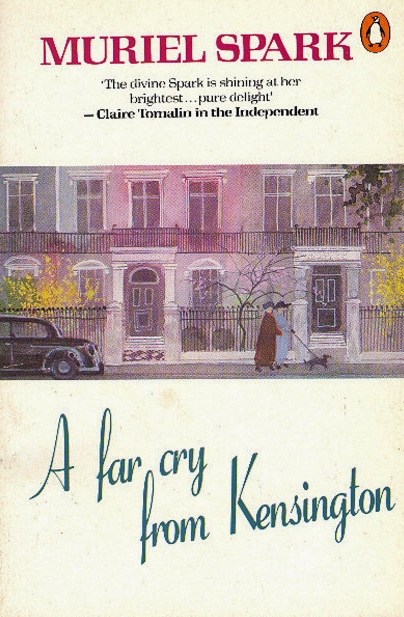
a far cry from kensignton pb muriel sparkA Far Cry From Kensington by Muriel Spark ~ 1988. This edition: Penguin, 1989. Softcover. ISBN: 0-14-010874-2. 189 pages.

My rating: 8.5/10

I am breaking my several-weeks’ book-discussing silence to applaud this brief novel by the increasingly enjoyable Muriel Spark.

Isn’t it interesting that there sometimes seems to be a proper time for certain writers in a reader’s life? I think I may have entered into a deliciously Spark-ling phase of my own, for recently I found The Mandelbaum Gate to be unexpectedly good, as is this other nicely crafted thing.

A Far Cry From Kensington turned out to be happily mesmerizing, being a tightly written tragi-comedy narrated by once-obese Mrs Hawkins – I mention the obesity because it is crucial to the plot in a most bizarre way – looking back three decades to her life in 1954-55.

At the period of time which is the focus of her reminiscences, Mrs Hawkins works “in publishing” – she is employed as an editor at a soon-to-be-doomed small press situated in Kensington – and throughout the novel we get intriguing glimpses of the workaday side of the flourishing-yet-troubled literary scene of London in the 1950s, an era and an atmosphere which Muriel Spark knew in intimate detail.

Widowed soon after her impetuous wartime marriage, Agnes (“Nancy”) Hawkins, always a large girl, has effortlessly transformed into a cheerfully fat woman, “massive in size, strong-muscled, huge-bosomed, with wide hips, hefty long legs, a bulging belly and fat backside; I carried an ample weight with my five-foot-six of height, and was healthy with it.” And people confided in Mrs Hawkins: “I looked comfortable. Photographs of the time show me with a moon-face, two ample chins and sleepy eyes… It was not until later, when I decided to be thin, that right away I noticed that people didn’t confide their thoughts to me as much, neither men nor women…”

Living in a rooming house presided over by the warmly maternal and personally high-principled Milly, Mrs Hawkins is fortunate in her housemates, whom she describes with concise but living detail: the ultra-respectable and preternaturally quiet married couple, the Carlins – he an accountant, she a nursery school teacher; the cleanliness-obsessed district nurse Kate; the gloomy and excessively emotional Polish seamstress Wanda; the young and vivacious post-deb Isobel, trying out her downy wings in London as a secretary, though in constant close contact with her doting father via a private telephone of her very own; and, not least in eventual importance to Mrs Hawkins’ personal story, the brilliantly promising, dragged-up-by-his-own-bootstraps medical student William Todd.

All of these lives are intertwined with that of Mrs Hawkins; some exceedingly closely, as we will discover later in the narrative, though Muriel Spark frequently dangles just the briefest, most tantalizing fragments of information in front of us in the course of Mrs Hawkins’ tale.

Mrs Hawkins is prone to giving advice, much of it quite good, as it turns out. Pragmatic common-sense spiced with opinionism is Mrs Hawkins’ style. We learn how simple it is to lose weight (eat just half of your regular portions, and then, when the willpower is adjusted, half again); to control rheumatism (eat a banana a day, as advised by “an American negress met on a bus”); to write an engaging narrative (pretend one is writing to a single close friend); to attain concentration (acquire a cat).

This last was one of my favourite asides in this vignette-rich novel. At a dinner party, Mrs Hawkins meets a gruff, red-faced, retired Brigadier General, who mentions that he “could write a book” about his life.

‘Why don’t you?’

‘Can’t concentrate.’

‘For concentration’ I said, ‘you need a cat. Do you happen to have a cat?’

‘Cat? No. No cats. Two dogs. Quite enough.’

So I passed him some very good advice, that if you want to concentrate deeply on some problem, and especially some piece of writing or paper-work, you should acquire a cat. Alone with the cat in the room where you work, I explained, the cat will invariably get up on your desk and settle placidly under the desk-lamp. The light from a lamp, I explained, gives a cat great satisfaction. The cat will settle down and be serene, with a serenity that passes all understanding. And the tranquillity of the cat will gradually come to affect you, sitting there at your desk, so that all the excitable qualities that impede your concentration compose themselves and give your mind back the self-command it has lost. You need not watch the cat all the time. Its presence alone is enough. The effect of a cat on your concentration is remarkable, very mysterious.

The Brigadier listened with deep interest as he ate, his glaring eyes turning back and forth between me and his plate. Then he said, ‘Good. Right. I’ll go out and get a cat.’ (I must tell you here that three years later the Brigadier sent me a copy of his war memoirs…On the jacket cover was a picture of himself at his desk with a large alley-cat sitting inscrutably beside the lamp. He had inscribed it ‘To Mrs Hawkins, without whose friendly advice these memoirs would never have been written – and thanks for introducing me to Grumpy.’ The book itself was exceedingly dull. But I had advised him only that the cat helps concentration, not that the cat writes the book for you.’

Ha!

If you smiled sympathetically at this excerpt, this book is for you.

Read it, then, and discover just what a pisseur de copie is, and what significance The Box in the esoteric (and deeply weird) practice of radionics holds, and just what Muriel Spark really thought about one of her ex-lovers, here immortalized as the deeply dislikeable Hector Bartlett.

And, for another agreeable opinion, click on over to His Futile Preoccupations, one of many other favourable reviews of this quietly malicious minor masterpiece.

Read Full Post »

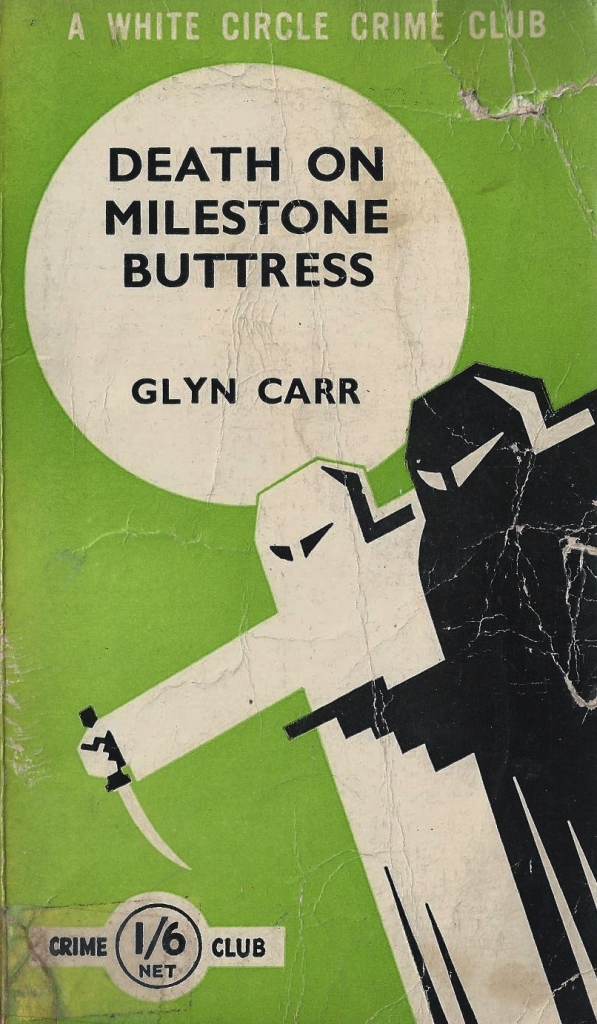
death on milestone buttress glyn carr 001Death on Milestone Buttress by Glyn Carr ~ 1951. This edition: The Crime Club, 1951. Paperback. 256 pages.

Provenance: Quesnel Family Thrift Store, October 2013. Previous book owner: Rebecca Lund, who enthusiastically rubber-stamped her name and address on all of her books, in numerous places. I know this because I have acquired a large number of them over the past few years; we obviously share a similar taste in books.

Or perhaps shared is more correct; I strongly suspect that Ms. Lund has passed on and that her books were subsequently donated to the thrift store; there do seem to be an awful lot of them, and they do look like they were carefully collected over a number of years by a dedicated reader. (Note to self: write codicil in will regarding which favourite second hand bookseller shall be the recipient of my own collection…)

My rating: 4.95/10 – I can’t quite put this at a 5 on my personal “enjoyment level” rating scale, and while it’s a very much okay specimen of its genre it’s not quite special enough to inspire me to seek out any more by this author.

Though perhaps I dismiss Glyn Carr too soon; he did go on to write fourteen more mysteries starring his stately, erudite and multi-talented Shakespearian actor/mountaineer amateur detective, Abercrombie Lewker.

Here’s the rundown on the plot, courtesy Rue Morgue Press, which has recently republished this vintage mystery, among many others. Check out their website – what a treasure trove of information on the genre! Rue Morgue Press republishes obscurish vintage mystery novels, and also deals in used copies of rare and out-of-print detective fiction.

Abercrombie (“Filthy”) Lewker was looking forward to a fortnight of climbing in Wales after a grueling season touring England with his Shakespearean company. Young Hilary Bourne thought the fresh air would be a pleasant change from her dreary job at the bank, as well as a chance to renew her acquaintance with a certain young scientist. Neither one expected this bucolic outing to turn deadly, but when one of their party is killed in an apparent accident during what should have been an easy climb on the Milestone Buttress, Filthy and Hilary turn detective. Nearly every member of the climbing party had reason to hate the victim, but each one also had an alibi for the time of the murder. Working as a team, Filthy and Hilary retrace the route of the fatal climb before returning to their lodgings where, in the grand tradition of Nero Wolfe, Filthy confronts the suspects and points his finger at the only person who could have committed the crime. Filled with climbing details sure to appeal to both expert climbers and armchair mountaineers alike, Death on Milestone Buttress was published in England in 1951, the first of fifteen detective novels in which Abercrombie Lewker outwitted murderers on peaks scattered around the globe.

And while we’re over cribbing info from the Rue Morgue Press site, here’s a snippet of their Glyn Carr Author Biography. (Much expanded on the site – please click through to read the rest.)

If you look upon a mountain climb as taking place in a large, open-air locked room, then Showell Styles was right to choose Glyn Carr as his pseudonym for fifteen detective novels featuring Abercrombie Lewker, all of which concern murders committed among the crags and slopes of peaks scattered around the world. There’s no doubt that John Dickson Carr, the king of the locked room mystery, would have agreed that Styles managed to find a way to lock the door of a room that had no walls and only the sky for a ceiling. In fact, it was while Styles was climbing a pitch on the classic Milestone Buttress on Tryfan in Wales that it struck him “how easy it would be to arrange an undetectable murder in that place, and by way of experiment I worked out the system and wove a thinnish plot around it.”

That book was, of course, Death on Milestone Buttress

So – what am I going to say about this fairly standard issue mystery tale? Perhaps I’ll just note some likes and dislikes, and leave it at that.

I liked:

  • The characterizations of both of the leading characters, Shakespearian actor Abercrombie Lewker and bank “calculating machine operator” Hilary Bourne. Both are nicely presented and sympathetically portrayed, though as the book progresses it is Hilary who stays much more real, while Lewker becomes a parody of the Hercule Poirot/Nero Wolfe type of detective, easily analyzing esoteric information with his great big superior brain, as it were. Though he is much more active physically than both of his fictional counterparts, being an accomplished amateur climber despite his less than boyish figure.
  • The mountaineering details and the descriptions of the Welsh setting, which seemed sincere and plausible.
  • The parody-like period setting, with the several sincere Communists being viewed by their acquaintances as slightly eccentric, mostly harmless, and generally rather figures of fun. The scientists who also play main roles (one is eventually the murderee) are of course working on a Great Big (not very secret) Secret Project, which when completed will apparently be The Weapon To Beat The Atomic Bomb. Quite ridiculous, the whole thing, and it rather felt like that was intentional. In any event, that’s how I viewed it, and it helped me make it through even when I found the complications of the plot rather uphill going.

I disliked:

  • The grotesque attempts at slang and dialect which were completely incomprehensible and too over-the-top, even given that the speakers of the garbled dialogue were generally meant to be figures of fun.
  • The predictability of the plot. I guessed the murderer very early on, and the red herrings provided were small and not particularly enticing.
  • The absolute unlikableness of the murderee. He had no redeeming traits whatsoever, except for his intellectual abilities as a scientist. No one cries when he dies. (Not for his loss, anyway. Though there are tears because of the multiple situations created by his death.) Created by the writer to be blithely killed off, one rather feels.
  • The love affair between Hilary and one of her fellow vacationers – absolutely meh.
  • The whole “smarter than the police” thing. Lewker takes on the mantle of Nemesis without official sanction, and all of the other players meekly fall into order without a whisper of protest. Including the murderer, who then goes on to an über-predictable end, with detective story justice thus being served with no boring paperwork to fill out or tedious trials to sit through

And that is all I have to say about Death on Milestone Buttress. Here is a rather more even-handed discussion on the Dust and Corruption blog, worth taking a look at.

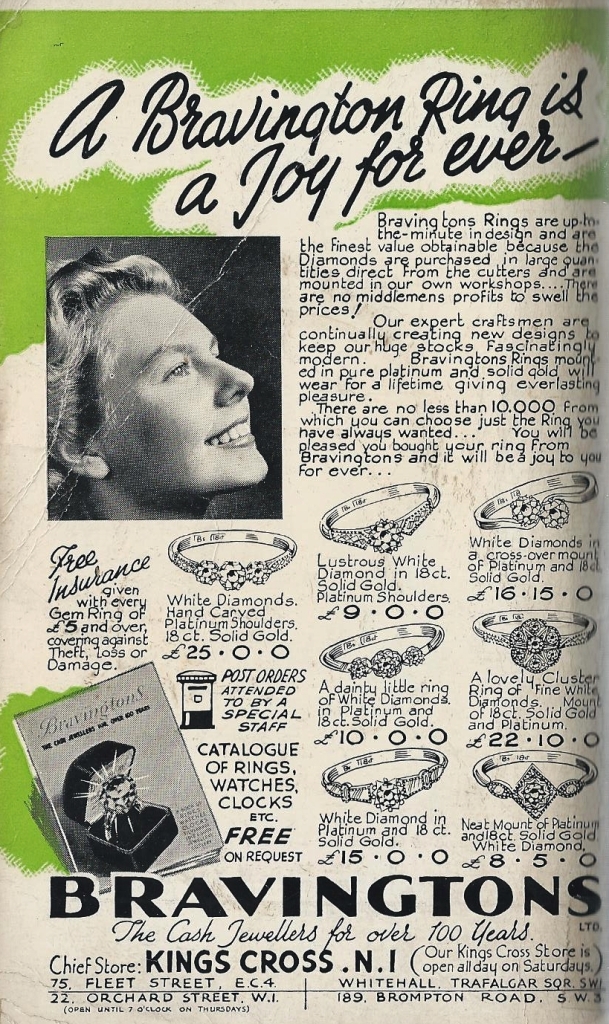
Oh – there was one more thing. Check out the back cover of my paperback, which features yet more rocks, these with gold and platinum settings. How’s this for period appeal? Check out the ad copy, and those prices!

death on milestone buttress glyn carr back cover advert 001

Read Full Post »

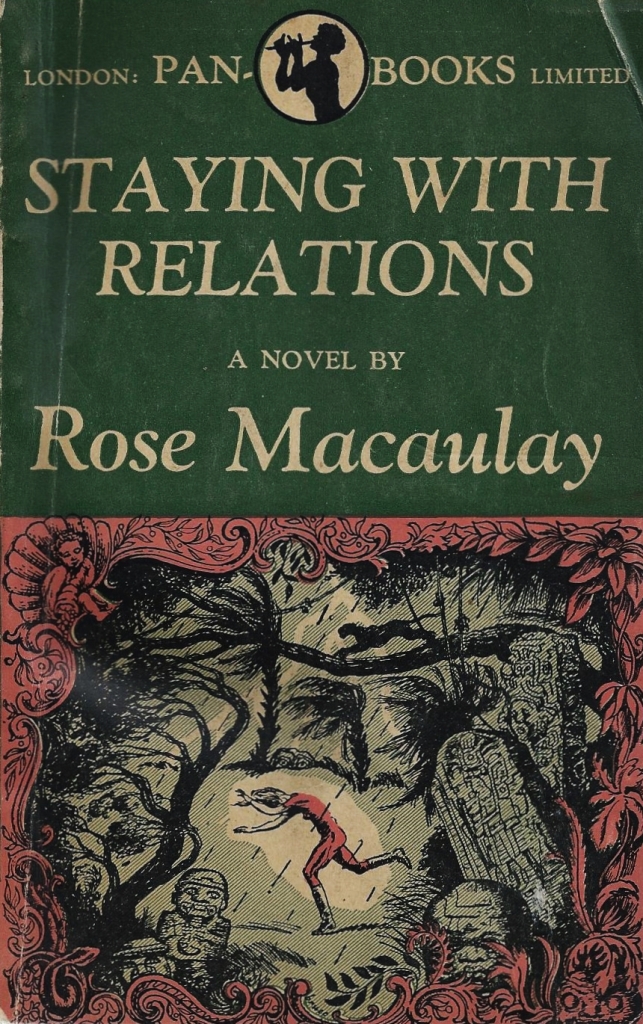
staying with relations rose macaulay 001Staying with Relations by Rose Macaulay ~ 1930. This edition: Pan, 1947. Paperback. 224 pages

Provenance: The Book Man, Chilliwack, February 2014.

My rating: 7/10

What did I just read?

My fourth encounter with the brilliant but unsettling fiction of Rose Macaulay – the others so far being Crewe Train, The Towers of Trebizond, and The World My Wilderness.

Of these, The World My Wilderness was closest to being a “plausible” story; the others were decidedly surreal. One cannot apparently read Macaulay on complacent auto-pilot; she takes a straightforward narrative and gives it the occasional twist sideways, just enough to catch the reader off guard.

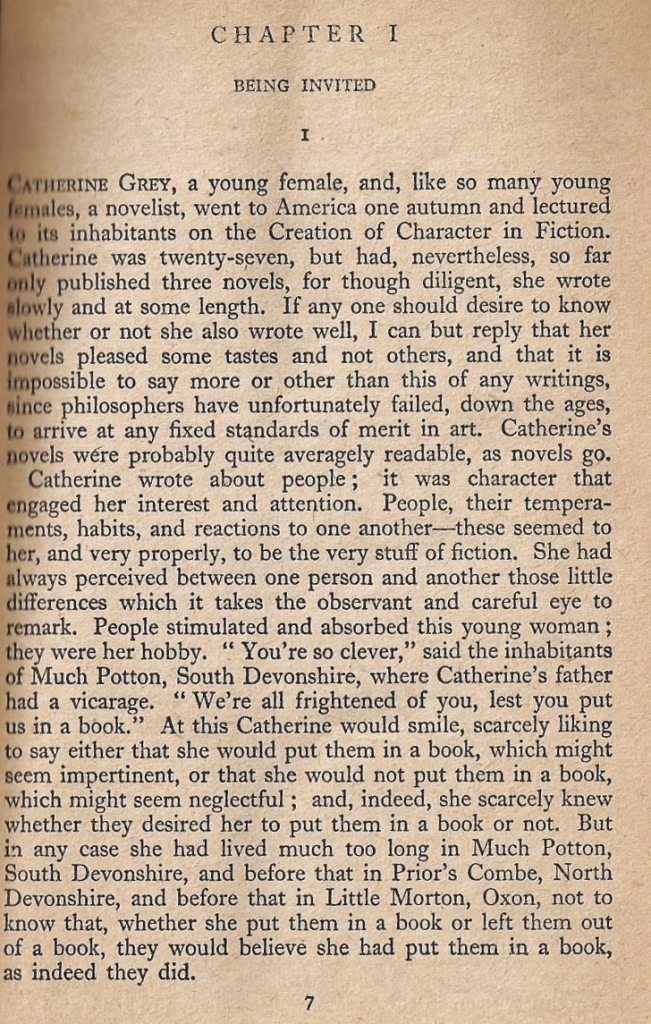
Un-credited poem, one would then assume to be by Rose Macaulay herself, on frontispiece page.

Un-credited poem, which I assume to be by Rose Macaulay herself, on frontispiece page.

Among other disconnects from reality on this latest addition to my small Macaulay collection, it was the mention of tigers in the Central American jungle that caused me my greatest bemusement. I could handle all of the other scenarios – the luxuriantly roccoco villa built upon an ancient Mayan temple/Spanish monastery, the sophisticated love lives of the family of English step-brothers, -sisters and cousins living lives of lazy pleasure financed by their older relations, the American con-man with his uncanny knowledge of hidden treasure and his bizarre plot to attain such – but the tigers threw me off my stride.

At first I thought they were merely hypothetical tigers, and that the man referencing them was harking back to years spent in India, but they popped up again (figuratively speaking), apparently as a threat as “real” as the stalking jaguars which lurk in the overgrown Guatemalan forest. Had to stop and do a bit of research, it bothered me so much, and no, there do not appear to be actual tigers endemic to this region of the world. Such a relief! – I thought not, but there was that tiny bit of niggling doubt…

Okay, I’m going off on a strange tangent. Well, perhaps rightly so. This is a rather odd and slightly unsatisfactory tale.

It starts off conventionally enough. This is what the back cover of my old Pan paperback says:

Staying with Relations is about a family who live in a baroque, Maya mansion in the heart of the Central American forest. A young woman novelist goes from England to visit her relatives in Guatemala. Theft, kidnapping and hunting for treasure left there long ago by Spanish priests occur. There is an earthquake; a girl is lost in the jungle while escaping from kidnappers; unexpected aspects of the characters of the dramatis personae emerge. Rose Macaulay has enjoyed in this book the three pleasures of relating adventures, describing exotic scenery, and writing about people…She wrote this book largely as compensation for not having, in a tour of Central America, reached Guatemala and seen its ancient temples buried in jungle…

Macaulay dips her pen deeply into the satirical ink well; she jabs away at herself as much as at her invented characters, being continually cutting about the phenomenon of the English woman novelist and her apparently universal habits. Well, the writer should know.

staying with relations rose macaulay excerpt 001 (2)

Once we get this sort of thing out of the way, the novel proceeds on its way detailing the adventures of the not particularly sympathetic cast of characters. Though Catherine-the-lady-novelist at first seems to be the main character, with the action viewed through her eyes, the point-of-view increasingly shifts until we realize, with something of a shock, that we don’t really know any of these people at all. And certainly not Catherine!

As Macaulay puts her puppets through their paces, one strains to see what her intent is; what is she really going on about? And I wish I could say that I figured this out for myself, but I must give credit elsewhere. It was a comment by Simon at Stuck in a Book , in a discussion of The World My Wilderness, that clicked on the light:

‘Reliable’ is just another word for ‘consistent’, really, and Macaulay does seem to write in a consistently dry, almost satirical style, pursuing a similar theme in each novel – albeit a theme so broad that she could have written two thousand novels and never needed to approach it from the same angle twice.  It is dangerous to summarise thus (and others may have said this before me…) but I believe Macaulay’s broad theme across her novels is: ‘What does it mean to be civilised?’

Once one views the novel with this thought in mind, it all begins to make much more sense. Macaulay is continually discussing, both by the dialogue of her characters and her scene setting, the difference between the “barbarians” and the “civilized” folk. No conclusion is committed to, but the concept of “civilization” trumps all of the other scurryings to and fro which make up the conventional skeleton of the story.

I enjoyed this book as much as one can when one feels as if the author is speaking rather over one’s head. As a dramatic fiction it is as unnervingly just off normal in the same way as something like Evelyn Waugh’s satirical novel The Loved One is, or his slyly funny Decline and Fall. (Though Waugh is rather more accessible, in my opinion; Macaulay can be downright obscure, giving her readers very little help at all.)

I should probably quit now, having not really talked about the plot or any of the details of the story, and digging myself deeper with every sentence into a situation which I am going to have a hard crawling back out of. A veritable tiger-pit of a post, as it were!

For those who are already Macaulay aficionados, Staying with Relations will be a most interesting read. But I wouldn’t start here for my first introduction to this unique novelist. Perhaps try Crewe Train instead; it is just as satirically twisted but there are less characters to keep track off, and a more clearly defined heroine. Who is also, now that I come to think of it, “staying with relations”…


Read Full Post »

olivia o douglas dj 001Olivia by O. Douglas ~ 1912. Original title: Olivia in India: The Adventures of a Chota Miss Sahib. This edition: Nelson, 1950. Hardcover. 281 pages.

Provenance: Shepherd Books, Victoria B.C., September 2013.

My rating: 7/10

The first published work by Anna Buchan, written under her pen name O. Douglas.

This slight epistolary novel is based on Anna’s own 1907 voyage to India to visit her younger brother William; the characters “Olivia” and “Boggley” are obviously very lightly veiled depictions of Anna and William, and there is even a reference or two to another brother, “John”, who is a highly regarded novelist. John Buchan – of The Thirty-Nine Steps fame – was of course a very real person, and though “Olivia” throughout refers to her family name as “Douglas”, we can’t help but draw the simple conclusion that this is mostly autobiography, presented as fiction.

India in the years of the Raj has been so often and thoroughly documented both in fact and fiction that it exists in our readerly imaginations as a defined time and place with expected characters, settings and situations. Olivia does nothing to further illuminate any of this, merely laying down another layer of sepia-tinted varnish on an already-finished picture.

I found the book enjoyable enough in a mild way; in common with all of the author’s other novels the people are very believable, being a mixture of good and not so good, and the situations are realistically described. It differs from most of O Douglas’s later novels which have a traditional plot structure in that in this one nothing really happens, aside from the expected incidents of domestic adventure and foreign travel.

Olivia journeys about, sightseeing and marking time, all the while writing to an unnamed correspondent back home, whom we are able to identify early on as a person of potentially romantic interest. The nearest thing to a climax occurs at the very end of the book, when the correspondent is given a name, and Olivia commits herself so far as to accept his apparent proposal of an enlargement and formalization of their “friendship” when she returns to England.

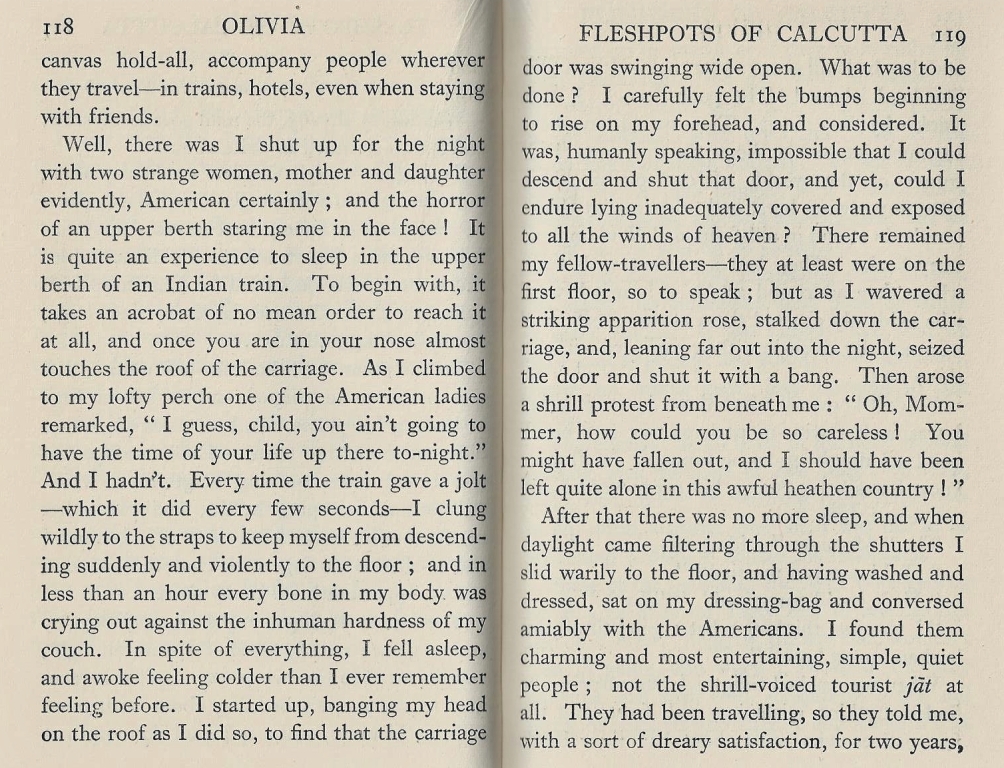
Though it sounds as if I were damning this quiet book with faint praise, it wasn’t actually all that bad. The scenes throughout are engagingly described and occasional vignettes stand out, as when Olivia sees the Himalayas for the first time, after a less-than-comfortable train journey.

Here is a snippet from that journey, with these pages being representative of the style of narrative of the whole. (Click on image to enlarge.)

olivia o douglas excerpt 001

And there are enough references to the political situation and dreadful things going on all about – the poverty of much of the native population and certain of the lower class Europeans and Eurasians, the constant occurrence of sudden death from misadventure and virulent tropical diseases, the occasional “throwing of bombs” by radical demonstrators – to keep the tone from being at all saccharine.

Olivia herself has a rather snobbish attitude to anyone not of her class, race and religion – these being upper, Scottish, and Presbyterian – but she does recognize this tendency in herself and occasionally puts herself out to overcome her prejudices, though to the end of her travels she remains fastidiously suspicious of the natives of the country.

Very much a first book, but, to be fair, quite a good one. It held my interest throughout, though I am sure most of it will fade away quite quickly to join the rest of the era’s Anglo-Indian accounts of chirpy young Great Britain-ites off to visit the exotic Colonial Outposts, before it all fell apart.


Read Full Post »

because of the lockwoods dorothy whipple 001Because of the Lockwoods by Dorothy Whipple ~ 1949. This edition: Longmans, 1949. 1st Canadian edition. Hardcover. 358 pages.

Provenance: Purchased (via ABE) from A Biblio-Omnivore Harvey Lev, Montreal – March 2014.

My rating: 9/10

Sound the trumpets! I have finally read a Dorothy Whipple. And thoroughly enjoyed every minute of it, too.

A satisfyingly nasty family of antagonists, and an absolutely feeble (though gentle and well meaning) family of protaganists, saved from themselves by the spunky youngest daughter, with the help of a lower-class social climber who has fallen in love with said daughter and uses his keen wits to their joint advantage.

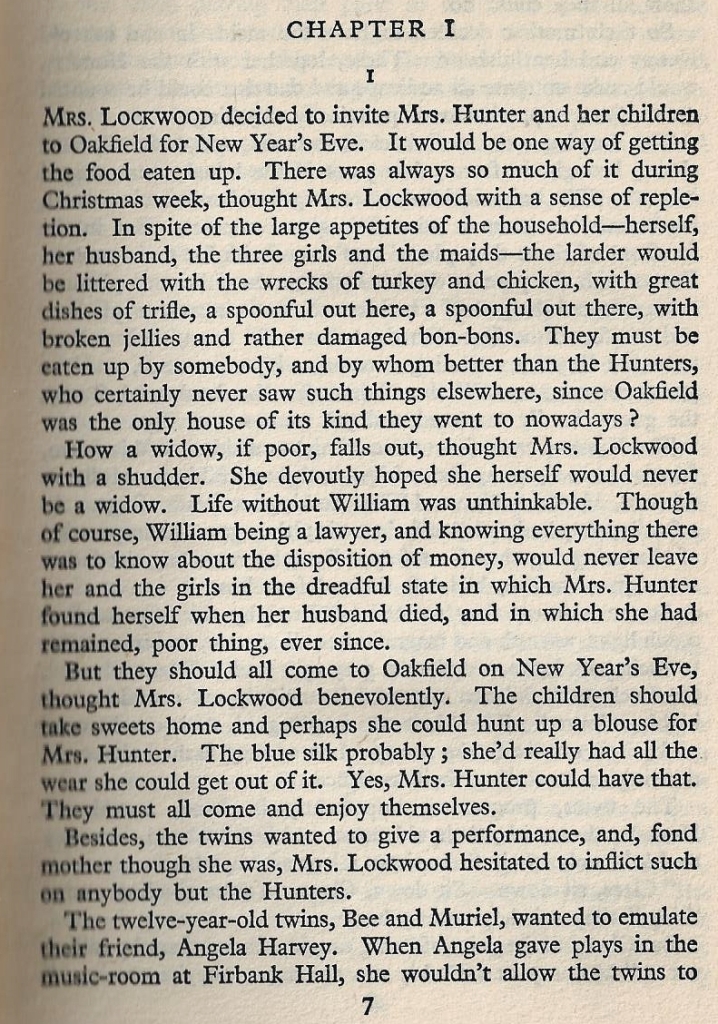
Shortly after the end of the Great War, meek Mrs. Hunter, an architect’s wife, is suddenly left a widow with three young children, and who should she turn to but her husband’s business acquaintance, lawyer Mr. Lockwood, for help with her affairs. Mr. Lockwood, fully occupied with feathering his own nest and the care and nurturing of his beloved wife and three daughters, rolls his eyes and sorts things out in a resentful way. While going through the late Mr. Hunter’s papers, Mr. Lockwood comes upon a situation which he can twist to benefit himself to the detriment of the surviving Hunters; he immediately does so, and the stage is set for our emotionally heart-rending story.

Mrs. Hunter insists on being grateful to Mr. Lockwood, and cherishes the benevolent friendship of Mrs. Lockwood, which is – to give Mrs. Lockwood credit – meant well, even if it doesn’t turn out to be truly kind in practice.

because of the lockwoods 1st page dorothy whipple 001


The Hunter children grow up under the shadow of the Lockwoods, and as the youngest child, Thea, watches her older sister, Molly, withdrawn from school and forced into an unsuitable post as a governess at the age of fifteen on Mr. Lockwood’s advice (“Your children must start earning,” he sternly informs the compliant Mrs. Hunter), and her older brother, Martin, placed into a bank rather than being allowed to train as a doctor (“Does anybody need a boy?” casually inquires Mr. Lockwood of his banking acquaintances at his club), she sets herself to avoid her siblings’ fate. Thea will not be shunted off into an uncongenial occupation, oh no, not she!

Thea, cleverest of the Hunters by far, sets herself on an upward path, and eventually, at the age of eighteen, manages to make it to France in company with the Lockwood girls; they to be “polished” and to learn French, Thea to teach English at the same school for her keep. But Thea’s ascendant star is about to tumble from the sky, when she is caught in a compromising situation with a handsome young Frenchman, and is sent home in deep disgrace.

Social injustice, deliberate wrongdoing, frustrated hopes, romantic yearnings – what a fruitful set of circumstances for a novelist! Add to that romance and revenge, plus a dash of remorse, and we have an engaging story with which to while away several most diverting hours.

Dorothy Whipple is now very much on my radar, and I will be actively questing for more of her titles. Happily Persephone Press is actively reprinting the Whipple oeuvre, so some at least will be easy to acquire.

What bookish joy, making the acquaintance of Bryher yesterday, Whipple today. And what a happy time I will have exploring more by both of these congenial (though rather different) novelists!


Read Full Post »

beowulf bryher 001Beowulf by Bryher ~ 1948. This edition: Pantheon, 1956. Hardcover. 201 pages.

Provenance: Purchased (via ABE) from Powell’s Books, Portland, Oregon – March 2014.

My rating: 9.5/10

This is a beautifully framed and constructed capture of a brief and bleak moment in time, focussing on a few ordinary people over a few short days in the midst of World War II’s London Blitz.

Selina Tippett, for twenty years a paid companion to a series of querulous old ladies, had at long last achieved her dream, that of operating a comforting teashop supplying nourishing and delicious refreshments to those most in need of a peaceful break in their stressful lives. For seven years the Warming Pan has been a haven for the harried housewives, elderly shoppers and frazzled governesses of this small corner of London, but times are increasingly difficult, and Selina is in a state of quiet desperation.

The bombs rain down, and her loyal customers are quietly fading away, either through the dismal fate of sudden death from the sky, or the more insidious process of quiet evacuation to the countryside. The Warming Pan’s once abundant selection of teacakes has dwindled to a mere shadow of past glories as rationing is in full force; Selena has just been informed that she may no longer buy fresh eggs for her baking, and she is ineligible for powdered eggs because she has never used them before and hence has no entitlement to a rationed allowance. The rent is months overdue; Selina receives each day’s post with trepidation, expecting an eviction notice. What will the future bring…?

Selina’s partner Angelina refuses to share Selina’s concerns. Girded for battle with her strong sense of righteousness, Angelina goes forth daily to enthusiastically do battle with the bureaucracy of the Food Ministry and her wide circle of provision merchants. In her free hours, Angelina is an aficionado of various evening courses; she is a keen autodidact and fierce feminist with a special interest in improving the position of women in society.

When Angelina brings home a hideous plaster statue of a  bulldog – christened “Beowulf” in a gesture of symbolic nose-thumbing at the disturbers of England’s peace – Selina tries to hide her inner anger at the fact that it was paid for with money intended for the gas bill and the fishmonger. But as Selina’s sense of foreboding increases hour by hour, fate is preparing a climactic solution (of sorts) to her most urgent problems…

Much more than a simply linear narrative, this novel is a spiral series of vignettes, all connected at the centre to the Warming Pan and the people who cross its threshold and find refuge within its threatened walls.

Short but quite perfect; an excellent reading experience. Though the subject matter is desperately sad, the novel is quietly and genuinely humorous, and not at all depressing.

Half a point lost because I wanted more, and the ending solved a key problem just a little too neatly.

Bryher was the pen-name of British novelist and poet Annie Winifred Ellerman. A keen historian and amateur archeologist (as well as the daughter of “England’s wealthiest man”, shipping magnate John Ellerman), she wrote a number of well-researched, well-written and well-reviewed historical novels focussing on various periods in England’s history, such as The Fourteenth of October (the year of 1066), and The Player’s Boy (Beaumont and Fletcher at the end of the Elizabethan period). She also dabbled in writing science fiction in 1965’s Visa for Avalon, and was well known for her strongly eclectic interests and her steadfast support of the literary and creative arts.

An author very much worthy of further investigation.

Read Full Post »

Poplar catkins, Hill Farm, some other spring.

Poplar catkins, here at Hill Farm, a spring or two ago. Rather tardy this year, as we are still covered mostly in snow, and yearning for a warm wind to take it all away and get those pussy willows and leaf buds started…

Here we have a random grouping of completely unrelated reads: the brightly satirical (Nancy Mitford’s Highland Fling), the contemporary fantasy (Neil Gaiman’s Stardust), the vintage teen girl tale (Betty Cavanna’s Almost Like Sisters), and the enduring anthropomorphic classic (Kenneth Grahame’s The Wind in the Willows).

highland fling nancy mitford 001Highland Fling by Nancy Mitford ~ 1931. This edition: Hamlyn, 1975. Paperback. ISBN: 0-600-20626-2. 185 pages.

My rating: 5.5/10

From The Spectator, April 11, 1931, a book reviewer’s summation at Nancy Mitford’s Highland Fling:

A dreary extravaganza of the post-Waugh school. (The conception is infantile, execution (at its best) undistinguished.) The Bright Young People cut familiar capers in the Gothick North. Vulgar, but not funny.

Oh, ouch! Talk about your brutal dismissal. Miss Mitford’s first published work was apparently not an instant hit with everyone in her home country, though she appears to have surmounted such dire reviews and gone on to find enduring popularity among the discriminating readers of the next eight decades. There does appear to be something of a cult Nancy Mitford following, if one may use such a term, though I’m standing very much on the edge of such, listening to the gushing praise with serene detachment.

Some of her novels are very good indeed, but this first one is not quite up to the standard of her best. She tries hard, though, and there are flashes of something very interesting going on in amongst the hectic activity and the constant digs at Society types which the young Nancy Mitford has trotted out rather heavy-handedly as a basis to her humorous repartee.

Young married couple Sally and Walter are living well beyond their means, so when they are offered an opportunity to play host and hostess at a relative’s country place in Scotland for the shooting season, they quite contentedly relocate from Town. Joining them are two of their contemporaries, the giddy Jane Dacre and the avante-garde artist Albert Memorial Gates.

The four young folk are quite clever at dodging the bloody amusement of the “grown-ups” of the party, that of going out and killing the local fish and fowl, but the two generations meet over dinner every night, which is good for some sparks-flying conversation of the culture clash type, as the Old Guard holds forth on How Things Should Be, while the younger ones parry the heavy handed pronouncements with their own rapier wit, which quite often fails to even catch the notice of the intended target.

Much merriment ensues, culminating with a conflagration which destroys Dalloch Castle, and sends everybody back to town. An inevitable romantic cat-and-mouse games ends happily for the players, and all’s well that ends well.

While readable enough, this is hardly a masterpiece. A very light entertainment, and I suspect of most interest to the already-won-over Nancy Mitford fan.

stardust charles vess nail gaimanStardust by Neil Gaiman ~ 1998. This edition: Vertigo, 1998. Illustrations by Charles Vess. Softcover. ISBN: 978-1-56389-470-1. 212 pages.

My rating: 10/10

This is why I still bother with Gaiman, because he created this sort of thing in his earlier days, and we still get glimpses of it now and then, though the stories are getting increasingly edgier and darker, as well as a little bit lazy here and there.

There is only a small gap in the wall that separates the Real World (where mortals hold sway and a young Queen Victoria sits on the throne) and the Other World where Magic holds sway, and where anything can (and does) happen. Pass through the gap with caution, Mortal…

Young Tristan Thorn, in love with the lovely, manipulative town beauty, Victoria (no relation to the ruling one), sees a falling star and boasts to his lady-love that he will travel into the Other World to the place it has landed and will bring it back to her, in exchange for her giving him his Heart’s Desire.

The star is duly discovered, and turns out to be a creature in the form of a lovely young woman, terribly injured in the fall. Tristan cold-heartedly chains her to himself and the two start the long journey back to the Mortal World – where upon crossing the wall the star will turn into a chunk of stone, something she knows but Tristan doesn’t – with the star proving desperately reluctant to cooperate and Tristan becoming increasingly apologetic but focussed on his goal of winning the fickle Victoria with his successful quest.

Complications ensue, in the form of a triumvirate of witches who are also dead keen on seeking out the star, to cut the heart from her living breast in order to regain their vanished youth. We also have a darkly funny parallel plot about a dead king and his seven fratricidal sons, who are busily bumping each other off – survivor gets the throne.

There are magical transformations, battles to the death (and a fair bit of gore), and helpful creatures here and there, and Tristan and his star eventually do get back to the wall, where he parks the star and passes through to go and find Victoria. However, he’s been away quite a long while, as time is counted in the mortal world, and things have moved on without him…

What a grandly imagined story this is, in the best fairy tale tradition. And the movie made of it back in 2007, starring Claire Danes as the luminescent Yvaine-the-fallen-star, Charlie Cox as an endearingly sincere Tristan, Robert de Niro as the campy captain of a sky-ship (another side plot, don’t worry, it makes sense when you’re reading this thing, sort of) and Michelle Pfieffer as a gloriously wicked witch (equipped with horribly sharp obsidian knives for hacking out Yvaine’s heart) was a rather decent adaptation.

I’ve read both the straight novel edition (no pictures) and the Charles Vess collaboration, and both are marvelous. To get the full effect of the story, go for the print-only one. Vess’s illustrations are brilliant, but horribly distracting, in the very best sort of way.

almost like sisters betty cavannaAlmost Like Sisters by Betty Cavanna ~1963. This edition: Morrow, 1968. Hardcover. 254 pages.

My rating: 5/10

I confess to a secret fondness for Betty Cavanna’s sincere teen girl tales. The obvious care and attention to setting up the backgrounds and the “educational” details she insistently inserts in to each and every one always win me over, even though there are many cringe-worthy elements throughout, such as the continued harping on anyone who is even the tiniest bit plump, and the sometimes dreadfully pedestrian writing style. Still, something keeps pulling me back to reading these over and over again, and I am obviously not alone, as Cavanna’s books went through many editions and reprintings, are in very strong demand (and are rather high priced) in the vintage book marketplace, and are always almost in tatters when one does find them. Kind of like Betty is the D.E. Stevenson of the mid-20th century teenage set, in fact…

Almost Like Sisters, while definitely readable if you go in for this sort of thing, is not one of the shining stars in this author’s substantial oeuvre, so I won’t go on at length, but will merely share the flyleaf blurb, because it pretty well tells you all you need to know about where this story goes.

Wearing the candy-striped mother-daughter dresses, Victoria and Mrs. Logan looked once again almost like sisters. But Victoria stood on the side lines of the party, while her mother danced with every boy there.

Victoria had spent seventeen years in the shadow of her fascinating young widowed mother. Sensitive, always ill at ease, she needed to escape that shining presence, to stand on her own two feet. And so Victoria engineered a change of schools. She came to Boston, where at last she felt herself becoming an individual. Here, too, she met Pietro, who was older, romantically Italian, and who stimulated her mentally. Then, unexpectedly, her mother came to live in Boston, and Victoria’s fears returned to haunt her. Would it happen all over again? Would Pietro also be caught in her mother’s spell?

Against a background of Boston and its busy intellectual life, Betty Cavanna has drawn a sharp picture of a difficult mother-daughter relationship. Subtle characterizations highlight this vibrant, intensely interesting story of a young girl’s struggle to attain judgement and maturity…

Not my personal copy, which is a rebound old school library edition with a boring green cover.

Not my personal copy, which is a rebound old school library edition with a boring green cover.

The Wind in the Willows by Kenneth Grahame ~ 1908. This edition: Scribner’s, 1954. Illustrated and with Preface by Ernest H. Shepard. Hardcover. 259 pages.

My rating: 10/10

What can be said about this book that hasn’t already been said, written, or recorded in some way? A true “classic”, in every sense of the word, beloved by children and adults the world over for the century-plus since its first publication.

Grahame’s anthropomorphic characters are most cleverly depicted. They are small humans in animal form, wearing clothes, walking upright when appropriate (though some find this easier to manage than others), and only sometimes following their animal nature. They interact with the humans in their world on a perfectly equal basis (or so they think) while the “real” humans seem to view them with a mildly patronizing attitude. The whole thing is rather complex, when one stops to think about it, and it says much for Grahame’s artistry that we accept his world immediately and without question.

The story itself is a series of linked adventures, starting with the subterranean Mole busily spring cleaning his rather dingy underground home, and throwing down his scrub brush in despair when the scent of Spring wafts through the air and catches the attention of his sensitive little nose. Wandering aimlessly out along the riverbank, Mole meets the cheerful Water Rat, who is appalled that his new acquaintance is unfamiliar with the joys of the river, and decides post-haste to initiate the ground dweller into the thrill of the liquid world, for

‘Believe me, my young friend, there is nothing – absolutely nothing – half so much worth doing as simply messing about in boats. Simply messing,’ he went on dreamily: ‘messing – about – in – boats; messing –‘

‘Look ahead, Rat!’ cried the Mole suddenly.

It was too late. The boat struck the bank at full tilt. The dreamer, the joyous oarsman, lay on his back at the bottom of the boat, his heels in the air…

The earnest Mole and the carefree Rat go on to have numerous adventures, mostly concerning their bumptious neighbour Toad, who is a wealthy creature much prone to following ever-changing whims full speed ahead until something new catches his short attention. A camping trip in a horse drawn caravan (with decent Mole walking along beside the Horse to keep him company and to try to make up for the fact that the Horse is doing all of the hot, dusty work while Toad lolls in the driver’s seat) goes awry as the group is run off the road by a Motorcar. Toad is seduced immediately, buys his own extra-deluxe motorcar, and with a war cry of “Poop! Poop!” (meant to mimic the klaxon horn of his newest Beloved) gets himself into much more serious scrapes and eventually into Court, where he receives a stern sentence for Driving to the Public Danger, and much more seriously, Cheeking a Policeman. Twenty years in the deepest dungeon of the best-guarded prison in all of England is the fate of Toad. How ever while he get out of this one?!

Good stuff. Read it for your personal pleasure; read it aloud to your children, and continue the long tradition.

That’s all I have to say. If you are looking for scholarly examination, it is freely available in great abundance here, there and everywhere. But not from me. It’s a grand book, undoubtedly an “important” book, and most crucial of all, a fun-to-read book. Go read it. It’s utterly perfect for Spring.

And oh, well, here is a link to a quite lovely blog post regarding it, the sort of thing which I would have liked to have written, but which has already been done to such perfection that I lazily thought, “Why do it again?”

Check this out: Behold the Stars: The Wind in the Willows

Read Full Post »

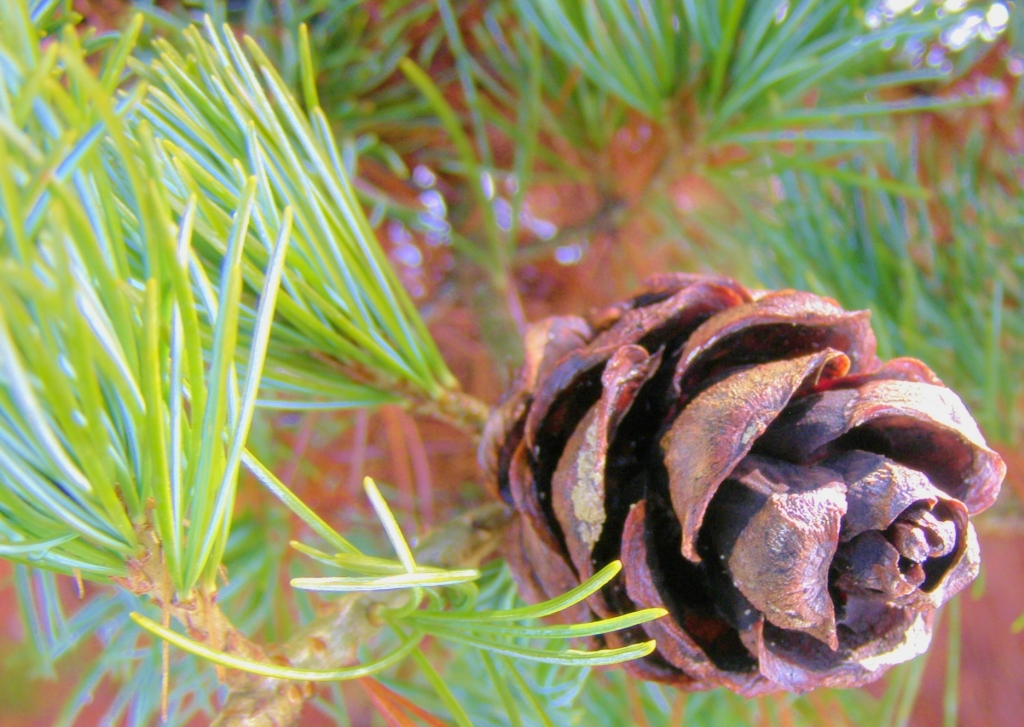
Pine cone, exact species unknown. UBC Botanical Garden, February 26, 2014.

Pine cone, exact species unknown. UBC Botanical Garden, February 26, 2014.


The next three books in my series of Round-Up posts all involve some sort of autobiographical experiences, though they are presented in different ways. Gavin Maxwell’s Harpoon Venture is self-critical and hyper-realistic; Rosemary Taylor’s Harem Scare’m goes for the gently self-mocking humorous approach, while W.H. Davies’ The Autobiography of a Super-Tramp is in the nature of a unemotionally-documented saga, told in the plainest of language by a man looking backwards down the years at his unconventional and occasionally dramatic vagabond (quite literally) days.

************

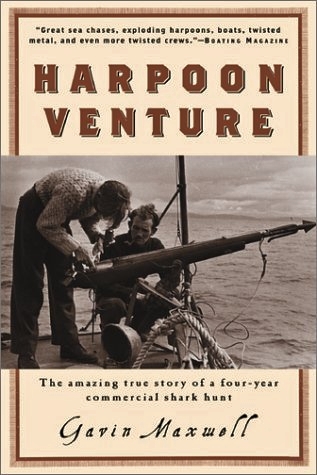
harpoon venture lyons press gavin maxwellHarpoon Venture by Gavin Maxwell ~1952. This edition: Lyons Press, 1996. Introduction by Stephen J. Bodio. Softcover. ISBN: 1-58574-370-4. 304 pages.

My rating: 8/10

If you have read Gavin Maxwell’s memoirs of his life with pet otters and other various creatures, Ring of Bright Water, Raven Seek Thy Brother, and The House of Elrig, you will recall his passing references to his several immediately post-WW II years spent hunting basking sharks off the Isle of Soay, in Scotland’s Inner Hebrides, close to the Isle of Skye.

This book, Maxwell’s first, details the doomed venture from its first conception during a bombing raid in the 1940 Battle of Britain blitz, when Gavin Maxwell determined that if he survived the war, he would

“…buy an island in the Hebrides and retire there for life; no airplanes, no bombs, no commanding officers, no rusty dannert wire…”

Two years later Gavin Maxwell was serving with Special Forces and stationed in northwest Scotland, when he joined a friend for a yacht trip during their leave and first came across the small, steep-hilled Isle of Soay. After spending two hours roaming the island, Maxwell had determined to make his dream a reality; he would buy it, establish a local industry, and spend his days in peaceful usefulness, looked up to as a local benefactor, the “laird”, in fact.

Needless to say, such utopian dreams were to prove to be too good to be true. The industry Maxwell decided upon was the establishment of a basking shark fishery, to chase down, harpoon and render into useful products the massive, plankton-eating basking sharks, which can reach weights of over 5 tons. These sharks contain huge livers which were at the time in great demand for their oil content, but Maxwell’s scheme involved a factory which would process all of the parts of the fish – skin which could be turned to leather, flesh which could be marketed as “sail-fish”, fins to be dried and sent to China as aphrodisiacs, cartilage and bones to be used to produce glue – the list of possibilities was endless.

It took almost four years for Maxwell’s enterprise to bankrupt itself; he never really recovered from the loss of his personal fortune which he had sunk into the project; he lost Soay and embarked upon a vagabond lifestyle of travelling and writing, which resulted in the acquisition while in the marshes of Iraq of the first of the famous otters.

But this was before that, and fascinating it is all on its own merits, though the brutal details of the process of hunting, harpooning and killing the basking sharks may be queasy-making to those readers of delicate sensibilities. Somehow the narrative manages to transcend the sordid details, leaving one with a portrait of a brilliantly intelligent, highly observant and sensitive yet deeply self-destructive man, who frequently made some very bad decisions, and only sometimes took responsibility for them. My final impression is of a book of intense experiences delicately observed and lyrically depicted.

A wonderful review of the book is here: Desperate Reader: Gavin Maxwell’s Harpoon at a Venture

One hint: Avoid the Lyons Press edition, pictured above. For some odd reason it leaves out all of the photographs – over seventy in number – which are referenced throughout the text, giving a rather surreal experience to the reader as Maxwell has continually linked his written narrative to the photos, and without them one is left completely at a loss as to what is being referred to.

Second-hand copies of  earlier editions of this book are readily available, generally titled Harpoon at a Venture, so go for one of those instead of the 1996 Lyons reprint.

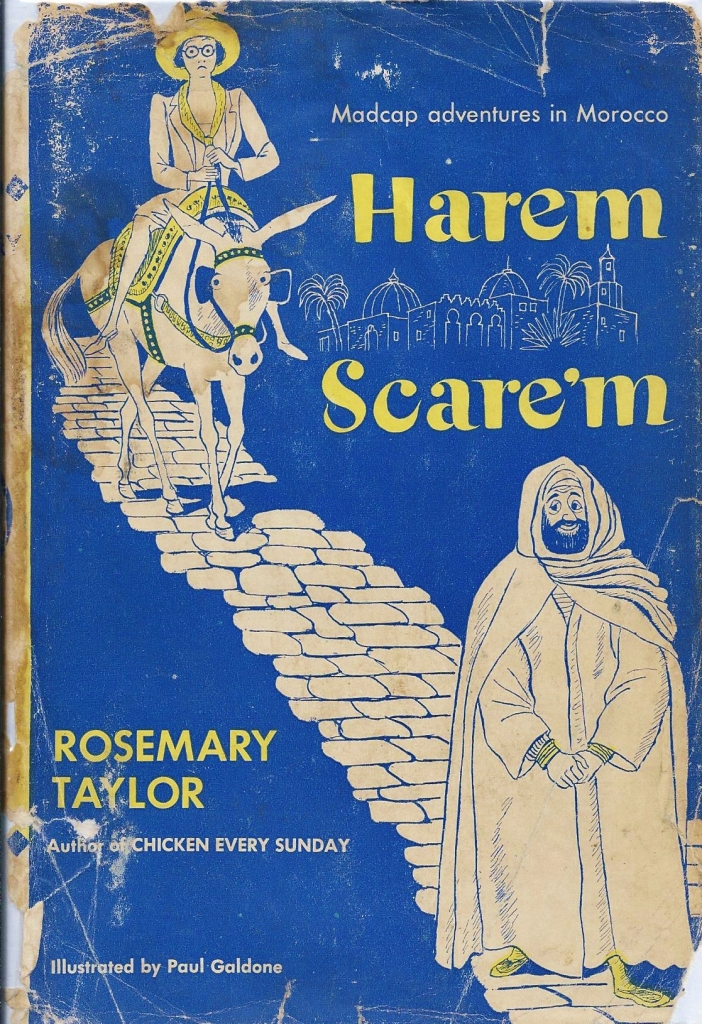
harem scare'm rosemary taylor 001Harem Scare’m by Rosemary Taylor ~ 1951. This edition: Thomas Y. Crowell, 1951. Illustrations by Paul Galdone. Hardcover. 246 pages.

My rating: 6.5/10

This was another one of those happy-chance stumble-upon books. I had read and written about Rosemary Taylor’s Arizona childhood memoir Chicken Every Sunday back in 2012, and then, just recently in March 2014 had received a comment on my post, which brought Taylor to mind again. Only a day or two later what should I notice among the tattered hodge-podge of old cookbooks and automotive repair manuals at a local antiques emporium, but “Rosemary Taylor” on the spine of a book. And here it is. Isn’t random promising-book-discovery a wonderful thing?!

Written in the early 1950s, Harem Scare’m is Rosemary’s account of her time as a young, aspiring writer in the early 1920s, when she was travelling with a friend in Europe on a break from her first job as an assistant dean of women at Stanford University.

In the process of “getting cultured”, Rosemary temporarily parts with her travelling companion and journeys solo to Madrid, with a week among the pictures in the Prado her goal. The train trip starts out well, but is soon to go sideways…

So there I sat, the future dean of women, dressed in the brown coat and tight-fitting white felt hat I’d bought at such a bargain in a little shop in Paris, wearing no make-up – I didn’t approve of make-up – my legs encased in lisle stockings, my shoes stout and sensible, and on my nose big horn-rimmed glasses, for I was, and am, very near-sighted. A prim and proper young lady, attending strictly to her own business, definitely not provocative, definitely not the type to invite any attention, welcome or unwelcome. Or so I thought.

An optimistic Spanish porter appears to think that Miss Taylor is very provocative, and as she fights him off with determination she is vastly relieved by the entry into her compartment of a one-eyed man, who turns out to be a fellow American, one Floyd Gibbons. The name sounds vaguely familiar to Rosemary, and she is grateful for Mr. Gibbons’ large and protective presence for the remainder of her trip. Floyd, who is of course the Floyd Gibbons, intrepid and well-known war correspondent for the Chicago Tribune, is on his way to Morocco, to cover the events of the Second Moroccan War, the long drawn out series of clashes between the Spanish and French forces with the Moroccans, also known as the Rif War.

Floyd takes quite a liking to the naïve young Rosemary, especially when he learns that she is corresponding with her hometown newspaper, the Tucson Citizen, and has just received a princely $5 for a recent article. Why not come with me to Morocco, he asks her teasingly? You can get the woman’s-eye view of things there, maybe get an interview in the local sultan’s harem…

Well, as things turned out, Rosemary did go to Morocco with Floyd, joining a bevy of other war correspondents, and she did get an interview in a harem, which she wrote up for the Citizen. She also found herself in many unexpected places, which she writes about with self-effacing good humour and occasional passionate poignancy.

Rosemary tries very hard to keep the tone light throughout, and though this makes for a not-very-deep but entertaining read, one sometimes feels like she is leaving a lot of interesting stuff out, by deciding to go for the laugh every time, which is why I couldn’t in good conscience rate it much higher.

Rather fascinating stuff, though, with much scope for further investigation. I’ll certainly be paying attention the next time I come across Floyd Gibbons’ name; he sounds like a very interesting personality indeed, and Rosemary Taylor’s depiction of him in Harem Scare’m is affectionate and appealing.

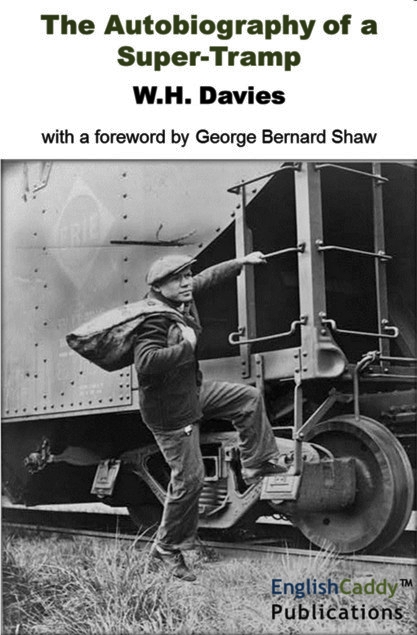
the autobiography of a super-tramp w h davies other

Not my personal copy, but a much later edition with an apt cover photo.

The Autobiography of a Super-Tramp by W.H. Davies ~ 1908. This edition: Jonathan Cape, 1933. Introduction by George Bernard Shaw. Hardcover. 304 pages.

My rating: 9/10

There’s a lot in this book, reminiscences of a long and event-filled life, by a sometimes less-than-sympathetic narrator, whose deadpan delivery takes some getting used to, but is worth putting up with for the vivid picture the book gives of a very unconventional attitude and way of living.

I suspect this is the most well-known of the three books in this grouping, being still in print over a century after its first publication, so I won’t go into too much detail.

Born in Wales in 1871, William Henry Davies was raised by his maternal grandparents, and from childhood showed a reluctance to follow in the expected path of others of his class and circumstance. Unable to settle into steady work, Davies abandoned his apprenticeship with a picture-frame maker and instead took to the roads, living on income derived from temporary work, a small income from a legacy, and eventually outright begging.

Davies was fascinated with North America, and eventually made it to the United States, where he joined a loosely connected tribe of “professional” hoboes who travelled the country by stealing rides in and on top of boxcars. They fed themselves on the charity of housewives and by taking on odd jobs, picking fruit, working as seasonal laborers and such. Davies was able to extensively travel throughout the States, and he crossed the Atlantic to and from England numerous times by working of his passage on cattle boats. His foray into Canada on the way to the Klondike gold rush ended horribly when he slipped while attempting to jump a train in Ontario, losing his foot and crushing his right leg, which was eventually amputated at the knee.

Returning to England sporting a wooden peg leg, Davies turned his attention to writing poetry, as he had always been a great reader and secret writer through his vagabond years. Living in charity rooms and living off of his grandmother’s legacy, Davies wrote and wrote and wrote, eventually paying to have his verses printed and attempting to sell them door to door. He met with small success, but kept on, until a series of lucky coincidences brought his poetry into the public eye, where it was received with enthusiasm for its universal themes and sincere tone.

George Bernard Shaw was shown the manuscript of this book, and by his patronage secured Davies a very favourable publishing deal, and the rest is history. Davies ended his days in England hobnobbing with the literary aristocracy of the time, a far cry from the days of stealing garments off of backyard clotheslines and dodging railroad cops.

This memoir is stunning in the scope of its content, and in its unapologetic tone. Davies makes few excuses for his choice of lifestyle and where it took him; he was a keen observer of his companions of the road and the book is full of fascinating portraits of unconventional people and the even stranger events they were involved in.

The Autobiography of a Super-Tramp is written in a very calm, almost overly flat style, and can occasionally be rather hard going as climax after climax is related matter-of-factly in Davies’ sober voice, but his musings on why he is like he is and how he relates to the others he meets in his journeyings and his pithy commentary on social peculiarities make it compelling reading.


Read Full Post »

Getting ready to unfurl - leaf buds at University of British Columbia Botanical Garden, late February, 2014.

Getting ready to unfurl – leaf buds at University of British Columbia Botanical Garden, late February, 2014.

Well, here we are at the end of March, with the year one quarter over, and there is a largish stack of books read in January-February-March sitting here and nagging at my conscience. They all deserve some sort of mention, ideally a post each all to themselves, but with spring coming and longer daylight hours and some serious gardening projects coming up (meaning somewhat less computer time for me – which is by and large a good thing – hurray!) I know that I will not get to them all.

So I think a series of round up posts is in order, to temporarily clear my desk and my conscience, and to allow me to shelve these ones and recreate a new stack over the next few months, because that pattern or reading/posting is inevitable, it seems.

I’ve been considering how best to present these (there are quite a few) and have sorted them very loosely into sort-of-related groupings. Here’s the first lot, then.

All four of these particular books are linked by general era – just before, during and just after the Great War, and by their vivid reflection of the times they are set in. From playful (Christopher and Columbus) to sincere (The Green Bay Tree and The Home-Maker) to bizarre (Her Father’s Daughter), all help to fill in background details against which to set other books, and all are engrossing fictions in their own disparate ways.

************
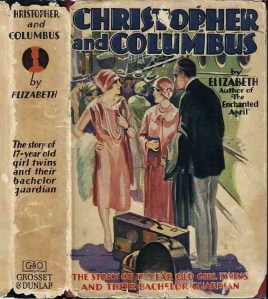
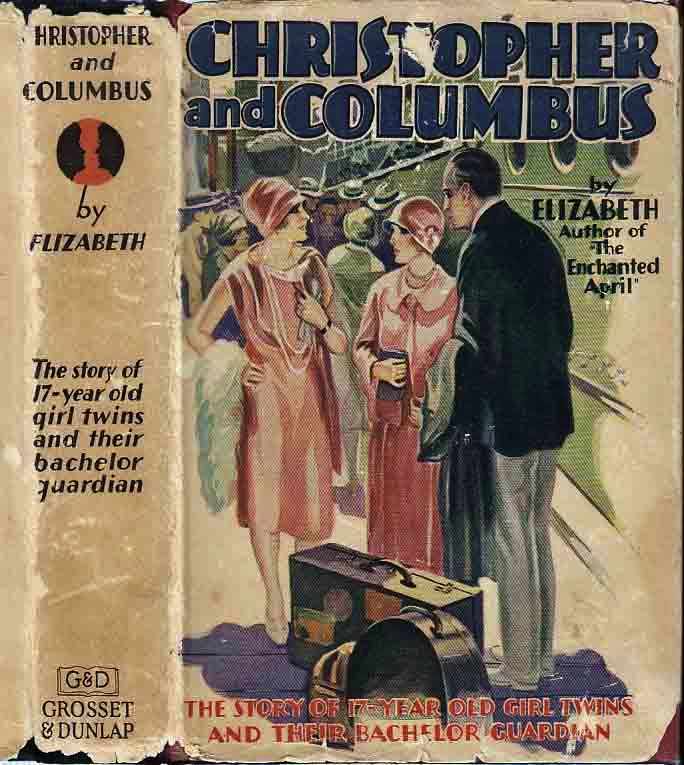
Not my copy - I have a much more recent Virago - but a nice early issue dust jacket depiction.

Not my copy – I have a much more recent Virago – but a nice early issue dust jacket depiction too good to not share.

Christopher and Columbus by Elizabeth von Arnim ~ 1919. This edition: Virago, 1994. Paperback. ISBN: 1-85381-748-1. 500 pages.

My rating: 8/10

Charming and playful, with a serious undertone regarding wartime attitudes to “enemy aliens”, set as it is in the early years of the Great War, in England and America.

Their names were really Anna-Rose and Anna-Felicitas; but they decided, as they sat huddled together in a corner of the second-class deck of the American liner St. Luke, and watched the dirty water of the Mersey slipping past and the Liverpool landing-stage disappearing into mist, and felt that it was comfortless and cold, and knew they hadn’t got a father or a mother, and remembered that they were aliens, and realized that in front of them lay a great deal of gray, uneasy, dreadfully wet sea, endless stretches of it, days and days of it, with waves on top of it to make them sick and submarines beneath it to kill them if they could, and knew that they hadn’t the remotest idea, not the very remotest, what was before them when and if they did get across to the other side, and knew that they were refugees, castaways, derelicts, two wretched little Germans who were neither really Germans nor really English because they so unfortunately, so complicatedly were both,—they decided, looking very calm and determined and sitting very close together beneath the rug their English aunt had given them to put round their miserable alien legs, that what they really were, were Christopher and Columbus, because they were setting out to discover a New World.

Total digression – check out the paragraph above. It is ONE sentence. Thank you, E von A, because now I don’t feel quite so bad about my own rambling tendencies!

Ahem. Back to our story. To condense completely, the two Annas, having been rejected by their English connections, are sent off to America (this is before the Americans have joined in the war) to be settled upon some distant acquaintances there. Everything goes awry, but luckily the two girls – they are twins, by the way – have gained a sponsor/mentor/protector in the person of Mr. Twist, a fellow passenger, who just happens to be wealthy young man with a strong maternal streak.

The three adventure across America – the twins getting into continual scrapes and Mr. Twist rescuing them from themselves – eventually ending in California, where they acquire a chaperone and a Chinese cook, and decide to open an English-style teashop. It is a blazing success, but not in the way they had planned…

Very much in the style of The Enchanted April, more than slightly farcical, with romantically tidy endings for all.

Internet reviews abound, and this is happily available at Project Gutenberg:  Christopher and Columbus
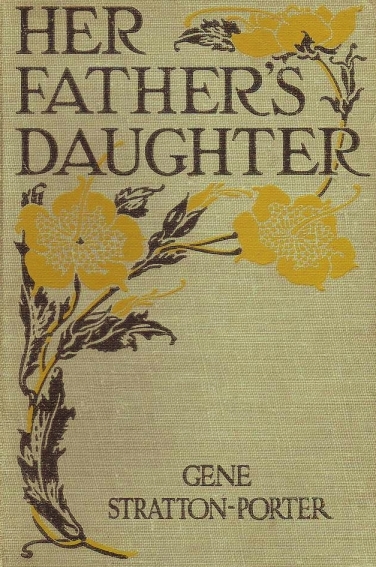
her father's daughter gene stratton porterHer Father’s Daughter by Gene Stratton-Porter ~ 1921. This edition: Doubleday, 1921. Hardcover. 486 pages.

My rating: 2/10

Talk about contrast between books of a similar vintage, between this one and the previous Elizabeth von Arnim confection. This next book was a shocker, and I disliked it increasingly intensely, forcing myself to keep reading because I was determined to see where the author was going to go with it. (Nowhere very good, as it turns out.)

I already had an uneasy relationship with Gene Stratton-Porter, and though I’d been forewarned by other reviewers about the deeply racist overtones of Her Father’s Daughter, I wasn’t prepared to have the “race issue” as such a major plot point.

Two teenage sisters are orphaned. The elder sister spends their joint income on herself, on her lavish wardrobe and gadding about, while the younger sister is left to her own dismal devices.

Luckily sister # 2, our heroine, Linda, is a young lady of vast resource and apparently limitless talents. She pseudonymously writes and illustrates popular articles on California wild plants and flowers, excels at her high school courses, and has attained the selfless dedication of the family cook/housekeeper, a brogue-inflicted Irishwoman, one Katy. (GS-P’s dialect mangling reaches new heights in this book.)

Linda also tootles about in her late father’s car, a Stutz Bear Cat, driving everywhere fast, and as it goes without saying, better than all the boys. There’s nothing this girl doesn’t excel at, and her acquaintance ooh and ah over her many accomplishments, and chuck their devotion at her feet. She’s ultimately so all-round darned smart and gorgeous and generally desirable – especially once she bullies her sister into ponying up some of Daddy’s cash so she can buy a few new dresses – that she attracts three suitors, two of them older men, and one a high school classmate.

Which brings us to the race angle. For in the high school class the teenage suitor attends, there is a Japanese boy, who is at the top of the class despite all efforts of Linda’s Boyfriend to displace Japanese Guy. So Linda wracks her brains to find a way to help Boyfriend beat “the Jap”. Says she:

 “They are quick; oh! they are quick; and they know from their cradles what it is that they have in the backs of their heads. We are not going to beat them driving them to Mexico or to Canada, or letting them monopolize China. That is merely temporizing. That is giving them fertile soil on which to take the best of their own and the level best of ours, and by amalgamating the two, build higher than we ever have. There is just one way in all this world that we can beat Eastern civilization and all that it intends to do to us eventually. The white man has dominated by his color so far in the history of the world, but it is written in the Books that when the men of color acquire our culture and combine it with their own methods of living and rate of production, they are going to bring forth greater numbers, better equipped for the battle of life, than we are. When they have got our last secret, constructive or scientific, they will take it, and living in a way that we would not, reproducing in numbers we don’t, they will beat us at any game we start, if we don’t take warning while we are in the ascendancy, and keep there.”

And this:

“Take them as a race, as a unit—of course there are exceptions, there always are—but the great body of them are mechanical. They are imitative. They are not developing anything great of their own in their own country. They are spreading all over the world and carrying home sewing machines and threshing machines and automobiles and cantilever bridges and submarines and aeroplanes—anything from eggbeaters to telescopes. They are not creating one single thing. They are not missing imitating everything that the white man can do anywhere else on earth. They are just like the Germans so far as that is concerned.”

And then this:

“Linda,” said the boy breathlessly, “do you realize that you have been saying ‘we’? Can you help me? Will you help me?”

“No,” said Linda, “I didn’t realize that I had said ‘we.’ I didn’t mean two people, just you and me. I meant all the white boys and girls of the high school and the city and the state and the whole world. If we are going to combat the ‘yellow peril’ we must combine against it. We have got to curb our appetites and train our brains and enlarge our hearts till we are something bigger and finer and numerically greater than this yellow peril. We can’t take it and pick it up and push it into the sea. We are not Germans and we are not Turks. I never wanted anything in all this world worse than I want to see you graduate ahead of Oka Sayye. And then I want to see the white boys and girls of Canada and of England and of Norway and Sweden and Australia, and of the whole world doing exactly what I am recommending that you do in your class and what I am doing personally in my own. I have had Japs in my classes ever since I have been in school, but Father always told me to study them, to play the game fairly, but to BEAT them in some way, in some fair way, to beat them at the game they are undertaking.”

Well, Japanese Guy soon realizes that something is up, because suddenly Boyfriend is pulling ahead in Algebra. (Or was it Trigonometry?) All because Linda is now helping Boyfriend study and has given him many words of encouragement. And then Linda and Boyfriend start to suspect that Japenese Guy is not a mere teenager like themselves, but an older man who is dying his hair and using cosmetics to make himself look younger. And then the gloves are off on both sides.

Subplots concerning sister and the inheritance and a friend who is an aspiring architect and more skulduggery concerning both of those scenarios, with the whole thing ending in a murder attempt by Japanese Guy upon Boyfriend, and his (Japanese Guy’s) death at the hand of Linda’s Irish servant Katy. Luckily killing a dirty yellow Jap is all in a day’s work in this neck of the woods:

“Judge Whiting, I had the axe round me neck by the climbin’ strap, and I got it in me fingers when we heard the crature comin’, and against his chist I set it, and I gave him a shove that sint him over. Like a cat he was a-clingin’ and climbin’, and when I saw him comin’ up on us with that awful face of his, I jist swung the axe like I do when I’m rejoocin’ a pace of eucalyptus to fireplace size, and whack! I took the branch supportin’ him, and a dome’ good axe I spoiled din’ it.”

Katy folded her arms, lifted her chin higher than it ever had been before, and glared defiance at the Judge.

“Now go on,” she said, “and decide what ye’ll do to me for it.”

The Judge reached over and took both Katherine O’Donovan’s hands in a firm grip.

“You brave woman!” he said. “If it lay in my power, I would give you the Carnegie Medal. In any event I will see that you have a good bungalow with plenty of shamrock on each side of your front path, and a fair income to keep you comfortable when the rheumatic days are upon you.”

By the end Linda has nabbed control of the family fortune, the sister has received a severe humbling, and the architect friend wins the prize. (And Japanese Guy is dead and vanished, his body mysteriously spirited away by “confederates”, adding a strange conspiracy theory sort of twist to the saga. All I could think was, “All that for academic standing in a high school class? Really? Really, Gene Stratton-Porter???!”)

Linda predictably finds true love, not with Teenage Boyfriend but with Older Man with Lots of Money and A Very Nice House built up amongst the wildflowers in Linda’s favourite roaming ground. How very handy.

Trying to think what I left this unsettling bit of vintage paranoia two points for. I guess because I did keep reading. But it was thoroughly troubling from start to finish on a multitude of levels – the racist thing being only one of the points that jarred – and even the gushing descriptions of California flora didn’t really salvage it.

Not recommended, unless you are a Gene Stratton-Porter completest. Not a very pretty tale, but if you wish to see for yourself, here it is at Project Gutenberg: Her Father’s Daughter

Will I read more books by this writer? Yes, very probably. For the curiousity factor, if nothing else, because these were hugely popular in their time, and that tells an awful lot (pun intended) about the general attitude of the populace who found these appealing, and they do much to enrich our background picture of an era.
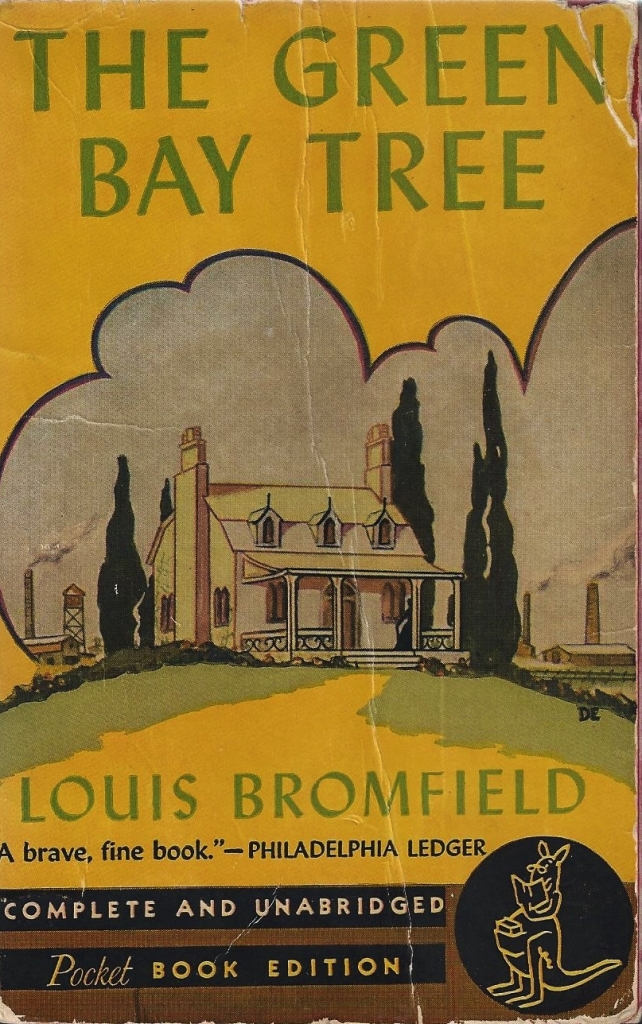
the green bay tree louis bromfield 001The Green Bay Tree by Louis Bromfield ~ 1924. This edition: Pocket Books, 1941. Paperback. 356 pages.

My rating: 7/10

Moving on just a year or two, to this family saga by American writer Louis Bromfield, who served in the French Army during the First World War, and subsequently lived in France for thirteen years, before resettling in the United States and dedicating himself to the improvement of American agriculture by establishing the famous Malabar Farm in Ohio.

Bromfield was a prolific and exceedingly popular writer of his time, winning the Pulitzer Prize in 1927 for his third novel, Early Autumn. 1924’s The Green Bay Tree was his first published work, and it was immediately successful, paving the way for his stellar future writing career.

This is a book which fits neatly into the family saga genre, focussing on one main character, the wealthy and strong-willed Julia Thane, but surrounding her with a constellation of competently drawn characters all carrying on full lives of their own, which we glimpse and appreciate as they bump up against Julia in her blazing progress from the American family mansion surrounded by steel mills to the secluded house in France, where she settles with her secret illegitimate child and remakes her life very much on her terms.

Bromfield, in addition to creating a strong female lead and allowing her much scope for personal activity, also has a sociopolitical angle which he persistently presents, in the major sideplot of ongoing labour unrest in the steel mills surrounding the Shane family mansion, and widening the focus to the greater situation right across industrial America, with the hard-fought battle for workers’ rights and labour unions, and the rise of Russian Communism and its ripple effect which spreads across the globe.

Late in the story Lily Shane is caught up in the German invasion of France at the start of the Great War, and though this section is reasonably well-depicted, it was a bit too conveniently rounded off, with the author fast-forwarding to the end of the war with very few details after Lily’s one big dramatic scene.

It took me a chapter or two to fully enter into the story, but once my attention was caught I cheerfully went along for the ride. Bromfield is a smooth writer, and though this occasionally whispers “first novel” in slight awkwardness of phrasing and sketchiness of scene, by and large it is a nicely polished example of its type.

Bromfield seems to be something of a forgotten author nowadays, which is a shame, as his novels are certainly as engrossing (if not more so) than many of those now heading the contemporary bestseller lists. More on Bromfield in the future, I promise.
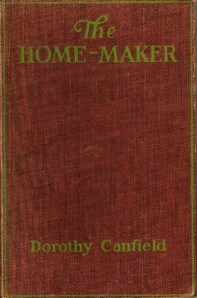
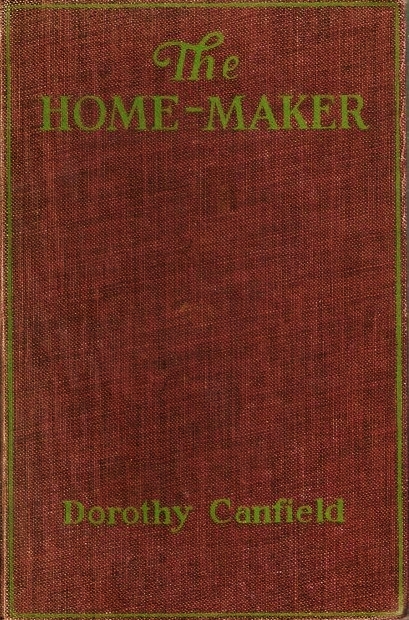
the home-maker dorothy canfield fisherThe Home-Maker by Dorothy Canfield ~ 1924. This edition: Harcourt, Brace & Co., 1924. Hardcover. 320 pages.

My rating: 8.5/10

Saving the best for last, here is a book I had been looking forward to for quite some time, after seeing it featured on the Persephone Press reprint list, and reading such stellar reviews by so many book bloggers.

It was very good indeed, though I found that the ending was vaguely unsatisfactory to me personally, involving as it did an unstated conspiracy between several of the characters to continue with a serious misrepresentation in order to allow a societal blind eye being turned to an unconventional family arrangement. I think I would have preferred an open discussion, rather than a sweeping under the rug sort of conclusion. But that’s just me… This novel must have been rather hard to round off neatly once the author had taken it as far as she thought her audience would swallow, and she decidedly had made her point and was likely ready to move on.

An ineffectually dreamy man labors on at an uncongenial job, while his wife keeps the house polished to the highest standard possible, and receives accolades from all levels of the social hierarchy of the small New England town where the family lives for her obvious achievement of wifely and motherly perfect devotion. Meanwhile the family’s three children are showing very obvious symptoms of psychological distress: excessive shyness (the oldest girl), a perennially wonky digestion (middle boy), and determined naughtiness (youngest boy).

Husband loses his job and on the way home to break the news has a terrible “accident”; he ends up in a wheelchair and the wife forays forth into the working world. And wouldn’t you know it? Suddenly everyone is much happier, and the children’s issues start to resolve “all on their own”. But the husband is healing much more fully than at first it was feared. How will this all end, in 1920s’ small town America, where gender roles are by and large carved in granite?

A lovely book, and extremely readable for its keen examination of the marital relationship it portrays, and its touching details of family life and the woes and joys of childhood.

Where it lost its few points with me was in the unlikely perfection of the wife’s experience in the working world; she waltzed right in and was promoted up the department store ladder of responsibility remarkably easily; even allowing for her detail-freak perfectionism her immediate grasp of her new role in life was a bit hard to swallow, as was her sudden relaxation regarding less than stellar household cleanliness. And I was uncomfortable with the “easy” ending, as I mentioned earlier.

I’ve read a number of other Dorothy Canfield Fisher novels, and they share this same occasional over-simplification as the author hammers her point home – she was something of a crusader in the area of improving family life and giving a fuller and freer role to children – but as she is also a marvelous story teller we can allow her this tiny tendency, I think.

************

Of the four books in this grouping, if I were going to recommend one as a should-read, it would definitely be The Home-Maker.

Followed by Christopher and Columbus, because it is utterly charming, if a bit silly in its premises and occasionally rather wordy. The Green Bay Tree is a perfectly acceptable drama, though nothing extraordinary. As for Her Father’s Daughter, consider yourself forewarned!

Read Full Post »
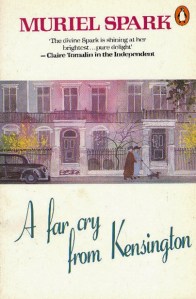
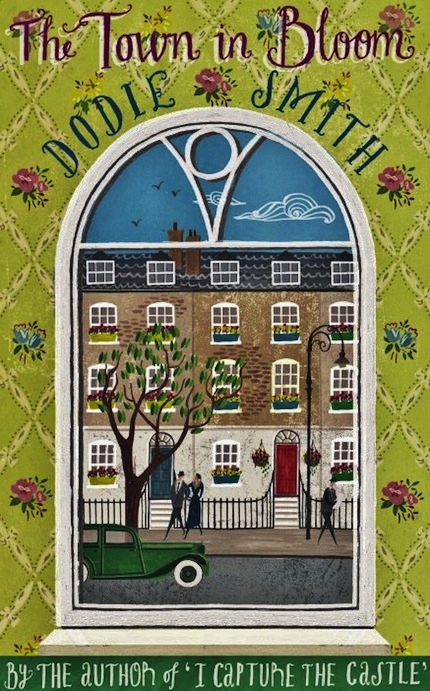
The Town in Bloom Dodie Smith corsair editionThe Town in Bloom by Dodie Smith ~ 1965. This edition: Corsair, 2012. Paperback. ISBN: 978-1-78033-301-4. 314 pages.

My rating: 8.5/10

After my mixed feelings about one of Dodie Smith’s “other” (meaning not I Capture the Castle) adult novels, The New Moon with the Old, and my rather shaky introduction to this one (I quit early on the first time of attempting to read it) I was very pleased to find that I did like this one, after all. A whole lot. Now isn’t that interesting?

Three ex-actresses meet for their every-five-years reunion dinner, hoping that this year, the eighth reunion, the fourth of their friends, the elusive Zelle, may join them, but it appears that this is not to be.

It’s been forty years since vivacious narrator Mouse (we never learn her real name), placid Molly and sleekly beautiful Lilian were all thrown together in the lively heyday of the 1920s London theatre scene. They have all gone on to varying degrees of success and happiness, and by and large enjoy their reminiscences every time they meet, but there is a shadow lurking regarding the unknown fate of the fourth of their jolly crew, who vanished (voluntarily) from her room in the theatrical boarding house they all shared and hasn’t been seen or heard from since, despite repeated pleas to join the reunion published in the personal ads of The Times.

As the three friends chat after their window table lunch, Mouse becomes increasingly intrigued by an eccentrically dressed woman huddled over her drab knitting on a park bench outside, who keeps glancing at the ladies inside in a surreptitious manner. Could it possibly be…?

An attempt to intercept the maybe-Zelle fails, but Mouse has marked the house her quarry disappeared into for future investigation. Meanwhile, the encounter has triggered a flood memories of the summer in the 1920s when the four girls came together in their unlikely friendship, and which ultimately saw all of them launched on their forever-after paths due to decisions made in the passionate heat of those few torrid months.

I hesitate to go much further in my description of the plot, because I did so enjoy unravelling it all on my own, but I will say that it involves a whole lot of sex. Thinking about it, talking about it, plotting how best to go about arranging it, and of course doing it. There is nothing at all graphic, aside from some teasing reference –  “I should write down all the details in my diary but well maybe I’ll just let it live in my memory…” – but these girls are all, in their own ways, carrying on very active love/sex lives. Mouse is assumed to be the most innocent, due to her relative youth (she’s eighteen) and child-like appearance (she’s tiny and innocent looking) but she turns out to be nothing of the sort, absolutely throwing herself into the experience, and eagerly shedding her virginity with only a few meditative regrets:

I was very happy too – in a way; I am finding that out as I write. I am, somehow…exorcising the loneliness. It will pass, it will pass.

But with it will pass someone I shall be a little sorry to lose: myself as I was before last night. Aunt Marion had a book of poems by Charles Cotton which she bought for the Lovat Fraser decorations, and in one poem are the lines:

She finds virginity a kind of ware
That’s very, very troublesome to bear,
And being gone she thinks will ne’er be missed.

I think one will miss it, but only for a very little while. Soon one will forget that it ever meant anything. Perhaps it never did; already I can almost accept that. The great plane tree outside my window is just as beautiful it was that May night when I last wrote in my journal, though its summer leaves are a little less green than the leaves of spring…

Shades of Cassandra Mortmain, I believe I detect in these youthfully self-focussed musings.

The novel gives a fascinating glimpse of the world of the 1920s’ theatre, being very much involved with backstage life, and the details Dodie Smith gives are worth wading through the occasionally tiresome teenage angst of our narrator, and the annoyances that her full-speed-ahead-towards-the-goal persona occasionally engender.

The theatre scenes of the first half of the book are fascinating, though the focus changes (dramatically) once the love affairs start. I did feel that perhaps Mouse’s experiences in the theatre were a bit too plush-lined – she seems to end jam side up pretty well each and every time she stumbles, being taken in and indulged and helped and sheltered again and again and again, even by those she’s deliberately wronged. Rather special, is our Mouse.

I was relieved by the ending, which wasn’t as blissfully neat and tidy as I feared it would be, though it glossed over a whole lot of bothersome details, citing their unimportance due to the passing of four forgetful decades.

Dodie Smith gained my readerly good regard by her willingness to show that there were no fairy tale endings, or, more aptly, that there are really no endings at all (except the very obvious final final one); life does go on and on and on, with no attainment of a permanent goal, and, furthermore, it (life) can continue to be exceedingly interesting, no matter what your birth certificate lists your age as.

Much has been made in some of the other reviews I’ve read about the unexpected feminist elements and the surprising frankness regarding sex in this book, but I didn’t at all feel that these were unusually daring, because though the novel was for the most part set in the 1920s, it was written in the 1960s. Though our mothers, grandmothers and great-grandmothers kept a discreet silence (for the most part) about their personal sexual affairs, there is no doubt whatsoever that their private lives were just as sophisticated as anything going on in this generation, so any sort of “Gosh! Golly! Gee whiz! These girls were downright modern in their escapades!” attitude gets nothing but a yawn from me.

To sum up, The Town in Bloom is a rather better book, in my opinion, than The New Moon With the Old, though I Capture the Castle still occupies a niche set well above either of these.

I have several volumes of Dodie Smith’s biography waiting on the TBR shelves, but I do believe I will investigate some more of her fictions first, if I can get my hands on them. It Ends with Revelations will be the easiest to obtain, and after that I’m not quite sure where to go. Possibly a play or two? Dear Octopus has been recommended to me as worthy of reading. And maybe a revisit to the juveniles, to dally for a bit among the Dalmations…


Read Full Post »

« Newer Posts - Older Posts »