I recently put myself in the mildly surreal situation of simultaneously reading two very different books set in the same location and covering a similar time period. Luckily they were both so very strongly voiced that I managed to focus on each as it deserved.
The first book, a novel by Gavin Lambert, a British-born author who moved to California in the 1950s and had considerable acclaim as a screenplay writer, was much better than I had anticipated from its cover appearance. The bizarre images of Natalie Wood starring as the titular character in a movie version of the novel and the fulsome blurb shouting out “-the happiest, saddest, sexiest Hollywood novel of all!” were a bit off-putting, but the first page grabbed me and pulled me into the story and never let me go until the nebulous but satisfying conclusion.
The second book was an engaging though fairly workaday movie star autobiography, written by Rosalind Russell with the assistance of a co-author, fellow actress-turned-writer Chris Chase. Published a year after Rosalind Russell’s much too early death from breast cancer, it is a mostly flattering self-portrait with a leavening of self-criticism, which left me with a warm-all-over regard for this very matter-of-fact and very dedicated screen and stage actress, famously “in Hollywood but not of it”, as one of her friends declares in the memoir. Rosalind Russell appears from this account to have had an admirably stable personal life, at least compared to the majority of her Hollywood peers.
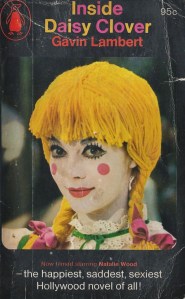 Inside Daisy Clover by Gavin Lambert ~ 1963. This edition: Penguin, 1966. Paperback. 265 pages.

My rating: 8/10
Thirteen-year-old Daisy Clover, father vanished from her life some years previously, is living a squalid life in a trailer park in rundown Playa del Rey, California with her mentally troubled mother The Dealer (named for her fixation on solitary card games).
Daisy finds joy in saving her nickels and dimes for occasional forays to a recording booth where she unselfconsciously belts out songs with more than a little “rare natural talent”, and she has just purchased the first of what will turn out to be a vast number of notebooks in which she will record her inner thoughts for the next two decades.
Confided to her diary, Daisy has a soberly related sexual awakening assisted along by a certain Milton, an older boy, “quite nice looking, he had muscles and butch hair and good teeth, but also a slight weight problem”, with their relationship consummated on an old, mattress-less brass bed in Milton’s father’s used furniture store, “priced at $25.00 and marked VERY NICE. Dot, dot, dot, dot.”
Daisy turns fourteen on a disastrous day which includes her mother inadvertently setting fire to their home, and it seems that despair is the theme of her young, angst-ridden life, but things are about to take a strange turn. Daisy enters one of her recorded discs (a new recording; all of the old ones having been destroyed in the fire) in a talent contest, and is “discovered” by Magnagram Studios magnate Raymond Swan.
Turns out that not only can our heroine sing like an angel, she can also act like a reincarnation of Mary Pickford (with the added benefit of being able to supplement her performance with vocals), and stardom bursts upon Daisy.
But this is not, of course, without its drawbacks.
Daisy’s patron Mr. Swan and his oddly hot-and-cold wife Melora keep Daisy on the path to ever-increasing fame, and while she finds deep satisfaction in the singing and acting aspect of her new life, being a true artist and all that jazz, the personal cost of her new life is rather brutal.
The Dealer has been whisked off to a mental home and erased from Daisy’s official biography, allowing her to be billed as “The Sensational Singing Orphan” (or something like that – couldn’t find the exact term in my flip-through just now), and Daisy is now under the care of her gosh-awful older sister Gloria, who married some years earlier and scooted out of Playa del Rey without a backward glance. Now that Daisy is a potential movie star, Gloria is very much back in the picture, and Daisy has quite a lot to say in Dear Diary about that development.
The years roll on. Daisy is a definite success as per Mr Swan’s planning and Gloria’s fervent pushing, but then the Star Train derails, when Daisy falls deeply in love with the worst possible prospect for promotional purposes she could come up with.
Once a top notch star, but now fading fast, the much older actor Wade Lewis is now a notoriously self-destructive drunk and a reportedly manipulative lover-of-many, but Daisy ignores the hissing whispers and goes with her emotions. The two find a common ground in their dislike for the lives they lead, and a genuine connection develops. The relationship strikes enough sparks to catch widespread attention, and through Daisy’s bullheaded insistence a marriage takes place. Too bad Wade’s real sexual interests are not in women, despite his reputation in the gossip columns…
Gosh, what a grand little slice-of-American-life novel, right up there with the smutty California romances and pill-popping exposés of Jacqueline Susann, albeit much better written than anything she pumped out just a few years after Lambert’s Daisy Clover appeared.
A measure of redemption is (predictably) found after the inevitable crash-and-burn of the aging child star, and the ongoing relationship between Daisy and The Dealer adds a poignancy and appeal to what might otherwise be an utterly depressing condemnation of everything that’s wrong with the American Star Machine.
Gavin Lambert turned his novel into a screenplay, though with considerable changes to adapt it to the screen, and the movie Inside Daisy Clover was released in 1966, starring Natalie Wood as Daisy, Christopher Plummer as Mr. Swan, and Robert Redford as Wade (with the character changed, at Redford’s insistence, to vaguely bisexual versus the original completely-homosexual-passing-as-straight).
The movie was, by all accounts, a flop.
But the book most definitely isn’t, and I’ll be keeping an eye out for some of Lambert’s other Hollywood novels, apparently seven in total, as well as a collection of short stories and a number of well-regarded celebrity biographies.
Gavin Lambert was – no surprises here, after finishing Daisy Clover and considering some of its themes – homosexual himself, and his sympathetic and ultimately open portrayal of gay characters was unusual and rather brave for his era.
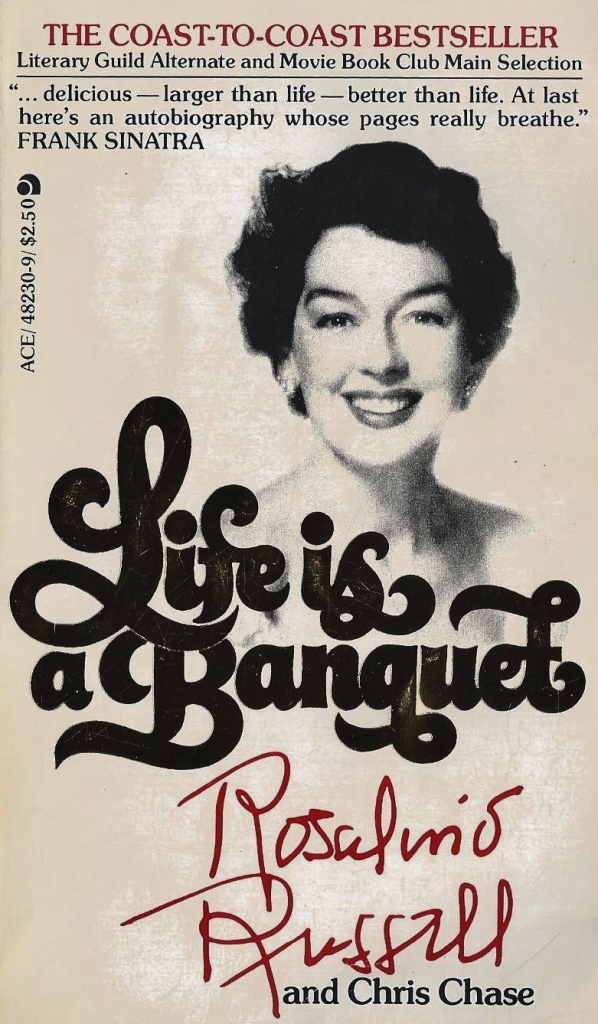
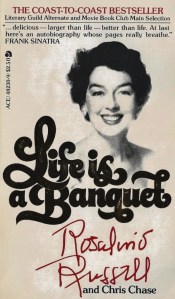 Life is a Banquet by Rosalind Russell and Chris Chase ~ 1977. This edition: Ace, 1979. Paperback. ISBN: 0-441-48230-9. 260 pages.
My rating: 7/10
From mince-no-words fiction to slightly airbrushed real life, with this cheerful autobiography set mostly in the early years of Rosalind Russell’s career, but with enough concentration on the decades of the 1950s and 60s to add a supplementary picture of this most unique setting to my concurrent reading of Daisy Clover.
Rosalind Russell was unusual among her peers in that she willingly (by her account) turned her back on Hollywood for a time to return to her roots as a Broadway actress. She then went back to Hollywood, taking along her stellar role of Auntie Mame from Patrick Dennis’ bestselling book-turned-theatrical production which was one of her outstanding stage performances, and then transitioned gracefully from first-run star to character actress in her later years.
Happily married for thirty-five years (to the same man, of course, making her rather unique in Hollywood circles – meow, meow!), Russell’s description of her relationship with her husband, Frederick Brisson, was downright heart-rending, especially in conjunction with his tribute to her in the book’s introduction.
Rosalind Russell died in 1976, aged 69, after years of struggle with both serious rheumatoid arthritis and breast cancer. Life is a Banquet was published a year after her death.
Though the autobiography is decidedly self-edited, it made me most sympathetic to its writer, not to mention deeply curious about the bits which were glossed over, though none of them appear to be at all scandalous. Rosalind merely kept a ladylike silence over other people’s private business, and obviously chose not to go into salacious detail regarding her own black moments.
Rosalind Russell was a truly beautiful woman – her photographs leave me smiling in admiration of the absolutely lovely composition of her face – those winged eyebrows over those dark, wide-set eyes! – and those sultry eyes show a glint of something else: deep intelligence and a love of laughter. Her well developed sense of humour shines through in this book.
As I mentioned earlier, Life is a Banquet is written in a slightly pedestrian style, and though it was pleasantly engaging and held my interest well, I couldn’t give it a higher rating than a “7” on my personal reading quality scale.
This memoir has left me with a warmly approving regard for its writer, and with a strong desire to watch the movie version of Auntie Mame again, and to seek out some of Rosalind Russell’s other movies, of which there is a large choice, from 1934 to 1971.
I think one might safely say Rosalind Russell was a Star well deserving of that designation in all of the best ways.









 Leaves & Pages
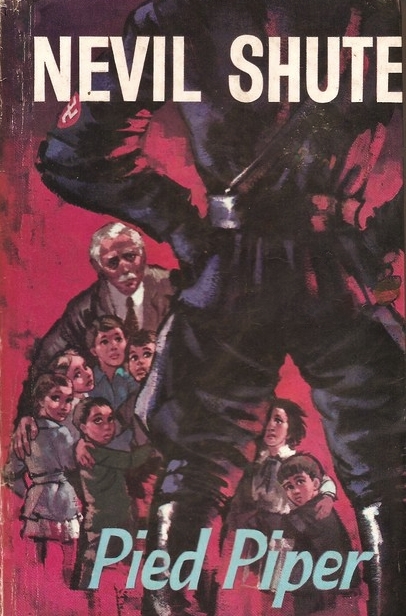
The Houses in Between by Howard Spring
Posted in 1950s, Century of Books - 2014, Read in 2014, tagged Century of Books 2014, Social Commentary, Spring, Howard, The Houses In Between, Vintage Fiction, War on July 23, 2014| 13 Comments »
My rating: After some deliberation, I cannot honestly give this less than a 10/10. This ambitious novel certainly has some flaws, but the overall reading experience, to me at this point in my life, was utterly satisfying.
A week or so ago I posted a quick teaser about this novel, and I am happy to report that it more than fulfilled its promise. It took me quite a long time to work my way through it, both because of general busy-ness in my real life, and my reluctance to rush through the book. Fine print, thin pages, and rather intense content made it crucial to be able to really concentrate; it was not a particularly “easy” read, though I did find it completely engaging.
On her third birthday, May 1, 1851, young Sarah Rainborough visits the newly-opened Crystal Palace in London, and the experience so impresses her that it becomes her earliest vivid memory, to be referenced throughout the rest of her long life.
I am not going to share many more plot details than this, as the story was most rewarding to me as I read with no prior knowledge as to where it was all going to go, and there were some surprising developments.
Written in the first person as an autobiography, with Sarah starting to record her life in her later years and the tone very much one of “looking back”, there are of course many references to future events, interweaving Sarah’s past and present and going off into short tangents here and there. Sarah’s fictional life covers ninety-nine years of a history-rich century, and though as a member of the upper middle class our narrator is cushioned from the harshest realities of her time, she is fully aware – at least in retrospect – of what is going on all around her.
The strongest part of the book to my mind was the portion regarding the Great War. The author, using his character’s voice, is bitterly sincere in condemnation of the brutal destruction of an entire generation of the best and brightest of England’s – and Europe’s – young men, and the impact of their loss on the structure of society as a whole, and on the families and individuals left behind.
Part social commentary and part good old-fashioned family drama – Sarah’s personal life and the lives of her family members are chock full of incident, some spilling over into positive melodrama – the book is by and large very well paced and beautifully balanced between fiction and history.
Here is the author’s foreword, which tells of his intentions. I must say that I thought he pulled it off rather well.
Howard Spring made a commendably good job of voicing his narrator; occasionally it felt a tiny bit forced, but in general he drew me in and kept me engaged. The latter chapters, covering Sarah’s extreme old age, were particularly believable, as the narrator is shown to be letting herself go a bit, both in her recording of the current phase of her life, and in her relationships to the people around her, as she deliberately eliminates strong emotional feelings regarding her descendants and looks more and more inward, preserving her energies for herself.
An author whom I shall be exploring in the future. I very much liked what he did here, though no doubt some of the appeal of this book is in that it describes the long life of a rather ordinary woman, and I am myself in a reflective mood regarding the life of my own mother, who died just over a month ago at the venerable age of eighty-nine, a decade less than our fictional Sarah’s, but still impressive, when one considers the societal changes that occurred in her (my mother’s) life as well.
Well done.
For more reviews:
The Goodreads page has several succinct and accurate reviews by readers.
Reading 1900-1950 has a detailed review, with excerpts, as well as links to reviews of several other of the author’s novels.
Read Full Post »