Archive for the ‘Century of Books – 2014’ Category

I have only two books yet to read to meet the 2014 Century of Books goal – one for 1933 and one for 1983 – so it looks like (fates allowing) I will be finishing it under my personal deadline of December 31st – for a bit there I had my doubts! Then it’ll be back to reading-at-random, and I have a rather nice must-find/must-read list developing. Loads of memoirs and biographies, and of course a goodly smattering of mid-20th Century middlebrow fiction, as well as some promising 19th Century things.

Without further ado, here’s another assortment of opinions and summations on Century books needing reviews to qualify them for the project. Abandoning all attempts at themed presentation, and in no particular order, just as they come off the pile. The scanner is on for cover pictures, and here we go.

the motive on record dell shannon 1982 001The Motive on Record by Dell Shannon ~ 1982. This edition: William Morrow & Co., 1982. Hardcover. 189 pages.

My rating: 7/10

A fairly standard police procedural by the prolific Elizabeth Linington, who penned something like 40 murder investigation novels featuring Lieutenant Luis Mendoza of the Los Angeles Police Department. She started with these in 1960; The Motive on Record is (I believe) number 33 or thereabouts. (She also wrote numerous murder/suspense novels under her own name, as well as under a second pseudonym, Lesley Egan.)

The books follow a sequential, chronological pattern, though it seems to me as though time perhaps works a bit differently in Shannon’s fictional world, for though 22 years of “real time” have passed between Mendoza’s first appearance and this book, he seems to have aged hardly at all, and his wee children whom I remember from much earlier books are still very young. If I really cared I would investigate further as to whether this tale was supposed to be set in the 1980s when it was published, or if it is meant to be set back in the 1960s. It reads like a book from an earlier era than the 80s, though some of the slang the author uses seems to place it later. For example, much offhand talk about “f*gs” in reference to homosexual men. Curious and repellant from a 2014 standard, I found, much as I like this writer in a general way.

Anyway, Mendoza and his fellow LAPD investigators tackle an ambitious number of suspicious deaths and other criminal activities. A murderous child rapist stalks a peaceful neighbourhood, an elderly woman and two children are found slumped dead in a church pew, an elderly fortune teller catches a knife to the chest, a missing drug dealer shows up on (not in) an elevator, a quiet postal worker turns up naked and dead behind a warehouse though his half-empty letter basket has been neatly returned to the mail hub, Vietnamese immigrants fall fatally afoul of their neighbours due to different dietary customs, and a clever pair of robbers successfully scoop several theatres’ door receipts on their busiest nights. And more.

All of the problems are eventually solved; just another few weeks down at the station…

Mendoza’s “quirks” include a customized Ferrari which he drives to work, and a quartet of Siamese cats, as well as a palatial dwelling outside of the city, complete with a small flock of grass-controlling sheep (the Five Graces) and ponies for the children.

Nasty murders aside, this is a mild sort of thing for the genre. Probably most appealing to those who’ve started out at the beginning of the sequence; much of the narrative assumes a prior acquaintance with the main characters.

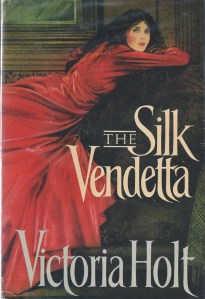
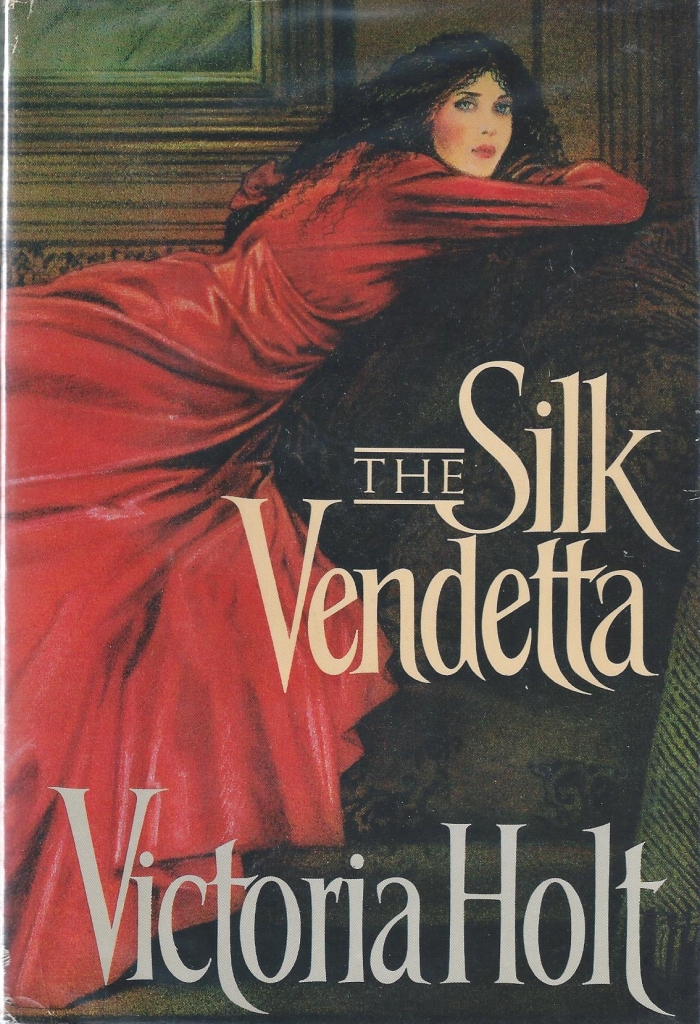
the silk vendetta victoria holt 1987 001The Silk Vendetta by Victoria Holt ~ 1987. This edition: Doubleday, 1987. Hardcover. 345 pages.

My rating: 5.5/10

An utterly stereotypical gothic romance concerning a young woman with mysterious antecedents living in a stately English home.

Beautiful Lenore lives with her grandmother in a separate suite of rooms in Silk House, home base of the wealthy silk manufacturer-merchant family, the Sallongers. Grandmother designs dresses, while Lenore shares a schoolroom and meals with the Sallonger daughters, though the servants sneer at her relentlessly, and the family matriarch obviously despises her. She’s definitely not viewed as an equal to the “young ladies”, but neither is she a servant. What’s it all about, I’m sure we’re meant to wonder. No points for figuring out that “someone” was begotten on the wrong side of the blankets, as it were. Or is she really legitimate? A fortune may ride on the answer…

Both Sallonger sons are attracted to beautiful Lenore, with very different motives towards her. The obligatory near-rape scene pays homage to the gothic novel tradition, as does the doomed marriage Lenore undertakes, before finding herself a safe haven enclosed by muscular manly arms.

I’m rather ashamed to say I read this with no qualms at all; it’s utter crap but also acceptably diverting, for those times when one doesn’t want to have one’s intellect or emotions ruffled. The writing is quite decent for this sort of thing, though the plot is completely standard issue. To be read on auto-pilot, while sipping a soothing cup of tea after a tiresome day. If all else fails, you can claim you’re reading it ironically, or perhaps just doing “research” for your book blog…

The honest verdict? Not particularly recommended. There’s better out there. (But in a pinch it would suffice.)

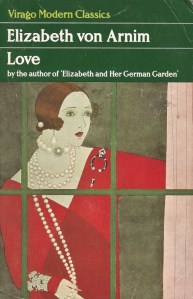
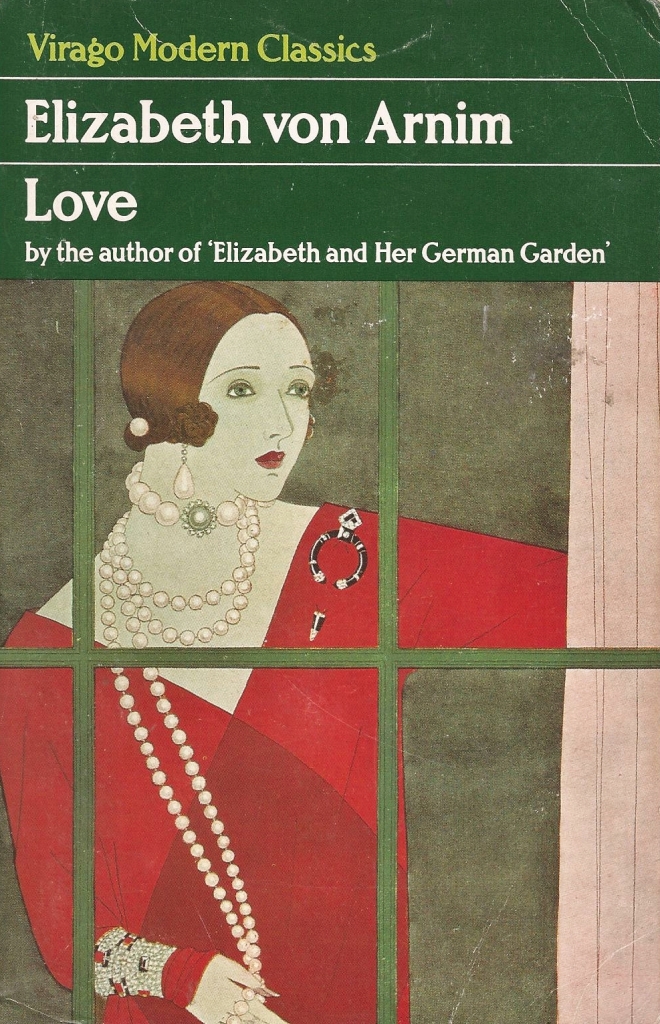
love elizabeth von arnim 1925 001Love by Elizabeth von Arnim ~ 1925. This edition: Virago, 1988. Softcover. ISBN: 0-86068-941-7. 408 pages.

My rating: 9.75/10

One of von Arnim’s “serious” novels, and one which deserves a much more detailed discussion. I suspect I’ll be returning to it in future.

Middle-aged widow Catherine attracts the besotted notice of much-younger Christopher. He proposes marriage, to the dismay of everyone in their joint circles, and Catherine eventually accepts.

The question at the heart of the novel why is it completely acceptable for a very young woman to be married to a much older man (vis-à-vis Catherine’s own 19-year-old daughter’s recent marriage to a 49-year-old clergyman) and so socially dire for the opposite to be true.

Catherine’s second marriage soon encounters rocky ground, and, as she desperately tries to keep up a youthful appearance both for her husband’s and her own sake, much deep discussion on the nature of “Love” itself ensues. A favourite topic of von Arnim’s, and as seriously treated here as it was frivolously mauled about in The Enchanted April.

The ending is one of the best I’ve yet read by this particular writer; she doesn’t let us down as she sometimes does with her romantically tidy conclusions, but gives us something to consider most thoughtfully.

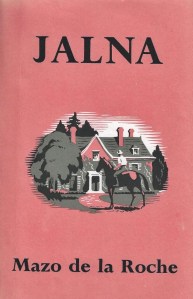
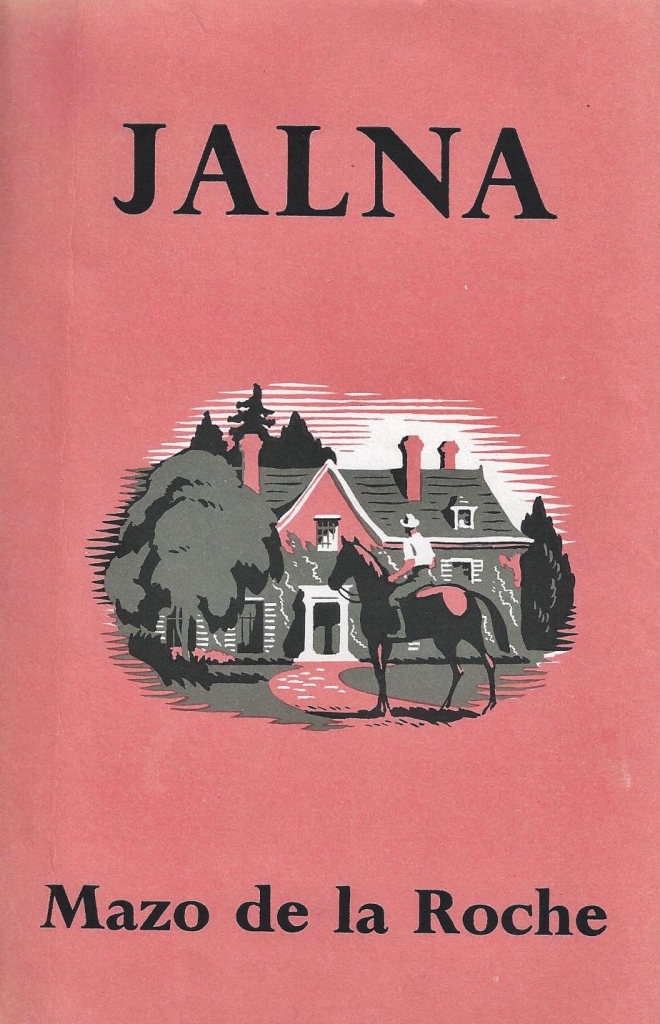
jalna mazo de la roche 1927 001Jalna by Mazo de la Roche ~ 1927. This edition: Macmillan, 1977. Hardcover. ISBN: 333-02528-8. 290 pages.

My rating: 5.5/10

This dramatically romantic novel by a young Canadian writer won a literary prize of $10,000 upon its publication nearly a century ago: an astonishing amount for the time, equivalent to something like $132,000 in today’s currency. (I looked that bit up using a handy-dandy inflation-indexed currency converter I found online.)

Spurred on by her success, Mazo de la Roche went on to write another fifteen Ontario-set installments in the Whiteoaks family saga, creating something of a literary cottage industry of sequential books, assorted editions and collections, and theatrical, radio and filmed productions for the next fifty years.

I was well aware of this novel and its reputation as an iconic bit of literary Canadiana, but I hadn’t actually read it until this year.

My verdict: I’m not stacking up the other 15 on my night table for essential reading, though I might possibly poke my nose into another one if the mood feels right. I do have a number of them stashed away, found at a library book sale some years ago. I gave them to my mother, and she returned them with not much comment, which should have been a bit of a tip-off.

No hurry on the others, though. Jalna was not particularly compelling. In fact, only okayish is as far as I’m willing to commit myself on this one.

The plot in a nutshell:  Wealthy matriarch Adeline Whiteoak is approaching her 100th birthday, and her various offspring and descendants circle round her angling for her slightly senile blessing.

One grandson unpopularily marries a local girl, by-blow of  the man who once unsuccessfully courted one of Adeline’s daughters, while another brings home an American bluestocking. Both brides soon come to think that perhaps they have chosen the wrong brothers. The eldest of Adeline’s grandsons, broodingly charismatic, ceaselessly womanizing and still-single Renny, catches the eye of the American wife, while her spouse in turn dallies with his brother’s bride. Much chewing of the scenery ensues, helped along by the unmarried members of the family, Adeline’s two elderly sons and her much-past-her-prime passive-aggressive daughter.

Absolute soap opera. Think a low-rent Gone With the Wind, sans Civil War and southern drawls and a horribly likeable heroine, but with similar over-the-top romantic heart-throbbings and dirty little secrets. (Perhaps not really the best comparison, but it was what popped into my mind. It’s not really like GWTW at all. Perhaps Mazo de la Roche does stand alone.)

And there’s an elderly parrot, and a cheeky young boy, to provide much-needed levity, though not enough to ultimately save this overwrought thing from itself.


Read Full Post »

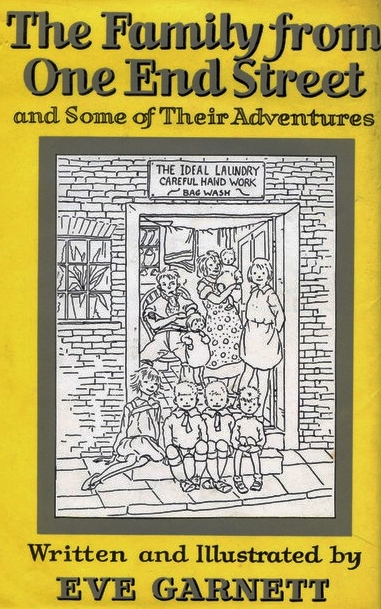
the family from one end street eve garnett 1937The Family From One End Street and Some of Their Adventures by Eve Garnett ~ 1937. This edition: Frederick Muller, 1949. Illustrated by the author. Hardcover. 212 pages.

My rating: 8.5/10

A cheerful period piece of a book, illustrated by the author.

Mrs. Ruggles was a Washerwoman and her husband was a Dustman. “Very suitable, too,” she would say, though whether this referred to Mr. Ruggles himself, or to the fact that they both, so to speak, cleaned up after other people, it was hard to decide…There were a great many Ruggles children – boys and girls, and a baby that was really a boy but didn’t count either way yet.

The seven Ruggles children, from twelve year old Lily Rose doorstepping down through Kate, twins James and John, Josiah (after his father, and both called “Jo” for everyday), Margaret Rosie, and baby William, get into the expected scrapes, and find their way out of them in various ingenious ways.

Anecdotal chapters follow the children in turn, and together give an amusing portrait of between-the-wars London through the eyes of a poor-but-respectable working class family.

Homeschooler “living books” note: Much in the line of Eleanor Estes and Elizabeth Enright, this might well work as a read-aloud to attentive children, or as a good read-alone for thoughtful and competent middle grade and older readers, if they are interested in “family stories” from “long ago.” Nicely complex in structure and vocabulary; developing early readers might have some trouble deciphering some of it, but confident readers should be able to power through.

Charming and diverting, for the problems are quite genuine, the adventures are sometimes poignant (and also frequently quite funny), and they always seem to come right in the end.

Pleasant adult read for its historical interest and distinctive narrative voice. I’ll repeat: this is definitely a period piece.

Wikipedia provides some background context:

Garnett was commissioned to illustrate Evelyn Sharp’s 1927 book The London Child and the work left her “appalled by conditions prevailing in the poorer quarters of the world’s richest city”. She determined to show up some of the evils of poverty and extreme class division in the United Kingdom, especially in contemporary London. To that end she worked on a 40-foot mural at the Children’s House in Bow, completed a book of drawings with commentary called Is It Well With The Child? (1938), and both wrote and illustrated a story book that dealt with the social conditions of the English working class, which was exceptional in children’s literature.

That book, The Family from One End Street, was rejected by several publishers who deemed it “not suitable for the young”, but eventually published by Frederick Muller in 1937. It won the second annual Carnegie Medal from the Library Association, recognising the year’s outstanding children’s book by a British subject. (It beat Tolkien’s The Hobbit among others.) For the 70th anniversary of the Medal, it was named one of the top ten Medal-winning works, selected by a panel to compose the ballot for a public election of the all-time favourite. It is regarded as a classic, having remained in print to the present day.

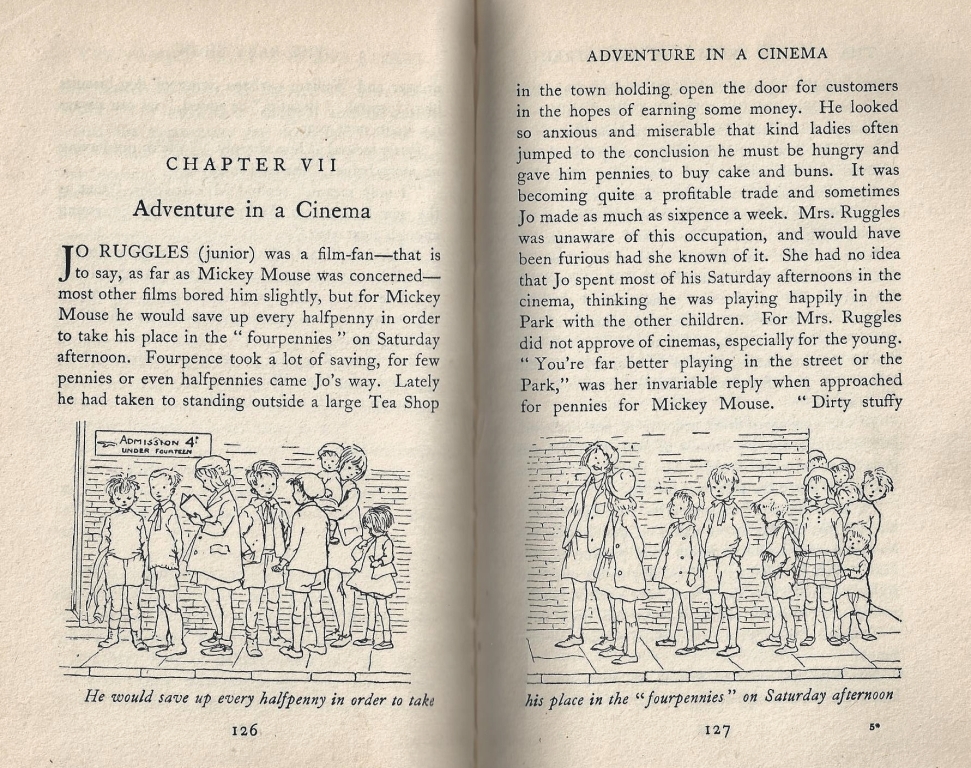
the family from one end street excerpt eve garnett 001

A random page scan from The Family From One End Street, by Eve Garnett, 1937.

little britches ralph moodyLittle Britches: Father and I Were Ranchers by Ralph Moody ~ 1950. This edition: University of Nebraska Press, 1991. Softcover. ISBN: 0-8302-8178-1. 260 pages.

My rating: 7/10

In 1906 the Moody family – Mother, Father, and five children, with Ralph the second oldest at 8 years old – moved from New Hampshire to Colorado, where it was hoped that the clean air and a healthy outdoor life would help Father recover from a lung ailment acquired while working in a dusty woolen mill. This turns out to be galloping tuberculosis, and you just know it’s not going to end well, especially when you note that the sequel to Little Britches is titled Man of the Family.

Gloomy foreboding aside, I’ll return to the installment under discussion. Promised a thriving ranch, the family finds instead a derelict three-room house set on skids in the middle of a cactus-infested field, with not a decent fence or sound outbuilding in sight. They almost head back to New Hampshire then and there, until Mother proclaims, with a sob in her voice, that the Good Lord led them there, and there they shall remain.

Needless to say there are many challenges, but a small and thriving ranch is indeed established, with young Ralph, in the throes of hero worship for the local cowboys he has just encountered, participating to his utmost alongside his competent and hardworking through constantly ailing father.

A diverting enough tale, mostly autobiographical, with some creative license applied by the author. Young Ralph seems to have been a rather accomplished child for an 8-year-old; he excels at everything he tries, though frequently not without a lesson-teaching setback or two. Father is continually having to spank him soundly, and of course (this being an inspirational type tale), young Ralph is grateful for his correction, for naturally Mother and Father know best.

Sometimes a bit preachy, but nevertheless an effortless and engaging read. This book and its sequels, Man of the Family (1951), The Home Ranch (1956), Mary Emma & Company (1961), The Fields of Home (1953), Shaking the Nickel Bush (1962), The Dry Divide (1963) and Horse of a Different Color (1968), were the result of a creative writing course taken by Ralph Moody at the age of 50, and are composite portraits of events and characters from his childhood and later years.

These books are beloved of many “religious-minded” homeschoolers, for their emphasis on moral fortitude and godly behaviour. Though Ralph fell aside from the narrow way many times, he was always able to boost himself back up by his bootstraps, with the help of an occasional inspirational visit to the back of the barn with Dad and a willow switch, or a less-physically-painful session with Mother and the family Bible.

Ralph Moody’s agenda as a writer was simple and sincere. As he said in a 1967 interview in the New York Times Book Review: “My goal in writing is to leave a record of the rural way of life in this country during the early part of the twentieth century, and to point up the values of that era which I feel that we, as a people, are letting slip away from us. ”

Fair enough. Mostly very good, this book, and perhaps I am being overly critical regarding all of the corporal punishment the author so enthusiastically reports.

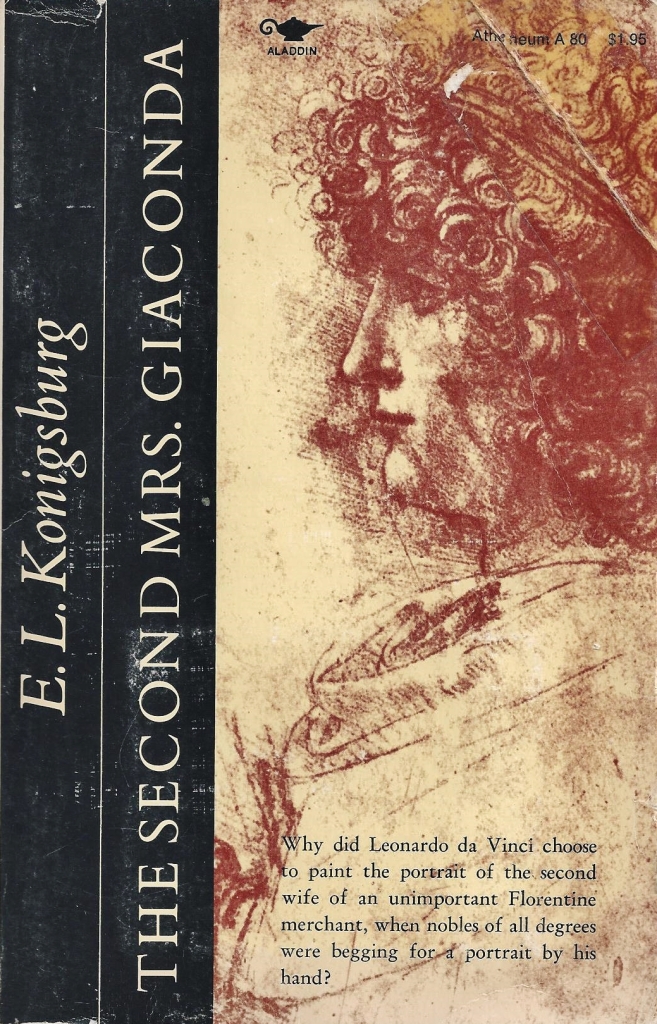
the second mrs giaconda e l konigsburg 001The Second Mrs. Giaconda by E.L. Konigsburg ~ 1975. This edition: Aladdin, 1980. Softcover. ISBN: 0-689-70450-X. 138 pages.

My rating: 4.5/10

Why did Leonardo da Vinci choose to paint the portrait of the second wife of an unimportant Florentine merchant, when nobles of all degrees were begging for a portrait by his hand?

Great question, regarding the enigmatic “Mona Lisa.” Too bad the author never really answers it.

I quite like a lot of Elaine Lobl Konigsburg’s work, for though she was of the “problem novel” school of juvenile writer, her books for the most part contain a lot of humour, and are never preachy. The “educational” bits are generally unobtrusively incorporated into the tale, with the final product being entirely pleasing.

Sadly, The Second Mrs. Giaconda, despite its perennial inclusion on juvenile reading lists due to its Leonardo da Vinci theme, is to my mind something of a dud, being written exclusively in “tell, don’t show” mode. A great shame, because this writer was capable of doing so much more, and the subject is chock full of potential.

The novel gives an overview of life in Renaissance Italy through the eyes of Leonardo da Vinci’s young apprentice Gian Giacomo de’ Caprotti, known to his familiars as Salai. Giacomo/Salai was a real historical personage, and he is mentioned in da Vinci’s journals with intriguing frequency, from his entry into the household as a child of 10, in 1490, to his inclusion as a beneficiary of a house and half of da Vinci’s garden property in da Vinci’s will.

Leonardo da Vinci refers to Salai as a “liar, thief, mule-head, glutton”, and includes mention of his apprentice’s numerous failings, but obviously something happens during their time together to turn the tables completely. What was it? Konigsburg fabricates her version of their joint story referring to da Vinci’s actual journal entries, and in this case her creative license feels forced, as she incorporates Salai’s fancied involvement in all of da Vinci’s personal and professional relationships, in particular with Leonardo’s great patron, the immensely powerful Duke of Milan, and his wife Beatrice d’Este.

None of this has anything to do with the Mona Lisa, and the “second Mrs Giaconda” shows up only very briefly in the very last chapter, with her portrait painted as something of a slap in the face to Beatrice’s jealous sister Isabella, and the whole project completely engineered by the cunning Salai.

Here, courtesy of ever-handy Wikipedia, is some more of a rundown on the plot of this novel. :

The son of a poor shoemaker, Salai is a cutpurse caught in the act by the master, whose grasp and visage he mistakes for the hand and face of God. Leonardo takes him as an apprentice, at no fee, and practically as a servant. Salai remains a scoundrel who moves from petty theft to selling his master’s sketches, and later to selling his audiences.

Princess Beatrice comes to Milan and marries Il Moro, the duke, who had hoped to marry her beautiful older sister Isabella d’Este. He continues to wait on his beautiful mistress Cecilia Gallerani, the subject of a Da Vinci portrait that is already famous. “She’s small and dark and perfectly plain”, Salai says when he first sees Beatrice; when they meet by accident, she is “trying to get the sun to make me blond and beautiful”. They discover a shared taste for mischief. To Leonardo she laments, “Could I but gain my husband’s love, I know that I could disguise this plain brown wrapping.” He asks what she has “to give him that Cecilia has not” and she volunteers her “sense of fun”.

Salai and even Leonardo often visit Beatrice and she becomes the toast of Milan —assisted by the visits. They come to consider her “our duchess” but she does win her husband’s love. Isabella visits and envies her sister for “the intellectuals, the gifted, the skilled craftsmen; the very elements who were drawn naturally to Beatrice.”

Beatrice grows into a political role and becomes a collector of clothing, jewels, etc., and no longer a companion to Salai. She [eventually] conveys insight regarding the master’s talent, and admonishes Salai to take some responsibility for that. To achieve great art, Leonardo needs “something wild, something irresponsible in his work”, and Salai must help.

The merchant Giaconda and his wife appear only in the last of nineteen chapters, visiting the studio during the master’s absence. [In the meantime], Beatrice has approved Leonardo’s The Last Supper and died in childbirth. Milan has been conquered by the French and Leonardo has moved to Mantua. Duchess Isabella of Mantua (sister of Beatrice) has been frustrated for years seeking her portrait by Leonardo, which delights Salai. “Sooner or later she would come to realize that here was one prize that was just out of reach of her jeweled pink fingers.” Spurred by [thoughts of] Beatrice and Isabella, the irresponsible Salai determines to persuade Leonardo to paint Lisa [Giaconda]…*

…and the rest, as they say, is history.

Got all that?

If it all seems a bit flat, despite its convolutions, it is, especially as reported by Konigsburg.  I thought this little historical fiction highly contrived and not particularly interesting, despite its achievement of the Best Book of the Year (1975) for Young Adults Award from the American Library Association.

*All of the quotations in the Wikipedia excerpt are taken from Konigburg’s novel, not Leonardo’s journal.


Read Full Post »

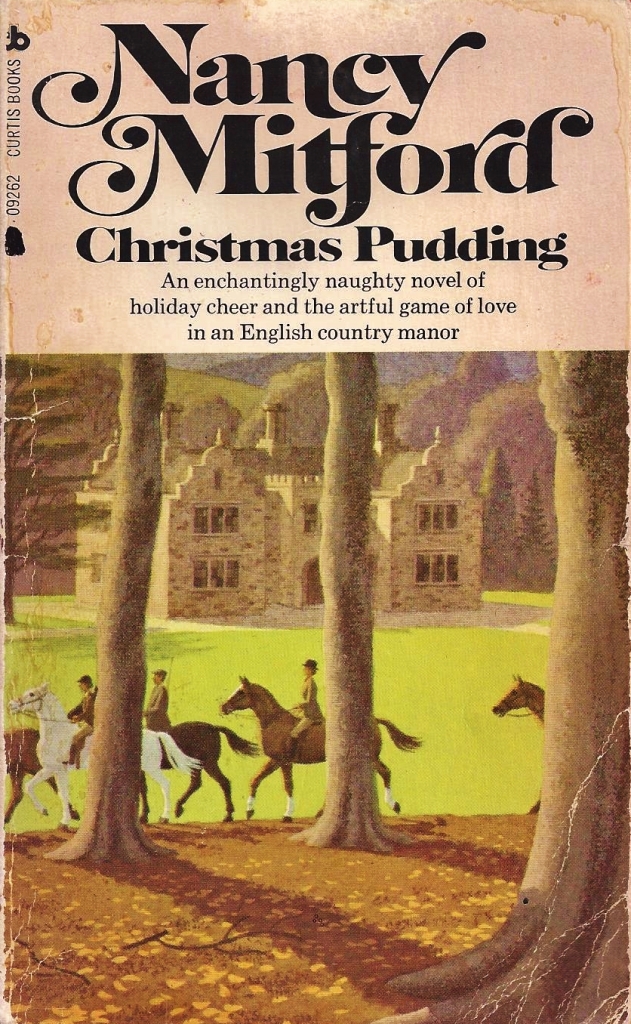
christmas Pudding by Nancy Mitford 001Christmas Pudding by Nancy Mitford ~ 1932. This edition: Curtis Books, 1973. Paperback. 238 pages.

My rating: 5.75/10

I had to go back to April to double-check my rating of the earlier companion piece to this very minor entry into the satirical humour, between-the-wars, Brit Lit canon, Miford’s 1931 Scottish grouse moor-set Highland Fling. I see I rated it at 5.5, which is, on further reflection, quite generous. Christmas Pudding therefore gets an also-generous 5.75/10.

This is Very Light Fiction, and not quite up to Wodehousian standards, which one would assume was the author’s goal. There is a certain flair for humorous phrasing which gives a strong hint of what the Mitford would later accomplish to a higher degree in her most critically, popularly and financially successful books, the semi-autobiographical The Pursuit of Love, Love in a Cold Climate, The Blessing, and Don’t Tell Alfred.

Christmas Pudding is a romantic farce, with the expected eclectic cast of characters, most taken out of their usual urban habitats and tossed together into close proximity in the isolation of a country house Christmas. Here are the major characters, and a glimpse of the set-up:

  •  Paul Fortheringay, recently published author of Crazy Capers – a grim tragedy of a novel despite its name – is devastated when instead the “serious” book he has laboured over with such care is received as a humorous satire. “Funniest book of the season!” the critics bray. Paul is not amused. How to salvage his writerly self-esteem? Perhaps with a work of unmistakeable sincerity, such as a biography of a hitherto-neglected literary personage? But all the obvious subjects are already well written up, so Paul decides on an obscure pre-Victorian poetess, Lady Maria Bobbin, whose diaries and letters are rumoured to be still extant and sitting in dusty preservation at the country estate of Compton Bobbin.
  • Walter and Sally Monteath, the penniless yet well-born young couple at the centre of Highland Fling’s hectic action, have recently been blessed with a baby girl. Still on the brink of financial disaster, the couple (now with child and nanny) are most ready to accept any offer of hospitality over the holidays, graceful sponging on wealthier acquaintances being their speciality.
  • Middle-aged but very well preserved Amabelle Fortescue, retired and rather well-invested ex-demimondaine, moves in the better circles and includes such Bright Young Things as Walter and Sally among her chums. Paul is also a pal. Amabelle has decided to do something different this Christmas, and has taken Mulberrie Farm as her temporary abode, an amusing departure from the London whirl-of-gaiety norm.
  • Next door to Mulberrie Farm we have the sedate estate of Compton Bobbin (aha!), inhabited by hunting-mad Lady Bobbin, the unchallenged matriarch of her meek household and the terror of the countryside at large. Also in residence are her daughter Philadelphia, beautiful, bored, listless and waiting for something – anything! – to rescue her from her bleak existence in the rural purdah dictated by her mother, and young Roderick – Bobby – Bobbin, down from Eton for the hols. Bobby is an oldish sort of young man; he is rather well acquainted with our Amabelle, without his mother’s knowledge, of course.
  • Michael Lewes, of the diplomatic service, presently stationed in Cairo, but coming back to England for Christmas, which he will be spending as a guest of the Bobbins. Michael has long been in love with Amabelle, and persists in asking her for her hand in matrimony, to her continual good-natured refusal.
  • Major Stanworth is another neighbour Mulberrie Farm. A widower, he’s a rather good sort, hearty and cheerful and, as it turns out, at a stage in life where some womanly consolation for his single state is welcome.

Plot in a paragraph:

Paul writes to Lady Bobbin asking permission to go through Lady Maria’s papers. Lady Bobbin gives a brief but forceful “No!” Hang on, says Amabelle, when Paul bemoans the situation to her, I know the young Bobbin heir. So Paul is dispatched to Compton Bobbin under guise of being Bobby’s holiday tutor, the plan being that while he pretends to be closeted with young Bobby in academic solitude, he will in reality be working on his biography of Lady Maria, leaving Bobby free to go a-visiting on the quiet at Mulberrie Farm. Paul sees Philadelphia, and his heart goes thump-thump, as does Michael Lewes’ heart, which is open for consolation after yet another gentle put-down by Amabelle. Philadelphia, suddenly the focus of two sets of admiring male eyes, perks up marvellously. Major Stamworth’s more mature charms appeal to Amabelle, and hers to him; a romance quietly blossoms in the most unlikely way. Scads of Bobbin relations descend for Christmas on Compton Bobbin, as do a number of Amabelle’s friends on Mulberrie Farm, including Walter and Sally, who are just sort of there in the tale, though they don’t really play a major part in the intrigues. Will Paul have his cover blown? Will Bobby’s deception be revealed to his bossy mum? Will Philadelphia go for money, good nature and sterling worth (Michael) or poverty, hot passion and the literary arts (Paul)? Will urbanite Amabelle and country gentleman Major Stanworth get together for good and walk arm in arm off into the rural sunset?

I thought that Christmas Pudding, Mitford’s second published novel, was perhaps a more polished piece than Highland Fling, with its young author settling down a bit and finding it easier to maintain a narrative strand of sorts. (Well, not that young, really, for when I do the math I see that Nancy Mitford was 28 years old when Christmas Pudding was published, which surprised me rather – it reads as though she were 19 or thereabouts, with its frequently cheeky “Let’s shock the elders!” tone.)

Though the book is set during the holiday season, one can’t really call it a “Christmas book” in the heart-warming, nostalgic, feel-good sense; the smiles it engenders are just a little too cynical, though there is a rather funny episode Christmas morning which I think will stick with me, concerning one of the wee children roistering about the country house where most of the characters are staying.

At about five o’clock in the morning Master Christopher Robin Chadlington made a tour of the bedrooms, and having awoken each occupant in turn with a blast of his mouth organ, announced in a voice fraught with tragedy that Auntie Gloria had forgotten to put a chocolate baby in his stocking. “Please might I have a bit of yours?” This quaint ruse was only too successful, and Christopher Robin acquired thereby no fewer than fourteen chocolate babies, all of which he ate before breakfast. The consequences, which were appalling, took place under the dining-room table at a moment when everybody else was busily opening the Christmas post. After this, weak but cheerful, young Master Chadlington spent the rest of the day in bed practising on his mouth organ.

Forgive me, for I laughed out loud at this passage.

“Weak but cheerful.” Oh, indeed! That could well describe this frothy little novel.

P.S. – Young Christopher Robin has a sister named Wendy. I know some of you will deeply appreciate that tidbit. 😉

Read Full Post »

I have just spent several days immersed in writings from – what an incredible thought! – a century ago. Three books, as different from each other as can be imagined, each written with deep care and sincere emotion, and expressing the writers’ fervent beliefs along with a sober (and on occasion somber) recording of their experiences.

O. Douglas/Anna Buchan’s semi-autobiographical novel The Setons, 1917,  is the gentlest and at the same time perhaps the most disturbing, for reasons which I hope to make clear below. Rose Macaulay’s also-autobiographical novel, Non-Combatants and Others, 1916, is a fascinating combination of emotionally heart-rending and curiously impassionate, while Robert Graves’ pre-war, wartime, and post-war memoir, Goodbye to All That, 1929, is utterly compelling. If you haven’t read Graves’ book  yet, you should, if only for its historical details.

All of these writers are genuinely accomplished in their various ways, and these books are exceedingly easy to read for their “entertainment” value alone, if one may use that innocuous term with regard to wartime-focussed writings. Ratings are going to be very high – I think I can safely say each more than fulfilled my readerly expectations to the highest degree, though they can not be classed together genre-wise.

Good books, all three, which deserve preservation. In particular the Rose Macaulay book, which languished out-of-print for many decades. Robert Graves’ memoir has already received much publicity and is, I believe, frequently used in schools and colleges. Don’t let that discourage you – it’s not at all a “boring school book”, and it is very much worth reading for the highly opinionated voice of the author as much as for its historical context.

As usual, these “mini-reviews” got ridiculously long. I should really take another go at these and edit ruthlessly, but as you all know, that process would take a tremendously long time in itself – it’s so much easier to meander on than to write short and sharp! The long quotations are also not in the accepted pattern of “professional” book review brevity, but to my mind they serve as useful samplers of writing style to interested readers, and that is how I hope they will be received.

*****
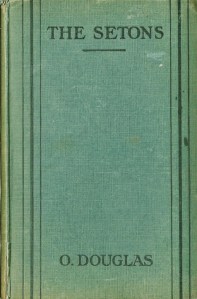
the setons o douglas 1917 001The Setons by O. Douglas ~ 1917. This edition: Hodder & Stoughton, 1922. Hardcover. 315 pages.

My rating: 8/10

Based strongly on Anna Buchan’s memories of growing up as a “minister’s child”, this early novel – only her second, after 1912’s Olivia in India –  is her tribute to her beloved father, and is strongly autobiographical in its most telling details, much as her later 1922 tribute to her mother, Ann and Her Mother, was to be. Comparing these two books, I feel that The Setons is possibly the stronger. I found it a very easy read, utterly charming and deeply sincere.

The Setons follows the activities of a Glasgow family-of-the-manse: a slightly elderly, widowed father, grown-up daughter, young schoolboy son, and two live-in household helps. There are also two adult sons in India, who appear in the novel only by reference when a letter is received.

Reverend James Seton is the shepherd of a rather “poor” church – “Not even an organ!” as another character comments disapprovingly – but he quite literally lives to serve God, and is a sterling character of intense devoutness leavened with abundant good humour. Reverend Seton’s fondness for old Scottish ballads, good literature, poetry, and “fairy tales” enlivens life in the family circle – it’s definitely not all prayers and sober good works, though these have their prominent place in daily affairs.

Elizabeth Seton, the 28-year-old daughter of the family, who has largely taken over her mother’s role as mistress of the household, helpmeet to the minister, and surrogate mother to her young brother, is a creature of contradictions. Personally devastated by the untimely death of a brother away at college and then, shortly thereafter, her mother’s death, Elizabeth hides her personal pain and most sensitive emotions under a well-constructed façade of outspoken good humour. Elizabeth performs the many duties of a pastor’s female counterpart exceedingly well, though her occasionally outrageous statements and evident sense of humour excite comments from the more sober-minded of her father’s parishioners. Elizabeth knows this and disregards it, for she has chosen to accept occasional derision over pity from those outside of her intimate group of family and close friends.

Young Buff, as the small son of the household is nicknamed (he was christened David Stuart), is a gloriously boyish character, with all of the expected eccentricities and passions of an imaginative, much loved child. Modeled on the childhood characteristics of Anna Buchan’s own brother who died as a young man, Buff and his literary counterparts show up in every one of the O. Douglas novels, a sort of composite portrait of her beloved childhood companion.

The Setons is one of those utterly peaceable books where nothing really happens. It chronicles the day-to-day goings-on of the Setons and their friends and parishioners, mild anecdote by mild anecdote. A nicely pithy sense of humour and a good deal of Scottish sensibility keeps the whole from being too indigestibly sweet, even when romance enter the picture, in the persons of two personable men who cast speculative eyes on the apparently unimpressionable Elizabeth.

Events take on a sudden seriousness in the final quarter of the story, as Reverend Seton develops a potentially fatal heart ailment and must leave the ministry. The family uproots itself from Glasgow and settles in the village of Etterick. Shortly thereafter, war is declared, and the-world-as-they-know-it turns upside down.

I was reading along quite happily until the onset-of-war chapters, when everyone (at least from my ten-decades-later perspective) seems to lose their collective minds. “Off you go, my lads!” (most of) the women exhort the men and the boys, “If you die in battle you will be rewarded with eternal life in Heaven!” Or words to that effect. And off the young men go, quite cheerily leaving sweethearts and young wives and baby children with the sentiment that even though gruesome death looms, it will all be all right. Right? Right?

“But seriously, Lizbeth—if I never come back to you, if I am one of the ‘costs,’ if all you and I are to have together, O my beloved, is just this one perfect afternoon, it will still be all right. Won’t it? You will laugh and be your own gallant self, and know that I am loving you and waiting for you—farther on. It will be all right, Lizbeth?”

For those of sincere religious faith I suppose this is some consolation, but I found that the scenario utterly sickened me. I have no alternate suggestion as to how one should send one’s nearest and dearest off to war, so my criticism is without much useful merit, but there it is.

In the other two books I am about to discuss below, this fervently patriotic-religious attitude comes in for some brutal discussion, and I have to admit that I fully concur with those who feel that an entire generation was wantonly slaughtered with, at least initially, the enthusiastic compliance of the at-home civilians who then lived on alone to later mourn their many “glorious dead.”

As a family memoir and a piece of domestic fiction, The Setons succeeds most well, and even the declaration-of-war and with-your-shield-or-on-it bits had merit as a documentation of the sentiments of the time, at least among the members of the population with a strong belief in the rewards of the hereafter, which naturally would include the author, devout daughter of a Scottish Free Church minister as she herself unapologetically was.

Last word to O. Douglas/Anna Buchan:

You know, of course, Gentle Reader, that there can be no end to this little chronicle?

You know that when a story begins in 1913, 1914 will follow, and that in that year certainty came to an end, plans ceased to come to fruition—that, in fact, the lives of all of us cracked across.

Personally, I detest tales that end in the air. I like all the strings gathered up tidily in the last chapter and tied neatly into nuptial knots… But, alas! as I write (May 1917) the guns still boom continuously out there in France, and there is scarce a rift to be seen in the war-clouds that obscure the day…

…It is useless to tell over the days of August 1914. They are branded on the memory. The stupefaction, the reading of newspapers until we were dazed and half-blind, the endless talking, the frenzy of knitting into which the women threw themselves, thankful to find something that would at least occupy their hands. We talked so glibly about what we did not understand. We repeated parrot-like to each other, “It will take all our men and all our treasure,” and had no notion how truly we spoke or how hard a saying we were to find it. And all the time the sun shone.

It was particularly hard to believe in the war at Etterick. No khaki-clad men disturbed the peace of the glen, no trains rushed past crowded with troops, no aeroplanes circled in the heavens. The hills and the burn and the peeweets remained the same, the high hollyhocks flaunted themselves against the grey garden wall; nothing was changed—and yet everything was different.
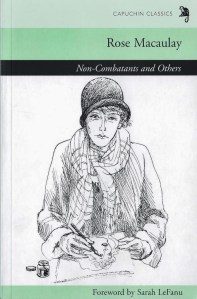
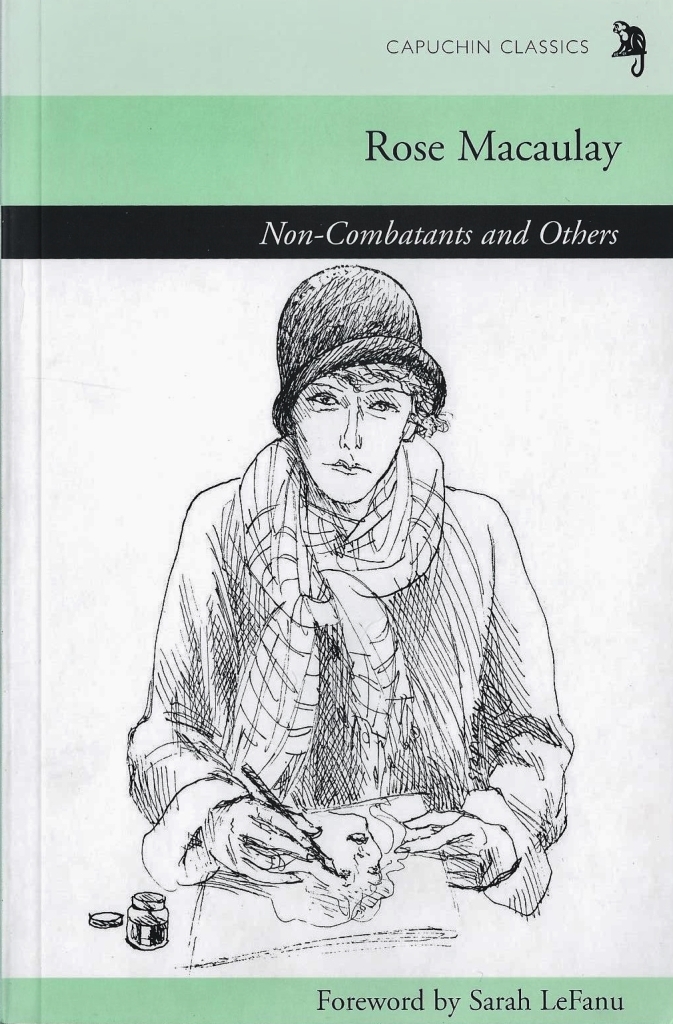
non-combatants and others rose macaulay 1916 001Non-Combatants and Others by Rose Macaulay ~ 1916. This edition: Capuchin Classics, 2010. Softcover. ISBN: 978-0-9562947-0-8. 204 pages.

My rating: 9/10

Rose Macaulay was already a published author when World War I commenced in 1914, of well-received novels and poetry, but Non-Combatants and Others, with its nervously high-strung and  desperately “non-patriotic” heroine, and its strong pacifist message, was not a commercial success upon its publication in the third year of the war.

It is April of 1915. The story opens with a vignette of the daily occupation of Alix Sandomir.  25 years old and an artist – she has no other interest or apparent occupation – Alix is the daughter of a brilliant and politically active Polish father – dead now some years in a Warsaw prison – and a highly energetic and forward-thinking English mother.

Daphne Sandomir’s interest in many things had always been so keen that before the war you could not have picked out one as absorbing her more than a score of others. She had been used to write pamphlets and address meetings on most of them: eurhythmics, for instance, and eugenics, and the economic and constitutional position of women, and sweated industries, and baby crèches, and suggestion healing, and health food, and clean milk, and twenty other of the causes good people have at heart.

Daphne is now off touring the countries of those involved in the present conflict, interviewing government members and civilians and promoting a pacifist organization she has been instrumental in forming, the S.P.P.P., the Society for Promoting Permanent Peace.

Alix and her older brother Nicholas view their parents’ attitudes and activities with more than a tinge of benevolent cynicism; their own approach is to lay low, as it were, and laugh things off when they get too serious. A younger brother, Paul, just 18 and a brilliant student with a scholarship to Oxford awaiting him, has gone off to France to fight, and has found the experience overwhelming to his highly imaginative sensibilities.

Alix desperately wishes she could also be involved in the war in some sort of truly practical way, but due to a physical infirmity – she is lame due to a hip infection in childhood – extremely nervous disposition – she vomits uncontrollably if under intense stress, a characteristic young Paul is also afflicted with, with the imagined results in the trenches – and, of course, her sex – females being allowed limited roles in the actual conflict – she turns these wishes inward, and presents a cynical, ever-laughing face to the world.

Alix refuses to undertake any of the normal, socially accepted wartime jobs. She won’t knit comforts for the soldiers, roll bandages, volunteer in hospital, or go to work on the land. Instead she pursues her artistic inclinations, drawing and painting and eventually going off to London to continue studies at art school, while all around her friends and relations engage in a flurry of ceaseless activity.

In answer to an invalided-home brother’s comments that all of his at-home womenfolk look thinner than when he went off to France, Alix’s cousin Margot exclaims:

‘Well, we’re not in the trenches…We’re leading busy and useful lives, full of war activities. Besides, our food costs us more. But Dorothy and I are fairly hefty still. It’s mother who’s dwining; and Alix, though she’s such a lazy little beggar. Alix is hopeless; she does nothing but draw and paint. She could earn something on the stage as the Special Star Turn, the Girl who isn’t doing her bit. She doesn’t so much as knit a body-belt or draw the window-curtains against Zepps.’

Alix, who has been staying with these cousins in the country, flees the atmosphere of friendly familial disdain which her non-activity inspires, and takes a room in a respectable suburban London villa, which is occupied by a middle class mother and two daughters, also “doing their bit” in the war effort.

Alix turns her back on anything having to do with the war, and for a while succeeds in pretending everything is going on as normal, until she receives word that her young brother Paul is dead, “of a bullet wound”.

Alix completely breaks down at the news, for the two were very close, and Alix knows full well what her brother suffered mentally in the trenches, let alone physically. She tries to console herself with the thought that his suffering is now over, but she can’t escape the conviction that this is a false consolation – Paul loved life with such an intensity that to have it end in such a way is completely unthinkable to her. She finds herself unable to keep up her façade of cheerful dismissal towards war affairs, and allows herself to be drawn into intellectual discussions of how this situation could ever have developed, and how the people at home in England – the non-combatants – are reacting and how their reactions (or non-reactions) will affect the course of history.

A soldier friend, home on leave, muses on the reactions of the majority of civilians he has observed, in the following long passage, which I’ve left unedited so you can get a sense of Macaulay’s style in monologues:

‘The fundamentally untouched…Superficially, of course, they are, as you put it, flustered. They read the papers, of course, for the incidents; but the fundamental issues beneath don’t touch them. They’re impervious; they’re of an immobility; they’re sublimely stable. The war, for them, really isn’t. The new world, however it shapes, simply won’t be. What’s the war doing to them? All the beastliness, and bravery, and ugliness, and brutality, and cold, and blood, and mud, and gaiety, and misery, and idiotic muddle, and splendour, and squalor, and general lunacy … you’d think it must overturn even the most stable … do something with them—harden them, or soften them, or send them mad, or teach them geography or foreign politics or knitting or self-denial or thrift or extravagance or international hatred or brotherhood. But has it? Does it? I believe often not. They haven’t learnt geography, because they don’t like using maps. They’ve not learnt to fight, because it’s non-combatants I’m talking of. They’ve not even learnt to write to the papers—thank goodness. Nor even to knit, because I believe they mostly knew how already. Nor to preserve their lives in unlit streets, for they are nightly done in in their hundreds. Nor, I was told by a clergyman of my acquaintance the other day, to pray (but that is still hoped for them, I believe). The war, like everything else, will come and go and leave them where it found them—the solid backbone of the world. The rest of the world may go on its head with ideas, or progress, or despair, or war, or joy, or madness, or sanctity, or revolution—but they remain unstirred. I don’t suppose a foreign invasion would affect them fundamentally. They couldn’t take in invasion, only the invaders. They remain themselves, through every vicissitude. That’s why the world after the war will be essentially the same as the world before it; it takes more than a war to move most of us…. We all hope our own pet organisation or tendency is going to step in after the war and because of the war and take possession and transform society. Social workers hope for a new burst of philanthropic brotherhood; Christians hope for Christianity; artists and writers for a new art and literature; pacificists for a general disarmament; militarists for permanent conscription; democrats say there will be a levelling of class barriers; and I heard a subaltern the other day remark that the war would ‘put a stopper on all this beastly democracy.’ We all seem to think the world will emerge out of the melting-pot into some strange new shape; optimists hope and believe it will be the shape they prefer, pessimists are almost sure it will be the one they can least approve. Optimists say the world will have been brought to a state of mind in which wars can never be again; pessimists say, on the contrary, we are in for a long succession of them, because we have revived a habit, and habit forms character, and character forms conduct. But really I believe the world will be left very much where it was before, because of that great immobile section which weighs it down.’

And in conversation with a Church of England minister, her brother Nicholas’s flatmate:

‘If we could go out there and try,’ said Alix, ‘we shouldn’t feel so bad, should we?’

He shook his head.

‘No: not so bad. War’s beastly and abominable to the fighters: but not to be fighting is much more embittering and demoralising, I believe. Probably largely because one has more time to think. To have one’s friends in danger, and not to be in danger oneself—it fills one with futile rage. Combatants are to be pitied; but non-combatants are of all men and women the most miserable. Older men, crocks, parsons, women—God help them.’

Alix then finds out, while in casual conversation with a soldier-on-leave who turns out to have shared a trench with Paul, that her brother died of a self-inflicted wound. Add to this absolutely understandable angst a love affair gone quietly and irretrievably wrong.

Alix has long been in love with a fellow artist, Basil Doye, and he has returned the passion, glorying in Alix’s intellectual equality and their meeting-of-minds. Now Basil has been seriously wounded in the right hand, and his artistic future is ruined. Basil turns away from Alix and her too intellectually and emotionally demanding mindset, and instead becomes infatuated with one of the daughters of the house where Alix lives. Evie is physically lovely – appealing to Basil’s artistic eye – and sweetly natured – once she realizes that Alix is still in love with Basil she immediately offers to turn him away – but she is of very mediocre intellectual ability, and has no idea most of the time what Basil is going on about.

Basil doesn’t care; all he sees is healthy normalcy, and in it a relief from the overstimulation of the war. Despite the respite in England and his dalliances with Evie – who is eventually put off by Basil’s intensity, preferring instead the more comfortable, “traditional” courtship of a hearty (and wealthy) young sprig of the minor nobility – Basil feels compelled to go back to France, which he eventually does once his hand with its amputated finger is superficially healed, and after a scene in which Alix confesses her love for him and he refuses to acknowledge it, acting as though she is merely assuring him of her continued “friendship”.

Much inner examination follows. Alix seeks enlightenment through religion – she has always been an atheist and is now starting to wonder if there is indeed “something more” in Christianity – but though she gets a glimpse of something there she can’t quite yet embrace it. She decides to join her mother’s Peace Society, to at last do something with regard to the war, and the book closes with every character in limbo, as indeed their counterparts were in real life.

The year of grace 1915 slipped away into darkness, like a broken ship drifting on bitter tides on to a waste shore. The next year began.

Bleak? Yes, this book is desperately bleak. But not to the degree which one would think, and there are many moments of relief from the bleakness, for it is Rose Macaulay, and she has a likeably sardonic sense of humour which even the seriousness of the setting cannot damp down.

Therefore, instead of leaving you with that poignant ending line about the broken ship on the bitter tide, I am going to backtrack to an early episode between Alix, Nicholas, and the clergyman flatmate.

‘It’s awkward,’ West added, lowering his voice and glancing at one of the shut bedroom doors, ‘because we keep a German, and they can’t meet.’

‘What do you do that for?’ asked Alix unsympathetically.

‘Awkward, isn’t it?’ said West. ‘Because they keep coming to see us—the Belgians, I mean (they like us rather), and he’—he nodded at the bedroom—’has to scoot in there till they’re gone. It’s like dogs and cats; they simply can’t be let to meet.’

‘Well, I don’t know what you want with a German, anyhow.’

‘He’s a friend of ours,’ explained Nicholas. ‘He was living in the Golders Green Garden City, and it became so disagreeable for him (they’re all so exposed there, you know—nothing hid) that we asked him here instead. If they find him he’s afraid they may put him in a concentration camp, and of course if the Belgians sighted him they’d complain. He means no harm, but unfortunately he had a concrete lawn in his garden, about ten feet square, where he used to bounce a ball for exercise. Also he had made a level place on his roof, among Mr. Raymond Unwin’s sloping tiles, where he used to sit and admire the distant view through a spyglass. It’s all very black against him, but he’s a studious and innocent little person really, and he’d hate to be concentrated.’ (‘It would make one feel so like essence of beef, wouldn’t it?’ West murmured absently.) ‘He’s not a true patriot,’ went on Nicholas. ‘He wants the Hohenzollerns to be guillotined and a disruptive country of small waning states to be re-established. He writes articles on German internal reform for the monthly reviews. He calls them “Kill or Cure,” or, “A short way with Imperialism,” or some such bloody title. I don’t care for his English literary style, but his intentions are excellent…

Good reading, this book. Especially recommended if you are already familiar with Rose Macaulay. Shades of The World This Wilderness, and the ethical and religious musings of Macaulay’s last and perhaps best-known work, The Towers of Trebizond.

A note on the Capuchin Classics edition I read. It contains a forward by Macaulay’s biographer, Sarah LeFanu, which seems to have been prepared for another edition of Non-Combatants, as it references in great detail a 1942 short story, ‘Miss Anstruther’s Letters’, which does not appear in this edition of the book. There are also numerous typographical errors, mostly in punctuation, which I found slightly troubling, as it broke the flow while reading. Neither of these issues should deter you from acquiring this book; I am very grateful that Capuchin has republished it, as it is much too good to be lost.

goodbye to all that robert graves 1929 001Goodbye to All That by Robert Graves ~ 1929. This edition: Penguin, 1977. Revised edition, with text amendments, Prologue and Epilogue added by the author in 1957. Paperback. ISBN: 0-14-001443-8. 282 pages.

My rating: 10/10

Oh, where to start with this one?

I think I will give a bare-ish sort of overview, because I am quite sure (though I haven’t actually looked) that the internet abounds with excellent, in-depth, analytical reviews.

Robert von Ranke Graves was born in 1895 to a mother with connections to the German nobility (hence the von Ranke), and an Anglo-Irish father, the respected Gaelic folklorist and scholar Alfred Perceval Graves. This made him just the right age to head off to war as soon as he exited his prep school (Charterhouse) in 1914.

Graves served as an officer on active duty for the entire duration of the war, though he almost didn’t make it through. He was wounded so horrifically at one point that his commanding officer, assessing the bloody mess of his officer draped upon a stretcher with a gaping and presumably fatal chest wound, wrote and sent off a letter of condolence to Graves’ mother, telling her of her son’s brave and “mercifully swift and painless” demise.

Graves pulled through that episode, and later had the pleasure of being able to read his own prematurely-published obituary, and to grimly chuckle over fulsome letters of condolence sent to his parents by certain bosom enemies of school days.

Goodbye to All That was the result of Robert Grave’s bitter disillusionment with the horrors of the Great War, and with the society which bred the “good sportsmen” who perished in their wasteful thousands. Supremely sensitive and articulate – Graves was a published poet while still in his teens – he communicates his disgust at the whole British system – the “All That” of the title – which not only allowed but which actively encouraged (in his mind) the kind of blindered thinking which allowed this to happen.

Goodbye to All That details Graves’ youth and school years, the war years, and his unconventional 1918 marriage to the just- eighteen-year-old Nancy Nicholson. The narrative reads like a Who’s Who of Big Names of the time: Siegfried Sassoon, T.E. Lawrence (late of Arabia), and John Masefield (whose garden cottage Robert and Nancy and their four young children gratefully occupied for some years), among many others.

There’s a whole lot Graves doesn’t tell in this memoir, including the details of his marriage breakup and his subsequent decision to scrape the dust of England off of his feet with bitter finality. Robert Graves moved to Majorca in 1929, a week before the publication of Goodbye to All That, and from there he shrugged off the numerous shouts of dismay his then-controversial tell-all work engendered. Graves lived in Majorca until his death at the age of 90 in 1985. His life-work was an astounding 140-plus volumes of poetry, biography, personal memoir, and novels.

Full of questionable truthfulness as some bits may be – accounts of others-who-were-there occasionally vary – Goodbye to all That is superb.

Very highly recommended.

A note: Robert Graves edited the 1929 edition of Goodbye to All That in 1957, replacing pseudonyms with real names, and adding to and tightening up many of the details. He later said that nobody noticed that he had essentially rewritten the book, and that readers reported themselves surprised by “how well it had held up” since its original publication. Since the 1957 edition is the one we are most likely to encounter (my own copy is of that vintage) it might be rather interesting to at some point to also read an earlier version, if one were so inclined.


Read Full Post »

The calendar is on month 12 of the 2014 Century of Books, and much as I wish I could write pages and pages on each of the books already read but yet to be reviewed, I’m afraid it’s not going to happen. I need to start the new year with a clean slate, so this coming week-before-Christmas will see a whole slew of briefest-of-assessment round-up posts. Some of the books noted will be re-reads in the future, and I’ll have to see if I can do better then.

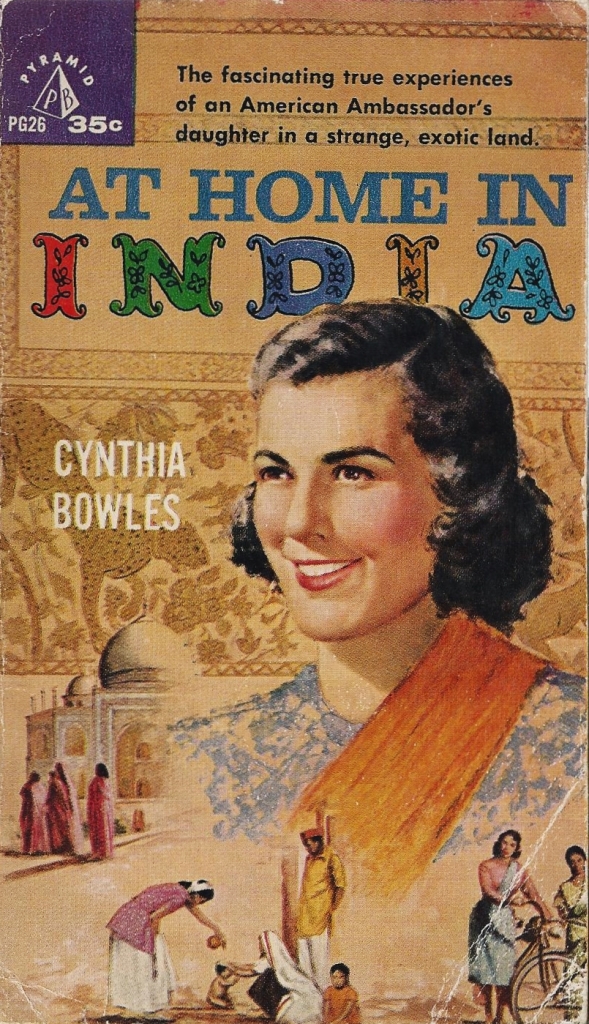
at home in india cynthia bowles 001At Home in India by Cynthia Bowles ~ 1956. This edition: Pyramid, 1959. Paperback. 158 pages.

My rating: 5/10.

“The fascinating true experiences of an American Ambassador’s daughter in a strange, exotic land.”

An American ambassador’s teenage daughter records in earnest detail her experiences of two years in India in the early 1950s. The writing is plodding but the subject has its moments of interest, with much reference to Nehru and Ghandi, and Miss Bowles finds her stride in the later chapters as she stays behind for a few months after the rest of her family’s return to America. Flying solo, the author visits the homes of Indian school friends and does a bit of mild personal research into social programs.

From the back cover, “A Personal Message from Cynthia Bowles”:

I went to India as a young, teen-age girl anxious not so much for knowledge as for the happiness and security which I was reluctantly leaving behind me in Connecticut. Consequently this is not a book of facts and figures. It is the story of what I did in India, of the places I visited, and of the people I came to know. I write because I wish to share, as best I can with you, my experiences in this strange and wonderful land.

And that snippet from young Cynthia tells you all you need to know about her writing  style. Worthy topics of discussion aside, a bit of a bore, really. I doubt I’ll reread this one.

in patagonia bruce chatwin 001In Patagonia by Bruce Chatwin ~ 1977. This edition: Picador, 1979. Paperback. ISBN: 0-330-25644-0. 186 pages.

My rating: 8.5/10

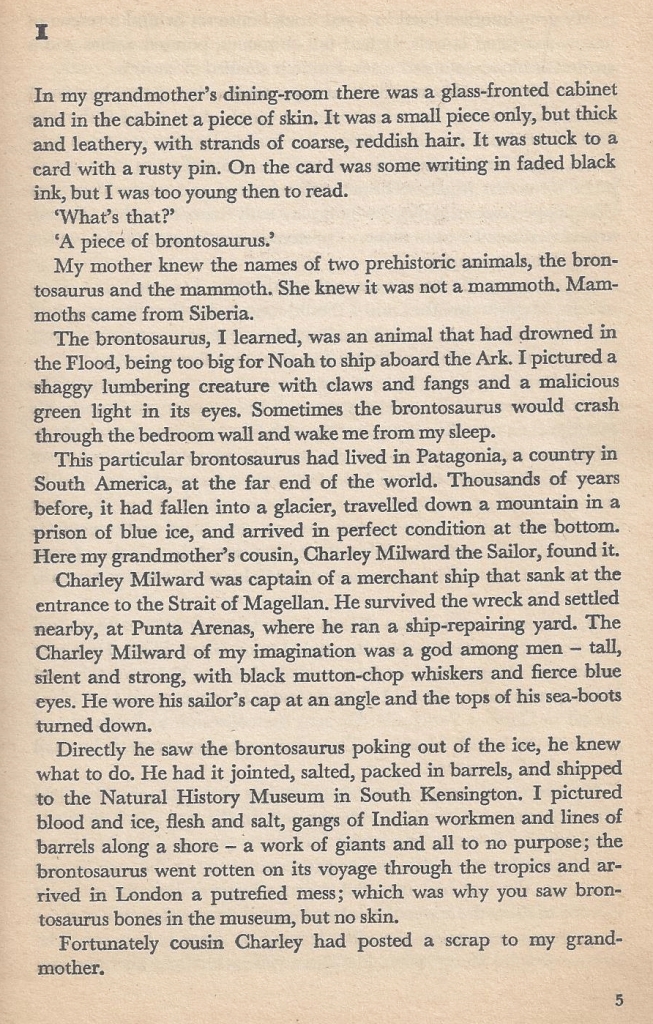
The inveterate traveller, raconteur and ceaseless self-inventor Bruce Chatwin burst onto the travel writing scene in 1977 with this fantastical “documentation” of a quest to the farthest reaches of Patagonia, inspired by a childhood fascination with a strip of mysterious preserved skin in his maternal grandmother’s curio cabinet:

in patagonia bruce chatwin page 1 001

The brontosaurus turns out to be in actuality a mylodon, a giant ice-age era ground sloth, and the specimen in question apparently came (theorizes Chatwin) from a collection of bones, skin and fossilized sloth droppings boxed up for shipment to the British Museum at the end of the 19th Century.

This book defies classification.

Chatwin refused to call himself a travel writer, though his best known books, In Patagonia and its equally quixotic Australia-set counterpart, 1987’s The Songlines, are superficially recordings of actual journeys. Chatwin embellished his tales with a goodly dollop of dramatic invention on occasion, though they read like the cold-sober truth. The many narrative gaps perhaps signal the bits of pure invention, or, just as probably, select bits of actual experience denied the author’s readers for reasons of his own.

Presented in ninety-seven sections, from one-line observations to chapter-length expositions, In Patagonia hits a number of high points, one of which most memorably is a multi-faceted examination of the legendary outlaw triumvirate of  Robert LeRoy Parker, Harry Longabaugh, and Etta Place. The first two are perhaps more famously known by their noms-de-guerre: Butch Cassidy and The Sundance Kid.

Did they really die in a hail of bullets in Bolivia, as pop culture would have it? Chatwin explores the possibilities of their fates in intriguing detail, in between sharply crafted odes to the impossible and brutal beauties of the lands he travels through, and vignette-encounters with the real and historical inhabitants.

Recommended, with the caveat that the best bits may quite well be fiction.

chasing the monsoon alexander frater 001 (2)Chasing the Monsoon by Alexander Frater ~ 1990. This edition: Penguin, 1991. Paperback. ISBN: 0-14-010516-6. 273 pages.

My rating: 10/10

Back in September I read and later glowingly reviewed Alexander Frater’s Beyond the Blue Horizon. I am most pleased to report that Chasing the Monsoon, written four years later, is equally as excellent.

Here is the publisher’s description:

The fascinating and revealing story of Frater’s journey through India in pursuit of the astonishing Indian summer monsoon.

On 20th May the Indian summer monsoon will begin to envelop the country in two great wet arms, one coming from the east, the other from the west. They are united over central India around 10th July, a date that can be calculated within seven or eight days.

Alexander Frater aims to follow the monsoon, staying sometimes behind it, sometimes in front of it, and everywhere watching the impact of this extraordinary phenomenon. During the anxious period of waiting, the weather forecaster is king and a joyful period ensues: there is a period of promiscuity, and scandals proliferate.

Frater’s journey takes him to Bangkok and a cowboy town on the Thai-Malaysian border to Rangoon and Akyab in Burma (where the front funnels up between the mountains and the sea). His fascinating narrative reveals the exotic, often startling, discoveries of an ambitious and irresistibly romantic adventurer.

This doesn’t even begin to describe the scope of this highly likeable book, which is part memoir, part ode to his beloved parents, and part better-than-conventional travelogue.

Frater writes rings around such plodders (by comparison) as Eric Newby, and he comes off as nicer and more relatably human than the über-snarky Paul Theroux, and much more reliable than the skittish Bruce Chatwin.

Good stuff.

Frater is now firmly on my list of writers whose new-to-me books I will purchase without even peeking at the contents.

Highly recommended for those of you who like this sort of thing, especially if you have a high tolerance for occasional (and always pertinent) inclusion of statistics and arcane terminology.

For a quick teaser, here’s page 1:

chasing the monsoon frater excerpt pg 1 001


Read Full Post »

Well, I might just make it to my Century of Books (2014 version) goal. That is: 100 books read and reviewed from January 1, 2014 to December 31, 2014, one for each year between 1900 and 1999. I have 8 years left to read, and 3 weeks to read them in – still quite do-able.

But the reviews…well…I think those might not be exactly in-depth – I have a fearfully large number to write about!

These past few weeks have been rather trying, in a number of small, niggling ways. Everyone’s been sick with various viruses, we’ve had some unplanned trips to the dentist, vehicles have been acting up, and we’re in the midst of some ambitious house renovations – tomorrow the dining room floor is coming apart, from the floor joists up, to be completely replaced and then followed by a ceiling to floor redo of the room.

What else? Oh yes, my faithful old computer printer died, right in the middle of a large clerical project for the upcoming regional performing arts festival, which I’m deeply involved in. To make things even more interesting, it has been very cold, well into the minus 20s Celsius. It’s warmed up a bit the last day or two, but now the prediction is for freezing rain. Oh, hurray.

And then there’s that whole Christmas thing. The first without my mother, who passed away in June of this year, and also mostly without my oldest child, who is now living away from home. I miss him quite a lot, though I’m glad he’s happily getting on with his life. We’ve just been discussing Christmas arrangements, and where everyone will be, and how to coordinate new schedules and commitments – it feels very strange.

Well, this too shall pass. It’s really just little stuff, and one feels very “first world problemish” even mentioning it, but there it is.

On the plus side, I’m back in my little office after its recent desperately-needed facelift, though the re-installed bookshelves are still empty and things are just kind of plunked down here and there in a very muddled fashion.

How are you other Century-of-Bookers making out? Please share!

It’s been a grand project, and I’ve greatly enjoyed it, even while getting pulled away into some bookish side paths.

Happy December, everyone, and I’ll try to get some more book-related posts up very soon.


Read Full Post »


Not my personal copy, which is a rebound old school library edition with a boring green cover.

Not my personal copy, which is a rebound old school library edition with a boring green cover.

The Wind in the Willows by Kenneth Grahame ~ 1908. This edition: Scribner’s, 1954. Illustrated and with Preface by Ernest H. Shepard. Hardcover. 259 pages.

My rating: 10/10

What can be said about this book that hasn’t already been said, written, or recorded in some way? A true “classic”, in every sense of the word, beloved by children and adults the world over for the century-plus since its first publication.

Grahame’s anthropomorphic characters are most cleverly depicted. They are small humans in animal form, wearing clothes, walking upright when appropriate (though some find this easier to manage than others), and only sometimes following their animal nature. They interact with the humans in their world on a perfectly equal basis (or so they think) while the “real” humans seem to view them with a mildly patronizing attitude. The whole thing is rather complex, when one stops to think about it, and it says much for Grahame’s artistry that we accept his world immediately and without question.

The story itself is a series of linked adventures, starting with the subterranean Mole busily spring cleaning his rather dingy underground home, and throwing down his scrub brush in despair when the scent of Spring wafts through the air and catches the attention of his sensitive little nose. Wandering aimlessly out along the riverbank, Mole meets the cheerful Water Rat, who is appalled that his new acquaintance is unfamiliar with the joys of the river, and decides post-haste to initiate the ground dweller into the thrill of the liquid world, for

‘Believe me, my young friend, there is nothing – absolutely nothing – half so much worth doing as simply messing about in boats. Simply messing,’ he went on dreamily: ‘messing – about – in – boats; messing –‘

‘Look ahead, Rat!’ cried the Mole suddenly.

It was too late. The boat struck the bank at full tilt. The dreamer, the joyous oarsman, lay on his back at the bottom of the boat, his heels in the air…

The earnest Mole and the carefree Rat go on to have numerous adventures, mostly concerning their bumptious neighbour Toad, who is a wealthy creature much prone to following ever-changing whims full speed ahead until something new catches his short attention. A camping trip in a horse drawn caravan (with decent Mole walking along beside the Horse to keep him company and to try to make up for the fact that the Horse is doing all of the hot, dusty work while Toad lolls in the driver’s seat) goes awry as the group is run off the road by a Motorcar. Toad is seduced immediately, buys his own extra-deluxe motorcar, and with a war cry of “Poop! Poop!” (meant to mimic the klaxon horn of his newest Beloved) gets himself into much more serious scrapes and eventually into Court, where he receives a stern sentence for Driving to the Public Danger, and much more seriously, Cheeking a Policeman. Twenty years in the deepest dungeon of the best-guarded prison in all of England is the fate of Toad. How ever while he get out of this one?!

Good stuff. Read it for your personal pleasure; read it aloud to your children, and continue the long tradition.

That’s all I have to say. If you are looking for scholarly examination, it is freely available in great abundance here, there and everywhere. But not from me. It’s a grand book, undoubtedly an “important” book, and most crucial of all, a fun-to-read book. Go read it. It’s utterly perfect for Spring.

And oh, well, here is a link to a quite lovely blog post regarding it, the sort of thing which I would have liked to have written, but which has already been done to such perfection that I lazily thought, “Why do it again?”

Check this out: Behold the Stars: The Wind in the Willows

Read Full Post »

Where-Angels-Fear-to-TreadWhere Angels Fear to Tread by E.M. Forster ~ 1905. This edition: Book-of-the-Month Club, 1995. Hardcover. ISBN: not found. 208 pages.

My rating: 6/10

My relatively high rating of 6 is mainly for the quality of some of the writing. If judged by the appeal of plot and characters alone, this would get about a 4 or so.

I felt that the author lost his way towards the end, and I couldn’t abide any of the characters by the final chapter, least of all the main male protagonist, young Italiophile Philip.

So, has anyone else read this first novel by E.M. Forster? And if so, what did you think?

I found it rather uneven, with moments of sheer brilliance interspersed with numerous rather shaky bits. And the ending was not what I’d expected. I think that is possibly a good thing in a literary sense, in that I was shocked out of my readerly complacency – I thought I was reading merely a satirically humorous tale for the longest time – but I felt it (the final tragic occurrence and its aftermath) ultimately rather artistically troubling, as none of the responses of the characters to the contrived situation felt genuinely satisfactory. (Sorry to be all  mysterious as to the nature of the tragedy – I don’t want to spoil the ending, in case someone is half way through and wondering where it’s all going.)

This is a very slender novel, really more of a novella in its limited scope, and not up to the standard of Forster’s later, longer, more complex and much better-known works such as A Room with a View, Howard’s End, and A Passage to India. But as I’ve already mentioned, there are passages of wonderful writing in Where Angels Fear to Tread, which show what Forster was capable of at his best.

A widowed Englishwoman, very much under the thumb of her in-laws, departs for a year in Italy in the company of a much younger woman, whom she is to chaperone. It is hoped by the in-laws that the beauties of Italian art, architecture and culture will have a refining effect on the rather common nature of slightly foolish, slightly crass Lilia Herriton, and everyone concerned draws a sigh of relief when the train bears her away. Even her young daughter is content to see her go, and her mother-in-law is positively gleeful to have a free hand with bringing up her deceased son’s only child.

At first all is well, and Lilia writes gushing epistles home full of wonder at the beauties of Italy, leading her in-laws to hope that she will return a changed-for-the-better woman. But then a further letter comes, announcing Lilia’s engagement to an Italian “met in a hotel”. Shocked inquiries by telegram bring in return a brief explanation from Lilia’s companion, that the fiancé is “of the Italian nobility”. Something doesn’t seem quite right, and an immediate intervention is put into action, with the dispatch of Lilia’s young brother-in-law, Philip, with orders to set things straight and bring Lilia back home unencumbered with an Italian second husband, “nobility” or not.

Philip finds himself arriving too late to prevent the worst, for Lilia has actually married her Italian swain. Far from being a member of the nobility, he turns out to be the impoverished son of the local dentist, and Philip finds Lilia defensive and unrepentant and her young travelling companion in the throes of guilty despair, for she has encouraged the unlikely lovers in their wedding plans, and has now, with the arrival of the appalled Philip, realized the extreme unsuitability of the liaison and her own role in it.

Lilia is cast off by her exceedingly genteel in-laws back in England, and left alone to make do the best she can in her new life. Needless to say things are not quite as rosy as she has expected, and even the fact that she is comparatively wealthy and can afford a high standard of living for herself and her husband in the small Italian town where they establish their nuptial home does not compensate Lilia for her subsequent bitter loneliness and boredom as she finds herself isolated by nationality, language, and personality from everyone around her.

Lilia is not left to linger long, as she exits the Italian scene as impetuously as she entered it, triggering new complications which again cause the family of her first husband much hand-wringing and heart-burning. Philip finds himself despatched once more to attempt a resolution to an exceedingly awkward state of affairs, this time accompanied by his impetuous and outspoken sister Harriet. They are hot on the heels of Lilia’s one-time lady-companion, who, still wracked with guilt over the original scenario, has also departed post-haste to Italy in order to effect her own attempted rescue mission of the only true innocent in the increasingly sordid tale.

There is plenty of room for farce in all of these goings on, and Forster plays his characters for comedic effect well, but the story turns relentlessly from comedy to tragedy, and all of Philip’s (and the young author’s?) anguished philosophizing cannot turn back the course of events.

A tacked-on sort of romantic coda at the very end felt to me out of place. I’m not quite sure what I would have had the author do in its stead. Perhaps stop sooner and leave us to use our imaginations at the point of the tragedy? As it was, to my mind the story lost much of its poignancy because of what came after.

I doubt I’ll be reading this book again, though it has reminded me how good Forster can be, if in a slightly patchwork fashion. I may be looking at him again in the new year, and reading some of his later works once the Century project is all tidied up.

Where Angels Fear to Tread is an excellent title, even to its gentle warning to the reader not to expect a completely satisfactory tale.

My final verdict: I felt this was an “interesting” book, rather than a particularly “good” one.


Read Full Post »

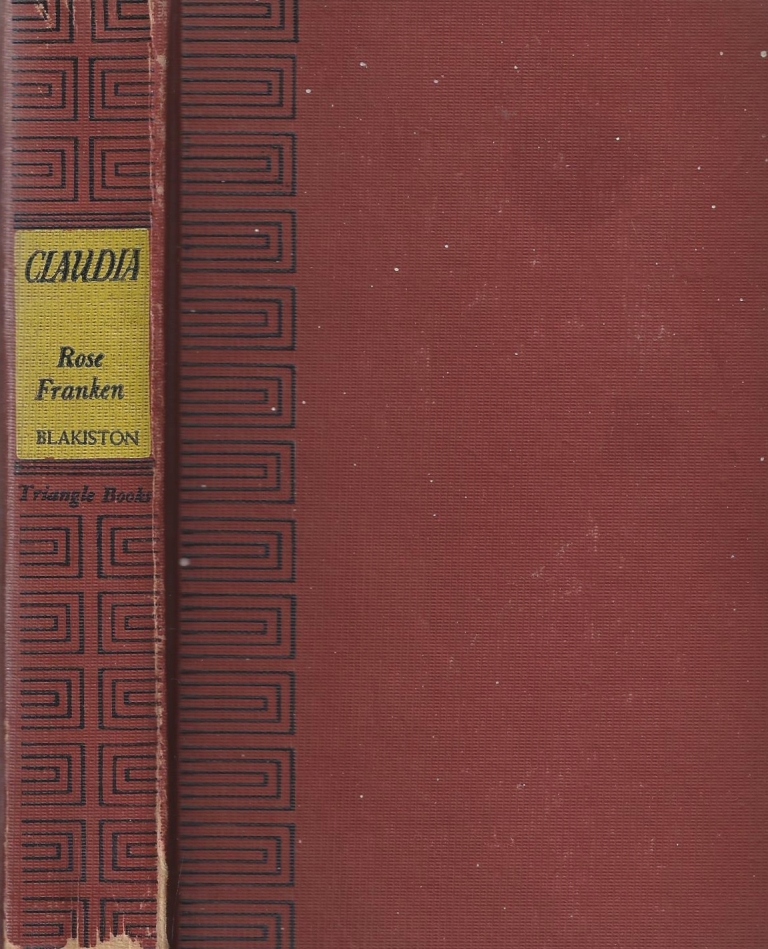
claudia rose franken 1938 001Claudia by Rose Franken ~ 1938. This edition: Blakiston, 1939. Hardcover. 305 pages.

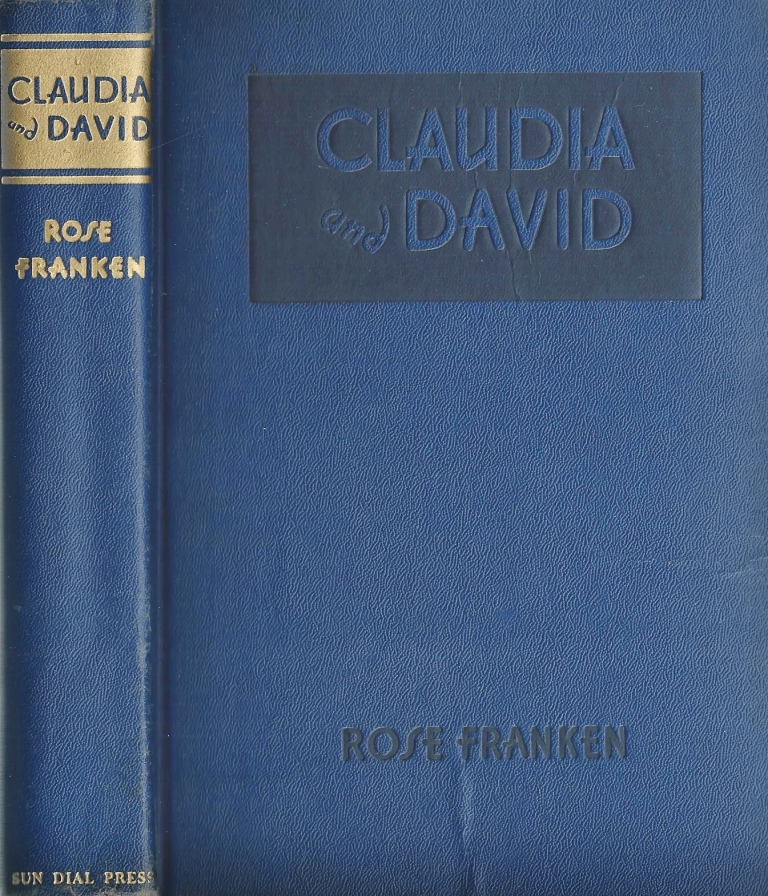
Claudia and David by Rose Franken ~ 1939. This edition: Sun Dial Press, 1940. Hardcover. 307 pages.

claudia and davis rose franken 1938 001My rating on both of these: Withheld for the time being. I’m not quite sure if I found these appalling or charming. Both, really. But which one is the strongest response will have to wait until I’ve re-read these, and perhaps explored a little more of the Claudia saga. (I think I may just have revealed which way I’m leaning.)

*****

This summer I acquired three of the Claudia novels – I believe there were something like eight in total – by Rose Franken, a highly successful American playwright and novelist. (An extended biography is here.)

I’m not sure what I was expecting – likely something fairly “deep”, as I had an idea that Franken was something of an “intellectual” writer – but it certainly wasn’t what I found.

These books – if the two I’ve just read are any indication; I set aside Young Claudia for future reference – are pure tweak-your-heartstrings sentimental tosh.

Our heroine Claudia is perilously close to being…hmm…how can I put it?….rather silly is fairly polite…but I could forgive her that because she was a young, young thing (just 17, or maybe 18) when she was matrimonially snapped up by the brusquely outspoken (and seven years older) rising young architect David.

Claudia has mild aspirations to go on the stage, but marriage to dashing and forceful David ultimately seems like a better idea. Who could resist being wooed by being constantly called a “young idiot”? Not our Claudia!

David has some manly notions regarding his teenage wife, including keeping her close to home – they may be struggling financially, but no wife of his is going out to work, because that would reflect on his ability to be the breadwinner. Who cares if she’s bored to tears and clawing at the wallpaper in her tiny apartment? A woman’s place is in the home, or at least his woman’s place is there, because David says so, dammit.

David, to be frank, is a bit of a jerk, even though he proves time and time again to have a heart of gold under his gruff exterior. (Uh-huh, he really does. Because Rose Franken tells us so, over and over and over.) He is constantly telling Claudia how dumb she is, and she agrees with him, and then silly little wifey comes up with some stunningly obvious solution to whatever the issue-of-the-chapter is, or has a brush with death, and David shows a glimpse of human emotion and then we’re off to the next episode. (Can you say “formula”, dear readers?)

Oh yeah, and David occasionally spanks Claudia, “hard enough to hurt”, and she likes it, because she realizes that she needs to be punished for daring to bruise David’s incredibly tender ego by having occasional ideas of her own. Argh.

Franken plays us like a piano, up and down the keyboard, tinkle-tinkle-tinkle, great big crescendo and then soft pause, and on to the next. These novels started out as story collections – Claudia first appeared in Redbook in the 1930s – and the structure is classic women’s-magazine-short-story, each chapter being a complete episode, arranged in chronological order with the same characters reappearing and new ones being added as we go along.

I haven’t really told you much about what actually happens in these absolutely fluffy light novels, and I’m not going to in any detail, because I think you can guess. Honeymoon period, quarrels, making up, financial difficulties, Great Big Breaks, life-threatening illnesses, babies (and life-threatening childbirth complications – Claudia walks the knife edge, because she’s always on the brink of dying, which gives David an opportunity to display that glimpse of human emotions and gruff tenderness referred to earlier), a little bit of mental and physical spousal abuse, servant issues, house issues, yadda yadda yadda.

But you know what? The saga is actually rather sweet, and occasionally quite funny, and horribly addictive – I absolutely gobbled these up.

Go figure.

I’m wondering if any of Rose Franken’s non-Claudia novels are a little deeper, because she’s a decent enough writer, and occasionally she whams the wifehood/motherhood thing right on the button.

I found a fun review of the Claudia books here, at Blue-Hearted Bookworm. Go take a look, because you’ll end up snorting with laughter, especially if you’ve already made the acquaintance of Claudia.

Here’s a brief excerpt:

I first discovered the Claudia novels (in one volume, The Claudia Omnibus) while browsing in my undergraduate library when I was, like Claudia, just 18. I stood there in the aisle and read for a while, then replaced the book. My Tough & Cool Inner Bookworm and I curled my (our?) lip contemptuously and thought: “What shit.” It was almost time for my next class, so I left the building.

Here’s the strange part: I was back in that same spot the very next day, surreptitiously enjoying another chapter! I’d read with an eye on the page and an eye on whoever might be walking by. I was in constant danger of being discovered; even back then, anyone who wanted to find me knew that the library was the perfect place to look…

I so get this, because it’s exactly how I felt. “What shit.” <Turns page to next installment.>

Don’t say we didn’t warn you. 😉

Read Full Post »

I am writing from exile, as it were. My usual “happy place”, as my ever-so-clever and perhaps slightly cynical offspring often call it, is a small room which was once dedicated to the more formal of our homeschooling endeavours. Those students are all grown up now, and over the past few years the schoolroom has turned into a not-very-well-organized office area for yours truly.

It’s really quite lovely in there, with two tall windows overlooking the garden, and lots of bookshelves. The space is (was!) filled by a work table overflowing with stacks of crucial papers (mine) and art supplies (my daughter’s) and mostly empty music CD and computer game cases (my son’s), an ancient oak teacher’s desk – but not of the antique-variety ancient, sad to say, merely of the old, scarred and scuffed sort – and a file cabinet full of the oddest collection of things – an abandoned knitting project from back in 1994 (a wooly sweater for my then-newborn son, who outgrew it long before it was completed), an out-of-order telephone answering machine (even older than the sweater), a stack of my old school report cards from the early 1970s, a small tub of child-proof electric outlet covers and cupboard door latches, the official pedigrees of several horses long since departed for greener (celestial) pastures, a collection of brown paper bags…everything, in fact, except for things-to-be-filed, like receipts and bills and important papers.

The floor in the little room has needed some serious attention for some time – the old linoleum was worn through to the plywood below in the main travel area – and when a recent cold snap which put a sudden stop to outdoor projects had us looking about for a small, manageable, renovation project we zeroed in on this one.

Everything was hastily bundled out of the room and deposited willy-nilly wherever a space could be found. My computer has ended up in a little hallway nook which usually houses the telephone and directories and stacks of incoming mail and such; it’s just large enough to squeeze everything in, and here I sit in a state of some discomfort, pecking away at my keyboard in a much less congenial atmosphere than my private little room.

A (tiny!) room with a view. Note that there is NO SNOW outside the window - very unusual for this part of the world at time of year. Mentioning this should immediately bring the snowflakes drifting down...

Playing about with floor tile patterns in a (tiny!) room with a view. Note that there is NO SNOW outside the window – very unusual for this part of the world at time of year. Mentioning this should immediately bring the snowflakes drifting down…

We’ve ripped up the old floor, replaced a few iffy floor joists and all of the plywood, removed a huge corkboard which took up most of one wall, added wainscoting to another wall, and brought out the paint tins. The new floor tiles are stacked up waiting for the acquisition of a bucket of glue next time I’m in town, and if all goes well I should be back in residence in the next week or so.

The old wooden desk has been relocated and another, larger, more “professional” ex-office steel desk is taking its place; my new view will be out those previously-mentioned windows versus the wall in the corner. I’m not sure what this will do to my concentration level, but I’m thinking it will be a happy psychological development. 🙂

The bookshelves are being relocated, and the stacks of “juveniles” they now contain boxed up for temporary storage; my working library of horticulture books may replace them, or perhaps just another bunch of novels. Not quite sure yet. Books find their own way about, in my experience.

A large grow light stand for the germination of December- and January-sown perennial seeds is planned for the remaining space; the old stand was unceremoniously hauled outside during our last winter’s renovations, and as the plant nursery sabbatical period comes to an end (see Hill Farm Nursery for more on that aspect of my life) indoor early seed-sowing facilities are once again about to be required.

Oh, and the file cabinet is being emptied out, with high hopes that in its new life it will actually be used for its intended purpose – that of holding files. The “cardboard box filing system” which I have been using in the past is apparently going to change. Or so declares my perhaps-too-optimistic husband. 😉 We’ll see. About half of the stuff currently taking up space in the cabinet is his, so he’s hardly innocent of random stashing of “treasures” himself. It’ll be interesting to see what he makes of his stuff, and where it will end up! I have several empty cardboard boxes awaiting his pleasure…

Well, I did promise book notes too, didn’t I? So I think I will tuck a few in here on the end. Minor notes for minor books. These are all from the shelves in the now-ex-schoolroom. I enjoy occasionally reading from the juvenile stacks – well-written books easily cross genre and “intended-age” boundaries.

dodgem bernard ashley 001Dodgem by Bernard Ashley ~ 1981. This edition: Puffin, 1983. Paperback. ISBN: 0-1403-1477-6. 222 pages.

My rating: 6.5/10

A better-than-average “problem novel” by ex-headmaster and prolific children’s and young adult fiction writer Bernard Ashley – see his biography here.

Teenage Simon is in trouble with the Child Welfare; he’s been skipping school in order to care for his father, who has been in a state of severe clinical depression since the death of Simon’s mother, a death surrounded by questions, which have torn the small family even further apart in ways which will only become too apparent part way through the novel.

Simon ends up “in care”, and, desperate to return to his father, teams up with the seemingly emotionless Rose in a well-thought-out escape plot which seems at first to be daringly successful.

Decidedly well written and totally engrossing, this short novel, from early in Bernard Ashley’s writing career, was made into an acclaimed 6-episode British television series.

Scenes set in a juvenile care home and in a travelling carnival are excellent in their detail. Despite the young protagonist’s rage against the system which one completely sympathizes with, the adults are given as much time on the page as the teenagers. There is a quite remarkable balance of points-of-view, unusual in this sort of highly-contrived juvenile novel.

This is the only book by Bernard Ashley I’ve yet read, but if the writing quality stays the same in subsequent books he might be worth investigating further for those of you with young teens, or if you are merely open to reading novels targeted at younger-than-adult readers.

*****

the ballet family jean estorilThe Ballet Family by Jean Estoril ~ 1963. This edition: Macdonald Children’s Books, 1989. Paperback. ISBN: 0-356-16797-6. 176 pages.

My rating: 6/10

Jean Estoril was one of the several pseudonyms of Mabel Esther Allan, a prolific writer of children’s books (Wikipedia reports 130) between 1938 and 1994. The “Jean Estoril” books were all concerned with the world of ballet, most notably a series about an orphaned aspiring dancer, one “Drina” (short for Andrina)  – Ballet for Drina, Drina’s Dancing Year, Drina Dances in Exile, and so on.

I am rather leery of juvenile series books, but in this case I may investigate further, for The Ballet Family, not about the afore-mentioned Drina but instead concerning a group of hyper-talented siblings and their orphaned cousin, is intriguingly good for its sort of thing. Better, in my opinion, than Noel Streatfeild’s ubiquitous (and perhaps over-rated? – others of her books are much, much better, in my humble opinion) Ballet Shoes, which I must confess causes me to grit my teeth here and there.

Mabel Esther Allan studied ballet in her younger years, and it shows, in a good way. The Ballet Family is quite marvellously realistic regarding the dance aspect, aside from the glorious improbability of the initial set-up.

Pelagia, Edward, Anne and Delphine Garland are all dancers and ballet mad. Their mother is a prima ballerina and their father a conductor of the ballet company orchestra.

When their cousin Joan is orphaned she comes down from Lancashire to live with Garlands in London. Confused and lonely, Joan finds it hard to fit in, especially as her cousins are rather wary of her and don’t understand how Joan could survive without knowing anything about ballet!

But Joan does survive and begins to enjoy her new life observing the ups and downs and tears and triumphs of her glamorous cousins.

Pelagia flits in and out of the story, being the eldest and very much concerned with her burgeoning career, Edward is a decent sort with sensible notions, Delphine is a spoiled brat who needs (and thankfully gets) a reality check, but the book is really mostly about middle sister Anne and her difficulties relating to her cousin, whom she finds nothing at all in common with, and whose apparently sullen attitude (she’s really deeply grieving the sudden loss of her beloved mother) precludes friendly girlish chats.

Joan finds her feet in her new life, and astounds the self-centered Garland family by displaying some talents of her own they had no inkling of. Bless the author – Joan does not turn out to be ballerina material – she doesn’t even try to go there, nor do the Garlands ever expect her too, for she is much too “old” to start, in their united opinion – her special talent is in a slightly different area.

A slight book, but very nicely done.

 She Reads Novels gives a glowing recommendation to some of Jean Estoril/Mabel Esther Allan’s books. I think I will be following up on these.

*****

green-knoweThe Children of Green Knowe by L.M. Boston ~ 1954. This edition: Faber & Faber, 1962. Illustrations by Peter Boston. Hardcover. 157 pages.

My rating: 7.5/10

A subtle classic of children’s literature, this novel calls one back to the elusive world of imaginative childhood, when all things are possible, and some things are downright magical.

Synopsis cut and pasted in directly from the Green Knowe Wikipedia page, because whomever wrote it did a lovely job of summation of the story set-up:

The Children of Green Knowe is the first of the six books written by Boston about the fictional manor house of Green Knowe. It was a commended runner up for the 1954 Carnegie Medal.

The novel concerns the visit of a young boy, Toseland, to the magical house of Green Knowe. The house is tremendously old, dating from the Norman Conquest, and has been continually inhabited by Toseland’s ancestors, the d’Aulneaux, later Oldknowe or Oldknow, family. Toseland crosses floodwaters by night to reach the house and his great-grandmother, Linnet Oldknow, who addresses him as Tolly.

Over the course of the novel, Tolly explores the rich history of his family, which pervades the house like magic. He begins to encounter what appear to be the spirits of three of his forebears—an earlier Toseland (nicknamed Toby), Alexander, and an earlier Linnet—who lived in the reign of Charles II. These meetings are for the most part not frightening to Tolly; they continually reinforce the sense of belonging that the house embodies. In the evenings, Mrs. Oldknow entertains Tolly with stories about the house and the children who lived and live there. Surrounded by the rivers and the floodwater, sealed within its ancient walls, Green Knowe is a sanctuary of peace and stability in a world of unnerving change.

The encounters of Tolly and his ghostly companions are reminiscent of similar scenes in some of Elizabeth Goudge’s books, being serenely beneficent rather than at all frightening. Though there are a few twists…

children of green knowe l m boston peter boston 001The full-page and in-text illustrations by Lucy M. Boston’s artist son Peter are intricately detailed in pen-and-ink and scraperboard technique; make sure the copy you share with your child (or read for yourself) has these included; many of the cheaper paperback and some later hardcover editions are missing these.

Perhaps I should have kept this review for closer to Christmas, as that celebration features strongly in one of the most charming incidents in the story.

In a word: Nice.


Read Full Post »

« Newer Posts - Older Posts »