Archive for the ‘Canadian Book Challenge #6’ Category

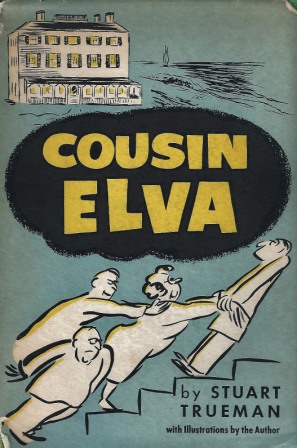
Cousin Elva by Stuart Trueman ~ 1955. This edition: McClelland and Stewart, 1955. First edition. Hardcover. 224 pages.

My rating: This is tough. I almost was going to say un-rateable, but on second thoughts I will give it maybe a 5.5/10. It’s a first book, and the author went on to write many more. There’s nothing really wrong with it, and I did read it with mild enjoyment, but I found it very easy to put down and I had to consciously pick it up and finish it. Probably a keeper, but on the bottom shelf or exiled to the “B”-reads boxes, I’m thinking.

*****

Cousin Elva is a humourous, satirical light novel about a fictional couple, Penelope and Frank Trimble, who purchase a large house in the (also fictional?) community of Quisbis on the Bay of Fundy, and proceed to open a boarding house – “Mr. and Mrs. Trimble’s Tourist Rest Haven”. The only catch is that the house comes with a pre-existing resident, Miss Elva Thwaite, granddaughter of the original owner.

Miss Thwaite, or “Cousin” Elva as she insists on being called, is a blatantly eccentric, sixty-ish,”old maid” who refuses to be put on the shelf, taking an active interest in everyone and everything that crosses her path. She’s also keen to catch herself a man. Hi-jinks ensue as a motley assortment of visitors to Trimble’s Rest Haven fall into Cousin Elva’s clutches.

The humour is, at its best, rather understated and wry, but too often over-the-top farcical. I did enjoy the many regional and Canadian references; those did much to keep me reading when I occasionally got overloaded with the slapstick action.

A well-meaning attempt by an author new to me. The kind of book you perhaps enjoy best when scanning the meagerly stocked shelves at an isolated lakeside cabin in summer. In other words, welcome if you’re fairly desperate for amusement and it’s too far to go to town…

Stuart Trueman (1911-1995) was a Canadian writer from New Brunswick. He won the Steven Leacock Memorial Medal for Humour in 1969. I had never heard of him before picking up this book, but as you can see from his biography he had a long and prolific writing career. I would definitely be interested in reading some of his other work, but only if it was easily obtainable; I don’t think I’d go to a lot of effort to seek it out.

From the New Brunswick Literary Encyclopedia:

Stuart Trueman (writer, editor, historian,  reporter, cartoonist, and humorist) was born in 1911 in Saint John, New Brunswick,  the son of the late John MacMillan and Annie Mae (Roden) Trueman. He was  the husband of Mildred Kate (Stiles) and a father to Mac and Douglas, his two  sons; he was also a grandfather of four, and a great-grandfather to one.  Growing up, he had two sisters and three brothers, along with a countless  number of friends whom he believed shaped him into the man that he was. He  passed away in his home in Saint John,   New Brunswick, on 25 April 1995  after a period of failing health.

Trueman was known  for being a great representative of journalism, and he garnered a lot of  respect and credibility in all that he accomplished. Straight out of high  school, he started out as a cartoonist and reporter at the Telegraph Journal in Saint    John, where he stayed for forty-two years, later  becoming a sports writer. In 1951, Trueman became the editor-in-chief at the Telegraph Journal and Evening Times Globe, a position that he  would hold for the last twenty years of his working career. Upon retirement in  1971, he remained faithful to the newspapers that he had been involved with and  continued to contribute to weekly columns until 1993. He took writing, journalism,  and public speaking seriously, and had a keen insight into human character. He  was also known for being a stickler for details, always following the journalist’s  obsession with the “who,” “what,” “where,” and “how.”

Trueman was often  referred to as “Mr. New Brunswick”  because of his broad knowledge of the history of this province and of its  scenic and cultural attractions. He wrote many books about New Brunswick, its people, and its unique  history. Along with being a well-known author, Trueman was a part of New Brunswick history.  On 19 May 1932, he and co-worker Jack Brayley interviewed Amelia Earhart at the  Saint John Airport  as she was preparing for her historic flight across the Atlantic.  Another accomplishment for Trueman was when he and Brayley took a trip to Moncton, New    Brunswick, where they discovered an attraction that  many are familiar with today: Magnetic Hill. Trueman’s son Mac said that  despite the fame and development that has built up around Magnetic Hill, it was  always his father’s favourite natural phenomenon. The discovery of Magnetic  Hill gave way to the tourism industry within New Brunswick,  and it continues to be one of New    Brunswick’s most popular attractions.

Trueman published  fourteen books and wrote more than three hundred humorous articles for both  Canadian and American magazines. He thought of these articles as “light pieces,”  and although he never claimed they were funny, he was commonly referred to as a  funny man. One of his greatest accomplishments was winning the Stephen Leacock  Memorial Award for humour in 1969 for his book You’re Only as Old as You Act (1968). Other books Trueman produced  include: Cousin Elva (1955); The Ordeal of John Giles: Being an Account  of his Odd Adventures; Strange Deliverances, etc. as a Slave of the Maliseets (1966); An Intimate History of New  Brunswick (1970); My Life as a  Rose-Breasted Grosbeak (1972); The  Fascinating World of New Brunswick (1973); Ghosts, Pirates and Treasure Trove: The Phantoms that Haunt New  Brunswick (1975); The Wild Life I’ve Led (1976); Tall Tales and True Tales from  Down East: Eerie Experiences, Heroic Exploits, Extraordinary Personalities,  Ancient Legends and Folklore from New Brunswick and Elsewhere in the Maritimes (1979); The Colour of New Brunswick (1981); Don’t Let Them Smell the Lobsters Cooking:  The Lighter Side of Growing Up in the Maritimes Long Ago (1982); Life’s Odd Moments (1984); and Add Ten Years to Your Life: A Canadian  Humorist Looks at Florida (1989). Many of his books include light-hearted  stories that have been adapted from Trueman’s popular columns in the Telegraph Journal, Weekend, and the Saturday Evening Post.

Trueman’s wife,  Mildred, played an important role in his overall success as an author in New Brunswick. She  supported him throughout his career, and the couple collaborated on two  cookbooks: Favourite Recipes from Old New Brunswick Kitchens (1983) and Mildred Trueman’s New Brunswick Heritage Cookbook: With  Age-Old Cures and Medications, Atlantic Fishermen’s Weather Portents and  Superstitions (1986).

Amanda Palmer     St. Thomas University

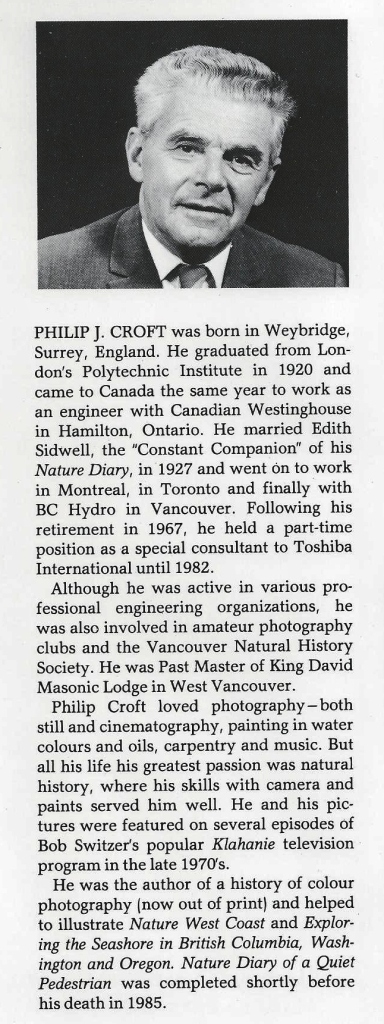
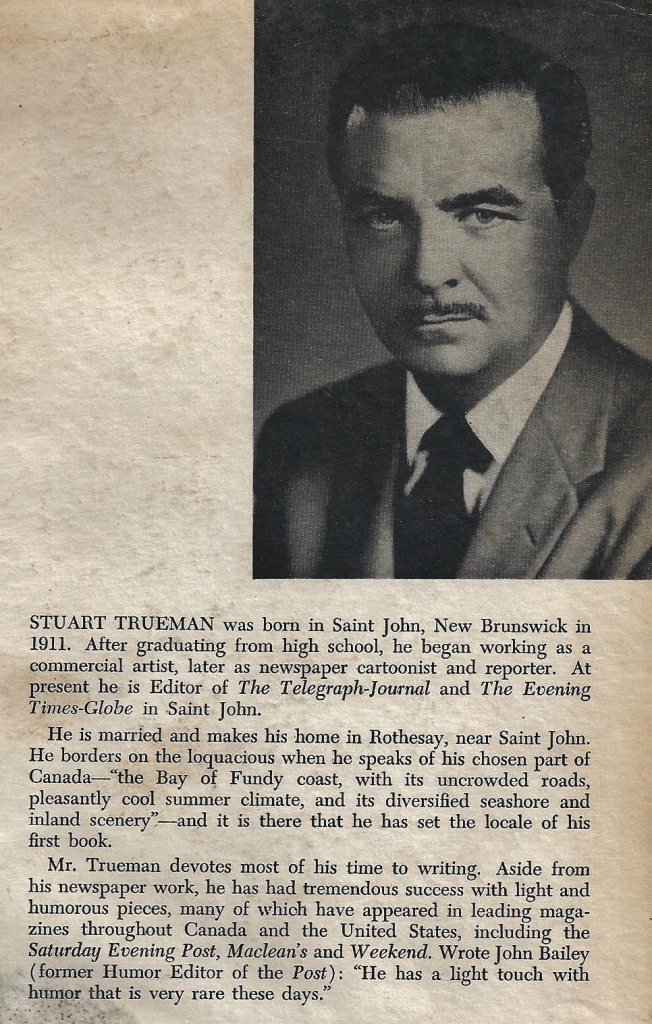
And here is the author photo and biography from the back cover of Cousin Elva:
Read Full Post »

Nature Diary of a Quiet Pedestrian by Philip Croft ~ 1986. This edition: Harbour Publishing, 1986. Hardcover, illustrated by the author. ISBN: 0-920080-87-1. 141 pages.

My rating: 8/10. Occasionally a tiny bit stilted as the author tries hard to keep up his literary momentum, but for the most part the prose flows along just fine. An appealing glimpse into one man’s life, and into the natural history of his personal world.

*****

I spent some days in the Vancouver area earlier this week, and though my free time was limited I did manage to visit several used book stores – used bookstores? used-book stores? – for some reason this does not look right this morning! I am still a bit groggy from sleep, and this is very much a stolen hour at the start of what promises to be a very busy day… Anyway, on the holiday Monday (B.C. Day) evening, when most of the interesting small shops were closed up tight, I nipped into the Langley Value Village to browse their large book section, and, casting about for that elusive 5th book – the “freebie” – this one just sort of slid off the shelf at me in a shyly appealing “Hey, look at me” sort of way. From the title I was thinking – “Hmmm, probably British, another one of those made-for-tourists, Edwardian Lady take-offs, get ready to put it back…” so imagine my delight in finding that it was instead a very appropriate British Columbia book, written about the very region I was visiting.

Amateur naturalist Philip Croft kept a diary of his regular daily walks through his West Vancouver neighbourhood, through a section of forest and down to the beach. Blessed with a keenly observational eye, an artistic hand for illustration, and a gentle sense of humour, Mr. Croft’s year as recorded in this handsome book is very readable indeed. I have visited the coastal areas of B.C. enough to be generally familiar with the setting, but I have often been curious as to some of the interesting plants, insects and seashore creatures unfamiliar to me as a native of the very different, dryland fir zone interior of the province. I found myself browsing through the book in my next few evenings in my hotel room, during breaks from my delighted absorption in The Benefactress by Elizabeth von Arnim.

From the Preface:

I am an inveterate pedestrian. I walk daily for pleasure, exercise and control of the waistline. But mostly for pleasure… I like to walk alone: I prefer to be a quiet pedestrian, to walk and think, not walk and converse. In this respect my hour afoot is apt to be the most useful and productive hour of my day, for it is a time in which I am able, to a measured footfall, to think many things through uninterruptedly, to a logical or practical conclusion… It is my time for meditation and reflection…

…It is not necessary to travel to the out of the way wilderness areas of our province to be confronted by the year-long pageant of natural events in the life cycles of common plants, insects, birds and animals. It is surprising how many species inhabit roadside ditches, patches of woodland, vacant lots, railway embankments and cuttings and similar waste places throughout our area. By following the same limited selection of routes day after day, week in and week out throughout the year, one is enabled to note every phase in the development of wild plants as they spring, grow, flower, seed and make their appearance; when the birds that feed on the insects appear and when they congregate for their annual migrations… a never-ending source of wonder and pleasure…

Something that never ceases to please me is the abundance of natural life surviving and thriving in pockets of our crowded cities; as a dedicated country-dweller who enjoys occasional immersion in city life, I always give silent homage to the urban dandelions growing through cracks in the sidewalk, the fireweed colonizing the sagging roofs and windowsills of derelict buildings, the small birds opportunistically gleaning the road-killed insects from the grills of parkaded cars. And though I view the rural areas as my natural habitat, I have also lived in towns and cities; long enough to appreciate what Mr. Croft is speaking about; that nature surrounds us and goes about its inevitable business quietly and inexorably; if we pause for a moment now and then we can get much joy and encouragement from the steady adaptation of all sorts of organisms in our concrete-filled urban worlds.

This quick trip I noticed the ripening masses of blackberries, the last few foxglove flowers on their impossibly long, seedpod-lined stems, and the forests of Himalayan impatiens and buddleia along the roadsides. Parked in a busy industrial area, waiting for my daughter to emerge from a cavernous, ex-warehouse dance studio, I noticed several small brown rabbits lolloping among the blackberry vines at the edge of the parking lot. A large transport truck pulled up; the driver emerged holding a small plastic container and, without hesitating a moment, went bravely into the thorny thicket and started to pluck the berries; one in the mouth, one in the tub… I chuckled to myself and mentally went through my own belongings; sadly I had no suitable container or I might have joined him!

What joy to then read about Philip Croft’s August ode to walking in blackberry time, taking along a container to fill on the return trip to be subsequently made into a delectable pie, and his investigations of bumblebees pollinating the ubiquitous impatiens! The writer documents his observations, and enriches the narrative with philosophical mullings over of the state of the world and of human endeavour.

This book will join my collection of B.C. natural history titles which we delve into beforehand and take with us on trips and refer to later to answer queries triggered by things we see in our travels. A most enjoyable read. Mr. Croft must have been a delightful person to know; I am glad I stumbled across his natural history memoir.

Read Full Post »

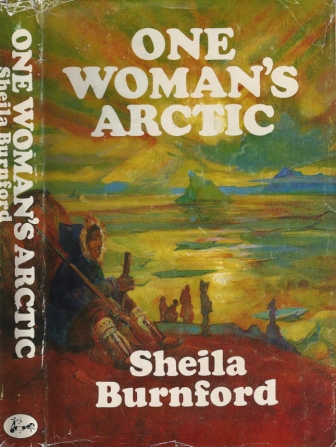
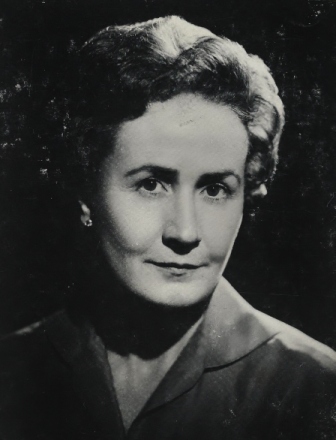
One Woman’s Arctic by Sheila Burnford ~ 1973. This edition: McClelland and Stewart, 1973. Hardcover. ISBN: 0-7710-1825-8. 222 pages.

My rating: 7/10.

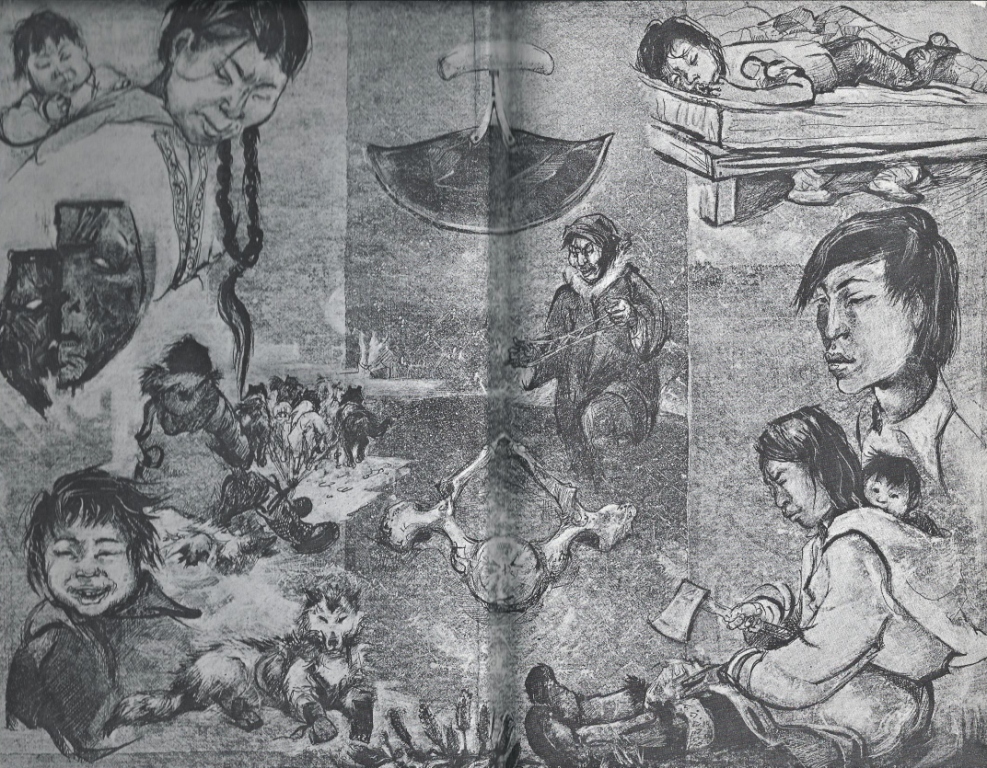
This is the account of writer Sheila Burnford’s personal impressions of two summers spent in and around Pond Inlet on Baffin Island, in 1971 and 1972. Burnford had received a Canada Council of the Arts grant to gather material for a book; she accompanied celebrated artist Susan Ross who had been commissioned by the Royal Ontario Museum to create work for an exhibition of art depicting Indian and Eskimo life. The two were longtime friends and travelling companions, having previously spent time living together among the Ojibway of northern Ontario, which she wrote about in 1969’s Without Reserve.

This was a time of cultural shift, as the Inuit embraced and were influenced by modern culture and innovations, while still practicing their traditional way of life to a great extent. Burnford describes her personal impressions, and occasionally tries to pat the larger picture into context, but this is exactly what it says it is in the title – one person’s take on a place too large and complex for generalities to be made, though of course the author occasionally writes as though her observations and conclusions about this small piece of the Arctic apply more broadly. In general, the author keeps to her mandate, which is to tell us about her impressions during her short excursion into the far northern world.

Though it took me a while to work my way through it, now that I’ve completed it I find that ultimately I liked this book, and I enjoyed filling in a few more of the pieces of the author’s life. But it could have been better. What Burnford did so well in The Fields of Noon, though, was talk about herself, her life, her childhood, her family; always in reference to her subject, which made that collection of memoirs so very readable. In One Woman’s Arctic there seems to be more distance between writer and subject, while at the same time the tone is uneven – we’re never sure what “voice” the writer is using because she shifts around so much.

Burnford sometimes maintains an onlooker’s dispassionate view, describing the landscape and the animals and the indigenous people of the small part of the Arctic she visits with a writer’s eye, painting pictures with words. These episodes are very nicely done indeed, and I found that my vision of the scenes from her words were borne out by the pictures I later searched out of the places she visited. Burnford had a rare ability to capture the visual in words.

The weakest parts of the book were when Burnford left the realm of observation and description and ventured into the difficult area of analysis of what she is seeing in regards to the behaviours and motivations of the Inuit (“Eskimos”) she came into brief contact with, or, in the case of the two white mens’ graves at Quilalukan, researched in some depth. Sometimes, as John Mutford points out in his own not particularly favorable review of this book – One Woman’s Arctic by Sheila Burnford – The Book Mine Set Review – the writer falls into the “white man bad/Eskimo good by default” trap. But I felt that she salvaged the situations where she did this by continually acknowledging that she didn’t know if her interpretation was correct; that she was mulling over the situation and trying to make sense of it from her perspective as a very superficial onlooker, and a member of the invading, paternally patronizing race. Burnford never seems to lose sight of the fact that she is a visitor in an alien landscape, and that her comfort and safety rely on the kindness of others.

The episodes I enjoyed the most were when Burnford described the individuals she travelled and stayed with and got to know more intimately. The residents of Pond Inlet, where Burnford and her companion, artist Susan Ross, made their home base in the community’s kindergarten building, are described in lively anecdotal style; Burnford remarks on the fact that no one seems to have anything bad to say about each other, and that she thinks that this is the result of conscious effort on their parts. Referring to the non-Inuit residents of Pond Inlet, the group she and Ross associated with and socially fit in with:

Those who lived here all year round whether teacher, nurse, game warden, R.C.M.P. or administrator, had seemingly developed a safe preservation of peace (outwardly, anyway) attitude to their fellows. One very, very seldom heard any criticism of personalities, but only he/she is so nice/does so much/is wonderful at/ – etc. Occasionally, because one’s antennae were more acutely tuned through being an outsider, one was conscious of tension between certain individuals, but this was rare. I gathered that they had all worked it out during the six months of twenty-four hour darkness…Activities, such as bridge, over which people in cities can tend to become rather maniacal sometimes, were recognized as potential trouble-makers and avoided; and anything involving competition. A good, safe activity, capable of being shared, arousing no jealousy or competition, was that of photography: practically everyone was madly interested in this, and many did their own developing and printing. I have never seen such an impressive array of Hasselblads, Pentaxes, Leicas, etc. as I had up there.

Another contributing factor of harmony – which of course had its overall impact on the general community – was the average age, which was around thirty or under. An age more exposed to today’s precepts of ‘doing your own thing’ and Make Love Not War – precepts very much more in line with the outlook of the Inuit, who have always been a non-aggressive people; and also an age which avoids that difficult menopausal age group, universal elsewhere among those who have made it up to positions of authority, during which strife is commonplace and mayhem (verbal or otherwise) frequent…

An interesting take on the situation, especially as Burnford and Ross were older than the Pond Inlet “white person” average, being in their mid-fifties; one wonders if the menopausal comment was coming from personal experience, or merely through prior observations in the southern world!

Also very readable were the descriptions of the archeological dig at Button Point on Bylot Island under the auspices of the venerable Father Guy Mary-Rousselière; Burnford was present at the discovery of the second Dorset culture (A.D. 500-1000) shaman’s mask found at that site and vividly describes the unique challenges of archaeological exploration in a permafrost zone. Dorset Masks – Canadian Museum of Civilization Treasures Gallery

I found One Woman’s Arctic to be interesting read from my perspective as someone who has never personally experienced the Arctic, though I found it easier to lay aside and read other things concurrently than I did with her other memoirs, Without Reserve and The Fields of Noon. Even though it has some unresolved and unsatisfactory conclusions about northern life and Inuit culture, I think there is much to learn from Burnford’s observations, purely on the natural history aspect of the area she visited. Her descriptions of the human impact on the area, both Inuit and white, are frank and outspoken; Burnford may be looking through wishful rose-coloured glasses occasionally, but she mostly has them off, the better to turn a sharp eye on the details of her surroundings, and she is not afraid to share what she sees.

A snapshot of a time and place now lost in time, from the perspective of a thoughtful and very individual observer. The quality of the writing is excellent through most of the book, though there are occasional awkward phrasings and strangely punctuated passages which I suspect point to lapses on the editor’s part; Burnford, from my past experience with her work, is an accomplished writer not prone to sloppiness.

I would recommend this book to anyone interested in exploring the different regions of Canada, and in particular the far north, though with a reminder that it should be kept in context as one individual’s impressions, and is, unavoidably, now very dated, being written forty years ago.

Read Full Post »

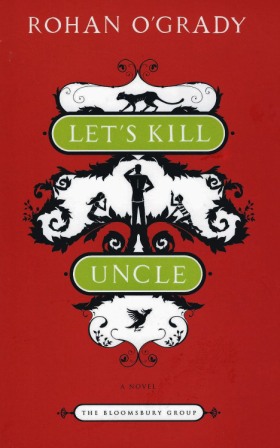
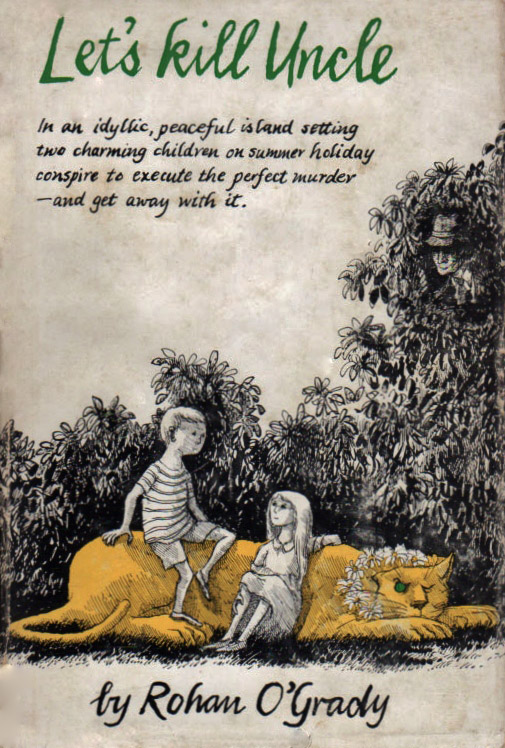
Let’s Kill Uncle by Rohan O’Grady ~ 1963. This edition: Bloomsbury Press, 2011. Softcover. ISBN: 978-1-60819-511-4. 279 pages.

My rating: 7.5/10. Extra points for the creepy and darkly humorous plot, the very thoughtful and poignant musings of Sergeant Coulter, and the grand British Columbia Gulf Island setting, apparently based on the author’s visit to Saltspring Island. (I chuckled at the naming of Benares; shades of Ganges and Vesuvius on Saltspring!) Points off for the cardboard cutout characterizations of most of the characters. Points off for the occasional swearing, which, though mild, felt out-of-place, even if this story was aimed at an adult audience. Extra points for letting the cougar finally ultimately be a cougar, and for letting the villain be purely evil with no redeeming qualities! Far from a flawless effort, but I liked it much more than I didn’t.

*****

You’ll find lots of reviews on this one; its reissue by Bloomsbury a year ago brought it into high profile.

This was a weird little book. I had read quite a few reviews before I ordered it, so I knew what to expect, but heaven help the innocent reader who thought they were picking up a mild children’s tale! Nothing innocent here; chock full of the darkest human flaws and emotions; the humour (of which there is a lot, all intentional) shades from gray to ebony black.

Two 10-year-old children from very different backgrounds are sent to stay on an isolated, and, incidentally, long-childless island. (Every son from the past generation has gone away to war and thus perished, except for one: the island’s Royal Canadian Mounted Police officer, Sergeant Albert Coulter. The bereft parents and grandparents view him with a certain resentment and suspicion making for a bitter underplot.)

Orphaned Barnaby is the heir to a ten million dollar fortune; he is coming to spend the summer with his uncle at a rural retreat. Christie is the sickly daughter of a struggling more-or-less single mother. Her parents are separated; her father is a good-for-nothing drunkard; her selfless mother is working extra hours to pay for Christie’s country holiday with Mrs. Nielsen, the island’s “goat-lady.”

The children meet on the ferry ride to the island; it is hate at first sight, but that doesn’t prevent them ganging up, running wild and wreaking havoc the entire trip. They are gratefully off-loaded, and the first person that makes an impression on them is the local Mountie, Sergeant Coulter. Luckily both children are struck with hero-worship at first sight, and Sergeant Coulter’s calming influence starts their personal transformations from brats to pleasant children.

Turns out that Barnaby’s Uncle Sylvester is not the mild, mannerly and caring man he appears to be. He is a psychotic murderer with a long history of killing for pleasure and profit; Barnaby is pegged as his next victim, and soon Christie is doomed as well. The children are on to him, and unite to plot right back, deciding to strike first to save their lives. Uncle foils them at every turn. Enter a surprise ally, an outlaw cougar, One-Ear, livestock and child killer, who is hiding out in the underbrush. One-Ear tolerates the two children associating with him, sparing their annoying lives only because he can’t afford to draw attention to himself; the three end in working together to act as Nemesis to stop this wickedest of uncles.

Nothing in this story is quite as expected; the ground continually shifts under our feet as we think we know what the author is going to have her characters do and say next; we often predict completely wrong. Sergeant Coulter is one of the most surprising characters. Initially he is a figure of fun, a slightly blustering, generally disregarded, musical-comedy type policeman. But the Sergeant has hidden depths. He writes long letters to his unaware (and happily married) love interest, rips them up and casts them on the waves. He has survived being a prisoner of war, and, in the novel’s very serious thread which runs through all the farcical nonsense of the murder plot, condemns the political forces that send young men away to kill and be killed, destroys innocent civilians, and allow the evil of the Jewish Holocaust to happen. A few incidents involving First Nations people, or, as 1963 lingo describes them, “Indians”, would likely not get past today’s politically correct censors.

There are quite a number of parallel stories going on in this novel; the author competently intertwines them and brings them to their rightful conclusions. A highly moral tale, when all is said and done.

Let’s Kill Uncle has a superficial feel of being a children’s story, and it definitely works on that level as a straightforward if morbidly fantastical adventure, but I finished with the strong feeling that the intended audience was very much the adults, and the message much more sophisticated than the plot description allows for.

The author’s name, Rohan O’Grady, is the pseudonym of June Skinner, a Vancouver writer who published five novels between 1961 and 1970, of which 1963’s Let’s Kill Uncle seems to be the best known. The others are:

  • O’Houlihan’s Jest, 1961.
  • Pippin’s Journal; Or, Rosemary Is for Remembrance, 1962.  (Also published as The Curse of the Montrolfes and The Master of Montrolfe Hall.)
  • Bleak November, 1970. Michael Joseph, London, 1971.
  • The May Spoon, 1981. (Published under the pseudonym A. Carleon.)

Edward Gorey illustrated Let’s Kill Uncle; I regret that the Bloomsbury reprint contains no art except for a rendition of the original cover on the title page.

This is a very hard book to classify. I’m trying to think of another similar book to compare it to; A Series of Unfortunate Events has been suggested as its natural successor, but Let’s Kill Uncle is a much more complex work than the contemporary Lemony Snicket series.

I enjoyed this quick read; it will be even better the second time around. Recommended.

Read Full Post »

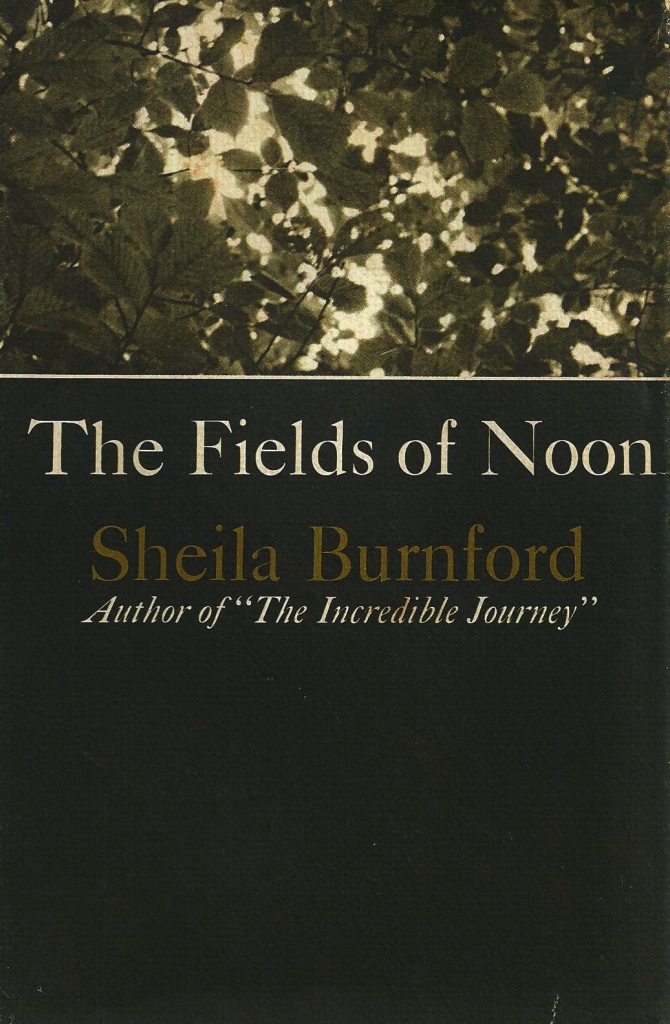
The Fields of Noon by Sheila Burnford ~ 1964. This edition: Little, Brown & Co., 1964. Hardcover. 175 pages.

My rating: 10/10

This quiet, elegant, and often very funny book is one I keep  in my ‘favourites’ collection, and regularly reread with great enjoyment.

The Fields of Noon is a memorable collection of autobiographical essays by Scottish-born Canadian writer Sheila Burnford, better known for her bestselling fictional book The Incredible Journey, a story of two dogs and a Siamese cat who together embark on a 300-mile journey through the northern Ontario wilderness. Disneyfied and popularized, The Incredible Journey might be dismissed without further attention by the discerning reader, but it was intended to be an adult book, was based on actual pets of the Burnford family, and is quite a lovely little piece of work with its own merit. Ignore the sentimental movies, please! (Perhaps I should re-read and review The Incredible Journey as an entry into the 2012-13 Canadian Book Challenge …)

Sheila Burnford, if these highly personal essays are any indication, must have been a fascinating woman to know; her writerly voice is warm and intimate, highly intelligent and self-deprecatingly humorous.

To give you a taste of the tone of this collection, here is an excerpt from the essay Time Out of Mind, concerning Sheila’s interest in archaeology and anthropology, and her subsequent attempts to learn the art of flint-knapping.

The first story I ever remember having read to me was Robinson Crusoe, and later I read and reread it myself, starting again at the beginning the moment it was finished, just like painting the Forth bridge. The Swiss Family Robinson was even better; not the shortened version so often found today but a wonderfully fat volume, profusely illustrated and complete in every last moralization (and every gruesome detail of poor Grizzle’s demise in the folds of the boa constrictor and subsequent mastication; five hours from ear to hoof – Papa Robinson timed it; children were apparently credited with stronger stomachs in those days) and its pages crammed with useful tidbits of information on how to improve one’s lot and live more graciously on desert islands. I used to spend hours daydreaming of starting from scratch on my island utopia and putting all this practical information to the test. Thanks to Mr. Robinson, that bottomless well of How To Do It lore, I knew how to make a Unique Machine for boiling whale blubber; I could construct a sun or sand clock, train ostriches, open oysters and manufacture sago; if a sturgeon had been caught in my coconut fiber fishnet I knew just how to make isinglass windows from its bladder. I could even – and as I write I feel the urge to do so – make waterproof boots (beloved, familiar gumboots), with a clay mold, taken from my sand-filled socks, then painted over with layers of latex tapped from the nearest rubber tree. It would have been a luckless Man Friday who made his imprint on my solitary sands, for I would have been a fearful bore to live with: like Papa Robinson, one innocent question would have released a pedantic torrent of information.

This childhood preoccupation with carving out an existence by my own unaided efforts used to end, invariably, I remember, with that baffled, mind-boggling feeling that used to overcome me – and still does – when staring up at a cloudless blue sky and trying to make my small limited mind grasp that the blue is a void, endless infinity, nothing, not even omega. For, sooner or later, a fearful nagging doubt insinuated itself into every castaway installment of my self-told story: What if one did not have a knife, or a goat, or a gun to start with? Or, worse still, had not read Swiss Family Robinson? How on earth did one go about forging steel for that most necessary knife (what, for that matter, was steel?), substitute for a goat, manufacture a gun, or any kind of weapon?

*****

  • Canadian Spring – a trip with an artist friend to an isolated lakeside cabin during spring ice break-up.
  • Walking: Its Cause, Duration and Effect – reflections on a Scottish childhood spent largely out-of-doors.
  • The Peaceful Pursuit – the joys and occasional pitfalls of wild mushroom hunting.
  • Confessions of a Noisemaker – how to shed one’s vocal inhibitions while accompanied on a solitary expedition by a patient dog and four inflatable duck decoys.
  • Time Out of Mind – the deceptively steep learning curve of the paleolithic flint-knapper.
  • Inclinations to Fish – the consideration of large bodies of water as primarily “fish containers”, and the joys of a lifetime of attempting to bring those fish to shore.
  • Tom – a touching ode to a feral tom cat.
  • With Claud Beneath the Bough… – caring for a solitary canary.
  • Pas Devant le Chien – a sober-minded dog becomes firmly convinced that an electric heater contains a small, living inhabitant.
  • William – the last day of life and the death of a beloved bull terrier.

Read Full Post »

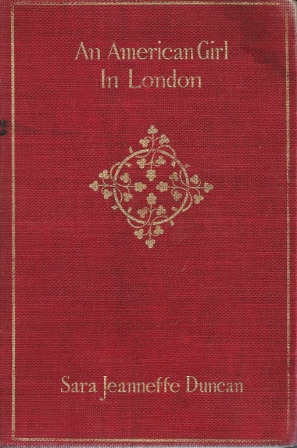
An American Girl in London by Sara Jeannette Duncan ~ 1891. This edition: Rand, McNally & Co., circa 1900. Inscription: “To another American girl – Mary Couch Huntington, Xmas 1900.” Hardcover. 290 pages.

My rating: 7.5/10

This is that most pleasant of things, a book purchased on a whim for a for a minor sum, which turns out to be a grand read, and then, even better, to add another author to the “keep an eye out for” list.

I paid 50 cents for this “genuine antique”; it was half-price book day at the local Sally Ann; I dipped into the gilt-edged, obviously well-read volume and it looked promising, well worth a tiny monetary gamble. I had initially thought that it was a volume of genuine reminiscences, but early in I realized that it was instead a gently satirical fiction. I found myself completely drawn into Miss Mamie Wick’s fresh and frank dialogue, and I eagerly followed her as she solitarily travels from Chicago to New York, and sets sail for England.

What a grand period piece this amusing novel is! Written in the late 1800s, the narrator is not shy of poking gentle fun at herself and the thousands of her American compatriots who are eager to explore England’s historical places and partake of whatever social whirl they can shoehorn themselves into.

Our own Miss Wick is extremely fortunate in her shipboard acquaintances; she makes a strong impression on a young British aristocrat (how strong becomes quite apparent to us early on, and to Mamie herself at long last, near the end of the story), as well as on an initially frosty elderly ladyship who completely unthaws under the influence of Mamie’s unusual charm, with interesting further consequences.

Mamie does all of the typical American tourist things; she visits Madame Tussaud’s, the London Zoo, the Epsom Derby, boat races at Oxford, and all the rest, but her aristocratic acquaintances smooth her way to higher levels and grander experiences than most American tourists ever attain, and she shares every impression with us. I did truly get a vivid picture of what the England of the time (at least in the relatively “higher” circles in which Mamie’s social class moved) looked, sounded and felt like through Mamie’s eyes; the author, while maintaining a delicately cynical tone, obviously had a great fondness for all of the best aspects of contemporary and historical England and her inhabitants.

The protagonist is thoroughly likeable and full of little unexpected insights and surprises; I laughed out loud several times at her philosophizing and her witty internal voice; she doesn’t miss much, but she continually minds her manners and behaves with impeccable politeness, much to her credit, as the same cannot be said of some of the people she encounters.

My only complaint was that the ending was much too sudden; it was the only part of the story that felt a bit forced; but as we could have gone on with Mamie forever I suppose it was a necessary break.

I was so impressed by this story and its unexpected quality that I researched the author. Lo and behold – Sara Jeannette Duncan turns out to be a well-respected and quite well-known turn of the century Canadian author and journalist. Here she is:

http://en.wikipedia.org/wiki/Sara_Jeannette_Duncan

http://www.biographi.ca/009004-119.01-e.php?&id_nbr=7912

Several of Sara Jeannette Duncan’s works are available on Project Gutenberg, and many of her works are still in print; she is apparently a staple of Canadian women’s studies courses at our universities. Who knew?! (Well, obviously a lot of people. Just not me. But I know now!)

And I am mildly thrilled to discover that An American Girl has a sequel,  A Voyage of Consolation. I started reading this on Gutenberg last night, and then decided to quit with that and try instead to find a print copy; I want to read it in perfect comfort, meaning not on a screen, and then place it on my shelf next to my newest antique, ready for re-reading at my leisure.

Sara Jeannette Duncan’s more serious works, fictional and journalistic, are now top of my look-for list, and if these light novels are any indication, she will be a smooth and witty read in any genre.

Bonus: I can add this review as my second entry in the 6th Canadian Book Challenge: http://www.bookmineset.blogspot.ca/2012/06/6th-annual-canadian-book-challenge-what.html

This author is authentically Canadian, despite the title of this piece, which had led me to initially assume she was American, and her body of work reflects her native land, though she did leave Canada both to travel widely in her journalistic career and to accompany her British husband on his postings abroad. Sara Jeannette Duncan died in England in 1922, at the much-too-young age of 62.

Read Full Post »

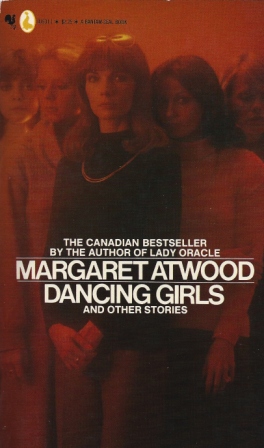
Dancing Girls by Margaret Atwood ~1977. This edition: Bantam Seal, 1978. Paperback. ISBN: 0-7704-1531-1. 245 pages.

My rating: 5.5/10. A few too many misses for a really high rating.

*****

A collection of short stories written early in the career of Canadian icon Atwood.

I have an ambiguous relationship with Margaret Atwood, or, rather, her work. I greatly admire the real person; Atwood has become an outspoken and lucid critic of much of what is troublesome about Canadian societal, political and environmental issues. I have heard many of her interviews and lectures via our venerable CBC Radio, lifeline of many Canadian rural dwellers far from the bright lights of the cities which have absorbed the majority of the population in this vast and still-wilderness-filled land. Just thinking about her, Atwood’s distinctive voice fills my head; nasal, cynical, with a deadpan delivery that would make her a knock-out stand-up comic if she were ever to desire to switch careers at this late date.

But… I am not completely comfortable with much of her written work. I’ve read all the novels dutifully as they’ve appeared through the years, as a typical middle-aged, literate, Canadian liberal feminist (as good a description of my demographic as any) should. I can nod and smile knowingly during literary discussions with the local intelligentsia, though I add little to the conversation myself; I am very aware of my value as an audience to my much more vocal acquaintances and have no real desire to step into the conversational limelight myself much of the time; it’s simpler to stand by and listen…but I digress.

Atwood. How to describe my feelings? Well… ambiguous… I guess. There is no doubt that the woman can write. Her words flow, dance, surprise, shock – grand stuff indeed! But too often I put down the latest Atwood feeling a vague dissatisfaction. Are things really that bad? Are all of our relationships – friendly, familial, societal and particularly sexual and marital – as deeply flawed as Atwood continually portrays? A course of Margaret Atwood often drives me to the other extreme; to the literary arms of, say, Elizabeth Goudge, with her encouragements of perseverance and sacrifice rewarded, versus Atwood’s cynical view that it doesn’t really matter how hard you try, you’re pretty well screwed from the get-go. (I rather agree, but all in all, it’s not that bad; most of us muddle along with a fair amount of happiness despite the inevitable rough bits. Don’t we?)

But this woman can write.

Here is what you’ll find in Dancing Girls.

***  =  the ones I greatly enjoyed.

*  =  Worth reading.

The rest I rather wish I hadn’t subjected myself to, though opinions obviously will differ.

  • The War in the Bathroom – A week in the life of a woman who has apparently descended into some form of mental illness; she has split into two personalities; the intellectual (controlling) and the physical (responding). Typically depressing; not one of the gems of this collection.
  • ***The Man From Mars – An unattractive student is targeted by a stalker, “a person from another culture”.  I liked this one. Melancholy (of course!) but very well presented; cynically amusing; I can hear Atwood’s best voice loud and clear.
  • Polarities – A woman goes slowly mad. Dreary as the winter setting and the doomed relationships it describes.
  • Under Glass – Another doomed love affair. Sad, sad, sad.
  • The Grave of the Famous Poet – A journey becomes a metaphor for another imploding relationship.
  • ***Rape Fantasies – This one story is probably worth buying the book for. Four young women discuss rape fantasies. Atwood at her wickedly humorous best.
  • ***Hair Jewellery – Beautifully written. Another relationship unravelling, but the protagonist moves successfully on. Or at least so we think.
  • ***When It Happens – An elderly woman prepares for the end of the world. Haunting.
  • A Travel Piece – A travel writer on a trip that goes terribly wrong. Taps into all of my worst-case flight scenario fears. Wish I hadn’t read this one – personal nightmare stuff!
  • The Resplendent Quetzal – Too many details about an unhappy marriage and the petty meannesses that bitter people resort to.
  • *Training – A young man examines his motivations and innermost feelings as he deals with his family’s and his own expectations for his future.
  • *Lives of the Poets – This one feels autobiographical. Another relationship tragedy, enhanced by the futility of struggling artistic careers.
  • *Dancing Girls – Culture clashes in a rooming house.
  • ***Giving Birth – The ambiguities of expectant and new motherhood. Excellent.

Read Full Post »

The 6th Annual Canadian Book Challenge

The 6th Annual Canadian Book Challenge

13 (or more) Canadian books in 365 days – Read, Review and Share

I’m in!

Read Full Post »

« Newer Posts