Archive for the ‘1990s’ Category

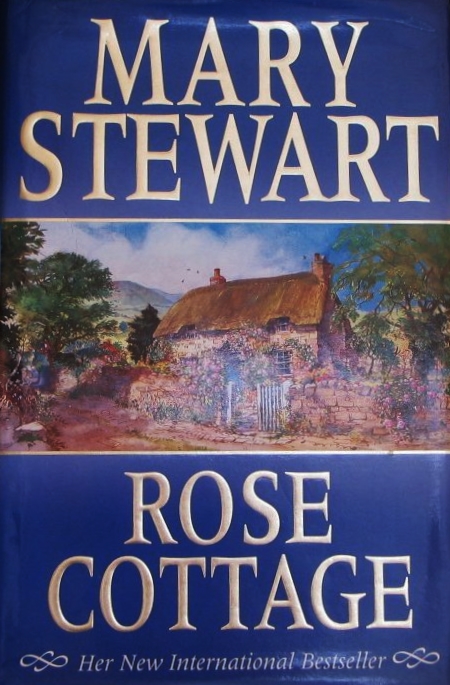
rose cottage mary stewartRose Cottage by Mary Stewart ~ 1997. This edition: Hodder & Stoughton, 1997. Hardcover. ISBN: 0-340-69560-9. 234 pages.

My rating: Honestly, all I want to give is a 4.5/10, upped to a 5 because it is Mary Stewart, and I will be looking for a copy to purchase and add to my collection of gentle books maintained for my mother’s perusal.

I feel absolutely rotten giving this low of a rating to a writer I have come to greatly enjoy, but it is an honest assessment of my reading experience. Rose Cottage is indeed a lovely story, a nostalgic journey into the past, and I do believe that the author meant it to reflect her own pleasant memories, dedicated as it is

To the gentle shades of Henry, George, Patsy, Nip, Rosy, Maudie and Muffin, and all the other friends whom I meet again in my stroll down Memory Lane.

But it was vaguely unsatisfying, and a bit too – dare I say it – mild, with an anticlimactic happy ending and love and flowers and reconciliatory kisses all round and even a kitten.

And how could one not love a kitten? Well, in this case, the kitten felt superfluous, the one adorable straw which caused this particular camel to sag at the knees and subsequently dock several points off the rating scale. Do I feel like a big old meanie discounting the kitten? Oh, yes, I do indeed. But I can’t, in all honesty, recant. Sorry, George-the-kitten.

And sorry, Mary Stewart. I’ve come to admire you greatly these past few months as I read my way through a selection of your novels. But Rose Cottage, though a sweet thing in its own way, is not representative of your work at its peak. It’s a step down and back, a lessening-off, a gentle coda to round off your life-long symphony of written words.

Looking back down the vista of years, Kathy (Kate) Herrick reminisces about the summer of 1947, when her life took an abrupt turn.

Kate was brought up in a tiny thatched cottage – Rose Cottage – attached to the estate where her mother (Lilias) and grandmother were employed as maid and cook. Kate’s mother lost her position when it was discovered that she had become pregnant; Kate has never been told who her unknown father is. Her grandfather dies, and sternly religious Aunt Betsy comes to stay. Aunt Betsy’s bitter disapproval of Kate’s mother’s “fall” results in Lilias leaving for parts unknown when Kate is only six. Some time later word comes that Lilias has been killed in a bus accident; Kate is effectively left an orphan.

Kate grows up in an atmosphere of combined love (Gran) and puritan repression (Aunt Betsy), and, when the war comes, it is not as much a break as it could be when Kate moves away, and then falls in love and marries a bomber pilot. Their short marriage is happy, but ends tragically when her husband is killed in action. Kate takes this in stride in her quiet way, and goes on to keep herself occupied with an interesting job in a plant nursery, though she has been left well-provided for in her late husband’s will.

Then, out of the blue, Kate gets an urgent phone call. Gran has been ill; she has something important she needs Kate to look after for her. Can Kate please come to Scotland, where Gran’s employers have migrated due to the requisition of their English house during the war, and hear what it’s all about?

Aunt Betsy has since died, and Gran’s old home, Rose Cottage, is due to be renovated and sold, but all of Gran’s things are still there. Could Kate please go and pack up Gran’s furniture and small treasures, including the family’s personal papers and the bits of sentimental jewelry and keepsakes hidden in a small wall safe?

So off Kate goes to her childhood home, where she immediately discovers that there has been a recent intruder. The wall safe, which was papered over and known only to household intimates, has been opened, and the contents are gone. Now who would ever have known the safe was there? And what did it really contain?!

Luckily one of Kate’s old school friends, handsome, still-bachelor Davey Pascoe, is more than happy to renew acquaintance with pretty Kate, and to help her solve the mystery.

Many worrisome coincidences and much foreboding evaporate into a purely domestic situation with a prosaically reasonable explanation, and everything is tied up very tidily indeed by the last page. Definitely a feel-good sort of read, a very meek and tame adventure despite the potential of the early events to be worked into something much more melodramatic.

I can’t help but wish there had been some more dramatic developments, even though those sorts of plot twists in Mary Stewart’s earlier novels sometimes made me roll my eyes with readerly disbelief. But I’ve become used to this sort of thing from this author, and her stepping away from drama left me feeling surprisingly let down.

Still and all, a nicely written and completely sweet story. One to give to one’s own granny for gentle entertainment over a nice cup of tea, if one’s relative is of the type to enjoy a non-challenging sort of tale with a blissfully happy ending.

Read Full Post »

Three quick reads this past few days ran the gamut from slightly-gosh-awful to thoughtfully-affirmative to poignantly-hilarious. All are deeply imbued with sense of place. Light reading, all three, easy to pick up and put down, though I must confess I read each one straight through. Without further ado, here they are.
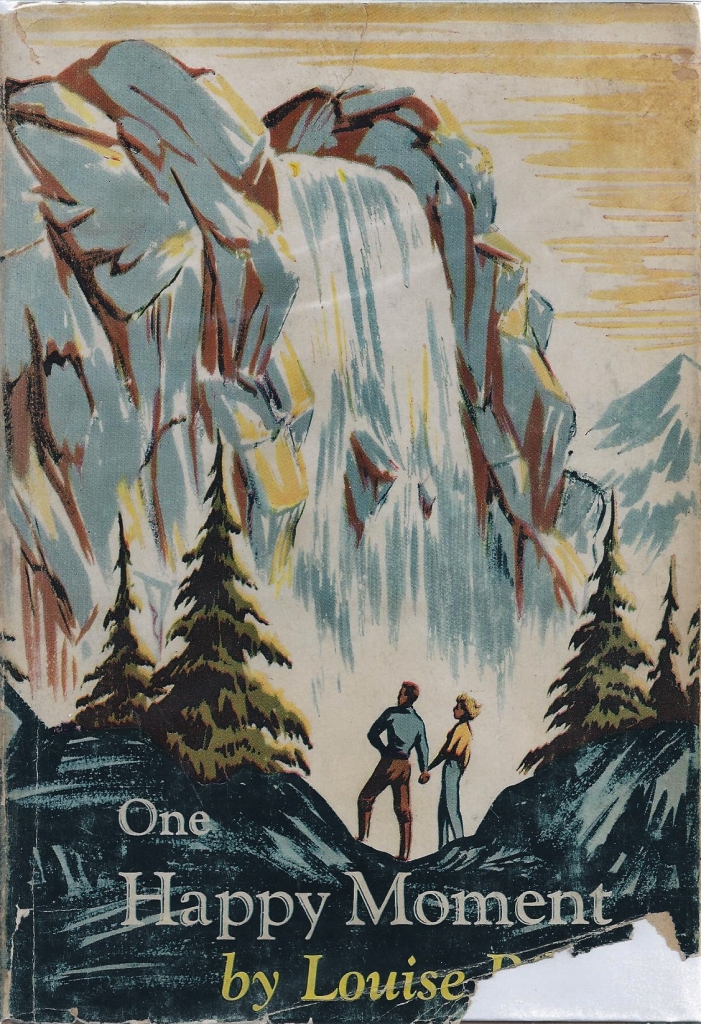
one happy moment dj louise riley 001One Happy Moment by Louise Riley ~ 1951.

This edition: Copp Clark, 1951. Hardcover. 212 pages.

My rating: 4.5/10

I’m glad to have read this obscure Canadian novel, for it made me stop and muse on what makes a style of writing either a hit or a miss with a reader. This one felt awkward to me, stylistically and plot-wise, and even its glowing portrayal of a landscape I have personally known well didn’t quite make up for the clunky prose and the rather cardboard characters. I opened it up prepared to enjoy it; I closed it no longer wondering why this was the author’s only adult novel, and why it (apparently) never made it past that first printing.

She lifted her arms and pulled off her grey felt hat, shaking her head like a young horse, freed from his bridle. She ran to the lakeshore and tossed the hat into the lake, laughing at it as it bobbed primly over the ripples. She tore off the jacket of the grey suit and hesitated about throwing it after the hat. Instead she ran back to her suitcase, snapped it open, and took out a pair of plaid pants and a yellow sweater. Taking a last quick look about her, she pulled down the zipper on her skirt and stepped out of it, kicking it aside. Quickly she unbuttoned her grey blouse and took it off, tossing it on top of the skirt. She pulled her slip over her head and, as she stooped to take off her shoes and stockings, the warm sun felt like a caress on her back. She pulled on yellow knitted socks and heavy shoes. When she was dressed in slacks and yellow sweater, with a scarlet handkerchief knotted around her throat, she pulled the pins out of her fair hair, shook it free, and tied it back with a yellow ribbon.

And in case you didn’t quite catch the symbolism, there’s more.

Into the suitcase Deborah shoved the clothes she had taken off, added a few rocks, hauled the suitcase to the shore, and tossed it into the lake. She watched it sink. Her hat had floated several yards away from the shore, and she waved good-bye to it. Then, slinging her rucksack onto her back, she looked for the path up the mountain side.

The young woman so anxious to dispose of her city clothes – and, by inference, her dull, grey, prim and proper former life – is one Deborah Blair, and she’s about to hike nine miles up a trail to a tourist camp somewhere between Lake Louise and Lake O’Hara, on the Alberta side of the Rocky Mountains.

Her first encounter with another person is an old man just up the trail; he pops out of the bush, startling her greatly, and then proceeds to tell her that he knows she is running away from something, and that she is like a young doe, “…frightened…by a hunter, maybe, out of danger now, taking time to be proud of her speed and to taste her freedom, but still wary, remembering her fright…”

But the mountains will give her sanctuary, he goes on to say, and Deborah parts from him, mulling over what he has said, rehearsing her new role in preparation for meeting her fellow guest camp residents.

These are a motley crew indeed. Evangeline Roseberry is her hostess, an uninhibited, provocative and sultry woman of a certain age. Young ranch hand Slim appears to be very close indeed to his employer, and when Slim is not in attendance the male guests are often to be found in “Vangie’s” cozy cabin. Middle-aged Dr. Thornton is holidaying without his wife and apparently finding his hostess a suitable substitute; downtrodden Mr. Nelson is at the beck and call of his own formidable wife, though he glances hopefully at Vangie’s lush charms when Mrs. Nelson’s focussed gaze is elsewhere, and teenage Sue Nelson cherishes a passion for handsome, red-haired, flashing-eyed yet taciturn geologist Ben Kerfoot. In the kitchen brusque Mrs. Horton reigns supreme, dispensing pithy criticisms to all and sundry along with the bacon and eggs.

Deborah gravitates toward avuncular Dr. Thornton, as nosy Mrs Nelson attempts to probe into “Mrs. Blair’s” past, which appears to be decidedly mysterious, especially when an RCMP officer appears asking questions about why a suitcase with the initials D.B. was found floating in the lake at the bottom of the trail. The plot thickens, with heaving bosoms and flashing eyes from the female contingent all round, and lusty glances and/or darkly passionate glares from the men.

One after another, the people from whom Deborah seeks to hide track her down to her mountain fastness, but she gains strength from the purity of the air and the pristine beauty of the surrounding peaks – not to mention Mrs. Horton’s hearty cooking – and stands up for herself at long last.

Though this novel started out promisingly enough, but ultimately didn’t take me where I hoped it would, and most of that was the fault of the writing, and the lack of a cohesive plot.

Deborah’s vaporings are overplayed, and her flip-flopping between men left me bemused. She is decidedly attracted to both Dr. Thornton and Ben-the-geologist, who in turn steal embraces from whichever woman is present and willing, and, when a manipulative cad from her past appears she mulls over throwing her lot in with his, before the mountain breezes blow some sense into her head. An über-controlling mother appears and is finally confounded, and Deborah prepares to set her sights on making her fortune in Vancouver, being as far away across the continent as she can get from her previous life as a meek librarian in Montreal.

The author was a Calgary librarian and storyteller, and her work with children resulted in the naming of a library branch after her in her native city; the wealthy Riley family was well-known for their philanthropy and social conscience, and Louise by all reports was a fervent advocate for childhood literacy.

Four of Louise Riley’s books were published between 1950 and 1960, the juveniles The Mystery Horse, Train for Tiger Lily, and A Spell at Scoggin’s Crossing, as well as her only adult book, One Happy Moment. Though Train for Tiger Lily received the  Canadian Library Association Children’s Book of the Year Award in 1954, a quick glance into my standard go-to children’s literature reference, Sheila Egoff’s Republic of Childhood, finds that perceptive literary critic dismissing Louise Riley’s juveniles as “insipid and contrived”, which I can sympathise with after reading One Happy Moment. Interesting though it may be in a vintage aspect, this is not in any way inspired writing.

Worth taking a look at is the commentary at Lily Oak Books , where I first heard of One Happy Moment. Lee-Anne’s review is well-considered and thoughtful, and she includes some gorgeous pictures.

My copy of the book is going on the probation shelf; I’ll share it with my mom and then decide if it gets to stay or go. The attractive dust jacket will likely tip the balance. As it arrived in fragile shape, I went ahead and put it into Brodart, and its vintage appeal might be too tempting for me to part with, though the words inside the book are not of the highest rank.
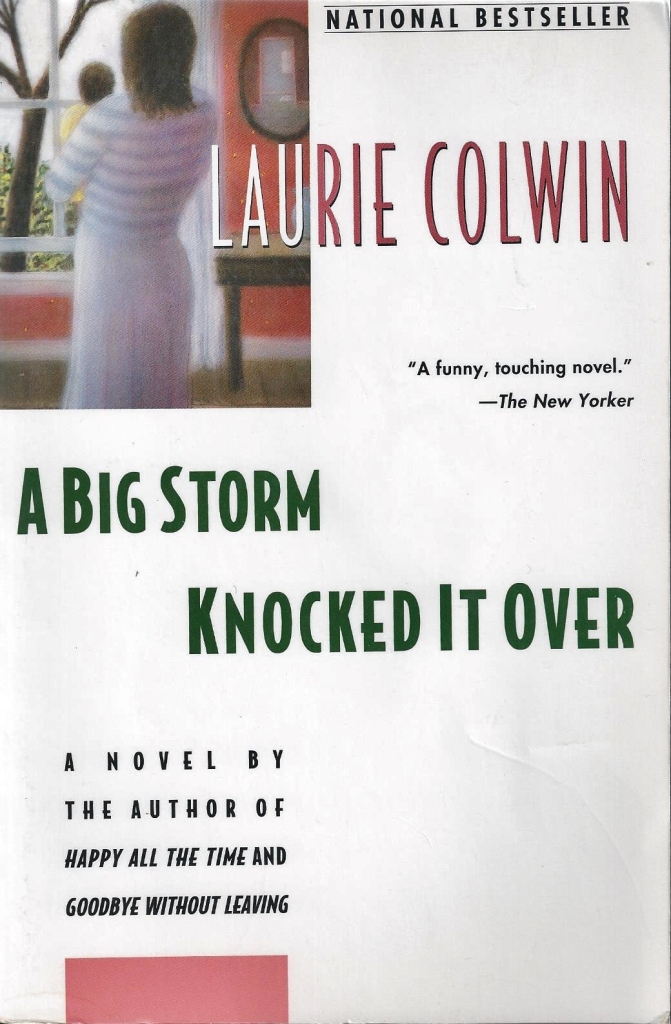
a big storm knocked it over laurie colwin 001A Big Storm Knocked It Over by Laurie Colwin ~ 1993.

This edition: Harper Collins, 1993. Softcover. ISBN: 0-06-092546-9. 259 pages.

My rating: 7/10

Moving right along to the other side of the continent and New England, for this gentle yet slyly cunning novel about love and friendship and transcending unhappy childhoods. It’s also about the terrifying act of bringing a child into the world, and an ode to the possibility of happiness, and our right to seek such out in an often unhappy world.

Does that sound impossibly twee and gaggingly chick lit? Well, it isn’t. (Okay, maybe just the tiniest bit. But it’s easy to get past. I liked this book.)

One Happy Moment has a stellar cover and ho-hum contents; A Big Storm Knocked It Over has a dreadful cover and a well-written inside. Ironically, for the protagonist of Big Storm is a graphic designer employed in the book trade, the blandness of the exterior presentation would not normally have received a second glance from me but for my previous encounter with this author. The late Laurie Colwin – she died suddenly in 1992, before this book was published – was a much-loved columnist for Gourmet magazine and  a bestselling cookbook author, novelist and short story writer. Big Storm was her fifth and last novel.

My first acquaintance with her was some twenty years ago, through Goodbye Without Leaving, about a white ex-backup singer for a black pop band – the token “White Ronette” on the tour bus – and her life after music. I read it just after my son was born, and it struck very close to home; Colwin perfectly captured that “now what?” atmosphere of the ultimate personal change of new motherhood and walking away from your past you, and I was comforted by the parallels between her fictional world and my own. It was also very funny.

In Big Storm, Jane Louise has just married her live-in boyfriend Teddy, and is surprised to find that marriage does indeed change things, even if all that is different is a piece of paper and a ring. We are introduced to an ever-widening circle of co-workers, friends and family, and watch with only slightly bated breath as Jane and Teddy find their new groove.

The gist of the novel is that sometimes family is rotten bad, but that you can always choose your friends. And that babies are quite amazing. And yes, life is terrifying, but if you can find someone to love, who also loves you, it still isn’t all shiny sparkly perfect, but it helps.

I don’t know what else to say. It was good. Not great, but definitely good. And there was a fair bit of to-ing and fro-ing from the countryside to the city, and a lot of emphasis is placed on where you’re from and ancestral homes and the clannishness of small New England towns, so I figure it counts in my vaguely themed geographical surroundings thing I’ve got going in this post.

Laurie Colwin was an interesting person and a more-than-just-good writer. I still feel sad when I think about her too-soon departure from our world.
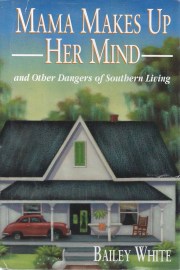
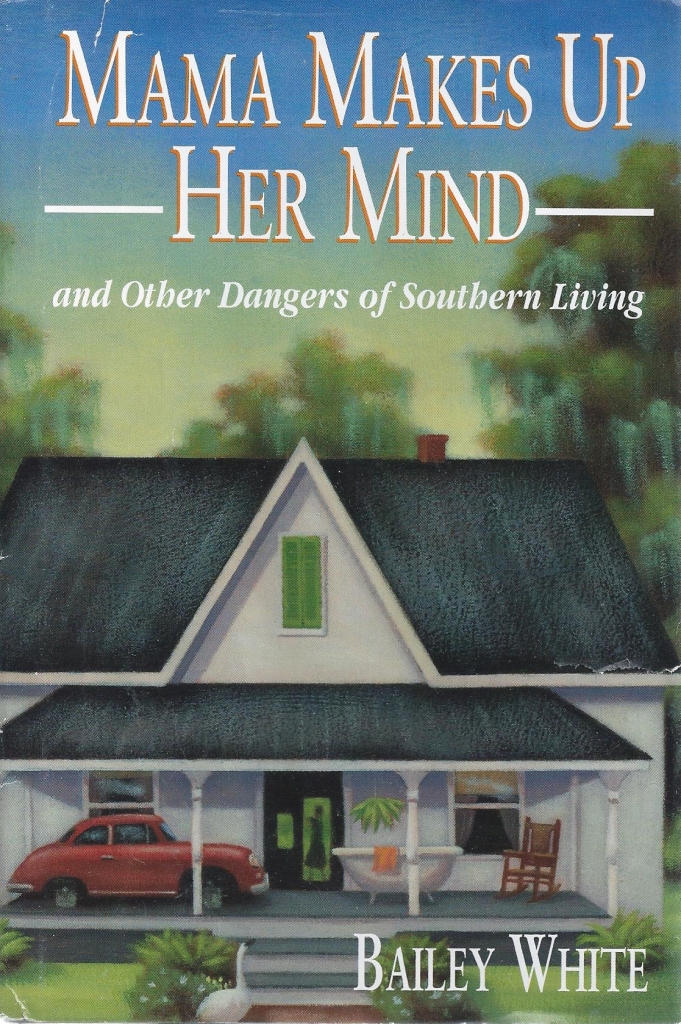
mama makes up her mind bailey white 001Mama Makes Up Her Mind, and Other Dangers of Southern Living by Bailey White ~ 1993.

This edition: Addison Wesley, 1993. Hardcover. ISBN: 0-201-63295-o. 230 pages.

My rating: 9.5/10

The best is last, and what an unexpected book this turned out to be. I had picked it up along with a random selection of others at the Sally Ann one day, thinking it was a light novel suitable for dropping off with my mom for her entertainment, but not really intending to read it myself. (It reminded me of something by Fannie Flagg, from the title and the cover illustration and the blurbs about “absolute delight” and “like sitting on a porch swing.” Look away! my inner voice chirped, because I have to confess that Fannie Flag leaves me utterly cold, though Mom can handle her in well-spaced intervals.)

My husband was between books, picked it up off the stack by the door and chortled his way through it before pressing it on me. I sat down with it over dinner, and looked up two hours later after having read it through in one continuous session. Easy as picking daisies to prance through, this one was. And I must say a laugh or two escaped me as well.

This turned out to be a collection of short – some very short – anecdotes and vignettes, many centered on White’s mother, the “Mama” of the title, and others more concerned with Bailey White herself. They were originally presented on NPR in the United States, with the author reading her own pieces, but they work exceedingly well in print.

Bailey White was born in 1950 and still lives in her rural family home in Thomasville, Georgia. Until her mother’s death at the age of 80 in 1994, the two were close companions. Their joint adventures as  “a widow and a spinster” are the focus of some of these lively vignettes, but Bailey White’s scope is wide and she draws inspiration from a vast range of experiences. Bailey White worked as a Grade One teacher for over twenty years in the Thomasville school she herself attended as child, after returning to Georgia when her eleven-year-old California marriage ended in 1984.

Between the covers of this delectable smorgasbord of a book you will find tales of an antique spyglass, the best movie ever made (Midnight Cowboy, according to Mama), Road Kill (and how to decide if it’s edible), Pictures Not of Cows, an Armageddon of a storm and how prayer proved not all that useful, feral swans, an alligator which bellowed on cue, snakes lethal and benign, Great Big Spiders, the perfect wildflower meadow, how to travel unmolested by men (involving a maternity dress and a fake wedding ring), D.H. Lawrence as a life-saving substitute for The Holy Bible, and tales from the classroom.

And much, much more. Something like fifty little stories are stuffed into this book, and they are, without exception, quite excellent.

Apparently based on real people and incidents, there is likely a bit of embellishment to some of these; they have the well-polished feel of anecdotes often told, but that in no way lessens their deep charm.

Passionate, deeply revealing, kind, maliciously humorous – all of these can and do describe the author’s voice. Loved this.

And to think I almost missed it!

A great quick read for the bedside table, or to tuck into a pocket for a waiting room stint. Or to read at coffee break, or over a solitary lunch. Watch out for those spontaneous moments of glee, though. You might get some odd looks. (Or even get in trouble with your beverage.)

Read Full Post »
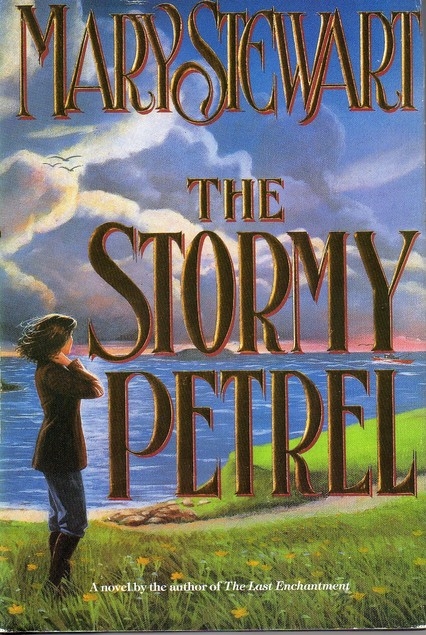
the stormy petrel mary stewartThe Stormy Petrel by Mary Stewart ~ 1991. This edition: William Morrow & Co., 1991. Hardcover. ISBN:  978-0-688-11035-2. 176 pages.

My rating: 8.5/10

Short and refreshingly sweet, this pleasant contemporary romance reads like the author was in a confident and relaxed mood when she dashed it off. It’s smooth and seamless, and a fast and effortless read. I enjoyed it.

Twenty-seven-year-old Cambridge don Rose Fenemore is ready for a break from her busy life; as well as lecturing and tutoring, she is a published poet as well as a writer of popular science fiction – the poetry under her own name, the sci fi under a pseudonym. When she sees an ad for an “ivory tower” retreat, a cottage on a remote Scottish island, she is intrigued enough to convince her physician brother to join her there for a holiday. Crispin is an avid bird watcher and photographer in his rare free time, and he and Rose have a marvelous relationship, each allowing the other plenty of space on their trips together, but also happy companionship when their interests merge.

Off to the tiny (and apparently fictional) isle of Moila, then, where Rose finds a small community of welcoming villagers, a recently renovated seaside cottage, and a stunningly beautiful natural world. Steep cliffs, shingle beaches, a few sandy coves, stands of seagrass and wildflowers, tiny rockbound lochs, a ruined Iron Age stronghold (a “broch”), and an abundant population of seabirds, seals and otters all unite to make Moila a very special place indeed. The finest part of this likeable book is Mary Stewart’s very evident delight in describing all of the previous; if Moila is a fictional place, then it must be based on a reality which the author is very familiar with. Her descriptive prose has the authentic ring, from the scent of the sedums growing on the tumbled stones of the broch to the iniquities of the “Defenders of the Highlands”, the vicious clouds of biting midges which swarm in their thousands when the breeze dies down.

But no sooner has Rose settled into her quaint cottage than things begin to go sideways; her peaceful retreat is suddenly a hive of activity. Rose wakens one night to the sound of someone in her kitchen; and stumbling down to welcome her brother – she assumes he has unexpectedly arrived in the night – she finds a handsome and charming young man making tea as if he owns the place. Which, he claims, he does. Or did. The cottage was apparently his foster parents’, and he has no idea that they have moved away, as he himself has been out of touch in an unspecified location for several years. Many apologies and all the rest, but surely Rose will forgive his unwitting intrusion?

No sooner have Rose and the smooth-talking Ewen made tentative friends over tea than another young man tumbles in out of the rain. This arrival claims he is a camper chased out of his tent by the rising wind; he has seen the lights in the cottage and seeks refuge from the storm. He identifies himself as a visiting geologist, John Parsons, but there is something about the cold and calculating glances the two men exchange which suggests something may be up. Rose sensibly retreats to her room, leaving the two young men to make do as best they can on sofa and floor, and when she awakes to find them gone, she thinks she’s seen the last of them.

She hasn’t.

I admired this heroine. She is most sensible and cool as a cucumber when things begin to tumble down around her ears. She deeply appreciates the place she has found herself in, and her rhapsodies on nature are sincere and unsentimental. She is properly cynical regarding the things that require such a view, and her musings on integrity, artistic and otherwise, are well stated and generally spot on.

A slight novel, with little in the way of true suspense; we never really fear for our capable heroine, as emotionally and physically she proves she is able to fend for herself. The romance aspect is low key as well, but comfortably there; we don’t quite know where our characters are all going to end up, but we’re pretty sure at that last page that their futures bode well.

Bonus portrayals of Rose’s two visiting students, and an intriguing glimpse into Crispin’s world and his “his life-her life” marriage. What the author doesn’t follow up is as telling as what she includes.

Nicely done. Thank you, Mary Stewart.

Read Full Post »

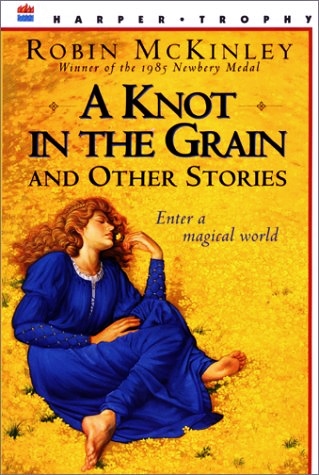
a knot in the grain robin mckinleyA Knot in the Grain and Other Stories by Robin McKinley ~ 1994. This edition: Harper Trophy, 1995. Softcover. ISBN: 0-06-44064-0. 192 pages.

My rating: 8/10, with the aside that these five short stories are über-fantasy-romantic, perhaps a tiny bit too fantastical for anyone past the age of about, oh, probably 13 or so.

Or maybe not. For anyone, teen to adult, this is total escape lit. Especially nice if you’ve already spent time in Damar.

I seriously love the cover illustration on this one, all romantically Burne-Jonesy. It’s by someone named Bryan Leister, and kudos to him, because it is perfect.

This is a collection of five short stories, three of which were previously published in other anthologies. Two are obviously set in the alternative-reality world Damar of The Hero and the Crown and The Blue Sword, two more are set in an unnamed alternative world, which could be Damar, and the last is set in the “real” world, in contemporary times. All feature completely sympathetic, strong female characters, and their male counterparts.

The Healer (1982)

The child was born just as the first faint rays of dawn made their way through the cracks between the shutters. The lantern-wick burned low. The new father bowed his head over his wife’s hands as the midwife smiled at the mite of humanity in her arms. Black curls framed the tiny face; the child gave a gasp of shock, then filled its lungs for its first cry in this world; but when the little mouth opened, no sound came out. The midwife tightened her hands on the warm wet skin as the baby gave a sudden writhe, and closed its mouth as if it knew that it had failed at something expected of it. Then the eyes stared up into the midwife’s own, black, and clearer than a newborn’s should be, and deep in them such a look of sorrow that tears rose in the midwife’s own eyes.

The baby, Lily, has been born without a voice, but she has another trait that more than makes up for that lack, at least in the eyes of the world: the gift of healing. Lily grows up beloved of her parents and ever-increasing siblings, and at the age of twelve she becomes apprentice to the midwife who was present at her birth. The two live together in love and harmony, until one day, when Lily is twenty, and she encounters a mysterious stranger on the road who can communicate with her mind-to-mind, without spoken words. Turns out that Sahath is an ex-mage, a once-accomplished master of the arcane arts, who has inexplicably lost most of his powers. One thing leads to another, and soon Lily and Sahath are sharing not just unspoken conversations but shyly blushing glances. And when Sahath puts forward the suggestion that perhaps his old mage-master could help Lily find her lost voice, the resulting journey to the mountain lake of the mysterious Luthe (yes, fellow Damar fans, that Luthe) brings all sorts of potentials to fruition.

The Stagman (1984)

She grew up in her uncle’s shadow, for her uncle was made Regent when her father was placed beside her mother in the royal tomb. Her uncle was a cold, proud man, who, because he chose to wear plain clothing and to eat simple food, claimed that he was not interested in worldly things, but this was not so…

The princess grows up under the oppressive shadow of her quietly malicious uncle, until, on her name day, when she is to be declared queen, she is instead offered as a living sacrifice to the mysterious Stagman, half-man, half-deer, who has been summoned forth by the Regent’s magicings in a swirl of ominous storms. The people of the kingdom raise no objection to the sacrifice of their princess; it is well known that she is a poor thing, of weak mind, for has not the Regent himself tried his hardest to educate her, without notable success? Into the cave then goes the maiden, to be chained to the stone wall to await her sacrificial fate. But things don’t go quite as the Regent has planned…

Luthe reappears in this story, offering succour to the Princess Ruen, unnamed until the end of her desperate journey to the inevitable mountain lake.

Touk’s House (1985)

In the best fairy tale tradition, a woodcutter steals into a witch’s garden for herbs to save his beloved youngest daughter’s life, is caught, and forfeits his next child to the witch, who claims she wants an apprentice to pass along her herb lore to. And then, still in best fairy tale tradition, things do not turn out as one would anticipate. For starters, the child in question, young Erana, has absolutely no aptitude for messing about with plants…

That’s all I’m going to say about this one; it is quite delightful, and my favourite story of the five in this book. You’ll just need to read it for yourself! (And, one more thing, because it’s by Robin McKinley – you probably don’t need me to tell you this – but it predictably morphs into a love story.)

Buttercups (1994)

There was an old farmer who married a young wife…

… but contrary to predictions, all goes well. At least until the farmer’s curiosity arouses a sleeping power emanating from Buttercup Hill…

A lovely story of a May-December romance, with two genuinely good people at its heart. A rather unusual story, this one, which doesn’t turn to tragedy as it so easily might in another author’s hands.

A Knot in the Grain (1994)

The last story in the collection returns from not-quite-here lands to contemporary times. High school student Annabelle reluctantly accompanies her family to their new home in a quiet New England town. She’s left all of her lifelong friends behind, and is having a hard time finding her new groove. Spending her summer visiting the library and rereading childhood favourites (thus giving the author a nice venue for mentioning her own favourites, from E. Nesbit to Mary Norton to Diana Wynne Jones, with a tiny shameless plug for McKinley’s partner, fellow author Peter Dickinson – I admit I chuckled a bit at that one, though I’m not much of a Dickinson fan) Annabelle is just plain ready for something to happen.

Which it does. One day, while staring at the ceiling in her attic hideaway, Annabelle notices an interesting knot in the wooden beam, which turns out to be the key to a hidden staircase, and another room. And in the room Annabelle finds a box. A box full of… well, I can’t tell you. (Nor can Annabelle.) But interesting things transpire, in a low-key sort of way.

A cute story, with a very likeable bunch of teenagers, including our heroine. Very nice. Just a titch too good to be true, though? (Says Inner Cynic.) Well, nice is a legitimate state of being, too…

*****

I feel like I should say something to sum up this collection. It’s a competently written group of stories, and very typical of the author’s early work, before she got into the edgier, darker, more adult realms of Deerskin and Sunshine. These fairy tales are aimed at the young teen reader and up, and the first four are strongly tinted with the veiled eroticism which is present in all of her longer novels. These heroines definitely all have hidden depths, and their male counterparts tend to be of the smoldering passion, glance-full-of-meaning type. Nothing to make one even blush, but it’s definitely there.

All in all, there’s not much to criticize. No masterpieces here, but it definitely should be on the shelf of every McKinley fan. I find myself rereading this one every so often; one day I’ll replace my battered ex-library paperback discard with a better, preferably hardcover copy. So – probably a recommendation, if you need it!

Read Full Post »

 Happy summer, my fellow reading friends!

???????????????????????????????

Colors passing through us


Purple as tulips in May, mauve

into lush velvet, purple

as the stain blackberries leave

on the lips, on the hands,

the purple of ripe grapes

unlit and warm as flesh.


Every day I will give you a color,

like a new flower in a bud vase

on your desk. Every day

I will paint you, as women

color each other with henna

on hands and on feet.


Red as henna, as cinnamon,

as coals after the fire is banked,

the cardinal in the feeder,

the roses tumbling on the arbor

their weight bending the wood

the red of the syrup I make from petals.


Orange as the perfumed fruit

hanging their globes on the glossy tree,

orange as pumpkins in the field,

orange as butterflyweed and the monarchs

who come to eat it, orange as my

cat running lithe through the high grass.


Yellow as a goat’s wise and wicked eyes,

yellow as a hill of daffodils,

yellow as dandelions by the highway,

yellow as butter and egg yolks,

yellow as a school bus stopping you,

yellow as a slicker in a downpour.


Here is my bouquet, here is a sing

song of all the things you make

me think of, here is oblique

praise for the height and depth

of you and the width too.

Here is my box of new crayons at your feet.


Green as mint jelly, green

as a frog on a lily pad twanging,

the green of cos lettuce upright

about to bolt into opulent towers,

green as Grand Chartreuse in a clear

glass, green as wine bottles.


Blue as cornflowers, delphiniums,

bachelors’ buttons. Blue as Roquefort,

blue as Saga. Blue as still water.

Blue as the eyes of a Siamese cat.

Blue as shadows on new snow, as a spring

azure sipping from a puddle on the blacktop.


Cobalt as the midnight sky

when day has gone without a trace

and we lie in each other’s arms

eyes shut and fingers open

and all the colors of the world

pass through our bodies like strings of fire.


Marge Piercy ~ Southern California Anthology ~ 1999

Read Full Post »

zigzag james houstonZigzag: A Life on the Move by James Houston ~ 1998. This edition: McClelland and Stewart, 1998. Hardcover. ISBN: 0-7710-4208-6. 278 pages.

My rating: 9/10.

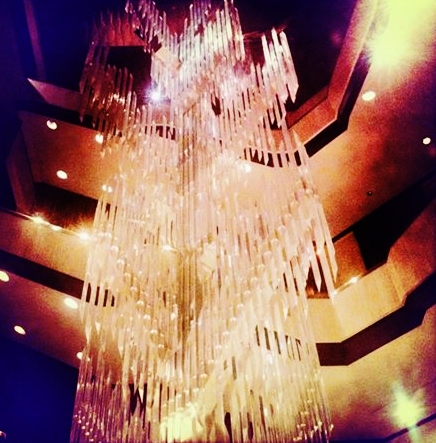
When we first visited Calgary’s Glenbow Museum in 1988 to take in the controversial but beautifully presented special exhibition on First Nations art and culture,  The Spirit Sings, we were impressed by the huge mobile, four stories in length, that hangs in the open foyer of the museum. “You should see it when it’s working!” we were told; plagued by continual malfunctions in the sound and lighting system, the mobile was hanging dim and silent. When artist James Houston installed the work in the newly opened Glenbow back in 1976, it was lit by moving lights coordinated to the strains of Debussy’s Snowflakes Are Falling. Though we visited the Glenbow numerous times during our Alberta sojourn, and again in 2005, we were never lucky enough to see the famed Aurora Borealis sculpture in its full glory, but it was a memorable sight nonetheless. (A bit more about the sculpture here. )

'Aurora Borealis', Glenbow Museum, Calgary, Alberta

‘Aurora Borealis’, Glenbow Museum, Calgary, Alberta

Several of the anecdotes in Zigzag concern the design of Aurora Borealis, and Houston and his son John’s personal transportation of the fragile, 5 to 7 foot long acrylic crystal “needles” by U-Haul truck from Rhode Island to Alberta. I will be looking at the sculpture with fresh appreciation on our next visit. (We are hoping to visit sometime this summer, to take in the current M.C. Escher exhibit before its closure in August.)

Joan Givner wrote in B.C. Bookworld, 1998:

James Houston’s second volume of autobiography, Zigzag: A Life On The Move begins as he leaves the Arctic to start a new life as a designer for Steuben Glass in New York. He has just spent 14 years working closely with the Inuit of the Arctic. [Houston is credited with discovering Inuit were producing great art and single-handedly creating a market for it. He also encouraged Inuit to adapt their work for North American buyers.] As he leaves Baffin Island, he receives two gifts from the Inuit: a carving of a walrus and a paper bag containing $33. “You’re going away, everyone says, to try and make more money,” they explain. “If at first you don’t have money in that foreign place, we thought to give some to you.”

The original purpose of Eskimo carvings was to bring luck and protection on hunting expeditions. Houston needs both luck and protection as he leaves a culture unconcerned with monetary gain (the market value of the walrus is $11,000) for one in which it is the be-all and end-all. In Manhattan in the 1960s, Houston at first has trouble adapting to the tyranny of clocks and schedules. Soon he becomes acclimatized and delights in the theatres, art shows, lavish parties and holidays on yachts where kings and presidents and Nelson Rockefeller casually drop by. Houston becomes a successful glass-designer, makes a fortune, teaches art in Harlem, becomes a successful writer, designs National Geographic’s centenary cover and even marries happily.

 It is, however, the Arctic which inspires and nurtures Houston. “I am thrilled by the frosted, Arctic-like appearance of deep engravings on glass,” he says. When the Glenbow Museum in Calgary asks him to design a sculpture, he creates his Aurora Borealis which is four storeys high. It is inspired by his memory of the spectacular ever-changing display of the Northern Lights. Either the protective qualities of the walrus carving or his years with the Inuit prevent him from succumbing completely to the glitzy life. He never confuses technological advances with civilization, nor economic gain with success. 

The final pages of the book describe his life in a cabin on another island, one of the Queen Charlottes now known as the Haida Gwaii, where he now lives part of every year. 

That anecdote about the paper bag filled with crumpled one dollar bills shows up in this collection of memoirs, as well as in the ending pages of Houston’s truncated account of his Arctic years, Confessions of an Igloo Dweller. It obviously moved him deeply at the time; it also made a “good story” and that, in essence, is something that James Houston liked to have under his hat.

Houston’s memoirs skirt extremely closely to the “If you want to know how good he is, just ask him” school of autobiography, but they are saved by his occasional self-effacing comments. He turns the laugh on himself as needed, and his frankness and willingness to comment openly on extremely intimate matters give small but crucial insights into his character. Whether that character comes across as intended is another story altogether; I frequently feel that there is a lot being left out of Houston’s story of himself.

What he does share is quite fascinating. Through Houston’s brief vignettes in both Zigzag and the earlier Confessions of an Igloo Dweller, we get glimpses of the Inuit world from the mid 20th century to the creation of Nunavut in 1999. We also get glimpses of what made this extremely driven and creative man “tick”; his great love for and pride in his two sons, and his lifelong dependence on touching base with the natural world to refuel him for his bouts of big city-based creativity.

He was an iconic figure in more ways than one in the numerous spheres he seems to have effortlessly inhabited. I suspect he might also have been a rather arrogant man to have bumped up against if one did not share his high opinion of himself, but I bet a dinner party with Houston at the table would have been a memorable thing.

Zigzag was a very good read; it lost a point merely because the vignette-style format jumped around an awful lot (to be expected, one supposes, from the very title of the work) and left me frequently wanting more than I was given.

Another volume of memoir, Hideaway, about the author’s cabin on Haida Gwaii, followed Zigzag and Confessions to form a trilogy of sorts. I will be reading this one when I come across it.

A memorable Canadian and a very gifted man; a complex persona in so many ways.

James Houston passed away in 2005. His artistic and literary legacy lives on.

Read Full Post »

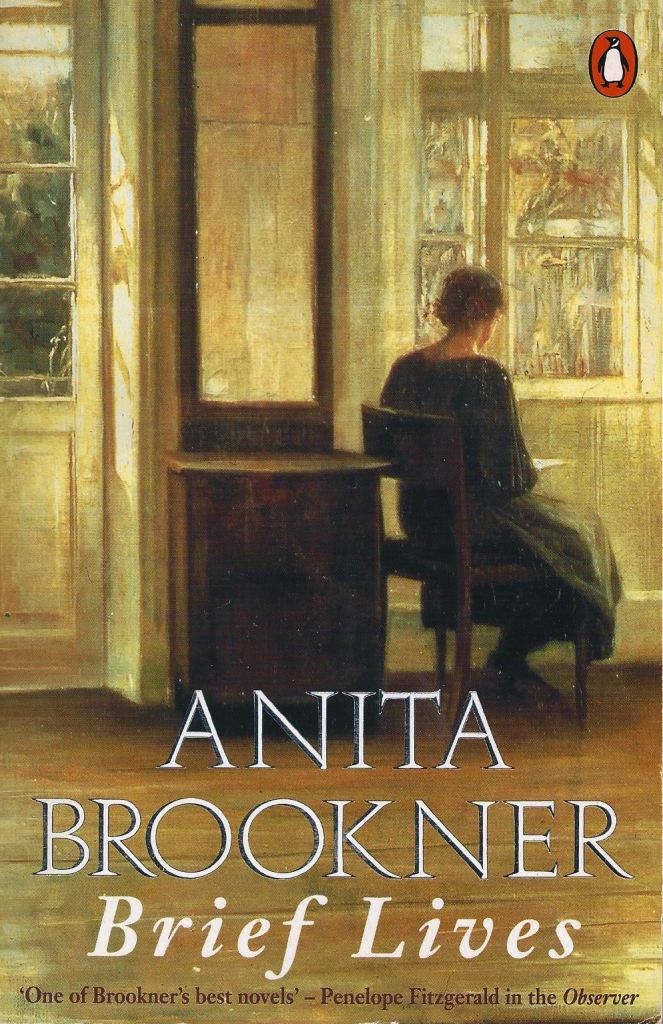
brief lives anita brookner 001Brief Lives by Anita Brookner ~ 1990. This edition: Penguin, 1991. Softcover. ISBN: 0-14-014538-9. 217 pages.

My rating: 7.5/10

Our bookshelves are in a constant state of flux. We’ve organized them in various ways throughout the years, even, for a brief halcyon time, in alphabetical order by author, just like a real library. Of course, that was many years ago, and just after a major inter-provincial move, so our joint collection was much smaller than it is now, after 22 years in the same house.

Most recently I’ve noticed we tend to group our books by type, as much as by author. Paul Theroux, Bill Bryson, and Bruce Chatwin share shelf space with Thor Heyerdahl; Lucy Maud Montgomery and Dorothy Emily Stevenson are bookshelf chums – or, rather, kindred spirits – both being represented by stacks of well-read, gaudily-covered paperbacks stacked precariously upon a few treasured vintage hardcover editions of their works; Margaret Atwood, Robertson Davies, Timothy Findley and Jack Hodgins anchor the Can-Lit section, with Farley Mowat off in solitary exile in our son’s cabin across the yard; Megan Whalen Turner and Robin McKinley are close at hand, right beside Diana Wynne Jones, ready to provide a escape into a well-created fantasy world when the real world loses its charm, as it occasionally does.

Off in a quiet corner there resides a community of women – and a few token men –  who are just a little bit difficult, just a shade sometimes-dreary. Their company is not often called for, though occasional visits prove refreshing; an antidote to the high drama and more obvious humour of so many of our other authorial favourites. The sisterhood on that shelf includes Barbara Pym, Muriel Spark, Elizabeth Taylor and Elizabeth Bowen; Vita Sackville-West and Nancy Mitford have settled nearby, as have H.E. Bates and D.H. Lawrence, the last two gathering quite a lot of dust, I must admit, though not in any way destined for the discard box. Though perhaps a bit out of place among that company of women, the melancholy tone of much of their work has placed them among the introspective ones.

And that shelf is where this author is headed. Anita Brookner’s Brief Lives is a fitting companion to Pym and Spark and Taylor and their ilk. It is quite beautifully written with a cleanly distinctive style, and an appreciable quantity of understated humour; the author is obviously one of the “intelligent women writers” who seem to have split their time equally between observation and introspection. The books on these shelves are rather thoughtful books, and, dare I say it, women’s books, in a most intimate way. Though men frequently feature in them, the intellectual emphasis is on the female characters, and the insights given are very much those of the feminine point of view.

Not much happens in Brief Lives; what drama there is exists mostly in the mind of the narrator; she is one of the self-aware observers who watch and hear themselves and rather brutally analyze their own actions and words and thoughts and feelings, while still proceeding with their outwardly “normal” ways.

Fay Langdon, narrator and chief character of Brief Lives, was once a modestly successful singer with a promising radio career. This ended with her marriage to a highly ambitious solicitor, Owen Langdon. Fay’s focus was shifted to the management and embellishment of her husband’s house, and to the frequent entertaining and socializing his rising career made de rigeuer. The marriage is childless, to Fay’s gentle regret, but she fills her days with her wifely duties, uncomplainingly accepting of her new role in the world, yet continually wistful for the life she once lived.

I accepted this routine without demur. I felt no indignation that he should give priority to the office; I doubt if many wives did in those days, or at least the sort of wife who came from my background, which I began to perceive was a little too simple for a man like Owen. He was used to complexity, trickiness, ambivalence; he would rather, I thought, be intrigued by a woman than disarmed by her. He hated those moments of unavoidable truth-telling which occasionally passed between us. I really think that he hated desire. He wanted a wife who would cause him no anguish, yet at the same time he wanted to hold her at arm’s length. He never seemed to sense the incompatibility of those two needs, the one for trust and the other for distance, even for a sort of formality, and I soon learned not to draw his attention to what was, to me, faintly alarming, his abrupt cancellation of intimacy as soon as the occasion for that intimacy had passed. My fault was precisely this, that I would seek to prolong our moments of closeness when I could see that he was already restless with the wish to do something else. My mistake was to lie in his arms moist-eyed with tenderness and gratitude, when the correct stance would have been a certain detachment, an irony, as if to imply that he would have to love me to a much higher standard to convince me that I had to take him seriously. I should have found such a tactic odious, but now I see that it is sometimes necessary to meet withdrawal with withdrawal, dismissal with dismissal. I did not know this then, and because of what happened since I remain unconvinced of it even now, but I see that if a woman has it in mind to bring a man to heel she may have to play a part which runs counter to her own instincts, unless her instincts are those of an aggressor, which mine certainly were not.

Fay is telling her story from the present day, looking back on sixty-some years of life. She is now widowed, and, left financially secure by her husband’s careful financial planning, she seeks to fill her days with some sort of meaningful occupation. Fay is carefully social on those occasions, increasingly rare, when she moves about among the people whom her marriage made into her peers. She is constantly mindful of overstepping the bounds of casual friendship; she dreads most of all becoming one of the emotionally needy women who others dread and eventually actively avoid.

Fay’s friend Julia has no such inhibitions. A decade older than Fay, and much more successful during her own show business career as a diseuse, a performer of dramatic monologues (I admit that I had to look that term up!), Julia’s husband was richer, her popularity greater, and her social circle higher and wider. Julia is a supremely unapologetic egoist; Fay has become an increasingly reluctant participant in the shrinking coterie of “helpers” whom Julia has collected to pander to her needs and desires.

The book opens with the announcement of Julia’s death in The Times, and Fay’s glimpse of Julia’s picture opens a floodgate of memories, and we follow along in almost horrified fascination as Fay monologues on about her life, marriage, and long and conflicted relationship with the acidic Julia.

I found, though “nothing happened”, I couldn’t look away from this novel. And yes, it was dreary, but I didn’t find it particularly depressing, even though I fully appreciated that Fay’s and Julia’s declining years were brutally lonely, and that they’d lived their lives in ways that fated them to an increase in that loneliness as the years advanced. I think it was the writing that tipped the balance. Anita Brookner, if this book is in any way a representative sample of her work, has a very readable, crisp and clean style; Brief Lives was an effortless read, in a very good way. I’ll be reading more Brookner in the future, and, yes, shelving her (I strongly suspect) right next to her literary sister Pym.

The novel lost points for its rather handy but not terribly believable removal of Julia from the scene right near the end. I felt it was a total cop out on the author’s part, though of course it allowed the character of Fay more scope for introspection without the bother of coping with the physical and emotional demands of her pseudo-friend. In real life I think this would have played out in a much more extended and ultimately tragic way.

An interesting author, with a dedicated following.

More on Brief Lives here:

Heavenali’s Review of Brief Lives

And more on Anita Brookner:

Anita Brookner – Her Life and Work

The Telegraph author interview – “A Singular Woman”

Read Full Post »

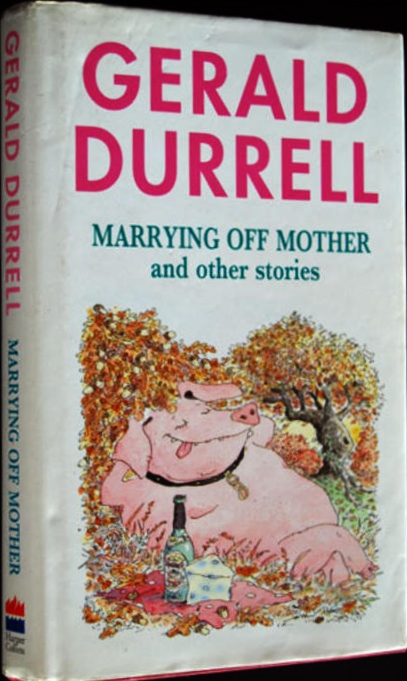
marrying off mother gerald durrellMarrying Off Mother and other stories by Gerald Durrell ~ 1991. This edition: Harper Collins, 1991. Hardcover. ISBN: 0-99-223808-X. 197 pages.

My rating: 8/10.

A quick, easy, and enjoyable read.

I have a strong fondness for Gerald Durrell’s self-aware, tongue-in-cheek, and humorously wry writings, stretching back to a childhood introduction to his books when my parents were given a copy of Catch Me a Colobus. My father had it on his night table, and was reading it with evident enjoyment, and when I asked him what it was about he handed it to me with a smile. I laboriously read it – I was of the tender age of 8 or 9 at the time – and was hooked.

Since then I do believe I’ve read every single thing the man wrote, with the exception of some of the juveniles of the writer’s last years. Obviously not an exclusive reaction, as Gerald Durrell was a best-selling author and eventually a household name in the English-speaking world –  right up there with the even more prominent David Attenborough –  though he (Durrell) bluntly stated in his later books that the income from his writing helped in great part to finance his pet project, the Jersey Zoo & Wildlife Preservation Trust , and that he continued to produce manuscripts only for the purpose of furthering his wildlife work.

Be that as it may, the man did have a decided literary talent, and in later years broadened his scope from the autobiographical to the more obviously fictional, with several novels and a number of short stories to his credit.  Many of Gerald Durrell’s fictional short stories show a decidedly macabre twist to the man’s mind; one in particular, The Entrance, the final story in The Picnic and Other Pandemonium – an otherwise quite light-hearted and delightful compilation – has the distinction of being one of the creepiest and most frightening tales I’ve ever read, and rather put me off Durrell completely for a while, giving an unwelcome insight into something other than the avuncular animal-loving anecdotist one innocently assumed. I got over it, though I still think of that particular book with a reminiscent shudder, and have studiously ignored it ever since. Though now that I’ve been reminded, I have the feeling that I should perhaps face my fears and re-read it and review it. Maybe. Or maybe not…

As usual, I’ve digressed. Back on track, then, with a rundown on this short story compilation, which, though a bit dark in places, was, as always, mostly just plain diverting reading, perfect for tea break consumption – engaging but not too challenging, and easy to take up and put down.

  • Esmeralda

Of all the many regions in La Belle France, there is one whose very name adds a lustrous glitter to the eye of a gourmet, a flush of anticipation to his cheeks, that drenches his taste buds with anticipatory saliva, and that is the euphonious name of Périgord. Here the chestnuts and walnuts are of prodigious size, here the wild strawberries are as heavily scented as a courtesan’s boudoir. Here the apples, the pears and the plums have sublime juices captured in their skins, here the flesh of chicken, duckling and pigeon is firm and white, here the butter is as yellow as sunshine and the cream on top of the churns is thick enough to balance a full glass of wine on. As well as all these riches, Périgord has one supreme prize that lurks beneath the loamy soil of her oak woods, the truffle, the troglodyte fungus that lives below the surface of the forest floor, black as a witch’s cat, delicious as all the perfumes of Arabia.

Enter one Esmeralda, a porcine lady graced with a delicate golden chain around her neck, and smelling delicately of the exclusive perfume Joy…

  • Fred – or A Touch of the Warm South

On a lecture tour of the American South, our author is hosted by a Traditional Southern Lady, and meets her butler Fred. By the by, the amount of ardent spirits consumed during this short foray into Tennessee give an insight into Durrell’s subsequent liver problems. The man did seem to enjoy tipping them back!

As the taxi drew up (the) handsome door was thrown open to the frame by a very large, very black gentleman with white hair in tail coat and striped trousers. He looked as though he might be the accredited Ambassador of practically any emerging nation. In the rich port-like tones that I remembered from the telephone he said, ‘Mr. Dewrell, welcome to Miz Magnolia’s residence.’ and then added as an afterthought, ‘Ahyam Fred.’

‘Glad to know you, Fred.’ I said. ‘Can you handle the luggage?’

‘Everything will be under control,’ said Fred.

The taxi driver had deposited my two suitcases on the gravel and driven off. Fred surveyed them as if they were offensive litter.

‘Fred,’ I said, interested, ‘do you normally wear that clothing?’

He glanced down his body with disdain.

‘No,’ he said, ‘but Miz Magnolia say ah was to greet yew in traditional costume.’

‘You mean that this is traditional costume here in Memphis?’ I asked.

‘No suh,’ he said bitterly, ‘it’s traditional costume where yew comes from.’

  • Retirement

A Scandinavian ship’s captain looks forward to his last voyage and retirement beside the sea, but his plans are tragically set at naught. A delicately appreciative tale with a chillingly memorable ending.

  • Marrying Off Mother

A return to the sunny Corfu of My Family and Other Animals, and an attempt by her children to bring some romance into Mrs. Durrell’s life.

‘I wonder if passion flowers would look nice on that east wall,’ said Mother, looking up from her seed catalogue. ‘They are so pretty. I can imagine that east wall just covered with passion flowers, can’t you?’

‘We could do with a bit of passion around here,’ said Larry. ‘Just recently, the place has been as chaste as a nunnery.’

‘I don’t see what passion flowers have got to do with nuns,’ said Mother.

Larry sighed and gathered up his mail.

‘Why don’t you get married again?’ he suggested. ‘You’ve been looking awfully wilted lately, rather like an overworked nun.’

‘Indeed I haven’t,’ said Mother indignantly.

‘You’re looking sort of shrewish and spinsterish,’ said Larry… ‘And all this mooning about passion flowers. It’s very Freudian. Obviously what you want is a dollop of romance in your life. Get married again.’

‘What rubbish you talk, Larry,’ said my mother, bridling. ‘Get married again! What nonsense! Your father would never allow it.’

‘Dad’s been dead for nearly twelve years. I think his objection could be overruled, don’t you? …’

Never fear. Mother competently turns the tables on her meddling family.

  • Ludwig

Do Germans, as a race,  have a sense of humour? The author attempts to answer this query with the cooperation of a willing-to-learn hotel manager, one Ludwig Dietrich.

  • The Jury

A former British public hangman is discovered to be living in a remote South American village. Though he has tried to make a new life for himself, he can’t outrun his past. An appropriately nasty ending awaits him, with our author as chief (fictional, one would hope and assume) witness.

  • Miss Booth-Wycherly’s Clothes

An ex-nun creatively and anonymously supports her old order’s orphanage, with the help of the bequest of the magnificent wardrobe of the deceased Miss Booth-Wycherly of Monte Carlo.

  • A Parrot for the Parson

The gift of a foul-mouthed parrot assists a defrocked vicar in his quest for replacements for the choirboys he longer has easy access to. Immensely politically incorrect, but rather funny in an “I shouldn’t be laughing at this” sort of way.

Read Full Post »

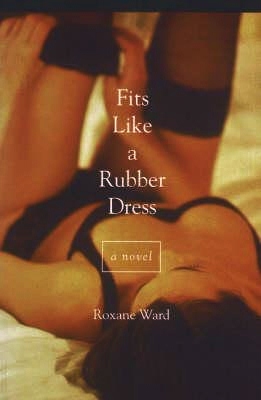
fits like a rubber dress roxane wardFits Like a Rubber Dress by Roxane Ward ~ 1999. This edition: Simon & Pierre, 1999. Softcover. ISBN: 0-88924-4. 303 pages.

My rating: 6.5/10.

*****

Great title and teasingly provocative cover. Didn’t realize it was Canadian until I got a page or two in, though the cover blurb by Timothy Findley should have been a major clue:

“It’s a glorious book! Roxane Ward is a sorceress – she transports you into a weird world of frantic characters dancing on the edge of the millennium. Then she lets you in on the secret: it is your own world, seen through the eyes of young, super-urban artists who are never satisfied with what they have or what they find. I warrant you will not forget Indigo Blackwell, in her pursuit of a life that fits like a rubber dress …”

– Timothy Findley

I raced through this one in a single sitting, staying up much too late last night to finish it, so that is an indication of its more than decent quality. This said, Fits Like a Rubber Dress is being added to the giveaway box as soon as I record this review, as I doubt it’s a re-reader for me.

Our heroine Indigo Blackwell is 29, on the cusp of leaving her youth behind, and she is obsessed with all of the usual angst-ridden baggage this entails. Her four-year-old marriage to a freelance writer/aspiring novelist, Sam, is happy enough, though Indigo loudly complains to her husband and her best friends (bartender Tim and television presenter Nicole) that her sex life is not as exciting as it once was in the “early days” of her marriage. She obsesses about this as much as she does about the incipient wrinkles she imagines are lurking, waiting merely for the flip of a calendar page to appear. Indigo wants to have sex, lots and often; Sam just isn’t that interested, citing stress, and preoccupation with finishing his novel, and gently ignoring Indigo’s increasingly desperate attempts to maneuver him into the bedroom.

“Frustrated” describes Indigo’s general state of mind. Not only is her marriage dull and her sex life stalled out, but her career is increasingly unsatisfying. Working for a Toronto public relations company, Indigo is modestly successful in her field, but when she receives a minor promotion, her feelings of dismay surprise her. Indigo needs to spice up her life …

All of this sounds most clichéd and rather yawn-making – oh, yes, we’ve read this story before – but author Roxane Ward managed to keep me engaged enough to follow Indigo on her quest for self-fulfilment, for a life that fits her and expands with her as she “grows” and makes her look and feel oh-so-good about herself, obliquely referencing the title. This first novel is more than competently written; Ward has oodles of talent, and I am curious as to what she did after getting Indigo out of her system, though I can find no evidence of a second novel in my brief internet search this morning. Which, if so, is a shame. But I digress.

Okay, back to Indigo. Her seems-so-serene marriage is about to founder, due to Sam’s own preoccupation with sex, or, rather, the sex lives of others. Researching the Toronto gay scene for material for his novel, Sam strikes up an increasingly deep acquaintance with a male escort, Graham, though he insists that there is nothing personal going on with his fascination with that parallel world. Indigo, having decided to dump her P.R. career and go to art school to study film-making, walks in on Sam and Graham in the midst of Sam receiving some firsthand experience with male-on-male sexual practices, and though Sam insists that it is all in the nature of research and that Indigo should basically get over it already, the marriage is, from that moment of we-could-all-see-it-coming-but-Indigo discovery, doomed.

Luckily Indigo has a cozy place to escape to, as her mother has just left for Bali for an extended artists’ retreat (what wonderful lives these people lead – no one is worried about the phone bill; it’s all about self-fulfillment; but how do they pay for it?! – I wish I knew!), leaving Indigo with the keys to her house. Indigo embarks on her own sexual explorations, taking up with bad boy, drug-dealing, sadomasochistic Jon, who introduces her to the world of fetish parties and anything-goes sex. This is cool for a while, but then things go a little bit sideways, and Indigo bails out, showing more sense than I had initially expected her to have. (She is described at one point in the novel as being “malleable” – very apt, as she appears willing to go with almost anything that comes her way – so it was a happy surprise when the girl found her spine at long last.)

So at the end of the tale – and here be spoilers, so look away now if you care to – Indigo is quite happily solo, Sam is off doing whatever comes next in his life, one friend is pregnant, and another is dead. Oh, and Indigo has a new tattoo. The end.

Did that sound rather bitchy? Yeah, I guess it did. On reflection, I realize that I didn’t ever really like Indigo. She was just too self-absorbed and navel-gazy and spent so much time worrying about the really obvious things in life – yes, Indigo, we’re all going to die, and no, Indigo, drug dealing, abusive artist types are not that into empathy and understanding. Go figure.

All that aside, a good first novel in a modern-urban, slightly satirical way. Well written, good characterizations. Nicely done, Roxane Ward. I hope you’re still out there writing away, because if Fits Like a Rubber Dress is any indication, you can say it well.

Read Full Post »

moab is my washpot steven fry Moab is my Washpot by Stephen Fry ~ 1997. This edition: Arrow Books, 2011. Softcover. ISBN: 978-0-09-945704-6. 436 pages.

My rating: 9.5/10.

One word: Unexpected.

Elaboration: Unexpectedly frank, unexpectedly kind, unexpectedly excellent. To clarify that last, I did expect it to be excellent, but not quite in the way it was. Almost too much information, with some very graphic sexual details, but it works.

The .5 is lost for various vague reasons. Maybe a bit too graphic?

This is a grandly quirky memoir, which I hugely enjoyed reading.

I’m attempting to work on this review while sitting at a borrowed desk in the office of a dance studio far from home. Above my head, in the rather less than sound proof dance space, my daughter and her choreographer hammer out the last difficult 8-counts of an ambitious lyrical jazz solo, and I find myself caught up in the music, the continual repetition of the same phrases over and over and over. The song they’re working with is Ghosting, by Vancouver band Mother Mother, in case you’re wondering what some of the soundtrack of my life is like this year.

Moab itself is not at hand, so I’m writing this cold, as it were, without the book to check for passages of note. You’ll just have to trust me on this one; the writing is more than competent. Fry can spin the words, on paper as well as in person, oh yes, indeed.

I deeply enjoyed Stephen Fry’s acting before I ever read this biography, and I sought out and purchased the book because of my admiration of his dramatic and comedic performances in the comedic sketches he and Hugh Laurie performed for television in the early 1990s, A Bit of Fry and Laurie. And the Granada Television adaptations of  the seminal P.G. Wodehouse’s Jeeves stories, starring Hugh Laurie as an elegantly simple Wooster, and Stephen Fry as the perfect gentleman’s gentleman, Jeeves, are absolutely brilliant.

The twitch of an eyebrow, a slight inflection of tone, a fragment of a glimpse of body language – Fry as Jeeves merely stiffens and draws in his breath almost imperceptibly, and it hits like a ton of bricks. This guy – these guys, because Hugh Laurie is equally brilliant and deserving of his own rave reviews – are good. Very, very good.

And after reading Moab, I will watch and read Stephen Fry in future with an even stronger appreciation, because of where he’s come from, and what he’s all about.

Critics of his biographical works have mentioned that some of his details are a bit unreliable. It matters not at all to me. For the purposes of artistic and personal appreciation, Fry can tweak away to his heart’s content. Moab has an authentic feel. Truth is, as the cliché goes, frequently stranger than fiction, and this man has led a gloriously strange life.

Moab is my Washpot – such an odd title, I can imagine you saying to yourself, as I did –  comes from a Biblical quote, King James Version, Psalms, Chapter 60, and it make a surprising amount of sense once one has embarked upon the reading of the book.

    1. O God, thou hast cast us off, thou hast scattered us, thou hast been displeased; O turn thyself to us again.
    2. Thou hast made the earth to tremble; thou hast broken it: heal the breaches thereof; for it shaketh.
    3. Thou hast shewed thy people hard things: thou hast made us to drink the wine of astonishment
    4. Thou hast given a banner to them that fear thee, that it may be displayed because of the truth. Selah.
    5. That thy beloved may be delivered; save with thy right hand, and hear me.
    6. God hath spoken in his holiness; I will rejoice, I will divide Shechem, and mete out the valley of Succoth.
    7. Gilead is mine, and Manasseh is mine; Ephraim also is the strength of mine head; Judah is my lawgiver;
    8. Moab is my washpot; over Edom will I cast out my shoe: Philistia, triumph thou because of me.
    9. Who will bring me into the strong city? who will lead me into Edom?
    10. Wilt not thou, O God, which hadst cast us off? and thou, O God, which didst not go out with our armies?
    11. Give us help from trouble: for vain is the help of man.
    12. Through God we shall do valiantly: for he it is that shall tread down our enemies.

 Moab is an account, creatively rendered, about Stephen Fry’s youth and time at boarding school, until his breaking bounds in a most anti-social way in his late teens. He consistently lied, cheated, and stole his way through school; his juvenile life of crime ended spectacularly when he stole credit cards from the father of one of his friends and went on a spending spree which ended in a jail term, at the age of seventeen.

Fry’s personal redemption and his university days and acting career are tales for another book, but there is enough packed into the early years detailed in  Moab to keep the reader more than interested for the duration.

Warning to readers: if you have any issues about homosexuality, you should probably give this one a pass. Or perhaps not. Perhaps you should take it on as prescribed reading. Stephen Fry is gay, and much of this memoir talks exceedingly frankly about what that means to him, and how it influenced his teenage years, and the life he lives now, or, rather, was living at the time of the writing of the biography, sixteen years ago.

This is a kind, clever, amusing, thought-provoking and above all firmly confident gay man’s manifesto: “Here I am, this is me. I don’t have any issues with my sexuality. Why should you?”

Though one might say that the fact that he needs to speak at such length about it argues “issues”…

But, on the other hand, as memoirs of youth and the teen years go, if curiousity about sex and accounts of yearning love were left out of any account by a narrator of any sexuality, the narrative would not ring true.

I deeply appreciated what the author had to say, and I will be reading more by Stephen Fry.

Read Full Post »

« Newer Posts - Older Posts »