Archive for the ‘1980s’ Category

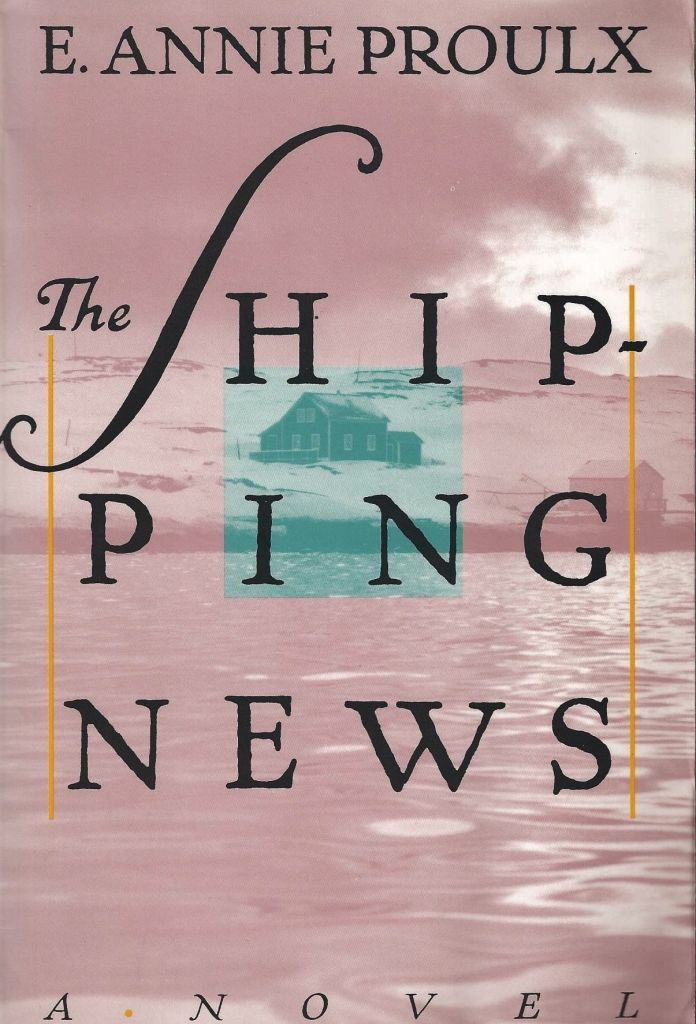
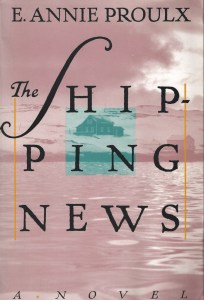
the shipping news e annie proulx 1993 001The Shipping News by E. Annie Proulx ~ 1993. This edition: Scribners, 1993. Softcover. ISBN: 0-684-19337-X. 337 pages.

My rating: 7/10

I’ve finally completely read this Newfoundland-set bestseller, after being defeated only a few chapters in on several previous tries.

What can I say, except that it does get better if one can persevere through the dismal beginning bits, and stumble through the author’s choppy prose until – glory be! – like miraculously deciphering key elements of a foreign language, everything starts to make sudden sense.

Once the cipher was broken, I never looked back, and I ended up rather enjoying this slow-moving tale of the dismal misfit Quoyle and his return to his ancestral Newfoundland roots after the exceedingly well-deserved demise of his sociopathic wife.

Though much of the novel is pure invention – and a good thing too, or there would be no Newfoundlanders left living on The Rock – they’d all be incarcerated for deviant sexual practices, or horribly perished in collisions with the ubiquitous imported moose, or pukingly dead of alcohol poisoning, or, barring all else, simply drowned at sea while a-seeking the vanishing codfish – Proulx catches the distinctive cadence of the regional dialect brilliantly, and her dialogue passages are an absolute joy.

On the negative side of the slate, there’s a completely boring love affair towards the end, all redemptive and meaningful with two sad, spousally-abused people finding each other, which was eye-rolling in its predictable banality. Also an unexpected and artistically over-the-top resurrection of a thought-to-be-deceased mentor figure in our hero Quoyle’s life which I could have happily done without – that bit felt like full-blown farce and jarred, even after all of the many other improbabilities, like the too-mobile ancestral Quoyle family home, and the disgustingly gruesome and never-really-explained fate of a sailor previously met by our hero on the deck of a based-on-reality Dutch-built yacht, once owned (in the story) by Hitler (though in reality the inspirational yacht was supposedly commissioned by Goering – check out this link for a fascinating little side story.)

Quite a mix, this one, of the ridiculous, the sublime, and, on occasion as with all of the details of widespread incestuous child abuse, the just plain distasteful.

Proulx borrows enthusiastically from fact, but never forgets that she is writing fiction, which the reader should also keep in mind throughout.

The internet abounds with reviews and book club discussions and author interviews, so if you’re curious about more detail, go to it. I’ll personally give it an “okay” recommendation, and add that I am quite open to reading some more by this writer, but that I’m not in a terrible rush.

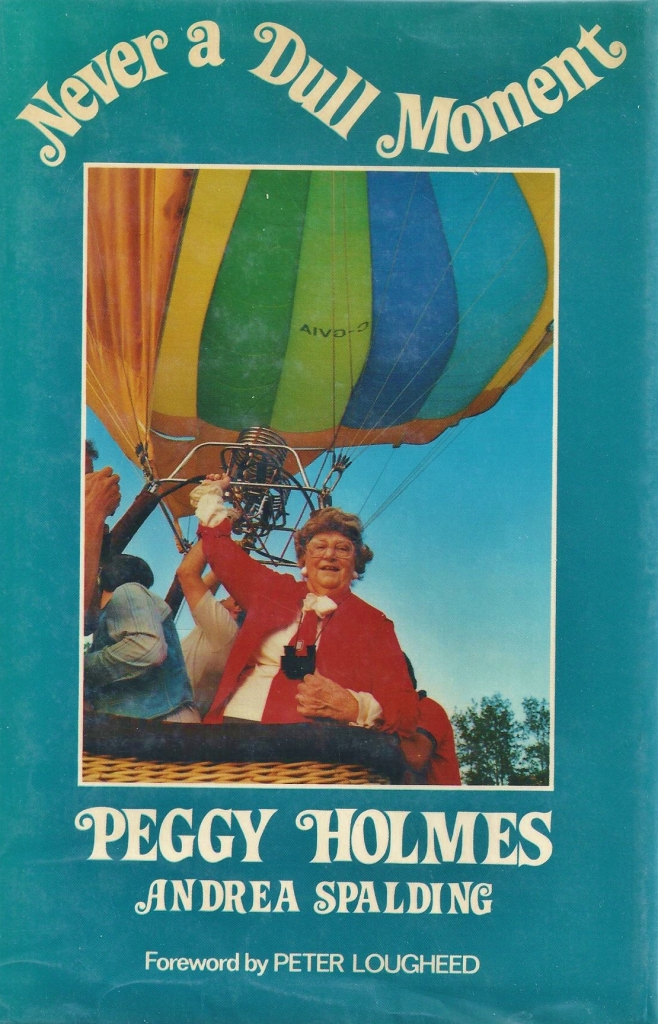
never a dull moment peggy holmes 1984 001Never a Dull Moment by Peggy Holmes ~ 1984. Co-authored by Andrea Spalding. This edition: Collins, 1984. Foreword by Peter Loughheed. Hardcover. ISBN: 0-00-217277-1. 188 pages.

My rating: 7.5/10

Peggy Holmes came to Canada after the Great War as an English war bride, settling on a small northern Alberta homestead with her husband Harry, and trying to make a go of farming under dismal conditions. The couple eventually gave up the farming dream and moved to Edmonton, where Harry became a law court transcriptionist, and Peggy raised her cherished young son, cared for her ailing father, and pursued various jobs in order to earn some extra money in order to keep the household afloat.

This is a lively recounting of Peggy’s long life in the heart of Edmonton. It was written, with the help of computer-literate friend Andrea Spalding, in 1984, when Peggy Holmes was 86. She was inspired to try her hand at memoir after taking a creative writing course, which led to her publishing a first volume of homestead memoirs, It Could Have Been Worse, and working as a highly regarded CBC regional radio broadcaster.

As “good old days” memoirs go, well done and very appealing and readable, though probably of greatest interest to those who are familiar to some degree with the Alberta setting and Edmonton local history. There are many local references.

There was a lot of personal tragedy in Peggy Holmes’ life, including several traumatic miscarriages, the loss of twin newborn girls through a doctor’s incompetence, and her elderly father’s death by suicide, but the tone throughout is pragmatically positive. Peggy Holmes must have been a very interesting lady, and she was certainly an interested one, always up for new experiences, such as the pictured hot air balloon ride when she was 85 years old.

Peggy Holmes wrote three memoirs in total, and I would be pleased to come across the two I don’t have, though I doubt that I will go to extraordinary effort to acquire them.

Peggy Holmes died in Edmonton in 1997, shortly before her one hundredth birthday.

repent at leisure front cover joan walker 001Repent at Leisure by Joan Walker ~ 1957. This edition: The Ryerson Press, 1957. Hardcover. 284 pages.

My rating: 6.5/10

Joan Walker was another English war bride, of a later vintage than Peggy Holmes, coming to Canada in 1946.

Walker had a background in various sorts of writing, and penned a well-received humorous memoir of her entry in Canadian life, with the Stephen Leacock Award-winning Pardon My Parka in 1953.

Repent at Leisure was Joan Walker’s attempt at writing a “serious” novel, and it is based on her war-bride, culture-shock observances, though it is fictional in its plotting, and not based on her personal marital tale.

Repent at Leisure is acceptably diverting, and I will be definitely be re-reading it in future.

The novel fits well into the “middlebrow women’s fiction” genre of its day, though I wouldn’t go so far as to enthusiastically recommend it. It was distributed in England as well as in Canada, and seems to have been critically well received, receiving the All Canada Fiction Award in its year of publication.

Walker did publish one more full-length book in 1962, a fictional depiction of the life of Richard Sheridan, Marriage of Harlequin. I can find no mention of further full-length works, though Joan Walker apparently continued writing essays and articles for various publications into the 1960s and 70s.

From the front cover illustration I had expected something fairly light-hearted, but the author’s intent seems to have been to write something more serious and dramatic; I can only assume that the cover artist was inspired by the comedic reputation of Pardon My Parka when tackling this new project.

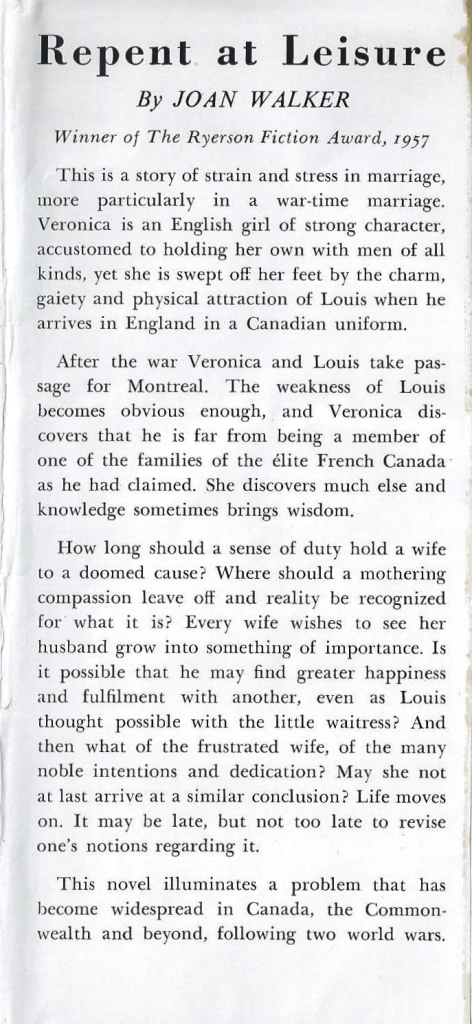
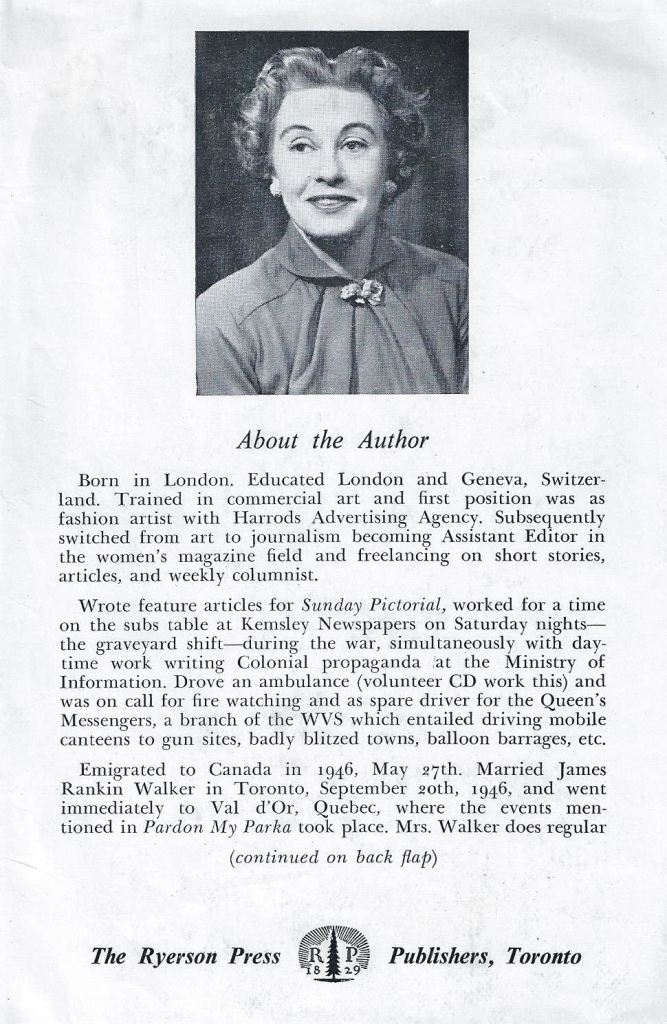
Here are scans of the back cover and flyleaf blurbs from Repent at Leisure, for those of you who are curious about the writer and her work from my brief description.

There are a few copies of this novel on ABE, quite reasonably priced, but, as I’ve already mentioned, I don’t feel it quite worthy of a “must read” recommendation, though there is nothing really wrong with it, either. More of a average-ish period curiosity than a hidden Canadian classic, is my honest opinion.

repent at leisure joan walker flyleaf front 001repent at leisure back cover joan walker 001repent at leisure joan walker flyleaf back001 (2)


Read Full Post »

I have only two books yet to read to meet the 2014 Century of Books goal – one for 1933 and one for 1983 – so it looks like (fates allowing) I will be finishing it under my personal deadline of December 31st – for a bit there I had my doubts! Then it’ll be back to reading-at-random, and I have a rather nice must-find/must-read list developing. Loads of memoirs and biographies, and of course a goodly smattering of mid-20th Century middlebrow fiction, as well as some promising 19th Century things.

Without further ado, here’s another assortment of opinions and summations on Century books needing reviews to qualify them for the project. Abandoning all attempts at themed presentation, and in no particular order, just as they come off the pile. The scanner is on for cover pictures, and here we go.

the motive on record dell shannon 1982 001The Motive on Record by Dell Shannon ~ 1982. This edition: William Morrow & Co., 1982. Hardcover. 189 pages.

My rating: 7/10

A fairly standard police procedural by the prolific Elizabeth Linington, who penned something like 40 murder investigation novels featuring Lieutenant Luis Mendoza of the Los Angeles Police Department. She started with these in 1960; The Motive on Record is (I believe) number 33 or thereabouts. (She also wrote numerous murder/suspense novels under her own name, as well as under a second pseudonym, Lesley Egan.)

The books follow a sequential, chronological pattern, though it seems to me as though time perhaps works a bit differently in Shannon’s fictional world, for though 22 years of “real time” have passed between Mendoza’s first appearance and this book, he seems to have aged hardly at all, and his wee children whom I remember from much earlier books are still very young. If I really cared I would investigate further as to whether this tale was supposed to be set in the 1980s when it was published, or if it is meant to be set back in the 1960s. It reads like a book from an earlier era than the 80s, though some of the slang the author uses seems to place it later. For example, much offhand talk about “f*gs” in reference to homosexual men. Curious and repellant from a 2014 standard, I found, much as I like this writer in a general way.

Anyway, Mendoza and his fellow LAPD investigators tackle an ambitious number of suspicious deaths and other criminal activities. A murderous child rapist stalks a peaceful neighbourhood, an elderly woman and two children are found slumped dead in a church pew, an elderly fortune teller catches a knife to the chest, a missing drug dealer shows up on (not in) an elevator, a quiet postal worker turns up naked and dead behind a warehouse though his half-empty letter basket has been neatly returned to the mail hub, Vietnamese immigrants fall fatally afoul of their neighbours due to different dietary customs, and a clever pair of robbers successfully scoop several theatres’ door receipts on their busiest nights. And more.

All of the problems are eventually solved; just another few weeks down at the station…

Mendoza’s “quirks” include a customized Ferrari which he drives to work, and a quartet of Siamese cats, as well as a palatial dwelling outside of the city, complete with a small flock of grass-controlling sheep (the Five Graces) and ponies for the children.

Nasty murders aside, this is a mild sort of thing for the genre. Probably most appealing to those who’ve started out at the beginning of the sequence; much of the narrative assumes a prior acquaintance with the main characters.

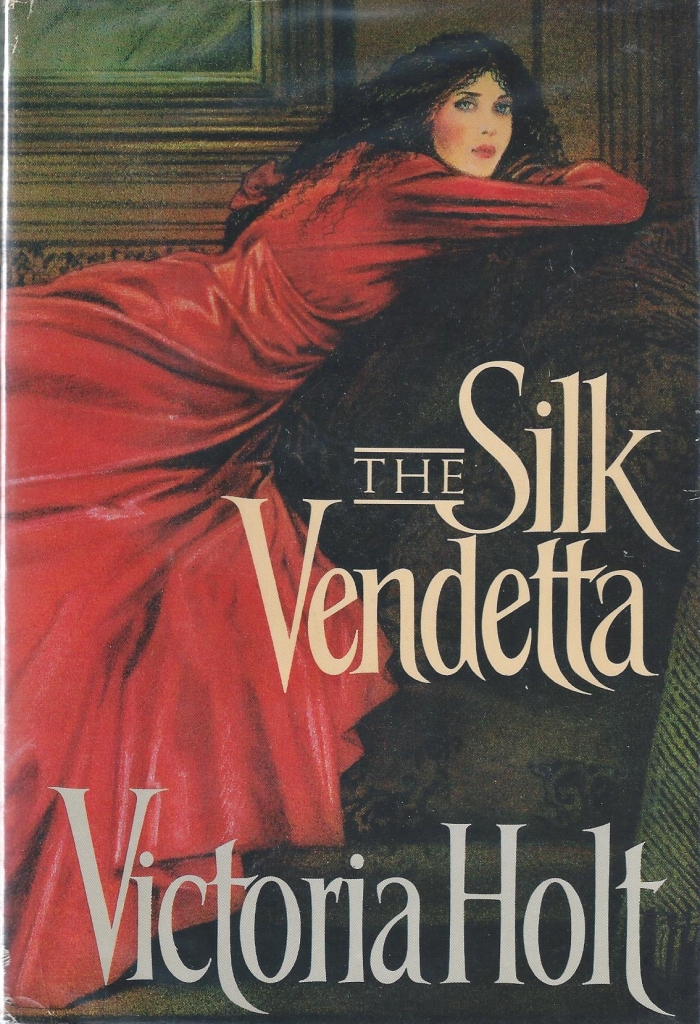
the silk vendetta victoria holt 1987 001The Silk Vendetta by Victoria Holt ~ 1987. This edition: Doubleday, 1987. Hardcover. 345 pages.

My rating: 5.5/10

An utterly stereotypical gothic romance concerning a young woman with mysterious antecedents living in a stately English home.

Beautiful Lenore lives with her grandmother in a separate suite of rooms in Silk House, home base of the wealthy silk manufacturer-merchant family, the Sallongers. Grandmother designs dresses, while Lenore shares a schoolroom and meals with the Sallonger daughters, though the servants sneer at her relentlessly, and the family matriarch obviously despises her. She’s definitely not viewed as an equal to the “young ladies”, but neither is she a servant. What’s it all about, I’m sure we’re meant to wonder. No points for figuring out that “someone” was begotten on the wrong side of the blankets, as it were. Or is she really legitimate? A fortune may ride on the answer…

Both Sallonger sons are attracted to beautiful Lenore, with very different motives towards her. The obligatory near-rape scene pays homage to the gothic novel tradition, as does the doomed marriage Lenore undertakes, before finding herself a safe haven enclosed by muscular manly arms.

I’m rather ashamed to say I read this with no qualms at all; it’s utter crap but also acceptably diverting, for those times when one doesn’t want to have one’s intellect or emotions ruffled. The writing is quite decent for this sort of thing, though the plot is completely standard issue. To be read on auto-pilot, while sipping a soothing cup of tea after a tiresome day. If all else fails, you can claim you’re reading it ironically, or perhaps just doing “research” for your book blog…

The honest verdict? Not particularly recommended. There’s better out there. (But in a pinch it would suffice.)

love elizabeth von arnim 1925 001Love by Elizabeth von Arnim ~ 1925. This edition: Virago, 1988. Softcover. ISBN: 0-86068-941-7. 408 pages.

My rating: 9.75/10

One of von Arnim’s “serious” novels, and one which deserves a much more detailed discussion. I suspect I’ll be returning to it in future.

Middle-aged widow Catherine attracts the besotted notice of much-younger Christopher. He proposes marriage, to the dismay of everyone in their joint circles, and Catherine eventually accepts.

The question at the heart of the novel why is it completely acceptable for a very young woman to be married to a much older man (vis-à-vis Catherine’s own 19-year-old daughter’s recent marriage to a 49-year-old clergyman) and so socially dire for the opposite to be true.

Catherine’s second marriage soon encounters rocky ground, and, as she desperately tries to keep up a youthful appearance both for her husband’s and her own sake, much deep discussion on the nature of “Love” itself ensues. A favourite topic of von Arnim’s, and as seriously treated here as it was frivolously mauled about in The Enchanted April.

The ending is one of the best I’ve yet read by this particular writer; she doesn’t let us down as she sometimes does with her romantically tidy conclusions, but gives us something to consider most thoughtfully.

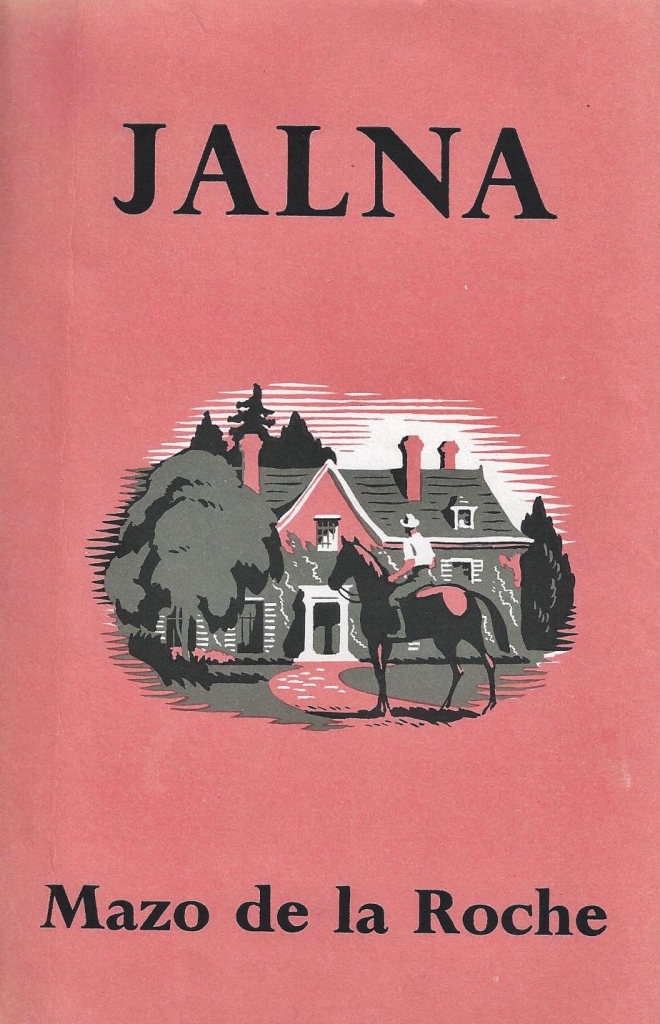
jalna mazo de la roche 1927 001Jalna by Mazo de la Roche ~ 1927. This edition: Macmillan, 1977. Hardcover. ISBN: 333-02528-8. 290 pages.

My rating: 5.5/10

This dramatically romantic novel by a young Canadian writer won a literary prize of $10,000 upon its publication nearly a century ago: an astonishing amount for the time, equivalent to something like $132,000 in today’s currency. (I looked that bit up using a handy-dandy inflation-indexed currency converter I found online.)

Spurred on by her success, Mazo de la Roche went on to write another fifteen Ontario-set installments in the Whiteoaks family saga, creating something of a literary cottage industry of sequential books, assorted editions and collections, and theatrical, radio and filmed productions for the next fifty years.

I was well aware of this novel and its reputation as an iconic bit of literary Canadiana, but I hadn’t actually read it until this year.

My verdict: I’m not stacking up the other 15 on my night table for essential reading, though I might possibly poke my nose into another one if the mood feels right. I do have a number of them stashed away, found at a library book sale some years ago. I gave them to my mother, and she returned them with not much comment, which should have been a bit of a tip-off.

No hurry on the others, though. Jalna was not particularly compelling. In fact, only okayish is as far as I’m willing to commit myself on this one.

The plot in a nutshell:  Wealthy matriarch Adeline Whiteoak is approaching her 100th birthday, and her various offspring and descendants circle round her angling for her slightly senile blessing.

One grandson unpopularily marries a local girl, by-blow of  the man who once unsuccessfully courted one of Adeline’s daughters, while another brings home an American bluestocking. Both brides soon come to think that perhaps they have chosen the wrong brothers. The eldest of Adeline’s grandsons, broodingly charismatic, ceaselessly womanizing and still-single Renny, catches the eye of the American wife, while her spouse in turn dallies with his brother’s bride. Much chewing of the scenery ensues, helped along by the unmarried members of the family, Adeline’s two elderly sons and her much-past-her-prime passive-aggressive daughter.

Absolute soap opera. Think a low-rent Gone With the Wind, sans Civil War and southern drawls and a horribly likeable heroine, but with similar over-the-top romantic heart-throbbings and dirty little secrets. (Perhaps not really the best comparison, but it was what popped into my mind. It’s not really like GWTW at all. Perhaps Mazo de la Roche does stand alone.)

And there’s an elderly parrot, and a cheeky young boy, to provide much-needed levity, though not enough to ultimately save this overwrought thing from itself.


Read Full Post »

I am writing from exile, as it were. My usual “happy place”, as my ever-so-clever and perhaps slightly cynical offspring often call it, is a small room which was once dedicated to the more formal of our homeschooling endeavours. Those students are all grown up now, and over the past few years the schoolroom has turned into a not-very-well-organized office area for yours truly.

It’s really quite lovely in there, with two tall windows overlooking the garden, and lots of bookshelves. The space is (was!) filled by a work table overflowing with stacks of crucial papers (mine) and art supplies (my daughter’s) and mostly empty music CD and computer game cases (my son’s), an ancient oak teacher’s desk – but not of the antique-variety ancient, sad to say, merely of the old, scarred and scuffed sort – and a file cabinet full of the oddest collection of things – an abandoned knitting project from back in 1994 (a wooly sweater for my then-newborn son, who outgrew it long before it was completed), an out-of-order telephone answering machine (even older than the sweater), a stack of my old school report cards from the early 1970s, a small tub of child-proof electric outlet covers and cupboard door latches, the official pedigrees of several horses long since departed for greener (celestial) pastures, a collection of brown paper bags…everything, in fact, except for things-to-be-filed, like receipts and bills and important papers.

The floor in the little room has needed some serious attention for some time – the old linoleum was worn through to the plywood below in the main travel area – and when a recent cold snap which put a sudden stop to outdoor projects had us looking about for a small, manageable, renovation project we zeroed in on this one.

Everything was hastily bundled out of the room and deposited willy-nilly wherever a space could be found. My computer has ended up in a little hallway nook which usually houses the telephone and directories and stacks of incoming mail and such; it’s just large enough to squeeze everything in, and here I sit in a state of some discomfort, pecking away at my keyboard in a much less congenial atmosphere than my private little room.

A (tiny!) room with a view. Note that there is NO SNOW outside the window - very unusual for this part of the world at time of year. Mentioning this should immediately bring the snowflakes drifting down...

Playing about with floor tile patterns in a (tiny!) room with a view. Note that there is NO SNOW outside the window – very unusual for this part of the world at time of year. Mentioning this should immediately bring the snowflakes drifting down…

We’ve ripped up the old floor, replaced a few iffy floor joists and all of the plywood, removed a huge corkboard which took up most of one wall, added wainscoting to another wall, and brought out the paint tins. The new floor tiles are stacked up waiting for the acquisition of a bucket of glue next time I’m in town, and if all goes well I should be back in residence in the next week or so.

The old wooden desk has been relocated and another, larger, more “professional” ex-office steel desk is taking its place; my new view will be out those previously-mentioned windows versus the wall in the corner. I’m not sure what this will do to my concentration level, but I’m thinking it will be a happy psychological development. 🙂

The bookshelves are being relocated, and the stacks of “juveniles” they now contain boxed up for temporary storage; my working library of horticulture books may replace them, or perhaps just another bunch of novels. Not quite sure yet. Books find their own way about, in my experience.

A large grow light stand for the germination of December- and January-sown perennial seeds is planned for the remaining space; the old stand was unceremoniously hauled outside during our last winter’s renovations, and as the plant nursery sabbatical period comes to an end (see Hill Farm Nursery for more on that aspect of my life) indoor early seed-sowing facilities are once again about to be required.

Oh, and the file cabinet is being emptied out, with high hopes that in its new life it will actually be used for its intended purpose – that of holding files. The “cardboard box filing system” which I have been using in the past is apparently going to change. Or so declares my perhaps-too-optimistic husband. 😉 We’ll see. About half of the stuff currently taking up space in the cabinet is his, so he’s hardly innocent of random stashing of “treasures” himself. It’ll be interesting to see what he makes of his stuff, and where it will end up! I have several empty cardboard boxes awaiting his pleasure…

Well, I did promise book notes too, didn’t I? So I think I will tuck a few in here on the end. Minor notes for minor books. These are all from the shelves in the now-ex-schoolroom. I enjoy occasionally reading from the juvenile stacks – well-written books easily cross genre and “intended-age” boundaries.

dodgem bernard ashley 001Dodgem by Bernard Ashley ~ 1981. This edition: Puffin, 1983. Paperback. ISBN: 0-1403-1477-6. 222 pages.

My rating: 6.5/10

A better-than-average “problem novel” by ex-headmaster and prolific children’s and young adult fiction writer Bernard Ashley – see his biography here.

Teenage Simon is in trouble with the Child Welfare; he’s been skipping school in order to care for his father, who has been in a state of severe clinical depression since the death of Simon’s mother, a death surrounded by questions, which have torn the small family even further apart in ways which will only become too apparent part way through the novel.

Simon ends up “in care”, and, desperate to return to his father, teams up with the seemingly emotionless Rose in a well-thought-out escape plot which seems at first to be daringly successful.

Decidedly well written and totally engrossing, this short novel, from early in Bernard Ashley’s writing career, was made into an acclaimed 6-episode British television series.

Scenes set in a juvenile care home and in a travelling carnival are excellent in their detail. Despite the young protagonist’s rage against the system which one completely sympathizes with, the adults are given as much time on the page as the teenagers. There is a quite remarkable balance of points-of-view, unusual in this sort of highly-contrived juvenile novel.

This is the only book by Bernard Ashley I’ve yet read, but if the writing quality stays the same in subsequent books he might be worth investigating further for those of you with young teens, or if you are merely open to reading novels targeted at younger-than-adult readers.

*****

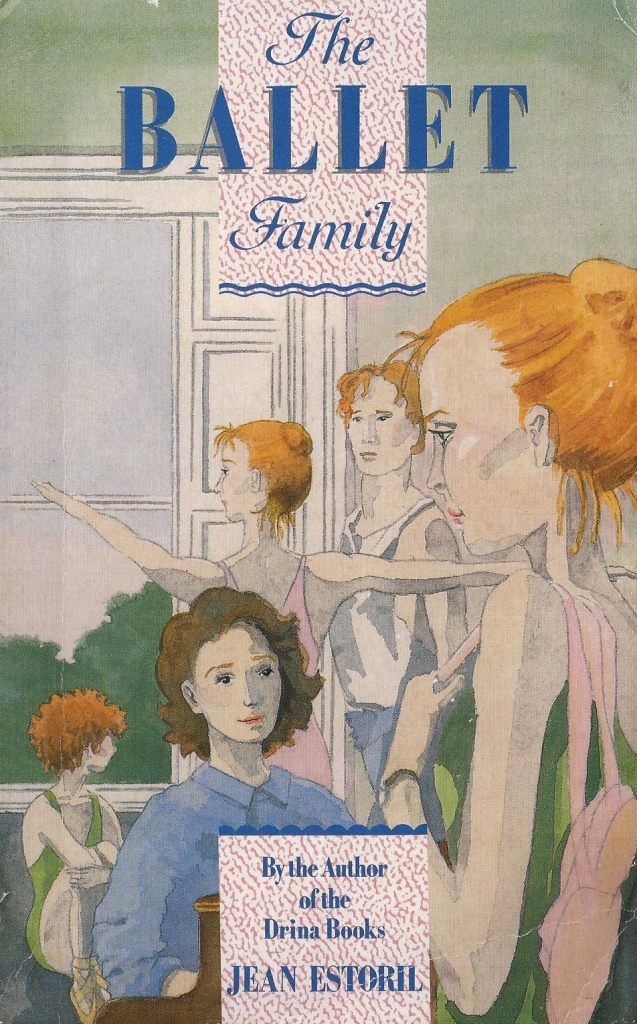
the ballet family jean estorilThe Ballet Family by Jean Estoril ~ 1963. This edition: Macdonald Children’s Books, 1989. Paperback. ISBN: 0-356-16797-6. 176 pages.

My rating: 6/10

Jean Estoril was one of the several pseudonyms of Mabel Esther Allan, a prolific writer of children’s books (Wikipedia reports 130) between 1938 and 1994. The “Jean Estoril” books were all concerned with the world of ballet, most notably a series about an orphaned aspiring dancer, one “Drina” (short for Andrina)  – Ballet for Drina, Drina’s Dancing Year, Drina Dances in Exile, and so on.

I am rather leery of juvenile series books, but in this case I may investigate further, for The Ballet Family, not about the afore-mentioned Drina but instead concerning a group of hyper-talented siblings and their orphaned cousin, is intriguingly good for its sort of thing. Better, in my opinion, than Noel Streatfeild’s ubiquitous (and perhaps over-rated? – others of her books are much, much better, in my humble opinion) Ballet Shoes, which I must confess causes me to grit my teeth here and there.

Mabel Esther Allan studied ballet in her younger years, and it shows, in a good way. The Ballet Family is quite marvellously realistic regarding the dance aspect, aside from the glorious improbability of the initial set-up.

Pelagia, Edward, Anne and Delphine Garland are all dancers and ballet mad. Their mother is a prima ballerina and their father a conductor of the ballet company orchestra.

When their cousin Joan is orphaned she comes down from Lancashire to live with Garlands in London. Confused and lonely, Joan finds it hard to fit in, especially as her cousins are rather wary of her and don’t understand how Joan could survive without knowing anything about ballet!

But Joan does survive and begins to enjoy her new life observing the ups and downs and tears and triumphs of her glamorous cousins.

Pelagia flits in and out of the story, being the eldest and very much concerned with her burgeoning career, Edward is a decent sort with sensible notions, Delphine is a spoiled brat who needs (and thankfully gets) a reality check, but the book is really mostly about middle sister Anne and her difficulties relating to her cousin, whom she finds nothing at all in common with, and whose apparently sullen attitude (she’s really deeply grieving the sudden loss of her beloved mother) precludes friendly girlish chats.

Joan finds her feet in her new life, and astounds the self-centered Garland family by displaying some talents of her own they had no inkling of. Bless the author – Joan does not turn out to be ballerina material – she doesn’t even try to go there, nor do the Garlands ever expect her too, for she is much too “old” to start, in their united opinion – her special talent is in a slightly different area.

A slight book, but very nicely done.

 She Reads Novels gives a glowing recommendation to some of Jean Estoril/Mabel Esther Allan’s books. I think I will be following up on these.

*****

green-knoweThe Children of Green Knowe by L.M. Boston ~ 1954. This edition: Faber & Faber, 1962. Illustrations by Peter Boston. Hardcover. 157 pages.

My rating: 7.5/10

A subtle classic of children’s literature, this novel calls one back to the elusive world of imaginative childhood, when all things are possible, and some things are downright magical.

Synopsis cut and pasted in directly from the Green Knowe Wikipedia page, because whomever wrote it did a lovely job of summation of the story set-up:

The Children of Green Knowe is the first of the six books written by Boston about the fictional manor house of Green Knowe. It was a commended runner up for the 1954 Carnegie Medal.

The novel concerns the visit of a young boy, Toseland, to the magical house of Green Knowe. The house is tremendously old, dating from the Norman Conquest, and has been continually inhabited by Toseland’s ancestors, the d’Aulneaux, later Oldknowe or Oldknow, family. Toseland crosses floodwaters by night to reach the house and his great-grandmother, Linnet Oldknow, who addresses him as Tolly.

Over the course of the novel, Tolly explores the rich history of his family, which pervades the house like magic. He begins to encounter what appear to be the spirits of three of his forebears—an earlier Toseland (nicknamed Toby), Alexander, and an earlier Linnet—who lived in the reign of Charles II. These meetings are for the most part not frightening to Tolly; they continually reinforce the sense of belonging that the house embodies. In the evenings, Mrs. Oldknow entertains Tolly with stories about the house and the children who lived and live there. Surrounded by the rivers and the floodwater, sealed within its ancient walls, Green Knowe is a sanctuary of peace and stability in a world of unnerving change.

The encounters of Tolly and his ghostly companions are reminiscent of similar scenes in some of Elizabeth Goudge’s books, being serenely beneficent rather than at all frightening. Though there are a few twists…

children of green knowe l m boston peter boston 001The full-page and in-text illustrations by Lucy M. Boston’s artist son Peter are intricately detailed in pen-and-ink and scraperboard technique; make sure the copy you share with your child (or read for yourself) has these included; many of the cheaper paperback and some later hardcover editions are missing these.

Perhaps I should have kept this review for closer to Christmas, as that celebration features strongly in one of the most charming incidents in the story.

In a word: Nice.


Read Full Post »

beyond the blue horizon alexander frater 001Beyond the Blue Horizon by Alexander Frater ~ 1986. This edition: Penguin, 1987. Paperback. ISBN: 0-14-010065-2. 430 pages.

My rating: 9.75/10

Almost perfect.

The tiniest bit of transitioning muddle here and there lost the 1/4 point. Nothing at all serious, but just frequent enough to very occasionally interrupt the otherwise seamless flow.

Okay, this one came (flew in?) from way out in left field.

Or, to be completely accurate, the slightly ho-hum Nuthatch Books in 100 Mile House, B.C. I sometimes pop in there when passing through in my travels, mostly because it is conveniently located right next to the village’s premier (only?) coffee house, the Chartreuse Moose, which, at two hours driving time from home, is a perfect quick stop for a beverage in a take-out cup to see one on the next few hours of travel when heading for points to the south.

Where was I? Oh yes, Nuthatch Books. The bookstore itself is very average, with mostly new stuff, and a fairish quantity of used. Stiffish prices on the second hand books, and not much in the way of a vintage selection, but I’ve picked up a few interesting things there now and then. Such as this book, which was a complete impulse buy, inspired by the promising title and a lightning-quick random-passage read. In this case, the book hunter’s instinct was rewarded. This was great.

From the back cover:

The romance and breathtaking of the legendary Imperial Airways Eastbound Empire service – the world’s longest and most adventurous scheduled air route – relived fifty years later in one of the most original travel books of the decade.

‘Whether being mown down by stampeding Baghdad-bound passengers in Cairo airport, or battling with Indian Airline staff (and failing) to reconfirm six vital going-on flights from Delhi, or being lured unwittingly into a souvenir shop selling pornographic wood carvings in Lombok, or hitting tropical cyclone Ferdinand in a 748 en route from Sumba to Bali, Frater rises above it all with humour, style and a wonderfully sharp eye’ – Christopher Matthew in the London Standard

The front cover of my Penguin paperback is emblazoned with the overly-familiar Theroux comparison – I quite like most of Theroux’s travel writing, but for goodness sake – can’t we occasionally reference someone else?! – and despite the initial annoyance this triggered, I found myself having to agree. Alexander Frater does share many of the best writerly qualities of Paul Theroux, though Frater’s voice is distinctively his own.

I’m coming at this rather backwards, for no doubt if you’ve made it this far you’re wondering what the heck Beyond the Blue Horizon is actually about.

It’s simple-ish. It’s an attempted recreation of an old commercial flight path from England to Australia, via Northern Africa, the Middle East, India, and South Asia, taking modern commercial flights and touching down at each and every one of the destinations referenced in the flight paths of the venerable Imperial Airways Eastbound Airways Service in its 1920s-30s heyday, when such a journey was referred to, aptly, as a “voyage”, and was more akin to a leisurely ocean journey in a luxury liner than to the sardine-can-squished, as-much-as-possible-non-stop, strictly-transportation experiences of today.

Back in the day, the trip from London to Brisbane by air took two weeks, with something like 35 way stops. Most flying was undertaken in the daylight hours, and passengers and crew slept each night in generally quite posh hotels, many of which were purpose-built to serve the airways trade, much in the way that the great railway hotels of North America were constructed as an adjunct to the leisurely upper-class train travel of a similar period.

Though definitely plotted with a book-in-mind – Frater was a well-respected travel writer and journalist well in successful mid-career when he embarked on this project – Beyond the Blue Horizon doesn’t feel terribly manufactured-for-sale, mostly because Frater is a true airplane enthusiast and a grand people person and an accomplished journalist, and he writes this slightly unlikely journey up in the most engaging way. He did his research first, lined up appropriate people to interview at pertinent points in his journey, and assembled a comprehensive number of long-ago accounts of air travel, which I wish could have been included in a bibliography, because the excerpts we are given are frequently intriguing.

Accounts of Frater’s trip are interspersed with accounts of long-ago flights covering the same bits of territory, and this is where my only complaint comes in. There are so many different references to so many different pilots, travellers, airplanes and airlines that I occasionally got a bit lost among all the reminiscences, and had to back up an reread the passages where Frater connects the now to the then of each particular bit of his journey. But it always came right, and the juxtaposition of experiences absolutely made this book, so it’s a very minor demerit point given to an otherwise excellent bit of travel lit.

Though I admire the concept of airplanes, I am not a comfortable flyer myself, and I read Beyond the Blue Horizon like I read accounts of mountaineering, or of sailing in small boats across the vast wastes of ocean – with admiration and interest but with no desire at all to emulate the experience. Writers who can keep me engaged in something so foreign to my personal comfort zone are quite rare, and greatly appreciated when found. Alexander Frater gets a shiny gold star from me for this one, and I already have a second journey-book by him purring promisingly on my bedside bookshelf: Chasing the Monsoon, 1990, in which Frater leaves rainy England for even more rainy India.

Frater’s writing in Beyond the Blue Horizon is no less than excellent. He combines sober statistics with revealing asides in which his inner keenness comes out all schoolboy enthusiastic and highly likeable, and he wanders off topic just enough to keep things continually engaging.

Frater also has a vast inner knowledge of the sort of esoterica in his chosen area of devotion which one comes across in other fields of interest, such as train buffs and vintage car people and those single-breed dog/cat/horse/you-name-it enthusiasts who occasionally, revealingly, let themselves go a little too far for the audience at hand, causing one to glance furtively about for an exit opportunity to escape the intensity of the one-topic conversationalist.

Frater never goes too far.

Highly recommended.

Read Full Post »

solomons seal hammnd innes 1980Solomons Seal by Hammond Innes ~ 1980. This edition: The Book Club, 1981. Hardcover. 320 pages.

My rating: 5.5/10

At one point in my reading life (late teens) I read a fair bit of Hammond Innes, mostly because I had read everything else handy and he was still “there”. I must say that I found his dramatic, testosterone-infused stories acceptable enough, though ultimately easy to re-shelve. This renewal of my acquaintance with Innes reminds me of just how readable-but-not-great he can be.

Please forgive that “astounding breasts” reference in the post header. Coupled with my last post featuring an almost-nude woman on a book cover, you might think I’m reading some pretty risqué stuff these days, but as with Dodie Smith’s allusive-but-not-explicit sex scenes, Hammond Innes avoids most of the details. He does, however, go on at some length about his female character’s physical attributes. Those breasts are mentioned numerous times; the hero describes them as astounding both before and after he has had some hands-on investigation. As a female reader I must say I found this rather off-putting. Hey, dude, what colour are her eyes?

This is merely a digression, though, a side note of personal annoyance regarding what is actually quite an initially promising story of mystery, suspense, and manly derring-do.

Trying to sort out the many plot strands to present them in logical order – more difficult than you’d think, as Innes has obviously decided that more is better in this case – and I am going to refer you to the Kirkus Review of 1980. Whoever penned this summation has neatly separated out the main points. I left the Big Plot Spoiler in, such as it was. See if you can make sense of this:

An improvement over Innes’ recent, dullish adventures – with stamps and sorcery (instead of, as usual, wildlife and armaments) helping to give a lift to at least the first half of the proceedings. Ex-naval officer Roy Slingsby, a temperamental property appraiser for a law firm is sent out to size up the auctionable holdings of the Holland family – and native-looking beauty Perenna Holland (whose twin brother Timothy is supposedly dying of sorcery) shows him the family treasures: carvings and stamps from Papua New Guinea. But before Slingsby can decide how much the stamps are really worth, Perenna disappears…and Slingsby himself quits his job, accepting an offer to relocate to Australia and settle a huge estate down there. Once Down Under, however, the Slingsby/Holland paths will merge again: in Sydney Slingsby meets Jona, a part-native Holland relation who captains an LCT (WW II landing-craft transport), and goes on a cruise with him to Bougainville in the Solomons, working as a navigator for his fare. Re-enter Perenna, of course, who is soon Slingsby’s shipboard bedmate – and the lovers then discover that Jona is delivering a cache of arms to rebels in Bougainville (where the Holland family has a long history). They all become involved in this insurrection (which fails) – and, while in the ancestral area, they uncover family secrets. Above all: grandfather Holland fathered Perenna on his own daughter-in-law – which is partly responsible for the family curse…The stamp stuff is fine, the rest is familiar and foolish but reasonably atmospheric – and none of it is as soporific as The Big Footprints or other Innes super-duds…

Do I detect more than a whiff of damning with faint praise in those first and last lines? If so, I must agree. This was a bit of a dog’s breakfast, and I notice that the Kirkus reviewer left out the cargo cult stuff, which Innes tosses in to justify the mindless actions of his “indigene” characters – the “fuzzy haired” (which epithet occurs as often as the breast reference, and is as equally irritating – did the man not have access to a thesaurus?) natives of Australia, Papaua New Guinea, and the Solomon Islands who, in a mostly amorphous mob, get to play the crowd scenes during the bizarre and hardly believable “political insurrection” bits.

Here’s another excerpt from a contemporary review, this one more openly annoyed.

Anatole Broyard, writing in the December 12, 1980 issue of The New York Times, has this to say:

Everyone, even V.S. Pritchett, praises Hammond Innes. But I wonder what they will say about Solomons Seal. It did not work for me, but then perhaps I have the wrong attitude in reading suspense novels. Since they are supposed to be entertainments, I refuse to work very hard in reading them. I tend instead to sit back and wait for the book to come to me, to manipulate me as a skillful masseur might… Mr. Innes’s ambitions, apparently, are of a higher order. Solomons Seal is a heavy stew of voodoo death, cargo cult, family curses, philately and South Pacific politics – plus a dash of Joseph Conrad’s Heart of Darkness and a soupçon of The Ancient Mariner… Much of the action occurs off stage, and we are given huge chunks of plot in summary. I think it was novels like Solomons Seal that inspired Edmund Wilson’s famous attack on the detective story, in which he said that reading them was like looking for a rusty nail in a crate of straw…

Well, this isn’t much of a review so far, dear readers, being mostly a presentation of other people’s words with me fervently nodding in agreement off in the wings.

I liked the set-up, and greatly enjoyed the details of the stamp collecting sub-world, as well as the introspective passages during the at-sea times, as multi-talented Slingsby contemplates the ocean during his solitary time on the bridge of the sturdy but wallowing Landing Craft Transport he finds himself piloting. There was also a short but good description of open pit copper mining which I greatly appreciated for its verisimilitude, for my husband works in just such a mine here in the interior of B.C. and Innes has obviously paid close attention during his research visit to a similar late 1970s mine site. He even references the many Canadians working in the mine, which I appreciated as evidence of the author’s keen eye for scene-setting detail. (Innes famously travelled for six months of every year, examining story settings and taking notes, then spent the next six months writing up his latest adventure tale. He also had a soft spot for Canada, and was warmly appreciative of the Canadians he met on his research journeys here, as portrayed in his autobiography, Harvest of Journeys, which I think I must really re-read some time soon, since he’s back on my radar.)

Where Innes lost me (setting aside the trying-to-be-sexy bits and the pervasive offhand racism) was in his failure to bring all of the story strands together in an interesting and understandable way. There is a Great Big Secret, which men are prepared to kill (and to die) for – this turns out to be some sort of muddly your-father-betrayed-my-father-therefore-I-don’t-like-you-very-much-and-oh-yeah-if-I-can-I’ll-do-you-down melodrama. The lone female character turns out to have a slightly complicated ancestry (see the Kirkus excerpt), but I was never quite clear on why that really mattered. There is a convenient maybe-suicide of the conflicted primary bad guy, who is really a mix of admirable initiative and evil genius – our hero admires him as much as fears and hates him. The two “native sorcerers” at the heart of the mostly-off-stage insurrection have a weird mental showdown; one mysteriously wins and the other “wills himself to die.” The few stray bodies (all of expendable bit players) are apparently easily disposed of with no apparent qualms or consequences – “These country bumpkin black fellas are continually bumping each other off, no need to interfere” seems to be the attitude of both the local and post-colonial management level and police types. The cargo cult and voodoo elements are continually mentioned but never really detailed, almost as if Innes expects his readers to be completely au fait with this sort of arcane knowledge and able to figure out these references by themselves.

As a plus point, the book title is a neat triple entendre, as the stamps which start the story-ball rolling are actually shipping company business seals versus true postage stamps, and they are embellished with an actual seal-on-an-ice-floe picture cribbed from a Newfoundland postage stamp design, and much of the action concerns the Solomon Islands.

This wasn’t a painful read, but it wasn’t great, either. It was, in fact, resoundingly okay-ish.

I’m eyeing the other Hammond Innes books tucked away on the “B-List” cabin bookshelves with mild surmise; we are about to head out on a longish road/camping trip and much not-too-hard-going reading matter will be required. Solomons Seal was needlessly convoluted, but some of Innes’ earlier works were much more linear in construction, if memory serves. Perhaps I should take along The Wreck of the Mary Deare (ghost ship!), or The Doomed Oasis (Arab chieftans and oil!), or The Land God Gave to Cain (murder and meanderings in desolate Labrador!) Or maybe the autobiographical Harvest of Journeys, which I remember from a long-ago read as being a very good memoir, with the bonus element of being eligible for inclusion on my Canadian book list, as it is much concerned with Innes’ travels in Canada.

Keep an eye on this space, and in the meantime, consider that you’ve been given the heads-up on how well (or not well) Hammond Innes travels through time from his heyday as a bestselling “blue collar” action-suspense writer.

Read Full Post »

Dodie Smith in 1921, aged 25.

Dodie Smith in 1921, aged 25.

Coming to the surface after blissfully submerging myself this past week in the massive memoir of one Dodie Smith: failed actress, reasonably competent department store saleswoman (and eventual mistress of the store owner), astonishingly successful playwright, bestselling novelist, Dalmatian dog lover, and all-around fascinating character.

I have just read something over one thousand pages of autobiography in all, if one adds up the pages counts of her four volumes: Look Back with Love, Look Back with Mixed Feelings, Look Back with Astonishment, and Look Back with Gratitude. A fifth installment was in the works, but never published, and I find that I am sorely disappointed – I would read it with great joy.

So – Dodie Smith. Where does one start?

Perhaps I’ll merely recommend that anyone who has read and enjoyed the first volume of her memoirs, Look Back with Love, immediately go on a quest to beg, borrow or (at daunting cost – these were the Great Big Splurge of this summer’s book hunting) perhaps even steel oneself to buy the rest of the books. They are absolutely excellent.

I am personally not terribly familiar with the 1930s and 40s London and New York theatre scenes, or the Hollywood of the 1940s and early 50s, and many of the big names referenced were quite vague to me, but it didn’t matter a bit: Dodie brought these various worlds to life.

I am glad I came to these memoirs after reading a number of Dodie Smith’s novels, as my familiarity with her fictions helped me center myself in her recollections. I was intrigued and surprised to find out how many of the incidents in these fictions came from Dodie’s own life. In her case, truth is frequently much stranger than fiction; the most outrageous incidents come from life.

The bits I’d jibbed at the most in The New Moon with the Old and The Town in Bloom suddenly clicked. I’d wondered where the author was coming from with her dramatically-minded, stage-struck, teenage heroines just aching to dispense with their virginity to older (sometimes much older) gentlemen, and now I know. They are echoes of Dodie herself, though she (reluctantly) kept her “purity” until the advanced age of twenty-five, at which point she decided to take a friend’s advice and bestow it on a slightly bemused man-about town of her acquaintance. (The advice was that if one wasn’t married by twenty-five, one should feel oneself obligated to embark upon an affair, to keep one from becoming a curdled old virgin. Or something to that effect. 😉 )

All of this talk about sex makes it sound like these memoirs are rather risqué, but in truth they aren’t. Dodie is so matter-of-fact and so willing to share not just reports of her actions but abundant self-analysis of why she did what she did, looking back on her youth from the perspective of her eighties, that the potential salaciousness of these frank remembrances is disarmingly diffused.

Dodie wrote an astounding quantity of journal entries – thousands of pages and millions of words over her lifetime – and she mined out the most fascinating nuggets to embellish her memoirs, which are easy reading, words flowing smooth as silk. No doubt Dodie took endless pains to make them so, as she references a favourite tag of Sheridan’s – “Easy writing’s vile hard reading” – and states that the opposite also holds true.

She should know.
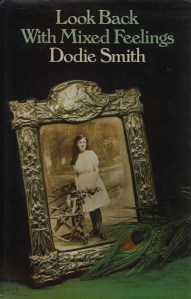
Dodie Smith, aged 14, at which point this volume of memoir begins, picking up where "Look Back with Love" ends.

Dodie Smith, aged 14, at which point this volume of memoir begins, picking up where “Look Back with Love” ends.

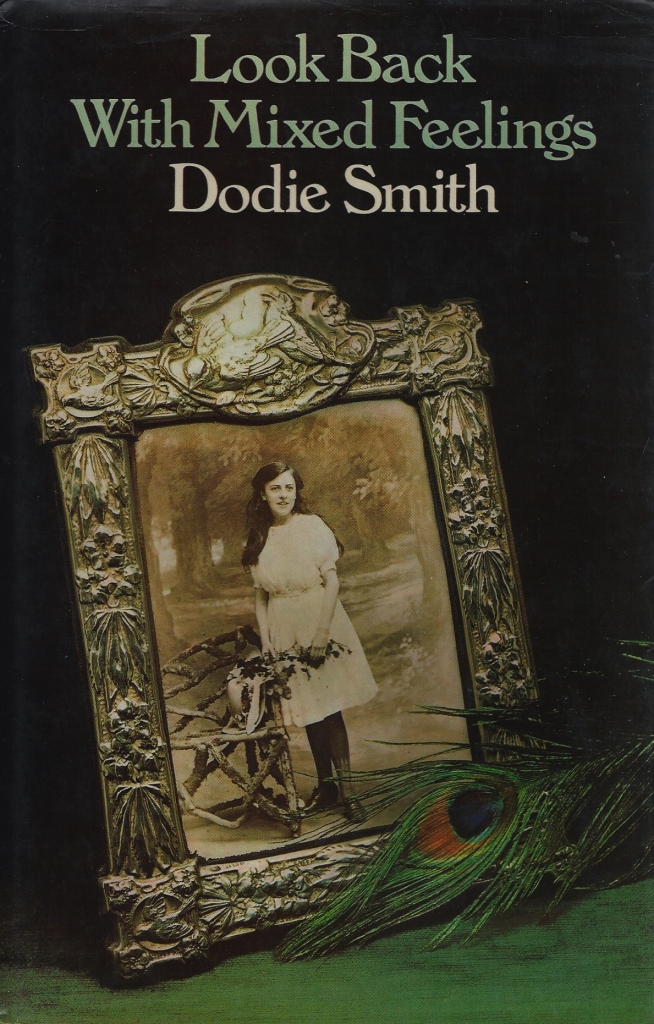
Look Back with Mixed Feelings: Volume Two of an Autobiography by Dodie Smith ~ 1978. This edition: W.H. Allen, 1978. Hardcover. ISBN: 0-491-02073-2. 277 pages.

My rating: 10/10

Fair warning: These will all be rated 10/10. Grand reading experience; better than anticipated. I mean, 4 volumes of autobiography – surely one will get tired of this introspection at some point and long to put these down?

Nope.

Super-condensed recap:

The 14-year-old Dodie moves from Manchester to London with her mother and new stepfather. Stepfather proves to be unsatisfactory, emotionally abusing Dodie’s mother and squandering her small fortune. Heartbreaking turn of events as Dodie’s mother falls ill and slowly dies of breast cancer; Dodie nurses her and is present at her deathbed.

With support of her aunts and uncles, Dodie embarks upon dramatic training in London at the Academy of Dramatic Arts (later the RADA) and then on to a concerted attempt to build a career as an actress. Though she does rather better than many others, she finds a pattern emerging in which she is able to talk herself into parts, only to not be able to sustain them. Many end ignobly – Dodie refers to herself as “the most fired actress in London”.

She finds a certain amount of solace and a relief of creative yearnings in her private writing; she works on a number of plays, writes much in her journals, and dabbles in poetry.

Writing of this period in her life, 1914 to 1922, Dodie references quite frequently her later novel, The Town in Bloom, in which she includes numerous from-life experiences of herself (“Mouse” in the novel) and her friends and fellow striving actresses. The “giving up virginity” scene is apparently also drawn from personal experience, as are the other romantic and sexual goings-on of the girls in the novel. As in the novel, this volume of memoir focusses as strongly on the yearnings of a young Dodie for love and romance as much as for a theatrical career.

Gloriously funny throughout; I laughed out loud at some of the anecdotes. Wonderful descriptions of, well, everything, really. Especially of clothing. Dodie put a lot of effort into her personal appearance, dressing for effect whenever possible. Heads up, Moira, if you haven’t already dipped into this one – the descriptions are brilliantly detailed and just begging to be illustrated! (Even better than in The Town in Bloom.)

The volume ends with Dodie down on her luck, finally accepting her failure as an actress, and preparing to enter into the “civilian” workforce, as a shopgirl at the esteemed London household furnishings emporium Heal and Sons. The saga ends abruptly and rather cliff-hanger-ishly (as does Look Back with Love) – one is left poised to go on, and yearning for the next installment. And luckily, here it is, published just one year later:

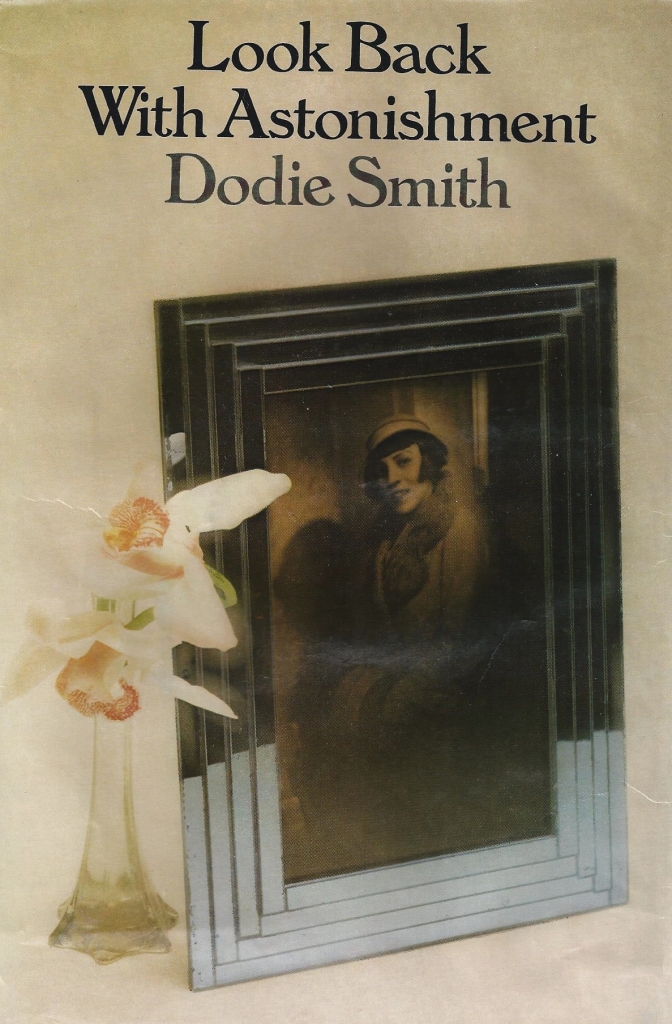
look back with astonishment dodie smith 001

Dodie Smith, circa 1932, in one of her most successful and beloved outfits to date, a grey hat and coat (with matching shoes and handbag) by “Gwen of Devon”

Look Back with Astonishment by Dodie Smith ~ 1979. This edition: W.H. Allen, 1979. Hardcover. ISBN: 0-491-02198-4. 273 pages.

My rating: 10/10

Picking up exactly where Look Back with Mixed Feelings leaves off, with Dodie stepping into Heal’s through the imposing glass entrance doors and taking on what would prove to be a respectably long stint in the retail trade – 1923 to 1931.

Dodie finds life as a working girl pulling the regular 9-to-6 shift five days a week (plus 9-to-1 on Saturdays) something of a change, but she grits her teeth and gets down to it. She has been engaged as Number Five Assistant to the section manager – a situation which rankles – Dodie must initial all of her transactions with the manager’s initials and “5” representing herself as an anonymous cog in the works – and which she soon manages to finagle herself out of, partly by intelligent grasp of her duties and promotion, and partly because (this bit is not in the memoir, but is added in by me from the accounts of others, most notably Valerie Grove in her biography Dear Dodie) Dodie has managed to secretly seduce the store owner, Ambrose Heal.

Ambrose is referred to in LBWA as “Oliver”; Dodie does a rather nice job of obscuring his identity, though when one is fully aware of the scenario many veiled references click perfectly into place. Ambrose is married, and he also already has a long-time mistress, Prudence Maufe, who is well up in the hierarchy of Heal’s. Dodie assures Ambrose/Oliver that she will be happy with “crumbs from the table”, as it were, and the two remain occasional lovers for the next 15 years or so, when Dodie makes a final break with Ambrose upon her departure for the United States on the brink of World War II. (They will remain lifelong friends and dedicated correspondents.)

Marvelous details of the workings of Heal’s; much discussion and description of the era’s domestic architecture. Dodie eventually becomes the toy buyer for Heal’s, and is sent to Leipzig Fair in Germany to view and order stock for the coming Christmas season. A side trip to Austria proves to have astonishing consequences, as Dodie there stays in a small mountain inn maintained by a harp-playing innkeeper.

Inspired by the mountain setting and the cheerful eccentricities of the innkeeper, Dodie, who has been churning out reams of dramatic manuscript and plays in her meager free time, translates her experience into what will become her astoundingly successful play Autumn Crocus, the smash hit of the 1931 London theatre season (“Shopgirl Writes Play!”) and the rest is history.

Look Back with Astonishment goes on to describe Dodie’s entry into the next phase of her life, that of a successful playwright. She was to go onto have an unheard-of six financially successful plays in a row: Autumn Crocus, Service, Touch Wood, Call It a Day, Bonnet Over the Windmill, and Dear Octopus. The quality of these varied, with Dear Octopus popularly declared to be her very best, but Dodie poured heart and soul into each and every one, and her descriptions of casting, staging, rehearsing and dealing with various actors, actresses and directors makes for fascinating reading.

Dodie’s private life has not been stagnating these years either. As well as continuing with her secret relationship with her boss, Dodie has developed another romantic partnership, one which will ultimately see her through to the end of her days.

Seven years younger than Dodie, and marvellously handsome and personable, Alec Beesley had led a life as dramatically complicated as anything Dodie could have dreamed up, and after a most difficult adolescence with a hateful stepmother had gone off to North America where he worked at a variety of jobs from section ganger on a railway in Alaska to cashiering in a Vancouver bank. Back in England, Alec has taken on the job of Advertising Manager at Heal’s, where he and Dodie meet frequently. (Often, to much eventual 3-way heart stirring, in Ambrose Heal’s office.) Com-pli-cat-ed!

Alec and Dodie eventually set up parallel households in adjoining flats; no one is quite sure what their exact relationship is, but Dodie makes mention of the happiness of both their sexual and emotional compatibility, and they do eventually marry (details in Volume 4, Look Back with Gratitude) though neither feels as though any fuss needs to be made regarding the legalization of what was long an established marriage in everything but the eyes of the public and the law.

As Look Back with Astonishment draws to a close, Alec and Dodie, along with Dodie’s beloved Dalmatian dog Pongo – yes, the inspiration for that Pongo, with much more concerning Dalmatians to follow in Volume 4 – are settling themselves into their accommodations on the ocean liner Manhattan, beginning what will prove to be a long self-imposed exile from their beloved England, due to Alec’s long and deeply held convictions as a conscientious objector and Britain’s coming entry into what will prove to be World War II. It is 1938.

I have left so much out; there is a lot in this volume! But I must move along, to the fourth and final installment:

Dodie, Alec, Folly, Buzz and Dandy (I'm not sure which of the canines is which - all these spotted dogs looking rather alike to me) in California, circa 1944

Dodie, Alec, Folly, Buzz and Dandy (I’m not sure which of the canines is which – all these spotted dogs looking rather alike to me) in California, circa 1944

Look Back with Gratitude by Dodie Smith ~ 1985. This edition: Muller, Blond & White, 1985. Hardcover. ISBN: 0-584-11124-X. 272 pages.


My rating: 10/10

Brutally condensing here, though I could go on and on and on.

Dodie and Alec and Pongo set up house in New York and then cross the continent to California. They spend the war years engaged in various theatre and film projects; Dodie’s list of new acquaintances is a Who’s Who of the entertainment and literary world of the time. The most wonderful, for all concerned, is her finding of deeply kindred spirit and forever-more close friend Christopher Isherwood.

Pongo expires; Dodie acquires two more Dalmatians, Folly and Buzz. Folly at one point produces an astonishing 15 puppies (anything familiar here? – yes – this shows up in print down the road) of which litter Dandy is kept to make a boisterous trio.

Dodie turns her attention from playwriting and screenplays to conventional fiction, and spends three years working on what will become her first novel and what many consider her lifetime magnaum opus. That would be – drumroll please – I Capture the Castle, published in 1949 and an instant bestseller in England, once it is released there after its respectable but not stunning debut in the United States.

Much detail of crossing the continent numerous times; the agonizing internal conflict of abandoning England in wartime, the feeling of bitter homesickness and exile which never really goes away, the temporary return to England and the production of several not-very-successful plays, much agonizing on “next steps”, the long gestation and glorious birth of Castle, and much, much more.

This volume ends with Alec and Dodie returning to England for good in 1953; we leave Dodie gazing at the receding horizon of New York City through her stateroom porthole on the Queen Elizabeth.

A fifth volume was planned and apparently mostly written, but never published. I am bitterly disappointed; there is much more to tell and Dodie is by far the very best person to tell it.

I am better than half way through Valerie Grove’s 1996 biography of Dodie Smith, Dear Dodie, and though there are snippets here and there of things not included in the original memoir, it is so far merely a repeat of what I have already heard from the subject’s own lips, as it were. I am looking forward to Grove’s coverage of the years Dodie didn’t get to, being most curious as to the circumstances surrounding the writing and publication of The Hundred and One Dalmatians, as well as the her subsequent adult novels – The New Moon with the Old, The Town in Bloom, It Ends with Revelations, A Tale of Two Families, The Girl in the Candle-lit Bath –   and two more children’s books – The Starlight Barking and The Midnight Kittens.

Dodie Smith died in England at the most respectable age of 94, in 1990. Her beloved Alec predeceased her by three years. Her last Dalmatian, Charley, pined after Dodie’s death, and died a mere three months later.

Dodie Smith never produced anything which could be considered high literature; her plays, though popularly successful, were slight things, mere entertainments for the masses. Yet the best of her work lives on today and continues to appeal to a succession of new readers and audiences. Not such a shabby legacy.

Dodie Smith was a truly unique character, a complex heroine of her long personal era, and a tireless documenter of the times she lived in.

Need I add, these volumes of memoir are very highly recommended?


Read Full Post »
mercy pity peace and love jon rumer goddenMercy, Pity, Peace and Love: Stories by Rumer and Jon Godden ~ 1989. This edition: Quill, William Morrow, 1989. Paperback. ISBN: 0-688-10965-9. 160 pages. Also published as Indian Dust in the U.K., Macmillan, 1989, with identical format and content.

My rating: I have somewhat mixed feelings about this collection of stories mostly by Rumer, because so many are already included in her 1957 collection, Mooltiki, and reading Mercy, Pity, Peace and Love felt very much like déjà vu all over again. But then I got to the very few (four out of fifteen) stories by Rumer’s sister Jon, and those were good enough to still my pangs of annoyance. To be fair, all of these short stories are actually very good, and if you haven’t read the rather obscure Mooltiki, you will be coming to them with fresh and appreciative eyes.

I think in this case I will award the collection as a whole a most respectable 8/10. (Along with the recycled stories, the two also-repeated poems made me knock it back a half point; Rumer Godden was a much more accomplished prose writer; her poems are just “not quite” for me; something just a bit jarring with the phrasing, I think.)

The intent of the collection is to celebrate the India that the Godden sisters knew and loved; they spent most of their childhood years in India, and significant amounts of their adult lives there as well. Rumer and Jon also collaborated on a beautifully written joint childhood memoir, Two Under the Indian Sun, which I read with pleasure some years ago.

Reader Alert! This is the same book as Indian Dust. Both were published in 1989, but Mercy, Pity, Peace and Love is the American title, from Macmillan, with Indian Dust the British title, from Macmillan. I had recently ordered Indian Dust, thinking it was another collection of stories, and was greatly disappointed to find it was identical to the one I already owned, under the Mercy, Pity title.

  • Bengal River by Rumer Godden – a poem – from Mooltiki. First stanza is the best.
Nothing can mollify the sky,
the river knows
only its weight and solitude, and heat, sun-tempered cold,
and emptiness and birds; a boat; trees; fine white sand,
and deltas of cool mud; porpoises; crocodiles;
and rafts of floating hyacinth; pools and water-whirls
and, nurtured in blue mussel shells, the sunset river pearls…
                                                                                                            … … …
  • Possession – by Rumer Godden – from Mooltiki.

The rice field lay farthest from the village, nearest the road. On all sides the plain unrolled in the sun with a pattern of white clouds, white pampas grass in autumn and white paddy birds, and glimpses of sky-reflecting water from the jheels or shallow pools. The sky met the horizon evenly all the way round in the flatness of the plain, an immense weight of sky above the little field, but the old peasant Dhandu did not look at the sky, he looked at his field; he did not know that it was little; to him it was the whole world. He would take his small son Narayan by the wrist and walk with him and say, ‘This field belonged to my grandfather and your great-grandfather; to my father and your grandfather; it is mine, it will be yours.’

But life-plans may go horribly awry; Dhandu’s does not follow its anticipated path; in an ironic ending, which I somehow found reminiscent of W.W. Jacob’s The Monkey’s Paw, the field stays with Dhandu but is forever lost to his son.

  • Rahmin – by Rumer Godden – new to this collection.

An anecdote concerning a series of encounters with a minor craftsman, who proves to be representative of a vast class of Indian society balanced on the knife edge of survival.

  • Monkey – by Jon Godden

Another anecdote, this time by Jon, telling of an encounter with a neighbour’s pet monkey, and the chain of events set off by its biting the author. Fascinating glimpse into the pet-owning culture of upper middle class Calcutta, where Jon was part of a mixed Anglo and Indian community.

  • Sister Malone and the Obstinate Manby Rumer Godden – from Mooltiki.

Sister Malone, the nun in charge of a charity hospital in Calcutta, is unshaken by the horrible sufferings all around her and does great good with her nursing abilities, but her continual effort to share her religious faith with those she heals goes unheeded. One day Sister Malone meets a man who has truly put all of his trust in God, but she cannot reconcile this with her own conception of what faith should be.

  • The Grey Budgerigar – by Jon Godden

Heart-rending short description of a valiant pet bird and its sad fate.

  • Children of Aloysius – by Rumer Godden – new to this collection.

A modest seamstress is offered a once-in-a-lifetime chance to make her fortune.

  • The Oyster – by Rumer Godden – from Mooltiki.

A Bhramini Hindu student, who has travelled abroad to study in England, visits Paris with a friend and is forced to examine the role of compromise in the formation of his own developing character.

  • Kashmiri Winter – by Rumer Godden – a poem – from Mooltiki.
Big Sister, Hungry Sister and the Greedy Dwarf of Ice,
these are forty days of winter, then twenty and then ten…

   … … …

  • The Wild Duck – by Rumer Godden – from Mooltiki.

A young Kashmiri hunter, longing for winter to be over, thinks of his time the previous year among the high mountains hunting ibex.

  • The Carpet – by Jon Godden

The long process of acquiring – or rather, being led into buying by a master salesman – a beautiful Persian carpet. Beautifully observed; gently humorous.

  • Red Doe – by Rumer Godden – from Mooltiki.

A vignette of a young nomad riding up the mountain to fetch his unseen new wife. Sensitive and poignant.

  • The Little Black Ram – by Rumer Godden – from Mooltiki.

An orphan boy,

… a young thief, a bully, noisy, quarrelsome and turbulent, against everyone with everyone against him…

finds his place in the world through his care of a black ram lamb.

  • Miss Passano – by Jon Godden

Miss Passano is disgusted by her fellow humans, and meditates upon a world without them, where only she would remain, in service to the animals she so greatly loves.

  • Mercy, Pity, Peace and Love – by Rumer Godden – new to this collection

Ganesh Dey attempts to write on these concepts – Mercy, Pity, Peace and Love – for his doctoral thesis. A gently ironical and emotionally powerful story, possibly the best of the collection in its summation of the contradictions of human nature and how we actually treat each other versus how we view our relationships and interactions.

Read Full Post »

a far cry from kensignton pb muriel sparkA Far Cry From Kensington by Muriel Spark ~ 1988. This edition: Penguin, 1989. Softcover. ISBN: 0-14-010874-2. 189 pages.

My rating: 8.5/10

I am breaking my several-weeks’ book-discussing silence to applaud this brief novel by the increasingly enjoyable Muriel Spark.

Isn’t it interesting that there sometimes seems to be a proper time for certain writers in a reader’s life? I think I may have entered into a deliciously Spark-ling phase of my own, for recently I found The Mandelbaum Gate to be unexpectedly good, as is this other nicely crafted thing.

A Far Cry From Kensington turned out to be happily mesmerizing, being a tightly written tragi-comedy narrated by once-obese Mrs Hawkins – I mention the obesity because it is crucial to the plot in a most bizarre way – looking back three decades to her life in 1954-55.

At the period of time which is the focus of her reminiscences, Mrs Hawkins works “in publishing” – she is employed as an editor at a soon-to-be-doomed small press situated in Kensington – and throughout the novel we get intriguing glimpses of the workaday side of the flourishing-yet-troubled literary scene of London in the 1950s, an era and an atmosphere which Muriel Spark knew in intimate detail.

Widowed soon after her impetuous wartime marriage, Agnes (“Nancy”) Hawkins, always a large girl, has effortlessly transformed into a cheerfully fat woman, “massive in size, strong-muscled, huge-bosomed, with wide hips, hefty long legs, a bulging belly and fat backside; I carried an ample weight with my five-foot-six of height, and was healthy with it.” And people confided in Mrs Hawkins: “I looked comfortable. Photographs of the time show me with a moon-face, two ample chins and sleepy eyes… It was not until later, when I decided to be thin, that right away I noticed that people didn’t confide their thoughts to me as much, neither men nor women…”

Living in a rooming house presided over by the warmly maternal and personally high-principled Milly, Mrs Hawkins is fortunate in her housemates, whom she describes with concise but living detail: the ultra-respectable and preternaturally quiet married couple, the Carlins – he an accountant, she a nursery school teacher; the cleanliness-obsessed district nurse Kate; the gloomy and excessively emotional Polish seamstress Wanda; the young and vivacious post-deb Isobel, trying out her downy wings in London as a secretary, though in constant close contact with her doting father via a private telephone of her very own; and, not least in eventual importance to Mrs Hawkins’ personal story, the brilliantly promising, dragged-up-by-his-own-bootstraps medical student William Todd.

All of these lives are intertwined with that of Mrs Hawkins; some exceedingly closely, as we will discover later in the narrative, though Muriel Spark frequently dangles just the briefest, most tantalizing fragments of information in front of us in the course of Mrs Hawkins’ tale.

Mrs Hawkins is prone to giving advice, much of it quite good, as it turns out. Pragmatic common-sense spiced with opinionism is Mrs Hawkins’ style. We learn how simple it is to lose weight (eat just half of your regular portions, and then, when the willpower is adjusted, half again); to control rheumatism (eat a banana a day, as advised by “an American negress met on a bus”); to write an engaging narrative (pretend one is writing to a single close friend); to attain concentration (acquire a cat).

This last was one of my favourite asides in this vignette-rich novel. At a dinner party, Mrs Hawkins meets a gruff, red-faced, retired Brigadier General, who mentions that he “could write a book” about his life.

‘Why don’t you?’

‘Can’t concentrate.’

‘For concentration’ I said, ‘you need a cat. Do you happen to have a cat?’

‘Cat? No. No cats. Two dogs. Quite enough.’

So I passed him some very good advice, that if you want to concentrate deeply on some problem, and especially some piece of writing or paper-work, you should acquire a cat. Alone with the cat in the room where you work, I explained, the cat will invariably get up on your desk and settle placidly under the desk-lamp. The light from a lamp, I explained, gives a cat great satisfaction. The cat will settle down and be serene, with a serenity that passes all understanding. And the tranquillity of the cat will gradually come to affect you, sitting there at your desk, so that all the excitable qualities that impede your concentration compose themselves and give your mind back the self-command it has lost. You need not watch the cat all the time. Its presence alone is enough. The effect of a cat on your concentration is remarkable, very mysterious.

The Brigadier listened with deep interest as he ate, his glaring eyes turning back and forth between me and his plate. Then he said, ‘Good. Right. I’ll go out and get a cat.’ (I must tell you here that three years later the Brigadier sent me a copy of his war memoirs…On the jacket cover was a picture of himself at his desk with a large alley-cat sitting inscrutably beside the lamp. He had inscribed it ‘To Mrs Hawkins, without whose friendly advice these memoirs would never have been written – and thanks for introducing me to Grumpy.’ The book itself was exceedingly dull. But I had advised him only that the cat helps concentration, not that the cat writes the book for you.’

Ha!

If you smiled sympathetically at this excerpt, this book is for you.

Read it, then, and discover just what a pisseur de copie is, and what significance The Box in the esoteric (and deeply weird) practice of radionics holds, and just what Muriel Spark really thought about one of her ex-lovers, here immortalized as the deeply dislikeable Hector Bartlett.

And, for another agreeable opinion, click on over to His Futile Preoccupations, one of many other favourable reviews of this quietly malicious minor masterpiece.

Read Full Post »

thornyhold dj mary stewartThornyhold by Mary Stewart ~ 1988. This edition: Ballantine/Fawcett Crest, 1989. Paperback. ISBN: 0-449-21712-4. 289 pages.

My rating: 8/10

Three-quarters of this romantic suspense novel was absolutely excellent; the promising plot evaporated just a little disappointingly in the concluding chapters, but on reflection my overall impression is favourable. It’s keeper, and it gets a very decent rating of 8/10 on my personal merit scale.

I do believe I am turning into a Mary Stewart fan; I’m feeling rather ashamed of my prior dismissal of this writer; I’m discovering that she is a more than competent writer; she has full control of her words, and I don’t believe I’ve yet to read an awkward phrase. She can write action scenes in vividly cinematic detail – see any of her romantic-suspense novels written between 1954 and 1976 – and accompany those with lyrical descriptions of the places where the action takes place. In a genre which encompasses some disappointingly sub-par stuff – Phyllis A. Whitney springs to mind for some reason, perhaps because I’ve been reading her this year too, and finding her sadly lacking – Stewart’s prose stands out. It’s not high literature, but it is well done, and most enjoyable to read. So I’m adding Mary Stewart to the shelf beside D.E. Stevenson and Georgette Heyer, as ones to track down, read with pleasure, and keep safe for future re-reads. Thank you, fellow internet book people, for giving me the nudge to explore these writers. You were more than right!

Mary Stewart’s heroines are uniformly well-drawn (so far every book I’ve read by her has been focussed on a leading female character), though they do always seem to share some characteristics. They are always good-looking, instantly attractive to men, and much prone to impulsive behaviour, with expected results. Each one of them does have her own personality, though, her own quirks and talents and weaknesses. The heroines are slightly interchangeable, perhaps – a test of a “stock” character is to imagine him or her in another of the author’s books – I could see Stewart’s young ladies managing quite well wherever they were placed within her fictional settings.

The heroine in Thornyhold is no exception, though the action in this low-key novel is confined to occasional verbal sparring. No drawn knives to avoid, no bullets to dodge, no trains to outrace, no rooftops to clamber over – our author at this point was likely ready to take a bit of an action-scene rest; Thornyhold was published in 1988, when Mary Stewart was a most respectable seventy-two.

Young Geillis – Gilly – Ramsay lives a lonely life, with an oddly assorted pair of parents.

I suppose that my mother could have been a witch if she had chosen to. But she met my father, who was a rather saintly clergyman, and he cancelled her out. She dwindled from a potential Morgan le Fay into an English vicar’s wife, and ran the parish, as one could in those days – more than half a century ago – with an iron hand disguised by no glove at all. She retained her dominance, her vivid personality, a hint of cruelty in her complete lack of sympathy for weakness or incompetence. I had, I think, a hard upbringing.

Gilly grows up; her mother dies, and with the natural mourning there is some relief, for her mother was a difficult person to live under. Gilly abandons her University classes and settles in to housekeep for her father; when he dies in his turn, Gilly is twenty-seven, with no resources to fall back on, and no real idea of what her future holds. Then, lo and behold, on her return from her father’s funeral to the vicarage which she will soon have to vacate, she receives a letter informing her that her godmother, (her older cousin, also Geillis, after whom Gilly has been named) has died and has bequeathed to Gilly a small country house and a very small income. Along with the lawyer’s letter is a note to Gilly from Cousin Geillis, telling her that she will find “everything here that you have most wanted.”

Cousin Geillis was something of a pagan, rejecting the outward trappings of Christianity, which made things just the tiniest bit awkward with her uncle-in-law the vicar. Her neighbours in the country regard her as something of a white witch, with her knowledge of herbalism and her sometimes peculiar behaviour, not to mention her large cat – her familiar? – Hodge. Gilly herself has had occasion to note that her cousin has some unique powers, showing up now and then just when most needed to help her young namesake over emotional hurdles in her life, and on one memorable visit providing Gilly a fleeting glimpse into the future, via crystal ball.

So Gilly steps into the life her cousin has left waiting for her. Needless to say there are some twists in store, chief among them being her cousin’s neighbour, Mrs. Trapp, who seems more at home in Geillis’ house than she should be. She brings Gilly meals, and nags her about finding a certain handwritten notebook she claims Geillis would have wanted her to have, and behind her ready smiles Gilly glimpses a steel-trap disposition which is most unnerving.

And, being a romance, there does in due time appear a man. And because it is a Mary Stewart romance, the man in question is preceded by a charming young son, whom Gilly befriends with no idea at all that the friendship will lead to something much, much more.

There is a certain intensity in the first part of the book which was rather heart-rending; one wonders if some of it is autobiographical? Or perhaps it is just cleverly imagined. The lonesome child Gilly is nicely portrayed, though the tone is carefully unemotional; our narrator telling the story is Gilly herself, some seventy years onward, looking back from her (happy) old age.

With the escalating escapades of scheming Mrs. Trapp, the tale turns towards farce, with the ending sequence – concerning, among other things, a love potion gone awry – striking something of a frivolous note after the emotional seriousness of what has come before.

A well-written book in its way, and one I will no doubt return to when I want something not too challenging to pass an hour or two. Good reading for a waiting room or a journey; easy to pick up and put down; the limited number of characters and the straightforward storyline are easy to keep hold of even with frequent interruptions.

Read Full Post »

And the last late reviews from February of 2013.

*****

the little bookroom eleanor farjeonThe Little Bookroom by Eleanor Farjeon ~ 1955

This edition: New York Review Books, 2003. Hardcover. ISBN: 978-1-590170-489. 336 pages.

My rating: 8/10

A collection of twenty-seven delicately written fairy tales. Aimed at the younger crowd, but possibly more suited to real appreciation by adults. A few are slight, gentle and – in the very best sense of the word – childish, but others are rich in their imagery and complexity. The stories were selected by Eleanor Farjeon herself, and are deliciously and perfectly illustrated by the one and only Edward Ardizzone. Rumer Godden’s Afterword is a lovingly worded compliment to the author.

My own pretty well grown children are sadly long past the stage of being read to, but I am keeping this one close by both for personal pleasure and perhaps to one day share with as yet theoretical grandchildren.

sensible kate doris gatesSensible Kate by Doris Gates ~ 1943

This edition: Viking Press, 1969. Hardcover. 189 pages.

My rating: 6/10

Doris Gates is perhaps best known for her Newbery Award runner-up children’s novel Blue Willow, as well as the widely read Little Vic, both viewed as important early examples of “realistic problem fiction” for young readers, not a genre I am particularly fond of as a rule, but which is perfectly acceptable when the characters and their story are over-emphasized over the “problem”. Doris Gates gets a pass; these are “real” novels no matter how they’re categorized.

Sensible Kate was Gates’ third novel, and it is a pleasant example of children’s literature of its era, with the young heroine facing her rather daunting challenges with good expectations of positive outcomes. The Kate of the novel is a likeable girl, flawed enough to be realistic, but with a solid core of goodness which makes her most appealing.

Kate has been an orphan as long as she can remember, and has been cared for by various “shiftless” relatives since babyhood. Now the relatives have decided to move out of the state, and they have decided to turn Kate over to the county relief office. Kate is placed as a foster child with an elderly couple, The Tuttles, and she soon makes herself beloved of them and many others whom she meets, including a young married couple, both artists, who are the very reverse of sensible in their daily affairs, and who are most appreciative of Kate’s practical talents.

A sweet but never saccharine story, with some interesting characters and scenarios which lift it a little over the average for its vintage and genre. Possibly one might pick up on the lightest shade of Anne of Green Gables, what with the red-haired heroine being an orphan and going off to live with an elderly couple, but the parallel ends right there. Kate is most certainly no Anne, and her creator has not attempted to model her so.

people who knock on the door patricia highsmithPeople Who Knock on the Door by Patricia Highsmith ~ 1983

This edition: Penguin, 1983. Paperback. ISBN: 0-14-006741-8. 356 pages.

My rating: 6.5/10

A rather unusual book, a noir almost-thriller with some odd twists, including a subplot involving a teenage girl’s abortion. Despite its date of publication, it seems to be set in the 1950s, and has a decidedly vintage feel to it. This is the first Patricia Highsmith book I’ve ever read, though I’ve seen several of the movie adaptations of her work, Hitchcock’s Strangers on a Train, and of course the Venetian-set Talented Mr. Ripley, so the dark psychological elements in this one came as no surprise.

Here we have a normal middle-class family, the Aldermans, with an insurance-salesman father, stay-at-home mother volunteering a few days a week at a children’s hospital, and teenagers Arthur and younger Robbie. Arthur is getting ready to go to college, has a satisfactorily active love life, and he is poised to get on with his life when his whole world takes a sickening lurch.

Robbie falls ill with a mysterious infection and is suddenly on the verge of death. The doctors turn away in dismissal – the boy is going to die –  but Mr. Armstrong refuses to give up hope, and prays diligently to God for a miracle. Robbie recovers, and the previously un-religious father is so moved by the experience that he embraces religion and joins a highly evangelistic Christian sect. Mrs. Armstrong and Arthur view this at first with mildly perturbed eyes, but Robbie fully embraces his father’s new-found faith, with eventual horrifying consequences.

A can’t-look-away, exceedingly uncomfortable depiction of a dysfunctional family and its twisted disintegration, with none of the characters completely faultless, including our pseudo-hero Arthur, the closest thing to a chief protagonist in this tense tale.

 the wedding of zein tayeb salihThe Wedding of Zein by Tayeb Salih ~ 1968

This edition: New York Review Books, 2009. Softcover. ISBN: 978-1-59017-342-8. 120 pages.

My rating: 7/10

Two short stories and a short novella – the title story – by the late Sudanese writer Tayeb Salih, set in the country around the northern Nile .

The Doum Tree of Wad Hamid speaks to the importance of tradition, and to the quiet resistance of the people of the Sudanese country to outside influences.

A Handful of Dates concerns a young boy who becomes aware for the first time of the realities of rich and poor, and the role his grandfather has played in a neighbour losing his inheritance.

The Wedding of Zein concerns an unlikely hero, a physically deformed “village idiot” (for want of a better term), who insistently falls in love with one after another village maiden, only to be disappointed as they always marry someone else. Imagine then the shock of everyone when it is announced that Zein has at last found a prospective wife, and an unexpectedly wise and beautiful one at that.

This book gives a diverting glimpse into an unfamiliar world, and the stories are told with clarity and understated, rather sly humour. A short but worthwhile collection.

Read Full Post »

« Newer Posts - Older Posts »