Archive for the ‘1970s’ Category

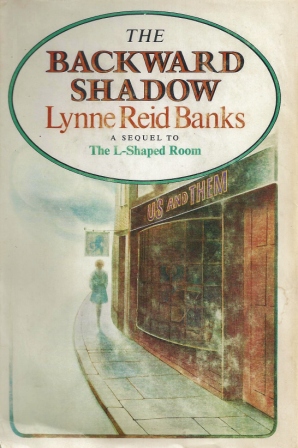
The Backward Shadow by Lynne Reid Banks ~ 1970. This edition: Simon & Shuster, 1970. Hardcover. 246 pages.

This is a failed review; a non-review; an unreview. I have been trying and trying to finish this book, but have found myself at a dead stop in interest level. Maybe during another time in my life? I need to get this off my desk, and off my conscience, so I’m going to shelve it now, along with its prequel, The L-Shaped Room (which I did manage to read and review, hence the presence of the sequel on my to-read list), and with all the sombre Margaret Atwoods et al which I also have trouble getting thrilled about at this point. Life changes; our reading choice ebb and flow and evolve. Someday, perhaps, “Jane Graham’s” tale will be of interest to me, but certainly not now.

It’s not that it’s a “bad” book; there is a certain style and flow to Banks’ writing that is decidedly appealing, and I can see that her heroine might be someone whom the reader could make friends with, if the reader is in that place in their life where they can identify and sympathize with Jane and her endeavours.

In the meantime, here is the flyleaf description, for the record. I fully agree with the facts of this blurb (okay, maybe not the “glowing achievment” bit, but I agree in general), but just can’t get past my personal annoyance at Jane’s irritatingly navel-gazingish personna; I know constant self-examination is a good thing and all, but this gal takes it to a high level. I’m just one person, though – others feel much more enthusiastic! You’ll have to try it for yourself.

Here’s a link to the Goodreads page:

http://www.goodreads.com/book/show/1916493.The_Backward_Shadow

And from the flyleaf:

From the author of the memorable The L-Shaped Room comes this powerful, disturbing, bittersweet sequel – a complete novel by itself, which continues the story of Jane, now living in an English country cottage with her illegitimate child, determined to forge a viable, independent future. She still loves Toby, her past lover but not the father of her child, but she has an obstinate conviction that she must not burden is writing career by saddling him with her situation.

Tough and resilient though Jane is in many respects, the intensity with which she loves her child is not enough to conceal from her the recognition of her essential loneliness in her isolated country life. She resolves to meet the challenges in her own way and, as readers of The L-Shaped Room will remember fondly, Jane’s way is one of honesty, humor, and unsentimental insight.

Rarely in fiction does the sequel to a celebrated novel measure up to its predecessor in impact and originality, but The Backward Shadow is in every way as glowing an achievement as Lynne Reid Bank’s first book…

And here is the Kirkus Reviews take, from 1970:

This is an extension of The L-Shaped Room (better remembered as a film?) in which unwed mother Jane has retired to Surrey with her infant, David, and is still in love with Toby (not his father). Toby comes down from London to see her now and again before he gets attached elsewhere and Jane learns too late that being an independent woman (not in the current sense) has a premium. With Dottie, an old friend, she starts a gift shop which is subsidized by Henry, Dottie’s contact. Before they’re through “the backward shadow” has darkened all their lives: Dottie’s is loneliness; Jane’s is the problem of getting along and bringing up David; Henry’s is “dying well”–which he does, although Jane and Dottie cry a great deal. . . . Essentially it’s a soft-shelled woman’s story–a term which has been discredited rather than the fact. There will be readers.
Read Full Post »

The Baler

You tourist composed upon that fence
to watch the quaint farmer at his quaint task
come closer, bring your camera here 
or fasten your telescopic lens 
if you're too indolent; all I ask 
is that when you go home you take 
a close-up among your color slides 
of vacationland, to show we pay the price 
for hay, this actual panic: no politic fear 
but tumbling wild waves down the windrows, tides 
of crickets, grasshoppers, meadow mice, 
and half-feathered sparrows, whipped by a bleeding snake.
 
Hayden Carruth, circa 1970

Read Full Post »

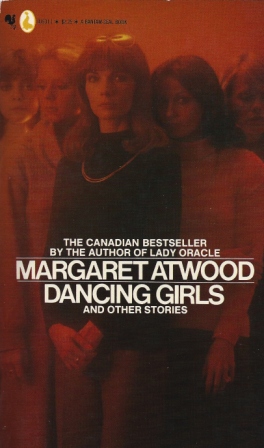
Dancing Girls by Margaret Atwood ~1977. This edition: Bantam Seal, 1978. Paperback. ISBN: 0-7704-1531-1. 245 pages.

My rating: 5.5/10. A few too many misses for a really high rating.

*****

A collection of short stories written early in the career of Canadian icon Atwood.

I have an ambiguous relationship with Margaret Atwood, or, rather, her work. I greatly admire the real person; Atwood has become an outspoken and lucid critic of much of what is troublesome about Canadian societal, political and environmental issues. I have heard many of her interviews and lectures via our venerable CBC Radio, lifeline of many Canadian rural dwellers far from the bright lights of the cities which have absorbed the majority of the population in this vast and still-wilderness-filled land. Just thinking about her, Atwood’s distinctive voice fills my head; nasal, cynical, with a deadpan delivery that would make her a knock-out stand-up comic if she were ever to desire to switch careers at this late date.

But… I am not completely comfortable with much of her written work. I’ve read all the novels dutifully as they’ve appeared through the years, as a typical middle-aged, literate, Canadian liberal feminist (as good a description of my demographic as any) should. I can nod and smile knowingly during literary discussions with the local intelligentsia, though I add little to the conversation myself; I am very aware of my value as an audience to my much more vocal acquaintances and have no real desire to step into the conversational limelight myself much of the time; it’s simpler to stand by and listen…but I digress.

Atwood. How to describe my feelings? Well… ambiguous… I guess. There is no doubt that the woman can write. Her words flow, dance, surprise, shock – grand stuff indeed! But too often I put down the latest Atwood feeling a vague dissatisfaction. Are things really that bad? Are all of our relationships – friendly, familial, societal and particularly sexual and marital – as deeply flawed as Atwood continually portrays? A course of Margaret Atwood often drives me to the other extreme; to the literary arms of, say, Elizabeth Goudge, with her encouragements of perseverance and sacrifice rewarded, versus Atwood’s cynical view that it doesn’t really matter how hard you try, you’re pretty well screwed from the get-go. (I rather agree, but all in all, it’s not that bad; most of us muddle along with a fair amount of happiness despite the inevitable rough bits. Don’t we?)

But this woman can write.

Here is what you’ll find in Dancing Girls.

***  =  the ones I greatly enjoyed.

*  =  Worth reading.

The rest I rather wish I hadn’t subjected myself to, though opinions obviously will differ.

  • The War in the Bathroom – A week in the life of a woman who has apparently descended into some form of mental illness; she has split into two personalities; the intellectual (controlling) and the physical (responding). Typically depressing; not one of the gems of this collection.
  • ***The Man From Mars – An unattractive student is targeted by a stalker, “a person from another culture”.  I liked this one. Melancholy (of course!) but very well presented; cynically amusing; I can hear Atwood’s best voice loud and clear.
  • Polarities – A woman goes slowly mad. Dreary as the winter setting and the doomed relationships it describes.
  • Under Glass – Another doomed love affair. Sad, sad, sad.
  • The Grave of the Famous Poet – A journey becomes a metaphor for another imploding relationship.
  • ***Rape Fantasies – This one story is probably worth buying the book for. Four young women discuss rape fantasies. Atwood at her wickedly humorous best.
  • ***Hair Jewellery – Beautifully written. Another relationship unravelling, but the protagonist moves successfully on. Or at least so we think.
  • ***When It Happens – An elderly woman prepares for the end of the world. Haunting.
  • A Travel Piece – A travel writer on a trip that goes terribly wrong. Taps into all of my worst-case flight scenario fears. Wish I hadn’t read this one – personal nightmare stuff!
  • The Resplendent Quetzal – Too many details about an unhappy marriage and the petty meannesses that bitter people resort to.
  • *Training – A young man examines his motivations and innermost feelings as he deals with his family’s and his own expectations for his future.
  • *Lives of the Poets – This one feels autobiographical. Another relationship tragedy, enhanced by the futility of struggling artistic careers.
  • *Dancing Girls – Culture clashes in a rooming house.
  • ***Giving Birth – The ambiguities of expectant and new motherhood. Excellent.

Read Full Post »

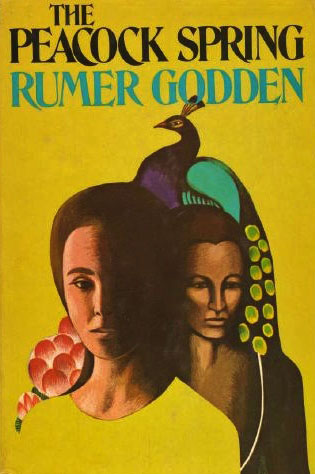
The Peacock Spring by Rumer Godden ~ 1975. This edition: Viking, 1976. Hardcover. 243 pages.

My rating: 7/10

Two English half-sisters are sent from boarding school in England to join their divorced U.N.-diplomat father in India.

15-year-old Una and younger sister Halcyon (Hal) are respectively gifted in mathematical ability and singing; Una in particular worries that their new Eurasian governess-teacher will not be able to teach to the standard required to qualify her for entrance to Oxford. This proves to be the case; Miss Alix Lamont turns out to have other qualities which the girls’ father, Sir Edward Gwithiam, has chosen her for; namely her beauty and personal charms. He is openly infatuated with Alix, and the girls’ presence is meant to give a plausible reason for her inclusion in his household.

Una and Alix find themselves in the position of jockeying for position in Sir Edward’s affections; Alix is strongly entrenched, and Sir Edward intends to marry her. Una, smarting from her father’s rejection (she was always his confidante, but he has distanced himself from both of his daughters since Alix gained his interest), becomes involved with Ravi, a young Indian gardener on attached to the U.N. estate, who is actually a well-born Brahmin student in hiding for his part in a violent political protest. Meanwhile, Hal has become infatuated with the son of a deposed Rajah, Vikram, who is in turn in love with Alix. This seething mass of emotional undercurrents leads to Una’s disastrous flight with Ravi and the laying bare and reworking of all of the relationships thus involved.

Quite a well-done story; generally plausible and sympathetically told. All characters are well-developed and complex, and are treated very fairly by their author in that we see the multiple facets of their personalities and fully understand their motivations. The ending is quite realistic, though not perhaps what one could call “happy”; the various characters move out of our vision with these particular issues resolved but many more looming. All in all I thought it was one of Godden’s better coming-of-age novels; I enjoyed it more than I initially thought I would from the reviews I had read.

Suitable for young adult to adult. Frank but not explicit sexual content including extramarital relationships and the sexual involvement between a schoolgirl and an older man; pregnancy and abortion are discussed though mostly by implication. Rumer Godden in this novel has kept abreast of the times; she was 69 when this novel was published and though a bit dated here and there the tone is generally contemporary.

Read Full Post »

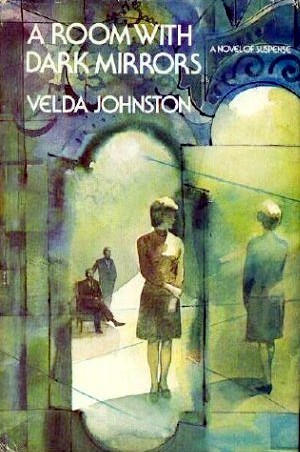
A Room with Dark Mirrors by Velda Johnston ~ 1975. This edition: Dodd, Mead & Co., 1975. Hardcover. 184 pages.

My rating: 5.5/10.

*****

I’m always on the lookout for light reading for my elderly, housebound mother; books are one of her last remaining pleasures after a very full and creative life now curtailed by painful and crippling severe osteoporosis and arthritis.

Always a voracious reader, she prefers well-written, intelligent, but not necessarily “deep” books; she readily acknowledges many of her stand-bys to be leaning towards “fluff”, but she does prefer them to be high-quality and mentally engaging fluff. With this recent thrift-store pick-up, I may have tapped into a new “Mom’s author” to keep an eye out for in my rambles.

Velda Johnston (1911-1997) was a prolific American writer of romantic-suspense and light-gothic novels. Doing a bit of internet research on her background, I find her listed as the author of 36 novels dating from 1968 to 1991. If this is correct, Velda Johnston’s published writing career spanned from her fifty-seventh to her eightieth year, leaving me a little curious about her full history and her earlier life.

I was able to find only a few random comments on several of Johnston’s other titles, but the general tone is that they are well-written and surprisingly literary and intelligent for the genre. My experience with Dark Mirrors would bear this out.

The story flowed beautifully and was much more engaging than I had expected from my initial page-through, though the plot was rather predictable, despite Dark Mirrors’ prominent billing as a “novel of suspense.”

Dorothy Lang is a recently divorced stewardess who keeps running into her regretful and apologetic ex-husband Eric on her flights. He hopes to reunite, though Dorothy has a very legitimate reason to refuse his continual offers of reconciliation. This trip, they find themselves bound for the same area of Paris, where Eric has been posted on an engineering contract, and Dorothy has her stopover accommodation. Hurrying down a street, trying to avoid her ex-husband whom she rather suspects is following her, Dorothy is accosted by a strange man with a gun who orders her into a waiting car. Eric appears in the nick of time to act as white knight, and our story is well away.

Does this sound rather trite and possibly a bit boring? Well, it is and it isn’t. Dorothy is a sweetly complex character for this type of thriller-lite; the very 1970s plot requires a certain suspension of disbelief; but I found myself a willing partner in Dorothy’s adventures. The ending left me wryly smiling, with a bit of a “I can’t believe I ate the whole thing” feeling, but, on the whole, I’d cheerfully read another of Velda Johnston’s books if it appeared in my reading stack and I was too tired to engage in something more intellectually challenging.

Perfect fare for summer reading for my mom, and anyone else looking for a mild trip down a recent(ish) memory lane; the 1970s setting and the evocation of the “glamorous” life of a an airline stewardess will stir nostalgia to any of us who remember that decade well, and possibly provide a bit of a chuckle for a younger generation. Our heroine Dorothy has enough deprecatory self-awareness and natural wit to be an enjoyable companion for the few hours it takes to get her sorted out and back on track after her Parisian adventure.

Read Full Post »

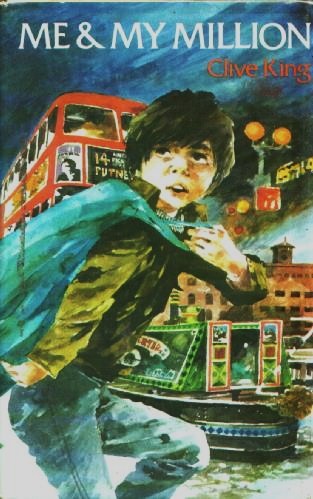
Me and My Million by Clive King ~ 1976. This edition: Kestrel (Penguin) 1979. Ex-lib hardcover. ISBN: 0-7226-5185-6. 133 pages.

My rating: 9/10.

From the front flyleaf:

Ringo knew he was carrying more in his laundry bag than just old socks. Whatever it was, his part in the job was a cinch – his brother Elvis had told him to leave it at the laundrette at the end of the 41 bus route. So how come Ringo found himself on the other side of London with a million pound picture in his bag and not so much as 10p in his pocket? Lost, broke, stuck on the pitch-black underground platform for the night – and scared witless by Angel Jim, all hairy and hippy, padding up beside him. Ringo’s troubles were just beginning…

Angel Jim took him home to his squat in the fire-station – all peace-loving and sharing. But sharing meant they wanted their cut of the million pound picture. And so did Uncle, the big dealer, and his chauffeur Eugene, and Glasses and his gang, not to mention Elvis! It looked like Ringo was cornered – until he fooled an old lady into holding onto the goods, and slithered down her drain-pipe to the canal – right onto Big Van’s barge – and what does he find? Big Van’s got the million pound picture, or one exactly like it. Big Van was just about to explain, when a copper knocks at the barge door. Ringo’s troubles were beginning again…

Cheerfully unrepentant  young delinquent Ringo tells of his part in the gone-wrong art heist master-minded by his junior-criminal brother Elvis. (Regretfully, we never get to meet the rest of their family.)

“Well, Elvis, he’s only half my brother really. So he’s half at home and half somewhere else. He’s old, more than twenty. They gave him this soppy name after some old pop star… Ringo, that’s what they call me. I think it’s some other old pop star that my mum liked…”

Clive King must have had a good time writing this fast-paced adventure story. Young Ringo, from the first sentence onward, never breaks character for an instant. Though we’d best not trust him alone for a minute with anything valuable around, his heart is nonetheless good deep down.

We willingly surrender our disbelief early on, when Elvis and his cohort Shane manage somehow to steal a valuable painting from a museum; Ringo is drafted as the receiver of the goods, and manages to totally mess up the hand-off to the next member of his brother’s gang. Ringo’s downfall is his obvious dyslexia – he struggles to read the simplest words, and numbers turn themselves around in his mind – hence his initial mistake in getting on the 14 bus versus the 41.

“It’s like this… It’s along of those figures and letters and words. I mean, like the buses. Elvis says forty-one and I get on a fourteen. But a forty-one coming towards you, and a fourteen going away, they look the same!”

Luckily Ringo’s mix-ups save his skin more than once as he careens through London bouncing off the most eclectic bunch of characters – a group of more-than-mellow peace-and-love hippies, a wealthy “picture collector” with less-than-legal connections, an artist-turned-(somewhat)-art-forger living on a canal boat, and a sinister group of animal liberationists with a dark agenda.

Happily everything turns up okay in the end. Ringo saves the day, and – water off a duck’s back – gets on with his life, which would appear to have taken a turn in a decidedly more positive (and distinctly more legal) direction due to his lively adventures and new acquaintances.

What a cheerfully loopy story this is! While it was written for a young(ish) audience, it is such a strong portrait of a certain kind of person at a certain point in time in a certain place that I suspect a young reader today would be rather at sea as to what’s going on and why the funny bits are so funny. The hippies in particular are such a period piece, gleefully and sympathetically portrayed by King. Or maybe there’d be no problem. My own offspring often surprise me by how sophisticated their understanding of the past sometimes is. And those of us who were young in the 1960s and 70s will “get it” completely. This book’s humour reminds me strongly of the classic 1969 British crime-and-car-chase movie The Italian Job, starring Michael Caine; Charlie Croker could have been Elvis’s role model!

Definitely share Me and My Million with your kids – it’s a neat little diversion of a book – but try it for yourself too. Enjoyable quick read.

Read-Aloud: I would say probably a “yes”, I’m thinking for 8 years old or so & up.  Definitely worth a try. 14 shortish chapters; fast paced. I think once you figured out a narrative “voice” it would be great fun to do, though we never tackled this one as a read-aloud ourselves.

Read-Alone: Probably 10 & up, and well into the teens. Depends on the individual reader and how good they are at catching inferences and figuring things out from prior knowledge; written in a bit of a challenging style; the reader has to fill in the blanks.

Read Full Post »

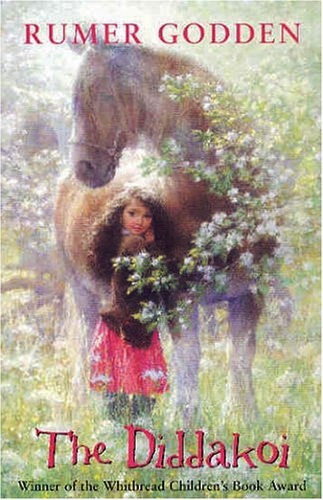
diddakoi rumer goddenThe Diddakoi by Rumer Godden ~ 1972. This edition: Macmillan, 2007.  Softcover. ISBN: 978-0-330-45330-1. 152 pages.

My rating: 6.5/10.

Also published as Gypsy Girl in some editions. Do not confuse with another of Rumer Godden’s titles – Gypsy, Gypsy (1940) – which is a decidedly adult novel.

I have a vaguely uneasy relationship with this small story of the half-Irish, half-Romani (“gypsy girl”) Kizzy. The writing is of very high quality (no surprise there; Rumer Godden seemed incapable of turning out a poorly written phrase) but the plot – oh! – the plot is terribly contrived, especially when read with today’s sensibilities.

Young Kizzy, about 6 or 7 years old (she doesn’t know her birthday), lives with her great-great grandmother in a shabby, blocked-up gypsy wagon on a corner of Admiral Sir Archibald Twiss’s estate. Ancient Joe, who used to pull the wagon, grazes away his days and is Kizzy’s favourite companion, and all is generally well, if occasionally cold and hungry, in Kizzy’s little world.

The village do-gooder, Mrs. Cuthbert, twigs  to the fact that Kizzy is school-age and decidedly not at school; she cries “neglect!” and calls in the welfare officer and the official wheels are set in motion. Off our wee heroine goes to the village school, where she immediately falls afoul of a village’s worth of young “mean girls” (ringleader none other than Mrs. Cuthbert’s daughter Prue) who set upon her as a ready-made victim for their taunts.

Kizzy copes as best she can, but things get even worse. Her Gran dies, relatives are located and called in to deal with things, the wagon is burned in accordance with Gran’s wishes (an old Romani custom upon a death), and Joe is destined for the knacker’s yard, while an argument erupts over who will take Kizzy in. No one much wants her.

Kizzy takes control of her own destiny, and of Joe’s, escaping in the night and ending up on Admiral Twiss’s doorstep begging sanctuary for her horse. Of course, in the proper melodramatic tradition, she now falls ill and “cannot be moved” (apparently there are no ambulances available in 1970s England to transport a gravely ill child to hospital!) and must be cared for by the Admiral and his two devoted retainers.

To condense: Kizzy is re-homed with understanding Miss Brooke, though with more than a little resistance from Kizzy who was quite content in the Admiral’s bachelor establishment. The bullying at school escalates into a physical episode where Kizzy is injured, bringing the situation at long last to the official notice of the village adults who had been letting things work themselves out. The young bullies are allowed their chance at redemption; Kizzy learns to love dedicated Miss Brooke; a proper home is providentially provided; and all’s well that ends well.

For all of the predictability and sometimes glaring flaws in the plot-line, this story works out quite well. We develop an affection and admiration for this stubbornly individual child who refuses to be a victim of fate, even while being tossed and turned by events beyond her control. Though the ending is a little too good to be true, we feel that justice has been done at last; it serves to satisfy the moral craving for “good to be rewarded, wicked to be punished” which lies at the heart of all classic story tales.

A bit of a period piece. Especially dated, in my opinion, is the episode of the young girl being left in the intimate care of three men completely unrelated to her, with the full approval of the local doctor and the child welfare officer – does anyone else raise an eyebrow at this unlikely nowadays scenario? A sentimental read for teens and adults, and a generally interesting and satisfying children’s book.

Read-Aloud:  Works well as a read-aloud for all ages of children, though prepare for discussion of the bullying as it is quite graphic. There are also two deaths (Granny and Joe), plus a nearly tragic episode involving a house fire. The narrative jumps around somewhat, making it challenging to follow for very young children; I’m thinking 6 or 7 and up is best though littler ones could certainly listen in. This story moves along at a good pace and holds interest well both for the reader and the listeners.

Read-Alone: Good chapter book for fluent readers in the 7-ish to 11-ish year-old age range. Written with an advanced (adult) style and vocabulary; not at all an “easy reader” but a “real book” for a novice bibliovore to tackle.

Read Full Post »

« Newer Posts