Archive for the ‘1970s’ Category

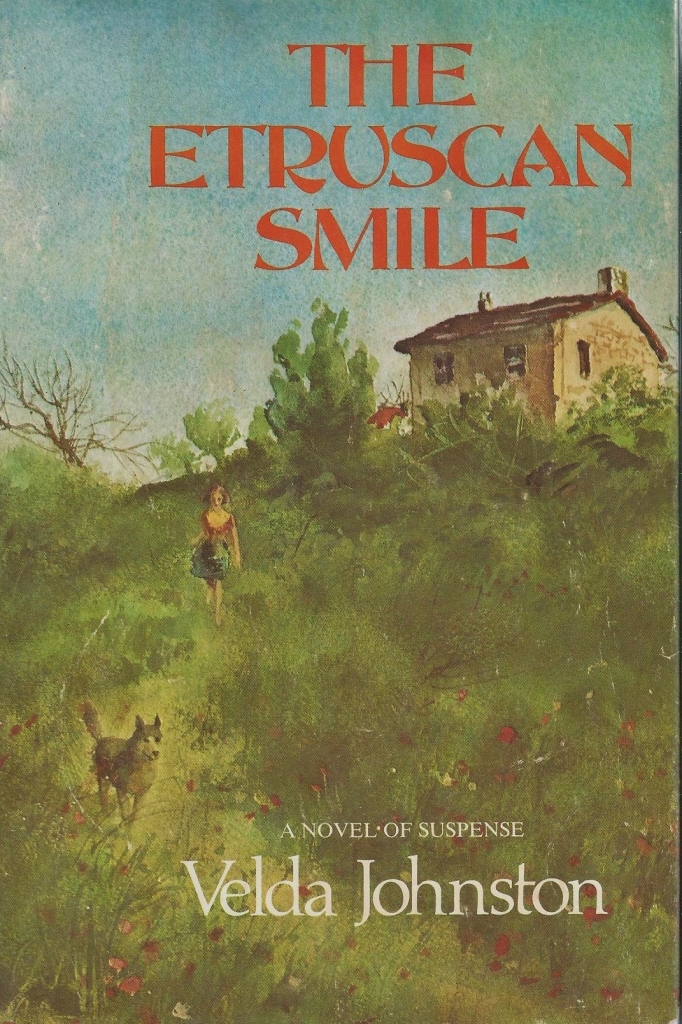
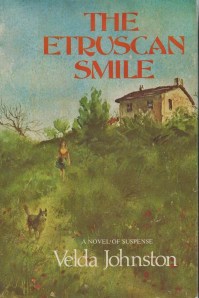
Tthe etruscan smile velda johnston 001he Etruscan Smile by Velda Johnston ~ 1977. This edition: Dodd, Mead & Co., 1977. Hardcover. 181 pages.

My rating: 6/10

I had read several of Velda Johnston’s mildly thrilling and sometimes simplistic “novels of suspense” before, so had tempered my expectations for The Etruscan Smile accordingly.

1975’s A Room with Dark Mirrors generally pleased me; the period detail of the heroine’s stewardess career and the doesn’t-miss-a-beat flow of the story kept me engaged enough to award it a thumbs-up and a 5.5 rating.

The Girl on the Beach, 1987, felt rather more awkward in plot and style; the author was a quite venerable 75 years old when it was published, and I theorized that perhaps she feeling rather tired of the whole writing-a-book thing. I panned the Beach Girl badly, mentioned that I was almost ready to cross Velda Johnston off my “light reading” list, and gave her a dismissive rating of 4.

Two years have passed, and the memory of my disappointing second encounter with the author has faded; enough so that when I came across this novel recently I was moved to give her another chance. And I am happy that I did; The Etruscan Smile was nicely done for its sort of thing, and reading it was no hardship at all.

A perfect sort of book for a waiting room sojourn; engaging but not challenging. It rocketed right along, and handed me a few surprises in the way of plotting that I wasn’t expecting, though I’m not quite sure that these worked out story-wise all that well. I did give the writer points for creativity; I could tell where she was going and the big picture she was attempting to embroider, even if she dropped her threads a bit here and there.

Mary Stewart this soundly second-rank writer isn’t, though there are bits here and there which remind me favourably of Stewart’s style. Our heroine is nicely independent and capable; but she does end up in the arms of a man, and one that she hasn’t known terribly long or particularly well – a favourite Mary Stewart closing scenario. Those brushes with death do tend to speed along romantic acquaintanceship, is all I can assume.

And I found this much more readable than anything I’ve experienced by Phyllis A. Whitney (see my last post, wherein I hand poor Phyllis her walking papers out of my personal book collection), though Velda Johnston was nowhere near as prolific or (apparently) as popular. Still, she (Velda) did manage to produce something like 35 romantic suspense novels, and so far out of the three I’ve read two have been acceptable; she’s now back on my list of promising minor writers, though I won’t be searching her out specially or paying more than bargain basement prices for any more of her books that I come across in my travels.

So – the actual storyline of The Etruscan Smile. Here it is, such as it is.

Samantha Develin has flown to Italy from New York, accompanied by her devoted German Shepherd, Caesar. Samantha has just learned that her older sister,  Althea, an accomplished artist who has gained a certain reputation as a painter-to-watch, has unaccountably vanished from the small rented farmhouse she has been living in for the past several years. No one seems to know where Althea has gone; the assumption is that she is off with a man; but Samantha immediately finds some clues that her beloved sister may not have planned her departure in a typical fashion.

A dashing Italian count – an old flame of Althea’s – appears out of the blue and puts himself rather unexpectedly at Samantha’s service. Another of Althea’s ex-lovers, an English archeologist, living close by, makes himself conspicuous by his continued presence, zipping in silently on his bicycle at the oddest hours of day and night.

These two men in particular and, to a lesser degree, everyone else she questions regarding Althea’s recent activities are rather cagy and evasive; everyone obviously knows something that they’re not divulging to Althea’s little sister. But what?

Samantha persists in her quest to track down her sister, and she soon comes to sense that perhaps something rather final has happened to Althea, though there is no evidence to support an act of violence or misadventure. Samantha must revisit her own past to unravel the tangled web which her sister had become bound up in; what she discovers is more bizarre than she (or we) could ever have imagined…

A hidden statue of an ancient Etruscan goddess plays an important role in the quest for Althea and the climactic scene; kudos to the author for not doing the expected with that particular clichéd suspense novel scenario. And kudos as well for not making everything all sunshine and light and picturesque Italian travelogue; there are some darkish situations in this short novel which add a certain depth to what could have been pure fluff. And the dog was a nice touch, and well portrayed. (Total super-dog; too good to be true, really. Hint: one may require a Kleenex near the end.)

An adequately engaging story to while away an hour or two on a summer afternoon; a long lunch hour today was sufficient to polish this one off. I must confess that the strongest impulse I felt upon completion was to revisit one of Mary Stewart’s Greek novels, to enjoy the next level up in this particular cozy-escape-lit genre.


Read Full Post »

Dear Phyllis A. Whitney: I’ve given you so three good chances, with Seven Tears For Apollo (1963), Sea Jade (1964) and Columbella (1966), and I must say I have found you lacking. One last chance was a just-abandoned attempt to read 1991’s Woman Without a Past, with me thinking that perhaps several more decades of writing experience might result in something more to my taste.

I regret to say that this hasn’t proven to be the case. I made it to mid-way in the book, but was at last defeated by the psychic cat (“Miss Kitty” – how blandly lame is that?!), the old black “servant” (described as such by P.A.W.) speaking the author’s conception of “black person Southern dialect” (while all the white Southerners appear to be speaking “normal” English), the secret letter hidden behind the tail of the wooden rocking horse (what an appropriate place, I caught myself thinking, because the plot was fast degenerating into, well, you know…), and the absolutely flatness of the writing. Fingernails on the chalkboard of my mind. Screeeeech.

That’s it. Phyllis is being top-shelfed. And possibly set to be purged, despite sentimental feelings about ridding myself of my late mother’s books. Rosamund Pilcher is on the probation shelf, too, as is Maeve Binchy. And Catherine Cookson. Helen Forrester should be getting worried, too. Joanna Trollope, you might want to keep a lowish profile; the last few of yours I read left me thinking you’ve worn out all of your best Aga Saga scenarios.

My husband says that Miss Read should join these others in exile, but I have an inexplicably deep affection for Dora Saint’s pleasantly innocuous stories, so those aren’t even up for debate.

Absolutely sacred.

So there.

Darling.

Where was I?

Oh, yes. Norah Lofts.

Because while I was trying to read Phyllis Whitney, I was concurrently actually reading and hugely enjoying yet another gorgeously dark domestic drama by Norah Lofts. (See The Little Wax Doll  (1960) and Lovers All Untrue (1970).)

Norah writes big, shiny, sparkling rings around plodding Phyllis.

Sorry, Phyllis.

You lose.

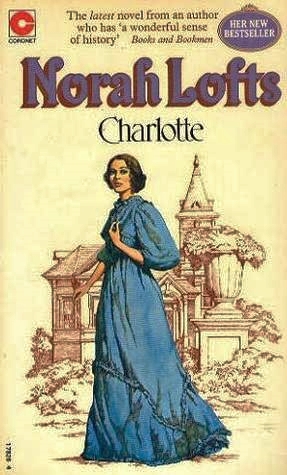
charlotte norah lofts out of the dark 1972Charlotte by Norah Lofts ~ 1972. American title: Out of the Dark. This edition: Coronet, 1973. Paperback. ISBN: 0-340-17826-4. 254 pages.

My rating: 9.5/10

The author notes that this story was inspired by the notorious real life situation of an English teenager, 16-year-old Constance Kent, who in 1860 was accused of the brutal murder of her young stepbrother.

Though the scenario in the first section of the book borrows heavily from the historical case, Norah Lofts states in her beginning Author’s Note that:

The characters…are my own; and whereas those who write factually about a crime – especially one never satisfactorily solved – can only speculate about the motives and, indeed, the identity of the murderer, the writer of fiction, dealing in a more plastic medium, is able to say: This is how it happened.

Part Two owes nothing to the Case of Constance Kent. Incredible as it may seem, it is based on a first-hand account of a school in which my sister once tried to teach, a mere forty years ago. Here again the characters are my own; but I did not invent the oil-stove that was carried up and down…

This is a dark little tale, of deep injustice done to the innocent by those who should have been the most concerned with their protection. Our author puts her titular heroine through a grueling ordeal which stretches on for years, before allowing a resolution (of sorts) which (possibly) rewards her (and our) quietly righteous perseverance.

How much should I tell about the plot? My impulse is to keep it fairly quiet, as this sort of story rewards readerly discovery. I’ve already given out some of the major points, which are indeed no secret, and are revealed very early on.

16-year-old Charlotte Cornwall, her younger brother Thomas, and older twin sisters Adelaide and Victoria live with their father, stepmother and young half-brother Vincent in outwardly respectable but secretly straitened circumstances. The first Mrs. Cornwall was possessed of a large private income; this came to a halt upon her tragic (and questionably natural) death some years earlier; the twins and Charlotte are to inherit their mother’s money when they each turn 21, under the terms of their maternal grandfather’s will.

Money concerns are just part of the unspoken tension in the Cornwall household; the second Mrs. Cornwall, who was previously the children’s nanny, is deeply jealous of her gentle predecessor’s lasting influence. Her own small son is the apple of her maternal eye, and she is again pregnant, leading to a situation of history repeating itself as Mr. Cornwall’s attention is caught by the latest nursemaid who has replaced her mistress in the household hierarchy in more ways than one.

When four-year-old Vincent is discovered gruesomely murdered, his body hidden in the muck heap in the stable yard, suspicion is directed at a nebulous night time prowler, but soon evidence comes to light which leads back into the heart of the family, and ultimately straight to Charlotte. But several people in the household know the real story of what happened that dreadful night. Surely the truth will come out; surely the culprit or culprits will confess, to save an innocent who is being wrongly accused…

Nope. Charlotte is completely sold up the creek, and by a person (or persons) who should have been willing to protect her at their own expense.

Charlotte’s youth and social status and some inconsistencies in the evidence lead to her acquittal, but her trials aren’t yet over. Not by a long shot. Seeking to escape a situation made increasingly unbearable by the dark stain on her name and her stepmother’s increasing hatred, Charlotte takes a position in a country girl’s school as an assistant mistress, a situation which at first appears to be a welcome refuge, but which soon puts her into still more nightmarish situation, as the school’s headmistress exploits her knowledge of Charlotte’s past to her own advantage…

Just when things are darkest, a gleam of hope appears, and our heroine at last has a chance to clear her name. But will she turn against the real murderer(s), once she discovers the true story of her betrayal?

Well, I guess you’ll just have to read it yourself to find out.

Multiple characters, multiple story strands, all beautifully handled and full of fabulous period detail. What I’ve divulged above is the briefest overview of this richly written noir tale.

Charlotte is most competently plotted and presented; a deeply engaging read of the chillingly almost-plausible sort. Abundant wry humour, too. Despite its grim theme, this is not at all a depressing read; I frequently found myself chuckling quietly to myself as the author sends up various stereotypes and scenarios with perfect comic timing, and without quite crossing the line into farce.

Thank you, Norah.

You had me just a tiny bit worried for most of the book; I wasn’t sure where we were going for quite some time there. Good job on stringing the reader along!

Oh – the half point docked was for several not very veiled homosexual side stories. Those felt possibly just the tiniest bit mean-spirited, just vaguely “off”. But possibly they weren’t meant to be, and were intended more in the nature of ironic natural revenge? Maybe? However, I felt these were a bit too similar to the Sudden Evil Lesbian who shows up to wield retribution in Lovers All Untrue – too unnaturally manufactured; even in such a highly fictionalized thing such as Charlotte turns out to be.


Read Full Post »

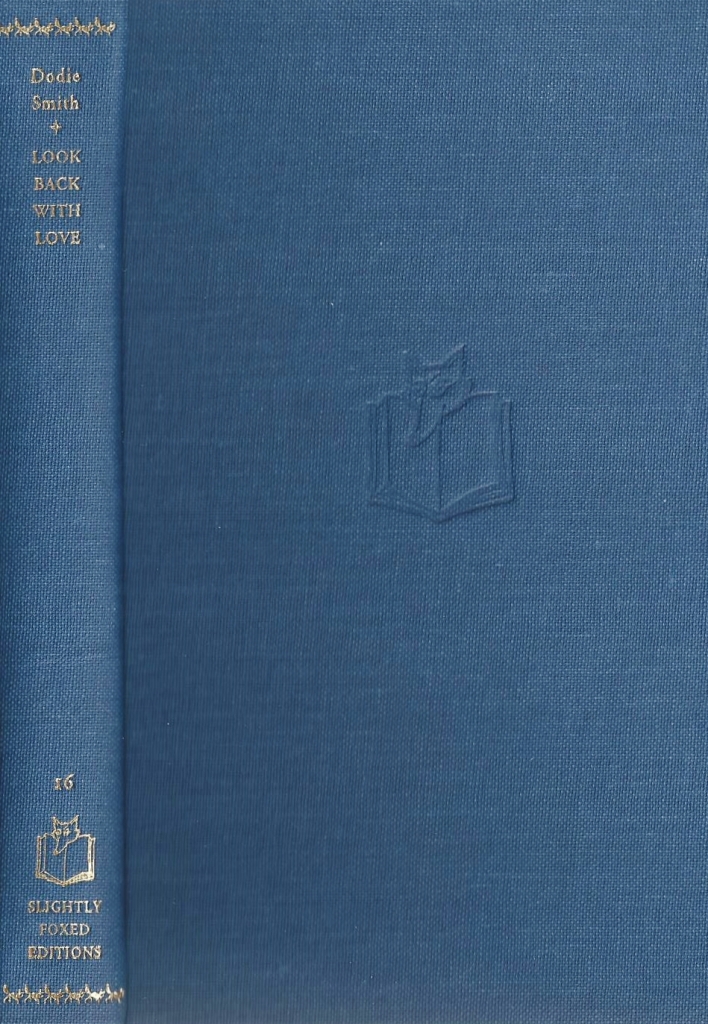
look back with love cover slightly foxed dodie smith 001Look Back with Love: A Manchester Childhood by Dodie Smith ~ 1974. This edition: Slightly Foxed, 2011. Hardcover. ISBN: 978-1-906562-30-4. 272 pages.

My rating: An easy 10/10. A pleasure first page to last.

This post should be extremely easy to write, as it is merely meant to be an enthusiastic recommendation of two things.

First and foremost, this stellar memoir by Dodie Smith (I capture the Castle, The Hundred and One Dalmations), detailing with immense good humour her childhood days in Manchester, when she lived with her widowed mother in a series of family homes.

Before reading this book I had come across several excellent and detailed reviews which inspired my search-and-purchase. I shall not attempt to add to their number, but instead will encourage you to follow these links to the several posts which led to this happy acquisition.

Geranium Cat’s Bookshelf  – a wonderful review, with generous quotes from the text.

Simon’s Stuck-in-a-Book post is disarmingly chatty and wholly enthusiastic.

And from Elaine at Random Jottings, this excellent advice:

I beg you, please do get hold of a copy. If you are feeling miserable, it will cheer you up, if you are feeling ill (as I was when it arrived) it will make you feel better and, if you are already well and happy, it will make you even more so.

Sheer and utter delight from start to finish.  I will end as I started. This is a lovely lovely lovely book.

Yes, indeed.

Which leads me to the second recommendation I have for everyone, which is of a bookseller.

Look Back in Love in the original being fairly scarce and rather highly priced when found, the book I have in hand is a beautifully produced reprint from Slightly Foxed Editions, who specialize in (among other things) “pocket hardback reissues of classic memoirs.”

Take a good look at their list of offerings. I’ve read enough of these to be able to say that whoever is searching out these memoirs to republish has a keen eye for an excellent read. Well done, Slightly Foxed! If I’m ever in London my bookish pilgrimage will include their store (either before or after a sure-to-be-costly visit to Persephone – how can one possibly choose?!) to bow down at the source (as it were) of some of the best-chosen and best-produced vintage reprints currently available.

While not exactly cheap – a postpaid copy to Canada set me back a rather sobering £19, or about $35 Canadian dollars – I justified the cost with the thought that I was supporting a most worthwhile enterprise.

My Slightly Foxed edition is a joy to handle and to read, being compact and neatly cloth bound with a handy ribbon marker, a text block of smooth, creamy paper, and a nicely legible font. My only regret is that it does not contain the photographs included in the original edition; I love the inclusion of photos in memoirs as it adds so much to be able to see the characters and places referred to. But Dodie Smith’s words give such a wonderfully clear picture of both people and surroundings that one can envision the scenes perfectly well without visual aids.

I was so very pleased with this first volume of Dodie Smith’s memoirs – which takes her to the age of fourteen – that I have just tracked down and ordered the middle two volumes of the remaining three autobiographical books, Look Back with Mixed Feelings, and Look Back with Astonishment. I had already acquired Look Back with Gratitude, the last of the four, and though I have leafed through it with anticipation I am being stern with myself and will be saving it to read last, to maintain a chronological order.

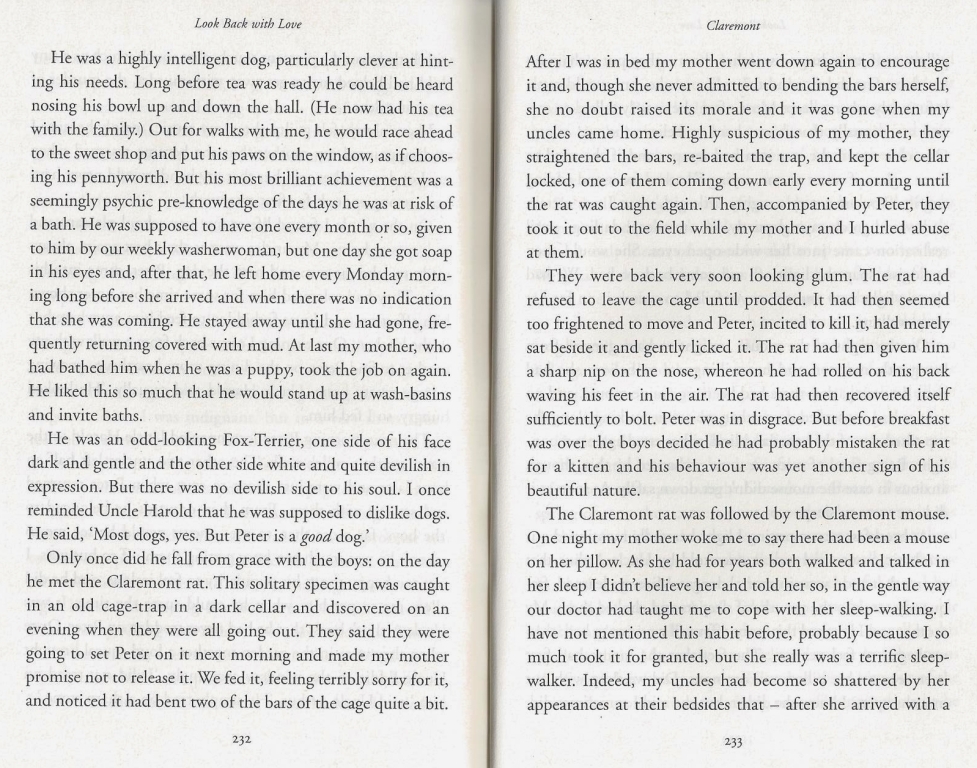
And here, to further pique your interest (those few of you who haven’t already discovered this gem for yourselves) is a random page scan. Open this book anywhere and similar anecdotes abound. Even out of context, isn’t this a joy?

Click to enlarge for ease of reading.

(Click to enlarge for ease of reading.)

Read Full Post »

I recently put myself in the mildly surreal situation of simultaneously reading two very different books set in the same location and covering a similar time period. Luckily they were both so very strongly voiced that I managed to focus on each as it deserved.

The first book, a novel by Gavin Lambert, a British-born author who moved to California in the 1950s and had considerable acclaim as a screenplay writer, was much better than I had anticipated from its cover appearance. The bizarre images of Natalie Wood starring as the titular character in a movie version of the novel and the fulsome blurb shouting out “-the happiest, saddest, sexiest Hollywood novel of all!” were a bit off-putting, but the first page grabbed me and pulled me into the story and never let me go until the nebulous but satisfying conclusion.

The second book was an engaging though fairly workaday movie star autobiography, written by Rosalind Russell with the assistance of a co-author, fellow actress-turned-writer Chris Chase. Published a year after Rosalind Russell’s much too early death from breast cancer, it is a mostly flattering self-portrait with a leavening of self-criticism, which left me with a warm-all-over regard for this very matter-of-fact and very dedicated screen and stage actress, famously “in Hollywood but not of it”, as one of her friends declares in the memoir. Rosalind Russell appears from this account to have had an admirably stable personal life, at least compared to the majority of her Hollywood peers.

inside daisy clover gavin lambert 1963Inside Daisy Clover by Gavin Lambert ~ 1963. This edition: Penguin, 1966. Paperback. 265 pages.

My rating: 8/10

Thirteen-year-old Daisy Clover, father vanished from her life some years previously, is living a squalid life in a trailer park in rundown Playa del Rey, California with her mentally troubled mother The Dealer (named for her fixation on solitary card games).

Daisy finds joy in saving her nickels and dimes for occasional forays to a recording booth where she unselfconsciously belts out songs with more than a little “rare natural talent”, and she has just purchased the first of what will turn out to be a vast number of notebooks in which she will record her inner thoughts for the next two decades.

Confided to her diary, Daisy has a soberly related sexual awakening assisted along by a certain Milton, an older boy, “quite nice looking, he had muscles and butch hair and good teeth, but also a slight weight problem”, with their relationship consummated on an old, mattress-less brass bed in Milton’s father’s used furniture store, “priced at $25.00 and marked VERY NICE. Dot, dot, dot, dot.”

Daisy turns fourteen on a disastrous day which includes her mother inadvertently setting fire to their home, and it seems that despair is the theme of her young, angst-ridden life, but things are about to take a strange turn. Daisy enters one of her recorded discs (a new recording; all of the old ones having been destroyed in the fire) in a talent contest, and is “discovered” by Magnagram Studios magnate Raymond Swan.

Turns out that not only can our heroine sing like an angel, she can also act like a reincarnation of Mary Pickford (with the added benefit of being able to supplement her performance with vocals), and stardom bursts upon Daisy.

But this is not, of course, without its drawbacks.

Daisy’s patron Mr. Swan and his oddly hot-and-cold wife Melora keep Daisy on the path to ever-increasing fame, and while she finds deep satisfaction in the singing and acting aspect of her new life, being a true artist and all that jazz, the personal cost of her new life is rather brutal.

The Dealer has been whisked off to a mental home and erased from Daisy’s official biography, allowing her to be billed as “The Sensational Singing Orphan” (or something like that – couldn’t find the exact term in my flip-through just now), and Daisy is now under the care of her gosh-awful older sister Gloria, who married some years earlier and scooted out of Playa del Rey without a backward glance. Now that Daisy is a potential movie star, Gloria is very much back in the picture, and Daisy has quite a lot to say in Dear Diary about that development.

The years roll on. Daisy is a definite success as per Mr Swan’s planning and Gloria’s fervent pushing, but then the Star Train derails, when Daisy falls deeply in love with the worst possible prospect for promotional purposes she could come up with.

Once a top notch star, but now fading fast, the much older actor Wade Lewis is now a notoriously self-destructive drunk and a reportedly manipulative lover-of-many, but Daisy ignores the hissing whispers and goes with her emotions. The two find a common ground in their dislike for the lives they lead, and a genuine connection develops. The relationship strikes enough sparks to catch widespread attention, and through Daisy’s bullheaded  insistence a marriage takes place. Too bad Wade’s real sexual interests are not in women, despite his reputation in the gossip columns…

Gosh, what a grand little slice-of-American-life novel, right up there with the smutty California romances and pill-popping exposés of Jacqueline Susann, albeit much better written than anything she pumped out just a few years after Lambert’s Daisy Clover appeared.

A measure of redemption is (predictably) found after the inevitable crash-and-burn of the aging child star, and the ongoing relationship between Daisy and The Dealer adds a poignancy and appeal to what might otherwise be an utterly depressing condemnation of everything that’s wrong with the American Star Machine.

Gavin Lambert turned his novel into a screenplay, though with considerable changes to adapt it to the screen, and the movie Inside Daisy Clover was released in 1966, starring Natalie Wood as Daisy, Christopher Plummer as Mr. Swan, and Robert Redford as Wade (with the character changed, at Redford’s insistence, to vaguely bisexual versus the original completely-homosexual-passing-as-straight).

The movie was, by all accounts, a flop.

But the book most definitely isn’t, and I’ll be keeping an eye out for some of Lambert’s other Hollywood novels, apparently seven in total, as well as a collection of short stories and a number of well-regarded celebrity biographies.

Gavin Lambert was – no surprises here, after finishing Daisy Clover and considering some of its themes – homosexual himself, and his sympathetic and ultimately open portrayal of gay characters was unusual and rather brave for his era.

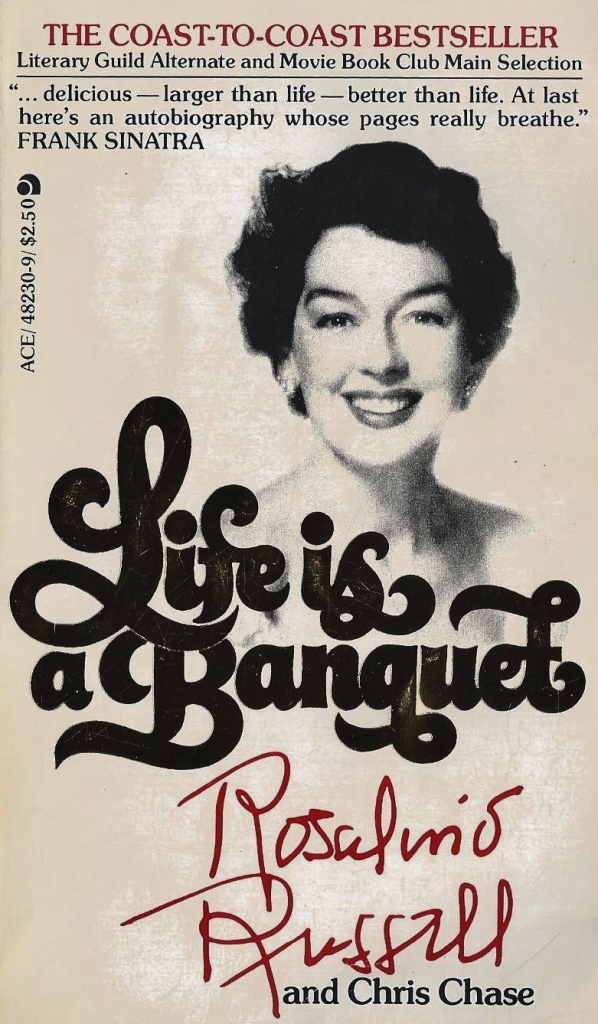
life is a banquet rosalind russell 1977 001Life is a Banquet by Rosalind Russell and Chris Chase ~ 1977. This edition: Ace, 1979. Paperback. ISBN: 0-441-48230-9. 260 pages.

My rating: 7/10

From mince-no-words fiction to slightly airbrushed real life, with this cheerful autobiography set mostly in the early years of Rosalind Russell’s career, but with enough concentration on the decades of the 1950s and 60s to add a supplementary picture of this most unique setting to my concurrent reading of Daisy Clover.

Rosalind Russell was unusual among her peers in that she willingly (by her account) turned her back on Hollywood for a time to return to her roots as a Broadway actress. She then went back to Hollywood, taking along her stellar role of Auntie Mame  from Patrick Dennis’ bestselling book-turned-theatrical production which was one of her outstanding stage performances, and then transitioned gracefully from first-run star to character actress in her later years.

Happily married for thirty-five years (to the same man, of course, making her rather unique in Hollywood circles – meow, meow!), Russell’s description of her relationship with her husband, Frederick Brisson, was downright heart-rending, especially in conjunction with his tribute to her in the book’s introduction.

Rosalind Russell died in 1976, aged 69, after years of struggle with both serious rheumatoid arthritis and breast cancer. Life is a Banquet was published a year after her death.

Though the autobiography is decidedly self-edited, it made me most sympathetic to its writer, not to mention deeply curious about the bits which were glossed over, though none of them appear to be at all scandalous. Rosalind merely kept a ladylike silence over other people’s private business, and obviously chose not to go into salacious detail regarding her own black moments.

Rosalind Russell was a truly beautiful woman – her photographs leave me smiling in admiration of the absolutely lovely composition of her face – those winged eyebrows over those dark, wide-set eyes! – and those sultry eyes show a glint of something else: deep intelligence and a love of laughter. Her well developed sense of humour shines through in this book.

As I mentioned earlier, Life is a Banquet is written in a slightly pedestrian style, and though it was pleasantly engaging and held my interest well, I couldn’t give it a higher rating than a “7” on my personal reading quality scale.

This memoir has left me with a warmly approving regard for its writer, and with a strong desire to watch the movie version of Auntie Mame again, and to seek out some of Rosalind Russell’s other movies, of which there is a large choice, from 1934 to 1971.

I think one might safely say Rosalind Russell was a Star well deserving of that designation in all of the best ways.


Read Full Post »

lovers all untrue norah lofts 1970 001Lovers All Untrue by Norah Lofts ~ 1970. This edition: Doubleday, 1970. Hardcover. 252 pages.

My rating: 7.5/10

Well, this was unexpected. And unexpectedly good.

I quite like what this author does when she turns away from the historical romantic fiction and creative biography she was so much better known for, such as her best-selling depiction of Anne Boleyn in The Concubine, and her somewhat sappy retelling of the Nativity in How Far to Bethlehem?, and lets herself go a bit over-the-top into the realm of domestically set macabre fiction. I’m catching glimmers of a Shirley Jackson-like mindset here, and it’s a treat.

Some time ago I read and was surprised and pleased by another of Norah Lofts’ odd little stories, The Little Wax Doll. Lovers All Untrue will definitely join it on the shelf of keepers. And I am wondering what else the prolific author produced in this style. Time for a bit of delving, I think.

The September, 1970 Kirkus Review call this “a lamplit tale of murder and madness in a Victorian doll house”, and goes on to end its spoiler-laden review (which I refuse to link for that reason) with this perfectly apt recommendation: “A fine horrid tale for matronly secret liberationists.” Yes, indeed, to both of those summations.

The well-off, upper-middle-class Draper family resides in respectable Victorian comfort in a slightly cramped but ever-so-appropriately located, furnished and staffed London house, on Alma Street. The family consists of fifty-year-old Papa (head of a nebulous family business in the City; I don’t think we ever do find out what it exactly is that the firm is all about), the slightly younger Mamma, and daughters 17-year-old Marion and 16-ish Ellen.

Papa is most decidedly the patriarch of the household, and holds unchangeable views as to the proper conduct of the women of his family. Mamma was once a brilliantly talented pianist, but as her more emotional pieces are unsuitably dramatic in her husband’s opinion, she has been squelched into concentrating her musical skills onto mild drawing-room-acceptable sentimental ballads instead of stormy Lizt concertos. Marion, of considerable intellect, has been abruptly withdrawn from the school where she excelled at academics, because Papa Draper felt that the views of the headmistress were unsuitably liberal in the encouragement of young ladies to consider advanced personal and intellectual development and (fatherly shudder) even careers. Ellen is the smiled-upon child, being peaceful, unambitious, and deeply domestic: the epitome of desirable feminine deportment, in Papa’s eyes.

Papa Draper is a marvelous villain, with absolutely no redeeming features, gloriously secure in his masculine superiority.

Mamma, destroyed herself by her husband’s sheer imperviousness to any sort of female ambition, abandons her daughters to their father’s brutally unimaginative plan for their future: he envisions two devoted (and needless to say unmarried) acolytes to his perpetual male glory, with Marion and Ellen functioning as (sexless) adjuncts to their mother in ensuring that domestic comfort is ceaselessly maintained.

Needless to say, despite Papa’s refusal to countenance such a thing, sex relentlessly enters the picture, with Marion in particular proving deeply passionate beneath her stoic exterior. And even mild Ellen and meek Mamma cherish a few secret desires of their own…

Marion seethes quietly under her repression, and breaks out in the expected way, by acquiring a secret (and decidedly lower class) lover with the expected results. However, events take on some dramatic twists and turns, with Marion showing unexpectedly resourceful attempts to free herself from Papa’s grasp. As Mamma recedes ever deeper into her passive state of non-resistance to Papa’s demands, and Ellen feebly attempts to play peacemaker, Marion finds herself (temporarily) committed to a facility for the mentally troubled, where Papa hopes she will find her outrageously forward impulses tamed.

No one in this oddly mesmerizing tale comes out particularly well; even as the nominal heroine Marion is chock full of too-human flaws, and some of her decisions are decidedly cringe-worthy. So her eventual fate is artistically quite perfect, even though it is rather unexpected. The author was brave in her ending; I applauded her decision to not …well…I’m not going to say what she did here with Marion and Ellen and Mamma. Just that it made me quite satisfied, in multiple ways.

Decidedly feminist themes throughout keep us rooting for the downtrodden women while happily hissing at the stupid, stupid men. Bonus points too for introduction of a scheming lesbian, all done up as another period stereotype just as bizarre as that of Papa’s set piece, whom Lofts has a bit of authorial fun with.

All in all, the author did seem to be rather enjoying herself here, with a good deal of humour glinting out from among the velvety shadows of this mildly horrific, darkish little tale.

Read Full Post »

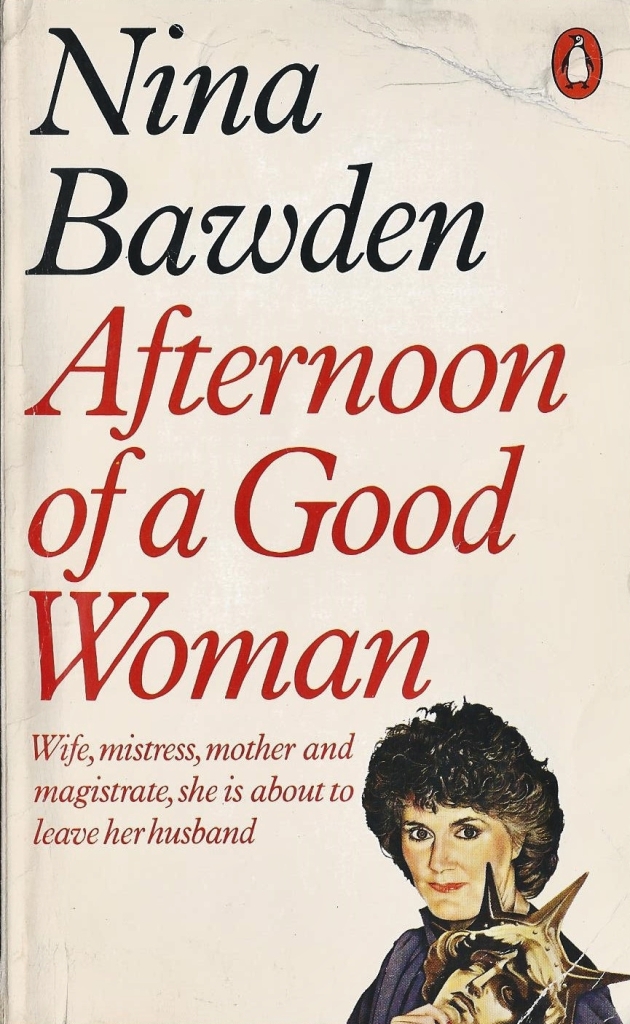
afternoon of a good woman nina bawden 001Afternoon of a Good Woman by Nina Bawden ~ 1976. This edition: Penguin, 1976. Paperback. ISBN: 0-14-00-4674-7. 142 pages.

My rating: 5.5/10

Yesterday I did something I seldom get a chance to do: I sat in my favourite armchair with my feet up and I read all day long.

My husband was unexpectedly home from work, and as he was feeling generally tired and rather in between projects – all of the carpentry jobs too big to start on a “spare” day; still too much snow on the ground for planned farm jobs; some before-convertible-season needful work on the pet sports car (our old Triumph Spitfire) stalled because of waiting for parts to arrive; too windy and blustery for an enjoyable walking excursion – he encouraged me to join him in a “proper” day off.

So I did, completely guilt-free. And it was good.

The reading itself ended up not being as purely pleasurable as it could have been, as I was finishing up Ann Patchett’s increasingly annoying The Magician’s Assisstant (see my last grumpy post) and finding it lacking. I then picked up this slender novel by Nina Bawden which I had just acquired on the my Vancouver trip, along with a copy of The Birds on the Trees. Not quite what I had expected – I thought from the cover text that it would be a bit “lighter” than it turned out to be – but definitely an engaging read, and very “1970s”. A perfect Century of Books entry, in other words, as it is very much of its era.

Lots of spoilers in this post, but I left much out as well. Onward!

Back cover blurb:

Penelope has always tried to be a good woman: as wife, mistress, mother and magistrate. But today – the day she has decided to leave her husband – she sits in the Crown Court listening to a short, sad case of indecent exposure and a long, involved incident of theft, and mentally reviews her own convoluted private affairs. And wonders how they would stand up in court.

Penelope, in her day-long musing about how she got to the point of leaving her husband for her long-time lover, (her step-brother Steve – and, oh, yes, the almost-incest of this relationship is a slight thing compared to the rest of Penelope’s complicated personal connections), reflects on the irony of her name. Patient wife though she has been for many years, her own Ulysses – her ineffectual husband Eddie – is not the adventuresome type, unless you consider his habit of painting his face with Penelope’s lipstick and chasing her about the bedroom with a real hatchet (!) as a precursor to sexual arousal.

Eddie has some serious baggage, as his first wife has gone insane and is incarcerated in a facility for the mentally troubled just a few blocks over. Handy for visiting, mind you, and Penelope occasionally sees her predecessor as she visits her own off-kilter stepmother, Eve – her lover Steve’s mother – in the same building.

There’s also a stepsister with a disastrous personal life – separated from an abusive husband (with Penelope’s help – a complex saga detailed in one of the many flashbacks this short novel contains) and continually fighting for custody of a young son. The ex-husband was involuntarily involved in the death of Penelope’s father, and the situation was not improved by Penelope making an untoward advance to him (the stepsister’s ex-husband) as he tries to soothe her as her (Penelope’s) father’s body lies sprawled at the bottom of the stairs he has just crashed down.

Still with me?

Isn’t this utterly too too much? Over-the-top, as a matter of fact, and Nina Bawden includes way too much information on everyone’s bedroom habits.

The point which I believe Bawden is trying to make is that her protagonist is very much on her way to becoming a modern liberated woman, free to live her (sex) life as she so chooses, and the heck with the staid conventions. Penelope has done the marriage thing, and raised two rather gormless daughters who are now at college. She loves her children but doesn’t particularly like them, having no rose-tinted illusions as to their intelligence or ambitions. Now she is ready to strike out on her own, to openly join her long-time secret lover, a decision just possibly triggered by Penelope’s fear that she is pregnant by him.

Ha ha – didn’t see that last bit coming, did you?

Anyway, bleakly absurd and mildly dirty soap opera plot aside, this book is cranked up a notch by Bawden’s more-than-competent writing, and by her under-handed style of sly humour. This is a rather funny book, once one gets over the initial shock of (for example) hearing the state of a flasher’s naughty bits described in analytical detail – it’s all part of the evidence, you see. Penelope is not at all a prude, though she acts in a publically circumspect manner. Her mind is always examining all the possibilities, and she doesn’t miss much.

Or does she?

As we follow Penelope through her day serving as a magistrate in the Crown Court, we become increasingly aware that her analytical tendencies are just a trifle askew here and there. Her assumptions of guilt and innocence prove not to be quite so crystal clear as she at first thinks. (And perhaps Penelope is a wee bit distracted by the proximity of the handsome and mildly flirtatious judge whom she is assisting…)

And then there is that unnerving incident of a threatening anonymous letter some weeks ago, and today, as she prepares to drive off to the station for her big gesture of freedom, the discovery that the brake system on her car has been tampered with. Someone else has apparently been doing some heavy thinking, too.

To sum up, an interesting read, once one comes to terms with the various ick factors. But I am thinking it will ultimately be just a blip on my readerly radar, for it’s rather a light thing when all is said and done.

I think I will tuck it up on the D.H. Lawrence shelf, for though DHL is rather more “literary”, this Bawden left me with the same after-reading impulse to put the book up high where I don’t have to see it, and then go and have a long hot shower.

A keeper, with reservations.

Oh – one last thing. This is indeed the same Nina Bawden who has written a number of highly esteemed children’s books, such as Carrie’s War, and The Peppermint Pig. If you have young readers in the household, you’ll likely be wanting to keep the two strands of her writing well separated. Just a thought.

Read Full Post »

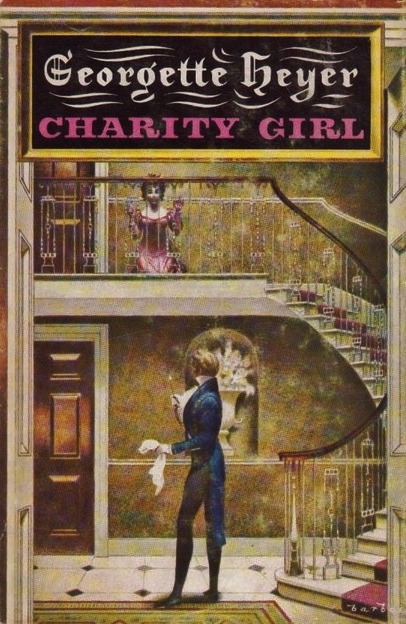
charity girl georgette heyerCharity Girl by Georgette Heyer ~ 1970. This edition: E.P. Dutton, 1970. Hardcover. 255 pages.

My rating: 7.5/10

This past Saturday morning which went rather sideways (three hours Good Samaritan detail waiting in a parking lot for BCAA to unlock a neighbour’s vehicle with the keys left inside) was salvaged by a very productive visit to the semi-annual Rotary Club book sale, where I picked up two small-but-packed-full boxes of pleasing finds for a mere $50. And best of all, I had my husband along to help in the search, and to lend strong arms to carry off the finds! (No mutters about “More books, why do we need more books?!” when he is involved in the process himself, and he was right in there with me searching for good things among the heaped tables and boxes of many other people’s cast-off reads.)

George Gissing’s The Odd Women, Antonia White’s Strangers, and Miles Franklin’s My Career Goes Bunk – all three nice unworn Viragos. A pristine Persephone edition of Miss Pettigrew Lives for a Day. Several new-to-me Willa Cathers – Death Comes for the Archbishop, The Professor’s House, and The Song of the Lark. A first edition of Rosemary Sutcliff’s The Shield Ring, not ex-lib, with perfect dust jacket, in Brodart, yet! And others too numerous to name off. (Well, here are just a few more: Doris Lessing, Sinclair Lewis, Pearl S. Buck, Margaret Bell Houston, Jeanette Winterson, W.P. Kinsella, Rex Stout…what good reading awaits us.)

And then there was this book, a lovely early edition hardcover in only-slightly-worn dust jacket, Georgette Heyer’s Charity Girl. How could I resist? Bumped off the bedside table was Margaret Laurence’s most excellent book of Ghanian-set short stories, The Tomorrow-Tamer, with but two stories left to read, to be temporarily eclipsed by something much more playful – I think “frothy” would describe it well. In the very best way, of course.

Handsome, athletic, witty, kind-hearted, and fantastically wealthy Viscount Desford (Ashley Carrington, to his family and friends) has displeased his gruffly doting father by refusing to settle down and marry the most eligible Henrietta (Hetty) Silverdale. The Silverdales and Carringtons are long-time neighbours and friends, and Desford and Hetty have been happily paired up since childhood, though both confound their respective parents by insisting that things are strictly platonic, and bound to remain so. In the meantime, neither has met anyone they like well enough to marry, though suitors and prospective brides are swarming round both attractive honeypots, to be kindly brushed away in the politest way possible. But the thirties are approaching, and gossips whisper that both are surely bound to settle soon, though with whom is up for abundant debate.

Desford attends a party hosted by the scheming Lady Bugle, who, with five daughters to get off, has hopes that her eldest, the admittedly lovely Lucasta, will snag the prize. But Desford preserves a wisely noncommittal silence, unbending only when he meets the household’s least prominent member, a semi-orphaned neice, one Charity Steane, who goes by the name Cherry, and is as sweet and delectable as that implies. Cherry is properly grateful to her Aunt Bugle, but her position in the household is a lowly one, being something between nursery maid and unpaid companion to the younger girls, and no one hesitates to remind Cherry of her obligations, and the digressions of her parents. (Her late mother, Aunt Bugle’s sister, had eloped with the dodgy Wilfred Steane, a man who has notoriously lived by his clever wits and card-sharping skills, and who has vanished from the scene, permanently, it seems, as all devoutly hope.)

Cherry is overheard spilling her personal story to the interested Desford, and the resulting brouhaha sees her fleeing Lady Bugle’s house in tears and trudging along the road towards London in a forlorn and lonesome state. Desford, on his way home all happily innocent of knowledge of Cherry’s disgrace, stops his curricle and rescues the maiden, and conveys her to London, hoping to settle her with her grandfather, the notoriously crusty skinflint, Lord Nettlecombe. But Lord Nettlecombe appears to be out of town, and no one knows his whereabouts. What to do, then, with the hapless runaway?

In a mood of increasing desperation – the gossips will no doubt already have started the whispers about Desford being seen with an unaccompanied and very lovely young female person of unknown provenance – Desford conveys Cherry to Hetty’s house, setting off a string of events which entangles not only Desford, Hetty and Cherry, but their respective families – including a very-much-not-dead Wilfred Steane – as well as Hetty’s chief suitor, the reliably calm and cool Mr. Nethercott, and Desford’s bumptious younger brother, Simon.

Despite the title, the book is centered around the two Carrington brothers rather than the girl, for once Simon appears he rivals his elder brother in both personal attractiveness and slightly muddled goodwill to the delicious but one-dimensional Cherry, who is of a type to be carried along pell-mell by her tempestuous fate, a very good girl at heart, seeking only to please those who undertake her care, and desperately longing in her simple way for a place to at last call home.

A collection of pleasing characters, all in all, with even the villains having their likeable moments, as the tale tumbles to its easily foreseen conclusion. A light and pleasant read; perfect a few hours escape from gloomy, dark November.

Read Full Post »

I’m still playing a bit of catch-up with reviews of books I’ve read throughout the year, and didn’t write about right away, but which I want to talk about before I tuck them away. Tonight I’m going to zip off some short reviews of some short easy books, the kind one can read quickly through in a few hours. Lit-light, for those times when you need something undemandingly different from your own possibly bothersome real world.

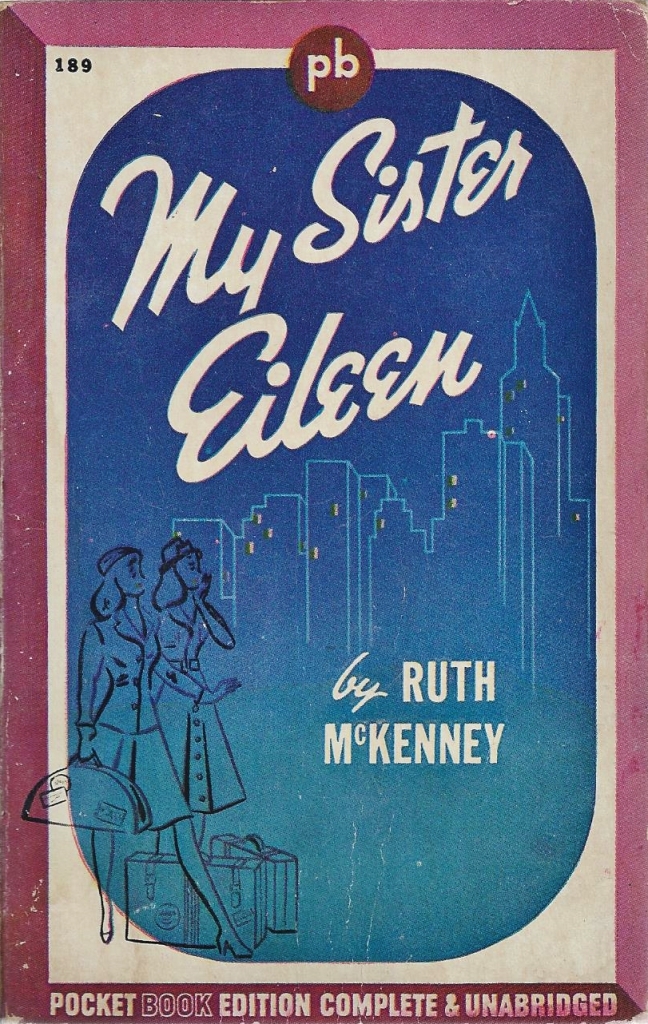
my sister eileen ruth mckenney 001My Sister Eileen by Ruth McKenney ~ 1938.

This edition: Pocket Books, 1942. Paperback. 142 pages.

My rating: 7.5/10

This frothy memoir was found among the stacks and stacks of vintage Pocket Books at Kelowna’s Pulp Fiction/Robbie Rare Books. The author was new to me, but a bit of internet research showed that she was a well-known journalist in the 1930s, 40s and 50s, with a sideline in humorous memoir, novel and travel writing. This very book, My Sister Eileen, as much about Ruth as it about her younger sister, is a an absolutely charming autobiographical account of growing up in Indiana and then Ohio, and of the two sisters going off to try their luck in New York City. The memoir caught the attention of the public, and it brought its author popular success, being made first into a Broadway play, then into a movie, and finally, in 1953,  into a very successful – 500 + performances – musical, Wonderful Town, starring Rosalind Russell, with music by Leonard Bernstein. A long way from Ohio, oh yes indeed.

I’m not much for laughing out loud while reading, but Ruth McKenney triggered more than a few giggles, as she and Eileen adventure together through their young girlhood, watching much-too-adult movies from behind the brims of their hats, failing dismally at piano and elocution lessons, being traumatized by summer camp, learning how not to swim with the Red Cross, and having a life-altering encounter with Noel Coward. A French pen pal brings romance into Ruth’s life, or so she supposes. She’s not quite sure because no one can translate his handwriting. First jobs give much scope for both girls broadening their horizons, and while Ruth does well for herself on the staff of a newspaper – printer’s devil at fourteen and onward and upward from there – Eileen struggles with the finer points of waiting tables at a posh tea room. Dreadfully dire beaux, a rather more happy (though short) encounter with Randolph Churchill, in America on a lecture tour, and a shipful of Brazilian future-admirals bring romance in the sisters’ lives.

My only complaint is that this sparkling little book is much too short. But there appear to be others, continuing the story, which I may well be searching out, though they are in much shorter supply than this bestselling first installment.

In later years Ruth McKenney’s life was to take a tragic turn. Her beloved sister was killed in an automobile accident only four days before the stage play inspired by her opened on Broadway, and on Ruth’s 44th birthday her husband committed suicide. She stopped writing, and faded into obscurity. A 2003 interview with Ruth’s daughter, Eileen Bransten, was published in the The New York Times, and gives a brief but lovingly poignant character portrait of this talented and ultimately unlucky woman.

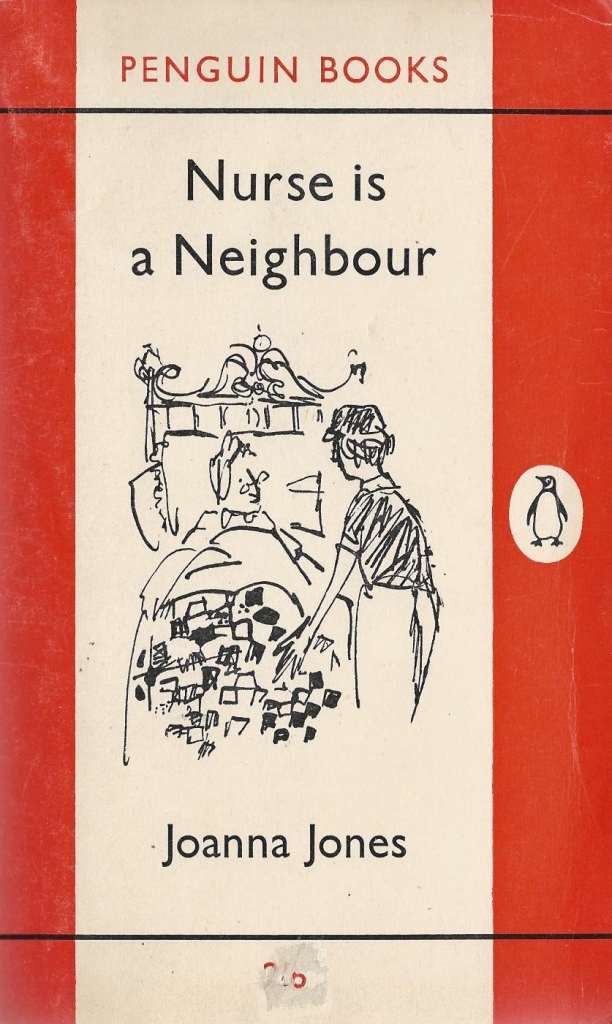
nurse is a neighbour joanna jonesNurse is a Neighbour by Joanna Jones ~ 1958.

This edition: Penguin, 1961. Paperback. 159 pages.

My rating: 5.5/10.

Crossing the pond to England, we hear from a rural district nurse, Joanna Jones, who tells of her work with a wryly sarcastic tone more than a little reminiscent of Monica Dickens at her most scathing. While not up to Dickens’ stellar level for this type of memoir, the writing here is competent enough to make this a smooth and easy read, and the details of Nurse Joanna’s life prompt us to forgive her frequently critical comments of all those around her.

Joanna has taken over her posting from a long-time Nurse Merrick, who is now well into her eighties, but still active and alert and very much keeping an eye on her young replacement. Nurse Merrick is not beyond giving some good advice when she thinks it needed, and Joanna tries to bear this in good grace, though it obviously rankles just a little now and again. Joanna also brings along to her cottage her elderly mother who is suffering from what seems to possibly be Alzheimer’s Disease (though the term is never used, I’m supposing that it was not in common usage in the 1950s), a progressive dementia which complicates Joanna’s life immensely, though she appears to cope with grace, humour, and much patience.

A very short, very anecdotal memoir, and an interesting glimpse into the state of British health care just as the National Health Program was being implemented; the protests of doctors and not a few patients as to the unwarranted interference of The State into the state of their medical care is rather familiar what with the United States’ “Obamacare” making the news these days.

Nurse is a Neighbour is quite readable, but I thought it was just missing that elusive special appeal which would make it a must-read. Joanna Jones wrote a second book of memoirs, Nurse on the District, and her books were the basis of a now-forgotten 1963 comedy film, Nurse on Wheels. Neither calls out to me for urgent investigation.

So if I wouldn’t go so far as to recommend this book as worthy of seeking out, I will repeat that it was a pleasant short read for a cold autumn afternoon’s tea break, in to warm up after digging in the garden and raking leaves.

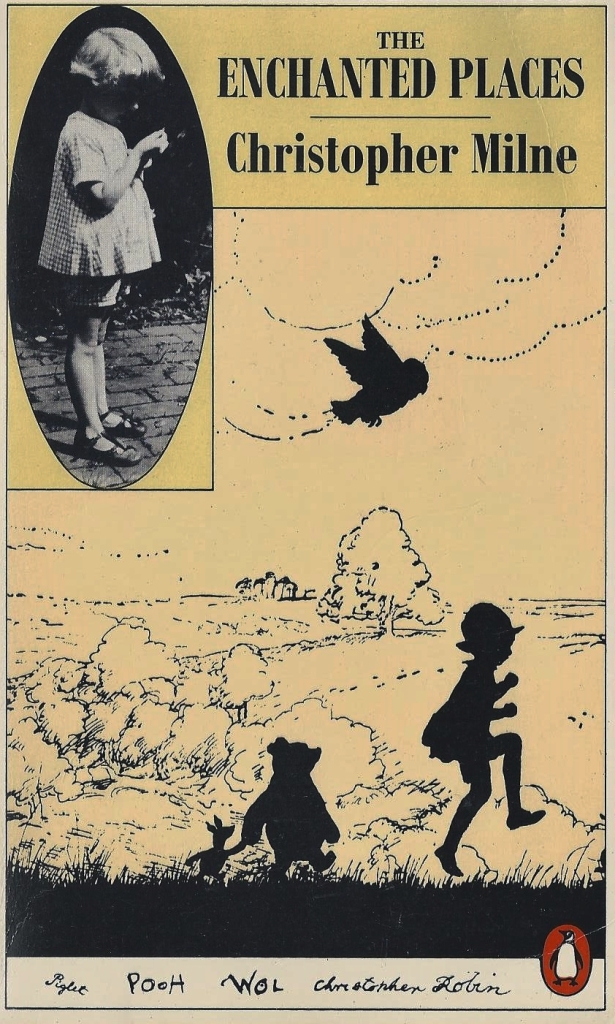
the enchanted places christopher milne 001The Enchanted Places by Christopher Milne ~ 1974.

This edition: Penguin, 1976. Paperback. ISBN: 0-14-003449-8. 183 pages.

My rating: 7/10.

I completely missed Winnie-the-Pooh in my own childhood; I can’t recall even being aware of such a character, though I’m sure A.A. Milne’s classic was readily available even in our rural British Columbia ranching community. Early childhood reading consisted mostly of a vast quantities of fairy tales, and of course the ubiquitous Little Golden Books. Beatrix Potter was just barely represented by a single non-Warne edition which consisted of Potter’s immortal text, but someone else’s dreadfully inadequate illustrations. I loved that one for the story alone – oh, brave, foolish Peter! –  and even today could probably reel off the entire thing from memory. But definitely no Pooh, in any way, shape or form.

I remedied that with my own children, of course, but Pooh never really took hold. Grilling them just now as to early childhood favourites, they mentioned Richard Scarry, the Dr. Seuss books, Beatrix Potter (hurray!) and, my daughter’s absolute favourite for a long, long period of her toddlerhood, The Poky Little Puppy. They do remember Pooh, but not with anything like dedicated fondness. Interesting.

Oh well, moving on, then. I myself do remember the Christopher Robin stories from that time of endless reading aloud, and I definitely appreciated the world of the Hundred Acre Wood, so when this memoir by the real Christopher Robin crossed my path, I read it with genuine curiousity.

In this slender volume (I found out later it is but the first of three, the following ones being The Path Through the Trees and The Hollow on the Hill, taking Christopher Milne into his adult years) the memoirist seeks to provide a sort of

…(C)ompanion to the Pooh books. In the first chapters I have attempted a picture of the Milne family life, the family life that both inspired and was subsequently inspired by the books…

For it is very evident from reading Christopher’s reminiscences that his life was indeed greatly influenced by his becoming a very well-known public figure indeed. His parents sought to shelter him from much of the publicity which his fictional counterpart attracted, but Christopher tells of his uneasy awareness that the fatherly gaze was often a bit too analytical for comfort, and then there was that rather awkward provision of new toys with an eye to story development possibilities…

The early half of the book was very much concerned with descriptions of the physical places which inspired the Pooh stories, and I must say that my interest faltered here and there, not being a true-blue devotee, but as Christopher (the real Christopher) grows up and begins to venture out into the broader world, the narrative becomes much more interesting, in an introspective, self-examining sort of way.

A.A. Milne, from Christopher’s restrained yet gently fond description of his father, seems to have been a man with a certain amount of reserve, a certain at-a-distance quality with his young child. He expressed his interest and attention through his writing rather than with much hands-on attention, and one gets the idea that Christopher in later years was very aware of how this had formed his own rather buttoned-up personality. An alone and one would think an occasionally lonely child, was young Christopher. And vaguely troubling is his mother’s insistence on the long locks and feminine attire; she was sorely disappointed that he had not been born a girl, reports Milne, and he muses about her motivations and their effect on his acceptance by his young peers.

I finished this memoir feeling just a little melancholy for that long-ago child’s sake, though it is comforting to see that he did manage to move on and break away from the heavy-though-benevolent burden of his past. I will be looking for the next two memoirs, to find out, in best story-telling tradition, “what happened next.” And, for my upcoming Century of Books, I intend to revisit Pooh himself, with his real-life owner’s story in mind.

Read Full Post »

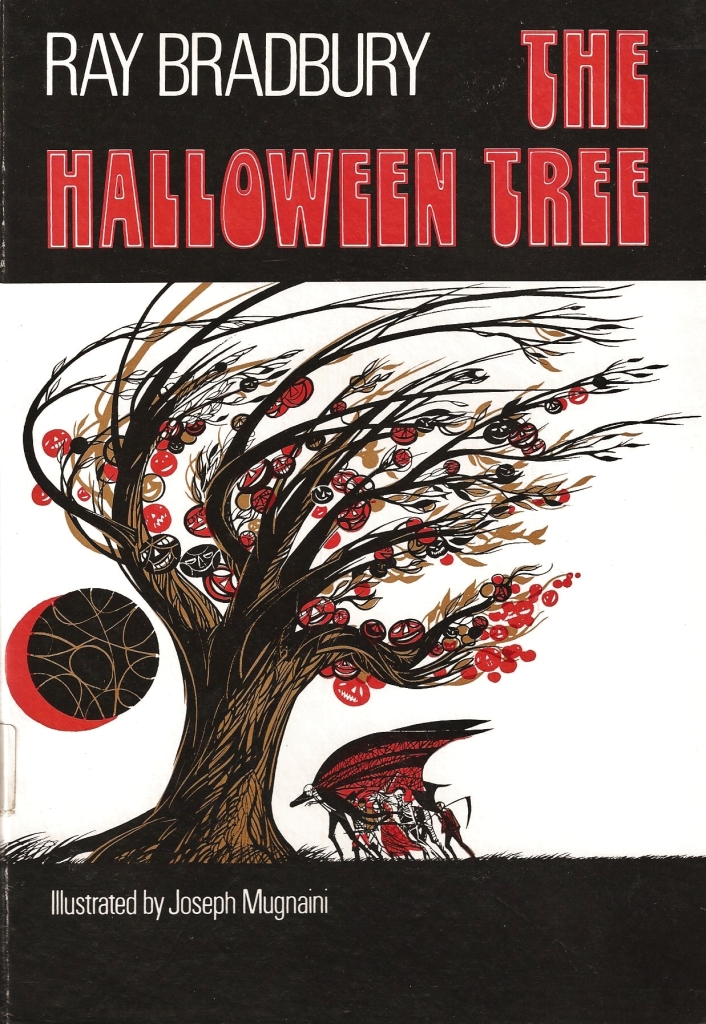
the halloween tree ray bradbury cover 001The Halloween Tree by Ray Bradbury ~ 1972. This edition: Knopf, 1972. Illustrated by Joseph Mugnaini. Hardcover. ISBN: 0-394-92409-6. 145 pages.

My rating: 6.5/10

Blink your eyes and a year has passed by. Weren’t we just here, on All Hallow’s Eve? And here we are again…

Last night I went out to the car and brought in the bags of Hallowe’en candy stashed in the trunk. Many years of experience have taught me the folly of allowing it into the house too early, and numerous times I have had to buy it twice. For once it is in, all bets are off, and unless I can package it up into bags intended for neighbourhood trick-or-treaters immediately, the odds are high that some wee child will get shortchanged of his or her full share of sugar.

We live at the end of a sparsely populated rural road, and no one ever makes it this far, so part of our Hallowe’en tradition since moving here twenty-some years ago has been to take our contribution to a neighbour’s place mid-way along the traditional route. For Hallowe’en in the country is a bit different than in town. No walking is involved (though one legendary year a few intrepid teens did go on horseback) – the distances are too great. Our usual route was a 15 miles round trip, with 12 houses visited, and those houses would strive to outdo each other in creativity and quantity of goodies for the “neighbour kids” who knocked on the door.

Homemade popcorn balls, full size bags of chips, cans of pop, store-bought candy by the bagful, pickles (yes, pickles – “witch’s fingers”, don’t you know?!), and pomegranate halves (“Because they just look so weird”) and just-roasted pumpkin seeds – what a glorious haul! At each house a prolonged visit, as the costumed ones are made to sing for their treats, spun around to examine their get-ups, photographed and congratulated on their creativity and sent on their way. It’s a very big deal around here, where everybody knows everybody, and usually can predict to the exact number how many children will be showing up – a phenomenal 18 (!) last year. Until our own kids passed that elusive milestone (mid-teenish) when the dress-up thrill began to pale, it was one of our family’s favourite nights of the year.

This year, after a few seasons of non-observance of the night, the now-independently-mobile (driver’s licences and a car) teens are talking of going into town to take part in a “zombie walk”, and costume makings are all over the kitchen table, so I guess they’re not too old for it after all, though the whole concept of the zombie thing leaves their parents a bit bemused. We will be joining up for a bonfire and fireworks once it gets dark, hosted by some of our in-town relations, so it promises to be an pleasurable evening.

All of this digression out of the way, I will now turn to the original purpose of this post, which is to talk a little bit about a book. Twizzlers and Rockets and a few mini Mars Bars at hand, I’m ready to go. Let’s see what my sugar-fueled morning brain can come up with to say about the book I searched out last night as an appropriate Hallowe’en read.

It was a small town by a small river and a small lake in a small northern part of a Midwest state. There wasn’t so much wilderness around you couldn’t see the town. But on the other hand there wasn’t so much town you couldn’t see and feel and touch and smell the wilderness. The town was full of trees. And dry grass and dead flowers now that autumn was here. And full of fences to walk on and sidewalks to skate on and a large ravine to tumble in and yell across. And the town was full of…

Boys.
And it was the afternoon of Halloween.
And all the houses shut against a cool wind.
And the town was full of cold sunlight.
But suddenly, the day was gone.
Night came out from under each tree and spread.

Behind the doors of all the houses there was a scurry of mouse feet, muted cries, flickerings of light.

Behind one door, Tom Skelton, aged thirteen, stopped and listened.

The wind outside nested in each tree, prowled the sidewalks in invisible treads like unseen cats.

Tom Skelton shivered. Anyone could see that the wind was a special wind this night, and the darkness took on a special feel because it was All Hallows’ Eve. Everything seemed cut from soft black velvet or gold or orange velvet. Smoke panted up out of a thousand chimneys like the plumes of funeral parades. From kitchen windows drifted two pumpkin smells: gourds being cut, pies being baked.

Tom Skelton is ready to take part in this night of nights. Playing on his fortunate last name, he’s decked himself out in bones, white stitched on black, and he’s keen to get going, as are his friends.

Wham. Eight front doors banged shut.

Eight boys made a series of beautiful leaps over flowerpots, rails, dead ferns, bushes, landing on their own dry-starched front lawns. Galloping, rushing, they seized a final sheet, adjusted a last mask, tugged at  strange mushroom capos or wigs, shouting at the way the wind took them along, helped their running; glad of the wind, or cursing boy curses as masks fell off or hung sideways or stuffed up their noses with a muslin smell like a dog’s hot breath…

But wait! Shouldn’t there be nine of them? Who is missing?

One is not there, and as they run to the missing Pipkin’s house an awful foreboding forms in each boyish heart. What could be wrong?

Pipkin appears, pale and sad, moving like an old man. Not feeling well at all. But still keen to join in. “You go ahead. I’ll catch you up.”

Agreeing to rendezvous in the ravine, at the House of the Haunts (brrr!) the boys scatter into the night.

And when they get there, still no Pipkin.

…They stood at last by a crumbling wall, looking up and up and still farther up at the great tombyard top of the old house. For that’s what it seemed. The high mountain peak of the mansion was littered with what looked like black bones or iron rods, and enough chimneys to choke out smoke signals from three dozen fires on sooty hearths hidden far below in dim bowels of this monster place. With so many chimneys, the roof seemed a vast cemetery, each chimney signifying the burial place of some old god of fire or enchantress of steam, smoke, and firefly spark. Even as they watched, a kind of bleak exhalation of soot breathed up out of some four dozen flues, darkening the sky still more, and putting out some few stars.

And towering over the house, an amazing, stupendous, fabulous tree.

And it was such a tree as they had never seen in all their lives.

It stood in the middle of a vast yard behind the terribly strange house. And this tree rose up some hundred feet in the air, taller than the high roofs and full and round and well branched, and covered all over with rich assortments of red and brown and yellow autumn leaves. [And] the Tree was hung with a variety of pumpkins of every shape and size and a number of tints and hues of smoky yellow or bright orange.

“A pumpkin tree,” someone said.

“No,” said Tom.

The wind blew among the high branches and tossed their bright burdens, softly.

“A Halloween Tree,” said Tom.

And he was right.

And out of a pile of leaves below the tree arises a huge man in dark clothes, a menacing and laughing man, intoning something about “tricks Tricks TRICKS,” and before they know it the eight boys are being whisked off on a fantastical journey into the past, to glimpse the origins of Halloween, and to try to pin down the elusive Pipkin, who seem always to be just a little beyond them, a faint and ghostly presence.

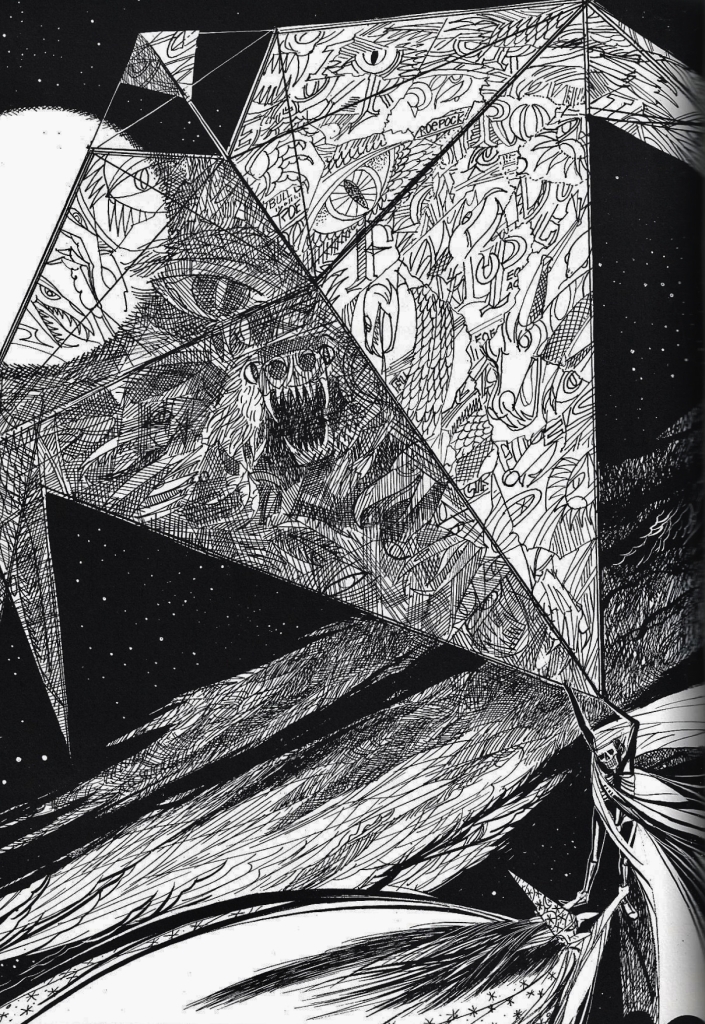
the halloween tree ray bradbury illustration 1 001

I have to admit that right here, page 33, is where Ray Bradbury rather lost me. I completely bought into the nostalgic Halloween night magic of the house and the tree and the boys and the thrills of their adolescent nocturnal glories, but once their shape-shifting, darkly mysterious host materialized and whisked them off into a time travel journey, the magic thinned and the bones of the Teachable Moment shone through.

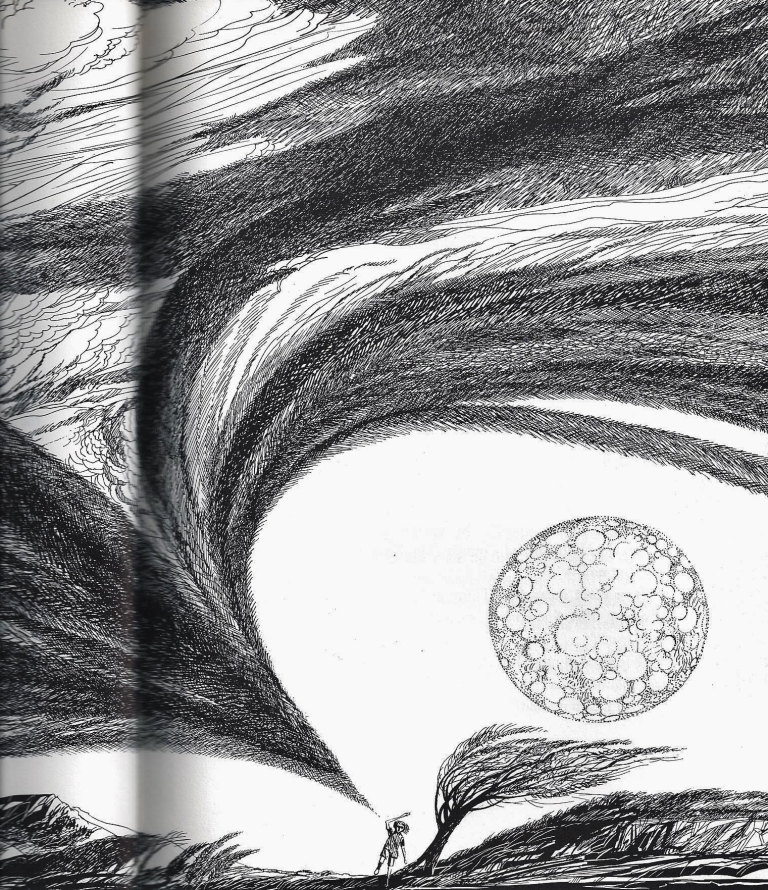
For this is a journey back to learn about the origins of Halloween, and the boys first build a kite out of a barn’s wall worth of tattered circus posters which carries them out into the night sky and beyond. The author is grandly creative in this bit, and admittedly throughout; the strength of the book is definitely in the imagery, if not in the highly contrived plot.

the halloween tree ray bradbury illustration 3 001

Off they all go to visit ancient Egypt, when the pyramids were new, and then to glimpse Night of the Souls rites in Greece and Rome. They have a seriously creepy encounter with scythe-wielding Samhain in Druidic times, watch the Romans fall the sacred groves, and the Roman golden images turn into Christian icons. A witch’s gathering attended by flying broomstick is next, merging into a visit to Notre Dame Cathedral and its fantastical gargoyles, one of which appears to be the missing Pipkin, turned to stone. Nice bit here with the wind and the rain allowing the stone creatures to speak.

Finally to the Day of the Dead in Mexico, into the graveyards and down into the Catacombs, where the eight boys are given a chance to finally save their elusive friend, but at a potentially terrible cost. Needless to say, they do the expected thing, and find themselves whisked back home, where they learn that Pipkin has indeed had a brush with death (appendicitis) but has had an operation, and has rallied wonderfully well.

Midnight strikes. All return to their homes, and the night turns quiet as the candle blames wink out on the Halloween Tree.

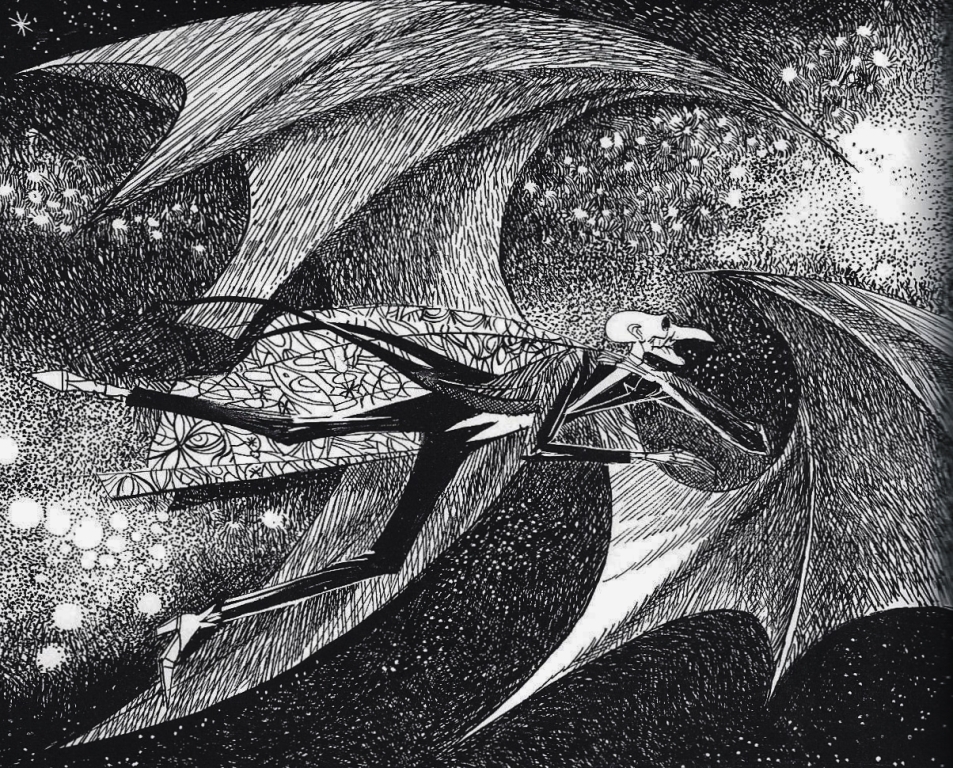
the halloween tree ray bradbury illustration 2 001

That felt really rushed. A whirlwind tour with too many stops.

I have mixed emotions about this short novel, this juvenile fable, this ode to youth and to the magic of an idealized Halloween.

Bradbury returns to his personal childhood world of white-picket-fence, small-town, mid-West America; his characters are those perennially adolescent boys just on the verge of the thing that comes next. Their world is ultimately clean, decent, safe and secure; the dark places are there, but there is always a refuge, and the light always triumphs in the end. Fair enough, but one can’t help but feel a bit uneasy, that there’s something missing from the scene, or maybe that there’s something more going on than we get to see. Where are the dark places in your world, dear reader, and what place of safety have you to look forward to?

Exactly.

The time travel bits are a bit too handy, a bit too contrived, a bit too screenplay-ready. Aha! And there’s the twist. This story was first conceived as just that, a screenplay for an animated movie, in 1969. That project fell through, and Bradbury dusted it off and turned it into this narrative work a few years later. This explains a lot, the abrupt switching from scene to scene, and the rushed and hyper-active speed of travel throughout. It would make a good movie, and in 1993 Bradbury helped Hanna-Barbera bring the story to the screen, winning an Emmy Award in 1994 for the project. ( I haven’t seen the 1993 film, but I am mildly curious about it now.)

An evocative juvenile novel, with interest for the adult reader in the beautifully written descriptive passages found throughout, if one can wade through the “Gee whiz!” kidspeak and the absolutely dire rhyming bits scattered throughout. (Poetry obviously is not one of Bradbury’s strengths, at least not here.) I’m not quite sure how present day youth would view this one; I suspect the dreamily imaginative ones would find much to like, but it also has a very vintage feel, perhaps too much so to appeal to the majority.

So there it is: a Halloween book review on the day itself.

Cheers, all.

Oh, and the morning candy was most tasty, but I think I’m good now for another year! 😉

Read Full Post »
Looking back at my list of books read, February 2013 was obviously a good month for hitting the books, but not quite so good for writing reviews. Playing catch-up, then with a series of short impressions of things I read 9 months or so ago.

In approximate order of reading, here are some of the books not previously reviewed from February of 2013.

*****

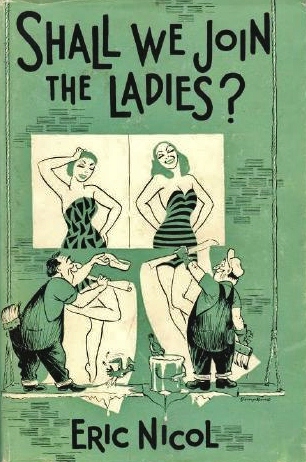
shall we join the ladies eric nicolShall We Join the Ladies? by Eric Nicol ~ 1955

This edition: Ryerson Press, 1965. Hardcover. 110 pages.

My rating: 5/10

I suspect I was sated with Nicol’s particular brand of humour when I read this one immediately after an old favourite, Nicol’s first collection of essays, The Roving I. For I recollect that I was not terribly amused. The mood was hectic, the punchlines groan-inducing. Vintage humour, turned a bit “off” after years of shelf life, perhaps?

A keeper, because it has its moments, and it is Eric Nicol, but not one I am eager to re-read any time soon. Contemporary readers thought much more highly of it, and it won the Leacock Award in 1956.

Canus Humorous thought it was a gem, and I recommend a look at this link if you’d like more detail. Such a thoughtful review that I feel immediately guilty for my faint enthusiasm. I promise I’ll revisit this one and do it more justice. Some day.

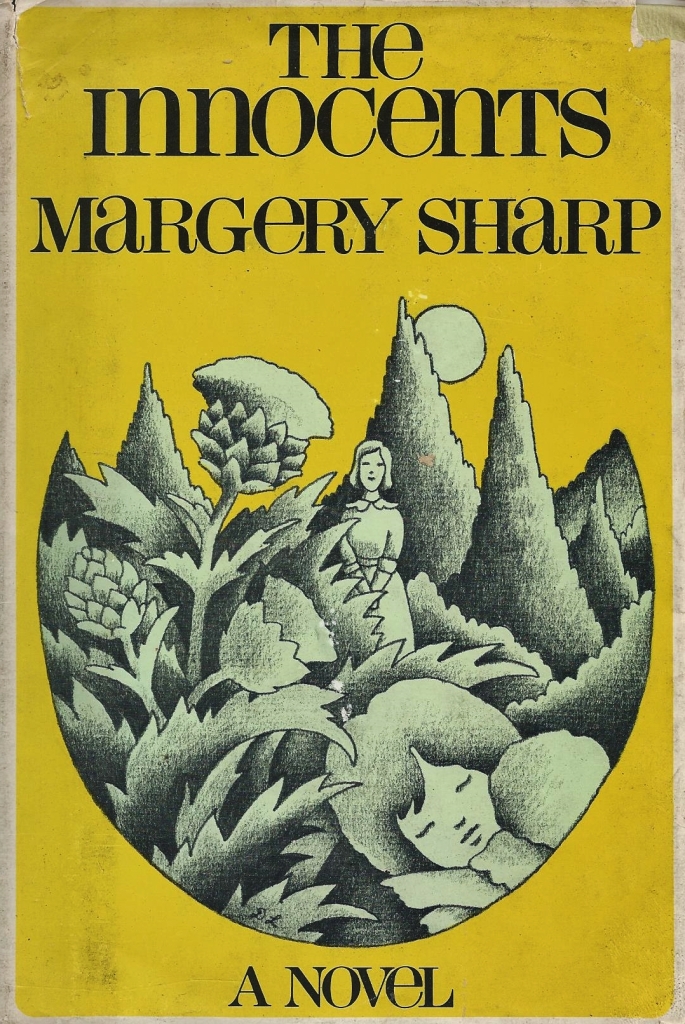
the innocents margery sharp 001The Innocents by Margery Sharp ~ 1972

This edition: Little, Brown & Co., 1972. Hardcover. 183 pages.

My rating: 11/10. I think this may well be my very favourite Margery Sharp, and, as you all may have guessed by now, I am seriously enthusiastic about this author to start with.

This was my second time reading The Innocents; I will be rationing myself to revisiting it, oh, maybe once a year or so, because I don’t want to wear out its already special status in my favourites list. For all of that enthusiasm, this is a very quiet book, one of those minor tales concerning a few people only, with nothing terribly exciting going on within it. But it is a compelling read, and I was completely on the side of the angels right from the get go, though fully cognizant of their failings.

In brief, then.

A middle-aged spinster living in a quiet English village is visited by a younger friend who has married very well indeed, and who is now living in America. It is immediately pre-WW II, and the married couple are hoping to squeeze in a Continental holiday before things cut loose. They are also travelling with their small child, and the unstated purpose of the visit-to-an-old-friend soon becomes clear: they are hoping that they can leave the child in the peace of the country while they continue on their tour.

All is arranged, and spinster and child settle in to a peaceful routine, which quietly turns into a longer-term arrangement as war intervenes and the parents return to America without stopping to collect their child.

Here’s the hook. The young child is very obviously mentally retarded, and though the father suspects this, the beautiful and vivacious mother refuses to even consider that her offspring may be in any way “sub normal”. The child and her caregiver form a deep and complex bond in the ensuing years before the now-widowed mother returns to collect her daughter and return with her to America, to launch into society, as it were, as a charming sidekick to her fashionable mother.

The reality is much different than the dream, and the subsequent events are absolutely heart-rending. The author lets us all suffer along with the brutally dazed child until bringing things to a rather shocking conclusion, which she has already told us about on the very first page.

Margery Sharp is at her caustic best in this late novel. Loved it. A longer review shall one day follow, full of excerpts and much more detail.

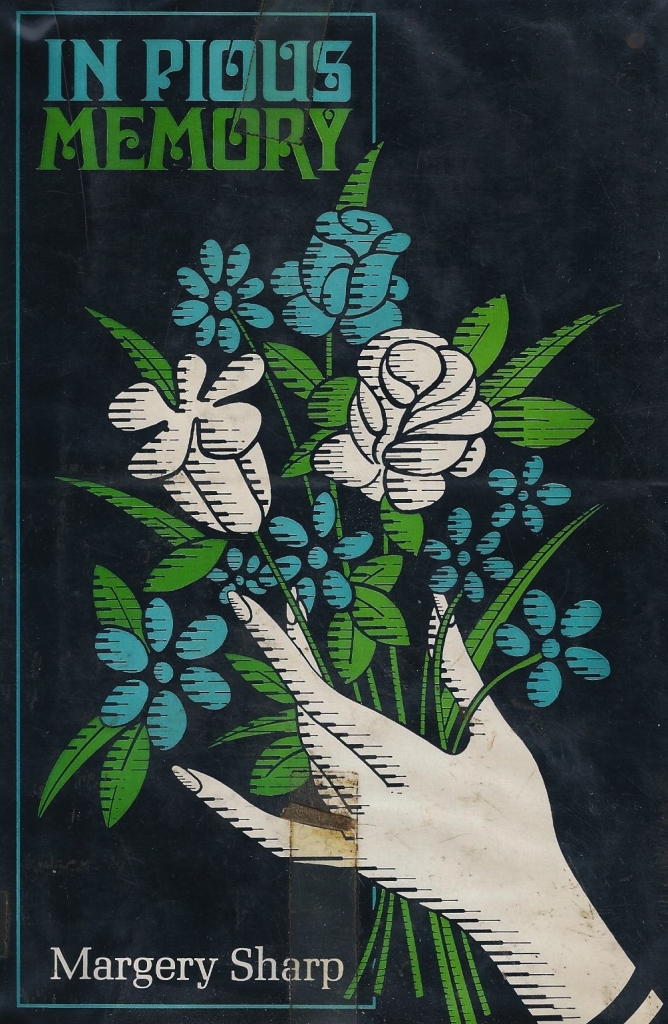
in pious memory margery sharp 001In Pious Memory by Margery Sharp ~ 1967

This edition: Little, Brown & Co., 1967. Hardcover. 184 pages.

My rating: 5/10

Well, then I went on to this slightly earlier novel, and of course it couldn’t even begin to stand up to The Innocents.

An out-and-out farce, this one. Mr. and Mrs. Prelude are in a plane crash in the Swiss Alps, and while Mrs. Prelude escapes relatively unharmed, Mr. Prelude perishes. Or does he? On her return to England, Mrs. Prelude begins to second-guess her hasty identification of what she now isn’t quite sure were her husband’s mortal remains. Sixteen-year-old Lydia sets out on a quest to find her father. Much hilarity ensues.

The whole thing fell rather flat. It seemed forced, and needlessly frenetic, and Margery Sharp’s sly innuendo just plain annoyed me this time around. To be fair, I will be re-reading this one in future, and may then possibly view it with less jaded eyes. I must say that it reminded me strongly of Dodie Smith’s The New Moon with the Old, and my reaction was much the same: reluctant amusement tinged with distaste for the general tone.

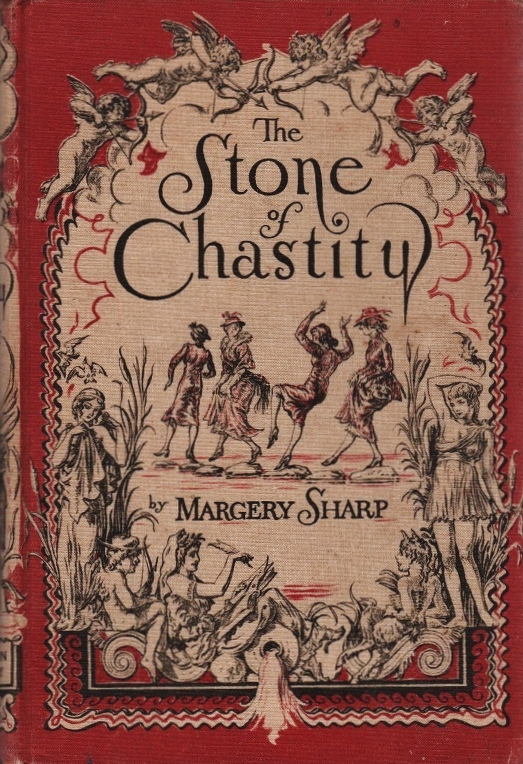
the stone of chastity margery sharpThe Stone of Chastity by Margery Sharp ~ 1940

This edition: The World Publishing Co., 1945. Hardcover. 280 pages.

My rating: 6.5/10

Now going back a few decades, to 1940, and Margery Sharp’s ninth novel, this one pure farce.

In the small gun-room, temporarily converted into a study, Professor Isaac Pounce was even then completing his questionnaire (later to be circulated through the unsuspecting village of Gillenham) on the subject of Chastity…

Professor Pounce is hot on the track of a piece of English folklore. He is looking for a mythical stepping stone which, when trod upon by female persons, will unfailingly support the virgins and toss off the unchaste ignominiously into the gurgling stream. Having a very good idea of where the stone might be, Professor Pounce’s first step in this very scientific study is to send his nephew Nicholas out with a questionnaire to all of the likely young village maidens. Confusion ensues as the rural rustics turn against the snoopy visitors in the Old Manor.

Another one due for a re-read, to savour the full flavour of what Margery Sharp has assembled here. She’s in fine form throughout, and the thing is most readable, though I felt that it wasn’t altogether convincing, even allowing for its obviously satirical intention.

Another snippet, to give you a taste of the flavour of the narrative within:

On the first floor Mrs. Pounce, mother to Nicholas and sister-in-law to the Professor, was lurking in her bedroom afraid to come out. She had appeared at lunch wearing a very nice necklace of scarabs and enamel, and the Professor, cocking an interested eye, had remarked that it was just such trifles – the sight of an English gentlewoman ornamented with seven phallic symbols – that made life so perennially interesting to the folklorist. Mrs. Pounce did not know what a phallic symbol was, and instinct (or perhaps a look in her son’s eye) prevented her asking; but after coffee she quietly sought out a dictionary and took it upstairs. At the moment she was feeling she could never come down again.

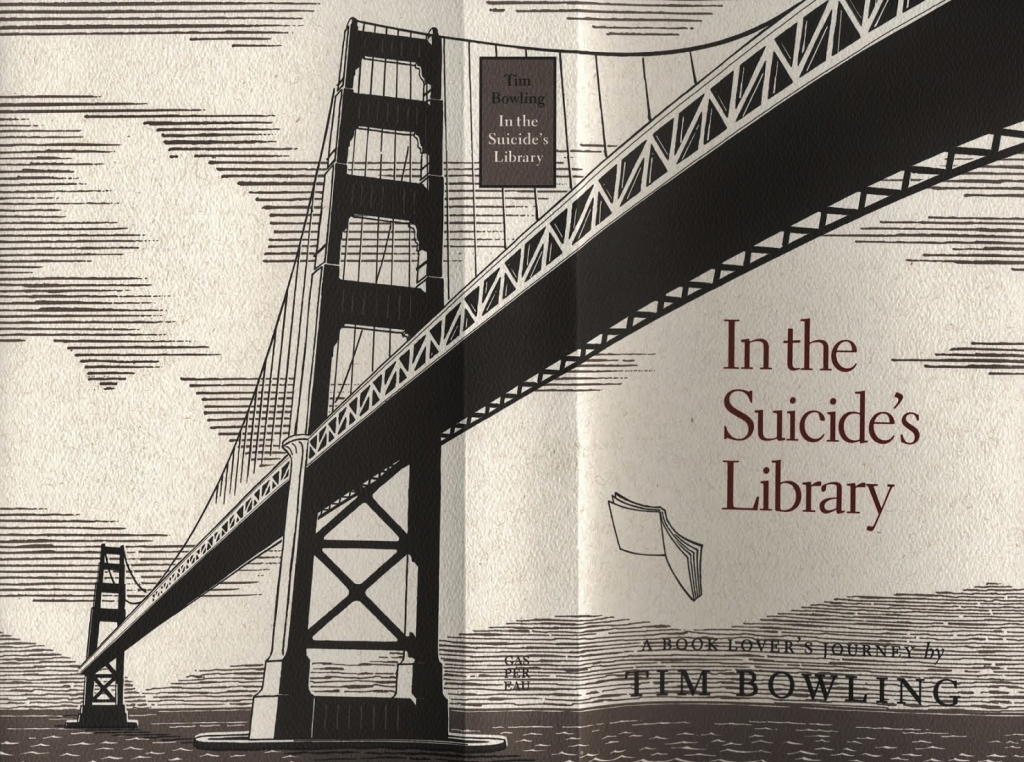
i the suicide's library tim bowling jacketIn the Suicide’s Library by Tim Bowling ~ 2004

This edition: Gaspereau Press, 2010. Softcover.  ISBN: 1-55447-089-7. 320 pages.

My rating: 7/10

And now, changing gears completely to something much more consciously literary.

Is it ever right to steal a book? Tim Bowling, Canadian poet, browsing a university library collection, stumbles upon a copy of poet Wallace Steven’s Ideas of Order, signed on the flyleaf by yet another poet, Weldon Kees, who disappeared mysteriously one day in 1955, with evidence suggesting his suicide by jumping of San Francisco’s Golden Gate Bridge.

As Tim Bowling allows his collector’s lust to suggest certain possibilities to him – would anyone even notice if he “liberated” such a poet’s treasure from its dusty obscurity in the stacks? – his renewed interest in both Wallace Stevens and Weldon Kees leads into a book-length examination of his own life, and the parallels between himself and his predecessors.

The angst of middle age, marriage and parenting are discussed with passionate intensity, as are such things as the relevance of poetry in the world, the desire to own objects, the new importance of the internet to the serious book collector, and much, much more.

Absolutely fascinating, but it does go on and on and on, and I absolutely hated Bowling’s final decision regarding the book, which I cannot share here, as it is the whole point of working through this thing. It made me grumpy for days, and still offends me to think about it.

Has anyone else read this one? What did you think he should have done?

And I must say that this has to be one of the most aesthetically pleasing of the contemporary books I personally own; Gaspereau Press did a fabulous job of the actual production of the physical book. The paper, the fonts, the slipcover and the undercover and the graphic design – absolutely perfect.

Read Full Post »

« Newer Posts - Older Posts »