Archive for the ‘1970s’ Category

within this wilderness feenie zinerWithin This Wilderness by Feenie Ziner ~ 1978. This edition: Akadine Press, 1999. Softcover. ISBN: 1-888173-86-6. 225 pages.

My rating: 8.5/10

I read this book some months ago, and posted a brief mention of it as part of a round-up post. Expanded here, and re-posted in order to include this in the Canadian Book Challenge #8.

Within This Wilderness is an autobiographical account of Ziner’s final attempt to come to terms with her adult son’s rejection of society and his retreat to the remote coastal woods of British Columbia’s Vancouver Island.

The 1978 Kirkus review:

Feenie Ziner’s son Ben was one of those Vietnam war casualties who was never in uniform: spooked by the military buildup, repelled by the consumer culture, he dropped out of school and took off for the Northwest, talking of cosmic energy and inner space, drifting in and out of lack-limbed communes, ultimately settling on his own wilderness island. Anxious for his return or at least some answers, Ziner flew in after he’d been living alone for nearly two years, and her skillfully developed account of what transpired between them – a progressive disarmament – slips over the boundaries of personal experience. She masters the primitive flusher and inures herself to thoughts of wolves (“I’ve read Farley Mowat”); he points out handmade appliances and shares new wisdoms (“Plastic is to us what horses were to the Spanish”). They lie to each other, spar philosophically, and resume a fragile peace. Even the eccentric neighbors – classic misfits – find him difficult. “Why does he make himself so damned. . . inaccessible?” “Why does he live that way? As if he were expiating for some kind of a sin?” She draws on the tranquillity of the place, reads the I Ching with the beatific vegetarian round the bend (“The companion bites a way through the wrappings”), and waits. And eventually the staunch independence unmasks, the precarious self-esteem surfaces, a pained confession of inadequacy is spoken. One must suppress dark thoughts about the shaping of this material (could it have happened so smoothly? was she taking notes?) for the perfect curve of events seems almost too good to be true. But Ziner deftly renders the nature of their exchange and the nuances of her private adventure, and the illumination of his fringe benefits and her mainstream hollows will reach that audience attuned to generational discord and cultural reflections.

I found this book deeply moving, relating (of course!) to the mother-figure as she tries to figure out just what is going on with her son, and how much of it had to do with her. Her son’s back story leads one to speculate that it was not so much what his parents did as what he was in and of himself, but the mother-angst is no less because of this.

Feenie Ziner turns this very personal aspect of her life into something engagingly relatable. I myself found it comforting, being involved in the same stage in my life in relation to my own newly adult son – that point where they wander off and do slightly inexplicable things and leave you wondering just where you lost your place in the parenting manual – oh, hang on – was there a manual? – and the only thing one can cling to is the thought that your motherly experience is widely shared.

The worries in both of our cases, I hasten to add, are not as much about the moral state of the offspring as about the little details about how they are going to feed themselves, and the lack of any obvious-to-the-parental-eye long-term planning “career”-wise.

Within This Wilderness, along with its deeper moments, is permeated with wry humour, as the author turns her thoughtful gaze upon herself, and the various characters she encounters as she steps into her son’s out-of-the-mainstream world.

Curious about the whole Ziner ménage, I recently tracked down Feenie Ziner’s 1966 memoir, A Full House, detailing her life with her husband, acclaimed artist Zeke Ziner, their two young sons, and newborn triplets. I will be writing about this memoir in more depth in a future post.

“Ben” Ziner is in reality Joe Ziner, and he did stay on Vancouver Island, pursuing an eventual calling as an artist and printmaker. Joe Ziner founded Percolator Press in Courtenay, B.C., which specializes in graphic art and illustrated books.

Very much worth reading. Recommended.

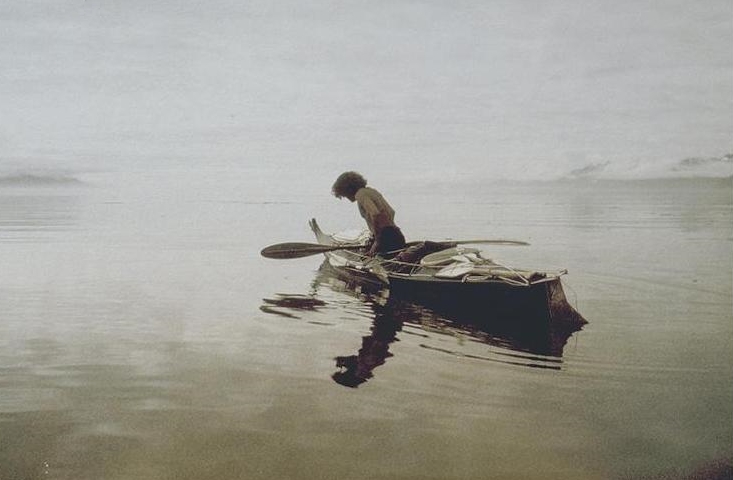
Joe Ziner in Chatham Strait - photographic image by George Dyson

Joe Ziner in Chatham Strait – photographic image by George Dyson


Read Full Post »

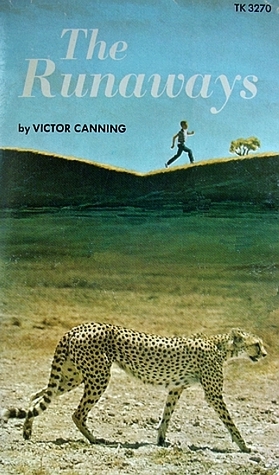
the runaways victor canningThe Runaways by Victor Canning ~ 1971. This edition: Scholastic, circa 1975. Paperback. 300 pages.

My rating: 6/10

This was something of a nostalgia trip, being a book I remember reading and re-reading in my late grade school years. Though it has lost some of its original magic on this four-decades-later adult re-read, there still exists a certain appeal, though the set-piece situation (misunderstood teenager with a working class background wrongly accused of a crime and on the run from the authorities) is very much of a muchness with so many other books in the youth market genre of the 1960s and 70s.

Victor Canning’s twist is that his protagonist’s adventures are twinned with those of an escaped cheetah, and though the improbability of the whole scenario is exceedingly glaring to me as a cynical grown-up who notices the many logistical gaps in the story, the tale works very well for its intended readership.

From The Runaways page on John Higgins’ extensive Victor Canning website:

Samuel Miles, known as “Smiler”, aged 15, has been falsely convicted of stealing an old lady’s handbag. He runs away from an approved school (young offenders’ prison), is recaptured and escapes from the police car during a thunderstorm. He is determined to stay free until his father, a ship’s cook, returns from his current voyage in nine months time and can help to clear him of the theft charge. The same thunderstorm brings down a tree in the wildlife enclosure at Longleat, allowing a cheetah called Yarra to escape.

On their first night of freedom, Smiler sleeps in the loft of a barn in which Yarra also takes shelter. We then follow their parallel stories, Smiler using a cottage in the village of Crockerton which belongs to the absent Major Collingwood, and Yarra learning to hunt again and finding a den in the Army firing range at Imber on Salisbury Plain. Smiler gets a job at a kennel. Yarra gives birth to cubs. Major Collingwood returns and Smiler goes to stay with the dog’s meat man, Joe Ringer, who teaches him a lot of country lore including poaching skills. Meanwhile Major Collingwood is intrigued with the signs of occupation at his cottage and starts a quiet investigation…

Vignettes from the story have stayed with me in crystal clarity from my youthful reading days: the escape from the police car in the thunderstorm; the cheetah’s escape at the same time only a few miles away; Smiler’s roaming through an empty cottage and his happy discovery of a jar of coins in the study and his use of those for “running money” and the subsequent replacement; the cheetah learning to craftily live with army maneuvers on Salisbury Plain.

Smiler outsmarts the well-meaning authorities, and fades away at the end of the tale, leaving things open for possible sequels, of which Canning did write two: Flight of the Grey Goose, 1973 and The Painted Tent, 1974, respectively concerning Smiler’s further adventures on the run and in temporary sanctuary in an animal sanctuary/castle in Scotland (with wild geese for the animal interest), and then with a Romany fortune-teller and an injured peregrine falcon.

I found The Runaways a rather simplistic read for an adult, though this is doubtless the reason it has retained its popularity as a recommended school novel for “reluctant readers”. I haven’t read the two other books in the trilogy, nor do I feel particularly compelled to seek them out, though I would be pleased enough to read them if the opportunity arose.

What I am really interested in, however, is the rest of Victor Canning’s body of work. The Smiler trilogy is something of a later-career departure for this writer, for his main claim to fame was as a prolific producer of adult fiction, from his comedic, best-selling, 1934 pseudo-travelogue, Mr Finchley Discovers His England, and a few similar books, to a large number – something like fifty – of thrillers and short story collections of varying degrees of darkness, a great number of which were successfully made into movies and television productions. He also penned a well-reviewed Arthurian trilogy.

Victor Canning kept himself busy writing up until the end of his life  – he died in 1986, at the age of seventy-five – with his last novel, Table Number Seven, being finished by his wife and sister, and published posthumously in 1987.

Looking over the list of Victor Canning’s titles on the excellent website already referred to, some titles sound more than a little familiar. I may perhaps already have a few of these tucked away amongst the boxes of yet-to-be-shelved books from my parents’ attic. I look forward to investigating this writer in a mild way in future, though I will need to make note of his several pseudonyms – Alan Gould and Julian Forest – to enable me to identify his books for further examination.

A promising writer to add to the vintage-books look-for list.

Is anyone already a fan?


Read Full Post »

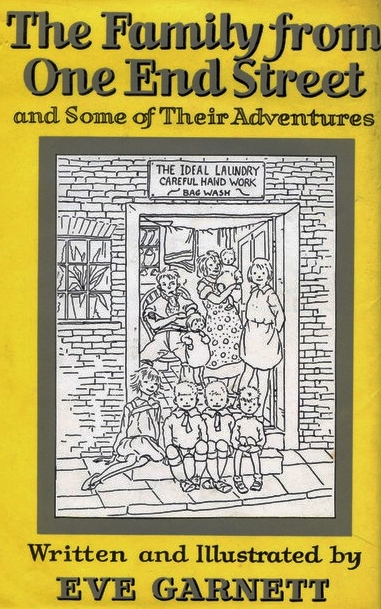
the family from one end street eve garnett 1937The Family From One End Street and Some of Their Adventures by Eve Garnett ~ 1937. This edition: Frederick Muller, 1949. Illustrated by the author. Hardcover. 212 pages.

My rating: 8.5/10

A cheerful period piece of a book, illustrated by the author.

Mrs. Ruggles was a Washerwoman and her husband was a Dustman. “Very suitable, too,” she would say, though whether this referred to Mr. Ruggles himself, or to the fact that they both, so to speak, cleaned up after other people, it was hard to decide…There were a great many Ruggles children – boys and girls, and a baby that was really a boy but didn’t count either way yet.

The seven Ruggles children, from twelve year old Lily Rose doorstepping down through Kate, twins James and John, Josiah (after his father, and both called “Jo” for everyday), Margaret Rosie, and baby William, get into the expected scrapes, and find their way out of them in various ingenious ways.

Anecdotal chapters follow the children in turn, and together give an amusing portrait of between-the-wars London through the eyes of a poor-but-respectable working class family.

Homeschooler “living books” note: Much in the line of Eleanor Estes and Elizabeth Enright, this might well work as a read-aloud to attentive children, or as a good read-alone for thoughtful and competent middle grade and older readers, if they are interested in “family stories” from “long ago.” Nicely complex in structure and vocabulary; developing early readers might have some trouble deciphering some of it, but confident readers should be able to power through.

Charming and diverting, for the problems are quite genuine, the adventures are sometimes poignant (and also frequently quite funny), and they always seem to come right in the end.

Pleasant adult read for its historical interest and distinctive narrative voice. I’ll repeat: this is definitely a period piece.

Wikipedia provides some background context:

Garnett was commissioned to illustrate Evelyn Sharp’s 1927 book The London Child and the work left her “appalled by conditions prevailing in the poorer quarters of the world’s richest city”. She determined to show up some of the evils of poverty and extreme class division in the United Kingdom, especially in contemporary London. To that end she worked on a 40-foot mural at the Children’s House in Bow, completed a book of drawings with commentary called Is It Well With The Child? (1938), and both wrote and illustrated a story book that dealt with the social conditions of the English working class, which was exceptional in children’s literature.

That book, The Family from One End Street, was rejected by several publishers who deemed it “not suitable for the young”, but eventually published by Frederick Muller in 1937. It won the second annual Carnegie Medal from the Library Association, recognising the year’s outstanding children’s book by a British subject. (It beat Tolkien’s The Hobbit among others.) For the 70th anniversary of the Medal, it was named one of the top ten Medal-winning works, selected by a panel to compose the ballot for a public election of the all-time favourite. It is regarded as a classic, having remained in print to the present day.

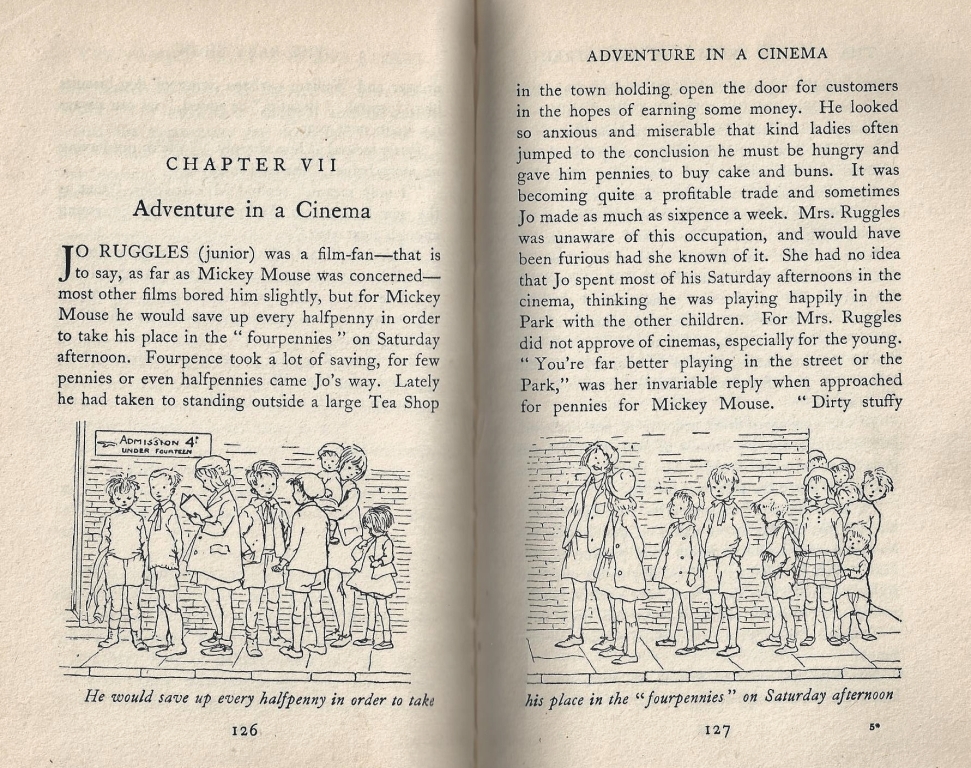
the family from one end street excerpt eve garnett 001

A random page scan from The Family From One End Street, by Eve Garnett, 1937.

little britches ralph moodyLittle Britches: Father and I Were Ranchers by Ralph Moody ~ 1950. This edition: University of Nebraska Press, 1991. Softcover. ISBN: 0-8302-8178-1. 260 pages.

My rating: 7/10

In 1906 the Moody family – Mother, Father, and five children, with Ralph the second oldest at 8 years old – moved from New Hampshire to Colorado, where it was hoped that the clean air and a healthy outdoor life would help Father recover from a lung ailment acquired while working in a dusty woolen mill. This turns out to be galloping tuberculosis, and you just know it’s not going to end well, especially when you note that the sequel to Little Britches is titled Man of the Family.

Gloomy foreboding aside, I’ll return to the installment under discussion. Promised a thriving ranch, the family finds instead a derelict three-room house set on skids in the middle of a cactus-infested field, with not a decent fence or sound outbuilding in sight. They almost head back to New Hampshire then and there, until Mother proclaims, with a sob in her voice, that the Good Lord led them there, and there they shall remain.

Needless to say there are many challenges, but a small and thriving ranch is indeed established, with young Ralph, in the throes of hero worship for the local cowboys he has just encountered, participating to his utmost alongside his competent and hardworking through constantly ailing father.

A diverting enough tale, mostly autobiographical, with some creative license applied by the author. Young Ralph seems to have been a rather accomplished child for an 8-year-old; he excels at everything he tries, though frequently not without a lesson-teaching setback or two. Father is continually having to spank him soundly, and of course (this being an inspirational type tale), young Ralph is grateful for his correction, for naturally Mother and Father know best.

Sometimes a bit preachy, but nevertheless an effortless and engaging read. This book and its sequels, Man of the Family (1951), The Home Ranch (1956), Mary Emma & Company (1961), The Fields of Home (1953), Shaking the Nickel Bush (1962), The Dry Divide (1963) and Horse of a Different Color (1968), were the result of a creative writing course taken by Ralph Moody at the age of 50, and are composite portraits of events and characters from his childhood and later years.

These books are beloved of many “religious-minded” homeschoolers, for their emphasis on moral fortitude and godly behaviour. Though Ralph fell aside from the narrow way many times, he was always able to boost himself back up by his bootstraps, with the help of an occasional inspirational visit to the back of the barn with Dad and a willow switch, or a less-physically-painful session with Mother and the family Bible.

Ralph Moody’s agenda as a writer was simple and sincere. As he said in a 1967 interview in the New York Times Book Review: “My goal in writing is to leave a record of the rural way of life in this country during the early part of the twentieth century, and to point up the values of that era which I feel that we, as a people, are letting slip away from us. ”

Fair enough. Mostly very good, this book, and perhaps I am being overly critical regarding all of the corporal punishment the author so enthusiastically reports.

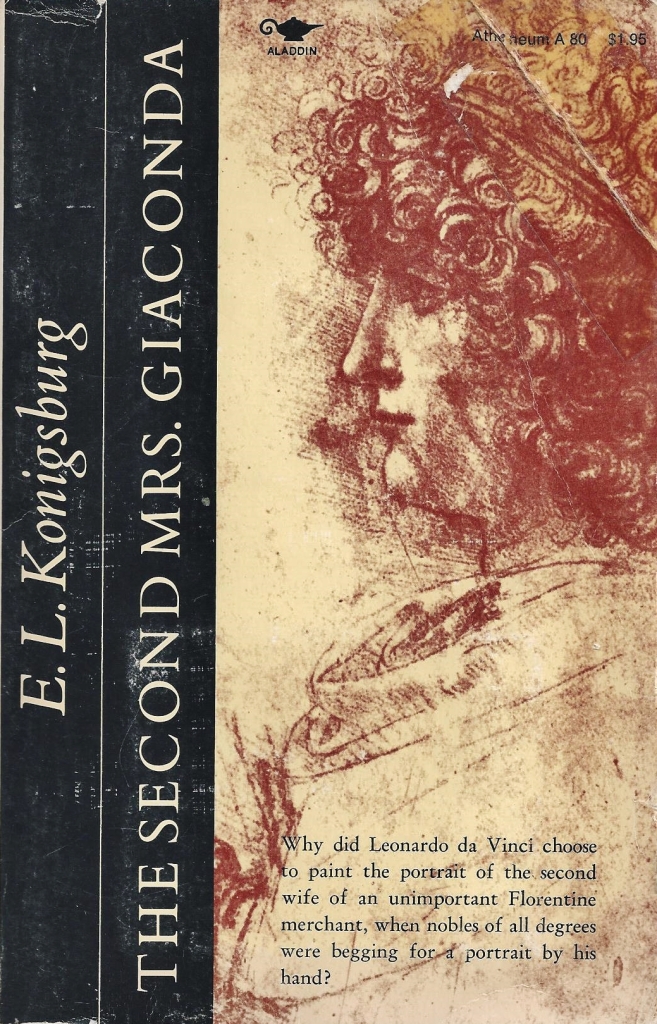
the second mrs giaconda e l konigsburg 001The Second Mrs. Giaconda by E.L. Konigsburg ~ 1975. This edition: Aladdin, 1980. Softcover. ISBN: 0-689-70450-X. 138 pages.

My rating: 4.5/10

Why did Leonardo da Vinci choose to paint the portrait of the second wife of an unimportant Florentine merchant, when nobles of all degrees were begging for a portrait by his hand?

Great question, regarding the enigmatic “Mona Lisa.” Too bad the author never really answers it.

I quite like a lot of Elaine Lobl Konigsburg’s work, for though she was of the “problem novel” school of juvenile writer, her books for the most part contain a lot of humour, and are never preachy. The “educational” bits are generally unobtrusively incorporated into the tale, with the final product being entirely pleasing.

Sadly, The Second Mrs. Giaconda, despite its perennial inclusion on juvenile reading lists due to its Leonardo da Vinci theme, is to my mind something of a dud, being written exclusively in “tell, don’t show” mode. A great shame, because this writer was capable of doing so much more, and the subject is chock full of potential.

The novel gives an overview of life in Renaissance Italy through the eyes of Leonardo da Vinci’s young apprentice Gian Giacomo de’ Caprotti, known to his familiars as Salai. Giacomo/Salai was a real historical personage, and he is mentioned in da Vinci’s journals with intriguing frequency, from his entry into the household as a child of 10, in 1490, to his inclusion as a beneficiary of a house and half of da Vinci’s garden property in da Vinci’s will.

Leonardo da Vinci refers to Salai as a “liar, thief, mule-head, glutton”, and includes mention of his apprentice’s numerous failings, but obviously something happens during their time together to turn the tables completely. What was it? Konigsburg fabricates her version of their joint story referring to da Vinci’s actual journal entries, and in this case her creative license feels forced, as she incorporates Salai’s fancied involvement in all of da Vinci’s personal and professional relationships, in particular with Leonardo’s great patron, the immensely powerful Duke of Milan, and his wife Beatrice d’Este.

None of this has anything to do with the Mona Lisa, and the “second Mrs Giaconda” shows up only very briefly in the very last chapter, with her portrait painted as something of a slap in the face to Beatrice’s jealous sister Isabella, and the whole project completely engineered by the cunning Salai.

Here, courtesy of ever-handy Wikipedia, is some more of a rundown on the plot of this novel. :

The son of a poor shoemaker, Salai is a cutpurse caught in the act by the master, whose grasp and visage he mistakes for the hand and face of God. Leonardo takes him as an apprentice, at no fee, and practically as a servant. Salai remains a scoundrel who moves from petty theft to selling his master’s sketches, and later to selling his audiences.

Princess Beatrice comes to Milan and marries Il Moro, the duke, who had hoped to marry her beautiful older sister Isabella d’Este. He continues to wait on his beautiful mistress Cecilia Gallerani, the subject of a Da Vinci portrait that is already famous. “She’s small and dark and perfectly plain”, Salai says when he first sees Beatrice; when they meet by accident, she is “trying to get the sun to make me blond and beautiful”. They discover a shared taste for mischief. To Leonardo she laments, “Could I but gain my husband’s love, I know that I could disguise this plain brown wrapping.” He asks what she has “to give him that Cecilia has not” and she volunteers her “sense of fun”.

Salai and even Leonardo often visit Beatrice and she becomes the toast of Milan —assisted by the visits. They come to consider her “our duchess” but she does win her husband’s love. Isabella visits and envies her sister for “the intellectuals, the gifted, the skilled craftsmen; the very elements who were drawn naturally to Beatrice.”

Beatrice grows into a political role and becomes a collector of clothing, jewels, etc., and no longer a companion to Salai. She [eventually] conveys insight regarding the master’s talent, and admonishes Salai to take some responsibility for that. To achieve great art, Leonardo needs “something wild, something irresponsible in his work”, and Salai must help.

The merchant Giaconda and his wife appear only in the last of nineteen chapters, visiting the studio during the master’s absence. [In the meantime], Beatrice has approved Leonardo’s The Last Supper and died in childbirth. Milan has been conquered by the French and Leonardo has moved to Mantua. Duchess Isabella of Mantua (sister of Beatrice) has been frustrated for years seeking her portrait by Leonardo, which delights Salai. “Sooner or later she would come to realize that here was one prize that was just out of reach of her jeweled pink fingers.” Spurred by [thoughts of] Beatrice and Isabella, the irresponsible Salai determines to persuade Leonardo to paint Lisa [Giaconda]…*

…and the rest, as they say, is history.

Got all that?

If it all seems a bit flat, despite its convolutions, it is, especially as reported by Konigsburg.  I thought this little historical fiction highly contrived and not particularly interesting, despite its achievement of the Best Book of the Year (1975) for Young Adults Award from the American Library Association.

*All of the quotations in the Wikipedia excerpt are taken from Konigburg’s novel, not Leonardo’s journal.


Read Full Post »

The calendar is on month 12 of the 2014 Century of Books, and much as I wish I could write pages and pages on each of the books already read but yet to be reviewed, I’m afraid it’s not going to happen. I need to start the new year with a clean slate, so this coming week-before-Christmas will see a whole slew of briefest-of-assessment round-up posts. Some of the books noted will be re-reads in the future, and I’ll have to see if I can do better then.

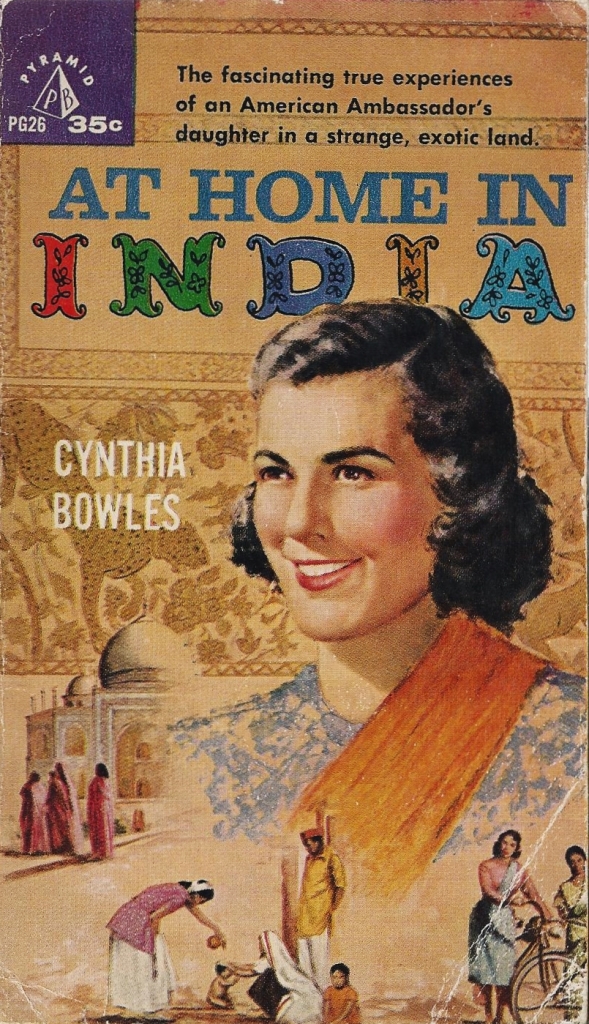
at home in india cynthia bowles 001At Home in India by Cynthia Bowles ~ 1956. This edition: Pyramid, 1959. Paperback. 158 pages.

My rating: 5/10.

“The fascinating true experiences of an American Ambassador’s daughter in a strange, exotic land.”

An American ambassador’s teenage daughter records in earnest detail her experiences of two years in India in the early 1950s. The writing is plodding but the subject has its moments of interest, with much reference to Nehru and Ghandi, and Miss Bowles finds her stride in the later chapters as she stays behind for a few months after the rest of her family’s return to America. Flying solo, the author visits the homes of Indian school friends and does a bit of mild personal research into social programs.

From the back cover, “A Personal Message from Cynthia Bowles”:

I went to India as a young, teen-age girl anxious not so much for knowledge as for the happiness and security which I was reluctantly leaving behind me in Connecticut. Consequently this is not a book of facts and figures. It is the story of what I did in India, of the places I visited, and of the people I came to know. I write because I wish to share, as best I can with you, my experiences in this strange and wonderful land.

And that snippet from young Cynthia tells you all you need to know about her writing  style. Worthy topics of discussion aside, a bit of a bore, really. I doubt I’ll reread this one.

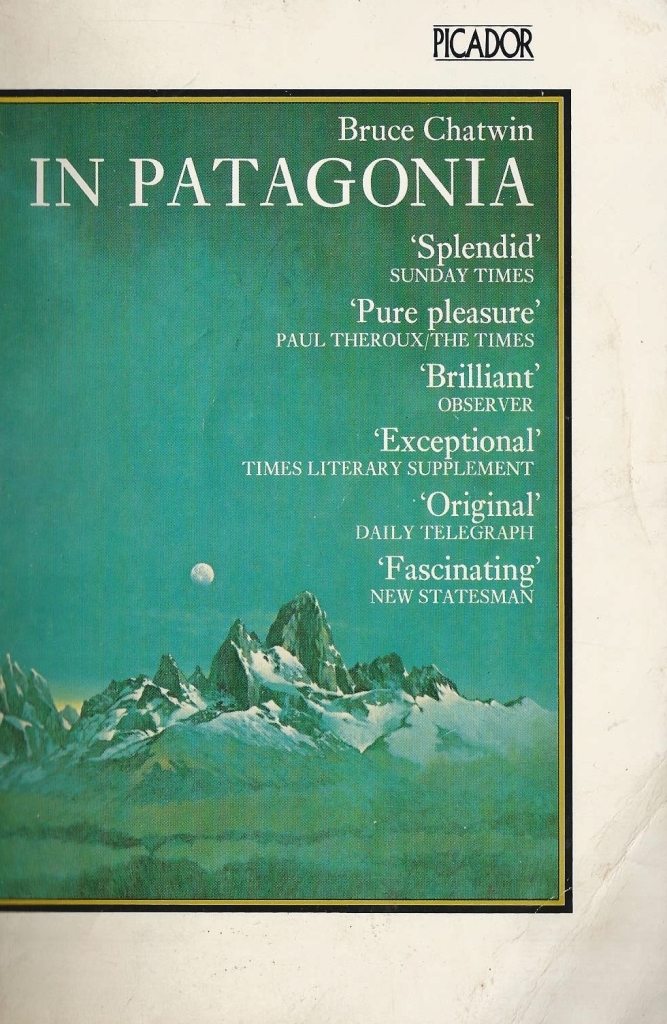
in patagonia bruce chatwin 001In Patagonia by Bruce Chatwin ~ 1977. This edition: Picador, 1979. Paperback. ISBN: 0-330-25644-0. 186 pages.

My rating: 8.5/10

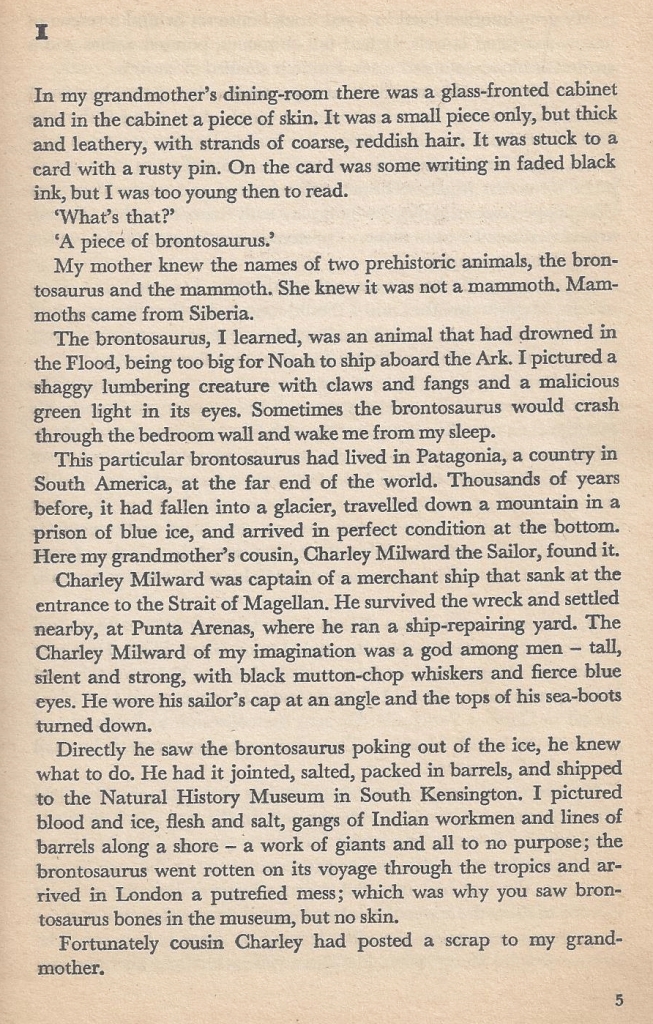
The inveterate traveller, raconteur and ceaseless self-inventor Bruce Chatwin burst onto the travel writing scene in 1977 with this fantastical “documentation” of a quest to the farthest reaches of Patagonia, inspired by a childhood fascination with a strip of mysterious preserved skin in his maternal grandmother’s curio cabinet:

in patagonia bruce chatwin page 1 001

The brontosaurus turns out to be in actuality a mylodon, a giant ice-age era ground sloth, and the specimen in question apparently came (theorizes Chatwin) from a collection of bones, skin and fossilized sloth droppings boxed up for shipment to the British Museum at the end of the 19th Century.

This book defies classification.

Chatwin refused to call himself a travel writer, though his best known books, In Patagonia and its equally quixotic Australia-set counterpart, 1987’s The Songlines, are superficially recordings of actual journeys. Chatwin embellished his tales with a goodly dollop of dramatic invention on occasion, though they read like the cold-sober truth. The many narrative gaps perhaps signal the bits of pure invention, or, just as probably, select bits of actual experience denied the author’s readers for reasons of his own.

Presented in ninety-seven sections, from one-line observations to chapter-length expositions, In Patagonia hits a number of high points, one of which most memorably is a multi-faceted examination of the legendary outlaw triumvirate of  Robert LeRoy Parker, Harry Longabaugh, and Etta Place. The first two are perhaps more famously known by their noms-de-guerre: Butch Cassidy and The Sundance Kid.

Did they really die in a hail of bullets in Bolivia, as pop culture would have it? Chatwin explores the possibilities of their fates in intriguing detail, in between sharply crafted odes to the impossible and brutal beauties of the lands he travels through, and vignette-encounters with the real and historical inhabitants.

Recommended, with the caveat that the best bits may quite well be fiction.

chasing the monsoon alexander frater 001 (2)Chasing the Monsoon by Alexander Frater ~ 1990. This edition: Penguin, 1991. Paperback. ISBN: 0-14-010516-6. 273 pages.

My rating: 10/10

Back in September I read and later glowingly reviewed Alexander Frater’s Beyond the Blue Horizon. I am most pleased to report that Chasing the Monsoon, written four years later, is equally as excellent.

Here is the publisher’s description:

The fascinating and revealing story of Frater’s journey through India in pursuit of the astonishing Indian summer monsoon.

On 20th May the Indian summer monsoon will begin to envelop the country in two great wet arms, one coming from the east, the other from the west. They are united over central India around 10th July, a date that can be calculated within seven or eight days.

Alexander Frater aims to follow the monsoon, staying sometimes behind it, sometimes in front of it, and everywhere watching the impact of this extraordinary phenomenon. During the anxious period of waiting, the weather forecaster is king and a joyful period ensues: there is a period of promiscuity, and scandals proliferate.

Frater’s journey takes him to Bangkok and a cowboy town on the Thai-Malaysian border to Rangoon and Akyab in Burma (where the front funnels up between the mountains and the sea). His fascinating narrative reveals the exotic, often startling, discoveries of an ambitious and irresistibly romantic adventurer.

This doesn’t even begin to describe the scope of this highly likeable book, which is part memoir, part ode to his beloved parents, and part better-than-conventional travelogue.

Frater writes rings around such plodders (by comparison) as Eric Newby, and he comes off as nicer and more relatably human than the über-snarky Paul Theroux, and much more reliable than the skittish Bruce Chatwin.

Good stuff.

Frater is now firmly on my list of writers whose new-to-me books I will purchase without even peeking at the contents.

Highly recommended for those of you who like this sort of thing, especially if you have a high tolerance for occasional (and always pertinent) inclusion of statistics and arcane terminology.

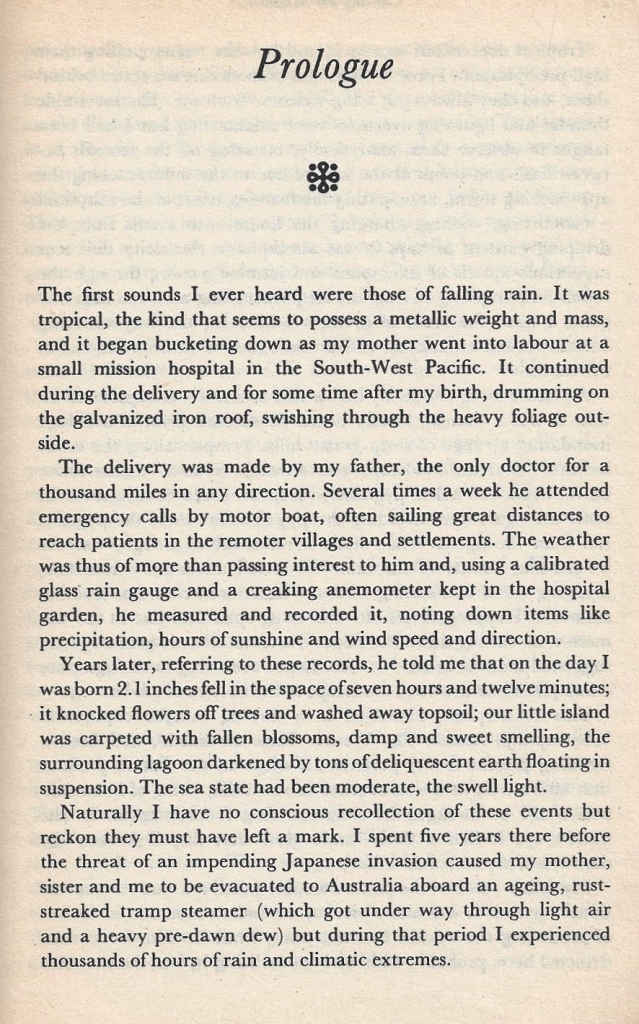
For a quick teaser, here’s page 1:

chasing the monsoon frater excerpt pg 1 001


Read Full Post »

All  three of the following deserve in-depth reviews, and perhaps one day I will re-read them all and do just that, but for now the following must suffice. These “women’s works” are all exceedingly different from each other, and reward the reader in a variety of ways. Their one meeting point is that they are all, to various degrees, concerned with what it means to be a mother.

*****

roast beef medium edna ferber 1913 001Roast Beef, Medium by Edna Ferber ~ 1913. This edition: Grosset & Dunlap, 1913. Illustrations by James Montgomery Flagg. Hardcover. 296 pages.

My rating: 7/10

A slightly  unexpected book, for I have always associated Edna Ferber with sincerely-meant dramatic novels, all about earthily passionate immigrants and melodramatic family sagas. In Roast Beef, Medium, we have a rather quieter sort of tale, of a single mother way back at the beginning of the 2oth century working away to support herself and her teen son, in an unexpectedly “modern” style.

Our heroine, Emma McChesney, is a traveller in petticoats, in both senses of the term. She has a past history of a ne’er-do-well ex-husband, and is the deeply proud mother of a seventeen-year-old son whom she supports in a respectable boarding school. Her area of expertise is ladies’ undergarments, for Emma McChesney is one of the more successful travelling salesmen (in her case I suppose that would be saleswomen, though she rather stands alone in this male-dominated calling) for T. A. Buck’s Featherloom Petticoats.

It’s a tough sort of business to be in, for along with stiff competition in the ladies’ lingerie department – there is a positive crowd waiting to press their particular wares on every department store in the mid-west American sales territory where our Emma operates – there is a continual male-female dance of propriety, for Emma is a very handsome woman, and her good looks belie her ten years on the road and her status as the mother of a son approaching adulthood.

Emma can handle those who assume she is an easy mark for some casual romance, but deep down inside are the pangs of loneliness. What does the future hold…?

An explanation of the title is in order, and here are the words of the author herself.

FOREWORD

Roast Beef, Medium, is not only a food. It is a philosophy.

Seated at Life’s Dining Table, with the Menu of Morals before you, your eye wanders a bit over the entrees, the hors d’oeuvres, and the things a la, though you know that Roast Beef, Medium, is safe, and sane, and sure. It agrees with you. As you hesitate there sounds in your ear a soft and insinuating Voice.

“You’ll find the tongue in aspic very nice today,” purrs the Voice. “May I recommend the chicken pie, country style? Perhaps you’d relish something light and tempting. Eggs Benedictine. Very fine. Or some flaked crab meat, perhaps. With a special Russian sauce.”

Roast Beef, Medium! How unimaginative it sounds. How prosaic, and dry! You cast the thought of it aside with the contempt that it deserves, and you assume a fine air of the epicure as you order. There are set before you things encased in pastry; things in frilly paper trousers; things that prick the tongue; sauces that pique the palate. There are strange vegetable garnishings, cunningly cut. This is not only Food. These are Viands.

“Everything satisfactory?” inquires the insinuating Voice.

“Yes,” you say, and take a hasty sip of water. That paprika has burned your tongue. “Yes. Check, please.”

You eye the score, appalled. “Look here! Aren’t you over-charging!”

“Our regular price,” and you catch a sneer beneath the smugness of the Voice. “It is what every one pays, sir.”

You reach deep, deep into your pocket, and you pay. And you rise and go, full but not fed. And later as you take your fifth Moral Pepsin Tablet you say Fool! and Fool! and Fool!

When next we dine we are not tempted by the Voice. We are wary of weird sauces. We shun the cunning aspics. We look about at our neighbor’s table. He is eating of things French, and Russian and Hungarian. Of food garnished, and garish and greasy. And with a little sigh of Content and resignation we settle down to our Roast Beef, Medium.

E. F.

This is a light sort of novel, but it has its merits, and it works quite well as both a period piece and a nicely worked bit of domestic vintage American fiction. Slip on over to Gutenberg, and read this for yourself.

Roast Beef, Medium was Edna Ferber’s third published novel, and she went on to write many more of increasing popularity – think Show Boat, American Beauty, So-Big, Ice Palace, and Giant, among others – to take her place as one of the most successful mainstream novelists of her time. Her writing career stretched from 1911 to 1963, and her novels provide a lively – if decidedly dramatized – portrait of American life.

*****

the pumpkin eater penelope mortimer 1962The Pumpkin Eater by Penelope Mortimer ~ 1962. This edition: Penguin, 1969. Paperback. 158 pages.

My rating: 9/10

This book has been described as proto-feminist, on par with Germaine Greer’s writings, and though I wouldn’t go that far myself, I will agree that it is very much a book of its time and demonstrative of the uneasy gender-battling mood of the late 1950s and early 60s.

Penelope Mortimer’s The Pumpkin Eater is a grimly can’t-look-away, can’t-quite-believe-I’m-reading-this, what-is-the-author-really-trying-to-say, blackly funny self-portrait of a seriously troubled woman and her bizarre approach to both motherhood and marriage. Apparently drawn from Mortimer’s own experience, it nevertheless reads like the strangest of fictions, and though the tale fascinated me it left me utterly untouched in any sort of personal way, save for my feeling of admiration at Mortimer’s success at keeping me engaged even when I wanted to put the book down and walk away.

Absolutely cheating here on writing an actual précis, by providing that of the re-publisher of this odd little novel. The New York Review of Books included it in their 2011 reprint list, and this is what the promotional material has to say:

The Pumpkin Eater is a surreal black comedy about the wages of adulthood and the pitfalls of parenthood. A nameless woman speaks, at first from the precarious perch of a therapist’s couch, and her smart, wry, confiding, immensely sympathetic voice immediately captures and holds our attention. She is the mother of a vast, swelling brood of children, also nameless, and the wife of a successful screenwriter, Jake Armitage. The Armitages live in the city, but they are building a great glass tower in the country in which to settle down and live happily ever after. But could that dream be nothing more than a sentimental delusion? At the edges of vision the spectral children come and go, while our heroine, alert to the countless gradations of depression and the innumerable forms of betrayal, tries to make sense of it all: doctors, husbands, movie stars, bodies, grocery lists, nursery rhymes, messes, aging parents, memories, dreams, and breakdowns. How to pull it all together? Perhaps you start by falling apart.

This doesn’t really portray the surreal atmosphere of this tense tale, but it does give a general idea of the storyline, which doesn’t really matter, as it is all seen through a fog by the narrator, the “mother-of-many”, who never gets her own name.

The writing is marvelous; the humour is richly dark; the subject is immensely uneasy-making. And the ending is beyond nebulous. What is reality, anyway? And why not seek comfort in dreams?

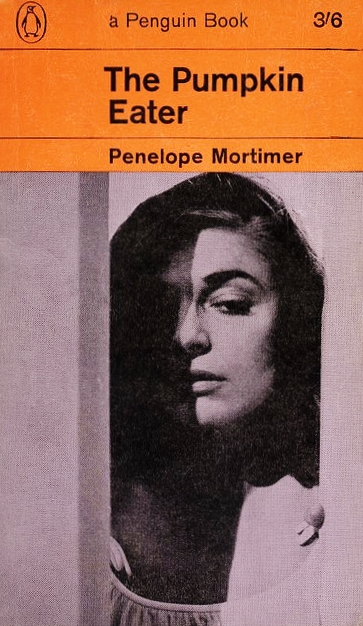
The Pumpkin Eater was also made into a 1964 movie, with screenplay by Harold Pinter, starring Anne Bancroft, hence the cover image on my old Penguin paperback. Haven’t seen it (the movie) myself, and quite frankly I have no desire to, though I have heard it spoken highly of. The book was quite enough, thank you kindly.

*****

within this wilderness feenie zinerWithin This Wilderness by Feenie Ziner ~ 1978. This edition: Akadine Press, 1999. Softcover. ISBN: 1-888173-86-6. 225 pages.

My rating: 8.5/10

Within This Wilderness is an autobiographical account of Ziner’s final attempt to come to terms with her adult son’s rejection of society and his retreat to the remote coastal woods of British Columbia’s Vancouver Island.

I found this book deeply moving, in a decidedly personal way. Though the circumstances of our lives are not in any way identical, the evolution of the mother-son relationship and the delicate negotiation of expressing maternal love and the desire for “safety” for one’s child warring with the needs of a young man for walking his own path and making his own mistakes is something I share with this other mother, and, I suspect, most other parents whose moved-beyond-us children have stepped somewhat aside from the well-marked path of our particular society’s norm.

Kirkus sums it up perfectly:

Feenie Ziner’s son Ben was one of those Vietnam war casualties who was never in uniform: spooked by the military buildup, repelled by the consumer culture, he dropped out of school and took off for the Northwest, talking of cosmic energy and inner space, drifting in and out of lack-limbed communes, ultimately settling on his own wilderness island. Anxious for his return or at least some answers, Ziner flew in after he’d been living alone for nearly two years, and her skillfully developed account of what transpired between them – a progressive disarmament – slips over the boundaries of personal experience. She masters the primitive flusher and inures herself to thoughts of wolves (“I’ve read Farley Mowat”); he points out handmade appliances and shares new wisdoms (“Plastic is to us what horses were to the Spanish”). They lie to each other, spar philosophically, and resume a fragile peace. Even the eccentric neighbors – classic misfits – find him difficult. “Why does he make himself so damned. . . inaccessible?” “Why does he live that way? As if he were expiating for some kind of a sin?” She draws on the tranquillity of the place, reads the I Ching with the beatific vegetarian round the bend (“The companion bites a way through the wrappings”), and waits. And eventually the staunch independence unmasks, the precarious self-esteem surfaces, a pained confession of inadequacy is spoken. One must suppress dark thoughts about the shaping of this material (could it have happened so smoothly? was she taking notes?) for the perfect curve of events seems almost too good to be true. But Ziner deftly renders the nature of their exchange and the nuances of her private adventure, and the illumination of his fringe benefits and her mainstream hollows will reach that audience attuned to generational discord and cultural reflections.

Very much worth reading. Recommended.


Read Full Post »

I must do some round-up posts – I have ten months’ worth of miscellaneous stray reads stacked up and begging to be re-shelved, but I don’t feel that I can happily do that until I at least give them a quick summation. Most books worthy of time spent reading them deserve thoughtful posts all to themselves, and I wish I could do that, but life is full of a variety of occupations, and there are still only twenty-four hours in each day.

I’m hoping to clear at least some of the backlog of books-I-read-in-2014-but-haven’t-managed-to-post-about, and at the same time tidy up the Century of Books list. I’m a bit afraid to look at it, but if I check off a few more of the years, I think I may still find that the December 31st goal is within reach. Though perhaps I will need to seek out some shorter tales to fill in the gaps. Didn’t someone who tackled this project a few years ago (Stuck-in-a-Book’s Simon?) resort near year’s end to reading Beatrix Potter for some of those troublesome years? Nice and short, definitely worthy of attention, and conveniently published year-after-year-after-year in a hard-to-fill Century time slot. 😉

Well, here we go. Hang onto your hats, people, for if all goes well the next few days will see a flurry of micro-reviews.

*******

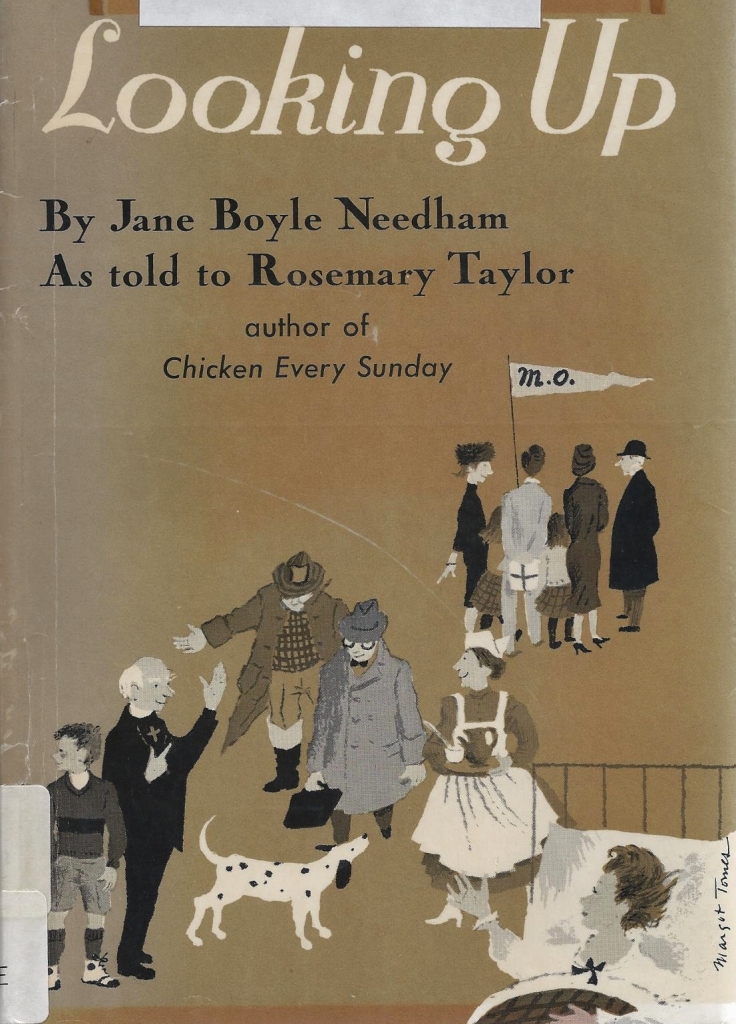
looking up jane boyle needham rosemary taylor 1959 001Looking Up by Jane Boyle Needham, as told to Rosemary Taylor ~ 1959. This edition: G.P. Putnam’s Sons, 1959. Hardcover. 191 pages.

My rating: 7/10

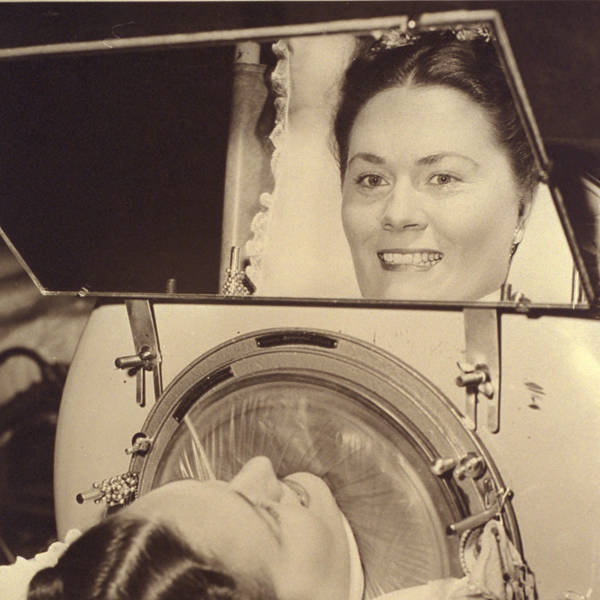
This was a rather unusual memoir, narrated by the author to journalist/memoirist Rosemary Taylor (Chicken Every Sunday, Harem Scare’m) for the very good reason that the subject was paralyzed from the neck down as a result of adult-acquired bulbar (affecting the brainstem) polio in 1949, when she was 27 years old. Jane Needham lived in an iron lung for thirteen years, until dying from complications of gall bladder surgery in 1962.

Looking Up was written when Jane Needham had been in the iron lung for nine years. She was, as she well knew, living on borrowed time. After five years in hospital, Jane Needham decided that she needed to make a concerted effort to provide as “normal” as a home as possible for her three children.

She had been unexpectedly divorced by her husband several years earlier and had with difficulty retained custody of her young children. Her elderly parents liquidated their assets, moved into an apartment, and purchased a house for Jane, the children, and Jane’s round-the-clock private nurses. Unable to breathe on her own, and never regaining more than twinges of movement in her extremities, Jane did create a functional home and proceeded to confound the naysayers who predicted disaster.

Jane Boyle Needham, quite literally "looking up", into the mirror attached to her iron lung, which allowed her to view her world.

Jane Boyle Needham, quite literally “looking up”, into the mirror attached to her iron lung, which allowed her to view her world.

The tone of this book is rather unrelentingly cheerful; one might call it positively inspirational. Jane Boyle Needham comes off as a darned good sport, even when relating her experiences with her rather caddish husband. Perhaps her strong Catholic faith had something to do with this? Towards the latter part of the memoir Jane goes on at great length about the strength her faith has given her, and the spiritual and moral assistance given to her by her parish priests.

Or perhaps the positive tone was partly façade? But Jane does manage to occasionally convey the anger at her fate and the anguish of her spouse’s betrayal; occasionally she is downright cutting, and those bits are a relief, because otherwise this woman’s saintliness and fortitude would be much too good to be true.

This book, something of a bestseller in its time, is a fascinating glimpse into the world of the many polio sufferers whose lives were saved by the invention of the iron lung and various portable breathing apparatus. Every breath was a struggle, brutal physical pain was a constant, and death was ever-present, lurking around the corner. A few moments of electrical outage, and it could be game over, quite literally, unless one had an attendant who could immediately start manual lung compressions.

The chirpy tone of Jane Needham’s narration serves to add piquancy to her tragic fate. She desperately hoped to live long enough to see her children make their way in the world; they would have been still in their teens when she died. I wonder what became of them?

*****


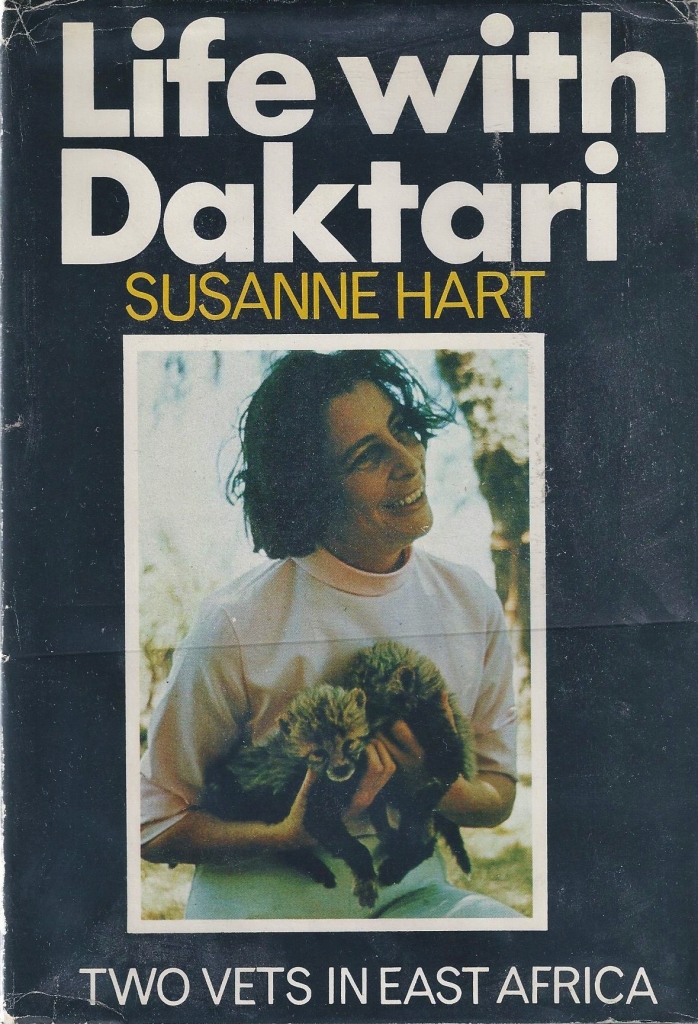
life with daktari susanne hart 1969 001Life with Daktari: Two Vets in East Africa by Susanne Hart ~ 1969. This edition: Bles/Collins, 1969. Hardcover. ISBN: 7138-0234-0. 224 pages.

My rating: 5/10

Susanne Hart (her last name condensed from her second husbands surname, “Harthoorn”) loved animals from her childhood, studied at the Royal Veterinary College in London, England, and qualified as a vet in 1950. She found herself in South Africa newly divorced and with two young children to support, and she set up a thriving domestic animal veterinary clinic. Then she encountered a fellow vet whom she had known in college days, Dr. Toni Harthoorn, and gave up her practice to marry him and join him in Nairobi.

Dr. Harthoorn specialized in working with wild animals, with particular expertise in immobilizing large creatures such as rhinos and elephants to be studied and fitted with radio collars. Susanne found herself becoming involved in her husband’s interests, and the two soon started working as something of a team, though Toni insisted that Susanne preserve a womanly decorum by avoiding the more dangerous situations that their work invariably entailed.

This is an uneven memoir, in that it has a rather hero-worshipping tone to it. Susanne goes on at great length about her second husband’s brilliant technique with wild creatures; the two of them also become acquainted with the famed Adamsons of Born Free fame, Joy and George, and their lion study project.

The animal bits are much the best, and I found the accounts of various encounters with wild and semi-wild creatures quite mesmerizing, but I could have done without the preachy details of Susanne Hart’s vegetarianism and special “health diet”, which she apparently pushed on every one of her acquaintances. She is quite snooty about those who don’t immediately fall in with her notions in this area, and it rather put me off.

I bogged down somewhere around the middle of this promising sounding but ultimately awkwardly written book, and had to force myself to finish it; a rather disappointing state of affairs as I had wanted to like it so very much.

Susanne and Toni were obviously passionate about their life callings, and their impatience with other people who didn’t quite embrace their ideas with full fervour is understandable, but the impression I received was that the reader was rather included with those not really “on side”; there is the faintest hint of patronization in Susanne Hart’s tone, and it left me not at all eager to seek out any of her other memoirs, of which there are something like eight or nine.

Susanne Hart was also active in environmental outreach, and hosted a short-lived television series, Animal Ark, featuring a group of children being introduced to various African creatures. In later years she was deeply involved in an organization assisting African children whose parents had died of AIDS. Susanne Hart was still actively involved in her social charity work when she died in South Africa in 2010, at the age of 83.

Susanne Hart was no doubt an admirable woman in many ways, and I feel rather like a rotter for not liking this memoir more, but there you have it. She annoyed me as much as she informed and entertained me so she gets a generously conditional “5” on my personal rating scale.

*****

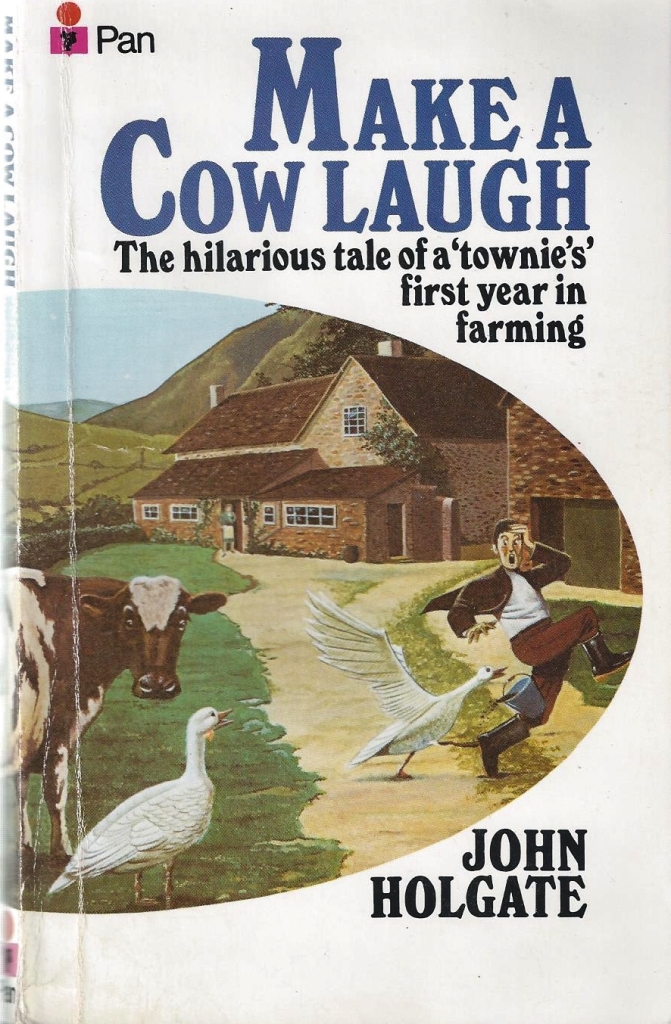
make a cow laugh john holgate 1977 001Make a Cow Laugh: A First Year in Farming by John Holgate ~ 1977. This edition: Pan, 1980. Paperback. ISBN: 0-330-25780-3. 221 pages.

My rating: 8/10

Despite the off-putting front cover blurb – “The hilarious tale of a ‘townie’s’ first year in farming” – I found myself liking this book a lot.

“We moved to the country, and look how stupid we were!” self-mocking memoirs are a dime a dozen, and I almost didn’t pick this one up, but a quick peek at the contents inspired me to give it a go. It rewarded me for my bravery by being quite a nice little neophyte farmer’s tale, and it wasn’t hilarious at all – what a relief! – merely gently amusing.

John Holgate, his wife, and three children – sixteen-year-old son, eight-year-old daughter and four-year-old son – all make the move from city life in London to a 75-acre mixed farm on the Welsh border. Their motivation is rather vague, even to themselves, but upon consideration John Holgate theorizes that it was a collective desire to leave the city for the emotional and aesthetic pleasures of rural life, and the more elemental challenges of “sweat labour” versus the hurly-burly bustle of the city, where he was successfully involved in a standard “career”.

I am ashamed to say that I can’t quite recall what it was that John Holgate actually did in his London life. Or perhaps he didn’t tell us? My husband, who also read and enjoyed the book, can’t remember either, so perhaps it was a deliberate omission. In any event, it doesn’t matter, as the Holgates leave it all behind. They finance the purchase of the farm by selling their city house; money is tight and their subsequent financial struggles are completely believable.

John Holgate is a more than competent writer; his words have a beautifully readable lyrical flow, and he is deeply, quietly funny. His characters are respectfully portrayed – no bumpkins here! – and are utterly recognizable and familiar, even though we live in rural western Canada and the Holgates in far-off Great Britain.

John’s relationship with his eldest son, who completely embraces the rural lifestyle, is a joy to read about. The whole book is a pleasant experience, in fact, and the Holgates come across as being truly nice people, with their share of human flaws, but with the most relatable good intentions.

Not much happens in this memoir – no great disasters, no epiphanies, no real drama. At the end of Year One on the farm, things are plodding along quite nicely. John Holgate has been fortunate in his neighbours; they are keen to rally round when needed, and John has had the deep satisfaction of being able to lend a hand in his turn. Humourous incidents have indeed occurred, but none of them were “hilarious”, and that made me deeply pleased.

John’s personal challenges ring true – spousal squabbles triggered by money stress and culture shock, the physical discomfort caused by moving from a sedentary to a deeply physical working day, the inevitable “second-guessing” of the decision to change one’s lifestyle in such an astounding way, the continual drama of dealing with farm animals – and are seen to be resolved in a sober and very true-to-life way.

I would happily read John Holgate’s subsequent books. He wrote at least two more, On a Pig’s Back and A Sheep’s Eye View, and though I have no strong urge to go to a lot of effort to seek them out, I would be gently pleased to stumble across them on my travels. As I said before, the man can truly write, and a well-phrased, gently humorous, nicely realistic memoir which speaks highly of one’s own lifestyle choice is a desirable thing to have on the shelf.


Read Full Post »

No uniting theme here, unless it is that of gently engaging but not wow-inducing works by quite decent writers, quickly consumed and just as quickly set aside. Nothing really wrong with any of these, but I must admit that I almost forgot I’d not-that-long-ago read them until I unearthed them from one of the book piles mushrooming on my perennially overcrowded desk.

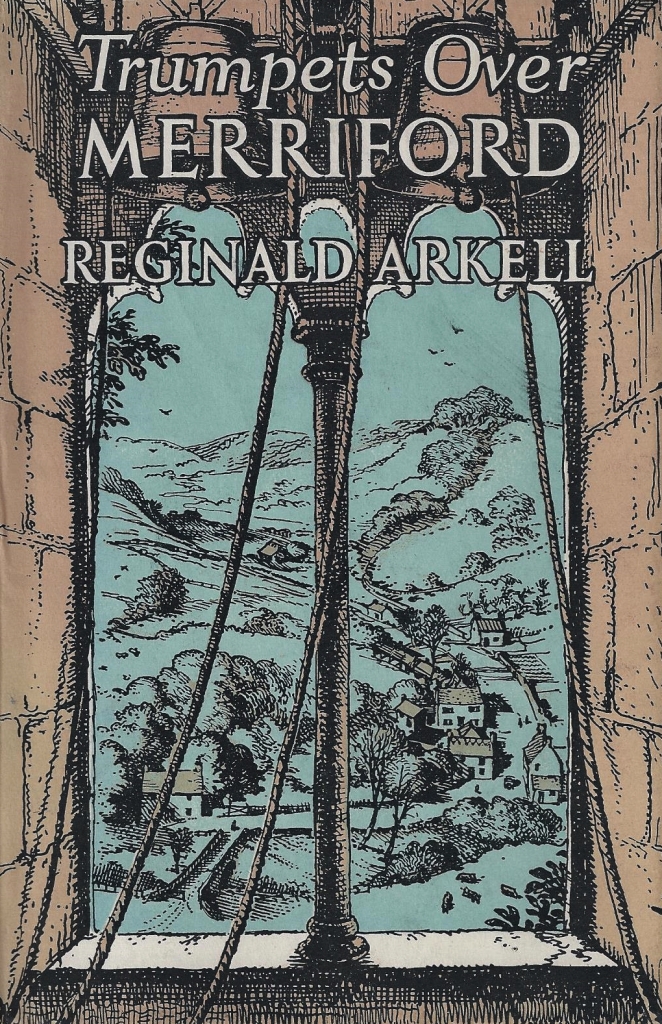
trumpets over merriford reginald arkell 001Trumpets Over Merriford by Reginald Arkell ~ 1955. Published in the United States as The Miracle of Merriford, 1956. This edition: Michael Joseph, 1955. Hardcover. 175 pages.

My rating: 6.5/10

I’d heard of Reginald Arkell before, author of the gardening ode Old Herbaceous and other humorous depictions of English rural life, but this was my first time reading him.

Quick verdict: Quaint. Almost painfully so, in fact, but salvaged by the abundance of good humour and the general likeability of the characters.

It is several years post-World War II, and the tiny English village of Merriford has subsided back into its centuries-old peace. But world affairs keep moving right along, and to prove it Merriford is unexpectedly invaded by a military force from another country. An American Air Force base, strategically located within striking distance of those increasingly pesky Russians, is erected with stunning speed, wiping out farm fields and ancient common grounds with no advance warning.

No more mushroom patch, no more wildflower meadow, just acres of runway and a small city of rambunctious young airmen. Needless to say, the locals are shocked to the core, and react in their various ways. Most find some degree of acceptance, some few are deeply hostile, while others predictably haunt the base gates, hoping to catch the attention of lonely (and well-paid) young men far from home and missing feminine company.

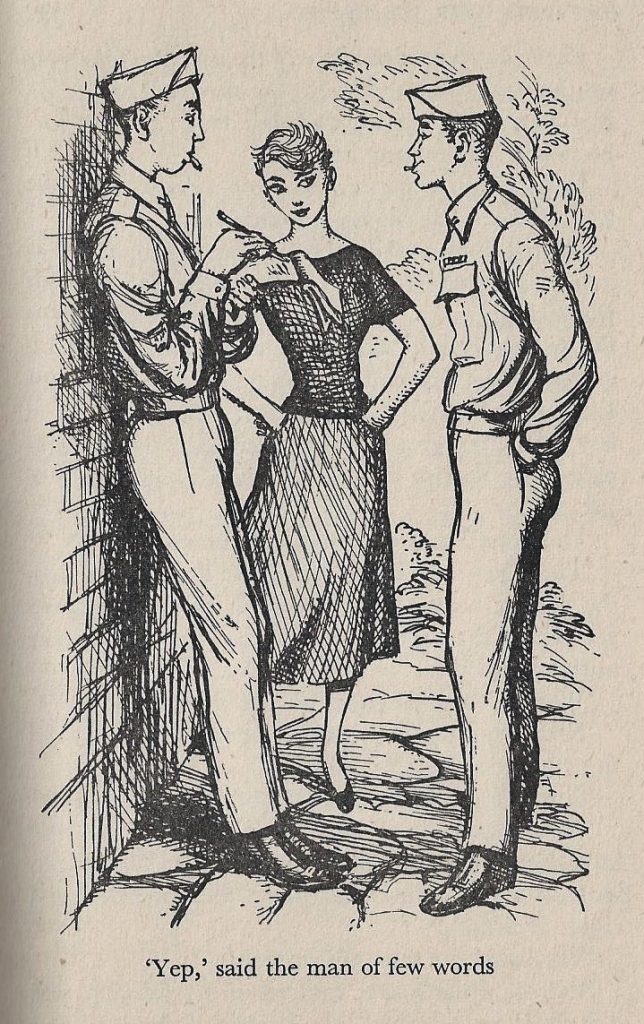
trumpets over merriford illustration reginal arkell js goodall 001The elderly vicar of Merriford takes it all in stride – for he takes the long view, back through the centuries, and an enthusiastic American or two in the here-and-now is no cause for undue alarm – until he is informed by the American work party affixing a warning light to the church steeple that there is something of an emergency concerning the venerable church bells. Or, rather, the bell tower. The support beams are rotten – riddled with wood-worm! – and could tumble down at any time, with dire results to any unlucky congregants in the church below. The vicar orders the bells silenced and the bell tower off limits, and casts about for some way to raise the substantial funds required for repairs, a dauntingly difficult prospect in cash-strapped post-war England.

Meanwhile the vicar’s lovely young housekeeper, the war-orphaned Mary, has caught the eye of one Johnny Fedora, lately of Texas. Mary is much too busy mothering her beloved employer to dally with anyone, let alone one of the forward Americans cheekily camped on her very doorstep, but Johnny is well smitten despite his initial resistance to the charms of rural Britain. He woos the fair Mary with a certain individual style and a noteworthy persistence which eventually brings the vicar round to his side, even if Mary is primly accomplished at keeping her feelings to herself.

Of course there is a charming happy ending, all full of Anglo-American goodwill. Very nice, very sweet. Almost too nice. (But not quite.)

This reminded me quite a lot of similar efforts by Miss Read, though Reginald Arkell writes with considerably more dash, and much more obvious humour. The two also share an illustrator, which served to highlight the resemblance, and I felt that the cheerful line drawings by J.S. Goodall were a marvelous embellishment of a very light sort of village tale.

every living thing james herriot 001Every Living Thing by James Herriot ~ 1992. This edition: McClelland and Stewart, 1993. Paperback. ISBN: 0-7710-4093-8. 374 pages.

My rating: 6/10

Quick verdict: Pleasant enough, but perhaps just a titch too obviously written for the existing fan base.

Between 1970 and 1981 Yorkshire veterinarian James Alfred Wight wrote a number of fantastically successful fictionalized memoirs under the pseudonym James Herriot. Anthologized in compilation volumes, these are All Creatures Great and Small, All Things Bright and Beautiful, and All Things Wise and Wonderful, and their popular success spawned movie and television productions and a thriving tourist industry in Thirsk, Yorkshire, where Wight settled and practiced.

I have read all of them with great enjoyment, and tattered copies remain on our shelves, providing pleasant re-reading for those times when quiet good humour is required. Nominally about the animals the authorial vet comes across in the course of his rounds, the books are at heart most appealing because they are all about human interactions.

Wight/Herriot was a master at capturing the moment; he is one of those writers whose words create vivid snapshots of time and place. The fact that he was fifty years old when he penned the first of his memoirs perhaps leads to their strong appeal. By this time the author had been involved in veterinary medicine for three decades, and his sometimes quite deliberate documentation of the post-war shift of small British farms with their work horses and diverse range of small herds and flocks to a machine-powered, amalgamated, single-enterprise system gives his work a certain importance far beyond the charm of the worked-over anecdotes which comprise them.

When I came across Every Living Thing, I was quite thrilled. Here was a new(ish) work by an author I already held in high regard. And in many ways, the book was well up to par with its predecessors, full of charmingly poignant stories of the animals and people the vet bumps up against.

Some way into the book, though, I started to feel vaguely uncomfortable. Though many of the vignettes are well portrayed, and the glimpses of Wight/Herriot’s family life are most intriguing – he speaks with great feeling about his young children and the joys of their company on his rounds; his son went on to become a vet and his daughter a “human” physician – the book as a whole is slightly unsatisfying. The vignettes are short, frequently unrelated, and often dependent upon one having already read the original books, bringing in references to the best known of the stories and characters of the previous bestsellers.

Preaching, perhaps, mainly to the choir.

For something fairly substantial, 374 reasonably dense pages, Every Living Thing was a very fast read, being smoothly written and engaging. I definitely wouldn’t recommend this as a first experience of James Herriot to one who has not yet read him, but for those who are already fans, the book adds a little something to the other works. Herriot was 72 years old when it was published in 1992, and as he had publically announced back in 1981 that he would no longer be adding to the memoirs, it reads rather like a tacked-on addition to the earlier works, versus a seamless continuation. Not without merit, but a lesser thing, comparatively speaking.

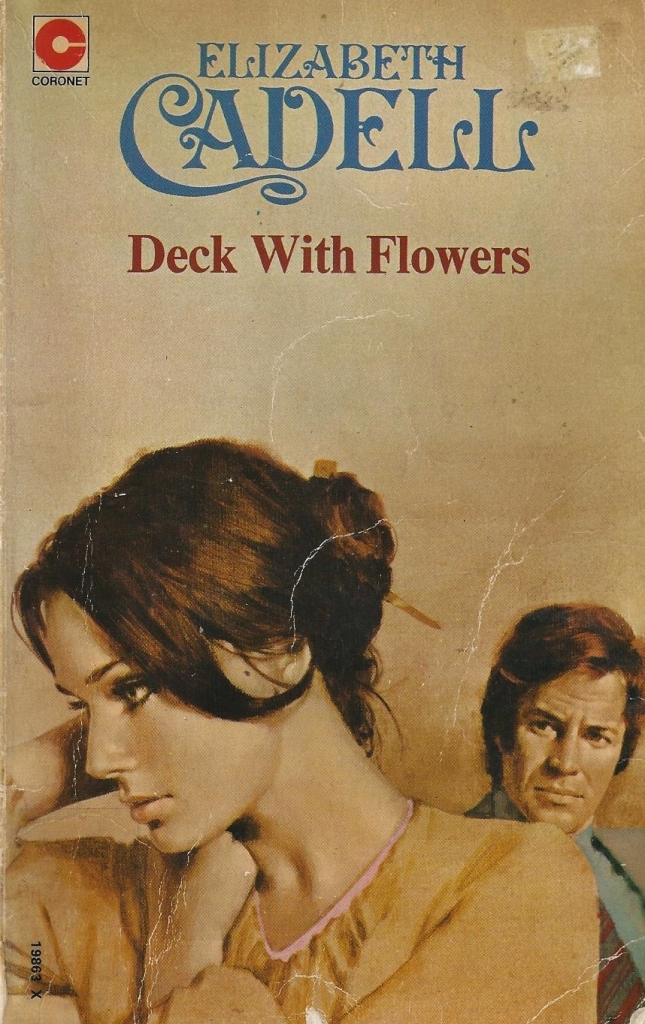
deck with flowers elizabeth cadell 001Deck with Flowers by Elizabeth Cadell ~ 1973. This edition: Coronet, 1976. Paperback. ISBN: 0-340-19863-X. 192 pages.

My rating: 7/10

Quick verdict: Pure fluff, but fun.

I vaguely recall Elizabeth Cadell being ranked with D.E. Stevenson among writers of vintage “women’s fiction” – a designation perhaps even more damning than my beloved mid-20th Century “middlebrow” fiction – but I had not paid too much attention, being at the time still a rank neophyte in the Dessie world, as it were, and not quite convinced of its merits.

Of course, that was then, and this is now, and these days every time I am in a second hand bookstore with even the slightest pretension to an organizational system I do an automatic scan of the appropriate shelves for serendipitous D.E.S. titles. (I’ve found her most frequently in Romance, in Vintage, in Pulp, downright expensively in Collectible, rather surprisingly in Classics, and once in the rather all-embracing Brit Lit.) During one of these generally fruitless scans, this slender paperback caught my eye, with its typically romantic cover and slightly familiar author’s name.

“Oho! What have we here?!” was my immediate response, and a quick scan of the back cover blurb confirmed me in my suspicion that I had stumbled across a classic example of this gentle genre.

Madame Landini’s memoirs promised to be sensational. Rodney, who was publishing them, and Oliver, his literary business agent friend, congratulated themselves on a brilliant coup. But having covered her childhood as a Russian princess, her exile in Paris, and the discovery of her phenomenal voice, the prima donna reached her first husband’s death – ‘man overboard’ – and declared she would write no more.

Rodney suspected that there was more to her change of heart than a display of temperament. He hoped that perhaps Nicola Baird, Madame Landini’s dismissed secretary, could help solve the mystery. But Nicola was beautiful as well as elusive and Rodney found himself becoming romantically entangled with her…

Kirkus is mildly dismissive, and I won’t argue with this 1973 review as it pretty well sums this thing up:

Another soft-centered entertainment of light mystery and lighter romance in London, where Mme. Landini, a once formidable diva, whose autobiography editor Rodney is publishing, literally screeched to a halt in mid-memoir. Some fairly casual sleuthing reveals that Mme. Landini had been spooked by the watch of Nicola, her pretty secretary. And did that have something to do with the disappearance, years ago, of the singer’s husband, who was last seen on shipboard with an armload of flowers? By the time this tangle is gently untangled, Rodney and Nicola have discovered pleasant things about one another and Rodney’s charmingly scatterbrained sister hooks her man. For the lounge library.

Pure chocolate box reading, this was, and quite guiltily delicious as a treat among more wholesome fare.

I thought it not quite up to D.E. Stevenson standard in plotting, at least not that of her best attempts. Though perhaps Cadell is a mite more technically proficient? Deck with Flowers was smooth as smooth, with some grand characters – loved the elderly head of Rodney’s publishing house in particular – but I’ll have to read more examples to be able to pass a fair judgement in this area.

Elizabeth Cadell is an author whom I am as of now adding to my standard look-for list, albeit one of those whose covers I will automatically conceal when reading out in public. 😉

Read Full Post »

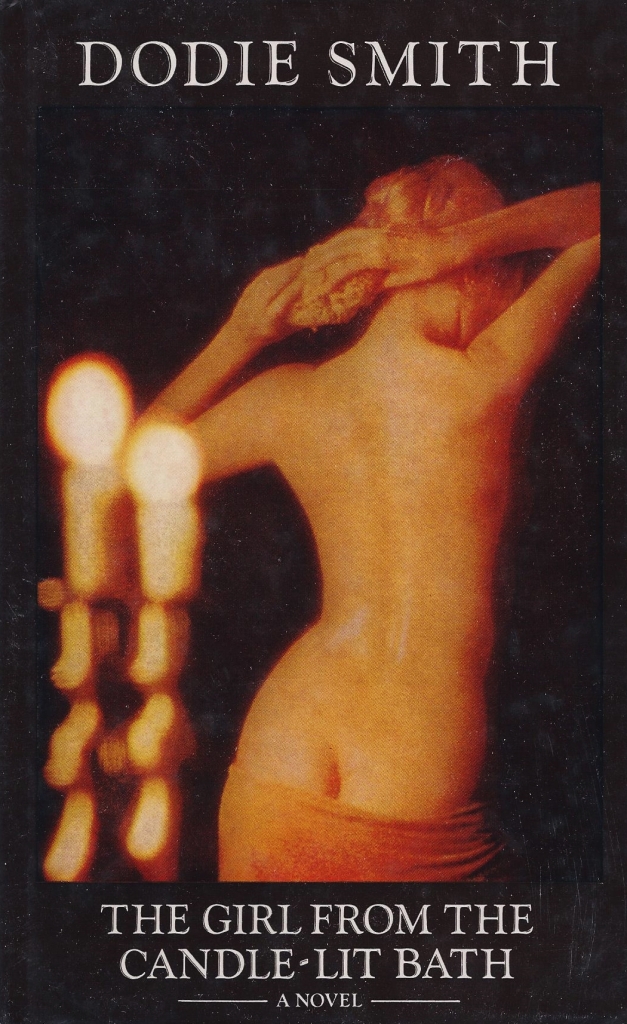
the girl from the candle-lit bath dodie smith 1978 001The Girl From the Candle-Lit Bath by Dodie Smith ~ 1978. This edition: W.H. Allen, 1978. Hardcover. ISBN: 0-491-0-2113-5. 155 pages.

My rating: 3/10

Oh, dear.

I was warned ahead of time that this book was a huge disappointment (see what Nan has to say here, and Elizabeth here) but I thought to myself, “Surely it can’t be that bad?”

I was wrong.

It is dreadful.

Great title, gorgeous cover. Very titillating to the readerly imagination, kind of like our heroine’s soap commercial was to the TV-viewing masses in this thankfully short novel, which explains the reference which the title makes. For our heroine is a not-very-successful actress, who was engaged to perform in a soap commercial which showed her nude but with the naughty bits always just concealed, and she is therefore famous enough to be recognized for this years later.

So, did her many fans concentrate solely on her face? I can see some credence in her being continually recognized if she were wandering around nude, but as her fans instantly recognize her when she is fully clothed there is something weird going on with this premise.

Oh, heck. The whole thing is weird. And not in a good way, either.

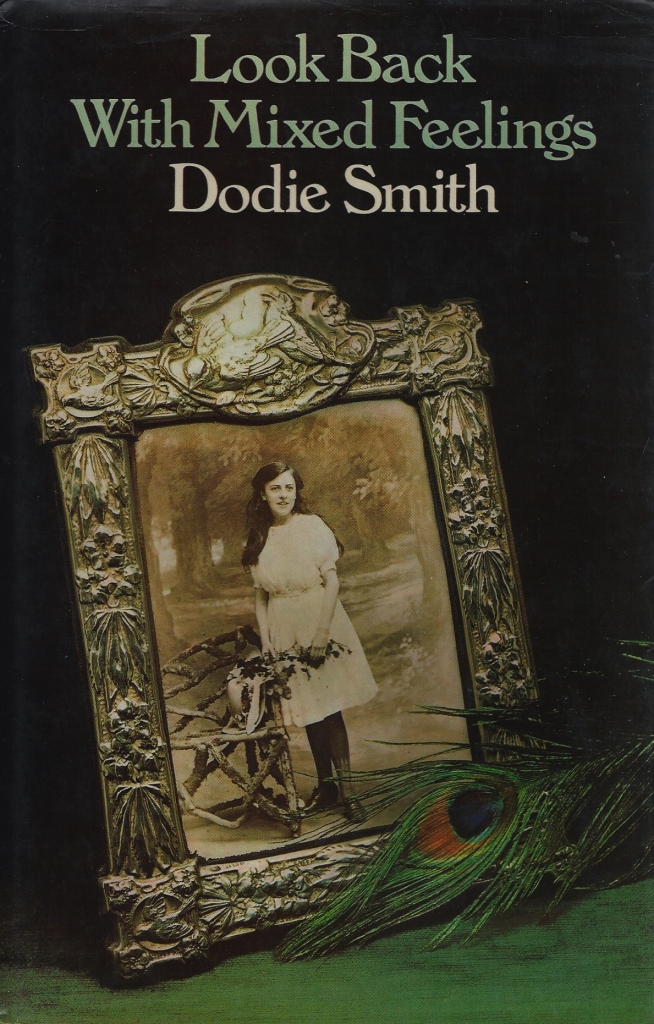
Dodie Smith was 82 years old when this was published, part of an all-at-once 1978 three-book release by her publisher, along with the second volume of her autobiography, Look Back with Mixed Feelings (which is utterly excellent), and a juvenile, The Midnight Kittens (beautifully illustrated by Anne and Janet Grahame-Johnston, and appearing quite promising from my recent browse-through), and all I can assume is that her elderly energies were mostly being engaged with her journals and memoirs. The Candle-Lit Girl is a sketchy creation, paper-thin and not terribly engaging. In fact, I found myself wishing someone had left her in that notorious bathtub, well submerged.

But here she is, undeniably on paper, and wafting about the vintage book world tempting those seduced by the excellence of Dodie Smith’s masterpiece I Capture the Castle into exploring her other novels. I speak from experience; I was one of those seeking something of the same quality of Castle, and I must agree with all of those who have quested before me that there is nothing in this particular book for us.

The other Dodie Smith novels I’ve read, The Town in Bloom and The New Moon with the Old, are quite acceptable as minor diversions, containing as they do a lot of genuine charm and reasonably cohesive narrative threads, but The Girl From the Candle-Lit Bath is an utter dud, not even up to the standard of these mild but amusing second-raters.

So – have I made my point yet? I think I have. Stay away!

Do we need a plot description? I guess we do, after this opening rant.

From the flyleaf:

When Nan Mansfield arrives home to hear her husband, Roy, on the telephone arranging a clandestine meeting in Regent’s Park, she is determined to find out what he is involved in. Is there another woman – or can it be blackmail, drugs, or even treason?

Roy is a Member of Parliament who was helped into politics by Cyprian Slepe, a brilliant eccentric who lives with his sister, Celina, in a decaying Stately Home. Nan comes to believe that Cyprian is connected with Roy’s mysterious activities. Helped by an enigmatic taxi-driver, she delves deeper and deeper, while her love and loyalty war with her ever-increasing suspicions, until at last she discovers that her own life is in jeopardy.

This starts off quite well, with a mysterious meeting and exchange of a small package in Regent Park between respectable Roy and a shady-looking man with long, “obviously dyed” hair. In fact, Nan thinks Roy’s meet-up is a woman, though taxi-driver Tim insists the stranger is a man.

Tim insists on quite a number of things, come to think of it. He goes well beyond the call of taxi-driverish duty, escorting Nan up to her apartment after the witnessed rendezvous and examining every nook and cranny, and warning Nan that she well may be up against more than she knows. For while Nan is still thinking that Roy is engaged in a purely personal complication, Tim is spouting off about the possibilities of Evil Russian Involvement (Roy is an M.P., after all,  although very much an innocuous backbencher) and Political Espionage. Of course, Tim claims to be a (and actually is) a thriller writer, so these sorts of plots come quite naturally to his mind.

Not so Nan, who is exceedingly dim and unimaginative for someone whose métier is the theatre. Can’t help but think (rather meanly) that this might explain why her career was so second-rate, and why she was so willing to drop out of the theatre world to play tame political wife to ambitious Roy.

Anyway, Nan starts dictating her experiences into a tape recorder, the transcripts of which recordings we are now reading. At first I thought that might explain the curiously flat tone of the writing, that it was a deliberate attempt by Dodie Smith to represent Nan’s monologue, but after a while I gave up on that idea, concluding instead that the author really wasn’t that engaged with her story, hence the droning prose.

The plot is as full of holes as a piece of Swiss cheese, and the analogy doesn’t stop there. As well as being embarrassingly cheesy, this thing is capital-L Lame. Poor Dodie proves herself to be something of a one-trick pony, repeating all of the theatrical clichés we’ve already seen in her other non-Castle novels. Sure, she had some great youthful experiences in her own time as an aspiring actress, but we can only hear them so many times before we turn away in boredom. And her rather promising villain, Cyprian Slepe, is never properly developed, nor is his ditzy sister Celina, who is actually rather intriguing, what with her habit of painting portraits all in swirls of colour with one pertinent feature rendered with artistic precision. I liked that bit, and thought it showed promise. But nope, Dodie drops it and wanders away, into poorly-thought-out Communist Plot Land. Well, more like British-Right-Winger-Mulling-Over-Getting-Involved-With-The-Russians Plot Land. Or something. It’s a bit nebulous as to what the whole conspiracy is actually about. Gar.

Well, I’m going to point you to those other two reviews, because they go into more detail and are well worth reading if you’re wondering if you want to hunt down this very obscure novel for yourself.

My advice to you: Don’t do it. And if you do do it, go for a library copy and don’t shell out your hard-earned cash for a personal copy. (Speaking from rueful experience. Oh, well, looks grand on the shelf. I do like that cover.)

Here you are:

Fleur Fisher’s Review of The Girl in the Candle-Lit Bath

Strange and Random Happenstance’s Review of The Girl in the Candle-Lit Bath

Thank you, ladies. Next time I’ll believe you and not go forging ahead in optimistic disregard of your assessments!


Read Full Post »

Prefacing this sure-to-be-rambling post with this information, for those of you who wonder what I’m actually talking about way down below. As different as can be in time periods and settings, but all at heart clinging to a similar traditional structure, that of the Gothic Romance Novel. The three books under discussion will be:

  • Cousin Kate by Georgette Heyer
  • Tregaron’s Daughter by Madeleine Brent
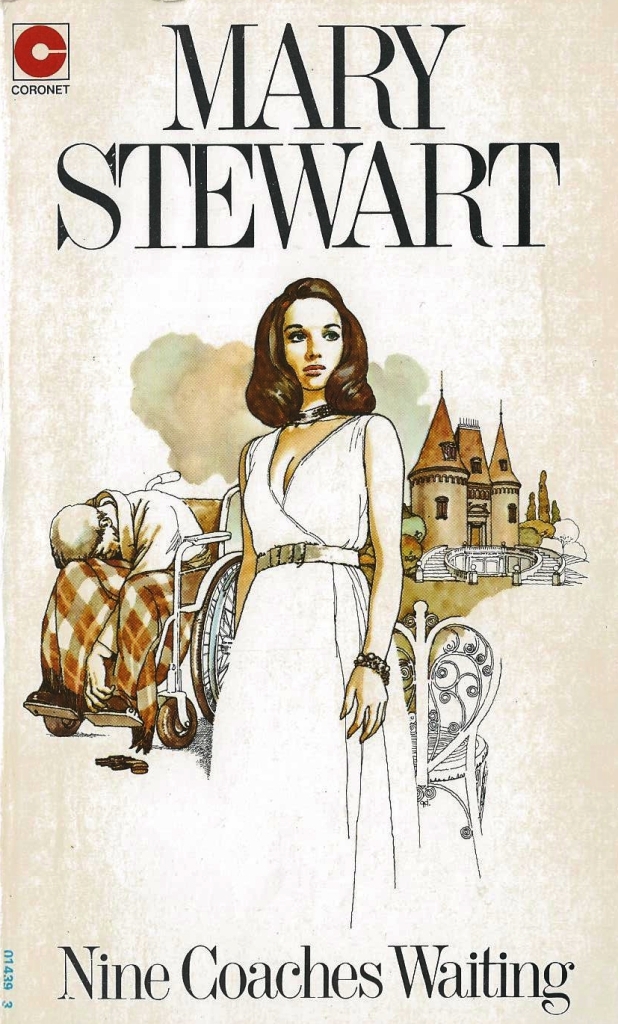
  • Nine Coaches Waiting by Mary Stewart

All of these are velvety dark, thrillingly romantic (for the most part), highly predictable (ditto), and guiltily enjoyable tales.

Perhaps this won’t be the most sober-minded book discussion, which would indeed be fitting, for these books are not High Literature in any sense of the term, and are therefore free game for a little bit of mild mockery, all in good fun, because I did read them willingly and with general pleasure, though occasionally that pleasure was all about their fulfillment of stereotypical Gothic Romance Scenarios.

I have had recourse to our ever-handy Wikipedia to quickly define the main elements of a proper traditional gothic novel, and by applying the criteria to the books in question we can get a nice overview of how well the authors fulfilled the requirements of this assigned genre.

So, cribbing from the article and adding some of my own descriptive notes to those provided, we generally must have:

  • Virginal Maiden – young, beautiful, pure, innocent, kind, virtuous and sensitive. Usually starts out with a mysterious past, and later discovered that she is the daughter of an aristocratic or noble family.
  • Older, Foolish Woman – who often has charge of or advises the Virginal Maiden, or acts as an Awful Warning due to past errors of judgement, which Virginal Maiden may or may not take into consideration
  • Hero – who may or may not be misrepresented as The Villain for the earlier stages of the plot
  • Tyrant/villain – who may or may not be disguising his (her) True Evil Nature for the earlier stages of the plot. Usually male, occasionally female.
  • The Stupid Servant – acts as comic relief by asking seemingly stupid questions, transitions between scenes, brings news, messenger, moves plot forward. Sometimes takes on form of Humble Social Inferior or Female Friend of Virginal Maiden, well-meaning but ignorant of darker designs of Villain.
  • Ruffians – always under the secret (or not so secret, depending on if he is the Disguised or the Obvious species) control of the Villain
  • Clergy – always weak, usually evil (says Wikipedia, but in more modern gothics I have noticed that the Clergy figure is often absent, being replaced by a Doctor or Lawyer or other Figure of Social Authority, acting under the influence of the Villain)
  • The Setting – The setting of the Gothic Novel is a character in itself. The plot is usually set in a castle, an abbey, a monastery, or some other, usually religious edifice, and it is acknowledged that this building has secrets of its own.
  • And, if I may add to this list, The Secret. There is generally some Great Big Secret which the heroine – er, Virginal Maiden – either sets out to investigate or unwittingly stumbles upon. Sometimes (frequently) The Secret is, of course, that of her own mysterious past.
  • Also added by me: The Forced Marriage. Another common element I’ve noticed in my own perusal of gothics. So many times the heroine faces matrimonial peril, either by being forced to marry the Disguised Hero (who she then realizes she loves in Chapter Ten), or by a Weak Male Character under the control of the Villain, or by the Villain himself.

So, let’s see how these measure up. I’m going to present these in order from my least to most favourite.

Warning: There may well be some significant spoilers here and there, but as the plot twists are all highly predictable by anyone with the least bit of experience with the genre, I doubt if having these confirmed ahead of time will lessen one’s reading pleasure. 😉

Cousin Kate georgette heyer 1968Cousin Kate by Georgette Heyer ~ 1968. This edition: The Bodley Head, 1968. Hardcover. 318 pages.

My rating: 6/10.

Front flyleaf blurb, Bodley Head edition:

Finding that her youthful appearance and the lack of accomplishments caused by a childhood spent following the drum prevent her from securing a position as governess, Kate Malvern, recently orphaned, gratefully accepts an invitation from her unknown aunt Minerva to make her home at Staplewood, the seat of Sir Timothy Broome, Minerva’s elderly and invalid husband.

On arrival at Staplewood, Kate finds herself in beautiful and luxurious surroundings, and is treated by her aunt with a kindness which is regarded by those best acquainted with Minerva with considerable surprise. At first grateful, Kate gradually becomes uneasy, and with the arrival on the scene of Sir Timothy’s nephew, Mr. Phillip Broome, the plot rapidly thickens. Minerva’s motive for bringing Kate to Staplewood is revealed, and her machinations are brought to a dramatic conclusion.

Okay, let’s see how Cousin Kate does on the Elements of Gothic Fiction scale.

  • Virginal Maiden – check! No secrets as to origin, as Kate is legitimately accepted as a family connection. She is an orphan, reasonably young (24), beautiful (“a flower-like countenance”), appears younger than her age, is sexually pure but well aware of the “facts of life” from her experience as a soldier’s daughter, and is definitely kind and sensitive, though she also fearless and well able to stand up for herself in socially awkward situations.  A most promising heroine.
  • Hero – check! Our Hero turns out to be one of the disguised ones, who operates under a cloud of misunderstanding engineered by the Villain, or, in this case, the Villainess.
  • Villainess – check! No mystery here, though it takes a while to reveal her true nature. It is, of course, suspiciously friendly Aunt Minerva.
  • Humble Social Inferior – Moving the plot along is Kate’s old nurse, Mrs Nidd, who bring’s Kate’s need of succour (she’s just been fired from her first job and has little prospect of finding another due to lack of training or experience) to Aunt Minerva, setting things in motion. Mrs Nidd reappears later in the story to aid Kate in unravelling The Secret.
  • Doctor – weak rather than deliberately evil, and under the complete influence of the Villainess, the Doctor plays here merely a supporting role
  • The Setting – It is 1817, mid-Regency. Most of the action occurs at a stately country home, Staplewood, with Aunt Minerva established at the centre of things controlling all of the domestic strings, and separate wings housing the frail Sir Timothy and the family son and heir, beautiful, erratically-mannered Torquil, who is under the fulltime care of the Doctor, for reasons no one is prepared to elaborate on. Mysteriously locked doors, male screams in the night, random shots being fired, a suicide-worthy lake, a lonely country setting leading to easy isolation of characters not wanted to be out in public circulation by the Villainess.
  • The Secret –  Insanity! Torquil’s. Kate has been tagged by the Villainess to be a suitable wife for her mentally unstable son. She (Kate) is to produce a son and heir to the Broome family fortune, after which Torquil will be put into ever-deeper seclusion as his insanity worsens (the Doctor is quite sure it will), and Kate will be allowed to discreetly seek consolation elsewhere.
  • The Forced Marriage – see The Secret.
  • Great Big Climax – Revelation of Secret! Murder! Suicide! Horror-stricken Virginal Maiden flees to arms of Hero! And once all of the details of The Secret are revealed, a blissful future is embarked upon via Glorious Holy Matrimony between the two who have suffered so many setbacks to the progress of their romance through initial misunderstanding and deliberate machinations of the Villainess, who has now had her ultimate comeuppance.

My verdict: While Cousin Kate had its appeal, and was quite nicely written and full of Heyer’s dependably engaging Regency slang. Kate is a likeable enough heroine, but the whole thing dragged on just too long for my interest to be sustained completely; the plot was desperately predictable, and the whole thing became rather depressing, what with its dependence on a mysterious insanity and the ditherings of all those concerned regarding the proper treatment of the sufferer.

The ending is rather brutal, as Heyer fatally disposes of two of her characters under horrific circumstances. The imagination of this reader was boggled regarding the possibility of a happy future for the heroine and hero with that sort of emotional baggage to deal with.

I rated Cousin Kate at 6 because of Heyer’s competent handling of her setting and the quality of her writing. Some serious themes (position of women/class distinctions/treatment of the mentally ill) were touched upon but never thoroughly examined – not really to be expected in this sort of light novel. But for a light novel it had some desperately dark strands.

Hard to classify, really. I know I said “boring” in the header, and that seems to be my ultimate feeling. Rather flat. Heyer could do much better.

tregaron's daughter madeleine brent 1971 001Tregaron’s Daughter by Madeleine Brent ~ 1971. This edition: Doubleday, 1971. Hardcover. 251 pages.

My rating: 7/10. I bumped it down just a bit because of the inclusion of Young Man with Symptoms of Insanity, a plot strand which I found exceedingly annoying for some reason. (Perhaps because a similar character plays a major role in Heyer’s Cousin Kate?)

Flyleaf says:

Excitement, drama and suspense were only part of Cadi Tregaron’s new life. It had been a sunny afternoon when she glanced from the cliff where she sat reading and saw below her in the sea a sight that would change her life.

Set in England and Italy in 1910, this is the story of a young English girl who by accident starts to unravel the unknown elements in her grandmother’s past and is brought by the mystery to the faraway city of Venice. There, among the gondolas and canals, she slowly comes to comprehend the meaning of two strange and puzzling dreams – dreams that seem to hold the an eerie and menacing prophecy of the future.

Elements of Gothic Fiction included:

  • Virginal Maiden – check! Our heroine, Caterina (Cadi), daughter of a half-Italian mother and sturdy Cornish fisherman father, is young (late teens), beautiful, pure, innocent, kind, virtuous and sensitive. And (spoiler alert!) she does turn out to be the descendent of the Italian nobility. No doubt because of this innate blue blood, our heroine has just naturally developed far beyond the expectations of her humble place in the world. Her language is surprisingly upper class (due to the convenient society of a cultured retired governess in the neighbourhood, who has taken the bright young Cadi under her tutorial wing), and she is fluent in Italian (learned from her grandmother), which comes in handy later. And she starts the story off as a half orphan, mother dead some years (fell off a cliff with grandmother in a tragic accident – sob!) and loses her father as well soon after we enter the story, which precipitates the now-fully-orphaned Cadi into the next stage of her saga.
  • Hero – check! This one is the conflicted type, and is disguised (occasionally deliberately) as a villain. Classically gothic  introduction of hero and heroine involving heroine being pulled up onto horse and forced to cling closely to rock-hard-muscled hero as they gallop to rescue of hero’s uncle who is caught in a dangerous current in his borrowed sailboat. (This is the life-changing thing which Cadi saw from the cliff.) Bonus first-meeting episode: as Cadi, her father, and the hero row out to the rescue, the bodice of Cadi’s dress rips, leaving her lily-white skin exposed in a rather delicate area, and causing the hero to take a deep breath and force his gaze away, manfully resisting the surge of testosterone this incident inspires. Predictably, hero’s taciturn silence is misunderstood by heroine – “He thinks I am below his notice!” Oh, no, darling, that ain’t it.
  • Villain – check!  Disguised variety. Cadi’s Italian relation, Count Chiavelli, who is surprisingly warm and welcoming to the little English chit who is apparently going to bump him from both his title and his fortune – unless, of course, she can be enticed into a marriage with the Count’s weak-natured son – shows another side to his nature as this plan fails to advance.
  • Hero’s Sidekick – not at all stupid, though a slight social inferior, the Sidekick keeps things moving by his unexplained presence at key points of the saga. He is eventually assisted in his efforts by Female Friend of Virginal Maiden, as they join forces to assist Hero in rescue of Virginal Maiden from the Villain’s foul clutches.
  • Ruffians – check! The Villain has a full complement of brutish henchmen, but as bad guys in gothic novels are always slightly slower (and much more stupid) than good guys, these particular ruffians are continually foiled by the Hero, Sidekick and Maiden.
  • Lawyers – These People of Social Authority – we have an English and an Italian version – are in general full of good intentions and quite helpful to Heroine, though they are completely hoodwinked by the Villain. I would like to put forward that a too-trusting lawyer = weakness, so this element is included, albeit in a very minor role.
  • The Forced Marriage – The Virgin is pressured to marry the Villain’s weak-willed son, in order for the Villain to get his hands on the fortune the Virgin is coming in for, and also to keep the title in the family.
  • The Setting – Gorgeous settings, full points for those. We start out in a humble cottage in a little Cornish fishing village – towering sea cliffs above it, treacherous currents swirling offshore – progress to turn-of-the-century London as the heroine is adopted by the beneficent and wealthy family whose patriarch she helped save back in chapter one, and end up in Italy in a gloomy Venetian palazzo, with a final nighttime chase scene by boat through mist-shrouded canals.
  • The Secret – Hmmm, aside from the confusion around the true nature of the Hero-disguised-as-Villain, the only other secret of major import was that Granny was almost murdered by the Villain’s sister, and that honestly came as no surprise, being telegraphed strongly right from chapter one. Young Man with Symptoms of Insanity was also something of an obvious twist, and quite wonderfully similar to the same figure as depicted in Cousin Kate. (Do we need to add him to our list of shared elements?)

My verdict: A better-than-average modern gothic, and an excellent first-novel-in-the-genre by – drumroll! – a male author writing under a female pseudonym.

For “Madeleine Brent” was actually Peter O’Donnell, British mystery novel and comic strip writer, and creator of the pop culture character Modesty Blaise.

O’Donnell’s publisher, Ernest Hecht of Souvenir Press, pleased by the success of O’Donnell’s thrillers, asked his author to try his hand at writing gothics under a female pseudonym. The Madeline Brent novels were a decided success, and Peter O’Donnell eventually wrote nine. All are set in the Victorian or immediately post-Victorian era, and feature young women in exotic locations seeking the truth about their identity. O’Donnell’s authorship was kept secret until after the publication of the last one, Golden Urchin (featuring a Caucasian girl raised in isolation from mainstream society among Australian Aborigines), in 1986.

An interesting side-note, this revelation of the gender of the author, and one which sheds some light on the structure of the Tregaron’s Daughter. Do I dedict a technically-minded male slant in – just one example – the inclusion of the details about construction of gondolas which allow them to be operated from one side by a single person?

Great details in the setting throughout, and the action was well maintained. The plot was (predictably) groaningly predictable, but my interest was held despite the lack of surprises. Good job, Mr. O’Donnell!

nine coaches waiting by mary stewart 1958 001Nine Coaches Waiting by Mary Stewart ~ 1958. This edition: Coronet, 1973. Paperback. ISBN: 0-340-01439-3. 317 pages.

My rating: 10/10. Now this is how you write a gothic! Mary Stewart, after her previous year’s rather dire first attempt, 1957’s Thunder on the Right, pulls up her authorial socks and takes another run at the genre, this time succeeding brilliantly.

Chicago Review Press blurb:

A governess in a French château encounters an apparent plot against her young charge’s life in this unforgettably haunting and beautifully written suspense novel. When lovely Linda Martin first arrives at Château Valmy as an English governess to the nine-year-old Count Philippe de Valmy, the opulence and history surrounding her seems like a wondrous, ecstatic dream. But a palpable terror is crouching in the shadows. Philippe’s uncle, Leon de Valmy, is the epitome of charm, yet dynamic and arrogant—his paralysis little hindrance as he moves noiselessly in his wheelchair from room to room. Only his son Raoul, a handsome, sardonic man who drives himself and his car with equally reckless abandon, seems able to stand up to him. To Linda, Raoul is an enigma—though irresistibly attracted to him, she senses some dark twist in his nature. When an accident deep in the woods nearly kills Linda’s innocent charge, she begins to wonder if someone has deadly plans for the young count.

Applying the Gothic Fiction checklist yields some promising results:

  • Virginal Maiden – Check! Our heroine Linda is indeed young, beautiful, pure, innocent, kind, virtuous and sensitive. And orphaned, too, which should really be one of the traits listed alongside young, beautiful, etc. etc. etc. No mysterious past, unless one counts Linda’s own concealment of her French heritage in order to pass for a strictly-English governess as required by her new employer.
  • Older Woman – Check! Elegant Madame de Valmy, who acts as an extra set of eyes and legs for her wheelchair-bound spouse, brings Linda into the household and complicates the plot by her alternating moments of warm we’re-all-women-here-together friendliness and cold putting-the-help-in-her-place slap-downs to our heroine.
  • Hero – Check! We actually have a choice of two Heroes, either or both possibly of the disguised variety, and in the interests of not spoiling the ending for those of you who haven’t read this, I will not say any more. Just that both are perfectly perfect for their chosen roles, and I was up in the air guessing as to which one was going to be the ultimate winner of the lovely Linda’s heart.
  • Villain – Check! The debauched old nobleman now confined to his wheelchair, of course. And he is masterful at disguising his True Evil Nature, though our heroine catches a disturbing gleam in his eye when he looks at his hapless nephew, the young Heir to the Family Fortune who has tied up the riches which the Villain would like to further his own ambitions.
  • The Servants – Linda finds herself associating with several useful servant-figures who fill her in on all the gossip and aid in her attempts to discover why her young charge, The Endangered Heir, is having so many close brushes with death. We have a chatty English housekeeper, who came to France some decades ago, and a sprightly local maid who has rather tragically (but usefully, as he drops some hints which can then be related to the heroine) fallen in love with the Wicked Henchman.
  • Wicked Henchman – One is indeed in residence, and he is secretly under the control of the Villain.
  • The Setting –  Time: The early 1950s. Place: A vast French château, isolated from all neighbours and tucked away in its own private forest among the craggy hills of the High Savoy in France. A steep, narrow, twisting road leads to the château, ideal for those sorts of engineered “accidents” where one’s automobile brakes unexpectedly fail, or where a pedestrian can be “inadvertently” run down on a one-lane bridge over a rushing torrent.
  • The Secret – How far will someone go out of personal and family pride, and for love for a piece of land?

This is one of the very best of Mary Stewart’s romantic suspense novels. Decidedly well written, with abundant clever humour, and an ongoing literary thread as revealed in the title, for the Nine Coaches Waiting reference comes from a rather obscure Renaissance play by Cyril Tourneur, The Revenger’s Tragedy, in which a poor but pure and beautiful young woman is tempted with the luxuries of palace life to yield up her virtue.

The parallels between the Tourneur scenario and the Mary Stewart gothic are not particularly apt, but as a poet’s daughter herself (did I mention that bit? – I don’t think I did) our heroine in the novel is of course a highly imaginative (and literate) type, and the snippets of the play included by Mary Stewart are most intriguing and set the mood of rushed passion and moral unease very well indeed.

Oh, think upon the pleasure of the palace!
Secured ease and state! The stirring meats
Ready to move out of the dishes, that e’en now
Quicken when they are eaten…
Banquets abroad by torchlight! music! sports!
Nine coaches waiting – hurry – hurry – hurry –
Ay, to the devil…

My verdict: Hands down, Nine Coaches Waiting was the best of these three novels, but they all had their moments, and are all nice diversions for those times when one doesn’t want to think too hard, and wishes to recapture those long-ago (for many of us – I know a number of my regular readers are my generational compatriots) days of teenage summer reading, wrapped up in these darkly sensuous – but really quite chaste, kisses being as far as our heroines go – gloriously suspenseful, absolutely predictable romances.

(Ha! Grammar police, sort out that last paragraph. I dare you! It boggles me, rather, but I will let it stand, as a challenge to those of you who would perhaps like to dissect it and see of it actually works.) 😉

Read Full Post »

Dodie Smith in 1921, aged 25.

Dodie Smith in 1921, aged 25.

Coming to the surface after blissfully submerging myself this past week in the massive memoir of one Dodie Smith: failed actress, reasonably competent department store saleswoman (and eventual mistress of the store owner), astonishingly successful playwright, bestselling novelist, Dalmatian dog lover, and all-around fascinating character.

I have just read something over one thousand pages of autobiography in all, if one adds up the pages counts of her four volumes: Look Back with Love, Look Back with Mixed Feelings, Look Back with Astonishment, and Look Back with Gratitude. A fifth installment was in the works, but never published, and I find that I am sorely disappointed – I would read it with great joy.

So – Dodie Smith. Where does one start?

Perhaps I’ll merely recommend that anyone who has read and enjoyed the first volume of her memoirs, Look Back with Love, immediately go on a quest to beg, borrow or (at daunting cost – these were the Great Big Splurge of this summer’s book hunting) perhaps even steel oneself to buy the rest of the books. They are absolutely excellent.

I am personally not terribly familiar with the 1930s and 40s London and New York theatre scenes, or the Hollywood of the 1940s and early 50s, and many of the big names referenced were quite vague to me, but it didn’t matter a bit: Dodie brought these various worlds to life.

I am glad I came to these memoirs after reading a number of Dodie Smith’s novels, as my familiarity with her fictions helped me center myself in her recollections. I was intrigued and surprised to find out how many of the incidents in these fictions came from Dodie’s own life. In her case, truth is frequently much stranger than fiction; the most outrageous incidents come from life.

The bits I’d jibbed at the most in The New Moon with the Old and The Town in Bloom suddenly clicked. I’d wondered where the author was coming from with her dramatically-minded, stage-struck, teenage heroines just aching to dispense with their virginity to older (sometimes much older) gentlemen, and now I know. They are echoes of Dodie herself, though she (reluctantly) kept her “purity” until the advanced age of twenty-five, at which point she decided to take a friend’s advice and bestow it on a slightly bemused man-about town of her acquaintance. (The advice was that if one wasn’t married by twenty-five, one should feel oneself obligated to embark upon an affair, to keep one from becoming a curdled old virgin. Or something to that effect. 😉 )

All of this talk about sex makes it sound like these memoirs are rather risqué, but in truth they aren’t. Dodie is so matter-of-fact and so willing to share not just reports of her actions but abundant self-analysis of why she did what she did, looking back on her youth from the perspective of her eighties, that the potential salaciousness of these frank remembrances is disarmingly diffused.

Dodie wrote an astounding quantity of journal entries – thousands of pages and millions of words over her lifetime – and she mined out the most fascinating nuggets to embellish her memoirs, which are easy reading, words flowing smooth as silk. No doubt Dodie took endless pains to make them so, as she references a favourite tag of Sheridan’s – “Easy writing’s vile hard reading” – and states that the opposite also holds true.

She should know.
Dodie Smith, aged 14, at which point this volume of memoir begins, picking up where "Look Back with Love" ends.

Dodie Smith, aged 14, at which point this volume of memoir begins, picking up where “Look Back with Love” ends.

Look Back with Mixed Feelings: Volume Two of an Autobiography by Dodie Smith ~ 1978. This edition: W.H. Allen, 1978. Hardcover. ISBN: 0-491-02073-2. 277 pages.

My rating: 10/10

Fair warning: These will all be rated 10/10. Grand reading experience; better than anticipated. I mean, 4 volumes of autobiography – surely one will get tired of this introspection at some point and long to put these down?

Nope.

Super-condensed recap:

The 14-year-old Dodie moves from Manchester to London with her mother and new stepfather. Stepfather proves to be unsatisfactory, emotionally abusing Dodie’s mother and squandering her small fortune. Heartbreaking turn of events as Dodie’s mother falls ill and slowly dies of breast cancer; Dodie nurses her and is present at her deathbed.

With support of her aunts and uncles, Dodie embarks upon dramatic training in London at the Academy of Dramatic Arts (later the RADA) and then on to a concerted attempt to build a career as an actress. Though she does rather better than many others, she finds a pattern emerging in which she is able to talk herself into parts, only to not be able to sustain them. Many end ignobly – Dodie refers to herself as “the most fired actress in London”.

She finds a certain amount of solace and a relief of creative yearnings in her private writing; she works on a number of plays, writes much in her journals, and dabbles in poetry.

Writing of this period in her life, 1914 to 1922, Dodie references quite frequently her later novel, The Town in Bloom, in which she includes numerous from-life experiences of herself (“Mouse” in the novel) and her friends and fellow striving actresses. The “giving up virginity” scene is apparently also drawn from personal experience, as are the other romantic and sexual goings-on of the girls in the novel. As in the novel, this volume of memoir focusses as strongly on the yearnings of a young Dodie for love and romance as much as for a theatrical career.

Gloriously funny throughout; I laughed out loud at some of the anecdotes. Wonderful descriptions of, well, everything, really. Especially of clothing. Dodie put a lot of effort into her personal appearance, dressing for effect whenever possible. Heads up, Moira, if you haven’t already dipped into this one – the descriptions are brilliantly detailed and just begging to be illustrated! (Even better than in The Town in Bloom.)

The volume ends with Dodie down on her luck, finally accepting her failure as an actress, and preparing to enter into the “civilian” workforce, as a shopgirl at the esteemed London household furnishings emporium Heal and Sons. The saga ends abruptly and rather cliff-hanger-ishly (as does Look Back with Love) – one is left poised to go on, and yearning for the next installment. And luckily, here it is, published just one year later:
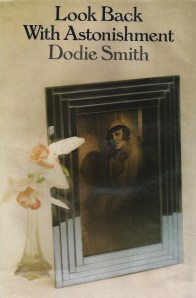
look back with astonishment dodie smith 001

Dodie Smith, circa 1932, in one of her most successful and beloved outfits to date, a grey hat and coat (with matching shoes and handbag) by “Gwen of Devon”

Look Back with Astonishment by Dodie Smith ~ 1979. This edition: W.H. Allen, 1979. Hardcover. ISBN: 0-491-02198-4. 273 pages.

My rating: 10/10

Picking up exactly where Look Back with Mixed Feelings leaves off, with Dodie stepping into Heal’s through the imposing glass entrance doors and taking on what would prove to be a respectably long stint in the retail trade – 1923 to 1931.

Dodie finds life as a working girl pulling the regular 9-to-6 shift five days a week (plus 9-to-1 on Saturdays) something of a change, but she grits her teeth and gets down to it. She has been engaged as Number Five Assistant to the section manager – a situation which rankles – Dodie must initial all of her transactions with the manager’s initials and “5” representing herself as an anonymous cog in the works – and which she soon manages to finagle herself out of, partly by intelligent grasp of her duties and promotion, and partly because (this bit is not in the memoir, but is added in by me from the accounts of others, most notably Valerie Grove in her biography Dear Dodie) Dodie has managed to secretly seduce the store owner, Ambrose Heal.

Ambrose is referred to in LBWA as “Oliver”; Dodie does a rather nice job of obscuring his identity, though when one is fully aware of the scenario many veiled references click perfectly into place. Ambrose is married, and he also already has a long-time mistress, Prudence Maufe, who is well up in the hierarchy of Heal’s. Dodie assures Ambrose/Oliver that she will be happy with “crumbs from the table”, as it were, and the two remain occasional lovers for the next 15 years or so, when Dodie makes a final break with Ambrose upon her departure for the United States on the brink of World War II. (They will remain lifelong friends and dedicated correspondents.)

Marvelous details of the workings of Heal’s; much discussion and description of the era’s domestic architecture. Dodie eventually becomes the toy buyer for Heal’s, and is sent to Leipzig Fair in Germany to view and order stock for the coming Christmas season. A side trip to Austria proves to have astonishing consequences, as Dodie there stays in a small mountain inn maintained by a harp-playing innkeeper.

Inspired by the mountain setting and the cheerful eccentricities of the innkeeper, Dodie, who has been churning out reams of dramatic manuscript and plays in her meager free time, translates her experience into what will become her astoundingly successful play Autumn Crocus, the smash hit of the 1931 London theatre season (“Shopgirl Writes Play!”) and the rest is history.

Look Back with Astonishment goes on to describe Dodie’s entry into the next phase of her life, that of a successful playwright. She was to go onto have an unheard-of six financially successful plays in a row: Autumn Crocus, Service, Touch Wood, Call It a Day, Bonnet Over the Windmill, and Dear Octopus. The quality of these varied, with Dear Octopus popularly declared to be her very best, but Dodie poured heart and soul into each and every one, and her descriptions of casting, staging, rehearsing and dealing with various actors, actresses and directors makes for fascinating reading.

Dodie’s private life has not been stagnating these years either. As well as continuing with her secret relationship with her boss, Dodie has developed another romantic partnership, one which will ultimately see her through to the end of her days.

Seven years younger than Dodie, and marvellously handsome and personable, Alec Beesley had led a life as dramatically complicated as anything Dodie could have dreamed up, and after a most difficult adolescence with a hateful stepmother had gone off to North America where he worked at a variety of jobs from section ganger on a railway in Alaska to cashiering in a Vancouver bank. Back in England, Alec has taken on the job of Advertising Manager at Heal’s, where he and Dodie meet frequently. (Often, to much eventual 3-way heart stirring, in Ambrose Heal’s office.) Com-pli-cat-ed!

Alec and Dodie eventually set up parallel households in adjoining flats; no one is quite sure what their exact relationship is, but Dodie makes mention of the happiness of both their sexual and emotional compatibility, and they do eventually marry (details in Volume 4, Look Back with Gratitude) though neither feels as though any fuss needs to be made regarding the legalization of what was long an established marriage in everything but the eyes of the public and the law.

As Look Back with Astonishment draws to a close, Alec and Dodie, along with Dodie’s beloved Dalmatian dog Pongo – yes, the inspiration for that Pongo, with much more concerning Dalmatians to follow in Volume 4 – are settling themselves into their accommodations on the ocean liner Manhattan, beginning what will prove to be a long self-imposed exile from their beloved England, due to Alec’s long and deeply held convictions as a conscientious objector and Britain’s coming entry into what will prove to be World War II. It is 1938.

I have left so much out; there is a lot in this volume! But I must move along, to the fourth and final installment:
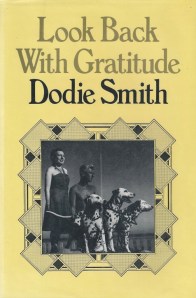
Dodie, Alec, Folly, Buzz and Dandy (I'm not sure which of the canines is which - all these spotted dogs looking rather alike to me) in California, circa 1944

Dodie, Alec, Folly, Buzz and Dandy (I’m not sure which of the canines is which – all these spotted dogs looking rather alike to me) in California, circa 1944

Look Back with Gratitude by Dodie Smith ~ 1985. This edition: Muller, Blond & White, 1985. Hardcover. ISBN: 0-584-11124-X. 272 pages.


My rating: 10/10

Brutally condensing here, though I could go on and on and on.

Dodie and Alec and Pongo set up house in New York and then cross the continent to California. They spend the war years engaged in various theatre and film projects; Dodie’s list of new acquaintances is a Who’s Who of the entertainment and literary world of the time. The most wonderful, for all concerned, is her finding of deeply kindred spirit and forever-more close friend Christopher Isherwood.

Pongo expires; Dodie acquires two more Dalmatians, Folly and Buzz. Folly at one point produces an astonishing 15 puppies (anything familiar here? – yes – this shows up in print down the road) of which litter Dandy is kept to make a boisterous trio.

Dodie turns her attention from playwriting and screenplays to conventional fiction, and spends three years working on what will become her first novel and what many consider her lifetime magnaum opus. That would be – drumroll please – I Capture the Castle, published in 1949 and an instant bestseller in England, once it is released there after its respectable but not stunning debut in the United States.

Much detail of crossing the continent numerous times; the agonizing internal conflict of abandoning England in wartime, the feeling of bitter homesickness and exile which never really goes away, the temporary return to England and the production of several not-very-successful plays, much agonizing on “next steps”, the long gestation and glorious birth of Castle, and much, much more.

This volume ends with Alec and Dodie returning to England for good in 1953; we leave Dodie gazing at the receding horizon of New York City through her stateroom porthole on the Queen Elizabeth.

A fifth volume was planned and apparently mostly written, but never published. I am bitterly disappointed; there is much more to tell and Dodie is by far the very best person to tell it.

I am better than half way through Valerie Grove’s 1996 biography of Dodie Smith, Dear Dodie, and though there are snippets here and there of things not included in the original memoir, it is so far merely a repeat of what I have already heard from the subject’s own lips, as it were. I am looking forward to Grove’s coverage of the years Dodie didn’t get to, being most curious as to the circumstances surrounding the writing and publication of The Hundred and One Dalmatians, as well as the her subsequent adult novels – The New Moon with the Old, The Town in Bloom, It Ends with Revelations, A Tale of Two Families, The Girl in the Candle-lit Bath –   and two more children’s books – The Starlight Barking and The Midnight Kittens.

Dodie Smith died in England at the most respectable age of 94, in 1990. Her beloved Alec predeceased her by three years. Her last Dalmatian, Charley, pined after Dodie’s death, and died a mere three months later.

Dodie Smith never produced anything which could be considered high literature; her plays, though popularly successful, were slight things, mere entertainments for the masses. Yet the best of her work lives on today and continues to appeal to a succession of new readers and audiences. Not such a shabby legacy.

Dodie Smith was a truly unique character, a complex heroine of her long personal era, and a tireless documenter of the times she lived in.

Need I add, these volumes of memoir are very highly recommended?


Read Full Post »

« Newer Posts - Older Posts »