Archive for the ‘1960s’ Category

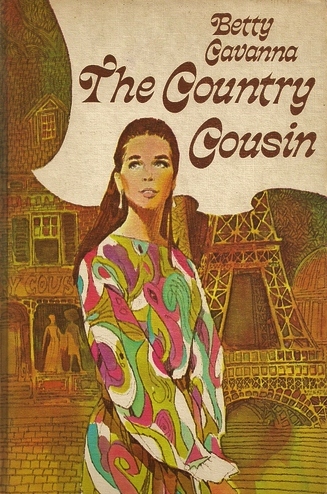
the country cousin betty cavannaThe Country Cousin by Betty Cavanna ~1967. This edition: William Morrow & Co., 1971. Hardcover. Library of Congress #: 67-21735. 222 pages.

My rating: 5/10.

An equal balance between interestingly vintage (Paris in the sixties!) and appallingly dated (chauvinistic boyfriends!) The author did her research for this slight little teen tome, and it shows, mostly in a good way. An interesting – if feather-weight – 40-year-old read.

Bonus – great cover! Tells you everything you need to know right there up front, doesn’t it?

*****

My reading is all over the map right now. It was a toss-up this morning whether to take a stab at reviewing Stephen Fry’s sex-and-bad-language-soaked novel The Hippopotamus, or this mild little vintage teen-girl romance. But since my last review was of a very contemporary (well, 1999 – not really that contemporary, though it seems but a moment ago in some ways), sex-filled book – Fits Like a Rubber Dress by Roxane Ward – I decided to keep things all mixed up; from one I wouldn’t dare to give my dear old mum to one she’s enjoyed with gentle enthusiasm. (As did I.)

Melinda Hubbard – Mindy – has grown up on a large farm in Pennsylvania, and now, recently graduated from high school and facing all the “next step” big decisions, is at a loss with how best to proceed. Her beloved older brother Jack, her opposite in almost every way – strong, intense, smart and focussed, where Mindy is soft, mild, merely average in academics and waffling – is studying medicine and has just married his college sweetheart, Annette.

Bridesmaid Mindy takes part in the wedding in a fog, brushing off inquiries as to her future plans with vague evasions; she’s done the proper thing and has applied to several colleges, but is ashamed to disclose that her applications have all been denied because she hasn’t met the academic standards. Her mother is pushing her towards taking a secretarial course, but Mindy is less than enthusiastic about that, not being able to picture herself sitting at a typewriter all day.

A saviour appears in the person of Mindy’s older cousin Alix. Recently widowed – we find out that her young husband was killed in Vietnam – Alix has taken the insurance money and opened a clothing store in Bryn Mawr, catering to the well-heeled college girls and their mothers. On an impulse, Alix invites her droopy cousin Mindy to come and live with her for the summer, to work in the shop – called “The Country Cousin” (after a real-life dress shop, as we find out in the author’s note at the end) – and gain some experience in the retail trade while considering her next move.

Mindy is agreeable – though one couldn’t call her “enthusiastic” – it’s really not in her nature, such a strong emotion, you know! – and soon is immersed in the retail clothing trade. If there’s one thing Mindy does enjoy, it’s pretty clothes, and we learn that she is something of an accomplished seamstress herself, designing and creating her own dresses and so on; a talent which will end up leading her to her true vocation.

Mindy meets several young men, and dabbles with romance for the first time in her life. Handsome Peter, a friend of Mindy’s brother Jack, is from a wealthy family, and has a succession of girls trailing after him, as he lackadaisically dallies with them while waiting for just the right one to come along. “I’m going to marry a rich girl,” he flat-out states to Mindy one day, letting her know that while she’s okay fun for a casual date or two, she shouldn’t get her hopes up. Realistic Mindy never really thought that Peter was for her, but she did daydream a bit, so rough and ready, definitely not wealthy and far from urbane Dana, another friend of Jack’s, on his way to study Oriental Languages at the Sorbonne in the fall term, looks very much like a second best in the boyfriend department.

Dana persists in his efforts to improve Jack’s sister’s intellectual capabilities, lending Mindy books on art, and carting her off to concerts and picnics in the country. He – and Peter, and Alix as well – all seem quite concerned with Mindy’s personal appearance. She is self-admittedly on the plump side, so with all of these people in her new life dropping comments to the effect that she’d be better-looking if she slimmed down, Mindy resolves to do just that, and tries to forget her butter-and-cream farm girl tastes, and to subsist on black coffee and a slice of toast for breakfast, and salad for lunch, and so on.

The pounds miraculously melt away, and everyone oohs and ahs about the improvement in her looks, and Mindy is quite smug with herself.  And this is where I had my biggest issues with this novel. The boys in her life, and her mentoring older cousin, mention to her that she’s too fat, and that she should slim down, so she unquestionably goes along with it, and does. She drops five pounds and everyone is all over her – “Good girl! Such an improvement!” Well, five pounds isn’t all that much, is it? I can’t imagine what their conception of “too plump” must have been if that made such a tremendous difference, and the fact that they were all so rude as to say such things to her rather floors me. It was obviously socially acceptable at the time to do so; Mindy takes it without a murmur. Anyway, this bit bothered me.

So, along goes Mindy, cooperating in her rather wishy-washy way with what everyone thinks she should be doing. Alix carts her along on buying trips to New York, and Mindy is introduced to the dress trade, and realizes for the first time that perhaps she might have a vocation after all, that of fashion design. She and Alix come up with a scheme to go to Paris on a selling trip, taking along clothing sample and taking orders from the community of Americans living there, who are desperate for well-made, reasonably priced clothes; Paris apparently offers only haute couture and shoddy department store dresses, nothing in the mid-range. This venture succeeds beyond their expectations, and of course they meet up with Dana, and romance predictably blossoms in the soft Parisian air.

A pleasant depiction of the time and place and people; the Paris of the “Americans abroad” is captured very well, as is the middle- and upper-class college town atmosphere of Bryn Mawr. As a “working girl”, Mindy is frequently reminded of her place in that society – at the lower end of the food chain – but she realizes that there is a dignity and self-satisfaction about doing whatever it is that you find yourself engaged in competently and cheerfully. A teeny bit preachy, with a Great Big Moral gently tromping about, elephant-in-the-room-style, but not offensively so. Betty Cavanna is so very genuinely earnest, and her heroines are so reasonably realistic, even to their modest goals and not-very-dreadful dilemmas, that it is hard to find much to object to. Middle-class girls are “people” too!

All in all, a typical bildungsroman of the era, which holds up well to a 21st Century nostalgic re-read, if you’re into dabbling with such stuff. I’m sure the junior high school girls of the time enjoyed it greatly; the old ex-library copy I have is very well read indeed.

Now, I wonder what I should read next …
Read Full Post »

hurray for me s j wilsonHurray for Me by S.J. Wilson ~ 1964. This edition: Pocket Cardinal, 1965. Paperback. 264 pages.

My rating: 5/10.

*****

This is a rather interesting book, written by an author I’d never heard of before. A first novel, very autobiographical in tone, which shows a lot of promise, and is a quite decent read.

The reviews on the back cover are glowing:

“A rare and refreshing book. It is a strong story gently told and I found it a delight to read…”  (Betty Smith, author of A Tree Grows in Brooklyn)

and

“…rings with character and the rhythms of young life. It stays with you for days after you’ve read the last page.” (New York Herald Tribune)

and

“Its innocence and freshness are like a breeze from the sea. What lends it magic is the way it is told, its highly original viewpoint, and the subtle shifts in mood and emotion …” (Saturday Review)

On the front flyleaf of this vintage paperback is this note from a previous owner:

Lake of Bays, July 13/66. Left under my pillow by Mary.

Intriguing!

And from Kirkus, 1963:

A five-year-old’s world which begins and ends with his mother and seem stable is viewed through the eyes of young Bobby Hirshman and told accordingly and lubly. For Bobby is a very verbal child whose tongue is given to twisting (“You’re crazy like a daisy, Fifi-la-la-Libby”). But once you get used to all these nonsense words and name calling, you may share in these scenes of Lower East Side, N.Y.C. and its good-natured schreierei; Mrs. Greneker whose feud with the landlord leads to further protest (garbage, out the window); the expansive Carmella; and the other familiars of the neighborhood. For Bobby, there’s first day at school and the new friend he meets, Johnny Schaefer. This brings many “”tsores”” (troubles) into his own life since Johnny’s mother is very sick, and, at her death, Bobby loses his own immunity to the intimations of mortality. With the loss of that childish certainty – mothers don’t die – Bobby grows up a little and the book closes…. A first novel, true to a time – the early ’30’s, and close to experience – guessably the author’s …

The story is told in first person narrative by young Bobby Hirshman, five years old and learning about life the hard way. Growing up Jewish in Depression-era New York is a theme which we’ve seen fairly frequently, and this poignant tale has the familiarity of repetition, but it is unique in its own way. Occasionally the author breaks character, but by and large the voice is authentic; the child’s-eye view feels true and strong.

I enjoyed this book, but not enough to shelve it with my “keepers”. In my internet browsing, looking for more information about the author, I have seen several comments to the effect that this is a rather hard to come by title. So I’ve decided, instead of just trusting to fate and releasing it via BookCrossing or the Sally Ann box, to pass it along more directly to anyone who wishes to try it. It’s a fairly slender paperback, crisp and clean despite some age-toning and a bit of weakness at the lower spine, and I’d be happy to mail it postpaid to anyone, anywhere. My treat!

This is by way of being an advance on my plan to give away some more books this month in honour of April being my one-year “Blog Birthday”. It’s a bit hard to believe the year has come full circle; I had no real expectations that I would still be so involved with the project, but here I am. Still interested, and hugely enjoying the conversations with other readers from all around the world!

So – if you think you’d like to own Hurray for Me, just drop me a note in the comments, and I’ll message you for your address and send it on its way.

It’s a neat little read, and deserves a good home. My other giveaways will be “draw” style, I think, but this one will be first come-first served.

Thank you, wonderful readers and writers, for a year of pure pleasure. I’m looking forward to what this next year will bring with happy anticipation!

Read Full Post »

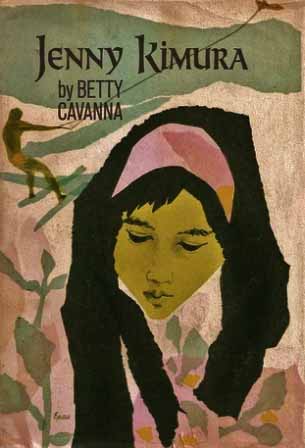
jenny kimura betty cavannaJenny Kimura by Betty Cavanna ~1964. This edition: William Morrow & Co., 1965. Hardcover. 217 pages.

My rating: 6/10.

All things considered, a slight little period piece, but a very good example of its genre: “teen girl” fiction of the 1950s and 60s, with a thought-provoking and rather brave theme for the time, that of racial prejudice.

*****

Jenny Kimura Smith, 16 years old, has lived her whole life in Japan. Her mother is Japanese, and her father is an ex-U.S. serviceman now working in banking. The Smiths live in Tokyo, and the portrait we are given is of a quietly happy family, enjoying, as Jenny’s father likes to say, the best parts of being both Japanese and American.

Jenny goes to an all-girls high school, and her interests are the same as those of her friends: study hard enough to get decent marks, spend time on your wardrobe, polish up your tennis game, and, increasingly, speculate about boys and romance and your fast-approaching adult life.

But Jenny’s life is about to change quite drastically from that of her schoolmates. Her American grandmother has invited her to spend the summer in Kansa City, and has sent money for airfare.

The invitation is something of a surprise, as Jenny’s father is vaguely estranged from his widowed mother since his Japanese marriage, and also, as we soon learn, because of his mother’s resentment towards the Japanese for the death of her second son during combat in the Pacific theatre in the Second World War. Jenny is excited to have this unexpected opportunity to travel, and is looking forward to experiencing life in exotic America.

On arrival in the States, Jenny is rather bewildered at the lack of open affection shown her by her grandmother, a wealthy, upper class, Kansas City society matron. She wonders why her grandmother has invited her to visit, as Mrs. Smith seems slightly cold and more than a little critical of Jenny’s very Japanese appearance, and some of her mannerisms. However, Grandmother does all of the proper things, and Jenny is introduced to a group of suitable teenagers, and is welcomed warmly into their social circle. It is soon apparent that she has caught the eye of one boy in particular, Alan, who begins squiring her about.

Could Jenny and Alan be falling in love? Not if Alan’s mother has anything to say about it! Once she realizes the increasing intensity of the situation, she whisks Alan away on a sudden holiday trip to remove him from the vicinity of “foreign” Jenny.

The plot takes another twist as Jenny and her grandmother travel to Cape Cod for a seaside holiday, and Jenny meets another young man, a Nisei (American-born Japanese), George Yamada, who was born in a California internment camp in 1944, but who considers himself completely American, despite his Japanese ethnicity and his family’s negative experience during the war.

Jenny immediately likes and is attracted to George, and soon realizes that the two of them are much more readily acceptable as a couple to their acquaintances because of their shared ethnicity, despite the differences in their actual backgrounds, than she and Alan were. She ponders this, and sees its “wrongness” – with her own parents as examples, Jenny realizes that love and “suitability” are more than skin deep – but she also realizes that appearances do matter to all concerned, much as they shouldn’t.

It also becomes very apparent that it is the older generation, the parents and grandparents, who are really resistant to anything like a “mixed race” relationship, while the younger generation is much more accepting, and openly discuss the issues raised by Jenny’s “foreign” appearance in a mostly non-judgemental way, though Jenny notices that she has a certain “novelty” appeal, especially when she appears in a kimono at a social function.

One of the key plot points is that Mrs. Smith deeply resents her son’s Japanese wife and has a hard time accepting and loving her own granddaughter, despite the attempt at reconciliation which inspired the invitation to America. She feels shame that her son has “demeaned” himself so far as to both marry a woman of a different race, and to live quite happily in a foreign country, far from “home”. Though Jenny tries to do everything right during her visit, her grandmother deep down is ashamed of her granddaughter and her “foreign” appearance and behaviours, only coming around when Jenny is snubbed by Alan’s family, when her pride is hurt, and her rage at their prejudice causes her to face her own feelings at last, and makes her realize how unfair her attitude has been in the years since her son’s marriage.

Similarly, from the Japanese viewpoint, Jenny’s mother has been shut out of her own family because of her insistence on marrying a foreigner, and Jenny’s maternal grandparents are cold and bitter towards both their daughter and granddaughter because of the “mixed” marriage which has caused the family to lose face. There is no reconciliation here, though, and it is implied that Jenny’s future relations will be much more positive with her father’s family than her mother’s.

The story ends with Jenny poised on the brink of her next step in life. She is about to return to Japan, but she has the promise from her grandmother that there will be a further family reconciliation, and she has had romantic experiences with two young men, George and Alan, which both look like they might possibly turn into something more serious depending upon Jenny’s future decisions. The idea of Jenny attending college in America has been raised, and she rather likes it, but nothing is yet decided, and that is where the story ends.

Despite the rather sober themes for a book of this genre, it is well padded with the usual happenings in a “teen girl” story: parties, shopping, lovely clothes, beach picnics and waiting by the phone for that special someone to call.

Jenny is realistic, likeable, delicately sensitive young heroine, and the author has done a better than average job in her portrayal of Jenny’s life both in Japan and the U.S.A. There are, of course, the expected clichés and stock situations, and many era-correct comments, which are a bit jaw-dropping when viewed from five decades further along.

This is no masterpiece, but it is a quite likeable book, and one I have happily re-read from time to time since my first acquaintance with it back in the 1970s, when I first checked it out of my high school library. The copy I own is that very copy I once signed out, found years later at a library discard sale, and the popularity of its heyday is borne out by the velvet softness of its well-thumbed pages and the many dog-eared corners throughout.

*****

Betty Cavanna was a prolific writer of “teenage” stories from the 1940s through the 1970s, publishing something like seventy titles, ranging from romance novels such as Jenny Kimura, to juvenile mysteries, horse-and-dog stories, and non-fiction “life in other lands” books. While many of her works are viewed as merely “average”, she was known for her meticulous research and wide variance of plots. Unlike many other novelists working in the same genre, Cavanna avoided series books; most of her stories are “stand-alone”.

I doubt that we will ever see this author re-published, but those of us nostalgic for revisiting the reading of our teen years will be happy to occasionally find her titles in secondhand bookstore and book sale rambles. Their value lies mainly in recording the attitudes and vignettes of a time now past, but those are reason enough for their preservation and occasional exploration, in my opinion.

Read Full Post »

the lonely life bette davis 001The Lonely Life by Bette Davis ~ 1962. This edition: G.P. Putnam’s Sons, 1962. Hardcover. 254 pages.

My rating: 7.5/10.

*****

I’m not a particularly dedicated fan of Bette Davis, though I’ve liked what I’ve seen of her acting – films I can remember watching are Dark Victory, Now, Voyager, Whatever Happened to Baby Jane?, Death on the Nile, and of course, most memorably, that glorious 1950s classic, All About Eve. Probably a few others over the years. But I do like a good autobiography, no matter who it’s about, and this one passed the browse test recently and found its way home.

I’d wavered a bit on it, because of the price (let’s just say “not cheap”) but the bookseller kindly gave my a nice discount – without my asking, because I very seldom dicker, figuring most people in the used book business aren’t exactly getting rich. I already had a generous collection assembled on the front counter, and this particular chap believes in encouraging his repeat customers. (The Final Chapter, downtown on George Street, the block between 4th and 5th Avenue, if you’re ever in Prince George, B.C. Cheerful, chatty owner – a self-confessed “non-reader” <gasp!> – his store has a quite decent selection, affordably priced for the most part. I’ve found some prizes there.)

Back to the bio.

*****

Bette Davis comes across in this tell-all much as she does on the screen – confident, outspoken and decidedly unapologetic. She fixes her eye on the goal, and powers ahead until she gets here, quite happily stepping on as many toes as need be.

The quality of writing is quite good, if a bit choppy in style – lots of short sentences. There often seems to be an assumption that the reader will have prior knowledge of whatever’s being discussed. Fair enough, coming from such a celebrity; this memoir was published at a time when most people reading it would have been fans, with intimate knowledge of the career of this prominent movie star.

Bette Davis was born Ruth Elizabeth Davis in 1908, famously during a thunderstorm, as she relates in The Lonely Life:

I happened between a clap of thunder and a streak of lightning. It almost hit the house and destroyed a tree out front. As a child I fancied that the Finger of God was directing the attention of the world to me … I always felt special – part of a wonderful secret. I was always going to be somebody. I didn’t know exactly what at first … but when my dream became clear, I followed it.

Bette, her younger sister Bobby, and their mother Ruth – “Ruthie” – were deserted by their father and husband when Bette was seven years old. Her mother refused to wallow in self-pity, but set herself to make a successful and prosperous life for herself and her daughters. Ruthie took on a wide variety of jobs, sending the girls to good boarding schools, and always arranging to spend vacation times together in interesting locations.

Bette received an unorthodox but adequate education; she was a great reader, and took singing, piano and dance lessons, apparently excelling at all of these pursuits. At some point she decided that her Great Big Goal was a theatrical career, and several seasons of New England theatre made up Bette’s dramatic apprenticeship.

As we all know, Bette eventually made the jump from dusty New York theatres to California sound stages. Roundly criticized as being homely in appearance and with zero sex appeal, there was paradoxically a certain something about Bette that came across as mesmerizing when she took on a dramatic role, and of course, there were those beautiful eyes.

Bette was never meek or humble. From a very early age she was tremendously focussed and not afraid to set her sights high, though she often fell afoul of fellow actors and her employers for her outspoken ways. She wasn’t afraid to take on unpopular characters, or to look less than glamorous if the role called for it – another characteristic which shocked many in “the business” was her insistence on realism over “pretty”. And though she full well knew what people were saying about her, she brazenly professed not to care.

If you aim high, the pygmies will jump on your back and tug at your skirts.The people who call you a driving female will come along for the ride. If they weigh you down, you will fight them off. It is then that you are called a bitch.

I do not regret one professional enemy I have made. Any actor who doesn’t dare to make an enemy should get out of the business. I worked for my career and I’ll protect it as I would my children – every inch of the way. I do not regret the dust I kicked up.

Speaking of those children, it is very obvious from this book that Bette’s dedication to her family matched her ambition. Frankly and with bitter regret, Bette reports that her first husband convinced her to have an abortion, fearing that a baby would damage her career. Years later, with husband number three, Bette did at last have a child. Barbara Davis Sherry – “B.D.” – was born in 1947, when Bette was 39. Under doctor’s orders to avoid further pregnancies, Bette and her fourth husband later adopted two more children, Michael and Margot. Margot was later found to have been brain-damaged at birth, and after being diagnosed as severely mentally handicapped, was then institutionalized, though she continued to spend much time with her family, and appears prominently in Bette Davis’s family publicity photos.

Bette’s personal life was predictably tumultuous; she was married four times, divorced from three of those husbands, and widowed tragically when her “true love”, her second husband, died suddenly of a blood clot in his brain after collapsing while walking down the street.

The Lonely Life was written in 1961, the year after Bette’s divorce from her fourth and final husband, actor Gary Merrill, her co-star and screen husband in the iconic All About Eve.

The Lonely Life, Bette says, refers to her resolution to live without a man in her life. She’s had rotten luck with husbands; better to go it alone.

After 1962 Bette had a number of career ups and downs and come-backs; she never really retired, never rested on her considerable laurels.

Several other memoirs followed The Lonely Life. Mother Goddam (1974) and This ‘n’ That (1987), continue the tale. Bette Davis died in 1989 from breast cancer, at the age of 81.

bette davis back cover the lonely life 001

Here she is on the back cover of The Lonely Life, aged 54.

I wondered how much of The Lonely Life was actually written by Bette herself; it did have an authentic-sounding ring to it. The dedication gives the answer to this question:

I attribute the enormous research, the persistence of putting together the pieces of this very “crossed”-word puzzle which comprises my life, to Sandford Dody.

Without him this book could never have been! His understanding of my reluctance to face the past was his most valuable contribution. We were collaborators in every sense of the world.

-Bette Davis

March 8, 1962

Sandford Dody was an aspiring actor-turned-writer who ghost-wrote a number of Hollywood memoirs. His own story seems worthy of a follow-up, and my attention was caught by his 2009 obituary in the Washington Post.  Dody’s version of his own life, Giving Up the Ghost (1980), is now on my wish list of future Hollywood memoirs to read.

The Lonely Life was a fast-paced and engaging, once I found my way into the choppy rhythm of the writing style. I particularly enjoyed the  well-depicted childhood and young adulthood reminiscences. My interest faded a bit in the later parts, when Bette Davis talks about her film career and the encounters with studio owners, directors, and fellow stars – lots of name-dropping, and assumptions that we know what she’s going on about. Much of the time it made sense – the names were mostly very recognizable – but occasionally I felt out of the loop.

While Bette is gracious about most of the people in her life – loyalty to her chosen friends is one of her positive traits – it is obvious that there was also a substantial baggage of animosity and bitterness in some of her working and personal relationships.

I don’t necessarily like Bette Davis any more after reading this personal saga, but I did feel like I understood her, and appreciated what she had to say, and why she said it. She was frequently too strident in her self-justification for me to feel that I could really relate to the egoism of the “star” aspect of her personality, but I did feel that she came across as worthy of admiration and respect for her many accomplishments.

The perfectionist little girl with the lofty goals did achieve her ambitious destiny. She stood up for her ideals of artistic integrity her entire career. She was literate, thoughtful and highly intelligent and articulate, and she was a darned hard worker.

I put down this book with the strong inclination to seek out and watch some more of Bette Davis’s films – the ones she spoke favourably of, among the vast array of B-movies she also appeared in – so you may take this as a pleased-with-the-read recommendation.

Read Full Post »

friendly gables hilda van stockum 001Friendly Gables by Hilda van Stockum ~ 1960. This edition: Viking Press, 1960. Hardcover. 186 pages.

My rating: 6/10.

An average to good example of the vintage juvenile “domestic drama” genre. I’ve happily re-read this book a few times, though if it disappeared from the shelves I wouldn’t be heartbroken, just mildly regretful.

*****

Living in a large house in Montreal, shortly after a move from the United States, the six Mitchell children, Joan, Patsy, Peter, Angela, Timmy, and Catherine, ranging in age from fifteen (Joan) to three (Catherine), are joined by twin brothers. Their mother has had a hard time with the birth, and is weak and confined to bed, so a strict English nurse, Miss Thorpe, is engaged to care for the babies and help run the household until Mother can recover enough to take on her usual role.

There are immediate conflicts. Only Joan finds favour in Miss Thorpe’s eyes as she proves herself both willing and very capable in helping with the babies and taking on much of the meal preparation; but the younger five are considered much too selfish, rambunctious, noisy, messy and careless by the strict nurse. Father is busy working and is seldom home; cash flow is definitely an issue in the household; which though comfortably middle-class is far from wealthy. There is nothing left for any extras after paying Miss Thorpe’s wages, and several plot lines focus on the children trying to earn enough money for various crucial things they need or desire.

The American Mitchells are still adjusting to life in French Canada. The children attend Catholic school, and their struggles with learning a second language, getting along with the Québécois children who occasionally toss a scornful “You Yankee!” their way, and trying to conform to the strict standards of the nuns and priests at their schools are nicely depicted.

The story focuses on each child in turn, while giving a broader picture of the inner workings of the family. The only child not given a starring role is young Catherine; each of the others has some sort of adventure. Joan falls in love, and attends her first dance; Patsy loses her glasses and disgraces herself deeply with the nuns at school in numerous ways; Peter falls afoul of a schoolmate and in the resulting fisticuffs knocks down and smashes a large plaster statue given by an important supporter of the school; Angela gets lost while attending a maple sugaring-off party; Timmy becomes infatuated with a girl at nursery school, and attempts to come up with a perfect gift for her.

Mother eventually gets better, the twins appear to be thriving after the month or so that we are in touch with the family, peace is made with Miss Thorpe, and we leave the family celebrating at the christening party.

*****

A pleasant though minor story, from an author who then went on to write several more serious and very well-regarded historical fictions set in Holland during World War II – most notably The Borrowed House and The Winged Watchman. Though there are superficial similarities to Elizabeth Enright’s The Saturdays, Friendly Gables does not attain the appeal and overall excellence of Enright’s creation, which defines the genre and deserves every word of its frequent praise.

The formula is also much like that of the Eleanor Estes’ Pye Family books in that it mostly relates a family’s daily life, sometimes in microscopic detail. As with the Pyes, the Mitchells are far from perfect, which is pleasantly reassuring to the reader. The morals in Friendly Gables are predictable but not terribly intrusive. And everything always comes out right in the end.

This story does have some lovely vignettes of parent-child and sibling relationships. Something I particularly appreciated was how independent the children were in sorting out their various dilemmas, and how confident the parents were in their children’s abilities to cope. Occasionally a child would go to Mother of Father to report the current happenings, and perhaps ask for assistance or advice (always cheerfully given), but often it was merely to report that the problem was solved, whereupon the parent would basically say “Well done!” and that would be the end of it – no muss, no fuss.

Friendly Gables is the last book in a series of three about the same family, so there are occasional references to off-stage characters and previous happenings, which left me a bit out of the loop, but those would make perfect sense to someone with access to the whole set. It certainly isn’t a big drawback, as the author sketches in enough information to pin it all together.

Friendly Gables is set in urban Montreal, and was preceded by two other novels about the fictional Mitchell family: The Mitchells, published in 1945 and set in Washington, D.C., and Canadian Summer, set in rural Quebec, published in 1948.

These three books are autobiographical, according to both the author and her now-adult children, and were inspired by and record incidents in the very real Marlin family’s life. Hilda van Stockum published her juvenile books and her many illustrations of other authors’ works under her maiden name, but was in her “everyday” life  Hilda Marlin: accomplished painter, U.S. Civil Service wife, and dedicated mother of six children, all of whom subsequently attained rewarding and creative careers of their own.

Hilda was born in 1908, in Rotterdam, Holland, to a Dutch father and an Irish mother, and spent her youth in both Holland and Ireland. She attended art school, where she apparently received much praise for her realistic paintings. Hilda married her brother’s college roommate, American Ervin Ross Marlin, in 1932, and travelled with him to New York. The couple and their steadily increasing family lived in various cities in the U.S.A.. They then spent six years in Canada, before moving to Ireland, and eventually to England, where Hilda died peacefully at the age of 98, still living in her own home, in 2006.

Hilda, child and grandchild of scientists, artists, philosophers, writers and intellectuals, was raised in an atheist household, but she embraced the Anglican faith in her teen years, converting to Catholicism in adulthood. Her devout faith appears in her books, including Friendly Gables, but more as a background to the story than in a “preachy” manner.

Hilda van Stockum’s strong belief in the importance of family also permeates her writings, making her a decided favourite of those seeking “wholesome” books to share with their children. A number of her titles are still in print, some more than seventy years after their first publication, so there are still eager readers. Hilda van Stockum’s works seem to be particularly in favour with “traditional” homeschoolers, which is understandable due to the author’s positive views on “family values” and religion. And “secular” readers – do not fear! These books can be enjoyed by all.

I’m including this book in the Canadian Book Challenge because of the Quebec setting, though the author is not Canadian, but Dutch-American, and the family in the story is American. National identities and prejudices play an important role in Friendly Gables; the author handles the topic very well.

Read Full Post »

the mysterious christmas shell eleanor cameron 001The Mysterious Christmas Shell by Eleanor Cameron ~ 1961. This edition: Little, Brown & Co., 1961. First edition. Hardcover – Library Binding. Illustrated by Beth & Joe Krush. Library of Congress #: 61-9281. 184 pages.

My rating: 8/10. What a nicely written book this was! It restores my faith in the joys of reading juvenilia, sadly shaken by recent forays into several more modern disappointments in the youth-oriented fiction line.

This one was a recent impulse buy from the ever-changing and happily eclectic selection at the Bibles for Missions thrift store in Prince George. I try to get there once a month or so, and I always come away with a promising mixed bag of reading material. Some goes right back into the giveaway box, but there’ve been some small treasures found there, too.

The cover illustration was what grabbed my attention, though this grubby ex-school-library book showed much evidence of many readers, and was less than appealing at first glance. (It ultimately cleaned up nicely with a triple application of soapy cloth, rubbing alcohol and a tiny dash of benzene – not in combination, I hasten to add, but in delicately selective stages.)

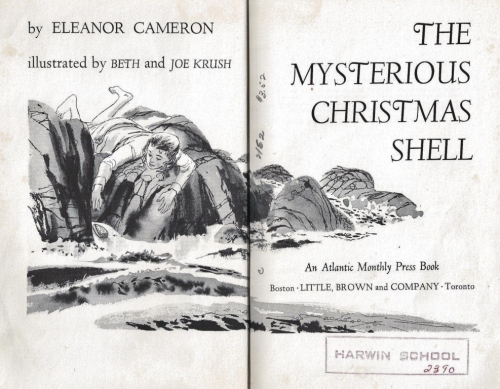
“Those look like Krush children,” I thought to myself, and by golly, my instinct was right. Beth and Joe Krush were a husband-and-wife team of children’s book illustrators working industriously together from the 1950s through the following decades, and their marvelously detailed pen-and-ink-and-wash drawings perfectly depicted the characters of such classics as Mary Norton’s The Borrowers and its sequels, and Elizabeth Enright’s Gone-Away Lake books, among many others.

Here’s a sample. Isn’t this appealing?

the mysterious christmas shell frontispiece eleanor cameron 001

And Eleanor Cameron’s name chimed a little bell, too, though I didn’t really place it until I Googled her after I’d read the book. This is the famed Mushroom Planet creator, though those junior sci-fi fantasies were only one aspect of her widely varied output.

The Mysterious Christmas Shell is very much a plain and simple “domestic adventure” story, and it turns out that it is Cameron’s second book concerning the same brother-sister pair, Tom and Jennifer. Their earlier adventure, The Terrible Churnadryne, was published in 1959.

*****

Five days before Christmas, Jennifer and Tom arrive in the fictional town of Redwood Cove, California, on the Monterey Peninsula, to spend the holidays with their Grandmother Vining, and Aunts Vicky and Melissa. As soon as they walk into their aunts’ house, they realize something is terribly wrong. The tree hasn’t been decorated, the usual garlands are in a heap of green at the foot of the stairs, and everyone has a strained smile; occasionally they catch one or another of the adults huddled in a corner crying.

Turns out that the Vining family has had to sell its treasured piece of ancient redwood-forested seaside property, Sea Meadows, because of the year-ago death of the family partiarch, the children’s grandfather. Some investments have gone wrong, and outstanding debts needed to be paid. The purchaser, a boyhood friend of the family, was thought to want to keep the property unspoiled, to be the site of a single home, but recently troubling word has come that there will instead be major development. Hotels, a shopping centre, and a vacation community are planned; many of the ancient trees will be coming down, and No Trespassing signs will be going up barring the locals from their most pleasant seaside beaches and coves. The local townspeople are up in arms, and are angry at the Vinings for the sale; the Vinings are distraught at the prospective destruction of their well-beloved redwood forest.

An offer to re-purchase the property from the developer has been turned down, and a prospective reprieve of sorts has not come about. Grandfather Vining had intended to change his will to transfer Sea Meadows to the state as a nature reserve, but no one has any record of the will being registered, and no one knows if the envelope containing it was actually sent. If the will was indeed written, it would effectively cancel out the subsequent sale, and the property would go to the state once the buyer’s money was refunded. This seems like a way out of the dilemma, but where, oh where is the will?

As Jennifer and Tom ricochet around Redwood Cove looking for clues, we get a vivid picture of a large, loving family, each member trying to do the best for the others, though occasional misunderstandings occur.

The physical description of the California coastline, with its sea caves and pocket-handkerchief beaches, its tide pools and their glorious variety of sea life, is wonderfully well done; it is obvious that the author held the area in deep affection.

I do have an extra special reason for loving this story, having spent some weeks every year in California as a child, visiting grandparents, aunts, uncles and cousins in the Fresno area, and travelling out to San Jose, Monterey, and Carmel-by-the-Sea to visit family friends and to explore the still-unspoiled seashore along the more remote stretches of coastline. I even had my own similiar near-brush with death, once being washed out into the surf by a rogue wave; my father’s heroic rescue has become a piece of family folklore, and I blame my deep but reasonably well-disguised unease about any body of water much deeper than my knees on that terrifying childhood experience. Tom, Jennifer and Aunt Melissa’s being caught in the waves of the incoming tide sent chills down my spine! I could feel the sand burns …

The familiar setting was a marvelously unexpected surprise, but putting aside nostalgia and concentrating on the writing, I must say I was impressed by the quality of the prose, and by the author’s fine story-telling ability. While this is one of those stories where nothing huge really happens, with the adventures being small ones, and the solution to the mystery very apparent to the reader from early on – the Vinings, on the other hand, struggle on for strangely long time figuring out their clues – I found I couldn’t put the book down until the satisfyingly happy (though rather improbable) ending.

A grand vintage read for adults of a certain age wishing to revisit their youth through the pages of a book, though I’m not sure how much it would appeal to our more sophisticated 21st Century children.

Despite the Christmas-time setting, this is not really a Christmas book as such, though a glass tree ornament from Innsbruck plays a major part. Oops – just gave away a clue!

It was enjoyable to read about Christmas preparations in a place far from snow, and that brought back memories, too. We only spent one Christmas in California when I was a child, as most of our travelling took place in the early spring and the fall, but I remember how surreal it was that one time to be singing carols under the palm trees, with roses still blooming and lemons on the trees in my grandmother’s garden, while back at home, in interior British Columbia, icicles reaching the ground were our parting memory as we’d pulled out of the yard for the marathon three-day drive southwards. (Somewhere I have a picture from that trip of me and my sister standing, in our matching velvet-collared coats, in front of a huge Christmas tree at Disneyland, which was ornamented by coloured glass balls as large as our heads.)

This is an author decidedly worthy of further investigation. Investigating the titles and plots of some of her non-sci-fi “realistic” children’s/teens’ novels, I strongly suspect that I read some of those when I was in grade school, as two or three of the unusual plots sound very familiar, but The Mysterious Christmas Shell was an unfamiliar, unexpected and most welcome find, for all of the reasons detailed above.

*****

Oh – one more serendipitous thing. Eleanor Cameron turns out to be Canadian! She was born in Manitoba, and though she subsequently lived most of her life in California, she is widely identified in all of the material I was able to find online as a Canadian. So – another one, completely out of the blue, for the Canadian Book Challenge!

Read Full Post »

the shape of a year jean hersey 001The Shape of a Year by Jean Hersey ~ 1967. This edition: Scribner’s, 1967. Hardcover. Library of Congress# 67-13158. 243 pages.

My rating: 6/10.

This is not at all a poor book, but rather an unexceptional one. Set in the author’s rural homeplace of Weston, Connecticut, here are month-by-month musings and reportings of the little incidents of her life. These definitely have a certain appeal, but there is a creeping banality clothed in florid description to some of what she judges worthy of note. Most of it is all very well and good, but while readable this does not promise to become a favourite.

As a personal record it seems just a bit too good to be true, a shade too sweet and optimistic; there is little record of any sort of frustration, annoyance, disappointment or anger; it is all very “nice”, as if the author decided ahead of time to only include the more inspiring incidents of her days. I think this would be a much stronger memoir if it showed a broader range of emotion.

Golly, these comments sound a little harsher than I had intended. Here, I’ll share some of the author’s words with you so you can get a better picture of what this one is all about. I suspect this author will appeal most to the Gladys Taber crowd. (For the record, I like Gladys Taber; my mother had a number of her Stillmeadow books and I read them with deep delight during my teen years.)

Jean Hersey, born in 1902 and living in the Eastern United States, in Pennsylvania and Connecticut, was a prolific writer of magazine articles for Woman’s Day and various gardening and houseplant periodicals. She also authored something like a dozen non-fiction books dealing with gardening, homemaking, and semi-rural life.

*****

From The Shape of a Year: January, 1965.

January mornings at seven are like opals, soft, milky white and pink around the edges. The January sun rises silvery white, bright but not warm, and a mist like an aura hovers over the south meadow.

One morning early as we ate breakfast, Bob was eyeing a cluster of many colored Christmas tree balls lying in one of the upholstered chairs. We had dismantled the tree the day before.

“They look,” said he sipping his coffee, “as if they were waiting for a goose to come along and hatch them.”

“It would have to be a golden goose,” I replied watching the stars laid on their shiny surfaces by the early sun streaming in the windows. Obviously no ordinary goose could sit on these bits of Christmas magic.

May, 1965:

May sweeps in on a theme of daffodils. I gather armfuls from the meadow and next day so many more unfold that I cannot see where I have picked. Along the roadside the willows are tumbled masses of pale green foam, and forsythia, in streaming fountains of flowers, reflects the sun’s golden rays. Here a dusky pink weeping cherry adds a soft note of color. There a magnolia tree is a bouquet of pink blossoms, and everywhere maples are shaking out their tight fists of green into lacy green leaves.

July, 1965:

Where is our grandson? I am waiting on the station platform for this young thirteen-year-old who will be carrying a suitcase and I don’t see him. Other people get off, but no Jeff. There is a boy down the platform – or is it a boy – it seems more like a thatched roof moving along.

“Hi, Grandma, here I am.”

“Why, Jeff,” I gasp. “Hello, how good to see you.”

I gasp because here we have the Beatles incarnate. I have no war with these young Englishmen beyond what they have done to the hairdos of America…

October, 1965:

The fragrance of burning leaves is another autumn delight. Their delicious rustle and the scent of their smoke invariably carries me back to the days when my father used to rake great piles to burn. Before he lit them my friends and I would burrow deep and hide ourselves in the slightly scratchy heaps. From here we would look out at the world through tiny odd-shaped chinks of light …

December, 1965:

These days the car is always filled with Christmas presents on the way in or the way out. One time we were in New York City with presents to deliver and we parked our convertible. When we returned the presents were gone and the top neatly slit with a little triangle just large enough to reach in and draw things out. The gifts did look rather festive with their gay paper and ribbons. I’ve often considered though, what their effect was on the person who appropriated them. He overlooked a suitcase and overcoat on the back seat, and took instead a package of wild bird food destined for my brother-in-law and a book called The Power of Constructive Thinking by Emmet Fox. I’ve never ceased to wonder about the reaction of this particular thief as he opened his haul.

*****

And there are recipes.

While I wouldn’t search this author out, I also wouldn’t turn down another of her books if it came to me cheap and easy, as this one did – on the bargain rack at a used bookstore this autumn.

Read Full Post »

the long winter john christopherThe Long Winter by John Christopher (pseudonym of Samuel Youd) ~ 1962. Alternate British Title: The World in Winter. This edition: Simon & Schuster, 1962. Hardcover. First American edition. Library of Congress #: 62-12411. 253 pages.

My rating: 7.5/10. This fifty-year-old post-apocalyptic novel was much more gripping than I had expected; the premise of a new ice age is chillingly depicted (pun intended). I thought this one was right up there with John Wyndham’s similarly themed works. I started it last night as a casual bedtime dip-into-and-check-it-out read, and I was quickly hooked and soldiered on until well after midnight to finish it, to my slightly groggy detriment today.

Good period piece and a fine example of the vintage speculative fiction genre, though with the expected true-to-the era misogynist attitudes and opinions. This would make an excellent film, in the right hands.

*****

Andrew Leedon rubbed his hands against the antique Victorian muff-heater Madeleine had given him. She had found it in an antique shop and presented it to him on his birthday, along with a supply of the small charcoal by which it was fueled. But even charcoal had become impossible to obtain, and its brief usefulness, after so many years, was almost at an end. He blew through the small holes on the side and watched the red glow brighten. A chair scraped and he turned his attention back to his fellow readers. He felt pity for them, but it was mixed with envy. The future was a current which soon, very soon now, must drag them down into the maelstrom; for the moment they bobbed like corks in this eddying backwater, but the deep tug of the undersurge was there and none would escape it. Yet they were indifferent. The red-eyed, gray-haired man across the aisle with his pile of volumes on King Arthur – he had always been there, in the same place, with the same books. When the end came to him, in however strange and incalculable a form, it would be irrelevant, as irrelevant as the pneumonia or heart attack or cancer which would otherwise have rendered his seat vacant. Soon all the seats would be vacant together until, as must happen, marauders broke in to rip up the wood and carry away the books that were left for fuel. Some of the rarest books had already gone, to the libraries in Cairo and Accra, in Lagos and Johannesburg, and more would go in the next few weeks; but there would still be enough to draw the mob. The people reading here were not so foolish as to expect a reprieve – for the library of for themselves. It was that he envied.

The main lights were off, conserving electricity. There were only the small reading lights, and, high up, the grayness that filtered in from outside. He thought of Africa; of sunshine, long beaches by a blue ocean, the green of trees and grass …

In the middle of the 20th Century a worldwide environmental catastrophe is occurring: the sun’s radiation is decreasing, and a new ice age is looming in the temperate zones. British television producer Andrew Leedon, happily married with a lovely wife and two young sons, catches a glimmer of the story as it first starts to break, but he, along with everyone else, pays little attention. Even if the predictions are correct, what would a degree or two difference in temperature really mean? Surely nothing to worry about; winters in England might even be more traditionally enjoyable again; skating on the Thames would make a pleasant Christmas diversion…

As the true impact of the swift and ever more severe solar cooling begins to be felt, Andrew’s marriage echoes the collapse of his planet’s future. His wife confesses that she has been continuously unfaithful since the first days of their marriage and is now leaving him for his good friend David Cartwell; as a consolation prize Andrew is thrown together with David’s discarded wife, the gentle Madeleine.

Those fortunate enough to have been able to plan ahead and liquidate their assets are moving towards the equatorial regions; Andrew’s now-estranged wife and sons leave for Nigeria without his initial knowledge. Stubbornly refusing to flee in his turn, Andrew is finally convinced to leave by Madeleine, and with David’s assistance the two obtain seats on one of the last air flights out of England. David himself remains behind, counting on his high position in the government to enable his escape if and when it becomes necessary. But for now he intends to stay and see England through this crisis to the best of his considerable ability.

In Africa, Andrew and Madeleine find themselves immersed in a society very different from that which they know. White-skinned Europeans and Britons are the new working class; their currency is worthless, their academic and professional qualifications ignored. Serving the ruling class Nigerians in the former British colony, the whites scrub toilets and wait tables and prostitute themselves to pick up enough money to eke out a precarious existence. Andrew and Madeleine settle into one of the worst of the slums, until a chance encounter with an African student whom Andrew had patronizingly but kindly treated to a dinner at his club back in the old days in London elevates him socially and professionally by making him a personal assistant.

This turn-about relationship leads to a morally challenging situation, when Andrew is asked to join a Nigerian military expedition force planned to explore England by Hovercraft, to assess the possibility of re-colonizing that now nearly abandoned territory under an African flag.

The first part of this post-apocalyptic tale is, in my opinion, the best-written, where Andrew struggles with the ethics and morality of his own behaviour in this unprecedented crisis, and keenly observes the reactions of those around him. As the novel progresses, and as the conditions in the frozen lands worsen, to martial law, brutal violence by the few elites with guns against the many without, and survival of the fittest by any means, including cannibalism, the story becomes much more intellectually shallow and far distant from the complex inner musings of the earlier days. To be fair, this might echo the increasing callousness of the strong as they jettison their finer feelings to ensure their own continued survival; ethics are a luxury no one can afford to indulge in any more.

The racial situation of blacks versus whites and their role reversals is cleverly presented; the tone remains “white” racially superior though, as the Africans ultimately are undone by their own “inborn” weaknesses, at least in the eyes of the staunchly patriotic Britons defending their frozen homeland.

This is indeed a very British book; the author assumes a strong familiarity with English landmarks and history, and knowledge of London neighbourhoods and architectural and physical features. The narration itself is very stiff-upper-lip, in the best stereotypical tradition.

I thought that Andrew lost some of his credibility as a character towards the latter part of the book; his continual fixation on his personal life while the world itself is crashing down around him strikes a false note.

Or does it? How would you react? Would you focus ever more inward, or would you harden your soul to pursue sheer survival over sentiment?

The ending of this epic is left open and vaguely optimistic, but though we may speculate on Andrew’s future, we are not at all assured that he will even survive, let alone thrive, in the changed world he is struggling to adapt to.

*****

John Christopher was the pseudonym of the late (1922-2012) prolific sci fi and speculative fiction writer Samuel Youd. His best-known works are perhaps the teen/young adult “Tripod Trilogy” concerning an alien invasion of Earth: The White Mountains (1967), The City of Gold and Lead (1968), and The Pool of Fire (1968). I read all three of these some years ago, and though I felt that they were often technically over-simplistic, they were emotionally gripping, thought-provoking and generally memorable.

This is an author worth investigating for the frequent excellence of his creative ideas and his sober examination of human emotional motivations, though his writing can be occasionally uneven, varying in quality even within the same book.

If you are a John Wyndham fan, you will find much to enjoy in John Christopher’s stories. In that case, recommended.

A note: The Long Winter was intended as an adult novel, even though this writer also wrote widely for teens.

Read Full Post »

The Secret World of Og by Pierre Berton ~ 1961. This edition: McClelland & Stewart, 1984. Softcover. Illustrated by Patsy Berton. ISBN: 0-7710-1386-8. 159 pages.secret world of og cover pierre berton 001

My rating: 6/10. It has its moments, hence the rather generous “6” rating, but I’ve been exposed to Og three times now and I’m still not a complete convert. Sorry, Pierre. And Patsy. This one is a cute Berton family in-joke, and I appreciate your sharing it with the country at large, but my personal enthusiasm for Og and its viridian denizens remains restrained.

*****

My first exposure to this Canadian children’s “classic” was back in the early 1970s, when a keen grade school teacher read it out loud to our class over a series of afternoon reading breaks.

This tweaks my memory – does anyone else from B.C. remember those after-lunch U.S.S.R. periods – Uninterrupted Sustained Silent Reading? Occasionally these would morph into read-aloud sessions, to the great joy of most of the students in the class, except for those few of us hardcore bookworms who would really have preferred to be left alone to focus openly and with official permission on our own reading choices.

I even remember the book I was sneakily perusing as the teacher read Og. I was deeply engrossed in Jade by Sally Watson – an absolutely marvellous book about an upper-class teenage girl who ends up crewing on a pirate ship, with a desperately swoony captain <ah, sigh>  – a saga which I remember with great fondness and which I always meant to track down for sentimental reasons and to share with my own daughter, but which I haven’t yet gotten my adult hands on. Gosh, Sally Watson was (is! – now in her eighties, she’s still writing away, last time I heard) a wonderful writer. But I totally digress. Back to Mr. Berton’s fantasy-land.

I caught bits and pieces of Og but nothing that made me close my own book and listen with great attention. Little green people in a tunnel. And some dead rabbits. That’s about all that stuck.

Years later, as a mother gleefully equipping a children’s library for my own book-loving youngsters, The Secret World of Og kept showing up on all the “best books to share with your Canadian kids” lists I came across. “Well, why not?” I thought. “So many recommendations can’t be wrong.” So Og was duly acquired, in the great big edition illustrated profusely and with more enthusiasm than finesse (Camberwell Art School regardless) by Pierre Berton’s now grown up daughter Patsy.

secret world of og pierre patsy berton 001

Our own attempted Og read-aloud session died an early death, as the book was replaced after only an evening or two by Kipling’s Just So Stories, which were a much greater hit with the listeners. Og was soon buried in the stacks, and eventually packed away out of sight. I found it again just last week when I was nostalgically going through boxes of children’s artwork and old lesson papers, preparatory to discarding most of them. Og was a the very bottom of a pile of Grade 3 math worksheets, which was quite a few years ago now. We hadn’t even missed it, or thought about it in the meantime, which is a rather telling state of affairs concerning a book in this household.

“Aha!” I thought. “This will be perfect for the Canadian Reading Challenge! Classic Canadian author, quickie-reading kid’s story – how can I go wrong?”

So, third time lucky, I have finally read The Secret World of Og with my full attention focussed on it, fully prepared, after Captive Reader Claire’s enthusiastic review, to find it at long last quite wonderful myself.

Oh, dear. It wasn’t to be. I liked it well enough, and I can see why others love it, but it still didn’t totally 100% click with me.

I happily admit that I laughed out loud at the best bits: the hilarious Lucy Lawless titles, the marvelous relationship between Paul (the Polliwog), his Pablum, and Earless Osdick the cat, and Yukon King, the small dog who thinks he’s a huge husky. A continually witty commentary comes very obviously straight from Father (our Mr. Berton himself), but I just couldn’t bring myself to much very care for those darned annoying children. And Og itself isn’t a much of a fantasy world, nothing like Alice’s rabbit hole, or the secret rooms of Mary Norton’s Borrowers, both of which seem to have influenced this Berton family fairy tale.

Here’s the story in brief.

The five Berton children – Penny, Pamela, Patsy, Peter, and Paul (aka the Pollywog) – have a playhouse in the woods. One day Pamela looks up from her comic book to see a very small, very sharp saw outlining a trapdoor in the playhouse floor. A small green creature pops up, looks at her, and promptly disappears. Pamela, living in a world of imagination most of the time, and well used to the scornful dismissal of those around her to her observations about unlikely things, neglects to tell anyone about this.

Until, that is, the afternoon when the Polliwog is left alone in the playhouse for a few moments, and vanishes, along with Osdick, into what seems to be thin air. Pamela remembers the trapdoor then, and the siblings manage to worry it open and descend into what turns out to be a tunnel leading underground, to a land surrounding a luminescent river and forests of coloured mushrooms, and populated by hundreds of little green people whose only word appears to be “Og”. Pause for much rambling on about the details of all of this.

The cat is destined for the butcher block; the locals think he is some sort of exotic rabbit, (which quadruped they much love to eat, having discovered the gourmet glories of mushrooms with rabbit sauce); the Polliwog is, as usual, in jail. Needless to say a rescue is effected and everyone returns to the surface in one piece. And that is that.

*****

Some of you might remember the headlines a few years ago, shortly before the revered Pierre Berton’s death at the age of 84 in 2004, when he stated, in a CBC television interview, that he had been recreationally smoking marijuana “since the sixties”. Though he insisted that he didn’t use it when he was “working”, the trippy aspect of the World of Og suddenly looks a little suspicious of something more than mere fatherly imagination!

Okay, okay, I apologize for casting such aspersions. (If you could see me, you’d know that I’m grinning like mad in a conciliatory way right now.) Pierre Berton was awesome; he wrote great books, and by and large was a worthy Canadian literary icon. But you have to kind of wonder… 😉

Some bits of this book are absolutely brilliant; much of it is truly very funny. Give it a look, decide for yourself. Me, maybe I’ll pack it far away again and bring it out to try on the (very much speculative at this point in time) grandchildren. Or maybe not. 🙂

Read Full Post »

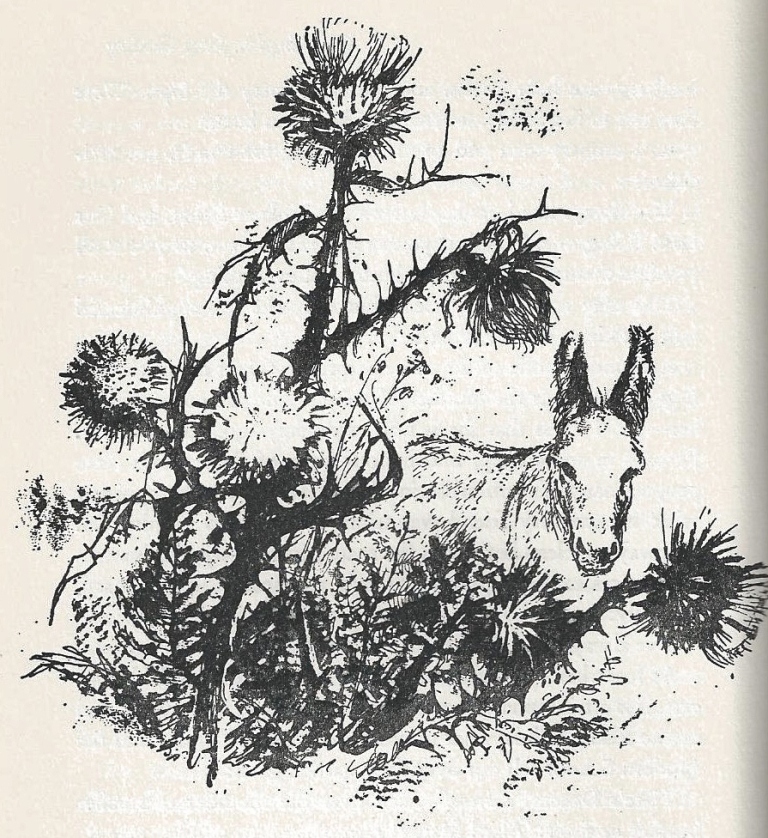
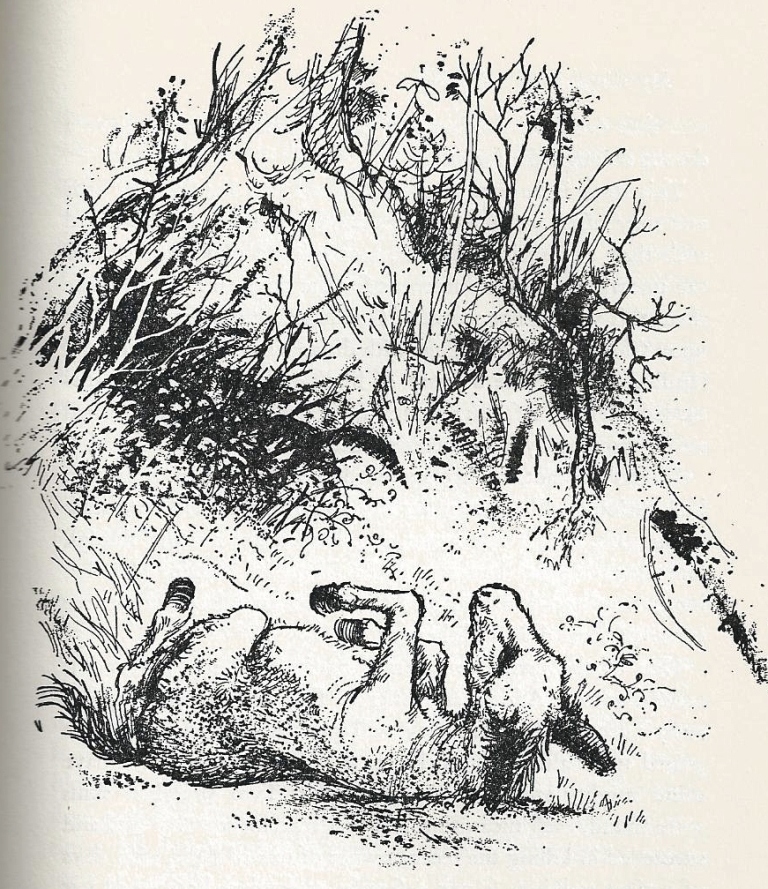
My Kingdom for a Donkey by Doris Rybot ~ 1963. This edition: Hutchinson & Co., 1963. First Edition. Hardcover. Line drawings by Douglas Hall. 128 pages.

My rating: Another unique book which is hard to rate. It’s centered on the author’s pet donkey, Dorcas, with predictable anecdotes about the creature itself, but it also ranges much more broadly into history, philosophy, animal rights and general opinionating by the author.

I liked it. I initially bought the book to give to a donkey-owning friend, but am finding it difficult to make up my mind to let it go just yet. And I love the illustrations. I should send it on its way back out into the world, but I strongly suspect I won’t.

Anyway – rating. I’m thinking 8/10. A slender little volume, but earnestly written, and beautifully sincere. Almost makes you yearn for a donkey of your own. (“Or not!” exclaims my reading-over-the-shoulder daughter, who has spent a number of sessions brushing out the knots in down-the-road Fanny’s woolly coat.)

*****

I’ve been carrying this one around with me for weeks, to the detriment of its rather fragile dustjacket, so I’ll try to pull off a quick review in my little window of time this evening so I can at last leave the poor thing on the shelf.

The author writes:

My own Dorcas is a plump, well-liking donkey. But even I – who can say of her as Sancho Panza said of his ass Dapple, she is the ‘delight of my eyes, my sweet companion’ – even I cannot call her beautiful. She is too like a child’s inexpert drawing, with her head absurdly big for the mouse-brown body that is at the same time neat and clumsy.

Poor grotesque beasts! Whose fault is it that they are as they are? From that day far down the increasing centuries, before the Pyramids, before Abraham, when the first wild ass was haltered and loaded. his kind have been abused, overweighted, beaten, ill-fed, chancily watered; kicks and goads have come their way more often than pats and praise. Little wonder they were reft of their real grace and swiftness to become the stunted toilers that we know, waifs of the world, clowns among horses, a byword for patience and humbleness.

This particular donkey has been acquired to keep the grass down on a small country acreage. She has not been neglected or abused, but instead was deliberately sought out and purchased from a horse dealer who kept the little jenny among a herd of ponies in the New Forest of England’s Hampshire region. Dorcas was a costly acquisition, donkeys apparently being rare and hard to come by in this particular place and time – England in the late 1950s – but the transaction was made and Dorcas soon adapted to her new home.

Dorcas’ new life was in no way harsh or unhappy; her days were filled with peaceful grazing and visits over the fence with many passers-by, occasionally pulling a small cart, being taken for short rides by her owner and visiting children, and, on one memorable occasion, embarrassing her owner mightily by refusing to participate in a horse show in the most public fashion possible, by rooting herself immovably in the show ring as the rest of the participants circled round in perfect form.

Dorcas provided her owner with years of interest and pleasure, mostly by her mere possession and the enjoyment of watching her carry on her natural inclinations and habits.

Doris Rybot tells the tale of Dorcas with the minimum of sentimentality – she sees her donkey and her own role as animal owner and caregiver through pragmatic eyes – but at the same time she speaks most movingly about the treatment of Dorcas’s tribe through the centuries, and expands this to a plea to treat all animals with respect. In between personal anecdotes featuring not only Dorcas but the other animals in her life, Doris retells a number of legends and Biblical stories in which the humble ass takes a prominent part.

An unusual and very heartfelt book, by a writer who has a deep and articulate love of all creatures from the lowliest insect to humankind itself. A hidden gem of a book, which I am quite thrilled (in a quiet way) to have come across.

I’ve done a little bit of background research on Doris Rybot, and have discovered little about her except that she did write at least one other book, It Began Before Noah, and that she also appears as Doris Almon Ponsonby, and that she was born in 1907.

Read Full Post »

« Newer Posts - Older Posts »