Archive for the ‘1960s’ Category

war stories gregory clarkWar Stories by Gregory Clark ~ 1964. This edition: Ryerson Press, 1968. Softcover. ISBN: 0-7700-6027-7. 171 pages.

My rating: 8/10

Born in 1892 in Toronto, Ontario, Gregory Clark was of perfect age to fight in the Great War, heading to Europe in 1916, at the age of twenty-four. Clark entered the fray as a lieutenant, and exited a major. In the trenches and out of them – Clark received the Military Cross for “conspicuous gallantry” at Vimy Ridge – the young man remembered what he had witnessed, the horror and the gallantry and the moments of respite and delight, to be shared later with his audience of newspaper readers as he took up journalism in the post-war years.

Too old to take active part in World War II, Gregory Clark none the less went overseas once again and pushed his way into the thick of the action, fulfilling a role as a front-line war correspondent, and receiving an Order of the British Empire for his services. Again, his experiences found their way into his short, chatty periodical articles published in the following decades. Clark’s son Murray was killed in action in 1944 while serving with the Regina Rifles, but there is no mention of that personal loss here in War Stories; Clark keeps that particular emotion well buried.

War Stories contains a selection of thirty-eight anecdotes, three to five pages in length, about a wide array of Gregory Clark’s personal experiences. Though the tone throughout  is upbeat and frequently humorous – War Stories won the Leacock award for humour in 1965, which rather surprises me, for funny as these anecdotes sometimes are, there is a sombre tone always present – Clark makes it very clear what his opinions are as to the brutality of what the soldiers and civilians went through.

These stories laud the bravery (and the frequent giddy foolishness) of the farm boys and office clerks and travelling salesmen who find themselves caught up in circumstances beyond their most vivid nightmares, fated to kill and, frequently, be horribly maimed, and wastefully killed, merely because of the circumstance of the time of their birth. Something I noticed is that there is not much sympathy shown here for the soldiers of the “other side”; Clark’s thoughts are ever for his own, and he was reportedly a fiercely protective officer of the men under his charge.

All is not muck and death and destruction though. Interludes of inactivity brought forth pranks and hi-jinks, while there were times of repose behind the lines, time for memorable meals and quiet conversation, and musings on what was going to come after, if there was going to be an after.

An appropriate book for this Remembrance Day weekend, this time of sober reflection. Clark reports the realities, but he persists as well in highlighting the lighter moments, the bits of sanity in a world of war.

A good read.

And a much more eloquent review of this book, well worth a click-over, may be found at Canus Humorous.

Read Full Post »

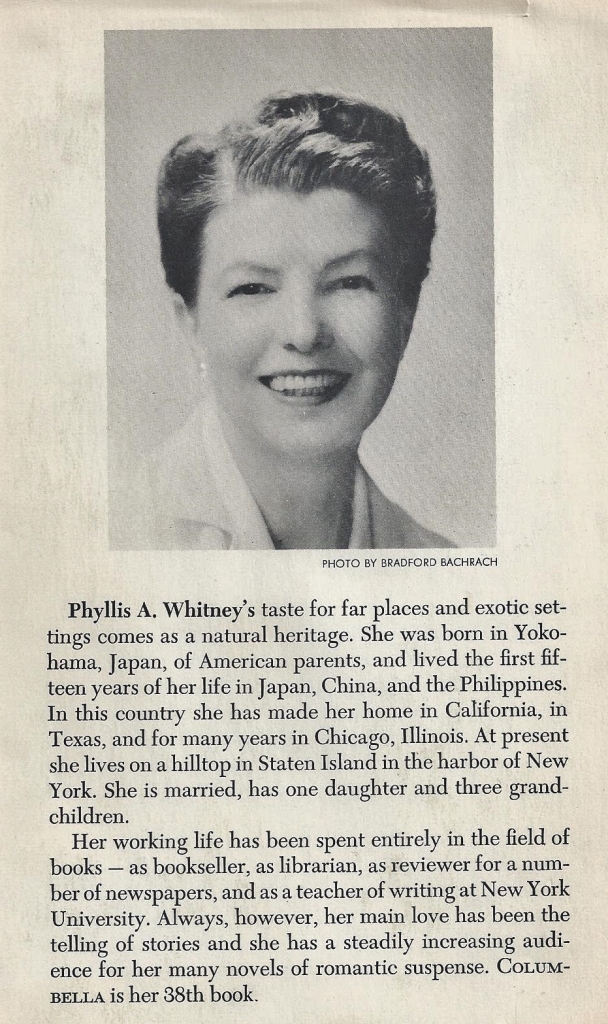
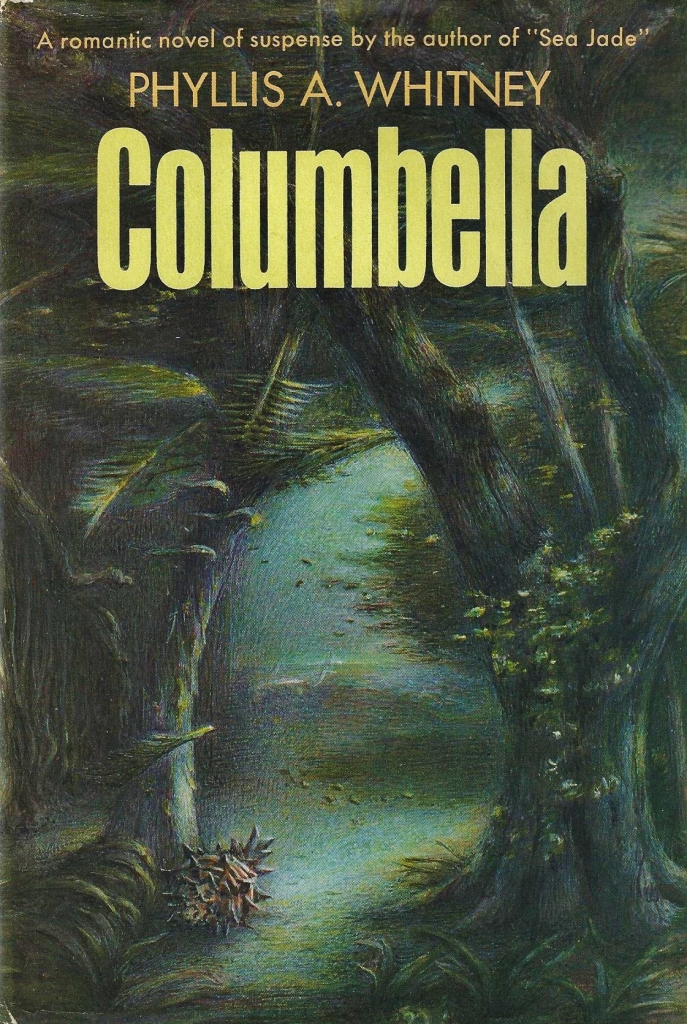
columbella phyllis a whitney 001Columbella by Phyllis A. Whitney ~ 1966. This edition: Doubleday, 1966. Hardcover. 246 pages.

My rating: 3/10

Oh, why did I read this? It was so disappointing. And I have had prior experience with this author – see here  – and went in fully cognizant of what I was about to experience. All I can say then is that hope springs eternal. And that my hope was dashed. Oh, woe!

But don’t you like the mysterious cover illustration, and doesn’t this flyleaf blurb sound promising, for a lightly diverting romantic-suspense thriller type thing?

That was a night of gold and red, with torches flaming on the hilltop and the lights of Charlotte Amalie fanning out around the harbor below. A night of water lily and sweet-smelling cereus. The night of the shell…

Jessica Abbott, fleeing her own past, finds herself the center of a whirlpool of conflict at Hampden House, high on its cliff in the Virgin Islands. She is confronted by Catherine Drew, a woman whose sole purpose is to torment and destroy. Catherine is the wife of a vital, driven man, Kingdon Drew-toward whom Jessica is irresistible drawn. Jessica must defy the beautiful, self-indulgent Catherine, who likes to affect the name of a shell – Columbella. She must fight for the very future of another woman’s child. Above all, she must find the strength to help the man she loves escape the trap Catherine has set for him. Yet each day Catherine seems to mock her in a new way – and win. Until the night of the shell…

Always, the brilliant island sun shines over Hampden House in St. Thomas and over Caprice, the plantation in St. Croix that is crumbling to eerie ruin, guarded by its unicorns. Always the threat of a hurricane looms over this exotic setting, where the past still affects the present.

So. Our lovely heroine Jessica has just lost her own sweet-faced, soft-voiced, utterly poisonous, insidiously controlling mother, and she is seeking to escape her own demons by taking on the role of companion-governess to yet another emotionally-abused girl, the teenage daughter of an architect and the aforementioned Catherine. Jessica falls in love with the hunky, broody Kingdon at first sight, and he himself is overcome with passion for her, which he manfully tamps down until it breaks free of its straining bonds. Lots of scenes of overt jealousy (on Catherine’s part) and apparent dislike (on Kingdon’s part only, for Jessica openly fawns on her employer from the get go) before the two lovers fall into each other’s arms. But there is still that pesky wife…

The final solution is of course a convenient demise – poor Catherine-Columbella! With Kingdon as main suspect, but of course he gets off the hook, thanks to a convenient confession by the true killer, who then is dealt with by the Hand of God (tree falling in a storm, crushing said murderer) and allowing everything to Work Out For The Best.

The best bits in the book were in the details. The setting, St. Thomas in the Virgin Islands, is enthusiastically described, and there are nice touches of verisimilitude in the discussion of the shell-collecting business and the preparation of the specimens for sale.

But the scenarios and the characters – wow! Can something be described as both flat and melodramatic at the same time? If so, our writer has pulled it off. And the passion between Kingdon and Jessica was blush-inducing indeed, but not because of its explicit nature. No, because it was so agonizingly clichéd. I was embarrassed at myself for willingly reading such schlock.

I want to like Phyllis Whitney so very, very much. She has such a promising back story as a writer, and she very obviously goes about her stuff with the best will in the world. She was a bestselling writer in her time, and much beloved by her devoted readers. So I may continue in my occasional investigations of her oeuvre, hoping to find a semi-precious gem or two amidst the very prolific sparkly bits of her vast body of work.

phyllis a whitney bio back dj columbella 001

Read Full Post »

And the last late reviews from February of 2013.

*****

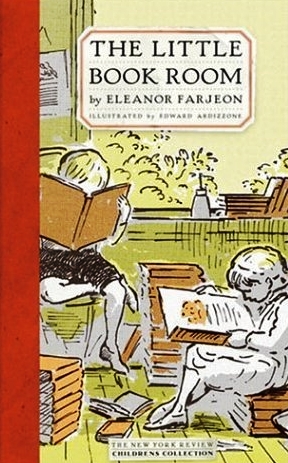
the little bookroom eleanor farjeonThe Little Bookroom by Eleanor Farjeon ~ 1955

This edition: New York Review Books, 2003. Hardcover. ISBN: 978-1-590170-489. 336 pages.

My rating: 8/10

A collection of twenty-seven delicately written fairy tales. Aimed at the younger crowd, but possibly more suited to real appreciation by adults. A few are slight, gentle and – in the very best sense of the word – childish, but others are rich in their imagery and complexity. The stories were selected by Eleanor Farjeon herself, and are deliciously and perfectly illustrated by the one and only Edward Ardizzone. Rumer Godden’s Afterword is a lovingly worded compliment to the author.

My own pretty well grown children are sadly long past the stage of being read to, but I am keeping this one close by both for personal pleasure and perhaps to one day share with as yet theoretical grandchildren.

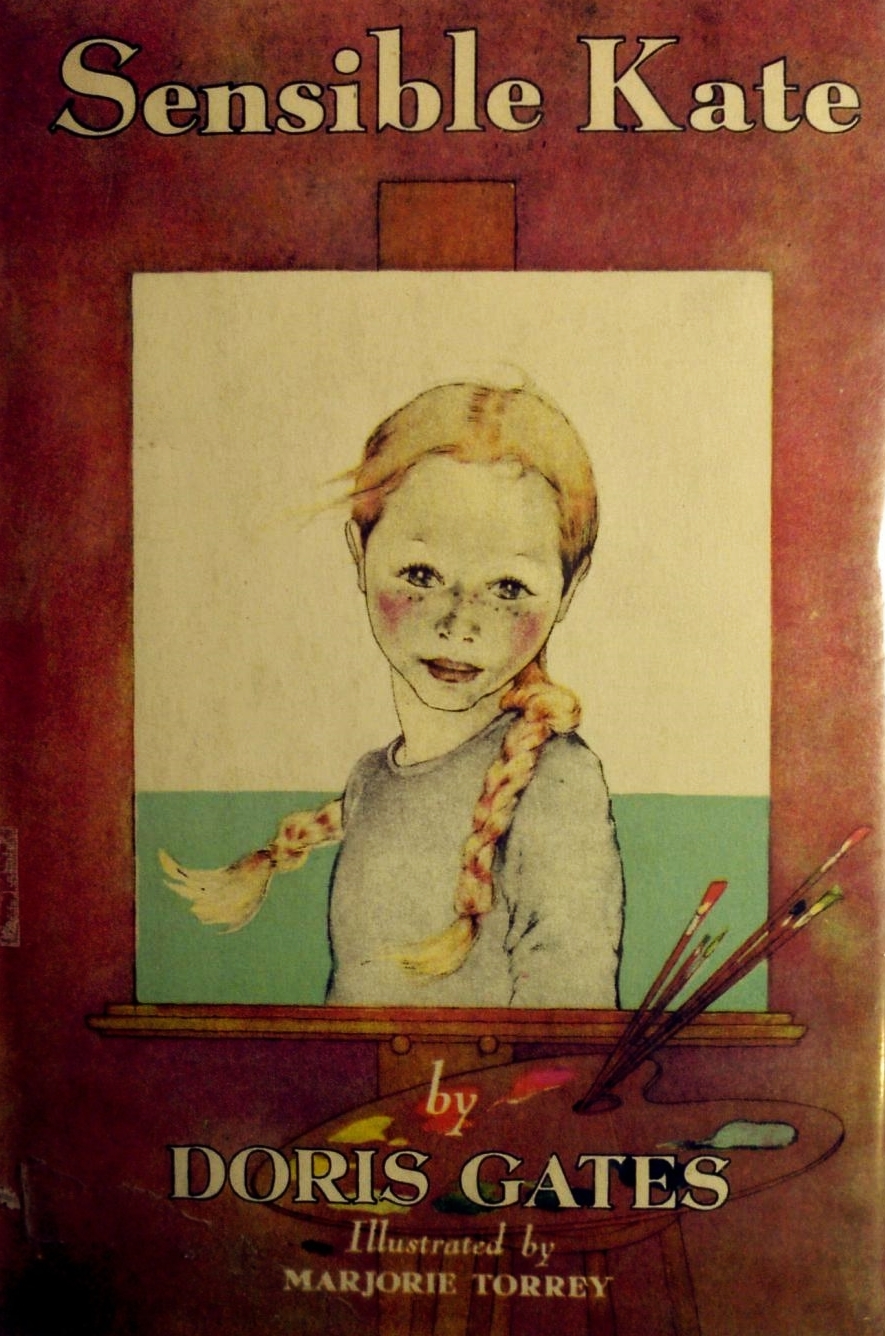
sensible kate doris gatesSensible Kate by Doris Gates ~ 1943

This edition: Viking Press, 1969. Hardcover. 189 pages.

My rating: 6/10

Doris Gates is perhaps best known for her Newbery Award runner-up children’s novel Blue Willow, as well as the widely read Little Vic, both viewed as important early examples of “realistic problem fiction” for young readers, not a genre I am particularly fond of as a rule, but which is perfectly acceptable when the characters and their story are over-emphasized over the “problem”. Doris Gates gets a pass; these are “real” novels no matter how they’re categorized.

Sensible Kate was Gates’ third novel, and it is a pleasant example of children’s literature of its era, with the young heroine facing her rather daunting challenges with good expectations of positive outcomes. The Kate of the novel is a likeable girl, flawed enough to be realistic, but with a solid core of goodness which makes her most appealing.

Kate has been an orphan as long as she can remember, and has been cared for by various “shiftless” relatives since babyhood. Now the relatives have decided to move out of the state, and they have decided to turn Kate over to the county relief office. Kate is placed as a foster child with an elderly couple, The Tuttles, and she soon makes herself beloved of them and many others whom she meets, including a young married couple, both artists, who are the very reverse of sensible in their daily affairs, and who are most appreciative of Kate’s practical talents.

A sweet but never saccharine story, with some interesting characters and scenarios which lift it a little over the average for its vintage and genre. Possibly one might pick up on the lightest shade of Anne of Green Gables, what with the red-haired heroine being an orphan and going off to live with an elderly couple, but the parallel ends right there. Kate is most certainly no Anne, and her creator has not attempted to model her so.

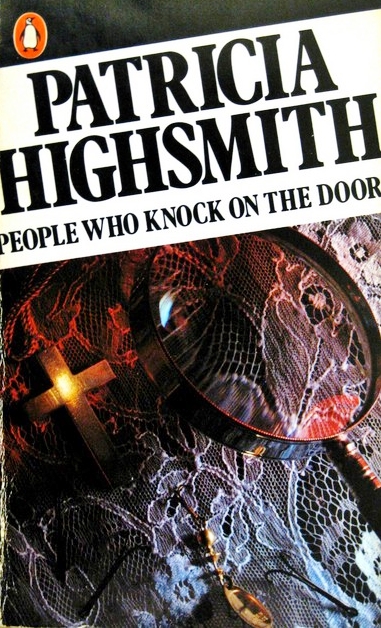
people who knock on the door patricia highsmithPeople Who Knock on the Door by Patricia Highsmith ~ 1983

This edition: Penguin, 1983. Paperback. ISBN: 0-14-006741-8. 356 pages.

My rating: 6.5/10

A rather unusual book, a noir almost-thriller with some odd twists, including a subplot involving a teenage girl’s abortion. Despite its date of publication, it seems to be set in the 1950s, and has a decidedly vintage feel to it. This is the first Patricia Highsmith book I’ve ever read, though I’ve seen several of the movie adaptations of her work, Hitchcock’s Strangers on a Train, and of course the Venetian-set Talented Mr. Ripley, so the dark psychological elements in this one came as no surprise.

Here we have a normal middle-class family, the Aldermans, with an insurance-salesman father, stay-at-home mother volunteering a few days a week at a children’s hospital, and teenagers Arthur and younger Robbie. Arthur is getting ready to go to college, has a satisfactorily active love life, and he is poised to get on with his life when his whole world takes a sickening lurch.

Robbie falls ill with a mysterious infection and is suddenly on the verge of death. The doctors turn away in dismissal – the boy is going to die –  but Mr. Armstrong refuses to give up hope, and prays diligently to God for a miracle. Robbie recovers, and the previously un-religious father is so moved by the experience that he embraces religion and joins a highly evangelistic Christian sect. Mrs. Armstrong and Arthur view this at first with mildly perturbed eyes, but Robbie fully embraces his father’s new-found faith, with eventual horrifying consequences.

A can’t-look-away, exceedingly uncomfortable depiction of a dysfunctional family and its twisted disintegration, with none of the characters completely faultless, including our pseudo-hero Arthur, the closest thing to a chief protagonist in this tense tale.

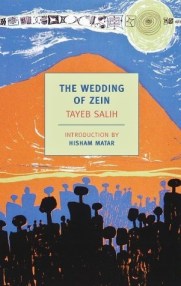
 the wedding of zein tayeb salihThe Wedding of Zein by Tayeb Salih ~ 1968

This edition: New York Review Books, 2009. Softcover. ISBN: 978-1-59017-342-8. 120 pages.

My rating: 7/10

Two short stories and a short novella – the title story – by the late Sudanese writer Tayeb Salih, set in the country around the northern Nile .

The Doum Tree of Wad Hamid speaks to the importance of tradition, and to the quiet resistance of the people of the Sudanese country to outside influences.

A Handful of Dates concerns a young boy who becomes aware for the first time of the realities of rich and poor, and the role his grandfather has played in a neighbour losing his inheritance.

The Wedding of Zein concerns an unlikely hero, a physically deformed “village idiot” (for want of a better term), who insistently falls in love with one after another village maiden, only to be disappointed as they always marry someone else. Imagine then the shock of everyone when it is announced that Zein has at last found a prospective wife, and an unexpectedly wise and beautiful one at that.

This book gives a diverting glimpse into an unfamiliar world, and the stories are told with clarity and understated, rather sly humour. A short but worthwhile collection.

Read Full Post »

Looking back at my list of books read, February 2013 was obviously a good month for hitting the books, but not quite so good for writing reviews. Playing catch-up, then with a series of short impressions of things I read 9 months or so ago.

In approximate order of reading, here are some of the books not previously reviewed from February of 2013.

*****

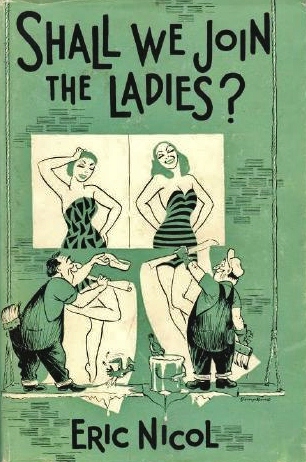
shall we join the ladies eric nicolShall We Join the Ladies? by Eric Nicol ~ 1955

This edition: Ryerson Press, 1965. Hardcover. 110 pages.

My rating: 5/10

I suspect I was sated with Nicol’s particular brand of humour when I read this one immediately after an old favourite, Nicol’s first collection of essays, The Roving I. For I recollect that I was not terribly amused. The mood was hectic, the punchlines groan-inducing. Vintage humour, turned a bit “off” after years of shelf life, perhaps?

A keeper, because it has its moments, and it is Eric Nicol, but not one I am eager to re-read any time soon. Contemporary readers thought much more highly of it, and it won the Leacock Award in 1956.

Canus Humorous thought it was a gem, and I recommend a look at this link if you’d like more detail. Such a thoughtful review that I feel immediately guilty for my faint enthusiasm. I promise I’ll revisit this one and do it more justice. Some day.
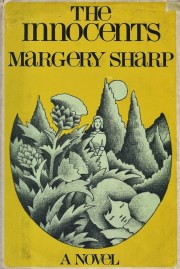
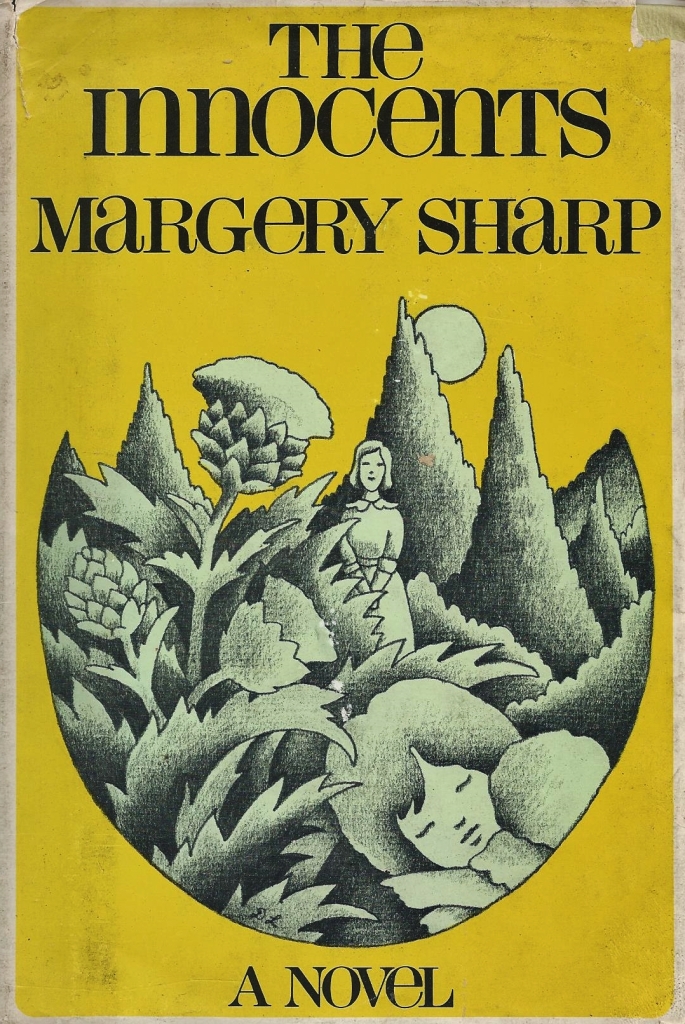
the innocents margery sharp 001The Innocents by Margery Sharp ~ 1972

This edition: Little, Brown & Co., 1972. Hardcover. 183 pages.

My rating: 11/10. I think this may well be my very favourite Margery Sharp, and, as you all may have guessed by now, I am seriously enthusiastic about this author to start with.

This was my second time reading The Innocents; I will be rationing myself to revisiting it, oh, maybe once a year or so, because I don’t want to wear out its already special status in my favourites list. For all of that enthusiasm, this is a very quiet book, one of those minor tales concerning a few people only, with nothing terribly exciting going on within it. But it is a compelling read, and I was completely on the side of the angels right from the get go, though fully cognizant of their failings.

In brief, then.

A middle-aged spinster living in a quiet English village is visited by a younger friend who has married very well indeed, and who is now living in America. It is immediately pre-WW II, and the married couple are hoping to squeeze in a Continental holiday before things cut loose. They are also travelling with their small child, and the unstated purpose of the visit-to-an-old-friend soon becomes clear: they are hoping that they can leave the child in the peace of the country while they continue on their tour.

All is arranged, and spinster and child settle in to a peaceful routine, which quietly turns into a longer-term arrangement as war intervenes and the parents return to America without stopping to collect their child.

Here’s the hook. The young child is very obviously mentally retarded, and though the father suspects this, the beautiful and vivacious mother refuses to even consider that her offspring may be in any way “sub normal”. The child and her caregiver form a deep and complex bond in the ensuing years before the now-widowed mother returns to collect her daughter and return with her to America, to launch into society, as it were, as a charming sidekick to her fashionable mother.

The reality is much different than the dream, and the subsequent events are absolutely heart-rending. The author lets us all suffer along with the brutally dazed child until bringing things to a rather shocking conclusion, which she has already told us about on the very first page.

Margery Sharp is at her caustic best in this late novel. Loved it. A longer review shall one day follow, full of excerpts and much more detail.
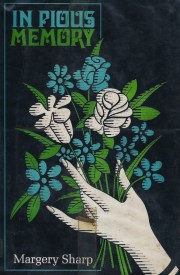
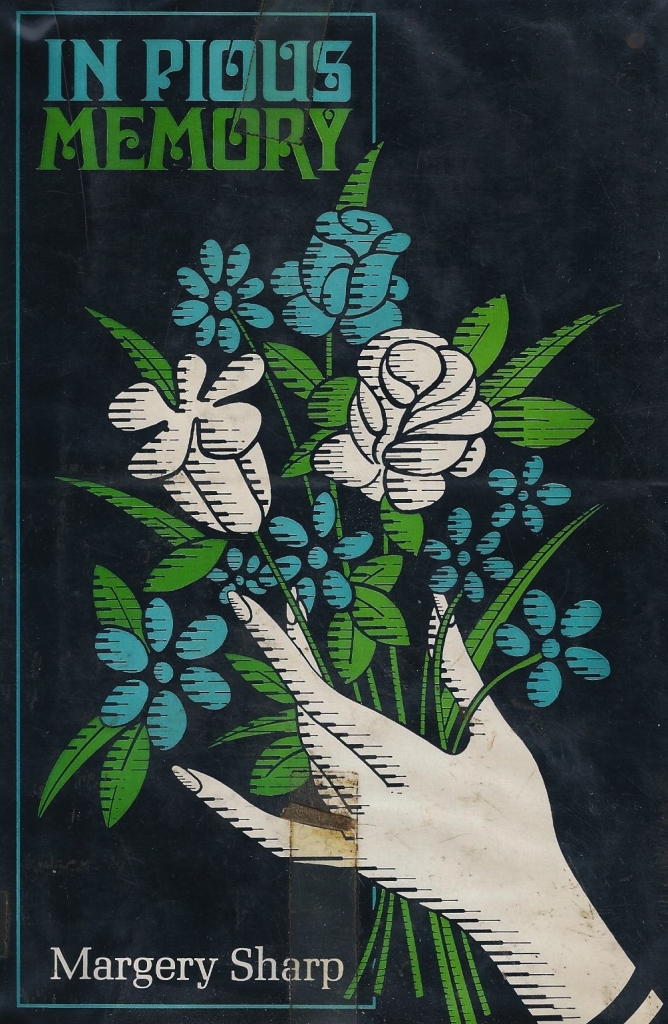
in pious memory margery sharp 001In Pious Memory by Margery Sharp ~ 1967

This edition: Little, Brown & Co., 1967. Hardcover. 184 pages.

My rating: 5/10

Well, then I went on to this slightly earlier novel, and of course it couldn’t even begin to stand up to The Innocents.

An out-and-out farce, this one. Mr. and Mrs. Prelude are in a plane crash in the Swiss Alps, and while Mrs. Prelude escapes relatively unharmed, Mr. Prelude perishes. Or does he? On her return to England, Mrs. Prelude begins to second-guess her hasty identification of what she now isn’t quite sure were her husband’s mortal remains. Sixteen-year-old Lydia sets out on a quest to find her father. Much hilarity ensues.

The whole thing fell rather flat. It seemed forced, and needlessly frenetic, and Margery Sharp’s sly innuendo just plain annoyed me this time around. To be fair, I will be re-reading this one in future, and may then possibly view it with less jaded eyes. I must say that it reminded me strongly of Dodie Smith’s The New Moon with the Old, and my reaction was much the same: reluctant amusement tinged with distaste for the general tone.
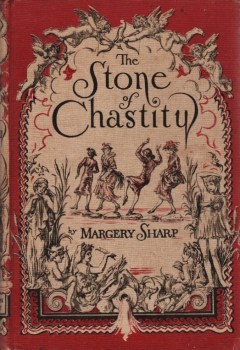
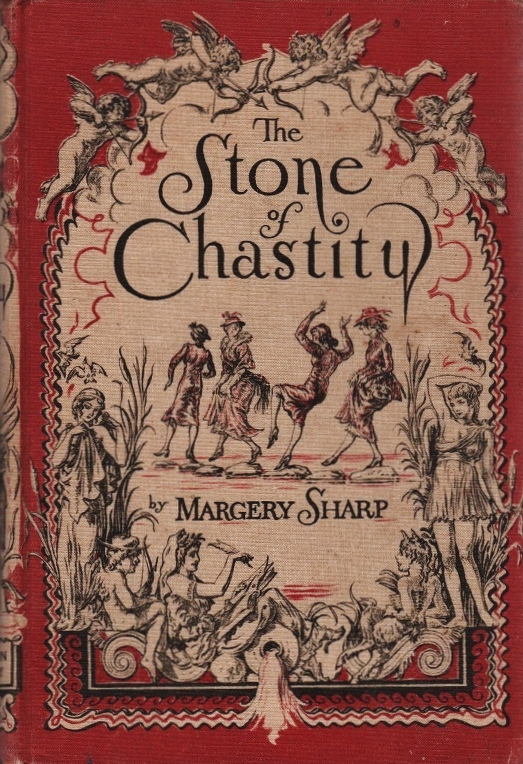
the stone of chastity margery sharpThe Stone of Chastity by Margery Sharp ~ 1940

This edition: The World Publishing Co., 1945. Hardcover. 280 pages.

My rating: 6.5/10

Now going back a few decades, to 1940, and Margery Sharp’s ninth novel, this one pure farce.

In the small gun-room, temporarily converted into a study, Professor Isaac Pounce was even then completing his questionnaire (later to be circulated through the unsuspecting village of Gillenham) on the subject of Chastity…

Professor Pounce is hot on the track of a piece of English folklore. He is looking for a mythical stepping stone which, when trod upon by female persons, will unfailingly support the virgins and toss off the unchaste ignominiously into the gurgling stream. Having a very good idea of where the stone might be, Professor Pounce’s first step in this very scientific study is to send his nephew Nicholas out with a questionnaire to all of the likely young village maidens. Confusion ensues as the rural rustics turn against the snoopy visitors in the Old Manor.

Another one due for a re-read, to savour the full flavour of what Margery Sharp has assembled here. She’s in fine form throughout, and the thing is most readable, though I felt that it wasn’t altogether convincing, even allowing for its obviously satirical intention.

Another snippet, to give you a taste of the flavour of the narrative within:

On the first floor Mrs. Pounce, mother to Nicholas and sister-in-law to the Professor, was lurking in her bedroom afraid to come out. She had appeared at lunch wearing a very nice necklace of scarabs and enamel, and the Professor, cocking an interested eye, had remarked that it was just such trifles – the sight of an English gentlewoman ornamented with seven phallic symbols – that made life so perennially interesting to the folklorist. Mrs. Pounce did not know what a phallic symbol was, and instinct (or perhaps a look in her son’s eye) prevented her asking; but after coffee she quietly sought out a dictionary and took it upstairs. At the moment she was feeling she could never come down again.
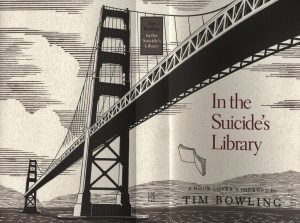
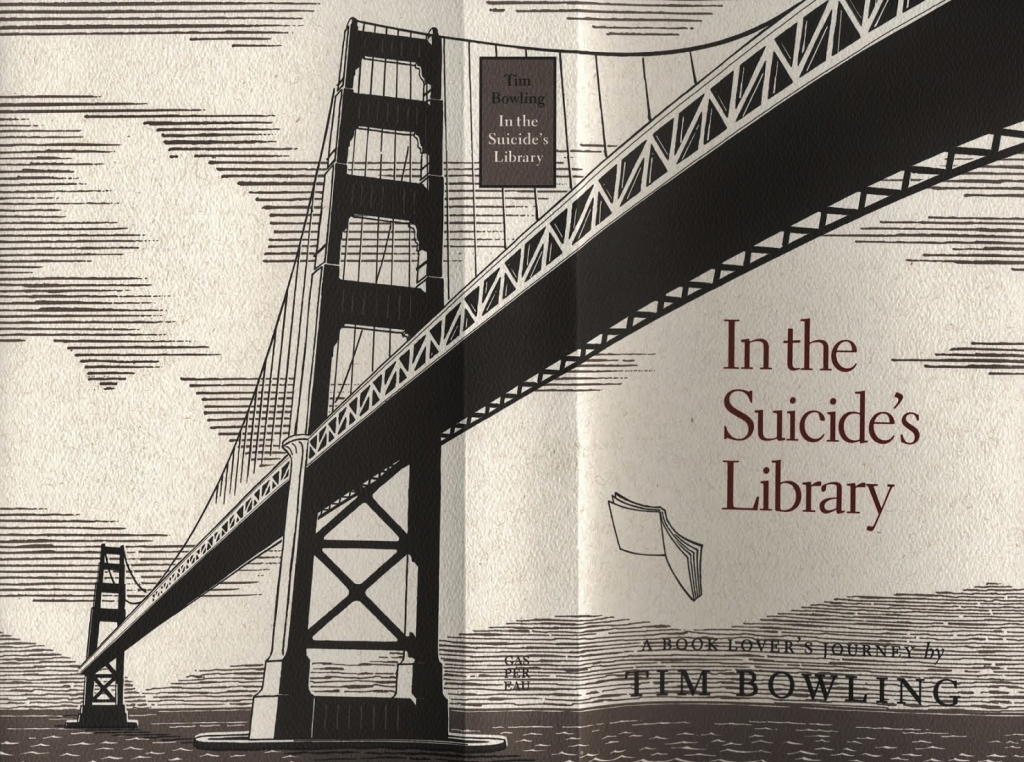
i the suicide's library tim bowling jacketIn the Suicide’s Library by Tim Bowling ~ 2004

This edition: Gaspereau Press, 2010. Softcover.  ISBN: 1-55447-089-7. 320 pages.

My rating: 7/10

And now, changing gears completely to something much more consciously literary.

Is it ever right to steal a book? Tim Bowling, Canadian poet, browsing a university library collection, stumbles upon a copy of poet Wallace Steven’s Ideas of Order, signed on the flyleaf by yet another poet, Weldon Kees, who disappeared mysteriously one day in 1955, with evidence suggesting his suicide by jumping of San Francisco’s Golden Gate Bridge.

As Tim Bowling allows his collector’s lust to suggest certain possibilities to him – would anyone even notice if he “liberated” such a poet’s treasure from its dusty obscurity in the stacks? – his renewed interest in both Wallace Stevens and Weldon Kees leads into a book-length examination of his own life, and the parallels between himself and his predecessors.

The angst of middle age, marriage and parenting are discussed with passionate intensity, as are such things as the relevance of poetry in the world, the desire to own objects, the new importance of the internet to the serious book collector, and much, much more.

Absolutely fascinating, but it does go on and on and on, and I absolutely hated Bowling’s final decision regarding the book, which I cannot share here, as it is the whole point of working through this thing. It made me grumpy for days, and still offends me to think about it.

Has anyone else read this one? What did you think he should have done?

And I must say that this has to be one of the most aesthetically pleasing of the contemporary books I personally own; Gaspereau Press did a fabulous job of the actual production of the physical book. The paper, the fonts, the slipcover and the undercover and the graphic design – absolutely perfect.

Read Full Post »
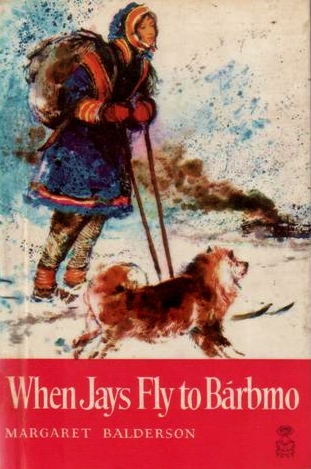
when jays fly to barbmo margaret baldersonWhen Jays Fly to Bárbmo by Margaret Balderson ~ 1968. This edition: Oxford University Press, 1970. Softcover. ISBN: 19-272010-4. 220 pages.

My rating: 8.5/10

Bárbmo is the mystical place in Lapland folklore where the migrating birds fly away to; some never go there, like the jays. The riddle of the intriguing title is made clear in the final pages of this engrossing historical fiction novel.

Fourteen-year-old Ingeborg lives on the remote Norwegian island of Draugoy, where her family household, consisting of her widowed father, an aunt, and elderly hired help Per (an obviously troubled man with a mysterious past), eke out a precarious but modestly comfortable living through farming and fishing. But even their small and isolated society is about to feel the effects of events in the greater world. It is 1940, and Hitler’s troops are advancing through Europe and into neutral Norway, with an aim to annex Norway’s ice-free shipping ports and to ensure crucial supplies of iron ore from Sweden which was handled through the Norwegian shipping system.

Norway falls under German control without much resistance; the royal family and the government escape to England to form a government-in-exile for the next five years; thousands of young Norwegian men begin to filter out of their homeland to train with Allied forces in other parts of Europe, and in Scotland and England; and as the years turn over even the farthest settlements are occupied by troops of the Wehrmacht.

This is the greater historical background to Ingeborg’s story, and against it the more detailed personal events of the novel take place. Our young heroine struggles with her place in her family, fiercely resenting her aunt’s attempts at turning her into a “proper” Norwegian housewife; Ingeborg would rather be out roaming the woods with her dog Benne, or out in the barn with the animals, or sitting with Per and badgering him for tales of his travels. Her father treats her with deep love but yet with a patronizing attitude, never letting Ingeborg forget that she will never be a part of his man’s world. He refuses to discuss her mother with her; there is some great mystery there which all of the adults skirt meticulously around, as if protecting Ingeborg from something which will harm her.

Being a properly traditional bildungsroman, Ingeborg tenaciously discovers the secrets of her origin. She faces and overcomes the loss of everything she holds dear, and in the end discovers who she really is and where she really belongs.

This novel is short and aimed at a juvenile audience, so by necessity glosses over large periods of time and merely hints at some events, but the author pauses at perfectly timed intervals to go into the exquisite details of Ingeborg’s inner and outer lives; the novel is beautifully written. The horrors of war are unflinchingly discussed; the evils of the Nazi regime and the atrocities surrounding the scorched earth policy of the retreat from northern Norway are tellingly depicted.

If there is any weakness to this story, it is that the realities spoken of – the historical facts – are so brutal as to be almost unbelievable, making accompanying research a necessity – heads up to those using this novel as part of a social studies/history curriculum.  Some details of the story are also perhaps a bit too lightly touched on, but appropriately so for the intended youthful audience.

But don’t overdo the background research; let the story tell itself, because it is first and foremost just that, a personal story of a quest for self-understanding. The dramatic events which unfold are viewed through a single set of eyes, that of the young narrator.

The seasons of the Scandinavian northland, the months without sun, the joy of returning daylight, the nomadic travels of the reindeer-herding Laplanders and their yearly brief relationship with the farmers and fishermen of the summer ranges are all wonderfully depicted.

This novel received the Children’s Book of the Year Award in 1969 in the author’s native Australia, and was a runner-up for the UK’s 1968 Carnegie Medal. It is also something of a one-of for the author. From the quality of the writing I had hoped to find some similar later works, but nothing comes to light except for a few light fictions for younger children published in the early 1970s.

A snippet of biography found online explains the author’s familiarity with the setting of her story, and her obvious passion for the sharing of the brutal experiences of the rural Norwegians during the German occupation.

Australian children’s book author Margaret Balderson first made a name for herself with When Jays Fly to Bárbmo, a coming-of-age story about Ingeborg, a Norwegian girl who experiences the German invasion of Norway during World War II. The fear of invasion, and then its traumatic reality, provoke the young woman into a soul-searching quest to validate her own personal identity. This debut novel won awards across the English-speaking world.

Balderson was born and raised in Australia, but in 1963 she left for Europe. She settled for two years in Norway, where she worked in the winters and explored the countryside in the brief northern summers. In the Arctic nation, according to Twentieth-Century Children’s Writers contributor H. M. Saxby, “she experienced in a deeply personal way the innate rhythms of that land as expressed through its seasons. In particular, the Dark Time of the long Arctic winter became for her symbolic of an oppression of spirit which evaporates with the miracle of each spring.” Balderson’s experience of that cycle is reflected in Ingeborg’s life, as she passes through the darkness of living under occupation and emerges into freedom and adulthood.

A grand example of a “living book” which will be of interest to homeschool families and history teachers. I would say that it is suitable for ages 10 or so to adult. Highly recommended.

My edition is the OUP softcover, published in 1970, and it is graced by a wonderful cover illustration by one of my very favourite literary artists, Victor Ambrus. The first chapter heading is also illustrated, but sadly the rest of the volume is without decoration. I wonder if the original edition has more pictures? If so, I would love to get my hands on one…

Read Full Post »

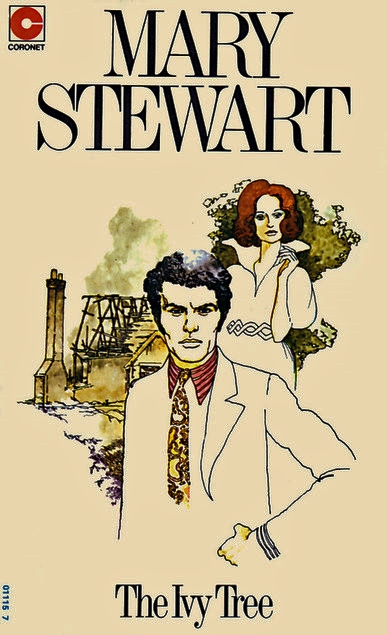
the ivy tree mary stewartThe Ivy Tree by Mary Stewart ~ 1961. This edition: Coronet, 1975. Paperback. ISBN: 0-340-01115-7 319 pages.

My rating: 7.5/10

This was my third Mary Stewart romantic thriller read in the last few weeks, and it was perhaps my favourite to date. Where This Rough Magic (1964) was set in exotic Corfu and referenced the English theatre world, Shakespeare’s Tempest, Communist politics in Albania, and a passionately fast-developing love affair between the heroine and a brooding hero-type, and Airs Above the Ground (1965) was set in the Austrian Alps and concerned itself with a complicated plot involving a happily married heroine, her two male companions, and a group of circus performers, The Ivy Tree is a much more sedate and personality driven story, and much more concerned with psychology rather than straight-out action as in the other two tales.

In this tale of family and inheritance and underhand plotting, the reader is never quite sure who is telling the truth, and what is really going on. The threads of the story wind about this way and that until the tapestry takes shape and the true picture emerges near the end. Told (as are the other two stories) in first person narration by the key female character, we are not quite sure if she is indeed the heroine in the accepted sense, for her actions are unreliable and her inner dialogue frequently less than frank with the reader. And though there were occasional credibility gaps in this story – as in the others – by and large it was an intriguingly detailed mystery.

Here is the basic plot outline, from the flyleaf of a 1962 edition:

Mary Grey had come from Canada to the land of her forebears: Northumberland, where Hadrian built his wall nearly 2000 years ago. As she leaned against the sun-warmed stones, savoring the ordered, spare beauty of England’s northern fells, the silence was shattered by a single name hurled, as it were, like an epithet:

“ANNABEL!”

And there stood one of the angriest, most threatening  young men Mary had ever seen. His name was Connor Winslow, and from his spate of words Mary discovered that he thought she was his cousin–a girl supposedly dead these past eight years. Alive, she would be heiress to an inheritance Con determined to have for himself…

Thus begins the story of an impersonation fraught with the perils of treading present depths without the buoyancy of an innocent past. To it, Mrs. Stewart brings her remarkable ability to create atmosphere be it joyous, brooding, or terrifying. And with her acknowledged talent for characterization, she delineates sharply the savage, ruthless, half-sardonical Con; his drab half-sister, Lisa, firm only in her dedication to Con and his wishes; arrogant Matthew Windlow, a failing tyrant, by tyrant nonetheless where his family was concerned; the ebullient, sometimes rebellious Cousin Julie; and Adam Forrest, the reserved owner of neighboring Forrest Hall,  now a widower, but eight years before, inextricably tied to a hysterical, neurotic wife and tormented by his love for Annabel.

With admirable skill, Mary Stewart practices the full scale of uncertainty while developing a theme embellished with the rich overtones of atmosphere and characterization.

That’s the basic outline, but the story itself is even more complex than this summary would indicate. Though some of the characters – including the true love interest of the heroine – never received much more than a superficial characterization, many of the others were nicely portrayed, showing realistic complexities of good and bad, and delving into motivations, and justifying contradictory behaviours in a most believable way.

Josephine Tey’s Brat Farrar was an obvious inspiration, and the author openly acknowledges that, giving the novel to her characters as a guidebook to their own planned deception; I enjoyed the parallels, as Brat Farrar is one of my favourite Teys (if there can be such a thing – I do love every single one of Josephine Tey’s too-few novels), and Stewart’s take-off of it was different enough to hold my interest.

I won’t say much else; this is a novel that rewards coming to it without too much foreknowledge of the crucial details of the plot.

The “what bugged me” bits were similar to the other Mary Stewarts I’ve just read: a too-convenient disposal of the “bad” character(s), with a rather too-rushed and too-neat conclusion. There were some fairly major holes in the story, and readerly questions left unanswered; I am thinking that one must just put up with this tendency of the author’s and enjoy the enjoyable bits regardless, but it does stop me from rating the books higher on my personal scale.

Last thought: well done. I will be reading this one again; I enjoyed it.

The Ivy Tree was read and reviewed for Mary Stewart Reading Week , September 15th to 21st, celebrating the author’s long career and her 97th birthday on September 17th, 2013. Mary Stewart Reading Week was initiated and hosted by Gudrun’s Tights.

Read Full Post »

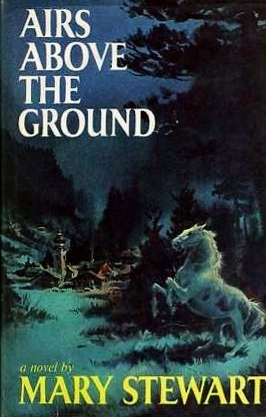
airs above the ground mary stewartAirs Above the Ground by Mary Stewart ~ 1965 . This edition: Mill-Morrow, 1965. Hardcover 286 pages.

My rating: 7/10

This was my second title tackled in honour of Mary Stewart Reading Week , September 15th to 21st, which celebrates the author’s long career and her 97th birthday on September 17th. (MSRW was conceived and hosted by Mary Stewart fan Anbolyn of the excellent book blog Gudrun’s Tights.)

Carmel Lacy is the silliest woman I know, which is saying a good deal. The only reason I was having tea with her at Harrods on that wet Thursday afternoon was that when she rang me up she had been so insistent that it had been impossible to get out of; and besides, I was so depressed anyway that even tea with Carmel Lacy was preferable to sitting alone at home in a room that still seemed to be echoing with that last quarrel with Lewis. That I had been entirely in the right, and that Lewis had been insufferably, immovably, furiously in the wrong was no particular satisfaction, since he was now in Stockholm, and I was still her in London, when by rights we should have been lying on a beach together in the Italian sunshine, enjoying the first summer holiday we had been able to plan together since our honeymoon two years ago. The fact that it had rained almost without ceasing ever since he had gone hadn’t done anything to mitigate his offense; and when, on looking up “Other People’s Weather” in the Guardian each morning, I found Stockholm enjoying a permanent state of sunshine, and temperatures somewhere in the seventies, I was easily able to ignore reports of a wet, thundery August in southern Italy and concentrate steadily on Lewis’s sins and my own grievances…

So when definitely-silly-but-self-indulgently-manipulative Carmel, scenting trouble in Vanessa’s married paradise, drops a seemingly casual comment that she has just seen Lewis in a newsreel clip about a tragic circus fire in Austria, Vanessa is completely floored – Lewis is supposed to be in Sweden, and she has a properly postmarked note from him to prove it, dated the same day as the Austrian incident. She manages to save face by some on-the-fly fabricating, and when Carmel asks Vanessa to accompany her (Carmel’s) nineteen-year-old son Timothy on a flight to Vienna to visit with his father – the Lacys are divorced and not really on speaking terms, hence the difficulties in arranging the travels of their son – Vanessa decides to go along with the plan to find out just what Lewis is up to. Particularly when her own covert perusal of that newsreel shot shows Lewis with his arm around a very beautiful young girl…

It just so happens that Timothy’s visit to his father is not as it seems either, and when he and Vanessa bury their initial resentment at being saddled with each other, they swap information and decide to team up in order to track down the errant Lewis, and allow Timothy to pursue his primary goal in visiting Austria, which is actually to gain an entry of some sort into the stable area of the famed Spanish Riding School. For Timothy is horse-mad, and longs to forge a career among the Lipizzaners, while Vanessa just happens to be a qualified veterinarian, spinning her wheels more than a bit as she has, in era-correct style, put her promising personal career on indefinite hold due to her marriage to the enigmatic, oft-travelling Lewis.

Vanessa and Timothy form one of the most downright adorable platonic couples I’ve come across in my many years of reading; Mary Stewart is on a decidedly playful roll in this novel as she sends them on their bantering way together.

We also have a small family circus full of accomplished artistes, some fabulous horsemen and horsewomen – one of whom happens to be the girl in the newsreel footage, bitter wartime and personal histories, tragedy, intrigue, romance, hidden identities, mysterious packages, jewels (or is that “jewels”?), large quantities of cocaine, brooding mysterious Eastern Europeans, beautiful (and valuable) horses, struggling aristocrats, amazing alpine scenery (described in long-winded detail by our author), a castle, a cog railway, close calls beyond count, threats and violence and brandished pistols and REVENGE. (Am I missing anything?!)

I truly loved most of this unlikely tale, and in particular the three-way relationship between Vanessa and her two male companions. I loved that the heroine was married, and that the mutual affection and physical attraction between her and her husband was portrayed in such a positive way, though I didn’t love the lack of spousal communication from Lewis’s end. But this was redeemed by Vanessa’s forthright dealing with the situations she found herself in, and her cool head and steady hand throughout.

I found myself completely bemused by Lewis’s actual occupation; I ended the story with a great big question mark floating up there in the air above my head, but I waved it away because by that time it didn’t really matter. There was a completely unlikely and over-the-top (pun intended) chase scene across castle rooftops, with the good characters escaping death by mere centimetres and the bad guys meeting their inevitable comeuppance. Oh, and a twist on the maiden-on-the-railway-track scenario, with a suitably last-moment rescue. The horse bits were reasonably well-written, though the Great Big Equine Secret was easy to guess and exceedingly improbable; my willing suspension of disbelief bobbled seriously around that bit, and, along with the rooftop chase scene, knocked my rating down a few points.

All in all, a very diverting vintage read, showing its age throughout, but enjoyable nevertheless. This one will stay on the shelf, though I suspect quite some time will pass before I feel the urge to read it again.

Read Full Post »

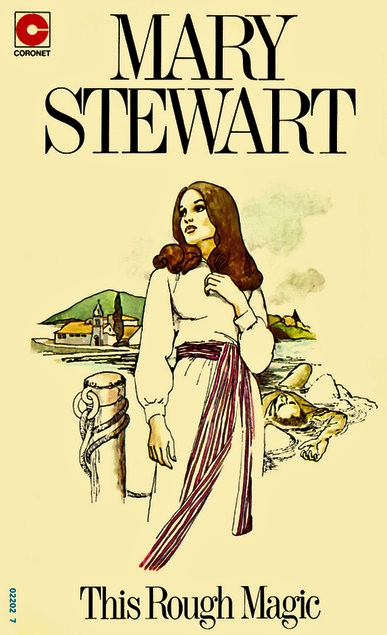
TThis Rough Magic Mary Stewart Coronet paperbackhis Rough Magic by Mary Stewart ~ 1964. This edition: Coronet, 1974. Paperback. ISBN: 0-340-02202-7. 255 pages.

My rating: 6/10

I haven’t read Mary Stewart for absolutely years and years, and now I remember why. This book was so full of action and plot twists that it was positively exhausting! In a mostly good way, but by golly, I had to pay attention.

I have collected a number of Mary Stewart novels in the past few years, as part of the personal circulating library I maintain and continually add to for my housebound elderly mother, but for some reason I have not dipped into them myself, perhaps because I rather overdid it on them in my teen years, and somehow felt I had moved on.

The Mary Stewart Reading Week , September 15th to 21st, celebrating the author’s long career and her 97th birthday which is actually today, September 17th, has been planned and hosted by a fellow book blogger whose site I greatly enjoy, Anbolyn of the intriguingly named Gudrun’s Tights. I share so many of the same tastes as Anbolyn, I was thereby moved to give Mary Stewart another go in honour of this occasion. I’ve just finished This Rough Magic, am well started on Airs Above the Ground (early impression – excellent – I’m really loving this one), and expect to tackle The Ivy Tree next, and possibly Touch Not the Cat, if I can squeeze it into my travelling bag. We’re about to head out on a week-long driving adventure in our very small vintage sports car, so paperbacks are the order of the day, and TNTC is a hefty hardcover, so it might not be allowed.

So here is a quick rundown on This Rough Magic. The clock is ticking loudly this morning, and I need to soon be up and away from the computer. so I’ll see if I can keep it short and to the point. (I do tend to run on…) My husband is in the kitchen making waffles, a special treat though a rather complicated production – he is skilled at a very few particular items, excellent waffles being one of them – but is not the most efficient of cooks, so I have a bit of time. Let’s see what I can do.

A not much more than mediocre London actress, our heroine and first person narrator, Lucy Waring, is “resting” at her wealthy-by-marriage older sister’s villa on the Greek Island of Corfu. Basking in the sunshine and catching up on news with her beloved sister (who is, incidentally, happily very pregnant with her third child), the sting of the ignominious ending of Lucy’s first big theatrical role is fading fast. And there is a lot to catch up on. A neighbouring villa is temporary home to a certain Godfrey Manning, a wealthy world traveller, author and photographer, who is writing a book about Corfu, while the venerable and famous Julian Gale, a noted Shakespearian actor, is reclusively resident in the rather derelict Castello dei Fiori, accompanied by his son Max, an accomplished composer.

The first inkling that there may be troublesome events brewing to disturb Lucy’s peaceful holiday is when she takes a solitary swim in the bay, and has an initially terrifying encounter with a people-friendly dolphin. She makes the shore, realizes that the dolphin is merely trying to play, and ventures back into the water with him, when her joy at the dolphin’s advances turn to horror as she realizes that someone is shooting at it with a silenced rifle. Catching a glimpse of a figure in the woods above the bay, she storms up to confront the suspected gunman, only to be rudely rebuffed by Max Gale. He denies any knowledge of any shooting, and sneers at Lucy’s allegations, accusing her of being overly dramatic. She comes away feeling that she’s come off poorly in the encounter, which is depressing as she greatly admires Max’s father, and had rather wanted any encounters with the Gale family to be good ones.

The next dramatic thing that happens is the tragic loss at sea of her sister’s maid’s twin brother while out on a nighttime sail with the enigmatic Godfrey Manning, followed soon after by Lucy’s shocking discovery of a drowned body, which she at first thinks is the brother, but who turns out to be a local fisherman rumoured to be involved in the local side industry of smuggling to the nearby closed Communist country of Albania.

Ah, yes, for this is the 1960s, and Communism and the Cold War are at their full-blown peak; something one has to remember when considering the following plot twists and turns.

Lucy tenaciously goes on her way familiarizing herself with Corfu and meeting the locals. She makes friends with Sir Julian, and is casually courted rather by the über-self-confident Godfrey, but does not seem to be making much headway with the glowering and still-hostile Max.

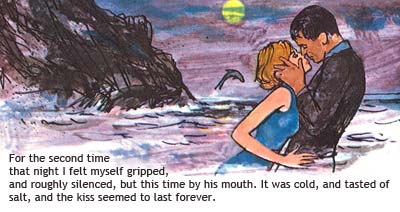
Until, that is, a midnight encounter involving the dolphin, a fabulous diamond ring, and a passionate embrace (page 101) while hip-deep in the phosphorescent sea. Now we’re cooking with gas, as the saying goes, and the action really picks up.

Smugglers, Communist spies, murderers, counterfeit money, mad motorcycle rides, burning kisses, and secrets galore are all involved from here on in; the ending is shockingly explosive (literally) while the heroes and heroines escape relatively unscathed and the bad guys are suitably knocked down to size.

Wow! That was exhausting just to read. <Fanning myself with book.>

But here’s the kicker. Did I really like this book?

Parts of it, definitely. I loved the author’s intelligence and the offhand way she assumes her readers are as literate as she is; continual snippets of quotation pop up both in the chapter headings and throughout the narrative; I caught some and suspect there were others that flew by me. I liked the heroine’s matter-of-fact assessment of her own skills as an actress, and her blunt description of her not-quite-stellar career; I enjoyed her voice for the early part of the story, before she became embroiled in the inevitable romantic entanglements later on.  I enjoyed many of the author’s descriptive passages; she very obviously has experienced and/or intimately researched her setting.

But other parts, particularly towards the end as the suspense builds, I don’t like so much. We can see the passionate response to the brooding mystery man coming from a long, long way away; methinks the lady falls too fast and too hard; her previous self-assessment and obvious sophistication in the ways of the world make her impulsive abandonment of good sense hard to stomach.

The action sequences I found to be overworked and more than slightly unbelievable; the dolphin bits as well as the motorcycle ride and the subsequent cat-and-mouse escapades with the murderous criminal mastermind of the slightly implausible mystery. The whole Tempest connection is overworked (in my opinion) and played out beyond its initial appeal as a clever “hook”. The aging actor’s save-the-day performance was absolutely no surprise to me at all; I suspect that this would pop up at some point, and by golly, how right I was. The convenient demise of the bad guy was too convenient, tidying things up just a bit too suddenly and, if I dare say, too appropriately. The God-like hand of the author is very evident in the dénouement; she might as well have tied a bow on this one; it was decidedly wrapped up at the end! The whole political element continued to confuse me even after I reread key points – such as they were – I felt that it was sketchy all the way through.

I did however enjoy reading the story; it helped a lot to have undertaken it as part of a participatory event, and I will be interested to read others’ thoughts on This Rough Magic, if anyone chooses to read it for the Mary Stewart Reading Week. (Returning to add that I see a few others have indeed done so – excellent!) The good bits were very good; the other bits were acceptable if viewed through “I’m reading a vintage book” lenses; I can see why Mary Stewart is beloved of so many readers, even though I cannot count myself among one of her true fans, at least not quite yet. I am looking forward to reading more of her titles; I feel, after reading This Rough Magic, that the author’s work has more to offer than it at first appears.

Onward then, to Airs Above the Ground, and The Ivy Tree, my other two Mary Stewart Reading Week choices.

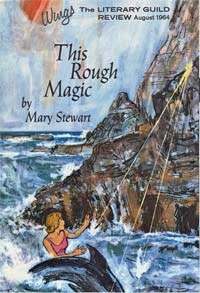
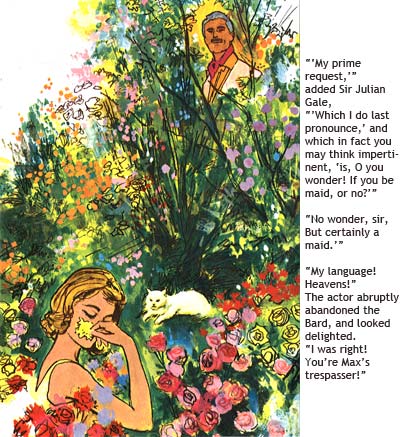
Oh – edited to add something – what a find! – several delicious illustrations from the Mary Stewart Novels BlogSpot. I found these when looking for an illustration of my particular copy’s cover; my book is who-knows-where, as I’ve been away from the computer and my desk for eight days, so I am trying to cheat on having to find it to scan it myself.

Enjoy!

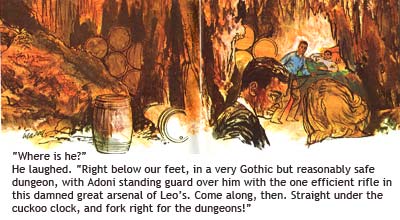
This Rough Magic Mary Stewart Illustration 1A Cover Literary Guild ReviewThis Rough Magic Mary Stewart Illustration 1This Rough Magic Mary Stewart Illustration 2This Rough Magic Mary Stewart Illustration 3

Read Full Post »

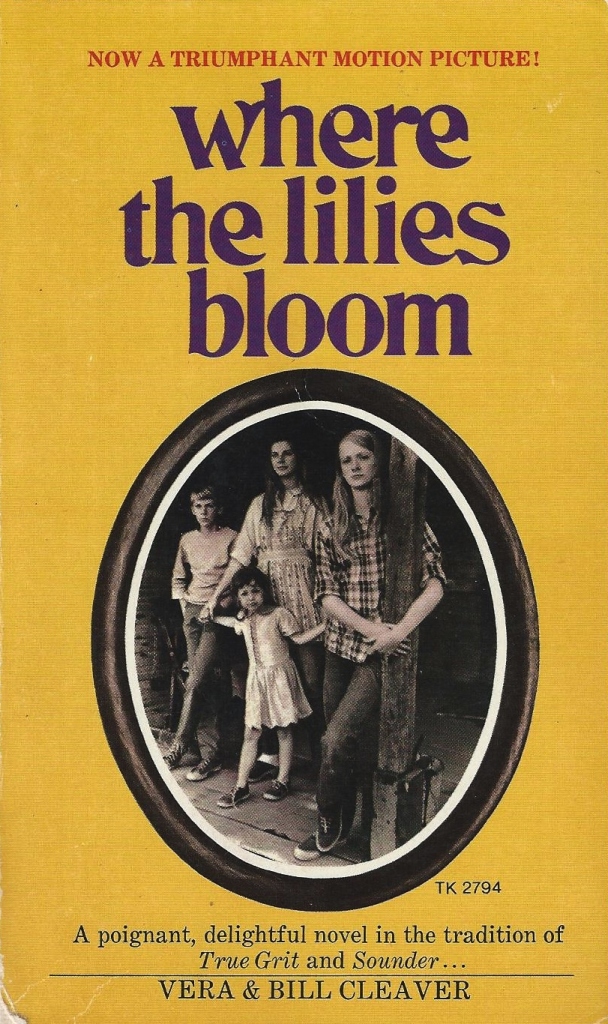
where the lilies bloom vera bill cleaver 001Where the Lilies Bloom by Vera and Bill Cleaver ~ 1969. This edition: Scholastic, 1974. Paperback. 175 pages.

My rating: Oh, gosh. This is a hard one. The writing is unique and enjoyable to read; the heroine’s voice is individualistic and uniquely portrayed. But the plot is where I held my head in agony. I get that this is a book aimed at the children’s/teens’ market, and therefore perhaps to be expected to be slightly simplified, but the plot was so full of holes that I kept stopping and going “What…???!!!” But the poignant bits were genuinely heartbreaking, and the story as a whole just might have happened. Just maybe…

Okay, I need to commit myself to a rating. How about an 8/10, with reservations. If a bit better developed and with more attention to plausibility, this one could well have been worth a 9 or even a 10 from me.

This is basically one of those bleak Appalachian stories all about abject poverty and fiercely stubborn people living in various degrees of squalor among fabulous natural beauty. And, predictably, we are taken behind the superficial vision of “dirty hillbillies” to see into the glorious nobility of the characters’ souls.

I am sincere in putting forth a rather cynical generalization of this type of fiction, which was abundant in the 1960s and 1970s, at least in the juvenile novels I was finding in my school library. There seemed to be a certain trend to showing all of the dreary details in kid-lit, with an amazingly strong hero, or, more frequently, a heroine, overcoming all sorts of obstacles and ending the book staring off into the gleaming sunrise (metaphorically speaking) of a better future. Hyper-realism combined with a fairytale ending. (“Did we play upon your deepest emotions, young reader? Well, here’s a nice resolution to make it all better.”) However, as the next development in youth fiction of the 1970s, 1980s and beyond was of brutally unrelieved bleak endings, I guess the “happy” fabrications are a mite easier to handle.

So here we have a family of five people living in a tired shack on twenty acres of share-cropped land in North Carolina’s Great Smoky Mountains. Widowed Roy Luther, patriarch of the family, is seriously ailing. About to die, in fact. Before he does, in a heart-rending episode, he makes his four children promise that they will bury him in a hand-dug grave, not inform anyone of his demise, and take care of each other. They are not to accept charity from anyone, and the eldest daughter, eighteen-year-old Devola, described as “cloudy-headed” (quite obviously mentally handicapped to a certain degree), beautiful in appearance and childishly happy in nature, is not to marry the wicked landlord, one Kiser Pease, who is actively pursuing her.

Fourteen-year-old Mary Call Luther is our narrator, and the heroine of this dramatic novel of survival.

Roy Luther has made me promise him some things:

When the time comes, which he hopes will be in his sleep, I am to let him go on as quietly as he can, without any wailing or fussing. I am not to call any doctor or allow anyone else to call one. If it happens at night I am to wait until morning before I tell the others: I am not to send for the preacher or undertaker. The preacher has a mighty voice in these mountains but he expects to be paid for his wisdom. And the undertaker, for all his hushed, liquid speakings of how paltry his tariff will be, can be ill-humoured and short-tempered when the time comes to divvy up as we found out in the case of Cosby Luther, my maternal parent, who died of the fever four years ago.

So it is that Roy Luther has requisitioned me to give him a simple, homemade burial when the time comes. After I am sure his heart and breathing have stopped, I am to wrap him in an old, clean sheet and take him to his final resting place, which will be within a stand of black spruce up on Old Joshua. We have not talked about how I am to get him there. Were you to ask Roy Luther it would shame him to have to say aloud that it will have to be in Romey’s wagon and he’d have to say what for me to do with the feet which will surely drag because the vehicle is but a toy.

Quite a charge for a fourteen-year-old; as Devola is incapable of taking charge, and the other children are even younger than Mary Call. Brother Romey is only ten, and smallest sister Ima Dean six.

From the tragedy of a slowly dying father, the story turns to farce with the discovery of Kiser Pease in a state of sickness alone in his house; the siblings decide to try some home remedies out on him, immersing him in a bathtub full of stewed onions to break his fever. Holding Kiser hostage in his weakened state, Mary Call forces him to sign a paper giving the Luthers the title to their farm, which he does with surprising meekness.

Roy Luther lingers on, and the children turn to wildcrafting to make grocery money.  Wildcrafting, for those unfamiliar with the concept, is the gathering of wild plants, generally for medicinal purposes. The Appalachians are a rich hunting ground for this purpose – ginseng, goldenseal, witch hazel and mayapple are just a few of the wild herbs fetching high prices at the drug store in the nearby settlement.

Roy dies and is buried by Mary and Romey in the most brutally poignant episode in this emotional little story; I swear a tear or two formed in my own eyes as I read this part. But the children soldier on, pretending to everyone that their father is still alive, and preparing as best they can for the fast-approaching cold time.

Disaster after disaster strikes the diminished family; winter is barely survived; but with spring a series of unlikely events brings a positive conclusion of sorts to this saga of endurance.

All in all, a decent enough fiction for the pre-teen to adult readership. Abandon your sense of disbelief at the first page, and just let yourself go; it’s the easiest way to get through this one, believe me.

If presenting this to your children as a novel study or social studies curriculum supplement, there are some truly interesting features in the story. The wildcrafting parts are based on fact, and would, to my mind, be the most valuable episodes to emphasize and research further. As for Appalachian life, I am of the opinion that this is a highly dramatized version. There is no real sense of a specific time period; one could assume the story is set in some time from the 1940s up until the 1950s or 60s. There is electricity, radios, freezers, cars, and tractors, but people are still farming with mules as well, and ignorance and superstition are rampant.

I have mixed feelings about this now-classic drama. Some parts are strong and beautifully written; other elements, such as the aforementioned shaky plotting, leave me at a complete loss.

I will be watching for other titles by this husband-and-wife team. I’ve recently read a later novel of theirs, Hazel Rye, and found it intriguing. Like Where the Lilies Bloom, a bit “light” despite the serious themes addressed, but with a certain charm and appeal, and containing passages that stay with one long after the book is reshelved.

Where the Lilies Bloom was also made into a movie in 1974, which I have not seen. The stills included in this copy of the novel show a rather inspired casting, going by appearances alone, though it appears that the movie plot differs somewhat from that of the book. The actress playing Mary Call Luther, Julie Gholson, looks perfect for her role, and the other children appear suitably cast as well. If you’ve seen this movie, or, better yet, read the story, I’d be interested in your own reactions.

Read Full Post »

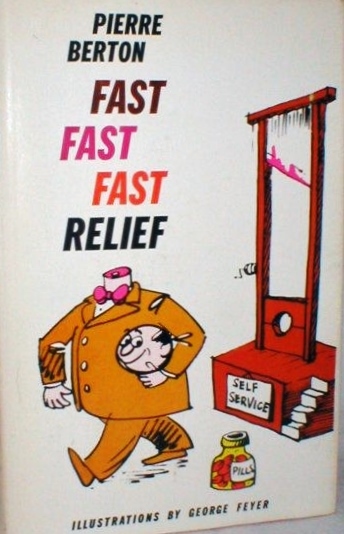
fast fast fast relief pierre berton 1Fast Fast Fast Relief by Pierre Berton ~ 1962. This edition: McClelland and Stewart, 1962. Hardcover. 185 pages.

My rating: 7.5/10

Pierre Berton, Canadian popular historian extraordinaire, began his career as a prolific and well-regarded newspaper columnist. After reading and enjoying an earlier collection of his newspaper articles, 1959’s Just Add Water and Stir , I was happy to acquire a similar 1962 collection. It has lived up to expectation, in providing a widely varied, and, for the most part, smoothly readable collection of serious essays, biographical sketches, social commentary, and satirical fabrications.

Highlights of the collection to me were a series of short, completely serious, “current affairs” articles highlighting social injustices, a number of lyrical essays describing the joys of country life, and a rather goofy collection of humorous short-short stories, extra-heavy on the satire. Of these last, The Waiting Room (Wesbrook Frayme, car racing ace, dies in a crash, gets to Heaven and is shocked to find out that his widow has married twice again; his wife and her other two spouses all appear to confound Wesbrook’s assumptions about his marriage and his wife’s mourning process) and Shakespeare Revises a Play (the Bard of Avon has his work worked over in a most Hollywood-like manner; in his first draft of Hamlet, Ophelia is thirty-two, and the ending involves lovers wandering off hand-in-hand into the sunset; the producer and director have other ideas), are particularly delightful.

A collection worthy of keeping on the night table for dipping into; an ideal guest room book for your fellow Canadian avid readers, especially those appreciative of Berton’s wry, thought-provoking, and occasionally just-plain-silly and boisterous tone.

All in all, over forty short pieces, plus an extensive and most interesting foreword by the author. Comic cartoon-like illustrations by George Feyer are an added touch.

Pure vintage Canadiana, and a good reminder of why Pierre Berton was so highly regarded for so many decades. His more than competent journalistic work brilliantly foretells his subsequent success as a writer of popularly accessible historical books.

Read Full Post »

« Newer Posts - Older Posts »