Archive for the ‘1960s’ Category

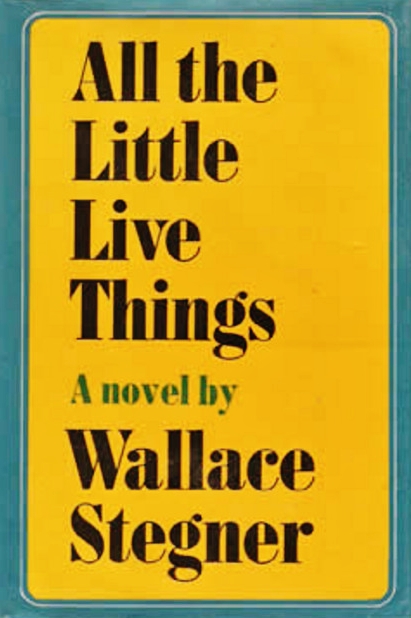
all the little live things wallace stegnerAll the Little Live Things by Wallace Stegner ~ 1967. This edition: Viking Press, 1967. Hardcover. 248 pages.
My rating: 10/10

This attempted review has been simmering away at the back of my mind for months and months. Getting it posted on New Year’s Eve day takes a great weight off of my conscience, even though I am not doing the novel the credit it deserves by this brief discussion.

Since reading the book way back in March of 2013, I have wondered how best to communicate the special quality it has, and its deep appeal, which is much more fundamental than its (highly engaging) storyline. This is where I bemoan my lack of a formal education in writing literary analysis; I know what I want to say but I don’t have the vocabulary to say it, so I fall back on the easy things: I liked the book. It moved me. Beautifully written. Memorable characters. An evocative picture of a time and a place.

These are things I can say of so many books I am fortunate enough to have encountered over an expansive reading life, but which do not at all illuminate the qualities that make this (or any other) book so special, this writer (or any other) so immediately compelling.

So, a review. Where to even start? How about here, with the front flyleaf material of the first edition, to set the story up, and to give me a lead in adding a very few thoughts of my own.

Why does the older generation feel as it does about what is happening in the world today? Wallace Stegner answers the question, with sympathy and understanding, for one good human individual trying to come to terms with his world while retaining his own integrity. In a novel that probes deeply into this and other aspects of contemporary life, he shows his narrative skill, his great gifts of evocation, and his eloquent intelligence at their mature best.

Fulsome praise indeed, even allowing for a publisher’s bias! But yes, in this case, not overstated. The author is addressing one of the Big Questions of his time, the mid 1960s, which is to say, the great divide between the generations; the wide movement of youth (and relative youth) to reject categorically the ethics, morals and social standards of their elders, and to try to remake the world into a new utopia. We’re talking about hippies, here. And the California setting is the seething nerve centre of this societal battleground, full of lines drawn in the sand and unwitting trespasses and deliberate provocations. Change is in the air, and no one is immune to its effects.

Joe Allston and his wife, two Easterners in their sixties, retire to California in search of peace after the death of their wayward son. Their paradise is invaded by various parasites – not only by the gopher and the rose blight, the king snake and the hawk, but also by a neighbour with a bulldozer, bent on “development.” Jim Peck, a bearded young cultist, builds a treehouse on their property and starts a University of the Free Mind, complete with yoga, marijuana, and free-wheeling sex. Most damaging of all, it is invaded by Marian Catlin, an attractive young wife and mother, affirming all the hope and love that the Allstons believe in, who carries within herself seeds as destructive as any in the malevolent nature that surrounds them.

The relationship between the two couples, the older Allstons and the younger Catlins, is beautifully portrayed, and I felt it was one of the most admirable aspects of the novel. Stegner delicately captures the nuances of friendship, unspoken sexual attraction which does not have to be acted upon, and the balance of power between youth and age. Joe and Marian strike sparks off each other, but the relationship never turns ugly; all four spouses are involved in the relationship and each turns to his or her partner for support and comfort as needed. For the core issue of the story is this: Marian is pregnant, with a much-desired second child. (The Catlin’s first child, a young daughter, is very much loved and wanted, and is a charming girl, nicely handled by the author.) Marian also has terminal cancer, and she has rejected treatment in order that she can bring the pregnancy to term.

A difficult plot to see any happy way out of, isn’t it? I’ll tell you right now: no feel-good miracles occur.

Here’s an admirable review which eloquently puts into words my own elusive thoughts on the novel: Bookslut: All the Little Live Things. Please read.

This is my very first Wallace Stegner, and I know full well it won’t be my last.
Read Full Post »

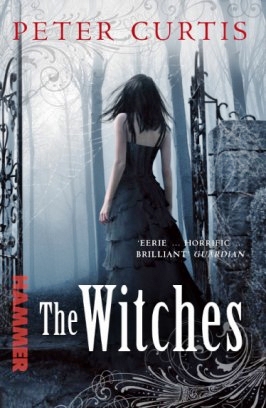
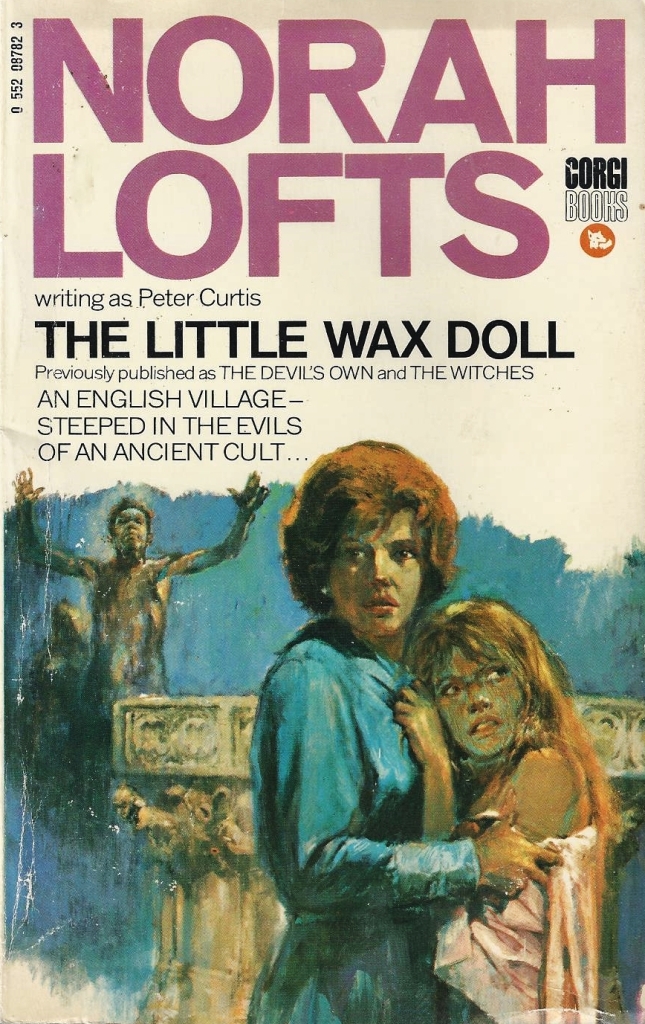
the little wax doll norah lofts 001The Little Wax Doll by Norah Lofts ~ originally published in 1960, and re-released under this title and author’s name in 1970.  Previously published as The Devil’s Own (1960) and The Witches (1966), under the pseudonym Peter Curtis. This edition: Corgi, 1971. Paperback. ISBN: 0-552-08782-3. 255 pages.

My rating: 9/10

This is definitely not a Christmas-time read. Hallowe’en, oh yes, indeed. But I am so tickled by my discovery of it that I’ve bumped down my review of D.E. Stevenson’s Charlotte Fairlie (which is an appropriate Christmas book for reasons I’ll enlarge on when I return to it) to talk about Norah Lofts’ village-with-dark-secrets instead.

I love these sorts of unexpected developments. Norah Lofts, mistress of the art of historical romance, occasionally let herself go in a very different direction and wrote a number of thrillers under the name Peter Curtis, adopting the pseudonym in order to avoid disappointing fans of the romances who would associate her name with a certain type of story.

I must say I would never have picked up this old paperback if it weren’t for Norah Lofts’ name on it; the cover illustration not being at all indicative of what a great read was hidden inside. I had recently read 1964’s How Far to Bethlehem? (with mixed reactions – good writing, but I had issues with the awkwardness of the Bible tie-in plot) so was tuned in to Lofts’ name, as it were, and a casual flip-through was intriguing enough that I squelched my qualms and brought it home.

Forty-something Miss Mayfield, a teacher by profession, is back in England after twenty years working at a friend’s private mission school in a remote part of Africa. She has had some health issues and a vaguely referenced “breakdown” so was sent back to England in the hopes that this would prove beneficial. Her health is better, but she harbours deep misgivings over her ability to cope with the stresses of her new teaching position at an inner city London school. When Miss Mayfield happens upon an advertisement for a teaching headmistress position at a rural private school she decides to try for it, never dreaming that she would be accepted.

An interview with the school’s benevolent sponsor, Canon Thornby of the village of Walyk, sees Miss Mayfield hired on the spot. Off she goes to the rural wilds, to a place very much out of the bustle of the modern world.

Miss Mayfield might want to watch her words when that friendly cat is hanging about...

Miss Mayfield might want to watch her words when that friendly cat is hanging about…

“Too good to be true,” is Miss Mayfield’s first impression of her new home. Not only is she being paid a generous salary, her position includes a wonderful cottage, an instant position of respect in the village hierarchy, and the society of wealthy Canon Thornby and his aristocratic sister. Miss Mayfield’s fellow teacher is competent and friendly, and the school children are polite, willing, and generally intelligent. The cottage even appears to come with an adorable resident cat, who purrs about with a welcoming attitude, and sleeps at the foot of the bed. Miss Mayfield settles in with a feeling of deep appreciation and relief, and counts her blessings every day.

The first inkling that something may not be all as lovely as it appears is when an anonymous note appears among the books on Miss Mayfield’s desk. “Ethel Rigby’s granny treat her something crool.” This shakes Miss Mayfield enough that she decides to investigate the allegation. Said Ethel Rigby is a well-cared for, meek and mild fourteen-year-old whose primary passion seems to be the care of her pet rabbits, and her granny openly dotes on her, having raised Ethel from babyhood, Ethel’s mother having run off and “gone wrong” in her own teenage years.

Though Ethel stoutly defends her grandmother’s innocence of any abuse, Miss Mayfield thinks that the maiden doth protest too much, and she comes away with the idea that Ethel is lying to protect the informer, who proves to be a school friend who claims to have witnessed Ethel’s grandmother push the girl’s hand deliberately into the rollers of a mangle. And Ethel’s hand is all bandaged up, though she insists her own clumsiness was at fault. And when the informing child falls mysteriously ill, only to recover just as mysteriously, and when Miss Mayfield discovers a little wax effigy of the child wrapped up and bandaged together – “healed” – hidden in Ethel’s school desk, the wheels really begin to turn.

Miss Mayfield decides to play detective and to find out what is going on behind all those brightly painted cottage doors. And what she discovers is most disquieting indeed.

What a marvelous heroine Miss Mayfield proved to be. Middle-aged and resigned to her life of perennial spinsterhood (though not unaware of the other sex, and recipient of at least one man’s interested advances) Miss Mayfield is unashamedly dowdy, choosing to focus her energies on doing her job well to the utmost of her ability. She fearlessly delves into the dark secrets of Walyk, is clever and creative in her investigative forays, and even after being brutally sidelined by an “accident” which results in a serious head injury and loss of memory, returns tenaciously to her original goal, which is to protect virginal Ethel from an unpleasant fate at the hands of Walyk’s wicked coven of witches.

The cover illustration of this 2008 reissue is just a wee bit misleading. I pity the poor teen who picks this one up expecting something Twightish, and instead finds herself sedately accompanying Miss Marple-ish Miss Mayfield on her earnest investigations!

The cover illustration of this 2008 reissue is just a wee bit misleading. I pity the poor teen who picks this one up expecting something Twilightish, and instead finds herself sedately accompanying Miss Marple-ish Miss Mayfield on her earnest investigations!

I was most pleased at the quiet humour throughout; the author appears to be enjoying herself thoroughly as she dashes this melodrama off.

Miss Mayfield, though primly proper even in her innermost thoughts, is not what one could call “prudish” – she is well aware of all elements of human nature, though she chooses to remain aloof from some of those aspects herself.  Even upon witnessing the penultimate scene of a full-blown witch’s Sabbath she mildly wishes that she could just close her eyes and avoid seeing the depravities of her neighbours, but she is not so much shocked as disgusted at their lack of proper dignity, and we never fear that this experience will shake her somewhat frail psyche. If anything, it strengthens her resolve to sort things out and bring everyone back into some semblance of decency, to protect the innocents, and to nobble future abuses and murders. Miss Mayfield’s inner dialogue proves that she is capable of appreciating the ridiculous aspects of the situation she has allowed herself to become embroiled in; we never fear for her sanity, but instead come away feeling that her future will be ever more assured. And as for Ethel, well, let’s just say that she appears well able to look after herself from this point forward!

There is also a perfect little twist at the very end.

This is an enjoyable “entertainment” read, rather nasty plot developments and all. If “Peter Curtis” did as well with “his” other three thrillers, I’m definitely keen to acquire them. Despite the absolutely stereotypical “black magic” theme, the author kept me engaged throughout, guessing a goodish bit of the time, and rather surprised here and there; very nicely done indeed.

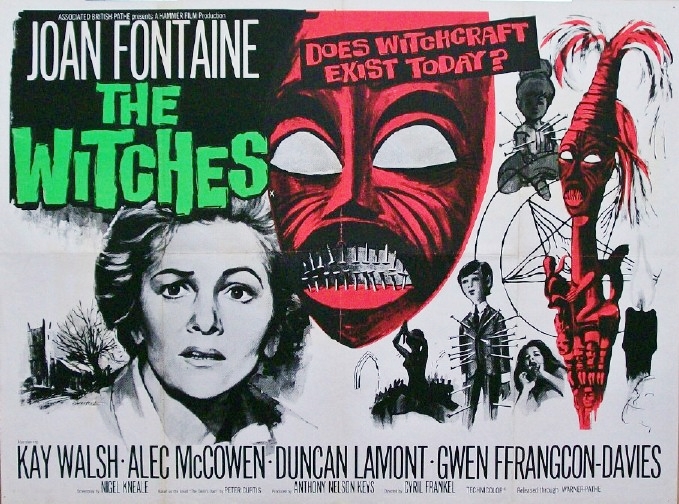
In 1966 the book was turned into a horror-suspense thriller, starring none other than Joan Fontaine as a rather elegant Miss Mayfield. From the plot description and movie stills it appears that the African connection is played up to a greater degree than in the book, and that one of the background characters who leaps into prominence in the last chapter is given a larger early role, and that there is general tweaking of the storyline to make it more dramatic. For those of you with an interest in this vintage film genre, it might well be an enjoyable diversion. (But be sure the read the book as well; it has charms of its own, though the original Miss Mayfield is no Joan Fontaine!)

The Witches horror film peter curtis norah lofts hammer film

And here is a rather detailed synopsis and analysis of both book and movie, containing abundant spoilers. I would suggest you read the book first, because it gives away all of the key twists, but it is most interesting after one is finished.

Necromania BlogSpot: The Witches by Peter Curtis

Read Full Post »

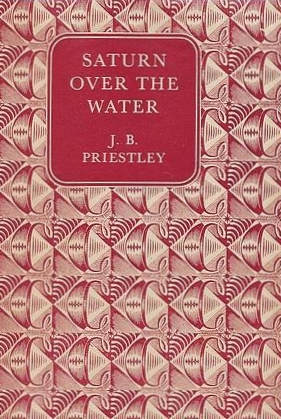
saturn over the water dj cbc j b priestleySaturn Over the Water by J.B. Priestley ~ 1961. This edition: The Companion Book Club, 1961. Hardcover. 255 pages.

My rating: I dunno. This is tough. It was a diverting read, but the ending was just too deus ex machine to swallow whole. What the hey, J.B.? Clairvoyants and psychics save the world at the eleventh hour?! Couldn’t they have stepped in a little earlier, like when the nefarious villains started their evil organization?

Oh. Right. No story.

Let me think. It was amusing in a campy sort of way, plus the hero was a moderately likeable sort. The action scenes were acceptable, though never with a fully developed edge. The women were a stumbling block, but I’ll waive objections to their overwhelming sexiness and sultry beauty because the author allowed them some competences. Okay, mostly that they were just good drivers. (And fireworks-inducing passionate kissers – does that count as a competence? In this novel, apparently so.) But he also made them just plain silly with men. Hm.

Full of goofy racial stereotypes; author Priestley/narrator Tim was particularly hard on the Germans; vestiges of the last war, obviously. And the Russians got some serious needling, too.

So with everything considered, and taking into account the other similar schlock that was being published at the time and the very real spy-versus-spy tenseness of the Cold War political situation, I think I can safely give this one a 7.5/10. Even with the cop-out ending. Because Priestley did an adequate job, and he had a few serious things to say hidden in the nonsense, and I appreciate his willingness to dabble in the genre. And it was rather a fun read, of the “so bad it’s good” school.

*****

So this was something unexpected. J.B. Priestley channels John Wyndham, with a dash of Ian Fleming, and a sprinkling of pure silliness. Here’s our story.

It all began with a call I had from Addenbrooke’s Hospital, Cambridge, where my cousin Isabel was dying of leukemia. The Hospital didn’t say she was dying of course – they never do – but I knew she was and she knew she was. The scientists who enjoy playing about with these filthy bombs tell us it’s all quite safe and have figures to prove it; but before these bombs came along I’d never known anybody who had died of leukemia, whereas now my cousin Isabel was the fourth person I’d known who had died of it.

saturn over the water dj 2 j b priestley

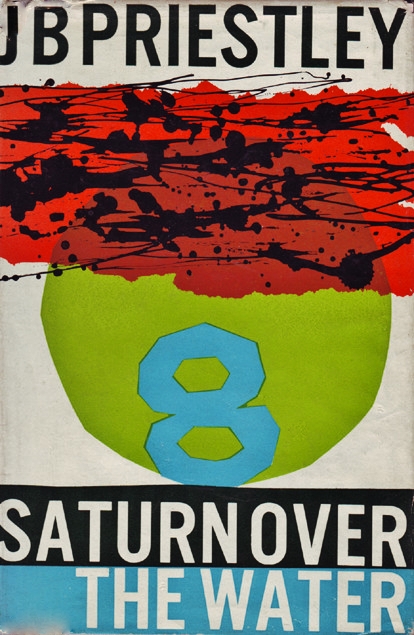
This handsome cover depicts Joe’s scribbled clues. Can you read his writing? If not, don’t feel too bad. Tim had trouble too.

Career artist Tim Bedford, standing by Isabel’s bedside, reluctantly takes on a commission for her. Some years ago her husband, Joe Farne, a biochemist, had gone out to Peru to work for the privately owned Arnaldos Institute, where research on various nebulous “beneficial projects” was being carried out. Isabel had stayed in England, because she and Joe were having marital issues, but they’d made up via letter and all was looking up when something disturbing occurred. Joe suddenly left his job at the Institute and vanished, Isabel’s letters started being returned unopened, and no one was able to say where he had gone.

Then another letter from Joe came, but from Chile, not Peru. Three pages of hastily scribbled reassurances that he loved her, and on the last page a collection of cryptic jottings, names and phrases that made no sense to Isabel at all, but that must have some meaning, otherwise why would Joe have sent them?

Could Tim please track Joe down, to see if he was all right, and to explain to him why Isabel herself was unable to come to him, and to give Joe her dying message of love? Well, what could Tim do, especially once he visited Isabel’s lawyer and found that there was a tidy sum of money for expenses at the ready.

Before departing England for South America, Tim does some intital groundwork by tracking down the widow of one of Joe’s fellow scientists at the Institute, and what she tells him gives him pause. Something deeply sinister was going on in Peru, and she urges him to start his search there, to find a clue to Joe’s departure and subsequent popping up several countries over.

Coincidences start to occur thick and fast, as Tim sets off on his quest, soon to encounter a stunning Russian countess, a wealthy English lord, a variety of Communist sympathizers, a beneficent New York art dealer, a Peruvian multimillionaire with a brooding and artistic granddaughter, pseudo-Nazis, evil scientists, corrupt policemen, and a motley crew of shady characters occasionally on his side in the ever-more-pressing race to discover what is going on in not only Peru, but the Emerald Lake in Chile and the Blue Mountains of Australia.

Will Tim find Joe, and incidentally help save the Northern Hemisphere from annihilation by the H-bomb?

Of course he will, and he’ll discover the cryptic meaning of the Wavy Eight symbol, too, and the significance of the mysterious phrase “Saturn Over the Water”. (It’s much more daft than you could ever imagine.)

A true period piece, this one. If you find it in your travels, give it a go. Says me.

saturn over the water dj j b priestley

Eye-catching first edition dust jacket.

Read Full Post »

D.E. Stevenson’s 1961 novel Bel Lamington, featuring a young woman thrust out unprepared into a harsh world, Miss Beatrice Elizabeth Lamington – the “Bel” coming from her initials – left me just slightly underwhelmed.

I had first read the sequel to Bel’s titular saga, 1962’s Fletchers’ End, and references to Bel’s previous stint as a downtrodden secretary rather intrigued me. My eagerness to discover her prior story sent me off to the internet to purchase the book, and though I can’t say I’m disappointed by my latest D.E.S. acquisition, I’m not as thrilled as I’d hoped to be.

Bel Lamington links up with the earlier Vittoria Cottage/Music in the Hills/Shoulder the Sky (a.k.a. Winter and Rough Weather) trilogy, and the last third or so of the book concerns a number of characters whom the author assumes we have already met. Doubtless this was so for most readers at the time of Bel Lamington‘s publication; D.E.S. had her staunch following, and a nod to the readers-already-in-the-loop was doubtless the author’s intention here. But for those of us coming newly to the D.E.S. world some half-century after her heyday it can be a little disconcerting, though I must say it is fairly easy to pick up and follow the story threads.

It never seems like the author intends to leave things out, just that she assumes that we know the histories of the cameo role stars she features beside the up-and-coming ingénues. And Bel is very much a charming ingénue, in every sense of the word. Luckily her stellar qualities are recognized by just enough people to soften the blows that fall upon her tentative entry into a working girl’s world.

bel lamington d e stevensonBel Lamington ~ 1961.

This edition: Collins, 1961. Hardcover. 255 pages.

My rating: 6.5/10

Bel was orphaned at the tender age of three when both parents perished together in an automobile accident –  a “terrible motor smash” – but luckily she was taken in by a loving aunt and raised and cared for with tender affection. Her aunt has now died, and with it the small income they both lived on; there is nothing for it but for Bel to go out into the world and find employment.

She trains as a secretary and finds a job as a typist in a London shipping firm, and is soon promoted to private secretary to the firm’s chief partner, Ellis Brownlee. For Bel is one of those quietly competent types who excels at everything she attempts, and the author gets some digs in at the lackadaisical sorts whose office ambitions are more to do with flirtation and gossip than in dedication to their employers’ interests. Bel is definitely not cut from that pattern, and this inevitably leads to her being ostracized by the other female staff members, in particular the bullying Miss Goudge, who finds meek Miss Lamington a perfect target for her sarcastic jabs.

Bel’s private life is emotionally fraught as well. She is finding London exceedingly lonely, and has not made friends with anyone at all in the eighteen months she has been there. Her one comfort is the tiny rooftop garden she has created outside her top floor window, and lo and behold, this garden brings her into contact with a handsome young man.

Mark is an artist, and his discovery of Bel’s garden when he is scrambling about on the roofs outside his own top floor studio-flat leads to his painting of Bel’s portrait, and his impetuously offhand courtship of this hidden flower, this “charming little mouse” of a girl. Bel is initially bowled over, but soon finds that Mark’s enthusiasms wane as fast as they sprout up, and she sensibly keeps herself out of trouble when Mark’s casual advances become too forceful.

But it is hard to keep smiling, and Bel is descending into the depths of despair when a chance encounter with an old school friend at the exhibition of Mark’s painting of Bel brings her a happy respite, as she and Louise discover that they are kindred spirits.

Back at the office things are not going well at all. Bel’s mentor and protector Mr Brownlee has left on an extended overseas business trip, leaving Copping, Wills and Brownlee under the supervision of the over-emotional and verbally-abusive Mr Wills. Hand in glove with the manipulative Miss Goudge, Mr Wills ensures that Bel’s office days are numbered, and when the inevitable happens, she flees to Louise for refuge, ending up in Scotland, where everything gets itself all sorted out.

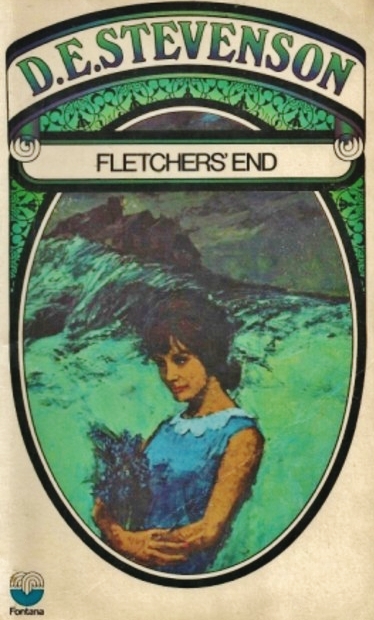
Fletchers’ End ~ 1962.

This edition: Fontana, 1971. Paperback. 256 pages.

My rating: 7.5/10

Spoiler alert: If you want to read Bel Lamington without knowing the results of her romance in book one, you should read no further. Here, I’ll pop in the cover illustration of Fletchers’ End to give you a chance to click away.

fletchers' end d e stevenson

Still here? Excellent. Here’s the next installment.

Bel and Ellis Brownlee are wed, and are now living in Bel’s tiny London flat and both working at Ellis’s office. They are also looking for a proper place of their own, preferably in the country but within easy commuting distance of London so Ellis can be handy to his shipping firm. Nothing suitable can be found, until Bel’s friend Louise sees potential in a dilapidated old house in a jungle of weeds, one Fletchers’ End in the village of Shepherdsford.

The absentee owner is desperate to sell, and Ellis and Bel purchase the house for a bargain price, though they are destined to make up for the initial savings in the ensuing renovation costs. This now becomes one of those “house books”, where the building is a character in its own right, and ultimately rewards its rescuers by becoming a warm and welcoming haven.

Bel’s adventures in renovation and restoration keep her occupied for the better part of the narrative, though there are side plots in the romance of Bel’s dear friend Louise, carried forward from the first installment, and the sudden appearance of the house’s previous owner, a young and handsome naval officer.

Mark-the-philandering-artist from Bel Lamington makes a brief appearance as well, as does the younger Copping from Ellis’s firm.

But not much really happens in this one, unless, of course, one appreciates the overwhelming busy-ness and architectural challenges and intrinsic rewards involved in a house renovation. The romance gets sorted out most satisfactorily, and all seems set for a happy ending when Bel and Ellis are suddenly faced with the possibility of having to walk away from Fletchers’ End: a will has been discovered which puts into question the legality of the house’s sale. Oh dear, whatever will happen now?!

Yes, it all comes out all right in the end.

(Was there ever any question?)

Nice parallel story of the elderly Mrs Warmer (what an apt name) who has been caretaking Fletchers’ End, and who stays on to provide a motherly presence in Bel’s kitchen, to the envy of all and sundry.

In both of these novels much is made of Bel’s timidity, her gentleness, and her overwhelming humility. D.E. Stevenson puts forward the argument that humility – true humility of spirit – is a worthy trait and should be viewed with respect. She therefore endows her heroine with appropriate rewards for her goodness and meekness. Though Bel occasionally shows that her inner core is of the toughest steel, her continual mildness is sometimes just the tiniest bit irritating; I can understand why Miss Goudge of the first book found her such a fitting target for perpetual scorn.

A very moralistic pair of tales, Bel Lamington and Fletchers’ End, with the author making very clear her opinions of how virtue and innate goodness should be rewarded, and how those who offend against the meek and well-meaning should be cast off into the outer darkness. All in all, a satisfying sort of point of view for this sort of blissfully simple fiction, for aren’t we all, fellow readers, on the side of the angels ourselves? 😉

Read Full Post »

This is one of the most lovely book jackets I've ever seen, a wrap-around illustration by Antony Groves-Raines, from my 1965 Doubleday "Book Club Edition".

This is one of the more attractive vintage book jackets I’ve yet seen, a wrap-around illustration by Antony Groves-Raines, from my 1965 Doubleday “Book Club Edition”. This is the front.

And this is the bag. Try to imagine them together. I tried scanning it as one section, but my scanner is just a bit too small for the whole thing.

And this is the back. Try to imagine them together. I wanted to include it as one continuous illustration, but my scanner bed was just a bit too small for the whole thing.

How Far to Bethlehem? by Norah Lofts ~ 1964. This edition: Doubleday, 1965. Hardcover. 246 pages.

My rating: 5.5/10

I’d decided to try to read some seasonal literature to go with the upcoming Christmas season, and what better way to start, I thought, than with this one, going right back to the source, as it were.

As you can see from my rating, it was an adequate though not an astounding success. I mildly enjoyed Norah Lofts’ attempt, but found that I could not fully enter into this creative re-imagining of the story of the birth of Christ, for reasons touched on below.

The narrative abruptly jumps around from character to character, which, though initially confusing, actually turned out to be a good thing, as the side characters were much the most interesting, with completely invented backstories, unlike Mary and Joseph, who were constrained by the traditional story.

We start out with the young Mary, imagined by Lofts as an enthusiastic lover of both lilies and donkeys – themes which tenaciously follow the girl throughout the tale – and the Annunciation, with the Angel Gabriel appearing to her and then to Joseph. Mary is portrayed as a very lovely, rather dreamy girl, much prone to episodes of introspection when she seems to be communicating with a greater power, which of course she is, if we accept her special status as Mother-of-God-to-be. She accepts the angel’s visit as the nebulous “big thing” she has been waiting for all of her life, and surrenders herself fully to her fate, though she has moments of great inner turmoil when she considers her baby’s eventual torment and death according to the ancient prophesies concerning the Messiah.

And this was were my first moments of readerly disconnect came in, as the author insisted on discussing the popularly accepted details of the end of Christ’s earthly life. It’s been a good many years since I attended a Bible Study class, but I don’t recall that much detail in the Old Testament prophecies concerning the Messiah; it was all rather mysterious in a soothsayers’ sort of way, and didn’t really get in to details such as how long the Messiah would be here on earth for, or the manner of his demise, even that he would be born of a virgin. Mary and Joseph both discuss the role that the coming Messiah will play in sacrificing himself for mankind’s sins; the expectation among the Hebrews of the day was more in the nature of a military leader. Though it is lovely of the author to provide Mary with this insight, it didn’t feel all that convincing. And more was soon to come.

The three wise men/three kings share the spotlight with Mary, and they are imagined in rather untraditional ways, made possible because their mention in the actual Bible narrative is superficial at best, and their place in the Nativity story more folkloric than theologically based. In Lofts’ version, Melchior is a Korean astronomer, Gaspar is a Mongol chieftain, and Balthazar is a runaway African slave, and their coming together and subsequent travels make up the better part of the book. It generally works, and some of their escapades are nice little novellas all on their own.

Highlights toward the end of the book which I thought interesting and well written as the author rather let herself go away from the constraints of clinging to the skeleton of the Biblical framework were a visit by the three “kingly” travellers to Herod’s palace in Jerusalem, and a night at a Roman military barracks; both episodes had some creative detailing which sparked them to life rather more than some of the other vignettes.

The innkeeper at Bethlehem gets his own mini-history as well, some of which was quite enthralling. In Norah’s imagination he is a Greek ex-sailor, and her description of his perilous voyage on a tin ship through the mist-shrouded ocean to the barbarous isles on the other side of the Pillars of Hercules was a fascinating and convincingly written inclusion which had me wanting more.

Her version of the shepherds was less than stellar, though. It felt highly contrived, with the chief shepherd being a grieving father of a son recently crucified by the Romans for a minor infraction; the author just wouldn’t quit with the meaningfulness of all of this, and it was another jarring note; much better if it would have been played a bit softer. Oh, and that very shepherd is represented as being the father of Lazurus, Martha and Mary – key players of an incident some years later in the New Testament narrative, and another glaring coincidence which annoyed the heck out of me by its total improbability. (If one can use “probable” in the context of any of the events in this re-imagined tale!)

Though there was much to like in this ambitious and creative retelling of the Nativity story, I found that the sections which worked well fictionally were overwhelmed by the less frequent but awkward attempts at bringing in Biblical quotations, and in the excessive use of coincidence in the creation of incidents. What might have been an excellent piece of creative fiction instead turned out to be a slightly off-key homage to a story we already know in its earlier form. The King James version very adequately stands alone and I would have been much happier if Norah Lofts had let herself go a little more and not tried to incorporate so much of the Gospel narrative in her own work.

Does that make any sort of sense? I mean, we already know how it goes, so letting the reader do the work in mentally making it click with the original would have worked, and given us the pleasure of the “Aha!” moment, instead of being bludgeoned by the exceedingly obvious “taken from the Bible” parts. And if one isn’t familiar with the original, it would be a more accessible read, and might well lead one to investigate the source. Perhaps?

I’m a bit grumpy about this, because some of this was, as I already said, quite excellent, and I felt cheated in that it all could have been that way.

Norah Lofts appears to be a firm believer in the Biblical versions of the Nativity which inspired her book, and one must respect that. This is an unusual novel, and rather brave in its attempt to fictionalize such an iconic religious tradition, while remaining true to the source. And her writing is always more than competent, and occasionally inspired.

Damning with faint praise, this feels like, but I could not completely give myself over to the tale, and I was fully willing to when I started. I do wonder how much having a previous knowledge of the King James version of the story influenced my reading pleasure, or lack thereof. While it definitely helped me to appreciate the author’s use of narrative nuances and connections between characters, it made me continually stop and try to make Norah Lofts’ version jive with my memory of what was contained in the books of Matthew, Mark, Luke and John. I did come away with a strongish desire to reread the originals as a sort of refutation to Lofts’ tale, so I’m not quite sure if that is a point in favour or against How Far to Bethlehem?!

But please don’t let my personal response put you off giving this book a whirl. It is much beloved by Norah Lofts’ many dedicated followers for good reason, and it was definitely not at all a chore to read. I easily got over my annoyed moments and followed it through to the end; I will be keeping it around for future personal perusal, and because my mother enjoys reading it now and again.

But am I at least more in the Christmas mood now?

Honestly, not really. I think I need to revisit some old favourites, the Margot Benary-Isbert stories (The Ark, Rowan Farm and A Time to Love, all set in wartime and post-war Germany) and Pilgrim’s Inn by Elizabeth Goudge, for its sweet Christmas-time finale. And of course Beatrix Potter’s The Tailor of Gloucester, and Rumer Godden’s The Story of Holly and Ivy, from the children’s bookshelf of annual re-reads.

And Heavenali’s post on Christmassy books gives much scope for exploration of some titles I haven’t yet read, and reminded me of a few I’d forgotten, like Susan Cooper’s The Dark is Rising.

Other Christmas reading suggestions always welcome!

Read Full Post »

the street mordecai richler 001The Street by Mordecai Richler ~ 1969. This edition: Panther Books, 1971. Paperback. 142 pages.

My rating: 8.5/10

It’s been a good many years since I’ve read anything by Mordecai Richler, and reading The Street reminded me why: a little goes a long way. And I mean that in the very best way.

The Street was just long enough, at 142 pages, to be a quick one-evening read, a bracingly rude and somewhat startling experience which balanced the well-meant inanity of my other recent reading. The naïve earnestness of D.E. Stevenson’s rather silly Miss Buncle and the good natured ramblings of Georgette Heyer’s handsome dilettantes are decidedly mild pleasures in contrast to Richler’s sly, cheeky, say-anything Montreal ragamuffins and their bluntly outspoken elders. And I find that the mixing of genres here adds piquancy to all, with Richler’s pungent acidity emphasizing the good brown bread and airily sweet meringue of the others.

The Street is a collection of ten linked stories-slash-memoirs – fictionalized memoirs? – mostly following the narrator – Richler himself, one assumes – from childhood to adulthood. The anecdote here is everything, and Richler’s authorial voice is perfectly suited to these short pieces.

From the author’s Foreword:

‘Why do you want to go to university?’ the student counsellor asked me.

Without thinking, I replied, ‘I’m going to be a doctor, I suppose.’

A doctor.

One St. Urbain Street day cribs and diapers were cruelly withdrawn and the next we were scrubbed and carted off to kindergarten. Though we didn’t know it, we were already in pre-med school. School starting age was six, but fiercely competitive mothers would drag protesting four-year-olds to the registrarion desk and say, ‘He’s short for his age.’

‘Birth certificate, please?’

‘Lost in a fire.’

On St. Urbain Street, a head start was all.  Our mothers read us stories from Life about pimply astigmatic fourteen-year-olds who had already graduated from Harvard or who were confounding the professors at M.I.T.  Reading Tip-Top Comics or listening to The Green Hornet on the radio was as good as asking for a whack on the head, sometimes administered with a copy of The Canadian Jewish Eagle, as if that in itself would be nourishing.  We were not supposed to memorise baseball batting averages or dirty limericks.  We were expected to improve our Word Power with the Reader’s Digest and find inspiration in Paul de Kruif’s medical biographies.  If we didn’t make doctors, we were supposed to at least squeeze into dentistry.  School marks didn’t count as much as rank.  One wintry day I came home, nostrils clinging together and ears burning cold, proud of my report.  ‘I came rank two, Maw.’

‘And who came rank one, may I ask?’

The Jewish mothers in The Street fulfill every stereotype, being supremely ambitious for their children, yet never letting them get too full of themselves; chicken soup and sharp cuffs being administered with equal enthusiasm as maternal whim decides. To get ahead, to make good, to get away from St. Urbain Street and its taint of poverty-ridden struggle and the worst lingering despairs of the “Old Country” is what they wish for their children, and their self-imposed self sacrifice is both the bane of their families’ existence and the driving force which propels them all onward. In adulthood the children of those ubiquitous mothers begin at last to understand this and give homage; in childhood they merely endure and dodge the good advice and the blows with equal agility.

These stories are full of a sense of a very particular place and time, Montreal of the early 1940s, captured in microscopic detail of sight, sound and smell in Richler’s steel-trap memory. His boyhood companions are familiar to us from similar narrators and from Richler’s previous works; Duddy Kravitz is present, spouting off his knowing comments, and the author assumes we know who he is, assumes that his readers already know the context and are willing participants in the narrative. And while the scene here is unmistakeably this very small corner of Montreal, it is evocative of similar boyhoods and experiences in New York and London and any of the other key locales in the continual global diaspora and resettling of the Hebrew race.

For this is, above everything else, a very Jewish book, as well as being a Montreal book, and a Canadian book; Richler makes no bones about the uniqueness of this aspect of his own experience and of the importance of it in the scenes he so meticulously describes. His Jewishness is at the core of his very being; everything else is layered on top.

Heads up, gentle readers expecting a mildly humorous memoir, for this author is proud of his outspokenness and his humour has a cutting edge; it is also frequently bawdy, and full of the smuttiness of guffawing enclaves of adolescent boys. That hoary old dirty joke, “Bloomberg’s dead!”, is here on page 23, told with especial glee, and more of the same is scattered liberally throughout.

Mordecai Richler can be terribly rude, but he is also very, very good. I had forgotten quite how good. I do believe it is time for another visit with the one and only Duddy Kravitz.

Here are some other thoughts on The Street.

Kevin from Canada: The Street

Humanities 360: Erin Yorke reviews The Street

Read Full Post »

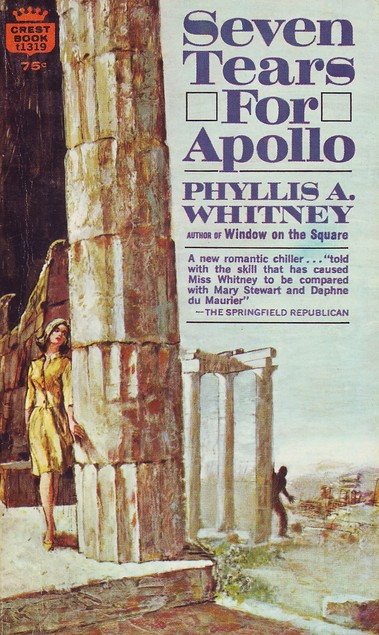
seven tears for apollo phyllis a whitneySeven Tears for Apollo by Phyllis A. Whitney ~ 1963. This edition: Fawcett Crest, 1966. Paperback. 224 pages.

My rating: 5/10

Here’s the back cover blurb on my tattered paperback, relic of one of my high school library’s discard sales way back in the 1970s:

Ever since the sudden, tragic death of her husband, pretty Dorcas Brandt lived in fear. Too many frightening, unexplainable things had begun to happen – the fatal accident to a close friend, the mysterious warnings scrawled on her mirror, her room ransacked.

Dorcas fled to Greece in search of sanctuary. But even on the beautiful island of Rhodes she could never escape the shadows of terror.

Was she just imagining it all?

Had the loss of her husband unhinged her mind?

Or was someone really out to destroy her?

Well, which one of those options would you suppose is the correct one?

If you guessed number three, you’d be bang on target. Dorcas is being persecuted, poor girl, and by a collective at that. Anyone she confides in either openly sneers at her allegations, patronizes her, or steps up the pressure. But why, oh why?

Here’s the story. We start out in the U.S.A., in an unspecified location that might just be New York, or possibly some other major eastern city. Some years back, museum curator’s lovely seventeen-year-old daughter Dorcas made a very bad marriage indeed, to sleek, handsome, half-Greek, half-Italian and all-wrong Gino. He turned out to be deceitful, manipulative, and physically violent; when Dorcas attempts to depart the marriage with baby daughter Beth, one of Gino’s mysterious “friends” pursues her and brings her back, warning her that it would be a very bad idea indeed to cross Gino, as what he owns (inferring Dorcas and Beth) he holds on to. Or else.

Gino’s profession as an art dealer is slightly nebulous but apparently profitable. Dorcas suspects that all of Gino’s transactions are not strictly legal, but she has no real proof, just an uneasy feeling which no one else seems to share, as Gino has a wide circle of influential friends in the arts-and-culture world, including matronly Fernanda, a best-selling author of quirky travel books, who has mothered Gino for years and extends her kindly meant but overbearing patronage to his wife and child.

Now nasty Gino has perished in a plane crash, and Dorcas is attempting to move forward in her life. She’s been having some emotional issues; Gino has had her in a facility for psychological treatment for her alleged neuroses, and Fernanda has been overseeing young Beth’s care. Now, since her widowhood and release from psychiatric care, Dorcas is herself living with Fernanda, acting as Fernanda’s secretary-assistant,  and reacquainting herself with four-year-old Beth. An upcoming trip to the Isle of Rhodes seems to be a positive step for everyone. Fernanda will gather material for her latest book; Dorcas will get a chance to experience Greece and see at first hand the sights that her late father could only dream of; Beth will bond with her mother in the bits in between.

As Dorcas stands in front of the museum copy of a statue of Apollo, steeling herself for the emotional journey she is about to embark upon, tears come to her lovely eyes, as she recalls her first meeting with the man that would become her husband – in front of this very statue, only a few months after her beloved father’s death – and Gino’s mysterious pronouncement that she must weep seven times for Apollo before she could shake the bonds that held her – whatever that had meant, if anything.

Dorcas weeps her way through this novel, with – I’ll give her that – abundant good reason. Gino brutalized her and left her physically traumatized and an emotional wreck; Beth has been virtually adopted by well-meaning Fernanda, with Dorcas’s contact with her daughter being held up as reward for good (meaning calm and rational) behaviour; and people – most notably Fernanda – insist on viewing Dorcas as a bereaved widow, when she is in actuality very relieved to be free of her malicious spouse. Everyone thinks Dorcas is a bit of a mess, and she tends to concur – though with slightly different reasoning.

Lately Dorcas has been finding evidence of a mysterious intruder in her room, with her belongings being ransacked, and a strange symbol being soaped on her mirror, or chalked on the floor – two circles, like the eyes of an owl. What could this mean?! And what is the apparent interest in a cryptic letter Gino had received just before his death, which Dorcas has refused to share with Gino’s associates, and which has now disappeared?

The average reader will be quicker off the mark than lovely, confused, jittering Dorcas. Something is definitely up, and Gino was obviously deeply involved. This trip to Rhodes will no doubt trigger all sorts of happenings. Beware, pretty lady!

The set-up of the novel is fairly promising, though the author drops some immensely broad hints as to what is coming up, first and foremost being that Gino is perhaps not quite as dead as he should be. The cryptic letter is obviously a clue of some sort to Gino’s last uncompleted nefarious transaction. Wee Beth is a perfect pawn, and will no doubt be used at some point to gain her mother’s cooperation by the as-yet-unidentified bad guys. Fernanda’s kindness will have a cost. Markos’s widow will hold a key secret to the affair. And there will be a romantic interest popping up soon. Ah yes, here he is. Johnny Orion, handsome young American schoolteacher, employed by Fernanda to squire her about Rhodes.

When we discover upon reaching Rhodes that the local museum is missing a major piece of ancient sculpture – the head of a boy with a tear on his cheek – we put two and two together. Obviously the Big Dark Secret has something to do with art theft! (At first I thought it might be drug running. But I swear that art theft was my second guess!)

Things get more and more hectic as the tale goes on, until the final dramatic dénouement, which sees our heroine weeping for what we hope will be the very last time.

This story was really not that great, being awkwardly plotted out throughout, and chock full of implausible action scenes and poorly written dialogue. It was head and shoulders better than Sea Jade and Columbella, though, hence its relatively high rating on my personal scale. I’m giving it a pass, at 5, because I think the author tried really hard to create an interesting scenario, and I could tell her heart was in the right place. It’s just too bad that others (Mary Stewart!) have done it so very much better.

Here’s an excellent review which goes into much more detail, plus it has lovely pictures. All of the troubling bits this blogger identified, I completely concur with, and the positive bits, too. Check it out.

Romantic Armchair Traveller – Seven Tears for Apollo

Read Full Post »

The Forecast

Perhaps our age has driven us indoors.

We sprawl in the semi-darkness, dreaming sometimes

Of a vague world spinning in the wind.

But we have snapped our locks, pulled down our shades,

Taken all precautions. We shall not be disturbed.

If the earth shakes, it will be on a screen;

And if the prairie wind spills down our streets

And covers us with leaves, the weatherman will tell us.

Dan Jaffe, 1964

From the anthology Reflections on a Gift of Watermelon Pickle… and other modern verse

(November, 2013. Apropos the happenings in the wider world of late.)

Read Full Post »

the moon-spinners pb cover mary stewartThe Moon-Spinners by Mary Stewart ~ 1962. This edition: Hodder, 1964. Paperback. 264 pages.

My rating: 9/10

I don’t know what it is – perhaps the snowy weather and the early dark evenings – but this book completely hit the spot with me a few nights ago, following through to the next day as I surreptitiously raced to finish it off in between my proper occupations.

Maybe the appeal comes from the sunny setting – the Isle of Crete at Easter, mountains alive with wildflowers – or possibly just the perfectly adorable love interest of our intelligent heroine – he’s slightly mysterious, rather handsome, charming even on his bed of pain, plus he throws himself wholeheartedly into the fray-of-the-moment, particularly if it’s to avenge damage done to his lady-love.

It certainly doesn’t hurt that The Moon-Spinners is quite beautifully written for its genre, in what I’ve come to realize is Mary Stewart’s trademark detailed travelogue style. It assumes a certain degree of intellectual and general knowledge among its readers, and refuses (for example) to reference in-text literary allusions, assuming our familiarity with them, something I always appreciate when done in an appropriate fashion, as a natural part of the narrator’s voice.

The action scenes were relatively short, though no more believable than any of Stewart’s other escapades, and I found I managed to get through them with only a raised eyebrow, not an outright snort of indignation. Let’s see, now. The heroine is attacked once with a knife and once with a fish spear (the spear episode is while in the water, of course, with the heroine scantily attired in her underthings), and she is present while bullets fly about willy-nilly but ultimately harmlessly, and she manages to bring the chief villain to grief at the very end with a spur of the moment intervention. There are two successful murders (well, perhaps more of the lost-my-temper manslaughter-type murders versus deliberate planning) plus at least one attempted murder, all in just the first few days of what was supposed to be a restful botanizing vacation.

Stewart gets the flowers right, and includes a clever Linnaean word-joke or two which I greatly appreciated, being of the horticultural persuasion myself. The whole novel is packed full of heart-racing action and instant romance, which keeps things clipping right along. The side characters – the heroine’s older cousin, the hero’s local-boy sidekick and charming younger brother – are a fabulous addition to the story, and allow for an abundance of humorous repartee. Even the surviving villains are quite a lot of fun, if you’ll forgive my using “fun” in the same breath as “murderous villain”. One is prone to violent loss of temper, the other tiptoes around anything messy with faint disdain – “Well, I’d hate to have to kill you, but you leave me no choice. Oh, better yet, I’ll leave it up to my brutish sidekick here to deal with you. I just don’t want to know!”  Together they make a diverting team, in every sense of the word. The murderees themselves are unlikable thug types, so we don’t shed too many tears at their demise.

What else can I say? Loved it. The best Mary Stewart I’ve read yet, though My Brother Michael comes close. (Must also post some thoughts on that one, some day.)

So, the story.

It was the egret, flying out of the lemon-grove, that started it. I won’t pretend I saw it straight away as the conventional herald of adventure, the white stag of the fairy-tale, which, bounding from the enchanted thicket, entices the prince away from his followers, and loses him in the forest where danger threatens with the dusk. But, when the big white bird flew suddenly up among the glossy leaves and the lemon-flowers, and wheeled into the mountain, I followed it. What else is there to do when such a thing happens on a brilliant April noonday at the foot of the White Mountains of Crete; when the road is hot and dusty, but the gorge is green, and full of the sound of water, and the white wings, flying ahead, flicker in and out of deep shadow, and the air is full of the scent of lemon-blossom?

Lovely young Nicola comes on holiday to a remote village in Crete. Arriving a day early for a planned rendezvous with her cousin, she wanders into the hills and is assaulted by a knife-wielding Greek; he then takes her to a hut in which she finds a wounded Englishman, Mark. Much swearing to secrecy results; the hiding-out is because Mark’s fifteen-year-old brother has been kidnapped by a gang of thugs, one of whom shot Mark and left him for dead; Mark and Greek pal (Lambis) have realized that killer is now out searching for the not-quite-as-dead-as-thought Mark, to finish him off. A deadly game of cat-and-mouse keeps tension high as the various characters dash (or limp) from nook to cranny to shepherd’s bothy to niche-in-rock-cliff to ancient temple.

After spending the night nursing Mark, Nicola reluctantly goes off down to the village, plays all innocent, and sleuths away like mad. The small hotel where she is booked to stay is run by an oddly assorted partnership. One is a local man, Stratos, returned from years away in England with a nest egg which he is investing in the hotel; the other is his English partner, Tony, a fabulous cook , darling – and also bar-man and waiter and general manager. Tony is much given to gushing extravagances of speech; his dialogue is well-peppered with italics. I wonder rather if Mary Stewart is trying to portray something more than personal eccentricity here; if this novel were a few decades older Tony would be the quintessential “catty gay guy” we see so frequently in contemporary chick lit. As it is there are one or two possibly double entendre references to Tony not being the heroine’s type, and her older cousin Frances, a sophisticated type herself, is quite catty in regards to Tony, calling him “Cedric” after the literary Little Lord Fauntleroy.

Anyway, Nicola snoops about, discovers that all is not as it seems in this peaceful little village, identifies the villains, discovers the fate of the kidnapped boy, foils the nefarious plottings of the gang of villains, and finds true love. This takes several hundred pages, but they are filled with incident and description and clever conversation and in general are a pleasure to read. A good read indeed, completely effortless and a fabulous diversion from the onset of the Canadian winter.

Oh, and the “moon-spinners” of the title. I thought at first this was a reference to the Cretan windmills, as these are a feature of almost every one of this novel’s cover illustrations I’ve seen. You know, round, like the moon; spinning, because they’re windmills. But though a windmill features importantly in the narrative – hence the illustrations – the moon-spinners referred to are something quite different. Here is Nicola, telling their story:

They’re naiads – water nymphs. Sometimes, when you’re deep in the countryside, you meet three girls, walking along the hill tracks in the dusk, spinning. They each have a spindle, and onto these they are spinning their wool, milk-white, like the moonlight. In fact, it is the moonlight, the moon itself, which is why they don’t carry a distaff. They’re not Fates, or anything terrible; they don’t affect the lives of men; all they have to do is to see that the world gets its hours of darkness, and they do this by spinning the moon down out of the sky. Night after night, you can see the moon getting less and less, the ball of light waning, while it grows on the spindles of the maidens. Then, at length, the moon is gone, and the world has darkness, and rest, and the creatures of the hillsides are safe from the hunter, and the tides are still . . .

Then, on the darkest night, the maidens take their spindles down to the sea, to wash their wool. And the wool slips from the spindles into the water, and unravels in long ripples of light from the shore to the horizon, and there is the moon again, rising above the sea, just a thin curved thread, re-appearing in the sky. Only when all the wool is washed, and wound again into a white ball in the sky, can the moon-spinners start their work once more, to make the night safe for hunted things . .

Worth reading the book, just for the bits like that. I’m liking Mary Stewart more and more!

One more note. Disney made a 1964 movie based on this novel, starring Hayley Mills. It sounds like “loosely based” is more accurate; descriptions of the Disney production show that the plot diverges widely from Mary Stewart’s crisp thriller. Apparently no expense was spared in the making of the film, which was filmed on location in Crete, with Disney rebuilding a war-damaged village and engaging local people as background players. I’ve not seen it myself, and from the sounds of the plot changes, would not find the Disneyfied version of the story terribly appealing, but I would like to see the physical setting. Has anyone both read the book and seen the film? If so, would love to hear your thoughts!

Read Full Post »

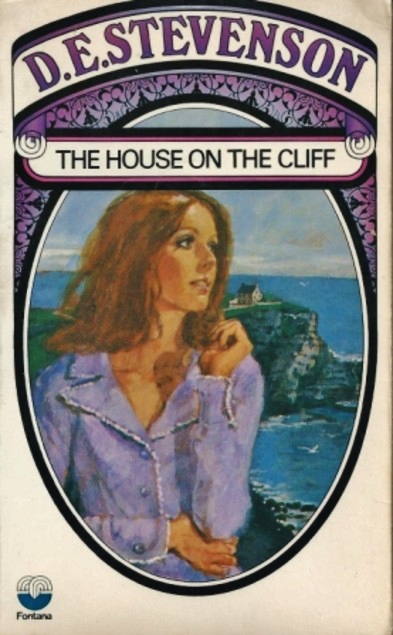
the house on the cliff pb cover d e stevensonThe House on the Cliff by D.E. Stevenson ~ 1966. This edition: Fontana, circa 1960s. Paperback. 224 pages.

My rating: 7.5/10

What a blissfully easy read, second time around this year for The House on the Cliff. Looking at my handy-dandy reading list, I see that I first read it way back in March of this year, while in the throes of dance festival season (my teen daughter was a competitive dance troupe member until this autumn) which seems aeons ago now, as we’re as close as touching to mid-November.

And though I still retained a reasonably accurate memory of the plot line, many of the details were completely erased from my brain. Not such a bad thing in a comfort read, I maintain, because much of the charm in those is their re-readability. I see I rated this one quite highly back in March, and I’ll keep it there, for though it is a slight thing, it is very pleasant, and that has merit enough for me.

Young Elfrida Jane Ware – twenty-one-ish, I believe – is having a rough time of it. Elfrida has grown up as a child of the theatre, accompanying her second-rate actor father and third-rate (despite beauty and intelligence) actress-mother-turned-seamstress from posting to posting, knowing only the backstage world as she grew up, until one day her father disappears, leaving Elfrida to eventually scramble into an acting career herself, in order to help support herself and her frail mother. “Dead”, her mother claims; “Run off!” whispers the theatre community; but no matter which is was, Elfrida has been popped in at the deep end. She’s been working bit parts here and there, but she’s not exactly star stuff herself, though she’s managed to snag a key role in a failing comedy, along with theatre star Glen Siddons, whom she has a serious (though, she thinks, hidden) crush on.

Now her ailing mother has quietly died, and through her grief Elfrida gamely soldiers on, until one day when her benevolent landlady shows her an advertisement in the newspaper asking for news of Marjory Thistlewood – her mother’s maiden name. When Elfrida visits the lawyer’s office named in the advert, she is astounded to find that she has inherited her grandparents’ country house, Mountain Cross, a not-so-shabby two-storey stone-built gentleman’s home on a sea cliff in Devonshire.

the house on the cliff dj d e stevenson

Here is someone’s vision of Elfrida’s house. In the book it is surrounded by neglected gardens, which appear to be missing here, though it does have the appropriate stunning view of the sea. At least there are no couples clinching on this dust jacket, or on the Fontana cover above. For this heroine is very good at standing alone, and avoiding passionate advances with firm grace. Some other covers I’ve seen in my internet travels are rather more trashy, showing the heroine in full embrace with an unspecified male companion. (Coming back to add that there is one passionate embrace, but as it is very much a last page sort of thing, it doesn’t necessarily represent the heroine’s usual habits.)

The search for her mother was meant as an attempt at reconciliation from her estranged parents – Marjory had eloped with Elfrida’s father against all parental advice – and since both of Marjory’s parents and Marjory herself are no longer living, Elfrida gets the estate.

Unluckily there is only the tiniest of cash inheritances, but Elfrida decides to go off anyway and try living in her new possession, hoping to scrape by on her meagre inherited income. In this she is encouraged by one of the junior partners in the law firm, one Ronnie Leighton, who knows Mountain Cross well from his own childhood. Ronnie and Elfrida get along like old pals from the first time they meet; the reader may draw what inference they like from this convenient kindred spirithood!

To Mountain Cross goes our heroine, abandoning her life on the stage with only the briefest moment of regret, and that for the glamorous Glen. She falls in love with her ancestral home, and everyone about falls in love with sweet Elfrida, relieved that she is not some flighty actress, but a new version of her gentle mother, whom everyone remembers fondly.

Everything goes most swimmingly, in fact, until the visit of a cousin from Canada, who has lost out on the inheritance through his own carelessness. Walter Whitgreave is on the hunt for a stamp album which he claims is off sentimental value only, but a search is unsuccessful, and Walter wanders away muttering forebodingly. (Cue dramatic music.)

Then who should show up on Elfrida’s doorstep but Glen Siddons himself, along with his eight-year-old son from his tragically ended youthful  marriage. The child, Patrick, has been fostered out since his mother’s death, but Glen has collected him at last. Though Glen is playing the doting father and  promises to take an interest in Patrick at long last, we sense that this is not going as well as it could be.

The cast of characters includes a slightly fantastical married couple who decide to stay on at Mountain Cross for love alone (Elfrida cannot afford their wages), a handsome local bachelor who has checked out his new neighbour and found her most appealing, and various local characters (“characters” in every sense of the word) who bend over backwards to ease Elfrida into country life. What with the three young men (Ronnie, Glen and neighbour Lucius), not to mention the adorable Patrick – also smitten with our heroine – Elfrida’s retreat is becoming rather full of male presence; we know romance is inevitable, but which one will it be?

I’m not telling, though I did drop a rather obvious clue early on. Oh, and the stamp album reappears, with prefect timing. The villains wander away, leaving Elfrida in possession of her house on the cliff, and her happy new life.

(And there are pigs. And a friendly milk cow. Though no ducks. Read the book, and you’ll get the reference to ducks. A minor note, but I’m rather fond of ducks myself, so their mention piqued my interest.)

How very sweet! <happy sigh>

I wonder if some of the appeal in this not-very-complex story is Elfrida’s gallant disposition, her quiet but witty sense of humour, and her refusal to make a complete fool of herself even while enmeshed with forthcoming and handsome young men? One gets the feeling that this young lady knows a lot more than her swains (bar one) give her credit for. We wish Elfrida well from first to last, enjoying with quiet vicarious pleasure her acquisition of lovely house, thoroughly nice new friends, and well-deserved romantic partner.

Shall I read another, or should I go for something a bit more intellectually demanding? It’s been hectic round here lately – all in a good way – just dreadfully busy – so I suspect another easy-on-the-tired-brain D.E.S. may be coming to bed with me tonight. Which one, though? Hmmm…

Read Full Post »

« Newer Posts - Older Posts »