Archive for the ‘1960s’ Category

the gabriel hounds coronet mary stewartThe Gabriel Hounds by Mary Stewart ~ 1967. This edition: Coronet, 1974. Paperback. ISBN: 0-340-04353-9. 256 pages.

Oh. My. Goodness. This was utterly over-the-top, and if it had been written by anyone lesser (say Phyllis A. Whitney) I would have savagely panned it. But I’ve now embraced this author fully, and therefore completely forgave her the bizarre plot and the very weird and unlikely “drugging” scenes. (And the slightly ick-inducing cousinly love.)

Drum roll, please (or you may substitute the snarl of an accelerating Porsche engine here) …

My rating: 9.5/10

Loved it.

Okay, this isn’t even going to be a “proper” review, because I want you to come to it with no idea of where the plot would go, like I did. I will instead throw out these teasers. This story contains:

  • A lovely, unapologetically wealthy, 22-year-old sophisticated world traveller as the heroine.
  • An eccentric old lady who has completely channeled Lady Hester Stanhope and has created her own legend in a decaying Lebanese castle.
  • A ne’er-do-well young Englishman, handsome and intelligent but fatally weak-willed, who has gotten into a situation very much over his head; perks being the privilege of enjoying the favours of a dusky local maiden and galloping about the countryside on a beautiful Arab horse, accompanied by two gorgeous saluki hounds.
  • A scene in which the heroine unwittingly (???) smokes three “marihuana” cigarettes and only succumbs to their “self-will erasing effect” until the end of the third one, after which she is unable to walk and is carried away giggling.
  • A dastardly villain who eventually confesses absolutely EVERYTHING in a long, rambling monologue.
  • A handsome young man who can scale steep cliffs (and crumbling castle walls) without benefit of climbing gear, and who (bonus feature!) drives a white Porsche 911 S with utter aplomb and finesse.
  • Oh, and a fabulously unique and valuable ruby ring, which no one of the evil-doers seems to be able to recognize for what it is. (Among other priceless heirlooms which they casually dismiss and bundle away as “junk”. Hmmm, not quite as sophisticated as all that, then, these out-for-the-main-chance types.)

There. How can one resist all of that? And there’s more. Oh yes, much, much more!

Enjoy!

Couldn't find a white Porsche 911 S, but here's a 1966 in an elegant shade of sand, suitably posed against a Mediterranean-looking setting. How'd you like to tootle about the Levant driving this?

Couldn’t find a white 1966 Porsche 911 S, but here’s one in an elegant shade of cream, suitably posed against a Mediterranean-looking setting. How’d you like to tootle about the Levant driving this?


Read Full Post »

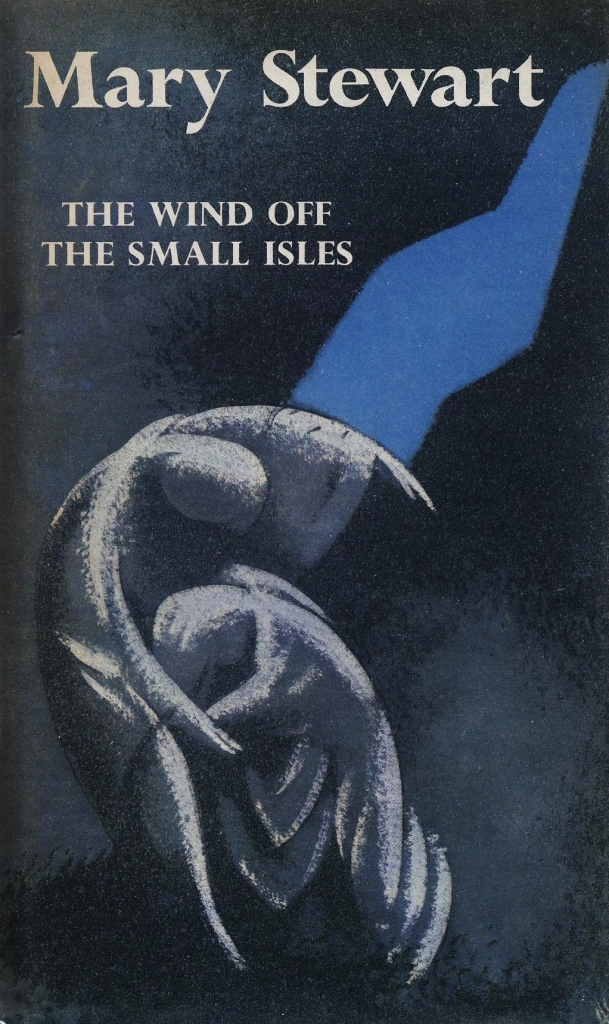
the wind off the small isles mary stewart 001The Wind Off the Small Isles by Mary Stewart ~ 1968. This edition: Musson, 1968. Illustrated by Laurence Irving. Hardcover. 96 pages.

Provenance: Montreal Books (ordered via ABE), October 2013. Purchased after warm recommendation by fellow reader Susan.

My rating: 7.5/10

I’ve been saving this book for just the right time, and, upon hearing of the recent death of its author, now seemed perfectly appropriate.

It was enjoyable, to be sure, and one which will join the others of Mary Stewart’s best on my re-read shelf, though it was unsatisfying in its brevity – there seemed so much more possible to do with these characters, almost as though it were a rather incomplete first draft of a longer novel.

This slender work is very much a vignette; a lead-up-to and description of an incident. Beyond the violent action of the climactic episode-of-peril, most of what goes on is friendly conversation between the four main characters: two very different writers and their young assistants.

Perhaps this is completely intentional? Danielle, in her long and exceedingly well thought-out must-read post on this novella on her marvelous (and perhaps now moved-on-from?) blog, The Romantic Armchair Traveller, has this to say.

In an essay published in 1973 Mary Stewart calls The Wind Off The Small Isles “a kind of coda” to the ten gothic and romantic suspense novels that precede it and “a bridge” to The Crystal Cave, her first historical novel (“Teller Of Tales” in Techniques Of The Selling Writer, edited by A. S. Burack, p.42). Now that I have finally had a chance to read the book, I think I can see what Stewart means. A novella of less than a hundred pages, The Wind Off The Small Isles can be inhaled in one quick, casual sitting. But in doing so one risks overlooking the allegory hidden within the simple story of lovers lost and found. For this is Mary Stewart’s dialogue with her own work, a meditation on the writer’s craft and a summing up of her philosophy.

This is reportedly the rarest of the Mary Stewart works. I have seen mention that it was originally published as a “feature novella” in a magazine – either (or perhaps both) Redbook or Good Housekeeping – but the promotional blurb on the book jacket inclines me to thinking that it was written as a stand-alone book, albeit a very short one. Never published in book form in the United States (ah! – perhaps that is why it appeared in the American magazine(s) instead) it is rather rare in the vintage book trade. Sadly so, for my edition is a physically lovely thing, beautifully illustrated by Laurence Irving and printed on thick, cream-coloured, heavily textured paper. A pleasure to handle and a definite enhancement of the short story.

From the jacket flyleaf:

Mary Stewart’s new story is lit with the special magic of people and of place that are the hallmarks of a famous author’s best work. In a series of deft brushtrokes she brings her heroine, Perdita—a beautiful twenty-three year old—to vivid life. A secretary to the redoutable children’s novelist, Cora Gresham, Perdita’s job carries her to the Canary Islands in search of local colour for a new masterpiece, and a peaceful house in which to write it.

But the house is already occupied—once by the past, and the haunting memory of what happened there a century ago; and now by its present owners—very much alive—a famous playwright and his research assistant, Michael. In the fierce beauty of the volcanic landscape, in the persons of Perdita and Michael, past and present meet, violently. The weird, semi-deserted island of Lanzarote is the scene for the collision which reshapes the lives of the young lovers, as it did a hundred years ago.

The Wind Off the Small Isles, for all its brevity, is complete and quintessential Mary Stewart. It is a book to read and re-read.

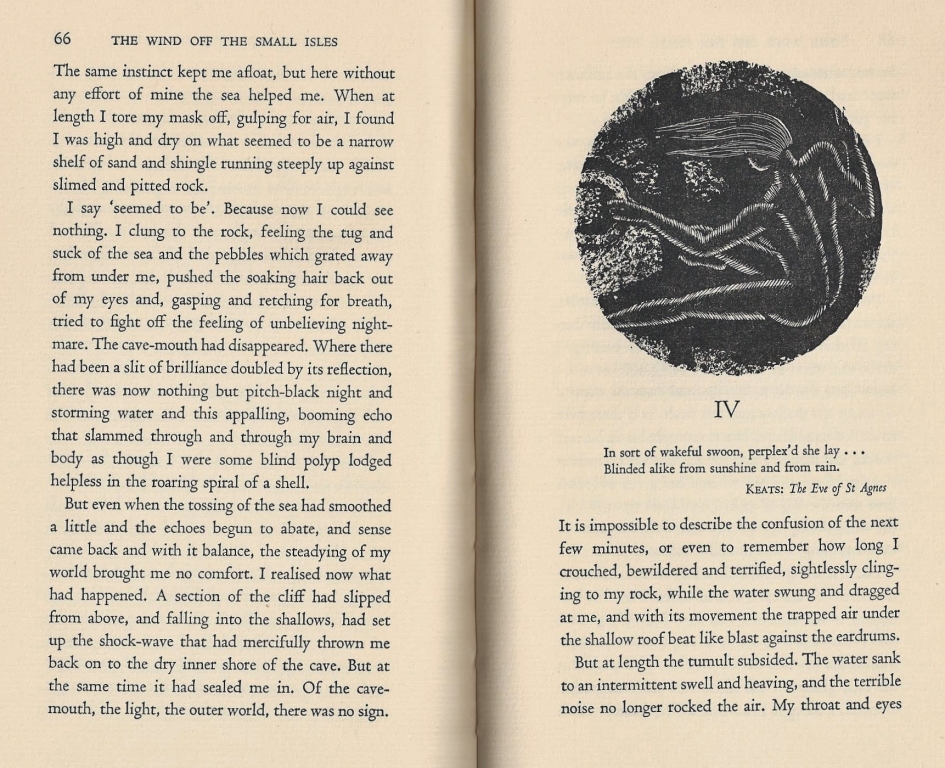
What a dramatic build up to what turns out to be a rather slight, rather thoughtful, perhaps not particularly dramatic story, though we do indeed have two sets of lovers in deadly peril, and a climactic action scene to cap off the gentle set-up. Well, three sets of lovers, really, if you count the couple in Keats’ The Eve of St. Agnes, which provides a rather good framing device and some appropriate chapter-heading excerpts. (Click image to enlarge to reading size.)

the wind off the small isles excerpt mary stewart 001

The most unusual element in this particular story is that while we have all of the other romantic-suspense standards – the lovely heroine and strong hero united in a situation of peril which throws them (literally in this case) into each others arms, absolute lashings of coincidence – we have no villain, no nefarious plot, no sinister complications with other characters. The danger comes from the setting itself, which is the evocatively depicted closest-to-Africa of the Canary Islands, Lanzarote, at the point in time when it was just starting to be developed into the tourist destination it is today, all super-civilized posh resorts set amidst a starkly contrasting natural setting.

Mary Stewart writes setting brilliantly, and the complex beauty of the bleak volcanic landscape is perfectly portrayed; searching out images of the places she described brought an instant nod of recognition. (I also spent a ridiculous amount of time off on a rabbit trail started by the references in the book to the cochineal industry which flourished on Lanzarote in the 1700s and 1800s; I had of course heard of the famous red dye produced by tiny insects, but was not familiar with the actual details. Quite amazing!)

The characters are instantly recognizable as well, for we’ve met them many times before in the vintage novels of Mary Stewart, Helen MacInnes, Frances Parkinson Keyes, and others of this writerly sisterhood.

The two older writers are well-respected (and rather lionized by their respective “publics”), financially secure, exceeding well-read and exceptionally well-travelled (those necessary “collecting local colour” excursions, don’t you know!); as much at home in their exotic writers’ retreats as they are in their English country cottages and New York brownstone walk-ups.

Their assistants – the equivalent of today’s young literary interns, though perhaps rather more generously financially compensated – are merely younger version of their employers. They combine athleticism and adventurous spirit with intelligence; they are charmingly golden in their youthful promise, and the dreamy bit of me is so very jealous of each and every one of them – they do lead rather envious lives, at least on paper!

In other words, the mixture as so many times before, and even in this highly abbreviated form, happily worthy of keeping about for a dash of escape reading to liven up our own same-old same-old days.

Because of its rarity and costliness – and the fact that it is a very slight thing, not a “proper” novel – I can’t comfortably recommend that you try to acquire this book unless you are an absolute Mary Stewart fan and need to own every single thing she published. It will likely still be available in the Canadian and U.K. library systems, though probably hidden well back in the most obscure stacks. The Goodreads page mentions the existence of a scanned version taken from Redbook; read through the reviews for hints on how to access this. Good luck on the quest!


Read Full Post »

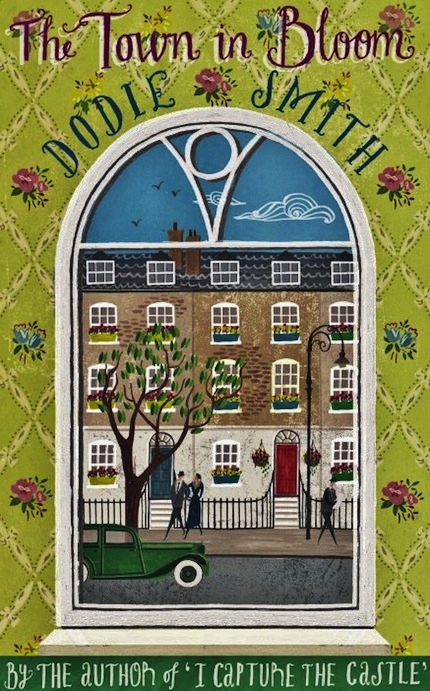
The Town in Bloom Dodie Smith corsair editionThe Town in Bloom by Dodie Smith ~ 1965. This edition: Corsair, 2012. Paperback. ISBN: 978-1-78033-301-4. 314 pages.

My rating: 8.5/10

After my mixed feelings about one of Dodie Smith’s “other” (meaning not I Capture the Castle) adult novels, The New Moon with the Old, and my rather shaky introduction to this one (I quit early on the first time of attempting to read it) I was very pleased to find that I did like this one, after all. A whole lot. Now isn’t that interesting?

Three ex-actresses meet for their every-five-years reunion dinner, hoping that this year, the eighth reunion, the fourth of their friends, the elusive Zelle, may join them, but it appears that this is not to be.

It’s been forty years since vivacious narrator Mouse (we never learn her real name), placid Molly and sleekly beautiful Lilian were all thrown together in the lively heyday of the 1920s London theatre scene. They have all gone on to varying degrees of success and happiness, and by and large enjoy their reminiscences every time they meet, but there is a shadow lurking regarding the unknown fate of the fourth of their jolly crew, who vanished (voluntarily) from her room in the theatrical boarding house they all shared and hasn’t been seen or heard from since, despite repeated pleas to join the reunion published in the personal ads of The Times.

As the three friends chat after their window table lunch, Mouse becomes increasingly intrigued by an eccentrically dressed woman huddled over her drab knitting on a park bench outside, who keeps glancing at the ladies inside in a surreptitious manner. Could it possibly be…?

An attempt to intercept the maybe-Zelle fails, but Mouse has marked the house her quarry disappeared into for future investigation. Meanwhile, the encounter has triggered a flood memories of the summer in the 1920s when the four girls came together in their unlikely friendship, and which ultimately saw all of them launched on their forever-after paths due to decisions made in the passionate heat of those few torrid months.

I hesitate to go much further in my description of the plot, because I did so enjoy unravelling it all on my own, but I will say that it involves a whole lot of sex. Thinking about it, talking about it, plotting how best to go about arranging it, and of course doing it. There is nothing at all graphic, aside from some teasing reference –  “I should write down all the details in my diary but well maybe I’ll just let it live in my memory…” – but these girls are all, in their own ways, carrying on very active love/sex lives. Mouse is assumed to be the most innocent, due to her relative youth (she’s eighteen) and child-like appearance (she’s tiny and innocent looking) but she turns out to be nothing of the sort, absolutely throwing herself into the experience, and eagerly shedding her virginity with only a few meditative regrets:

I was very happy too – in a way; I am finding that out as I write. I am, somehow…exorcising the loneliness. It will pass, it will pass.

But with it will pass someone I shall be a little sorry to lose: myself as I was before last night. Aunt Marion had a book of poems by Charles Cotton which she bought for the Lovat Fraser decorations, and in one poem are the lines:

She finds virginity a kind of ware
That’s very, very troublesome to bear,
And being gone she thinks will ne’er be missed.

I think one will miss it, but only for a very little while. Soon one will forget that it ever meant anything. Perhaps it never did; already I can almost accept that. The great plane tree outside my window is just as beautiful it was that May night when I last wrote in my journal, though its summer leaves are a little less green than the leaves of spring…

Shades of Cassandra Mortmain, I believe I detect in these youthfully self-focussed musings.

The novel gives a fascinating glimpse of the world of the 1920s’ theatre, being very much involved with backstage life, and the details Dodie Smith gives are worth wading through the occasionally tiresome teenage angst of our narrator, and the annoyances that her full-speed-ahead-towards-the-goal persona occasionally engender.

The theatre scenes of the first half of the book are fascinating, though the focus changes (dramatically) once the love affairs start. I did feel that perhaps Mouse’s experiences in the theatre were a bit too plush-lined – she seems to end jam side up pretty well each and every time she stumbles, being taken in and indulged and helped and sheltered again and again and again, even by those she’s deliberately wronged. Rather special, is our Mouse.

I was relieved by the ending, which wasn’t as blissfully neat and tidy as I feared it would be, though it glossed over a whole lot of bothersome details, citing their unimportance due to the passing of four forgetful decades.

Dodie Smith gained my readerly good regard by her willingness to show that there were no fairy tale endings, or, more aptly, that there are really no endings at all (except the very obvious final final one); life does go on and on and on, with no attainment of a permanent goal, and, furthermore, it (life) can continue to be exceedingly interesting, no matter what your birth certificate lists your age as.

Much has been made in some of the other reviews I’ve read about the unexpected feminist elements and the surprising frankness regarding sex in this book, but I didn’t at all feel that these were unusually daring, because though the novel was for the most part set in the 1920s, it was written in the 1960s. Though our mothers, grandmothers and great-grandmothers kept a discreet silence (for the most part) about their personal sexual affairs, there is no doubt whatsoever that their private lives were just as sophisticated as anything going on in this generation, so any sort of “Gosh! Golly! Gee whiz! These girls were downright modern in their escapades!” attitude gets nothing but a yawn from me.

To sum up, The Town in Bloom is a rather better book, in my opinion, than The New Moon With the Old, though I Capture the Castle still occupies a niche set well above either of these.

I have several volumes of Dodie Smith’s biography waiting on the TBR shelves, but I do believe I will investigate some more of her fictions first, if I can get my hands on them. It Ends with Revelations will be the easiest to obtain, and after that I’m not quite sure where to go. Possibly a play or two? Dear Octopus has been recommended to me as worthy of reading. And maybe a revisit to the juveniles, to dally for a bit among the Dalmations…


Read Full Post »

please don't eat the daisies jean kerr 001Please Don’t Eat the Daisies by Jean Kerr ~ 1957. This edition: Doubleday, 1957. Illustrations by Carl Rose. Hardcover. 192 pages.

My rating: 8/10.

I’ve had this book kicking around for years, as you can see from the sad state of its dust jacket pictured over there on the left (now covered with crinkly, shiny Brodart Just-a-Fold, one of my happier recent personal library improvement initiatives), and I re-read it with pleasure every so often. The only thing keeping it from a 10/10 rating is that it is too darned short; we never really get to settle down into it; it’s over and done with much too soon.

Jean Kerr lightly channels Shirley Jackson (the domestically-focussed SJ of Life Among the Savages versus the darker fictions, I hasten to add) and shines a cheerful and mildly sarcastic light on her own marriage and the goings-on of her four young sons.

Jean was always interested in the theatrical arts, and upon graduation from college, married one of her drama professors, Walter Kerr, who later became a prominent stage and film critic. The Kerrs dabbled in playwriting, producing a series of not terribly successful efforts, but having much more success with writing material for revues.

Jean Kerr did eventually have a hit, with the 1961 Broadway comedy Mary, Mary. She also wrote humorous essays which were published in various periodicals, such as the Ladies’ Home Journal and The Saturday Evening Post. Please Don’t Eat the Daisies is a compilation of these essays, and was followed some years later by other collections: 1960’s The Snake Has All the Lines, 1970’s Penny Candy, and 1978’s How I Got to Be Perfect.

Somewhere in the middle of Daisies, the Kerrs buy a house. Not just any house, but an eccentrically designed and decorated Larchdale, New York mansion formerly owned by a compatriot of Henry Ford, one retired inventor, world traveller and stuff collector, Charles B. King. King incorporated such features into his “fairy tale home” such as carved ceiling beams and a dining room floor made of planks from a retired paddlewheel steam ship, the door of ST. Gabriel’s Church, a clock tower, and a thirty-two bell courtyard carillon (connected to a clock in said clock tower) which played the duet from Carmen every day at noon.

The Kerrs found the house bizarrely irresistible, and persisted in their efforts to buy it from the trustees of the King estate, who could not agree on a reasonable asking price, until a fire destroyed one of the wings, and the price dropped to a level the Kerrs could manage.

For anyone interested in taking a peek at the house of the book, here is a link to an article and a slide show of a tour of the building prepared when Jean Kerr’s sons put the building up for sale in 2003, after it had been in the family for 58 years:

http://larchmontgazette.com/2003/features/20030318kerrhouse.html

Please Don’t Eat the Daisies caught the spotlight in 1960 as it was used as the basis of a romantic-comedy movie by the same name starring David Niven and Doris Day, and then a 1965-67 television sit-com based very loosely on the Kerr ménage and their unique home.

While I enjoy Jean Kerr’s on-page persona as a harassed mother of many (she eventually had six children, including one set of twins) I think my favourite essays in Please Don’t Eat the Daisies are the parodies of literary works. Stephen Vincent Benét’s sombre poem John Brown’s Body is presented as a readers’ theatre piece entitled Don Brown’s Body (starring Mike Hammer and set amongst the gangsters), while Francoise Sagan’s  A Certain Smile inspires Jean Kerr’s brutally funny mockery, Toujours tristesse. These two essays make the book for me; the Kerrs’ revues, if they were anything like these, must have been an absolute joy to attend.

A very clever lady, behind that “I’m just a harried mom who happens to write on the side” literary disguise.


Read Full Post »

the shapes of sleep j b priestley 001The Shapes of Sleep by J.B. Priestley ~ 1962. This edition: Granada, 1981. Paperback. ISBN: 0-586-05201-1. 190 pages.

My rating: 5/10

Close call, J.B. You almost didn’t make that 5, but my enduring fondness for your many years’ worth of earnest and good-humoured novels and essays and memoirs tipped the balance.

This is not so much a baddish book as a terminally undecided one. It reads like the author can’t quite decide on some rather major plot developments so has decided to make it up as he goes. Which can work, but in this case means false starts, dropped threads, and a general lack of a sturdy backbone to build the story upon.

And J.B. Priestley has tried his hand here at writing sexy, but it reads very much like the author is extremely uneasy with the style, and the hands-on-breasts and rigid (or not rigid) nipple descriptions are much more embarrassing for the reader than titillating. At least I found them so. I absolutely cringed, and mostly because it made the writer look inept and out of his comfort zone, style-wise. This is Priestley, after all, and you’d expect a higher level of capability in handling a scene. Any sort of scene.

Following closely on the heels of 1961’s uneven “suspense-thriller” Saturn Over the Water, Priestley further experiments with the genre, using the action to sugar coat some intellectual musings about the continual deterioration of societal mores, the dangers of state-sponsored paranoia (this is smack dab in the middle of the Cold War), and the status of women inside and outside of marriage. There are some fairly substantial shades of proto-feminism here, with Priestley trying his darnedest to articulate his support and appreciation for the “other side” from his masculine point of view.

So, regarding the actual story.

Here we have a freelancer journalist, Ben Sterndale, on the declining end of what was apparently a stellar career. He is offered a small job which will require him to use his investigative skills rather than his writing ability. A pale green piece of paper covered in mysterious figures and foreign handwriting has gone missing from an advertising agency office. Strayed or stolen, it is wanted back. Luckily there is a tiny corner of the paper left behind, with a few word ends which Ben interprets to be of German origin, and the investigation is on.

People with guns and sinister accents pop in and out, as well as a female person who is rather obviously not what she seems. Ben tenaciously follows every little lead, and by a combination of sheer bullheadedness and a fair bit of luck (courtesy our old fictional friend, the blissful coincidence) tracks down the secret behind the green paper as well as the girl.

A Helen MacInnes-like hectic tour of Germany plays a central role in the story; Ben-voiced-over-by-Priestley does not care for the Germans much – as I already sort of had gathered from his (Priestley’s) jibes in Saturn Over the Water – which adds an uneasy element to his adventurings in that country.

The mysterious paper and the secret it holds the key to are the least important thing going on here; so much so that even when we get a firsthand description of the “shapes of sleep” and their sinister inferences (spoiler: this would apparently be brainwashing and social engineering, to be delivered via subliminal messaging/advertising), we can’t quite believe that they are worth killing and being killed for, and they fade away completely in the last scene of Ben/Priestley mulling over the deteriorating state of the world and the changing status of women and their vital importance to future “peace and prosperity.”

I couldn’t help but wonder how much of this was due to Priestley’s private life influencing his writing. When The Shapes of Sleep was written, Priestley was sixty-eight years old, and just a few years into his third marriage, with archeologist/researcher and fellow writer (and Priestley’s co-writer in their 1955 collection of travel and opinion essays, Journey Down a Rainbow) Jacquetta Hawkes.

All in all, a rather unsatisfactory book, mostly interesting to this “fan” to enable me to check off another entry in Priestley’s widely-varied oeuvre. I may read it again one day to see if my impressions can be revised; then again, I may not.

Here, see Kirkus for its take, from June 15, 1962. I was amused to read this briefly cynical review after I had formulated my own, and to see that I was not alone in my disenchantment regarding this novel.

An uneven writer is our Mr. Priestley; one scarcely knows what to expect. This time as in last year’s Saturn Over the Water he has turned to suspense and an international spy story, but has fallen down in two aspects that made Saturn engaging reading. He never in this new book sets his scene so that the reader becomes absorbed in atmosphere and mood. Nor – on the story line – does he hold to a central thread that, intricate as the windings may prove, goes from Point A to Point B. This time he substitutes motion for action. His newspaperman, with a keen scent for the unusual, jumps from London to the Continent, from town to town and back again in Germany; but somehow he seems to be chasing his own tail, and even the near misses of danger peter out. Finally, there is a touch – just a touch – of the element of mysticism, which characterized his The Other Place back in 1955. And this too somehow dissipates the effect. And the injection of some random sex and a romance in which one cannot feel too involved does not add to the sense of unity demanded.

Read Full Post »

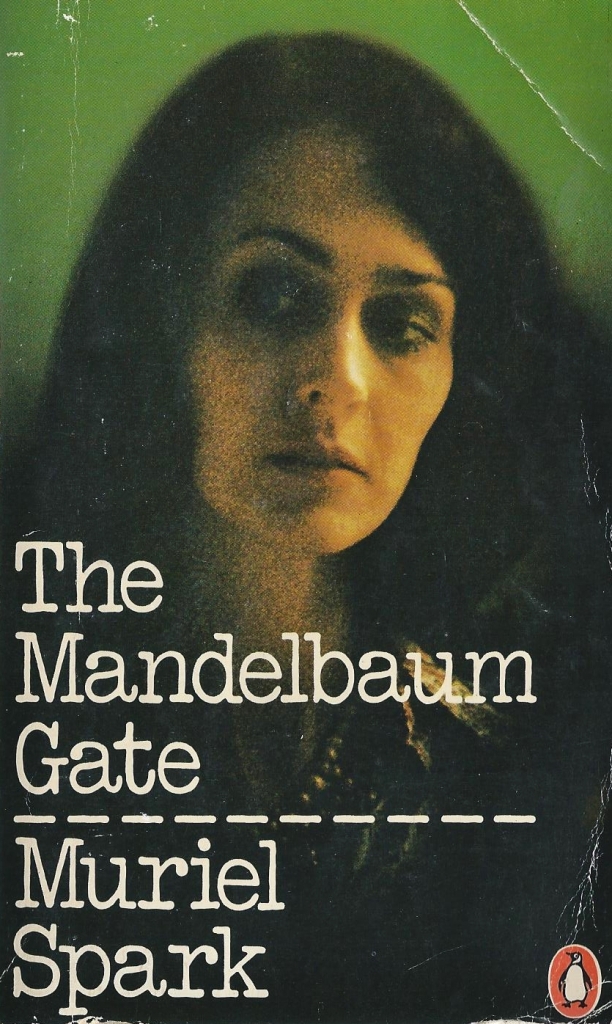
the mandelbaum gate muriel spark 001The Mandelbaum Gate by Muriel Spark ~ 1965. This edition: Penguin, 1977. Paperback. ISBN: 0-14-00-2745-9. 304 pages.

My rating: 7.5/10

Well, now, this one started out rather slowly but became increasingly enjoyable as I sorted out the many story strands the author tossed out and put names to characters and figured out how everyone knew everyone else and what the significance of all of the confusing references were. But it was toughish going for the first third or so. I’m glad I persevered – I almost didn’t.

For a long time I was afraid this was going to turn out to be one of those dismal and fatal tragedies, hearts all broken and dismal suicides and arbitrary deaths-by-misadventure – well, check out the sad face on the cover of my Penguin! – but the author graciously pulled a quickie on me there, resolving everything mildly and without bloodshed, except for one background character who perishes awfully far from the scene of the novel, and who we rather think deserves her nasty fate from what we’ve heard of her.

I liked this book. A lot. Which surprised me, because my expectations were low, after reading a number of dismissive comments regarding its place in the Muriel Spark canon on book blogs which are generally highly reliable indicators of “good” and “bad”.  Which just goes to show that one should remember that taste in books remains a nebulously personal thing.

I must be off and away again this morning, but I wanted to post something about this book and move on – my stack of “want to write abouts” is intimidatingly tall and I hesitate to add yet another. Drawing something of a blank on how best to frame this review, so I am going to refer you over to this excellent précis at Vulpes Libris, where Sharon Rob concisely identifies all of the important bits of this nicely complex novel.

A tiny excerpt here:

Protagonist Barbara is in her thirties, a Catholic convert from Judaism, (whose) status as a woman and a Jewish-Catholic one at that is one way in which Spark takes the thriller genre in hand and gives it a good shake. Barbara is gutsy, bloody-minded and heedless of other people’s opinions, but also committed to her own strong moral code. She is closer to the ideal of the intrepid hero than Freddie Hamilton, the novel’s central male protagonist…a fifty-something diplomat (who) in some ways is more of an archetypal female character than Barbara …who is bound by nothing she didn’t choose…

Barbara has decided, against all advice, to cross over from the Israeli-held side of Jerusalem to the Jordanian side through the titular Mandelbaum Gate, the “Checkpoint Charlie” of its place and time, in order to continue on a personal religious pilgrimage of the Holy Land. The fact that her fiancé, an archeologist working on the Dead Sea Scrolls dig in Jordan, is also “across the line” may or may not be a factor in her determination to put herself at serious risk (as a “person with Jewish blood”) and venture into forbidden territory.

Throw in Freddie’s well-intentioned attempts to save Barbara from herself, a Jordanian family of “fixers”, a couple of turncoat British spies, nuns, disguises, a scarlet fever epidemic, varied sexual liasions, the Catholic Church’s policy on valid marriages for its members, the sudden appearance of Barbara’s ex-roommate and ex-boss Ricky-the-scary-English-girls’-school-headmistress hot on Barbara’s trail, and – with chilling reminder of the atrocities of the Holocaust just past – the Eichmann trial (which Barbara attends as a spectator for a sobering afternoon), and you have a glorious muddle which eventually settles out into separate-though-interrelated strata and against all odds works.

Perhaps not a “typical Spark”, but as I haven’t read enough of her work to have a really good handle on what that even is – I have previously read with enjoyment The Prime of Miss Jean Brodie, though I failed to get more than a few pages in with Robinson – it struck me as quite good enough to make me keen to read some more of her novels and fill in the Muriel Spark-shaped gaps in this region of my reading history.

Read Full Post »

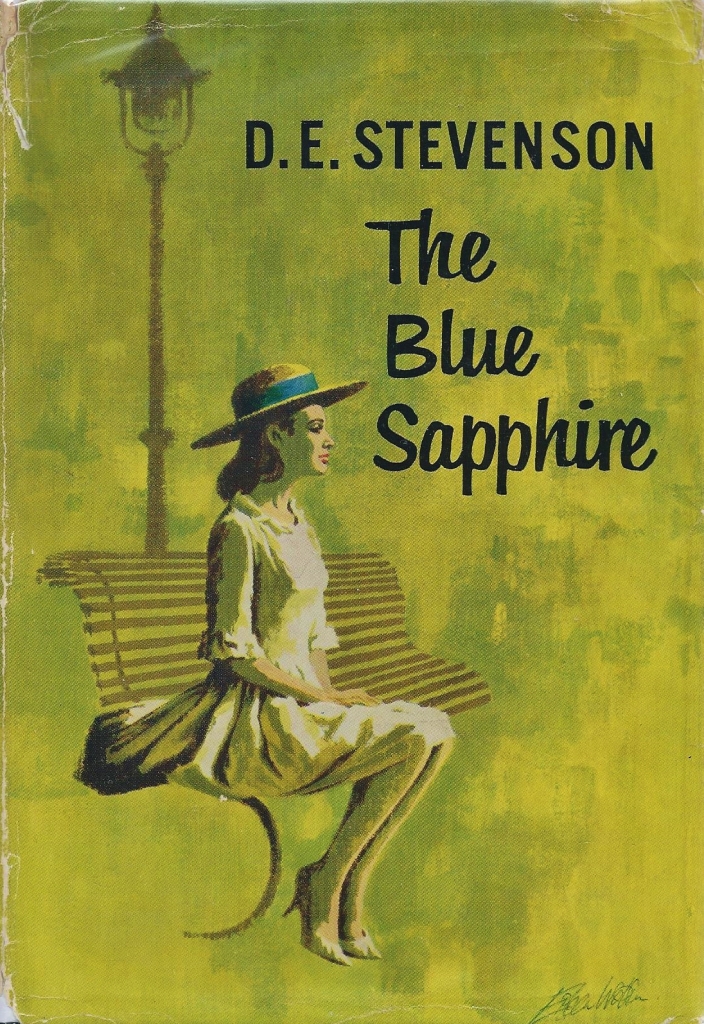
the blue sapphire d e stevenson 001The Blue Sapphire by D.E. Stevenson ~ 1963. This edition: Collins, 1963. Hardcover. 320 pages.

My rating: 9/10

Yesterday’s post was all supercilious and disapproving of D.E. Stevenson’s 1969 novel Gerald and Elizabeth, but happily I am able to balance that with a much more enthusiastic opinion of this also far-fetched but charmingly engaging 1963 effort.

There are several parallels between the two stories, which makes their comparison and my views of one as “good” (The Blue Sapphire) and the other as “not-very-good” (Gerald and Elizabeth) an interesting micro-study in perception and the ambiguities of personal taste. I won’t delve any more deeply into this aspect of these two books, but will zip right into a brief discussion of the book itself.

Dust jacket blurb:

The blue sapphire is a gem which the Ancients called the hyacinthus and which Solinus described as ‘a gem which feels the influence of the air and sympathises with the heavens and does not shine equally if the sky is cloudy or bright’.

On a beautiful spring day, Julia Harburn sat on a seat in Kensington Gardens enjoying the sunshine. She was wearing a white frock and a large straw hat with a sapphire-blue ribbon which exactly matched her eyes – a strange coincidence, as it turned out, for the blue sapphire was to have a far-reaching influence upon her life. So far, her life had been somewhat dull and circumscribed; but quite suddenly her horizons were enlarged. She began to make new friends – and enemies – and she began to discover new strength and purpose in her own nature. This development of her character led her into strange adventures, some amusing, others full of sorrow and distress. The story is itself a blue sapphire story, of clouds and sunshine.

As pretty Julia sits on her park bench waiting for her tardy fiancé Morland to appear for their teatime rendezvous, she is increasingly worried that she will be “annoyed” by the numerous questionable masculine types who have started closing in on her, like hopeful jackals surrounding a tender little gazelle. Luckily a rescuer appears in the person of tall, handsome and very forthcoming Stephen Brett, newly arrived in London after some years away in South Africa overseeing a gemstone mining operation. At first Julia snubs the friendly Stephen, but she soon warms to his innocent cheerfulness, and the two part on mutually appreciative terms just as Morland grumpily hoves into view.

Julia is waiting to break some rather big news to Morland. She has decided to move out of her father’s house and find a job and take a room in a boarding house. Some years ago Julia’s mother had died, and her new stepmother, while not at all cruel, is making it increasingly obvious that she would be happier if she were the only woman in the household.

Morland loftily dismisses Julia’s intentions of independence, but she holds firm, eventually ending up in an attic room in the fabulously Victorian-styled boarding house of the inestimable Miss Martineau, ex-actress and current patroness to “resting” theatrical folk. Miss Martineau takes a shine to Julia, and sets her up in a job at a posh hat shop, where Julia proceeds to thrive, becoming a very special chum to her new boss, the ex-Parisian Madame Claire, to the deep resentment of Julia’s several jealous co-workers.

Meanwhile Stephen Brett pops in and out of Julia’s life, adding some much-needed good humour and friendliness as Julia finds her way as a working girl and tries to cope with Morland’s moodiness and reluctance to set a date for their marriage. Stephen is embroiled in a complicated situation involving a potential sapphire mine back in South Africa; he finds relief from his worries in his growing friendship with Julia.

A turning point in the plot occurs as Julia receives a letter from her father’s estranged brother in Scotland, begging Julia to come and see him before he dies. Off she goes, against Morland’s advice, to find in her Uncle Randal the loving relationship she has never been able to attain with her own father. But Uncle Randal is declining rapidly, and it seems as though Julia will tragically lose him just when she has found him…

Stopping right here, because this is a sweet story which you will want to finish up for yourself. D.E. Stevenson is in her usual form, mixing unlikely scenarios with sunny-natured heroines, grumpy-but-ultimately-innocuous villains, salt-of-the-earth old family retainers, and a knight-in-shining-armour (or two) who appear(s) at just the right time.

The mixture-as-usual, but just what is needed in a book of this gentle genre. Highly recommended to those of you who like this sort of thing; everyone else, tactfully glance away!

Another Look Book liked it, too. As did Claire and Susan, who recommended it to me in the comments to my last year’s post about this other DES, also featuring the incorrigibly snoopy but divinely maternal Miss Martineau, 1966’s The House on the Cliff.

Read Full Post »

gerald and elizabeth d e stevenson 001Gerald and Elizabeth by D.E. Stevenson ~ 1969. This edition: Holt, Rinehart and Winston, 1969. Hardcover. ISBN: 03-066555-8. 245 pages.

My rating: 4/10

I hadn’t noticed a lot of discussion regarding this mild romance-suspense novel by the generally esteemed D.E. Stevenson in my online travels, and as it seemed to be widely available and very reasonably priced (for a DES book) in the second-hand book trade, I rather wondered why.

Well, I wonder no longer. The answer appears quite clear. It is my humble opinion that this book is not very good, and DES fans are keeping a discreet silence, spending their reviewing energies instead on the author’s top end novels.

While it’s sufficiently readable to keep one’s interest gently engaged, and there are charming passages and likeable characters galore, the whole thing is something of a stretch in numerous ways, even allowing for the DES formula of everyone ending up romantically paired up with all “mysteries” neatly resolved.

Dust jacket blurb:

Gerald Brown is young, good-looking, personable, but he holds himself aloof from the other passengers aboard the Ariadne, a small passenger ship returning to London from Cape Town, South Africa. In fact, his behavior is so extremely antisocial that he appears on deck only late at night, rarely venturing from his cabin during the day. Something is troubling him deeply, something that happened while he was working as an engineer in a Cape Town diamond mine that has left him spent and hopeless.

After the Ariadne docks in London, Gerald, desperately in need of a job, decides to contact his sister, the beautiful and famous actress, Elizabeth Burleigh, whose current play is the hit of the London theater season. As he reveals to her his haunting past in South Africa, he learns that she too is suffering, that behind her facade of gaiety and sophistication lurks a nagging suspicion about her mental health that is threatening to destroy her career and her love affair as well.

What are the forces that seem bent on these destroying these young people who have so much to live for? Can the mysteries surrounding their lives be solved – and in time to prevent irreversible consequences?

D.E. Stevenson reveals the answers to these questions in a way that will hold her thousands of fans breathless until the very end…

A glaringly obvious diamond-theft frame-up has our hero fleeing the gossip and speculative glances of South Africa to end up under the protective wing of his older half-sister Elizabeth, star of a rather goofy-sounding London stage play – Elizabeth plays a princess from the planet Venus marooned on Earth, to the delight of the hypothetical crowds who pack each performance during the play’s astoundingly successful run.

But all is not well in Elizabeth’s world either. Though feted by the all and vigorously courted by a kind, handsome and wealthy Scottish shipyard owner, Elizabeth fears that she has inherited the “melancholia” which plagued her long-deceased mother. How can she marry with such a doom hanging over her head? – for naturally it will be passed along to her own children!

As Gerald seeks to make a new start he also strives to delve into the background of Elizabeth’s mother, hoping to make some sort of discovery which will ease his sister’s worries and smooth the rocky path of her romance.

A wartime bombing raid on the night Elizabeth was born and an enterprising maternity nurse hold the key to the actress’s future happiness, and the events surrounding her birth are as spectacularly far-fetched as D.E. Stevenson’s conception of mental illness. Shades of the bizarre insanity scenario of Rochester’s Wife, published thirty years earlier, made me cringe in readerly discomfort for the author’s lack of research and her apparent clinging to archaic superstitions.

The mysteries aren’t very mysterious, and the characters never truly come to life. The author could and did do much better in many of her other novels. In my eyes, this is a book to round out one’s DES collection, but otherwise I feel that it is without a lot of merit. Please don’t give it to a neophyte Dessie; it might endanger one’s contention that this is indeed an author to spend time and energy tracking down!

Read Full Post »

It’s always fascinating to read vintage books aimed at the youth market. The terms “literary snapshots” and “period pieces” apply particularly well to this widely varied genre, though more serious themes tend to be handled in a gentle way, obviously in order to cushion young minds from the harsher realities of the world they live in.

I recently read these two American “juveniles” from the many which have accumulated on our shelves in the past nineteen years of buying books for the younger members of the family, and while neither is an outstanding piece of fiction in any sense of the word, they are both rather interesting in what they have to say about the eras they were written in and about. Footnotes to the period, as it were, which is why I’m including them among the Century of Books fellowship.

*****
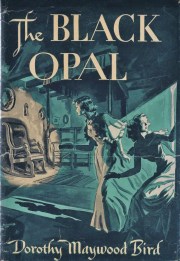
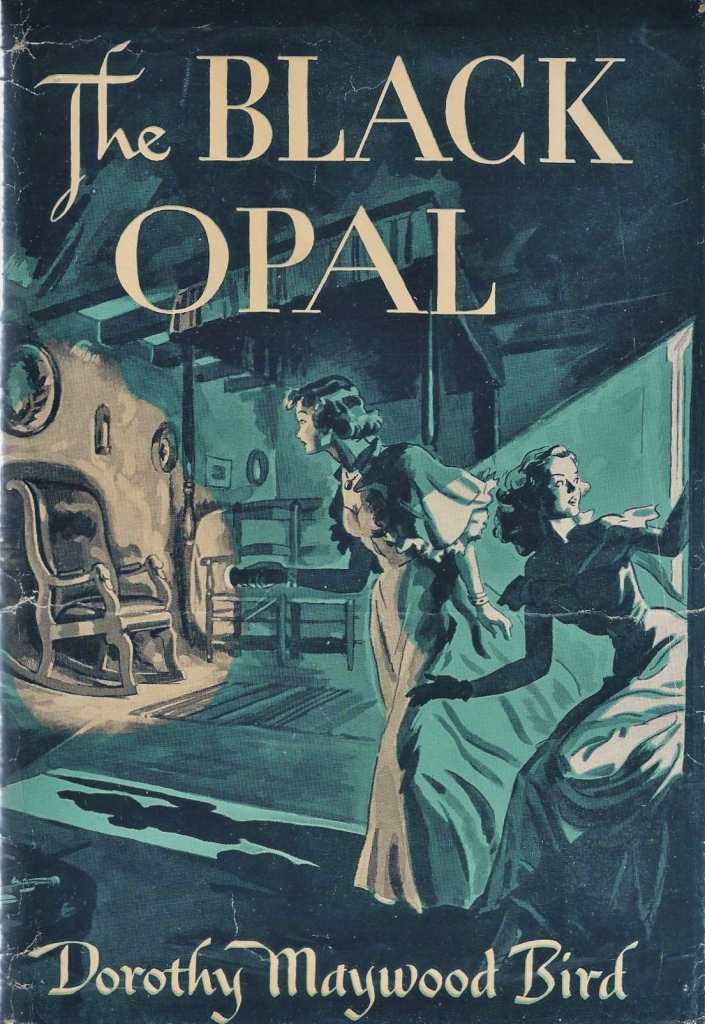
the black opal dorothy maywood bird 001The Black Opal by Dorothy Maywood Bird ~ 1949. This edition: Macmillan, 1962. (Ninth printing.) Hardcover. 202 pages.

My rating: 6/10

Surprisingly likeable was this rather hard to classify light novel, comprised as it was of equal parts college caper, highly contrived mystery, and blossoming romance. All right, maybe not that hard to classify! But the mixture works quite nicely, and the characters are highly appealing, and the whole thing is completely adorable. Decidedly a book aimed at the feminine readership of the junior high schools of its time.

Look, I even found an approving Kirkus review, from October of 1949:

When Laurel went off to the small coeducational college in Michigan which had been her great-great-grandmother’s alma mater, she expected it to be fun — and it was. What she didn’t know was that she would find herself up to the neck in a century old, unsolved murder mystery which was to give her the thrill of establishing the identity of the murdered man and his killer. The mystery theme is well-integrated and companions a satisfying modern college story of dates, term papers and strict house-mothers. There is not only the sinister black opal which Laurel unearths but also the exciting and sparkling diamond with which her One And Only ends the story. Maybe her solution will seem a trifle glib and maybe everything falls in place too smoothly, but no one will care for it is a nice, light entertaining tale with the virtue, highly to be prized, of not following an exact formula.

Laurel Stanwood has decided to do something a bit out of the norm. Instead of going with her high school friends to a college in her native Vermont, Laurel has chosen to attend a school, Colbert College, in far-off Michigan, a decision inspired by the fact that her Great-great-grandmother Caroline Hayes was a student of the precursor to the now co-educational facility, the Colbert Female Seminary, in 1846.

What follows is an absolutely typical account of lively college life. Laurel immediately makes two best friends, and immerses herself in a whirl of activity, where some serious studying is livened up by dramatic football games, campus socials, the ongoing “campus war” between the freshmen/juniors and sophomores/seniors, and some serious battling of the sexes via the two campus newspapers, the Colbert Feminist, under the editorial control of Laurel’s new friend Rue, and the Colbert Iconoclast, presided over by the woman-despising J. Swinton Towne. As an aspiring journalist, Laurel is immediately put to work gathering material for the Feminist; she has high hopes of finding a stunning “scoop” which will allow the Feminist to grind the Iconoclast‘s annoying pretensions to male superiority under its well-clad foot.

Lovely period details abound throughout this book, such as here where the girls are opening their mail at dinner time.

Laurel slit them open with her fork. The first, a circular, ordered her to make reservations at once for that Round-the-World Cruise she’d been eagerly awaiting since before the war. “Lapping waves,” it promised, “soft winds to caress your brow, nights full of wonder.” The second assured her that she could borrow up to three hundred dollars without embarrassing investigation and could pay it back in easy monthly installments. “Why be short?” it demanded. The third looked more hopeful, an expensive ivory envelope addressed in a feminine hand and postmarked Detroit. But the letter inside merely stated that if she planned to invest five hundred and fifty dollars in a genuine blue muskrat coat, she would do well to visit Compere’s Fur Salon first.

“Here’s a card from Mother,” Stacy giggled, “reminding me that if I want my duds to get into the Monday wash I can’t wait till Monday to mail them, and here’s a letter from Kent. Even if I didn’t recognize the scrawl, nobody else would have the nerve to start out ‘Dear Horseface.'”

Laundry sent home by mail for washing, stocking boxes to protect one’s cherished “nylons”, beau parlors to entertain your male guests in, telegrams sent with gay abandon in the same way teens today fire off texts to arrange their dates, having one’s hair washed once a week at the beauty parlor, Sadie Hawkin’s Day dances with both sexes in drag, apple cider socials, and a continual description of the most lovely-sounding clothes are happy period details. Laurel is continually sporting such gems as a “cherry flannel robe”(while filling out her college application form), “white wool gabardine suit” with a white chrysanthemum corsage (to attend a football game), “green silk raincoat” (actually that was Stacy’s, but it sounds quite sharp), “red cambric bolero edged in gold furniture braid” (for dressing up as a Spanish courtier on Sadie Hawkin’s Day), dungarees and sheepskin lined stadium boot (for winter hiking in the snow), a plaid gingham dress giving way to a “heliotrope spun rayon” (dressing for dinner, a must-do in the girl’s dormitory house), a beau’s “electric-blue loafer coat”, a friend’s “magenta taffeta with the bustle” prom dress, and Laurel’s own costume for the high point of the story, prom night topped off by discovery of the “Black Opal” mystery: mist-gray tulle with silver slippers and handbag, and a corsage of forget-me-nots, rosebuds and silver ribbon. Oh, swoon!

The girls, despite their life of strict midnight curfews and beau parlors, are given a wonderful amount of freedom; in most ways they are treated as completely competent adults and are left to sink or swim and make their own decisions in a way that many of the sheltered-but-socially-sophisticated teens of today would be most miffed to asked to do. Failed your Biology exam? Oh, well, guess you should have studied harder! No helicopter-parenting mom or dad in this 1940s’ world is about to confront the Biology prof to demand their pampered offspring’s mark be altered!

The historical murder mystery/mysterious gemstone plot, though prominent in the title and constantly referenced, is a very minor part of this happy little novel, though it forms a uniting thread throughout. It is the least well handled aspect of the book, being utterly predictable, totally fabricated out of unlikely coincidences, and not particularly believable even at its most detailed point. But this I completely forgave, because the rest of the story charmed me completely.

Dorothy Maywood Bird wrote two other similar novels, Granite Harbor and Mystery at Laughing Water, and I would be quietly pleased to get my hands on these at some point, for a little more travelling gently back in time.

*****
the year of the dream jane collier 001The Year of the Dream by Jane Collier ~ 1962. This edition: Funk & Wagnalls, 1962. Hardcover. Illustrated by E. Harper Johnson. 122 pages.

My rating: 4.5/10

This one is aimed at a younger set, the elementary school ages. Another very predictable plot, with rather more cardboardish characters, but again an interesting period piece with some redeeming features.

A middle-class family of five – mother at home baking cookies, father a teacher, thirteen-year-old Dick, twelve-year-old Wendy and younger brother Beanie – have been summering at a lakeside cottage and messing about with rowboats for years. But this year it somehow doesn’t quite satisfy – “If only we had a boat of our own…!” And not just a rowboat, but a proper boat. A cabin cruiser, so Mom can come along and not miss her kitchen(!) – bright red flag, here – first hint of era-correct gender stereotype, but far from the last.

Anyway, it’s decided that this is just a dream, as Dad isn’t exactly wealthy, and even a cheap cabin cruiser would cost thousands to buy. Then a chance conversation puts the family on the track of a derelict boat to be sold as part of an estate settlement. For two thousand dollars they can have it. Lots of work would be needed, but the boat is essentially sound. But where to find the money?

Everyone chips in and the year progresses as the pennies and dollars start to flow into the boat fund. The family decides to holiday at home and put their vacation money in the fund. Dad quits smoking and takes on an evening job, Wendy gives up her riding lessons and takes on babysitting jobs, Dick decides to raise rats to sell for science experiments, and Beanie roams the neighbourhood with his wagon collecting old newspapers to sell for salvage prices – 75 cents per 100 pounds. Even Mom finds something to do – she goes back to work in a law office part time, asking Wendy to step up and help out more at home.

Domestic details of the early sixties include a gee-whiz!-isn’t-it-great! reliance on cake mixes, instant pudding, canned everything, and casseroles of frankfurters and beans. Mom pores over a book called Shipboard Menus, leaving the mechanical and construction details of boat refurbishment up to the menfolk.

The only person not thrilled with the family’s common goal and their pursuit of their dream is Mom’s older sister, Aunt Louise. Louise had raised her younger sister after they were orphaned, and has settled into a prudently conservative spinsterhood. She lives in an apartment above the card and gift shop she has established with persistent self-sacrifice and dogged determination, and though she is the epitome of a self-sufficient woman she is, paradoxically, absolutely livid with Dad for “allowing” Mom to work. Mom, on the other hand, decidedly blossoms as she goes back out into the world, which inspires an interesting line of thought in twelve-year-old Wendy, about who “Mother” really is, and how she appears to herself and to each individual in her family, and what her mother’s own dreams might be, the ones she calmly has put aside to dedicate herself to her family. Inklings of the consciousness-raising going on in the greater world of the 1950s and 60s.

The dream – the cabin cruiser – is tantalizingly close to becoming a reality when catastrophe strikes, as young Beanie is struck and severely injured by a hit-and-run driver as he plods along with a wagonload of newspapers. Everything turns upside down as priorities are instantly re-assessed, with the two older children readjusting their personal ambitions for the boat without a murmur, much to the surprise of the adults in their lives, who have rather assumed that there would be resistance to the idea of letting the dream die.

Expectedly clichéd is the ending, with everyone rallying around and “family comes first” the slogan of the day; my greatest disappointment (from an adult point of view) was the sudden windfall that allowed the dream a new life. Artistically speaking, the sacrifice would have made for a stronger ending, but thinking back to my own juvenile reading days, the happy ending would have been appreciated by my young self, so I’ll let it go.

These sorts of books were a dime a dozen back in my elementary school years, mild dramas with some sort of a message attached, and The Year of the Dream is neither exceptionally good nor dreadfully bad. It’s a very average example of the middle range of juvenile literature of its era, and as such is worthy of a nod of appreciation as it helps to embellish the background against which “better” and more “mature” and “literary” books are set.

**********

I wouldn’t say that Jane Collier’s The Year of the Dream is worth looking for – it’s very much a nonentity of a thing – but for those of you who enjoy “teen girl’s fiction” of the 1940s and early 50s, precursors to the “malt shop” genre, Dorothy Maywood Bird’s three novels may be of some interest.

Read Full Post »

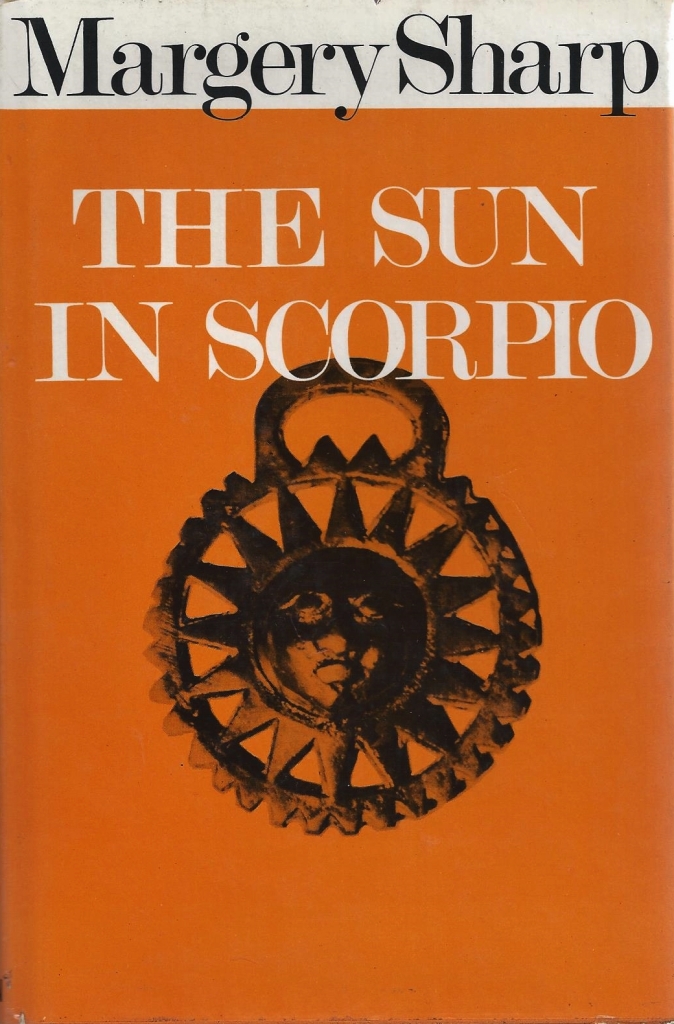
the sun in scorpio margery sharp 001The Sun in Scorpio by Margery Sharp ~ 1965. This edition: Heinemann, 1965. Hardcover. 231 pages.

My rating: 10/10.

She does it again.

Just when I thought I knew everything there was to know about Margery Sharp’s eclectic style, she pulls something new out of the hat. This is an absolutely crisp, clean and elegantly written novel, by a master of her craft, with some attention-catching stylings. I  suspect the author was enjoying herself quietly and deeply while working this out, based as it is on her memories of her childhood years in Malta.

Nice. Very, very, nice.

I’ve been sitting on this post for a few weeks now, waiting for an inspired moment to sit down and really delve into this book, but things are picking up speed in my real life and computer time for blogging is getting a bit pinched, so it’s looking like now or never. A quickie review it will have to be.

Everything sparkled.

Below the low stone wall, beyond the rocks, sun-pennies danced on the blue Mediterranean; so dazzlingly, they could be looked at only between dropped lashes. (In 1913, the pre-sunglass era, light was permitted to assault the naked eye.) Opposite, across the road called Victoria Avenue, great bolts of sunlight struck at the white stone buildings and richocheted off the windows. A puff of dust was a puff of gold-dust, an orange spilled from a basket like a wind-fall from the Hesperides…

Young Cathy Pennon, middle child of three growing up on an outpost of the grand British Empire, on the small island “next-door” to Malta, glories in the sun and basks in its rays. She is soon to leave the scene of her young years, as the growing winds of the Great War unsettle her civilian parents enough to urge a return to safer England. Cathy is soon to discover that she never will be truly warm again; the rainy isle of “Home” being resistant in its mists to the heat of that lost-and-mourned Mediterranean sun.

We follow Cathy, and to a lesser degree, her older sister Muriel and younger brother Alan, as they grow up in England, move into their adult years, and go their separate ways. Muriel is to find a comfortable niche in married domesticity; Alan settles into a happy bachelor existence while dedicating himself to the banking business – he is, ultimately tragically, of just the age to be destined to fight in the next great war – and Cathy drifts into a loosely-defined position as companion-lady’s maid to the aristocratic Lady Jean.

The book is a delicious moving picture of the years of and between the wars; our author touches delicately but succinctly on the many personalities and types of those years of tremendous flux, when the world is continually shaking itself and forming itself again as its inhabitants struggle, with various degrees of success, to come to grips with every new normal.

Cathy survives, though not without some scars, and we leave her at the end of the Second Great War poised for what looks to be the greatest change yet in her four decades of life, contemplating with wild surmise and growing joy the possibility of a return to the sun.

What a very good book this is. Margery Sharp is in absolutely fine form, having created a crisp, clean narrative with beautiful styling and more than a little cynically black ink in her accomplished pen. Cathy is a most human protagonist; full of flaws and not at all likeable a certain amount of the time; she tends to stand back a step from those around her, never fully entering in to the lives of those she bumps up against. A girl and then a woman of unexpected responses, and a few hidden talents…

Read Full Post »

« Newer Posts - Older Posts »