Archive for the ‘1960s’ Category

I am writing from exile, as it were. My usual “happy place”, as my ever-so-clever and perhaps slightly cynical offspring often call it, is a small room which was once dedicated to the more formal of our homeschooling endeavours. Those students are all grown up now, and over the past few years the schoolroom has turned into a not-very-well-organized office area for yours truly.

It’s really quite lovely in there, with two tall windows overlooking the garden, and lots of bookshelves. The space is (was!) filled by a work table overflowing with stacks of crucial papers (mine) and art supplies (my daughter’s) and mostly empty music CD and computer game cases (my son’s), an ancient oak teacher’s desk – but not of the antique-variety ancient, sad to say, merely of the old, scarred and scuffed sort – and a file cabinet full of the oddest collection of things – an abandoned knitting project from back in 1994 (a wooly sweater for my then-newborn son, who outgrew it long before it was completed), an out-of-order telephone answering machine (even older than the sweater), a stack of my old school report cards from the early 1970s, a small tub of child-proof electric outlet covers and cupboard door latches, the official pedigrees of several horses long since departed for greener (celestial) pastures, a collection of brown paper bags…everything, in fact, except for things-to-be-filed, like receipts and bills and important papers.

The floor in the little room has needed some serious attention for some time – the old linoleum was worn through to the plywood below in the main travel area – and when a recent cold snap which put a sudden stop to outdoor projects had us looking about for a small, manageable, renovation project we zeroed in on this one.

Everything was hastily bundled out of the room and deposited willy-nilly wherever a space could be found. My computer has ended up in a little hallway nook which usually houses the telephone and directories and stacks of incoming mail and such; it’s just large enough to squeeze everything in, and here I sit in a state of some discomfort, pecking away at my keyboard in a much less congenial atmosphere than my private little room.

A (tiny!) room with a view. Note that there is NO SNOW outside the window - very unusual for this part of the world at time of year. Mentioning this should immediately bring the snowflakes drifting down...

Playing about with floor tile patterns in a (tiny!) room with a view. Note that there is NO SNOW outside the window – very unusual for this part of the world at time of year. Mentioning this should immediately bring the snowflakes drifting down…

We’ve ripped up the old floor, replaced a few iffy floor joists and all of the plywood, removed a huge corkboard which took up most of one wall, added wainscoting to another wall, and brought out the paint tins. The new floor tiles are stacked up waiting for the acquisition of a bucket of glue next time I’m in town, and if all goes well I should be back in residence in the next week or so.

The old wooden desk has been relocated and another, larger, more “professional” ex-office steel desk is taking its place; my new view will be out those previously-mentioned windows versus the wall in the corner. I’m not sure what this will do to my concentration level, but I’m thinking it will be a happy psychological development. 🙂

The bookshelves are being relocated, and the stacks of “juveniles” they now contain boxed up for temporary storage; my working library of horticulture books may replace them, or perhaps just another bunch of novels. Not quite sure yet. Books find their own way about, in my experience.

A large grow light stand for the germination of December- and January-sown perennial seeds is planned for the remaining space; the old stand was unceremoniously hauled outside during our last winter’s renovations, and as the plant nursery sabbatical period comes to an end (see Hill Farm Nursery for more on that aspect of my life) indoor early seed-sowing facilities are once again about to be required.

Oh, and the file cabinet is being emptied out, with high hopes that in its new life it will actually be used for its intended purpose – that of holding files. The “cardboard box filing system” which I have been using in the past is apparently going to change. Or so declares my perhaps-too-optimistic husband. 😉 We’ll see. About half of the stuff currently taking up space in the cabinet is his, so he’s hardly innocent of random stashing of “treasures” himself. It’ll be interesting to see what he makes of his stuff, and where it will end up! I have several empty cardboard boxes awaiting his pleasure…

Well, I did promise book notes too, didn’t I? So I think I will tuck a few in here on the end. Minor notes for minor books. These are all from the shelves in the now-ex-schoolroom. I enjoy occasionally reading from the juvenile stacks – well-written books easily cross genre and “intended-age” boundaries.
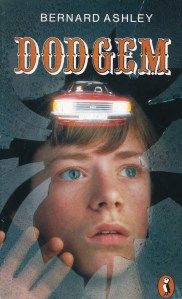
dodgem bernard ashley 001Dodgem by Bernard Ashley ~ 1981. This edition: Puffin, 1983. Paperback. ISBN: 0-1403-1477-6. 222 pages.

My rating: 6.5/10

A better-than-average “problem novel” by ex-headmaster and prolific children’s and young adult fiction writer Bernard Ashley – see his biography here.

Teenage Simon is in trouble with the Child Welfare; he’s been skipping school in order to care for his father, who has been in a state of severe clinical depression since the death of Simon’s mother, a death surrounded by questions, which have torn the small family even further apart in ways which will only become too apparent part way through the novel.

Simon ends up “in care”, and, desperate to return to his father, teams up with the seemingly emotionless Rose in a well-thought-out escape plot which seems at first to be daringly successful.

Decidedly well written and totally engrossing, this short novel, from early in Bernard Ashley’s writing career, was made into an acclaimed 6-episode British television series.

Scenes set in a juvenile care home and in a travelling carnival are excellent in their detail. Despite the young protagonist’s rage against the system which one completely sympathizes with, the adults are given as much time on the page as the teenagers. There is a quite remarkable balance of points-of-view, unusual in this sort of highly-contrived juvenile novel.

This is the only book by Bernard Ashley I’ve yet read, but if the writing quality stays the same in subsequent books he might be worth investigating further for those of you with young teens, or if you are merely open to reading novels targeted at younger-than-adult readers.

*****
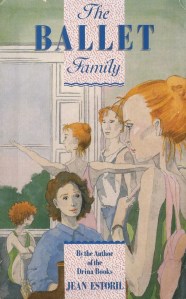
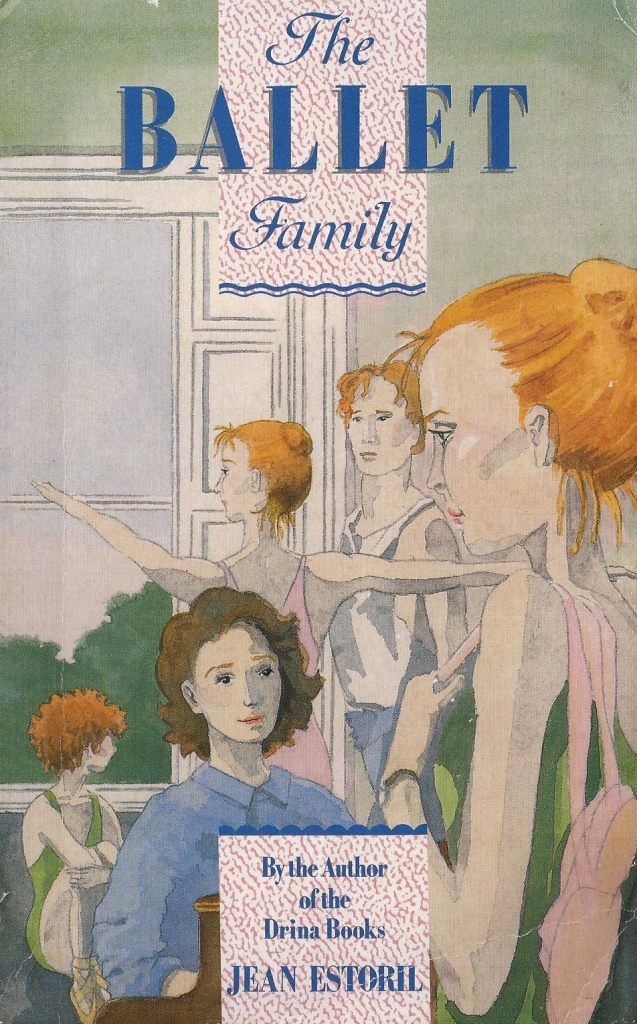
the ballet family jean estorilThe Ballet Family by Jean Estoril ~ 1963. This edition: Macdonald Children’s Books, 1989. Paperback. ISBN: 0-356-16797-6. 176 pages.
My rating: 6/10

Jean Estoril was one of the several pseudonyms of Mabel Esther Allan, a prolific writer of children’s books (Wikipedia reports 130) between 1938 and 1994. The “Jean Estoril” books were all concerned with the world of ballet, most notably a series about an orphaned aspiring dancer, one “Drina” (short for Andrina)  – Ballet for Drina, Drina’s Dancing Year, Drina Dances in Exile, and so on.

I am rather leery of juvenile series books, but in this case I may investigate further, for The Ballet Family, not about the afore-mentioned Drina but instead concerning a group of hyper-talented siblings and their orphaned cousin, is intriguingly good for its sort of thing. Better, in my opinion, than Noel Streatfeild’s ubiquitous (and perhaps over-rated? – others of her books are much, much better, in my humble opinion) Ballet Shoes, which I must confess causes me to grit my teeth here and there.

Mabel Esther Allan studied ballet in her younger years, and it shows, in a good way. The Ballet Family is quite marvellously realistic regarding the dance aspect, aside from the glorious improbability of the initial set-up.

Pelagia, Edward, Anne and Delphine Garland are all dancers and ballet mad. Their mother is a prima ballerina and their father a conductor of the ballet company orchestra.

When their cousin Joan is orphaned she comes down from Lancashire to live with Garlands in London. Confused and lonely, Joan finds it hard to fit in, especially as her cousins are rather wary of her and don’t understand how Joan could survive without knowing anything about ballet!

But Joan does survive and begins to enjoy her new life observing the ups and downs and tears and triumphs of her glamorous cousins.

Pelagia flits in and out of the story, being the eldest and very much concerned with her burgeoning career, Edward is a decent sort with sensible notions, Delphine is a spoiled brat who needs (and thankfully gets) a reality check, but the book is really mostly about middle sister Anne and her difficulties relating to her cousin, whom she finds nothing at all in common with, and whose apparently sullen attitude (she’s really deeply grieving the sudden loss of her beloved mother) precludes friendly girlish chats.

Joan finds her feet in her new life, and astounds the self-centered Garland family by displaying some talents of her own they had no inkling of. Bless the author – Joan does not turn out to be ballerina material – she doesn’t even try to go there, nor do the Garlands ever expect her too, for she is much too “old” to start, in their united opinion – her special talent is in a slightly different area.

A slight book, but very nicely done.

 She Reads Novels gives a glowing recommendation to some of Jean Estoril/Mabel Esther Allan’s books. I think I will be following up on these.

*****

green-knoweThe Children of Green Knowe by L.M. Boston ~ 1954. This edition: Faber & Faber, 1962. Illustrations by Peter Boston. Hardcover. 157 pages.

My rating: 7.5/10

A subtle classic of children’s literature, this novel calls one back to the elusive world of imaginative childhood, when all things are possible, and some things are downright magical.

Synopsis cut and pasted in directly from the Green Knowe Wikipedia page, because whomever wrote it did a lovely job of summation of the story set-up:

The Children of Green Knowe is the first of the six books written by Boston about the fictional manor house of Green Knowe. It was a commended runner up for the 1954 Carnegie Medal.

The novel concerns the visit of a young boy, Toseland, to the magical house of Green Knowe. The house is tremendously old, dating from the Norman Conquest, and has been continually inhabited by Toseland’s ancestors, the d’Aulneaux, later Oldknowe or Oldknow, family. Toseland crosses floodwaters by night to reach the house and his great-grandmother, Linnet Oldknow, who addresses him as Tolly.

Over the course of the novel, Tolly explores the rich history of his family, which pervades the house like magic. He begins to encounter what appear to be the spirits of three of his forebears—an earlier Toseland (nicknamed Toby), Alexander, and an earlier Linnet—who lived in the reign of Charles II. These meetings are for the most part not frightening to Tolly; they continually reinforce the sense of belonging that the house embodies. In the evenings, Mrs. Oldknow entertains Tolly with stories about the house and the children who lived and live there. Surrounded by the rivers and the floodwater, sealed within its ancient walls, Green Knowe is a sanctuary of peace and stability in a world of unnerving change.

The encounters of Tolly and his ghostly companions are reminiscent of similar scenes in some of Elizabeth Goudge’s books, being serenely beneficent rather than at all frightening. Though there are a few twists…

children of green knowe l m boston peter boston 001The full-page and in-text illustrations by Lucy M. Boston’s artist son Peter are intricately detailed in pen-and-ink and scraperboard technique; make sure the copy you share with your child (or read for yourself) has these included; many of the cheaper paperback and some later hardcover editions are missing these.

Perhaps I should have kept this review for closer to Christmas, as that celebration features strongly in one of the most charming incidents in the story.

In a word: Nice.


Read Full Post »

All  three of the following deserve in-depth reviews, and perhaps one day I will re-read them all and do just that, but for now the following must suffice. These “women’s works” are all exceedingly different from each other, and reward the reader in a variety of ways. Their one meeting point is that they are all, to various degrees, concerned with what it means to be a mother.

*****

roast beef medium edna ferber 1913 001Roast Beef, Medium by Edna Ferber ~ 1913. This edition: Grosset & Dunlap, 1913. Illustrations by James Montgomery Flagg. Hardcover. 296 pages.

My rating: 7/10

A slightly  unexpected book, for I have always associated Edna Ferber with sincerely-meant dramatic novels, all about earthily passionate immigrants and melodramatic family sagas. In Roast Beef, Medium, we have a rather quieter sort of tale, of a single mother way back at the beginning of the 2oth century working away to support herself and her teen son, in an unexpectedly “modern” style.

Our heroine, Emma McChesney, is a traveller in petticoats, in both senses of the term. She has a past history of a ne’er-do-well ex-husband, and is the deeply proud mother of a seventeen-year-old son whom she supports in a respectable boarding school. Her area of expertise is ladies’ undergarments, for Emma McChesney is one of the more successful travelling salesmen (in her case I suppose that would be saleswomen, though she rather stands alone in this male-dominated calling) for T. A. Buck’s Featherloom Petticoats.

It’s a tough sort of business to be in, for along with stiff competition in the ladies’ lingerie department – there is a positive crowd waiting to press their particular wares on every department store in the mid-west American sales territory where our Emma operates – there is a continual male-female dance of propriety, for Emma is a very handsome woman, and her good looks belie her ten years on the road and her status as the mother of a son approaching adulthood.

Emma can handle those who assume she is an easy mark for some casual romance, but deep down inside are the pangs of loneliness. What does the future hold…?

An explanation of the title is in order, and here are the words of the author herself.

FOREWORD

Roast Beef, Medium, is not only a food. It is a philosophy.

Seated at Life’s Dining Table, with the Menu of Morals before you, your eye wanders a bit over the entrees, the hors d’oeuvres, and the things a la, though you know that Roast Beef, Medium, is safe, and sane, and sure. It agrees with you. As you hesitate there sounds in your ear a soft and insinuating Voice.

“You’ll find the tongue in aspic very nice today,” purrs the Voice. “May I recommend the chicken pie, country style? Perhaps you’d relish something light and tempting. Eggs Benedictine. Very fine. Or some flaked crab meat, perhaps. With a special Russian sauce.”

Roast Beef, Medium! How unimaginative it sounds. How prosaic, and dry! You cast the thought of it aside with the contempt that it deserves, and you assume a fine air of the epicure as you order. There are set before you things encased in pastry; things in frilly paper trousers; things that prick the tongue; sauces that pique the palate. There are strange vegetable garnishings, cunningly cut. This is not only Food. These are Viands.

“Everything satisfactory?” inquires the insinuating Voice.

“Yes,” you say, and take a hasty sip of water. That paprika has burned your tongue. “Yes. Check, please.”

You eye the score, appalled. “Look here! Aren’t you over-charging!”

“Our regular price,” and you catch a sneer beneath the smugness of the Voice. “It is what every one pays, sir.”

You reach deep, deep into your pocket, and you pay. And you rise and go, full but not fed. And later as you take your fifth Moral Pepsin Tablet you say Fool! and Fool! and Fool!

When next we dine we are not tempted by the Voice. We are wary of weird sauces. We shun the cunning aspics. We look about at our neighbor’s table. He is eating of things French, and Russian and Hungarian. Of food garnished, and garish and greasy. And with a little sigh of Content and resignation we settle down to our Roast Beef, Medium.

E. F.

This is a light sort of novel, but it has its merits, and it works quite well as both a period piece and a nicely worked bit of domestic vintage American fiction. Slip on over to Gutenberg, and read this for yourself.

Roast Beef, Medium was Edna Ferber’s third published novel, and she went on to write many more of increasing popularity – think Show Boat, American Beauty, So-Big, Ice Palace, and Giant, among others – to take her place as one of the most successful mainstream novelists of her time. Her writing career stretched from 1911 to 1963, and her novels provide a lively – if decidedly dramatized – portrait of American life.

*****

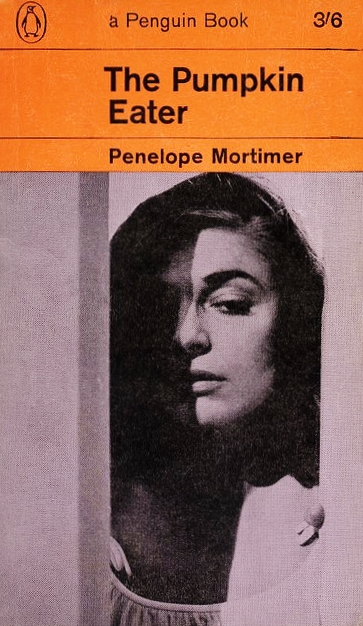
the pumpkin eater penelope mortimer 1962The Pumpkin Eater by Penelope Mortimer ~ 1962. This edition: Penguin, 1969. Paperback. 158 pages.

My rating: 9/10

This book has been described as proto-feminist, on par with Germaine Greer’s writings, and though I wouldn’t go that far myself, I will agree that it is very much a book of its time and demonstrative of the uneasy gender-battling mood of the late 1950s and early 60s.

Penelope Mortimer’s The Pumpkin Eater is a grimly can’t-look-away, can’t-quite-believe-I’m-reading-this, what-is-the-author-really-trying-to-say, blackly funny self-portrait of a seriously troubled woman and her bizarre approach to both motherhood and marriage. Apparently drawn from Mortimer’s own experience, it nevertheless reads like the strangest of fictions, and though the tale fascinated me it left me utterly untouched in any sort of personal way, save for my feeling of admiration at Mortimer’s success at keeping me engaged even when I wanted to put the book down and walk away.

Absolutely cheating here on writing an actual précis, by providing that of the re-publisher of this odd little novel. The New York Review of Books included it in their 2011 reprint list, and this is what the promotional material has to say:

The Pumpkin Eater is a surreal black comedy about the wages of adulthood and the pitfalls of parenthood. A nameless woman speaks, at first from the precarious perch of a therapist’s couch, and her smart, wry, confiding, immensely sympathetic voice immediately captures and holds our attention. She is the mother of a vast, swelling brood of children, also nameless, and the wife of a successful screenwriter, Jake Armitage. The Armitages live in the city, but they are building a great glass tower in the country in which to settle down and live happily ever after. But could that dream be nothing more than a sentimental delusion? At the edges of vision the spectral children come and go, while our heroine, alert to the countless gradations of depression and the innumerable forms of betrayal, tries to make sense of it all: doctors, husbands, movie stars, bodies, grocery lists, nursery rhymes, messes, aging parents, memories, dreams, and breakdowns. How to pull it all together? Perhaps you start by falling apart.

This doesn’t really portray the surreal atmosphere of this tense tale, but it does give a general idea of the storyline, which doesn’t really matter, as it is all seen through a fog by the narrator, the “mother-of-many”, who never gets her own name.

The writing is marvelous; the humour is richly dark; the subject is immensely uneasy-making. And the ending is beyond nebulous. What is reality, anyway? And why not seek comfort in dreams?

The Pumpkin Eater was also made into a 1964 movie, with screenplay by Harold Pinter, starring Anne Bancroft, hence the cover image on my old Penguin paperback. Haven’t seen it (the movie) myself, and quite frankly I have no desire to, though I have heard it spoken highly of. The book was quite enough, thank you kindly.

*****

within this wilderness feenie zinerWithin This Wilderness by Feenie Ziner ~ 1978. This edition: Akadine Press, 1999. Softcover. ISBN: 1-888173-86-6. 225 pages.

My rating: 8.5/10

Within This Wilderness is an autobiographical account of Ziner’s final attempt to come to terms with her adult son’s rejection of society and his retreat to the remote coastal woods of British Columbia’s Vancouver Island.

I found this book deeply moving, in a decidedly personal way. Though the circumstances of our lives are not in any way identical, the evolution of the mother-son relationship and the delicate negotiation of expressing maternal love and the desire for “safety” for one’s child warring with the needs of a young man for walking his own path and making his own mistakes is something I share with this other mother, and, I suspect, most other parents whose moved-beyond-us children have stepped somewhat aside from the well-marked path of our particular society’s norm.

Kirkus sums it up perfectly:

Feenie Ziner’s son Ben was one of those Vietnam war casualties who was never in uniform: spooked by the military buildup, repelled by the consumer culture, he dropped out of school and took off for the Northwest, talking of cosmic energy and inner space, drifting in and out of lack-limbed communes, ultimately settling on his own wilderness island. Anxious for his return or at least some answers, Ziner flew in after he’d been living alone for nearly two years, and her skillfully developed account of what transpired between them – a progressive disarmament – slips over the boundaries of personal experience. She masters the primitive flusher and inures herself to thoughts of wolves (“I’ve read Farley Mowat”); he points out handmade appliances and shares new wisdoms (“Plastic is to us what horses were to the Spanish”). They lie to each other, spar philosophically, and resume a fragile peace. Even the eccentric neighbors – classic misfits – find him difficult. “Why does he make himself so damned. . . inaccessible?” “Why does he live that way? As if he were expiating for some kind of a sin?” She draws on the tranquillity of the place, reads the I Ching with the beatific vegetarian round the bend (“The companion bites a way through the wrappings”), and waits. And eventually the staunch independence unmasks, the precarious self-esteem surfaces, a pained confession of inadequacy is spoken. One must suppress dark thoughts about the shaping of this material (could it have happened so smoothly? was she taking notes?) for the perfect curve of events seems almost too good to be true. But Ziner deftly renders the nature of their exchange and the nuances of her private adventure, and the illumination of his fringe benefits and her mainstream hollows will reach that audience attuned to generational discord and cultural reflections.

Very much worth reading. Recommended.


Read Full Post »

I must do some round-up posts – I have ten months’ worth of miscellaneous stray reads stacked up and begging to be re-shelved, but I don’t feel that I can happily do that until I at least give them a quick summation. Most books worthy of time spent reading them deserve thoughtful posts all to themselves, and I wish I could do that, but life is full of a variety of occupations, and there are still only twenty-four hours in each day.

I’m hoping to clear at least some of the backlog of books-I-read-in-2014-but-haven’t-managed-to-post-about, and at the same time tidy up the Century of Books list. I’m a bit afraid to look at it, but if I check off a few more of the years, I think I may still find that the December 31st goal is within reach. Though perhaps I will need to seek out some shorter tales to fill in the gaps. Didn’t someone who tackled this project a few years ago (Stuck-in-a-Book’s Simon?) resort near year’s end to reading Beatrix Potter for some of those troublesome years? Nice and short, definitely worthy of attention, and conveniently published year-after-year-after-year in a hard-to-fill Century time slot. 😉

Well, here we go. Hang onto your hats, people, for if all goes well the next few days will see a flurry of micro-reviews.

*******

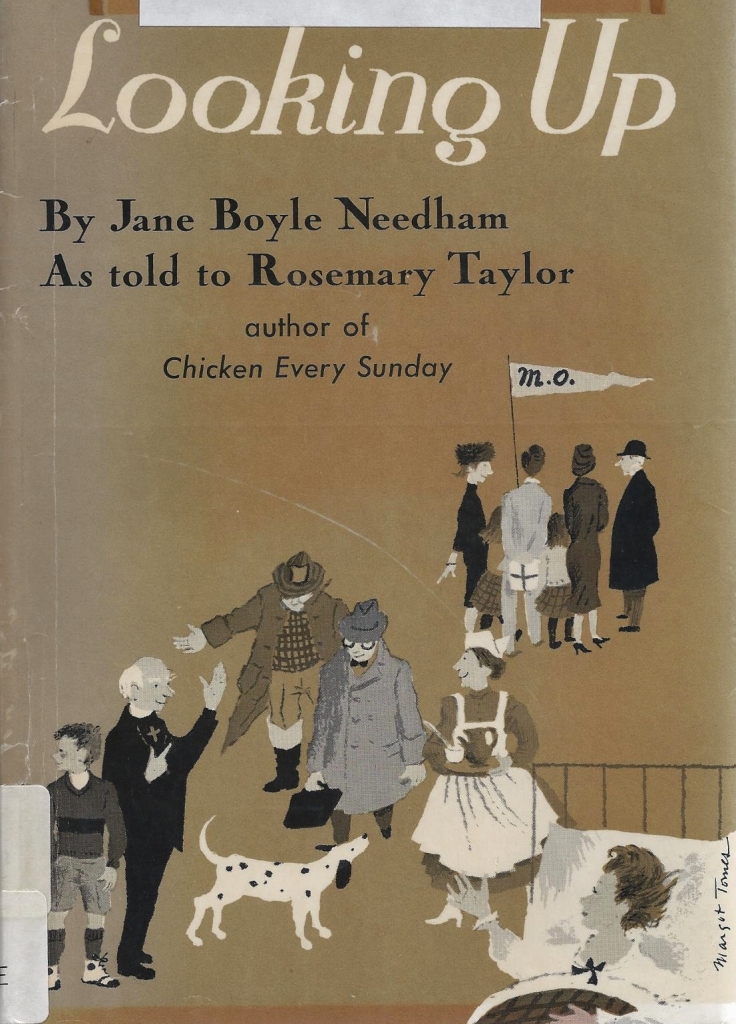
looking up jane boyle needham rosemary taylor 1959 001Looking Up by Jane Boyle Needham, as told to Rosemary Taylor ~ 1959. This edition: G.P. Putnam’s Sons, 1959. Hardcover. 191 pages.

My rating: 7/10

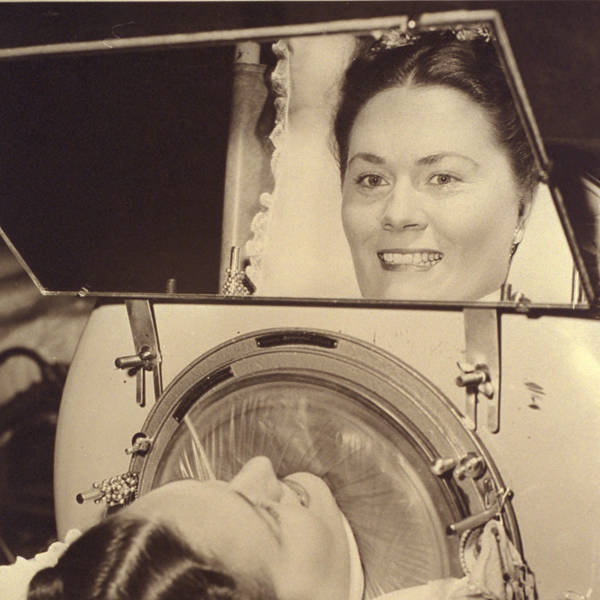
This was a rather unusual memoir, narrated by the author to journalist/memoirist Rosemary Taylor (Chicken Every Sunday, Harem Scare’m) for the very good reason that the subject was paralyzed from the neck down as a result of adult-acquired bulbar (affecting the brainstem) polio in 1949, when she was 27 years old. Jane Needham lived in an iron lung for thirteen years, until dying from complications of gall bladder surgery in 1962.

Looking Up was written when Jane Needham had been in the iron lung for nine years. She was, as she well knew, living on borrowed time. After five years in hospital, Jane Needham decided that she needed to make a concerted effort to provide as “normal” as a home as possible for her three children.

She had been unexpectedly divorced by her husband several years earlier and had with difficulty retained custody of her young children. Her elderly parents liquidated their assets, moved into an apartment, and purchased a house for Jane, the children, and Jane’s round-the-clock private nurses. Unable to breathe on her own, and never regaining more than twinges of movement in her extremities, Jane did create a functional home and proceeded to confound the naysayers who predicted disaster.

Jane Boyle Needham, quite literally "looking up", into the mirror attached to her iron lung, which allowed her to view her world.

Jane Boyle Needham, quite literally “looking up”, into the mirror attached to her iron lung, which allowed her to view her world.

The tone of this book is rather unrelentingly cheerful; one might call it positively inspirational. Jane Boyle Needham comes off as a darned good sport, even when relating her experiences with her rather caddish husband. Perhaps her strong Catholic faith had something to do with this? Towards the latter part of the memoir Jane goes on at great length about the strength her faith has given her, and the spiritual and moral assistance given to her by her parish priests.

Or perhaps the positive tone was partly façade? But Jane does manage to occasionally convey the anger at her fate and the anguish of her spouse’s betrayal; occasionally she is downright cutting, and those bits are a relief, because otherwise this woman’s saintliness and fortitude would be much too good to be true.

This book, something of a bestseller in its time, is a fascinating glimpse into the world of the many polio sufferers whose lives were saved by the invention of the iron lung and various portable breathing apparatus. Every breath was a struggle, brutal physical pain was a constant, and death was ever-present, lurking around the corner. A few moments of electrical outage, and it could be game over, quite literally, unless one had an attendant who could immediately start manual lung compressions.

The chirpy tone of Jane Needham’s narration serves to add piquancy to her tragic fate. She desperately hoped to live long enough to see her children make their way in the world; they would have been still in their teens when she died. I wonder what became of them?

*****


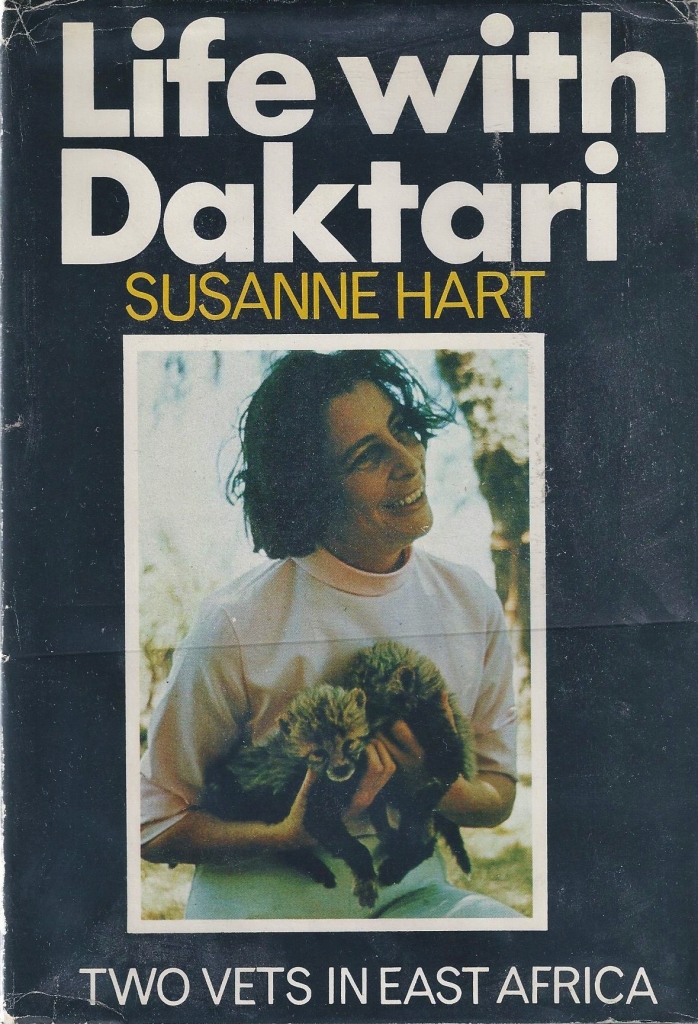
life with daktari susanne hart 1969 001Life with Daktari: Two Vets in East Africa by Susanne Hart ~ 1969. This edition: Bles/Collins, 1969. Hardcover. ISBN: 7138-0234-0. 224 pages.

My rating: 5/10

Susanne Hart (her last name condensed from her second husbands surname, “Harthoorn”) loved animals from her childhood, studied at the Royal Veterinary College in London, England, and qualified as a vet in 1950. She found herself in South Africa newly divorced and with two young children to support, and she set up a thriving domestic animal veterinary clinic. Then she encountered a fellow vet whom she had known in college days, Dr. Toni Harthoorn, and gave up her practice to marry him and join him in Nairobi.

Dr. Harthoorn specialized in working with wild animals, with particular expertise in immobilizing large creatures such as rhinos and elephants to be studied and fitted with radio collars. Susanne found herself becoming involved in her husband’s interests, and the two soon started working as something of a team, though Toni insisted that Susanne preserve a womanly decorum by avoiding the more dangerous situations that their work invariably entailed.

This is an uneven memoir, in that it has a rather hero-worshipping tone to it. Susanne goes on at great length about her second husband’s brilliant technique with wild creatures; the two of them also become acquainted with the famed Adamsons of Born Free fame, Joy and George, and their lion study project.

The animal bits are much the best, and I found the accounts of various encounters with wild and semi-wild creatures quite mesmerizing, but I could have done without the preachy details of Susanne Hart’s vegetarianism and special “health diet”, which she apparently pushed on every one of her acquaintances. She is quite snooty about those who don’t immediately fall in with her notions in this area, and it rather put me off.

I bogged down somewhere around the middle of this promising sounding but ultimately awkwardly written book, and had to force myself to finish it; a rather disappointing state of affairs as I had wanted to like it so very much.

Susanne and Toni were obviously passionate about their life callings, and their impatience with other people who didn’t quite embrace their ideas with full fervour is understandable, but the impression I received was that the reader was rather included with those not really “on side”; there is the faintest hint of patronization in Susanne Hart’s tone, and it left me not at all eager to seek out any of her other memoirs, of which there are something like eight or nine.

Susanne Hart was also active in environmental outreach, and hosted a short-lived television series, Animal Ark, featuring a group of children being introduced to various African creatures. In later years she was deeply involved in an organization assisting African children whose parents had died of AIDS. Susanne Hart was still actively involved in her social charity work when she died in South Africa in 2010, at the age of 83.

Susanne Hart was no doubt an admirable woman in many ways, and I feel rather like a rotter for not liking this memoir more, but there you have it. She annoyed me as much as she informed and entertained me so she gets a generously conditional “5” on my personal rating scale.

*****

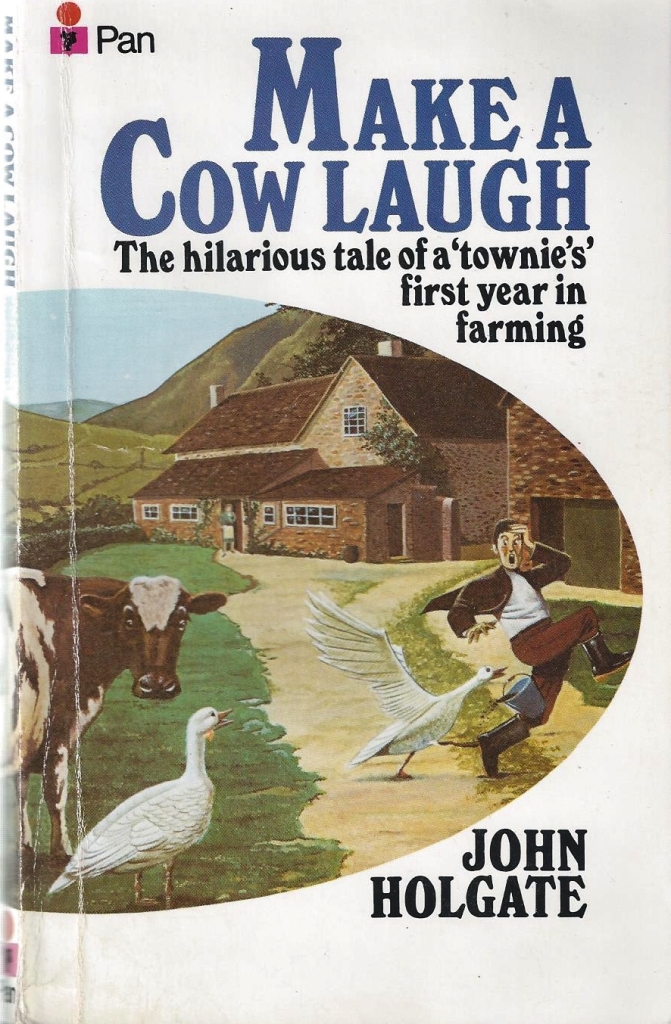
make a cow laugh john holgate 1977 001Make a Cow Laugh: A First Year in Farming by John Holgate ~ 1977. This edition: Pan, 1980. Paperback. ISBN: 0-330-25780-3. 221 pages.

My rating: 8/10

Despite the off-putting front cover blurb – “The hilarious tale of a ‘townie’s’ first year in farming” – I found myself liking this book a lot.

“We moved to the country, and look how stupid we were!” self-mocking memoirs are a dime a dozen, and I almost didn’t pick this one up, but a quick peek at the contents inspired me to give it a go. It rewarded me for my bravery by being quite a nice little neophyte farmer’s tale, and it wasn’t hilarious at all – what a relief! – merely gently amusing.

John Holgate, his wife, and three children – sixteen-year-old son, eight-year-old daughter and four-year-old son – all make the move from city life in London to a 75-acre mixed farm on the Welsh border. Their motivation is rather vague, even to themselves, but upon consideration John Holgate theorizes that it was a collective desire to leave the city for the emotional and aesthetic pleasures of rural life, and the more elemental challenges of “sweat labour” versus the hurly-burly bustle of the city, where he was successfully involved in a standard “career”.

I am ashamed to say that I can’t quite recall what it was that John Holgate actually did in his London life. Or perhaps he didn’t tell us? My husband, who also read and enjoyed the book, can’t remember either, so perhaps it was a deliberate omission. In any event, it doesn’t matter, as the Holgates leave it all behind. They finance the purchase of the farm by selling their city house; money is tight and their subsequent financial struggles are completely believable.

John Holgate is a more than competent writer; his words have a beautifully readable lyrical flow, and he is deeply, quietly funny. His characters are respectfully portrayed – no bumpkins here! – and are utterly recognizable and familiar, even though we live in rural western Canada and the Holgates in far-off Great Britain.

John’s relationship with his eldest son, who completely embraces the rural lifestyle, is a joy to read about. The whole book is a pleasant experience, in fact, and the Holgates come across as being truly nice people, with their share of human flaws, but with the most relatable good intentions.

Not much happens in this memoir – no great disasters, no epiphanies, no real drama. At the end of Year One on the farm, things are plodding along quite nicely. John Holgate has been fortunate in his neighbours; they are keen to rally round when needed, and John has had the deep satisfaction of being able to lend a hand in his turn. Humourous incidents have indeed occurred, but none of them were “hilarious”, and that made me deeply pleased.

John’s personal challenges ring true – spousal squabbles triggered by money stress and culture shock, the physical discomfort caused by moving from a sedentary to a deeply physical working day, the inevitable “second-guessing” of the decision to change one’s lifestyle in such an astounding way, the continual drama of dealing with farm animals – and are seen to be resolved in a sober and very true-to-life way.

I would happily read John Holgate’s subsequent books. He wrote at least two more, On a Pig’s Back and A Sheep’s Eye View, and though I have no strong urge to go to a lot of effort to seek them out, I would be gently pleased to stumble across them on my travels. As I said before, the man can truly write, and a well-phrased, gently humorous, nicely realistic memoir which speaks highly of one’s own lifestyle choice is a desirable thing to have on the shelf.


Read Full Post »

pomp and circumstance noel coward 001Pomp and Circumstance by Noël Coward ~ 1960. This edition: Pan, 1963. Paperback. 287 pages.

My rating: 9/10

Havoc under the sun…

Samolo – a lazy, sun-drenched island in the South Pacific where nothing ever really happens…
Until suddenly it is announced that the Queen and Prince Philip are to pay a state visit. From then on chaos reigns. And the arrival of the curvaceous Duchess of Fowey, who brings out the beast in every male, only adds confusion to confusion.

Here we have an easy candidate for the most unexpected book of 2014.

I can’t quite recall where I acquired this tattered and very well read paperback; it just sort of appeared one day at the top of a book stack, like the frothy sort of thing that it is, effortlessly rising above the (comparative) heavyweights below.

As this seems to be my year of reading mostly lightweight novels, and its year of publication was so-far blank in the Century of Books list, what could I do but succumb?

I was initially a little uneasy as to whether I could sustain my interest for the whole thing, as it started off at frenetic high speed, all very much a-laugh-a-minute, and that sort of style can get tiresome early on, especially if the writer bobbles, but Coward, old pro that he was by his point in his career, kept up the pace marvellously well, and completely won me over.

“Charming” is an overused term in describing the light novel, but in this case it is most apt. With a bit more consideration, charming isn’t complex enough, for there is a lot of snark here, too, of the most readable sort.

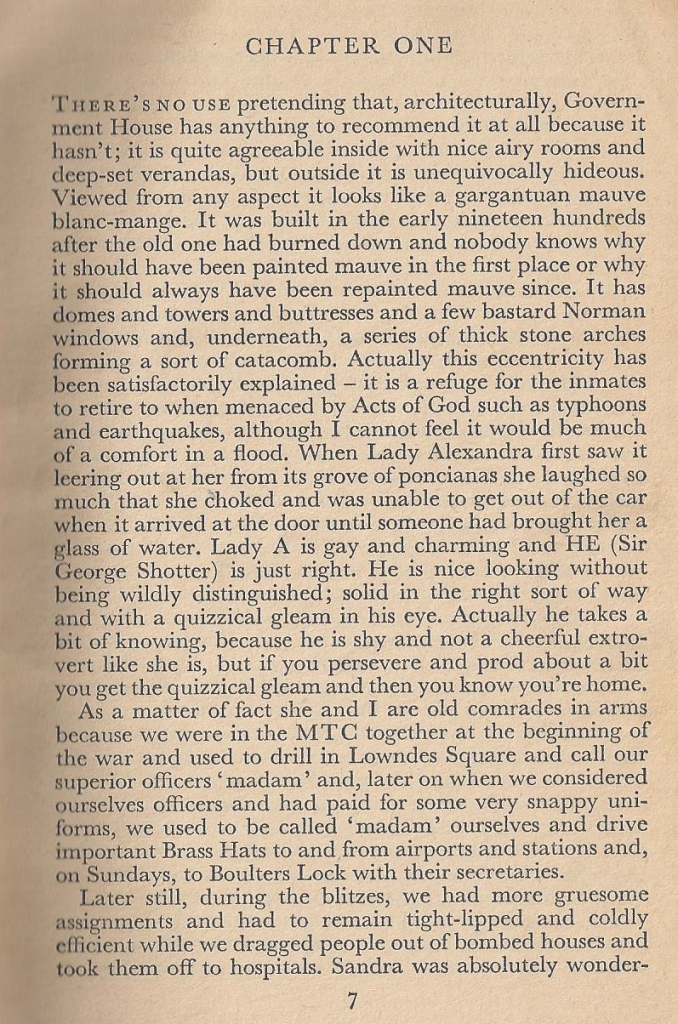
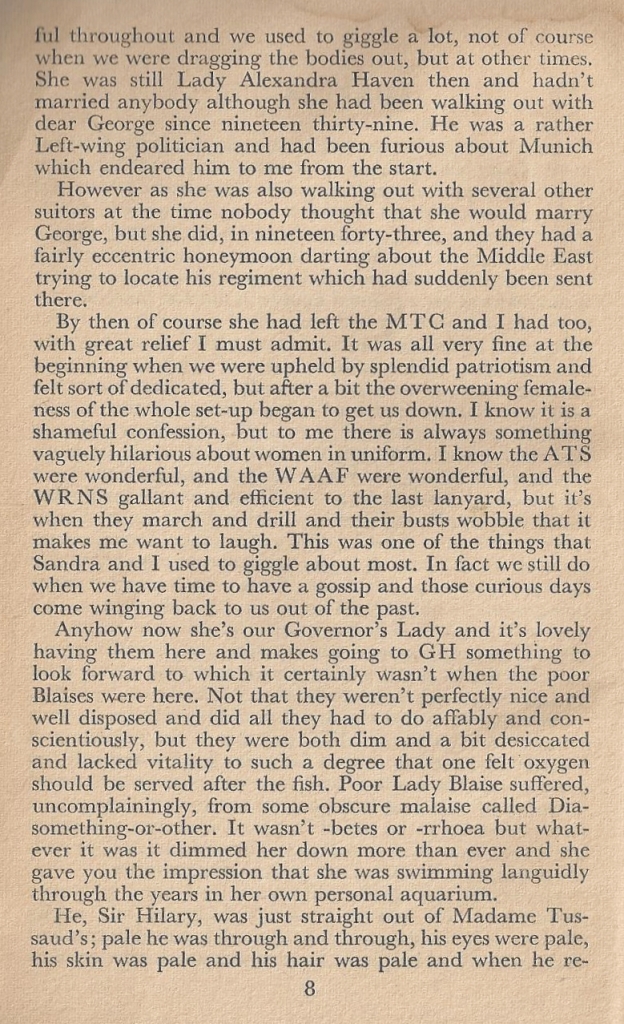
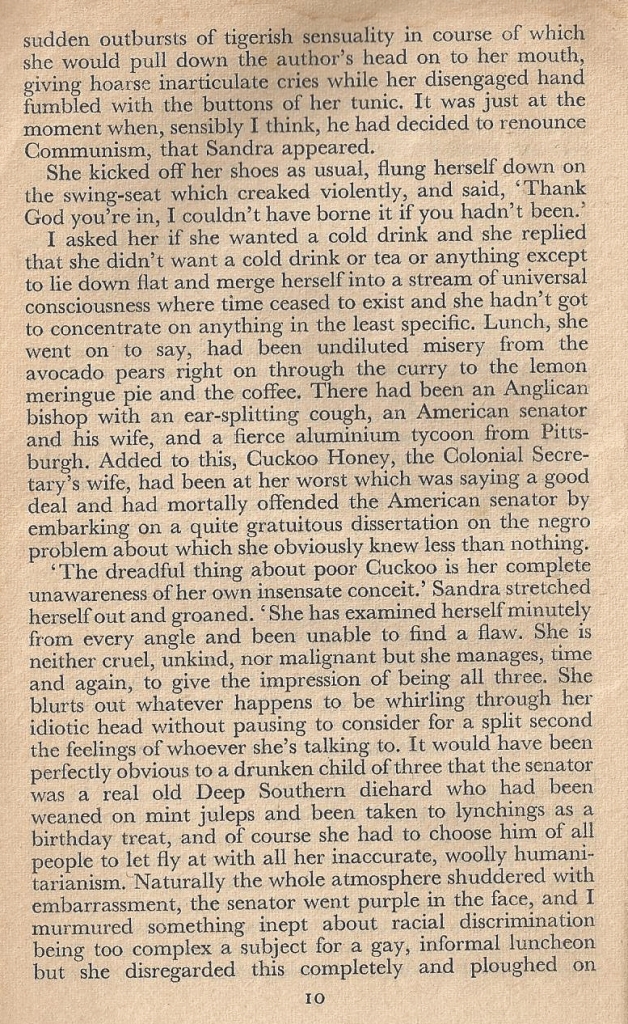
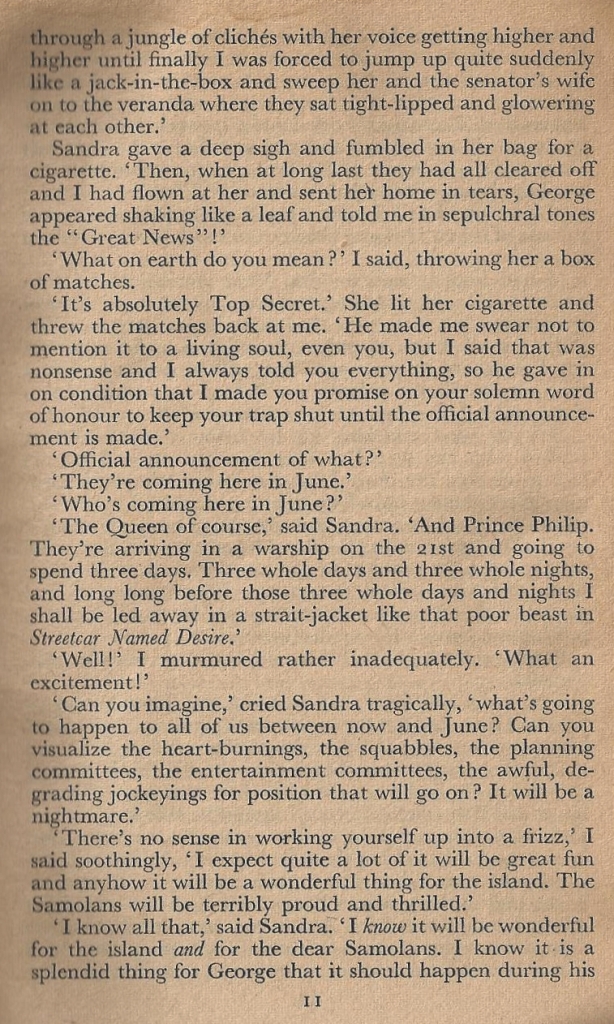
Maybe a page scan is in order, to give one a sample of the contents.

First, an overview.

The curtain rises over the (completely fictional) small South Sea island of Samolo, an idyllic tropical paradise populated by a happy-go-lucky native population and a large colony of British nationals who make up the bulk of the government. For Samolo was never conquered in the warfare sense of the word; the inhabitants merely welcomed the superior managerial style of the inhabitants of that other, colder isle and gladly made way for a dual society of semi-equality. The native upper classes mingle easily with the Brits; the ones a bit farther down the social scale are apparently quite thrilled to provide staffing for the expatriates in their various cottages, villas and stately homes. Everyone is very hail-fellow-well-met, with a bit of resigned-but-not-bitter bitching about the occasional laziness of the servants and their tendency to wander out of paid employment when the mood strikes them providing reliable tea table and cocktail party conversation. (Yes, this is most definitely a fantasy.)

Our narrator, one Grizelda Craigie (Grizel), is the happily married forty-something wife of banana grower Robin. Coward sustains the first-person voice of his female narrator beautifully, something I had serious qualms about when I realized that this was what he was undertaking.

Grizel moves in the upper social circles of Samolo, being on best-friends basis with the British Governor’s wife, Lady Alexandra (Sandra), so of course is the first person to be confided to when the news of the impending Royal Visit breaks.

This is just the start of the drama, for in quick succession Grizel must cope not just with the professional stresses (so to speak) of her highly placed friend, but with an incident in which her small son is mixed up in a very below-the-belt assault on a schoolmate (either triggering or in retaliation for a sharp knock on the head by the other party; the parents on both sides predictably receive conflicting stories from the superficially wounded lads), by the sudden confession of a bachelor friend that he has used her name in telegrams inviting his latest (aristocratic and very prominently married) paramour for a visit, with the intent that the lady actually spend her nights with said bachelor while pretending to occupy Grizel’s guest room, and by involvement in the island’s amateur dramatic association as it plans an elaborate aquatic pageant to be presented to the Queen and her consort, despite prognostications of squally weather soon to come.

Mix in an assortment of Samolan and expatriate characters of all walks of life – from gardener to Prime Minister to journalist to ex-secret-service-agent-turned-sugarcane-planter to aristocratic Duke, and add for good measure a brusque English nanny, numerous beloved-but-high-maintenance visitors, maddening letters from Mummy back home in England who always seems to know the latest Samolan news well before there-at-the-source Grizel, an intense lesbian who is openly smitten with our narrator, the various clashing personalities of the Dramatic Society members, and an epidemic of chicken pox striking in the most unexpected quarters.

It’s all highly silly, but increasingly enthralling. There are moments of sincerity here and there: the portrayals of both Griselda’s and Sandra’s marriages are warm and believably true-to-life, and the family scenes with the children are hugely enjoyable. Most of the sarcasm – which is in relentless but in general quite gentle – is reserved for Grizel’s outer circle of friends and acquaintances, with some deep digs being got in here and there at anti-monarchists both in Samola and back home in England; Noël Coward’s staunchly pro-monarchy patriotism is unabashedly on view.

Several homosexual couples play significant roles, with stereotypical behaviour paraded in full technicolour. I felt just a bit ashamed to find these characters and episodes so amusing, but comforted myself with the thought that the depictions were coming from a writer of that persuasion himself, for Noël Coward was well known to be gay, though always politely reticent about his private affairs.

Pomp and Circumstance was Coward’s one and only attempt at novel writing. One rather wonders what inspired this project, amidst all of the plays and musical compositions. It definitely works, and in my opinion deserves to be shelved alongside the older but similarly giddy Wodehouse tales, as more than slightly goofy, cheerfully amiably, decidedly literary entertainment.

I had a difficult time deciding where to take a page scan from, as much of the joy in this thing is in the building of the story and the connections and contexts of each succeeding episode, so perhaps a bit of Chapter One will be best. This will give a taste of what is going on here; it definitely gets better.

And keep your era-appropriate sense of humour dusted off. One can find much which might be viewed as potentially offensive and politically incorrect these five decades on. Disturbingly vast quantities of alcohol are consumed, mostly in cocktails with oddly evocative names – the “Horse’s Neck”, presumably a long sort of drink, seems exceedingly popular – though sometimes straight from the bottle. Cigarettes are prominently smoked during every emotional and romantic moment, too.  If these sorts of things bother you, best to stay clear. Everyone else, it’s a richly glorious vintage romp.

Pomp and Circumstance has been reissued numerous times since its first appearance in 1960, though it appears to be out of print at present. A quick look online shows it easy to find, and I’m guessing the larger library systems will still have copies. Enjoy!

pomp circumstance pg 1 noel coward 001

pomp circunstance pg 2 noel coward 001

 pomp circunstance pg 3 noel coward 001 (2)pomp circumstance pg 4 noel coward 001pomp circumstance pg 5 noel coward 001 (2)

Read Full Post »


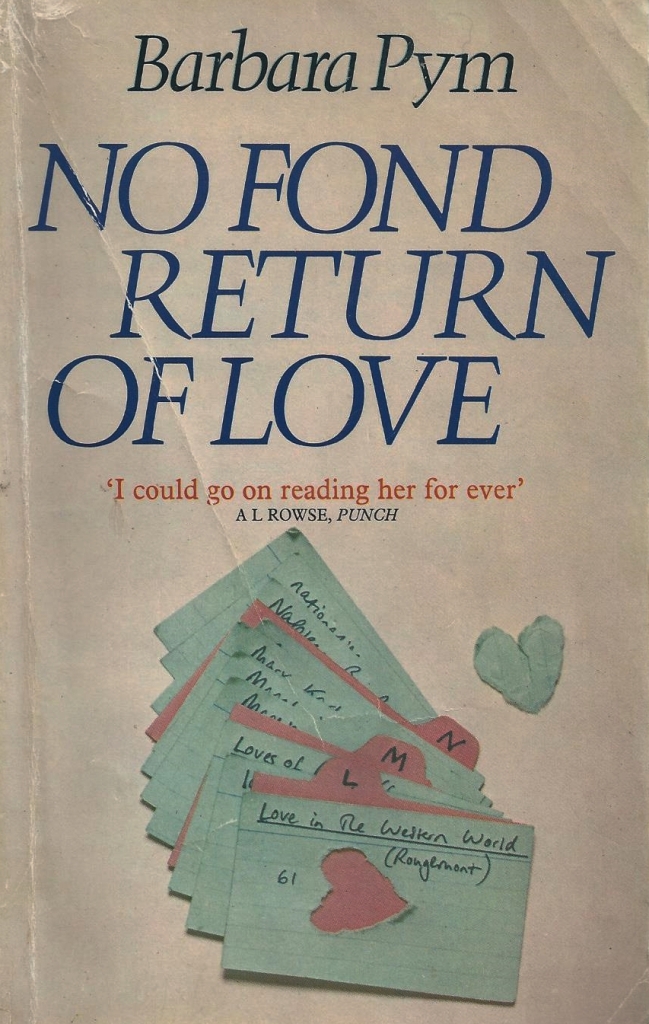
no fond return of love barbara pym 001

Great cover on this 1981 Granada edition, designed by someone who has obviously read and “got” the book.

No Fond Return of Love by Barbara Pym ~ 1961. This edition: Granada, 1981. Paperback. ISBN: 0-586-05371-9. 287 pages.

My rating: 8/10 on a first reading. Perhaps to be elevated after a future re-read. This author is always better the second time around.

Barbara Pym is in rather fine form with this further delving into the complex lives of a number of single women in various stages of contentment (or otherwise) with their unpartnered state.

As with the stellar Excellent Women, and most of her other stealthily pithy novels, No Fond Return of Love has twin strands: the inner voice of a quiet spinster of the keenly-watching-from-the-shadows type, and the omnipotent authorial observation (not always uniformly benign) of various relationships playing out in that spinster’s sphere.

The set-up is familiar to the Pym reader. A single, upper middle class lady of no-longer-young vintage, engaged in some sort of quasi-intellectual undertaking, encounters a number of new people, including a man who both repels and attracts her. The man may or may not look upon the spinster with equal interest; the interest, if piqued, may or may not be romantic. Pym then shines an illuminating light on her chosen small segment of society; she dances her puppets about in increasingly bizarre postures until at last pairing them up in sometimes unexpected partnerships, which frequently feel less than wholly satisfactory, though cleaving to the traditional pattern of a tidy, “happy” ending.

Dulcie Mainwaring is our key character here, though she occasionally steps aside to allow others to have their moment in the dusty spotlight of Pym’s regard. A pleasantly attractive and undeniably intelligent women in her early thirties, Dulcie has just been given her walking papers (in the most tactful way) by her long-time fiancé – he has recently informed her, in acceptably clichéd terms, that he is “not worthy of her love” – and though Dulcie unprotestingly goes along with this charade, her inner confidence is badly shaken.

Pulling herself together, Dulcie decides to divert herself with attendance at a conference designed to address some of the various complexities of her particular line of work. Dulcie belongs to that of the vast network of poorly paid, unseen people (mostly female) who proofread, fact-check, do minor research, tidy up footnotes, and compile indexes and bibliographies for scholarly works of research and biography, and the conference is highlighted by lectures on such arcane topics as “Some Problems of an Editor”, by presenters mildly well-known amongst their peers.

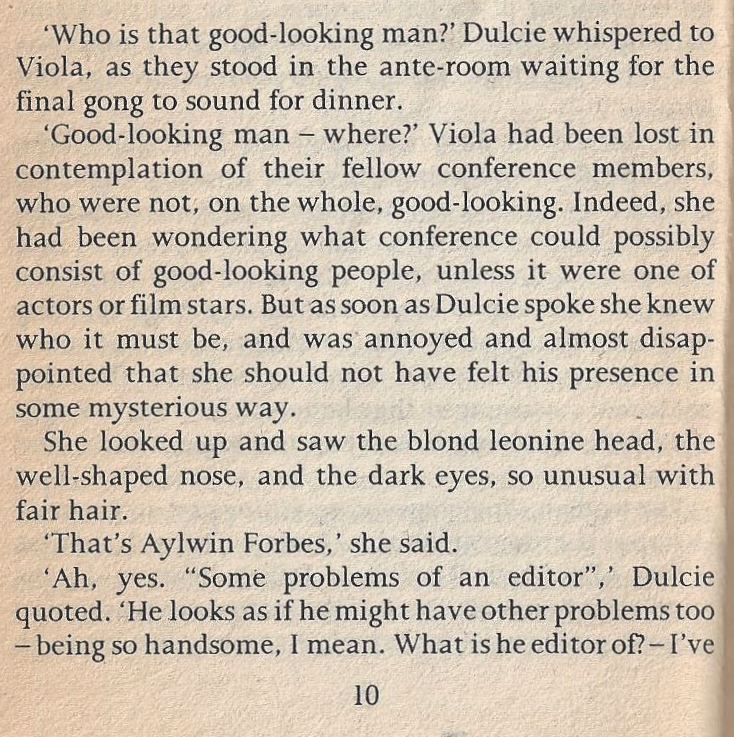
As anyone who has been to this sort of a limited-interest conference may have found, the really interesting networking happens during coffee breaks and over evening drinks, and this event is no exception. Making a deliberate effort to shake off her post-broken-engagement gloom, Dulcie winds herself up to approach a fellow attendee, the slightly younger, slightly more experienced-in-the-arena-of love, and more than slightly patronizing Viola Dace. Though not exactly kindred spirits at first encounter, the two find themselves sharing an interest in one of the conference’s key speakers, the handsome and apparently charming Aylwin Forbes.

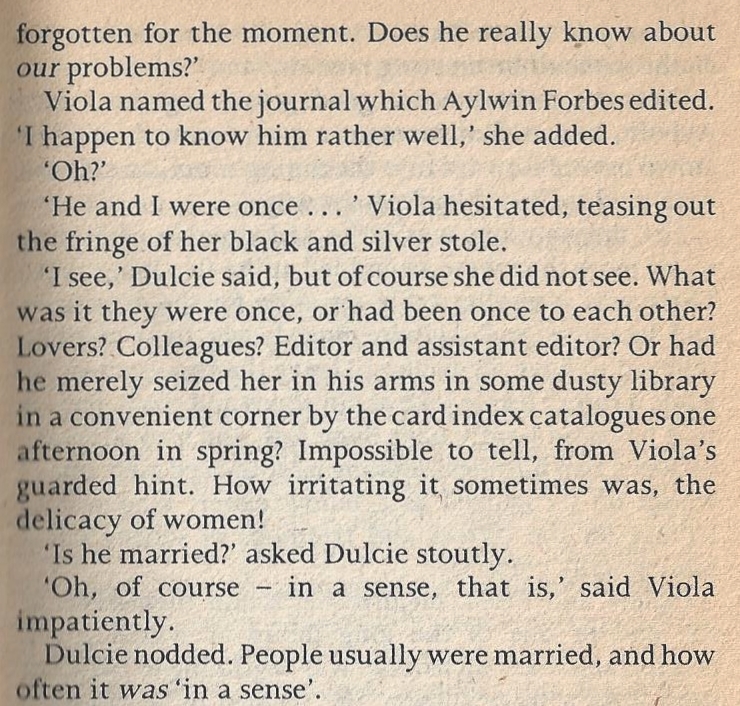
no fond return of love barbara pym excerpt 001no fond return of love barbara pym excerpt 001 (2)

Aylwin Forbes effortlessly repulses Viola’s attempts to renew their nebulous relationship with well-practiced urbanity; Dulcie watches their wary exchanges with an eyebrow secretly cocked; she catches every nuance. There is something about Aylwin which piques her interest, and after the conference is over and Dulcie is back home in the over-large house she has inherited from her late parents, she finds him popping back into her field of awareness.

Well, what else to do but research the man, then? Which Dulcie proceeds to do, with a tenacious thoroughness which does credit to her meticulous skill in tracking down elusive references and firmly knitting up tenuous connections. Dulcie’s technique, which involves much trudging about and putting herself into situations where she can inquire as to her subject without causing undue alarm to the interviewee, might well be what we refer to nowadays as stalkerish, but Dulcie, though obsessed with the minutiae of Aylwin’s life and the state of his troubled marriage, somehow manages to stay just on the sane side of this sort of behaviour. We view her actions as manifestations of her innate desire to acquire and organize information, even as her curiousity leads her into some exceedingly unlikely situations, in which the author’s sense of humour is fully indulged.

Dulcie is joined in her home by her eighteen-year-old niece Laurel, and then, in an odd plot twist, by the perennially sulky Viola Dace. Aylwin himself shows up, still vaguely attracted to/repulsed by Viola, and mildly interested in Dulcie in a platonic sort of way – she might be useful to him in a professional sense, Aylwin practically muses – and then increasingly infatuated with the oblivious (and half his age) Laurel, who has herself become romantically interested in the florist-shop-owning son of the family next door.

Meanwhile Dulcie has scraped acquaintance with Aylwin’s clergyman brother, Neville, who himself is having romantic problems with the aging spinsters of his flock, and with Aylwin’s rather soppy but ultimately likeable estranged wife Marjorie, with his matter-of-fact mother-in-law, and eventually with his surprisingly “common” mother, who owns a not-very-good guesthouse (complete with moulting taxidermied eagle in the lobby) in a seaside town, where most of the characters converge for what one fears will be a tremendous confrontation. This never materializes, though Dulcie has a bad moment or two as she crouches behind a piece of guesthouse furniture while Aylwin and Marjorie emotionally discuss the dissolution of their marriage, thinking they are alone.

The tale has strong elements of farce, as you may have gathered from this sketchy outline of some key points, but Pym’s dry tone, and the ever-apt inner thoughts of Dulcie kept me quite enthralled, even while I was mildly annoyed with myself for my collusion in such a nonsensical sort of thing. Dare I say that this reminded my of something which David Lodge might have dreamed up? Or even Robertson Davies, on one of his lighter-hearted days? Full of in-jokes which leave the reader feeling slightly on the fringes of the intellectual circle in which the author has placed his/her characters, and coming close to outright vulgarity with some of the more outlandish developments.

I didn’t much care for the ending, which seemed to argue that any man is better than none, after a book’s worth of practical examples of why a spinster’s fate might not be such a bad one. I thought that after going to great pains to demonstrate her character’s rich inner life, Barbara Pym let Dulcie down. Perhaps, writing at the end of that “happy housewife”-focussed decade, the author caved in to the 1950s’ ideal of marriage always being better than the alternative?


Read Full Post »

Prefacing this sure-to-be-rambling post with this information, for those of you who wonder what I’m actually talking about way down below. As different as can be in time periods and settings, but all at heart clinging to a similar traditional structure, that of the Gothic Romance Novel. The three books under discussion will be:

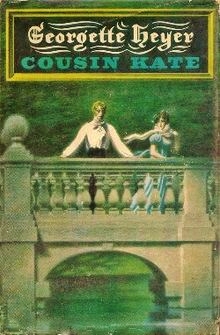
  • Cousin Kate by Georgette Heyer
  • Tregaron’s Daughter by Madeleine Brent
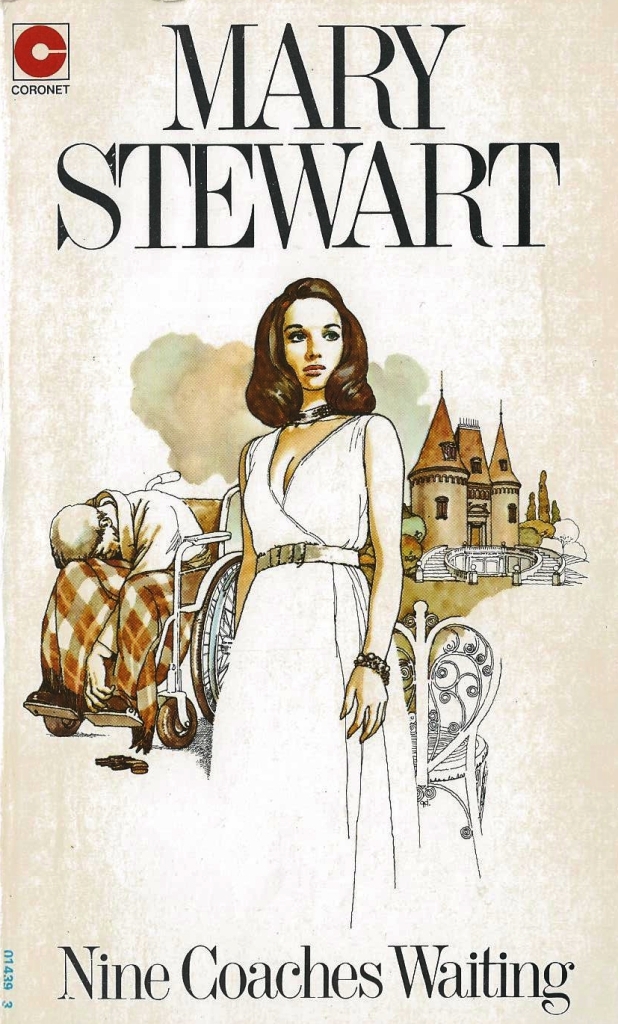
  • Nine Coaches Waiting by Mary Stewart

All of these are velvety dark, thrillingly romantic (for the most part), highly predictable (ditto), and guiltily enjoyable tales.

Perhaps this won’t be the most sober-minded book discussion, which would indeed be fitting, for these books are not High Literature in any sense of the term, and are therefore free game for a little bit of mild mockery, all in good fun, because I did read them willingly and with general pleasure, though occasionally that pleasure was all about their fulfillment of stereotypical Gothic Romance Scenarios.

I have had recourse to our ever-handy Wikipedia to quickly define the main elements of a proper traditional gothic novel, and by applying the criteria to the books in question we can get a nice overview of how well the authors fulfilled the requirements of this assigned genre.

So, cribbing from the article and adding some of my own descriptive notes to those provided, we generally must have:

  • Virginal Maiden – young, beautiful, pure, innocent, kind, virtuous and sensitive. Usually starts out with a mysterious past, and later discovered that she is the daughter of an aristocratic or noble family.
  • Older, Foolish Woman – who often has charge of or advises the Virginal Maiden, or acts as an Awful Warning due to past errors of judgement, which Virginal Maiden may or may not take into consideration
  • Hero – who may or may not be misrepresented as The Villain for the earlier stages of the plot
  • Tyrant/villain – who may or may not be disguising his (her) True Evil Nature for the earlier stages of the plot. Usually male, occasionally female.
  • The Stupid Servant – acts as comic relief by asking seemingly stupid questions, transitions between scenes, brings news, messenger, moves plot forward. Sometimes takes on form of Humble Social Inferior or Female Friend of Virginal Maiden, well-meaning but ignorant of darker designs of Villain.
  • Ruffians – always under the secret (or not so secret, depending on if he is the Disguised or the Obvious species) control of the Villain
  • Clergy – always weak, usually evil (says Wikipedia, but in more modern gothics I have noticed that the Clergy figure is often absent, being replaced by a Doctor or Lawyer or other Figure of Social Authority, acting under the influence of the Villain)
  • The Setting – The setting of the Gothic Novel is a character in itself. The plot is usually set in a castle, an abbey, a monastery, or some other, usually religious edifice, and it is acknowledged that this building has secrets of its own.
  • And, if I may add to this list, The Secret. There is generally some Great Big Secret which the heroine – er, Virginal Maiden – either sets out to investigate or unwittingly stumbles upon. Sometimes (frequently) The Secret is, of course, that of her own mysterious past.
  • Also added by me: The Forced Marriage. Another common element I’ve noticed in my own perusal of gothics. So many times the heroine faces matrimonial peril, either by being forced to marry the Disguised Hero (who she then realizes she loves in Chapter Ten), or by a Weak Male Character under the control of the Villain, or by the Villain himself.

So, let’s see how these measure up. I’m going to present these in order from my least to most favourite.

Warning: There may well be some significant spoilers here and there, but as the plot twists are all highly predictable by anyone with the least bit of experience with the genre, I doubt if having these confirmed ahead of time will lessen one’s reading pleasure. 😉

Cousin Kate georgette heyer 1968Cousin Kate by Georgette Heyer ~ 1968. This edition: The Bodley Head, 1968. Hardcover. 318 pages.

My rating: 6/10.

Front flyleaf blurb, Bodley Head edition:

Finding that her youthful appearance and the lack of accomplishments caused by a childhood spent following the drum prevent her from securing a position as governess, Kate Malvern, recently orphaned, gratefully accepts an invitation from her unknown aunt Minerva to make her home at Staplewood, the seat of Sir Timothy Broome, Minerva’s elderly and invalid husband.

On arrival at Staplewood, Kate finds herself in beautiful and luxurious surroundings, and is treated by her aunt with a kindness which is regarded by those best acquainted with Minerva with considerable surprise. At first grateful, Kate gradually becomes uneasy, and with the arrival on the scene of Sir Timothy’s nephew, Mr. Phillip Broome, the plot rapidly thickens. Minerva’s motive for bringing Kate to Staplewood is revealed, and her machinations are brought to a dramatic conclusion.

Okay, let’s see how Cousin Kate does on the Elements of Gothic Fiction scale.

  • Virginal Maiden – check! No secrets as to origin, as Kate is legitimately accepted as a family connection. She is an orphan, reasonably young (24), beautiful (“a flower-like countenance”), appears younger than her age, is sexually pure but well aware of the “facts of life” from her experience as a soldier’s daughter, and is definitely kind and sensitive, though she also fearless and well able to stand up for herself in socially awkward situations.  A most promising heroine.
  • Hero – check! Our Hero turns out to be one of the disguised ones, who operates under a cloud of misunderstanding engineered by the Villain, or, in this case, the Villainess.
  • Villainess – check! No mystery here, though it takes a while to reveal her true nature. It is, of course, suspiciously friendly Aunt Minerva.
  • Humble Social Inferior – Moving the plot along is Kate’s old nurse, Mrs Nidd, who bring’s Kate’s need of succour (she’s just been fired from her first job and has little prospect of finding another due to lack of training or experience) to Aunt Minerva, setting things in motion. Mrs Nidd reappears later in the story to aid Kate in unravelling The Secret.
  • Doctor – weak rather than deliberately evil, and under the complete influence of the Villainess, the Doctor plays here merely a supporting role
  • The Setting – It is 1817, mid-Regency. Most of the action occurs at a stately country home, Staplewood, with Aunt Minerva established at the centre of things controlling all of the domestic strings, and separate wings housing the frail Sir Timothy and the family son and heir, beautiful, erratically-mannered Torquil, who is under the fulltime care of the Doctor, for reasons no one is prepared to elaborate on. Mysteriously locked doors, male screams in the night, random shots being fired, a suicide-worthy lake, a lonely country setting leading to easy isolation of characters not wanted to be out in public circulation by the Villainess.
  • The Secret –  Insanity! Torquil’s. Kate has been tagged by the Villainess to be a suitable wife for her mentally unstable son. She (Kate) is to produce a son and heir to the Broome family fortune, after which Torquil will be put into ever-deeper seclusion as his insanity worsens (the Doctor is quite sure it will), and Kate will be allowed to discreetly seek consolation elsewhere.
  • The Forced Marriage – see The Secret.
  • Great Big Climax – Revelation of Secret! Murder! Suicide! Horror-stricken Virginal Maiden flees to arms of Hero! And once all of the details of The Secret are revealed, a blissful future is embarked upon via Glorious Holy Matrimony between the two who have suffered so many setbacks to the progress of their romance through initial misunderstanding and deliberate machinations of the Villainess, who has now had her ultimate comeuppance.

My verdict: While Cousin Kate had its appeal, and was quite nicely written and full of Heyer’s dependably engaging Regency slang. Kate is a likeable enough heroine, but the whole thing dragged on just too long for my interest to be sustained completely; the plot was desperately predictable, and the whole thing became rather depressing, what with its dependence on a mysterious insanity and the ditherings of all those concerned regarding the proper treatment of the sufferer.

The ending is rather brutal, as Heyer fatally disposes of two of her characters under horrific circumstances. The imagination of this reader was boggled regarding the possibility of a happy future for the heroine and hero with that sort of emotional baggage to deal with.

I rated Cousin Kate at 6 because of Heyer’s competent handling of her setting and the quality of her writing. Some serious themes (position of women/class distinctions/treatment of the mentally ill) were touched upon but never thoroughly examined – not really to be expected in this sort of light novel. But for a light novel it had some desperately dark strands.

Hard to classify, really. I know I said “boring” in the header, and that seems to be my ultimate feeling. Rather flat. Heyer could do much better.

tregaron's daughter madeleine brent 1971 001Tregaron’s Daughter by Madeleine Brent ~ 1971. This edition: Doubleday, 1971. Hardcover. 251 pages.

My rating: 7/10. I bumped it down just a bit because of the inclusion of Young Man with Symptoms of Insanity, a plot strand which I found exceedingly annoying for some reason. (Perhaps because a similar character plays a major role in Heyer’s Cousin Kate?)

Flyleaf says:

Excitement, drama and suspense were only part of Cadi Tregaron’s new life. It had been a sunny afternoon when she glanced from the cliff where she sat reading and saw below her in the sea a sight that would change her life.

Set in England and Italy in 1910, this is the story of a young English girl who by accident starts to unravel the unknown elements in her grandmother’s past and is brought by the mystery to the faraway city of Venice. There, among the gondolas and canals, she slowly comes to comprehend the meaning of two strange and puzzling dreams – dreams that seem to hold the an eerie and menacing prophecy of the future.

Elements of Gothic Fiction included:

  • Virginal Maiden – check! Our heroine, Caterina (Cadi), daughter of a half-Italian mother and sturdy Cornish fisherman father, is young (late teens), beautiful, pure, innocent, kind, virtuous and sensitive. And (spoiler alert!) she does turn out to be the descendent of the Italian nobility. No doubt because of this innate blue blood, our heroine has just naturally developed far beyond the expectations of her humble place in the world. Her language is surprisingly upper class (due to the convenient society of a cultured retired governess in the neighbourhood, who has taken the bright young Cadi under her tutorial wing), and she is fluent in Italian (learned from her grandmother), which comes in handy later. And she starts the story off as a half orphan, mother dead some years (fell off a cliff with grandmother in a tragic accident – sob!) and loses her father as well soon after we enter the story, which precipitates the now-fully-orphaned Cadi into the next stage of her saga.
  • Hero – check! This one is the conflicted type, and is disguised (occasionally deliberately) as a villain. Classically gothic  introduction of hero and heroine involving heroine being pulled up onto horse and forced to cling closely to rock-hard-muscled hero as they gallop to rescue of hero’s uncle who is caught in a dangerous current in his borrowed sailboat. (This is the life-changing thing which Cadi saw from the cliff.) Bonus first-meeting episode: as Cadi, her father, and the hero row out to the rescue, the bodice of Cadi’s dress rips, leaving her lily-white skin exposed in a rather delicate area, and causing the hero to take a deep breath and force his gaze away, manfully resisting the surge of testosterone this incident inspires. Predictably, hero’s taciturn silence is misunderstood by heroine – “He thinks I am below his notice!” Oh, no, darling, that ain’t it.
  • Villain – check!  Disguised variety. Cadi’s Italian relation, Count Chiavelli, who is surprisingly warm and welcoming to the little English chit who is apparently going to bump him from both his title and his fortune – unless, of course, she can be enticed into a marriage with the Count’s weak-natured son – shows another side to his nature as this plan fails to advance.
  • Hero’s Sidekick – not at all stupid, though a slight social inferior, the Sidekick keeps things moving by his unexplained presence at key points of the saga. He is eventually assisted in his efforts by Female Friend of Virginal Maiden, as they join forces to assist Hero in rescue of Virginal Maiden from the Villain’s foul clutches.
  • Ruffians – check! The Villain has a full complement of brutish henchmen, but as bad guys in gothic novels are always slightly slower (and much more stupid) than good guys, these particular ruffians are continually foiled by the Hero, Sidekick and Maiden.
  • Lawyers – These People of Social Authority – we have an English and an Italian version – are in general full of good intentions and quite helpful to Heroine, though they are completely hoodwinked by the Villain. I would like to put forward that a too-trusting lawyer = weakness, so this element is included, albeit in a very minor role.
  • The Forced Marriage – The Virgin is pressured to marry the Villain’s weak-willed son, in order for the Villain to get his hands on the fortune the Virgin is coming in for, and also to keep the title in the family.
  • The Setting – Gorgeous settings, full points for those. We start out in a humble cottage in a little Cornish fishing village – towering sea cliffs above it, treacherous currents swirling offshore – progress to turn-of-the-century London as the heroine is adopted by the beneficent and wealthy family whose patriarch she helped save back in chapter one, and end up in Italy in a gloomy Venetian palazzo, with a final nighttime chase scene by boat through mist-shrouded canals.
  • The Secret – Hmmm, aside from the confusion around the true nature of the Hero-disguised-as-Villain, the only other secret of major import was that Granny was almost murdered by the Villain’s sister, and that honestly came as no surprise, being telegraphed strongly right from chapter one. Young Man with Symptoms of Insanity was also something of an obvious twist, and quite wonderfully similar to the same figure as depicted in Cousin Kate. (Do we need to add him to our list of shared elements?)

My verdict: A better-than-average modern gothic, and an excellent first-novel-in-the-genre by – drumroll! – a male author writing under a female pseudonym.

For “Madeleine Brent” was actually Peter O’Donnell, British mystery novel and comic strip writer, and creator of the pop culture character Modesty Blaise.

O’Donnell’s publisher, Ernest Hecht of Souvenir Press, pleased by the success of O’Donnell’s thrillers, asked his author to try his hand at writing gothics under a female pseudonym. The Madeline Brent novels were a decided success, and Peter O’Donnell eventually wrote nine. All are set in the Victorian or immediately post-Victorian era, and feature young women in exotic locations seeking the truth about their identity. O’Donnell’s authorship was kept secret until after the publication of the last one, Golden Urchin (featuring a Caucasian girl raised in isolation from mainstream society among Australian Aborigines), in 1986.

An interesting side-note, this revelation of the gender of the author, and one which sheds some light on the structure of the Tregaron’s Daughter. Do I dedict a technically-minded male slant in – just one example – the inclusion of the details about construction of gondolas which allow them to be operated from one side by a single person?

Great details in the setting throughout, and the action was well maintained. The plot was (predictably) groaningly predictable, but my interest was held despite the lack of surprises. Good job, Mr. O’Donnell!

nine coaches waiting by mary stewart 1958 001Nine Coaches Waiting by Mary Stewart ~ 1958. This edition: Coronet, 1973. Paperback. ISBN: 0-340-01439-3. 317 pages.

My rating: 10/10. Now this is how you write a gothic! Mary Stewart, after her previous year’s rather dire first attempt, 1957’s Thunder on the Right, pulls up her authorial socks and takes another run at the genre, this time succeeding brilliantly.

Chicago Review Press blurb:

A governess in a French château encounters an apparent plot against her young charge’s life in this unforgettably haunting and beautifully written suspense novel. When lovely Linda Martin first arrives at Château Valmy as an English governess to the nine-year-old Count Philippe de Valmy, the opulence and history surrounding her seems like a wondrous, ecstatic dream. But a palpable terror is crouching in the shadows. Philippe’s uncle, Leon de Valmy, is the epitome of charm, yet dynamic and arrogant—his paralysis little hindrance as he moves noiselessly in his wheelchair from room to room. Only his son Raoul, a handsome, sardonic man who drives himself and his car with equally reckless abandon, seems able to stand up to him. To Linda, Raoul is an enigma—though irresistibly attracted to him, she senses some dark twist in his nature. When an accident deep in the woods nearly kills Linda’s innocent charge, she begins to wonder if someone has deadly plans for the young count.

Applying the Gothic Fiction checklist yields some promising results:

  • Virginal Maiden – Check! Our heroine Linda is indeed young, beautiful, pure, innocent, kind, virtuous and sensitive. And orphaned, too, which should really be one of the traits listed alongside young, beautiful, etc. etc. etc. No mysterious past, unless one counts Linda’s own concealment of her French heritage in order to pass for a strictly-English governess as required by her new employer.
  • Older Woman – Check! Elegant Madame de Valmy, who acts as an extra set of eyes and legs for her wheelchair-bound spouse, brings Linda into the household and complicates the plot by her alternating moments of warm we’re-all-women-here-together friendliness and cold putting-the-help-in-her-place slap-downs to our heroine.
  • Hero – Check! We actually have a choice of two Heroes, either or both possibly of the disguised variety, and in the interests of not spoiling the ending for those of you who haven’t read this, I will not say any more. Just that both are perfectly perfect for their chosen roles, and I was up in the air guessing as to which one was going to be the ultimate winner of the lovely Linda’s heart.
  • Villain – Check! The debauched old nobleman now confined to his wheelchair, of course. And he is masterful at disguising his True Evil Nature, though our heroine catches a disturbing gleam in his eye when he looks at his hapless nephew, the young Heir to the Family Fortune who has tied up the riches which the Villain would like to further his own ambitions.
  • The Servants – Linda finds herself associating with several useful servant-figures who fill her in on all the gossip and aid in her attempts to discover why her young charge, The Endangered Heir, is having so many close brushes with death. We have a chatty English housekeeper, who came to France some decades ago, and a sprightly local maid who has rather tragically (but usefully, as he drops some hints which can then be related to the heroine) fallen in love with the Wicked Henchman.
  • Wicked Henchman – One is indeed in residence, and he is secretly under the control of the Villain.
  • The Setting –  Time: The early 1950s. Place: A vast French château, isolated from all neighbours and tucked away in its own private forest among the craggy hills of the High Savoy in France. A steep, narrow, twisting road leads to the château, ideal for those sorts of engineered “accidents” where one’s automobile brakes unexpectedly fail, or where a pedestrian can be “inadvertently” run down on a one-lane bridge over a rushing torrent.
  • The Secret – How far will someone go out of personal and family pride, and for love for a piece of land?

This is one of the very best of Mary Stewart’s romantic suspense novels. Decidedly well written, with abundant clever humour, and an ongoing literary thread as revealed in the title, for the Nine Coaches Waiting reference comes from a rather obscure Renaissance play by Cyril Tourneur, The Revenger’s Tragedy, in which a poor but pure and beautiful young woman is tempted with the luxuries of palace life to yield up her virtue.

The parallels between the Tourneur scenario and the Mary Stewart gothic are not particularly apt, but as a poet’s daughter herself (did I mention that bit? – I don’t think I did) our heroine in the novel is of course a highly imaginative (and literate) type, and the snippets of the play included by Mary Stewart are most intriguing and set the mood of rushed passion and moral unease very well indeed.

Oh, think upon the pleasure of the palace!
Secured ease and state! The stirring meats
Ready to move out of the dishes, that e’en now
Quicken when they are eaten…
Banquets abroad by torchlight! music! sports!
Nine coaches waiting – hurry – hurry – hurry –
Ay, to the devil…

My verdict: Hands down, Nine Coaches Waiting was the best of these three novels, but they all had their moments, and are all nice diversions for those times when one doesn’t want to think too hard, and wishes to recapture those long-ago (for many of us – I know a number of my regular readers are my generational compatriots) days of teenage summer reading, wrapped up in these darkly sensuous – but really quite chaste, kisses being as far as our heroines go – gloriously suspenseful, absolutely predictable romances.

(Ha! Grammar police, sort out that last paragraph. I dare you! It boggles me, rather, but I will let it stand, as a challenge to those of you who would perhaps like to dissect it and see of it actually works.) 😉

Read Full Post »


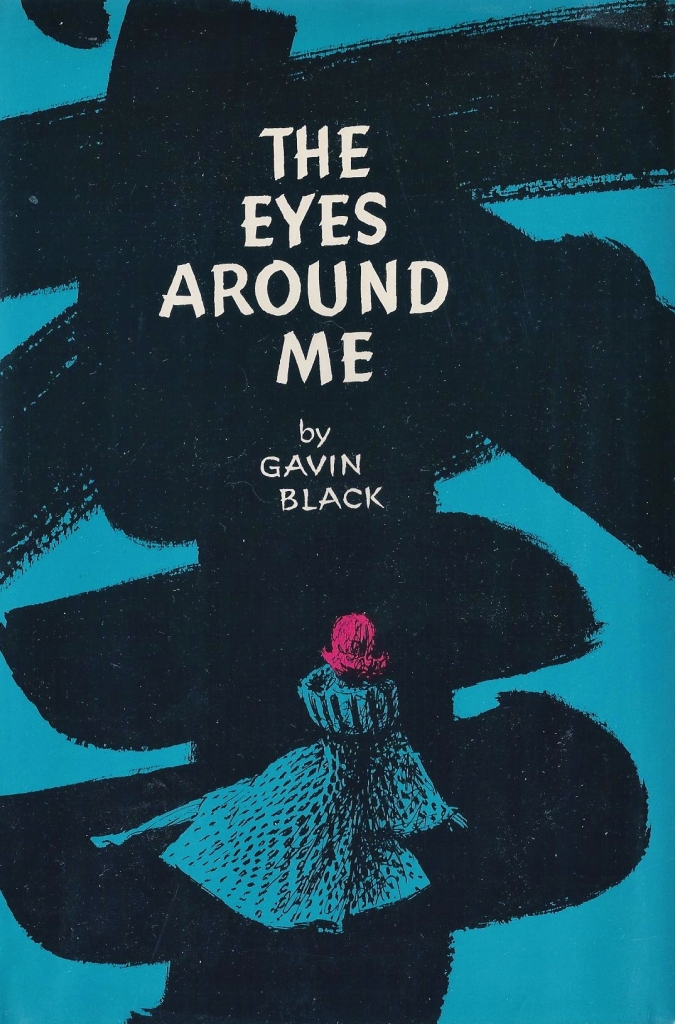
the eyes around me gavin black 001The Eyes Around Me by Gavin Black ~ 1964. This edition: Harper & Row, 1964. Hardcover. 216 pages.

My rating: 8.5/10

Okay, why have I never come across this writer before? This murder mystery novel set in Red-era Hong Kong was pretty darned fabulous. Instant fan, I am. Now I must track down more…

From his obituary notice in The Independent, August 6, 1998:

Oswald Wynd was a modest man who had little to be modest about. As Gavin Black he wrote superior and literate thrillers – school of Stevenson and Buchan – which were at the same time witty and clever, and moved at a by no means gentlemanly pace…

A “superior and literate thriller” describes this fast-paced novel exceedingly well.

Middle-aged, recently divorced, lush living Scottish shortbread heiress Ella Bain lives in Hong Kong, in a lavish seaside mansion. An outside staircase to her bedroom allows her to receive gentleman callers without offending the sensibilities of old family retainer Kirsty, and by all reports it is a well-used piece of domestic architecture.

Ella is loud, she drinks too much, and though she has proven herself an astute businesswoman, enlarging her already substantial fortune by her occasional managerial visits back to the family factory in Scotland, she occasionally raises eyebrows by her larger than life actions. Long-time platonic friend Paul Harris views Ella with sometimes-exasperated affection; he has turned down her marriage proposal, but remains in Ella’s will as her chief beneficiary, cutting out Ella’s only brother Angus, who enjoys a fortune of his own.

So when Ella is found dead in her bed on New Year’s Day morning by Paul, who squired Ella about town the night before and stayed over at her house, both the police and the intimately entwined Hong Kong society crowd look at Paul with more than a little speculation.

Paul Harris, wealthy in his own right through a series of past speculations and questionably legal activities which I shan’t reveal to you here, resents the assumption that he murdered his friend, and sets out on a quest to clear his name.

This is a vividly atmospheric mystery novel, with a finely detailed setting and memorable (if occasionally rather unlikely) characters. One forgives the over-the-topness because the thing is so gloriously well written for this type of light fiction; Oswald Wynd/Gavin Black spins an exceedingly readable tale.

Paul Harris comes across as a greatly  improved version of Ian Fleming’s James Bond. Paul is suave, fast on his feet, good in a fight, exceedingly attractive and attracted to gorgeous women, and (one feels) truly a good guy at heart, despite his somewhat shady backstory. The arrogance which emanates from his fictional counterpart Bond is completely missing; one likes Paul Harris, despite our doubt that he is now a purely lily-white boy, gone all straight and narrow.

I guessed the murderer with surprising ease; I foretold the romantic clinch at the end; as a mystery the thing is decidedly clichéd and predictable, but despite these drawbacks I greatly liked this book.

The author wrote a rather respectable number of novels and thrillers, most set in Asia. I am keen to follow up on my introduction to Paul Harris, who apparently features in all of the Gavin Black-authored thrillers; the Oswald Wynd novels sound intriguing, too, if perhaps a bit “deeper” in theme.

1977’s The Ginger Tree was made into a well-received Masterpiece Theatre 4-part miniseries, and Wynd’s depiction of cross-cultural and mixed race relationships is spoken of very highly in reviews.

For future investigation:

As Oswald Wynd:

  • Black Fountains (1947) (1st novel, winner of $20,000 Doubleday prize for fiction)
  • Red Sun South (1948)
  • Friend of the Family (1949)
  • The Stubborn Flower (1949)
  • When Ape is King (1949) (Wynd’s lone speculative fiction, very rare )
  • The Gentle Pirate (1951)
  • Stars in the Heather (1956)
  • Moon of the Tiger (1958)
  • Summer Can’t Last (1960)
  • Death, the Red Flower (1965)
  • Walk Softly, Men Praying (1967)
  • Sumatra Seven Zero (1968)
  • The Hawser Pirates (1970)
  • The Forty Days (1972)
  • The Ginger Tree (1977)

As Gavin Black:

  • Suddenly at Singapore (1961)
  • The Devil Came on Sunday (1961)
  • Dead Man Calling (1962)
  • A Walk in the Long Dark Night (1962)
  • A Dragon for Christmas (1963)
  • The Eyes around Me (1964)
  • You Want to Die, Johnny? (1966)
  • A Wind of Death (1967)
  • The Cold Jungle (1969)
  • A Time for Pirates (1971)
  • The Bitter Tea (1972)
  • The Golden Cockatrice (1974)
  • A Big Wind for Summer (aka Gale Force) (1975)
  • A Moon for Killers (aka Killer Moon) (1976)
  • Night Run from Java (1979)
  • The Blazing Air (1981)
  • The Fatal Shadow (1983)
  • A Path for Serpents (1991)

Read Full Post »

ellison wonderland signet 1974 harlan ellison 001Ellison Wonderland by Harlan Ellison ~ 1962. This edition: Signet, 1974. Paperback. 178 pages.

My rating: Collectively, I think maybe 7/10. The individual stories vary in their appeal. In general, I like the dark twisters better than the emotion-tugging ones. Perhaps I’ll stick some ratings on them below.

Tripping back in time to long ago teen reading days when I happily dabbled in science fiction, starting with Ray Bradbury’s fantastical Martian Chronicles – the entry level drug, as it were – and soon moving on to Robert A. Heinlein’s The Moon is a Harsh Mistress and others of its ilk, and, finally, discovering the more than slightly twisted short stories of the ever-angry Harlan Ellison.

Rounding up potential reading for the Century of Books, I pulled this collection of early pulp shorts by Ellison from my son’s bookshelf. He (my son, not Ellison, of course) has taken over my collection of vintage sci-fi, and if I want to time travel the genre I need to make a special effort to go out to the cabin, stand on a rickety old kitchen chair and ascend to the top bunk bed (no ladder – my son and his friends being athletic and bounding types), and, kneeling gingerly amongst the flotsam and jetsam which finds its way to that mostly uninhabited space, go through the book shelves stacked high with a varied collection of  (forgive the lazy stereotype) “guy books” – loads of falling-apart World’s Best Sci-Fi collections, most of Heinlein’s output, John Steinbeck, Hammond Innes, Alistair MacLean, Nicholas Monsarrat, John le Carre, Ian Fleming, John Christopher, Bertrand R. Brinley, Robert Ludlum, Michael Crichton – you get the drift.

Leafing through the dusty Harlan Ellison paperbacks, I waffled between Shatterday, Stalking the Nightmare, Gentleman Junkie, I Have No Mouth, and I Must Scream… and then I settled on this one, as rather less strident than some of the others. The 1974 reissue also has the bonus of introductory commentary by the author to each of the sixteen stories, always a fascinating addition to such collections, adding context to these otherwise rather innocuous “pulp mag” shorts.

When Harlan Ellison is good, he is very, very good, but when he is bad… well, you know the rest of that little nursery rhyme tag. A few of these stories are highly memorable; the rest, maybe not so much. But still something of a must-read collection for the vintage speculative fiction/sci-fi buff.

  • Introduction: The Man on the Mushroom – 1974 – Ellison describes the events surrounding the first publication of this collection in 1962, and the utter financial and emotional destitution attendant upon his migration from Chicago to Hollywood, California, and the exceedingly welcome publisher’s cheque which validated his writerly ambitions.
  • Commuter’s Problem – 1957 – “Thing” was all I could call it, and it had a million tentacles. An ordinary guy living in modest suburbia is vaguely troubled by the not-quite-normal functioning (including the weird garden plant referred to in the first-sentence quote) of the household next door. And then one day the absent-minded morning commute goes on a stop too far. Much too far…  Spoiler: Earth is just a suburb. Good for a chuckle: 7/10
  • Do-It-Yourself – 1961 – Madge retina-printed her identity on the receipt, fished in her apron for a coin, and came up with a thirty-center. It’s amazing what one can purchase by mail order. Like a no-fail, do-it-yourself murder kit. Watch out, loutish husband Carl. (But maybe Carl reads the same back-of-the-magazine ads himself…) Brilliant. This sort of thing is why I keep Harlan on the shelf: 10/10
  • The Silver Corridor – 1956 – “We can’t be responsible for death or disfigurement, you know,” reminded the duelsmaster. Two opinionated academics take their elemental disagreement with each other to the next level, in a literal battle of the minds. Cleverly imagined: 10/10
  • All the Sounds of Fear – 1962 – “Give me some light!” The ultimate Method Actor goes too far. Interesting concept: 5/10
  • Gnomebody – 1956 – Did you ever feel your nose running and you wanted to wipe it, but you couldn’t? A teenage social misfit meets his magical counterpart. Nice twist at ending which I totally didn’t see coming: 7/10
  • The Sky is Burning – 1958 – They came flaming down out of a lemon sky, and the first day, ten thousand died. Intergalactic lemmings, with a bleak message for Earth. Brrr: 7/10
  • Mealtime – 1958 – While the ship Circe burned its way like some eternal Roman Candle  through the surrounding dark of forever… Homo superior? The crew of a far-roving Catalog Ship mapping the planets of unknown stars gets an unnerving comeuppance. This little story has a sting in its tail, but it felt a bit awkward in execution: 5/10
  • The Very Last Day of a Good Woman –  1958 – Finally, he knew the world was going to end. Arthur Fulbright knows the future, and doesn’t want to die a virgin. Multiple things going on here, rather darkly. Kind of icky: 5/10
  • Battlefield – 1958 – The first needle of the “day” came over Copernicus Sector at 0545…and seven seconds. Earthly conflicts are now fought out on the moon, with clinical accuracy of elimination of opponents. The combatants commute to and fro, sharing the same shuttles and getting together to socialize in their downtime, for “peace on Earth” is well-maintained. An eerie tale, all too chillingly possible, one feels: 10/10
  • Deal From the Bottom – 1960 – There was really quite a simple reason for Maxim Hirt’s presence in the death cell. A condemned man sells his soul to the devil for a reprieve. Too bad Maxim has always been a bungler… Okay, I laughed: 7/10
  • The Wind Beyond the Mountains – 1958 – Wummel saw the shining thing come down. The crew of a planetary exploration mission need to find a justification to keep their jobs from being cut. Maybe a live specimen from a strange small planet will help? This one didn’t quite get off the ground, in my opinion, though it had its moments: 4/10
  • Back to the Drawing Boards – 1958 – Perhaps it was inevitable, and perhaps it was only a natural result of the twisted eugenics that produced Leon Packett. Robotics expert Packett is screwed over by his employers. Revenge is inevitable. Beware compound interest! 7/10
  • Nothing for My Noon Meal – 1958 –  There was a patch of Fluhs growing out beyond the spikes, and I tried to cultivate them, and bring them around, but somehow they weren’t drawing enough, and they died off before they could mature. Marooned on a small, barren planet, with his wife’s body entombed in their broken spaceship, a lone man is succoured by oxygen-producing native plants. A chance at escape presents itself; can he bring himself to leave this place he once called Hell? Awkwardly poignant: 4/10
  • Hadj – 1956 – It had taken almost a year to elect Herber. The Masters of the Universe show up and order an envoy from Earth, but at the end of the long journey to the home world, a humiliating slap-down awaits. A four-page snippet of a story, saved from readerly dismissal by being wryly funny: 6/10
  • Rain, Rain, Go Away – 1956 – Sometimes I wish I were a duck, mused Hobert Krouse. Trapped in a dismal job, in a perpetually rain-drenched city, Hobert occasionally intones the childhood incantation, with generally successful results. But then one day it is “the other day”… and Hobert finds himself in a bit of a situation. We leave him surreally floating: 5/10
  • In Lonely Lands – 1958 – Pederson knew night was falling over Sytris Major; blind, still he knew that the Martian night had arrived; the harp crickets had come out. Coming to Mars to live out his few remaining years, Pederson at last finds a kindred spirit who eases his troubled soul. Flirting with the stickily sentimental here, Harlan. Not one of my favourites of this collection; too gosh-darn poignantly sweet: 4/10


Read Full Post »

I recently put myself in the mildly surreal situation of simultaneously reading two very different books set in the same location and covering a similar time period. Luckily they were both so very strongly voiced that I managed to focus on each as it deserved.

The first book, a novel by Gavin Lambert, a British-born author who moved to California in the 1950s and had considerable acclaim as a screenplay writer, was much better than I had anticipated from its cover appearance. The bizarre images of Natalie Wood starring as the titular character in a movie version of the novel and the fulsome blurb shouting out “-the happiest, saddest, sexiest Hollywood novel of all!” were a bit off-putting, but the first page grabbed me and pulled me into the story and never let me go until the nebulous but satisfying conclusion.

The second book was an engaging though fairly workaday movie star autobiography, written by Rosalind Russell with the assistance of a co-author, fellow actress-turned-writer Chris Chase. Published a year after Rosalind Russell’s much too early death from breast cancer, it is a mostly flattering self-portrait with a leavening of self-criticism, which left me with a warm-all-over regard for this very matter-of-fact and very dedicated screen and stage actress, famously “in Hollywood but not of it”, as one of her friends declares in the memoir. Rosalind Russell appears from this account to have had an admirably stable personal life, at least compared to the majority of her Hollywood peers.

inside daisy clover gavin lambert 1963Inside Daisy Clover by Gavin Lambert ~ 1963. This edition: Penguin, 1966. Paperback. 265 pages.

My rating: 8/10

Thirteen-year-old Daisy Clover, father vanished from her life some years previously, is living a squalid life in a trailer park in rundown Playa del Rey, California with her mentally troubled mother The Dealer (named for her fixation on solitary card games).

Daisy finds joy in saving her nickels and dimes for occasional forays to a recording booth where she unselfconsciously belts out songs with more than a little “rare natural talent”, and she has just purchased the first of what will turn out to be a vast number of notebooks in which she will record her inner thoughts for the next two decades.

Confided to her diary, Daisy has a soberly related sexual awakening assisted along by a certain Milton, an older boy, “quite nice looking, he had muscles and butch hair and good teeth, but also a slight weight problem”, with their relationship consummated on an old, mattress-less brass bed in Milton’s father’s used furniture store, “priced at $25.00 and marked VERY NICE. Dot, dot, dot, dot.”

Daisy turns fourteen on a disastrous day which includes her mother inadvertently setting fire to their home, and it seems that despair is the theme of her young, angst-ridden life, but things are about to take a strange turn. Daisy enters one of her recorded discs (a new recording; all of the old ones having been destroyed in the fire) in a talent contest, and is “discovered” by Magnagram Studios magnate Raymond Swan.

Turns out that not only can our heroine sing like an angel, she can also act like a reincarnation of Mary Pickford (with the added benefit of being able to supplement her performance with vocals), and stardom bursts upon Daisy.

But this is not, of course, without its drawbacks.

Daisy’s patron Mr. Swan and his oddly hot-and-cold wife Melora keep Daisy on the path to ever-increasing fame, and while she finds deep satisfaction in the singing and acting aspect of her new life, being a true artist and all that jazz, the personal cost of her new life is rather brutal.

The Dealer has been whisked off to a mental home and erased from Daisy’s official biography, allowing her to be billed as “The Sensational Singing Orphan” (or something like that – couldn’t find the exact term in my flip-through just now), and Daisy is now under the care of her gosh-awful older sister Gloria, who married some years earlier and scooted out of Playa del Rey without a backward glance. Now that Daisy is a potential movie star, Gloria is very much back in the picture, and Daisy has quite a lot to say in Dear Diary about that development.

The years roll on. Daisy is a definite success as per Mr Swan’s planning and Gloria’s fervent pushing, but then the Star Train derails, when Daisy falls deeply in love with the worst possible prospect for promotional purposes she could come up with.

Once a top notch star, but now fading fast, the much older actor Wade Lewis is now a notoriously self-destructive drunk and a reportedly manipulative lover-of-many, but Daisy ignores the hissing whispers and goes with her emotions. The two find a common ground in their dislike for the lives they lead, and a genuine connection develops. The relationship strikes enough sparks to catch widespread attention, and through Daisy’s bullheaded  insistence a marriage takes place. Too bad Wade’s real sexual interests are not in women, despite his reputation in the gossip columns…

Gosh, what a grand little slice-of-American-life novel, right up there with the smutty California romances and pill-popping exposés of Jacqueline Susann, albeit much better written than anything she pumped out just a few years after Lambert’s Daisy Clover appeared.

A measure of redemption is (predictably) found after the inevitable crash-and-burn of the aging child star, and the ongoing relationship between Daisy and The Dealer adds a poignancy and appeal to what might otherwise be an utterly depressing condemnation of everything that’s wrong with the American Star Machine.

Gavin Lambert turned his novel into a screenplay, though with considerable changes to adapt it to the screen, and the movie Inside Daisy Clover was released in 1966, starring Natalie Wood as Daisy, Christopher Plummer as Mr. Swan, and Robert Redford as Wade (with the character changed, at Redford’s insistence, to vaguely bisexual versus the original completely-homosexual-passing-as-straight).

The movie was, by all accounts, a flop.

But the book most definitely isn’t, and I’ll be keeping an eye out for some of Lambert’s other Hollywood novels, apparently seven in total, as well as a collection of short stories and a number of well-regarded celebrity biographies.

Gavin Lambert was – no surprises here, after finishing Daisy Clover and considering some of its themes – homosexual himself, and his sympathetic and ultimately open portrayal of gay characters was unusual and rather brave for his era.

life is a banquet rosalind russell 1977 001Life is a Banquet by Rosalind Russell and Chris Chase ~ 1977. This edition: Ace, 1979. Paperback. ISBN: 0-441-48230-9. 260 pages.

My rating: 7/10

From mince-no-words fiction to slightly airbrushed real life, with this cheerful autobiography set mostly in the early years of Rosalind Russell’s career, but with enough concentration on the decades of the 1950s and 60s to add a supplementary picture of this most unique setting to my concurrent reading of Daisy Clover.

Rosalind Russell was unusual among her peers in that she willingly (by her account) turned her back on Hollywood for a time to return to her roots as a Broadway actress. She then went back to Hollywood, taking along her stellar role of Auntie Mame  from Patrick Dennis’ bestselling book-turned-theatrical production which was one of her outstanding stage performances, and then transitioned gracefully from first-run star to character actress in her later years.

Happily married for thirty-five years (to the same man, of course, making her rather unique in Hollywood circles – meow, meow!), Russell’s description of her relationship with her husband, Frederick Brisson, was downright heart-rending, especially in conjunction with his tribute to her in the book’s introduction.

Rosalind Russell died in 1976, aged 69, after years of struggle with both serious rheumatoid arthritis and breast cancer. Life is a Banquet was published a year after her death.

Though the autobiography is decidedly self-edited, it made me most sympathetic to its writer, not to mention deeply curious about the bits which were glossed over, though none of them appear to be at all scandalous. Rosalind merely kept a ladylike silence over other people’s private business, and obviously chose not to go into salacious detail regarding her own black moments.

Rosalind Russell was a truly beautiful woman – her photographs leave me smiling in admiration of the absolutely lovely composition of her face – those winged eyebrows over those dark, wide-set eyes! – and those sultry eyes show a glint of something else: deep intelligence and a love of laughter. Her well developed sense of humour shines through in this book.

As I mentioned earlier, Life is a Banquet is written in a slightly pedestrian style, and though it was pleasantly engaging and held my interest well, I couldn’t give it a higher rating than a “7” on my personal reading quality scale.

This memoir has left me with a warmly approving regard for its writer, and with a strong desire to watch the movie version of Auntie Mame again, and to seek out some of Rosalind Russell’s other movies, of which there is a large choice, from 1934 to 1971.

I think one might safely say Rosalind Russell was a Star well deserving of that designation in all of the best ways.


Read Full Post »

I’m getting back on the posting pony, after having been tumbled to the ground by recent events, and aren’t I lucky this morning, because look at this! – I found a draft post from mid-May that I never did publish. I think I was going to add a Bill Bryson (I’m a Stranger Here Myself) to the line-up, but I’m sure no one will mind giving my thoughts on Our Mr. Bryson a miss (short verdict: in general, I like his stuff quite a lot), because he’s hardly under-reviewed and I haven’t anything new and stunning to say about his earnestly (relentlessly?) humorous ramblings.

Quickie reviews only, I’m afraid, but operating on the premise that a little something is better than nothing, here we go.

pied piper nevil shutePied Piper by Nevil Shute ~ 1942. This edition: Heinemann, 1962. Hardcover. 303 pages.

My rating: 9/10

A ripping yarn, indeed, and typical of Nevil Shute at his best.

Elderly (70-ish) John Howard, not needed for war-related work due to his age, and mourning the loss of his pilot son in the early days of the Second World War, decides to take a quiet fishing trip to eastern France, despite the menacing activities of the German forces in other parts of Europe. Unwittingly caught out by the swiftness of the unstoppable German invasion, Howard finds himself escorting two young English children in an increasingly desperate attempt to return to England. His entourage increases child by child as he collects various waifs and strays, as well as a young French woman who has an unexpected connection to the Howard family.

The coast is reached, and transport across the Channel seems to be coming together nicely when the local Nazi commander intercepts Howard and accuses him of espionage – a charge which carries a brutal penalty…

A fast-moving story with a slightly unusual cast of characters. The children are mostly believable, and John Howard himself is the epitome of quiet heroism. The invading Nazis are brutish and brutal, in between their attempts at placating the locals by benevolent establishment of soup kitchens and the like; the English who are caught in the turmoil are universally likeable and high-minded; the French locals are mostly portrayed as a combination of bovinely stoic, and (paradoxically) boldly sly.

Pied Piper is rather obviously (and expectedly so given its time of writing) something of a fervent propaganda novel, celebrating as it does the sterling nature of the British Everyman in the face of the Teutonic War Machine, but with enough departure from the clichés here and there to keep it engaging. Nevil Shute brushes over some vital details as he keeps his story moving right along, but those he includes add clarity and verisimilitude to this gripping and very readable tale.

something wholesale eric newbySomething Wholesale by Eric Newby ~1962. This edition (revised 1970 and 1985): Picador, 1985. Softcover. ISBN: 978-0-00-736751-1. 228 pages.

My rating: 6.5/10

Ever since a teaser in the early part of A Short Walk in the Hindu Kush I have been deeply curious as to Eric Newby’s “time in the rag trade”, as he so facetiously terms his years as a apprentice of sorts in the family business, Lane and Newby Limited, a wholesale women’s fashion house situated in London. By the time Eric darkened its door in 1945, after his return to England after a traumatic wartime of special forces service, time on the run from capture, and prison camp incarceration (see Love and War in the Apennines/When the snow comes they will take you away), the once-thriving business was in the first stages of what would prove to be its death throes.

The rationing of cloth was still in effect for some years after the end of the war, and this created serious difficulties for Great Britain’s dress-making firms, but of more serious impact was the resurgence of the very competitive French fashion houses, in particular Dior, whose hyper-feminine New Look (incidentally requiring vast yardages to make up, putting the struggling English firms at a severe logistical disadvantage) was a jaw-dropping success on the 1947 haute couture scene.

As Eric becomes more and more enmeshed in the garment trade – quite literally, as one will learn from the anecdotes in Something Wholesale – he records with a keen eye to detail the absurdities of that arcane world, and the many eccentric characters he came up against, from flirtatious “outsize” models intent on playing under-the-table footsie with the boss’s son (Eric, of course), to various department store buyers, commercial travellers and contract seamstresses.

In general I enjoyed this memoir, though the humour is of the determined type and not particularly funny after a certain point – pseudonymous names such as Throttle and Fumble (a retailer of Lane and Newby’s output), and the Misses Axhead and Stallybrass being examples of the sort of heavy-handed fun which Eric Newby resorts to for much of the book.

But here and there the narrative strikes pure gold, and some bits are sarcastic gems of prose and really quite perfect. And though he refuses to be completely serious for much of the tale, Eric Newby’s ultimately loving depiction of his parents and their dedication to the firm is perhaps the most gentle and poignant aspect of this uneven memoir.

Lane and Newby went down for the third and final time in 1956, winding up its affairs after the death of Eric’s father, but Eric himself stayed employed in the garment business until 1963 – taking off for an occasional expedition during holidays and writing the odd book and magazine article here and there in his spare time – when he finally managed to find full-time employment in a career much more suited to his tale-telling aptitude, journalism.

Read Full Post »

« Newer Posts - Older Posts »