Archive for the ‘1950s’ Category

Tthe tall stranger d e stevenson hc djhe Tall Stranger by D.E. Stevenson ~ 1957. This edition: Ace, 1978. Paperback. ISBN: 0-441-79621-4. 252 pages. (Note: This is not the cover of the paperback, but of the original hardcover dustjacket. The Ace paperback illustration is quite a different thing! I will spare you it.)

My rating: 8/10.

Yes, it’s a very high rating for what is basically a “fluff” book, but it was what I needed last night, after a very trying day (condensed version – an unexpected visit to the vet with our 13-year-old dog and $2000 in emergency surgery fees, prognosis a guarded “fair”, upgraded to “good” when it was apparent that she handled the surgery very well indeed, all things considered) and it (the story) made me forget our combined woes for a bit, and made me happy. Maybe I should even put it up a point or two more for that!

Postscript – the dog is back home and looking most happy to be here; though rather sore and stiff after her internal surgery. Feeling optimistic this morning that all will be well with her for at least the near future, because, realistically, at 13, the inevitable final parting is not all that far away. This is the dreadful bit about sharing your home and heart with pets…

*****

This is one of D.E. Stevenson’s minor romantic novels which doesn’t get much press – I don’t think I’ve ever read anything about it at all. And probably for good reason – it’s a slight little thing, and the characters are nothing if not “stock”. But I loved it!

So here we have two roommates in a London flat. Barbara – Barbie – works for an interior decorating firm, while Nell is a secretary to a doctor. As the story opens, Barbie is in hospital with a mysterious virus, exceedingly ill. To cut a long story short, she recovers, due to timely intervention by Nell’s employer, and the loving care of Barbie’s Aunt Amalie and her companion-housekeeper Miss Penney.

Now toss in a charming but shifty love interest for Barbie, Aunt Amalie’s handsome stepson Edward, and a mysterious “tall stranger” met briefly at a crowded wedding. Relocate the action to a rather shabby castle on the Scottish border, garnish with a lovable child (and one not quite so immediately lovable), various charming clients-cum-friends, a basket of kittens, a dramatic storm and a rescue from an island, another love interest for Nell (looks aren’t everything in a man, you know), and there you go. One trials-and-tribulations-overcome-with-a-very-happy-ending double (quadruple?) romance.

Not very realistic, but lovely to escape into. Nicely done, Dorothy Emily!

I promised myself I’d just post and run with this one, because it’s really not the material for any sort of deep analysis, but I feel like sharing this snippet from midway through, because of course spring is, by the calendar at least, here; my life (and nursery greenhouse) is full of plants and my mind is full of gardening plans, and I too have a fondness for, but, sadly, no luck with, the lovely willow gentian.

The garden was now at its best; wistaria rioted over the south wall, its branches bowed down with their weight of blossom, and the willow-gentian in its cool shady spot was beginning to come into flower. Soon the little bushes with their slender stems would bear narrow bells of deep blue flowers, and the corner of the garden where they grew would look like a pool of blue water. Amalie was very fond of these gentians, she had grown them herself from a few seeds gathered on a visit to Switzerland. She had been told that they would not grow here in the Cotswolds but they had liked their new home and had thriven and multiplied under her care.

Amalie was in no hurry for them to flower. She would have held back the garden if she could … for, as each plant flowered and faded, she knew that it was gone for a whole year. The longest day was long past … Next year was such a long time to wait … all through the dead winter. Summer days passed too quickly, thought Amalie, and then she thought, but there are still the chrysanthemums to come and the dahlias and the proud upstanding gladioli and the gold of the ripe corn in the garvest fields and the flames ofthe autumn leaves!

The years do pass so swiftly, as do the days of the garden and the moments of each flower’s particular glory, but (apt thought with Easter coming and all) there is at least the eternal resurrection of plant life each year to look forward to. For every thing there is a season, if you’ll forgive the overused but most appropriate quotation, though (increasingly, it seems with the passing years) the season in question is often too brief. Would I freeze time if I could? Perhaps occasionally…

I’m going to my sister’s 50th birthday party today, so please forgive my rather angsty ramblings. Half a century. No matter how casual we are about joking that 50 is the new 40, it’s a slightly sobering milestone!

gentiana asclepiadeae hf 2013 x

Read Full Post »

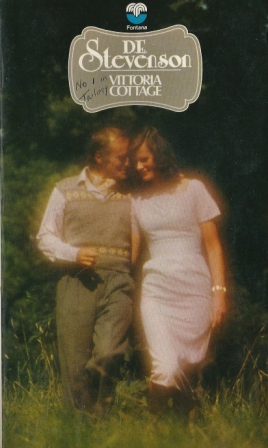
I’m going to review these together. They were both quite wonderful, so much so that, pressed for time as I am this week, I cannot let them pass onto the “have read” list without mention. In my opinion, this trilogy, Vittoria Cottage, Music in the Hills, and Shoulder the Sky, have the Miss Buncle books beat all hollow. Good stuff! I can see these going on my treasured keeper shelf.

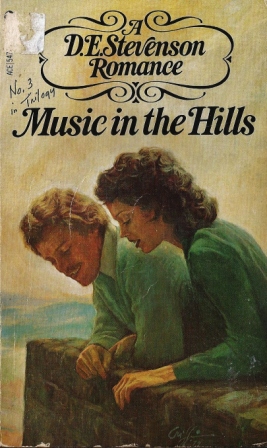
Please try to ignore the desperately ugly covers on these re-released paperback editions. I find them quite embarrassingly inappropriate to the content, which, while “romantic” enough to please the most sentimental, is not cloyingly so as these would lead one to believe. I had some explaining to do to family members who saw me reading these – “What the heck is that?! You’re slipping, old girl …!”

*****

vittoria cottage d e stevensonVittoria Cottage by D.E. Stevenson ~ 1949. This edition: Collins-Fontana, 1974. Paperback. ISBN: 0-00-613-444-0. 191 pages.

My rating: 8.5/10.

Middle-aged Caroline Dering has just been widowed, and, aside from her genuine and seemly sorrow at the death of someone who has shared her life for many years, she is not at all steeped in sorrow. Her lately departed spouse, Arnold Dering, was of a complaining and perpetually malcontented disposition. While  his wife and three children were accepting of his character – Caroline thought that he always meant well, and suspected that at rare moments Arnold recognized and truly regretted his deep pessimism – but by and large enjoyed themselves much more in his absence.

The scene is set for what is to become a series of three novels by descriptions of the village of Ashbridge and the far from cottage-like Vittoria Cottage, ancestral home of the Derings. Though she has merely “married into” the local family, Caroline fits into the local hierarchy almost immediately, and by and large leads a deeply contented life, caring for her children, volunteering for various worthy causes, keeping house and gardening. The children are all grown up, with James away in Malaya, and lovely but discontented Leda (she takes after her father in full) and boisterous Bobbie making their way out into the larger world from the safe haven of their village nest.

To-day Caroline Dering was not working in her garden. She had taken a basket and gone up the road to the gravel-pit to pick blackberries. There was a thicket of brambles, there, and Caroline knew it well. Every year she made this pilgrimage and every year she returned with her harvest of big, black, juicy berries to make into jelly and to bottle for the winter. It was curious (thought Caroline, as she began her task) how the years seemed to telescope when you looked back. Surely there were less than three hundred and sixty-five days between each picking! She remembered the first time she had come. She and Arnold had come together – they had just returned from their honeymoon and settled at Vittoria Cottage – but Arnold had not enjoyed picking blackberries, he had got a thorn in his finger and had torn his trousers on a wild-rose bush and he had suggested that in future they should employ some of the village children to undertake the task. After that Caroline had come alone until James was old enough to help … and then the little girls had joined the party and blackberrying had become an event, a yearly picnic, which took place, weather permitting, upon James’s birthday.

Now, once again, Caroline came alone. The girls had other things to do and Caroline had no use for reluctant assistants. Next year … would James be here? And if he were here would he want to come and pick blackberries on his birthday?

World War II has been over for several years, but England is still very much in coping and recovery mode. Society is fast changing into some sort of new normal, and though things are steadily improving, there is still food and fuel rationing, and a strong atmosphere of “making do”, which makes for some quite fascinating scenarios as we progress through the book and look over Caroline’s shoulder as she goes about her days.

Life in Ashbridge gets suddenly quite interesting with the arrival of the mysterious Mr. Shepperton, who is apparently very reluctant to discuss his past, and who arouses even more suspicion because he appears to have no old belongings or clothing, a real rarity at that place and time, immediately post-war – “everything new!” the village gossips whisper with raised eyebrows.

Caroline’s lovely younger sister Harriet, a successful actress ducking away to her sister’s home for a respite from a difficult and failed recent stage production in London, brings some ex-urban dash and sparkle to village gatherings, and with the unexpectedly sudden return of James from Malaya, and the trials and tribulations of Leda and her fiancé Derek, the local squire’s son, there is plenty of scope for complications, dilemmas, surprises and sometimes unexpected resolutions.

I thought the characters were very well drawn and (mostly) very believable. Caroline is our heroine, but she is not a perfect person by a long shot; her flaws are well on display, but we forgive her them because she is ultimately exceedingly likeable, as is her sister and most of the other players in this excellent domestic drama. It ends quite abruptly, but this served merely to make me keen to get my hands on the next episode in this extended tale, which I was fortunate enough to acquire along with its sister novels recently.

On to Music in the Hills.

________________________________________

Music in the Hills by D.E. Stevenson ~ 1950. This edition: Ace Books, circa 1970. Paperback. ISBN: 0-441-54725-7. 282 pages.music in the hills d e stevenson

My rating: 8/10.

Having more or less settled the fates of Caroline Dering and her sister Harriet Fane in the previous novel, Vittoria Cottage, this next one follows Caroline’s son James, who, at loose ends after his military service and several years spent “chasing terrorists” in Malaya, is looking towards his future.

Deeply in love with his childhood companion Rhoda, he is struggling with her rejection of his marriage proposal. While we suspect that she is in love with James in her own way, Rhoda fears that, as a rising professional painter, marriage would spell the end of her career goals, and that she would be a discontented wife as well as a poorer artist, having to split her focus between two roles, doing neither well.

James takes it very well, all things considered, and hies himself off to the community of Drumburly in Scotland, where he has been invited by his aunt and uncle to reside at the remote Mureth House, a prosperous sheep farm. Jock and Mamie Johnstone have no children of their own, and are hoping that their nephew might be interested enough in farming life to take over Mureth some day. James has always cherished a desire to be a farmer himself, so the situation looks like a success all around; the story follows some of James’s apprenticeship and details the day-to-day occupations of a hill farmer of mid-2oth century Scotland; quite nicely detailed and striking true in the telling.

We have sheep rustlers and romantic entanglements and, of course, more than a few misunderstandings between various parties, all neatly tidied up as the story progresses. Perhaps not as strong a narrative as the preceding Vittoria Cottage, but definitely engaging. I enjoyed it greatly.

The characterizations of the local inhabitants are often well drawn; we all know people just like these.

I’m looking through the book for a snippet to share with you, but am finding nothing really suitable – everything is so enmeshed with the  rest of the story that to take a bit out of context would do it no justice, so you’ll have to take my word for it that this is a well-written post-war domestic drama, with much to recommend it as escape reading in our hectic modern age.

Music in the Hills is followed by a third book to form a trilogy, Shoulder the Sky, also published as Winter and Rough Weather. I’d read this one some months ago, liked it a lot, and reviewed it here: Shoulder the Sky

Reading this trilogy has made me into a confirmed D.E. Stevenson fan. This is good stuff, for which I am ready to forgive some of the less than stellar output by this writer. She definitely had highs and lows in her output, but the Vittoria Cottage trilogy is quite decently lofty.

Read Full Post »

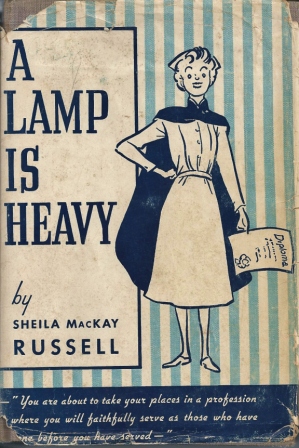
a lamp is heavy sheila mackay russell 001A Lamp is Heavy by Sheila MacKay Russell ~ 1950. This edition: J.B. Lippincott, 1950. Hardcover. 256 pages.

My rating: 5/10.

This one just sneaks (on quiet rubber soles, perhaps?) into the “keeper” pile. It did have its moments, though it was mostly just a milder North American version of the stellar Monica Dickens life-as-a-British-nursing-student classic, One Pair of Feet.

Here’s a bit of trivia I discovered while trolling about for a bit of background info on author Sheila MacKay Russell. According to writer Julia Hallam in Nursing the Image: Media, Culture and Professional Identity, a critical examination of nursing as portrayed in popular culture, A Lamp is Heavy was adapted into a movie titled The Feminine Touch in 1956, with the setting changed to England from North America – I originally had said “The United States” here, but it turns out that the author is from Alberta and likely based it on her experiences nursing in Edmonton – and – much to my surprise! – with Monica Dickens herself contributing as a screenwriter.

I can see how A Lamp is Heavy would transfer well to film; it is equally as concerned with a romance between the main character, nursing student Sue Bates, and a handsome young intern, Doctor Alcott, as it is with the events of hospital life.

But I’m getting a bit ahead of myself here. I’ll let the author speak for herself. Though the main character in the novel is named pseudonymously “Sue Bates”, she is based strongly on the author’s own experiences; the book is strongly autobiographical, though details have been changed to obscure the people and places it is based upon.

It was my long-standing and persistent longing to be a nurse … [and this] impelled me to take the most portentous step in my life, in spite of the discouragement heaped upon me by all and sundry of my friends, including my mother. Mother, in her own way, was a realist. Nurses in her mind were synonymous with fallen arches, varicose veins, questionable language and backaches, and only the fact that she discovered, quite by accident, that Florence Nightingale was a lady of cultured family tended to reconcile her to what seemed to her to be my unnecessarily earthy inclinations.. She wasn’t really reconciled until the day came when she could comfort herself with the possibility of my salvaging a doctor husband out of the fiasco. She even kept all of my relatives in a similar state of doubt. This included my father. Where I was concerned, he reflected Mother’s attitudes as faithfully as a full-length mirror, and as I was an only child, he insisted on having a serious talk with the Mayor of the town before I was allowed to set foot on hospital soil. What he expected to get, or what he did get, from the Mayor, I don’t know, but he seemed happier. He came home and said that the board members of the city hospital were all Chamber of Commerce men, and perhaps I would be safe enough if I trained there.

Sue enters the hospital with her class of eleven other eager probationers; the twelve manage to stay the course and finish out their three years of training to graduate together; tales of their goings-on, trials and tribulations make up the majority of this memoir, with time out here and there for more serious discussions of some of the tragedies – and, to be fair, some of the more than occasional joys – of dealing with patients and their woes, as well as sidelights on the plight of the poverty-stricken members of the population who could not afford to avail themselves of proper medical care despite the efforts of a developing medical outreach service led by several of the hospital’s doctors.

Handsome, charismatic and manipulative Doctor Alcott provides romantic interest; he and Sue have an on-again, off-again love affair throughout Sue’s hospital years, which seems to end quite satisfactorily for all concerned. (Including, incidentally, Sue’s mother!)

A decently readable word portrait of a North American hospital in the just-prior-to World War II years, with likeable characters and enough drama to keep one interested start to finish.

I don’t recommend that you rush out and search this one down, though. Instead, invest your hard-earned dollars in Miss Dickens’  grand tale, unless A Lamp is Heavy absolutely leaps off a used bookstore shelf at you – in that case, it would repay a small investment, returning a few hours of interesting reading.

*****

After I published this review, I received a comment from Susan (see comments, below) to the effect that she thought the author was Canadian. I searched around a bit more and came across this mention on pages 9-10 of Volume 2 of Literary History of Alberta: From the End of the War to the End of the Century, by George Melnyk, 1999, University of Alberta Press.

Sheila Mackay Russell (1920-?) published two novels, A Lamp is Heavy (1950) and The Living Earth (1954). Russell was born in Airdrie, Alberta, went to school in Calgary, and attended university in Edmonton, where she took a degree in public health nursing. After her marriage to a doctor in 1947, she continued to live in Edmonton. A Lamp is Heavy is a first-person account of a nurse during the Second World War. [L&P note: A sharp-eyed reader has mentioned that this is slightly inaccurate, as the novel takes place prior to the start of the war.] This popular novel sold 75,000 copies over five years, including a Dutch translation, and was made into a film called The Feminine Touch with wartime Britain as the setting.

Russell’s character captured an exposed feminine sensibility:

“Witnessing childbirth had a strange effect on me. I can’t explain the close, proud kinship with other women which it seemed to bring me. I only knew, as I watched them, that they were performing a tremendous and elemental act of living.”

Russell’s second novel, The Living Earth,also had a nurse for a protagonist. Set in an isolated settlement in the north of the province (Alberta), the novel tells the story of two women who come from the south to  seek new lives. “It was spring in Mud Creek. Sun and earth, uniting, had thrown off the shackles of winter; the earth steamed from its effort and the sun lingered triumphantly a few minutes longer each day …”

The Living Earth won the Toronto Womens’ Canadian Club prize. The commercial success of Russell’s first novel reflected a need among women readers for literary work that captured their experiences and sensibilities during World War Two. Her second novel dealt with a more specialized topic and a return to an agrarian setting, which did not have the wider appeal of the first book.

Read Full Post »

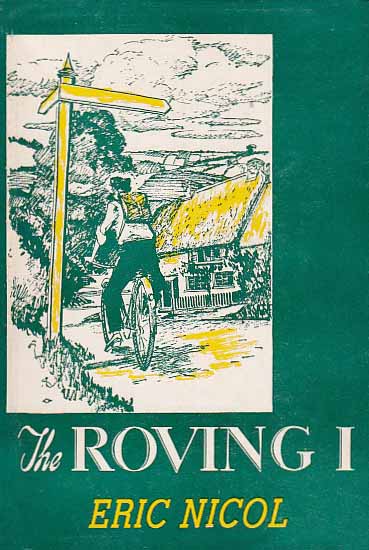
the roving i eric nicolThe Roving I by Eric Nicol ~ 1950. This edition: Ryerson Press, 1951. Hardcover. 134 pages.

My rating: 7/10, after some inner debate.

I  am rather sad to have to say that much of the humour is groaningly dated in this one, but despite that single failing, I have a strong affection for Eric’s comic tale of his year on The Continent, some phrases of which are ingrained deeply into my memory. The more eloquent passages obviously resonated deeply when I first read this at an impressionable age.

The Roving I won the Stephen Leacock Medal for Humour in 1951, which is commendable but not necessarily a guarantee of, well, of anything! The bits of Roving I which I am fondest of are the more serious bits, hidden beneath the sometimes-forced playfulness of the narrative.

Do I date myself when I assume that everyone knows who Eric Nicol is? As a middle-aged, mostly lifelong British Columbia resident, Vancouverite Nicol has somehow always been there, always on the edges of my awareness, a cultural constant. Exceedingly prolific throughout his writerly life, which began in college – he famously started his career by writing in the Ubyssey under the pen name of Jabez – Nicol went on to write more than 6000 newspaper columns for The Vancouver Province, as well as 40-odd books and a number of mostly-comic plays. Eric Nicol died in 2011, at the age of ninety-one, writing up until the end, despite battling the onset of Alzheimer’s. His last book, Script Tease, a collection of typically whimsical articles, was published in 2010.

But we’re going to go way back, to the early days, to Eric’s more youthful days as a young man after his WW II military service – three years in a non-combat role in the R.C.A.F. –  when he was taking advantage of an opportunity to pursue post-graduate studies for a year at the Sorbonne.

Here’s a sampling, from Chapter One: Debut of a Vagrant, at the start of the long train journey eastward to the embarkation point for ship travel to Europe.

The train lurches forward heavily, trying to take us all out by the roots at once. Mine hang on. Mine and those of the old couple across the aisle, who never thought of buying a newspaper because the news of the day was their being on the train, with a rope around their world.

Another good jerk does it. The station begins slowly to glide out under a full sail of flapping handkerchiefs. No, it’s us. We’re rolling. I and the fat lady sitting opposite me, reluctant to admit one another to the sudden vacuum of our existence, stare out the window at a grey and indifferent Vancouver. Oh, Vancouver, that I’ve given the best years of my life to, how can you dismiss me as though I were just another can of salmon? Is this how I’m to remember you, this motorist stymied by the crossing gate and glad to see the last of us? Couldn’t that woman stop hanging out her laundry for a minute? Is there no one to wave to us, on behalf of the city of Greater Vancouver?

Yes, by heaven! There she is. A little girl, a delegate at large, patting the air slowly and solemnly, making it last for the whole train. The fat lady and I wave back, and, relinquishing Vancouver, smile at each other, having in common someone we both said goodbye to…

That’s a fair sampling of Nicol’s style. Though occasionally it drops into sheer silliness, it is usually redeemed by clever, often very funny phrasings; the man did have – overused cliché fully applicable here – a way with words.

Eric Nicol’s books are quite easy to come by here in B.C., and are – here’s another cliché – well worth dipping into if you come across them in your travels, though some I find more enjoyable than others. The more hectic ones do seem to be trying a bit too hard, but there are little gems of delicious prose in each and every one. The Roving I is one of my personal favourites, a slight little period piece which captures a moment of time in a fast-moving world and frequently makes us smile at the infinite absurdities of life.

Read Full Post »

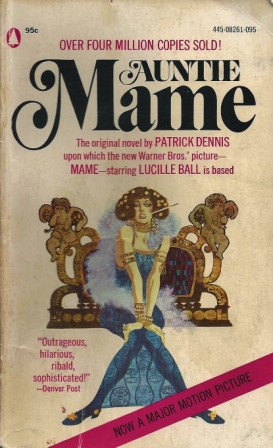
auntie mame patrick dennis 001Auntie Mame by Patrick Dennis ~ 1955. This edition: Popular Library, circa 1974. Paperback. ISBN: 445-08261-095. 254 pages.

My rating: 8/10.

It is what it is – a blissfully easy-to-read, unapologetically American social comedy, with enough perfectly timed, backhanded slaps at social snobbery, racism and anti-Semitism to redeem it from total silliness.

*****

I don’t know quite where she came from, but Auntie Mame appeared one day in a stack of old paperback books I was sorting and putting away. I gave her a rather scornful glance – she was, after all, ensconced between tatty covers emblazoned with movie tie-in headlines, never a particularly endearing feature – and popped her into a box with a bunch of other “maybe someday” books. But not long afterwards she showed up on my night table, brought into the bedroom by (of course) a man, who’d been looking for a diversion, found her intriguing and decided to experience her lavish charms more intimately. After he’d finished with Mame, he left her there to work her charm on me.

“Well, darling,” she whispered to me with a we’re-all-girls-in-here-together-now intonation, “how about it? Don’t you want to find out what Auntie Mame is all about?”

So I read her.

Hotcha!

*****

I’m guessing almost everyone’s either seen one of the two movies based on this 1955 bestseller – the 1958 Rosalind Russell vehicle (pretty darned good), and the 1974 Lucille Ball effort (pretty darned bad) – or one of the countless stage adaptations, or read the actual book itself – printed and reprinted numberless times, most lately in, I believe, 2001. That’s a good half-century of popularity, and I think it’s safe to state that Auntie Mame has a decidedly secure place well up in the top end of the American pop culture archive.

Does she deserve it?

Well, yes, I rather think she does. She’s a deeply lovable creation – with that lovableness outshining her undeniable glamour and her bizarre goings-on as the key reason for my re-reading her spicy “biography” every so often, whenever Mame winningly works herself up to the top of the book stacks, like cream rising to the top of an old-fashioned bottle of milk.

Here’s the basic outline, for those of you who’ve so far been blissfully unaware of the existence of Auntie Mame and her impressionable young nephew, Patrick.

Orphaned at the age of ten in 1929, the very much fictional* Patrick Dennis is sent to live with his wealthy and gloriously extroverted aunt, who is presently holding court (apt term) in a lavish apartment at 3 Beekman Place in Manhattan.

*The author published this book under this pseudonym in order to add verisimilitude to the “memoir” form; after the novel’s success, the pseudonym was maintained for most of the author’s future writings. Edward Tanner is the real name of the author – actually, Edward Everett Tanner III. Mame was inspired by, but was not an accurate depiction of, the author’s real-life aunt, Marion Tanner. Edward Tanner also wrote under the pseudonym “Virginia Rowans”.

Mame welcomes her “own little love” with open arms, and Patrick returns that affection immediately and instinctively, despite his father’s rather foreboding words while making his will the year prior to his sudden demise.

…My father read his will to me in a shaky voice. He said that my Aunt Mame was a very peculiar woman and that to be left in her hands was a fate that he wouldn’t wish a dog, but that beggars couldn’t be choosers and Auntie Mame was my only living relative.

Despite the deathbed wishes of Patrick’s father for his son to receive a conservative upbringing, Mame craftily dodges the stodgy school which Patrick’s trustee, the estimable but strictly conventional Mr. Babcock, has chosen. Instead Patrick ends up in a very avant-garde establishment distinguished by its policy of complete nudity for all, students and staff – and absolute lack of any inhibitions, or actual academic teaching. Mr. Babcock’s visit as the students and their adult mentors are role-playing a school of spawning salmon puts a quick end to the experiment, and lands Patrick in that dreaded boarding school, far away from the influence of his aunt, whom Mr. Babcock regards as the epitome of evil decadence from that moment forward.

Luckily Patrick’s education had already received something of a unorthodox but most useful boost from his aunt’s insistence, from his very first day with her, of Patrick’s carrying a pad of paper with him and writing down any unfamiliar words for future explanation.

I spent that first summer in New York trotting around after Auntie Mame with my vocabulary pad, having Little Morning Chats every afternoon, and being seen and not heard at her literary teas, salons and cocktail parties.

They used a lot of new words, too, and I acquired quite a vocabulary by the end of the summer. I still have some of the vocabulary sheets of odd information picked up at Auntie Mame’s soirees. One, dated July 14, 1929, features such random terms as: Bastille Day, Lesbian, Hotsy-Totsy Club, gang war, Id, daiquiri – although I didn’t sell it properly – relativity, free love, Oedipus complex – another one I misspelled – mobile, stinko – and from here on my spelling went wild – narcissistic, Biarritz, psychoneurotic, Shönberg, and nymphomaniac. Auntie Mame explained all the words she thought I ought to know and then made me put them into sentences which I practiced with Ito, while he did his Japanese flower arrangements and giggled.

Once Patrick is incarcerated in conventional school, his visits to Auntie Mame are restricted to occasional weekends and the holidays. No matter, though, as the two are already bound by a strong and abiding love which will see them through the most outrageous of Mame’s excesses and the rapid ups and downs of her changing fortunes and continual reinventions of herself.

Mame’s fortune is decimated by the Stock Market Crash of October 29, 1929, and she hits the lowest point, financially speaking, of her life, ending up selling roller skates (ineptly) in Macy’s department store, before being rescued at the 11th hour by a wealthy Deep Southern white knight, Beauregard Jackson Pickett Burnside, who sweeps her of her feet and sets her up for the rest of her life, leaving her a seriously large fortune when he dies rather tragically only a few years into the marriage.

Mame sincerely mourns Beau, but continues on her merry way charming and being charmed, and enjoying the attentions both platonic and amorous of a huge range of people, including at one point one of Patrick’s college friends – Mame refuses to let a little thing like age difference stand in the way of her relationships of any sort.

Patrick drifts in and out of Mame’s circle, observing and pithily commenting on her friends and latest fads, which range from the oriental stylings of their first meeting to the Southern belle of the Beau years, to literary pseudo-Irish tweed and brogues, to war-time Friend of England sponsoring some truly horrible Cockney refugee children in a Colonial mansion which they promptly completely destroy.

Patrick falls in and out of numerous relationships on his own, from gold-digging waitress Bubbles, to über-snobbish fiance Gloria Upson, to a poverty-stricken but determinedly aristocratic trio of blue-blooded and stunningly beautiful sisters. He finally finds true love, marries and produces a son of his own, only to have Mame swish in sari-bedecked and trailing a pet swami during her Indian reincarnation period, to carry her latest “little love” off to the orient, thus bringing our tale full circle.

*****

Undeniably funny – though I never did “laugh out loud” as many reviewers report themselves doing – this satirical tale is as full of barbs as a porcupine is of quills. The author uses his humorous platform to trot out his very decided views on the state of middle class American mores, while amusing us with his bitchy delivery – there’s a decidedly contemporary feel to a lot of the humour, despite the book being well into its sixth decade by now.

“Risque” is a word not often used today, but it applies in full force to Auntie Mame – the book and the character. Inhibitions – pshaw! If it feels good and doesn’t harm anyone, go for it! is the credo Mame lives by, and Patrick slips into that attitude easily, though prudishness occasionally rears its head in his case. The innuendo throughout is frequently gloriously bawdy, though there are a few groaningly bad double entendres, as when Patrick reports on his first social occasion at Auntie Mame’s, as an still-innocent ten-year-old. (Needed information: Norah is Patrick’s Irish nurse, and Ito is Mame’s Japanese houseman; Prohibition is in full swing.)

One lady with red hair said that she spent an hour a day on the Couch with her doctor and that he charged her twenty-five dollars every time she came. Norah led me to another part of the room.

The little Japanese man gave Norah a glass and said it was right off the boat and Norah said she wasn’t used to spirits – even though she was always telling me about seeing ghosts and haunts – but this time she’d take a drop of the creature. She seemed to be feeling very happy all of a sudden. And in a little while she asked Ito to give her another Nip.

Oh. My. Goodness. That was pretty dire, Mr. Dennis/Tanner. Had to read this bit twice to make sure I’d seen it correctly. Groan. How many desperately bad puns did the author cram into these few sentences? I think I counted six.

Luckily most of the jibes aren’t quite so deeply awful, but in the interests of full disclosure the prospective reader should be warned of these types of things!

To sum up, I do ultimately enjoy this gloriously campy period piece. Yes, it’s chock full of period-typical stereotypes and attitudes towards women and “foreigners”, but that doesn’t bother me one whit in this one – it’s an innocently era-correct sort of prejudice, and there’s enough social awareness going on of the greater evils in the world of the time to excuse the bits which would be politically incorrect if written today.

It’s a refreshingly easy read, too, as I think I mentioned earlier, and has a very American type of blatantly outrageous humour which appeals in its own way as much as the typically lower key, straight-faced British literary wit does. You do need to pay a certain amount of attention while reading to catch all the nuances, but Auntie Mame romps along at such a good pace that drowsing off in her company is not a danger at all.

(And I’m glad to report that I didn’t use the term “madcap” once in this review. Ha! Points for me!)

Read Full Post »

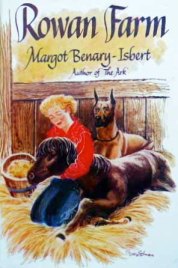
rowan farm margot benary-isbertRowan Farm by Margot Benary-Isbert ~ 1954. This edition: Peter Smith, 1990. Translated from the German by Richard and Clara Winston. Hardcover. ISBN: 0-8446-6475-8. 277 pages.

My rating: 10/10. A sequel/companion piece to The Ark.

A more mature, less “sentimental” book than the also very excellent The Ark, and a classic example of a bildungsroman – a “coming of age” story – set in 1948 and centered on 16-year-old Margret but involving many other characters as well as they react and adjust to their changing situations and the challenges of the immediate post-WW II world of defeated Germany.

*****

Rowan Farm continues the story of the Lechow family, war refugees from Pomerania who have settled into an abandoned and renovated railway carriage located on a rural farm in the Hesse region of Germany (near Frankfurt). The family’s father has made the long journey from the prison camp in Siberia where he has been interned, and the joy of the family’s reunification is still strong, though shadowed by the wartime death of one of the sons, and the emotional and physical damage Dr. Lechow is recovering from.

Other returning soldiers are finding their way home all over Germany, though for many there are literally no homes to return to. An unprecedenting readjustment of the entire population is taking place, as refugees seek a place to settle and get on with their lives, while those fortunate enough to still have their properties often grimly resent the official mandate that they must share their resources and often their homes and land with the incomers.

Bernd Almut, son of matriarch Anni Almut of Rowan Farm, has found his own way home, and having regained some of his physical strength is now trying to fit himself back into the farm life which his mother has capably managed without him for so many years. The eldest Lechow children, 17 year old Matthias and 16 year old Margret, are now integral members of the Rowan Farm hierarchy, Matthias working on the land, with Margret caring for the livestock and the sadly diminished breeding kennel of Great Danes which Rowan Farm was long famous for. Bernd and Matthias have become good friends, but that relationship founders when both become infatuated with lovely Anitra, a city girl on holiday from her studies at Franfurt University.  Margret is nurturing some romantic feelings of her own towards Bernd, and he had apparently returned them until flirtatious Anitra (who can’t be all so fluffy as she looks – she is a Mathematics major) shows up. Margret deeply feels her own intellectual shortcomings; because of the war she has had to leave school some years ago, and no longer even thinks of returning to the world of studies; life has taken her a very different direction, into practical labour with her hands.

Multiple subplots abound in this novel. 11-year-old Andrea is academically gifted and is fortunate enough to be a scholarship student in the Catholic Lyceum in the nearby town; her parents are hoping that she of all of their children will be able to attend university, but Andrea has been bitten by the stage bug and has her heart set on becoming an actress. 8-year-old Joey and now-adopted “twin” brother Hans Ulrich are involved in many boyish pursuits, including raising a family of prized Angora rabbits, and running wild through the countryside every chance they get; a favourite stop is the cottage of solitary and eccentric “bee-witch” Marri, who always has a slice of bread and honey for her young visitors. Marri’s war has been a tragic one. She is the widowed mother of a lone son, a gentle and pacifistic boy; upon conscription he had willingly put on the soldier’s uniform as was his duty, but he ultimately was unable to follow orders to shoot another person, and was court-martialled and executed. Marri’s grief has brought her to the edge of madness. Fearing for her sanity, the Almuts and Lechows have tried to refocus her interest by asking her to take in a returned veteran who has himself lost his wife in a bombing raid, and who is desperately searching for his baby son, who would now be a toddler of three, if he is still alive.

There is also a young, one-armed, returned war veteran schoolmaster who falls afoul of the village mayor by involving his students in establishing a refuge for homeless soldiers; an outspoken and controversial journalist who visits the soldiers’ home and turns out to be a very unexpected individual; a American Quaker aid worker who is interested in both the Great Danes Rowan Farm raises and in the possiblilities of sponsoring the young kennel maid for emigration to the U.S.A.; a gang of black market dealers stealing local livestock; a rescued Shetland pony mare which Margret and her father nurse back to health; and two young ex-soldiers who stay for a short time until suddenly moving on, with tragic results. Musical Dieter and his band of Cellar Rats come and go, bringing a breath of the city with them as they play for the village dances and help with the haying.

Re-reading this story as an adult, I was most impressed by how delicately the author portrayed the difficulties of the returning soldiers such as Dr. Lechow. Parted from his family in the very early days of the war when he was conscripted to serve as a military doctor; finding his beloved family home in Pomerania has been lost forever; losing one of his sons – Margret’s twin brother Christian – all of these are things he takes to heart. His delicate (in his view) wife and helpless (in his mind) children have survived work camps and refugee camps and untold dangers and hardships while he himself has been incarcerated in a brutal Siberian prison camp. He finds his family at last and once he has healed enough to take an interest in their affairs, he is slightly shocked to realize that they have been functioning exceedingly well without him. His occasional attempts to regain his “beneficient patriarch” status, and his wife’s tactful handling of his delicately bruised ego and his confusion at the “new normal” he finds himself coming back to is realistically portrayed.

This story, and its predecessor The Ark, are paeans to the steadfast strength of women throughout and after the war. The men leave, usually not by choice, and either fail to return or come back terribly altered physically and emotionally. The mothers, grandmothers, wives, daughters and girlfriends who have been viewed as secondary citizens – especially in patriarchial Germany – remember that this is the land and the time of the woman’s role being defined as Kinder, Küche, Kirche – children, kitchen, church – have had to take on traditionally male tasks and for the most part have managed exceedingly well. The horrors of the war are more openly referred to in this story, including references to the death camps, and there is very much an atmosphere of both acknowledging what has happened and hoping that the future will be a more just and positive time for the survivors from all segments of German society.

All in all, a sensitive and moving story for older children (possibly 10 and up?) and adults both, inspired by the personal experiences of the author. Very highly recommended. It should follow The Ark for best effect, but can also be read alone.

Read Full Post »

just add water and stir pierre berton 001Just Add Water and Stir by Pierre Berton ~ 1959. This edition: McClelland & Stewart, 1966. Paperback. 221 pages.

My rating: 8.5/10.

*****

Here’s another well-read paperback from my late father’s bookshelves, boxed up and brought home six years ago as my just-widowed, elderly mother was preparing to downsize from a huge, rambling three-story house to a much smaller bungalow. Both homes, incidentally, were built in their entirety by my father, who was a foundation-to-roof master carpenter, among his other jack-of-all-trades and master-of-many accomplishments and interests.

One of his interests was books. Dad did love to read, and I like to think that this collection of mostly humorous, often over-the-top satirical, sometimes sincerely thoughtful short essays made him smile as they did me when I finally read this briskly paced book over the course of this potentially dreary day spent recovering from a brief bout with the latest flu bug.

Being a random collection of satirical essays, rude remarks, used anecdotes, thumbnail sketches, ancient wheezes, old nostalgias, wry comments, limp doggerel, intemperate recipes, vagrant opinions and crude drawings …

So says the front page, and it describes the ensuing contents well. Most of these short pieces appeared as columns in the Toronto Daily Star in the 1950s, and they are definitely indicative of the time in which they were written. As a cynically humorous portrait of the era, this book is an excellent little period piece, but it’s an enjoyable read even for those of us not familiar at first hand with the context of some of the references. Berton’s opinionated prose is seldom dull, and the shortness of each entry makes it good for dip-into reading as well. I read the whole thing in one go, and that likely wasn’t such a great idea, as I’m now feeling a bit light-headed, but I’ll blame that on my current bug as much as on the flippant nature of my reading matter.

The book is arranged into groupings of similarly themed articles and essays. These can be read in order, or sampled at will.

Five Modern Fables ~ Pure over-the-top satire starts us off. Berton skewers modern advertising techniques and ploys in his first three fables, lampoons the vicious cycle of competitive Christmas card lists, and ends with a cautionary tale about not heeding the omens and building too close to the volcano.

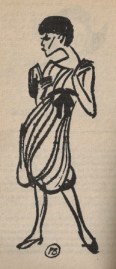
Seven Men and a Girl ~ Brief character portraits of eight people Berton met and interviewed: Ex-convict John Brown, pianist Glenn Gould, aviator Russ Baker, evangelist-turned-politician Charles Templeton, Canadian Communist Joe Salsberg, poet and writer Robert Service, entertainer Milton Berle, and call girl Jacqueline (no last name given).A Woman of "Vogue"

The Wayward Periodical Press ~ “Six periodical publications deserving of comment” – Vogue, Time, Mayfair, Playboy (and the rest of the Bosom Books), Mad, and Justice. What an interesting combination of companions these are. Vogue is, well, Vogue, and it apparently hasn’t changed much at all.

My favourite magazine, next to Screen Stars and Mad, is Vogue. The day it appears, I rush eagerly to the newsstand and, with the help of a couple of weightlifters, lug it off to my den. For sheer escape reading it beats the old Blue Fairy Book hollow. It chronicles a world so foreign and unreal that I would not believe it existed, if there weren’t photographs to prove it.

The women who grace Vogue’s pages are like no women I have ever known. I have tried to sketch one or two of them here, but my brush does not do them justice for their absolute and utter sexlessness defies reproduction. If they came from a far corner of the solar system they could not be more different than the blousy creatures one finds romping through Esquire and Playboy.

Am I all wet in my theory that a bosom craze is sweeping the country? In Vogue, there isn’t a bosom in a carload. These women are all eyes and cheekbones, and they do something with their necks that I haven’t seen since Leona, the Giraffe Girl, went into retirement.

At the end of the neck one finds a face that has overtones of Buchenwald about it – chalk-white and haggard, Vogue women do not have noses, only nostrils. Their eyes are enormous and decadent, their lips are thin and solemn. Their hair is always quite odd. They are shown thrust forward in inscrutable positions that suggest some curious doe-like animal at feeding time.

Time sets off a passionate diatribe in defense of Canadian content in “Canadian” versions of American magazines; Mayfair is a “high society” periodical seething with anachronistic class consciousness. Playboy and the rest of the “men’s magazines” are investigated as to the number and degrees of exposure of female body parts posed artistically for masculine delectation; Berton claims to be overwhelmed by sheer numbers.

The Cult of the Bosom has now reached its zenith in this continent, as a glance at any newsstand will show. In the seventeen magazines I examined, there were 503 photographs of well-endowed young women displaying their endowments.

In 125 of these photographs, many of them in glowing colour, the young ladies’ torsos were entirely exposed. In the remaining 378 photographs there was a certain roguish attempt at concealment.

I did not bother to count any photographs of women dressed for the street, because there were so few.

I did not bother to count any photographs of flat-chested young women, because here were none.

I did, however, make a count of the numbers of photographs of women with no pants on. There were sixty of them.

Mad magazine receives an enthusiastic nod of approval, for the “sophistication of the humour”, while Justice, an arcane periodical dedicated to the practices of sadomasochism and corporal “discipline”, garners strong words of scorn.

The Broadcasting Arts ~ Television and radio – including the already-venerable C.B.C. – come in for their turn in Berton’s critical spotlight.

Verse, Blank and Otherwise ~ Several parodies in verse of current events of the time. The Sixty-Five Days of Christmas struck a modern chord, though nowadays it would need to be retitled The Ninety Days of Christmas to approach a closer accuracy!

Christmas began last Tuesday
Just three days after Hallowe’en,
By which time the big emporiums,
Having disposed of the comic ghosts and candy pumpkins
And having burned all the second-hand witches,
Replaced them with more seasonal symbols:
A reindeer with a crimson nose,
A talking snowman and a terribly cute bear,
Fifty-seven varieties of Santa Claus,
And here and there, an inconspicuous plastic replica of the Christ-child,
 
Entirely non-denominational.
 

Intemperate Recipes ~ A plea for a return to real cooking versus the pre-packaged growing norm in the titular Just Add Water and Stir, and a heartfelt rant against instant coffee, obviously a newly popular abomination in Berton’s world. Plus four quite decent-sounding recipes – or, more accurately, anecdotal instruction pieces on how to best prepare these Berton standbys – Tomato Soup, Baked Beans, Corned Beef Hash, and Clam Chowder. Pierre Berton in the kitchen – what a grand thought!

The Passing Show ~ A satire from the viewpoint of the future, and musings on the status significance of offices and office furnishing, smoking, and divorce. Shopping for a Coffin is thought-provoking and quite serious, while Several Openings for Novels will make the aspiring writer nod in rueful recognition. A few more observations – paying to be published, the confusion of children’s toy assembly instructions, and a modern Red Riding Hood round out this section.

Certain Vagrant Opinions ~ Full rant mode! On Dick and Jane (Berton is against), On Advertising and the Press, On Racial Origins (none of the government’s business), On Thought Control (shades of Orwell’s Nineteen-Eighty-Four), and most passionately, On Flags and Anthem and On Modern Torture (prison reform), which is the most serious piece of the lot, and describes an execution by hanging which Berton was assigned to attend as a young reporter.

Some Old Nostalgias ~ Memoirs, 1927 to 1941, of Berton’s earlier days. Fascinating and charmingly written.

Read Full Post »

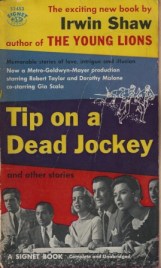
tip on a dead jockey irwin shaw 001Tip on a Dead Jockey and other stories by Irwin Shaw ~ 1957. This edition: Signet, 1957. Paperback. 176 pages.

My rating: 8/10. Very decent collection of mostly melancholic short stories about jaded Americans in post-war Europe and “back home”.

I found this disintegrating paperback on my dad’s workshop bookshelves when I was going through his papers after his death six years ago. Dad liked his reading straight-serious (think detailed war memoirs and biographies), and satirical-serious (John Steinbeck was a big favourite), and cynically humorous (Wilhelm Busch in the original German was there in a number of editions), and technical and creative (Popular Science and Popular Mechanics, heaps and heaps, dating back to the early 1950s – my son scooped these and they now reside in dusty, well-read, falling apart glory on the cabin bookshelves), and travel and historical (National Geographic, of course, another massive, complete collection. I think these start with the 1961 full year, though there are stray earlier ones.) The dramatic fictional bestsellers of the day were well-represented as well, lots of Irwin Shaw around when I was growing up, though I don’t remember this particular one. Must have been on a really high shelf!

This Shaw collection, from very early in the writer’s career – 1946 to 1957 being the publication dates mentioned on the copyright page – are crisp, clean, often cynically humorous, well written and definitely entertaining. Not all have conclusions, which while a bit cliffhangerish is not necessarily a handicap to appreciation. Good stuff. Thanks, Dad.

I’ve been reading other bloggers’ magnificent and thoughtful posts with great admiration recently, and am feeling decidedly sub-par in this regard tonight – I will not even try to get all deep and meaningful.

Here’s my review: I liked these stories. They were very readable. You may find yourself craving a glass of whiskey (with or without a mixer), or a bottle of harsh red French wine (glass optional). My usual beverage of choice, a “nice cup of tea”, felt rather too granny-ish; I was almost ashamed of myself. No, hang on – two of the stories had tea-drinking in them. Though one couple  added rum. Hm, that sounds fairly foul. Or maybe not?! Worked for the characters, apparently – it was followed by a night of passion!

*****

Tip on a Dead Jockey ~ In post-war Paris, pilot Lloyd Barber is offered a chance at some easy money, just one simple trip, flying a brand-new single-engine Beechcraft, from Egypt to Cannes.

“Alone?” Barber asked, trying to keep all the facts straight.

“Alone, that is,” Smith said, “except for a small box… When you take off from the airport in Cairo, the box is not on board. And when you land at the airport at Cannes, the box is not on board. Isn’t that enough?”

It’s not quite enough, or maybe it’s too much – Barber eventually turns the job down, but not before inadvertently introducing Smith to another pilot friend, the naïve and trusting Jimmy Richardson.

You didn’t have to speculate about Jimmy. If you bought Jimmy a drink, he was your friend for life. For all that he had been through – war and marriage and being a father and living in a foreign country – it had still never occurred to Jimmy that people might not like him or might try to do him harm. When you were enjoying Jimmy, you called it trustfulness. When he was boring you, you called it stupidity.

Choosing not to warn Jimmy about Smith’s “opportunities”, Barber is overwhelmed with guilt and unease when Jimmy’s distraught wife shows up begging for help in finding him; he’s been gone thirty-two days without a word. There’s a little twist in the tail of this tale.

This short story was worked up into a 1957 Metro-Goldwyn-Mayer movie, with loads of added elements; only the author’s original sketchy premise and a few of the names remained the same.

A Wicked Story ~ A wife’s unfounded  jealousy becomes a self-fulfilling prophecy.

In the French Style ~ Cynical Walter Beddoes, “career man in the foreign service”, returns to his home base in Paris from two months away in Egypt to find his reliable good time girlfriend has decided to move on to something more permanent. Beddoes had had his chance, but he’d ducked it:

It was lucky he was leaving, if she was moving into that phase. That was the pre-yearning-for-marriage phase, and you had to be on guard against it, especially late at night, in Paris, in darkened rooms where pianists and electric guitars played songs about dead leaves and dead loves and lovers who were separated by wars.

Beddoes had been married once, and he felt, for the time being, that that was enough. Wives had a tendency to produce children, and sulk and take to drink or other men when their husbands were called away to the other side of the earth for three or four months at a time on jobs.

Of course, there are regrets.

Peter Two ~ Thirteen-year-old Peter has a harsh foray into the fickleness of the adult world. This one almost cries out to be included in a high school short story anthology – maybe it has been? – I can imagine how joyfully an earnest teacher would pick it apart and spread out its “discussion points”! Lots of essay material here, oh yes indeed.

It was Saturday night and people were killing each other by the hour on the small screen, Policemen were shot in the line of duty, gangsters were thrown off roofs, and an elderly lady was slowly poisoned for her pearls, and her murderer was brought to justice by a cigarette company after a long series of discussions in the office of a private detective. Brave, unarmed actors leaped at villains holding forty-fives, and ingénues were saved from death by the knife by the quick thinking of various handsome and intrepid young men.

Peter sat in the big chair in front of the screen, his feet up over the arm, eating grapes. His mother wasn’t home, so he ate the seeds and all as he stared critically at the violence before him. When his mother was around, the fear pf appendicitis hung in the air and she watched carefully to see that each seed was neatly extracted and placed in an ashtray. Too, if she were home, there would be irritated little lectures on the quality of television entertainment for the young, and quick-tempered fiddling with the dials to find something that was vaguely defined as educational …

Suddenly, in the hall outside the apartment, a woman screams…

Age of Reason ~ A man’s repeated nightmare highlights uneasy aspects of his marriage, and forebodes a disaster which may or may not come to pass.

The Kiss at Croton Falls ~ Frederick Mull, trolley driver, “a huge rollicking man, with a russet mustache”, a drinking habit, and a supremely jealous wife who sneaks around spying on Mull’s lady passengers, dies at the height of his glory, leaving his wife to convene with his ghost, and his grown-up daughter Clarice to take a good hard look at her own husband. Grand little story, humorous and perfectly crafted.

Then We Were Three ~ American expatriates Munnie, Bert and Martha travel through France enjoying a platonic three-way friendship which lasts one day too long.

The Sunny Banks of the River Lethe ~ A man’s perfect memory dissolves. Irwin’s been reading Kafka.

The Wedding of a Friend ~ Ronny Biddell’s wedding brings back memories of his ill-fated, one-sided, first love affair during the war, with the duplicitous but delicious French Virginie. Light-hearted.

Voyage Out, Voyage Home ~ Lovely young American Constance is taking a quiet, solitary skiing vacation in Switzerland at her father’s expense, to mull over her prospective marriage to a much older man (Daddy doesn’t approve), when she meets the charming, reckless Englishman Pritchard. No surprises, but nicely done – a classic tale of  love and loss.

Read Full Post »

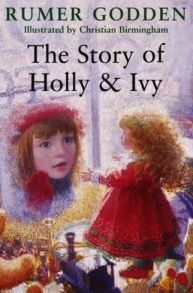
the story of holly and ivy rumer goddenThe Story of Holly and Ivy by Rumer Godden ~ 1958. This edition: Macmillan, 2005. Illustrated by Christian Birmingham. Softcover. ISBN: 0-330-43974-x. 58 pages.

My rating: 10/10. Pretty well perfect.

*****

This is a story about wishing. It is also about a doll and a little girl. It begins with the doll.

Her name, of course, was Holly.

It could not have been anything else, for she was dressed for Christmas in a red dress, and red shoes, though her petticoat and socks were green.

She was ten inches high and carefully jointed; she had real gold hair, brown glass eyes, and teeth like tiny china pearls.

The newest toy in Mr. Blossom’s shop in the village of Appleton, Holly is unpacked the day before Christmas Eve, and she is apprehensive as to what will happen next. The other toys are in a state of high excitement. “We must be sold today!” they whisper to each other, before the shop opens. “Wish, wish, wish!”

“What happens if I’m not sold?” wonders Holly.

“You will be put back into stock,” hisses Abracadabra, the sinister stuffed owl who broods over the store. “It is shut up and dark, and no one will see you or disturb you. You get covered with dust, and I will be there.”

Holly quivers in despair. “I wish, wish, wish for a little girl for Christmas!”

But Christmas Eve is here, and the shop is being closed up, and Holly is still on the shelf…

Meanwhile…

Far away in the city was a big house called St Agnes’s, where thirty boys and girls had to live together, but now, for three days, they were saying ‘Goodbye’ to St Agnes’s. ‘A kind lady – or gentleman – has asked you for Christmas,’ Miss Shepherd, who looked after them all, had told them, and one by one the children were called for or taken to the train. Soon there would be no one left in the big house but Miss Shepherd and Ivy.

Ivy was a little girl, six years old with straight hair cut in a fringe, blue-grey eyes, and a turned-up nose. She had a green coat the colour of her name, and red gloves, but no lady or gentleman had asked for her for Christmas. ‘I don’t care,’ said Ivy.

Sometimes in Ivy there  was an empty feeling, and the emptiness ached; it ached so much that she had to say something quickly in case she cried, and, ‘I don’t care at all,’ said Ivy.

‘You will care,’ said the last boy, Barnabas, who was waiting for a taxi. ‘Cook has gone, the maids have gone, and Miss Shepherd is going to her sister. You will care,’ said Barnabas.

‘I won’t,’ said Ivy, and she said more quickly, ‘I’m going to my grandmother.’

‘You haven’t got a grandmother,’said Barnabas. ‘We don’t have them.’ That was true. The boys and girls at St Agnes’s had no fathers and mothers, let alone grandparents.

‘But I have,’ said Ivy. ‘At Appleton.’

I do not know how that name came into Ivy’s head. Perhaps she had heard it somewhere. She said it again. ‘In Appleton.’

But Ivy is going to the Infants’ Home in the country, as Miss Shepherd must go to her sister, who has influenza. Ivy is loaded onto the train, with “a packet of sandwiches, an apple, a ticket, two shillings, and a parcel that was her Christmas present”, and on to Ivy’s coat was pinned a label with the address of the Infants’ Home.

As soon as Miss Shepherd leaves her, Ivy tears off the label and throws it out the window. ‘I’m going to my grandmother,’ she declares. ‘In Appleton.’ That is in just a few stops, a helpful lady tells her, and sure enough, as the train stops at Appleton station Ivy gets off, leaving her suitcase and her St Agnes-supplied gift – a pencil-case – on the seat, and, unnoticed by the busy ticket inspector, starts out on her quest.

Not far away, in the toyshop, Holly is wishing and wishing and crying out silently, ‘Stop. Stop. Oh, someone, stop.’ But in vain.

Only one person stopped, but it was not a boy or a girl. It was Mrs Jones, the policeman’s wife from down the street. She was passing the toyshop on her way home when Holly’s red dress caught her eye. ‘Pretty!’ said Mrs Jones and stopped.

You and I would have felt Holly’s wish at once, but Mrs Jones had no children and it was so long since she had known a doll that she did not understand; only a feeling stirred in her that she had not had for a long time, a feeling of Christmas, and when she got home she told Mr. Jones, ‘This year we shall have a tree.’

‘Don’t be daft,’ said Mr Jones, but when Mrs Jones had put her shopping away, a chicken and a small plum-pudding for her and Mr Jones’s Christmas dinner, a piece of fish for the cat, and a dozen fine handkerchiefs which were Mr Jones’s present, she went back to the market and bought some holly, mistletoe, and a Christmas tree.

The tree is decorated, but

‘Who is to look at it?’ asked Mr Jones.

Mrs Jones thought for a moment and said, ‘Christmas needs children, Albert.’ Albert was Mr Jones’s name. ‘I wonder,’ said Mrs Jones. ‘Couldn’t we find a little girl?’

‘What’s the matter with you today, my dear?’ said Mr Jones. ‘How could we find a little girl? You’re daft.’ And it was a little sadly that Mrs Jones put holly along the chimney shelf, hung mistletoe in the hall, tied a bunch of holly on the doorknocker, and went back to her housework.

*****

Need I go on? Of course not! You know what eventually happens, don’t you? But the path to wish-fulfillment is never so straight and easy …

This is a deliciously sweet story, perfect for a reasonably accomplished independent reader of 6 or 7 or maybe a bit older (my own daughter read it happily to herself for the first time at 10) and a marvelous Read-Aloud for all ages – it’s fairly text dense, so allow at least three good long sessions.

Ivy is a grand little heroine, misguidedly stubborn and with something of a temper, which makes her eventual fate even more emotionally satisfying. And because this is a fantasy – a Christmas fantasy – we do not worry about her wandering alone through a strange village; we know that she will come to no lasting harm, though an adventure or two may befall her.

Highly recommended, for the children in your life, and for a gentle treat for yourself, too!

*****

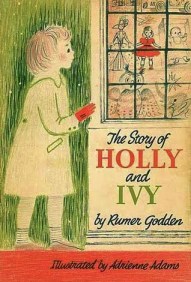
Holly-and-IvyIf you can, try to find the original, long out of print hardcovers illustrated first by Adrienne Adams, and then in another edition by Barbara Cooney. The currently in-print Christian Birmingham version is quite lovely, too, especially if gifting this book, where crisp and new is an issue, though it is without the vintage appeal of the older versions.Holly and Ivy

Read Full Post »

guard your daughters diana tutton 001Guard Your Daughters by Diana Tutton ~ 1953. This edition: The Reprint Society, 1954. Hardcover. 246 pages.

My rating: This is one of the more difficult ratings I’ve had to mull over in the eight months since I’ve started this blog. I’m going to say, after much consideration, 6/10.

That rating may change if I can get my hands on some of the author’s other works; I am curious to see her next developments as a writer.

I thought this was an ambitious and strongly written first novel. There were a few rough patches here and there, and I bogged down a bit about a third of the way through, but the narrative then picked up speed, and I had no trouble staying engaged until the bitter end.

The following review is divided into two sections, the first for those who haven’t yet read the book, and the second for those who have; I have some comments to add to the recent online discussion regarding Guard Your Daughters and, of course, its inevitable comparison to Dodie Smith’s I Capture the Castle.

*****

I’m very fond of my new friends, but I do get angry when they tell me how dull my life must have been before I came to London. We were queer, I suppose, and restricted, and we used to fret and grumble, but the one thing our sort of family doesn’t suffer from is boredom.

So speaks this novel’s narrator, Miss Morgan Harvey, looking back on the circumstances of her nineteenth year, the year when everything changed, and when she and her sisters finally emerged from their mother-woven cocoons and ventured out into the larger world.

“Queer” and “restricted” are apt descriptions of the Harvey ménage. Father is an immensely successful mystery story writer, distantly busy in his study churning out his manuscripts and emerging occasionally to pay the bills and blink short-sightedly at his daughters. Mother is an oddly attractive though emotionally needy and mentally fragile creature whom the other six treat with extreme care tinged with apprehension – “What if something should set her off?” they all whisper to each other – every word and action weighed with care to ensure the avoidance of a quivering, wailing breakdown. Friends are forbidden the house, and indeed the girls do not appear to even have friends; they were not allowed to attend school, and their last governess left four years ago. There is no telephone –  “it worried mother” – and no outings but for the necessary trips to the village shops and to the next door farm for illicit black market acquisitions of butter, cream and eggs (the story is set in post-World War II England, when food rationing was still in effect). And there are, most emphatically, no opportunities to meet young men.

The oldest sister, twenty-two-year-old Pandora, has unexpectedly escaped and been recently married. Now living in London, she’d caught the eye of a visiting young man, grasped her rare opportunity, and speedily carried out a courtship whilst officially occupied teaching Sunday School. To everyone’s surprise, the marriage was accepted relatively quietly by Mrs. Harvey, but the rest of the sisters are now even more aware of their restrictions, and are beginning to cast their glances speculatively around for their own chances to blossom forth.

Thisbe, second eldest, is twenty-ish, Morgan is nineteen, Cressida eighteen, and Teresa fifteen, but they all have the dual personality of the overly sheltered but mentally bright child, a combination of beyond-their-years intellectual sophistication and total social naïvety. Snobbishly proud of their status as daughters of a best-selling author, their good looks, their various “arts”, and above all their determined and deliberate “eccentricity”, they play these points up for all they’re worth when they do have their rare social interactions.

As the narrative starts, Morgan has just captured (apt term!) a young man whose car has broken down at the Harvey gate, and his enforced stay to tea allows us to sum up each sister’s particular persona.

Pandora is absent, though she arrives that evening for a visit and turns out to be wonderfully “normal”; bloomingly happy in her marriage and eager for her sisters to share in her good fortune. Thisbe is proud of her own witty tongue, and delights in shocking people with her cutting comments; she privately pursues the muse of poetry, shutting herself up to write with little care of the boring logistics of helping with household chores. Morgan is musical; she has occasional piano lessons and works away on her own, though not strenuously enough to gain the skill needed for her talked-of concert pianist’s career. Cressida is the handy sister, the practical one; yearning after normalcy and highly aware of her family’s general oddness, she cooks and cleans and mends and tries to keep her careless sisters as decent as she possibly can, to their frequent mild scorn. Teresa is a very young fifteen, and thrilled to have reached the age when the visits of the country education inspector need no longer be feared. She has surrounded herself with books and lives in an intellectually precocious world of her own, while clinging to her mother and indulged by her older sisters; a true baby of the family, talked of and treated as if she were five or six versus on the cusp of young womanhood.

The eventual implosion of the Harveys’ private little world and the true nature of their mother’s “ailment” forms the climax to which this hectic story builds. And though billed as a “social comedy”, there is a much darker undercurrent to the facetious surface story; I was uncomfortable as often as I was amused.

*****

This next bit is addressed to those who’ve read the book – alert to others –  there may be spoilers.

I did enjoy the actual reading of this book; I was drawn into the story and I was decidedly curious as to what was going to happen next; my expectations changed drastically as the narrative moved on, and I began to pick up on darker elements of what initially seemed like merely an amusing “light” novel.

Paradoxically I did not like or admire most of the characters in any sort of personal way, and I found myself getting more and  more uncomfortable as the comically brittle farce turned into something much darker. I think this was a deliberate ploy by the author; in which case she deserves high marks – this novel, if viewed as a dawning-of-an-awful-light portrait of a severely dysfunctional family, is, in my opinion, decidedly a success.

If, on the other hand, I’m reading the author’s intentions completely wrong, and this was indeed meant to be an amusing romp, it fails utterly and dismally. This is not a feel-good book. I felt that the frenetic posturings of the narrator serve initially to hide, and later to sharply accentuate, the misery of her life and the psychological damage to all five of the siblings and their father by the emotional malfunctioning of the family’s mother. In turn, the mother has been deeply emotionally injured in her own earlier life; the five sisters of Guard Your Daughters are classic cases of victims of the victim; the “spiral of abuse” – that handy modern catch-phrase – applies most appropriately here. That the abuse is prompted by love – albeit love gone terribly wrong – in no way lessens its effects on the many victims, though it may excuse the perpetrators of deliberate viciousness and leave them guilty only of the lesser crime of thoughtlessness.

Though some reviewers (see links at the bottom of this post) have felt that this novel is strongly derivative of other stories, I felt that though it may have shared a few vague similarities of plotting with other “classics” of similar genre (and yes, I’m referring here to Dodie Smith’s I Capture the Castle), by and large I felt that it was an original work by a creative mind, not a copycat work by any stretch. There are only so many situations out there; the repetitive themes of young people (in this case young women) yearning after both romantic love and “suitable” mates, and, indeed, the struggle to break free of parental influence and to escape from childhood into the wider world of true maturity, are universal and repeated time after time after time, because writers and readers so strongly identify with them, whatever the era.

The frequent humourous situations were well portrayed, and they did make me smile; but my final impression of Guard Your Daughters is that this was not a happy book; the humour is not the point here, it merely fulfills the part of the curtain that refuses to stay drawn over the utter awfulness of the understory.

The Harvey sisters did not gain my instant affection as did Castle‘s Mortmains; Morgan as narrator was not nearly as charming and individualistic as Cassandra; I never could shake the feeling that I was being overtly manipulated into accepting Morgan’s point of view, while Cassandra’s narrative became an effortlessly absorbed voice in my head for the entire time of the reading of the novel.

While both sets of fictional sisters are snobbish, the Mortmains recognize this and admit it as a failing, while the Harveys revel in their snobbishness and deliberately mock anyone of lower social status who draws their attention, from their departed governess to their lone domestic to the farmer’s wife who sells them their black market eggs to the bookstore owner who promotes their father’s bestsellers.

This continual self-regard and deep snobbishness was what prevented me from embracing the Harvey sisters as truly “lovable” characters. All five had some good points, some complexity of character, but I never felt like we were equals. In their world, I fear very much I would be one of the mocked commoners, with boringly bourgeois views and the wrong ancestors and accent.

The continual selfishness of all of the Guard Your Daughters protagonists is the most difficult trait standing in the way of my sympathy for them; while they occasionally acted in a disinterested way towards the members of their inner circle, their inward-facing focus added to their greater problems; at some point in the story I felt like shaking each and every one of them and hissing “reality check, you fool!” in their silly faces. Morgan most of all!

I’m glad I read Guard Your Daughters, and I’m very curious to read more by this writer, though this novel will definitely not join the “comfort reads” in my personal stacks. I think it might best be placed with the ones on my “love-hate” shelf, alongside Muriel Spark, Margaret Atwood, Jeanette Winterson and their ilk, to be taken in small doses when the need for an emotional shake-up of sorts is desired; literary bitters to add piquancy to a milder, more easily digestible, dare I say, generally more enjoyable everyday reading diet.

*****

I’m not completely happy with my review above; it seems that my after-midnight thoughts have not all quite made it to the page, but I’ll leave it there for now – a new midnight is fast approaching! The following reviews are the ones that started me on this very interesting examination of Guard Your Daughters. If you haven’t already, please visit these for a wider discussion of this slightly controversial read.

Stuck in a Book – thought it was grand!

Jenny’s Books – generally enthusiastic with some reservations.

The Captive Reader – decided it wasn’t her thing.

Book Snob – loved it.

*****

And here, by way of a little bonus, are two teaser reviews for Diana Tutton’s second and much harder to locate novel, Mamma, published in 1955.

From Kirkus, April 1955:

A pleasant autumnal blooming for Joanna Malling has its problems which are fortuitously solved. For Joanna moves to a new house, after a widowhood of twenty years, only to find that she must ready it for her daughter’s (Elizabeth aged 20) wedding to Stephen Pryde, 35 and a Major expecting to be stationed abroad. Joanna, at 41, finds him stolid and slightly inimical. But when his orders do not come through and she must do the necessary and provide a home for them when he is assigned to her locality, she begins to find many things in common with Stephen which Elizabeth can never achieve. Stephen, too, is not unaware. The impasse is resolved when Stephen’s mother dies and there is a home of their own for Elizabeth, now pregnant, and Stephen, so Joanna, rid of her temptation, faces an undisturbed future. A British blend of feminine frailty and domesticity provides an amiable amble.

And from Jet, May 1955:

Attractive Joanna Malling, who at 41 had been a widow for 20 years, is appalled (and pleased) when she finds herself falling in love with the husband of her 20-year-old daughter Libby.

This is the core of Mamma, a novel by Diana Tutton (Macmillan, $3.50). It is a lean English novel that attempts to be “modern” in facing a basically tragic problem that Miss Tutton strains to solve as a “social comedy”.

Before she even met him, Joanna was prepared to dislike Steven Pryde, an English army major, primarily because Libby’s affection for her would be deflected. But when Steven and Libby visited Joanna at her little cottage outside of London, Joanna found her 35-year-old future son-in-law more than attractive. After the marriage, pneumonia felled Steven and Joanna had Libby bring him to her home to recover.

Proximity drew Joanna and Steven together but he never quite gave in to his impulse to take her into his arms. Joanna, on the other hand, plotted to culminate an affair, her conscience all the time reminding her that Steven was her own flesh and blood’s husband. Aching for one last fling, after so many barren years, Joanna almost gives in to indiscretion.

With a woman’s infallible intuition in these matters, Libby is not unaware of what is transpiring, but she makes no over moves, except to conveniently become pregnant before she can tell Joanna that she strongly suspects her of being in love with Steven and trying to steal him.

In what is described as a “social comedy”, Miss Tutton solves this three-pronged problem with cool English efficiency, but the reader is led to expect more than Mamma offers.

Well, are you as curious as I am to investigate this one? Methinks Diana Tutton may have had some “mother issues” of her own which she was working out on the page!

Read Full Post »
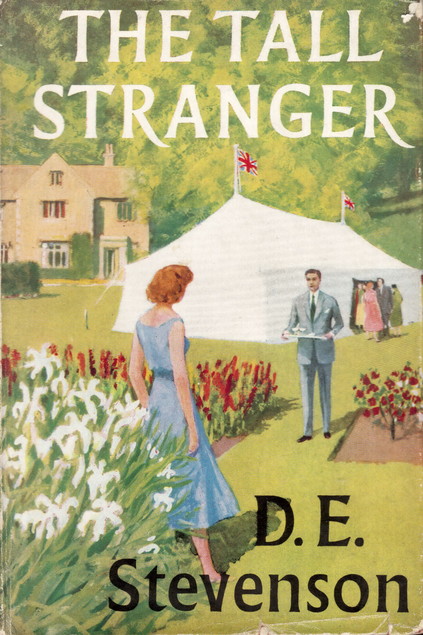
« Newer Posts - Older Posts »