Archive for the ‘1950s’ Category

river for my sidewalk gilean douglas 001River for My Sidewalk by Gilean Douglas ~ 1953. Originally published under the pseudonym Grant Madison. This edition: Sono Nis Press, 1984. Softcover. ISBN: 0-919203-41-8. 132 pages.

My rating: 7/10, after some consideration. Some of these short anecdotes and essays are solid 10s, some are not.

I’ve been slightly sidelined with a minor virus these past few days, and the upside is that while I’m just feeling sub-par enough to take a break from most of my more strenuous everyday chores, I’m perfectly able to putter about in the garden, do some gentle weeding, tomato-staking and pruning, watering, and definitely take advantage of the down time to read and type. So, having ambitiously started a number of reviews, I may just get a few more than usual launched in the next day or so. Or perhaps I’ll take advantage of the WordPress feature which allows us to schedule posts for future dates, something I’ve never yet had to do, as there is definitely no backlog of things ready to share! If anything, I frequently post before all of the final tweaking is done, catching typos and awkward phrasings after I’ve hit the “Publish” button. Luckily there is an “Edit” feature, too…

I picked up this particular book at The Final Chapter in Prince George last week, while browsing the excellent Canadiana section. Being rather partial to memoirs in general and British Columbia rural and wilderness settings and history in particular, River for My Sidewalk‘s back cover blurbs pretty well guaranteed my purchase.

About the Author

Gilean Douglas has been a newspaper reporter, copywriter, editor, columnist and, throughout and still, a freelancer. Her work has appeared in numerous periodicals both here and abroad, including Chatelaine, Saturday Evening Post, Canadian Business, Audubon, the New York Times and, by actual count, 144 other periodicals. She has five volumes of poetry to her name, one of light verse, and three nonfiction titles. Four of her poems were set to music and published by Schirmers and others received choral settings and have been performed at [various venues] and in concert. She edited Modern Pioneers for the B.C. Women’s Institute after holding local, district, provincial and national office in that organization.

Gilean Douglas now [in 1984] resides on Cortes Island, where she is a Weather Observer with Environment Canada (receiving four awards for her work) and a Search and Rescue Agent. In her spare time she raises plants, produce, and bulbs.

About the Book

Gilean Douglas spent close to a decade living alone in a small wilderness cabin in the Cascade mountains. River for My Sidewalk, first edition, was originally published…in October of 1953, under the male pseudonym of Grant Madison. The reading public of that time would have doubted the authenticity of a woman managing in the circumstances described. But Gilean Douglas did more than manage, she thrived in the isolation and completeness that solitude brings. Well before the days of liberated females, Ms. Douglas chose, lived, survived, and savoured a self-sufficient existence in an area that is still considered wild and inaccessible. Her story is timeless and the observations are lyrically clear…
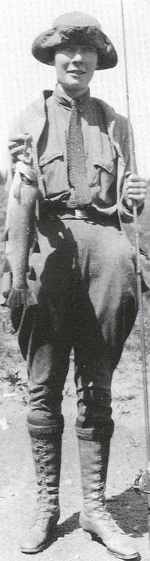
Gilean Douglas: Naturalist, feminist, farmer, poet, author.

Gilean Douglas: Naturalist, feminist, farmer, poet, author.

Well, I’d never heard of the woman myself, but who could resist finding out more? And, after reading River for My Sidewalk, I did just that. What an absolutely fascinating woman Gilean Douglas must have been! And not just fascinating, but, for all of her quirks and her unhappy history with husbands, apparently much admired and beloved by her friends and neighbours. Here is an excerpt from a longer biography in B.C. Bookworld:

Gilean Douglas, author of River for My Sidewalk (1953), was a female Thoreau of Canada. A loner from a well-to-do family, she retreated to wilderness cabins and became an environmentalist before the word existed, leaving four marriages behind her.

Gilean Douglas, born in Toronto in 1900, was orphaned at age 16 and soon became a reporter. She travelled extensively prior to her arrival in B.C. in 1938 where she first lived in a cabin on the Coquihalla River. She then moved to an abandoned miner’s shack on the Teal River near Duncan, B.C. “It was the great moment of my life when I waded the Teal River,” she wrote, “with my packboard on my back and stood at last on my own ground. I can never describe the feeling that surged up inside me then. . . I felt kinship in everything around me, and the long city years of noise and faces were just fading photographs.” Subsisting mainly on produce from her garden, Douglas began to write about her adventures but could not find acceptance as a woman writing about outdoor life. Adopting the male pseudonym Grant Madison did the trick—and she published River For My Sidewalk, her best-known book.

Gilean Douglas continued to use her male name until 1983 when she revealed herself in a Vancouver Sun interview. Douglas next moved to Cortes Island, near Campbell River. “I have spoken many times of ‘my land’ and ‘my property’, but how foolish it would be of me to believe that I possessed something which cannot be possessed,” she once wrote. Along with seven poetry books, she produced two more meditative memoirs, Silence is My Homeland: Life on Teal River (1978) and The Protected Place (1979). The latter describes life on her 140-acre homestead on Cortes Island where she was employed as an Environment Canada weather observer and a Search and Rescue agent. Her cottage was situated at Channel Rock on Uganda Pass. For nine years she served as the Cortes representative on the Comox-Strathcona Regional Board. Gilean Douglas also contributed a nature column called “Nature Rambles” to the Victoria Daily Colonist (which became the Times Colonist in 1980) for 31 years, from 1961 to 1992, a longevity for a B.C. columnist that places in her in the company of Eric Nicol and Arthur Mayse. She died on Cortes Island in 1993.

And for a much longer and much more detailed biography, Andrea Lebowitz’s well-researched and fascinating article, Narratives of Coming Home: Gilean Douglas and Nature Writing, is a must-read.

Well, this is all well and good, but how does River for My Sidewalk measure up to its author’s infinitely intriguing promise?

I must say that I had high expectations, just from reading the cover material and from my quick perusal of the contents before I purchased the book. And I did enjoy reading it, though it went in a little different direction than I had anticipated.

Something about the tone of the narrative voice struck me as a little bit odd, and occasionally forced, and it wasn’t until I twigged to the fact that the author was carefully phrasing her passages to make the book appear as if it were written by a man that the penny dropped. I had started out assuming that the reader was aware that the writer was indeed a woman, and once I revised this assumption and allowed for the time of writing and publication, the late 1940s and early 1950s, the rather coy slant was understandable, and therefore much more acceptable.

Gilean Douglas writes in a strongly opinionated manner. She lays down the law as she sees it, unapologetically critical of mankind’s abuse of nature, and eloquently defensive of the way in which she has chosen to retreat from the mainstream world. She never condemns the city dweller as such, acknowledging that it would be an impossibility for all to strive for her type of lifestyle, but she has little patience for the squeamish and feeble-hearted visitor to the bush who quails at the thought of coming across a cougar or bear, or of crossing a river on an open cable car, or of hiking miles for a casual neighbourly visit.

Much of the book is an enthusiastic tribute to the natural world, phrased in glowing and effusive tones. Possibly just a little too glowing and effusive? The style frequently seems a bit dated even for the time of writing, being perhaps more typical of the century before; it reminds me of those rather stilted memoirs one frequently comes across hiding behind ornate covers in the antique books section of the better second hand book stores.

Example:

The day is my friend. I meet it with outstretched hand and use every moment of it to the utmost. Sitting in the house I have partially built I eat the food which I have grown for myself. I have tried to learn everything there is to know about the trees, flowers, birds, animals, insects and rocks which are all around me. It has taken me years and will take more years, but I feel that every grain of such knowledge brings me closer to the great harvest of the universe.

The night is my love. Dusk comes with the benediction  of the thrush and the darkening of river water. The clearing is all shadow and the forest dim with mystery. The shade climbs higher and higher up the mountains which ring my valley, leaving only the peaks crested with sunlight. Everything becomes slower and more silent as the dusk deepens into night. Then stars burn silver in the sky and sometimes the moon sails a midnight sea to a port beyond the tall evergreens of Home Wood. This has been the way of night in the wilderness for untold eons. How few living now have ever known it as I do! Campers, fishermen, hunters come in here bringing their shouts and drinking and luxuries. They go home to boast of their wilderness adventures, but all they take away is a paste jewel in a plastic setting.

And then there are the passages like these:

Spring has swept away the last patch of her snow with her green-twigged broom and hung out the clouds to bleach…

and

When burning … fir and hemlock have their swan song of beauty… as needles become rosettes of flame which shimmer and fade along the twigs, transforming each one into a garland for some fire queen’s shining hair…

But for all the occasionally purple prose there is much beautifully phrased and sincerely presented, as Gilean Douglas documents the thoughts of her long solitudes. I buried all my qualms when I read this:

We are all strangers here, but no one more so than the person who is out of step with the time. If you are that person you will be understood – and then only imperfectly – by just one or two of all those you know and perhaps by none at all. To the others you will always be suspect. The timid will be afraid o be seen with you; the bold will say they cannot be bothered with anyone who is more interested in the future of the world than in whether today’s market is going up or the price of tomorrow’s whisky going down.

Most of this ostracism will bother you very little for there is nothing you like better than quietness and privacy. But not every moment of your life. In books you can find the comradeship and understanding you are denied by living men, but even so you are hungry for a good heart-to-heart talk with someone who comprehends you intellectually and emotionally. If you are lucky you will come across one or two people with whom you can exchange ideas, and if you are luckier still you will marry one of them…

…[An] urgent sense of the shortness of life, perhaps more than anything else, distinguishes the man out of step with his time from his fellow beings. He sees time wasting everywhere around him and he is disgusted and alarmed. He knows that it is all wrong; that life is precious and should be used for precious things. Not that he believes in all work and no play, but simply that his idea of play differs from the bridging, gossiping, clock-watching, pulp-reading average. To him play is a change of occupation – perhaps from writing to splitting wood – while relaxation is letting go completely in sleep, laughter or lying on a summer hill watching the clouds drift over and “growing soul”…

An unusual and admirable woman, this Gilean Douglas, and one whom I will be seeking to acquaint myself with more deeply through her other writings. Apparently the two 1970s memoirs are not quite so gushing, and are more contemporary in tone, though they are not as well known (relatively speaking) as River for My Sidewalk.
Read Full Post »

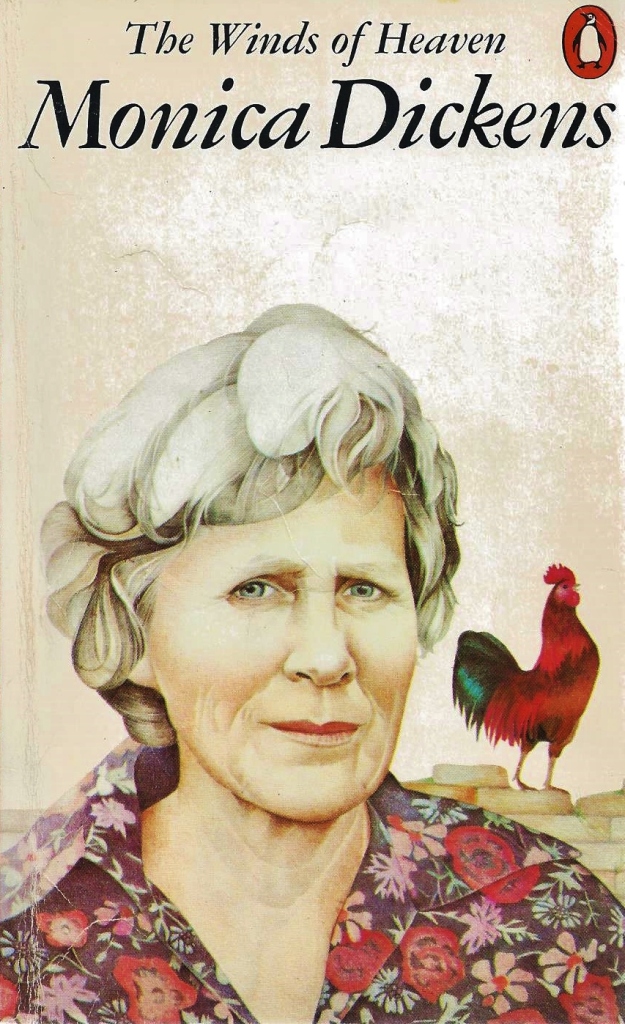
the winds of heaven monica dickens 001The Winds of Heaven by Monica Dickens ~ 1955. This edition: Penguin, 1977. Paperback. ISBN: 0-14-00.1917-0. 239 pages.

My rating: 7/10.

Monica Dickens is one of my pet authors; her books, despite their undoubted flaws, reside prominently on the bedroom bookshelves reserved for our favourite re-reads. And when one is so comfortable with a certain author, isn’t it sometimes hard to step back and realize that not everyone shares either their familiarity or enthusiasm?

I was quite surprised at my own passionate feelings of defensiveness regarding Monica Dickens recently when I read this review of The Winds of Heaven by blogger Rachel of Book Snob. I was half way through reading my own copy of the novel, and Rachel’s comments made me step back a bit and look at the story with new eyes. I’d read it several times previously over the years, and I didn’t really change my views on it with this reading, but it was truly interesting to read with a more critical eye, as if experiencing the novel as a “first” Monica Dickens, and to try to identify what exactly pushed Rachel’s buttons all wrong. Great discussion followed that post; worth reading, so please visit if you haven’t already.

So – taking a deep breath, stepping back, and trying to maintain some sort of distance so I’ll be able to give my own picture of the book in question.

First off, I must say that The Winds of Heaven isn’t, in my opinion, one of this author’s stronger books. Though well up to standard as far as the writing goes, there are others much, much better handled, both in plot and execution. The recent re-issue of this title by Persephone Books leaves me jut a bit bemused; there are others in this writer’s canon which are so much more worthy of that great honour. If this is your first exposure to Monica Dickens, it might well also be your last, and that would be an immense shame, as she has some rather good stories to tell.

I can only assume that Persephone chose this book because of its attention to women’s roles in the mid 20th century. Set in England in the post war years (The Winds of Heaven is set in 1951 and 1952, and was published in 1955), the characters are broadly representative of their time.

When the winds of Heaven blow, men are inclined to throw back their heads like horses, and stride ruggedly into the gusts, pretending to be much healthier than they really are; but women tend to creep about, shrunk into their clothes, and clutching miserably at their hats and hair.

To Louise Bickford, on this late April day, the wind that jostled through the London streets seemed a bitter personal enemy, turning to meet her no matter which way she turned, beating against her small figure in the open stretches, and calling in reserve cohorts to attack her afresh at every corner.

She had intended to walk to the Park and look at the spring flowers, but she was soon so tired of fighting the wind’s fiendish determination to pluck her clothes and hair awry that she turned into a teashop to resettle her hair and recover her breath, until it was time to meet Miriam and the children at Marble Arch.

Miriam was Louise’s eldest daughter. She had borne three daughters, to her surprise, for her husband had set his heart on a son, and Louise was in the habit of giving him everything he asked for. That she failed to give him a boy, with a long conceited nose like his own to look down on the world, had not helped to raise his opinion of his wife’s usefulness to society…

Louis, widowed for just over a year,  is on the cusp of sixty. Her late husband, the supercilious Dudley, has died unexpectedly after a short illness, leaving his financial affairs in a state of great turmoil. Instead of a sedate widowhood financed by a respectable income, Louise is startled to hear that she is, in fact, penniless. Her one resource is a small income from her parents’ estate, barely enough to keep her clothed and fed. Her home and possessions must be sold to repay Dudley’s many debts; Louise has become a bemused and helpless vagabond, thrown out into a world she has been increasingly insulated from during the long years of her difficult marriage.

Louise’s three daughters have stepped in to take on their mother in turn, a situation which all are unprepared for.

Miriam, married to an upwardly mobile barrister, is strongly focussed on the requirements of keeping up a suitable home, entertaining and being entertained by her husband’s business associates, and ensuring her three children are moving ahead in their school and social circles. The most financially prosperous of Louise’s children, it has fallen to Miriam to take on a major part of the responsibility of her mother’s care. Both Louise and Miriam are having a difficult time reconciling themselves to their new relationship. Louise would love to be a fond grandmother figure to Miriam’s three children, but this never quite works out as hoped for. Her closest relationship within the household is to Miriam’s eldest child, Ellen, a dreamy and ineffectual misfit in a household of high achievers. Louise and Ellen are kindred spirits, and Louise’s gentle defense of Ellen serves mostly to irritate, as Miriam sees this as unwarranted interference and an insidious criticism of her mothering skills.

Louise’s second daughter, Eva, an aspiring actress with a hectic personal life, maintains a small flat in London, and good-naturedly tucks her mother into her tiny spare room when it is her turn to host her mother, but her bohemian lifestyle is so at odds with Louise’s conventional nature that the two are never really comfortable together. Eva’s personal affairs are also made more difficult by the presence of her mother in her flat, especially now that she has fallen deeply in love with a married man, and faces her mother’s unspoken but very obvious horror at the situation her daughter has placed herself in.

Louise’s youngest daughter, Anne, has married a struggling market gardener and smallholder. Louise and her practical and kind-natured son-in-law get along well, and Frank has no objection to hosting his wife’s mother. Louise is even becoming rather handy with minor chores about the farm, and she and Frank work well together, with Louise showing increasing competence in practical things under Frank’s relaxed tutelage. Anne herself is the sore point here. Lazy by nature and downright slovenly about the house, Anne finds herself irritated by her mother’s attempts at housecleaning and cooking; those very small efforts at “helping out” seem to Anne to be a personal condemnation of her chosen lifestyle.

So Louise shuttles from daughter to daughter, with a brief respite as a winter resident – at extremely reduced rates –  at an old school friend’s seaside hotel. She increasingly desperately muses over what she should be doing to try to find some sort of solution to her poverty and homelessness. Never expecting to have to support herself, and ineffectual and self-effacing by nature, any initiative she once might have had has been quenched by the late Dudley’s continual verbal criticism. Though Louise has never been physically injured, she is as much a victim of abuse as any battered wife; the way out of her dilemma is lost to her, though well meaning friends try to pep her up and encourage her to find some occupation which might bring in enough income to enable her to maintain some semblance of an independent life.

Then, in a random meeting in a restaurant, Louise becomes friendly with a most unlikely character, department store bed salesman-slash-author of sex-and-murder pulp fiction, Gordon Disher. Gordon is hugely overweight, a severe diabetic who must be extremely careful of what he eats. He’s the never-married middle-aged son of a now-deceased, over-controlling mother, and he is a deeply likeable character, being soft-spoken, kind and deeply compassionate. Louise inspires affection and the longing to protect in Gordon, and their growing relationship winds through the book, increasing in importance until the startling  – but not surprising, given the increasingly melodramatic tone of this minor saga – conclusion.

The Winds of Heaven is “typical” Monica Dickens in that the characters are presented with all flaws fully intact. This is an author who sees every wrinkle, bump and character flaw, and doesn’t hesitate to share them with us. She is adept at showing us that those flaws don’t necessarily completely define her characters, and she generally shows us the positive aspects of each personality as well. She creates her characters, sets them on the stage to play out their various stories, and lets her readers make of everything as they will. I like “not liking” various of her players, and I like the grace that their creator gives by dropping hints of their deeper motivations, and their complex inner lives. Monica Dickens is occasionally sentimental, but only momentarily; her default tone is wryly observant, and her observations are frequently very amusing, in an “Oh my gosh, she’s right, that could be me!” or, “I know that person!” sort of way.

The book ends on a highly ambiguous note. Louise is about to change her life, and future happiness is a strong possibility, but there is a terrible price to pay.

One of my major issues with this novel is the rushed and superficial handling of the ending; after providing such micro-detail throughout, the sketchy handling of final events is something of a let-down, as if the author was really just ready to be done with the story, already.

I don’t personally feel that the author had any statements to make with this tale, much as it could be read as a critique of the treatment of the elderly (though Louise, at a hale and hearty sixty, isn’t really elderly, in the way that we interpret the term today). Every character is presented sympathetically in that we get to see all the facets of their personalities. We may not like how they behave, but we understand why they are like they are.

Yes, Louise’s daughters are selfish, but their creator does not condemn them for it. Louise is just as selfish in her own way, as is Gordon Disher. Everyone has something that they want, some vision that they’re chasing, which affects their relationships with those they are intimate with. It’s plain old human nature, and I appreciate Monica Dickens’ way of presenting each situation with glimpses of motivation and reasoning, and also those moments of reconciliation and affection which are so reflective of real life.

And this is why I love Monica Dickens. She is fully aware of the contradictory aspects of human nature, and forces them upon us in a way that is impossible to dismiss, all the while telling a diverting story. The Winds of Heaven, while not in her top rank, is full of good writing.

And that is all I have to say, at least for now.

I’m hoping to review more of this author’s work, but I find it is rather difficult to step back enough from someone I’ve read and re-read so much and really talk about the book in question while trying to remember that perhaps everyone else reading is not so familiar with the author’s canon. I read The Winds of Heaven quite a way along in my roster of Dickens’ titles; my response to the novel was definitely informed by that circumstance. If it was my first book by her, I very well might never have gone on.

Come to think of it, I’m not quite sure which was my first book by her. That’s sadly lost in the foggy mists of time. I think it was One Pair of Feet; I do remember picking that one up, in a vintage Penguin version, from a used book store in Calgary sometime in the 1980s, and not being quite sure what to expect. Obviously whatever it was that appealed still does!

Read Full Post »

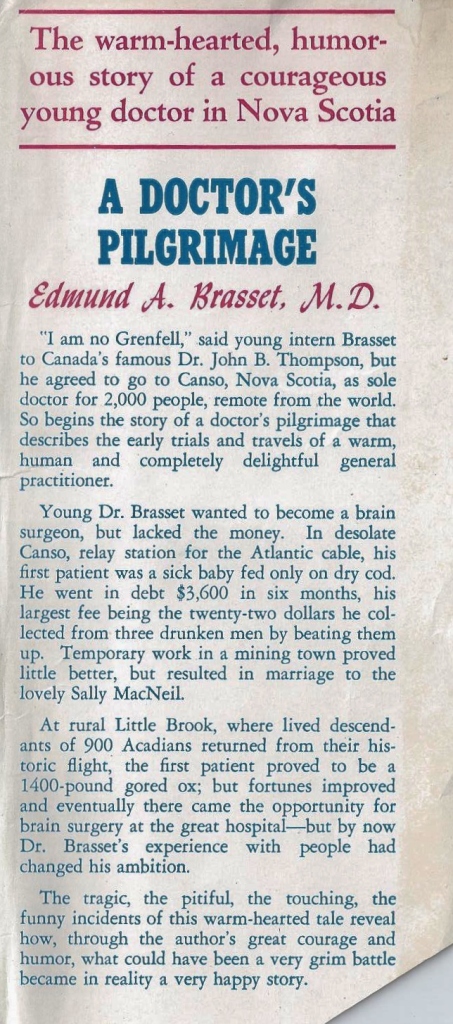
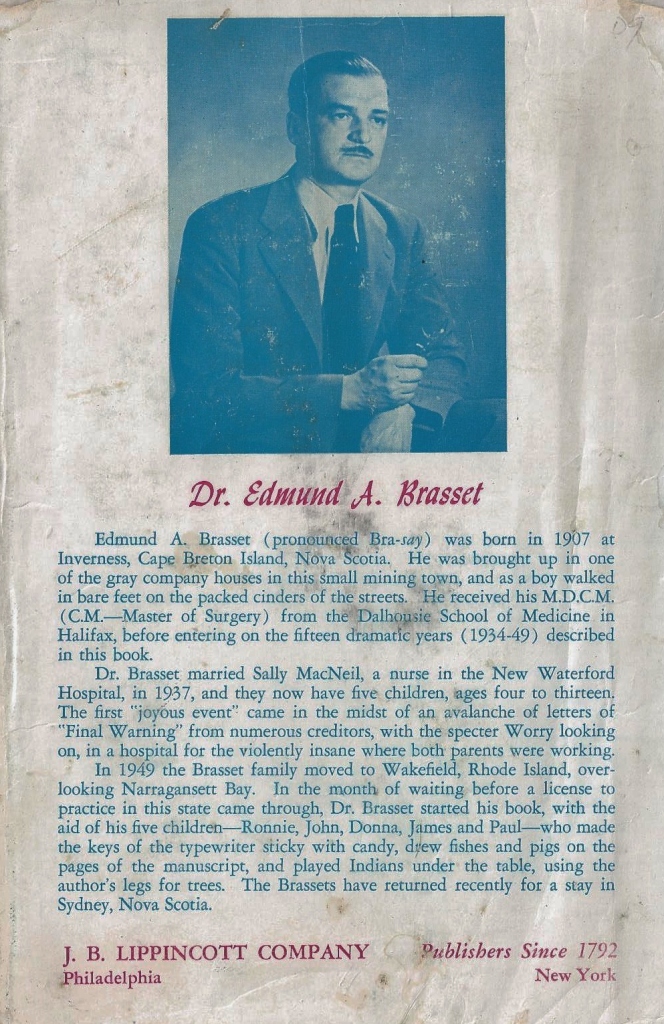
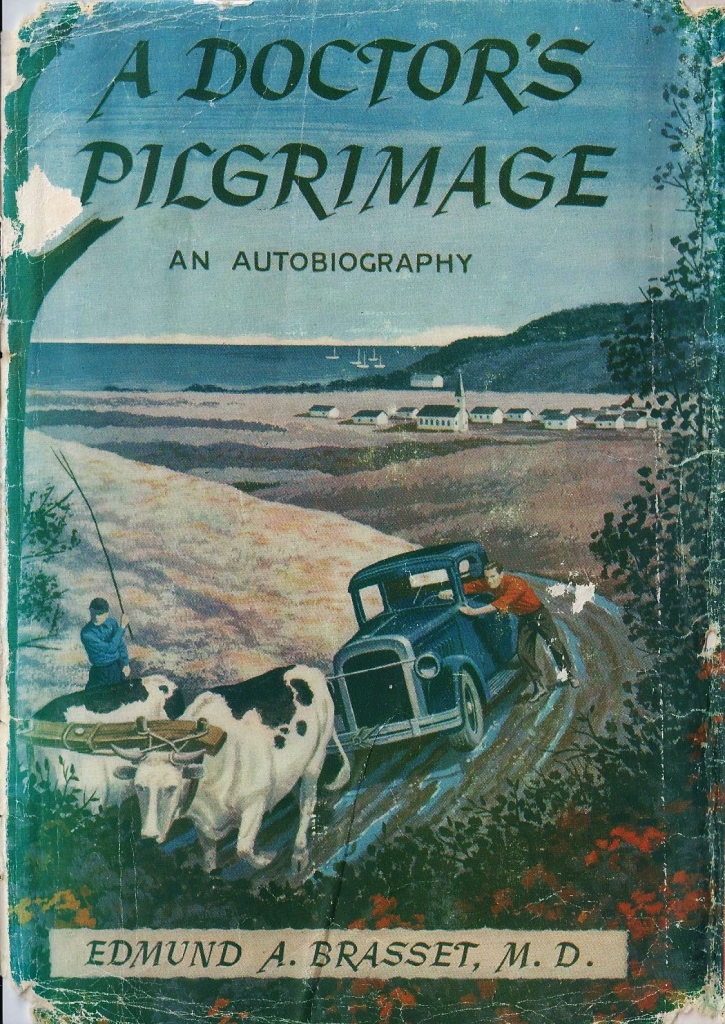
a doctor's pilgrimmage edmund a brasset 001A Doctor’s Pilgrimage: An Autobiography by Edmund A. Brasset, M.D. ~ 1951. This edition: J.B. Lippincott Company, 1951. First Edition. Hardcover. 256 pages.

My rating: 8/10.

What a great little autobiography this was! Totally unexpected. This was one of the books I picked up in Hope’s fabulous Pages bookstore recently; so far my eclectic selection of books from that source have been overwhelmingly rewarding.

A Doctor’s Pilgrimage covers only a small portion of the life of Nova Scotia physician Edmund Brasset’s life and career, and it appears, from a fairly involved internet book search, that this was Brasset’s only literary endeavour. One can only assume that the man was too busy with his career and family to continue writing, but this lone work is interesting and well written and gives a wonderful portrait of both the man and the time and place he was writing about.

From the inner flyleaf:

a doctor's pilgrimmage edmund a brasset 001 (2)

The book consists of anecdotes of medical school, internship and work as a novice doctor in rural Nova Scotia, first in poverty-stricken Canso and later in a variety of other communities, ending in the almost utopian Acadian community of Little Brook, a posting which changed Dr. Brasset’s focus for the continuation of his medical career. Dr. Brasset never talks down to his readers; medical terminology is used with great abandon, but never to impress, merely to inform. Character portraits abound, as do retellings of local legends – a mysterious case of spontaneous combustion; the morning discovery on shore of an unconscious man with both legs recently amputated; a woman who believes that she is surrounded by ghosts – as well as asides referring to the author’s strong faith in both the goodness of humanity and the existence of a benevolent God. A very individualistic and opinionated (in a very good way) memoir.

A grand little book, in its happy minor key.

From the back cover, more on the author. (Aren’t these old dust jackets great?)

a doctor's pilgrimage back dj edmund brasset 001

And last but not least, the Kirkus Review entry for A Doctor’s Pilgrimage, from September of 1951.

A lively, likable record of a doctor’s rewarding if unrewarded first years in practice, and a little black bag full of fascinating cases, Brasset’s story starts when he left Halifax and the ambition to become a brain surgeon behind for Canso in Nova Scotia, where there was only fish and fog. After two years in Canso and a rising debt of several thousand dollars, Brasset was forced to leave for New Waterford where he married Sally, and his obligations increased in spite of a grateful mobster’s attempt to drum up business. A year on the staff of a mental institution widened his experience but did not increase his income, and finally he found a good practice in the remote French-Canadian village of Little Brook. Later given the chance to become a neurosurgical specialist, Brasset found the indifference and institutionalism of working with cases, as against people, less satisfying, made the decision to return to his country doctoring in Little Brook… A record of service which has warmth and humor.

The family eventually moved to the United States; during my internet research I found mention of Dr. Brasset’s son Paul, who is now a successful winemaker in California’s Somona Valley, even naming his winery after his childhood home: Bluenose Wines . (What an interesting little side note I found this to be. One reason I love the internet – such an abundance of rabbit trails one can happily follow!)

Read Full Post »

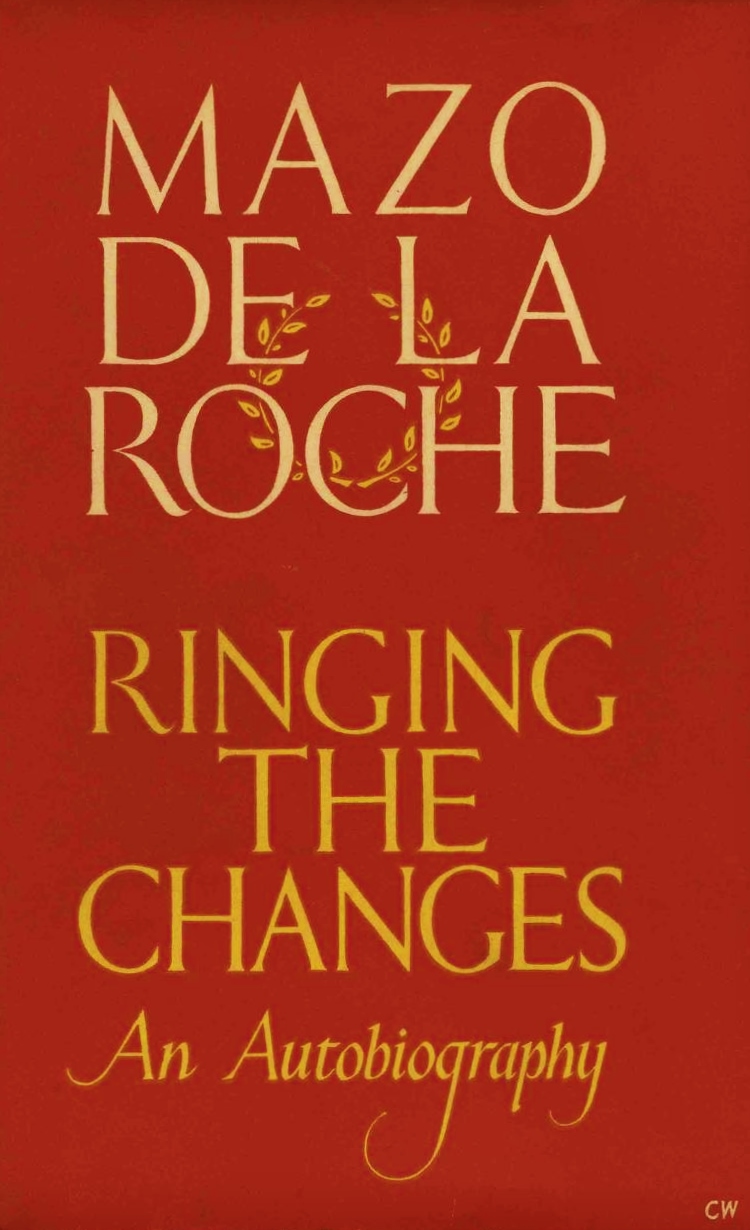
ringing the changes mazo de la rocheRinging the Changes: An Autobiography by Mazo de la Roche ~ 1957. This edition: Macmillan, 1957. First Canadian Edition. Hardcover. 304 pages.

My rating: 9/10. What a fascinating autobiography! It was definitely readable, and full of vivid vignettes, capably portrayed.

But is it factual? Perhaps not particularly, from what I’ve  found out in some very desultory online research. It is very much a created portrait rather than a true glimpse into what made its subject tick. Nonetheless, I found it a compelling read and I will be approaching my future reading of the author’s works with this self-portrait very much in mind.

*****

First, some background information for those of you (and I suspect there may be some) who have no idea who Mazo de a Roche was, and why I’m finding her story so interesting. Feel free to skip this section; my response to the autobiography itself follows at the bottom of the post. I’ve spent a fair bit of time this past few days doing something of a mini-study on de la Roche; I’m not at all what one would call a fan, though I’ve read a few of her books in the past, without feeling the urge to read everything the author has written. She’s not quite my thing, though I’m intending to explore her fiction more in the future, nudged on by the new knowledge I’ve just gained. An intriguing woman.

Mazo de la Roche was born in Ontario in 1879, the only child of parents who, while not exactly poverty-stricken, certainly experienced ongoing financial difficulties. Young Mazo was a self-described eccentric child, and an avid reader. She created an imaginary world peopled by invented characters which she referred to in her autobiography as “The Play”, and this world, expanded and lovingly detailed as the years went on, is thought to be at least partially the basis of de la Roche’s eventual epic sixteen-book series about a fictional Ontario family, the Whiteoaks, and their home estate, Jalna.

When Mazo was seven years old, her parents adopted her younger cousin Caroline, and the two became as close as sisters – and in some ways perhaps closer. Their intimate relationship was to persist until Mazo’s death in 1961. The young girls shared in the imaginary world originally created by Mazo, and as they grew up they built a shared life which seemed to preclude either of them marrying or living independently of the other for more than brief periods of time. Mazo had written stories and poetry throughout her life, but her ongoing bouts of ill health and the need to care for her invalid mother prevented her from spending as much time writing as she desired to. Caroline became the breadwinner of the family group, while Mazo stayed at home, nursed her mother, and wrote in her spare time.

Mazo had had some success selling occasional short stories to magazines, but her first real literary break came with the publication of a series of linked anecdotal stories, Explorers of the Dawn, in 1922. Mazo de la Roche was at that point forty-four years old, and her greater success was yet to come. Explorers of the Dawn made it onto bestseller lists of its time, alongside The Beautiful and Damned by F. Scott Fitzgerald and Louis Hémon’s Maria Chapdelaine. A foreword by Christopher Morley (best known nowadays for his humorous novels The Haunted Bookshop and Parnassus on Wheels, but a respected literary editor and critic in his own time) gave credence to de la Roche’s evident talent, and her distinctive authorial voice.

Two more promising novels followed, the critically acclaimed Possession, in 1923, and Delight, a less popularly successful Thomas Hardy-esque rural satirical romance, in 1926. In 1927, the work that was to launch Mazo de la Roche’s career into the Canadian and eventually worldwide literary stratosphere was published. Jalna was a a soap-opera-ish family saga centered on an old Ontario family, the Whiteoaks,  headed by a wealthy matriarch. Something about it caught readers’ imaginations, and, when Jalna unexpectedly won the prestigious Atlantic Monthly $10,000 cash award – a small fortune in 1927 – for “most interesting international novel of the year”, it assured its author’s financial security and allowed her the freedom to write full time. At the age of forty-eight, Mazo’s creative life was about to become very much the focus of an overwhelmingly adoring public and a varied group of intensely opinionated critics.

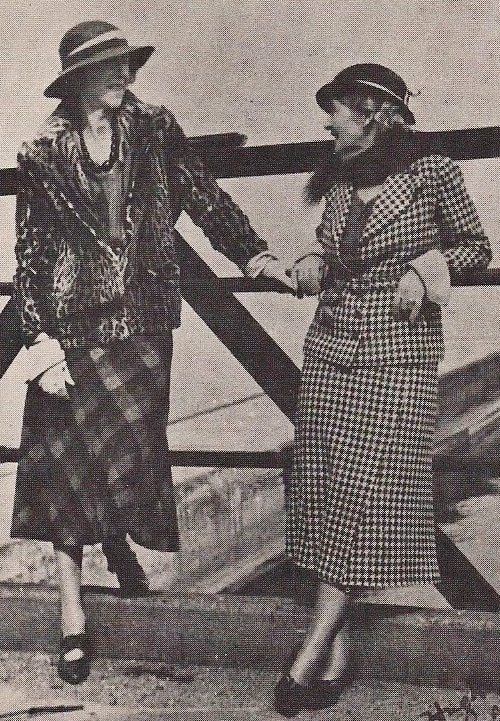
Mazo de la Roche and Caroline Clement, 1930s

Mazo de la Roche and Caroline Clement, 1930s

Caroline was now able to retire from wage-earning work and she took on the role of her suddenly-famous cousin’s housekeeper, editor, secretary, and collaborator in creativity. “The Play”, so precious to the two in childhood and maintained throughout the years, continued to expand in their leisure time, as the cousins ought respite from the pressures of fame in their shared imaginary world. Suffering continually from blinding headaches and trembling hands – and at least one bona fide nervous breakdown – Mazo found that the only way she could sometimes get her thoughts down on paper was to dictate them to Caroline. While Caroline always disclaimed any notion that she originated the plot lines and characterizations that Mazo was so famous for, both women were very open about Caroline’s role as a sounding board and critic.

Fifteen more “Whiteoaks of Jalna” novels were to follow that first astonishing bestseller, as well as more novels, plays, short stories and, eventually, several autobiographical memoirs, of which 1957’s Ringing the Changes is the last. Mazo de la Roche died four years later, at the age of 82. Caroline survived her cousin for some years; the two are buried side-by-side in an Anglican church cemetery in Sibbald Point, Ontario.

It is estimated that the Jalna novels have sold more than eleven million copies worldwide in the years since 1927. They have been translated into more than ninety languages, and were adapted for the stage, movies and television, with varying degrees of popular, commercial and critical success. Despite – or perhaps because of – their bestseller status,  the Jalna novels were increasingly viewed with scorn by the literary world as being too “popular”  and “melodramatic” in plot and execution.

Mazo de la Roche, in the decades since her death, has slipped into literary oblivion but for a few dedicated readers who staunchly read and reread the Jalna saga, and passed the books along to their children. Mostly daughters, one would assume, as de la Roche was seen as a “women’s writer”; her works were thought to appeal mostly to the bored housewife seeking sensation and emotional escape from the humdrum everyday round.

A recent (2012) documentary by Canadian film maker Maya Gallus has brought Mazo de la Roche into new focus. Both her ambitious novels and her unconventional and rather mysterious life are being examined with twenty-first century eyes. It will be interesting to see if there will be something of a “Jalna Revival”; I’m betting that we’ll be hearing much more of this not-quite-forgotten Canadian in the months and years to come.

Pertinent links regarding the recent docudrama:

NFB – The Mystery of Mazo de la Roche

Review: NFB docudrama: The Mystery of Mazo de la Roche

Quill & Quire – Interview with Maya Gallus

*****

(When reading) the autobiographies of other writers …  some appear as little more than a chronicle of the important people the author has known; some appear to dwell, in pallid relish, on poverty or misunderstanding or anguish of spirit endured. They overflow with self-pity. Others have recorded only the sunny periods of their lives, and these are the pleasantest to read.

~Mazo de la Roche ~ Ringing the Changes

Mazo de la Roche and her beloved Scottie, Bunty

Mazo de la Roche and her beloved Scottie, Bunty

Ringing the Changes itself is a diverting memoir, and, if the author indeed intended to record the frequent sunny hours of her life, she by and large succeeded. Tragedy both major and minor continually followed Mazo and her extended family, and while unhappy events are described, they are not dwelt on or singled out as an excuse for pathos. I never got the feeling that the author was “wallowing”, though I occasionally shook my head in wonder at the sad fates of so many of her relatives, and, frequently, of her family’s beloved animals. They did seem, so many of them, to come to such tragic ends…

I must confess that I knew very little about de la Roche before I read this book, though I had a pre-existing vision of her as a rather reclusive, mildly eccentric sort. I had read several of the Jalna novels way back during my teenage years, but had certainly not found them worthy of any sort of “fandom”, as so many others apparently have. I did pick up a number of the books quite recently in a library sale, thinking that my mother might enjoy them, but she was rather dismissive of the series, so they currently languish somewhere in a box.

In this memoir, Mazo looks back to her childhood, and, once a bit of genealogical discussion is gotten out of the way, launches into a compelling tale of gallantry, tragedy, heartrending anecdotes and humorous vignettes. “Gallant” is a term I kept saying to myself as I read Ringing the Changes; so many of the people in Mazo’s life demonstrated this trait, in particular her beloved cousin Caroline, who was the epitome of selfless devotion in numerous ways, though she appeared to have a full and satisfying independent life as well. The Mazo-Caroline relationship is still raising eyebrows – were they lesbians? what was Mazo’s hold on Caroline? who really wrote the books? – but, seriously, it does seem like that particular relationship was one of equals. Both women apparently had romantic interludes – with men – at various times throughout their lives; that they would choose to stay single and in a “family relationship” with each other and various other family members surely is a purely personal matter and rather understandable given their backgrounds and that of their extended family.

The argument for “closet lesbianism” for Mazo at least is quite strong, or perhaps one might go so far as to speculate that “cross-gendered” might be a more apt term. From her own statements in Ringing the Changes, in childhood she wanted to be a boy, she related on completely equal terms with her male editors and literary advisors, and, perhaps most tellingly, she frankly states that she identified extremely strongly with one of her male protagonists, Finch Whiteoak, who is portrayed as artistic, emotionally and physically fragile, and highly conflicted in his romantic yearnings.

In Ringing the Changes it does seem that Mazo de la Roche was continually striking back at her many critics, the ones who denied her work any place in the “literature” canon, due to its popular success and formulaic nature. She is highly defensive of her own motivations, and this oft-quoted passage sums up her rather hurt tone well:

I could not deny the demands of readers who wanted to know more of that [the Whiteoak] family. Still less could I deny the urge within myself to write of them. Sometimes I see reviews in which the critic commends a novelist for not attempting to repeat former successes, and then goes on to say what an inferior thing his new novel is. If a novelist is prolific he is criticized for that, yet in all other creative forms — music, sculpture, painting — the artist may pour out his creations without blame. But the novelist, like the actor, must remember his audience. Without an audience, where is he? Like the actor, an audience is what he requires — first, last and all the time. But, unlike the actor, he can work when he is more than half ill and may even do his best work then. Looking back, it seems to me that the life of the novelist is the best of all and I would never choose any other.

Ringing the Changes, read as a stand-alone book without reference to Mazo de la Roche’s fictional body of work, “works” as a memoir which can be read for the pleasure of the tale itself. Mazo de la Roche was, as even her harshest critics freely admitted, a “born storyteller”, and this account of incidents in her life, as deliberately selected and edited as they may be, is a very readable thing indeed.

Read Full Post »

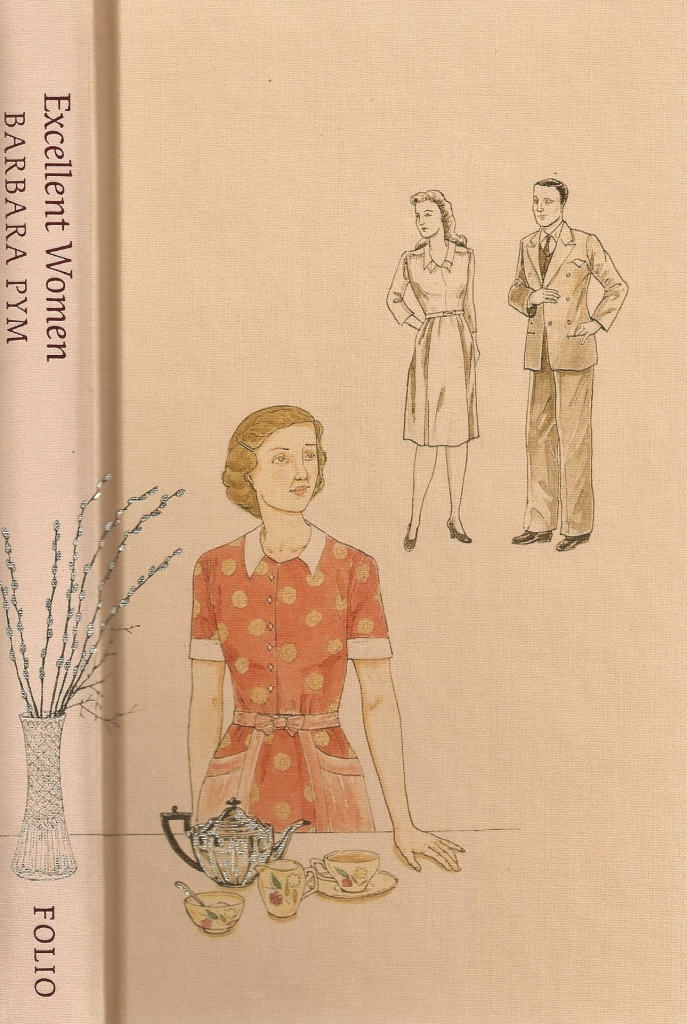
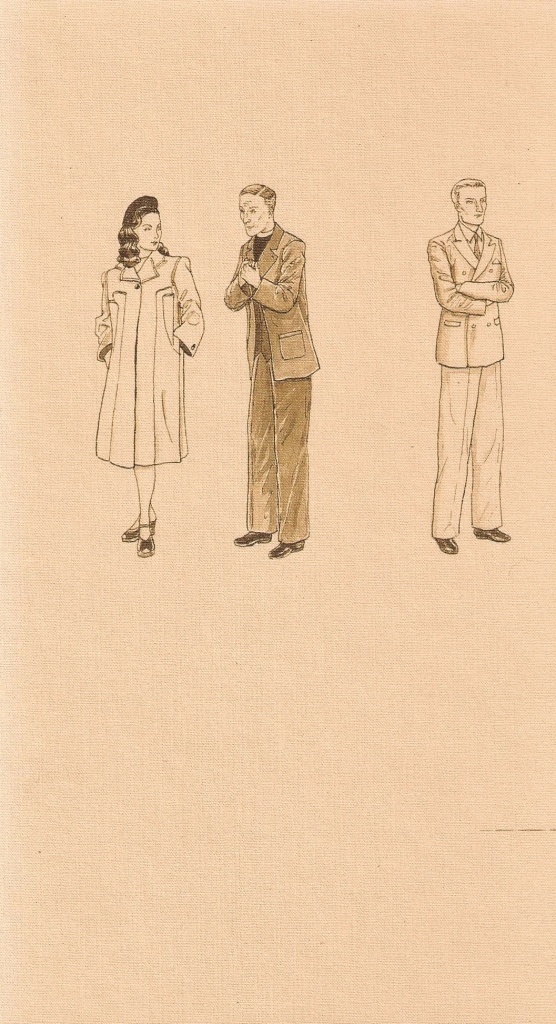
excellent women barbara pym folio front c 001Excellent Women by Barbara Pym ~ 1952. This edition: The Folio Society, 2005. Introduction by A.N. Wilson. Illustrated by Debra McFarlane. 206 pages.

My rating: 10/10.

This is the second time around for this book. My first reading left me gently pleased but not much more; this reading was much more rewarding, and I found I fully appreciated every nuance, every delicious – and occasionally malicious – little scenario.

This absolutely beautiful Folio edition certainly added to the experience; my first reading was of a yellowing paperback. I wonder if eyestrain is starting to influence my reading enjoyment? I do notice type clarity (and lack thereof) and font size much more these last few years.

And I must confess I almost passed this one by – “I already have it in paperback and it wasn’t that wonderful” – but am so glad I went back and splurged on this much more aesthetically pleasing book. Every sense was indulged by it! The pussywillows picked out in silver tipped the scales and sealed the impulse buy. I’m a sucker for pussywillows; these stole my heart. (On such small things do my buying decisions sometimes rest!)

Barbara Pym. Read her, and then reread her. Second time around is the key, here, I think. (Much as one needs to do with Diana Wynne Jones.)

*****

At the rather young age of thirty-one, Mildred Lathbury, self-described “spinster” and “clergyman’s daughter” (both of these designations serving to explain her clear-eyed observations of other people’s lives, and her lack of sentiment about her own), is well on her way to becoming one of the titular “excellent women” so dutifully and frequently thanklessly keeping things on an even keel in the bleak post-World War II years. Surplus females of every age, in super-abundance at mid-century after the decimation of their generations’ crops of marriageable men in the two brutal cullings of the previous decades.

“They have nothing better to do,” shrug their “luckier” compatriots, “they might as well make themselves useful, and be grateful for the occupation…”

So they do. Make themselves useful, that is. Though, as Mildred so delicately observes, the gratitude frequently falls short on both sides of the equation.

excellent women barbara pym folio back c 001Read quickly, this is a rather depressing, non-eventful, bleakly dreary minor tale. Not much happens. Mildred gets new neighbours, watches as the vicar of her church is pursued and almost caught by a predacious widow, narrowly escapes being saddled with an unwanted flatmate, and is offhandedly wooed in a most unromantic way by an anthropologist looking for a meek but competent dogsbody to take on the tedious task of editing his notes.

But, oh! – her inner voice! She misses nothing at all, our Mildred, and her wry observations are a joy to read.

I’m going to stop right here. What with it being Barbara Pym’s centenary year, and with the book blogging world full of mostly fulsome praise and beautifully written, thoughtful book reviews of her work (though the occasional dissenting voice is heard from, mostly from mildly querulous folk wondering what all the fuss is about – I can’t say I’ve yet come across anything resembling a brutal denunciation of Miss Pym) anything I have to add to the conversation is rather superfluous, I feel.

I liked this book.  A whole lot. You might, too. My caveat: it might take more than one try.

Here are some excellent reviews, well worth reading. They include all of the excerpts I would have chosen myself.

Well done, all!

You’ve saved me much typing. Well, that, and also, more importantly, you’ve given me the great pleasure of reading your delightful posts. Thank you. A (fresh) wand of mimosa all round! (And a cup of China tea, if that be your desire. Unless you’d prefer a beer? Or a glass of wine, exciting or merely adequate?)

Excellent Women –  Review at The Captive Reader

Excellent Women – Review at Book Snob

Excellent Women – Review at The Indextrious Reader

And there are many more.

Read Full Post »

???????????????????????????????I’m not sure what’s going on with my reading this spring; I seem to have gotten stuck among the crinolines, as it were (though only one of the books I’ve read has actually had crinolines in it, this being the just-post-Civil-War Sea Jade), what with my newly discovered fondness for Georgette Heyer’s Regency heroines, and now these two similar but oh-so-different “American gothic” vintage romances. Maybe it’s just that I’ve run out of D.E. Stevensons, which made admirable escape reading through much of March.

April – unbelievable that it’s so close to over already! – has brought its usual share of real life busy-ness, what with being in the plant nursery business, and still providing taxi service to the dancer, and a mountain of paperwork relating to taxes, and even a little bit of lambing, though we’re presently down to a tiny vestige of our former flock, and sometimes I almost forget that they’re out there, what with the more-than-competent teens running things in the barnyard these days.

Spring does seem to have arrived, after dragging her heels rather reluctantly this year, and yesterday brought us a warm wind and the overnight emergence of leaves on the cottonwood trees down by the river – with associated heavenly aroma; the colloquial name for these trees is “Balm of Gilead”, and the fragrance of the sticky sap is indescribably spicy and fresh and green and evocative of every good thing about spring in the country. Our venerable (and almost completely non-productive) apricot tree has blessed us with blossoms this year and yesterday was alive with bees, and (hurray!) the hummingbirds are back. The harbinger of what will become a lively and prolific horde, a lone male Rufous, buzzed through the garden, hovered low to visit the first opening Pulmonaria blooms, and danced in front of the kitchen window, an action which brings forth the lady with the sugar syrup every year.

???????????????????????????????

Amazing that such tiny scraps of feathers and attitude make such long journeys twice a year on their migratory travels, and every year I wonder just how long each individual can survive for. I know we have some of the same birds year to year; how else to explain their immediate presence at the traditional feeder sites before I get the sugar water out, and the buzzing at the one window next to the door where I always emerge with the top-ups through the months when we host our demanding little visitors?

The mosquitoes are here as well, and this less welcome sign of spring was in evidence yesterday. Slapping mosquitoes with potting soil encrusted hands leads to embarrassing smudges on the face and dirt in the hair; luckily I had no human visitors to comment on my disarray! In the evening we built a fire out in the stone ring by our favourite sitting spot on the lawn and ate our supper in a cloud of smoke (welcome because it discouraged the mosquitoes), kept company by the two dogs, the two “barn” cats – big joke, that designation – they are in the house more than occasionally – plus the three “real” house cats, who are glorying in the present situation of open windows unblocked by screens. In and out at will all day long without needing a human hand on the doorknob – feline nirvana!

The teens, careless as only those in the second decade of life can be to the quiet joy of sitting out on a spring evening, were firmly planted in front of their laptops, cruising Facebook and doing whatever else it is that they do when enjoying their non-school-related screen time, though they did remember their filial duties enough (once reminded by loud calls from the father figure) to bring their parents a welcome cup of tea. (It wasn’t that warm out there, even with the fire.)

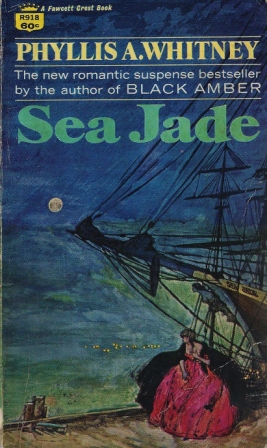
We sat and read until it was too dark to see the words, and I powered through the book I’d grabbed from the “recent acquisitions” pile in the porch, where I’d been going through them and making up a box full for my housebound elderly mother. Mom enjoys the occasional Phyllis A. Whitney, and I’d found an older one with a gorgeously gothic cover illustration, Sea Jade, which didn’t ring a bell as one she’d already read. “I should really try this,” I thought to myself. “Perhaps, like Heyer, Whitney is one of those authors I’ve ignored for too long. Perhaps she too has hidden qualities I’ve foolishly been depriving myself of…”

Short answer: nope.

I almost quit on Sea Jade very early in, but was too lazy to get up and go search for something else; and after a while the sheer awfulness exerted a hypnotizing effect, and I was driven to keep reading by the desire to see how many of the stock gothic romance situations the author was going to put her breathless heroine through. (I lost count.)

Which had me musing this morning on what makes a book a “good” read. Why two such books as these I’ve just read can have so many similarities in plot and character and setting, and why one can be so enjoyable, and one such a blatant mistake. Author’s voice is all I can come up with.

Well, if you made it this far, I’m about to get back on track and discuss some books. Both are vintage gothic romances, with American settings, and both are by accomplished and prolific authors. I found it rather interesting that my favourite was by the lesser-known and less popular author. Margaret Bell Houston is virtually unknown now, while Phyllis A. Whitney is still very much in evidence, both in online discussions and on the shelves of used book stores.

Houston’s gothic was very good indeed; Whitney’s was not. Rather disappointing, as I wanted to like Sea Jade so very much… there are so many Whitneys out there, and she’s so easy to acquire, while Houston’s titles, aside from the book I read, Yonder, are much more elusive.

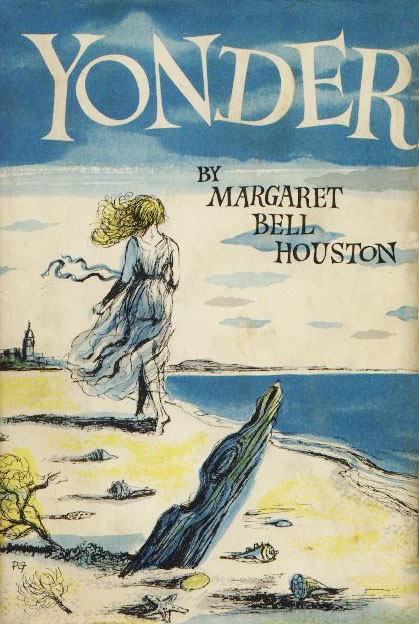
yonder margaret bell houstonYonder by Margaret Bell Houston ~ 1955. This edition: Crown Publishers, Inc., 1955. Hardcover. 242 pages.

My rating: 9/10.

This was one of those rewarding random acquisitions. I was attracted by the eye-catching dust jacket illustration by Paul Galdone, which led me initially to believe that this was a juvenile/teen book. It’s not. (Though any nowadays teen wouldn’t turn a hair at some of the content, which has a decidedly adult theme. Sex and illegitimate babies and so on, not to mention crimes of passion and plenty of psychological drama.)

Olive York, twenty-two years old and recently orphaned by the deaths of her beloved parents in a plane crash on their way to a church convention in California – Olive’s father was a parson – is at a rough point in her life. Her long-time friend-turned-romantic-interest, Dane Carrington, has just married another woman, and, though Olive is a sensible enough girl and does not believe her life is over or anything dramatic like that, she’s looking for a way to move on.

When she’s offered a job as a companion to an emotionally troubled relative of the Carringtons, she’s intrigued both by the vague explanation of Zoé Croome’s “insanity”, and by the descriptions of the Croome family’s estate on a remote Florida key, Yonder Island.

Arriving in an almost-hurricane, the setting is all Proper Gothic Romance, and when we meet the Croome family and their assorted associates, we recognize immediately that here is a group of people with more than a few deep dark secrets. Watch out, Olive!

There’s the immense, handsome, stone-faced and monosyllabic black houseman, Ezra; the white-uniformed nurse Nannine; Judge Croome, family patriarch, forceful and intense but obviously getting rather tired of life; the elder Croome daughter, Joanna, wheelchair bound, even more intense than her father and in charge of the operation of the household and Yonder Island citrus groves; and of course Zoé Croome herself.

Thirty years ago something happened, something that isn’t discussed within the bosom of the family, but which is speculated on by the rest of the neighbourhood at large. Whatever It was has affected Zoé so strongly that her mind has stayed locked in time; she speaks and acts as a young woman, repeating the days of her youth over and over again. “This is the day!” she greets every morning, emphasis on “the” day; obviously a day when something marvelous is about to happen. But what could it possibly be?

Not only is her mind stuck in its groove, but her body is as well. Though a woman of fifty, Zoé looks like a young woman – unaged and of an ethereal beauty. She is “crazy, but not violent”, and a delicate hand is needed in her management. She is constantly looking or someone or something, and if she is locked up she goes wild with self-destructive passion; her bedroom windows are barred to prevent her throwing herself out, as she once attempted to. Olive’s primary job will be to accompany Zoé on her daily meanderings down to the beach, where Zoé collects seashells and gazes longingly at the boats passing by. Occasionally she runs into the waves…

Of course Olive, being a typically forward-thinking person as gothic romance heroines frequently are, is keen to get to the bottom of the many mysteries of Yonder Key, and she is certain she can help Zoé move forward in time and find some sort of personal peace. In this she is strictly forbidden by bossy Joanna to “meddle”, and Ezra threateningly shadows Olive’s every move. Despite this discouragement, Olive persists in putting together Zoé’s back-story, with the increasingly interested assistance of Richard Lowrie, who lives alone in a little house across the island. Richard is working on one of his best-selling books about discoveries made while sailing the world’s seas in his one-man yacht. Richard is a long-time Croome family friend, hence his permission to inhabit his quiet corner of the Key, and is a confidante of both Judge Croome and, in her more lucid moments, Zoé. (Joanna keeps her distance.)

And of course, as Olive starts to investigate and ask awkward questions, things begin to happen.

This was an excellent read. Olive’s voice (the story is told in first person narration) is rather stoic and matter-of-fact, but that was a strength, rather than a weakness; the fantastical elements of the story are rather more believable when presented so dispassionately.  Olive paints vivid pictures of both the world of her own past, and of her new life on Yonder Key. The author has, in general, done well by her heroine in this story, allowing her scope to go about her clichéd path from mystery to resolution with reasonable motivations for everything she does. The romantic interests in Olive’s personal life are very well handled, and, as we discover the secrets of the Croomes, there is a certain plausibility to the tale which allows us to suspend our disbelief in the dramatic scenario which eventually unfolds.

Without going into spoiler mode, because this is a great little book and one which I’d recommend for further investigation to those of you who like a good du Maurier-like suspense novel – and yes, this one deserves to be mentioned in the same breath as the works of Dame Daphne – it is very well done, in a minor key of the genre – I’ll share with you my satisfaction in the ending. The Yonder mystery is solved, and both Zoé and Olive find places of peace after their trials and travails.

I’ll be re-reading this one, I know, as well as looking for other books by the author.

Oh yes, the author. She is (was) Margaret Bell Houston, granddaughter (as every mention of her I can find emphasizes) of Texas soldier and politician Sam Houston, who famously led the state to independence from Mexico in 1836. (“Remember the Alamo”, and namesake of the city of Houston, Texas, etcetera, etcetera.)

Margaret was born in Texas in 1877, and was a published poet at an early age, winning numerous awards for her verse throughout her lifetime. She went on to write short stories, and something like thirteen novels, some of them bestsellers. The one most often mentioned is this one, Yonder, and its more than decent quality makes me immensely curious to explore more of her work. If Yonder is the best thing she produced – it was published in 1955, when the author was 78 years old, and nearing the end of her long life – she died in 1966, at the age of 89 – it must have come from somewhere, and I’m thinking her earlier works would show a similar quality. Yonder is not “high literature” in any sense of the term, but it is a good American light novel.

Is anyone familiar with this author, or any of her other works?

Well, after my satisfaction with Yonder, I picked up Sea Jade with high anticipation. Sadly, I was doomed to disappointment. “Gothic” it was; “good” it was not.

Sea Jade by Phyllis A. Whitney ~ 1964. This edition: Fawcett Crest, 1966. Paperback. Library of Congress Number: 65-12605. 224 pages.sea jade phyllis a whitney 001

My rating: 3/10.

Phyllis A. Whitney. I read her occasionally while in high school, though I can’t remember a thing about any of the books. Seven Tears for Apollo is one that comes to mind; I’ve had that tattered paperback kicking around for a good thirty years, though I haven’t read it recently – for at least twenty of those years. My general impression, when I stop to think about it, is favorable. My mom likes it, and has read it a few times since I’ve been in charge of her reading material; I’ve picked up other Whitney novels – they’re quite  easy to come by – and she’s read them without comment and with every appearance of enjoyment.

But if Sea Jade is typical of Whitney’s work, I think I’ve perhaps personally outgrown this author.

Sea Jade is set in post-Civil War New England, on the shores of the crashing Atlantic, an ocean-side setting it shares with Yonder to some extent. There’s a similiar situation of massive family mansion inhabited by people with secrets, and the heroines of both enter the scene seeking physical and emotional refuge of sorts. In the accepted tradition of the Gothic Tale, both books even start with storms.

The heroine of Sea Jade, young, innocent and oh-so-lovely Miranda Heath, is uddenly desperately poor after the death of her lone surviving parent, a retired sea-captain. Despite an apparent deathbed warning by her father to avoid the Bascomb enclave, Miranda decides to seek help from her father’s old partner, wealthy Captain Bascomb, whom she’s heard so many romantic stories about, and whom she just knows will be happy to act as a surrogate father in her time of need.

It was fitting that I had my first glimpse of the house at Bascomb’s Point during the flash and fury of a violent thunderstorm.

The storm had not yet broken when my train from New York  stopped at the Scots Harbor station. As the conductor helped me to the platform, a gusty October wind whipped at my skirts and mantle. I clasped my portmanteau in one hand and stood looking about me – eagerly and without fear.

My father’s warnings had touched me not at all and my mind was filled with a romantic dream that I fully expected to become a reality. Since my father’s death some months before, the state of ny fortunes had grown very nearly desperate. Unless I threw myself on the charity of friends, I had nowhere to turn. Only Obadiah Bascomb could help me know. He had written to me in response to an appeal of my own, and I had come running, given wings by a sense of adventure, of expectancy, eager to meet the life counterpart of a legend with which I had grown up.

I know how I must have looked that day when I first set foot in the little New England town where my father, my mother, and I were born. Since I am no longer so tenderly, so disarmingly young, I can recall the look of that youthful Miranda Heath as if she were someone else. Slight and slender she was, with fair tendrils of hair, soft and fine, curling across her forehead beneath the peak of her bonnet. Her eyes were tawny brown, with quirked, flyaway brows above them. The wind undoubtedly added to the illusion of her flyaway look; the look of a fey, winged creature straight out of a make-believe world where love and pampering were taken for granted. A creature unaware that she was about to stray into dark regions for which nothing had prepared her…

That’s page one. I’m not sure why I even turned it to page two, but I did, to find much more of the same. Breathless, gushing Miranda goes on to have all the stock adventures of a gothic genre heroine. She’s immediately forced into an unwelcome marriage with the widowed son of Captain Bascombe, in circumstances which completely beggar belief. There are all sorts of family secrets, and of course her husband hates her and wants nothing to do with her, having married her under extreme duress. Dramatic deathbed scenes and mysterious Chinese wives and exotic swords and ill-begotten fortunes feature in the scenario. And there’s an intially-hateful-yet-ultimately-winsome child, a huge black dog named (of course) Lucifer, an unexpected will, a mysterious murder (or two)… In other words, the formula as usual.

The family secret is discovered and the villain is unmasked, and there is a last-minute rescue as the hero snatches the heroine from certain death; his arrival on a clipper ship with all sails set in time to rescue her from a fiery doom is improbable in the utmost. Luckily by the time we’ve made it this far we’re used to the author’s complete lack of attention to detail, and are taking her at her word that it’s all possible. Because she says so, right there in black and white.

Ha. This tale is so silly. Be warned!

The points I left this with were for a certain amount of creativity in the historical bits involving the tea trade and the brief glory of the Yankee clipper ships. And also because the author used every cliché in the romance writer’s book, completely (I’m quite sure) without irony. One of those “so bad it makes everything else look good by contrast” reading experiences – a necessary thing in every reader’s life. Occasionally.

Read Full Post »

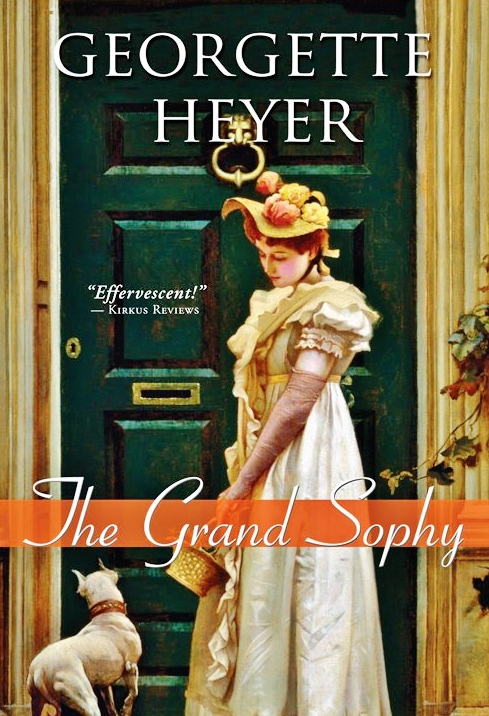
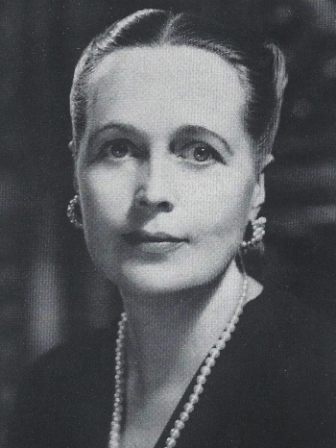
the grand sophy georgette heyerWell, I’ve finally done it. Georgette Heyer has been praised so often and so enthusiastically by so many of the book bloggers whose recommendations I have come to look forward to as decidedly reliable that I have taken the plunge.

I don’t really “do” romance novels as such, though of course most of the books I read incorporate some sort of romance, whether it be traditional male and female or some other sort of love affair (and by this I mean any sort of relationship – platonic friendships are love affairs, as are parent-child relationships, and all of the individuals emotionally invested in some way, whether it be with an idea, an occupation, a house, a garden, a country, a way of life… it’s all about passion and feelings and, yes, “romance” of some sort, isn’t it?)

(And did I just digress? Yes, I think I did!)

Anyway, bodice rippers in the good old Harlequin tradition aren’t really my thing, and the undoubted fact that Georgette Heyer has been republished by Harlequin – I have here on my desk a just-purchased (but as yet unread) copy of The Quiet Gentleman, Harlequin, 2006, with a publisher’s list of other Heyers in the back – was not a point in favor. I’d also read several of Heyer’s mystery stories – she famously wrote one romance novel and one mystery novel each year during a period of financial necessity – and found them no more than mildly diverting. But then there were all those Jane Austen comparisons, and the chatter about her being a seriously underrated writer, and all those comments about her undoubted mastery of her chosen literary period – England’s Regency era, the first few decades of the 19th Century – and all of the lavish praise in the blogosphere…

So I made the decision to give Heyer one more try. Pulling up her name on the library catalogue, I was impressed to see that there was a reasonably large selection of titles, arguing a current popularity (my present public library is very quick to cull and has very few older books in the stacks), some of which I remembered as having received glowing reviews from my blogging peers. Home came Sylvester and The Grand Sophy, as well as a third which appealed because of the plot description on the back, but which I haven’t yet read, Black Sheep. I’m a bit Heyer-saturated at the moment, after reading the first two almost back-to-back, but will definitely be reading the third book well within my alloted three weeks before it needs to be turned back in.

In other words, I liked these. A lot.

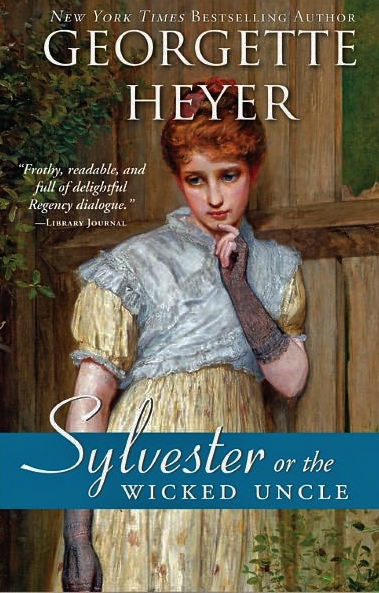
Sylvester: or the Wicked Uncle by Georgette Heyer ~ 1957. This edition: Sourcebooks, 2011. Softcover. ISBN: 978-1-4022-3880-2. 386 pages.sylvester or the wicked uncle georgette heyer

My rating: 9/10.

This story is an absolute hoot. It has everything. Misunderstood heroine – check. Highly intelligent and of an unconventional attractiveness, of course – check. Wicked stepmother – check. Fabulously handsome, wealthy and aristocratic love interest – check. Initial misunderstanding by chief couple and instant dislike of each other – check. Endless complications before true love finds its way – check.

It’s basically Pride and Prejudice with the added bonus of a botched kidnapping (literally), a surreal trip to France, and horses.

You know what? I’m going to stop right here and refer you over to this absolutely excellent blog post by Claire at Captive Reader. It’s the one that convinced me to give this author a go, and the post says absolutely everything I would like to. Anything I could come up with this morning would be a pale shadow of what Claire has said so well. (I am horribly pressed for writing time these days, but cannot let this book pass without a mention. It was so much fun!)

The Captive Reader – Sylvester or the Wicked Uncle

Sylvester more than met my own expectations. The point it lost was right at the very end; I thought the final romantic scene wasn’t quite up to the standard of the rest of the story. But endings are notoriously difficult, and it wasn’t terribly bad or anything. Just not quite… something

But all in all, a very enjoyable read. Great introduction to this author; I’m won over.

*****

the grand sophy yestermorrow georgette heyerThe Grand Sophy by Georgette Heyer ~ 1950. This edition: Yestermorrow, 1998. No ISBN found. 347 pages.

My rating: 9/10.

Gosh, where to start? Let’s see how good my condensation skills are this morning!

Sir Horace Stanton-Lacy, world-roaming diplomat, drops in on his aristocratic sister Lady Ombersley for a brief visit while en route from Lisbon to Brazil. After racing through the polite preliminaries (Sir Horace is excessively focussed on getting right to the point with the least amount of fuss and trouble to his self-indulged self) the object of his detour becomes apparent.

Could he possibly leave his (motherless) twenty-year-old daughter Sophy with her dear aunt? Brazil, in the early 1800s, is rather rough in places, and even careless Sir Horace has qualms about its suitability for an upper-class English girl’s place of residence, even under the auspices of her important Papa. Sophy – “Dear little soul: not an ounce of vice in her!” exclaims said Papa – is as good as “out”, though the formalities of a Court presentation have been unavoidably omitted, what with living on the Continent and all – and will be a lovely companion for her cousin Cecilia. And while she’s here, dear sister, Sir Horace goes on to say, how about fixing her up with a suitable husband? I’m sure you can manage to arrange that for me…

Lady Ombersley is shocked into agreement, and Sir Horace disappears as quickly as he came, leaving with a promise that Sophy shall be welcomed into the bosom of her extended family. The family, as far as I can remember – there’s a lot of characters in this hectic novel – consists of Lord and Lady Ombersley, their eldest son Charles Rivenhall – who is by way of being head of the family, financially speaking, as he is his recently deceased wealthy grandfather’s heir as Lord Ombersley is an incorrigible gambler who has virtually impoverished his own estate – sober Charles is busy doing damage control while his father continues his dissipated lifestyle on a much more modest scale – the beautiful aforementioned Cecilia, a younger brother, Hubert, at Oxford, another, Theodore, at Eton, and young sisters Amabel and Gertrude.

Sophy shows up quite soon, and far from being the meek and gentle niece and cousin the family was expecting, turns out to be positively Amazonian, a self-assured and shockingly outspoken young lady, looking on her English sojourn as something of an amusing lark, though she’s agreeable to being introduced to some interesting and suitable young men on matrimonial approval, as it were. She throws the household into a turmoil it has never known before, and soon it becomes apparent that Sophy is a born manager of other people for their own good, and that in her staid cousins she has found much scope for her personal hobby.

Charles is engaged to the most prim and proper Eugenia Wraxton, who is looking forward to her upcoming marriage and increase in social status with smug self-satisfaction; it soon becomes apparent that cousin Sophy does not meet with her approval, and Eugenia’s true nature as a sly, prying, manipulative scold is thereby revealed, though Charles appears blind to this, at least initially.

Cecilia has been presented with a suitable young nobleman, Lord Charlbury, as a potential spouse, but has instead become infatuated with Adonis-like Augustus Fawnhope, an aspiring poet. (He instantly reminded me of none other than P.G. Wodehouse’s Madeleine Basset, of “the stars are God’s daisy-chain” fame; subsequent events merely strengthened that comparison.) Hubert has gotten himself embroiled in gambling debts – shades of the paternal situation – and is too terrified to confess to his older brother, and has instead gotten into the clutches of an evil moneylender.

The younger children, luckily, are not much in need of sorting out, so Sophy busies herself with rearranging Charles’, Cecilia’s and Hubert’s lives for them.

Charles is immediately resistant to his lively cousin’s attempts to “manage” his family; he cleaves to the unpleasant Eugenia with commendable loyalty, but cracks soon appear in his iron-hard facade. Eugenia is quickly driven to open criticism of Sophy’s lack of propriety; Sophy seems to delight in shocking and annoying Eugenia; Sophy is marvelously clever at pushing all of Charles’ buttons, and seems to come out ahead in each of their encounters; her and Charles’ continued verbal sparring (and shared love of horses) gives the alert reader the key to the eventual outcome of that particular triangle of personalities!

Cecilia and her poet are all over each other, while Lord Charlbury mopes in the his lonely corner (he’s recovering from the indignity of having had the mumps at a crucial time in the progression of his courtship of Cecilia.) Sophy takes those three in hand as well, giving Lord Charlbury instruction on how best to woo his reluctant prospective spouse, and eventually exposing Augustus Fawnhope’s deep ineffectualness to the no-longer-quite-so-besotted Cecilia.

Hubert’s moneylender is confronted with aplomb, in a scene which received some negative press in the blog world for its deeply stereotypical depiction of a Shylock-like Jewish character. (See here for a fascinating and extended discussion of racial stereotyping in literature, centered on The Grand Sophy, and widening to Heyer in general, then bringing in Agatha Christie, Ngaio Marsh and Dorothy L. Sayers as well; the many comments following this post are thought-provoking; the whole exchange is well worth reading.)

This workaday plot summary leaves out the sparkling dialogue and the deep humour which infuses every page of this lively historical romance; it’s a grand read for a dull day; perfect escape literature, and not to be taken too, too seriously, I think. An amusing romp, with the bonus of being meticulously researched and full of era-correct dialogue, descriptions of food, dress, and the social world of upper classes of post-Waterloo England. If you appreciate Jane Austen and Thackeray’s Vanity Fair, you’ll find much to admire in Georgette Heyer’s detailed and very funny take-offs of the time.

As with Sylvester, The Grand Sophy was a whole lot of fun. More so, really – it is almost antic in its multitude of plot twists, turns and tangles, where Sylvester maintained a certain dignity even in its most absurd moments. But Sophy lost its point in the same place, right at the end. It was a good ending, a proper ending, with loads of predictability and a few (small) surprises, but there was something just a tiny bit rushed over how everything tied itself up so quickly, as if the author, with finish line in view, had pushed herself into one last full-speed-ahead dash of writing. But, as with Sylvester, not a big issue, and easy to forgive.

And I did forgive the author her moneylender; I mulled this over quite a bit, and have held back this review to consider how deeply I wanted to address this issue. I have come down on the side of letting it go in the interests of era-correctness. Yes, the book was published post-World War II, when the horrors of the Holocaust were well-known and fresh in memory, but the treatment of the character in question was completely in line with the 19th Century world it depicted. And The Grand Sophy is something of a parody in its treatment of all of its characters; I don’t believe we are meant to take any of them all that seriously. If one wants to be offended, there’s a lot of scope for that in more than the Jewish moneylender episode. I choose not to be offended, though I see where the offense lies, and will leave it at that. (At least for now. This is a topic which is never really dormant, whether reading vintage or contemporary fiction.)

At the end of the day, I must say that I enjoyed these books, and I’m looking forward to encountering more of Heyer’s delicious romances, but I suspect that they are best taken one at a time, as a sort of self-indulgent literary “rich dessert”; nice as an occasional treat but not really suitable for daily fare!

Read Full Post »

Lasso Your Heart by Betty Cavanna ~ 1952. This edition: The Westminster Press, 1952. 184 pages.lasso your heart betty cavanna

My rating: 5/10.

This one just squeaks onto the keeper shelf and therefore gets a “pass”, and I’ve made generous allowances for the genre and time of writing. The Kirkus review says it, too. Merely “adequate.”

*****

Kirkus Review, October 1952

A wholesome young love and how-to-be-natural-with-people-instead-of-just-horses-and-dogs novel, by a popular teen-age fiction author – about a young Texas girl and her adjustment problems with rich Philadelphia relatives. Sixteen year old Prue Foster and her family have moved to rural Pennsylvania where her father is managing a cattle fattening ranch. In Bryn Mawr live the Rowntrees, Mrs. Foster’s socialite family, and Prue is invited to her cousin Cissy’s debut. Her misgivings intelligently reasoned away, Prue enjoys herself with a young journalism aspirant Colin, until news is received of Cissy’s brother-in-law’s death in Europe. Mr. and Mrs. Rowntree fly to their elder daughter’s aid and Cissy goes out to the ranch with Prue where she falls in love with Mac, a Texas A. & M. student summering with the Fosters as a ranch hand. Prue averts a would be tragic elopement by enlightening Mac as to the evils of running away from temporary disapproval. So Cissy wins Mac the honorable way and Prue looks forward to a nice winter with Colin who will study at Penn. Adequate.

This is one of prolific “teen fiction” writer Betty Cavanna’s earlier books, and it is an exceedingly stereotypical “young romance” novel, though it is not at all a bad book – no groans of despair were emitted by this reader during the reading, which says something.

An interesting scenario in some ways, with the main character, Prudence – Prue – coming from a ranching family who has recently relocated from Texas to Pennsylvania. I appreciated that Prue’s father was not a ranch owner himself, but merely an employee of a large Texas holding. There is a complete acceptance by the author that agriculture was a more than respectable occupation for both Mr. Foster and the young “cowboy” love interest, Mac – much is made of the fact that they are well-educated professionals much respected in their fields – Mr. Foster is writing scientific articles for the U.S. Department of Agriculture’s Yearbook, and Mac is in his final years of study at Ag school (Texas A. & M. University), which is treated with as much respect as Harvard might be. I really liked those touches, and awarded an extra star for them. (Being an old aggie of sorts myself, from one of the venerable Albertan “cow schools.”)

Otherwise this is mostly just a typical 1950s’ teen romance, with the sweet, naïve, wholesome country girl falling in love with the cute city guy with the convertible, and wondering if he could ever be interested in her, and being oh-so-flushed-and-confused when it becomes apparent that yes, young love is in full delicious bloom. But though Prue and Colin are involved in a gentle teenage courtship (does he really read poetry to her under the trees by the brook? – I’m so jealous!) the situation between Prue’s cousin Cissy and the older Mac hints at something much more emotionally mature and physically passionate.

There is also a situation involving Cissy’s older sister Lea, living in Amsterdam with her pilot husband, Stewart. Stewart’s death in a flying accident on the evening of Cissy’s debutante ball injects a sombre overtone into what is otherwise a light and airy story, and the grief this brings to the families involved is handled well by the author, though she takes care to keep most of that aspect well off stage; Cissy is staying with Prue so Lea can go through the first months of her widowhood in private seclusion back at her childhood home without the fuss of Cissy’s busy social life trespassing on her mourning period. I thought this was an atypical scenario to include in a teen book of this period, and it definitely added another dimension to the story, beyond stereotypical “fluff.”

Betty Cavanna knows her horses, too, and includes a sweet interlude with Prue’s mare giving birth to an adorable foal; there is also the de rigueur “caught in wire” scenario with the young heroine single-handedly rescuing the entangled horse and being praised for her good sense and bravery etcetera etcetera etcetera.

The readers of the period liked this stuff just fine; the old library copy of Lasso Your Heart I’ve acquired (no idea where – it’s been around for years and I cannot remember where I got it, though I’m guessing it was cheap or even free, due to its decrepit condition) is literally falling to pieces, and has been repaired by conscientious librarian a few times – tape overlapping on tape!

I’m getting rather interested in this author in a low-key way, and will be on the lookout for more by her. She has surprised me a bit, in a good way, in each of her three books I’ve read over the past few weeks. I spent some time browsing her titles on ABE, and was quite surprised to see that some are in short supply and are indeed very high-priced; she’s been deemed as “collectible”, apparently, so my interest is not exclusive.

I’m sure I’ll have more to say about Betty Cavanna in the future.

Read Full Post »

my heart lies south elizabeth borton de trevino 001My Heart Lies South: The Story of My Mexican Marriage by Elizabeth Borton de Treviño ~ 1953. This edition: Thomas Y. Crowell, 1953. Hardcover. 248 pages.

My rating: 8/10.

*****

I found this book among my mother’s boxes in her attic which I was supposed to go through and “deal with” when she downsized from the too-many-staircases rambling family home to the tiny-but-manageable single-level house she’s in now. I almost put it into the Sally Ann box, but something stayed my hand. “Elizabeth Borton de Treviño…. I know that name, somehow,” I thought, and that was enough to put it into my keeper pile instead.

Some years passed (well, six years, to be exact, because Mom moved in 2007, and much of what I brought home is still in “temporary” storage here, still waiting to be “dealt with” – and honestly, the only boxes I’ve cracked open are the ones full of books) and then one day I looked at My Heart Lies South again. And the penny finally dropped.

Elizabeth Borton de Treviño. Of course! I, Juan de Pareja. The 1966 Newbery Award winning historical fiction about the Spanish painter Velazquez and his personal slave, Juan de Pareja. I’d read this some years ago, and found it a well-written juvenile historical fiction, and that was why the name of the author sounded so familiar.

I opened My Heart Lies South, as I should have done six years ago, and started reading bits here and there. Far from being the serious and sober biography I had expected from the rather unprepossessing dustjacket – (“Don’t judge a book by its cover” – I know, I know) –  the passages I read were wry and funny and interesting. And when I settled down to tread it cover to cover, it definitely did not disappoint. Another hidden bookish gem, I think we could safely say.

*****

Elizabeth Borton was born in 1904, in Bakersfield, California, and, encouraged by her parents, started writing at a very young age. After graduating from Stanford University in 1925 with a degree in Latin American History, Elizabeth went on to the Boston Conservatory of Music to study violin. She then worked as a reporter for the Boston Herald, and spent five seasons in Hollywood interviewing film personalities.

With her strong interest in all things Latin American, Elizabeth was continually talking about going to Mexico, and one day, in 1934, her editor broke down and sent her off with a handful of tickets, vouchers and contact lists, telling her to “just write something” once she got there. And with her eventual meeting with the representative of the Monterrey Chamber of Commerce, one Luis de Treviño, Elizabeth’s future, though she didn’t know it at the time, was about to take a very different turn from her life as an independent American career woman.

“Hello Luis!” said Bill. “This is Miss Borton. When you get to Vallecillo, buy her an ice-cold beer.”

Luis laughed nervously. There is nothing he likes better than a cold beer, but the lady he had taken across the border for the Chamber of Commerce two weeks before had resisted the beer with desperation as if it might be the first step in a seduction, and the lady last week had been Dorothy Dix, who was even then rather tired from pushing seventy or so and inclined to be tart with young men eager to waste her time in taverns.

I was turned over to the vaccination, immigration, and customs authorities, and at last, in a car which had been provided by the Chamber of Commerce, complete with chauffeur, we set out for Monterrey. I had my hair tied up in a scarf and I was wearing a large black hat as well as sun glasses. Now the sun began to go down and long violet shadows crept across the plain. I took off my hat.

“Ah,” breathed Luis.

I undid the scarf.

“So?” remarked Luis.

I took off the black glasses.

“Wonderful,” he decided, aloud. He leaned toward me and looked at me soulfully.

“Shall I sing you a song about love?” he asked.

“Why yes,” I agreed, thinking this must be a gag.

But he launched into “Palm Trees Drunk with the Sun,” went on to “The Sea Gulls,” and then sang “The Green Eyes,” in a light baritone voice.

“Very nice,” commented the chauffeur from the front seat. “Now sing ‘Farolito.'”

He sang it. After our beer in Vallecillo, Luis sang other songs. He sang all the way to Monterrey.

I didn’t realize it, but I was being courted.elizabeth borton de trevino 001

As you can see from the photo of the author, taken from the jacket of the book published eighteen years after her marriage, the initial attraction on looks alone is understandable!

Luis shows Elizabeth the attractions of Monterrey, including things definitely off the tourist track, such as his family ranchito, and, significance unknown to Elizabeth at the time, the private parlour of his beloved mother, Mamacita. He also takes her dancing, in company with a respectable engaged couple, a situation that made all of Monterrey society take note…

I was left at my hotel. But a sort of die had been cast. Luis had cast it and with his eyes open. He had taken a strange woman to dance. Just any strange woman, and the incident might have been passed over as a wild oat on the part of the fifth Trevino. But he had taken the strange woman in company with a pareja of his best friends, an engaged couple! Two plus two equals four. Dancing with one girl all evening, with an engaged pareja to make up the party, means something serious! Phones rang in Monterrey; the news went round. Only I was in the dark.

Formally on the afternoon of the next day, I was taken to call on Mamacita. While we sat in the sala, Luis disappeared, to return with a tray on which sat Mamacita’s best small silver liqueur glasses. In each was a thimbleful of sweet vermouth. On a plate there were some little yellow cakes that melted into a puff of flavour when bitten. These were Mamacita’s famous polvorones de maizena (cornstarch puff cookies), the engagement cake… They were a kind of symbol. All unknowing I ate the engagement cakes and tasted the engagement vermouth.

Later Luis brought me a small yellow-striped kitten and dropped it into my lap.

“Oh, the darling! I wish I could have him,” I cried. “But I am leaving tomorrow for Mexico City and I have lots of work to do. I won’t be home in California for weeks.”

Mamacita said calmly, “Galatea has kittens like these every four months. You will have a kitten.”

Paling visibly, Luis scooped up the kitten and left. I wondered what had happened, but it seemed he had only recognized his mother’s acceptance of me. Mamacita had decided that I was to come to Monterrey, marry Luis, and receive a kitten from the fecund Galatea. He had been working toward this, but it was serious, and it sobered him to realize he was practically a married man.

Elizabeth eventually catches on, and with the blessing of both sets of parents, the couple is married and sets up housekeeping in Monterrey, on a shoestring budget. Culture shock hits strong and hard, as Elizabeth is suddenly immersed in traditional Mexican society, and finds herself floundering more than a little in her new role as the wife of an established, upper class Mexican husband. Luckily Mamacita and Papacito, Elizabeth’s new parents-in-law, are firmly behind her, and guide Elizabeth through the maze of “proper” behaviour, and cover up her most blatant mistakes. Of which there are many, reported in full by the author.

I am afraid I am not at all familiar with Mexican society of the time period of the memoir – the 1930s – or even of the present day – but after reading My Heart Lies South I have a clear and mostly positive impression of a world in which family comes before all else, and in which women, though subject to the strictest of behavioural expectations from their menfolk, have an enormous influence and hidden power, which they can wield for either good or ill. Elizabeth’s family, visiting some years after her marriage, shake their heads in wonder and tell Elizabeth that she has wandered into a world frozen in the 1800s. Elizabeth, having carved out her domestic niche after significant struggle, agrees, but states that she is deeply happy, and that she now fully enjoys the more positive aspects of this steeped-in-tradition world.

This full acceptance of uber-traditional female roles may have modern-day feminists grinding their teeth in despair, and it also does appear, from the glowing reviews which this book receives on the “Godly womanhood” websites I’ve stumbled across while researching the author, that the more conservative “right-wing” types have embraced this memoir as an estimable example of true femininity.

I find that I fall somewhere in the middle of these two extremes. Elizabeth and Luis seemed, from all reports I’ve read, to have a most successful and happy marriage, which is an accomplishment worth celebrating, no matter in which society it is achieved. Elizabeth continued with her successful writing career after her marriage, managed to find time to keep up with her music, created a beloved home, and adapted very well to the expectations of her in-laws, while still staying in close contact with her American friends and relations. It seems to me that her life was most reasonably “fulfilled”; she certainly does not come across as downtrodden in any way, and she speaks of her integration into Mexican society with affection and sharp-eyed realism.

All of this to say that I enjoyed this book greatly.

There also exists an expurgated “Young People’s Edition” of My Heart Lies South, got up, I am sure, to piggyback on the perennial success of I, Juan de Pareja. Apparently all the more risqué bits are left out – and there are a few – so I can’t really see the point of that, as when Elizabeth shares some of her more “adult” anecdotes she’s really at her best. So look for the original version, which has been reprinted numerous times, instead. (And to add insult to injury, the cover of the junior version is not at all dignified, and hints at a jolly comedy, which, for all of its humour, this memoir is definitely not.)

My Heart Lies South has two companion memoirs, Where the Heart Is, and The Hearthstone of My Heart. I’m a bit taken aback by the Heart-y-ness of the titles – definitely working the theme to the utmost! –  but I’ll be keeping an eye out for these, as I’m sure they will be worth investigating.

Read Full Post »

to love and be wise josephine teyTo Love and Be Wise by Josephine Tey ~ 1950. This edition: Pan, 1973. Paperback. ISBN: 0-330-10381-4. 191 pages.

My rating: 8/10.

*****

Who is the unusual young man who catches Inspector Grant’s attention during a brief encounter at a literary cocktail party? Slender and soft-spoken, rather negligible but for his white-blond fairness, Leslie Searle professes to be a professional American photographer on a private trip to England.

Why has Searle insinuated himself into best-selling author Lavina Fitch’s household, focussing his charm on Lavinia’s niece Liz Garroway, and partnering up with Liz’s fiance Water Whitmore, the well-known radio broadcaster, on a suddenly conceived book project?

And why is Mrs. Garroway, Liz’s super-maternal stepmother, so immediately hostile to the personable and perfectly well-mannered Mr. Searle, and why does the local vicar murmur about other-worldly demons after making Mr. Searle’s acquaintance over a placid dinner?

Walter and Leslie head off on their spontaneously planned canoe trip down the twisting Rushmere River, which they are co-documenting in words and photographs, and all seems well until the night when Walter storms out of the pub where he’s been sitting with Leslie. Laughing off Walter’s departure, Leslie is in no hurry to follow, and when he does leave, he placidly walks down the street and out of the village on his way back to the riverside camping spot. And then he disappears into the night. Leslie Searle is never seen again…

What really happened that night, and what dark secrets are hiding behind the many blank, superficially cooperative faces of so many respectable people? Nothing is as it seems, and Inspector Grant of Scotland Yard has his work cut out in attempting to unravel the mysteries surrounding what may just be an exceedingly well-planned murder.

A most satisfactory vintage mystery story, with a traditionally English countryside setting – though what is it with these (purely fictional, I’m always hoping) sedate British villages and their exceedingly high rates of murder and other such mayhem?!  With its nicely detailed character development, and reasonably believable plot twists, Tey’s novel still stands up well more than a half-century after publication, and will provide an evening or two of diverting reading to the modern connoisseur of the genre. If you have not yet discovered Josephine Tey, I recommend her to you with admiration and enthusiasm.

I frequently find it a lot harder to sensibly talk about why I like a book, especially one I’ve read and re-read numerous times with pure enjoyment, than to pan something I’ve reacted to unfavourably and have no intention of ever reading again, as I did in my last review, of Mary Wesley’s The Chamomile Lawn. So though I’ve spent some time mulling over how best to analyze  the appeal of this author, I will merely say that something about her writing just “clicks” in a deeply satisfying way.

If I can compare Josephine Tey to anyone, it would be Ngaio Marsh at her very best, hybridized with the intellectual superiority of D.L. Sayers. This writer treats her readers as full equals, never for a moment talking down to us, and always assuming we are well able to catch all of the nuances of the characters, settings and plots she has created and presented for our enjoyment.

And Tey has a deliciously sly sense of humour as well, which shows that the author had a very keen observational eye on the society and personalities of her time, much as she seems to have been personally rather reclusive in nature. She did move in some interesting circles – the theatre, literary and upper-class society worlds of her time – though she quite cleverly evaded the attentions of the press once her work became widely popular.

I do admire and enjoy Josephine Tey’s clean, intelligent style, especially in her later books, and I deeply regret that her body of work is so slight. There exist only eight mystery novels, of which To Love and Be Wise is the sixth, as well as several “straight” novels, and a number of stage and radio plays.

“Josephine Tey” is a pseudonym, that of Scottish writer Elizabeth Mackintosh. She also published under the pen name “Gordon Daviot” – several of the novels and the dramatic works originally appeared under this name. This accomplished writer died tragically, much too young, of cancer at the age of fifty-six in 1952. For more information on this famously reclusive writer, check out this dedicated website: Josephine Tey.net

It’s been a few years since I’ve read this particular mystery novel, To Love and Be Wise, but now that I have indulged myself by escaping into her fictional world, and renewing my acquaintance with the most likeable Inspector Grant of Scotland Yard, key investigator in five of the mysteries, I am eyeing the rest of the Teys sitting here on the “special books” shelf with anticipation. Time perhaps for yet another single-author reading jag, now that I’ve gleefully polished off most of the D.E. Stevensons I was saving for a treat for myself during this most hectic time of the year.

I believe that Josephine Tey’s mysteries are being currently reprinted in handsome modern editions, but even if you are unable to find new volumes, her most popular titles are in wide abundance in the secondhand book world.

Edited to add this link to an exceedingly excellent review which I’ve stumbled upon in marvelous serendipity while looking for info on the story around the publishing of Tey’s very first mystery, The Man in the Queue. I beg of you, if you’re interested in Tey, please click over here:  A Gold of Fish – To Love and Be Wise

I wish I could write reviews like this. Thank you, Stewartry ! I anticipate much happy reading as I further explore your EXCELLENT blog!

Read Full Post »

« Newer Posts - Older Posts »