Archive for the ‘1950s’ Category

The Rescuers by Margery Sharp ~ 1959. Illustrations by Garth Williams. This edition: New York Review of Books, 2011. ISBN: 978-1-59017-460-9. 149 pages.

My rating: 7.5/10 for the story, 10/10 for the illustrations.

This is the first story in what eventually became a series of nine about the mice of the Prisoners’ Aid Society, and in particular the aristocratic white mouse Miss Bianca, and her admirer and co-adventurer, Bernard.

Everyone knows that the mice are the prisoner’s friends – sharing his dry bread crumbs even when they are not hungry, allowing themselves to be taught all manner of foolish tricks, such as no self-respecting mouse would otherwise contemplate, in order to cheer his lonely hours; what is less well-known is how spendidly they are organized. Not a prison in any land but has its own national branch of that wonderful, world-wide system…

In the un-specified (and purely imaginative) country these particular mice live in,

…(a country) barely civilized, a country of great gloomy mountains, enormous deserts, rivers like strangled seas…

… there exists the greatest, the gloomiest, prison imaginable: The Black Castle.

It reared up, the Black Castle, from a cliff above the angriest river of all. Its dungeons were cut in the cliff itself – windowless. Even the bravest mouse, assigned to the Black Castle, trembled before its great, cruel, iron-fanged gate.

And inside the Black Castle, in one of the windowless dungeons, is a prisoner that the Prisoners’ Aid Society has taken a special interest in.

“It’s rather an unusual case,” said Madam Chairwoman blandly. “The prisoner is a poet. You will all, I know, cast your minds back to the many poets who have written favorably of our race – Her feet beneath her petticoats, like little mice stole in and out – Suckling, the Englishman – what a charming compliment! Thus do not poets deserve especially well of us?”

“If he’s a poet, why’s he in jail?” demanded a suspicious voice.

Madam Chairwoman shrugged velvet shoulders.

“Perhaps he writes free verse,” she suggested cunningly.

A stir of approval answered her. Mice are all for people being free, so they too can be freed from their eternal task of cheering prisoners – so they can stay snug at home, nibbling the family cheese, instead of sleeping out in damp straw on a diet of stale bread.

“I see you follow me,” said Madam Chairwoman. “It is a special case. Therefore we will rescue him. I should tell you that the prisoner is a Norwegian. – Don’t ask me how he got here, really no one can answer for a poet! But obviously the first thing to do is to get in touch with a compatriot, and summon him here, so that he may communicate with the prisoner in their common tongue.”

Now, getting to Norway is a bit of a challenge, but the mice have a solution. They decide to call on the famous Miss Bianca, the storied white mouse who is the pamperd pet of the Ambassador’s son. Miss Bianca lives in a Porcelain Pagoda; she feeds on cream cheese from a silver dish; she is elegant and extremely beautiful and far, far removed from common mouse-dom. She also travels by Diplomatic Bag whenever the Ambassador and his family move – abd they have just been transferred to Norway. Perfect!

A pantry mouse in the Embassy, one young Bernard, is assigned the task of contacting Miss Bianca and enlisting her aid in the cause. She is to find “the bravest mouse in Norway”, and send him back to the Prisoners’ Aid Society so he may be briefed on the rescue mission.

Bernard successfully convinces Miss Bianca to assist, and then the real action starts. By a combination of careful planning, coincidence and sheer luck, the Norwegian sea-mouse Nils, Bernard and Miss Bianca venture forth to bring solace and freedom to the Norwegian poet.
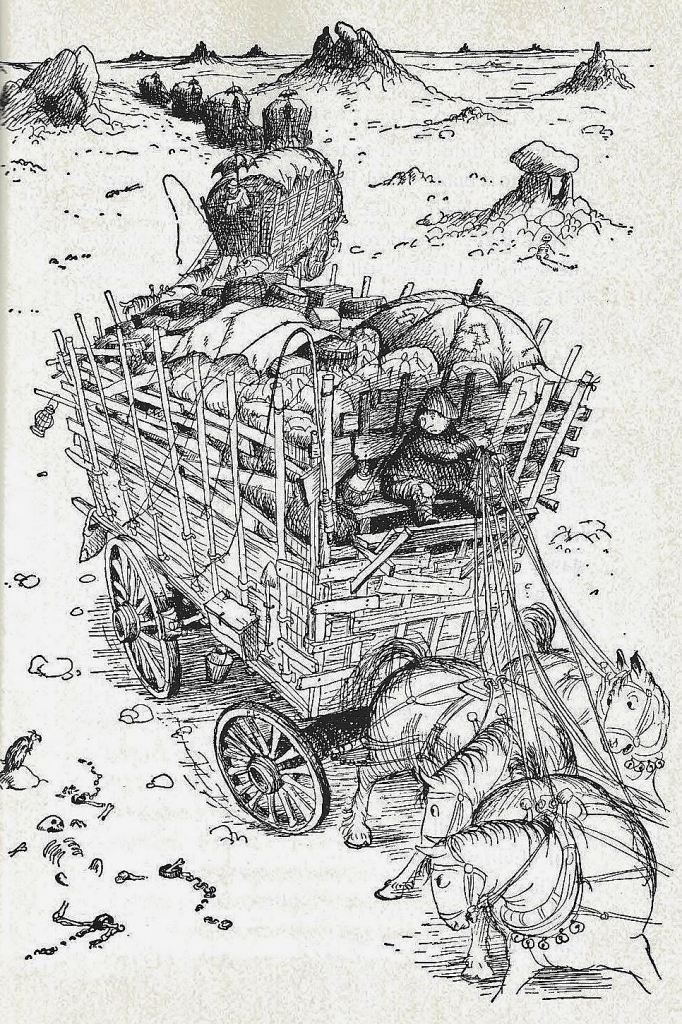
The illustrations by Garth Williams are absolutely perfect. Here is one of my favourites, of the journey to the Black Castle. Look carefully at the expressions on the horses’ faces, the fetters on the skeleton. Brrr! Danger lurks!

And here is Mamelouk, the Head Jailer’s wicked black half-Persian cat, whose favourite pasttime is spitting at the prisoners through the bars, and of course catching and tormenting any mouse who ventures into his dark domain.
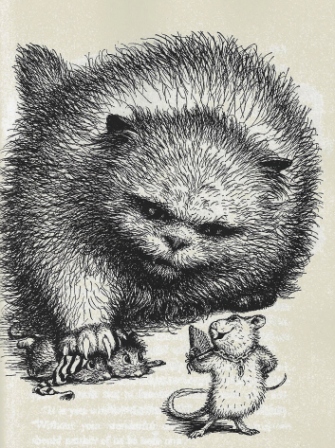
Miss Bianca proves herself more than a match for Mamelouk, utilizing her special bravado and charm. Needless to say, the mission is successfully accomplished, though not without setbacks.

A light, rather silly (in the best possible way), rather enjoyable story.

Miss Bianca is a very “feminine” character, in the most awfully stereotyped way possible, but there are enough little asides by the author that we can see that this is not a reccomendation for behaviour to be copied but rather a portrait of a personality who uses the resources at hand (her charm, her beauty, her effect on others) to get things done.

Bernard is typical yeoman stock, earnest striving and quiet bravery in the face of adversity. He is attracted to Miss Bianca as dull and dusty moth to blazing flame, but quietly accepts that their places in the world are too far apart to ever allow him the audacity to woo her. Or possibly not…

Nils galumphs through the story in his sea boots, “Up the Norwegians!” his Viking cry. A reluctant (or, more appropriately, unwitting) hero, who has had his adventure thrust upon him, Nils typifies dauntless.

Read-Alone: I’m thinking 8 and up. Margery Sharp has written a children’s tale with completely “adult” language and references; a competent young reader will find this challenging but rewarding. Be prepared to clarify occasionally, if your reader is of an inquiring mind. (Hint: Better bone up on Lloyd’s Register of Shipping.)

Read-Aloud: I think this would be a very good read-aloud. Ages 6 and up. Reasonably fast-paced. The first few chapters set the scene and may be a bit slow going, and the dialogue will require careful reading; you’ll need to pay attention while performing this one – no easy ride for the reader! – but I think it could be a lot of fun.

Definitely worth a look. If this is a hit, there are eight more stories in the series. I have previously reviewed the second title here:    Miss Bianca
Read Full Post »

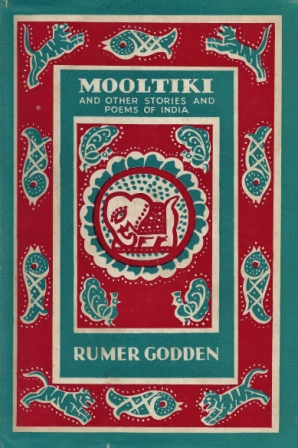
Mooltiki and Other Stories and Poems of India by Rumer Godden ~ 1957.    This edition: Macmillan & Co., 1957. Hardcover. 136 pages.

My rating: 7/10. Rather uneven collection of fair to excellent stories and mostly merely fair poems.

A slender volume of poems and short stories set in India.

BENGAL

  • Bengal River a poem
Nothing can mollify the sky,
the river knows
only its weight and solitude, and heat, sun-tempered cold,
and emptiness and birds; a boat; trees; fine white sand,
and deltas of cool mud; porpoises; crocodiles;
and rafts of floating hyacinth; pools and water-whirls
and, nurtured in blue mussel shells, the sunset river pearls.
                                                                                                            … … …
  • Possession

The rice field lay farthest from the village, nearest the road. On all sides the plain unrolled in the sun with a pattern of white clouds, white pampas grass in autumn and white paddy birds, and glimpses of sky-reflecting water from the jheels or shallow pools. The sky met the horizon evenly all the way round in the flatness of the plain, an immense weight of sky above the little field, but the old peasant Dhandu did not look at the sky, he looked at his field; he did not know that it was little; to him it was the whole world. He would take his small son Narayan by the wrist and walk with him and say, ‘This field belonged to my grandfather and your great-grandfather; to my father and your grandfather; it is mine, it will be yours.’

But life-plans may go horribly awry; Dhandu’s does not follow its anticipated path; in an ironic ending, which I somehow found reminiscent of W.W. Jacob’s The Monkey’s Paw, the field stays with Dhandu but is forever lost to his son.

  • Sister Malone and the Obstinate Man

Sister Malone is a nun in charge of a charity hospital in Calcutta; she is unshaken by the horrible sufferings all around her and does great good with her nursing abilities, but her continual effort to share her religious faith with those she heals goes unheeded. One day Sister Malone meets a man who has truly put all of his trust in God, but she cannot reconcile this with her own conception of what faith should be.

  • The Oyster

Gopal, a Bhramini Hindu student who has travelled abroad to study in England, visits Paris with a friend and is forced to examine the role of compromise in the formation of his own developing character.

HIMALAYAN NOMADS

  • The Goat PeoplePastoral Poems

Nine poems inspired by the nomadic peoples of the Himalayas of Northern India.

The tribes pass all through the spring, pitching their camp at night and lighting their fires under a boulder, a fir tree, or by an ice stream; moving on again at dawn, driving with a peculiar trembling whistle that is their own, something between a hawk’s cry and a flute, harsh, sweet and wild…

… I have tried to make these poems like the people, rough and rhythmical … without symbolism or image, simple and pastoral.

The Meadow

The Caravan

Flowers for the Animals 

The Elders

The Goat Women

The Animals

The Goat Children

The Goat Baby

Moving Downwards

  • Red Doe

A vignette of a young nomad riding up the mountain to fetch his unseen new wife. Sensitive and poignant.

  • The Little Black Ram

An orphan boy, Jassoof,

… a young thief, a bully, noisy, quarrelsome and turbulent, against everyone with everyone against him…

finds his place in the world through his care of a black ram lamb.

KASHMIR

  • The Wild Duck

Another vignette piece, about a young Kashmiri hunter, Khaliq, who, longing for winter to be over, thinks of his time the previous year among the high  mountains hunting ibex.

  • Two Sonnets

Just that; two sonnets. A regretful ode to winter; a joyful ode to spring.

Kashmiri Winter

Spring Sonnet

JUNGLE

  • Mooltiki

This first-person short story (24 pages)  is the jewel of this slight collection. Rumer Godden tells of her experiences in her sister and brother-in-law’s winter camp on the borders of Bhutan. Mooltiki, a small, opinionated elephant, is the “maid-of-all-work” of the camp, fetching firewood and providing transport for odd jobs, such as Rumer Godden’s small jungle explorations. Godden writes an amusing and appreciative ode to Mooltiki and her elephant kin, as well as an extremely evocative description of what if feels like to be involved as an observor in several “blinds” for problem tiger kills.

*****

Mooltiki is an interesting though quite slight collection of fictional short stories (except for the autobiographical title piece, decidedly the best part of the collection) and personal poems; after reading it through several times I must confess that my conclusion is that Godden was a much stronger writer of prose than of poetry!

Nicely done overall, with Godden’s trademark of strong, eloquent characterizations and descriptions of place. Definitely a work any Rumer Godden collector will want to have on the shelf; probably worth a purchase for Mooltiki alone, if it can be found for a reasonable sum.

The biggest fault is the shortness of the book; about an hour`s worth of reading, even if taking one`s time and savouring the beautifully nuanced style of most of the pieces. I thought the poems were the weakest point; some of the stories were excellent (Mooltiki, Red Doe, The Little Black Ram, and possibly Possession, stood out for me), while the others are merely good.

Recommended, with those reservations.

Read Full Post »

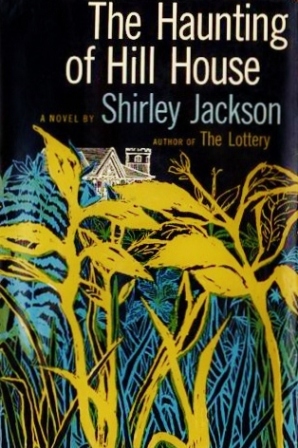
The Haunting of Hill House by Shirley Jackson ~ 1959Alternative title: The Haunting. This edition: Penguin, 1999. Softcover. ISBN: 0-14-028743-4. 246 pages.

1st edition dust jacket

My rating: 8/10.

*****

Oh, brrr! I do not like ghost stories as a general rule, or anything in the horror-supernatural genre. However, I do very much like American novelist and short story writer Shirley Jackson, whose works varied from the gently ironic domestic comedy of Life Among the Savages to this read-with-the-lights-on horror story, which I finally braved up enough to read after picking it up and setting it down numerous times over the years.

The Haunting is the story of an “evil” house, a “not sane” house, which exerts a malign influence over those unfortunate enough to enter through one of its many doors.

“No live organism can continue for long to exist sanely under conditions of absolute reality; even larks and katydids are supposed, by some, to dream. Hill House, not sane, stood by itself against its hills, holding darkness within; it had stood so for eighty years and might stand for eighty more. Within, walls continued upright, bricks met neatly, floors were firm, and doors were sensibly shut; silence lay steadily against the wood and stone of Hill House, and whatever walked there, walked alone.”

Four disparate personalities invade Hill House’s solitude with a view to discovering its secrets. Dr. John Montague is a doctor of philosophy and anthropology with an interest in “the analysis of supernatural manifestations.” He has sought out a “haunted” house, and hopes to observe at first hand the cause and effect of the psychic disturbances within it, with the aid of several lay-people he has recruited on the basis of their previous supernatural experiences.

Dr. Montague plans to spend several months in residence at Hill House with artistic and mysterious Theodora, and lonely and troubled Eleanor Vance, both of whom who have shown psychically sensitive traits.  Theodora appears to have a form of extra-sensory perception, while Eleanor was at the center of a poltergeist occurrence in her childhood.

Joining the party are Luke Sanderson, nephew of the owner of Hill House, and its prospective inheritor. Also present, during the daylight hours only, are an uncouth and sinister married couple, the Dudleys, local caretakers of the estate. The visit of the doctor’s amateur-spiritualist wife and her blustering male companion adds an element of comic relief which brings the horrific elements of the tale into even sharper focus.

What happens to this group of people in the “not sane” environs of Hill House I will leave you to discover for yourself. I must say that it is one of the creepiest stories I have had the dubious pleasure of enjoying, and enjoy it I certainly did, to my reluctant surprise.

The Haunting is a beautifully presented and rather unusual piece of writing. The story is told mainly from the point of view of Eleanor, who has grasped the opportunity to participate in Dr. Montague’s project as a way to escape her desperately unhappy everyday life. Eleanor and Hill House respond to each other in an unexpected and ultimately tragic way; the story’s ending is artistically satisfying and emotionally haunting.

There’s a lot going on in this story, and you’ll find yourself working through it in your mind long after the last page is turned.

I would highly recommend this to older teens and adults. Best read in the daylight hours, and preferably not when all alone in a country house far from neighbours!

Read Full Post »

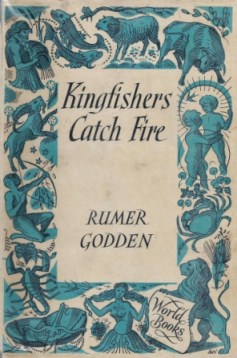
Kingfishers Catch Fire by Rumer Godden ~ 1953. This edition: Reprint Society, 1955. Hardcover. 280 pages.

My rating: 8.5/10.

*****

As kingfishers catch fire, dragonflies draw flame;
As tumbled over rim in roundy wells
Stones ring; like each tucked string tells, each hung bell’s
Bow swung finds tongue to fling out broad its name;
Deals out that being indoors each one dwells;
Selves – goes itself; myself it speaks and spells,
Crying What I do is me: for that I came.


These lines by Gerard Manley Hopkins head the prologue of this disturbing and haunting story.

This vintage Godden novel was new to me. I recently read the first volume of Godden’s autobiography, A Time to Dance, No Time to Weep, and was intrigued by the account of Godden’s three years in retreat in the Kashmir hill country, initially with only her two young daughters and later joined by several other women and children. Kingfishers Catch Fire was inspired by this time, and though the author states that this novel is not autobiographical, many of the incidents are those that Godden herself experienced, living in the actual house Dilkusha, in the Kashmir hills, operating a herb farm and employing the local people in the enterprise.

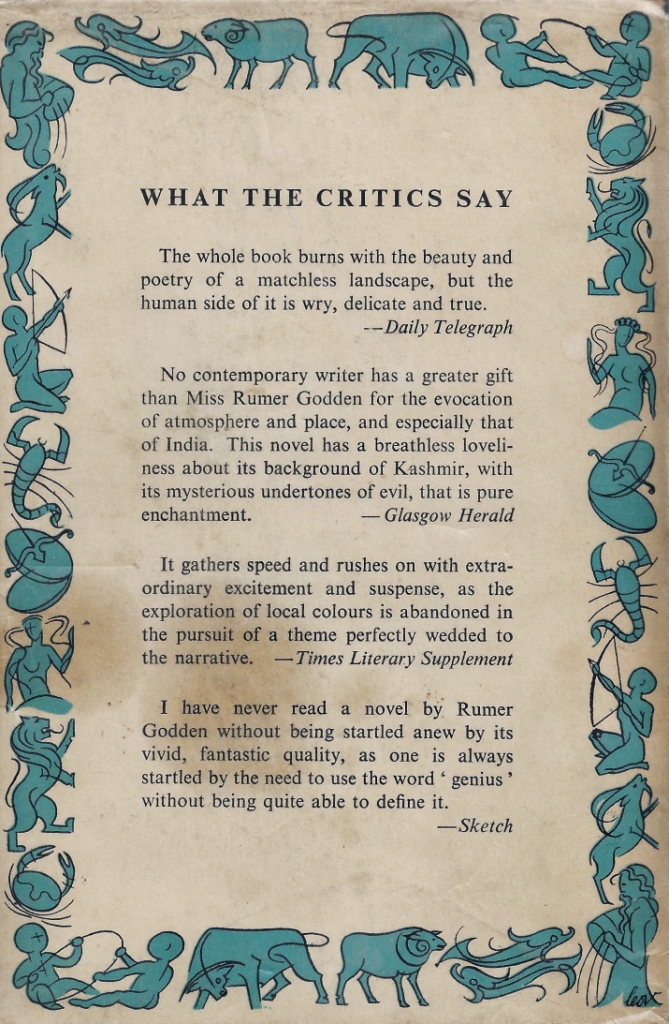
In one of those satisfying occurrences of bookish serendipity, soon after I expressed a desire to find this novel, it came to me all by itself, and in the form I most enjoy – an older hardcover, in its original dust jacket. I had casually ducked into the Salvation Army store to give the book section a quick scan, and had cherry-picked a Rohinton Mistry paperpack (Tales from Firozsha Baag) out from among the mix of ex-bestsellers and inspirational religious books that fill the racks in this particular location. I was turning away to leave when something turquoise-blue and white caught my eye – a promising “older book” dust jacket peeking out from behind the fat paperbacks.  My pulse quickened; after many years of second-hand book searching one seems to develop a sixth sense of when a find is at hand, and this time I was more than right – not only a good book, but  the particular book recently on my mind. I gently pulled it out from the shelf, and there it was, in its gorgeous World Books (Reprint Society) zodiac-themed jacket. About as perfect as it gets!

The story is typical Rumer Godden fare. An Englishwoman living in India (Sophie Barrington-Ward, long separated from her husband and recently widowed) gets herself into an impossible situation, behaves badly, finds redemption and emerges changed for the better; all of the action witnessed and brought into critical focus through the eyes of a child, in this case the Sophie’s young daughter, 8-year-old Teresa. Like a stone thrown into still water, the ripples of each action spread far and touch things on all sides, with unintended and often tragic consequences.

When news of her husband’s death reaches her, Sophie and her two young children are living on a houseboat on the lake at Rawalpindi in the Kashmir region of what would be present-day Pakistan. At first she is conventionally sad but not particularly upset; after all, she has a comfortable private income and her widow’s pension will be coming now as well. She has made a rather unique life for herself where she is, rejecting the British-European social life of the region and instead fraternizing almost exclusively with the locals – the picturesque boatmen, vendors and shopkeepers –  who see in Sophie a well-off patroness who spends generously and lives exclusively to please herself.

Sophie soon finds out that her husband has left huge debts; she manages to settle these but is left impoverished. Rather than returning to England in what she sees as defeat, Sophie ekes out an existence teaching “English to Hindu and Mohammedan ladies and Urdu to English people”.  As the bitter winter goes on, Sophie falls ill and is taken in by the local Mission hospital. When she recovers, she decides to simplify her life even further, to “live local” as a peasant (better a “peasant” than a “poor white”, she tells herself), and moves into a tiny house farther up the mountain.

Sophie’s idea of living like a peasant clashes with the reality of the local population, who are truly poor. Her continual blunders lead to a tragic incident that brings her “simple life” dream crashing down. Her daughter Teresa is a hapless witness to Sophie’s decline into chaos, and is a key player in the climactic ending of the story.

Sophie does wake up from her dream; she does confront her weaknesses; she does at least begin to change, and by the end of the story we have come to view her with a certain admiration if not with whole-hearted affection. Sophie’s initial emotional neglect of Teresa and her younger brother Thomas (“Moo”) is a key factor in making her such an unlikeable protagonist; she is an egotistical reverse-snob who makes snap judgments based on what she’d wish people’s personalities to be, and she sticks firmly to those opinions, even while being repeatedly shown how wrong they are. Sophie’s progression from that person to someone much more unsure of herself is the real drama of the novel.

For a while near the end of the story I thought I was going to be disappointed in my author – it was all coming out a bit too pat – a white knight who has been lurking in the background the whole book reappears to “rescue” Sophie just as she is sorting things out for herself, and Sophie falls into his arms with relief, but Godden ultimately allows Sophie (and Teresa) to walk out of the book with head held high.

An ultimately satisfying story, though not what I would consider a comfort read; the windows it opens into human foolishness and frailty strike close to home, and we are very aware throughout that there is no such thing as a universally happy ending; the most any of us can hope for is reaching some sort of compromise with life, if we are indeed one of the lucky ones.

As always, beautiful descriptions of place; Rumer Godden paints word pictures like no other. The children, Teresa and Moo, are very sympathetically handled; Godden is ever firmly on the side of innocence, though she never hesitates to let her innocents suffer in the interest of moving the narrative along.

This is, in my opinion, one of Godden’s better novels.

Read Full Post »

« Newer Posts