Archive for the ‘1950s’ Category

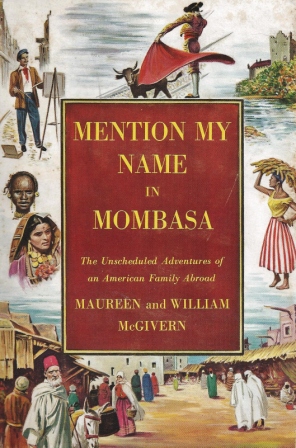
Mention My Name in Mombasa: The Unscheduled Adventures of an American Family Abroad by Maureen Daly McGivern & William McGivern ~ 1958. This edition: Dodd, Mead & Co., 1958. First Edition. Hardcover. 312 pages.

My rating: 7/10.

*****

This is a most interesting read; a travel memoir with a very 1950s’ feel – not surprising, seeing as it is a 1950s’ book! I enjoyed it.

The authors were literary figures of their time, and the travels herein described were, it seems from a few comments here and there, both to fulfill a personal desire for wanderlust and to collect material for future books, including this one.

If the name Maureen Daly rings a bell, it is most likely because of her extremely successful young adult novel, Seventeenth Summer, written when the author was herself just seventeen, and published in 1942. Some years later we find Maureen married to fellow writer William McGivern, a successful writer of crime-mystery novels (The Big Heat, Rogue Cop, war novel Soldiers of ’44, and almost 20 more) and film and television scriptwriter (Kojak, Adam-12, and Ben Casey, among others). They had their two children along, 6-year-old Megan and 2-year-old Patrick, when they left New York on New Year’s Eve to travel to Paris, the start of their extended travels.

Long, detailed and quite enthralling chapters describe the scenery, culture and especially the unique individuals the McGiverns came into contact with. The tone is a mixture of worldly-wise (but never condescending), travel guide (but merely to lay out the scene), and very 1950s’ American superiority (but innocent of bluster so therefore non-jarring – at least for the most part). The McGiverns were very eager to give credit where it was due regarding the superior aspects of their temporary homes and tourist destinations, which included Paris, and then a stay in the tiny fishing village of Torremolinos near Málaga, Spain, just on the verge of its discovery and development as a winter-tourist hotspot.

Then come several chapters on Spanish bullfighting, bullfighters and the ranches which raise and train the bulls. The tone here is journalistically non-judgemental much of the time; I never did get a grasp of whether the McGiverns were fully behind the “sport”, though from the farcical descriptions of a number of stereotypical bullfight aficionados which graces one of the chapters, I suspect they had marginally more sympathy for the bovine members of that elite yet widely populist pastime.

Next is a short visit (and hence a short chapter) in Gibraltar, where the McGiverns are rather disappointed in the elusiveness of the famous apes. On to Iceland, and a very travel-guide chapter this is, with loads of facts thrown at the reader, interspersed with short vignettes of some of the US Army families living on the vast NATO air base, and native Icelanders who opened their homes to our travellers.

Then comes the most memorable chapter of the book. During World War II, William had served as a US Army gunner in the European campaign, and his platoon had ended up entrenched on the mountainside near the tiny Belgian village of Fraipont, where the local people showed such generosity and warmth to their American allies that William had long planned to return in more peaceful times. Just over ten years later that sentimental visit took place, with the villagers overjoyed to recognize William and welcome his family. A poignant reminder that the war was not all that far in the past when this pilgrimage took place.

Back to Spain, and then a four-day voyage to the Canary Islands, a visit which seems not to have quite met the high expectations of the romance of the name. On to Morocco, where the McGiverns have several pleasant surprises regarding the locals, and then to Nigeria, on the cusp of independence as a full member of the British Commonwealth, after decades of colonial occupation.

A safari to Abadjan on the Ivory Coast and then to Fort Lamy in Chad doesn’t quite go as expected, but there are compensations in the people who the McGiverns meet as they wait for their travel visas to gain approval from the local bureaucracy. This does not happen, so back to Spain, through France, Belgium, and over to Ireland, where the Daly family is waiting to welcome their wayward relative and her family for an extended visit. Several months in Dublin follow, and then the trip is wound up, with a return to New York over a year after the original departure.

In this book there is a strong sense of how good it is to be an American at this point in history, and how welcome the traveller from the U.S.A. both feels and is made to feel; the McGiverns travel in their French-bought Citroën plastered with American flags fore and aft, and seldom seem to meet with a cold shoulder. Quite a change in the ensuing fifty years!

This is a fine book, and a literary time capsule of the post-war era, before things started to go wrong for the U.S.A., politically speaking.

I suspect it may be hard to come by (I ordered mine for a rather large sum from an online rare book dealer, for the Maureen Daly connection) but if your library happens to have a copy hidden in the stacks, or if you chance upon it in a used book store, it is well worth delving into.

Read Full Post »

The Stars Grow Pale by Karl Bjarnhof ~ 1956. This edition: Penguin, 1960. Translated from the Danish by Naomi Walford. Paperback. 267 pages.

My rating: 7/10.

This early years autobiography left me curious as to the next stage in Bjarnhof’s life. The internet is curiously empty of much information about a man who became a celebrated member of Danish musical and intellectual society.

Desperately bleak in parts; often deeply moving.

*****

This is the story of a boy whose early years were filled with an array of tragic and challenging  issues, not the least of which is his growing blindness. Looking back on his childhood from many years in the future, the tone is stoic yet unsparing of the details of the situation and actions of Karl Bjarnhof’s family and childhood associates, and his own reactions and thoughts.

Karl, from his own self-description, was a stubborn and introspective child, occasionally impulsive, and often unable to explain his own actions or respond emotionally appropriately to the out-reaching of others. The deep love of his parents for their troubled child comes through clearly and poignantly, though Karl does not acknowledge those feelings in so many words in this account.

A gifted mathematician and musician from childhood, though these tendencies were initially dismissed, Karl went on in his adult life to gain international fame and respect as a cellist and organist, and later as a writer and radio broadcaster.

I can’t say I exactly “enjoyed” this autobiography. It immediately pulled me in and kept me enthralled, but it is a painful account to read, and it left me saddened, even knowing that Karl’s persistence in following his inner vision won through, and that he went on to lead a creative and fulfilling adult life. There is a certain understated humour to some of the anecdotes, but much of the book comes across as serious and unsmiling in tone. I suspect that some of the sparingly written vignettes will be etched in my memory for years to come.

Karl Bjarnhof was born in 1889, and died in 1980. His vision faded throughout his childhood and teen years; he became fully blind at the age of nineteen.

From the inner cover of this vintage 1960 Penguin edition:

Karl Bjarnhof in this brilliant autobiographical novel tells the story of a boy marked out from his fellows by the gradual onset of blindness.

The boy himself is not depressed, though other people may make him miserable: the boys in the yard will not play with him because he is too ‘stupid’ to see the ball; his mother nags at him for being ‘peculiar’; his schoolmaster punishes him for not being able to do the sums set on the blackboard. When eventually he is taken to an occulist he is told he has ‘eyes like a hawk’ because while he was waiting for his test he memorized the letters on the chart.

This story is devoid of self-pity or sentimentality. It gives a complete picture of a childhood in a small town in Denmark, with a gallery of unforgettable characters, both comic and pathetic. The book is profoundly moving, and deserves its outstanding success; the Danish book trade awarded the Golden Laurels (for the most outstanding book of the year) to Kark Bjarnhof in 1956 for The Stars Grow Pale; it has been published in nine countries, and was a Book Society Recommendation.

‘The book is a thing of beauty, of tenderness, and, at times, humour; which has, too, a strong adventurous streak.’ – Elizabeth Bowen in the Tatler

‘The sheer beauty of the writing … is exquisite …[The boy’s] world is completely his own, yet Mr. Bjarnhof, by his almost uncanny power of communication, puts the reader right into it.’ – Rumer Godden in the Bookman

From the back cover:

Karl Bjarnhof was born in 1898 in the small town of Vejle in Denmark. His family lived in very moderate circumstances and was hard put to provide proper medical assistance for the boy, who began to go blind at an early age. He has been totally blind for many years.

Bjarnhof’s musical talents and interests were manifest from the very beginning, and he developed into one of Denmark’s best violoncellists, although he no longer performs in public.

He is now known chiefly for his radio work as feature writer, music commentator and quizmaster, and above all for his exceptional talents as radio interviewer. He has been the editor of a Copenhagen newspaper, and has written several novels and numerous feature articles on a wide variety of subjects ranging from music, literature, art and the theatre to the state of the world in general.

The Good Light, published in 1960, continues Karl Bjarnhof’s story. Both books are readily available through ABE.

Though I personally found The Stars Grow Pale an interesting, and often compelling, read, I would hesitate to recommend it unless the reader is a serious collector of rather obscure autobiography, or has a previous interest in Bjarnhof’s early years. Well written, in a distinctive style – or at least well translated with clarity and artistic flair – it is nonetheless a work which may not appeal to the broadest range of readers.

Read Full Post »

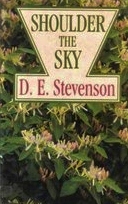
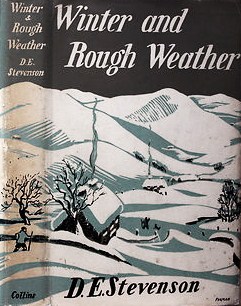
Shoulder the Sky: A Story of Winter in the Hills by D.E. Stevenson ~ 1951. Original British title: Winter and Rough Weather. This edition: Thorndike Press, 1992. Hardcover. Large Print. ISBN: 1-56054-343-4. 407 pages.

My rating: 8.5/10, for the majority of this story. I found myself very keen to get back to it and find out what was about to happen next, the most compelling of D.E. Stevenson’s books in this respect so far.

*****

A few years after the conclusion of the Second World War, a young, newly married couple, Rhoda and James Dering Johnstone, arrive at their isolated farmhouse near the fictional Scottish village of Mureth. Rhoda is an accomplished professional painter, and her husband worries, with some reason, as to how she will adjust to a life as a sheep farmer’s wife, far from the stimulating world she has happily abandoned for true love.

Rhoda drifts for a while, mulling over the dilemma of what she sees as a black and white choice between her perceived role as a wife versus personal fulfillment as an artist. The author handled this theme sensitively and sensibly, though I couldn’t help but think that childless Rhoda, overseeing a small house with the help of a live-in cook-general, had a luxury of a “domestic support system” impossible for those of us in a similar societal-economic position to attain today.

With her husband’s full support, Rhoda returns to the studio, and proceeds to paint a portrait which has far-reaching consequences among the local residents.

Add in several on again-off again love affairs, a missing wife, a bullying neighbour, a misunderstood child, and the challenges of winter storms in an isolated locale, and you have a quietly dramatic novel, and my favourite DES to date. There are two prequels/companions to this title: Vittoria Cottage and Music in the Hills, but Shoulder the Sky works well as a stand-alone; I never felt like I was out of the loop, though there were references to previous events throughout.

My only complaint is the ending seemed a bit rushed. Everything fell into place a little too neatly, and though things were obviously set up for happy resolution, too many plot strands were left hanging.  We were told that everything was now set to work out, so there were no real cliffhangers, but the novel’s abrupt ending felt very unfinished after some of the detail given earlier on. (This seems to be a common failing with most of the D.E. Stevenson books I’ve read to date.)

I greatly enjoyed this novel, aside from its minor but forgivable imperfections. The author has set it up beautifully, and the details she gives both of farm life and the art world appear to come either from personal experience or detailed research. I thought this particular novel was a relatively strong work for this “light romance” author, rather reminiscent of O. Douglas at her best.

Definitely recommended.

Oh! I must make one more comment. The edition I read was the Thorndike Press Large Print version, with a cover of lovely SPRINGTIME honeysuckle flowers. This story is decidedly wintry – a hugely important plot twist is centered on a winter storm, and the atmosphere throughout is shaped by the freezing weather. No mention of honeysuckle or springtime anywhere within – and I was watching for a clue. So a slap on the wrist to Thorndike’s design staff!

This cover is much more appropriate.

And now I must abandon my own cozy nook in the Prince George library, put on my winter jacket, and venture forth into our suddenly frozen world. It’s minus 10 (Celsius) out there and quickly getting colder; clear and crisp with a just-full moon shining on the newly fallen snow.

Grocery shopping, and the long drive home, and then a quiet day at home tomorrow, part of which will most likely be spent constructing the huge bonfire pile which has become a family All Hallows tradition. Or at least providing cocoa and other sustenance for the teens who’ve been plotting the construction of the pyre ever since last year’s spectacular display. (They’re running out of things to burn, having picked up sticks and collected scrap lumber so diligently in previous years that little remains anywhere within easy dragging distance. There was some mention of wanting a chainsaw and the use of a truck. We’ll see what happens. The weather forecast is dismal for October 31st – cold and snowy.)

There might even be a few Roman candles let off, which will shock the complacency of our own farm’s sheep – they definitely do not approve of such changes in routine, and generally wait out the human noisemaking in the shelter of their shed, gently baaing in ovine astonishment at all the fuss.

Happy Hallowe’en to those of you who celebrate it!  And to everyone at the mercy of the present widespread bitter weather, I wish you a respite from the storms, and a chance to catch your breath and regroup before winter sets in in earnest.

Read Full Post »

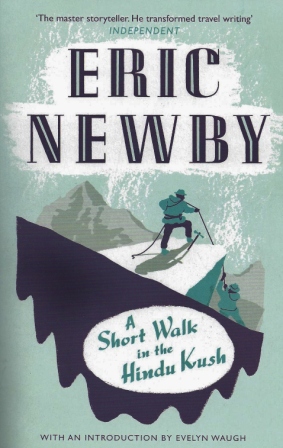
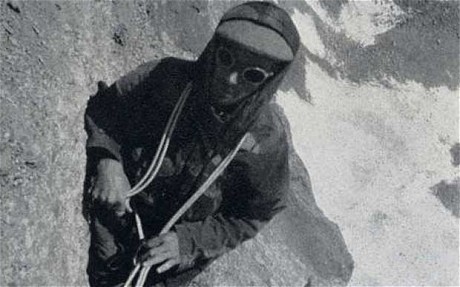
A Short Walk in the Hindu Kush by Eric Newby ~ 1958. This edition: Harper Collins, 2010. Introduction by Evelyn Waugh, Epilogue by Hugh Carless. Softcover. ISBN: 978-0-00-736775-7. 288 pages.

My rating: 8.5/10, after some inner debate. I have decided to overlook the more blatant “Eurocentric” passages, and to view this book as a product of its times, despite a vast change in standards of political correctness in the ensuing fifty-some years since its first publication. Very readable, in a dryly witty British way.

*****

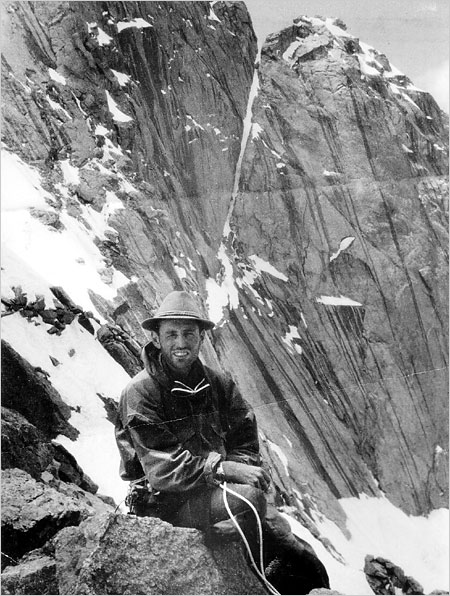
In 1956, 37-year-old Englishman Eric Newby, having received a publisher’s advance to write a travel book, contacted his friend, career diplomat Hugh Carless, and floated the idea of travelling to Afghanistan and trekking in the Hindu Kush mountains, an area where few Europeans had previously ventured. The two decided that the trek should have some definite aim, in part to enable them to request grants from various organizations to assist with expenses, so, without letting their lack of mountaineering experience stand in their way, they decided to focus on ascending 20,000 foot Mir Samir, which had not yet been climbed to its summit.

After a two-day crash course in basic alpine climbing at Snowdonia in Wales, the two felt they were marginally more prepared for the rigours ahead, and the trip was on. Each man brought a certain experience to the expedition.

Newby, though having spent the previous ten years working in his family’s ladies’ fashion business, had strong credentials as an outdoorsman. At the tender age of 19, he had spent time on a four-masted Finnish sailing ship, voyaging from Australia to Europe via Cape Horn, and his eventual book about this experience, The Last Grain Race, was responsible for the publisher’s advance which initiated the Hindu Kush journey. With the start of World War II, Newby served in the famous Black Watch regiment, and was involved in the Special Boat Section, making lightning commando raids on enemy airfields and the like. One of these expeditions went awry, and Newby was captured off Sicily and interned for the rest of the war, barring a brief period of freedom in the Italian mountains, where he met his future wife, a Slovenian village girl, Wanda, who aided him in an escape attempt. This period was also written about, in Love and War in the Apennines, published in North America as When the Snow Comes, They Will Take You Away. (I am currently reading this memoir, and it is fascinating, and helps put Eric Newby the Hindu Kush “explorer” into context.) Wanda wrote her own memoir, Peace and War: Growing Up in Fascist Italy, in 1992. Always strongly and competently athletic, and with a strong sense of humour and a forthright readiness to embrace new experiences, Newby’s intent to venture into the forbidding mountains of a somewhat hostile Afghanistan is more understandable than it appears from his account of the initial decision in A Short Walk, where it appears to be merely a whim of the moment.

Hugh Carless himself, while on one of his official postings in Kabul, had previous experience in the area, and it was his accounts of trekking in the region with Tajik guides which got Newby thinking about the possibilities of a more ambitious expedition. The 31-year-old Carless brought knowledge of local languages and on-the-ground diplomacy to the partnership, as well as a strong inclination to adventure which more than matched Eric Newby’s.

The entire adventure, the “short walk”, lasted only a month, but what a marathon that month was. The book details the trials and tribulations, as well as the rewards, of the journey first to Afghanistan, and then, after engaging local guides, into the mountains. Mir Samir was reached, and the climb attempted, but both Newby and Carless were so weakened by continual dysentery and altitude sickness that they were forced to turn back a mere 700 feet from the summit. (A German party of experienced climbers was the first to reach the summit, only three years later, in 1959.)

After descending Mir Samir, bloodied and bruised, the trekkers continued around the foot of the mountain, as Newby and Carless thought they would like to see it from the “other side”, which entailed the party entering the neighbouring province of Nuristan, to the trepidation of their guides; regional rivalries were intense and deadly, and there was a very real danger of violence to trespassers.

A safe return was made, and the two men were thereby provided with anecdotes for a lifelong series of dinner parties, not to mention a whole book. The guides returned to their normal lives, grateful, one would assume, that the whole darned thing was so quickly over.

Much is made of Newby’s playful, ironic tone in this book, and while I did appreciate the bantering tone, as it made for an enjoyable reading experience on a purely diversionary level, I did continually keep thinking to myself, “Why?” Why risk life and limb, not only of themselves but of their guides, on such a pointless journey? Because it was “there”? That does seem to be the chief motivation set forth in the book, and I am not sure whether learning from the afterword by Hugh Carless, special to the 50th anniversary edition of A Short Walk, that the trip was contrived at least partly in order to have an experience to write a book about, that I am any happier with that reasoning. I suppose it is no different from the contemporary trips in search of material by the likes of Michael Palin and Bill Bryson, and even the revered Paul Theroux. We do tend to love a good traveller’s tale, whether we are fellow adventurers or merely armchair voyeurs.

A Short Walk in the Hindu Kush is often referred to as the book that started that successful genre, but I must differ on that point, as the traveller’s tale form stretches back in popularity to pre-history. Think of The Odyssey, and the Nordic journey tales, and Marco Polo, and the countless accounts since then. This book is a worthy successor of its historical ancestors, but it very much walks in the shadow of what came before, versus branching out in any significant way.

Newby and Carless ultimately come across as being a wee bit arrogant (okay, in Carless’ case, hugely arrogant), with their snide comments on the personal habits of the natives of the area. To balance this they do poke continual fun at themselves, and there are numerous appreciative comments regarding the region and the people, so perhaps it is merely a case of the author being more honest than most in that he records his negative thoughts, rather than submerging them in the interests of political correctness as more modern writers have been trained to do. Whatever my criticism, the fact remains that these two men ventured where few others dared, and, in the face of overwhelming discomfort and very real danger, pushed forward to pursue their stated goals, with a great degree of success.

To sum up, I quite enjoyed reading this book, am eager to read more of Newby’s work, and would happily recommend A Short Walk to others, with the note that it represents the attitudes of the time it was written, and may jar the sensibilities of a more tactful and possibly better educated (in a worldly aware sense) time.

Read Full Post »

Adventures of a Botanist’s Wife by Eleanor Bor ~ 1952. This edition: Hurst & Blackett Ltd, 1952. First edition. Inscribed by the author. Hardcover. 204 pages.

My rating: 5.5/10. Not a poor book, exactly, but not what I had hoped for, hence the low rating.

*****

A rare disappointment, this book. It had all the hallmarks of a find: rich red and gold vintage hardcover binding, gorgeous maps on front and rear end papers, photographs and line drawings by the author throughout, and an extremely promising first paragraph:

When I married, in 1931, a member of the Indian Forest Service I brought with me as a dowry two table-cloths and a bull terrier. Apart from these possessions I was a portionless bride. As his own contribution, the bridegroom brought with him a large number of books, a torn pink cotton curtain and two spaniels. Also a trouser press used for pressing botanical specimens. And some camp equipment.

How could one resist?

I had hoped for a fairly detailed account of the author’s travels with her husband through the Himalayan foothills, with lots of descriptions of the flora of the region. “Botanist’s Wife”, right? While Eleanor was obviously aware of the natural beauties of the region, she seldom describes the flora in the kind of detail I was hoping for – “a meadow of primula and gentians” is about as much as she ever says, except for a quite detailed description of a Sapria species, a type of carrion-scented flower, which was once used to decorate her bedroom by her native servants, in the mistaken belief that she and her husband, famed Irish-born botanist Norman Loftus Bor, would find it delightful – Norman had raved over a prime specimen earlier in the trip, but the foetid odour of the bloom was not at all pleasant in close quarters!

This “autobiography” does not go into much detail of the sort that makes such accounts so potentially vivid and interesting. It is something of an arm’s length travelogue, with Eleanor often commenting a bit distastefully on the hygiene (or lack thereof) of the natives of the area she happens to be passing through. To be fair, she also comments on their favorable aspects, but it is a very much “we” and “them” account.

Where she unbends the most, and where we see glimpses of her true passion, is when she talks about her beloved pet dogs – a bull terrier and several spaniels – which travelled with her, occasionally on horseback, and required an inordinate amount of special arrangement to feed and care for in a region known for its high incidence of rabies, as well as various toxic plants, predatory animals, and various nasty insects and internal parasites. Having no children, it would appear that Eleanor’s maternal affection was lavished on her pets.

This short memoir’s greatest value is that it is something of an intriguing – albeit limited – picture of the wilderness areas of northern India and southern Tibet in the time between the wars, and into the World War II years, when Norman left the forest service and was engaged in some sort of secret war work which we are never enlightened on.

I found that I had a difficult time fully engaging with the narrative. The writing is quite stilted, and throughout there are numerous very promising beginnings of anecdotes which are left hanging with no resolution or conclusion, resulting in my frequently paging back to see if I’d missed something. I never had – it just wasn’t there.

I suspect the reality of Eleanor’s life was much more interesting and varied than she was able to communicate in this book. She appears to have an excellent relationship with her husband, and numerous long-enduring friends throughout the region of her Indian travels and, indeed, throughout the world. There is a picture of the author standing next to Jon Godden (novelist Rumer Godden’s sister) and two of the “seven kings of Rupa” which is never referred to in the text, though the seven kings themselves are discussed. Was Eleanor a friend of Godden’s, or is this merely a “tourist snapshot”?

Eleanor very wanted to be a published author; she relates that she was continually writing, but hesitated to describe herself as a writer to acquaintances because she had not had anything published.

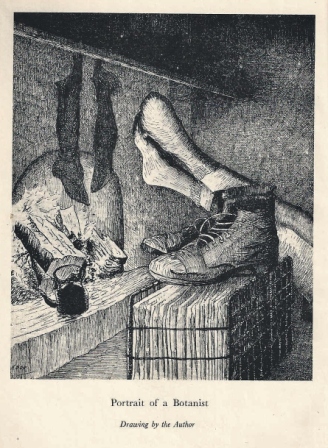
She was also a striving amateur artist; her drawings, six of which are reproduced, are capable but not particularly “good” – they look like the work of a hard-working, conscientious student – much care is taken with detail and cross-hatching, but something is a little off in perspective; they look somehow a bit lifeless.  The lovely end paper maps were drawn and illustrated by Ley Kenyon; Eleanor’s painstakingly stiff drawings suffer by the comparison.

The best and to me the most appealing of Eleanor’s efforts is this illustration used in the book’s frontispiece; it made me smile and soften somewhat in my criticism toward’s her authorial failings. She tried hard and did the best she could. And as this book shows, she did succeed in her quest for publication.

Would I recommend this book?

No, I don’t think I would, unless the reader is specifically interested in the ethnic groups and fast-changing lifestyles of the people of the area during the 1930s and 1940s. The author’s perspective might be a good addition to more detailed observations.

As an autobiography, it is not one of the better memoirs I have read, though I must repeat that it is not a “bad” book; it’s just that I had hoped for so much more. I will likely keep it for its curiousity value, to slip in beside E.H. Wilson’s Naturalist in Western China as an addendum of sorts to his vastly superior work written earlier in the century.

Read Full Post »

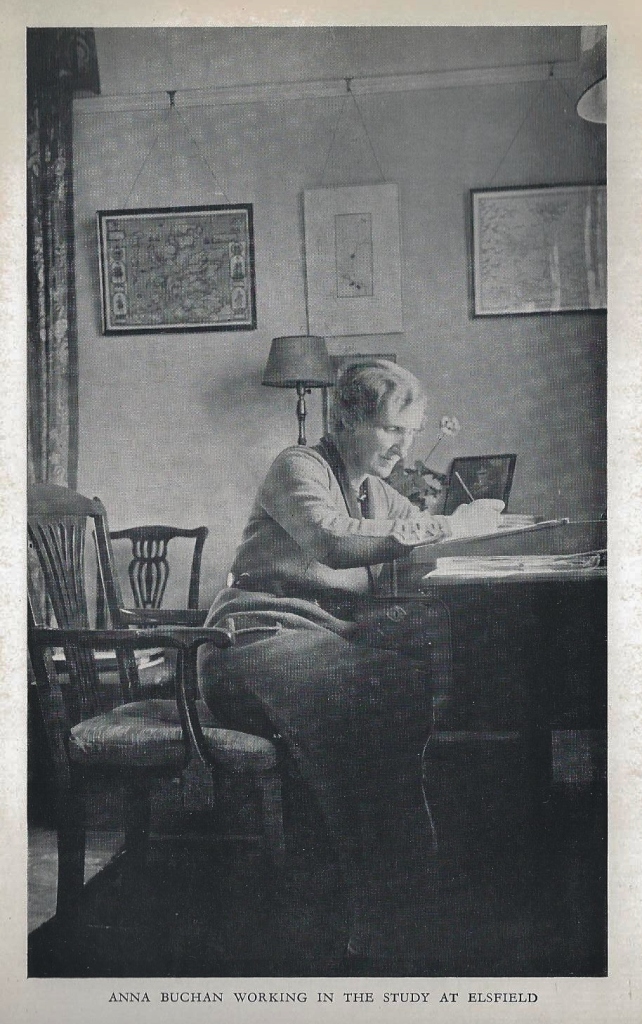
Farewell to Priorsford: a book by and about Anna Buchan (O. Douglas) ~ 1950. This edition: Hodder and Stoughton, 1950. Hardcover. With 5 photographs. 253 pages.

My rating: 10/10. Succeeds perfectly in its stated purpose, as noted in the Preface:

This book has been compiled at the request of the many who wish to know more about Anna Buchan by those privileged to enjoy her friendship.

This commemorative volume is presented in the hope that it will give to all who enjoy Anna Buchan’s books a share in the fun, the courage and the inspiration she gave to all who knew her.

*****

This book was published two years after Anna Buchan’s death, and is composed of several short biographical sketches, with the remainder a few collected short stories and anecdotes. There is also the fragment of the last novel Anna was working on, eight chapters of another Rutherfurd book, The Wintry Years.

This is a fascinating and enlightening glimpse into the world of this quiet yet eloquent author, and there are no surprises here for those who know the author through her fictional words, merely a confirmation of what we had hoped to find; that the author’s writings do indeed reflect her real life and her views that many people are indeed “good, gentle and scrupulous.” If this sounds too meek and wishy-washy, I hasten to add that Anna had a strong streak of cynical Scottish clear-headedness about her as well, and there is a leavening of wry humour and keen insight in her works to balance the goodness and gentleness.

The more I read of this author, the more I like her, both her works and the person she herself must have been. Farewell to Priorsford is a lovely memorial, and very much worth seeking out for O. Douglas fans. The eight chapters of The Wintry Years are an absolute treat to fans of the Rutherfurds, giving us a fleeting glimpse of their lives during the years of the second World War, and touching on many of the characters we came to know so well in The Proper Place, The Day of Small Things, and Jane’s Parlour, as well as teasingly introducing us to some new characters. Such a shame that Anna Buchan died so relatively young, at 71, and still very much at the peak of her writing years.

Here is what Farewell to Priorsford contains:

ANNA BUCHAN OF PRIORSFORD
 
I. A Biographical Introduction by A.G. Reekie
II. Anna by Susan Tweedsmuir
III. Olivia by Alice Fairfax-Lucy
IV. Author and Friend by Christine Orr
V. A Peebles Player by William Crichton
 
 
STORIES BY ANNA BUCHAN
 
I. Introductory Note
II. A Story for Young and Old:
          Jock the Piper
III. Broughton and Two Broughton Stories:
          An Upland Village
          An Echo
          Miss Bethia at the Manse
IV. Two Long Stories:
          A Tea-Party at Eastkirk
          Two Pretty Men
V. The First Eight Chapters of a Novel:
          The Wintry Years
 

*****

Highly recommended for O. Douglas – Anna Buchan fans.

Read Full Post »

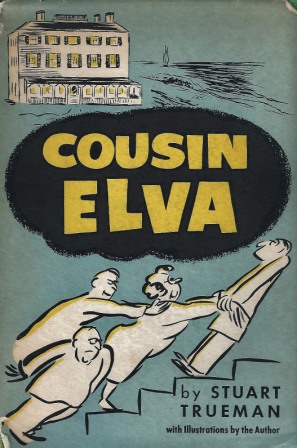
Cousin Elva by Stuart Trueman ~ 1955. This edition: McClelland and Stewart, 1955. First edition. Hardcover. 224 pages.

My rating: This is tough. I almost was going to say un-rateable, but on second thoughts I will give it maybe a 5.5/10. It’s a first book, and the author went on to write many more. There’s nothing really wrong with it, and I did read it with mild enjoyment, but I found it very easy to put down and I had to consciously pick it up and finish it. Probably a keeper, but on the bottom shelf or exiled to the “B”-reads boxes, I’m thinking.

*****

Cousin Elva is a humourous, satirical light novel about a fictional couple, Penelope and Frank Trimble, who purchase a large house in the (also fictional?) community of Quisbis on the Bay of Fundy, and proceed to open a boarding house – “Mr. and Mrs. Trimble’s Tourist Rest Haven”. The only catch is that the house comes with a pre-existing resident, Miss Elva Thwaite, granddaughter of the original owner.

Miss Thwaite, or “Cousin” Elva as she insists on being called, is a blatantly eccentric, sixty-ish,”old maid” who refuses to be put on the shelf, taking an active interest in everyone and everything that crosses her path. She’s also keen to catch herself a man. Hi-jinks ensue as a motley assortment of visitors to Trimble’s Rest Haven fall into Cousin Elva’s clutches.

The humour is, at its best, rather understated and wry, but too often over-the-top farcical. I did enjoy the many regional and Canadian references; those did much to keep me reading when I occasionally got overloaded with the slapstick action.

A well-meaning attempt by an author new to me. The kind of book you perhaps enjoy best when scanning the meagerly stocked shelves at an isolated lakeside cabin in summer. In other words, welcome if you’re fairly desperate for amusement and it’s too far to go to town…

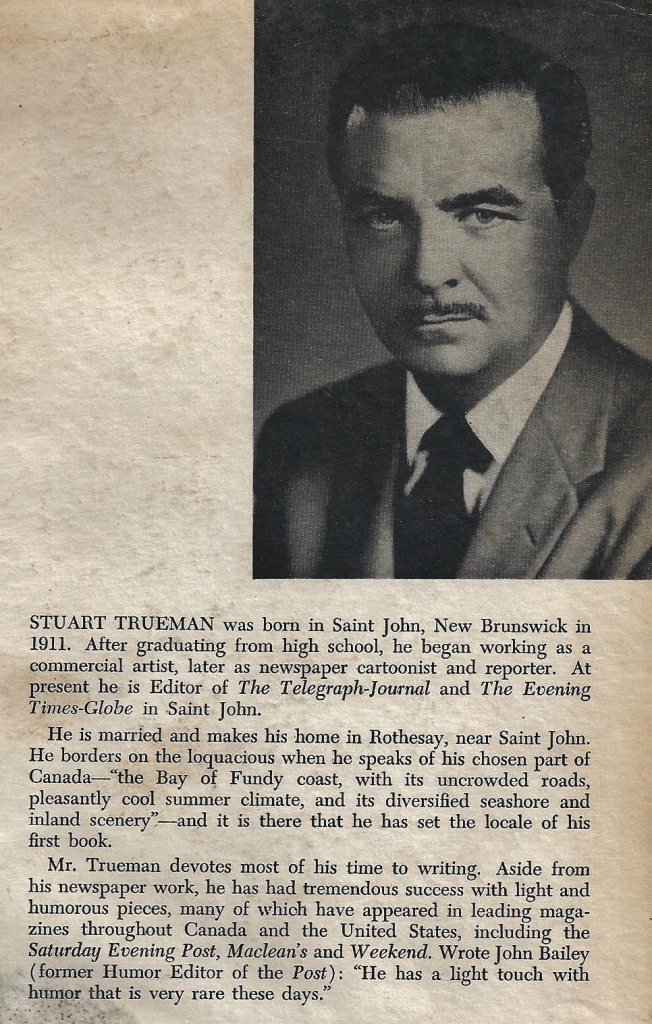
Stuart Trueman (1911-1995) was a Canadian writer from New Brunswick. He won the Steven Leacock Memorial Medal for Humour in 1969. I had never heard of him before picking up this book, but as you can see from his biography he had a long and prolific writing career. I would definitely be interested in reading some of his other work, but only if it was easily obtainable; I don’t think I’d go to a lot of effort to seek it out.

From the New Brunswick Literary Encyclopedia:

Stuart Trueman (writer, editor, historian,  reporter, cartoonist, and humorist) was born in 1911 in Saint John, New Brunswick,  the son of the late John MacMillan and Annie Mae (Roden) Trueman. He was  the husband of Mildred Kate (Stiles) and a father to Mac and Douglas, his two  sons; he was also a grandfather of four, and a great-grandfather to one.  Growing up, he had two sisters and three brothers, along with a countless  number of friends whom he believed shaped him into the man that he was. He  passed away in his home in Saint John,   New Brunswick, on 25 April 1995  after a period of failing health.

Trueman was known  for being a great representative of journalism, and he garnered a lot of  respect and credibility in all that he accomplished. Straight out of high  school, he started out as a cartoonist and reporter at the Telegraph Journal in Saint    John, where he stayed for forty-two years, later  becoming a sports writer. In 1951, Trueman became the editor-in-chief at the Telegraph Journal and Evening Times Globe, a position that he  would hold for the last twenty years of his working career. Upon retirement in  1971, he remained faithful to the newspapers that he had been involved with and  continued to contribute to weekly columns until 1993. He took writing, journalism,  and public speaking seriously, and had a keen insight into human character. He  was also known for being a stickler for details, always following the journalist’s  obsession with the “who,” “what,” “where,” and “how.”

Trueman was often  referred to as “Mr. New Brunswick”  because of his broad knowledge of the history of this province and of its  scenic and cultural attractions. He wrote many books about New Brunswick, its people, and its unique  history. Along with being a well-known author, Trueman was a part of New Brunswick history.  On 19 May 1932, he and co-worker Jack Brayley interviewed Amelia Earhart at the  Saint John Airport  as she was preparing for her historic flight across the Atlantic.  Another accomplishment for Trueman was when he and Brayley took a trip to Moncton, New    Brunswick, where they discovered an attraction that  many are familiar with today: Magnetic Hill. Trueman’s son Mac said that  despite the fame and development that has built up around Magnetic Hill, it was  always his father’s favourite natural phenomenon. The discovery of Magnetic  Hill gave way to the tourism industry within New Brunswick,  and it continues to be one of New    Brunswick’s most popular attractions.

Trueman published  fourteen books and wrote more than three hundred humorous articles for both  Canadian and American magazines. He thought of these articles as “light pieces,”  and although he never claimed they were funny, he was commonly referred to as a  funny man. One of his greatest accomplishments was winning the Stephen Leacock  Memorial Award for humour in 1969 for his book You’re Only as Old as You Act (1968). Other books Trueman produced  include: Cousin Elva (1955); The Ordeal of John Giles: Being an Account  of his Odd Adventures; Strange Deliverances, etc. as a Slave of the Maliseets (1966); An Intimate History of New  Brunswick (1970); My Life as a  Rose-Breasted Grosbeak (1972); The  Fascinating World of New Brunswick (1973); Ghosts, Pirates and Treasure Trove: The Phantoms that Haunt New  Brunswick (1975); The Wild Life I’ve Led (1976); Tall Tales and True Tales from  Down East: Eerie Experiences, Heroic Exploits, Extraordinary Personalities,  Ancient Legends and Folklore from New Brunswick and Elsewhere in the Maritimes (1979); The Colour of New Brunswick (1981); Don’t Let Them Smell the Lobsters Cooking:  The Lighter Side of Growing Up in the Maritimes Long Ago (1982); Life’s Odd Moments (1984); and Add Ten Years to Your Life: A Canadian  Humorist Looks at Florida (1989). Many of his books include light-hearted  stories that have been adapted from Trueman’s popular columns in the Telegraph Journal, Weekend, and the Saturday Evening Post.

Trueman’s wife,  Mildred, played an important role in his overall success as an author in New Brunswick. She  supported him throughout his career, and the couple collaborated on two  cookbooks: Favourite Recipes from Old New Brunswick Kitchens (1983) and Mildred Trueman’s New Brunswick Heritage Cookbook: With  Age-Old Cures and Medications, Atlantic Fishermen’s Weather Portents and  Superstitions (1986).

Amanda Palmer     St. Thomas University

And here is the author photo and biography from the back cover of Cousin Elva:

Read Full Post »

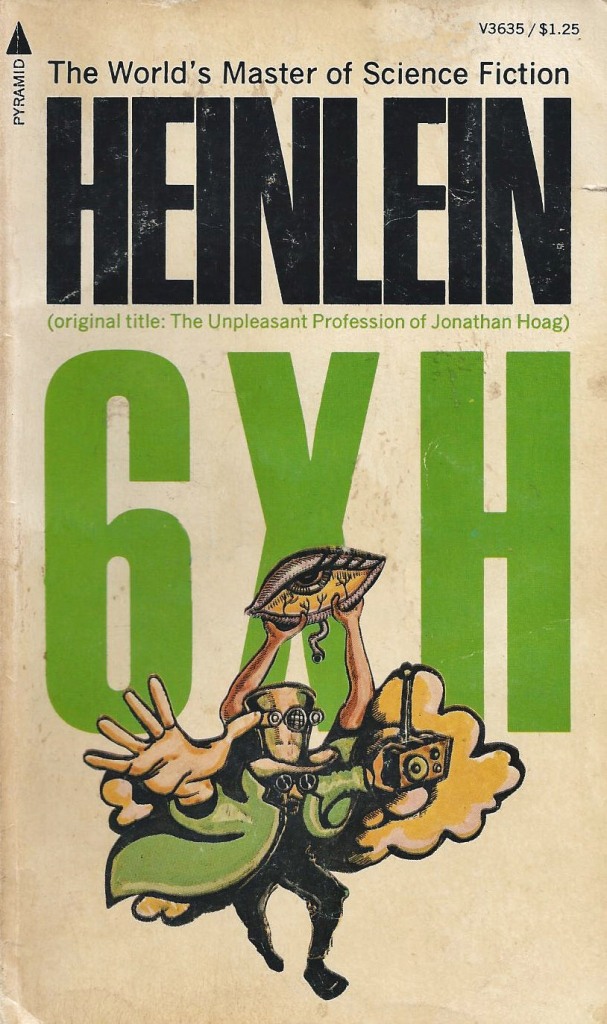
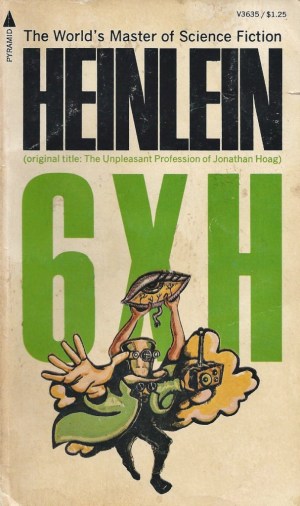
6 X H – Six Stories by Robert A. Heinlein ~ 1959. Original Title: The Unpleasant Profession of Jonathan Hoag. This edition: Pyramid Books, 1975. ISBN: 0-515-03635-0. Paperback. 219 pages.

My rating: 5/10. More or less.

I discovered the vast, strange, swirling ocean of science fiction in high school, and have dabbled happily along the edges of that varied genre ever since. That time being in the 1970s, the prolific Robert A. Heinlein was still front and centre of the revolving sci-fi paperback rack in the school library, and his books were readily available at our town’s rather dingy little secondhand bookstore, located down a precipitous set of stairs in the cramped basement of a main street store.

This volume is a relic of that era. Definitely not built to last, the pages are yellowing and loose in the binding, the glue having long since reached its expiry date. The smell of the dusty pages takes me instantly back to those high school days. Newly employed at a part-time job waiting tables at our town’s Chinese restaurant, I had money of my own for the first time in my life, and after putting aside most of it into a savings fund targeted for buying my own car, I splurged my tips on books, books, books –  a few new, but most secondhand; you could get more for your money that way, and the selection, then as now, was vastly superior.

That first car, a bright red ’72 Mustang, was purchased the summer I turned 15, for $800 cash, from a quiet young man with a highly pregnant wife (looking back over the years, I suddenly realize the significance of that situation, and my heart bleeds a bit for both of them, but at the time all I felt was sheer selfish desire, no room for empathy in my egotistical teenage heart) – and, oh! – how many hours of sore feet and cigarette smoke and ever-greasy uniforms – remember the hideous waitress garb of the time? – none of this “wear your own clothes” stuff that today’s “servers” get away with – how many early morning and late night hours at $2.65 an hour (before deductions) did this translate to?! – always doing homework frantically during a much-too-short meal break…

My father co-signed the papers for me (I was underage for a legal transaction) against my mother’s most strenuous objections, and after that most of my money went for gas, for despite not yet having a driver’s license I managed to put a lot of miles on that beautiful beast. Different times, different times…

My sweet first ride is sadly long gone, but many of the books of those halcyon teenage summers remain in my now-massive book collection, triggering little episodes of nostalgia which I savour for a moment before turning back to my present-day world. (Which happens to include this book blog, so here I go, digression over,  with my review.)

This is an odd collection even for all-over-the-map Heinlein, and it’s probably been a good thirty years since I read it; I had no memory of most of the stories and it’s definitely not in the favourites pile. Sorting out the last few boxes of my old possessions from my mom’s attic, I found this and immediately put it aside, thinking my sci-fi buff teenage son might like it; he read it and passed it back to me with that current expression signifying mild disinterest – “Meh!”

“No way, it’s Heinlein, must be something good in there!” I declared, and promptly read it myself. And, sorry to say, I guess this time he was more or less right. As he usually is. Quite a lot of fun, actually, having a teen sharing some of my reading tastes. Great excuse to pick up yet more books, equipping the kid with his own library, for when he moves out, you know… For what it’s worth, he’s already on his second car. Nowhere near as cool (hot?) as his mom’s first one, though.

Okay – FOCUS.

Six short stories, more fantasy than science fiction.

  • The Unpleasant Profession of Jonathan Hoag. At 120 pages, more of a novella than a short story. Originally published in the pulp magazine Unknown Worlds, in October of 1942, under one of Heinlein’s pseudonyms, John Riverside.

It starts promisingly enough:

“Is it blood, doctor?” Jonathan Hoag moistened his lips with his tongue and leaned forward in the chair, trying to see what was written on the slip of paper the medico held.

Dr. Potbury brought the slip of paper closer to his vest and looked at Hoag over his spectacles. “Any particular reason,” he asked, “why you should find blood under your fingernails?”

“No. That is to say – Well, no – there isn’t. But it is blood – isn’t it?”

“No,” Potbury said heavily. “No, it isn’t blood.”

Hoag knew that he should have felt relieved. But he was not. He knew in that moment that he had clung to the notion that the brown grime under his fingernails was dry blood rather than let himself dwell on other, less tolerable, ideas.

The fastidious Mr. Hoag has a problem. His evenings, nights and mornings are normal enough; he arrives home from work, socializes normally enough, goes to bed, sleeps and risess – but he has absolutely no memory of how he spends his days; no idea what his profession is; the only clue is the brownish-red residue under his fingernails, and a deep sense of foreboding that he is involved in something terrible.

After being turned away with no satisfactory answer by the brusque Dr. Potbury, Mr. Hoag decides to have himself followed. He contacts the firm of Randall & Craig, Confidential Investigators, who turn out to be a husband and wife team working out of their home. Edward and Cynthia (Craig) Randall are well experienced in everyday investigations; after some debate they agree to take on Mr. Hoag’s case, and the plot immediately thickens.

Up to this point the story is engaging and very nicely written; the mood is very 1940’s noir; we’ve all been there before, and we look forward with anticipation to the next logical step. And this is where Heinlein mixes things up. A straightforward “tailing” apparently is successful but goes strangely awry; Edward easily follows Jonathan Hoag to his workplace, a commercial jeweler’s workshop on the 13th floor of a city office building, and talks to Mr. Hoag’s employer. The mysterious red powder turns out to be jeweler’s rouge; Mr Hoag polishes gemstones. Case closed.

But hang on… why did Cynthia see Edward stop and talk to Jonathan, and why does Edward insist they never made contact? Why, when they both retrace Edward’s steps, do they find that there is no 13th floor in the building, and no record of a jeweler’s workshop? And why do none of Jonathan’s contacts and references seem to exist, and why doesn’t he have fingerprints?

Not content to those questions unanswered, to give Mr. Hoag the easy and plausible explanation of the jewel polishing job, and take his hefty fee, Cynthia and Edward decide to push further. And this is where things get really odd. Suddenly things are far from normal in the Randall & Craig world. Mirrors become portals into another reality; strange men with other-worldly powers enter and leave and drag Edward and Cynthia along. The threatening “Sons of the Bird” warn them to drop Mr. Hoag’s case and forget they ever heard about him, or face dire consequences.

After much hocus pocus and mumbo jumbo, Edward and Cynthia more or less get to the bottom of the strange situation, which is more than this reader ever really did. I had to go back and reread the last half of the story, and I was still confused. Something about alternative worlds improperly erased, with Mr. Hoag as a sort of unwitting Nemesis controlling rogue members of a previous world. I think.

Some great writing in this story; Heinlein struts his storyteller’s stuff here, but the plot was crazy-confusing for better than half of it, and the whole thing dragged on way too long. The main characters, aside from the mysterious Mr. Hoag, are Cynthia and Edward, and their close relationship is very well handled; their offhand manner to each other and continual wise cracking hide a deep and abiding love for each other which ultimately allows them to escape from the disaster their meddling has precipitated.

The ending of the story is as mysterious as the beginning, and I won’t really give too much away by sharing it here.

When he goes out to the vegetable patch, or to the fields, she goes along, taking with her such woman’s work as she can carry and do in her lap. If they go to town, they go together, hand in hand – always.

He wears a beard, but it is not so much a peculiarity as a necessity, for there is not a mirror in the entire house. They do have one peculiarity which would mark them as odd in any community, if anyone knew about it, but it is of such a nature that no one else would know.

When they go to bed at night, before he turns out the light, he handcuffs one of his wrists to one of hers.

Good work, front and back of this novella. Some slippage there in the middle, Mr. Heinlein!

I would be interested to hear from anyone else who has their own ideas about this tale.

  • The Man Who Traveled in Elephants. Written in 1948, and published in the magazine Saturn in 1957 under the title The Elephant Circuit.

This is a rather sweet, very nostalgic, Ray Bradbury-ish tale of a retired traveling salesman and his ultimate destination. Something of an ode to the mid-century tradition of local exhibitions and fairs, and all the best things about them. I won’t say too much about this one; there’s not much to it, just a gently sentimental little fantasy. Not a masterpiece, but rather enjoyable in its own small way. There’s an old dog, too. Need I say more? It works.

  • “-All You Zombies-“. Originally published in the pulp magazine Fantasy & Science Fiction, March, 1959.

Time travel and a sex change operation and some cheeky acronyms – see if you can get the connection between the “service” organizations Women’s Emergency National Corps, Hospitality & Entertainment Section, and Women’s Hospitality Order Refortifying & Encouraging Spacemen. (I know – GROAN. This is why, despite his many flaws, I like Heinlein – he makes me laugh despite my better judgement! The guy sure had a thing for acronyms – he was my introduction to TANSTAAFL, among others.)

A weird little “future tale”; pure Heinlein fantasy. Rather offensive and not as funny as the author obviously thinks it is, but it has a few points. A temporal agent on a recruiting mission with the cover profession of bartender – cute concept. For 1959. This one shows its age. And I’m surprised it wasn’t first published in Playboy. Definitely adult in theme!

  • They. Published in 1941, in the pulp magazine Unknown.

A rather Kafkaesque story concerning a man who is being held in confinement of some sort (mental institution? hospital?) because of his extreme paranoia – he insists that he is surrounded by a conspiracy to deceive him as to the true state of the world, and that his is the only “reality” he can be sure of. But is it paranoia if it’s true? One of Heinlein’s experiments in defining solipsism – the philosophy that one can only be sure of one’s own mind; everything else may only be a creation of that mind.

A bit too deep for me. Well written, with a good twist in the end, but overall – “Meh.”

  • Our Fair City. Published in Weird Tales, 1949.

An odd little urban fantasy. A sentient, apparently feminine whirlwind – yes – the kind of whirlwind that swirls about picking up dust and bits of rubbish – named, of all things, “Kitten” by “her” friend Pappy, an old parking lot attendant, plays a part in bringing corrupt city officials to justice. A playful farce of a story; I’ll grant points in that it’s kind of a fun concept; but my reaction was “read it quick and move on”.

“-And He Built a Crooked House-“. Astounding magazine, February, 1941.

A uncategorizable story (probably closer to sci-fi than fantasy… or vice versa – can’t decide!) about a California architect who designs and builds a three-dimensional house based on a four-dimensional tesseract. The whole concept made my head hurt; math and science geeks will no doubt fully “get” this, though. Anyway, an earthquake shifts the house fully into the fourth dimension, while being toured by the architect and his clients.

Heinlein, a quite brilliant mathematician in his own right, obviously indulged his arcane sense of humour here. Farcical and clever and probably best appreciated by like-minded sorts. I mildly chuckled, but mostly was just happy the book was finally over.

*****

So – final verdict? It was an interesting excursion into the long-ago world of Heinlein’s literary B-sides, but it can safely go back into the box. Maybe in another thirty years it will bring my grownup kid some $$$ as he flogs the excess of my book collection on the future equivalent of eBay!

If you see it cheap cheap cheap in the used book by-the-door bins, go ahead & pick it up. In my opinion, not really worth more than a dollar or two, unless you’re a dedicated Heinlein collector.

Read Full Post »
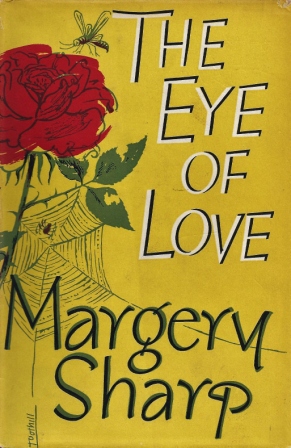
The Eye of Love by Margery Sharp ~ 1957. This edition: Collins, 1957. Hardcover. 1st Edition. 256 pages.

My rating: 9/10

I have been on an unapologetic reading binge these past few days; waking at my husband’s 5 AM alarm to blink the sleep from my tired eyes and reach groggily for the book I laid down the night before –  or, technically, earlier in the morning; too many times it’s been past midnight – foolish me!  A perfectly made cup of tea is always delivered to my bedside or chairside table by a man who values silence above conversation on workday mornings, and is himself stealing some precious reading time over his breakfast before heading out the door at the last possible moment. Our morning exchanges are brief; after thirty years together the pattern is predictably set, and it suits us very well. “What’re you reading?” and “Here, I’m done. You give it a try. Not bad…” and, so often,  “Hey, did you steal my book? I was still working on that one…”

Lately I have had an extravagant number of book-shaped packages from far-flung purveyors, so that like the proverbial child in the candyshop I am overwhelmed by choices and am greedily consuming each treat with an anticipatory eye on the next one. All are light fiction; summer reading at its best.

Trickling in much too slowly are a number of new-to-me vintage books by my beloved Margery Sharp. Margery wrote a trilogy of sorts between 1957 and 1964: The Eye of Love, Martha in Paris, and Martha, Eric and George. Naturally, the third book came first, then the second, with a dreadfully long lag before the first one showed up just a few days ago. I had been nobly holding off on reading them out of sequence, and I’m glad I did. These definitely need to be read in order to get a full appreciation of the journey of our unlikely heroine Martha. I am surprised that these do not appear in an omnibus edition; that would be kindest to the reader, and not unmanageable, as the three books are individually short and quick reads. Having gobbled them up, I will now review them in order, with a probably doomed attempt at brevity, and place them together on my dedicated Margery Sharp shelf in our bedroom (where all the “chuck out the window in case of house fire” treasures reside) to await happy re-reading in future.

Ladies of ambiguous status have by convention hearts of gold, and Miss Diver was nothing if not conventional; but a child in an irregular household is often an embarrassment. It had been wonderfully kind of Miss Diver to save her brother’s child from an orphanage, but not surprising; what was surprising was how well the arrangement had worked out.

It is 1929; Miss Dolores Diver’s widowed brother Richard Hogg has just died, leaving behind nothing of worldly value to his six-year-old-child, Martha, now a bona-fide orphan with an uncertain future. Miss Diver gallantly steps in.

She had never seen the child until an hour earlier; she had never before visited the shabby Brixton lodging-house in whose shabby parlour the thinly-attended wake was being held. – A dozen or so of Richard Hogg’s ex-colleagues from the post office stared inquisitively; this meeting between the two chief mourners provided a touch of drama, something to talk about afterwards, otherwise conspicuously lacking. (As Doctor Johnson might have said, it wasn’t a funeral to invite a man to: only one bottle of sherry and fish-paste sandwiches. Richard Hogg, with his motherless daughter, had lodged two full years in Hasty Street; but a landlady never does these things so wholeheartedly as relations, even with the Burial Club paid up and the next week’s rent in hand.)

Several years pass in complete amiability; young Martha is a rather odd but markedly placid child, and the Diver ménage, financed and patronized by Harry Gibson, head of a small furrier’s establishment, absorbs her without a hitch. Things are about to change, though. Harry’s business is struggling in the depths of the financial depression, and to save it he has contracted to marry one Miranda Joyce, hitherto-unmarriageable daughter of a very successful, upper-end furrier. Her father, in return for getting his daughter finally settled, is willing to re-finance Gibson’s. Harry decides to do the right thing by his prospective fiancé and renounce his mistress and his comfortable routine: five days of the week living quietly with his doting mother, with the weekend secretly spent in the little house with faithful Dolores and a tactful Martha, with the story to the rest of the world that he has continual weekend business in Leeds.

Since their meeting ten years earlier, at a Chelsea Arts Ball, Dolores and Harry have grown even more deeply in love. Now, on the eve of their parting, they cling together and reminisce.

“I’m sorry, Harry, but I can’t bear it,” said Dolores.

She huddled closer against his solid chest. It was his solidness shed always loved, as he her exotic fragility. For ten years they’d given each other what each most wanted out of life: romance. Now both were middle-aged, and if they looked and sounded ridiculous, it was the fault less of themselves than of time.

To be fair to Time, each had been pretty ridiculous even  at the Chelsea Ball. Miss Diver, in her second or third year as a Spanish Dancer, was already known to aficionados as Old Madrid. Mr. Gibson, who had never attended before, found the advertised bohemianism more bohemian than he’s bargained for. To the young devils from the Slade, unwrapping him, [Harry has come dressed as a brown paper parcel],his humiliated cries promised bare buff rather than pyjamas. Naked, indeed, he might have made headlines by being arrested; in neat Vyella, he was merely absurd.

Dolores, Old Madrid, not only pitied his condition but also lacked a partner. She’s have been glad to dance with anyone, all the rest of the night. But though rooted in such unlikely soil their love had proved a true plant of Eden, flourishing and flowering, and shading from the heat of day – not Old Madrid and Harry Gibson, but King Hal and his Spanish rose.

So they had rapidly identified each other – he so big and bluff, she so dark and fragile: as King Hal and his Spanish rose. Of all the couples who danced that night in the Albert Hall, they were probably the happiest.

Off Harry goes, to reluctantly propose to the very willing Miranda.

A quarter of an hour passed long as a century. To an impatient lover it would no doubt have seemed longer: Mr. Gibson was impatient only as a man about to be shot might be impatient. (Why hadn’t he been shot, in ’17?) The bitter parenthesis, by the memories it evoked, nonetheless helped his courage: when at last the door opened, like an officer and a gentleman Mr. Gibson clutched his carnations and stood bravely up to meet the firing squad.

Curiously enough, Miranda Joyce bore a marked physical resemblance to Miss Diver. Both were tall, black-haired, and bony. They were about the same age. Miss Joyce had even certain advantages: her make-up was better, she hadn’t Dolores’ slight moustache, and she was far better dressed. But whereas Mr. Gibson saw Dolores with the eye of love, he saw Miss Joyce as she was, and whereas the aspect of Old Madrid made his heart flutter with delicious emotion, the aspect of Miss Joyce sunk it to his boots.

But Harry Gibson soldiers on. The proposal is duly made and predictably accepted; the necessary conventions are observed.

Kissing her had been like kissing a sea-horse. Mr. Gibson knocked back his drink thankfully. (“I shall turn into a sozzler,” thought Mr. Gibson – dispassionate as a physician diagnosing the course of a disease.)

Fortunately Harry finds consolation in a growing friendship with his father-in-law to be. Mr. Joyce becomes a kindred spirit, and the one bright spot in Harry’s dark night of the soul.

Meanwhile Martha and Dolores are also soldiering on gamely. Dolores soon finds that she is unemployable; her only resource seems to be to let out rooms in her house. Fortunately for aunt and niece, Martha is quick to seize a chance while visiting her old home, and is instrumental in bringing home the perfect boarder. Bachelor Mr. Phillips, clerk of an insurance company, is at first innocuously quiet and reliable with the rent money. However, Dolores’ broken heart and subsequent stand-offish attitude soon have the effect on her boarder of rousing in him a great curiosity as to her personal situation, and, quite soon, a desire to wed this woman whom he very wrongly perceives to be financially independent and a property owner to boot.  What Mr. Phillips doesn’t know is that the house is merely leased, with the term coming up; hence Dolores’ desperate need for Mr. Phillips’ financial contribution, and her reluctance to snub his distasteful though so-far polite advances

The games of in-and-out and false pretences escalate, and while her elders are torturing themselves with emotional gymnastics, young Martha is single-mindedly pursuing her one interest. She is teaching herself to draw. Martha sees the world as a series of shapes; capturing images, fitting them into those categories, and transferring them from her eyes to her mind to paper takes up every waking moment.

Dismissed as merely a scribbling child, Martha stolidly ignores the adult world, and it in turn takes little notice of her. Until one day Mr. Joyce, through a series on coincidences, happens upon Martha drawing a tree. He is a connoisseur of the arts; he recognizes a budding young talent when he sees it. He offers Martha his patronage, and buys her much-desired paper, charcoal and chalks, which she unemotionally accepts while refusing the offer of  a longer-term artistic relationship and sincere, friendly interest which Mr. Joyce extends.

These complicated relationships get more tangled as time goes on; their multiple resolutions are a typically Margery Sharp juggling act. The tale winds up with a combination of most satisfactory endings, and we leave Martha in particular with the hopeful idea that her future, if not exactly easy, will be extremely interesting.

A cleverly written, very smart, satirical, darkly amusing novel. On par with Something Light, though not quite as gentle; the humour of The Eye of Love is decidedly savage at times.

I’m not at all sure if Margery Sharp planned at first to continue Martha’s saga, as The Eye of Love is a decidedly stand-alone novel, but I am so glad she did. Very highly recommended. Next book in the trilogy: Martha in Paris.

Read Full Post »

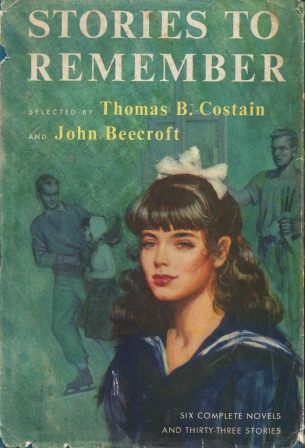
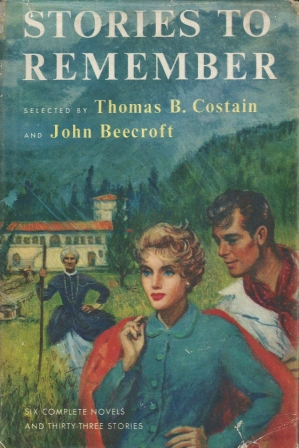
Stories to Remember, Volumes I & II, selected by Thomas B. Costain & John Beecroft ~ 1956. This edition: Doubleday, 1956. Hardcover. Volume I – 409 pages. Volume II – 504 pages.

My rating: 10/10. Excellent anthologies; something for everyone.

I have read the companion Stories to Remember  volumes many times over the years. This anthology was purchased new by my mother in 1956, likely through her long-time Doubleday Book Club involvement, and was some of the first “adult” material I dipped into as I expanded my childhood reading horizons. I still have the original books, and now my own family, adults & teens, re-read and enjoy them. And yes, I remember most, if not all, of the selections with deep fondness!

Looking at this collection with a critical eye 56 years after its publication, I fully suspect that some of the selections might no longer appeal to the average modern audience – would a typical 2012 teenager even “get”, or more to the point, even want to “get” many of the societal and historical references in Alexandre Dumas’ Man Who Lived Four Thousand Years, or Maugham’s Lord Mountdrago? –  but there is enough good stuff in here to keep any reader engaged for quite some time, even if one cherry-picks their way through the collection. Overall, an interesting vintage read containing a number of familiar authors & stories, as well as an introduction (or a remembrance?) of several writers now fallen out of public notice.

I have seen these volumes numerous times in 2nd hand bookshops, generally priced very reasonably. Worth picking up for dipping into, and for leaving on the guest room nightstand, if your guests are the type to appreciate a non-electronic reading experience.

The double-column format and smallish print takes a bit of adjustment on the part of the reader; it appears that the publisher tried to squeeze as much text as possible onto each page to limit the ultimate length of the book while still providing generous content. Occasional nicely rendered realistic line drawings throughout are an attractive feature.

A nice balance of dramatic, humorous and “darker” stories; not at all a depressing collection, which cannot be said for many other short story anthologies of more recent vintage!

Volume I

  • The General’s Ring (complete novel) – Selma Lagerlöf, 1925Written by the first woman to receive the Nobel Prize for Literature, in 1909. This is the first installment in a trilogy concerning a ring given to General Bengt Löwensköld by King Karl VIII of Sweden. After requesting that the very valuable ring be buried with him, it is soon discovered that the ring has been stolen from the General’s grave, with tragic consequences to everyone who subsequently comes in contact with it. A morality tale, a ghost story, and at least one love story make up this intriguing and well-paced novella, set in eighteenth century Sweden.
  • Mowgli’s Brothers Rudyard Kipling, 1894From The Jungle Book. A lost woodcutter’s child is adopted by a wolf family in the Indian jungle.
  • The Gift of the Magi O. Henry, 1906. Most of us will remember this one, stock story of countless anthologies! Della and Jim both sell the thing they love best to buy the perfect Christmas present for each other.
  • Lord Mountdrago W. Somerset Maugham, 1939. Lord Mountdrago consults a psychiatrist to help him deal with disturbing dreams. But are they really just dreams, or is something much more sinister going on?
  • Music on the Muscatatuck and The Pacing Goose (excerpts from The Friendly Persuasion) – Jessamyn West, 1945. Quietly humorous stories concerning Quaker fruit tree nurseryman Jess Birdwell and his Quaker minister wife Eliza.
  • The BirdsDaphne du Maurier, 1952. What if all the birds in the world banded together to revenge themselves on humans for the harm done to their kind throughout their shared history? Chilling. 
  • The Man Who Lived Four Thousand Years (excerpt from The Queen’s Necklace) – Alexandre Dumas, 1850. Count Cagliostro, who claims to have lived four thousand years, predicts the “unbelievable” futures of a group of royals and nobles gathered to dine with Maréchal de Richelieu in 1784.
  • The Pope’s Mule Alphonse Daudet, c. 1894. The humorous fable of a good Pope’s pampered mule, who gets her revenge on a tormentor after seven years’ patient waiting.
  •  The Story of the Late Mr. ElveshamH.G. Wells, c. 1911. The sinister Mr. Elvesham seeks immortality by continually switching bodies. 
  • The Blue CrossG.K. Chesterton, 1938. Clever but often underestimated Father Brown brings a jewel thief to justice. 
  • Portrait of Jennie (complete novel) – Robert Nathan, 1940. A struggling young artist encounters and adopts as a muse a mysterious girl who apparently has been travelling through time.  A ghostly love story.
  • La Grande Bretêche Honoré de Balzac, c. 1831. A convoluted telling of the tragedy of a grand old ruined house and its history regarding a Spanish nobleman, a jealous husband and a betraying wife.
  • Love’s ConundrumAnthony Hope, 1899. An ironically humorous, very short story concerning a self-absorbed scholar who completely misunderstands a confession of love and proposal of marriage.
  • The Great Stone FaceNathaniel Hawthorne, 1889. A young boy, inspired by a legend concerning a cliff resembling a strong human profile, waits his entire life for the human embodiment of the noble edifice to appear. It does, but in a way he has not suspected. (The Great Stone Face was an actual New Hampshire rock formation, known widely as “The Old Man of the Mountain” until its collapse in 2003. This story is one of the more dated tales in this anthology, though it is classic Hawthorne and enjoyable as such.)
  • GermelshausenFriedrich Gerstäcker, c. 1850. A wandering artist stumbles into a remote German village, the cursed Germelshausen; doomed to sink beneath the earth for eternity, only to arise for one day in each century. (This is one of my personal favourites in this anthology.) This story has been credited as the inspiration for the musical Brigadoon, though the setting in that case was changed to Scotland.
  • I am Born (excerpt from David Copperfield) – Charles Dickens, 1850. The title character describes his coming into the world. Irresistable – your next step will be to read the whole novel.
  • The Legend of Sleepy HollowWashington Irving, 1820. Itinerant schoolmaster Ichabod Crane sets his romantic sights on the lovely Katrina and meets a harsh fate for his folly in aiming too high.
  • The Age of MiraclesMelville Davisson Post, 1918. Injustice and retribution. A wronged heiress, a sudden death, and a clever onlooker who sorts it all out.
  • The Long Rifle (excerpt from The Long Rifle, a novel) – Stewart Edward White, 1932. Fictionalized account of the life of the legendary Daniel Boone.
  • The Fall of the House of UsherEdgar Allan Poe, 1939. A gothic horror tale. Roderick Usher and his sister Madeleine are the last of their family; they fulfill a prophecy which predicts their dramatic demise.
  • The Voice of Bugle Ann (complete novel) – MacKinlay Kantor, 1935A very short novella set in contemporary Missouri about an unjust conviction for murder and its surprising resolution. Fox hounds feature strongly.  

Volume II

  • The Bridge of San Luis Rey (complete novel) – Thornton Wilder, 1928. A suspension bridge in the Peruvian Andes gives way, sending a group of travellers to their demise. Who were they, and what chances of fate led them to their rendezvous with death at San Luis Rey? Excellent story.
  • Basquerie – Eleanor Mercein Kelly, 1927.   A lovely, not-so-young American girl in Europe must decide between love and (possibly?) a more financially wise match. This author is worth further investigation.
  • JudithA.E. Coppard, 1927. Aristocratic Judith meets  and dallies with a handsome young schoolmaster, to his eventual tragic downfall.
  • A Mother in Mannville – Marjorie Kinnan Rawlings, 1936. Touchingly poignant short story about an orphan boy and his integrity and pride.
  • Kerfol Edith Wharton, 1916. The tragic tale of a jealous French nobleman and his faithless wife. Supernatural elements – something of a ghost story.
  • The Last LeafO. Henry, 1905. Platonic love among a group of artists. Touching nd memorable.
  • The Bloodhound Arthur Train, 1923. Shrewd New York lawyer Mr. Tutt defends a client. Badly dated, one of the less memorable stories in this collection.
  • What the Old Man Does is Always RightHans Christian Andersen, 1861. Clever Danish peasants get the better of a condescending Englishman.
  • The Sea of Grass (complete novel) – Conrad Richter, 1936. Feuding between cattlemen and incoming small farmers in New Mexico at the turn of the century. Told from the point of view of the nephew of one of the most outspoken cattlemen, and with a crucial role played by Lutie Cameron, newly arrived from St. Louis to marry into the cattle-baron hierarchy.
  • The Sire de Malétroit’s Door Robert Louis Stevenson, 1877. In cavalier France of 1429, a case of mistaken identity and the equivalent of a shotgun wedding. Vintage Stevenson.
  • The NecklaceGuy de Maupassant, 1884. Vanity and social ambition lead to a young French couple’s downfall. An ironic small masterpiece of a story.
  • By the Waters of BabylonStephen Vincent Benet, 1937. Post-apocalyptic America seen through the eyes of a young man on a quest. A “rebirth of civilization” theme; definitely a precursor to the many similar stories which are hitting high popularity today.
  • A.V. Laider – Max Beerbohm, 1920. A palm-reader forsees the death of four friends, but chooses not to warn them. Or at least that’s his story… Nicely done! 
  • The Pillar of FirePercival Wilde, 1925. A clever method of cheating at cards is discovered and nipped in the bud. A bit rambling.
  • The Strange Will (excerpt from The Man With the Broken Ear) – Edmond About, 1862. The rather macabre tale of bringing a mummified murdered man back to life.
  • The Hand at the Window (excerpt from Wuthering Heights)- Emily Brontë, 1847. A short, decidedly gothic episode from the novel.
  • “National Velvet” (complete novel) – Enid Bagnold, 1935. 14-year-old Velvet Brown wins a horse in a raffle and decides to race him in the Grand National steeplechase. Beautifully written portrait of family life; the horses play second string to the human relationships. Excellent.

Read Full Post »

« Newer Posts - Older Posts »