Archive for the ‘1940s’ Category

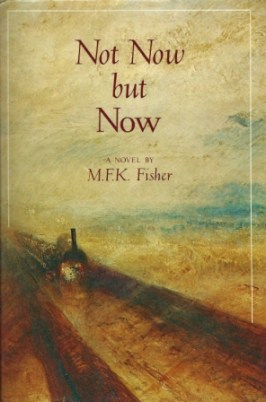
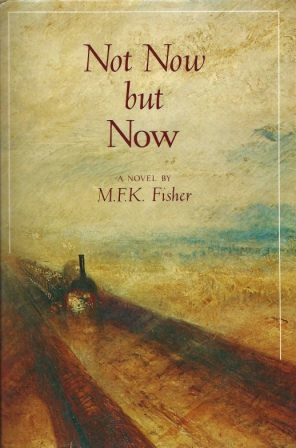
Not Now But Now by M.F.K. Fisher1947. This edition: North Point Press, 1982. Softcover. ISBN: 0-86547-072-3. 256 pages.
My rating: 5/10

I’ve been thinking hard all day how best to go about writing a description of this very unusual novel by Mary Frances Kennedy Fisher, otherwise best known for her creative autobiographical writings on food, travel, places and people.

Do any of these ring a bell?

  • Serve It Forth (1937)
  • Consider the Oyster (1941)
  • How to Cook a Wolf (1942)
  • The Art of Eating (1954)

Yes, that M.F.K. Fisher. Already very familar with  and an enthusiastic reader of Fisher’s food and travel memoirs, I was quite thrilled to come across this “only novel” (as the front fly leaf informed me) of hers. I wasn’t quite sure what to expect, but I knew it should be good; Fisher’s words dance off the page with sheer exuberance and joy for the good things in life, as well as wry humour for the darker days.

Well this was a departure! Here is the Kirkus review, from August, 1947:

The tale of the wandering wanton, whose character contains no glimmer of human decency, whose driving force through successive incarnations is the lure of sex, whether used as bait to wreck the lives of a Swiss household, or to disrupt a happy below stairs kingdom, or to inject suspicion of lesbianism into a normal girl’s adolescence, or to out-tart the tarts of the Gold Coast- Jennie sweeps her callous way.  An odd tale, told on four levels of time, 1928, 1847, 1927, 1882, – England and Europe and America – virtually four novellas woven together by the insidious Jennie, harlot supreme, whose spirit continues to attempt to escape and find freedom. M.F.K. Fisher has a unique gift, if one that is sybaritic, ultra-sophisticated, and for that market.

No denying that this novel is well-written and creative, and definitely “sophisticated”, as the review points us. But I have almost put this novel in the giveaway box several times, which fate is generally reserved for only the most dire of my used bookstore gleanings; most find a home on the double-deep shelves; very few books leave the ever-expanding collection. I think that the fact that I’ve already read it twice argues for its remaining here, but I still view it with mixed feelings.

I found the format initially quite confusing. Expecting a traditional narrative flow, the reapparance of the main character, Jennie, in the second of the four narrative sections, had me completely confused, as we jumped from 1928 to 1847 in time, while Jennie herself stays more or less the same. I had one of those surreal disconnect moments where I leafed back through the first section trying to see what clues I’d missed as to what the heck was going on.

Of course, if I’d read M.F.K. Fisher’s 1982 afterword first, it would have made much more sense. She says:

To my mind it is really not a novel at all… (I)t is a string of short stories, tied together more or less artfully by a time-trick. The female Jennie appears everywhere, often with heedless cruelty or deliberate destruction to her docile associates, and then slips away in her little snakeskin shoes…

I cannot whole-heartedly recommend this book. It is strange and more than a little confusing, and Jennie is a most unpleasant protagonist. I appreciate that Fisher was experimenting with a different literary style here, and I found this departure somewhat intriguing, but I much prefer her more prosaic works to this more than slightly twisted flight of fancy.

But – hey! – maybe others will embrace the Not Now But Now experience more enthusiastically than I did. Though the novel was not at all a commercial success, the reviewers of 1947 praised its literary creativity and style. Perhaps I’m just not ultra-sophisticated enough to completely “get it”?

Side note – I love the use of the Turner painting, Rain, Steam and Speed, for the slipcover of the 1982 reprint. Initially I found the disparity between the cover and the subject matter a bit odd, but once I’d time-slipped with Jennie a few times it suddenly felt most appropriate!
Read Full Post »

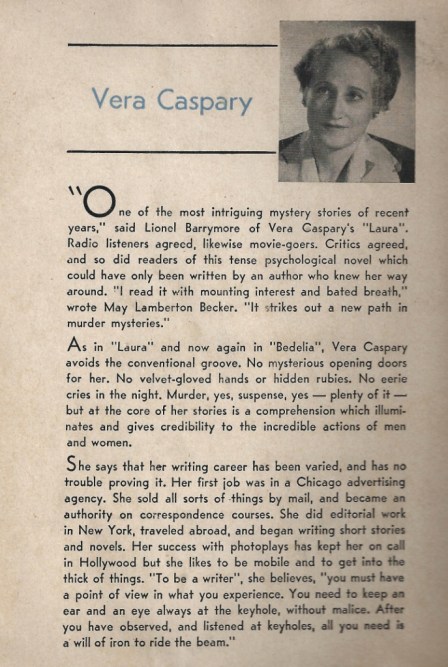
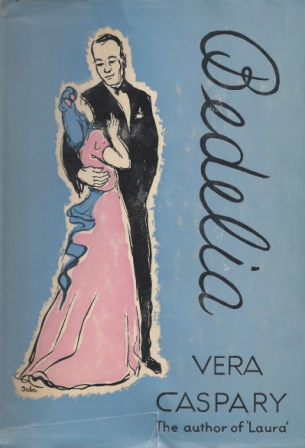
Bedelia by Vera Caspary ~ 1945. This edition: Blakiston, 1st edition, 1945. Hardcover. 187 pages.

My rating: 6/10.

I picked this book up “on spec” a few days ago; my attention caught by the back cover quote by Lionel Barrymore, referring to Caspary’s previous book, Laura:

One of the most intriguing mystery stories of recent years…

Always up for a good mystery story, and since this vintage hardcover would only set me back a few dollars, I took the gamble and brought it home. From the front flyleaf:

Vera Caspary has written a study of a psychopath as fluffy as eiderdown, a kitten whose claws were steel.

Bedelia was everything to please a man – and she pleased many. She was small, cuddly; she smelled nice. She never argued or lost her temper. Her house, like her hair, was shining, her food delicious. She loved to cook, and she adored the gadgets of housekeeping. How strange that a passion for percolators and copper pans should help solve the curious riddle of her past!

Irresistable prospect for an evening’s light read, I thought.

Right from the first page I was a bit disappointed in the quality of the writing; no beautifully put-together passages here. Caspary, if Bedelia is typical of her work, was a straightforward, “then she walked across the room” sort of writer. Just the facts, ma’am. Even the “tense psychological” bits are reported in a straight-faced, take-it-or-leave-it manner.

Bedelia and her new husband (and perhaps prospective victim?) Charlie posture and project all over the place, while I sat off in my spot as a not quite fully engaged spectator, figuratively yawning a bit and wishing they’d just get to the point, already. It felt very much like one of those melodramatic 1940s films where everything is so broadly telegraphed to the audience that we eventually become so hardened to subtle effects, which turns out to be an apt conclusion as I found out later that Vera Caspary was indeed a successful Hollywood screenplay writer from the 1930s to the early 1960s.

Bedelia is the tale of a besotted newly married man, Charlie Horst, and his adored bride, a beautiful and passionate young widow who gratefully clings to him and makes his life oh-so-sweet. She’s a marvelous housekeeper, an accomplished cook, a gracious hostess to his friends, lovely to look at (and smells good, too, as Caspary points out more than a few times) and, to Charlie’s greatest delight, she’s hot stuff in bed.

Charlie is as smug and contented as a well-fed tomcat parked on a fireside hearthrug, until a few too many discrepancies in his wife’s accounts of her past history get him wondering about which version of her story is the real one. When Charlie falls ill with a mysterious ailment his doctor immediately suspects malicious poisoning. But who would want to hurt good old Charlie? Certainly not his sweet little wife…

I later saw this novel referred to as Lady Audley’s Secret in 2oth Century clothes; most apt. While Bedelia left me considerably underwhelmed by the writing style, the plot was reasonably interesting, with a few surprises thrown in.

Charlie, far from being a sympathetic character as we would expect, has numerous flaws of his own, and a personality just as psychopathic in its way as Bedelia’s. His treatment of his childhood friend Ellen, who has long been in love with him (as he fully realizes) is callous in the extreme; she is possibly the only truly innocent and likeable character in the book, and we fear for her future at the close of the story. (At least, I did. Definitely a case of “be careful what you wish for!”)

I was curious enough about Caspary and her referenced previous novel Laura (apparently made into a very successful movie, which I confess I have never heard of before) to do a bit of internet research on her.

Vera Caspary (1899-1987) had a full and eventful life. After graduating from business college, she worked as a stenographer and in an advertising agency. To support her widowed mother, she turned her hand to projects such as creating a successful correspondence course in ballet dancing, and one on  charm and deportment. She went on to work in journalism, and as a successful Hollywood screenwriter, and a best-selling novelist and short story writer.

Caspary had strong convictions which she was steadfast in defending; she embraced Communism in its most idealistic form during the 1920s and 30s, but was disgusted by the realties which she found both within the Communist Party in America at the time, and the appalling conditions which she witnessed during a fact-finding visit to Soviet Russia.

Despite eventually renouncing her communist sympathies, she was “blacklisted” in McCarthy-era Hollywood and struggled financially during the post-W.W. II years. Caspary was also an ardent feminist who defended her personal views and also her strong and independent female screenplay protagonists against producers’ attempts to sugar-coat them.

Vera Caspary is a writer whom I will be giving a second chance to, Bedelia‘s “slightness” notwithstanding. I hope to find a copy of Laura (book and film), as well as Caspary’s autobiography, The Secrets of Grown-Ups, published in 1979.

From a quick glance at AbeBooks, it appears that there is are abundant Caspary titles in second-hand circulation at reasonable prices. Not an author I am deeply enthralled with from this first exposure, but intriguing enough to follow up.

Read Full Post »

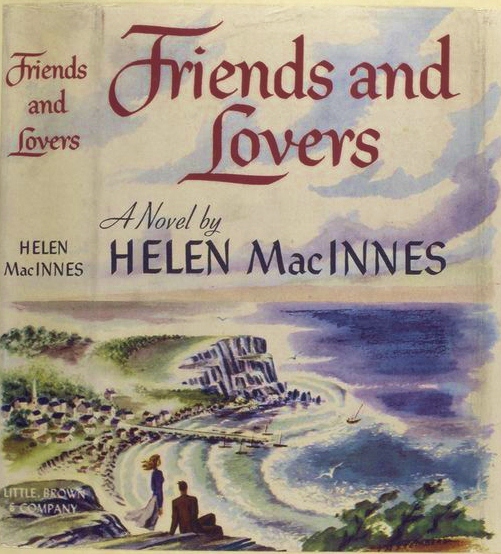
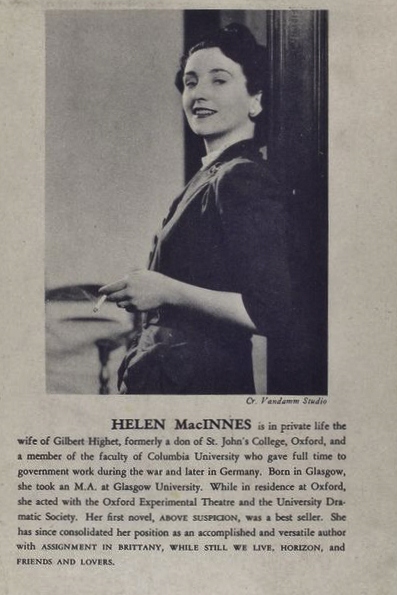
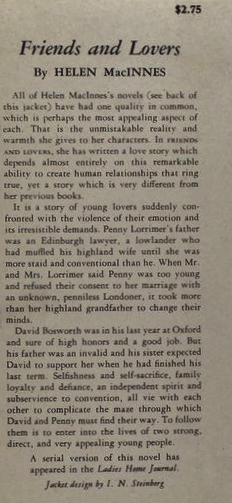
Friends and Lovers by Helen MacInnes ~ 1947. This edition: Little, Brown & Co., 1947. Hardcover. 367 pages.

My rating: 6/10.

*****

I met this author, figuratively speaking, one long, hot teenage summer in the 1970s. With the high school library closed to me and everything else in print in the house already devoured, I was desperate for something new to read. I was half-heartedly digging through boxes of old Reader’s Digests in our sultry attic when I found a stash of  hardcovers packed away in a pile of string-tied cardboard boxes, relics of my mother’s previous life in California before her marriage and relocation to the interior of British Columbia.

Mother was born in 1925, and as a lifelong avid reader collected as many titles as she could with her limited budget as a single “working girl”, a career which spanned almost 20 years before a late-for-the-time marriage at age 36.  A browse through my mother’s collection was a snapshot of middle class bestsellers of the 1950s and 1960s, when my mother did the majority of her book buying. If I made a list of authors I’ve been introduced to through my mother’s personal library, Helen MacInnes would be solidly on there.

Best known for her suspenseful espionage thrillers set in World War II and the Cold War, Helen MacInnes also wrote several romance novels, Friends and Lovers in 1947, and Rest and Be Thankful in 1949. The latter title was one on my mother’s shelf, and I read it and quite enjoyed it in a mild way, so when high school resumed in September and I came across another MacInnes title in our well-stocked school library, Above Suspicion, I added it to my sign-out stack. Already a fan of Eric Ambler and John LeCarre,  the political thriller immediately appealed, and Helen MacInnes was added to my mental  “authors to look out for” list.

Over the years I eventually read most of MacInnes’ titles, with varying degrees of interest and enjoyment. At her best she wrote a gripping, fast-paced, suspenseful story that held my interest well; occasionally I found my attention straying. When I recently came across Friends and Lovers, I picked it up and leafed through it, trying to remember if I had previously encountered it. The title was familiar, but darned if I could remember the storyline – never a good sign! When I started reading, I knew immediately that at some point I had read the book, but I had absolutely no memory of the plot. Was this a spy novel? A romance? A few chapters in I concluded that it was a pure romance, albeit one that attempted to address some larger issues.

David Bosworth is an academically brilliant though financially struggling student entering his last year of studies at Oxford in the early 1930s. In Scotland for the summer, employed as a tutor with a wealthy family, he meets 18-year-old Penelope (Penny) Lorrimer and, rather to his dismay, falls in love at first sight. He had always thought that intellect could govern emotion; his feelings for Penny turn this long-held theory on its head, and, when it becomes apparent that Penny has been similarly smitten, a clandestine relationship ensues.

David is the sole prospective support of a troubled family. His widowed father, seriously injured in the Great War, is a helpless invalid on a small pension. His sister Margaret, who has some talent as a pianist, refuses to take on a paying job to help support her father and herself, as she feels her musical training towards a career as a concert pianist is too important to compromise. David has financed his own university education by attaining a series of scholarships; now with his degree in sight he is agonizing over his future and his family responsibilities. A wife and family of his own have no place in his plans, and Margaret, once she realizes David’s attraction to Penny, is openly resentful of what she sees as a threat to her own future reliance on David’s earning power. David, emotionally fastidious, refuses to entertain the notion of a relationship other than marriage with the woman of his choice; his emotional and sexual frustration are frankly and sympathetically described by MacInnes.

Penny is also faced with family opposition to the relationship. Her well-off, upper-middle-class parents are and suspicious of the designs of a financially struggling university student on their daughter. A romantic entanglement is unthought of; a marriage even more ridiculous to consider – David will obviously be in no position to support a wife of Penny’s background “in the style to which she is accustomed” for quite some years, if ever. The only reason Penny is not out-and-out forbidden to see more of David is that the idea of her seeing anything in him is so ridiculous to her parents that he is dismissed as a momentary indiscretion, not deemed worthy of further notice by Penny as well as themselves.

Penny manages to get to London to study at the Slade Art School; David visits her on his free Sundays and the relationship progresses through its many difficulties to its inevitable conclusion.

Did I like this novel? Yes, and no.

It was very much a period piece in its portrayal of the two main characters. David, to my modern-day sensibilities, is much too chauvinistic and jealous to be admirable; Penny is much too ready to conform to David’s masculine expectations. Stepping back from that knee-jerk reaction to their fictional personalities, I realize it is a bit unfair to judge them by present-day standards. As products of their environment, possibly drawn from real-life characters, (I have read that this may indeed be a semi-autobiographical story, as the two protagonists resemble MacInnes and her husband in many key ways), David and Penny do seem generally believable, if a mite annoying at times, in their stereotypical behaviour.

Their friends and families were never given as much attention in character development throughout as they could have been, a definite flaw in this novel. Things tend to fall into place a little too neatly on occasion; Penny’s throwing off of her family’s protective embrace and her establishment as a gainfully employed London working girl comes out as a bit too pat and good to be true; David is offered opportunity after wonderful opportunity and enjoys a great luxury of choice as to his own working future; one sometimes wonders what all the fuss and angst is about.

A big point in favour is the discussion of attitudes in England towards the Great War veterans. MacInnes lets her very definite political opinions (liberal, anti-fascist) show throughout. The brooding situation of the “Germany problem” is well-portrayed; the story is set in the 1930s but was written and published in the 1940s, so the author’s portrayal of the characters’ apprehensions as to their and their country’s future must certainly have been influenced by the author’s own pre-World War II experiences and thoughts. Overall an interesting glimpse into the time, written by someone who lived what she wrote about.

Absolutely honest personal opinion: One of Helen MacInnes’ weaker novels. I much prefer Rest and Be Thankful, the other of her “pure romances”, which I regularly re-read.  It also discusses the after-effects of war and subsequent political attitudes, and is a stronger, more cohesive story overall with much better character development and a strong vein of humour, something I feel Friends and Lovers generally lacks. Friends and Lovers often feels forced, as if the author were rather abstracted while writing it; given the times it was written in, I will forgive her that but it does show in the final result.

Would I recommend it? Yes, with reservations. I will keep it on my shelves as a re-read, though for far in the future; no hurry! Has merit as a vintage novel, but not a favourite.

Read Full Post »

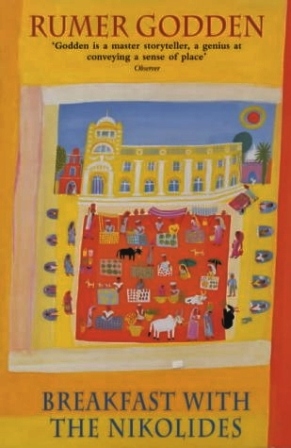
Breakfast With the Nikolides by Rumer Godden ~ 1942. This edition: Pan, 2002. Softcover.  ISBN: 0-330-48781-7. Includes an Introduction by Yvonne Roberts, and the short story A Red Doe. 213 pages.

My rating: 7/10.

Though frequently listed as one of Rumer Godden’s “children’s” books, Breakfast with the Nikolides is a decidedly adult novel, chock full of dark and difficult themes: sexual desire, frustration, betrayal, revenge, reconciliation. Written early in her long career, the fifth of her twenty-four novels, Godden remarked that though the book was received without much comment, it came very close to her personal goal of “truthful writing”.

This is one of the “Indian” novels, started in 1940 as Rumer, her two young daughters and their governess sailed back to India – where Rumer had already spent the majority of her life – to escape the potential German invasion of England at the start of World War II.

Inspired by Rumer’s experiences living in the rural Bengali area of India as the daughter of British Colonialists, the vivid depictions of the setting and supporting characters were drawn from first-hand observation and feel clear and true.

This was one of the novels Rumer Godden felt was “vouchsafed” to her – she drew a definite distinction between “a book written when you are looking for something to write, searching for a theme, and one that seems to arise of itself, demanding to be written.” Breakfast with the Nikolides was a book that demanded to be written, and though it seems at times the author is still working on clarifying her “voice”, on the whole it is a successful experiment.

In the small East Bengal town of Amorra, the Government Agricultural Farm flourishes under the guidance of English agriculturalist Charles Pool. Though he has lived and worked intimately with the local community, he still remains, after eight years, something of a mystery man. The assumption is that he is a bachelor of celibate habits, for he lives an exemplary life of dedication to his goal of converting the local farmers to his new and productive ideas, and he is a respected lecturer at the progressive agricultural college which has now been established at the farm.

One day Charles goes down to the jetty on the river to meet the paddle-wheel steamer, where he meets a beautiful woman and two young girls –  his wife Louise and their daughters. Louise, 11-year-old Emily and 8-year-old Binnie have travelled the long and arduous way from war-torn France where they had been living until forced to flee the German occupation.

Emily and Binnie are enthralled with their new environment; Emily in particular hopes that she will never have to leave. When her father, against her mother’s wishes, gives her a spaniel puppy, Don, this action precipitates a far-reaching set of events ending both in tragedy and elemental change for all of the protagonists.

Lovely Louise is a woman with some serious personal issues. Long estranged from her husband for reasons which we gradually get some clues about, she also has a very difficult relationship with her eldest daughter, whom she seems to misread at every turn. Despite Louise’s insistence that their unification as a family is only temporary, Charles and Emily begin to gradually build up a fragile relationship of trust and affection, which Louise openly resents. She is not looking for a reconciliation; rather she has turned to Charles as a temporary refuge until the war is over; she makes it clear that as soon as she can she will return with her daughters to “civilization”.

The spaniel Don becomes sick; Louise suspects rabies, and, without explanation and in an attempt to shelter her daughters from an emotional trauma and a real physical danger, sends the girls for an unexpected morning visit to a neighbouring family. “Breakfast with the Nikolides” is an unexpected treat, and the girls happily go off, unsuspecting of the drama that will ensue upon their return. (One of my personal small disappointments in this novel is the too-brief introduction to the rather intriguing Nikolides children, Jason and Alexandra, whom we tantalizingly meet for only a few moments before the story whirls on its way without them.)

The young college veterinarian, Narayan Das, becomes involved in the saga, as does one of the agricultural students, Anil, passionate and poetical son of a wealthy and influential Brahmin family.

As events unfold, we see that the marriage of Charles and Louise has foundered because of deep faults on both sides; neither party is innocent here, and though we never get the full details, we learn enough to sympathize even more deeply with the children of this tempestuous union. Godden concentrates to a great degree on showing us the feelings of Emily, who perhaps could be described as the chief character; another one of Godden’s “waifs in the storm” who suffer as the adults in their lives behave badly. Our heroine Emily weathers this episode of the familial storm, and, though emotionally battered and bruised, finds a certain peace of her own by the story’s end, though there are many loose ends left unravelled, just as in “real life”.

The place-portrait of the Indian village is also one of this book’s strengths; Godden’s intimate familiarity with the time and place she writes about is apparent in her clean yet detailed descriptions. Very nicely done.

This is a novel for mature teens and adults, who would best be able to appreciate what the author has presented here; I suspect a younger reader would soon lose interest.

I had to double-check the publication date; this novel has a very contemporary feel to it. Well worth reading, and a good companion piece to Godden’s other adult novels, which show a range of styles as she continually experimented with and honed her considerable craft.

Read Full Post »

« Newer Posts