Archive for the ‘1940s’ Category

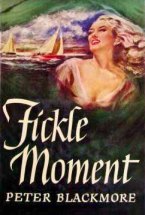
Fickle Moment by Peter Blackmore ~ 1948. This edition: G.P. Putnam’s Sons, 1948. Hardcover. 244 pages.

My rating: 7/10. The epitome of light reading; pure vintage fluff. A nice diversion from the snow whirling round outside!

*****

Elizabeth Portal rather smugly contemplates her thirtieth season as the leading star in the Watermouth Regis amateur operatic and dramatic society. She’s aging marvelously well, looks more youthful than her undeniable fifty, and only an unkind person would raise an eyebrow at Elizabeth’s coming performance as schoolgirl Yum-Yum in The Mikado. But when the other two of the Three Little Maids are Elizabeth’s daughters  Louise and Anna, more than a few sarcastic smiles are hidden behind politely shielding hands.

No matter – Elizabeth is on top of the world. Her eldest daughter, Anna, is about to marry the Watermouth Regis mayor, one Hubert Briggs, a man of varied experience: one-time jockey now turned respected undertaker after a riding accident ended his turf career and sent him back to take over the family business. People like Hubert, hence his election to the mayor’s chair; he’s unremittingly cheerful, and the funerals he presides over rocket right along, a relic (people whisper with a wink) of his sporting career and fondness for speed. Anna’s a bit of a drooper, true, but maybe marriage will pep her up?

Louise already has plenty of pep. A gorgeous young woman with a passion for tennis and swimming, Louise has attracted many admiring glances but so far has not returned the masculine attention of the local swains with anything other than polite amusement. Louise is ripe for love, ready to fall for the right man, who so far hasn’t appeared on her horizon. Or has he?

One day a rather battered sailboat, the Ayacanora, appears from nowhere and anchors just off the Portal’s private beach. Aboard is dashing sailor Richard Hardy, taking a break from his round the world voyaging, hoping to replenish stores and maybe engage in a little amorous relaxation. Lovely Louise swims by, and Richard’s interest is definitely aroused, especially when Louise glances back in her turn. Could something be about to happen?

Young Charlie Rogers, employed under the Portal patriarch Henry’s supervision at the Watermouth Regis town treasurer’s office, shows up to play the piano for the female Portals’ rehearsals. It has suddenly occurred to him that the questions his prospective employer asked him about his piano playing abilities were not so random after all. Charlie sees Louise, and fireworks go off inside his modestly manly heart. But could such a strong and vibrant girl ever look with even the remotest interest on an unathletic, sensitive and insecure (though undeniably good-looking) junior clerk?

Well, I’m thinking you can guess the answers to all of those, and I’m betting you’d be getting them all right. Shake these all together, add a generous handful of eccentric aristocrats and comic townspeople and ex-chorus girls and snobby upper-middle-class matrons, and here you have the ingredients to make a happy few hours reading.

The comeuppance of Elizabeth and the romantic flowering of Louise, plus the side stories of a nicely varied group of secondary characters makes for a narrative which dashes along at a very good pace indeed.

This one was picked up on a whim for the Gilbert and Sullivan quotation on the frontispiece: “Fickle moment, prithee stay!” Having a weakness for Penzancian pirates and Lord High Executioners and the rest of the G and S panoply of characters, my interest was piqued, especially when a closer investigation revealed a publishing date of 1948 and a Wodehousian sparkle of dialogue within.

I must say, if you’re not a devotee of The Mikado, you may find many of the scenes mildly confusing, but if you are, you will snicker along with the townspeople of Watermouth Regis at Elizabeth’s dramatic excesses.

Peter Blackmore was obviously a theatre lover, which assumption was confirmed when I researched him after reading this book and discovered that he was quite a well-known playwright and film screenwriter in the 1940s, 50s and 60s. Fickle Moment also appeared in dramatic form as a play called The Blue Goose, and a play called Miranda, featuring a captivating mermaid being paraded about in a bath chair as an invalid, was made into a very successful comedy movie, detailed here. Most intriguing!

I’d never heard of Peter Blackmore before, but you can bet your sea boots I’ll be watching for his name now. Though I somehow doubt I’ll soon come across another of Blackmore’s books at such a ridiculously low price – 25¢ at the local Salvation Army’s bargain book sale. Perhaps it will average out the next one I just might have to seek out online at a probably much richer price!

I’ll be looking for Miranda on film through the regional library system; this is just the thing that our wonderful librarians like to acquire and share. Please let me know if any of you are familiar with Blackmore; I’m really interested now, and the internet is strangely uninformative, save for the playwright designation, a few Miranda discussions, his dates – 1909 to 1984, and his British nationality.

Read Full Post »

FIELD OF AUTUMN

Slow moves the acid breath of noon
over the copper-coated hill,
slow from the wild crab’s bearded breast
the palsied apples fall.

Like coloured smoke the day hangs fire,
taking the village without sound;
the vulture-headed sun lies low
chained to the violet ground.

The horse upon the rocky height
rolls all the valley in his eye,
but dares not raise his foot or move
his shoulder from the fly.
The sheep, snail-backed against the wall,
lifts her blind face but does not know
the cry her blackened tongue gives forth
is the first bleat of snow.

Each bird and stone, each roof and well,
feels the gold foot of autumn pass;
each spider binds with glittering snare
the splintered bones of grass.

Slow moves the hour that sucks our life,
slow drops the late wasp from the pear,
the rose tree’s thread of scent draws thin –
and snaps upon the air.

Laurie Lee ~ 1945

Read Full Post »

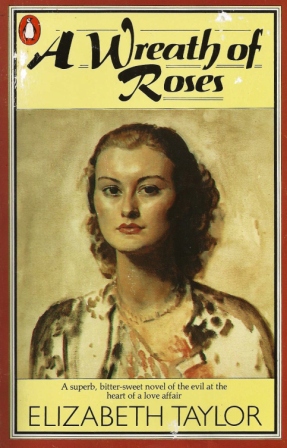
A Wreath of Roses by Elizabeth Taylor ~ 1949. This edition: Penguin, 1984. Softcover. ISBN: 0-14-00.2587-1. 176 pages.

My rating: Easily a 9/10 for the writing, perhaps a bit less for the dark mood it engenders.

Well, no, I don’t really mean that. There are abundant gleams of light. As a middle-aged person myself, fast approaching the half century mark, much in this novel resonated with me, and I felt a strong sympathy and emotional kinship for all three of the female main characters, “maiden, woman, and crone”, as another reviewer referred to them.

*****

There are several excellent reviews on this early Elizabeth Taylor novel, only her fourth, which I’ve linked for your enjoyment below. Anything I have to say merely echoes what these others have said, so I won’t go into too much detail, or describe my response to this interesting novel except to say that I found it much more enthralling than expected.

Three women spend a summer holiday together year after year, but this visit highlights the inexorable march of time, and is one of those “years where everything changes” which happen to everyone from time to time; markers which we think of later in the context of “before” and “after.”

Frances, the eldest, owns the cottage where the three convene. A retired governess and a confirmed spinster, she has for years pursued a secondary career as a modestly successful painter. Liz, the youngest, was once Frances’ charge, and in the year past has married a much older clergyman and has borne a child, whose inclusion in the party is looked upon with something like apprehension by the adult trio. Camilla, a school secretary, is approaching middle-age; she too is a spinster, though not by choice; circumstances and her fastidious personality have left her out in the cold in the mating ritual, and her pride reinforces her smooth shell; she pretends not to mind her state, and the pretence is so finely wrought that she has begun to believe in it herself.

It is Camilla who has the most outwardly eventful time. Her journey to the cottage has been horribly punctuated by a suicide at the railway station; shaken out of her usual reserve, she has made the acquaintance of a handsome young man who turns out to be going to the same village. Claiming to be a writer on a trip of nostalgic research, it is soon apparent that Richard is not averse to weaving a web of lies about his past and present. Camilla is attracted to him and he returns her interest, to the concern of Frances and especially Liz, who sense something “off” in Richard’s manner and constantly shifting explanations.

All three of the friends are “paired up” as the summer progresses. Liz’s husband Arthur drops in from time to time, and Liz flits between her home and the cottage. Frances apprehensively prepares to meet a man who has been a long-time artistic patron and correspondent. Film director Morland Beddoes is himself uncertain as to whether the woman of his long-distance friendship will be the kindred spirit he yearns for.

As the various personalities clash with each other, self-analyze and readjust, the truth about Richard slowly becomes revealed, with deeply disturbing repercussions.

I must also add that Frances’ dog Hotchkiss is one of the most unpleasant canines I’ve yet met in literature. I suspect that Elizabeth Taylor was more of a cat person, as she uses feline comparisons in a rather favorable way in describing some of the characters, and incidentally gives a beautiful cameo appearance to a pregnant Siamese.

*****

Check out the following for more detail and some very thoughtful analyses of this work:

Bentley Rumble: A Wreath of Roses

Laura’s Musings: A Wreath of Roses

Buried in Print: A Wreath of Roses

Read Full Post »

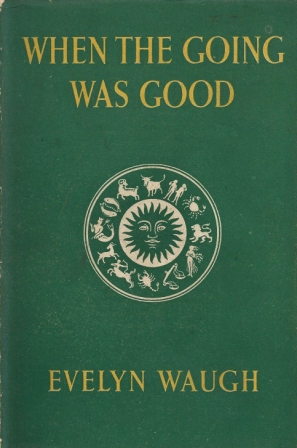
When the Going was Good by Evelyn Waugh ~ 1946. This edition: The Reprint Society, London, 1948. Hardcover. 314 pages.

My rating: 7.5/10. Held my interest throughout.

I’m not even sure where I picked this one up – it appeared in a stack of books gathered in this summer’s travels through B.C. I’m thinking either Kamloops or Vernon, though there is no price and bookseller code marked anywhere on the flyleaf. Possibly from the Sally Ann or a similar charity shop? No matter what it’s provenance, I’m most glad I’ve added it to my private collection. A most enjoyable read, consumed in goodly portions each evening for the last week just before closing my eyes.

*****

From the inner dustjacket:

About this book

It comprises all that the author wishes to preserve of the four travel books he wrote between 1929 and 1935: Labels, Remote People, Ninety-Two Days, and Waugh in Abyssinia. “These four books,” he writes, “here in fragments reprinted, were the record of certain journeys, chosen for no better reason than I needed money at the time of their completion; they were pedestrian, day-to-day accounts of things seen and people met, interspersed with commonplace information and some rather callow comments. In cutting them to their present shape, I have sought to leave a purely personal narrative in the hope there still lingers round it some traces of vernal scent … I never aspired to be a great traveller, I was simply a young man, typical of my age; we travelled as a matter of course. I rejoice that I went when the going was good.”

It’s vintage Waugh, and it’s well-written, the author’s disclaimers aside. Some of it is excellent; it’s all very readable, and it made me brush up on my history; Waugh was of course writing for a contemporary audience, and though I was pleased to realize his references were easy to place, I was quite vague on the details.

Here are the contents:

Preface

From 1928 until 1937 I had no fixed home and no possessions which would not conveniently go on a porter’s barrow. I travelled continuously, in England and abroad… We have most of us marched and made camp since then, gone hungry and thirsty, lived where pistols are flourished and fired. At that time it seemed like an ordeal, an initiation to manhood…”

Chapter One: A Pleasure Cruise in 1929 (From Labels) – London, Paris, Monte Carlo, Naples, Catania, Haifa, Cana (Galilee), Port Said, Cairo, Malta, Crete, Constantinople, Athens, Corfu, Gibraltar, Seville.

Chapter Two: A Coronation in 1930 (From Remote Peoples) – The coronation of Ethiopian Emperor Ras Tafari at Addis Ababa.

Chapter Three: Globe-Trotting in 1930-1 (From Remote Peoples) – Zanzibar, the Congo, Aden, Kenya (Nairobi, the Rift Valley), Tanganyika, Cape Town.

Chapter Four: A Journey to Brazil in 1932 (From Ninety-two Days) – Guiana and Brazil.

Chapter Five: A War in 1935 (From Waugh in Abyssinia) – The Italian invasion of Abyssinia, from a war correspondent’s perspective. Farce versus bloodshed.

*****

If you happen across this little account in your own travels, it is worth the time to read, especially if you are already a Waugh convert.

Read Full Post »

Seventeenth Summer by Maureen Daly ~ 1942. This edition: Simon & Shuster, 2002. Paperback. ISBN: 0-671-61931-4. 291 pages.

My rating: 9.5/10. Every time I re-read this book I love it all over again. I know I tend to overuse the term “evocative”, but if there’s any novel I’ve ever read that qualifies fully for that term, this is it. The young author started working on this book when she herself was seventeen; it was published when she was twenty. With the expected flaws due to the youth of the author, it does not stand up well to pure literary analysis, but as an emotionally appealing record of a teenage love affair it is a delicate little masterpiece.

I’m sitting here trying to think of other titles to compare it to, and I keep coming up with I Capture the Castle, by Dodie Smith, a book I love so much that I’m avoiding reviewing it because I don’t quite know how to put into words its very special quality and appeal.

Though the setting is completely different, and much more realistic – could I Capture the Castle be described as plausible? – I don’t think so! – Seventeenth Summer has a similar mood and delicacy of feeling. Innocent, sensual, agonizingly evocative of a girl’s romantic and yes – I’ll say it – sexual awakening – though anyone expecting the protagonist to actually go “all the way” will be shamefully disappointed. It’s all in there, though.

Maybe a girl’s, or a woman’s book, more than a man’s? Or maybe not. Anyway, I like it – a lot – and confidently recommend it to my fellow readers, at least those of you who think highly of Dodie Smith, Rumer Godden and their ilk.

*****

One early summer evening, in the small city of Fond du Lac, Wisconsin, the late 1930s, seventeen-year-old Angeline (Angie) Morrow, newly graduated from her all-girls Academy, catches a smile from public high-school grad Jack Duluth. A few days later they meet again; Angie is barefoot in the garden picking early radishes, and Jack, driving his father’s bakery delivery truck, stops to inquire about her mother’s bread order. Jack is as taken with Angie as she is with him; he invites her sailing, and the summer love affair is on. And off again, and then on, with all of the teenage angst and glorious peaks and abysmal valleys of emotion and “Does he like me? Really like me? And how much do I like him? And what’s next?”

As the flowers in the garden bud, flower, and reach their blowsy peak in late summer, the love affair follows its predicable natural course. The ending is not as expected, and is, in my opinion, perfectly fitted to what has gone before.

How much should I go into detail here? The internet abounds with reviews; it’s not hard to find a complete dissection of this novel with a minimum of effort. Somehow it has ended up on many high school reading lists, and has suffered far much over-analysis and way too many reluctant-student book reports.

Ignore all of these. Ignore the comments that “nothing happens in this book”, and “Angie is impossibly innocent”, and “how could a little thing like table manners condemn Jack if she really liked him?”, and “the metaphors are so obvious – tomatoes and radishes and poppies – we get it!”, and ” gee, they sure drink a lot of tea and eat a lot of ice cream”, and “what’s the matter with the mother, and why can’t her daughters talk to her?”, and “what about Lorraine (Angie’s older sister) and her parallel love affair with the abusive and manipulative Martin?”, and “what the heck is that ending all about – don’t we get to know what happens?!”

Ignore all of these. Pick up the book, remind yourself that the author was just seventeen herself when she first put these words on paper – because for a little while you will probably be thinking “What the heck? This is so lame!” – and surrender yourself in full to Angie and Jack’s golden summer of personal discovery, restrained passion, and first true love.

Read Full Post »

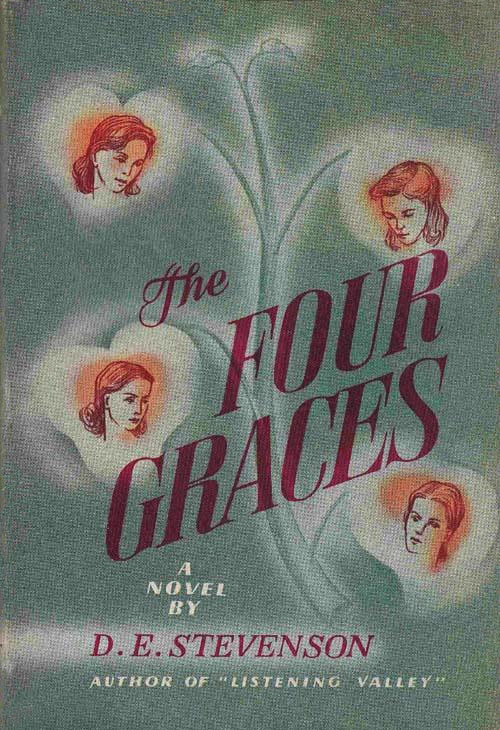
The Four Graces by D.E. Stevenson ~ 1946. This edition: Ulverscroft, 1975. Hardcover. Large Print – 370 pages.

My rating: For purely cozy, exceedingly nostalgic, “English village” escape literature, easily a 9/10. Literary merit – well, we won’t go there! I am actually quite impressed by the assumption that the author makes that her readers are very familiar indeed with the literary greats, as well as the current bestsellers of the day. References and quotations appear without any explanation, with, I’m quite certain, the belief that the reader as well as the characters of the story will “get it” immediately. Rather reminiscent of D.L. Sayers, and her own high-handed assumption that her readers are coming from the same erudite place as she is!

*****

This is my second D.E. Stevenson, after my initial introduction to this author’s esteemed Miss Buncle’s Book . I can understand how Dorothy Emily has garnered such a devoted following over the years. My elderly mother (87) would just love this one. I browsed ABE to see if I could perhaps pick it up for her, but was shocked at what  I thought were astronomical prices for this type of book – $22 and up for worn paperbacks to an unbelievable $246 for an ex-library hardcover. Who knew?!

Someone needs to get going on republishing this author – obviously there is a demand. I know Persephone has recently re-released, in 2009 and 2011 respectively, Miss Buncle’s Book and Miss Buncle Married, but those are the tip of a very large iceberg. According to my research – okay, to be honest, I looked at Wikipedia – this author’s career extended from 1923 to 1970, with a very respectable forty-six titles to her credit.

*****

The Reverend Mr. Grace is Vicar of a country parish, and is blessed with four now-motherless grown-up daughters. Adeline – Addie – the eldest, is a W.A.A.F. officer now living in London, but the three younger sisters remain at home. Matilda (Tilly), Sarah (Sal) and Elizabeth (Liz) all keep extremely busy, both by assisting their father in his many duties and helping with the war effort, for the story is set mid-World War II, and much of its charm is in seeing how the villagers live their lives and gamely make adjustments for the current reality.

Romance enters the sisters’ lives as two suitors suddenly appear – one quite traditionally, and the other much more insidiously. The reader never has a moment of doubt as to the eventual outcome, and though there are gentle setbacks to both romances everything inevitably works out as it should. A very sweet little story, which I found surprisingly appealing. Tiny touches of cynicism and humour kept it from being too saccharine, though it was a rather close thing.

From the Author’s Preface:

The author has been asked whether this is a funny book or true to life, and has some difficulty in answering the question, for life is a funny business altogether (both funny-peculiar and funny-ha-ha, as Elizabeth would say). The story covers less than a year in the life of a family and during this comparatively short period many things happen, some serious and important, others cheerful and gay. It is summertime – a summer during the greatest and most terrible f the wars – but the author felt disinclined to bring such a grave and desperate matter into a light-hearted tale; here, then, are to be found only the lighter side and the small inconveniences of Total War; the larger issues are ignored…

Read Full Post »

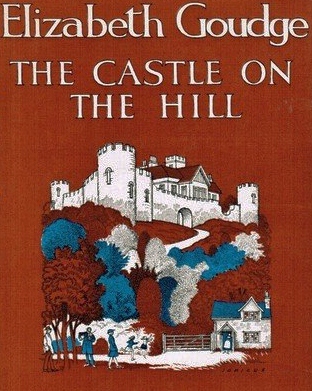
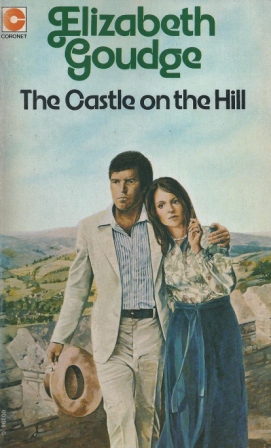
The Castle on the Hill by Elizabeth Goudge ~ 1941. This edition: Coronet, 1975. Paperback. ISBN: 0-340-00396-0. 256 pages.

My rating: 8/10. Rating based on the author’s body of work; I’ve read most of her books, and thought this one was one of the “upper end” in accessibility and lack of long, rambling, philosophical-religious side paths. I enjoyed it.

This is a deeply poignant story, written in the early years of World War II when the outcome was still very much in question, and the author and her fellow countrymen, along with her characters in the novel, were steeling themselves to bravely face their possibly horrific fates under a sea invasion of England. As she penned this novel, Elizabeth Goudge was living in a small country cottage near the village of Marldon, Devonshire with her frail, elderly mother; their days and nights were punctuated by the droning of fighter planes and bombers passing overhead, and the sound of explosions as German bombs exploded in the nearby coastal cities of Torquay and Paignton. Though Marldon itself escaped direct bombing, the inhabitants were extremely aware of their very real danger, and the stresses of living in wartime are very evident in this novel.

*****

Miss Dolores Brown is in a bad place, both literally and figuratively. Her home and source of income, the boarding house she has established in the family home she inherited upon the death of her parents, has been requisitioned by the government for wartime use. A relocation to London and attempts to find a job have proven fruitless; no one much needs or wants a quiet, unassertive forty-year-old woman with only her domestic skills to recommend her. Her friends and relatives are tired of hosting her; she needs to move on. Now news has come that her house and all of her stored possessions have been destroyed in a bombing raid. A train ticket to travel to stay with a relation for a day and a few coins remain between Miss Brown and utter destitution; her predominant emotion is an overwhelming fear of what will happen to her now.

As she sits outwardly proper but inwardly forlorn on a bench in front of the London Free Library, a strain of music catches her ear. Somewhere nearby someone is playing the violin, and Miss Brown rises to find the source of the music, and comes upon Jo Isaacson playing for coins in the street. Miss Brown impulsively puts one of her last shillings in the fiddler’s hat; they have a short exchange, and she goes on her way cheered and encouraged by the brief encounter.

Mr. Isaacson, born in England but musically trained in Leipzig and then settled on the Continent, was once a celebrated musician.  Now fallen on hard times both through his predilection for drinking and the growing persecution of the Jews which forced his flight from Germany, Austria and then Italy, Mr. Isaacson fears that even his old homeland England will reject him next. He has determined to earn a shilling to use in the gas fire in his room to commit suicide; due to Miss Brown’s impetuous generosity, the means to his end is now at hand.

Through a series of coincidences and under the sheltering hand of fate, Jo Isaacson does not use the shilling for his fatal final intention. He ends spending some of it for taking his landlady’s two small children to the train; they are being evacuated to the relative safety of the country. Ending up on the train himself, Mr. Isaacson has set in motion a series of events which will lead to his ultimate attainment of his longed-for place of peace.

In another part of the train, Miss Brown has just met and been taken under the wing of a prosperous historian, Mr. Birley. Mr. Birley has been to London to try to engage a housekeeper for his stately home, Birley Castle, and its household of men: himself, nephews Richard and Stephen, respectively a dashing fighter pilot and an emotionally tormented pacifist conscientious objector, and butler Boulder and gardener Pratt. Not to mention the elderly Alsatian dog Argos, and Steven’s fiery horse, Golden Eagle. But once Miss Brown has unburdened herself of her tale of woe to sympathetic Mr. Birley, he looks at her with calculating surmise. Could she, would she… ?

She certainly could and would. Bucked up by sympathy, a substantial dinner and the prospects of a job, Miss Brown brightens up considerably, and optimistically tackles the daunting task of bringing order to a heedless masculine world.

Meanwhile the two daughters of Mr. Isaacson’s landlady are also on their way to Torhaven, location of Birley Castle, to be billeted with a foster family there, as is Mr. Isaacson himself, who has been taken under the wing of Mr. Holly, the railway guard who discovered him collapsed in the baggage car after the express train left London. Mr. Holly offers him a chance to get settled and find a job “somewhere near the kiddies” – he has mistakenly thought that the children Mr. Isaacson was escorting are his own.

Add in Prunella, the lovely doctor’s daughter who has been the romantic interest of first peaceful Stephen and now exciting Richard, and elderly Mrs. Heather, endlessly smiling inhabitant of the cottage at the Castle gates, and you have all the players assembled on the stage.

Elizabeth Goudge loves to bring her characters together by impossibly convenient coincidence, and this novel is a prime example. The two little girls are billeted at the Castle, and Miss Brown eventually meets Mr. Isaacson; they are united in common memory and relief at each finding at least a temporary haven. Mr. Isaacson is modestly successful as a street musician and music teacher, and Miss Brown has settled nicely into her niche as the housekeeper of the Castle.

Mr. Birley returns to his creative solitude untroubled by household concerns; Stephen prepares for his upcoming hearing to allow him to avoid military service by working at rescue and recovery in the bombed sections of London; Richard comes and goes between missions, dallying with the passionate Prue whenever chance allows; Miss Brown wins over the initially hostile Boulder by her gentle good nature and hard work; Pratt gets on with things much as usual; Mrs. Heather keeps smiling.

Tragedy and turmoil turn this newly peaceful world upside down, and the responses of all concerned show the best qualities that lie buried in everyone to be brought forth under adversity, another favourite Elizabeth Goudge theme.

This condensation leaves out everything that makes this book so appealing: the glimpses into the inner thoughts and deeper motivations of every character involved. Stephen is handled particularly well as he wrestles with his decision to be a non-combatant; his brother and uncle are fiercely and actively patriotic, and though they treat him with respect and affection it is clear that they are impatient rather than understanding of his dilemma.

The character of the quiet and dedicated Miss Brown serves to highlight the divisions and expectations of the class system, soon to be changed forever by the new equality of the war and post-war years. She feels something more than subservient and feudal affection for the Birley family; they however regard her as an appreciated and respected but somehow not-quite-equal being. Miss Brown hides her feelings well; her pride lets her go forward with head held high even when the oblivious Birleys unintentionally disregard her occasional attempts at a deeper friendship.

Mr. Isaacson resolves his feelings of anger towards the world and its unfairness and is able to move onward in his life. (And I would like to mention that I thought he was one of the most awkward characters, as his creator did not seem sure of how she should portray him – he is inconsistent throughout, one moment gruff and earthy, and the next full of academically poetic musings.)

Elizabeth Goudge likes to sort out her couples and pair them off in their proper order. Children are inevitably provided with the best possible homes; damaged marriages are salvaged; family rifts are healed; happy spinsters and bachelors regain their peaceful solitude and worthwhile occupations. The Castle on the Hill runs true to form, but it has much to recommend it in its thoughtful passages and articulate characters. The setting is lovingly described, and most of the characters are fully realized and allowed their chance to show their full and complex humanity.

Given that the book was written in wartime, in the very time that it portrays, it acts as an interesting and quite readable realistic-idealistic period piece. The horrors and tragedies of the war are true to life; the human response of the heroes and heroines is certainly the ideal.

The last few pages have numerous references to the comforts of religion and the role of God in human lives, but this is not at all a “preachy” book.  I thought it was one of the less rambling and more focussed adult novels by this often-underrated writer. I could definitely see shades of some of the characters of Goudge’s most well-known and beloved books, the Damerosehay novels (The Bird in the Tree – 1940, The Herb of Grace – 1948, and The Heart of the Family – 1953) which were written during and after the war years; The Castle on the Hill is something of a dress rehearsal, though it stands alone as a story complete unto itself, with characters whom we never again meet, though their soul sisters and brothers reappear in different guise in her many other books.

Note: I am here including, with some reluctance, the cover shot from the 1975 paperback re-release. The cover at the beginning is from an earlier edition. I am not sure who these illustrated people are supposed to portray; in my opinion they do not represent actual characters of the story, but instead have strayed onto the cover from an Eaton’s mail-order catalogue, Misses and Gents section, circa the polyester era! Quite one of the ugliest covers possible for this book, and not at all indicative of the content. A dire reminder not to judge a book by its outward appearance!

Read Full Post »

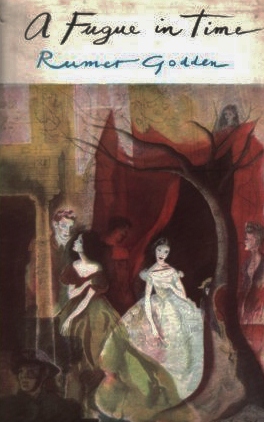
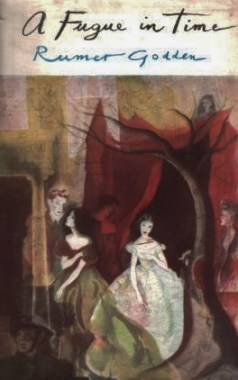
Take Three Tenses: A Fugue in Time by Rumer Godden ~ 1945. This edition: Macmillan, 1976. Hardcover. ISBN: 333-19366-0. 176 pages.

My rating: 6.5/10 for the overall story, 10/10 for the writing. The first rating really should be higher but I am comparing it to its successor, China Court (1958), which used the same idea expanded to five generations, with a much stronger story thread. This one felt a bit experimental, which the author herself notes. It took a few pages to get into the rhythm and figure out all the characters, but after that it was easy to follow, perhaps because I am already very familiar with this author’s use of concurrent and intertwining times in many of her novels. An unusual and ambitious book. Beautifully written.

*****

This book is prime Rumer Godden; an example of why I keep returning to her works time after time; as I’ve mentioned before, even a “poor” Godden is worth the time it takes to read it; her “top end” books are little masterpieces.

Take Three Tenses: A Fugue in Time is, in my opinion, almost a little masterpiece, or perhaps more aptly, the not-quite-finished work of a master artist, still needing a few final touches, but interesting to examine in the context of the artist’s body of work, to get a glimpse into how their mind works. A very experimental piece of work, and decidedly the precursor of the much longer and stronger China Court, which isprobably my favourite Rumer Godden book to date, though I still need to search down a few of her more obscure titles. Though China Court uses the same technique and many similar characters, Take Three Tenses is an entirely different story, except possibly for the theme of the importance of the house itself as a character with a life of its own.

Originally published in 1945, and with the War itself driving much of the story, this novel was reissued in 1975 with this note by the author:

This novel was the first in which I used a theme that has always intrigued me, Dunne’s Experiment With Time, i.e., that time is not consecutive, divided into past, present and future, but that these are all co-existent if only we could see it: if you are in a boat on a river you can only see the stretch on which your boat is travelling – a picnic party on the bank perhaps: a kingfisher diving. What you traversed before, passing willows, a barge tied up, cows in a field, as far as you are concerned, is gone; what lies around the next corner – a lock working, a man fishing – is hidden but, were you up in an aeroplane, you could see all these at once – the willows, the barge, the cows, the picnic party, the diving kingfisher, the lock, the man fishing.

In a Fugue in Time I have taken the part of being up in the aeroplane, seeing three generations of a family at once, all living in a house in London, their stories interweaving, as do themes in a fugue. The difficulty was, of course, not to confuse the reader and it was not until the eighth or ninth try that I found the right way; that it was right seems shown by the fact that, with few exceptions, neither critics nor readers have noticed it, only what Chaucer calls “the thinne subtil kinittinges of thinges”. Some years later I used the same technique with five generations, not three, living in a country house, China Court.

September 1975 R.G.

And from the frontispiece:

…two, three or four simultaneous melodies which are constantly on the move, each going its own independent way. For this reason the underlying harmony is often hard to decipher, being veiled in a maze of passing notes and suspensions…. Often chords are incomplete: only two tones are sounded so that one’s imagination has to fill in the missing third tone.

A SENTENCE DESCRIBING BACH’S FUGUES WRITTEN BY LAWRENCE ABBOT

*****

And for Rolls personally the poem he found:

Home is where one starts from. As we grow older
The world becomes stranger, the pattern more complicated
Of dead and living. Not the intense moment
Isolated, with no before and after,
But a lifetime burning in every moment
And not the lifetime of one man only
But of old stones that cannot be deciphered.
There is a time for the evening under starlight,
A time for the evening under lamplight
(The evening with the photograph album).
Love is most nearly itself
When here and now cease to matter.
Old men ought to be explorers
Here or there does not matter
We must be still and still moving
Into another intensity
For a further union, a deeper communion…
…In my end is my beginning.

T.S. Eliot (East Coker)

*****

Man that is born of a woman has but a short time to live…He cometh up, and is cut down like a flower; he fleeth as it were a shadow, and never continueth in one stay.

Children and the fruit of the womb are a heritage and a gift …. Like as arrows in the hand of a giant even so are the young young children.

THE BOOK OF COMMON PRAYER

*****

The story starts with the disclosure that a house that has been home to a family for almost a century is about to be pulled down as soon as the ninety-nine-year lease is up. The elderly lone occupant, apparently the last survivor of a once flourishing family, Sir Roland (Rolls) Dane, is shocked and appalled at the thought of having to give up his  home.

The house, it seems, is more important than the characters. ‘In me you exist’,’ says the house.

For almost a hundred years, for ninety-nine years, it has enhanced, embraced and sheltered the family, but there is no doubt it can go on without them. “Well” the family might have retorted, “We can go on without you.” There should be no question of retorts nor of acrimony. The house and family are at their best and most gracious together.

The question of their parting had arisen. The lease was up. “And the owners are not prepared to renew,” said Mr. Willoughby, putting his despatch case on the table.

“But they can’t pull down my house!” cried Rolls; but he cried it silently because he was perfectly sensible of the fact that they could and that it was not his house. He was sensible, and at the same time he was outraged. Outraged he said in a voice that was muffled for all its calm, “I don’t want the family to go out of the house.”

The only remaining family was Rolls himself, but Mr. Willoughby could hardly point that out. He wondered what there was slightly unusual about the sentence Rolls had just said, and presently, pondering, h thought it would have been more usual if Rolls had said, “I don’t want the house to go out of the family.” Families possessed houses: not houses the family…

So Rolls reluctantly accepts his fate, and, with his manservant Proutie (himself a life-long devotee of No. 99 Wiltshire Place), slowly starts to prepare for the unthinkable change.

And here the author sets the stage and starts to introduce the many characters whose lives and times make up the story’s “fugue”. We don’t yet know who they are or how they fit in, but their names are teasingly mentioned: Selina, Lark, Verity, Griselda…

In the house the past is present.

It is the only house in the Place that has a plane tree in the garden; for many years a Jewish family lives next door, and every year on the Feast of Tabernacles they would ask for the branches of the tree and built a little Succah on their balcony. All the houses have balconies, long ones across the French doors of the drawing-rooms at the back, and all the balconies have scrolled iron steps that lead down into the garden. The gardens are narrow and long, various in their stages of cultivation and neglect, heavily sooted as well. The gardens have an unmistakable London smell from the closed-in walls, and the earth that is heavy and old, long undisturbed; the smell has soot in it too, and buried leaves, and the ashes of bonfires, and the smell of cat; any child, sent out to play, comes in with the smell; it is part of the memory of Selina and Rolls and the other children and Lark…

The roots of the plane tree are under the house. Rolls likes to fancy sometimes, lately, that the plane tree is himself. ‘Its roots are in the house and so are mine,’ he said. …He flattered himself. The plane tree is more than Rolls, as is another tree of which Rolls is truly a part: it is a tree drawn on parchment, framed and hung over the chest in the hall by the grandfather clock. Selina draws it, marking the Danes in their places as they are born and die, making a demarcation line in red ink for the time they come to live in the house in the autumn of eighteen forty-one.

“We existed before you, you see,” the family might have said to the house; and the house, in its tickings, its rustlings, its creaking as its beams grow hot, grow cold: as its ashes fall in its grates, as its doorbells ring, as the trains in passing underneath it vibrate in its walls, as footsteps run up and down the stairs; as dusters are shaken, carpets beaten, beds turned down and dishes washed; as windows are opened or shut, blinds drawn up, pulled down; as the tap runs and is silent; as the lavatory is flushed; as the piano is played and books are taken down from the shelf, and brushed picked up and then laid down again on the dressing-table, and flowers are arranged in a vase; as the medicine bottle is shaken; as, with infinite delicate care, the spillikins are lifted in the children’s game; as the mice run under the wainscot the house might steadfastly reply, “I know! I know! All the same, in me you exist.”

And against the melodious pattern of the house and its many inhabitants there comes a stronger strain, as the story of the current time appears and plays itself out, with continual references to what lies before and behind. The doorbell rings, and Proutie announces the appearance of an unsuspected great-niece, Grisel Dane, come to England in this early year of the war as a member of a volunteer corps of woman ambulance drivers. Grisel is unhappy in her billet, and has remembered that she has a London relative. Savagely resentful of this disturbance, Rolls refuses to see her, but Grisel is fully as determined a person as her great-uncle, and she moves in to one of the empty bedrooms, determined at first merely to gain some physical comfort in, but soon becoming immersed in her ancestral family’s history for the few months remaining before the move.

Another important family connection also appears, and the inevitable love story plays itself out to the backdrop of the increasing violence of the war. We sense that an inevitable doom of some sort is coming, but we are not sure quite who or what will be lost.

Rumer Godden creates some well-drawn characters among the Danes and their associates. I found Griselda, mother of Rolls and his eight siblings, the most appealing of them all, with her yearnings for a larger world than that which she is trapped in, and her eventual attainment of a rich inner life which compensates in a small way for her over-possessive husband, her long succession of loved and cared-for yet not particularily welcome children, and the continual frustrations of her life as a Victorian upper class woman with strong societal strictures of behaviour to follow.

The strength of this book is in its style rather than its plot or characters; while they are well enough handled, they are secondary to the overall pattern. I almost think that this is intentional on the author’s part, but I was disappointed in her handling of the conclusion; it felt a little too pat; everything came predictably full circle. I fully understand the satisfaction that the author might feel in neatly winding things up, but sometimes a strong, even discordant climax is more memorable to even the most melodious composition than an easily anticipated, repetitive ending phrase.

Highly recommended for Rumer Godden fans, especially if you liked China Court. One of the lesser-known works of this author; I had something of a challenge finding a reasonably priced copy; they’re out there but in nothing like the abundance of many of her other titles.

Read Full Post »
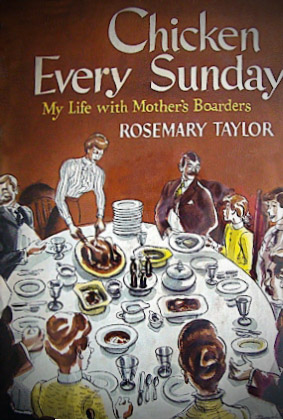
Chicken Every Sunday: My Life with Mother’s Boarders by Rosemary Taylor ~ 1943. This edition: Blakiston, 1945. Hardcover. Illustrated by Donald McKay. 307 pages.

My rating: 6.5/10.

A nostalgic trip down memory lane. This fictionalized autobiography fits well into the “humorous memoir” genre so popular a half-century ago. If you enjoyed Cheaper by the Dozen (Galbraith), and The Egg an I (MacDonald) you will find this a pleasing read. The rating feels a bit low, but it’s not meant to be a snub, just a reflection of where this book fits in with other similar works which I have read and enjoyed over the years. It’s pleasant enough and I will happily recommend it if you come across it “cheap and easy”, but I doubt I would deliberately search it down unless I were particularly interested in the era and setting.

*****

I purchased this old hardcover recently, for a reasonable $5, at Second Glance in Kamloops, B.C. – a WONDERFUL secondhand bookstore, by the way, for any of us local enough to visit it in person. The title rang a faint bell in deepest memory, and once I dipped into it I realized that I had indeed read it years ago. It must have been as part of my mother’s library, though she no longer owns it – it obviously did not survive her many give-ways as she prepared to move from her huge house (two stories plus a packed-full attic) to the much tinier “granny house” she lives in now.

I’m a bit mystified as to why Mom parted with it, as it is just the kind of light memoir she generally enjoys, so I’m going to surprise her with it the next trip in to town with a box of books. At a physically frail 87, one of her few remaining pleasures is reading, and she keeps me busy searching my own shelves and scouting the secondhand emporiums for reading material; a chore I must admit I take on with great pleasure – an excuse to book shop! How much better does it get than having permission from your mother?!

The setting is Tuscon, Arizona, during the first decade of the 2oth Century; the boarding house that the author’s mother ran with such success was built in 1906, “far out in the country”, though, as predicted, the city soon came out to surround it during the boom times of the “roaring twenties”.

The father of the family was quite the wheeler-dealer; finances swung like a pendulum as deals succeeded or fell through; the mother decided to take matters into her own hands to ensure a steady enough income to feed the family, so she began to take in boarders. The book details the succession of quirky characters that passed through the Drachman family doors, as seen through the eyes of young Rosemary.

The incidents are well-presented and the characters are well-portrayed; I did enjoy reading this period piece and I will be keeping it (once my mother finishes with it) with my largish collection of similar works. The humor works most of the time; I smiled (rather than full-out laughed) throughout; the writing is more than competent. The author wrote another book of memoirs focussed on her father’s many enterprises (Ridin’ the Rainbow: Father’s Life in Tuscon, 1944), and several novels.

Apparently very popular at its time of publication, the book inspired a comedic 1944 stage play and then a 1949 movie of the same title, starring Dan Dailey, Celeste Holm, and a young Natalie Wood. (I see that the movie gets lackadaisical reviews on the few online sites I browsed through; I’ve never seen it and don’t plan on searching it out, so that’s all I can tell you.)

Read Full Post »

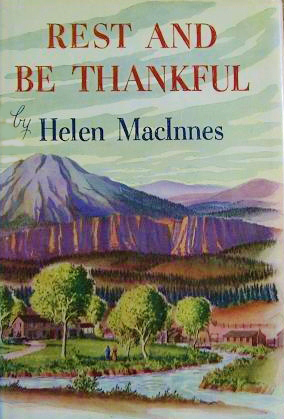
Rest and Be Thankful by Helen MacInnes ~ 1949. This edition: Little, Brown & Co., 1949. Hardcover. 368 pages.

My rating: 9/10

Every so often I find myself re-reading, with great enjoyment, this pleasant, humorous and thoughtful romantic novel by an author better known for her suspense and spy-versus-spy World War II and Cold War-era thrillers.

After almost twenty years living as expatriates in the literary and artistic circles of Europe, Margaret Peel and Sarah Bly are reacquainting themselves with their native America by taking a cross-country road trip in their 1933 Bugatti (purchased new in Rome in those faraway, idyllic times) with their Hungarian chauffeur Jackson. Living in France at the outbreak of the war, Margaret and Sarah had turned their abundant energy from sponsoring and promoting struggling poets to using their private printing press to create clandestine Free French materials, until their betrayal to the German occupying forces in 1941 forced their precipitous flight to eventual haven in England.

The war is over, Margaret and Sarah are back in the U.S.A. and are feeling rather untethered. They are hoping the road trip will give them time to think and refocus and decide on their next project. Heading for California, straying off the highway via a shortcut gone wrong, the trio find themselves lost in the Wyoming mountains with evening coming on. They encounter a group of cowboys, led by ex-soldier Jim Brent, and end up spending the night at his remote ranch house, “Rest and be Thankful”, nestled among tall cottonwoods on the banks of twisting Crazy Creek.

Immediately smitten by their beautiful surroundings, which they favourably compare to the Dolomites and the Alps, Margaret and Sarah concoct a scheme to set up a literary retreat at the ranch, to nurture and encourage struggling authors.

Margaret was a best-selling author before the war, though her most financially successful work, a “non-literary” romance, was written under a secret pseudonym, and she thinks her capital will be sufficient to support the scheme. Sarah, soon finding herself  renamed”Sally” as the simpler charms of Wyoming country life work their magic, has some funds left from her pre-War travel and cookbook sales. With this new project in hand, Margaret and Sally spread the word amongst the New York literary community, and the writers’ retreat is soon underway with “six authors in search of a character”.

And a disparate and difficult lot they prove themselves to be! Helen MacInnes has written a tongue-in-cheek expose, sometimes straying into parody, of stock New York literary characters of the 1940s, and their varied reactions to the “simple locals” of rural Wyoming. Those locals are handled with a much gentler tone; MacInnes obviously had some experience with and a deep fondness and respect for the ranching community of the area she writes about in this novel; though sometimes stereotyped and parodied she presents them in an overall very admirable light. (The book is dedicated “To Gilbert and Keith, my favorite cowboys”, so I suspect a back story is involved in the setting of this tallish tale.)

I also have a strong feeling that Helen MacInnes had a most enjoyable time writing this book. She has some cutting comments to make about various characters in the “high literary” world, which I suspect were based on people MacInnes personally knew. There is much discussion about the dangers of Communism; the Cold War is looming and MacInnes is keenly and vocally aware of the European and American political situation; themes she elaborates on in her later spy thrillers are very evident here.

But ultimately, for all the trimmings, this is a simple romance – or, more accurately, two or three – a love story lies at the heart of this appealing novel.

Flaws? Oh, yes – many! Very much a period piece, and should be read with this in mind. Stereotypical characters and situations abound, but these are balanced, in most cases, by the author’s open acknowledgment that she is writing something of a satire, and she generally allows her most outrageous characters and comments the grace of an explanation as to why they appear as they do.

Final verdict: an enjoyable vintage novel, of interest to fans of MacInnes’ thrillers and to those seeking an intelligently written comfort read.

Read Full Post »

« Newer Posts - Older Posts »