Archive for the ‘1940s’ Category

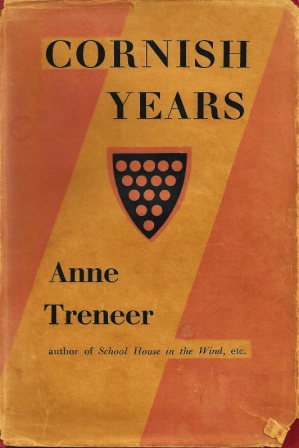
cornish years anne treneer 001Cornish Years by Anne Treneer ~ 1949. This edition: Jonathan Cape, 1949. Hardcover. 284 pages.

My rating: 8/10.

This is the second volume of Cornish writer and poet Anne Treneer’s trilogy of memoirs. The first, Schoolhouse in the Wind , was such an unexpected treat that I immediately decided to track this author’s other works down. I did all of the usual searches, and decided my best bet was to order the re-released trilogy published by the University of Exeter Press in 1998, under the (slightly altered) title of the first book, School House in the Wind.

Imagine then my delight upon finding this first edition copy of the second volume in a tiny antique store in the micro-community of Barriere, B.C. on a quickie road trip last week. We were out in our old Spitfire convertible, investigating promising narrow, winding (and must be paved – not a given in this part of the world) side roads in the Kamloops area, and were ready for a break from the wind and sun when a sign in the window captured our notice: “Used Books”. Well, that was irresistible, so I pulled a quick U-turn (an easy feat in a tiny little Triumph) and in we went. Lots of china and glassware, but the promised used books were only a shelf or two, quickly scanned and dismissed. However, as I made my way carefully out through the shelves of fragile treasures, something caught my eye in the showcase beside the cash register. There, side by side, were this book, and another, The Angels’ Alphabet by Hilda van Stockum, a first edition picture book by another author-illustrator I’m mildly interested in.

I’m guessing these were featured because of their intact dust jackets and general “vintage” appearance? Anyway, for well under twenty dollars I walked out of the store clutching my treasures with ill-disguised glee. And that proved to be the bookish highlight of the day, as our subsequent visit to our real destination, Kamloops’ excellent At Second Glance Used Books, source of so many wonderful finds over the past ten years, left us standing in bemusement peering through the windows of an empty store front.

“They’ve moved!” I said optimistically to my husband. Across the street to the Kamloops Art Gallery we trotted, and upon inquiry we were stunned to hear that the bookstore had indeed closed just a few months ago. “So many people are asking about it, and they’re all so disappointed,” said the helpful girls at the admissions counter.

Turns out that a steady decline in sales over the last few years had left the owner debating the state of the used book business. She sold off as much as she could in a series of escalating sales, and at the end had dumpsters brought in, and binned the remainder.

I am very sad. What a dismal ending to such a grand bookstore.

Two more of my local used book sources, Nuthatch Books in 100 Mile House, and The Final Chapter in Prince George, are also debating closure, as their margins are steadily decreasing. Every bookseller I’ve spoken to has blamed e-books for the decline in the print book business.

Meanwhile the charity shops are overflowing with books – most, admittedly, the epitome of “trashy” (in so many ways) – which may indeed be an indication of shelves being cleared as people embrace the new technology.

There is no adequate substitution for a well-established, well-organized used book store staffed by fellow book lovers. I tremble at the thought of more of these dying out, much as I understand the seduction of having your reading material to hand in a compact electronic format.

But used book sellers have grocery bills too, and once the point of too-little return is reached, what options do they really have? I know many are turning to internet sales, but to do that properly is a job in itself, and the competition is fierce unless you are prepared to vigorously establish a lucrative niche market of some sort, often not a very viable option for those in small communities with limited book-sourcing opportunities…

Ah, well. It is what it is. Back to this book.

*****

Cornish Years decidedly lived up to my high expectations. Ann Treneer continues her life story of the years between 1906 and 1932 with cheerfully pragmatic anecdotes about her own doings, and affectionate reminiscences of the places and people she rubbed up against. As in Schoolhouse, the narrative is never twee or gushing, but it is cheerfully positive in tone, and the mood feels genuine throughout.

As much as it is a personal narrative, Cornish Years is also a loving ode to place, both Treneer’s home region of Cornwall, and places farther afield. Anne Treneer spent time as an adult student pursuing studies at Lady Margaret Hall in Oxford, and her memories of those days are beautifully evocative and full of love and appreciation for her experiences there.

The snippets of Anne Treneer’s poetry in Cornish Years – she was a published poet from an early age – show much more style and polish than those in School House; I wonder if she has included these small samples of her work in some sort of chronological order? If so, I would be most interested to see what the third volume of memoir, A Stranger in the Midlands, contains, both in the way of poetry and in the continuation of Anne’s personal story.
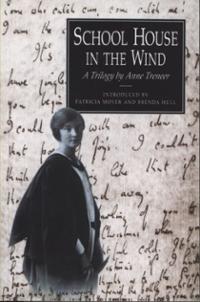
school-house-in-wind-trilogy-by-anne-treneer-paperback-cover-artAs I can’t count on bookish serendipity to bring me the third book as it did the first and second, I have taken things into my own hands and ordered the 1998 trilogy. And if I do come across an old copy of Stranger, I will of course be more than happy to add it to the bookshelf.

In my internet travels, I came across an interesting reference to Anne Treneer at this blog, The After Life of Books, written by Gillian Thomas, an English literature teacher and resident of Cornwall. She writes about the experiences of her parents and grandparents in relation to the books they read. (Fascinating website, well worth a look-around.)

She (Gillian’s mother) was particularly proud of having a personal connection with another Cornish writer, Anne Treneer, author of the childhood memoir, Schoolhouse in the Wind, and Cornish Years, a reminiscence of her college education and early years as a schoolteacher. Treneer had been my mother’s English teacher at the local grammar school and, as well, had rented a cottage from my grandparents. They, along with other villagers, appear in one of the chapters of Cornish Years, and both my grandmother and mother often proudly mentioned these references. They were flattered to find their names in a book, even as faintly amusing village “characters.”

My mother’s pride in the Treneer connection may have originated in the prestige of a personal aquaintanceship with a published author, but it was sustained by her fascination with Anne Treneer’s apparent independence from conventional restrictions.  During the time the author taught at the grammar school she used a motorcycle to explore the area, a detail which always figured in my mother’s recollections of that time as well as in Treneer’s happy reminiscences about her Velocette in Cornish Years. Similarly, my mother recalled visiting her former teacher years later and finding her fuelling the fireplace in her rented seaside cottage with an enormous driftwood spar that she had just scavenged from the beach. In all these reminiscences Anne Treneer seemed to embody an insouciant air of independence, a relishing of her own solitary company and an unconcern about conventional behavior. In the letters and postcards from her that arrived from time to time throughout my childhood, she always seemed free to travel at will. We imagined, I think, that this apparently carefree independence, came with the role of being “an author.” It was, of course, mainly made possible  by Treneer’s generally frugal tastes and habits. Also, it’s likely that  travel funds came from the author’s older brother, Maurice, who had emigrated to the US and become senior chemist at Miles Laboratories in Elkhart, Indiana. He is credited with creating the original formula for Alka-Seltzer, a product whose launch was fortuitously timed to coincide with a flu epidemic as well as the end of Prohibition. While he does not seem to have personally owned the patent to that lucrative cure for hangovers and other malaises,a number of other patents in his name, as well as his salary as head chemist at Miles Laboratories, would have enabled him to be generous in funding holidays for his sister…

And here, as another side note, is the Wikipedia page regarding the Velocette motorcycle, one of which Anne Treneer tenaciously learned to master and rode about on with undisguised joy, which she so eloquently described in Cornish Years.
Read Full Post »

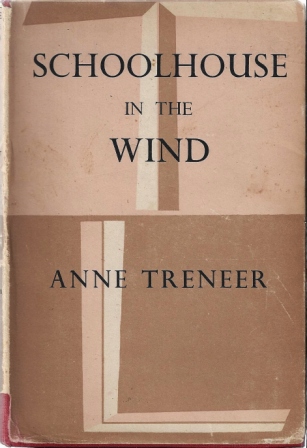
schoolhouse in the wind anne treneer 001Schoolhouse in the Wind by Anne Treneer ~ 1944. This edition: The Travellers’ Library, 1950. Hardcover. 221 pages.

My rating: 8/10.

A slight memoir which leapt into my hand as I was quickly browsing the back room bookshelves housing the “collectibles” during a recent visit to Hope’s lovely used book store, Pages. I’d never heard of Anne Treneer before, but I am so pleased to have made her unexpected acquaintance.

Intrigued initially by the title, and wondering rather why this volume had been shelved among the back room “treasures”, I had no idea what to expect, but a brief dipping-into let me know that this was one of those personal memoirs of childhood which can be such appealing reading, capturing as they do the very essence of an individual’s earliest memories, and frequently memorable glimpses of long-passed time and much-changed place.

*****

He panted to escape but I
As he was winding thin
And narrowly was slipping by
Gasped and drew him in.

~On Catching the Breath

Anne Treneer was born in 1891, in the small village of Gorran in England’s Cornwall (hotbed of so many writers and creative types), the very much unplanned-for sixth child of the family, born after the family of four boys and a longed-for daughter, Anne’s older sister Susan, was thought complete. The baby carriage had long been given away, so Anne was trundled about by her older brothers in whatever other conveyance was handy:

My brothers say they brought me up in a wheelbarrow, and that this accounts for certain bumps in my forehead and generally scrappy appearance. When I was small they used to tell me that old Mrs. Tucker brought me one winter night in a potato sack and left me on the front step; and that I squalled so loud that my father said to my mother, ‘For God’s sake bring the little Devil in and see if she’ll stop that noise’. So in I came and stayed…

Anne’s father was the local schoolmaster, and Schoolhouse in the Wind is an affectionate, humorous and occasionally poignant evocation of a small corner of Cornwall at the juncture of the 19th and 20th centuries.

Gorran School, with a house for ‘master’ glued to it, stood strong and symmetrical, without beauty but not mean, triumphantly facing the wrong way. It might have looked south over the distant Gruda and the sea; but this advantage was forgone in favour of presenting a good face to the road. Master’s room in school, the big room as we called it, caught the north wind while the closets at the back caught the sun. I have heard that Mr. Silvanus Trevail, the architect, who designed many Cornish schools, committed suicide in the end; but whether out of remorse for his cold frontages I do not know.

That last comment at the end of the book’s first paragraph filled me with quiet glee – obviously this was not to be a completely sweetly sentimental memoir, but something with a bit more bite! – and I read on with high expectations. Those expectations were well met and frequently exceeded.

a young Anne Treneer

A young Anne Treneer.

I could go on and quote many excerpts of Anne Treneer’s rather delicious writing, but I won’t. This book was recently (well, in the late 1990s, “recent” in the used book world, I feel) reissued along with its two companion memoirs, Cornish Years and A Stranger in the Midlands, as a one-volume trilogy. It should be fairly readily available in libraries – at least in British ones – and there are a number of copies available through ABE.

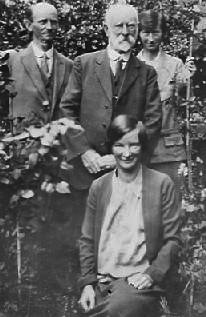
A young Anne Treneer (seated) with her father & sister Susan

A young Anne Treneer (seated) with her father & sister Susan

I recommend it on the strength of this first volume of the trilogy, and I will be buying the combined memoirs for my personal library. The first chapter of Schoolhouse in the Wind sets the stage, as it were, introducing the physical setting of the chapters of reminiscence to follow, and though it will perhaps be of greatest interest to those familiar with the area, even to me, a reader who has never visited England, the picture it draws is vivid and memorable. Also vivid are the character portraits the author paints of her family; with a few well chosen words they come alive on the page.

An internet search brought up a very few references to Treneer. Though she is described as a “prolific” writer, there appear to be few of her titles now available, aside from Schoolhouse in the Wind and the other two memoirs. Schoolhouse is also full of brief snippets of poetry; one assumes these are samples of the author’s work. Some are quite lovely; others seemingly aimed at perhaps a juvenile audience, which is understandable as Anne Treneer spent many years as a schoolteacher.

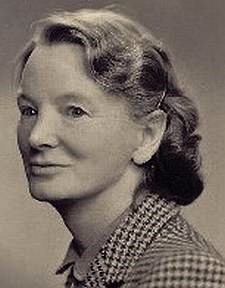
Anne Treneer

Anne Treneer

Anne Treneer never married, and seems to have led a happy and rather individualistic single life, pursuing her many interests with passion and good humour. She died in 1966.

I will leave the subject of Anne Treneer, at least for now, with this excerpt of a short biography from Maurice Smelt’s 2006 book, 101 Cornish lives.

 Anne Treneer pulled off a difficult trick; she wrote an autobiography that succeeds in enthralling despite its almost relentless happiness. Most writers would not even try, reminding themselves that ‘happiness writes white’. It came out as three books over a period of eight years – Schoolhouse in the Wind, Cornish Years, and A Stranger in the Midlands – and it runs from her earliest memories to a day in her late 50s when she went to America to visit her brother.

From her father’s village school she went to St Austell County School, then to a teacher training college in Truro and then taught in various schools in Cornwall. Ambitious to read deeper and wider she took an external course at London University during the First World War, later spent a year at Liverpool University, later still took a postgraduate degree at Oxford as a mature student. Her longest spell at any one school was a seventeen-year stint at King Edward’s in Birmingham, ending in 1946 with a year’s sabbatical leave. She had by then already written Schoolhouse in the Wind two years earlier, and her future was to be a writer, exiled but coming to her beloved Cornwall when she could. In those twenty post-war years she lived mostly in Devon. She was never married and died in 1966.

One reason why her life seems so tranquil is that she was so eccentric, and at the same time so commonsensical that she records what she did as if doing it were the most obvious thing. For example, she loved air with a passion. It is a word of power in her books, her poems especially; there it is, in slight disguise, in the title of Schoolhouse in the Wind. Hence her whizzing about the country in her young days on a Velocette motorbike, the air streaming past her nose like high-speed champagne. As a teacher in Birmingham she spent a summer term commuting (by Velocette) from a tent in Shropshire on Clent Hill. Tents also feature in later summer holidays in Gorran with her sister Susan – three tents, one for each of them and one for the saucepans… Her outdoorsness gave her the keenest eye for the particularity of place, and she could see several worlds in a single Cornish parish.

She claimed to hate crossings-out and third thoughts, but one would never know it as her books are easy reading, usually a sign of art concealing graft…

“Art concealing graft”… what an intriguing comment that one is, as well!

So, if you stumble upon anything by Anne Treneer in your travels, pick it up and peruse it. She has a lot – happily wry and generally unsentimental – to say.

This one gets a “hidden gem” tag.

Read Full Post »

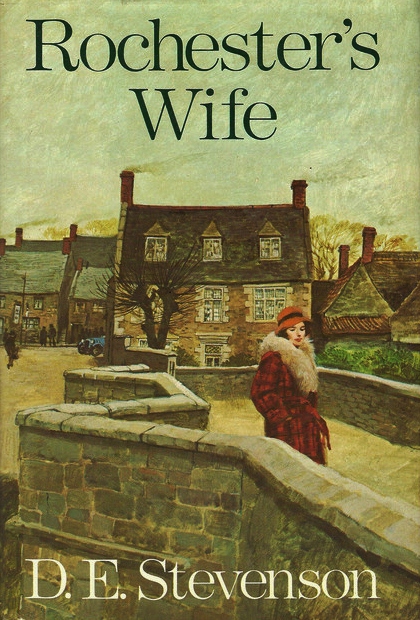
rochester's wife d.e. stevensonRochester’s Wife by D.E. Stevenson ~ 1940. This edition: Ace, circa 1970s. Paperback. ISBN: 978-0441733255. 335 pages.

My rating: 5/10.

*****

This is one of the “secondary” D.E. Stevensons, and, I believe, a “stand-alone” book, as none of the characters seem to reappear in any of the other stories. Though published in 1940, the time frame is pre-W.W. II, as there are only a few references to the “situation in Europe”, and, though the atmosphere is cloudy with foreboding, the focus is on the troubles of the individual characters, versus those of the wider world.

Young (in his late twenties) Dr. Kit Stone has returned to England after four years of travelling round the world seeking adventure. He had long cherished the ambition to become a sailor, but his (widowed) physician father had pressured him into studying medicine instead, with a view to taking over the family practice. The elder Dr. Stone died just as the younger Dr. Stone qualified, and the practice was instead sold, with the proceeds being split between the family’s two sons. The elder brother, Henry, had gone into business as a successful stockbroker and invested his share accordingly, while Kit, suddenly at loose ends, has decided to see something of the world.

Kit’s travels are touched on continually throughout the novel, and sound quite fascinating in and of themselves. He’s been in China, “looking for the war”, and has seen more of it than he had planned for. There is a reference, near the end of the book, to his standing in a marketplace when a shell fragment kills a mother and baby standing next to him; he is “spattered with their blood”, and there is a statement that he has seen quite a lot of blood in his travels. Strong stuff for this mild romance! Another incident, which has more bearing on the eventual plotline, is that Kit has had experience with diagnosing and treating a case of insanity while in America. One would rather like a full itinerary of his wanderings; he seems to have covered quite a lot of ground!

So now Kit is back in England, and though he still feels that he can’t bear to be “tied down”, he allows his brother to persuade him to try out steady employment for a while. Henry’s business partner, Jack Rochester, lives in the village of Minfield, just out of London. Jack’s wife, Mardie, is good friends with the elderly village doctor, who is getting overwhelmed with the demands of his practice, and when she hears of Henry’s brother’s sudden return, puts forward the idea that perhaps Kit might be interested in a position as assistant to the Minfield practice.

So Kit, rather reluctantly, agrees to try out life in an English village. Dr. Peabody welcomes him with gruff suspicion, which we (and Kit) immediately see as merely hiding hte proverbial heart of gold. The Peabody household consists of the elderly doctor, his bitter spinster daughter Ethel, and a grandson, precocious (and exceedingly likeable)young Jem, who is living in England for the “healthy climate” while his parents reside in Ceylon on a tea plantation. They are soon joined by another daughter, Dolly, recently married and, unbeknownst to her family, newly pregnant. Her husband, stationed in Malta, has asked her to stay in England because of her pregnancy, and Dolly’s reluctance to share this news with all and sundry has led to some speculation that perhaps her marriage is already in trouble, because otherwise why wouldn’t she be following her spouse?! Dolly and Ethel are the classic bickering sisters, and their feuding and continual cutting comments to each other add a lot of spice to this rather pedestrian tale.

The heart of the novel is an (apparently) doomed love triangle between Kit, the absolutely beautiful, charming and saintly Mrs. Rochester (Mardie), and her high-strung husband, Jack. Kit is immediately smitten with Mardie; Mardie is deeply in love with Jack; Jack depends on Mardie for emotional support as he deals with his stressful job, and much is made of how happy Mardie and Jack were in the first year or two of their marriage, though now, in year three, things are rather more difficult.

As young Dr. Stone is absorbed into the Minfield world, all seems to be going well with the “settling down” process, but for the unrequited love bit. Kit yearns for his unavailable love, and we start to see little hints that perhaps his passion isn’t exactly unappreciated and unreturned, but of course, there is that rather prominent husband in the picture. Jack, however, is showing signs of what could be charitably described as nervous tension; his personality is deteriorating by the day, and Kit and Dr. Peabody are soon looking up the characteristics of “insanity” in their medical books, and talking of bringing in a specialist.

The ending of this tale is a bit sloppy and unlikely, though everyone ends up neatly paired and with problems happily solved. I’m sorry to say that this is not one of D.E. Stevenson’s better efforts among those I’ve read so far, though there are many diverting situations throughout the book, mostly concerning secondary characters. We have the relationship between the Peabody sisters, young Jem with his brilliant talent for mimicry, an elderly Scottish housekeeper, Hoony, and her illegitimate grandson, Wattie, and, off in the background, the very happy marriage between Henry and his rather liberated wife, Mabel, who dabbles in the stock market quite successfully on her own, with her husband’s proud approval. The relationship between the two brothers, Kit and Henry, is nicely portrayed as well. They do seem a likeable family, with reassuringly human flaws fully recognized and easily forgiven by the reader.

A reasonably decent read, though I found myself groaning and figuratively smacking hand to forehead occasionally, especially regarding the whole “insanity” thing, and the remarkable (!) scenario the author has dreamt up for its resolution. Definitely worth reading as part of the D.E. Stevenson canon, though I’m afraid I closed the book and said farewell to the characters with a feeling more of relief than reluctance!

rochester's wife d.e. stevenson daylily detail 001And I must say something about the dreadful paperback cover. (Cover illustrations being, as some of you may have gathered by my continual harping on the subject, something of an issue with me.) Why, oh why do publishing companies insist on putting “current” illustrations on books set in past times? The characters illustrated on the Ace cover are obviously from the 1970s in dress and hairstyle; I cringe when I look at it. The only thing that that I found attractive (and here is the hort in me speaking) is the rather lovely inclusion of a border of tall orange daylilies (probably Hemerocallis fulva ‘Europa’ from the looks of them), in the foreground of the trio of tennis players and extending around the back of the cover.

Much more appropriate is this other coverrochester's wife hc dj d.e. stevenson, which captures the mood and setting exceedingly well.

I am coming to the end of my personal stash of D.E. Stevensons, and the more I read of her the more eager I am to go on with building the collection. It’s going to be an expensive year, I fear. Even the tired old paperbacks are seriously overpriced, but I’m afraid I’m now hooked and will be playing the seeking game to the full extent that my pocketbook allows.

Part of the fun is the glorious awfulness of some of Stevenson’s scenarios – I just now have realized I’ve made no mention of the Jane Eyre references in this particular novel – nothing subtle about that, is there?!

D.E. Stevenson. When she is good, she is very, very good, but when she is bad … maybe she’s even more interesting!

Read Full Post »

I’m going to review these together. They were both quite wonderful, so much so that, pressed for time as I am this week, I cannot let them pass onto the “have read” list without mention. In my opinion, this trilogy, Vittoria Cottage, Music in the Hills, and Shoulder the Sky, have the Miss Buncle books beat all hollow. Good stuff! I can see these going on my treasured keeper shelf.

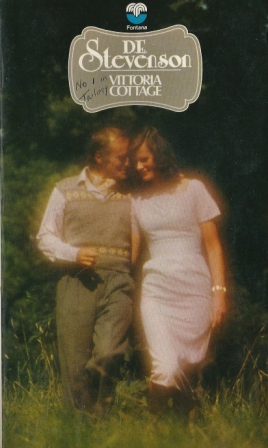
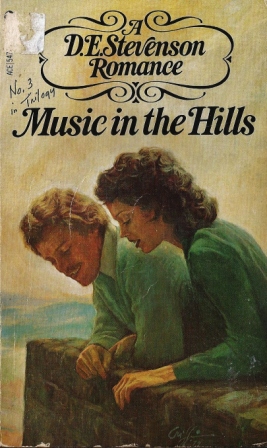
Please try to ignore the desperately ugly covers on these re-released paperback editions. I find them quite embarrassingly inappropriate to the content, which, while “romantic” enough to please the most sentimental, is not cloyingly so as these would lead one to believe. I had some explaining to do to family members who saw me reading these – “What the heck is that?! You’re slipping, old girl …!”

*****

vittoria cottage d e stevensonVittoria Cottage by D.E. Stevenson ~ 1949. This edition: Collins-Fontana, 1974. Paperback. ISBN: 0-00-613-444-0. 191 pages.

My rating: 8.5/10.

Middle-aged Caroline Dering has just been widowed, and, aside from her genuine and seemly sorrow at the death of someone who has shared her life for many years, she is not at all steeped in sorrow. Her lately departed spouse, Arnold Dering, was of a complaining and perpetually malcontented disposition. While  his wife and three children were accepting of his character – Caroline thought that he always meant well, and suspected that at rare moments Arnold recognized and truly regretted his deep pessimism – but by and large enjoyed themselves much more in his absence.

The scene is set for what is to become a series of three novels by descriptions of the village of Ashbridge and the far from cottage-like Vittoria Cottage, ancestral home of the Derings. Though she has merely “married into” the local family, Caroline fits into the local hierarchy almost immediately, and by and large leads a deeply contented life, caring for her children, volunteering for various worthy causes, keeping house and gardening. The children are all grown up, with James away in Malaya, and lovely but discontented Leda (she takes after her father in full) and boisterous Bobbie making their way out into the larger world from the safe haven of their village nest.

To-day Caroline Dering was not working in her garden. She had taken a basket and gone up the road to the gravel-pit to pick blackberries. There was a thicket of brambles, there, and Caroline knew it well. Every year she made this pilgrimage and every year she returned with her harvest of big, black, juicy berries to make into jelly and to bottle for the winter. It was curious (thought Caroline, as she began her task) how the years seemed to telescope when you looked back. Surely there were less than three hundred and sixty-five days between each picking! She remembered the first time she had come. She and Arnold had come together – they had just returned from their honeymoon and settled at Vittoria Cottage – but Arnold had not enjoyed picking blackberries, he had got a thorn in his finger and had torn his trousers on a wild-rose bush and he had suggested that in future they should employ some of the village children to undertake the task. After that Caroline had come alone until James was old enough to help … and then the little girls had joined the party and blackberrying had become an event, a yearly picnic, which took place, weather permitting, upon James’s birthday.

Now, once again, Caroline came alone. The girls had other things to do and Caroline had no use for reluctant assistants. Next year … would James be here? And if he were here would he want to come and pick blackberries on his birthday?

World War II has been over for several years, but England is still very much in coping and recovery mode. Society is fast changing into some sort of new normal, and though things are steadily improving, there is still food and fuel rationing, and a strong atmosphere of “making do”, which makes for some quite fascinating scenarios as we progress through the book and look over Caroline’s shoulder as she goes about her days.

Life in Ashbridge gets suddenly quite interesting with the arrival of the mysterious Mr. Shepperton, who is apparently very reluctant to discuss his past, and who arouses even more suspicion because he appears to have no old belongings or clothing, a real rarity at that place and time, immediately post-war – “everything new!” the village gossips whisper with raised eyebrows.

Caroline’s lovely younger sister Harriet, a successful actress ducking away to her sister’s home for a respite from a difficult and failed recent stage production in London, brings some ex-urban dash and sparkle to village gatherings, and with the unexpectedly sudden return of James from Malaya, and the trials and tribulations of Leda and her fiancé Derek, the local squire’s son, there is plenty of scope for complications, dilemmas, surprises and sometimes unexpected resolutions.

I thought the characters were very well drawn and (mostly) very believable. Caroline is our heroine, but she is not a perfect person by a long shot; her flaws are well on display, but we forgive her them because she is ultimately exceedingly likeable, as is her sister and most of the other players in this excellent domestic drama. It ends quite abruptly, but this served merely to make me keen to get my hands on the next episode in this extended tale, which I was fortunate enough to acquire along with its sister novels recently.

On to Music in the Hills.

________________________________________

Music in the Hills by D.E. Stevenson ~ 1950. This edition: Ace Books, circa 1970. Paperback. ISBN: 0-441-54725-7. 282 pages.music in the hills d e stevenson

My rating: 8/10.

Having more or less settled the fates of Caroline Dering and her sister Harriet Fane in the previous novel, Vittoria Cottage, this next one follows Caroline’s son James, who, at loose ends after his military service and several years spent “chasing terrorists” in Malaya, is looking towards his future.

Deeply in love with his childhood companion Rhoda, he is struggling with her rejection of his marriage proposal. While we suspect that she is in love with James in her own way, Rhoda fears that, as a rising professional painter, marriage would spell the end of her career goals, and that she would be a discontented wife as well as a poorer artist, having to split her focus between two roles, doing neither well.

James takes it very well, all things considered, and hies himself off to the community of Drumburly in Scotland, where he has been invited by his aunt and uncle to reside at the remote Mureth House, a prosperous sheep farm. Jock and Mamie Johnstone have no children of their own, and are hoping that their nephew might be interested enough in farming life to take over Mureth some day. James has always cherished a desire to be a farmer himself, so the situation looks like a success all around; the story follows some of James’s apprenticeship and details the day-to-day occupations of a hill farmer of mid-2oth century Scotland; quite nicely detailed and striking true in the telling.

We have sheep rustlers and romantic entanglements and, of course, more than a few misunderstandings between various parties, all neatly tidied up as the story progresses. Perhaps not as strong a narrative as the preceding Vittoria Cottage, but definitely engaging. I enjoyed it greatly.

The characterizations of the local inhabitants are often well drawn; we all know people just like these.

I’m looking through the book for a snippet to share with you, but am finding nothing really suitable – everything is so enmeshed with the  rest of the story that to take a bit out of context would do it no justice, so you’ll have to take my word for it that this is a well-written post-war domestic drama, with much to recommend it as escape reading in our hectic modern age.

Music in the Hills is followed by a third book to form a trilogy, Shoulder the Sky, also published as Winter and Rough Weather. I’d read this one some months ago, liked it a lot, and reviewed it here: Shoulder the Sky

Reading this trilogy has made me into a confirmed D.E. Stevenson fan. This is good stuff, for which I am ready to forgive some of the less than stellar output by this writer. She definitely had highs and lows in her output, but the Vittoria Cottage trilogy is quite decently lofty.

Read Full Post »

the web of days edna leeThe Web of Days by Edna Lee ~ 1947. This edition: D. Appleton-Century, 1947. Hardcover. 1st edition. 276 pages.

My rating: 3/10. The 3 points is for, um,  something.

Let’s see, now.

The best I can come up with is that it was engaging in that I read it to the end, hoping for some sort of unpredictable plot twist to crank it up a notch. (Sadly, that never happened.)

*****

Every once in a while I read a real clunker, which serves to remind me that all vintage books are not really worth saving.

The Web of Days was mesmerizing in its awfulness; I read it cover to cover, with increasing queasiness. Like the proverbial train wreck, I just couldn’t look away.

In a phrase: Melodramatic Gothic Southern Romance.

Prim, virginal, stunningly beautiful Yankee governess Hester Snow is engaged by the master of the derelict Georgia plantation called Seven Chimneys to care for his young son. The boy’s mother is a hopeless alcoholic, and Miss Snow finds the plantation to be an absolute disaster – the house is filthy, the servants sullen, and the master’s wife and mother viciously scornful of the new governess’s insistence on tidying up and tackling jobs for herself.

Hester immediately sets about fixing everything. Single-handedly she whips the house servants (ex-slaves, as this story takes place just after the end of the American Civil War, in Georgia) into shape, tames her sullen young charge, Rupert, and attempts to save the self-destructive mistress, Lorelie, from herself. She catches the attention of every man who sees her, from the riverboat captain who has delivered her to her new home, to the master of the Seven Chimneys plantation himself, Saint Clair LeGrand. More importantly, she has herself fallen in love with Saint Clair’s estranged half-brother, Roi LeGrand, who gallops in and out of the story on his fiery steed, Sans Foix.

Lorelie conveniently wanders out into the swamp and drowns herself one night, leaving the field open for Hester to marry the new widower, which she promptly does. Roi gallops in, chews on the scenery for a bit, and gallops off, leaving Hester deeply embroiled in a deep dark situation wherein her new husband schemes against her and attempts to engineer the death of young Rupert. It’s all to do with inheritances and such; Hester was assigned under the late Lorelie’s will the care of Seven Chimneys and Rupert, cutting out Saint Clair. (It’s complicated.)

Hester resurrects the plantation by master-minding a return to profitable farming; she also gets pregnant and eventually gives birth to young David, Saint Clair’s son, but widely suspected by all, including Saint Clair, to be Roi’s child. The plot sickens, er, thickens, ending in the violent demise of Saint Clair and the reunion of Hester and true love Roi. (That’s the condensed version. Now you won’t have to read the book! You may thank me for saving you that.)

As an orphan tumbling about in the world trying to make her own way, one would think Hester Snow would be a somewhat sympathetic character, but author Edna Lee has created an absolutely unlikable protagonist, whom I increasingly despised as the book progressed.

My biggest “queasy-making” issue was that the character Hester Snow is viciously misogynistic towards to the many black characters she encounters; I couldn’t help but wonder if this was a reflection of the author’s personal feelings as well. She (Hester Snow) is also very full of herself; self-confidence is an admirable trait, but add to it deep smugness and ruthless ambition, and you get a Scarlett O’Hara-type figure, but with less likeability. Scarlett had her moments where the reader could “get” why she was like she was and sympathize somewhat with her attempts to maintain control of her own life in an unkind world, but I’m afraid Hester never inspired such a feeling in me, much as I wanted her to.

The writing style itself is rather interesting, in that it is has a very nineteenth century feel to it in the phrasing. If deliberate, this is a good conceit on the part of the author, as the story is written in first person narration by Hester Snow herself, and the voice sounds authentic. There’s a fair bit of bodice-rippingly bad sex in a 1940’s style, in that we never really get a description of the act itself, just the prologue and epilogue; the velvet stage curtain swishes shut at the bedroom door.

A real period piece, but “of an inferior period, m’lord”, to paraphrase Bunter in one of the Lord Peter Wimsey tales – a quotation which I adore and use much too much.

Debating the fate of this book, I’m tempted to chuck it onto the giveaway pile, but while doing an internet search on the author I see she has several other “bestsellers” of her time which receive a fair bit of discussion: The Southerners, The Queen Bee, and All That Heaven Allows, among others. The Queen Bee was made into a 1955 film starring Joan Crawford, while All that Heaven Allows was made into a 1955 film starring Jane Wyman and Rock Hudson. (1955 was a good year for Edna Lee, apparently.) Both received a fair bit of popular, if not critical, acclaim, which just goes to show I’m not sure what – maybe that melodrama sells?!

I may tackle Edna Lee again in future. It was an interesting experience, and greatly highlighted the excellence of much of my other vintage reading in comparison to The Web of Days‘s deeply schlocky shlockiness.

Read Full Post »

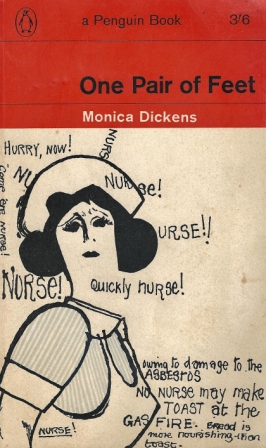
one pair of feet monica dickens 001One Pair of Feet by Monica Dickens ~ 1942. This edition: Penguin, 1964. Paperback. 221 pages.

My rating: 10/10.

One had got to be something; that was obvious. But what? It seemed that women, after having been surplus for twenty years, were suddenly wanted in a hundred different places at once. You couldn’t open a newspaper without being told that you were wanted in the Army, the Navy, or the Air Force; factory wheels would stop turning unless you rushed into overalls once; the A.F.S. could quench no fires without you, every hoarding beckoned you and even Marble Arch badgered you about A.R.P.

The Suffragettes could have saved themselves a lot of trouble if they had seen this coming. Men’s jobs were open to women and trousers were selling like hotcakes in Kensington High Street.

I could not make up my mind what to be. A lot of fanatics rushed into the most uncongenial jobs they could find, stimulated by a glow of self-sacrifice that lasted until the novelty wore off or the cold weather set in, but it seemed to me that, provided it was useful, it was no less patriotic to do something enjoyable. At first sight, the choice seemed so enormous that the trouble was to decide what not to be, but a closer inspection revealed so many snags that in the end the trouble was to find something to which I had a hope of sticking.

The Services? I didn’t think my hips would stand the cut of the skirt and I wasn’t too sure about my legs in wool stockings. Besides, I’d never been much good at drilling and all that. My school reports used to say: ‘Not amenable to discipline; too fond of organizing,’ which was only a kind way of saying: ‘Bossy.’ I might have been a success as a general but not as a private.

The A.F.S.? I did try that for a while, but at the beginning of the war there was not much doing and I got discouraged with sitting all day in the back room of a police station knitting and eating sticky buns with six assorted women and a man with a wooden leg. At the end of the week, we all knew each other’s life histories, including that of the woodenleg’s uncle, who lived at Selsey and had to be careful of his diet. Messenger Dickens had once been down to Roehampton to fetch the Commandant’s handbag and a small tube of soda-mints from the shelf in her bathroom.

A bus conductress? … The W.V.S.? … I worked in a canteen for a while, but had to leave after a terrible row with Mrs Templeton-Douglas, who could never subtract one-and-ninepence from half-a-crown. I sold some of her jam tarts for a penny instead of twopence, thinking they were the throw-outs we had bought at the back door of the A.B.C.

The Land Army? One saw oneself picking apples in a shady hat, or silhouetted against the skyline with a couple of plough horses, but a second look showed one tugging mangel-wurzels out of the frozen ground at five o’clock on a bitter February morning.

Ministries and Bureaux? Apart from the question of my hips again (sitting is so spreading), they didn’t seem to want me. Perhaps it was because I can only type with three fingers and it always keeps coming red.

The Censor’s Office I knew was in Liverpool, and I’d been there once.

Nursing? The idea had always attracted me, even in peace-time, but I suppose every girl goes through that. It’s one of those adolescent phases, like wanting to be a nun. It was reading Farewell to Arms, I think, that finally decided me, though what sort of hospital allowed such goings on, I can’t imagine. However, that was the last war…

So nursing it is, and Monica Dickens edgily and wittily documents the year she spent as a probationer at Queen Adelaide Hospital, and life on and off the wards, and the personalities she rubbed up against.

It is terribly difficult, I find, to write critically about an author whom one has read so often and with so much enjoyment, as I have read Monica Dickens. I will merely say that this book more than lives up to the first few pages excerpted above, and that it does not disappoint.

The author’s voice is two-thirds world-wearily cynical – as only a twenty-something writer can be! – and one-third completely sincere; “readable” is a mild recommendation, but very apt. Many of her sharper observations feel initially rather cruel, but Dickens is as hard on herself as on anyone, and often her most maligned characters are revealed to have redemptive qualities which the author displays with as much clarity as their failings.

Highly recommended.

Caveat lector: Several era-correct racial slurs in this one which may bring the modern reader up short. One character’s nickname is N_____, due to his curly hair, and several times the same term is used descriptively. There appears to be no intention to offend; I believe the usages here were completely accepted at the time of writing. I only mention them because it is a sensitive point with some modern readers.

Read Full Post »

gigi colette 001Gigi by Colette ~ 1944. This edition: Penguin, circa 1958. Translated by Roger Senhouse, 1952. Paperback. Penguin #1313 – also contains The Cat, translated by Antonia White. Total pages: 157. Gigi ends on page 57.

My rating: 10/10.

Because it is Colette, of course! And perhaps one of the most readable and least dark of her works. It even has what one might classify as a happy ending – a rarity in most of the novels and short stories of this unflinching recorder of the blissful agonies of all sorts of love.

Well, blissful as climax of Gigi’s short saga may be, I have no great hopes for her long-term joy. But that is mere speculation; perhaps I will say more about that later.

Gigi exists only in the short pages of this novella and the brief moments of her acquaintance which we are given must be our only consideration here. The “what ifs”, though enticing to formulate, are pointless.

I so often tell myself that as I read Colette – “Just go with it – don’t speculate and don’t give advice!”  Most of her characters are so obviously doomed, and so often by their own actions and refusals to let good sense overrule the physical desires and infatuations of the moment. Awful warnings, really, of the consequences of letting heart rule over head. And just as often, head over heart. No one is ever an out-and-out winner at the game of love in Colette’s complicated amorous world; there are always regrets.

Colette’s works read to me like delicate social satires. They are full of beautifully described vignettes and moments of time and thought and action (or inaction) noted by a deeply sensitive and sensuously aware observer. Frequently voyeuristic and occasionally deeply erotic, Colette’s works represent a certain stereotype of the “French novel”. There are always melancholy shadows lurking behind the most brightly depicted moments of teasing, banter, flirtation, and the inevitable love-making.

But enough of that train of thought.

Here we are with the deliciously portrayed schoolgirl Gilberte – Gigi – and her circumscribed world of women, all victims – no, that is not the correct term – let us say products – in some way or another of their own passions and planning (or lack thereof), and of course of the circumstances into which they were born, or in some cases thrust, and in other cases achieved by sheer force of will and personality.

*****

Who here has not seen a stage or film version of this book? Anyone? Or am I wildly waving my hand all alone?

After catching glimpses over the years of Maurice Chevalier’s wink, wink, nudge, nudge ode to “leetle girls” (Quick, lock up your daughters!) I mentally swore off ever watching the immensely popular musical based on the story.

Though Audrey Hepburn was a lovely woman and a fine actress, she does not look at all to me, in the theatrical stills I’ve seen of her in the role of the 1954 Anita Loos Broadway play, like the Gigi described in the original novella. Colette herself apparently chose Miss Hepburn to play the part in the stage production after glimpsing the young dancer-actress walking through a hotel lobby, but her physical appearance, petite, gamine, dark-eyed and brunette, is just so opposite in comparison to the description of Gigi as a tall, rosy-cheeked, blue-eyed blonde.

Lesley Caron was cast in the Lerner and Loewe film, and she fits the physical description of Gigi much more closely.

Here are glimpses of the original Gigi from throughout the story:

… with the heron-like legs of a girl of fifteen … the perfect oval shape of her knee-caps … a slender calf and high-arched instep … ash-blonde ringlets … sleek ripples of finely kept hair which fell just below Gilbert’s shoulders … cockle-shells of fair hair … eyes of a lovely dark blue, the colour of glistening slate … tall … snub-nosed … pink cheek with a single freckle, curved lashes, a mouth unaware of its power, a heavy mass of ash-gold hair, and a neck as straight as a column, strong, hardly feminine, all of a piece, innocent of jewellery …

The year is 1899, the setting Paris. Young Gilberte lives with her mother and grandmother in a modest establishment in a quiet residential area of the city. Grandmother – Madame Alvarez – and Great-Aunt Alicia are the twin matriarchs overseeing the small family of four, and it is implied that the main source of their joint sustenance is the careful investments of the two sisters, who were successful courtesans of their time.

Madame Alvarez had taken the name of a Spanish lover now dead, and accordingly had acquired a creamy complexion, an ample bust, and hair lustrous with brillantine. She used too white a powder, her heavy cheeks had begun to draw down her lower eyelids a little, and so eventually she took to calling herself Inez. Her unchartered family pursued their fixed orbit around her. Her unmarried daughter Andrée, forsaken by Gilbert’s father, now preferred the sober life of a second-lead singer in a State-controlled theatre to the fitful opulence of a life of gallantry. Aunt Alicia – none of her admirers, it seemed, had even mentioned marriage – lived alone, on an income she pretended was modest. The family had a high opinion of Alicia’s judgement, and of her jewels.

Andrée is gently scorned by her mother and aunt, as having failed to uphold the family traditions; they continually make little digs about her discarded “chances” and lack of “ambition”, though it is also apparent that this is a very closely bonded family, showing a seamlessly glossy surface to the world, regardless of the minor frictions of domestic life and familial bickering.

Gigi herself leads a conventional enough life, attending school and coming home with a satchel of homework every afternoon, though she is discouraged from associating too closely with the other schoolgirls on a personal level; Madame Alvarez quite obviously feels that her household is at least a notch or two above the common folk who lead drearily “respectable” lives, though she bridles at the implication that her past career has not been exactly respectable in its turn. The wealth of her “sponsors” has obviously raised her occupation beyond reproach.

The two older women are watching Gilberte with keen eyes, and they are finding her a much better prospect to follow in the family footsteps than now-faded Andrée ever was. The grooming process has been continual, and has picked up intensity as Gigi approaches her sixteenth birthday. Gigi herself is aware of her elders’ history and rather meekly goes along with her “education”, though we soon see that she has a decidedly childish naivety about her own future, though she accepts the premise that it will be centered around the “pleasing” of men.

The only man currently in Gigi’s world is Gaston Lachaille, the exceedingly rich son of one of Madame Alvarez’s old lovers, who has been accustomed to visiting the household whenever he wishes a momentary retreat from his glittering life of yachts, gambling at Monte Carlo, and a succession of volatile mistresses.

He has just been jilted, amongst a blaze of publicity, by his latest amour, and he is more than grateful to settle in for a cup of chamomile tea and a game of cards with Gigi, who has grown up knowing Gaston on terms of the greatest familiarity; she calls him Uncle Gaston. At thirty-three he has as yet shown no signs of wishing to marry; when it becomes apparent that his attention has been suddenly piqued by Gigi’s budding womanhood, Madame Alvarez and Aunt Alicia put their heads together to discuss the possibilities – in veiled terms, of course – of Gigi perhaps becoming his next romantic experience. Under the most iron-clad of arrangements, of course – a girl must be careful of her future …

*****

All morals aside – though now in middle age I am much more aware of the questionable motives of Gigi’s adult caregivers than I was when I first read Gigi as a teenager – only her mother appears to have qualms about seeing Gigi step into a courtesan’s high-heeled shoes – this is a delectable froth of a story, and a little classic of its type.

Shades of Colette’s Claudine in Paris, another schoolgirl-older man romance, though Gigi in this case stops short of the many complications Claudine encounters after her own virginal romance is consummated.

Gigi, one of Colette’s last works, was written in 1942, at the height of the Nazi occupation of Paris. Colette, bedridden with the excruciating arthritis which was to plague her until her death in 1954, and shaken by the arrest and internment of her third husband in a concentration camp, may understandably have been glad to return to an earlier and happier time when she created this last memorable gamine heroine.

Read Full Post »

the ark margot benary-isbertThe Ark by Margot Benary-Isbert ~ 1948 (German edition: Die Arche Noah) ~ English edition, 1953. This edition: Harcourt, Brace & World, Inc., circa 1963. Translated from the German by Clara and Richard Winston. Hardcover. Library of Congress #: 52-13677. 246 pages.

My rating: 10/10. This is an excellent piece of juvenile historical fiction. Actually, that designation is not really correct, as it was written as a piece of “straight fiction”, being written during the time of its setting, but to readers today it is most definitely historical, so I will classify it as that.

While not a deliberately Christmas-themed book, The Ark features two Christmases as it covers a little more than a year in the lives of its characters, and it was one I thought of when I was pondering which fictional Christmases stand out as memorable in my mind.

*****

The Lechow family – Mother, 15-year-old Matthias, 14-year-old Margret, 10-year-old Andrea, and 7-year-old Joey – are apprehensively but optimistically looking forward to their new home. Since being displaced from their village in Pomerania in the early years of the war, they have been separated – Mother and Matthias to work camps and the younger children to various farms – but they are finally together again and have been travelling through Germany seeking some place of refuge amongst the hordes of other homeless, wretched, often-starving people. They had made it to Hamburg, for a brief respite among relatives, but with the city filled with Occupation troops they were unable to get a permit to stay, and were instead assigned to accommodation in a town in Hesse. Yet another boxcar ride, and then nine more months in a refugee barracks, and their turn for a housing assignment has finally come. Number Thirteen Parsley Street – the name sounds like something from a fairy tale, and they hold their breath in anticipation of what they will find there.

And they are looking forward as well to having some sort of permanent address to share with the Red Cross, for the family’s beloved father, a doctor serving with the German army, has last been heard from a year ago with a tattered postcard sent from a Russian prison camp. Every place they’ve stopped the Lechows have registered their names, “dropping breadcrumbs in the forest” like a fairytale tribe of lost children, hoping beyond hope that Father will one day be released, now that the long war is over, and will be able to track them down from the traces they have left behind.

The owner of the Parsley Street house is appalled and offended at having to receive five penniless refugees. Elderly widow Mrs. Verduz has weathered the war reasonably well, though her nerves are “shattered” from the noise of all the bombing. Her street has miraculously stayed mostly undamaged, and though food and fuel is in terribly short supply, she fully appreciates her good fortune in having a roof over her head and all of her beloved possessions around her. She grudgingly shows the Lechows the two attic rooms she has been ordered by the Housing Authority to allot to the Lechows, and muttering in thinly veiled disgust, she raids her well-equipped cupboards for sheets to cover the mattresses she’s had to provide, and a few dented pots and pans and some chipped dishes as well – the Lechows quite literally have nothing but the clothes on their backs and a blanket each.

Once the family is settled in to their new home, things do begin to look up.

Matthias is assigned work as a bricklayer’s flunky working on reconstruction, which, though far from his true interests, astronomy and nursery gardening, at least provides a small income, and the acquaintance of a co-worker – soon to be new friend – the musical Dieter, who lives in the cellar of a bombed-out house with his raggle-taggle refugee companions, who have started an increasingly successful band called “The Cellar Rats”.

Andrea goes to public school, and is fortunate in passing an examination and receiving a scholarship to a private school run by the nuns. Here she meets butcher’s daughter Lenchen, and the two become bosom friends, with Andrea exchanging help with homework for lunchtime sandwiches provided by Lenchen’s grateful mother. Andrea is sternly forbidden to angle for anything more, but the odd morsel falls her way – a boon in these very hungry times.

Young Joey also goes to school, with less enthusiasm than his sister; he reluctantly acquires a smattering of knowledge, but his happiest acquisition is a friend of his own, a perky orphan named Hans Ulrich – last name and birth date unknown, as his only childhood memory is of being bombed, and of his mother dying when they were travelling together in a boxcar in the early years of the war, when Hans was only two or three; he was unable to tell his last name so no family was able to be tracked down; he is a waif in the truest sense, though his foster-mother (who we suspect may be getting by as a prostitute) is kind enough in her careless way.

Mother gratefully settles into the small space she can at last call her own, and immediately sets about creating a home for her brood. She smooths down Mrs. Verduz, helps her with the housework, and begins to take in sewing jobs – she is an accomplished seamstress, and finds that this skill is in high demand as people start to once more have the interest in dressing themselves well, now that the fighting is over, and life is turning to a new normal. New clothes and cloth are impossible to get, but a skilled seamstress can do much with old curtains and various patches and pieces from worn-out garments tucked away in clothes chests. Mrs. Verduz has lent a sewing machine in return for mending work, and the two women are becoming partners in the challenge of keeping everyone clean and clothed and fed. Contrary to Mrs Verduz’s fears, having a family of children in residence is not such a bad thing. Matthias chops firewood and brings home the precious small coal ration, Margret has taken over the tedious job of standing in line for hours to collect food rations, Andrea washes dishes and sweeps the stairs, while Joey brightens her life with his happy disposition.

The only one who is left in limbo in this new life is Margret. She willingly does all that is asked up her, competently handling her many menial and tiresome chores, but she is just too old, at 14, for priority to return to school, and just too young to be assigned to a job, though her mother has suggested that an apprenticeship to a professional seamstress might  be a good next step. Margret is secretly appalled at the thought of spending her life bent over a sewing needle; her true life was left behind back on the Pomeranian farm which is now lost forever. There she was deeply immersed in gardening and in caring for her animals, and in rambling the countryside with her beloved twin brother Christian. A gaping hole in the family, and in Margret’s grieving heart, is carefully veiled over by everyone – Christian was shot and killed by a Russian soldier who broke into their house during the battle which ultimately displaced the family and started their years of wandering.

Christmas comes, and the family celebrates with true joy and gratitude. The Lechow children, Lenchen and Hans Ulrich and Dieter and his band decide to go Christmas carolling into the countryside, hoping for a few morsels of food or a coin or two from the relatively more prosperous farmers living around the outskirts of the town. In the course of their travels that wintry night they come to Rowan Farm, home of the widowed Mrs Almut and her elderly household. Anni Almut is a bit of a character in the neighbourhood. Endlessly energetic and outspoken, she forges ahead with whatever she sets her hand to. She has a few milk cows, raises milk sheep and ponies, and best of all to Margret’s startled recognition, keeps a breeding kennel of Great Danes. The Lechows kept Great Danes as well back in the good old days; Margret’s beloved dog Cosi was shot along with Christian, and that is another unhealed wound in her heart.

One thing leads to another, and six months later both Matthias and Margret are working and living at Rowan Farm. They have fixed up an old railcar on the farm as a dormitory, with bunk beds and a cookstove, and soon begin to fill it with the stray animals which are attracted to Margret as moths to a flame, and their town relations and friends, who are eager to come out to spend a day or two at “Noah’s Ark”, as the rail car has been christened, a refuge from the stormy seas of the outside world.

As this is a children’s book, everything continues to come together for the best, with the lost finding their way home, and old wounds healed, and the future looking positive. But the hardships and horrors of the war, though not detailed, are very much a part of the story, which ultimately celebrates the goodness that people find in the midst of the most terrible situations.

The returning soldiers are physically maimed and emotionally wounded, but they do start to heal; those who are lost are remembered with poignant sadness but not dwelled upon for the most part, as “life must go on”. The dreadful food and living conditions are dealt with creatively and are made the brunt of much humour. Our final impression is of a people and a country looking to the rising sun of a new day with optimism and hope, with a glance back to the horrors they have been involved in and a “never again” resolve.

This is a World War II book which does not reference the Holocaust and the Jewish displacement and slaughter, except by veiled allusions which most young readers will not catch. It does however in no way excuse what has happened. It rather focusses on the other innocent victims of the war, the common people, the small town shop shopkeepers, the peasants and farmers, the families and children of Germany who suffered horribly while the men were off fighting and the bombs exploded all around. People died in horrible ways, and froze and starved to death in the bitter winters even after the official truce was called. This is all in there, in the shadows behind the joy of the Lechow’s story of recovery and a happy ending.

Die Arche Noah was released to great acclaim in Germany in 1948. It caught the attention of American publishers, and was translated and released in an English edition in 1953, and was received with deep appreciation in North America. The author, beginning her writing career at the age of 59 – she was born in 1889 and had lived through the two great wars in Germany – went on to write several more children’s and young adult books, which were also translated and found ready sales overseas. Margot Benary-Isbert, herself having lost her family home and being displaced by the war, immigrated to the U.S.A. in 1952, becoming an American citizen in 1957. Her stories show her great love of both of her countries, the beloved Germany of her birth and the American haven which adopted her so graciously as it did so many other refugees from conflicts worldwide.

The Ark is often deeply sentimental and a bit “old-fashioned” in style and tone to modern ears, but the story is powerful and memorable, and strikes a strong chord with many of its readers. I was ten or eleven when I read it for the first time in my school library. I eagerly searched out the rest of Benary-Isbert’s works – our school libraries were lavishly stocked back in the 1970s – they had everything! – and when I settled into my own home and started building my book collection the Benary-Isbert books were among the first I thought I’d like to track down from my childhood favourites. Sadly they are mostly out of print, and long gone from library shelves, but were so popular in their time that they are still very readily obtainable in the online second-hand book marketplace, which is where you will have to search them out.

Read Full Post »

hometown angel reita lambertHometown Angel by Reita Lambert ~ 1940. This edition: Triangle Books, 1942. Hardcover. 272 pages.

My rating: 8/10 – To be taken with a grain of salt, please – this rating merely reflects my opinion of this story’s merits among others of its narrow genre – vintage American light romantic fiction.

*****

Handsome, urbane Gerry Miles, a modestly successful short story writer and aspiring novelist, and the deeply devoted beau of moderately successful and keenly aspiring stage actress Lola Leighton, is waiting at the train station in New York City for an unkown-to-him girl. Eudoxia Abbott is Lola’s old school friend from way back in rural Ohio, and is on a first-ever visit to the big city. Gerry’s been detailed to waylay Miss Abbott and let her know, tactfully of course, that Lola is in no position to act as hostess to a little country bunny, no matter what their prior close relationship.

Gerry surprises himself by being immediately quite taken with Eudoxia – Doxie – who shows herself to be self-possessed and sensible – as well as a pretty little thing – but he rembers his instructions and rather shamefacedly fulfills his commission, telling Doxie that Lola is so exceedingly busy with auditions and rehearsals that she’ll have no time for shepherding Doxie around New York, but that there are some good hotels nearby. But first a quick visit to dear Lola is in order, before Doxie finds herself on her own.

The bitter truth is that Lola is on her uppers, and is too ashamed to admit it to Doxie. Her last play has folded and she’s now jobless in the harsh city. Her chosen profession has no place for losers, and Lola’s getting desperate. A play that she thinks would be perfect for her has made the rounds, but no producer wants to touch it – it’s a bit of a dud, if truth be told, though all Lola can see is her potentially glorious starring role as the titular “Linda”. She’s got one last call out to a prospective backer, and the last thing she wants to do is to waste her time showing Doxie about; Lola can’t afford to feed herself at this point, let alone sponsor a non-theatrical friend temporarily in town.

When Gerry and Doxie arrive at Lola’s apartment, she’s made a supreme effort and appears perfectly poised and beautifully dressed (in a costume left over from a stage production), with newspaper clippings of glowing reviews from her two-plays-back success scattered carelessly about, and a profusion of flowers she’s somehow cadged from the reluctant florist to whom she already owes a huge debt.

“Golly, Lola, you’re living such a glamorous life! I always knew you’d be a famous actress!” gushes admiring Doxie, and Lola basks happily in the uncritical praise, while remembering to maintain her noncommittal attitude towards Doxie’s visit.

Lola is just edging Doxie out the door to seek that hotel room when Doxie blurts out her own big news. She’s just inherited a handsome sum of money from her recently deceased foster grandfather back home, and this trip to the city is by way of being a celebratory binge.

Lola freezes for just a moment, then effusively turns on the charm. Why, darling Doxie must stay with her! Why is silly old Gerry suggesting an impersonal hotel room in a strange city, when Lola just happens to have an empty couch? Why, if it makes Doxie feel better, she can contribute to expenses with a modest boarding fee, but goodness! – what’s mere money between friends?! “Darling, you must stay with me!”

Gerry, speechless at the about-face, meekly goes along with Lola’s change of heart, but can’t help but wonder if Lola’s motives aren’t just a mite self-serving. He secretly decides to keep an eye on innocent Doxie and keep her from being too badly fleeced by his egotistical girlfriend.

Gerry has few illusions as to Lola’s hyper-ambitious nature. He’s been proposing marriage for some time now, asking her to give up the stage, but Lola insists that she needs one more hit play first, so she can walk away from the stage on a high note. She just needs the right opportunity, the perfect starring role. But as far as Gerry’s concerned, a continued run of unemployment will drive Lola into his arms, so he’s not too upset about her failure in getting Linda into production.

Well, predictably enough, Doxie is almost immediately buffaloed into backing Linda, and she embraces her new role as a theatrical “angel” with gusto. Gerry, a bit stunned by Lola’s rapid grasp of this unlooked-for opportunity and her immediate willingness to part her old friend from her nest egg, lurks around predicting doom and gloom, and sharing his conflicted concerns with his friend Nigel Tucker, a wealthy and cynical party boy with a casual interest in the theatre. Nigel was at first condescendingly kind to, and then increasingly taken with this fresh little number from the wilds of Ohio; Gerry is initially relieved at Nigel’s protective stance towards Doxie, but then starts to wonder why he feels almost, well, jealous of Nigel and Doxie’s growing closeness. But there’s no reason for jealousy, because Gerry loves Lola! And if Doxie ends up broke, the happy solution would be a marriage to immensely rich Nigel. Right? Right. Okay then, no worries.

As the Linda rehearsals progress and the off-Broadway opening approaches, it is evident to everyone except Lola and Doxie that the play is indeed a right royal mess. Gerry and Nigel are becoming increasingly short with each other as Doxie gushes on about her newly fledged theatrical enthusiasms to both of them, and they both realize what a disastrous effect Linda‘s coming almost-certain flop will have on her – not to mention Lola’s – psyche.

Tension builds, the tangle gets more tangly, and Gerry attempts to deny his growing romantic feelings for Doxie by pressuring Lola into a formal engagement. Lola brushes him off again and again, and insists on setting her sights higher by the day, envisioning a trip to Hollywood once Linda brings her the inevitable (she is convinced) critics’ applause and her long-deserved artistic success.

Up, down, around and around the four main characters chase each other – much drama plays out on and off stage, until the very end when (almost) everyone reshuffles their attachments and priorities and ends up where they really wanted to be in the first place.

*****

This is a true light romance – “pure eiderdown” as a Kirkus reviewer called another of this author’s fluffy creations. Effortless to read, deeply predictable, and surprisingly enjoyable, despite the inner groans of readerly despair at the frequent sheer obtuseness of the characters. The author also isn’t taking any of this too seriously, and she plays her characters freely upon her own little stage, with a wink and a nod to the audience. The result is, as I’ve just said, fluff, but fluff is welcome occasionally, to lighten the mix.

Lambert herself was modest in her literary claims, and did not pretend her works were anything other than for sheer amusement, her own and her readers’. If that was her criteria for success, this story succeeds. Though the characters are almost universally one-dimensional, and occasionally ill-behaved, they are reasonably well drawn, and the sweet and innocent nice-girl heroine has us on her side from start to finish. (I still think she ended up with the wrong man, though. Though I knew it wouldn’t happen, I willed her to take the one who truly appreciated her the most.)

Reita Lambert was a prolific writer of her time, and apparently quite well-known, though I wasn’t familiar with her before I researched her work after reading Hometown Angel. She wrote hundreds of short stories for the popular magazines of the 1910s through the 1940s, as well as a number of successful novels, among them Beauty Incorporated, Lines to a Lady, Yesterday’s Daughter, They Who Have, Right to the Heart, and others. Lambert also wrote stage and screen plays, and was involved in New York’s theatre scene. She was married to American composer Arthur Nevin, who had a successful career of his own in composing operatic scores based on American Indian folklore; his work was particularly well received in Germany in the pre-WW I years of the 20th Century.

Hometown Angel certainly demonstrates Lambert’s easy familiarity with the theatre scene, and her portraits of the various Theatrical Types of the time are well drawn and amusing. She definitely keeps a humorous eyebrow cocked in this book. I quite enjoyed this read, and would gladly tackle another, though, as I’ve said in other contexts, it would have to come to me easily and affordably. The few Reita Lamberts available through ABE seem rather high-priced for the non-literary popular fiction that they are, and I suspect at those prices would be of most interest to collectors of  the vintage light romantic fiction genre versus the casual reader.

Read Full Post »

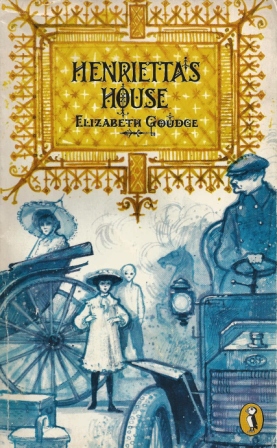
henrietta's house elizabeth goudge 001Henrietta’s House by Elizabeth Goudge ~ 1942Alternate American title: The Blue Hills. This edition: Puffin (Penguin), 1972. Illustrated by Anthony Maitland. Paperback. ISBN: 0-1403.0520-3. 191 pages.

My rating: 8.5/10. I’ve been playing amidst the juvenilia these past few days, and last night settled in to read this much-anticipated slender story. No surprises here, but no disappointments, either. Elizabeth Goudge lets herself go in full imaginative flight in this gentle and beautifully written juvenile adventure/fairy tale/moralistic tale.

Contains elements of her other two better-known juveniles, The Little White Horse, and especially Linnets and Valerians. Best approached with a willingness to surrender disbelief and just go with it! The usual Goudge theological and philosophical debate is present, but in this case makes more sense and is easier to digest than in some of her other books; two statues/church carvings, a laughing imp and a crying child, appear and reappear as analogies to the “mockery of Providence and the cringing human soul”, which sounds rather deep but which makes complete sense as one works one’s way through this multi-layered story.

This is a less common Goudge title, and I went to some trouble to acquire it. I suspect it is much more abundant in British used bookshops and libraries; used paperback copies on ABE start at $20 (with shipping) and hardcovers climb steeply into the $60s and $70s.

A must-read for the Goudge collector; one to share with a bookish child who is open to a good old-fashioned story. The fictional children are gloriously real, all expected flaws and faults fully present, though they are supremely fortunate in the adults in their lives!

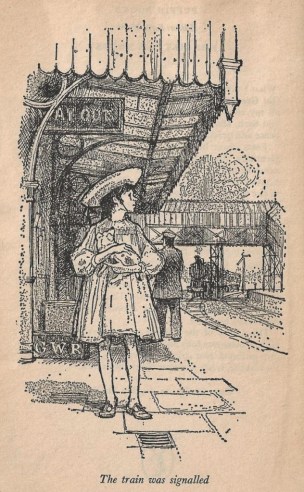
This edition has extremely well drawn pen-and-ink illustrations by Anthony Maitland; I’d love to find this in a larger hardcover one day.

*****

henrietta's house elizabeth goudge 5 001Young Henrietta, first introduced in The City of Bells as a poet’s daughter living with her adopted family in the cathedral city of Torminster – her father is alive and well, but is off roaming the world unencumbered by such prosaic details such as the housing, feeding and clothing of his offspring – is waiting on the railway platform for her beloved companion, Hugh Anthony, to return from his first term at boarding school.

Hugh`s birthday is impending, and a gala rural picnic is planned; what happens on the way to the picnic is told, in vivid detail, in this novel.

The birthday party leaves Torminster in five different equipages, and due to their varying rates of speed, soon lose sight of each other. Only one arrives at the designated rendezvous; the other four parties take the long way round and have some strange adventures before everyone finds each other in a completely unplanned-for common destination. Several extra guests add an unexpected dimension.

And that’s all I’m going to tell you, as the details of the adventures and the reference of the title are best discovered by the reader. Because this is, as the author declares at the close, a fairy tale, everything works out perfectly and a happy ending for all is assured.

Elizabeth Goudge is not for everyone, but if you’ve been exposed and find that she has “taken”, you will appreciate this slightly fantastical outing. A prior acquaintance with the characters (who also appear in The City of Bells and The Sister of the Angels) will add to your appreciation, but is not at all necessary; the story works beautifully as a stand-alone as well.henrietta's house elizabeth goudge 1 001

*****

I am here including a slightly edited review of Henrietta’s House from the Elizabeth Goudge Society website, which gives some background information on the author and the inspiration for the book. This is best read after reading the novel, so the references will make sense.

The dedication reads: ” For Dorothy Pope. There were once two little girls, and one had fair hair and lived in the Cathedral Close of Torminster and the other had dark hair and lived in the Blue Hills above the city, and they were friends. And now that they are grown up they are still friends, and the one who lived in Torminster dedicates this book to the one who lived in the Blue Hills, because it was she who saw the White Fishes in the cave. ”

The fair-haired child who lived in the city is obviously Elizabeth herself, and her friend Dorothy the template for Henrietta. I find it comforting to think that they remained in contact throughout their lives. It is an indication of Elizabeth’s loyalty and commitment. Elizabeth herself says that she never revisited any of the places she lived in because she wanted to remember them how they had been and not how they had become. So perhaps they corresponded with each other as she did with so many friends and admirers, a habit inherited from her Father.

It is a gentle story, a sequel to Sister of Angels and City of Bells, a tapestry woven with words around the charm of an Edwardian summer, when, as Elizabeth says “this story is set at the beginning of the present century, and in those days the world was often silent and sleepy, and not the bustling, noisy place that it is today.” (She is of course referring to the 20th century and not the 21st.)

In 1941 as the story was being written, British troops were fighting in the desert against Rommel, the Germans were taking on the might of Russia and the Americans were about to enter the war after the massacre at Pearl Harbour. A gloomy time, with no end of the war in sight and on the home front the introduction of clothes rationing. What better place and time to escape to than the opulence of Wells in a time before either World Wars had blighted her generation’s life.

The story starts with Henrietta waiting on the platform for Hugh Anthony to return for the holidays from boarding school ending their first separation from each other, and chronicles the delights of a summer in the countryside surrounding the tiny city where Elizabeth lived out the first few years of her life.

It contains many of her childhood memories from the way that hat elastic hurts the chin, to stately picnics in the hills. The story is as pedestrian as the procession of carts that convey the party to the picnic, and therein lies its charm. We are not hurried on to the next piece of drama, but have time to observe that “(t)he canterbury bells, and sweet williams, the roses and the sweet peas, the delphiniums and the syringa were a blaze of colour and scent in the gardens and all the birds were singing.”

Hills for Elizabeth were, as for so many of us, a place of heightened spirituality. They house the gods, myths and legends. They are the place of the solitary, the Hermit, the Wise Man. We ascend above the valleys and plains of every day life and looking back and down are able to see the bigger picture, to view where we have come from and how far we have travelled to get here: “Looking back he could see the great grey rock of the Cathedral and the old twisted roofs of Torminster, dwarfed by distance into a toy town that a child might have played with, and looking ahead, far up against the sky, he could see the blue hills growing in power and might as they drew nearer to them. He felt for a moment gripped between the grey rock of the Cathedral and the grandeur of the hills, two mighty things that time did not touch.”

All of the people invited on Hugh Anthony’s birthday picnic end up getting “lost”.  None of them with the exception of Grandmother’s party arrive at their preordained destination. But all of them are enriched by their experiences, they all attain something vital to their well-being, even if, like the Dean, they didn’t at first know that this was necessary.

henrietta's house elizabeth goudge 2 001

The Dean recaptures his innocence and love of his fellow man, Hugh Anthony loses some of his pride and arrogance. Grandfather rescues another soul in distress, Jocelyn and Felicity lose their car and find fairy land, and Henrietta, well – Henrietta finds her heart’s desire.

The strange figures sitting on top of the gateposts are explained as they come from the Cathedral at Wells and must have captured the young Elizabeth’s imagination. The explanation of their meaning given in the story by Henrietta’s Grandfather sounds as if it had originally been told to Elizabeth by her father. “Replicas of those two figures in the chantry in the south choir aisle … the cringing human soul and the mockery of Providence.” Elizabeth herself was to call her future Devonshire home Providence Cottage, so the Symbology obviously stuck with her.

I thought at first that the caves Elizabeth writes about so vividly were the ones at Wookey Hole, especially as the Old Man in the ruined house could have been a metaphor for the Witch of Wookey. with his wax figurines and pins. But there are no recorded sightings of cave fish in Wookey, and the caves themselves weren’t open to the public in the time that Elizabeth lived here.

henrietta's house elizabeth goudge 3 001

Cheddar gorge however is close and one of the caves there is actually called the Cathedral cave for its stunning similarity to a cathedral interior. I love the idea of being able to look up inside rabbit burrows and see the rabbits looking back at you in astonishment, a picture an imaginative child would conjure up. Cheddar too has its underground river complete with little rowing boat, its vast system of unseen caves riddling the Mendip hills like a honeycomb.

I have been unable to find the fish, all sources telling me that the lead content in the water, (the hills have been mined for lead since before the Romans arrived,) is too high for fish to survive. So maybe, the fish were flashes of light reflected back by a carried lamp, a code between friends for a shared magical experience. But I like to think the girls saw them on that long ago Edwardian afternoon. “Look!” cried Hugh Anthony excitedly, kneeling beside the still, inky pool, “There are white fishes here. Quite white. Like Ghosts.” The Dean put his oil lamp on the ground and knelt beside him and together they watched fascinated as the strange white shapes swam round and round in the black water, their ghostly bodies rippling back and forth as though they were weaving some never-ending pattern upon the black loom of the water.”

The story was written at a time when the bells of all the churches and cathedrals of England were silenced, only to be rung in a time of national emergency. They were to signal the devastating news that we had been invaded by Germany. How people must have dreaded the thought of hearing them ring. It would have been an especial sadness for Elizabeth, whose life so far had been lived and to a large extent regulated by the bells of the cathedrals her father worked in. No wonder she wanted to transport herself and her readership back to a time of innocence, when the bells would have rung out for worship and celebration as they were intended to be.

Read Full Post »

« Newer Posts - Older Posts »