Archive for the ‘1940s’ Category

12285312The Wooden Horse by Eric Williams ~ 1949. This edition: Collins, 1949. Hardcover. 256 pages.

My rating: 8.5/10.

It was January when they had first come to Stalag-Luft III, and for the whole of that month the ground was under snow. Snow lay thickly on the roofs of the barracks blocks and gave an air of gaiety to the barbed wire which sparkled and glittered in the sun. Every post carried its cap of crisp, powdery snow, and when the wind blew, the snow drifted up against the coiled wire, softening its gauntness. Escape in this weather was impossible, and when the snow stopped falling the prisoners made a bobsleigh run and cut up their bed-boards to make toboggans. They flooded the football pitch and made an ice rink on which they skated from morning until evening. The camp was pure and clean while the snow lay on the ground, and the air loud with the shouts of the skaters. It was only when the night carts came to empty the aborts that the compound became offensive, and then the air was malodorous and long yellow streaks marked the snow where the carts had been.

When the thaw came the camp was a sea of mud. The packed ice of the toboggan run was the last to melt, and the skating rink was a miniature lake on which a few enthusiasts sailed their home-made yachts. Then that dried up and the football pitch was reconditioned. The goalposts were replaced and the earth dams that had held the water were removed.

With the spring came a renewed interest in escape. Spring is the escaping season…

Royal Air Force Flight Lieutenant Peter Howard, shot down over Germany in 1942, is on his second prison camp. He and fellow officer John Clinton had already tunnelled out of their first camp, Oflag XXI-B, but were recaptured only a few days later. Now they are pondering the possibilities of surreptitiously leaving Stalag-Luft II, the massive internment camp purpose-built and maintained by the Luftwaffe for captured flight crews. (This officers-only camp eventually housed over 10,000 POWs. For an excellent description of Stalag-Luft III, see this extensive Wikipedia article.)

Escaping from Stalag-Luft III had so far been impossible. Built on sandy soil, with distinctly coloured subsoil making disposal of tunnelling debris extremely difficult to disguise, the camp buildings were constructed on pilings, with guard dogs patrolling the compound after dark, and a system of foot patrols and random spotlighting to prevent any prisoner activity under cover of darkness. Due to the prevalence of prisoners attempting to escape by tunnelling, microphones capable of picking up seismographic vibrations had been installed around the perimeter of the camp.

Conditions inside the camp were reputed to be among the most “lavish” in any of the German-run POW camps. Because the detainees were officers, they were not required to perform forced labour under the terms of the Geneva Convention, and were provided with regular Red Cross food and relief parcels, which included cigarettes and toiletries. Many of the POWs were taking correspondence-style university courses, and recreation opportunities within the camp – sports, theatre, music – were well organized and highly attended.

So why even try to escape, and risk being shot? Many of the captured British airmen were quite content to put up with the boredom of being interned, grateful to be in a relatively comfortable camp, but for others the idea of being held in detention was maddening. Their one focus was on getting out and away back to England, from where they could renew their active participation in the war.
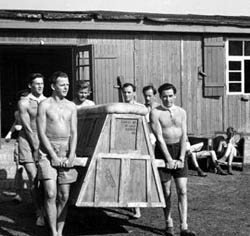
films-1950-the-wooden-horse

A re-creation of the vaulting horse in the 1950 movie version of the book.

Howard and Clinton come up with an ingenious plan, inspired by the traditional “Trojan Horse”, to start a tunnel close to the perimeter fence and so lessen the distance needed for excavation. They design a wooden vaulting horse, in which at first one and then later two and three men can be hidden and carried, and proceed to establish a regular routine of gymnastic exercises at their chosen tunnel head. With the cooperation and assistance of numerous fellow prisoners, the continuous vaulting, jumping, landing and related calisthenics created enough vibration that the tunneling noise was disguised from the microphones. Bags of excavated sand, made from the cut-off legs of prisoners’ pants, were hung on hooks inside the horse, to be removed and surreptitiously scattered in innocuous locations, and eventually, as it was harder to dispose off without being spotted, in the ceilings of the dormitories.

The Wooden Horse describes the escape plan in great detail, and makes fascinating reading. The ingenuity of the prisoners is admirable, as is the camp organization which coordinated escape attempts. A hidden stockpile of altered clothing, forged papers, German money and condensed food rations was assembled through various efforts, to be allotted to those who had made a plausible case to the Escape Committee.

Howard and Clinton, along with a third officer, Phillip Rowe, are the first and as it turns out, the only prisoners to successfully escape from Stalag-Luft III and to return to their home country. Every other escape attempt, of which there were many, including the famous “Great Escape”  of 1944 documented by writer Paul Brickhill, ended in recapture and, in the case of the Great Escape, execution of many of the escapees.
no111

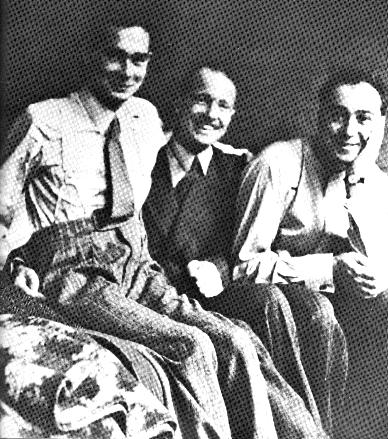
Michael Codner, Oliver Philpot, and Eric Williams

In The Wooden Horse, the fictionalized version of events written by participant Eric Williams, ‘Peter Howard’ is Eric himself,  ‘John Clinton’ is Michael Codner, and ‘Philip Rowe’ is Oliver Philpot. All three men returned to active service after their return to England.

An extremely interesting book, containing as it does such intensive detail concerning life in an officers’ POW camp, and vivid descriptions of life in civilian Germany midway through the war as the men blend in with the population during their journey toward the seaport where they hope to find transport out of the country.

The story is well-told, though events here and there which are really quite dramatic are told in an offhand sort of manner, with the exception of a brutal encounter with a German guard at the very end of the narrative, which stands out by its dramatic and gory details. This incident was later revealed to be fabricated at the request of the book’s publisher, in order to “spice up” the ending. Everything else, though, appears to be quite true.

A must-read for anyone at all interested in World War II history, for its extensive detail and its business-as-usual, “sure-we-did-amazing-things-but-why-all-the-fuss?” tone, keeping that British “stiff upper lip” stereotype nicely polished. What emotion is shown is in the realistic depiction of the nerve-wracking journey across Germany and into occupied Denmark, and the stressful situation at being completely at the mercy of randomly-met strangers who may or may not be willing to pass along information or messages, and any of whom might be in collaboration with the German officials.

All in all, a good read.
Read Full Post »

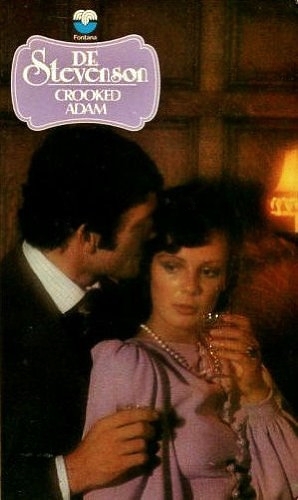
crooked adm d e stevensonCrooked Adam by D.E. Stevenson ~ 1942. This edition: Fontana, 1974. Paperback. 219 pages.

My rating: 6.5/10

You have to hand it to D.E. Stevenson. Even if she didn’t know anything at all about her subject (mental illness in Rochester’s Wife, for example) it didn’t stop her from taking a good old swing at it, cheerfully glossing over the complicated bits by having her characters tell each other, “It’s too specialized to explain. Just trust me.” And of course, they do.

In this case it is schoolmaster Adam Southey who is the clueless one. His headmaster, Samuel Cooke, is a prominent scientist who is working on a secret war machine, a kind of death ray which focus an ultraviolet beam of light on an object – say, an enemy airplane – and causes it to burst into flames. “A Death Ray!” exclaims Adam, only to be lectured by his superior that this is inaccurate: “It’s too specialized to explain to a simple soul like you. Just trust me.”

It is early in World War II, and Adam is disappointed that His Majesty’s Army has no use for him, due to a childhood injury which has left one of his legs shorter than the other. Despite this physical handicap, Adam is fit and strong, and can swing along at a great rate, which is about to come in very handy very soon. He surprises a suspicious intruder attempting to get a look at Cooke’s secret weapon, and ends up accompanying the van carrying the machine to a secret army testing base in Scotland, with some interesting adventures on the way, including an attempted hijacking and a stint of camouflage with a travelling circus.

Once in Scotland, with Marvelous Invention to Change the Course of the War almost ready to demonstrate, Adam’s adventures get even more exciting, as he stumbles upon a Cleverly Disguised Nest of Nazi Spies (complete with submarine access to a secret tunnel), teams up with the local shepherds and fishermen to foil the Wicked Teutonic Menace, and ultimately finds True Love.

Despite the simplistic tone of the whole thing, written in a “Gosh! Golly!” schoolboy-adventure-tale-genre sort of way, it is rather an enjoyable romp, and the groaning faux-pas-by-sincere-author moments add to the charming vintage atmosphere. The hero is sweet and true-blue all the way through (“Crooked Adam”, as one of his schoolboy charges murmurs in a scene-setting aside to a friend, is really one of those double entendre nicknames which mean the exact opposite – gimpy leg aside, Adam is straight as they come) and we can only hope that his serendipitous love interest will live up to his nobleness, once the war is safely over.

Though this adventure started off rather slowly for me – this is my second go at reading it, as the first try fizzled out – once I pushed past the “I can’t explain my invention; you’ll just have to take my word for it that it’s marvelous” bit by Dr. Cooke and wide-eyed Adam’s acceptance that he’s too dumb to grasp the complexities of science I started to grow rather fond of our sterling-natured hero, and cheerfully went along with the tale until the heroic and neatly tied up end. I’d noticed before that D.E. Stevenson often has no qualms about cold-bloodedly eliminating her bad eggs, and Crooked Adam proved no exception, with the author showing more sympathy with the German Nazis versus the turncoat Englishmen, who get their (fatal) comeuppance.

Yes, one might safely shelve this one with the propaganda novels, I think.

Read Full Post »

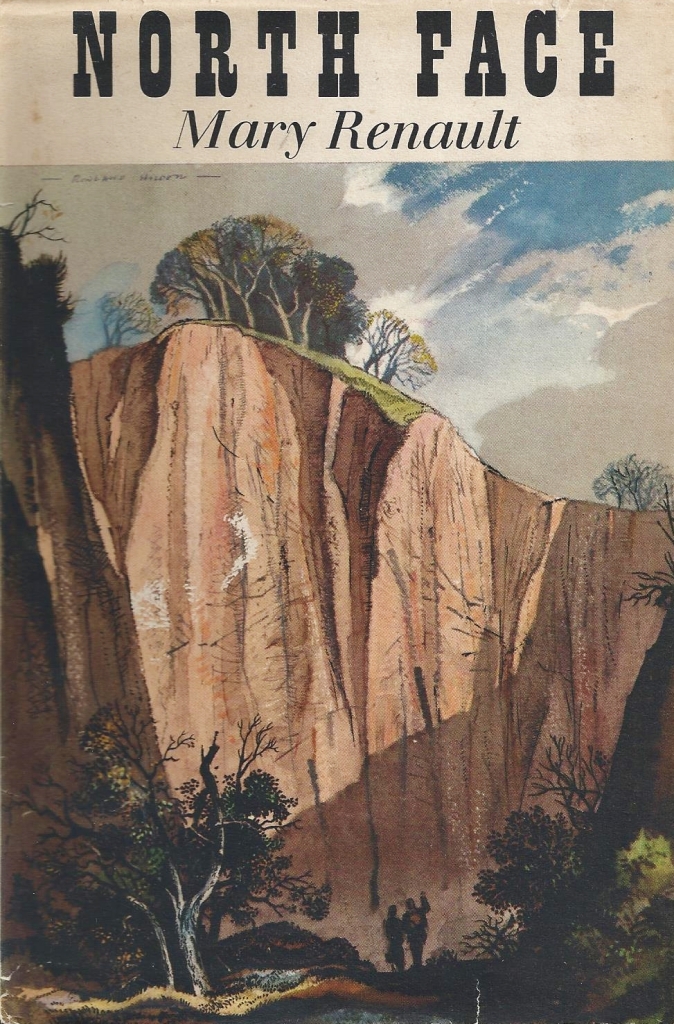
north face mary renault 001North Face by Mary Renault ~ 1948. This edition: Longmans, 1949. Hardcover. 318 pages.

My rating: 6/10

This is a little-discussed novel by the author who went on to become world renowned for her historical fiction centered on ancient Greece: The Bull From the Sea, The King Must Die, Fire From Heaven, et al. Before Mary Renault hit her stride with the ancients, she wrote a number of contemporary novels, all concerning the romantic relationships and struggles for self determination of the characters. Most featured hospital settings or nurses and doctors as characters, as the author drew on her own hospital and nursing experience for inspiration and to provide accurate detail.

North Face was Mary Renault’s fifth published novel, released in 1948 in North America (and a year later in England), just as Mary Renault was settling into a new life in South Africa, where she had moved with her partner Julie Mullard after winning a $150,000 prize from the American motion picture company MGM for her fourth novel, Return to Night. Renault was to write one more contemporary novel, the highly regarded The Charioteer (1953) before turning to ancient Greece for the inspiration of her future writing years.

The story opens in a boarding house in rural Devon, where two opinionated single women who are staying for their holidays are making each other’s acquaintance and finding each other rather unsympathetic. Miss Searle is an intellectual college don who travels with her weighty works of Chaucer, which she has been immersed in studying for the past decade. Miss Fisher is a nurse, with a hearty, rather “common” manner; she has a jolly appreciation of the realities of life, and finds Miss Searle’s fastidious air to be more than somewhat annoying.

World War II has just ended, and everyone we meet is still showing signs of the many years of emotional trauma they have experienced. Some have been wound up so tightly they are finding it difficult to return to some sort of new normal; society itself has taken a giant step sideways, leaving those slow to adapt floundering. Add to this the effects of personal tragedies, which are exacerbated by the effects of the war, and suddenly the tense atmosphere of every sort of social gathering is perfectly understandable.

The Misses Searle and Fisher unite in speculation regarding their fellow guests. They are most interested in the solitary Neil, who is abstracted and unapproachable, and spends his days trekking about the countryside with knapsack and detailed maps. A man with a secret, surely? Which is found to be true. Neil is a more than competent boys’ school teacher who has had a fairly uneventful war. Deemed an essential worker, most of it has been spent in his usual occupation, despite his attempts at joining active service. Finally he was accepted into a Service position, still in England, but far from home.

While Neil was otherwise occupied, his young wife discovered and was discovered by the young officers at the nearby American army camp; what started as innocent flirtation turned into a series of sexual liaisons. Neil had returned from his military posting to find that his wife was no longer interested in him in a sexual or emotional way. The dissolution of their marriage led to personal tragedy, as the couple’s young daughter, adored by Neil, is horribly injured in a fire while Neil is out and her mother is entertaining a soldier in her bedroom. The child dies, and on his return from her funeral, Neil is confronted by his wife’s demand for a divorce. She is pregnant by her latest lover, and wishes to start a new life with him post-haste.

Neil is therefore wandering about in Devon in a sort of trauma-induced trance, agonizing over what next to do, and if life is even worth living. In this state he bumps up against another troubled soul, the slender, virginal (literally) Ellen, who has just arrived at the guesthouse.

Ellen has also had an emotionally fraught time of things after the death of her fiancé, a fighter pilot, in the closing months of the war. He was a childhood first love; the two were brought up together as their mothers were step-sisters, and though Ellen was deeply attached to him, she was unable to bring herself to share his deeper passion. She feels that her rejection of his physical advances had hurt him so much that he had been careless while on his last mission; she holds herself responsible for his death, and has punished herself and sought to get over her frigidity by arranging a liaison with another man at the guest house. This falls through, as Ellen is unable to carry through with the physical aspect of the “fling”, and she too is wandering the countryside in something of a daze.

Neil and Ellen discover some shared interests, most notably rock climbing, and the theme of frail human pitted against cold stone and working out emotional issues through physical exertion runs through the novel. As Neil’s and Ellen’s romantic interests in each other grows, Miss Searle and Miss Fisher provide a sort of argumentative and gossiping Greek chorus to the progress of the affair, each putting her own interpretation on what is going on.

Much self-analysis and heart-rending ensues, before Neil and Ellen find comfort in each other’s arms.

A slightly unusual novel, and definitely of strong interest to the Mary Renault completest. I had no trouble at all reading this one through, though it was rather deeply seeped in gloomy psychological trauma and all sorts of Freudian situations, including a gypsy’s warning to Neil and Ellen to “stay away from high places”, which immediately led me to expect some sort of tragic ending, what with all the clambering about on cliffs. (Which didn’t materialize, much to my relief.)

Each of the two main protagonists finds at least some of the solution to their inner turmoil through the concentrated effort of working across a sheer rock face, though I was rather annoyed at the author for allowing Neil to get himself out of a desperate climbing situation while leaving Ellen stranded and requiring Neil’s aid, a metaphor which I felt was likely to represent their future life together.

Oh, and because it is Mary Renault, I am sure you are wondering about the gay/lesbian themes. Not much going on here, unless our intellectual and buttoned-up Miss Searle is a latent lesbian, but as she is quite obviously attracted to the masculinity of Neil, that one doesn’t really fly. Neil has had a close friend and climbing companion, Sammy, killed in the war, but how close a friend is never detailed and the relationship seems to be platonic from the hints dropped by Neil. Ellen thinks that she may be lesbian due to her frigidity towards her fiancé’s advances, but she allows herself to be wooed by a female friend and it doesn’t “take” so she crosses that possibility off the list. I think that’s about it, or at least all I can think of without re-reading with this sort of analysis in mind. 😉

Not in the same league as the best of this writer’s works, but most interesting in view of her future accomplishments. Next on my Mary Renault want-to-read list is The Charioteer, which is deemed to be the best of her contemporary fictions, along with the satirical The Friendly Young Ladies.


Read Full Post »

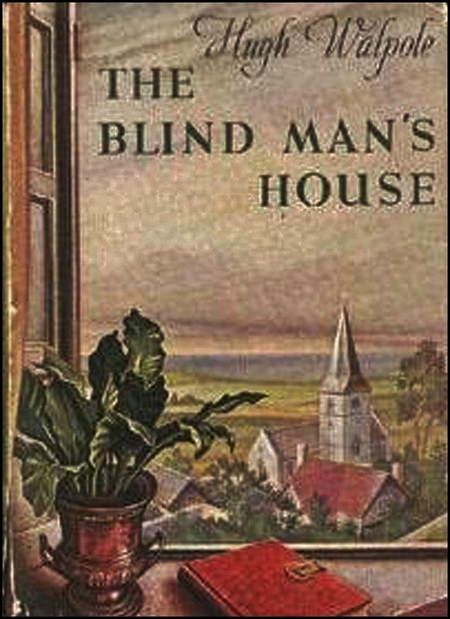
the blind man's house hugh walpoleThe Blind Man’s House by Hugh Walpole ~ 1941. This edition: Doubleday, Doran & Co., 1941. Hardcover. 337 pages.

My rating: 5.5/10

Sir Julius Cromwell, blinded many years before by a bullet to the head in the Great War, has recently married the lovely and impetuous Celia, fifteen years his junior. The two are still in the physically passionate honeymoon stage of their relationship, Celia’s husband adores and indulges her, and she worships him; they are moving to a country estate in the town where Sir Julius grew up; a warm welcome by the locals is anticipated. So why does Celia feel so apprehensive and sick with fear, and why does she cringe away from the sightless gaze of her husband’s beautiful blue eyes?

Everybody loves Sir Julius, from the youngest vicarage child to his servants to the one surviving member of the noble family whose ancestral home Sir Julius has just taken over. Even the handsome Jim Burke, well-born but looked down on with disdain for his wandering ways and philandering approach to the local young women, has settled into a remarkably stable relationship as a companion-odd job man to Sir Julius; the two are comfortable in each others’ company, and Jim reads aloud by the hour to Sir Julius and is his intellectual equal in their long shared talks together.

The young Mrs. Cromwell, on the other hand, is not going over so well. Her hasty temper and impulsive ways wreak domestic havoc and Sir Julius is frequently called upon to smooth ruffled feathers. Celia is well meaning and vivacious; she soon realizes that she is making some bitter enemies among the local ladies – most particularly and seemingly without cause with the vicar’s wife, but she is floundering with how best to make friends and handle her servants tactfully.

When it becomes obvious to all that Jim Burke is looking with admiring eyes at the lovely wife of his employer-friend, gossip starts to ferment and Celia’s popularity takes a further nosedive. When the two are witnessed in an embrace in the woods, whispers become outspoken words, and Sir Julius’ happy world starts to crumble around him.

This is a readable though occasionally melodramatic examination of the psychological effects of blindness both on the blind man and on everyone around him. Much as Sir Julius attempts to just get on with things, his injury is the elephant in the room, engendering endless speculation. Celia in particular can’t seem to get over her surprise that her husband’s other senses are so highly developed to make up for the loss of his sight; she is almost offended by the keenness of his hearing, by the delicacy of his touch, and by his uncanny ability to navigate through the darkest of rooms. Jim Burke has perhaps the most natural response to Sir Julius and the two mens’ friendship is sincere, despite the complications of the jointly admired Celia.

Just as I thought to myself that the story was taking on shades of Lady Chatterley’s Lover, what with the maimed husband, passionate young wife and handsome young retainer aspect and all, what does clever Walpole do but make reference to D.H. Lawrence in his own narrative, leading me to believe that the resemblance to the scenario is more than accidental.

It was as though (Celia) had been placed out of contact with everyone living. She picked up a book—a heavy brown volume on the table at her elbow. The Letters of D. H. Lawrence. There had been a time when it had been the fashion among her friends to read Lawrence, as though there were a new gospel here. And perhaps there was. She could never be sure, because so much of The Rainbow and Women in Love bored and wearied her, and sometimes there were magnificent things.

But now she read on and on and it was as though Lawrence screamed in her ear, telling her that catastrophe was on the way. She could not understand why he rejected everything and everybody—rejection, hate, misery. And then would come some passage of natural description so lovely and quiet that his voice dropped to a loving encouraging whisper. He rejected all living human beings. He said again and again with sickening reiteration that he trusted no one. His dearest friends he would embrace at one moment and reject with loathing at the next. Everything revolved around himself. He was sick, he was poor, he was betrayed, and he said so over and over again. But he had genius, that strange gift of seeing everything and everybody for the first time, as though no one had ever lived on this earth before himself.

But his thin nervous cry increased her own fear. He was right. The world was dreadful because the people in it were dreadful—dreadful and menacing…

Poor Celia, and poor Sir Julius. Poor Jim Burke, too! For this love triangle evaporates into nothingness, leaving the married couple still in partnership with each other and leaving Jim to make peace with himself on the outside of society’s charmed circle after his brief time of friendship with his fellow kindred spirit.

Hugh Walpole capably weaves numerous personal histories together on his way through this domestic saga, and some of his characterizations are clever and beautifully poignant, particularly concerning the three vicarage children.  But ultimately I felt that The Blind Man’s House was something of a minor work; too busy with incident and attempts at analysis to ever really settle down into story; personalities only carrying the thing so far.

The Blind Man’s House is available online at Project Gutenberg Canada.

Read Full Post »

sapphira and the slave girl willa catherSapphira and the Slave Girl by Willa Cather ~ 1940. This edition: Knopf, 1940. Hardcover. 295 pages.

My rating: 7.5/10

This book passed the ultimate reading test last weekend. I picked it up while browsing the treasure trove of vintage books at the very recently opened (a year or so ago) Pulp Fiction Coffee House & Robbie’s Rare Books right downtown on Pandosy Street in Kelowna, British Columbia. I settled down with Sapphira and an excellent coffee mocha, and then I read and read and read. The place was busy; the conversation levels loud; I was a at tiny, tippy, table-for-one and it wasn’t exactly what one would consider prime reading conditions, but it didn’t matter. The story won out.

When Sapphira Dodderidge Colbert first moved out to Back Creek Valley with her score of slaves, she was not warmly received.  In that out-of-the-way, thinly settled district between Winchester and Romney, not a single family had ever owned more than four or five negroes.  This was due partly to poverty–the people were very poor.  Much of the land was still wild forest, and lumber was so plentiful that it brought no price at all.  The settlers who had come over from Pennsylvania did not believe in slavery, and they owned no negroes.  Mrs. Colbert had gradually reduced her force of slaves, selling them back into Loudoun County, whither they were glad to return.

Sapphira Colbert is now in her late fifties, and she and her husband Henry Colbert have lived in Back Creek Valley for thirty years. Between them they have built up a modestly successful business in a notoriously poor region; Henry is the flour miller. Sapphira herself is of modestly aristocratic stock; her mother was born in England, and Sapphira’s family heirlooms furnishing her house and her own finicky attention to “proper” speech and deportment set her apart from most of her neighbours. For the last five years Sapphira has been wheelchair bound; she suffers from dropsy and suffers even more from the loss of her physical freedom, though she still rules her household and keeps a keen eye on the mill and Henry’s doings there.

And Sapphira has recently not liked what she is seeing. One of her most-favoured slaves is pretty and intelligent Nancy, the half-white daughter of Till and granddaughter of Jezebel; the third generation of a family line owned by the Dodderidge family. Sapphira has made something of a pet of Nancy, keeping her as a personal servant and giving her trinkets and pretty clothes, but recently she has turned on the bemused girl, lashing out at her verbally and physically. Nancy has no idea why her beloved mistress has turned against her, but everyone else on the place has an opinion on the matter.

Nancy has been in the habit of cleaning Henry Colbert’s bedroom over at the mill – Henry and Sapphira lead very separate lives, and no longer share their marriage bed – and has started bringing Henry small nosegays of flowers, which she leaves in his room. The two have recently been seen in earnest conversation, and Sapphira, viewing Nancy’s lushly blossoming adolescent figure with a cynical eye, suspects that her husband and her slave girl are up to something even more intimate in the hours of the night.

She is mistaken, though. The relationship between Nancy and Henry is innocent through and through. Henry views Nancy as a pure young girl, and himself as her paternal protector. It has never crossed his mind to look at her in a sexual way, and she herself is  vehemently virginal, shuddering at the thought of sex with anyone, least of all her fatherly patron.

Henry is a noble character, of a sternly righteous Lutheran heritage; the thought of slave ownership is anathema to him, and only his vast respect for his wife has made it possible for him to keep quiet about what he sees as a fundamentally wrong practice. It is pre-Civil War Virginia, though, and marriage laws are such that Sapphira is unable to sell her property – including her slaves – without her husband’s permission. She has made her intention of selling Nancy clear to Henry, and he has categorically refused to allow such a thing, believing that Sapphira owes her slaves a permanent benevolent protection, adding fuel to the fire of Sapphira’s suspicion. So Nancy continues to receive sharp words and sharp cuffs, while Sapphira muses on other ways to revenge herself on her two supposed betrayers.

How Sapphira plots her revenge, and how Nancy is able at last to escape her wrath is the storyline which runs through the book, though there is a lot more going on here too, and numerous cleverly drawn characters besides the three key players.

Willa Cather tells her story in a spare, clean style, mincing no words whatsoever. As a matter of fact, the frequent colloquial language made me wonder rather why this novel has not suffered the same criticism as Mark Twain’s Huckleberry Finn has recently received; Sapphira, her compatriots and the narrator herself have no problem with calling anyone a “yellow girl” (for the half-white Nancy) or a “darkie”; “nigger” is an everyday expression and is used abundantly throughout.

Perhaps it is the overall theme, a critique of the practice of slave ownership, and an ongoing discussion of moral obligations, which has made it less of an issue? Or maybe the book is just that much more obscure that publicity has so far escaped it. In any event, it is there, and slightly shocking to a modern day reader; I did find myself glancing around to see if anyone was reading over my shoulder, and I angled the book to prevent a casual glance from catching the potentially offending words.

An excellent read, which kept me engaged even through the increasing melodrama, and Nancy’s continual jittering vapours. Sapphira as the key antagonist is cold and calculating, and we are very cognizant of her manipulative ways, but we are also given a chance to see behind the façade, to glimpse her fears and insecurities and internal conflicts, as well as those of every other major character.

In Sapphira and the Slave Girl, Willa Cather lives up to her reputation as a brilliant writer and a keen observer of American culture and personal history.

Read Full Post »

the innocent traveller ethel wilsonThe Innocent Traveller by Ethel Wilson ~ 1949. This edition: New Canadian Library, 1982. Paperback. ISBN: 0-7710-9316-0. 277 pages.

My rating: 9/10

Every once in a while a book comes along which, unexpectedly, completely delights me. The Innocent Traveller is one such novel.

There’s not much in the way of drama in this joyfully written book, but it struck a chord of shared experience and of common humanity in its delicious narrative of the irrepressible Topaz. Always witty and occasionally poignant, the tale spans a full century of one woman’s life, and simultaneously gives a lightly drawn but absolutely fascinating portrait of the times she moved through, and of the society of her peers.

From the Author’s Note:

This is the story – part truth and part invention – of a lively woman who lived for a hundred years and died triumphant in Vancouver and is nearly forgotten after her small commotion of living.

The metaphors are not mixed. The drop of water, the bird, the water-glider, the dancer, the wind on the canal, and Topaz, are all different and all the same…

E.W.
Vancouver
British Columbia
1947

Our story – Topaz’s story –  begins in the 1840s,  in a respectable and prosperous London house, at dinner with the family (and important dinner guest) all decorously present.

Far away at the end of the table sat Father, the kind, handsome and provident man. At this end sat Mother, her crinoline spread abroad. On Mother’s right was Mr. Matthew Arnold. On each side of the table the warned children ate their food gravely, all except Topaz, on Mother’s left. Topaz, who could not be squelched, was perched there on top of two cushions, as innocent as a poached egg. Mother sat gracious, fatigued, heavy behind the majestic crinoline with the last and fatal child.

Topaz in a few moments makes the expected scene and ends the evening under the table amongst the trouser legs and skirts of her elders; poor Mother is indeed doomed, perishing along with her “last and fatal” baby within the next 48 hours. After a suitable period of mourning, Father remarries in order to provide a suitable mother and guide for his large family, choosing his late wife’s sister Jane as replacement and new helpmeet.

Stepmother is absorbed into the Edgeworth family, and life goes on. We watch the brothers and sisters blossom, go forth into the world, marry, have children, and flourish (or decline into early death) each in their turn, and we return again and again to take a look at little Topaz, who, still innocent of deliberate intent to speak out of turn, does indeed manage to do so continuously.

Boarding school, an unfulfilled love affair, travels with her older siblings, and the long gentle transition into adult, then middle-aged daughter-at-home with elderly parents; through this all Topaz burbles as irrepressibly as a forest spring. Stepmother dies, and Topaz finds herself in control of the household, and sadly at a loss. Others step in, as always, and Topaz goes back to her comfortable niche as universal companion to all, talking her way through her days, greeting each new thing with cries of alarm or delight (mostly delight); persisting in her perennial girlishness until she finds herself at fifty, Mother, Stepmother and Father now all gone, at last on her own.

Now this could go very badly indeed, but luckily (for Topaz) the Victorian custom of family looking after family is one the Edgeworths faithfully and automatically practice, and Topaz is absorbed into a new family grouping, one which will see her out to the end of her days. She moves, along with her elder widowed sister Annie and her unmarried cousin Rachel, across the Atlantic to Canada, via sea journey and long train trip, all the way to Vancouver, where Annie’s sons welcome the three adventurers, “whose years added up to over one hundred and fifty”, and helped them to establish a new home.

Topaz embraces her new life with typical enthusiasm, and we follow her for the last five decades of her life until her peaceful ending, a full century after her birth.

Ethel Wilson writes this semi-biographical tale with a very personal touch – she appears just a little over half way in in the person of recently orphaned eight-year-old Rose, born in South Africa to English parents – Annie’s son and daughter-in-law. Annie, Rachel and Topaz warmly enfold this fourth person into their world, and subsequently raise her in to womanhood in her turn.

Through the fabulous social and scientific changes of the turning of the nineteenth into the twentieth century, through two world wars and the stunning growth of the colonial city of Vancouver and change after change after change, Topaz remains the same, endlessly curious, endlessly outspoken, endlessly optimistic and reaching for the next adventure. Her death is sad but not tragic; her memory persists in those whose lives she fluttered in to and out of.

Lovingly written, with warm humour and an unsentimentally analytical eye, this is a lovely ode to an individual and a family, and an absolute joy to read.

Read Full Post »

And the last late reviews from February of 2013.

*****

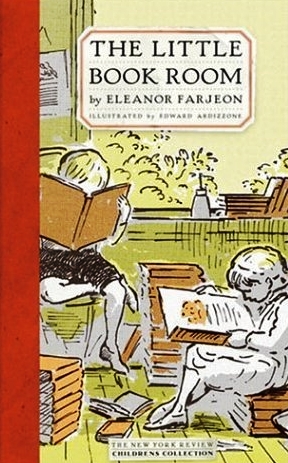
the little bookroom eleanor farjeonThe Little Bookroom by Eleanor Farjeon ~ 1955

This edition: New York Review Books, 2003. Hardcover. ISBN: 978-1-590170-489. 336 pages.

My rating: 8/10

A collection of twenty-seven delicately written fairy tales. Aimed at the younger crowd, but possibly more suited to real appreciation by adults. A few are slight, gentle and – in the very best sense of the word – childish, but others are rich in their imagery and complexity. The stories were selected by Eleanor Farjeon herself, and are deliciously and perfectly illustrated by the one and only Edward Ardizzone. Rumer Godden’s Afterword is a lovingly worded compliment to the author.

My own pretty well grown children are sadly long past the stage of being read to, but I am keeping this one close by both for personal pleasure and perhaps to one day share with as yet theoretical grandchildren.

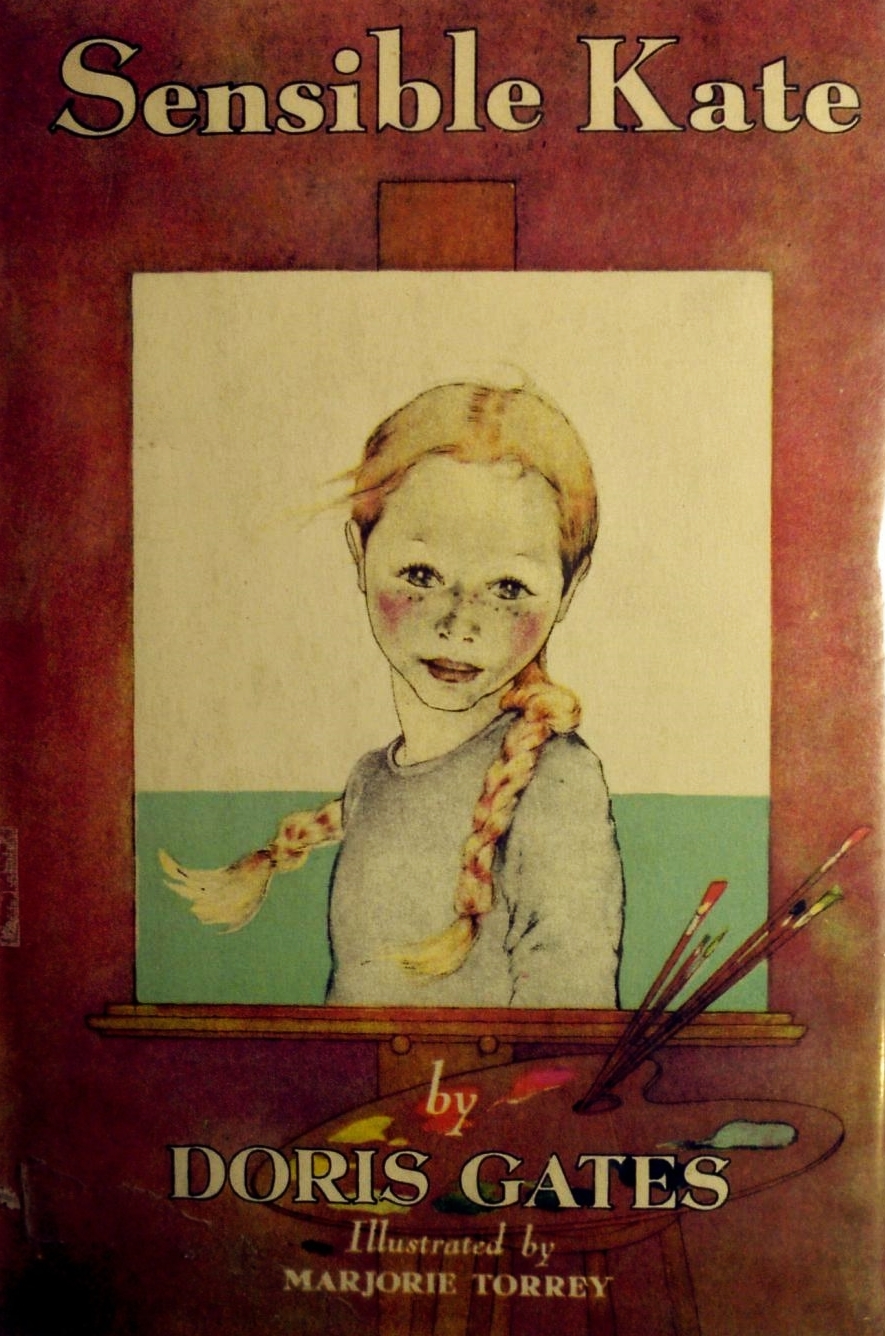
sensible kate doris gatesSensible Kate by Doris Gates ~ 1943

This edition: Viking Press, 1969. Hardcover. 189 pages.

My rating: 6/10

Doris Gates is perhaps best known for her Newbery Award runner-up children’s novel Blue Willow, as well as the widely read Little Vic, both viewed as important early examples of “realistic problem fiction” for young readers, not a genre I am particularly fond of as a rule, but which is perfectly acceptable when the characters and their story are over-emphasized over the “problem”. Doris Gates gets a pass; these are “real” novels no matter how they’re categorized.

Sensible Kate was Gates’ third novel, and it is a pleasant example of children’s literature of its era, with the young heroine facing her rather daunting challenges with good expectations of positive outcomes. The Kate of the novel is a likeable girl, flawed enough to be realistic, but with a solid core of goodness which makes her most appealing.

Kate has been an orphan as long as she can remember, and has been cared for by various “shiftless” relatives since babyhood. Now the relatives have decided to move out of the state, and they have decided to turn Kate over to the county relief office. Kate is placed as a foster child with an elderly couple, The Tuttles, and she soon makes herself beloved of them and many others whom she meets, including a young married couple, both artists, who are the very reverse of sensible in their daily affairs, and who are most appreciative of Kate’s practical talents.

A sweet but never saccharine story, with some interesting characters and scenarios which lift it a little over the average for its vintage and genre. Possibly one might pick up on the lightest shade of Anne of Green Gables, what with the red-haired heroine being an orphan and going off to live with an elderly couple, but the parallel ends right there. Kate is most certainly no Anne, and her creator has not attempted to model her so.

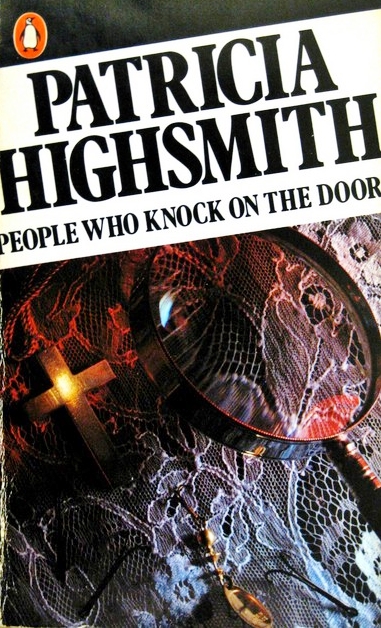
people who knock on the door patricia highsmithPeople Who Knock on the Door by Patricia Highsmith ~ 1983

This edition: Penguin, 1983. Paperback. ISBN: 0-14-006741-8. 356 pages.

My rating: 6.5/10

A rather unusual book, a noir almost-thriller with some odd twists, including a subplot involving a teenage girl’s abortion. Despite its date of publication, it seems to be set in the 1950s, and has a decidedly vintage feel to it. This is the first Patricia Highsmith book I’ve ever read, though I’ve seen several of the movie adaptations of her work, Hitchcock’s Strangers on a Train, and of course the Venetian-set Talented Mr. Ripley, so the dark psychological elements in this one came as no surprise.

Here we have a normal middle-class family, the Aldermans, with an insurance-salesman father, stay-at-home mother volunteering a few days a week at a children’s hospital, and teenagers Arthur and younger Robbie. Arthur is getting ready to go to college, has a satisfactorily active love life, and he is poised to get on with his life when his whole world takes a sickening lurch.

Robbie falls ill with a mysterious infection and is suddenly on the verge of death. The doctors turn away in dismissal – the boy is going to die –  but Mr. Armstrong refuses to give up hope, and prays diligently to God for a miracle. Robbie recovers, and the previously un-religious father is so moved by the experience that he embraces religion and joins a highly evangelistic Christian sect. Mrs. Armstrong and Arthur view this at first with mildly perturbed eyes, but Robbie fully embraces his father’s new-found faith, with eventual horrifying consequences.

A can’t-look-away, exceedingly uncomfortable depiction of a dysfunctional family and its twisted disintegration, with none of the characters completely faultless, including our pseudo-hero Arthur, the closest thing to a chief protagonist in this tense tale.

 the wedding of zein tayeb salihThe Wedding of Zein by Tayeb Salih ~ 1968
This edition: New York Review Books, 2009. Softcover. ISBN: 978-1-59017-342-8. 120 pages.

My rating: 7/10

Two short stories and a short novella – the title story – by the late Sudanese writer Tayeb Salih, set in the country around the northern Nile .

The Doum Tree of Wad Hamid speaks to the importance of tradition, and to the quiet resistance of the people of the Sudanese country to outside influences.

A Handful of Dates concerns a young boy who becomes aware for the first time of the realities of rich and poor, and the role his grandfather has played in a neighbour losing his inheritance.

The Wedding of Zein concerns an unlikely hero, a physically deformed “village idiot” (for want of a better term), who insistently falls in love with one after another village maiden, only to be disappointed as they always marry someone else. Imagine then the shock of everyone when it is announced that Zein has at last found a prospective wife, and an unexpectedly wise and beautiful one at that.

This book gives a diverting glimpse into an unfamiliar world, and the stories are told with clarity and understated, rather sly humour. A short but worthwhile collection.

Read Full Post »

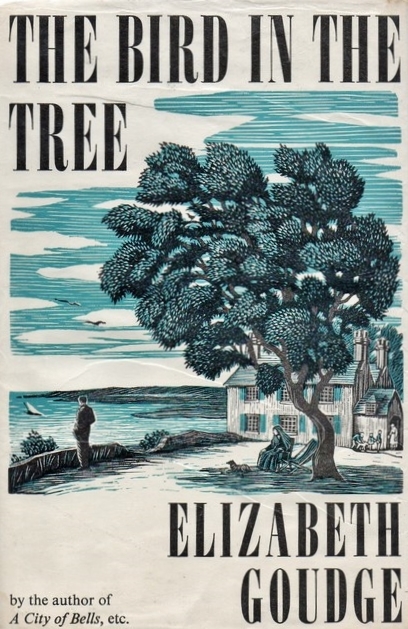
the bird in the tree elizabeth goudgeThe Bird in the Tree by Elizabeth Goudge ~ 1940. This edition: Coronet, 1990. Paperback. ISBN: 0-340-02683-9. 256 pages.

My rating: 6/10

This is the first book of what was to become the well-known “Eliots of Damerosehay” trilogy; three novels centered around a (mostly) artistic and intellectual upper-class family before and just after the World War II years. The setting of the ancient ship-building village in Hampshire, the real-life Buckler’s Hard referred to as Fairhaven, or “The Hard”, consisting of Big Village and Little Village, is lovingly drawn from life. The houses so eloquently described in the books as to be characters in their own right – Damerosehay, and, in the second book, the Herb O’Grace,  were fabricated by the author from memories of similar places important to her in her own retreat from the world to recuperate from her own emotional breakdown following the long illness and traumatic death of her beloved father, which prefaced the writing of this novel.

Visitors to Damerosehay, had they but known it, could have told just how much the children liked them by the particular spot at which they were met upon arrival. If the visitor was definitely disliked the children paid no attention to him until Ellen had forcibly thrust them into their best clothes and pushed them through the drawing-room door at about the hour of five; when they extended limp paws in salutation, replied in polite monosyllables to inquiries as to their well-being, and then stood in a depressed row staring at the carpet, beautiful to behold but no more alive than three Della Robbia cherubs modelled out of plaster. If, on the other hand, they tolerated the visitor, they would go so far as to meet him at the front door and ask if he had bought them anything. If they liked him they would go to the gate at the end of the wood and wave encouragingly as he came towards them. But if they loved him, if he were one of the inner circle, they would go right through the village, taking the dogs with them, and along the coast road to the corner by the cornfield, and when they saw the beloved approaching they would yell like all the fiends of hell let loose for the afternoon…

And as the story opens, the approaching visitor is very well beloved indeed. It is David, grandson of the matriarch of the country home Damerosehay, Lucilla Eliot, and the children referred to are his three young cousins, Ben, Tommy and Caroline, who are living with their grandmother in Hampshire while their father is in India and their mother in London.

As well as gifts for the children, David comes on this visit with some disquieting news for his grandmother. He has fallen in love with the children’s mother, his own aunt-by-marriage Nadine, who has just obtained a divorce from Lucilla’s son George. David and Nadine, despite the vaguely incestuous awkwardness of their relationship and the five year difference in their ages (Nadine is thirty; David twenty-five) propose to marry, and David has screwed up his courage to confront Lucilla with the decision as unalterable.

Lucilla cannot agree; she still hopes that Nadine and George will reunite, and she is utterly appalled at the thought of the trauma which the children will undergo, in particular the sensitive and sickly Ben, who worships his older cousin as well as his absent father; his mother’s proposed marriage will shatter Ben’s fragile peace, and Lucilla refuses to countenance such a thing.

Lucilla fits the pattern of benignant family matriarch wonderfully well. She is a woman of strong personal attractiveness, being both physically beautiful and deeply invested in the interests of her extended family. She had, years ago when the child David was orphaned shortly after the Great War, purchased Damerosehay and built it up as a place of refuge to her children and grandchildren to retreat to for emotional and spiritual healing from the stresses of their workaday lives. And, like all matriarchs, she frequently feels as though she knows best in every situation, regardless of what her family wishes for themselves. So Lucilla sets out to make David and Nadine see the errors of their ways, and to knit together the unravelling family bonds.

Damerosehay itself has a fascinating history, and it is through the discovery of the details of the lives of those who have resided there before the Eliots that Lucilla finds support for her passionate defense of the virtues of loyalty and higher responsibility – to family and God, and to community and society – which she presses upon both David and Nadine as of higher importance than personal happiness.

Elizabeth Goudge was a loquacious describer of both people and places, and her sincere nature-worship and delight in the beauties of the rural world come through loud and clear in this novel. The descriptive passages, though frequently gushing, do paint clear and evocative pictures of the Hampshire countryside and village worlds; her descriptions of the people in her stories are equally well drawn.

If the story has one major fault – and it does have many small ones, too – it is that the conclusion is very obviously contrived and owes much too much to convenient discovery of old manuscripts and vaguely supernatural occurrences including a mysterious blue bird and a phantom mother and child. Capping things off is a well-placed storm and rescue-by-rowboat of an old family retainer with a key part to play in the background tale of Damerosehay’s earlier inhabitants, and its mysterious carved drawing-room mantelpiece, which exerts a strangely compelling influence on everyone who enters the room.

This whole concluding episode is sentimentally melodramatic, and not particularly convincing, unless one accepts the extra-special specialness of the Eliots’ collective hypersensitivity to atmosphere, which selectively is a trait shared among the main characters, in particular Lucilla, David and Ben. And in this case, Nadine, who is temporarily allotted the same sensitivity in order to allow her to benefit from Damerosehay’s special atmosphere. (In later books she goes back to being herself, to my great relief, as she is a breath of sensible, sarcastic fresh air among the dreamy Eliots she finds herself saddled with as in-laws. I personally wish frequently to give David a good hard shake when he starts maundering poetically on in his actor’s way.)

The story has its merits, chief of which is its introduction of the very winsome Eliot children and its value as a back story to the even more sentimental but completely endearing Pilgrim’s Inn, the second book of the trilogy, which is one of my secret comfort reads when I need some moral pepping up. I also greatly enjoy Lucilla’s two adult children who are always steadily there in the background. Saintly Hilary, living in bachelor squalor in the local vicarage, and overworked and underappreciated Margaret, with no fashion sense, plain looks, and little talent for doing things as Lucilla would wish them done in the house, but with a secret life in her glorious garden, both give a refreshing breath of reality to the rarefied Damerosehay atmosphere.

If I seem to be damning this story with faint praise, I do wish to add that I am very fond of Elizabeth Goudge’s novels, and read them through on as regular basis, so my criticisms are those of an old, occasionally querulous, but ultimately well-meaning friend. This is not one of my favourites, but it is very readable despite my quibbles, particularly in context with the two companion books which follow.

This novel has been cursed with a wide array of hideous covers, so instead of sharing the actual Coronet illustration on my edition’s cover I am cheating a bit and using a much more lovely vintage cover, which sadly is inaccurate as to its depiction of Damerosehay overlooking the sea. In the book, the house is set in a sheltered place, set among walled gardens, and separated from the sea by an ancient oak wood. But let that pass; it will suffice.


Read Full Post »

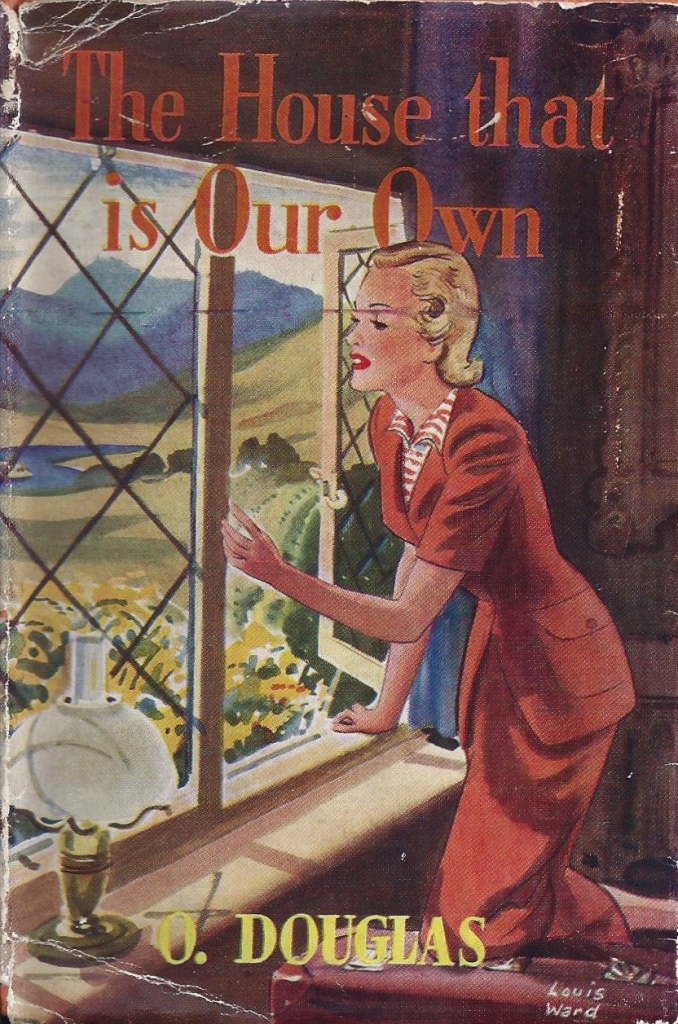
the house that is our own o douglas 001The House that is Our Own by O. Douglas ~ 1940. This edition: Nelson, 1951. Hardcover. 314 pages.

My rating: 8.5/10

Absolutely charming!

And I’m adding a whole point for the glowing descriptions of the Canadian foray which rounds off the book. I’m all proud and patriotically glowing now, after reading about how wonderful my native country was in 1940 or thereabouts, in every aspect. The author is absolutely right – Canada is really big. And it is still stunningly beautiful, and the people are really nice. Hurray for us!

Those of  us already under the quiet spell of O. Douglas’s story-telling charm will have no trouble in understanding the appeal of this gentle domestic tale. Those unfamiliar with her may be bemused a bit at what there is to get excited about, in which case I can only recommend that one dip into one to see for yourself, preferably something like The Proper Place, which will let you know if this sort of thing is for you.

Here we have the tale of two friends, Kitty and Isobel. Kitty is well into middle age, and has recently been widowed after several years of travelling abroad with her seriously ill husband, seeking treatment for his unspecified condition. Her furniture is in storage, and she has taken rooms in a London residential hotel, where she is befriended by a younger fellow resident, Isobel (all of twenty-nine, and financially independent due to a well-invested legacy), who has been living there for the past six years. Some months have gone by, and Kitty is starting to emerge from her deepest mourning, and she has started to yearn for a quiet place she can truly call her own, a place to rebuild her life along its new lines.

Encouraged by Isobel, Kitty leases an flat, and goes about getting herself all set up, with delightfully homely details.

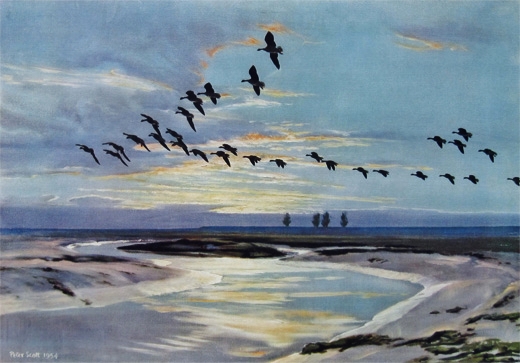
“This,” said Kitty, “is going to be my book-room. I think the long bookcase will get in along that wall. The writing-table in the window. A sofa in front of the fire – it’s so nice to lie with books piled all around you – and an arm-chair, if I can get it in. My ‘Peter Scott’ above the mantelpiece. This is the room I’ll sit in most, and I want my wild geese beside me. I’ll get the electric man to put a light over it. We had that at Hampstead, and we used to sit in the gloaming, and look up at the lighted picture, and think we heard the geese honk-honk – ”

Peter Scott - 'The Wash At Dawn' - wild geese

Peter Scott – ‘The Wash At Dawn’ – wild geese

Kitty settles contentedly into her new digs, hiring a live-in housekeeper, the widowed Mrs. Auchinvole, whom the two friends then hold up to gently snobbish ridicule from time to time – the most jarring note in the book, to me. Kitty feels she must continually snub “The Auchinvole”, as she calls her employee to Isobel, finding in her an inclination to over-familiarity and a “We’re both widows together” attitude of emotional kinship, which Kitty finds vaguely distasteful. A vignette of class-conscious attitudes of the times, perhaps, and yet another small clue as to the resulting dearth of women willing to enter “service” in just a few years time, post-WW II.

Isobel, inspired by her friend’s nest-building initiative, decides to look about for new surroundings too. In her case, the country appeals. Through Kitty’s connections in the Border area of Scotland, Isobel rents rooms in the Scottish village of Glenbucho, in the farmhouse of a sadly diminished estate, whose young laird has had to sell up most of is land, and who has since moved to Canada, leaving his family home sadly vacant. Though she hasn’t come away an her retreat intending to purchase a house, Isobel finds herself doing just that, and she becomes effortlessly absorbed into Glenbucho’s feudal society, in which she dons the mantle of “Lady of the Manor” with effortless ease and total acceptance by all and sundry.

Much discussion ensues about the arrangement of the rooms in her new home, and the hiring of a married couple (complete with adorably realistic small boy) to look after things; the descriptions of the inner workings of the new society Isobel finds herself in is a gently fascinating interlude. And when Isobel ends up making the acquaintance of the young laird himself, one Gideon Veitch, engineered by the author most ingeniously and involving a marvellously luxurious, all-expenses-paid trip to Canada (with another adorable small boy as the raison-d’être), things play out most predictably and heart-warmingly well.

A happily feel-good little story, saved from too-saccharine “niceness” by the frequent self-examinations of the heroines – they see their own flaws and mourn them, though sometimes they chose not to remedy such, which I like – so true! – and by the sourpuss and opinionated characters who pop up here and there, to add a dash of vinegar and spice to the narrative meal.

World War I is a constant backdrop to the story; many characters have had their lives turned on end by it, and are still in recovery mode; World War II is looming, and the “situation in Europe” is discussed throughout with sombre foreboding. Though the characters refuse to let themselves dwell on such negativity for any length of time, one can sense them steeling themselves for the bitter times to come; the author makes it very clear that the gentle people of her narrative have an inner core of toughness which will see them through trial and tribulation, though they spend these peaceful days concerned with societal trivialities and creature comforts, and “What’s for tea?”, and the colours of their drawing room walls.

I enjoyed this small novel a lot. So happy to have found it; our recent foray into the used book stores of that most “English” of Canadian cities, Victoria, B.C., resulted in four new-to-me O. Douglas titles to add to my “comfort reads” bedroom shelf. Next up, Pink Sugar. With Olivia and Eliza for Common waiting in the wings. Perhaps I will save those for winter reading, though it’s so tempting to just gobble them all up right now!

(A book-room with a sofa and an arm-chair in front of a fireplace – wouldn’t that be grand? That is the image I am clinging to with wistful longing after reading this cheerful tribute to the joys of making yourself a comfortable home!)

Read Full Post »

the friendly young ladies mary renault 001The Friendly Young Ladies by Mary Renault ~ 1944. Published in America as The Middle Mist. This edition: Vintage, 2003. Afterword by Lillian Faderman. Softcover. ISBN: 0-375-71421-9. 280 pages (novel), extended to 293 pages with Afterword.

My rating: 7.5/10

I’ve long considered myself a dedicated Mary Renault fan, ever since reading The Bull From the Sea at an impressionable age and being blindsided by the author’s creative interpretation of Greek myth mixed with plausible historical fiction. I’d never read anything quite like this before, and I liked it a lot. What followed was an active quest for more of the same; I eventually read all of the author’s “Ancient Greece” novels, and the collection I painstakingly acquired by scanning the dusty stacks of numerous second hand book stores, in the days before used book buying was made so gloriously accessible through the internet, is one I value greatly.

Mary Renault’s contemporary works were a much later discovery; for a long time – pre-internet, I remind you – I had no idea that such even existed. When I discovered the first of these, Kind Are Her Answers, I could not at first quite take in that this was the same author. Reading that novel bemused me some; though the storytelling skill was certainly there, the subject matter was far removed from the classical world, unless of course one were to step back and muse that human nature remains the same no matter what the era. Love and lust and jealousy and ambition and rage and sorrow being key elements in all of these stories; the figures in the plays remained similar, though the costumes and sets varied.

Mary Renault excels at characterization. Her contemporary novels in particular concentrate on the life of the mind, and the relationships between characters, much more than on the actions of the physical world. The Friendly Young Ladies takes place in a variety of intriguing locations – a houseboat on the Thames, Cornwall, London – but the action is overwhelmingly in the characters’ heads.

Here’s our story.

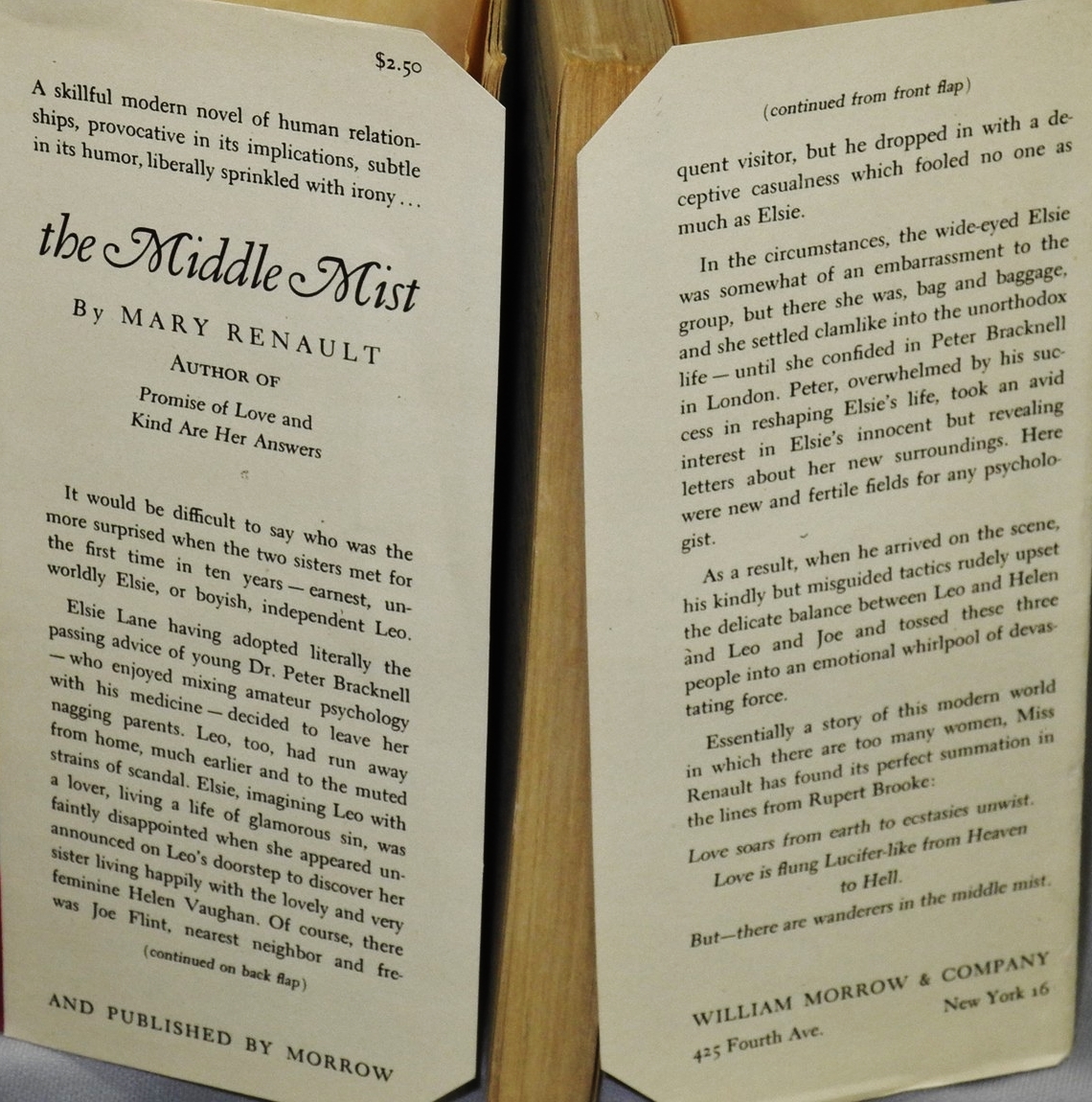
From the 1945 American edition, published under the title "The Middle Mist".

From the 1945 American edition, published under the title “The Middle Mist”.

Seventeen-year-old Elsie in Cornwall is deeply unhappy in her family life. Her parents bicker endlessly, and Elsie is the pawn of many of their arguments. An older sister, Leonora, has already broken free; nine years ago she left with a rucksack of belongings, never to return; her name is never mentioned, and Elsie has always assumed that her sister has gone to a dreadful fate, and is “living in sin”, if not something worse.

Elsie falls ill, and is treated by a young, newly qualified doctor filling in for the local G.P. Peter fancies himself something of an amateur psychologist; he decides to give Elsie a new interest in life by flirting with her and “pepping her up”. Elsie predictably develops a passionate crush on Peter; when he leaves to go back to London, Elsie reacts by running away herself, to throw herself on the hospitality of the elusive Leonora, whose address she finds in a locked drawer in her mother’s desk.

Crossing England, Elsie fetches up on the banks of the Thames just out of London, where Leo resides on a houseboat with her close friend, Helen, a nurse and medical artist. Leo has made a tenuous career for herself as a writer, turning out pulp Westerns under the pseudonym “Tex O’Hara”. The two have built a quiet and satisfying life for themselves, into which Elsie drops as an oblivious intruder. Thrilled deeply at the “bohemian” lifestyle she is now part of – just how unconventional her sister’s living arrangement is completely escapes her – Elsie writes to Peter, inviting him to visit, with the hopes that he will be suitably impressed by her initiative in escaping her dreary home life.

Peter shows up, and is thrilled to discover a rich new playground for his Freudian explorations. Two beautiful lesbians, apparently receptive to male advances, plus the awkwardly blossoming virgin Elsie – he can do them all so much good, and if he benefits by a bit of the action himself, all the better!

Now this is the bit that many modern reviewers have concentrated on, spinning the novel as an “erotically charged romantic comedy”, or some such nonsense. This couldn’t be further from the truth, and it does this novel an immense injustice, though there is certainly a lot of sly humour in the characterizations and situations involving Peter. At one point Leo seduces Peter’s girlfriend; Peter sort of gets it, and is understandably miffed when the penny drops, but he comes back more persistently than ever, being stunningly bulletproof in his self-confidence, and absolutely unputdownable. Leo and Helen run rings around him, having figured him out at the first encounter, though naïve Elsie is devastated when she realizes that she was never in the running where Peter is concerned.

All of this is mere superficial action though, and the real core of the novel is the three-way relationship between Leo, Helen, and fellow river-dweller Joe, an accomplished author of “serious” novels, who masquerades as a common labourer between bouts of writing. Their platonic circle is serene and secure, untroubled by complications of romantic jealousy, until hapless Elsie and bumptious Peter stir things up and irretrievably alter the delicate balance among the friends.

There is so much good stuff in this novel, so many worthwhile and thought-provoking passages, regarding the creative strivings of writers and artists, and also involving the convoluted realm of human sexuality. Simply viewing Leo and Helen as “confused lesbians” utterly misses the point the author is making, which is that sexuality can be a fluid and ever-evolving state of being, and, most importantly, that one should not be defined by stereotypical views having to do with one’s sexuality, be it hetero, homo, or some combination thereof. It is, at most, a sideline characteristic, and those who concentrate upon sexual identity at the expense of other character traits do themselves and society at large a disservice.

This novel is competently written, frequently amusing, poignant in places, and articulately and viciously critical of middle-class mores. I appreciate the nuances more each time I read it, though I cannot bring myself into a place of true sympathy for the oblivious and ultimately smug Elsie; she returns to the parental fold basically unchanged by her impulsive adventure, leaving unguessed-at havoc in her wake. She suffers in her own way, and she has her few moments of hellish self-examination, but she moves on; we do not agonize over her future happiness as we do for physically and emotionally fragile Leo, and for lovable and loving Helen, and for compassionate and deeply decent Joe.

I wish I myself could be more articulate as to this book’s appeal; luckily the author’s own Afterword, written in 1983 and looking at her novel down the long vista of years, sums it up well and gives a glimpse of the motivation that spurred on its writing – a kneejerk reaction to the sombre The Well of Loneliness by Radclyffe Hall, which the author and her partner read with snickering dismissal while on a French holiday in 1938. (The book was banned in England for its homosexual themes.) Renault’s lesbians don’t agonize too much about their “condition” – if it could be called such a thing – they get on with things in general, taking sex in stride as it happens (or doesn’t) and assuming the same of those around them. A refreshing change from the norm, today as much as seventy-some years ago.

Leo’s end-of-the-book encounter with heterosexual sex aside, this is a book about desires of the mind rather than the body, and it is an interesting read on multiple levels.

Thank you to Jenny, for nudging us all to give Mary Renault a try, and a reminder to re-read for those of us who are already fans. And please do follow the conversation over at Reading the End.  You will find more musings on Renault and her varied oeuvre there.

Read Full Post »

« Newer Posts - Older Posts »