Archive for the ‘1940s’ Category

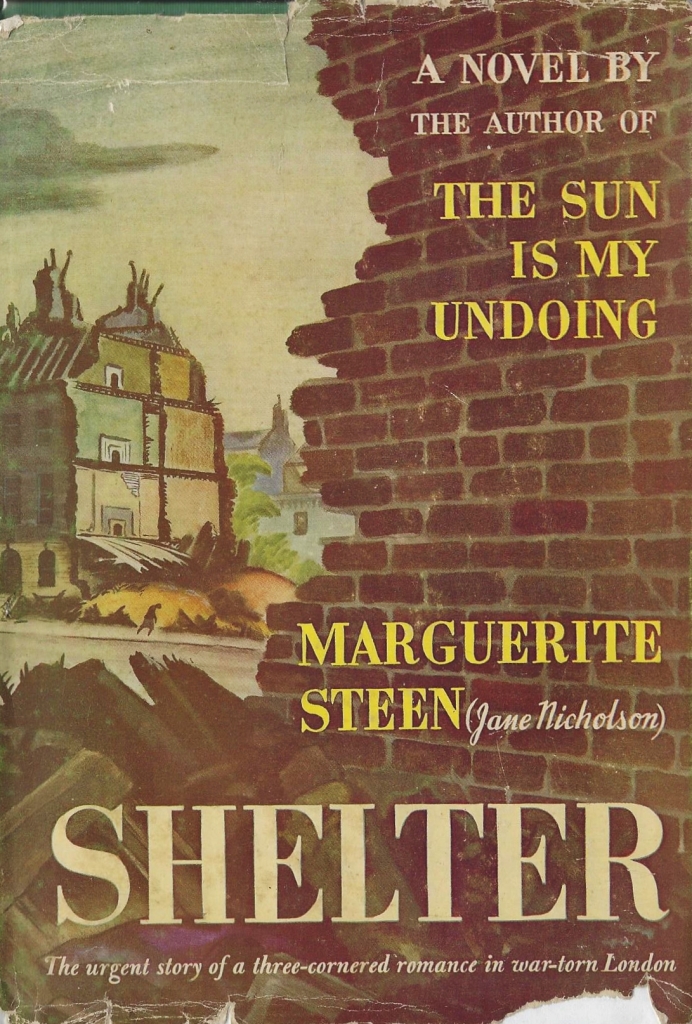
shelter-marguerite-steen-1941Shelter by Marguerite Steen ~ 1941. This edition: Sun Dial Press, 1942. Originally published under the pseudonym Jane Nicholson. Hardcover. 241 pages.

My rating: 6.5/10

I followed my reading of Frances Faviell’s superb London Blitz memoir, A Chelsea Concerto, with this rather unusually structured novel covering the exact same time period, in the same London borough.

It’s an interesting novel, and certainly not a bad novel, but I rather wonder what I would have made of it if it hadn’t been so much related to the Faviell memoir in setting and time period. The writing itself is much more than competent; I would go so far as to call it “fine”, in the highest-praise sense of the term.

This said, I suspect I got more out of Shelter as a companion piece than I would have if it were a stand-alone read, for it is a bit of a jumble, written in what I would term a modestly “experimental” style, sections of straightforward storytelling interspersed with random vignettes, the thoughts of various unnamed characters, glimpses of newsreel dialogue, and what one must assume are the author’s own pithy comments, not directly related to her erstwhile story-plot, that of a troubled marriage which has turned into a delicately balanced ménage à trois.

Highbrow Louise is married to not-highbrow (but not quite lowbrow, either) Jos, and they are reasonably content within their 7-year-old relationship. Or so Louise thinks, until it becomes apparent that Jos has become infatuated with the fragile (and possibly hypochondriac?) Camma, who returns his interest with bells on.

Jos seems to be the kind of chap who hates fuss; he’d like to keep both wife and mistress, and the fact that the two women are well aware of each other, and carry on a brittle sort of almost-friendship, seems to indicate that his delicate balancing act may be succeeding.

But then Louise breaks the news: she’s pregnant. Now what?

Meanwhile the bombs are dropping, and emotions are being wound ever upwards to some future breaking point…

The relationship angle of the plot runs parallel to the wider story of a city, country and way of life in peril, and as dreadful thing succeeds dreadful thing one is left at a loss as to anticipate how – or if! –  the author is going to resolve, if not the major problem of surviving the war, at the very least her teetering love triangle.

By removing one of the principles, as it turns out, in a decidedly final way.

Curious?

Well, the book is readily available in the secondhand trade, and has recently been released as an e-book, so it’s not too hard to come by. My own first awareness of it was when I came across it at a small used book store I occasionally frequent and decided to gamble my $5 that it would be an interesting read.

It is all of that, but I hesitate to recommend it, because despite the writer’s sure hand, Shelter seems to me to be missing that elusive something which turns a perfectly adequate novel into something extra-special.

Forewarned, you are, fellow book hunters. (As Yoda might say.)

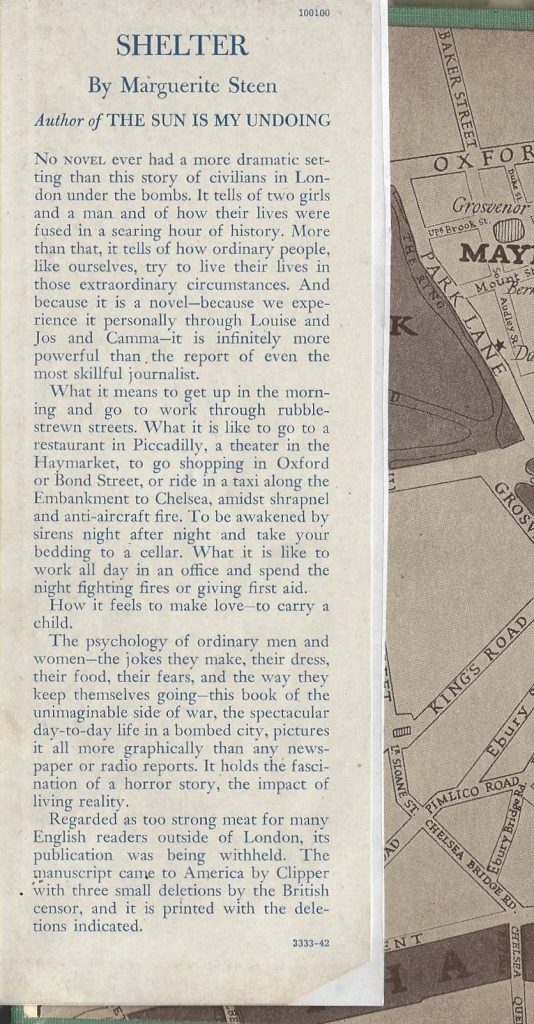
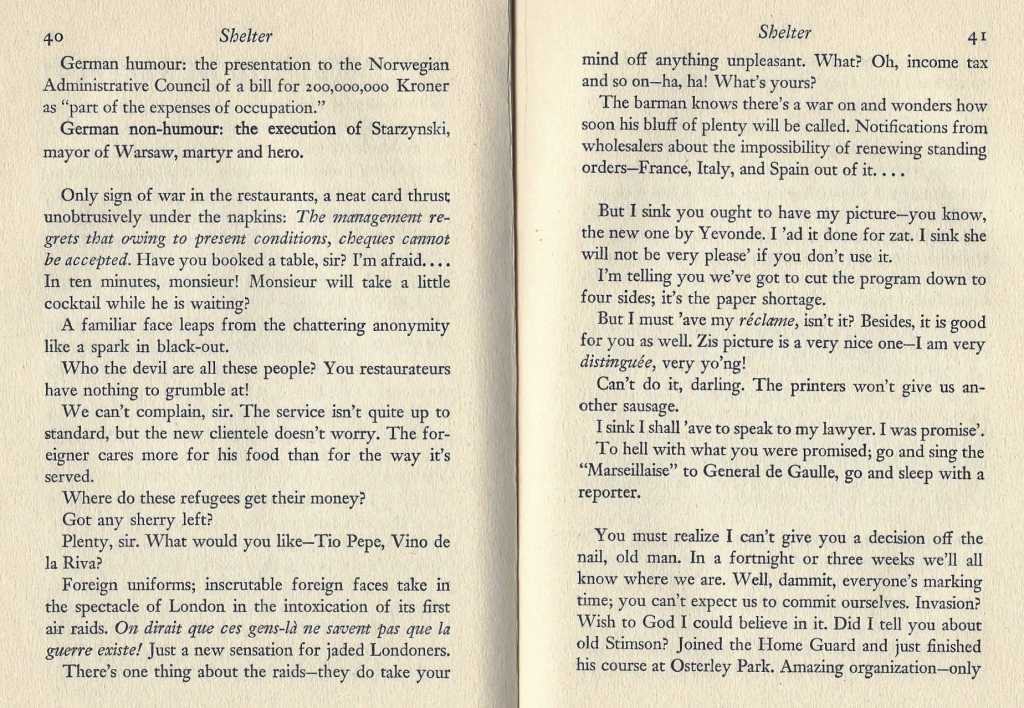
For further interest, here’s a look at the dramatic promotional blurb from the American-edition dust jacket, as well as a random scan of one of the vignette sections.

shelter-marguerite-steen-front-flyleaf

shelter-marguerite-steen-excerpt

Here’s the story on Marguerite Steen, courtesy Library Thing:

Marguerite Steen was adopted as a child and educated at a private school and at Kendal High School. At age 19, she became a teacher, but abandoned that career after three years and moved to London in an effort to find work in the theater. After failing at that, she became a dance teacher in the Yorkshire schools. This job enabled her to spend long periods travelling in France and Spain.

In 1921, she joined the drama company of Fred Terry and Julia Neilson, based at The Strand Theatre in London, and spent three years touring with them. She was befriended by Fred’s sister Ellen Terry, who suggested that she try to write a novel during a period of unemployment.

Marguerite’s first book, The Gilt Cage, was published in 1927. She went on to become a well-known author of some 40 books, mostly historical novels, having her greatest popularity in the 1930s and 1940s. She wrote biographies of the Terrys and of her friend Hugh Walpole, as well as that of 18th-century writer and actress Mary Robinson. Among her bestsellers were Matador (1934), for which she drew on her love of Spain, and The Sun Is My Undoing (1941). She also produced two volumes of autobiography, Looking Glass (1966) and Pier Glass (1968), which provide insights into the English creative set of the 1920s to 1950s.

She shared a home with artist Sir William Nicholson for about 15 years and wrote his biography as well. In 1951, she was elected a Fellow of the Royal Society of Literature.


Read Full Post »

An early English-language edition, perhaps a little too "prettied-up", when one considered the darkness of much of the content...

An early English-language edition.

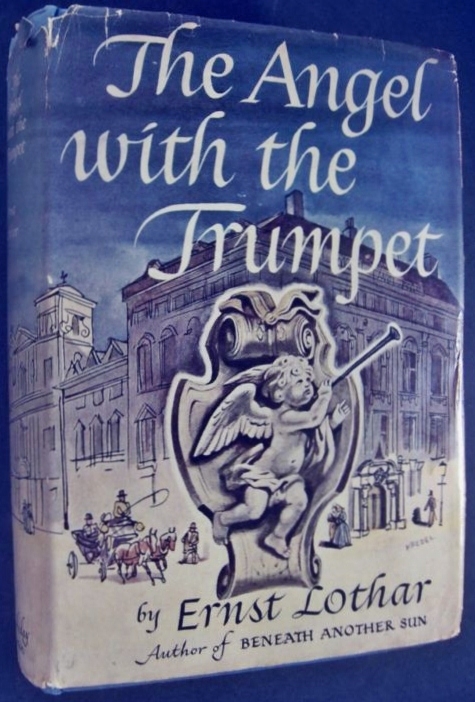
The Angel with the Trumpet by Ernst Lothar ~ 1942. First English language publication 1944. Alternate U.S. title The Vienna Melody. This edition: George C. Harrap & Co., 1946. Translated from the German by Elizabeth Reynolds Hapgood. Hardcover. 439 pages.

My rating: 7/10

This is a dense, clever, sometimes powerful, occasionally humorous, and ultimately deeply disturbing novel, based as it is on the author’s own experiences as a member of the Austrian artistic and dramatic community in the years leading up to Hitler’s Anschluss, the annexation of Austria into Nazi Germany in 1938.

It’s also an ambitious traditional-style family saga, following the stories of three generations of a prominent Viennese family, the piano-making Alts, and incorporating cameo appearances by various high-profile historical characters.

We have Mozart in a flashback scene of the performance in the Alt family music room of the composer’s personal rendition of Die Zauberflöte in its entirety, high soprano arias and all. The ill-fated Austrian Crown Prince Rudolf, who has carried on an illicit romantic relationship with a young woman who then marries into the Alt family; his dramatic suicide (real) takes place on her (fictional) wedding day. A highly unlikable Adolf Hitler appears first as a student who takes and fails an entry examination to art school alongside one of the Alt sons, and later in full dictator mode.

The rise and fall of the Alt family is something of an analogy to that of Austria itself, and it feels very deliberate. Lothar paints a damning portrait of a family, and by extension a people, who turn on their own for political expedience.

I am of course referring to the persecution of the Jewish population. Perhaps nowhere else in Europe had those of Jewish heritage become so much a part of existing society that their “Jewishness” was merely a descriptor, not a barrier to social standing, or to one’s career, and definitely not to one’s participation in the fine arts.

So how, in a few short years, did an entire society turn against a portion of itself, and why where “decent people” unable to prevent the tragedy of the ethnic-religious “cleansing” which accompanied the annexation of Austria into the Third Reich?

Troubling, indeed. But much more recent political events very close to home show that this is not an outdated possibility. Enough said.

Political and historical significance aside – and this is a valuable book to read for its documentarian atmosphere for anyone who is interested in the time period it covers, 1889 to 1938 – The Angel with the Trumpet is also an absorbing dramatic novel.

I did feel that the novel was just the slightest bit weak in its failure to fully engage me in the lives of its characters; there were few times when I completely identified with any of them, or cared deeply for their joys or despairs, though I certainly found myself deeply interested in what would happen next.

The ending is ambiguous, for the book was published before the conclusion of the war, but it shows a gleam of hope, that amongst all the evil of the time some people still cared for the wellbeing of others, and for their troubled, deeply changed, but still beloved country.

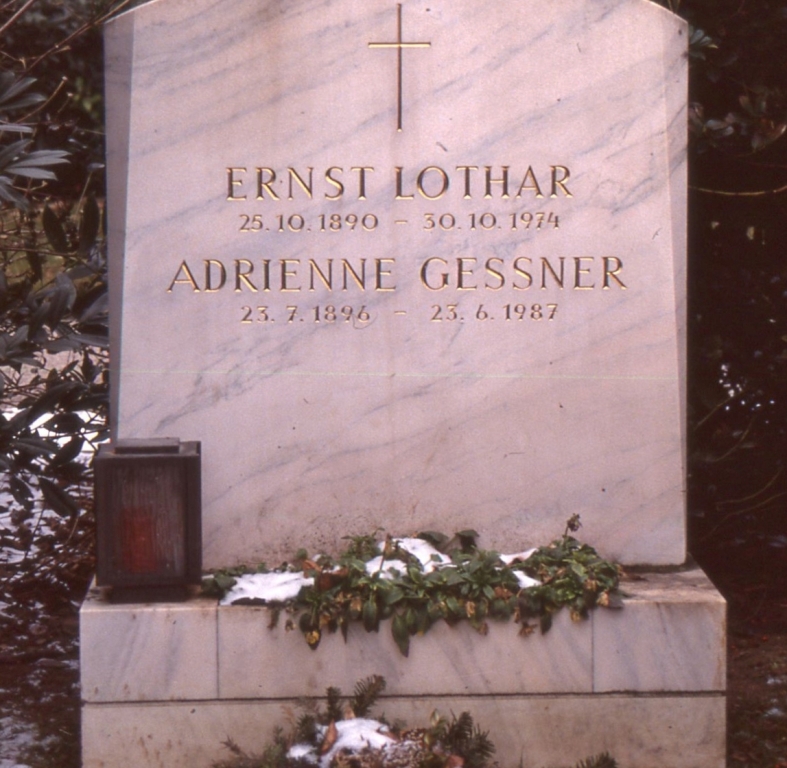
adrienne-gessner-ernst-lothar-2The author, Ernst Lothar, was a theatre director and producer as well as an established writer when he fled Austria for the United States in 1938, along with his wife, actress Adrienne Gessner. Lothar’s loving nostalgia and poignant despair for his lost homeland are very evident in this novel. The couple returned to Austria after the war, and continued to pursue their artistic endeavours. They are buried under the same headstone in a Viennese cemetery.

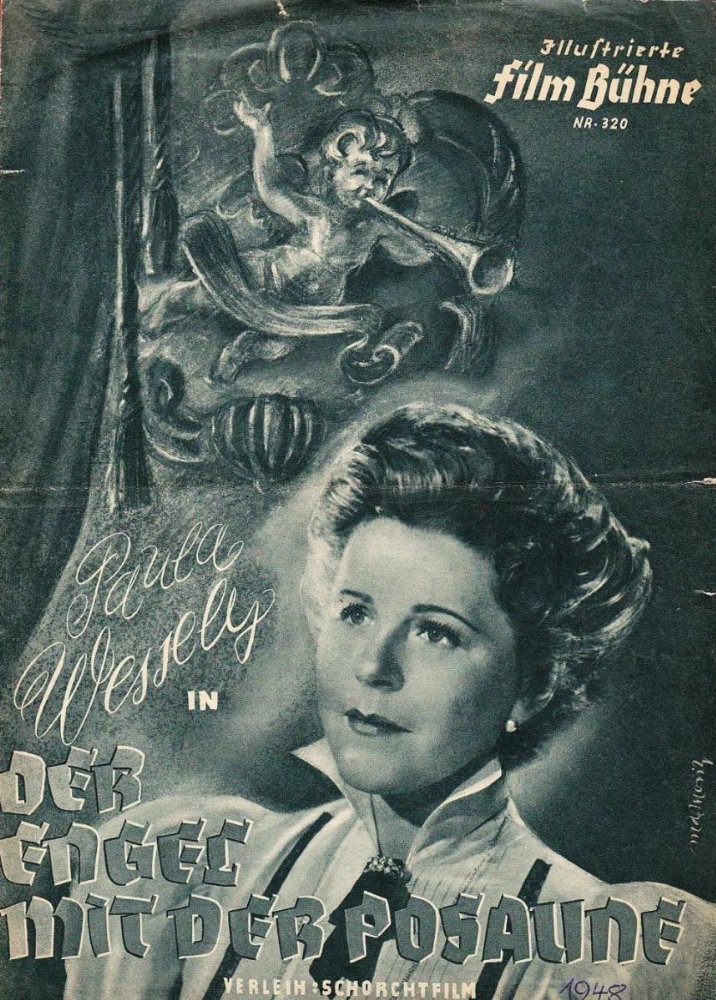
mv5bntk5zte2nzytyjrlmc00mwuwlwe4n2qty2flztc1mwm4yzy4l2ltywdll2ltywdlxkeyxkfqcgdeqxvyndy3mzu2mdm-_v1_sy1000_cr007161000_al_This novel was made into a 1948 Austrian film, with Adrienne Gessner filling one of the secondary roles. It was remade in Britain in 1950, starring English actors but using much of the Austrian-shot footage.

The Angel with the Trumpet was recently republished by Europa under its alternate title, The Vienna Melody. Those with experience in reading vintage novels will find much to enjoy, though its relatively slow pace and matter-of-fact portrayal of dramatic scenarios may fail to completely engage the modern reader.


Read Full Post »

wayward-bus-steinbeck-1947The Wayward Bus by John Steinbeck ~ 1947. This edition: Viking, 1947. Hardcover. 312 pages.

My rating: 8/10

I am gradually coming to terms with the fact that there is no way I can do full justice to the books I read in the manner in which they deserve. Even the most dismal of the period pieces I willingly engage myself in are worthy of a fuller discussion than I am able to provide in the limited discretionary time this writing-for-pleasure blog inhabits in my current lifestyle.

So rather than wallowing in guilt about not being able to go on for thousands of words regarding each and every one (yes, I tend to be long-winded at the keyboard or pen in hand, something I paradoxically rather enjoy in others and quietly deplore in myself) I’m going to be all firm with myself and try to pop out hyper-condensed “reaction pieces” to more things – reviewlets, as I think we were all calling them in a similar discussion on someone else’s writing space not that long ago.

Did you get through all that? More posts. Less words each.

Go!

Yeah, and I would decide to start with Steinbeck, an eminently discussable author. (In other words, “Ha!” to the short-and-pithy reviewlet. I predict I won’t be able to get out of this one quick-and-easy, though I’m going into it with the best of intentions.)

I like Steinbeck. Generally quite a lot. As do many others, so musings on his books (especially the headliner titles) are easy as pie to come by, thereby releiving the johnny-come-lately book blogger to get away with minimal effort, for what else really can one add? There are a fair number of reviews out there for this book, for though The Wayward Bus isn’t one of the Big Important Novels, it’s reasonably mainstream, and a rather decent example of what the man was capable of at his best.

Juan Chicoy, a competent, handsome, humorous, middle-aged, Mexican-Irish-American mechanic-philosopher type, runs a small gas station and lunch counter at a fictional spot-on-the-road in southern California. He is aided in this by his perpetually bitter, frequently angry, and not particularly attractive (or kind) wife Alice. He loves her and stays with her (though opportunities abound for moving on with others more attractive – Juan is rather a fine figure of a man both physically and intellectually) for deep and complicated reasons, not the least of which being that no one else likes her.

Alice in turn loves Juan, single-mindedly and jealously, and his easy manner with all and sundry triggers much inner turmoil which generally leads to her making a fool of herself, ranting away at the easiest targets in the room.

Those targets at this point in time are the Chicoy employees, teenage apprentice-mechanic Ed (“Kit”) Carson, more commonly called “Pimples” for obvious reasons – he has a truly stellar acne affliction, which Steinbeck spells out for us in some detail – and young waitress Norma, a shy and homely type who nourishes a secret infatuation for Clark Gable.

Among his other endeavours, Juan owns and operates an old bus, one “Sweetheart”, under contract with Greyhound to provide a shuttle service along a secondary road between two official main-highway stops. This is the literary device which is used to assemble the cast of players who people this novel, a disparate assembly of travellers who walk in with their backstories, bump against each other for the twenty-fours hours or so which Steinbeck describes in vivid detail, before dispersing again into the wider world.

When the titular bus finally hits the road, approximately half way through the novel, its passengers consist of a successful businessman, his prissy, sexually frigid wife, their athletic university-student daughter, a travelling “novelty products” salesman, a beautiful, sexually arousing stripper masquerading for purposes of peaceful travel as a “dental nurse”, a cranky rural rancher type who hates absolutely everybody, Pimples/Kit, who begs to come along ostensibly to help in case Sweetheart breaks down, but in reality in order to bask in the presence of the delectable stripper, and Norma, who has just quit her job after being seriously wronged and insulted by outspoken Alice.

Alice herself stays behind, locking up the lunchroom and then losing herself deeply in a series of bottles, a process thoughtfully and rather compassionately described by our author.

Each person in this random cast of players faces an inner crisis of sorts during their short journey, and the resulting interconnected character studies make up the novel.

Steinbeck makes no secret of who he sympathizes with and who he despises, and he uses his authorial powers to both reward and punish his pen-and-ink creations, leading us ultimately to a glimpse into the philosophical leanings of Steinbeck himself.

Good stuff, and a stellar example of John Steinbeck’s mastery of his particular genre, the “gritty American realism” school of writing, as I always think of it with just a hint of a lifted eyebrow. He knew exactly how good he was, too, and here he shows off his literary erudition by prefacing what is merely a humble road trip novel with a quotation from a 14th Century English morality play, Everyman:

I praye you all gyve audyence,
And here this mater with reverence,
By fygure a morall playe;
The somonynge of Everyman called it is,
That of our lyves and endynge shewes
How transytory we be all daye.

Or, put into slightly more modern English:

I pray you all give audience,
And hear this matter with reverence,
By figure a moral play;
The Summoning of Everyman called it is,
That of our lives and ending shows
How transitory be our days.

Indeed.

The Wayward Bus is, as its author points out, a contemporary morality play. Though it is decidedly a thing of its time, immediately post-war America, angst-ridden and brutally pessimistic and, also, cautiously optimistic, the personal dilemmas of its characters remain relatable today, some seven decades onward.

Note to self: re-read Steinbeck. My father’s personal library, now mine, included most of John Steinbeck’s novels and memoirs; I read these voraciously as a teenager and young adult, though not as much in recent years. There’s a lot to appreciate here, though occasionally the grit gets in one’s eyes.


Read Full Post »

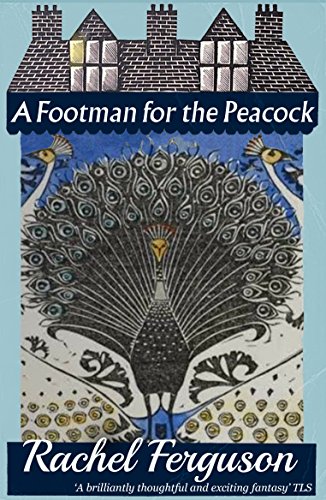
a-footman-for-the-peacock-rachel-ferguson-1940A Footman for the Peacock by Rachel Ferguson ~ 1940. This edition: Dean Street Press, 2016. Softcover. ISBN: 978-1-911413-71-4. 206 pages.

My rating: 8/10

Ever since my 2012 reading of Rachel Ferguson’s challenging but ultimately enjoyable 1931 novel, The Brontës Went to Woolworths, I’ve harboured a yen to broaden my exploration  of the further works of this highly intelligent (and highly class conscious) writer.

Imagine then my anticipatory pleasure when approached by Dean Street Press with a review copy of one of Rachel Ferguson’s long out-of-print novels, A Footman for the Peacock, a partly serious, partly fantasy, partly satirical novel set at the beginning of the Second World War.

“Yes, please!” was my response, and I must say in this case my instinct that this was going to be a pleasure to read and review was perfectly correct.

A small aside, here, regarding my book reviewing. As a book blogger in this esoteric corner of the internet, I frequently receive requests to read and review things, and I generally turn these requests down. No time or energy for possible duds, you know. (I find enough of those for myself quite voluntarily!)

Unless the book in question is one which looks to be something I’d be interested in buying for myself in any event, in which case I’m naturally as keen as can be. (Re-publishers of mid-century middlebrow fiction, and gardening and travel books of any era, please take note! 🙂 )

Back to the Peacock.

It’s 1939, and the war is looming. Even the most optimistic of “peace in our time” Munich Agreement yes-men have come to the realization that all of that was a great big political farce, and that the guns will soon be firing.

The aristocratic Roundelays are in residence at Delaye, a vast pile of a country house just barely holding its own as the 20th century brutally takes its financial toll on the English “gentleman’s class”. Sir Edmund and Lady Evelyn know that another war is well-nigh inevitable, but in concert with their rural neighbours are merely holding still, making no actual preparations other than mental, because to do so would break the fragile hope that peace might yet prevail.

The Roundelays are walking a financial tightrope, balanced as they are between the still-wealthy and the newly bankrupt; each breath of political wind sends them swaying, but they refuse to step aside and are making shift to keep things going, with ever-fewer servants and not running a car (Lady Evelyn does the household shopping herself, travelling to and fro by bus) and having a cousin in residence as a paying guest, his five guineas a week going directly into the grocery budget for cousin Maxwell, Lady Evelyn, Sir Edmund, their two daughters still at home, three perennially feuding great-aunts, an ancient and increasingly senile old family retainer (Nursie), long-time dedicated butler, cranky cook, and a gardener, his helper, and a housemaid or two, not to mention kitchenmaid Sue Privett, eighth in her family to have been in service to the Roundelays, which turns out to have great significance to our story.

And there’s the peacock.

Ill-tempered, raucous, and tolerant only towards kitchenmaid Sue and the younger Roundelay daughter, Angela, the peacock haunts the grounds of Delaye, finding his way home after being forcibly relocated to a neighbouring estate where it is hoped he will find solace with a flock of peahens.

We have clues early on that this particular peacock is much more than a semi-domestic bird. He is, instead, a sort of reincarnation of long ago Roundelay servant Thomas Picocke, a “running footman”, who perished in 1792 due to the horrific nature of his duties (running in front of the carriage horses for miles and miles, to clear the way and announce the arrival of his masters) and the callous disregard of the family he served; all but French expatriate Lady Marguerite, wherein lies a sad tale of pity and betrayal, but not that which you might think…

Of reincarnations we have an inkling of three in this complex tale; also an intriguing reference to Dunne’s Theory of Time, a concept of serialism, or parallel streams of time, much discussed by the intellectuals of Rachel Ferguson’s time, and used by such disparate writers as J.B. Priestley, Rumer Godden and Elizabeth Goudge in their novels.

A Footman for the Peacock was received with lukewarm enthusiasm upon its publication early in the war. Though Rachel Ferguson was well-known by that time as a cutting satirist, the portrayal of the Roundelays as self-devoted shirkers of wartime duties grated just a bit too much on the sensibilities of reviewers, who suspected that Rachel Ferguson’s tongue was not quite as far in cheek as it should have been.

Here’s a sample of what got on their nerves.

War has just been declared, and the Roundelays are appalled by the thought of taking in evacuees or refugees. -(Perhaps understandably so, for their domestic arrangements are delicately balanced at the extreme edge of manageability – though others less well-placed are turning their households inside out in the service of the National Emergency, so that’s not a real excuse.) Anyway, at dinner one night, eldest daughter Margaret drops a bit of a conversational bomb.

‘I say, mother, I had a letter yesterday from Ortrud Bohm, that German girl I was at school with – ‘

Lady Roundelay smote the table with her fist. ‘No! No she doesn’t! My heart bleeds for the German Jews as much as anybody’s but I cannot face a pale fugitive running tear-stained in what she stands up in down this avenue. I’ve read horrors until I’m sick and I know everything the Nazis have done and I can’t cope with being wept over and having the old home in Hamburg or wherever it is described brick by brick and hearing that Mein Vater was suddenly not there and hasn’t been seen since, and that the Liebe Mutter was raped before her eyes and my German wouldn’t stand the strain. I can only say Bitte and Danke Sehr and Sauerkraut and Mein Kampf, and I won’t, I won’t, I WON’T!’

‘God, no,’ confirmed Sir Edmund. ‘If she comes, I go.’

Margaret finished her ham. ‘I was only going to tell you what she wrote and she’s not Jewish, you know… She says that she’s joined the Youth Movement and her brother’s in the army and he’s got a commission he couldn’t have hoped for in peace time as the Bohms aren’t geboren, you know, and that they’re not half so sniffed at as they used to be when they were only in trade, and she’s really seeing some men at last and is having the time of her life. She actually used some German words, so that really looks as though she might even marry now she sees it’s no good being so frightfully British. She was the one who came into the class once in a tartan skirt.’

‘Gosh… well, sorry I spoke. I hope she hooks some oberleutnant – what happened in church today, aunt Jessie?’

Did you find this passage rather shocking?

Well, you were supposed to, because Rachel Ferguson’s point is that people are a mix of thoughts, feelings and instinctive responses.

Quite “nice” people like the Roundelays – who are loving parents (the relationship between Lady Evelyn and emotionally fragile daughter Angela is one of the most likeable aspects of this all-over-the-place book), relatively decent to their servants (that episode with the running footman being in the bad old past), kindly dutiful to their tiresome relations and dependents (the great-aunts and Nursie are high maintenance to the nth degree) – I repeat, quite nice people in comparison to the society they exist in, harbouring selfish and bigoted thoughts, and having the temerity to voice them out loud.

In the last lies the rub.

For though we all harbour certain best-not-spoken thoughts, the Roundelays let fly. Mostly in the family circle, but we are privy to their words, and we recoil in politically correct horror to what is expressed in passages such as the one above, while guiltily holding in laughter, because a lot of what is said is (full disclosure – I laughed when I read this) very funny.

There is a strand of plot running through this very full story, but much of the pleasure of the thing lies in the many side excursions – show Rachel Ferguson a glimpse of a rabbit trail and she’s off like a shot, returning to the main path not at all winded and blithely assuming her reader to be loping along still in stride.

It takes a bit to get it figured out, but once one is hooked – it took me about 20 pages or so; I went back and checked – the rest of this quirky novel is both thought-provoking and entertaining. It’s occasionally rather like untangling a mess of yarn complete with helpful kitten, but it works.

And, thanks to Dean Street Press and the republishing of not just this one Rachel Ferguson novel, plus two more and a tempting selection of other mid-century reprints, my Christmas book wish-list for myself is well-nigh complete. Check out their recent releases – oh, bliss! Available as paper books (print on demand, and very nicely done; I’m impressed) from the publisher or via Amazon and Book Depository; also as ebooks in various formats.

For the original book blog review which triggered this reprint, I’m going to send you over to Scott of Furrowed Middlebrow, whose impeccable taste in obsolete fiction has pointed the way to many, many hours of excellent reading.

Here’s his take on A Footman for the Peacock, with loads of quotes and a most thoughtful analysis, which I find myself nodding away to in complete agreement.


Read Full Post »

Here’s another entry for The 1947 Club. This one doesn’t give any sort of portrait of the year, being strictly inventive historical fiction, but it does have a telling author’s note which serves to highlight the difficulties of the researching writer during wartime.

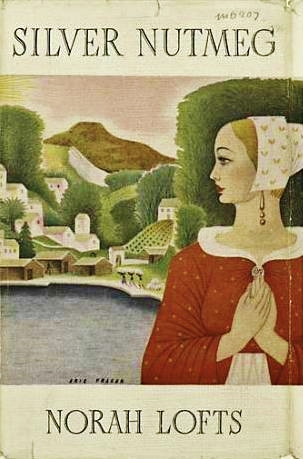
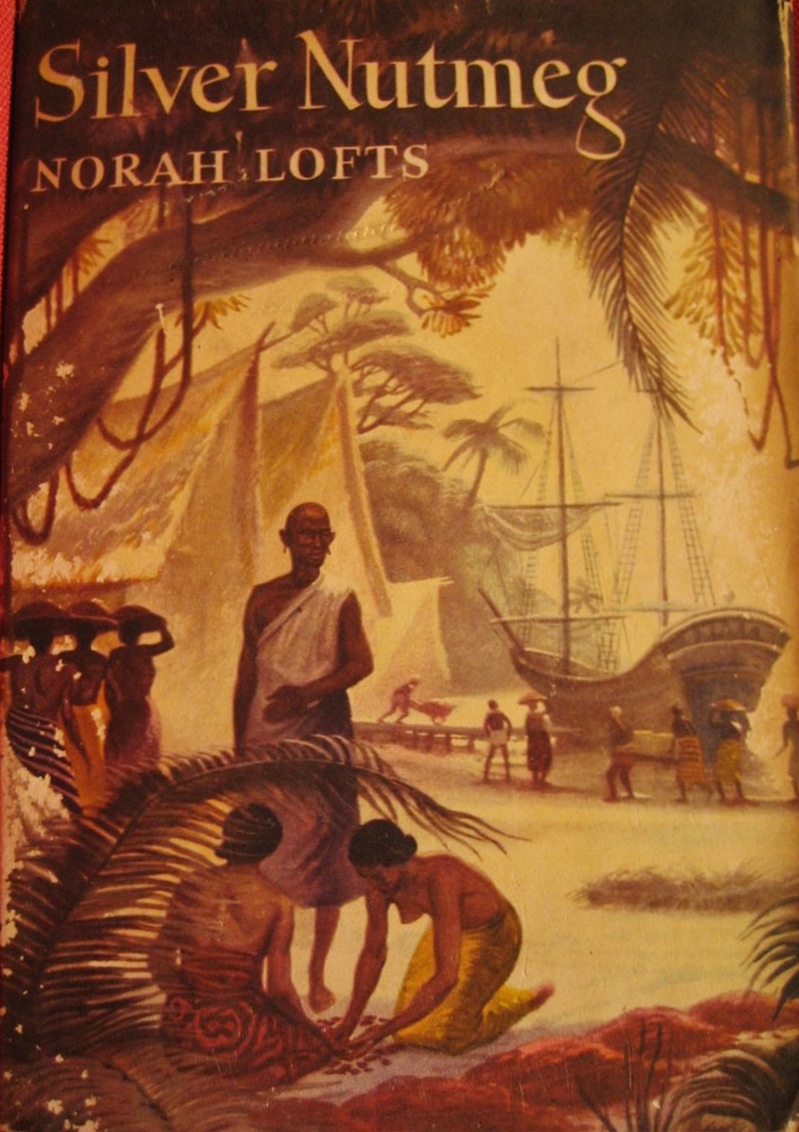
silver-nutmeg-norah-lofts-1947From Norah Lofts:

Apology and Acknowledgement

The irresistible desire to write a book about the nutmeg island of Banda came upon me when I was reading H.W. Ponder’s book, In Javanese Waters. There, in one short chapter, was outlined a romantic, bloodstained history that called for exploration. But, like all exploration, it presented great difficulties. The Dutch East Indies were in Japanese hands, all contact broken; Banda itself is no more than a speck, the size of a fly dirt on the map; no book that came my way gave any idea of the island’s layout. So my geography is the geography of the imagination.

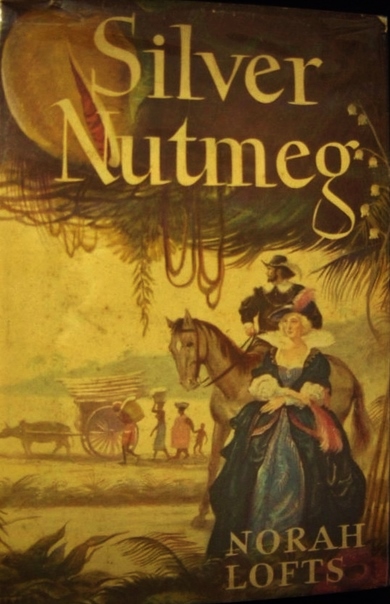
Silver Nutmeg by Norah Lofts ~ 1947. This edition: Doubleday, 1947. Hardcover. 368 pages.

My rating: 4/10

Some centuries ago, in the 1600s, shrewdly businesslike and sensibly adventurous Dutch merchants sailed the southern seas, creating trading empires for themselves in direct competition with their British counterparts. One area both factions set their sights on was the group of tiny island just off Indonesia, on one of which, Banda, grew the world’s only known population of nutmeg trees.

The Dutch having attained possession of the nutmeg isle, they jealously guarded their monopoly.  Spice trading being a big deal way back then, the export of fertile nuts or tree seedlings was strictly prohibited, transgression being punishable by imprisonment or worse. Needless to say, some of the Dutch spice plantation owners became fabulously wealthy, and herein lies the nucleus of this absolutely over written story.

(There will now be spoilers galore.)

Look, a pretty little Dutch girl!

A nice Dutch girl of good family. (Don’t do it, Annabet!)

Two Dutch half brothers, one a wealthy nutmeg plantation owner (Evert), the other a moderately successful sea-captain (Piet), meet on Banda after many years apart.

Says Evert to Piet, “Oh, dear half-brother, good to see you and everything, though we were never very close as children, my mom hating yours and all. Never mind all that, for I am now fantastically wealthy and have progressed  so far from our shared childhood as middle class nobodies in Holland. All I need now is a lovely wife to grace my fabulous house. A nice Dutch girl of good family, preferably aristocratic, so I can rub it in to those back home how far I’ve come.”

Says Piet to Evert, “Hey, what about one of the daughters of the Van Goen family? They used to be so high and mighty, scorning our family as not worthy of notice, but they’ve now gone bankrupt. I’ll bet they’d be willing to marry off one of their daughters if one flashed a few guilders their way. Annabet’s a good looker, just seventeen and blond and lovely…”

“Oh, ho!” says Evert. “Just what I’m looking for. Dear half-brother, how about you take this casket of jewels and gold and head back to Holland to convince Mama van Goens to part with her daughter in return for the fixings? You can go ahead and arrange a marriage by proxy for me, and then arrange to ship me my luscious bride.”

Done.

Small problem, however. Lovely Annabet has suffered an illness and is now no longer the beauty she once was, being emaciated and scraggly. Ah, well, the long sea voyage should put her right.

Nope.

Shal Ahmi, keeping an eye on things. (Cue foreboding music.)

Shal Ahmi, lurking about keeping an eye on things. (Cue foreboding music.)

Though Annabet proves to have a winning way about her, enslaving other men’s hearts after just a few moments of conversation despite her hideous appearance, proud Evert is instantly appalled. Calling up his pet native fixer, the shady Shal Ahmi, Evert hints that he’d be thrilled if his new wife could be eliminated from the picture.

“No worries”, says Shal Ami. “I’ll get rid of your problem.”

Which he does, by using his many connections to have Annabet massaged and herbal-cured back to her original beauty.

Evert comes home, expecting to find his marriage bed empty, all ready to start anew, and instead finding a tempting beauty in residence. “Oh, wow! My luck is in”, he gloats.

Not so fast, Evert-me-lad. For Annabet has given her heart away to another, and not just any another, but the rogue Englishman who is Evert and Shal Ahmi’s partner in a highly secret nutmeg smuggling scheme.

So that’s the set-up.

xx

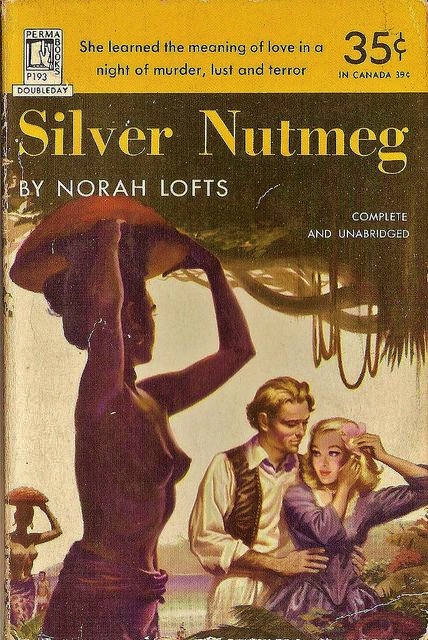
“She learned the meaning of love in a night of murder, lust and terror.” Not quite sure if the possessively groping guy is husband Evert or lover what’s-his-name. That’s quite the foreground image, isn’t it?! Reminds me that I never mentioned the native mistress thing.

It goes on for 368 long, long pages, of heart-wringings and bodice heavings, and sullen scenes, and bitter revenge scenarios, culminating in a bloody native rebellion led by Shal Ahmi, which results in the nasty demises of every single one of the key players, except Piet (remember him?) who sails into the Banda harbour just as Annabet is breathing her last after being knifed by one of Shal Ahmi’s disciples, just after she herself has done in Shal Ahmi with a handily wielded wine bottle.

Husband Evert is also messily dead, as is, presumably, the true love Englishman. (“True love”, though Annabet only actually saw him for a few hours total, with a single stolen kiss their only amorous memory) Can’t remember his name. Maybe it was John? Something like that. He’s offstage for 99.9 percent of the saga, living mostly in Annabet’s head, so we never really get to know him in person.

Norah Lofts could be and frequently was a very good writer, and I find her stuff generally quite entertaining – she had a lovely dark sense of humour and indulged in it on numerous occasions – but this book isn’t one of her winners. On the contrary, it’s truly crappy, because the love stuff is so darned unrealistic that I just couldn’t get my head around it – first sight this, first sight that, unlikely ailments miraculously cured – bah, humbug! – and the historical part is just barely sketched in.

(For those really wish to know, a bit about the real world Banda and the nutmeg trade. It’s truly interesting; I can see why Norah Lofts was intrigued.)

Let’s blame it on the war, and move along, shall we?

Silver Nutmeg had okay sales, most likely (I’m assuming) due to Lofts’ prior bestsellers, in particular Jassy (1944), a very dark, gorgeously crafted gothic-ish novel which does make the cut as far as this reader is concerned. From Kirkus, 1945, with the spoilers removed:

Once again, an experienced period romance as the story of Jassy who lived and loved too much, and was xxxxxx for it in the 19th century, is related by four who knew her. Half gypsy, with an ugly-beautiful fascination, an ungovernable temper, and the gift of second sight, Jassy is first recorded by Barney Heaton, the boy next door; next by a Mrs. Twysdale whose young ladies’ school was to be disrupted by Jassy; next by Dilys Helmar, her friend at that school, who took Jassy home with her to the ruined estate – Mortiboys – and to her amorous, wine-sodden father, Nick… (Lots of plot details removed here.) …Intricately contrived imbroglio, elemental passions for a story that keeps one reading. In the Lady Eleanor Smith tradition.

I’ve also just found a rather lovely post by author Katharine Edgar on  Norah Lofts and Why You Should Read Her which I really liked because it pinned down Lofts’ peculiarly unique style most cleverly: The Queen of Gritty, Dark, Agricultural Histfic With Lots And Lots Of Murders.

Yup.

I concur.

I’m pro-Lofts in general, despite the times I want to pitch her books across the room, but I must say you can safely give Silver Nutmeg a miss.

But please do find yourself a copy of Jassy. It’s very available. A candidate for fireside reading these gloomy autumn evenings, with the dead leaves rustling in the cold wind outside…

Read Full Post »

the-1947-clubI’m notoriously not much of a joiner, here in blog-world as much as in my introverted real life, but I do make exceptions from time to time, especially when the thing-to-be-joined is so interesting as this.

The 1947 Club is the third year-specific “read-in” which Simon and Karen have hosted; previous years featured were 1924 and 1938. The idea is to read and post about writing published during the year, and by doing so sharing a glimpse at what was being read and talked about at the time.

The resulting assortment of books read and reviewed is wonderfully varied, and does indeed paint a literary portrait of a year. It is rather fascinating to see which books are still very much in circulation and in public awareness. Others are rather more obscure; some were never particularly successful; some are bestsellers which have fallen into obscurity.

Deciding at last minute to jump into the project, I looked over my shelves and happily found a number of likely prospects. Here is the first.

gentlemans-agreement-1947-laura-z-hobson-001Gentleman’s Agreement by Laura Z. Hobson ~ 1947. This edition: Simon and Shuster, 1947. (First edition, third printing.) Hardcover. 275 pages.

My rating: 6/10

Serialized in Cosmopolitan in 1946, Laura Z. Hobson’s second novel, Gentleman’s Agreement, was published in book format in 1947. It had an enthusiastic reception, spending five months on the New York Times bestseller list.

Later that year, Gregory Peck – against his agent’s advice due to the sensitive subject matter – was asked to fill the leading role in a Hollywood movie adaptation of the novel. (Cary Grant had already turned it down.) The movie was a decided success, and it went on to receive five Academy Award nominations. It won three of those, including Best Picture, Best Director for Elia Kazan, and Best Supporting Actress for Celeste Holm.

Despite – or perhaps because of – its success, the film attracted the attention of the House Un-American Activities Committee, with charges of subversive and quite possibly “communist” points of view being promoted. The director, Elia Kazan,  producer Daryl Zanuck, and two of the film’s actors, Anne Revere and John Garfield,  were called upon to testify before the committee. Revere refused to participate, and Garfield refused to name names; both were subsequently blacklisted and barred from employment with Hollywood movie studios. John Garfield died of a heart attack a year later, rumoured to be caused by his stress over the blacklisting and his call to a second hearing. Anne Revere, a quietly renowned character actress, did not appear in another mainstream film for twenty years.

By now you may be wondering what Gentleman’s Agreement was about to cause all this brouhaha.

The answer: antisemitism in American society.

No question that this was a genuine issue of the time, and that the subject stirred up strong feelings. Hobson’s book no doubt had much of its success because of the righteous audacity of her hero, new-in-New York investigative journalist Phil Green, a gentile who decides to outspokenly claim to be a Jew in various situations, and then cannily identifies each embarrassed shift of gaze or cover-up of language slip in those who assumed that Phil was “one of us”, because his name isn’t a tip-off, and his appearance is basic-white-caucasian.

It works the other way, too, once Phil’s feigned “ethnicity” becomes common knowledge. His Jewish contacts react in various ways, most often – how ironic! – warning Phil off from acting too outwardly Jewish, because he is endangering the chances of other Jews who share Phil’s ambiguous appearance to “pass” as gentile, or, worse yet, if all Jews were accepted as completely equal to gentiles, that the “wrong element” would climb in society. You know, the beak-nosed Yids fresh from Old Europe, and the crass social climbers dead keen to sign up at the country clubs and buy into the housing projects where there is no written policy excluding those with the Hebrew taint, but which operate on the “gentleman’s agreement” that everyone will be really careful whom they introduce into the secretly closed society.

This just after the end of the war, with the country full of returned servicemen who saw firsthand the results of Hitler’s Final Solution, smoke just barely dispersed from the death camps. American is full of bleeding heart liberals who insist that there is no racial prejudice in their brave new world, but who flinch when the Jacob Finkelsteins move into the apartment next door.

Liberal, broad-minded Americans like Phil Green’s fiance Kathy, who truly thinks she is prejudice-free, but who freezes for a moment when Phil states that he is Jewish. She’s stated loudly that she deplores any sort of bigotry, but her first response to Phil is a cry of, “But you’re not Jewish, really, are you?!” Phil, who was about to explain his charade to her, decides in a flash to let the misunderstanding go on. Kathy becomes an unwitting subject in Phil’s social experiment, and she doesn’t present very well.

Gentleman’s Agreement is a novel with a Great Big Message, and the author pounds that message home with a sledgehammer, somewhat to the detriment of her novel as a novel. Her characters are relentlessly one-dimensional; the good guys are too good; Phil’s mother and son (Phil is a widowed single father whose mother cares for his eight-year-old child) are well nigh unbelievable in their moral perfection and their unerring ability to say the right thing in every situation, always on the side of the angels.

Kathy, on the other hand, isn’t nearly good enough to merit heroic Phil’s ardent infatuation. She’s a smugly self-regarding bit of goods, who divorced her first husband basically out of boredom, because the man would keep insisting on coming home and going on and on and on about his work. The nerve of the guy, couldn’t he see how tiresome Kathy found it?!

I kept hoping that Phil would get it together with much more interesting and worthy-of-devoted-love Anne, who is an independent and successful fellow writer, smart as a whip, who unhesitatingly says what she thinks. There’s enough chemistry between Phil and Anne to set a good size New York walk-up on fire, and Phil is seriously attracted, because who the heck wouldn’t be, but in the end, after several break-ups and reconciliations with Kathy, each one seeing her get a bit more of a clue as to where she is falling short in the moral worthiness department, he returns to her arms, leaving Anne all stiff-upper-lip over at stage left.

The love story in this novel was deeply annoying, but there was enough other stuff going on to keep me interested, and on the author’s side. Discussions of religion, mostly, and its un-relation to race, a self-evident truism which to this day is a hard thing for most people to grasp. Phil and his mother are also agnostic, and the passages where they think about and discuss death, and “what happens after”, are likely the finest bits of the book.

Is Gentleman’s Agreement a portrait of its time?

You bet it is.

Is it worth reading now in 2016?

Yes, I think so.

Not so much for its merits as a novel, because it falls short in many ways – most obviously in its many over-simplifications to prove the author’s thesis – but for its well-thought-out and timeless discussion points concerning race, religion, and the often unintentional hypocrisy of the civilized human being.

Read Full Post »

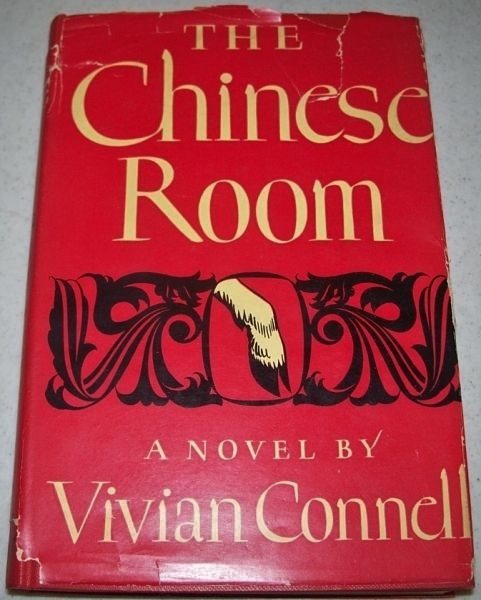
the chinese room 2 vivian connell 1942The Chinese Room by Vivian Connell ~ 1942. This edition: Citadel Press, 1942. Hardcover. 344 pages.

My rating: 3.5/10

And all this time I thought it was merely a garden variety murder mystery!

The book’s been sitting on the shelf for a few years now. I’d heard it referenced as a mystery novel, and I was sort of saving it for the right time for such a mental amusement. I guess I’m just a little out of the loop.

Here’s Kirkus, from 1942, with the review I read after I put down the novel in bemusement partway through to do some further research.

Deep purple, in an uninhibited novel largely about sex, which wanders now and again into perversion, psychiatry, and Oriental eccentricities. The publishers claim affinity with D. H. Lawrence, which might be recognisable only in the very obviously exerted efforts of the characters to find physical passion. They are Nicholas, an English banker, whose wife Muriel had been consistently frigid; Sidonie, his secretary and paid mistress, who is aloof, baffling, and is revealed to have a cloven hoof; Saluby, a psychiatrist, who “awakens” Muriel, the result of which ricochets on Nicholas so that by the close, husband and wife find complete satisfaction in each other. Can only see one type of market – and one reason for reading it.

What an odd novel this one turned out to be.

It starts of traditionally enough, following staid English banker Nicholas Bude as he goes off home to the country for the weekend, only to discover things in a state of turmoil, due to the unexpected suicide of an estate employee’s daughter. Seems there was some sort of mental aberration going on, with the young woman apparently writing abusive anonymous letters to herself before her fatal breakdown.

Nicholas and the doctor in attendance – the saturnine Dr. Saluby – spend quite some time discussing this, with the result that Nicholas is prompted by Saluby to try a similar experiment upon himself.

We’re not quite sure what these fellows are actually trying to prove, but it sets the narrative up for some strenuous navel gazing on the part of Nicholas, while Dr. Saluby lurks stage left, rubbing his hands with glee for reasons a bit murky, though they might have something to do with Nicolas’s beautiful and (apparently) sexually frigid wife Muriel, who has become the focus of Dr. Saluby’s seductive gaze.

So far, so good. I was still thinking that the suicide would prove to be a key element in the puzzle, and that a clever whodunnit was yet in the offing, especially when Nicholas starts receiving his own series of anonymous letters, which may or may not be written to him by himself.

I couldn’t be more wrong. Instead, the novel abandons the sedate mystery format and morphs instead into an increasing torrid series of sexual situations. It’s a dirty novel!

Nicholas turns out to be having a long-running affair with his brilliant Oxford-educated secretary, Sidonie, a stunningly beautiful and deeply secretive blond with a strange physical deformity. He and Sidonie indulge in a rough sexual interlude every Monday evening, reaching “mutual satisfaction” after each bedroom encounter involving Sidonie refusing to let her hair down or (hint, hint!) reveal her bare feet. She bites Nicholas arousingly – and apparently quite viciously, for she frequently draws blood! – and he always leaves her an envelope of money on his way out, which she then mails off to an orphanage.

Surely there is some mystery plot developing with this scenario? Is there some clue in Sidonie’s habit of serious nipping? In the orphanage connection?

Nope. Not at all. Purely random.

Meanwhile, back in the country, Muriel finds herself the target of Dr. Saluby’s amorous advances. She experiences a sexual awakening of sorts, leading to much discussion about the emotional dangers of repressing one’s erotic desires in order to adhere to societal expectations. Apparently Muriel and Nicholas should have let their passions flow early on in their engagement, instead of waiting for the marriage ceremony.

The premise is that Muriel has buried her natural impulses so deeply that she is unable to access them when she finally has official permission to do so. But once these come to the surface, thanks to Dr. Saluby’s selfishly chauvinistic love-making, the newly aroused Muriel starts looking around with wild surmise.

After a brief interlude with another doctor, a gorgeous Scottish he-man sort who is quick to seize the opportunity of an afternoon’s lovemaking with the newly receptive Muriel, she spurns Dr. Saluby and sets her sights on seducing her own husband, whom she was initially attracted to by his passionate nature and “powerful hands”. (There is a whole sub-plot involving Nicholas’s hands which I won’t get into here, as this is already getting too darned long.)

With the help of a homemade pair of green silk, crotchless leggings and the lavish application of red lipstick to various key bits of her body, Muriel catches Nicholas’s attention and husband and wife finally find their sexual groove after ten years of disappointing marital “duty sex”.

Nicholas, Muriel, and Sidonie then get together in a mutual reconciliation session, followed by explanations of all the bemusements. Though I rather expected them all to end up in bed together, the author spares us this. Thank you, Mr. Connell.

The anonymous letter thing gets cleared up, sort of, though we never do get a satisfactory explanation regarding the original suicide which set the wheels of this novel in motion.

Still with me, and still curious about this odd little period piece?

Here’s a link to the only other review I could find in my not-very-strenuous internet search. Dan Stump writes a good review in Mystery File , referencing The Chinese Room‘s  subsequent movie adaptation, and its status as something of a cult classic of its erotic-pulp-fiction genre.

Another link to the 1966 film, with a brief biographical note on the author at the very bottom.

Remember the reference to D.H. Lawrence in the Kirkus review? Vivian Connell deserves a mildly favourable comparison to DHL, as The Chinese Room did contain a fair bit of decent writing and some interesting musings on the inner lives of its characters, but, sadly, the gratuitous and increasingly frequent semi-explicit sex scenes ruined what might instead have been something of a higher literary standing.

The Chinese Room was surprisingly successful, going into numerous editions and selling over three million copies. Perhaps this had something to do with its instant notoriety due to its American recall in 1942 by the Society for the Suppression of Vice, who demanded the censorship of a certain phrase before it could be allowed back into general circulation.

My particular edition is the original, and I would be hard pressed to identify which particular phrase that was. There’s quite a lot of questionable stuff herein, blush-inducing, indeed, though mostly because of the awkwardness of the writing and the ridiculousness of the scenarios versus anything too wildly explicit in the way of sexual detail. Pornographic it isn’t, if one applies the dictionary definition.

The Chinese Room was Vivian Connell’s most commercially successful book, though he was also a playwright, and was apparently involved in the Hollywood movie industry. He did go on to write a number of other, apparently even more risqué novels. I rather think, from the “serious” bits of The Chinese Room, that he would have liked to be viewed as a more mainstream writer, and he might indeed have made it, for there is evidence of a certain competence of thought and phrasing and even flashes of brilliance here and there. Doomed by those intrusive sex scenes, though.

Ah, well. So close, but yet so far…

by Howard Coster, half-plate film negative, 1942

Vivian Connell, Irish writer and playwright. Image from the collection of the National Portrait Gallery. Photographed in 1942 by Harold Coster.

Though The Chinese Room ultimately disappointed me, I suspect I’d snap up any reasonably-priced Connells found while browsing the pulp fiction shelves in future. (Say, $5 maximum, though $2 would be better.)

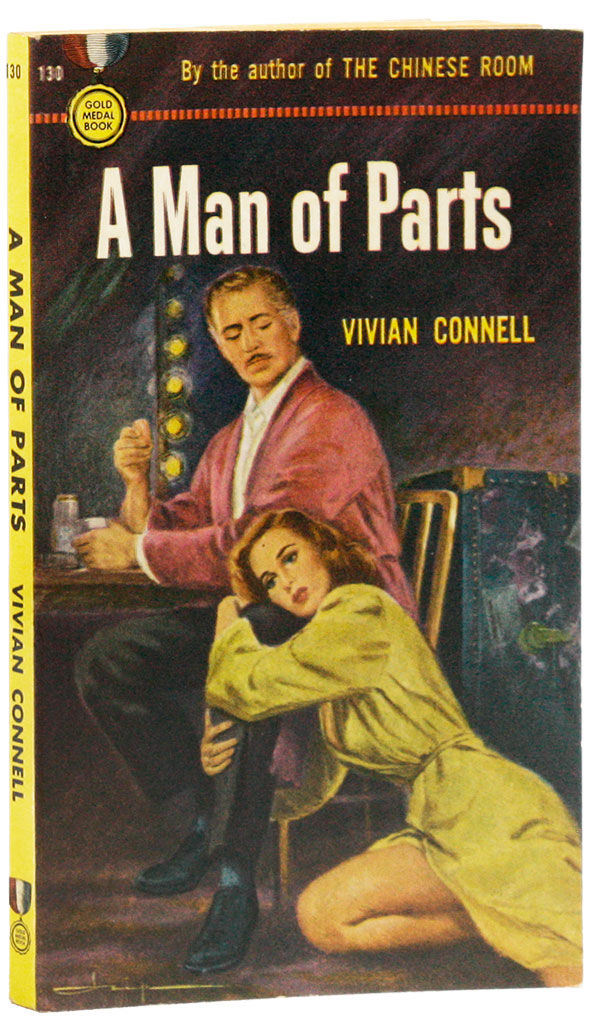
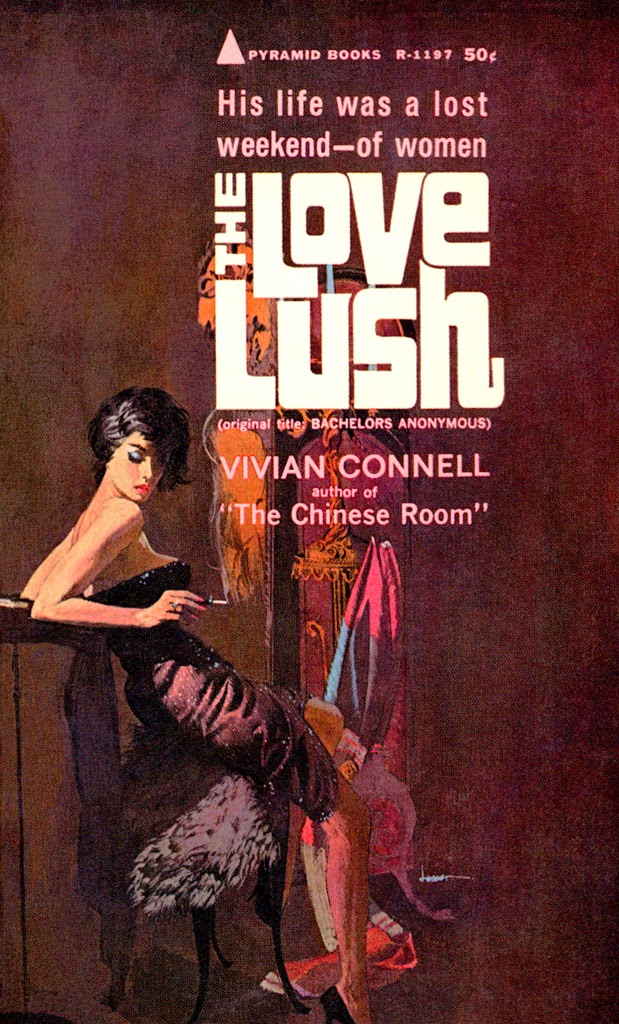
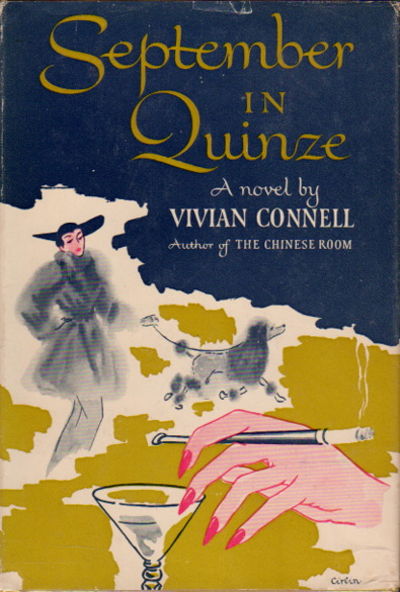
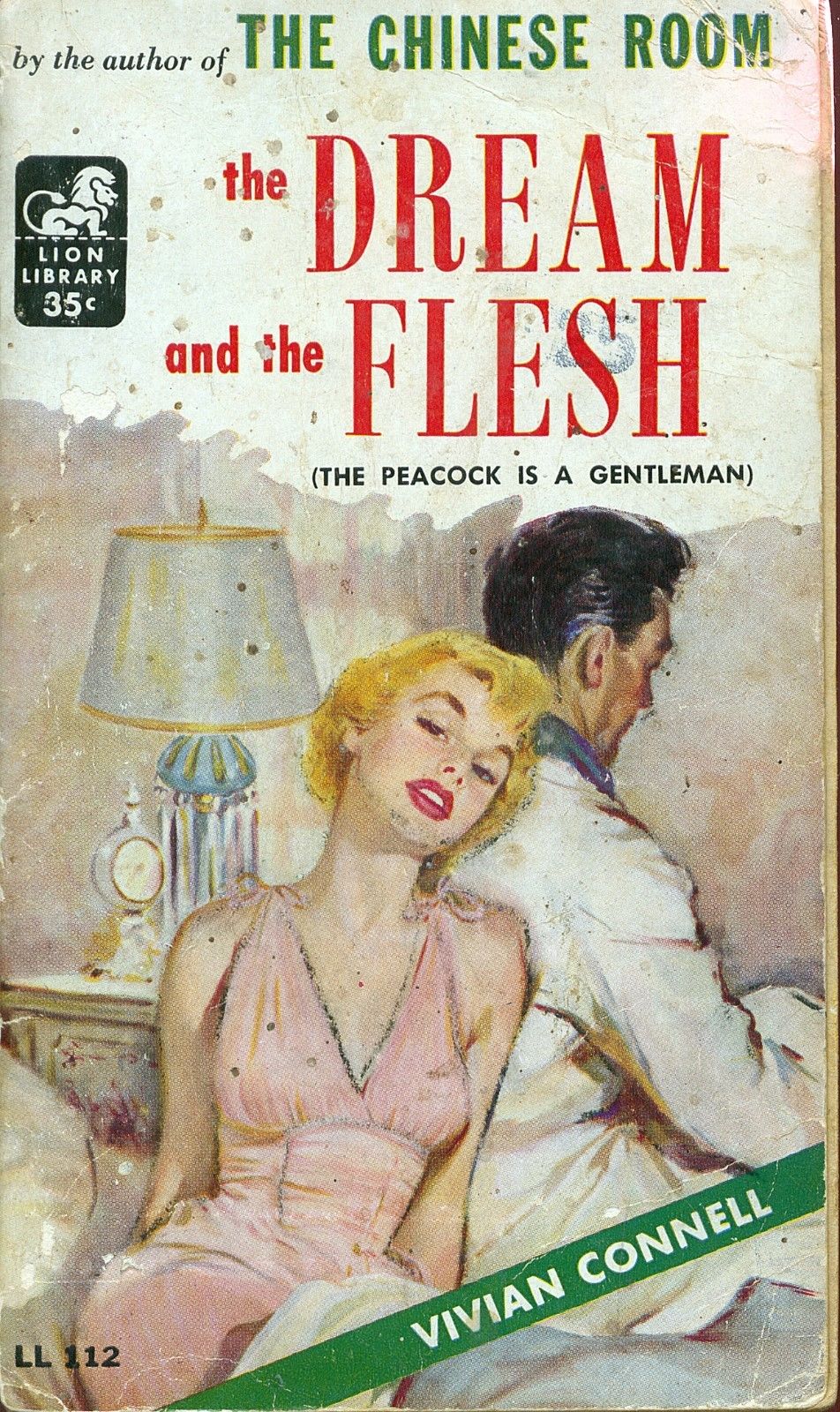
Don’t you find these representative covers strangely curiousity-inducing?! “A lost weekend – of women”. Huzzah!

Other titles to be aware (or beware) of:

A Man of Parts, 1950. “A tempestuous novel of the London stage, its greatest lover, and the women caught in the tempest.”

a man of parts vivian connell 1950

Bachelors Anonymous, 1956. “For David Young, life was a lost weekend of dames. In a word, he was a love lush. He could fake out the boss on most hangovers, until ‘one too many’ happened to be a client’s wife. And then it was go on the wagon or else. But how, when a guy can’t break the habit? And then the club came to the rescue…”

bachelors anonymous vivian connell 1956

The Love Lush - illus Ron Lesser.2September in Quinze, 1952. Published later in paperback as The Naked Rich. “Set on the French Riviera, a world of sybaritic luxury, violence, self-indulgence, loneliness and sometimes even love.” Bonus dust jacket blurb:

He stood in the street disguised in a pair of old trousers and a shirt that bared his massive chest. His eyes dwelled feverishly on the woman standing beneath a lampost. Of all the women in France tonight he desired only this tawny-haired, dark-eyed female. “Do you know what I want from you?” he asked. She nodded and led him silently to her apartment. From the window they could see the yacht of the fabulous King Sadook, its royal flag fluttering. “Do you want a king tonight?” he whispered. She shook her head. Her single garment fell away. “I want a man,” she told him simply. He laughed and said “I’ll give you both!”.

september in quinze 1952 vivian connellThe Dream and the Flesh, originally published as The Peacock is a Gentleman, 1959. “Paris was his – and so were its women!”

the dream and the flesh vivian connell 1959

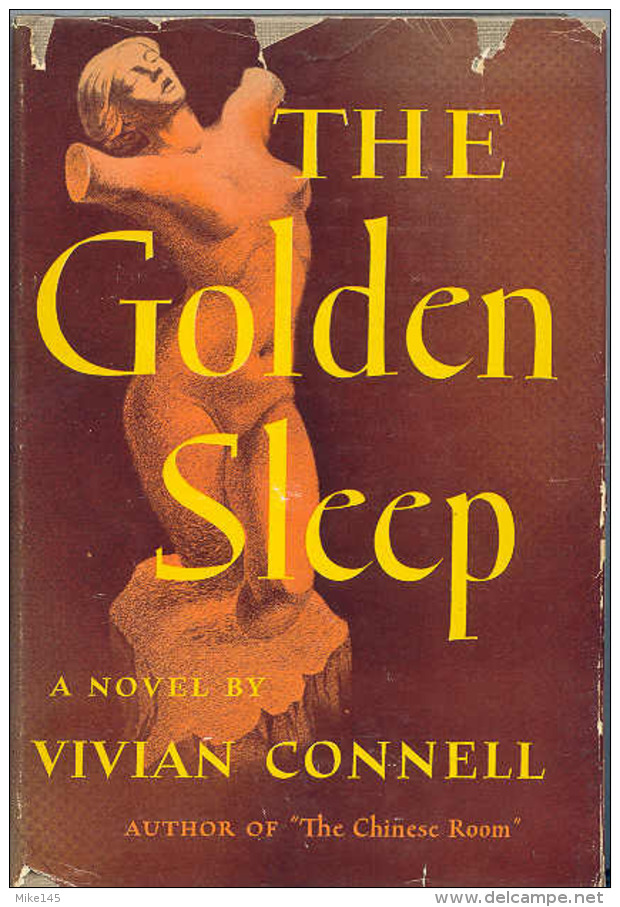
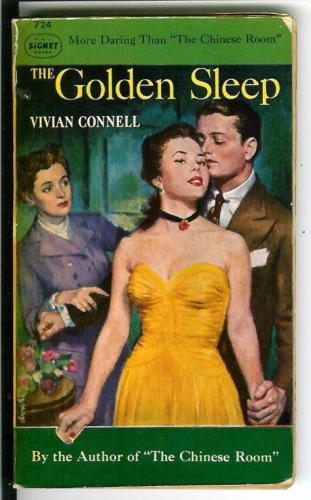
The Golden Sleep, 1948. “More daring than The Chinese Room!”

the golden sleep 2 1948 vivian connell

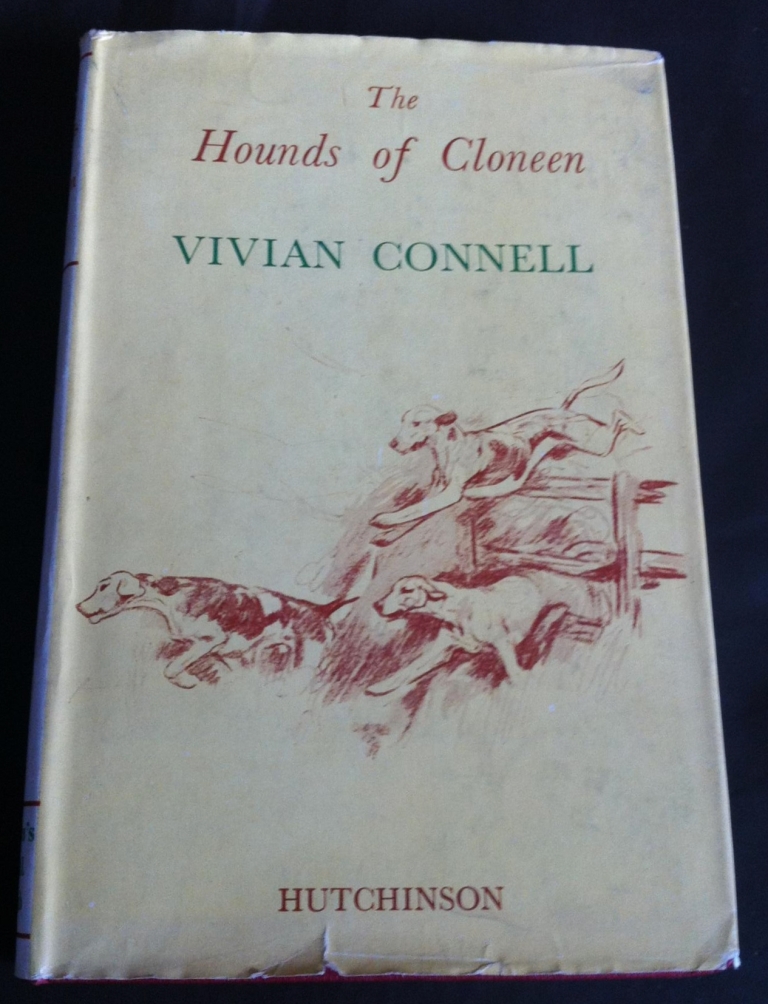
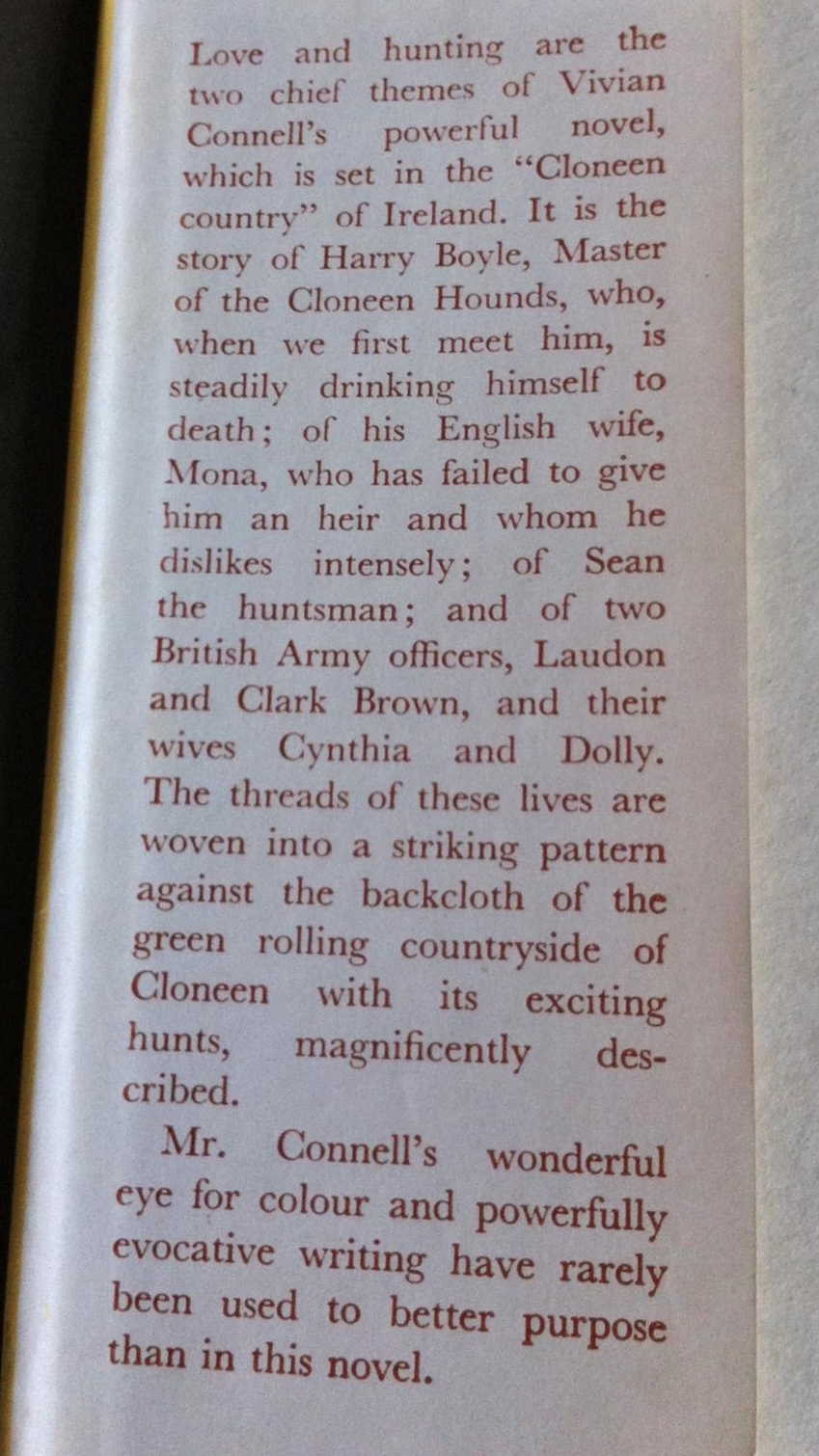
the golden sleep vivian connell 1948The Hounds of Cloneen, 1951. Hey, check this out. An author bio on the back cover!

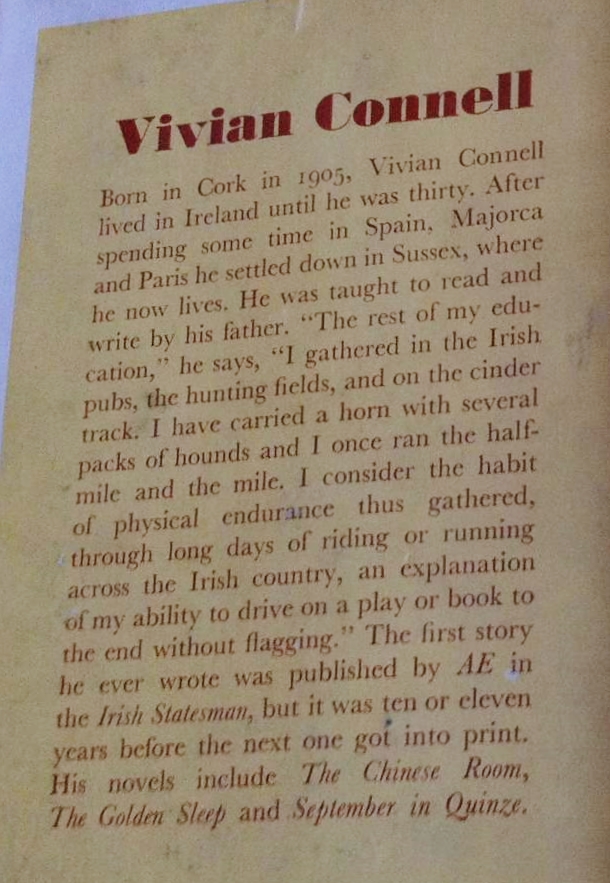
the hounds of cloneenhounds of cloneen dj blurbvivian connell bio, back dj the hounds of cloneenThe Stolen Pearls, 1961.

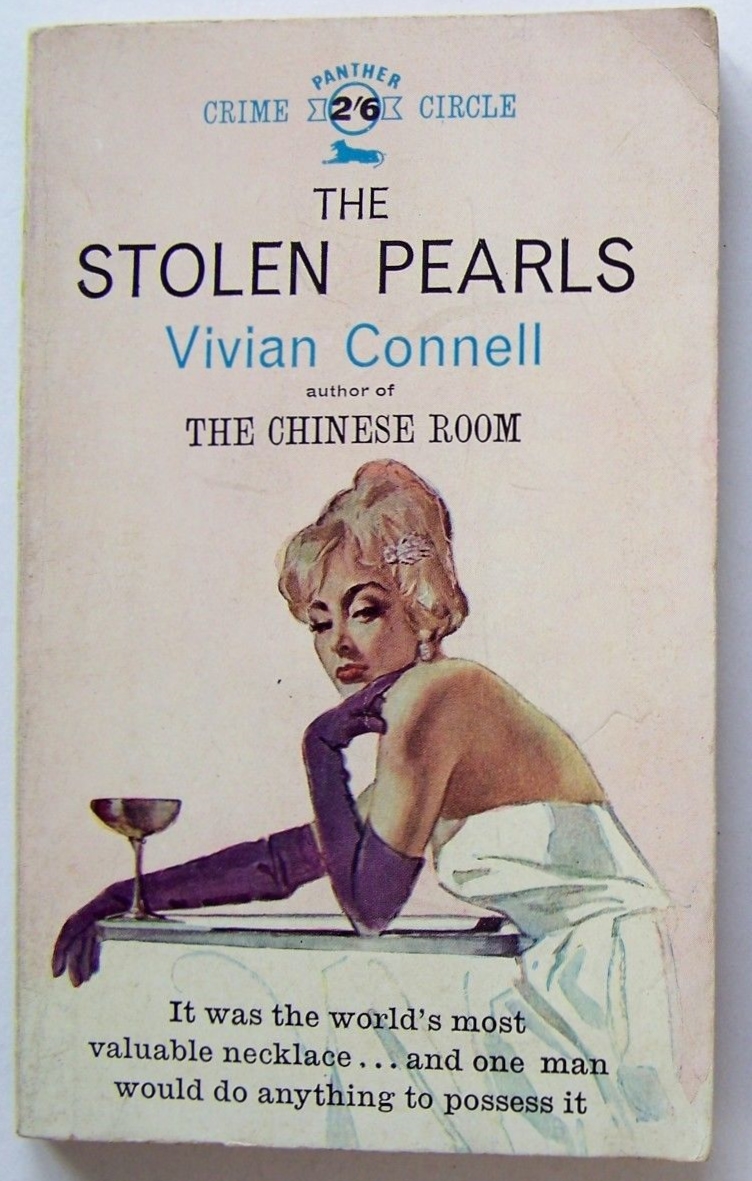
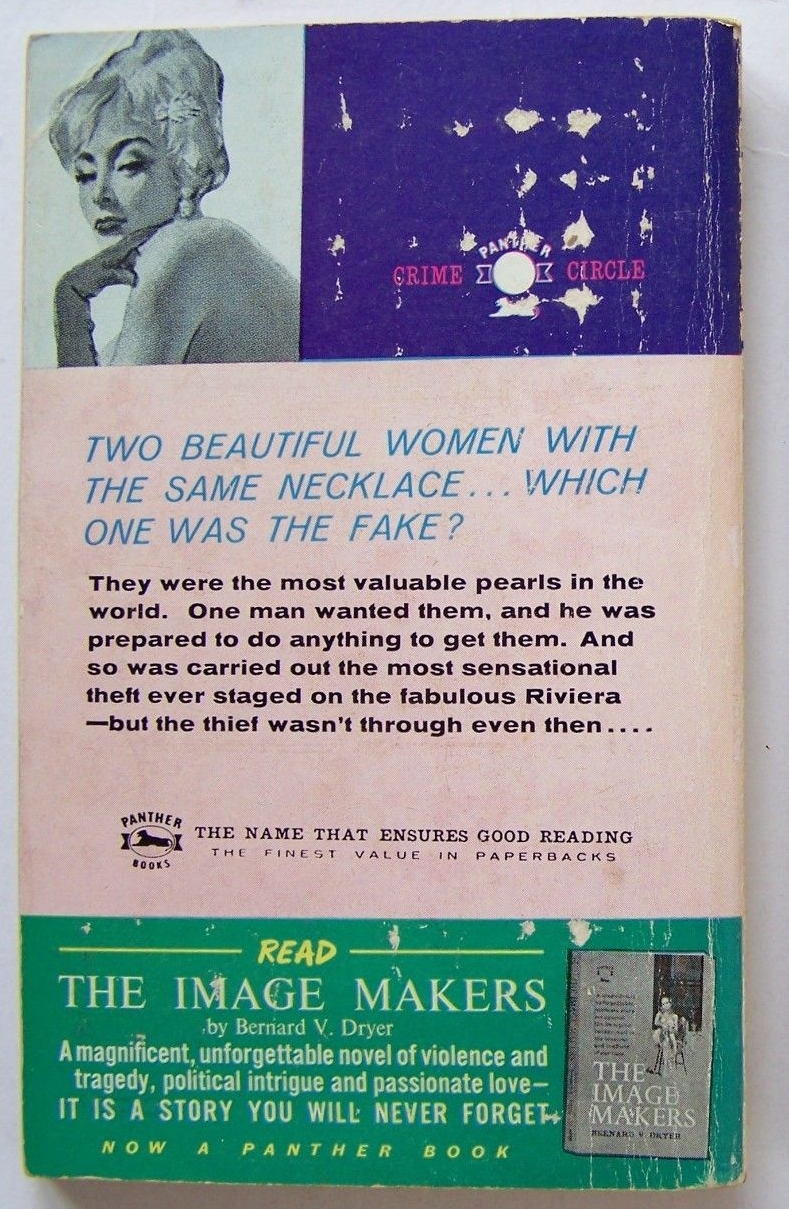
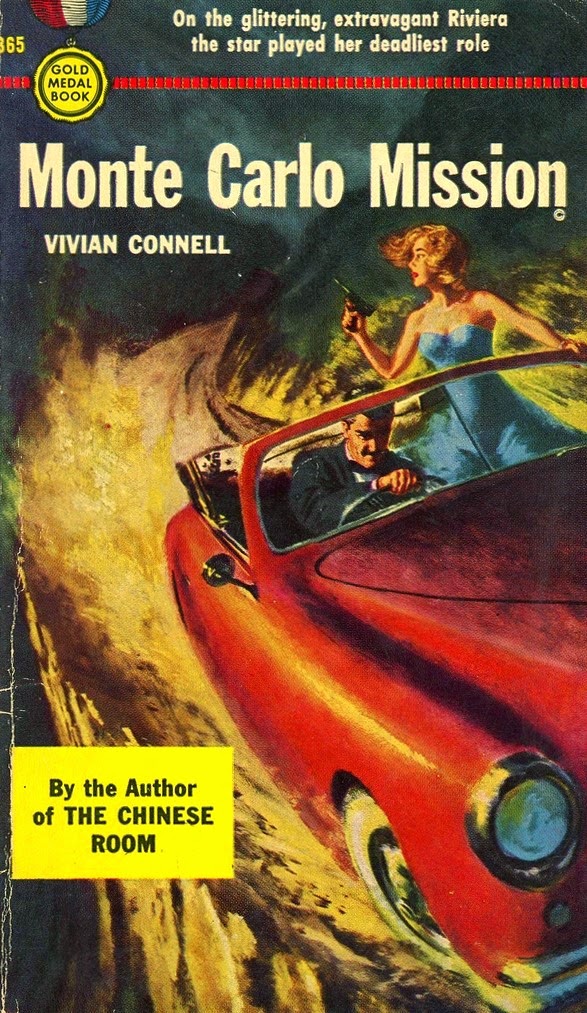
VIVIAN-CONNELL-Stolen-PearlsVIVIAN-CONNELL-Stolen-Pearls back coverMonte Carlo Mission, 1954. “Vivian Connell, master of the sophisticated suspense novel, brings you his finest in Monte Carlo Mission. Meet Corinna Lang, a goddess of the movies, who was bored with mammoth swimming pools, small MGs, fat directors, and slim leading men. Bored with the whole great golden illusion of Hollywood, this smart cookie decides a mere vacation in Monte Carlo would be just too tame. She’s looking for adventure, and has the right amount of moxie and courage to take advantage of it when she finds it! Take a journey with this enchanting heroine to the wicked, extravagant Riviera where the golden Corinna, undertaker of a top secret mission, lives in the shadow of international intrigue, and matches her quick wit with the most dangerous men in Europe.”

Monte Carlo Mission.2

Read Full Post »

Crossing the Skeena River by 2-car reaction ferry, Usk, B.C.

Crossing the Skeena River by 2-car reaction ferry, Usk, B.C.

Since my last post a good two weeks ago quite a lot has happened in my world. The most exciting thing being an immensely enjoyable week-long road trip to Alaska in our old Triumph Spitfire. Top down all the way, though we were pretty chilly those cool northern British Columbia summer mornings!

An overwhelming magnitude of most excellent scenery. Glaciers and totem poles, the tock-tock of ravens everywhere we went, and the fragrance of sweet clover from the hayfields and roadsides overcoming our little car’s perpetual miasma of Old British Car over-fuelled exhaust.

It was grand.

Bear Glacier, near the Canada-U.S.A. border towns of Stewart, B.C. and Hyder, Alaska

Bear Glacier, near the Canada-U.S.A. border towns of Stewart, B.C. and Hyder, Alaska

Lichen-covered lava flow at the Nisga'a Memorial Lava Bed Park near Terrace, B.C., site of Canada's last volcanic eruption in the mid-1700s.

Lichen-covered lava flow at the Nisga’a Memorial Lava Bed Park near Terrace, B.C., site of Canada’s last volcanic eruption in the mid-1700s.

Totem poles near Kitwanga, B.C. These are memorial poles erected over the graves of band chiefs. The figures depict clan memberships and significant connections of the people they memorialize.

Totem poles near Kitwanga, B.C. These are memorial poles erected over the graves of band chiefs. The figures depict clan memberships and significant connections of the people they memorialize.

So. Books.

Just before we took off on our drive, a kind neighbour passed on to us three boxes full of dusty vintage hardcovers she’d been shuffling from shelf to shelf for years. In between the collections of sermons and prayers-for-the-day, the moralizing children’s tales, and the expected classics were some now-obscure popular novels which were bestsellers in their day. E. Phillips Oppenheim, John Buchan, and Ethel M. Dell, anyone? Or how about Kathleen Norris?

I packed a random handful of the most promising along on our trip, but was so exhausted each night from the miles of windy driving and the glorious sightseeing (and possibly the brisk northern air combined with those afore-mentioned exhaust fumes) that I only managed to make my way through one of them.

An Apple for Eve by Kathleen Norris, 1942, was a contemporary romance novel by the prolific San Francisco writer. If you’re not familiar with the name, here’s a brief biography, courtesy of Wikipedia:

Kathleen Thompson Norris (July 16, 1880 – January 18, 1966) was a popular American novelist and newspaper columnist. She was one of the most widely read and highest paid female writers in the United States for nearly fifty years, from 1911 to 1959. Her stories appeared in the Atlantic, The American Magazine, McClure’s, Everybody’s, Ladies’ Home Journal and Woman’s Home Companion, and she wrote 93 novels, many of which were best sellers. She used her fiction to promote values including the sanctity of marriage, the nobility of motherhood, and the importance of service to others

An Apple for Eve by Kathleen Norris, 1942. This edition: P.F. Collier and Son, 1942. Hardcover. 340 pages.

My rating: 5.5/10

an apple for eve kathleen norris 1942An Apple for Eve was the fourth novel by this writer that I’ve read, and based on past experience I assumed it would be a readable, well-detailed, decidedly earnest though not off-puttingly preachy, easy to take up and put down light read. And it was all of that.

Teenage Loveday, daughter of a much-respected family of once-wealthy California Quakers, falls tempestuously in love with a young man of not quite top-drawer origins. She promises eternal faithfulness, and sends her fiance off to flight school with the promise to marry him as soon as he can finish his training and set up a modest starter home.

Much drama then ensues. Loveday becomes orphaned; we learn of a mysterious family fortune possibly hidden somewhere in the decaying family mansion; Loveday is semi-adopted by a wealthy family and introduced to high society and rich living; Larry-the-fiance stops writing; Loveday finds herself in a mutually-attracted relationship with an already-married playwright; heart rendings all round!

Eventually Loveday and Larry reunite and marry, but things go swiftly downhill. For Larry is something of a ne’er-do-well. He can’t keep a job, he argues with any sort of authority figure he comes across, he’s deeply jealous of Loveday’s affection for her adopted family, who keep swooping in with welcome cash donations to ease Loveday’s continual financial woes, for she and Larry and their three small children are sliding ever deeper into a lower strata of society than either of them started out in.

Re-enter Loveday’s other lover, the wealthy playwright Chris. His wife has just died, and he feels himself free to woo the still-lovely Loveday, as her husband is obviously unwilling to man up and support her in the way which she deserves. And Loveday must admit that she returns the illicit passion. But will she be able to set aside her marriage vows and divorce her sad-sack spouse? Larry, though continually inadequately employed, occasionally sullen, and generally slightly mopey, is quite a sweet guy at heart, who has never done anything to deserve spousal desertion.

Hmmm…

Take a peek up to the bit about Kathleen Norris’s championship of the sanctity of marriage vows and the nobility of motherhood for a Great Big Clue as to what our heroine eventually decides.

I’ve occasionally seen this author’s work classified as “Christian Romance Fiction”, and while I wouldn’t go that far myself – she seldom directly references God or religion, and her characters get up to some rather worldly shenanigans – I can see why that is a tidy and appropriate categorization in this current anything-goes age.

This not particularly top rate novel is redeemed by its generous period detail and its depiction of rural California life in the early World War II years, when America was poised on the brink of committing to the overseas conflict. There is ongoing discussion of the situation in Europe and the role which America should play in the escalating war; some characters go north to Canada to join the R.A.F.; during the course of the novel the Japanese attack on Pearl Harbor takes place, precipitating the U.S.A.’s decision to jump into the fray. Back on the home front, wives and mothers scramble to compensate for breadwinners heeding the call to arms, and, just a little later on, to deal with the inevitable deaths of loved ones and the return of the wounded.

By 1942 Kathleen Norris had honed her writerly craft to a very competent level, and working one’s way through this melodramatic tale some 75 years after its publication is no great hardship, with the expected allowances for era-expected attitudes, as well as a soupçon of bigotry and racial slurs. Those of Chinese ethnicity come in for most of the little digs, as Loveday’s household staff (for of course our heroine has devoted family retainers despite her desperate poverty) are descendents of the California Gold Rush “coolies” of a generation or two before. A typical off-the-cuff comment from Loveday, in reference to her housekeeper: “The Chinese are trustworthy because they find it pays better to be honest.”

As in the other Norris novels I’ve read, the chief heroine is almost impossibly beautiful, universally admired, and stunningly competent at everything she does. Though she temporarily allows herself to be tempted – remember that clue-providing title? – “Eve”, “apple”? – I couldn’t work up any surprise upon finding out that she ultimately does the morally right thing. And of course earthly rewards follow thick and fast, though Norris pleased me by not tying up quite every loose end.

Some years ago I read and reviewed 1937’s The American Flaggs. My opinion of the writer’s style engendered by that first experience of her work have not changed in my subsequent readings; I’ve since acquired and read The Venables (1941), Bread Into Roses (1936), and, just the other day, Butterfly (1923). Good summertime books, not too deep, and the annoying bits are easily brushed aside. Next in the queue is The Heart of Rachael (1916), which I may dip into this evening, before setting aside Norris’s all-of-a-pattern heroines for something with a bit more oomph.


Read Full Post »

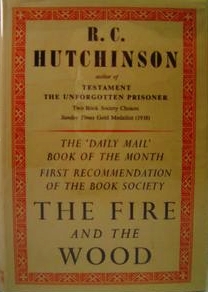
the fire and the wood by r c hutchinson 1940The Fire and the Wood. A Love Story. by R.C. Hutchinson ~ 1940. This edition: The Literary Guild of America, 1940. Hardcover. 440 pages.

My rating: 9/10

Hidden gem alert!

I have just stumbled upon a now-obscure, once-bestselling British novelist. Why have I not heard of  Ray Coryton Hutchinson before?

Seventeen books published between 1930 and 1975. The third, 1933’s The Unforgotten Prisoner, sold over 150,000 copies in its first month. A Child Possessed, 1964, won the W.H. Smith Literary Award, and is the inspiration behind a 2012, 2-act orchestral opera composed by Robert Paterson. The last, 1975’s posthumously published Rising, made it to the Booker Prize shortlist.

The Fire and the Wood, apparently regarded as merely one of Hutchinson’s “average” efforts, is a downright excellent piece of authorial work, being utterly relevent to its period, chock-full of easily absorbed “message”, and, best of all, compulsively readable. I couldn’t put the thing down. The writing flows, the whole transcends its parts. Brilliant work.

In the opening days of World War II, a novel was published in Great Britain with the following dedication:

To M. H. CHURCHILL

My Dear Jeremy,

You will remember that I told you Josef’s story one evening, the summer before last, in the Half Moon at Clare. You thought then that it was worth putting on paper, and I still think it was. But the time, between now and then, has not been a good one for the job: the means by which we know what is happening round the world have become so efficient that it’s increasingly hard to concentrate, for several hours a day, on the fortunes of one or two people. The excuse, of course, is not valid: no excuse is valid. The masters of the trade have done it as well, and sometimes better, when the hubbub was loudest. But I myself find difficulty, with these cold winds blowing incessantly against the mind, in raising it to that temperature which seems to me necessary for work which has the smallest pretension to seriousness; and I fancy that some others among the feebler-hearted brethren may be in the same case.

I mention the handicap as an apology for dedicating such a book as this to you, an amateur suckled by Turgenev and weaned on Henry James. Will you take the gesture as one of gratitude for many kindnesses, and for twenty years of friendship?

Yours ever,

R.C.H.

Infantry Training Centre,

R——

March, 1940.

What follows this elaborately modest introduction is a dense but never staid novel, approaching farce in its humorous opening scenes, darkening by imperceptible degrees into a nightmare scenario, a Kafkaesque dream sequence, appalling reality and delirious fever-dreams ever more entwined.

In the mid-1930s, young Doctor Josef Zeppichmann, newly qualified, joins the staff of a prestigious hospital in a large German city. Coming with glowing references which are at odds with his awkward manner, lumpy countenance, and country-lad ways, Zeppichmann proves to be an exceedingly competent doctor, though his bedside manner is brusque to the extreme, and his concentration on the ailments of his patients with the casual exclusion of all unimportant details such as name (or even gender) soundly shocks the nurses.

For Josef Zeppichmann is at heart a medical researcher, a bacteriologist concentrating on an audaciously risky cure for tuberculosis. Pursuing a pet theory during the latter years of his medical internship, he has progressed to the point of wishing to experiment on human patients – his guinea pig and rat trials have been remarkably successful – in most cases – but Josef runs up against a brick wall in the strict Moltke hierarchy; he is not even permitted to examine the patients in the TB ward, and is restricted to junior doctor duties in the general wards.

But Josef is made of stern, single-minded stuff. He bullies his way into the best room in his new boarding house, and sets up his own private laboratory. And what’s this? Close at hand, the kitchenmaid Minna is showing unmistakable signs of an advanced lung complaint. When she collapses one day while working, Josef is quick to grasp the heaven-sent opportunity of a human guinea pig. He takes advantage of the boarding house owners’ strict economy to offer treatment free of charge in return for exclusive access to the girl, and the real experiment is on.

Meanwhile, on the post-Weimar Republic mean streets outside the hospital, civil unrest is brewing between various political factions. The roving bands of young thugs running under the banner of  the National Socialist German Workers Party are becoming more and more efficient in striking out at anyone they suspect of being in less than perfect sympathy with the cause of Germany’s new Chancellor, a certain Adolf Hitler. Josef inadvertently runs afoul of a group of these young “Nazis”, and repercussions are swift to follow.

For Josef Zeppichmann is a Jew.

As Minna moans in fevered agony, emaciated body struggling to cope with Josef’s escalating injections, a series of increasingly somber blows fall upon our protagonist, culminating in his dismissal from his hospital post and his arrest and subsequent detainment in a political prisoner internment camp.

Luckily for Minna, Joesf has had time to give her the last vaccination in his series, and it has apparently proven successful. She and Josef have also formed a strong attachment, with the doctor-patient bond turning at the eleventh hour from pure need of each other in an elemental sense – Josef needing a subject for his research, Minna needing a cure –  to unanticipated love, just in time for Minna to see Josef dragged away in handcuffs, leaving behind his precious medical notes in her care.

The suspense continues to build, escalating to a daring rescue-escape of the damaged lovers via canal boat to Holland, and thence to England. But their troubles are far from over, for Josef has in turn contracted TB in the prison camp, and Minna herself is still weak from her long ailment.

The mood and style of the novel evolves along with the misfortunes of its two main characters; as the once utterly in control Josef sinks into fevered oblivion we increasingly see the action from Minna’s point of view. Her own grip on reality is far from strong, though, and the ending sequence, seen through her eyes, is decidedly surreal. (I’m not quite sure what’s going on with the bit at the very end, and if you’ve read it and have an interpretation I’d be most interested to compare notes, but the lapse from logical story progression doesn’t really matter – in this case it works.)

R.C. Hutchinson had an agenda, which was to bring the horrific pre-war social conditions in Germany to his reading public’s attention. Fascinating to read what is basically a propaganda novel, published in 1940 before the worst of the Nazi Party’s subsequent excesses became common knowledge. It’s a clever piece of work, brilliant even, and as I mentioned earlier, a page-turner from start to finish.

So, R.C. Hutchinson. Ever heard of him before?

I hadn’t. And I should have, I think. He’s unaccountably fallen by the literary wayside, though Bloomsbury has recently released a number of his novels in e-book format, and his long list of out-of-print bestsellers are easy enough to find in numerous editions through online booksellers.

The quest is on.

R.C. Hutchinson in an undated publicity photo.

R.C. (Ray Coryton) Hutchinson, 1907-1975, in an undated publicity photo.


Read Full Post »

The books I have read the past ten days of 2016 are already disappearing from my desk quicker than I can consider writing about them. I blame my husband, who is in his wintertime mode of reading the long evenings away, as it is too dark and cold for his other-three-seasons outside occupations. He’s hot on my heels reading-wise this time of year, as I am spending much of my inside “free” time parked at the computer, working on twin time-consuming projects – our plant nursery website, and our upcoming regional performing arts festival, of which I am registrar and program director. No winter doldrums here!

But I’ve looked in all of the obvious spots, and have re-gathered the January books-to-date. I doubt I’ll be writing at length about much this coming year – it promises to be fully as hectic as 2015 – so I am going to try instead to pull off some mini-reviews as I go along.
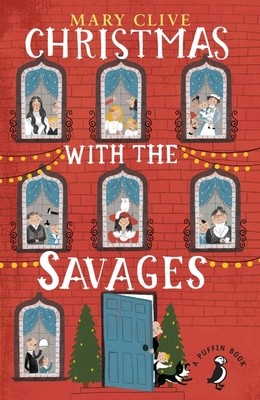
christmas with the savages mary cliveChristmas with the Savages by Mary Clive ~ 1955. This edition: Puffin, 2015. Paperback. ISBN: 978-0-141-36112-3. 186 pages.

My rating: 7.5/10

Ordered in late November from England, this one arrived a few days too late for pre-Christmas reading, but it turned out not to really matter, as its time frame covered the extended after-Christmas weeks as well, and it felt most timely for a seasonal New Year’s read.

This slim book is based on the childhood experiences of the author – Lady Mary Katherine Packenham as she was christened in 1907 – as an attempt to share with her grandchildren a vanished way of life. I had assumed its depiction of a rather spoiled, prim and proper solitary child going off to spend Christmas with a boisterous house full of other children was autobiographical, but as it turns out, the narrator “Evelyn” of Christmas with the Savages is a fictional creation, though all of the children are based on real-life models – Mary, her own brothers and sisters, and assorted cousins.

Though marketed by Puffin as a “sweetly charming” juvenile Christmas story, this wasn’t that at all, being rather a gloves-off depiction of the true nature of children by a writer with little use for mawkish sentiment.

Young Evelyn is quite a horrible prig of a child – she treats her governess and nursery maid with snobbish disdain, looks askance at the rowdy crowd of upper class brats she is expected to mingle with, and assiduously courts the company of the mostly disinterested grownups who live their parallel silk-lined lives alongside the slightly grotty sub-world of the nursery.

This is quite a grand little book in its way, and though it wasn’t the “cosy” I assumed at first that it would be, it does have a dash or two of youthful joy, with Mary Clive’s unsentimental depiction of the world of Edwardian upper class childhood including many pleasurable events and the occasional thoughtful moment.

Mary Clive wrote several other memoirs for adult readers, and I am now dead keen to get my hands on them, in particular Brought Out and Brought Up, her 1938 account of her season as a debutante in 1926.

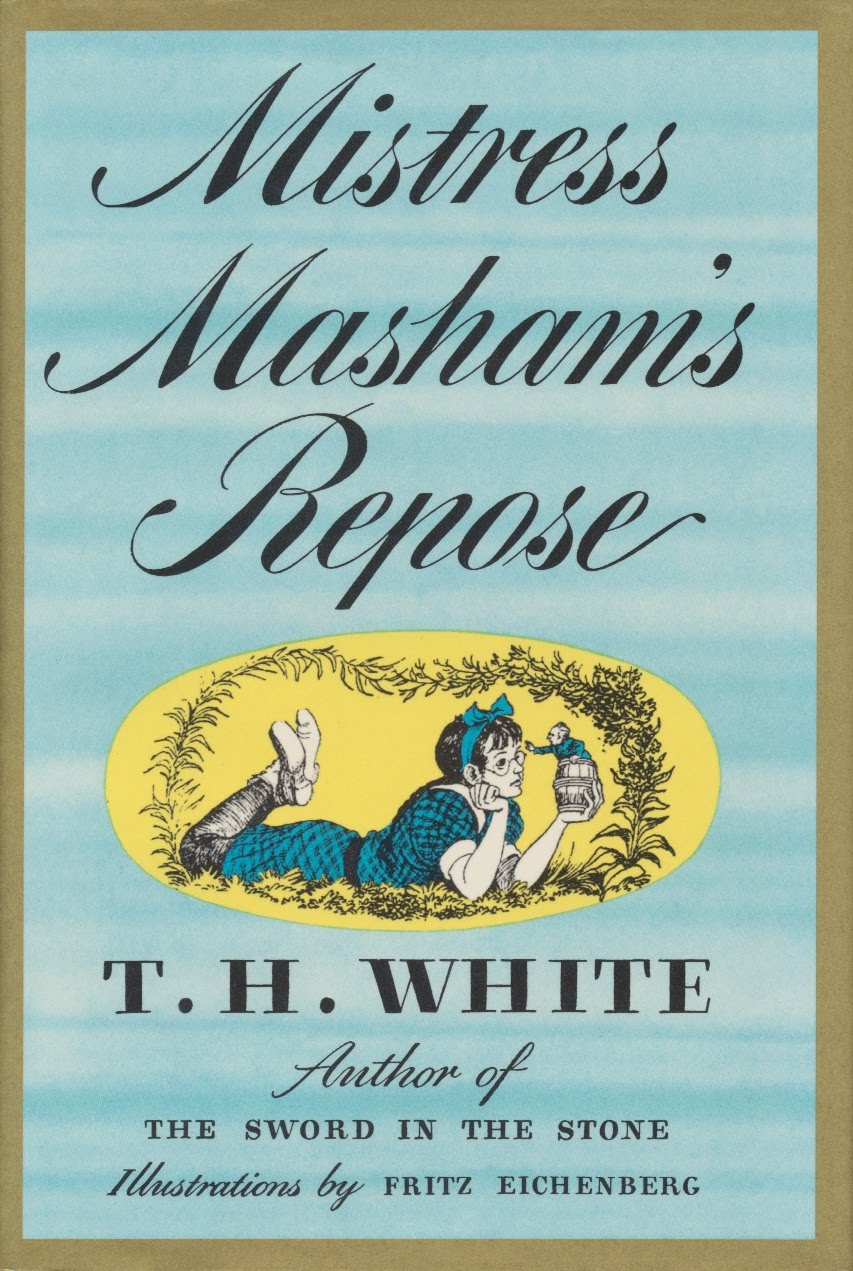
Mistress-Mashams-Repose-by-TH-WhiteMistress Masham’s Repose by T.H. White ~ 1946. This edition: Putnam, 1946. Illustrations by Fritz Eichenberg. Hardcover. 255 pages.

My rating: 9/10

This gloriously involved juvenile by the brilliant T.H. White is one I’ve read and re-read with great pleasure over the years, though somehow I never did read it aloud to my own children. Indeed, I rather wonder what the 21st century child would make of its arcane references to art, architecture, history and literature. I suspect a fair bit of what makes this tale so deeply funny would sail right over the heads of the present crop of youngsters, though an interested child could certainly find a lot of scope for click-research!

Orphaned ten-year-old Maria, last of her noble and once fantastically wealthy family, resides in a tiny corner of the crumbling Great House of the Malplaquet estate, attended to only by a solitary old family retainer, and under the sadistic “protection” of her malicious governess and her official guardian, a wicked vicar.

One day, while out exploring the ornamental lake in a leaky punt, Maria decides to visit the tiny manmade island which is crowned by a now-decayed ornate ornamental temple, known as Mistress Masham’s Repose. What she stumbles upon there is a thriving population of Lilliputian people, descendents of escapees from those brought to England by the scheming but bumbling Captain Biddle, who displayed them as sideshow oddities in order to earn money to indulge in his drinking habit, way back in 1700-and-something.

What happens when Maria decides to take on a philanthropist’s role to her discovery – and when her overseers inevitably discover the tiny people – makes for a lively, occasionally philosophically meandering, deeply appealing adventure tale.

Good stuff. This one may well get a proper long post one day, full of quotes and samples of Eichenberg’s brilliantly detailed illustrations.
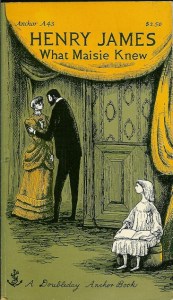
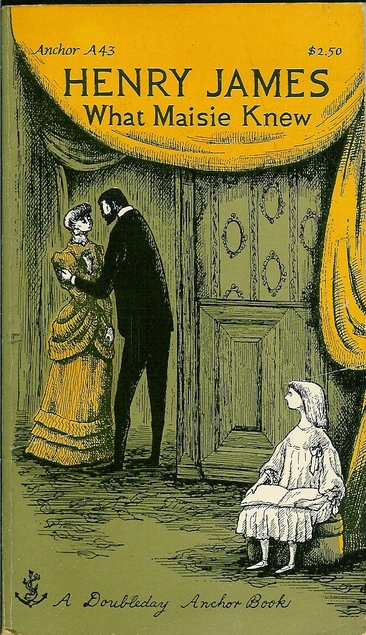
what maisie knew henry jamesWhat Maisie Knew by Henry James ~ 1897. This edition: Anchor Books, 1954. Paperback. 280 pages.

My rating: 6/10

Ah, Henry James. Master of the densely written social examination. In small doses, I rather enjoy him, though I am beyond grateful I’ve never had to approach his work in any sort of scholarly capacity.

What Maise Knew should be subtitled Adults Behaving Badly, as it portrays some of the least likeable parents imaginable.

Wee Maisie is the focus of her parent’s divorce trial, with each vying for possession of her small person in order to punish the other. A compromise is reached, six months per household, and Maisie shuttlecocks between mother and father, acquiring in the course of affairs two governesses, who shall feature strongly in her subsequent life.

In a few years, Maisie’s terms of residence turn from being maneuvered for to being something to be avoided; now the parental game is to see how long each can force the other to care for the increasingly unwelcome child. In the course of things, Governess Number One becomes Maisie’s stepmother, while Governess Number Two tries to imbue the child with at least a semblance of moral sense, while giving her a modicum of steadfast love and stability in a brutally uncaring world.

Parental partners come and go, until at last Maisie is disowned by both birth parents and ends up as the charge of two step parents, the kind but weak Sir Claude who has married and then been abandoned by Maisie’s mother, and the newly “freed” second wife of Maisie’s father.

Complicated doesn’t begin to describe the relationships in this morbidly fascinating concoction, thought be some critics to be Henry James masterwork. I found it hard to look away, while at the same time struggling with the bogging-down complexities of James’ über-wordy prose.

Pleasure reading?  Well, sort of. It felt like something of an accomplishment merely to make it to its odd and only vaguely optimistic (in my opinion) end.

And what did Maisie “know”? A heck of a lot, as it turns out. As a depiction of how an unwanted child remakes herself into a survivor, this is a telling little tale.

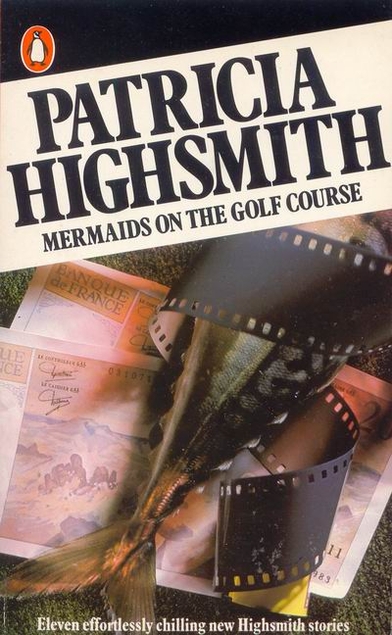
mermaids on the golf course patricia highsmithMermaids on the Golf Course by Patricia Highsmith ~ 1985. This edition: Penguin, 1986. Paperback. ISBN: 0-14-008790-7. 233 pages.

My rating: 5/10

A collection of eleven rather grim, sometimes macabre, only occasionally – and then only faintly – humorous short stories. Not really what I was in the mood for, as Highsmith here portrays her characters in the least positive light possible, and I just got sadder and sadder as I worked my way through these, hoping that the next one would strike short story gold. It wasn’t to be.

This rather twisted moodiness was something Highsmith made rather a thing of in her novels as well, come to think of it. Mr. Ripley being what he was, for one example.

Several of the stories end in suicide, and one of the most subtly disturbing concerns a Down’s Syndrome child’s secretly resentful father and a brutally random murder.

People in these gloomy tales generally wander about with festering grievances which precipitate the plot lines. Endings fade into grey, and most of them left me feeling a bit suspended in space, as if I’d missed that last step – but with no subsequent bang! of a landing. Just floating down, landing with a suppressed whimper.

Not a collection I’d whole heartedly recommend, though there are compensations in Highsmith’s more than competent styling.
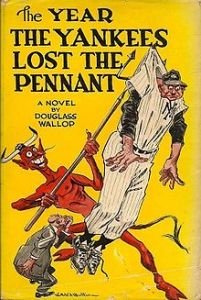
TheYearTheYankeesLostThePennantThe Year the Yankees Lost the Pennant by Douglass Wallop ~1954. This edition: Norton, 1954. Hardcover. 250 pages.

My rating: 8.5/10

Now this was an unexpected pleasure. A happily romping fantasy concerning a middle-aged real estate salesman’s inadvertent pact with the devil, and his transformation into a younger baseball superstar who comes out of nowhere (literally!) in order to assist his favourite but dismally unsuccessful baseball team, the Washington Senators, break the clockwork-precise New York Yankees’ long winning streak.

Now, I’m not at all a baseball fan, but one doesn’t have to be to appreciate this cheerfully light tale.

Will our hero Joe be able to hold the devil to his bargain? And what of the middle-aged wife so staunchly dealing with her sudden loss of a husband with good natured stoicism? And then there is the most beautiful woman in the world, who falls in love with the reinvented Joe, and who has a Faustian dilemma of her own to work out.

This is the best-selling novel behind the successful musical Damn Yankees, which I must confess to never having seen. But now I want to!
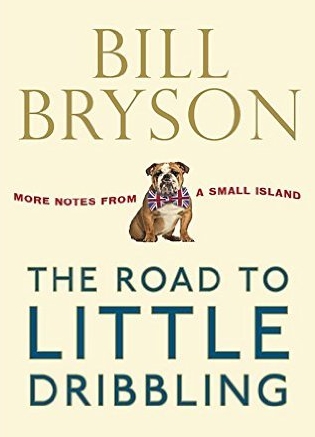
bill bryson road to little dribbling 2015The Road to Little Dribbling: More Notes from a Small Island by Bill Bryson ~ 2015. This edition: Doubleday, 2015. Hardcover. ISBN: 978-0-385-68571-9. 384 pages.

My rating: 7/10

Do I need to talk about this one? Surely not, for those interested will likely already have read it, and the internet will of course be rife with reviews, though I haven’t actually checked to see, having purchased the book as a Christmas gift to my husband merely on spec, seeing as how we have enjoyed (to various degrees) everything else the author has ever written.

Bill Bryson delivers the goods as expected, though this redux of the earlier Notes from a Small Island shows American-by-birth Mr. Bryson in full curmudgeon mode, versus his earlier honestly appreciative if frequently critical take on his adopted country, Great Britain.

Basically, England is going to hell in a handbasket, and our Bill is both mournful and moved to righteous annoyance. Occasionally he finds something to appreciate, and is honestly fulsome in his praise. I laughed out loud here and there, but I also occasionally cringed, because the author’s tone is so harshly judgmental. Well, generally with good reason, but still…

It was more than okay, but not one of his best. Has the Bryson bucket gone to the travel memoir well one time too many? I wonder.

*****

And I bailed out on two books. Just couldn’t get into them, though I may try again one day.

Iris Murdoch’s The Green Knight defeated me at page 80, after a long rambling set-up filled with the complicated back stories of way too many characters. Weird things going on with phrasing and punctuation, too, which had me stopping in confusion and re-reading whole paragraphs to see if I was missing something. I wasn’t, but the editor certainly was. Browsing ahead, there are some intriguing passages, and I hope to return one day to enjoy them. Perhaps.

One Winter in the Wilderness by Pat Cary Peek sounded extremely promising, being presented as the diary of Peek and her wildlife biologist husband one isolated winter in the Idaho back country at the Taylor Ranch Field Station. It might have picked up steam farther along, but the first few sections were just the tiniest bit plodding, as if the writer were trying a mite too hard – and mostly unsuccessfully – to turn her repetitious diary entries into something more literary. Apparently the Idaho Book of the Year in 1998. Fair enough. Back on the shelf, perhaps even into the giveaway box, for someone else to take a go at.


Read Full Post »
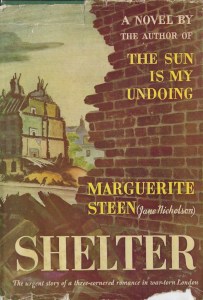
« Newer Posts - Older Posts »