Archive for the ‘1930s’ Category

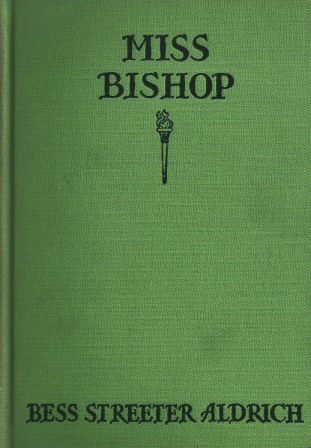
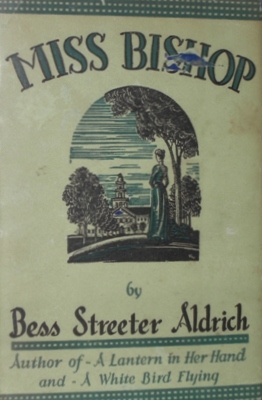
Miss Bishop by Bess Streeter Aldrich ~ 1933. This edition: Grosset & Dunlap, circa 1940s. Hardcover. 337 pages.

My rating: 5.5/10

This book started with such promise, and I raced through the first chapters happily, but as the story passed the midpoint I found I was losing my enthusiasm; something had changed. Now maybe that is just the author’s “genius”, in changing the mood to follow the life-path of the main character, Ella Bishop, from optimistic youth to dreary old age, but somehow I think that is too generous an assessment. I think rather that it is the author’s fault, in retelling her same old story with a different character. I thought that this book was very reminiscent of both A White Bird Flying, and Spring Comes On Forever, sharing the theme that “it is sad but noble to sacrifice your dreams as long as the sacrifice benefits the future generations”.

Miss Ella Bishop is one of the first class of students at the newly established Midwestern College in the growing town of Oak River, in an unspecified mid-western prairie state. The year is 1876, and the mood is of optimism and enthusiasm as progress strides across the prairie, bringing culture and higher education into the hitherto culturally isolated farming communities of the region.

Ella Bishop is that character beloved of novelists, the poor but bright and winsome orphan, or in this case, semi-orphan; Ella’s father has just died, and she and her ineffectual mother are just barely getting by; college fees are, as is the inevitable case in this genre, a challenge to meet. Ella of course does wonderfully well in college and graduates high in her class; she is now well-trained and ready to take on a job as a teacher, the only real choice of profession (other than shop clerk or seamstress) open to a young lady of her generation.

This was the best part of the book, in my opinion. The author captures wonderfully well the heady atmosphere of the new college and its small group of professors and students. The boys and girls attending the school are mostly children of immigrants, proud of their various distinctive heritages while identifying firmly as modern Americans. The glimpses into the homes and lives of the students, and the physical descriptions of the prairie in its state of being transformed into “civilization” are beautifully handled and a joy to read.

But all is not well in Ella Bishop’s world; her youthful optimism is about to take a hit. A bit of a heads-up here: there will be major spoilers in this review. If you are wanting to discover Ella’s trials and tribulations for yourself, it is time to click away. Otherwise, you’re going to get the condensed version of this soap opera of a tale.

Ella graduates and is offered a job teaching grammar at the selfsame college she has just been a student at; gratefully, she accepts; she is now able to support her frail mother, and teaching will do fine as an interesting occupation for the next year or two, until her true vocation comes along.

As well as she liked her teaching, – to have a husband and home and children, – these were better. These were the things for which her healthy young body and warm heart were intended. She knew.

Eventually Ella’s white knight trots into town. She meets young Delbert Thompson, a newly arrived junior partner in the town’s law. All is wonderful; the wedding date is set, the dress is being made, when into Ella’s shiny happy world a small dark shadow comes. An eighteen-year-old cousin has been orphaned and asks to come and stay for a while to get over her grief and plan her next move; young Amy has just found out that she is penniless as well as bereft of her parents. The perfumed note gives us our first inkling of disaster to come; Ella is mildly annoyed at having to give a thought to another body in the house just when she is getting ready to bring a new husband home, but she nobly does the right thing and welcomes Amy with cordiality and grace.

Oh no! Wrong thing to do! Amy is tiny and cute and flirtatious, and soon a circle of other girls’ beaux are attracted like bumbling moths to Amy’s bright little flame. Including Delbert. With the wedding mere weeks away, Amy sets her sights on her cousin’s attractive fiancé. Ella proudly refuses to interfere; the worst happens, and Delbert now “must” marry Amy, as he has fallen into the trap she has set baited with her delectable, willing little body. Off they go, leaving Ella in a state of despair. Going to her mother for comfort, that is denied to her as well, as her self-centered parent is so upset by the situation that Ella ends in burying her own emotions to administer to her mother’s hysteria. Better get used to it, Ella, it’s going to be the pattern of the rest of your sorry life.

Nine months later, in the depths of winter, a foreboding stranger appears, bearing a passionate letter from Delbert. He is on his deathbed; time is short; he begs Ella to come and see him. Off she goes, to find Delbert, as advertised, indeed on his deathbed from some unspecified illness. The highly pregnant Amy is creeping around helplessly; with his dying breath Delbert begs Ella to take Amy home with her and care for her until the child is born. “I’m ever so sorry, Ella, and it was such a mistake, but here we all are, and I’m counting on you…”

And Ella nobly steps up. Amy is rescued once again and brought back into the Bishop fold, where she promptly gives birth to a baby girl before blinking out of life herself a few hours later. And there is Ella, left holding the baby, child of her one true love and her deceptive cousin. What else to do but adopt the child as her own and lavish all her pent-up love on the helpless little thing? She even names the child, ever so predictably, “Hope”.

Ella divides her life into two; in one part she is the dedicated college teacher, loved and respected by students and fellow instructors; in the other she is the devoted surrogate mother to young Hope and the endlessly patient daughter to her increasingly needy mother. Luckily she has picked up a stalwart Danish girl even more selfless than herself to keep the home fires burning and the old lady and young girl cared for while Ella is out working to support them all. Stena has lost her own lover and baby, and is a godsend to the Bishop ménage, so grateful for a roof over her own head that she quickly becomes an indispensable member of the all-female household.
The years roll by, and Ella gets another chance at love when Professor John Stevens arrives to teach English literature. The two hit it off immediately; friendship warms to something much deeper, and all systems are “go” except for one small glitch – the pre-existing Mrs. Stevens, an unattractive, unintellectual, querulous kleptomaniac. Ella and John are tempted to ditch the unlucky Mrs. Stevens and take their true love elsewhere, but both decide to do the right thing, renouncing their passion unrequited. John moves on with his cranky wife, leaving Ella to take comfort in her role as noble teacher:

A flaming torch…meant to light the paths of boys and girls along the rugged way!

I was already teetering a bit about this story but this is where Aldrich finally lost me. The woman is a grammar teacher in a small prairie college. A grammar teacher. Useful enough, and with the power to inspire students to a great degree, but not really of flaming torch importance. Nice that she can embrace her vocation in place of her tragically doomed romantic life, but please. This pushes all of my cynical buttons; I figuratively roll my eyes and wish that Miss Bishop would just hop into bed with the Professor already and get it out of her system. But no, that would betray her pure life and her flaming dedication to her career. (Golly, am I overreacting here? Maybe. I liked Ella so much at the start of the story that I want her to get a bit of fun out of life, I think. But she keeps piling on self-denial after self-denial. She’s getting a bit inhuman in her steadfast nobility.)

The rest of the story I read in a state of “come on, what else can this poor old girl take?” And she does not disappoint.

Hope is duly launched, with several expensive (and ultimately wasted) years of college and a speedy marriage soon after, and Ella feels like she can concentrate on herself at long last. She plans a longed-for trip to Europe with her fellow professors, scrimps and saves, and is ready to go when her already fragile mother finally slips into full-blown dementia. Though the stalwart Stena is perfectly willing to take on full responsibility and encourages Ella to go, Ella decides to abandon her cherished travelling ambition to stay home on the off-chance that her mother will return, even briefly, to a state of lucidity. Doesn’t happen, and Mother Bishop lingers on, to die quietly some years later.

Ella sees one last chance, plans the European trip again, and is poised to go when Hope’s eighteen-year-old daughter Gretchen falls in love with a hopelessly unsuitable older married man. Ella gives over her savings so Gretchen can go to Europe and forget her lover; Gretchen comes back “cured” with an offhand “Thanks, Granny!” and finds a more available man to marry. It is at this point that Ella suddenly realizes that her earning years are coming to an end, and her savings are not what they should be; the expenses of caring for her mother, Stena’s wages, Hope’s college and Gretchen’s trip seemed like worthwhile expenditures at the time but one woman’s resources are decidedly limited.

Another blow falls. A restructuring takes place within the college. The instructors are asked to take a twenty percent pay cut. Ella soldiers on. And then Ella discovers that her bank is in difficulties, and she loses a portion of her meager remaining savings, and finds she will only be able to withdraw twelve percent of the remainder each year. Ella is now seventy, and had hoped to retire in some sort of comfort, but stark reality faces her; she must continue to work to live. “Only three more years,” she tells herself. “I’ll cut back, and scrimp and save, and get by somehow.”

But she won’t even have those three more years. Out-of-the-blue, a note arrives from the college president. Some changes in the faculty are being planned. Just a heads-up, Miss Bishop, that you might want to hand in your resignation before the college board meeting…

Yet again, Ella faces despair.

There was nothing now to look forward to – but death. Death! How little thought she had ever given to it! So full of living, – her hands so filled with duties, – she had existed only day-to-day, doing the hour’s tasks as well as she could.

But wait! – What about the Alumni banquet to close out the school year. Don’t you want to attend one last time, Miss Bishop? Reluctantly Ella decides she will close out her teaching career in style, so off she goes, to be greeted by a packed house and a ceremony of honour to recognize her lifetime of dedication to the college. Suddenly Ella sees her life in whole; the good and the bad laid out together; every sacrifice having its reason in the great scheme of things; her main importance being in furthering the ambitions of the coming generations. Tomorrow she will again be old and poor, but tonight she is being lauded, and that is enough reward…

*****

I found myself getting increasingly cynical, especially as first Hope and then Gretchen acted so selfishly in regards to their foster-mother and grandmother, taking heedlessly what she selflessly offered on the altar of youth’s desires’ (not needs, but desires) coming first. I felt like shaking Miss Bishop – “Be occasionally selfish, you fool!”

This book is lauded as a “salute to dedicated teachers”, and I get that, but by the end my overwhelming emotion was annoyance. And I’m all about “family first” and “sacrificing” for our children, having done my fair share of tamping down of own desires while raising babies and fully embracing the numerous challenges of motherhood, but there is a limit. Miss Bishop went past the reasonable point into martyr territory, and the author lauds her for it. To be fair, Ella herself in her musings at the end of the book recognizes that the larger picture was not evident to her at the time, that she just went on day-to-day, tackling each issue as she needed to, a very realistic assessment of how most of our lives work!

I’ve also heard this story referenced as the “female, American Mr. Chips“. Recently reread that one, too, and cynically thought James Hilton’s opus was a mite overrated, though when I first read it as a teen I mentally filed it as a pleasant enough story. Now, with many more years to my credit, my opinion is that both Mr. Chips and Miss Bishop were a bit too focussed on their school worlds at the expense of their inner lives. The authors excused their protagonists’ narrow lives by lauding their personal sacrifices for their students. Admirable in a way, but excessive, needless sacrifice is cloying in a fictional character after a certain point; the delicate balance between pleasant story and moral tale is compromised.

This is a rather crabby review, but it reflects my feeling in the here and now regarding the book in question. It might well be different at another time in my life! I would like to emphasize that there is much to admire in Aldrich’s writing, and she is highly regarded by many. She’s a great author for capturing the atmosphere of the times she writes about, and I definitely will continue to read her works as they cross my path. However, I think I might need to re-read A Lantern in Her Hand to see if it can restore my cheerfulness in regards to this author’s work. I feel like the über-predictable Miss Bishop rather let me down.
Read Full Post »

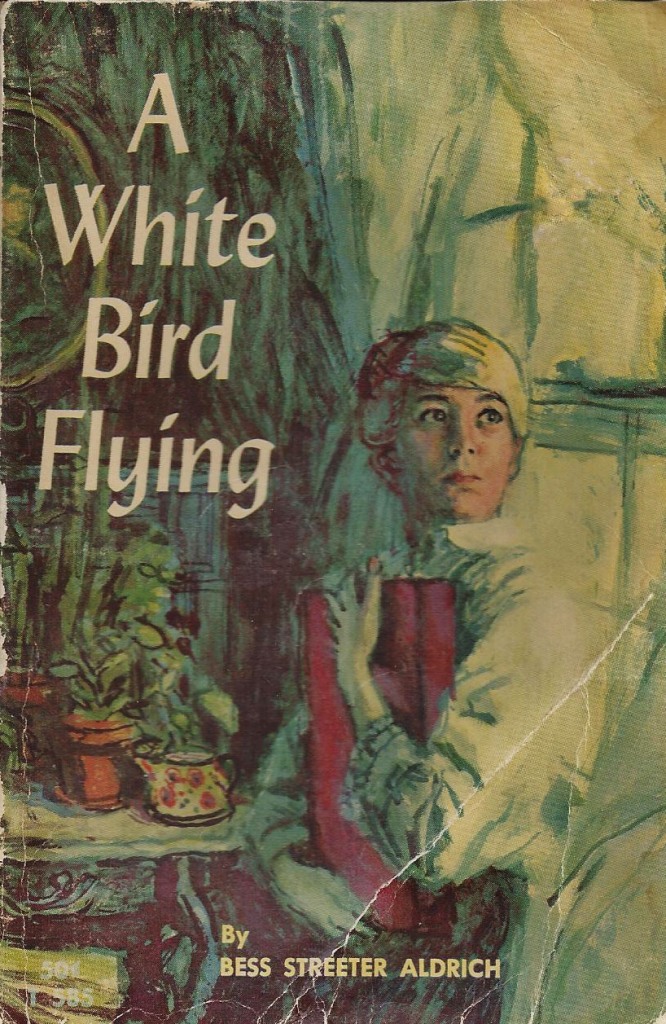
A White Bird Flying by Bess Streeter Aldrich ~ 1931. This edition: Scholastic, 1964. Paperback. 318 pages.

My rating: 5.5/10

American writer Bess Streeter Aldrich (1881-1954) is likely best known for her popular novel, A Lantern in Her Hand, the story of Nebraska pioneer Abbie Deal. I had read and greatly enjoyed that novel, so was quite looking forward to reading A White Bird Flying, which follows Abbie’s granddaughter, Laura Deal, on her own coming-of-age journey.

I am sorry to say that strong Abbie’s granddaughter is a wishy-washy little thing, and that I was generally disappointed in this lightweight  novel. It reminded me of some of the more sentimental twaddle perpetrated by our iconic Canadian author Lucy Maud Montgomery, who wrote in a similar time period and genre; much as I love some of her stronger novels, she was also capable of churning out some dreadful slush; ditto Aldrich.

The first part of the book is perhaps the strongest. Abbie Deal has died and been buried with due ceremony; young Laura stands in her beloved grandmother’s house a few days after the funeral, and tries to come to terms with death and what will happen next. Laura is a deeply emotional, imaginative child; at twelve she already aspires to one day be a writer, and she thinks in those terms.

She was half enjoying herself in an emotional way. There was a sort of gruesome ecstasy in making herself sad with memories. She would like to write about it. “The girl moved about from room to room, touching the things lovingly,” went through her mind. She was in one of those familiar moods when she looked upon life in a detached way as though she herself were not a part of it. She could never talk to anyone about it, but in some vague way she felt withdrawn from the world. She lived with people, but she was not one of them.

Perfectly captures the essence of an introspective adolescence.

Laura goes on her dreamy way, often at odds with her practical, striving mother who is often bewildered by her introverted, sentimental daughter. Laura continues to pursue her private ambition, turning out poems and stories and seeing the world through detached eyes.  She often thinks of her grandmother, and of how Abbie had given up her own ambitions to dedicate herself to full wife- and motherhood; Laura is appalled at the thought of a similar fate for herself and resolves to form her own life quite differently. She decides that she will turn her back on love, and particularly marriage; instead she will dedicate herself to her art and become truly fulfilled in a way a mere housewife can never attain.

Well, the inevitable happens. Laura dreams her way through college, and attracts the attention of a boy from her own home town, Allen Rinemiller, who has strong ambitions to improve the family farm with modern ideas, and has a rather interesting philosophy himself, which Laura scornfully dismisses.

Allen proposes; Laura naturally declines.

“…I can’t think of anything more prosaic than settling down here…and sort of letting the world go by.”

“I don’t call it letting the world go by,” he returned quickly. “I call it tackling a small piece of the world and making something of it. You admit Morton and his bride and all the rest of the old pioneers did a great thing when they crossed he river and started their settlements. You’ve said it was romantic and intensely interesting, and quite worthwhile. You think their own love lay at the bottom of their acts of courage and bravery. All right – did you ever stop to think that maybe we’re pioneers, too? Haven’t you the vision to see that? Why isn’t it something of pioneering that I’m trying to do? Agriculture in most quarters has been a hard, wearisome proposition…I’m pioneering, too – and a whole lot of other young fellows from colleges and universities, we have visions, too – a new outlook on the whole thing…We’re pioneering…starting a new class…the master farmers who are attempting to develop agriculture to the nth degree. Why couldn’t you enter into that in the same spirit your grandmother did? …Because you’re rooted in the soil, need you be a nonentity?”

Allen’s stirring words fall on deaf ears; Laura has already decided to pursue the celibate life, and has even promised her wealthy, childless aunt and uncle that she will remain unmarried and look after them as a daughter would, in return for inheriting their fortune, justifying this strangely unromantic and mercenary agreement by the excuse that it will allow her to pursue her writer’s career without worry and interruption.

The only fly in this particular ointment is that Laura is no prodigy; her talent is modest at best, as she is slowly beginning to realize.

The rest of the story follows its predictable-from-the-first-page path; no surprises here. Laura does marry Allen and dedicate herself to the farm; there are some tough years, but even through these Laura`s issues are not on par with those of her grandmother’s generation. Laura bemoans the fact that she cannot afford new curtains, and a new carpet, and a new dress; Abbie Deal dealt with life and death concerns and had a much more elemental notion of what the truly important things in life were than her grandchild ever faces up to.

I do get the feeling, however, that Aldrich portrays this dichotomy deliberately; the decadence of the descendents of the pioneers, though sympathetically portrayed, is a common undercurrent of her books I’ve read so far. She was obviously very interested in the generational and cultural shifts of the pioneer-to-modern era, and by and large captures the essence of the succeeding generations and their attitudes towards those who came before.

I will be reading more of this author’s works, as opportunity allows, though I doubt I will go to a lot of effort to seek them out. And while White Bird was not a particularly strong novel, it had its generally well-written and thoughtful moments, and I will overlook my vague annoyance at self-centered Laura and her self-created melodramas to classify it merely as a lesser entry into the long-respected Aldrich canon.

I am editing this review to add a Young Adult classification. It was re-published by Scholastic, after all, and the subject matter may be of interest to teenage readers, though I suspect many of them will be as annoyed at Laura as I am.

Read Full Post »

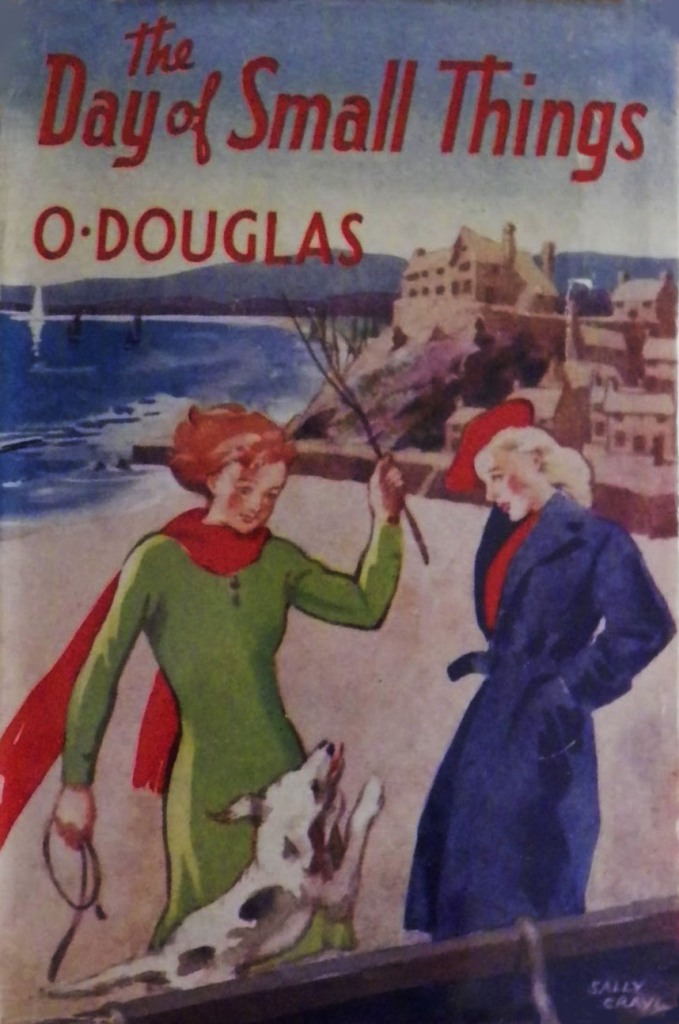
The Day of Small Things by O. Douglas ~ 1930. This edition: Thomas Nelson & Sons, Ltd., no date stated;circa 1950. Hardcover. 286 pages.

My rating: 8/10

Who hath despised the day of small things?

Zechariah, iv. 10

Good things sometimes come in unpromising packages. Check out the cover illustration of this small novel. What would you think?  Perhaps a children’s holiday tale? Given the Biblical-reference title, what about a religious story-tract, one of those saccharine preachy ones so distressingly common in vintage book stacks? Girls’ school story? Luckily, it’s none of the above. Instead, a delightful “character” novel following the lives and thoughts of a group of women in a seacoast town in Scotland between the wars.

I was familiar with O. Douglas only through one of her earlier books, Penny Plain, which, while a pleasant and quaint diversion, was not a masterpiece by any stretch. The Day of Small Things, published 10 years after Penny Plain, is not a masterpiece either, but it is rewarding to see how the author has refined her craft in the years between the two books.  While Penny Plain is generally competently and appealingly written; Small Things is exponentially better.

This book is a sequel to an earlier novel, The Proper Place (1926), concerning an aristocratic Scottish family, the Rutherfurds, forced by circumstances to sell the family estate. Lady Jane has lost both of her sons in the recent Great War; the subsequent death of her husband and unexpected financial hardship prompts her one remaining child, a daughter, Nicole, to suggest their removal to a smaller establishment more within their new means. Accompanying them is Lady Jane’s niece, Barbara, but she has married and is back at Rutherfurd Hall at the opening of Small Things, leaving Lady Jane and Nicole in their new home, Harbour House, close by the sea’s edge in the fictional east coast town of Kirkmeikle.

I found the first few chapters rather confusing, as they continually reference people, places and events that I felt I should have known much more about; such is the nature of a sequel. However, I soon sorted it all out due to the author’s clarity of conversational “sorting out”, and I proceeded on my way, enjoying the story at hand while mentally resolving to read the earlier novel as soon as possible.

In The Day of Small Things, Nicole and Lady Jane have become more than reconciled with their new life; they have made Harbour House a refuge from the world’s storms for themselves and a varied parade of friends. Into their peaceful world comes a disruptive influence in the form of Althea Gort, Lady Jane’s sister-in-law’s niece. Child of a notoriously ill-matched and eventually divorced society couple, nineteen-year-old Althea is now an orphan, and well used to rejection. Her aunt wishes her upon the Rutherfurds hoping they will provide a settling influence, and also to remove Althea from an undesirable lover. While Lady Jane is welcoming, both Nicole and Althea bristle at the thought of sharing a home with each other – their upbringings and personalities are diametrically opposed and they resent each other even before they meet.

The transformation of Althea runs through this novel. There are many interweavings of  personal stories, and a wide array of characters. Those that stand out are the matronly “middle class”  (by her own description) Mrs. Heggie and her brusque but talented poet daughter Joan, and the newly widowed Esmé Jameson, seeking solace in a new home and garden, after nursing her husband through years of pain and suffering caused by his war injuries.

A theme that runs through both this novel and, to a lesser extent, Penny Plain, are the changes in social class and the blurring of societal boundaries since the war. The Rutherfurds are of the old aristocracy, but they also realize that their traditional “time at the top” has come to an end; they are gracious in their ceding to a new social order, while the strivings of the strong and rising “upper middle class” and the nouveau riche incomers are observed with a wry and humorous (but generally benign) eye. As in Penny Plain, wartime recovery, dealing with grief, and drastically changed circumstances also shadow a story mostly concerned with small doings; friends and social rivals drink tea, gossip and jockey either delicately or robustly for position among the evolving small-town cliques.

While one of the love stories in this tale resolves itself in the traditional way, another does not; the circumstances of both are well-handled by the author. There is a lot of emphasis on doing one’s duty and the importance of willing sacrifice of personal desires; again, these unfashionable moralities are handled with sensitivity and humour by the characters.

The narrative is flawed at times; some of the characters are improbably “good” in their thoughts and actions, though all are allowed to show a glimmer of human temper and weakness on occasion, saving the story from blandness.

I enjoyed this book enough to actively seek out more of O. Douglas’s titles; a number are being brought back into print, and several are available through Project Gutenberg, but as I prefer early edition hardcovers I have gone ahead and ordered several through the trusty ABE network; Priorsford, which is the sequel to Penny Plain, and The Proper Place, the prequel to The Day of Small Things.

These are just what I need right now, as in my real life there is a certain amount of emotional turmoil as friends and family deal with health problems and other life-altering challenges; we have very recently lost a dear family member to illness at much too young an age; books such as these are a diversion and something of a comfort as the characters are dealing hopefully and gracefully with similar universal problems.

Read Full Post »

The Middle Window by Elizabeth Goudge ~ 1935. This edition: Thomas Nelson & Sons Ltd., 1949. Hardcover. 310 pages.

My rating: 3.5/10

This is a rare negative review. Rare, because if I sincerely dislike a book, I will put it down unfinished and never pick it up again. Since one can’t honestly review a book without reading the whole thing at least once, and spending some mulling-over time on it as well, the situation generally doesn’t arise.

In this case I persevered with The Middle Window (though it took me numerous tries) because it is an early work by an author whom, for all her many literary flaws – frankly purple prose, excessive sentimentality, long passages of vaguely theological navel-gazing, repeated use of the same characters under different guises, and improbably tidy “happy” endings – I generally enjoy, and I was eager to add another title to the growing Elizabeth Goudge section on my shelves. I have at last choked the whole thing down, several years after its much-too-pricey purchase, and at least three aborted previous reading attempts. So I am going to review it, and then tuck it away at the back of the shelf, and move on.

Warning: spoilers follow. If you’re already a die-hard Goudge fan, you won’t be put off by knowing what happens; it’s utterly predictable but you won’t mind that – all of her books follow generally the same pattern, and you’ve already figured that out, right? If you’re just getting started on her books, or are wondering if they’re worth your time, this may help you make up your mind. This author wrote some MUCH better novels – do not start with The Middle Window! Try the Eliot trilogy instead (The Bird in the Tree, The Herb of Grace, The Heart of the Family), or The Scent of Water – my personal favourite.

*****

Spring had jumped straight out of heaven into London. For an eternity coughing, sneezing millions had coughed and sneezed at the centre of a black balloon of fog and dirt, frost and misery. Young and old, rich and poor, fair and ugly, they had all alike choked and shivered and beaten imprisoned hands against that rounded black wall that shut them in. But now, suddenly, between the hours of sunset and sunrise, the miracle had happened. The boy Spring, his arms full of glories stolen from divine treasuries, had strolled to the portal of heaven, had poised tiptoe on the lintel, had spread his wings and jumped. Crash! His feet, pressed together and pointed downwards like a slender arrow, had punctured the black balloon. All that was left of it, torn black scarfs of smoke, evil-smelling wraiths of fog, drifted and coiled into the foul, dark corners of London, while the boy, speeding downwards, flung out his arms and spread his treasures sweeping fanwise over the city.

The crash awakened the millions. Running barefoot to their windows they looked out. Beyond the smoke-grimed panes they were aware of a drifting glory and showers of rainbow light. Some of them, throwing up their windows and thrusting tousled heads out, were just in time to hear a rustle of wings and glimpse the downward gleam of arrowy feet, and a few, a very few, as the sun rays slanted across the sky, saw the shadowed sparkle of a boy’s blue eyes behind the curve of golden lashes.

Whew. First two paragraphs of the novel. Elizabeth Goudge has let her writerly hair down, and that’s just from the prologue.

Beautiful, wealthy and rather spoiled young socialite Judy Cameron is just getting over the flu, and is feeling physically and emotionally fragile as a result. Wandering window-shopping this spring day through the London streets, Judy is inexplicably drawn to a painting in an art gallery window. It is a Scottish scene, mountainside and loch and heather, and as Judy stares into it the traffic sounds fade and she is drawn into a strangely familiar world where, in reality, she has never been before. Luckily her doting fiance, Charles, a cheerful if not particularly intellectual army captain, turns up in time to rescue her from her daze.

Soon Judy is off to Scotland to holiday in a rented estate house, dragging an entourage of doting father, volubly complaining mother, and bemused Charles. (They were supposed to holiday in Bournemouth.) They are heading for what Judy just knows is the original setting of the painting. And, lo and behold, she’s right! Everything is familiar to her, she knows exactly how things will be before she gets there, it’s just as if she was once there in a previous life! How intriguing!

It gets even more intriguing as the estate’s picturesque butler (“Arrr, do ye be the wealthy Sassenach interlopers? Here’s yer tea, then…”) stares deeply into her eyes and calls her “Mistress Judith” with a certain knowing intonation. And look, here’s the young laird himself – a hunky dish named Ian Macdonald – come to welcome her. What is this thrill of mutual recognition, and why does he also stare into Judy’s lovely eyes with such passion, heedless of her looming official lover, Charles?

To condense: Judy and Ian turn out to be the reincarnations of 1700s’ doomed lovers Judith and Ranald Macdonald. Before consummating their wedding night, Ranald tears himself away from his passionate (and passionately frustrated, one must assume) bride to take part in the attempted restoration of Bonnie Prince Charlie to the British throne. And, as we all know, that whole adventure is doomed to end badly. Goudge subjects us to a long and tiresome historical fiction episode in the middle of the story in order to explain all of this. Modern-day Judy puts on dead-and-gone Judith’s dress and suddenly travels back in time (mentally, not physically – in real life she merely faints) where she relives Judith’s experiences.  After the Jacobite rout at Culloden, Ranald sneaks home, after a side trip to help row the prince to Skye, good for another few pages of filler.

Unluckily for Ranald, British soldiers are already there waiting for him; they intend to hang him as a traitor. He manages to duck the soldiers and briefly reunite with Judith, but slides away again to hide nearby until she can get rid of the arresting officers. They know something is up, are not fooled by Judith’s vague excuses, and hang around in ambush mode. Eventually Judith fires a warning shot through her parlour’s “middle window” and fatally wounds Ranald, who was lurking just outside. He dies in her arms, but not before telling her that their great love will be fulfilled in a future generation. Judith is left to linger on, which she does for many years, as the estate falls into ruin and the Scottish mists mingle with the tears in her eyes.

Hence Judy and Ian’s overwhelming mutual adoration. Poor Charles is eventually given the heave-ho, but that’s all right, because Ian’s chipper sister Jean is there to catch him; she’s been giving him the glad eye the whole summer, and she’s a much better fit for him anyway, so all’s well that ends well.

Gar. What a tiresome story this was. I feel all bilious; I think I need to read something crisp and witty to cleanse my emotional palate. Or maybe another Goudge to prove that she can do better (a lot better!) than this overblown romantic mess. The whole reincarnation thing was just downright disturbing. Not that I have a problem with the concept, at least fictionally speaking, but it felt exceedingly contrived in this case. In later novels Goudge tones this idea down, or perhaps “refines” would be a better term, but she still continually trots out the troubled ancestor “coming back” in the contemporary character for some sort of redemption or fulfillment.

Stereotypical characters, predictable plot, overly rambling, and decidedly over-written. This was Goudge’s second published book, following her very popular first novel Island Magic, which I have not yet read; now I’m rather afraid to! She was definitely still very much finding her narrative voice.

*****

Goudge was, in her heyday, a very popular writer of the “inspirational-romantic” genre. Daughter of a noted theologian, Elizabeth Goudge’s strong Christian faith is obvious in every one of her stories, though she also generously allows strong pagan overtones in some of her tales and has a deep tolerance for other religions; some of her best characters are atheists and agnostics. She was all about finding “God” in your own way, not blindly following a laid-out creed; something I must admit I deeply appreciate in many of her works.

While I have a sentimental fondness for Elizabeth Goudge and her often inspirational messages, I have reservations about certain aspects of all of her books. Even in my favourite, The Scent of Water, there are several rambling sections I scan over quickly to get back to the thread of the story. But none of her later books are anything near so dreadfully messy as The Middle Window! Such a relief that this writer’s style evolved.

Read Full Post »

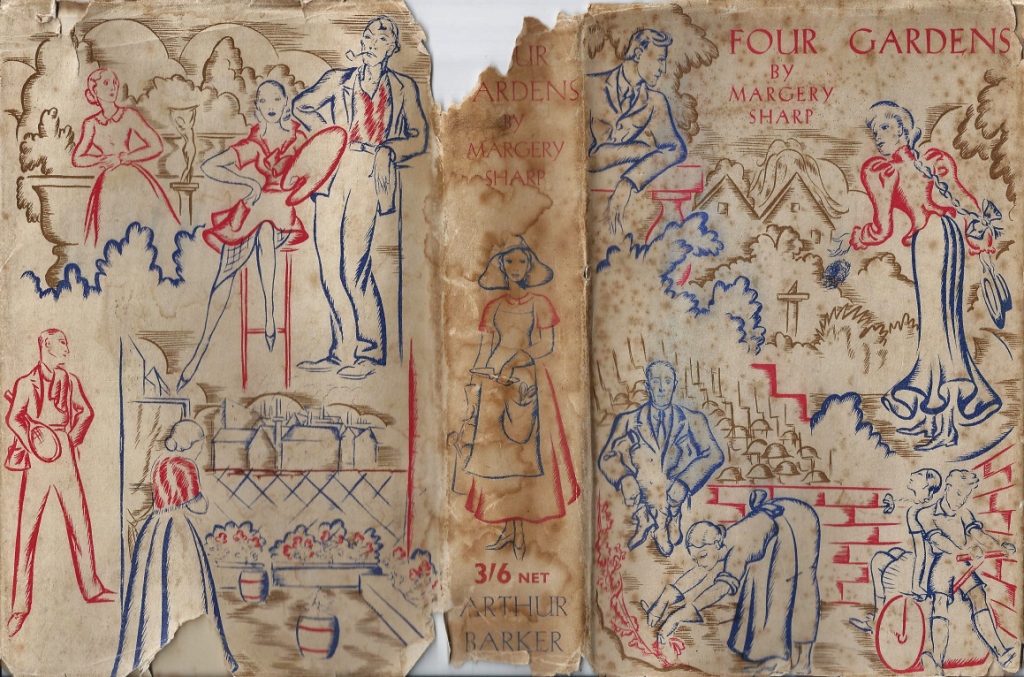
Four Gardens by Margery Sharp ~ 1935. This edition: Arthur Barker Ltd., 1935. Hardcover. 297 pages.

My rating: 10/10

In the early years of the 20th Century, Caroline Smith lives the quiet life of a dutiful middle class daughter with her widowed mother. Walks on the Common, occasional tea parties and church bazaars, helping with the housekeeping and pursuing quiet amusements; such is her life. Occasionally Caroline muses about her place in the world, and wistfully thinks of what her future may hold, but all in all she is of an accepting nature.

Caroline’s one weakness is gardens; on her strolls with her mother she peers through gates and quietly and deeply absorbs what she sees. We pick up Caroline’s story during her seventeenth year, as she takes possession of her first garden; the abandoned wilderness of an empty estate house. Caroline finds a secret way in, and there in the garden she has her first innocent encounter with romance.

Time moves on, and that first garden is lost to Caroline, but after some secret mourning she accepts it as something that must be. She marries a good (though not romantic) man, has two children, and does her duty in all of her relationships even though they are not always what she’d hoped for. The second garden, very different from the first, is a balm to Caroline’s sometimes troubled soul, and is the backdrop of her early wifehood and motherhood, darkly overshadowed by the Great War.

Circumstances change for the better; Caroline is presented with a chance at a new life and a rise in her social position; she gracefully takes it all in stride, though she quietly remains the same thoughtful, uncomplaining soul. Her third garden is one in which a didactic gardener holds sway; Caroline secretly mourns her new distance from physical contact and a real relationship with the plants and the soil, but she does  the correct thing as always and goes forward into this newer, more luxurious world as staunchly as she faced adversity in her younger days.

The fourth garden is the one Caroline creates for herself when her situation again changes; though the smallest and most makeshift, it is perhaps the most satisfying. Life has come full circle, and there is a strong sense of the fitness of things.

This is a gentle but not sentimental book; Margery Sharp keeps it crisp and interesting by allowing us to hear the ongoing commentary of Caroline’s innermost thoughts. Though I continually call Caroline gentle and accepting (and rightly so), she is also keenly perceptive of both her own and others’ motivations and reactions; her inner voice is wry and quietly witty. We are therefore thoroughly on her side as she copes with difficult social situations, troublesome relationships, a well-meaning but emotionally distant husband, and confusingly complex and progressively minded (but by-and-large loving) children.

Not as full of parody as some of Margery Sharp’s works, Four Gardens is a touch more serious and thought-provoking. Beautifully written; often very funny; occasionally very poignant. By the end, the story has become something of a celebration of the quiet satisfaction of dealing well with the not always exciting commonplace life one is dealt by fate, keeping one’s head up, and carrying on.

Very highly recommended.

***

Updated to add a contemporary review I have just discovered, from the New York Times Saturday Review of Books, February 1, 1936

FOUR GARDENS. Margery Sharp. Putnams. 1935. $2.50.

There is refreshment in this book of Margery Sharp’s, a cool sanity that is infinitely restful. She has by nature something of the Jane Austen touch, springing from a detached, quiet power of observation, a delicious, satirical way of relishing affectation, and a respect for sensible, genuine people.

It is a quiet book, the life-story of a woman to whom very little ever happens, a woman as undistinguished as her name of Caroline Smith. But it is a pleasure to read about her and her great good sense; she is lovable in her simplicity, and because of the gentle, irrepressible spark of humor that she possesses. But for all her simplicity she has maturity and wisdom. There is a note of high comedy, rare enough in these days, in the deftness with which she copes with her two ultra-modem children.

All the details are so right and neat, the shades of social difference in the little English town where Caroline lives shown to such nicety, the varying relationships between people set forth with so much exactness and delicacy, that the book makes delightful reading.

***

NoteFour Gardens may be a bit hard to come across, as it was published early in Margery Sharp’s long career and was eclipsed by her later, much more highly publicised works. A few copies show up on AbeBooks, but be prepared to pay a premium price, $40 into the hundreds, for a hardcover in good condition. There appears to have been at least one reissue in paperback in the 1960s, so there should be reasonably priced editions out there in the used book world for a patient collector to track down.

Read Full Post »

Spring Came on Forever by Bess Streeter Aldrich ~ 1935. This edition: D. Appleton-Century Company, 1935. Hardcover. 333 pages.

My rating: 7.5/10

Nebraska writer Bess Streeter Aldrich, 1881-1954, was well-known for her portrayals of Mid-West American pioneer days. Her novels and short stories generally featured strong heroines who met adversity with grace and strength. Aldrich herself knew tribulation and great grief; widowed suddenly at 44 with a family of young children in the midst of the Great Depression, she supported her family with her writing.

Spring Came on Forever is a tale of missed chances and second choices. It follows star-crossed lovers Matthias Meier and Amalia Holmsdorfer as they fall in love, are separated by circumstance, and marry other people. Their descendents’ lives are eventually intertwined, bringing their youthful tragedy to a gently satisfying, much happier conclusion, though they themselves are not aware that they started the chain of events.

Aldrich excels at illustrating the march of progress through the years; her characters both embrace and lament time’s changes; the good and the bad are matter-of-factly portrayed.

An excerpt from the Vachel Lindsay poem The Chinese Nightingale gives the novel its title:

“Years on years I but half-remember…
Man is a torch, then ashes soon,
May and June, then dead December,
Dead December, then again June.
Who shall end my dream’s confusion?
Life is a loom, weaving illusion…
 
One thing, I remember:
Spring came on forever,
Spring came on forever,”
Said the Chinese nightingale.
 

Though often predictable and occasionally straying into melodrama, Aldrich’s novels are quiet works of everday people dealing with the everyday problems. Encouraging and supportive of the trials and rewards of wifehood and motherhood, her novels are as much loved by readers today as when they were published in the 1920s, 30s and 40s. While realistic regarding tragedy and disappointment, Aldrich always highlighted the deep and quiet joys of womanhood, and the inner rewards of “keeping on” through difficult times.

Spring definitely has some flaws as a literary work. The characters are sometimes a bit one-dimensional, and so much is packed into a relatively short story that the years whip by at lightning speed with only small vignettes to mark the many stages of the protagonists’ journeys. However, those vignettes are well presented enough to give us a clear understanding of events as they unfold; by the end of the novel the whole story is spread out before us in all its interweavings, rather like the patchwork quilts Amalia crafts with such care.

An old-fashioned writer of old-fashioned tales, Bess Streeter Aldrich’s often-poignant words still resonate today, particularily with those of us past our first youth and embroiled in our own family affairs. Not to everyone’s taste; a sophisticated modern reader may dismiss Aldrich’s sometimes dated style and storylines; but there are rewards hidden in the pages of her tales for those with the temperament to appreciate them.

Read Full Post »

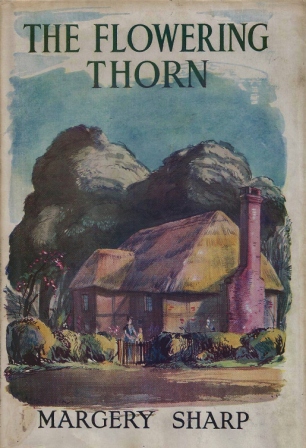
The Flowering Thorn by Margery Sharp ~ 1933. This edition: Little, Brown & Co., 1952. Hardcover. 345 pages.

My rating: 10/10

Margery Sharp’s fourth novel, The Flowering Thorn,  first appeared in England in 1933, with an American edition appearing in 1934, but it attracted little attention in North America until almost twenty years later. The later novels Cluny Brown (made into a 1946 movie of the same name, starring Jennifer Jones and Charles Boyer) and The Nutmeg Tree (used as the inspiration for the popular 1948 movie Julia Misbehaves starring Greer Garson, Walter Pidgeon, Nigel Bruce and a young Elizabeth Taylor) brought Margery Sharp  to the attention of the North American public, who happily bought her books and asked for more.

The reason I mention this is that there are two sets of “first editions” of The Flowering Thorn out there. The first “first” would be the original British 1933 edition published by Arthur Barker, Ltd. Putnam’s American edition followed in 1934. Then in 1952 appears another “first”, so stated in the book, with a stated copyright date of 1934, published by Little, Brown and Co. The dustjacket and front flyleaf of the 1952 Little, Brown edition refers to a number of the Sharp titles published after 1932, and up to 1951 – The Nutmeg Tree, The Stone of Chastity, Cluny Brown, Britannia Mews, The Foolish Gentlewoman, and Lise Lillywhite – giving the game away – but it can be confusing. There were several paperback editions as well. This title is fairly scarce; if you can find a decent-condition hardcover of any edition under $30, grab it. A 1933 true first in good condition will set you back $100 +, going by the May 2012 AbeBooks listings.

(Vintage book collector’s digression now over!)

I would like to call this a gentle, slow-moving examination of a woman’s progress towards true fulfillment and happiness, but Margery Sharp’s always analytical and occasionally tart tone, as well as protagonist Lesley Frewen’s no-nonsense attitude, make “gentle” a somewhat inadequate description.

Lesley is a twenty-nine year old socialite living in London in 1929. Her life is perfectly organized; she lives well, and just within her income, in a high-end, most desirable flat; her interests are the theatre, modern art, literature and music; she moves among the Bright Young Things of the day with aplomb and style. What Lesley suddenly realizes she is missing, after a tactful brush-off by a man she highly admires and has delicately offered herself to, is love.

…there slipped into her mind, already bodied in words, a strange and dreadful notion. She thought,
‘Perhaps I am not a woman that men do love.’
She thought,
‘There are women like that. Attractive women…. And if that is so, and if…that is what I have been waiting for, what am I to do now?’
The intricate daily patchwork was still there to work at, the innumerable dovetailing fragments still lay ready to hand: but it now seemed to her, and for the first time, that her work had no pattern.
‘I want something new,’ said Lesley aloud.
 

And it is in this frame of mind, struggling with her sudden inner turmoil, that Lesley goes to tea with her elderly aunt, who is embroiled of a turmoil of her own: her recently hired companion, a young, widowed Scotswoman, has suddenly died, leaving behind a four-year-old child. There are no relations in sight, and the orphanage looms.

Lesley, who has been watching young Patrick playing on the floor as the conversation regarding his future goes on above his head, is impressed and intrigued by the child’s tenacious attitude and sober demeanour. On a whim, she offers to take him on herself, much to her aunt’s consternation. Lesley immediately regrets her rash offer, but before she can backtrack the child catches her eye; to renounce him would be a betrayal, she suddenly feels. The immediate and very vocal opposition to her proposal by the elderly women present has the contradictory effect of  stiffening Lesley’s resolve, and the wheels are set in motion.

Lesley suddenly finds herself in the position of having to leave her flat (no children allowed) and to take on extra expenses in regards to Patrick’s care. Her careful budget is in tatters, and she decides, on another not particularly well thought out whim, to move into a cottage in a country village in order to live more cheaply. After all, it is only going to be for four years, until Patrick is old enough to send to boarding school, and then Lesley can slide back into her well-organized town life. Her social butterfly friends will surely understand…

Lesley’s new life is not what she had anticipated, but she takes it well in stride, attempting at first to keep up her strict London standards, but, ever-so-slowly, a new Lesley is born, a much more human and ultimately more lovable one.

Something I deeply appreciated about this story was Sharp’s total avoidance of sentiment regarding the relationship between Lesley and Patrick. Lesley is, almost immediately, deeply resentful of Patrick’s demands – both the physical demands of a small child, and the moral demands his presence in her life place upon her stern conscience. Confronted by a friend pushing the option of backing out of the situation, Lesley examines her innermost soul and comes to a surprising conclusion:

She thought, ‘If I don’t see this thing out I shall have something rotten inside me for the rest of my life.’ Rotten like an apple – the brown decaying core under the firm red skin…

Nevertheless, she does not initially feel any sort of affection for the child; to the contrary

…she looked at him with an intensity of dislike so nearly bordering on hatred that her own features, could she have seen them at that moment, would have seemed completely strange to her.  And even without seeing, it was as though she guessed: for in all their enforced companionship she never once spoke to him without consciously masking her face. It was a hatred to be ashamed of, ignoble and unjust: but she did not love him the more for making her ashamed.

The development of a much more positive relationship between the two is the thread that winds through the story, though Lesley in no way concentrates solely on the nurturing of Patrick; she is even more so concerned with working through her own emotional and intellectual growth as her self-imposed exile from her previous world gradually brings her an awareness of the unexpectedly rich and satisfying reward of relationships based on mutual affection and respect versus social expediency.

A thought provoking, often humorous, rather surprising story. Highly recommended.

Read Full Post »

« Newer Posts