Archive for the ‘1930s’ Category

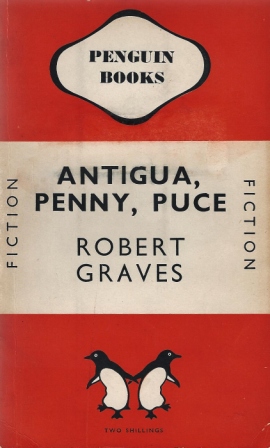
antigua, penny, puce by Robert Graves 001Antigua, Penny, Puce by Robert Graves ~ 1936. This edition: Penguin, 1947. Paperback. 314 pages.

My rating: 8.5/10. Parts of this one – many parts! – were decidedly “10” in quality. I rated it lower only because the author ran a few sections just a bit harder than they could take; I did have to force myself onwards here and there. But it always got interesting again.

I greatly enjoyed this book, and found it playful, amusing and gloriously cynical in parts. Graves has his authorial knife keenly honed and digs it into such things as British prep and public schools, golf, the British upper classes in general (with the hearty sporting types coming in for the most blatant caricaturizations), and, for reasons known only to himself, Jerome K. Jerome’s Three Men in a Boat. I laughed out loud several times while reading; a thing I seldom do.

*****

This is an intricately structured, highly detailed, cleverly framed, humorous and yet deeply cautionary tale about sibling rivalry, and the dangers of pursuing familial tit for tat to extreme lengths. Robert Graves, already a well-established and very prolific writer of “serious” literature and poetry, apparently wrote this atypical farcical novel as a result of a bet that he couldn’t pull off a “modern” bestseller. Graves is, of course, probably best known now for his screen-adapted historical fictions I, Claudius and Claudius the God, among something like 150 other published works, most rather sober and scholarly examinations of the classical world, biography, historical fiction and poetry.

*****

Oliver Price and his younger sister Jane grow up together in an atmosphere of stereotypical English upper-middle-class respectability. Their father is a country vicar who hobnobs on equal terms and with a strong element of rivalry with his wealthy neighbour, Sir Reginald Whitebillet. Their mother, the daughter of a marquess, was cast off by her family for marrying the Castle chaplain, and through her there are connections to the aristocratic Babrahams. These details are important; both the Whitebillet and Babraham connections figure crucially in the saga of the siblings a few years later on.

Oliver, at the age of twelve, is the proud curator of a stamp collection while Jane, a year younger, yearns to participate in her brother’s hobby. Through maternal machinations on behalf of Jane and a set of rather devious circumstances – the mother of the family exhibits a strongly manipulative technique which her daughter fully inherits –  Jane attains a half-interest in the collection, and proceeds to contribute a number of rare and unusual items to the album, including a one-of issue of a purple-brown (“puce”) Antiguan one-penny stamp, the only surviving example of a lot which has gone to the bottom of the sea in a ship wreck.

Aha! That’s the explanation of the rather odd title. Antigua, penny, puce. It’s the description of a postage stamp! I did not grasp this until I started reading, at which point it became as clear as day.

Time marches on, and Oliver and Jane grow up and go their separate ways, with varying degrees of success.

With the assistance of her childhood friend Edith Whitebillet – a scientific prodigy – and her own single-focus ambition, Jane has become first a highly successful actress and then the brilliantly manipulative proprietor of a theatrical company known as Jane Palfrey Amalgamated, consisting of actors whom she has groomed and renamed to each fill a very defined character with a strong appeal to public sentiment of one sort or another.

Oliver has gone through his school career and on to Oxford aiming for and just falling short of his desired goals in every aspect of his endeavours. He only makes the Second Eleven in football, misses the scholarships he aims for, and generally places as an also-ran in everything he does. Now he’s deeply involved in writing his first novel, which he has stellar plans for, but samples we are given  of his prose style make it very clear that in this too Oliver will be less than successful.

Oliver is by nature rather pompous and quickly belligerent; his clever sister runs rings around him now as she did in their younger days. First as a joke engineered to raise his ire so she could examine closely his mannerisms when taunted – one of her stage characters is based on her blustery and rather laughable brother – Jane reminds Oliver of her half-ownership of that childhood stamp collection, and announces her intention of coming to take away every second stamp. Oliver’s subsequent tantrum swings Jane over from merely joking to deadly serious about this intention.

Much devious work on both sides now goes on, as Jane and Oliver are well-matched in their desires to not let the other get the better in any sort of confrontation. A series of wins, losses and draws ensues, with the titular Antiguan stamp as the catalyst of their many explosive altercations.

Robert Graves was nothing if not a well-prepared author. His attention to detail was legendary, and even in this “light” novel he includes a plethora of background information on every subject he touches upon. This article, from a website dedicated to his work, details the research and process of writing Antigua, Penny, Puce. Absolutely fascinating!

As well as being a well researched author, Graves has a strong sense of humour and a very readable, deeply satirical way with words. He examines the real world, translates it into a fictional one, and rather maliciously – though never mean-spiritedly – probes and lays bare the absurdities he finds.

Good stuff.

Little Raven says it well; she approves, too.

Read Full Post »

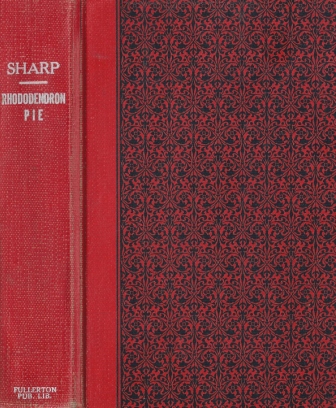
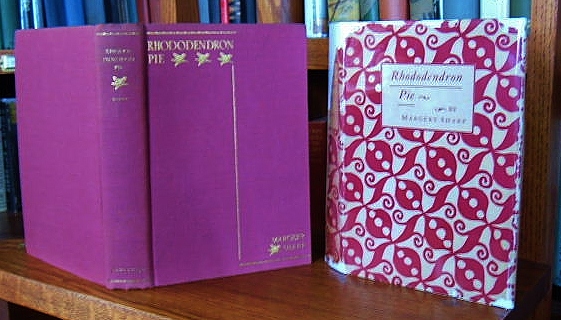
rhododendron pie margery sharp rebound 001Rhododendron Pie by Margery Sharp ~ 1930. This edition: D. Appleton & Co., 1930. 3rd American printing. Hardcover, rebound by library. 359 pages.

My rating: 9.5/10.

The standard set by this first novel is high; Sharp began as she was to go on, moving from strength to strength throughout her long writing career. Even her few “bobbles” in her later works are entertaining; her sheer writing skill and love and mastery of language make her a joy to read, even when the plotline falters. And it doesn’t do that here; this book is very well put together indeed.

This is the depressingly rare first ever Margery Sharp novel, long out of print, and extremely hard to come by. I finally tracked it down through inter-library loan; a complete search of the Canadian library database located one lone copy in Ontario. After paying a $20 borrowing fee, and waiting for what seemed like a terribly long time, it arrived in pieces, held together with several rubber bands, with a note asking me to use extreme caution when handling it.

Not knowing quite what to expect as a reading experience, but having very high hopes, I was more than rewarded for the time and trouble it took to get my hands on a copy of this book, at least temporarily, and I redoubled my efforts to find a copy of my own. This was something of a “take a deep breath” step,  as prices range from a low of $200 to a high of $600; the most copies I’ve ever seen on offer at one time are the current seven on ABE.

I won’t tell you what I ended up paying for my own copy, pictured above, but it was a major investment for someone of my relatively modest resources. Not the most expensive book I’ve ever purchased – that dubious honour goes to the even rarer Fanfare For Tin Trumpets, Margery Sharp’s second (and just a little less stellar) novel. What I will say is that I haven’t regretted it at all. Either of them. But most of Sharp’s later works – she wrote something like twenty-six novels for adults, and a dozen or so juveniles, many starring the mousy “Rescuers”, elegant white Bianca and common brown Bernard (“the Brave”) – are relatively easy to find. She was a best-selling author in her time, with a humourous inflection which transcends time. I love her writing; for me it simply “flows”, carrying me effortlessly along. Each re-reading reveals another layer; I’m far from finished with my exploration and enjoyment of her work.

I do so wish that someone in the publishing world would catch the Margery Sharp bug and reprint her early works! Rhododendron Pie is such an exquisite little gem, with the genuine clarity and sparkle. There are much more pedestrian works being brought back into the marketplace to feed the current hunger for such nostalgic period pieces! I live in hope.

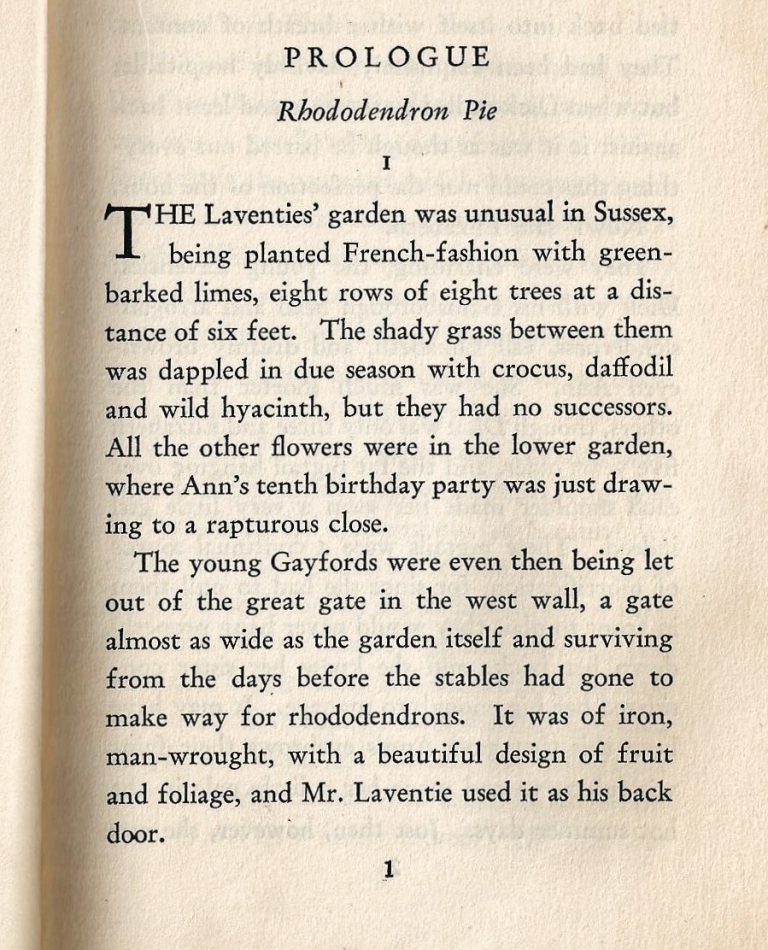
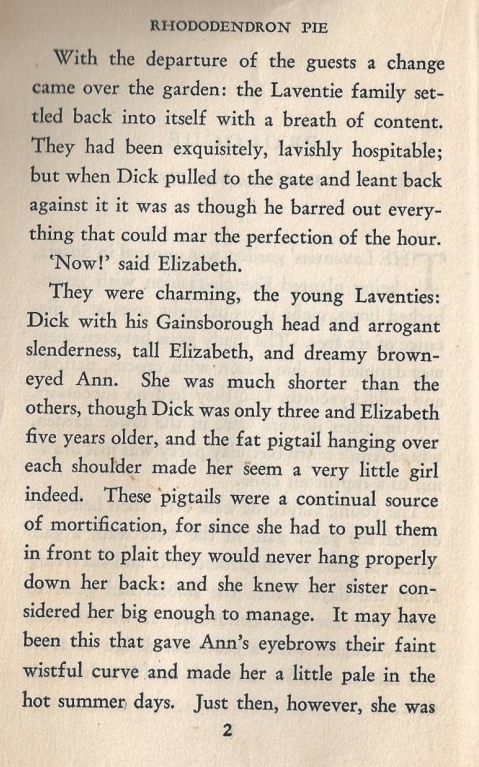
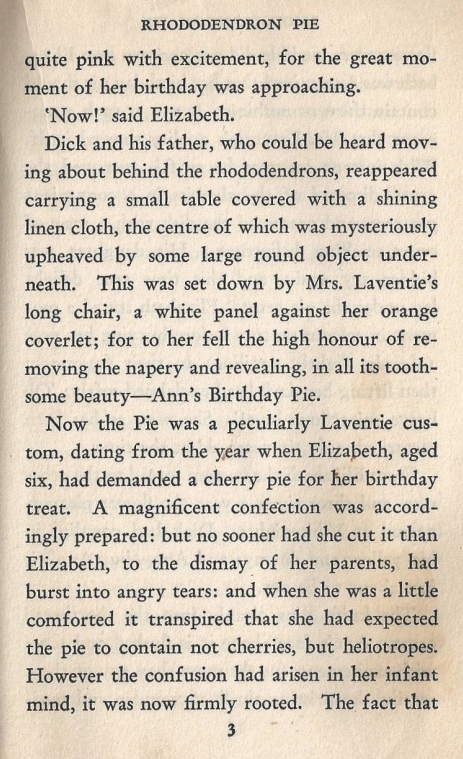
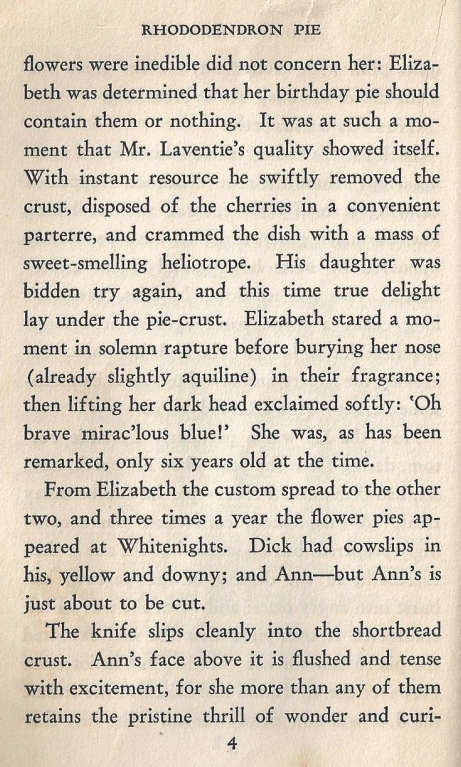
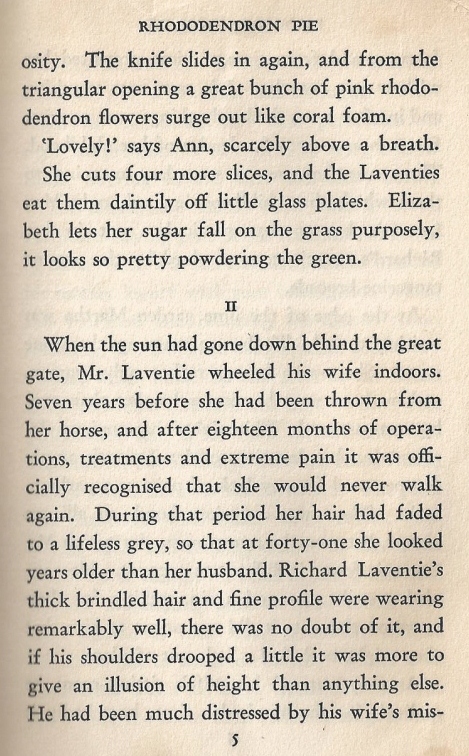
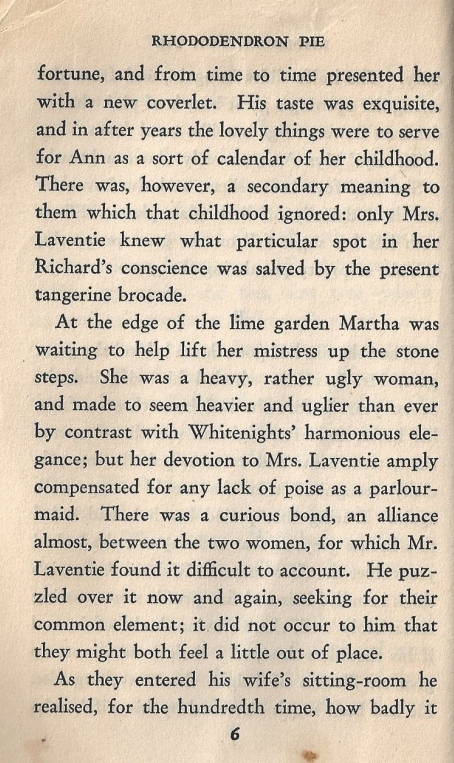
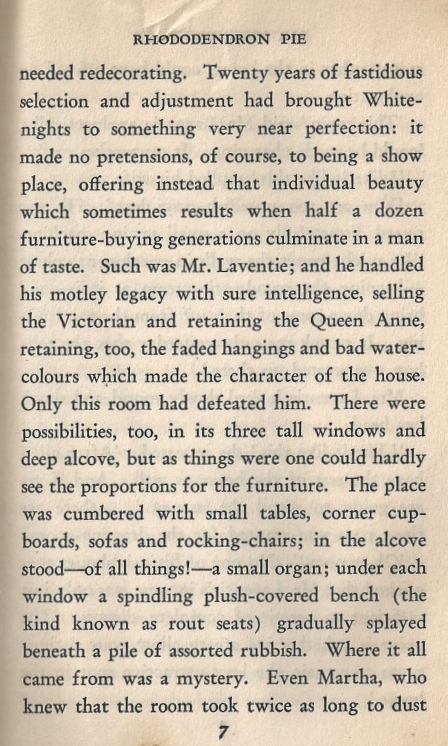
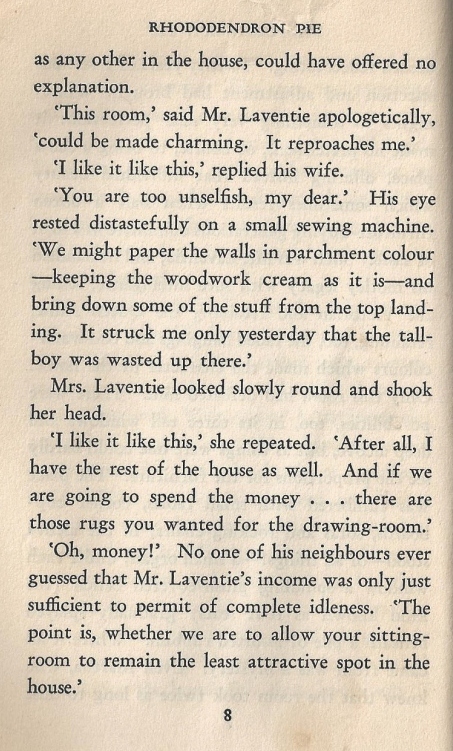
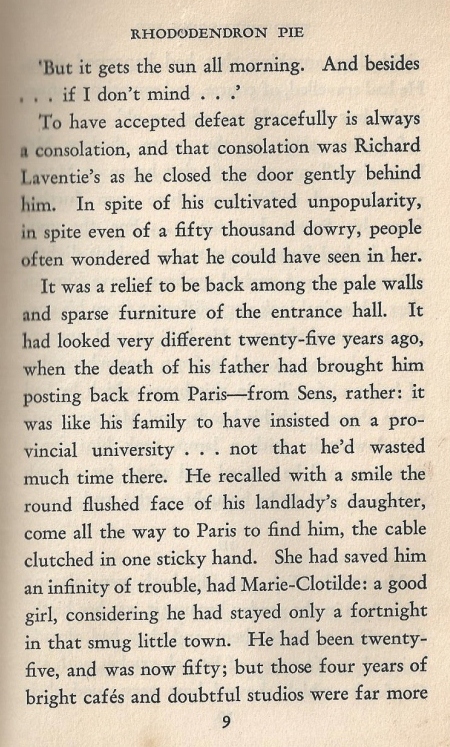
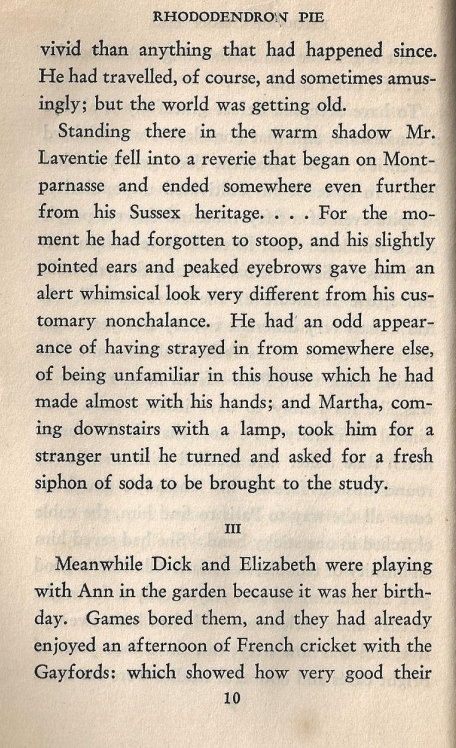
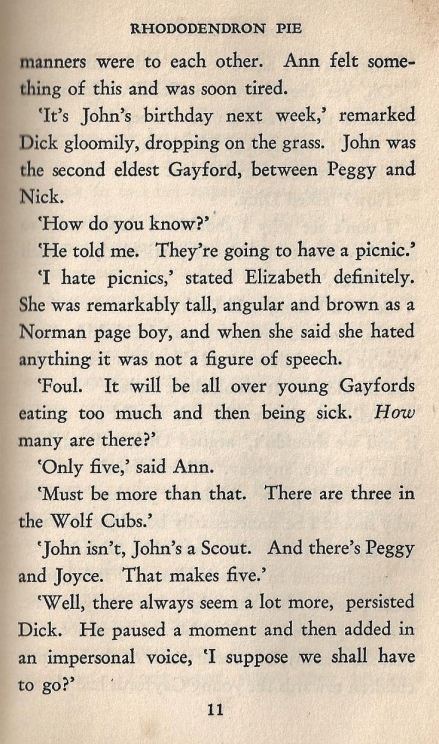
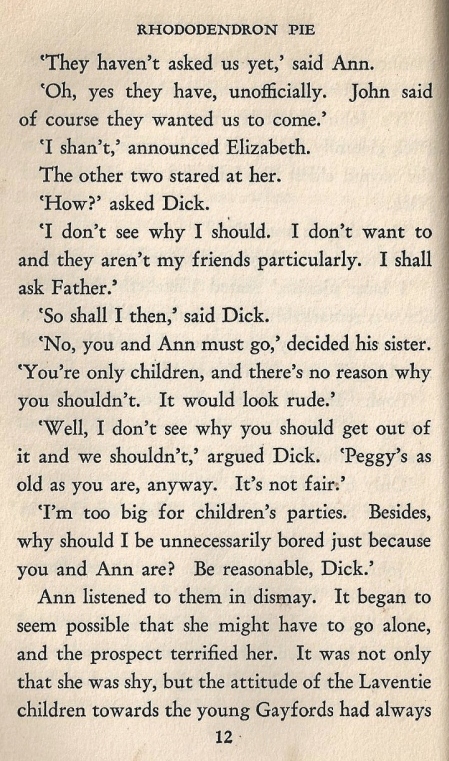
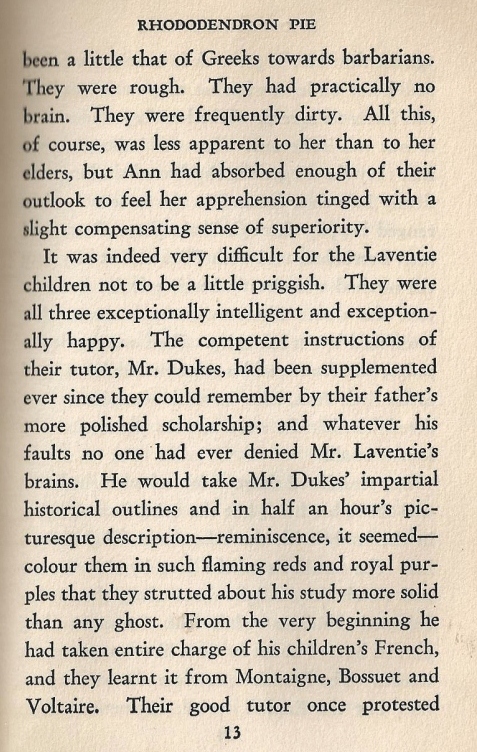
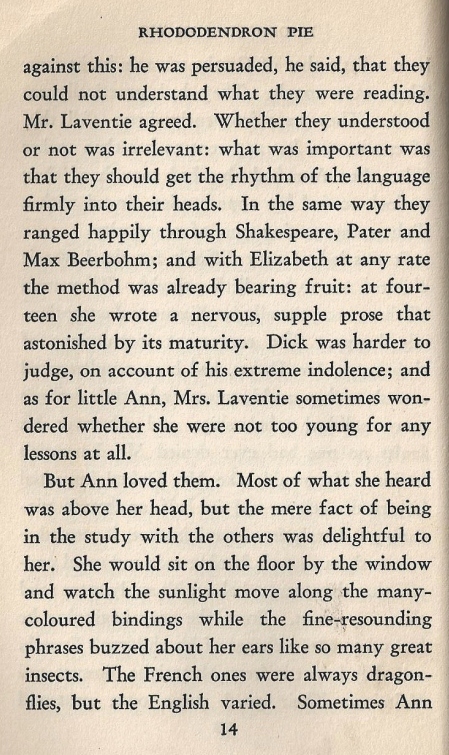
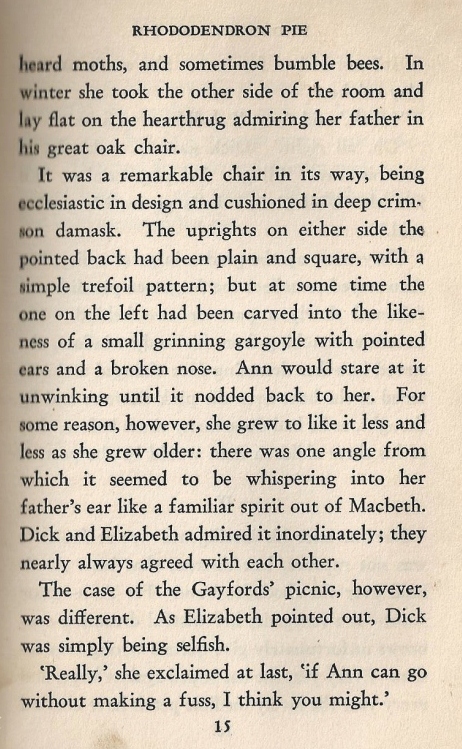
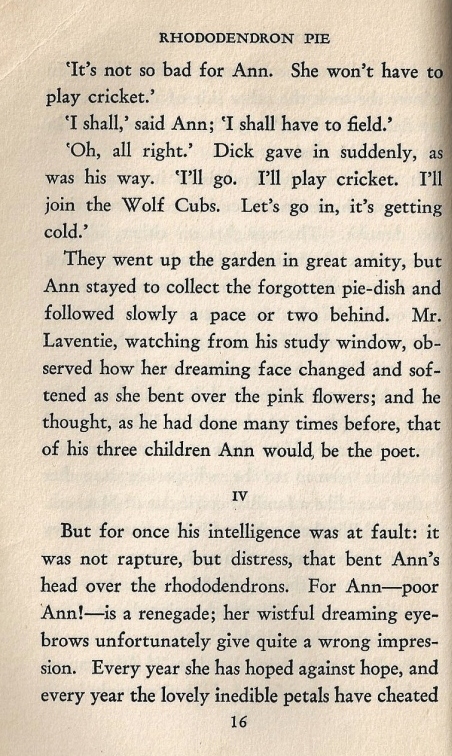
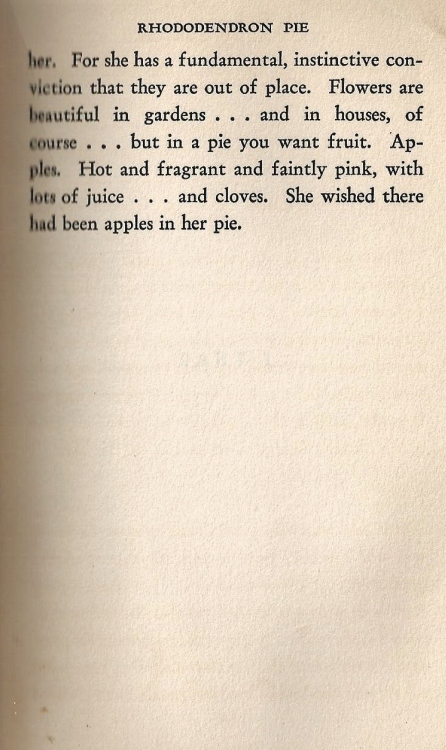
In the meantime, we do what we can. For those of you who are also Margery Sharp fans, and who have not yet gotten your hands on this little prize, I am now posting, as promised way back in August or September, the entire Prologue to Rhododendron Pie. One day, if no publisher blesses us with a reprint, I might be tempted to scan the whole book and turn it into a pdf file, to share with fellow Sharp aficionados. (Or perhaps it might qualify for Project Gutengberg? I thnk it just might be old enough, and long enough after the author’s death.) In the meantime, here’s a sample.

If you enjoy the Prologue, let me assure you that the rest of the novel is ever so much better.

But first, a contemporary review from 1930:

Rhododendron Pie is something more than an amusing and good-natured gibe at literary and artistic snobbery, for all the Laventie family–including the mother, who comes in with a great burst of rhetoric on behalf of the bank clerk at the finish–and the various minor characters are far more than argumentative counters in the attack or defence of aestheticism.  They have all authentic lives of their own, and Miss Sharp is particularly successful in catching the accent of those inhabitants of the modern world who carry a magnificent undergraduate irresponsibility into the affairs of everyday life. – The London Times Literary Supplement

rhododendron pie sharp prologue pg 1 001rhododendron pie sharp prologue pg 2 001rhododendron pie sharp prologue pg 3 001 (2)rhododendron pie sharp prologue pg 4 001rhododendron pie sharp prologue pg 5 001 (2)rhododendron pie sharp pg 6 001rhododendron pie sharp pg 7 001 (2)rhododendron pie sharp prologue pg 8 001rhododendron pie sharp prologue pg 9 001 (2)rhododendron pie sharp prologue pg 10  001rhododendron pie sharp prologue pg 11 001 (2)rhododendron pie sharp prologue pg 12  001rhododendron pie sharp prologue pg 13 001 (2)rhododendron pie sharp prologue pg 14  001rhododendron pie sharp prologue pg 15 001 (2)rhododendron pie sharp prologue pg 16 001rhododendron pie sharp prologue pg 17 001 (2)

The story proper opens ten years later. Our heroine, Ann, is now twenty, and we find her dreaming the summer away, poised on the brink of life. Her brother Dick and sister Elizabeth are busy following their own intense pursuits – Dick as an art student and aspiring sculptor, and Elizabeth as a writer and editor – but Ann has so far found no particular artistic bent of her own to follow. She is mostly merely accomplished at being agreeable, and with her sophisticated family and their many visitors a listening ear and a pleasant, interested expression are much appreciated as the egoists expound and Ann takes it all in. But she has a rich inner life of her own, and she’s busy sorting it all out.

Ann settled down on the grass again with her chin on her fists and one shoe waving in the air. She wasn’t reading really, only pretending to, so that the others wouldn’t talk to her. It was too nice in the garden to talk. How queer to think she was lying on the surface of the world… an enormous warm green ball spinning slowly through space with somewhere, under a lime tree like a sliver of grass, a minute pink dot…

The Gayfords, ten years after we first meet them, are still persisting in being friendly to their uppish neighbours; continual delicate snubs are absorbed and ignored, and Ann has settled into her role as a liaison of sorts between the two worlds, which leads to occasional mockery by Dick, Elizabeth and Mr. Laventie, who assume that Ann is merely “collecting material” for reasons of her own.

But Ann is honestly fond of the happy Gayford clan, and this summer, with Peggy Gayford’s approaching marriage and John’s unchangeable good nature with every brief encounter, Ann is starting to wonder what is wrong with her, to find such healthy, hearty normalcy so attractive. For isn’t life meant to be an endless round of sensation-seeking, with the creation of an exquisite and “individual” persona for the edification of the other elite highbrows one’s chief occupation? So why is Ann having such difficulty working up a properly scornful attitude of her own to the Gayford’s enthusiastic embrace of the comfortable pleasures of upper-middle-class country life. (The Gayford patriarch is the local doctor; John has embarked on a career in banking, and his younger brother Nick is at medical school, in sharp contrast to the general Laventie bent for something more artistic and “fine” than mere useful “labour”.)

Avant-garde filmmaker Gilbert Croy appears on the scene, and with his languid courtship of her, which she warmly responds to, it seems that Ann will embrace the family tradition and rise above her delight in the everyday to take her place among the rarefied intellectuals. But circumstances and Ann’s innate common sense unite to turn things upside down …

Margery Sharp, though she does the conventional “happy ending” thing very well indeed, always seems able to put a twist into her story somewhere. Nothing is completely as it seems, and the clichés fall apart upon closer examination. There are some cleverly well-realized character sketches in Rhododendron Pie, as enjoyable to today’s reader as they would have been to those readers of the time more cognizant of the sly references Sharp has such a grand time making.

On re-reading what I’ve just written, I see that I haven’t done much in the way of detailing the plot, and I’ve completely ignored many characters who wander in and out of Ann’s widening orbit. There’s a lot in this little book; too much to share without giving things away completely, and too complex to detail without making this review even longer than it already is, what with all the images I’ve crammed in!

*****

Sound appealing? If so, this is what you’re looking for in your library book sale and flea market travels. This lovely (and exceedingly rare) first edition with an intact dust jacket will set you back a cool $600, at Old Scrolls. Right now, April 2013, there are 7 copies listed on ABE, from $212 to the aforementioned $600.

There must be a few more out there in dusty corners for the persistent (and lucky) searcher. Particularly in Great Britain, or possibly the U.S.A. Happy hunting!


Read Full Post »

some buried caesar rex stoutSome Buried Caesar by Rex Stout ~ 1939. This edition: Contained in All Aces: A Nero Wolfe Omnibus, Viking Press, 1958. Hardcover. Also published as The Red Bull in some editions. 153 pages.

My rating: 8/10.

*****

What with the immense number to choose from, with over seventy novels and novellas to the author’s credit, I’m nowhere close to having read all of Rex Stout’s clever and generally complicated tales starring private investigator Nero Wolfe (the more than slightly eccentric orchid aficionado, world-class gourmet, and superior thinker, with a most well-functioning brain residing in a body famously weighing, as we are often informed, a full one-seventh of a ton – a much rarer bulk back in the 1930s when Wolfe was created by Stout than we are used to today; I am quite sure I have seen a few gentlemen of this poundage and beyond in our nearest large city, though Wolfe would no doubt eschew the shopping mall food courts where many of my sightings have take place) and his trusty Man Friday – as well as Saturday, Sunday, Monday, Tuesday, Wednesday and Thursday – Archie Goodwin. (Note to eagle-eyed readers and red-pencil holders, please forgive this complicated run-on sentence. I bemuse myself sometimes … punctuation scattered at will, stream-of-consciousness posting going full speed ahead …)

I am going to assume everyone reading this is at least generally familiar with Nero Wolfe, by reputation if not from personal experience, and from his rock solid position in the American mystery fiction canon, so I won’t go into too much background detail. Suffice it to say the Nero Wolfe is a superior thinker, doing all of his detective work sitting down, usually with eyes closed after a gourmet meal created by his private chef, Fritz. (Shades of Hercule Poirot’s “little grey cells”, but infinitely more cerebral, if that is possible.) Live-in employee Archie is the legs of the outfit, and, frequently, the eyes, ears and hands as well, especially when a female client calls. While Wolfe has a definite misogynist streak, Archie appreciates all things feminine, though he doesn’t allow a pretty figure and face to distract him from his duties. Well, most of the time, that is …

One thing for certain about Nero Wolfe is that he strongly dislikes having to leave his comfortable 4-story brownstone house in New York. He strongly distrusts the internal combustion engine, and assumes the worst of any vehicle, ascribing a sentient malevolence to the machinery, which mistrust is occasionally borne out, as in Some Buried Caesar. We are rather shocked to realize that not only is Nero Wolfe out and about in a car, but that the occurrence has satisfied his deepest misgivings, and the vehicle has indeed been involved in a crash. Archie is, as always, the narrator of the tale.

That sunny September day was full of surprises.

The first one came when, after my swift realization that the sedan was still right side up and the windshield and windows intact, I switched off the ignition and turned to look at the back seat. I didn’t suppose the shock of the collision would have hurled him to the floor, knowing as I did that when the car was in motion he always had his feet braced and kept a firm grip on the strap; what I expected was the ordeal of facing a glare of fury that would top all records. What I saw was him sitting there calmly on the seat with his massive round face wearing a look of relief – if I knew his face, and I certainly knew Nero Wolfe’s face. I stared at him in astonishment.

He murmured, “Thank God,” as if it came from his heart.

I demanded, “What?”

“I said thank God.” He let go of the strap and wiggled a finger at me. “It has happened, and here we are. I presume you know, since I’ve told you, that my distrust and hatred of vehicles in motion is partly based on my plerophory that their apparent submission to control is illusory and that they may at their pleasure, and sooner or later will, act on whim. Very well, this one has, and we are intact. Thank God the whim was not a deadlier one.”

Did you catch the obscure word  in this passage? Reading Rex Stout is an education all in itself, if you stop to take the time to investigate Nero Wolfe’s arcane terminology. I’ve never come across this one before: plerophory. According to my highly intellectual (ahem) search for a definition (I Googled it), plerophory means “a fullness, especially of conviction or persuasion; the state of being fully persuaded.”

All right, digressions aside, and on to the story. I’ll try to be as concise as possible. (The nice thing about writing up a post about a mystery novel, in my opinion, is that the reviewer shouldn’t really give too much away, so as to preserve the pleasure of discovery for those new to the tale.)

After crashing their car, Archie and Nero head off cross country to look for assistance. (They’re on their way to the big state fair, with a collection of rare albino orchids which Wolfe is planning on showing.) Crossing a pasture, they are distracted by a shouting man brandishing a shotgun, and, moments later, a large and very irate Guernsey bull.

The bull in question is the key player in the mystery to follow. He’s a prize herd sire raised by a neighbourhood farmer from a pup (okay, calf) and purchased by the present owner, entrepreneur owner of a highly successful restaurant chain, for the unheard-of sum of $45,000, as a publicity stunt. The bull is destined to be killed and barbecued and served to a large party of prominent people who are preparing to converge on the country estate in a few days. Needless to say, there is an upswelling of outrage among the farmers of the area, that an animal of such value as a breeder should be sacrificed at such a whim.

The plot gets really messy (literally) when the son of the next-door estate holder, a vocal opponent of the prospective barbecue, who has just advanced a $10,000 bet to the effect that the bull will NOT be killed and eaten, is found dead on the ground in the pasture being pushed around by the bull. Ah – but did the bull actually kill the young man? Nero Wolfe, reluctant witness to the scene, thinks not, and details his reasons.

As well as the (possibly) murderous bull, there are a pair of star-crossed lovers, an anthrax epidemic, a glorious description of a big state fair, and a second mysterious death – this one by pitchfork, so at least the bull is off the hook. This novel, only the sixth in the Nero Wolfe/Archie Goodwin canon, also introduces beautiful, witty, and wealthy socialite Lily Rowan, who figures prominently from here on in as our Archie’s soon-to-be close friend and love interest.

This is a classic vintage mystery read. Rex Stout stands alone; he’s in his own class entirely, though sometimes his stuff can be rather hit-and-miss.  Some Buried Caesar, good though it is, is far from my personal favourite of the Nero Wolfes I’ve read (I think The Mother Hunt might get that designation) – but this is an author worthy of exploration for any mystery lover. If your choice of book falls flat, try another; it may take an attempt or two to really get involved in Wolfe’s world, but once you’re won over, you’ll be a fan for life.

And this is what inspired me to pick up this book, after a Rex Stout hiatus of years. My sister, who recently celebrated a milestone birthday, is fond of orchids and has quite decent luck in keeping them happy and blooming, which can be something of a challenge. As a birthday gift, I gave her this handsome Cymbidium in full bloom, and, as I photographed it against the aqua walls of our newly painted enclosed porch, its temporary home awaiting the birthday party, I suddenly thought of orchidphile extraordinaire Nero Wolfe.

???????????????????????????????

Read Full Post »

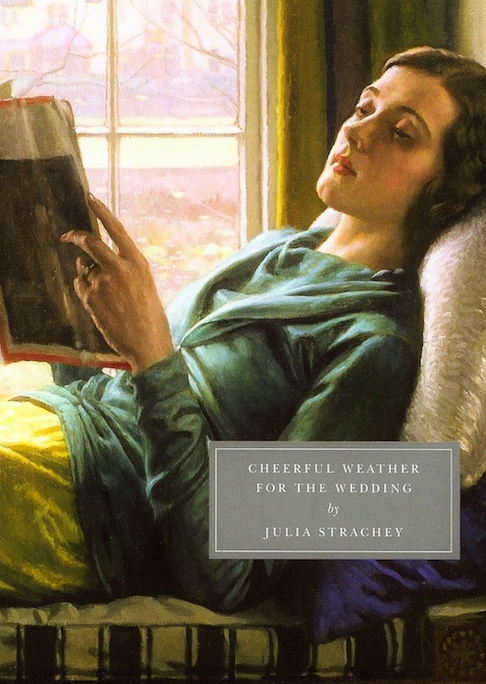
cheerful weather for the wedding  julia stracheyCheerful Weather for the Wedding by Julia Strachey ~ 1932. This edition: Persephone, 2011. Preface by Frances Partridge. Softcover. ISBN: 978-1-906462-07-9. 119 pages.

My rating: 7.5/10

*****

This slender novella read much better the second time around. The initial attempt rather threw me – I wasn’t quite sure what I was dealing with – it was decidedly unexpected. Much more noir than I had anticipated from the other reviews I’d read, and from the Persephone description.

Having sorted things out, I was able to read with more attention to detail the second time around, and to pin down my impressions much more firmly. Though, the more I think about it, the more complicated my responses seem to be!

Dolly Thatcham is getting married in a few hours, and upon meeting her in the opening pages of the book we take a deep breath and hold it for the duration. This book is strung out with tension. Something is going to happen. Something more than a mere marriage ceremony, the veiled implication teases us.

Her mother, whom Dolly appears to tolerate with thinly disguised disgust, is fluttering about micro-managing the action, and confusing the servants by constantly contradicting her impulsive orders. Dolly’s younger sister, Kitty, a brash but deeply insecure seventeen-year-old, barges about and loudly plays the knowing naïf. Dolly’s close friend Evelyn tensely hovers at the edges of the action. The bridegroom is about somewhere, but does not seem to be a prominent player in this drama; it is a very feminine world we are glimpsing: the bride, her sister and mother, her best friend, the inside servants.

Several hours before she is due at the altar, Dolly seems immobilized with a kind of fixated lethargy. On her way through the drawing-room to breakfast, she sits down at the writing-table, and we see the room and Dolly’s face reflected in the clouded surface of an antique mirror.

It was as if the drawing-room reappeared in the mirror as a familiar room in a dream reappears, ghostly, significant, and wiped free of all signs of humdrum and trivial existence,. Two crossed books lying flat, the round top of a table, a carved lizard’s head on a clock, the sofa-top and its arms, shone in the grey light from the sky outside; everything else was in shadow. The transparent ferns that stood massed in the window showed up very brightly and looked fearful. They seemed to have come alive, so to speak. They looked to have just that moment reared up their long backs, arched their jagged and serrated bodies menacingly, twisted and knotted themselves tightly about each other and darted out long forked and ribboning tongues from one to the other; and all as if under some terrible compulsion … they brought to mind travellers’ descriptions of the jungles in the Congo, – of the silent struggles and strangulations that vegetable life there consists in it seems.

To complete the picture, Dolly’s white face, with its thick and heavily curled back lips, above her black speckled wool frock, glimmered palely in front of the ferns, like a phosphorescent orchid blooming alone there in the twilit swamp.

For five or six minutes, the pale and luminous orchid remained stationary, in the centre of the mirror’s dark surface. The strange thing was the way the eyes kept ceaselessly roaming, shifting, ranging, round and round the room. Round and round again … this looked queer – the face so passive and remote seeming, and the eyes so restless.

The light perhaps caught the mirrored eyes at a peculiar angle, and this might have caused them to glitter so uncomfortably, it seemed even so wildly – irresponsibly, – like the glittering eyes of a sick woman who is exhausted, yet feverish.

Is this the portrait of a joyful bride? Obviously not, and as the narrative continues we discover nothing to change this initial impression of the bride as having some serious emotional turmoil going on under her numbly complacent cooperation with those preparing her for her imminent ceremonial change of matrimonial status.

For we soon become aware that this bride has a back story, and that story has another main character, and he is actually in the house, waiting for a chance to speak to Dolly, who in her turn seems most reluctant to encounter him.

Joseph Patten is an anthropology student who is obviously on familiar terms with the Thatcham menage. Apparently he has been a bosom friend of Dolly’s; they spent the previous summer inseparably together, though they have since parted ways. Yet here is Joseph, lurking about, waylaying people as to the whereabouts of Dolly, obviously hoping to speak to her before the ceremony, after which she will be immediately departing with her new husband to embark for South America where the bridegroom has a diplomatic posting.

Dolly is avoiding Joseph, and he whiles away the hours by popping out of rooms and dropping inflammatory comments into the midst of conversations, before retreating into sullen silence which builds until the next outburst.

Dolly makes it into her dress and eventually out the door with the aid of a bottle of rum, which, in a memorable vignette, we see clutched in her hand and swathed in the lace of her antique lace veil as she droops down the stairs in the final moments of her spinsterhood. She and Joseph do connect, but as neither of them can articulate their Great Big Expectations of each other – if indeed they actually have fully formed expectations – the wedding day proceeds as originally planned.

Once the bride and groom are seen off, the dregs of the guests and the family mingle in anticlimactic winding-down mode. Joseph is still hanging about, and he lets go with a shocking but highly suspect account of what Dolly has been up to the summer before while in Albania. Mrs. Thatcham, the target of this bizarre allegation, dismisses it with a fine cold shoulder, and we are left reeling a bit at the swirling undercurrents of this brief and highly disturbing glimpse into this collection of fictional lives.

Julia Strachey has put together a quirky, memorably stylized, very visual bit of fiction with this short novella. The exceedingly unlikable Mrs. Thatcham was based on Strachey’s first mother-in-law, whom she apparently despised; it is a damning character portrait, if that is indeed the case.

I did find myself surprisingly in sympathy with both Dolly and the almost-invisible Owen at the end of the tale; I suspect and hope, from a few tiny clues dropped here and there, that they will create a marriage with some hope of success, once they have escaped the physical bonds of their old lives in England and can recreate themselves in a new world.

Joseph – well – I found myself rather on his side as well. In his “affair” with Dolly, and his failure to further develop their relationship, he’s perhaps had a fortunate escape. The Thatchams in general so obviously scorn him, and Dolly herself is so reluctant to acknowledge any sort of affection or lasting committment to their prior dalliance, that we must accept the obvious. That is, that a Dolly-Joseph alliance was never a real option.

Or possibly not.

Cheerful Weather for the Wedding is a rather gloriously intriguing little bit of literature in that the speculations it spawns are endless. I’m going to quit right here with it, at least for now, but it’s been great fun kicking ideas around regarding what the author intended, and how we’re supposed to read her characters and the seething back story.

Thank you for initiating this discussion, Simon!

And to everyone else who has been much prompter in posting their reviews, your thoughts were most fascinating and beautifully presented. I am in awe of the clever people who post on these topics; you find the most intriguing angles and nooks and crannies to illuminate; thank you all so much for sharing your thoughts!

Here’s the link to the post which kickstarted my discovery of this arcane author:

Stuck-in-a-Book – Cheerful Weather for the Wedding Readalong

Read Full Post »

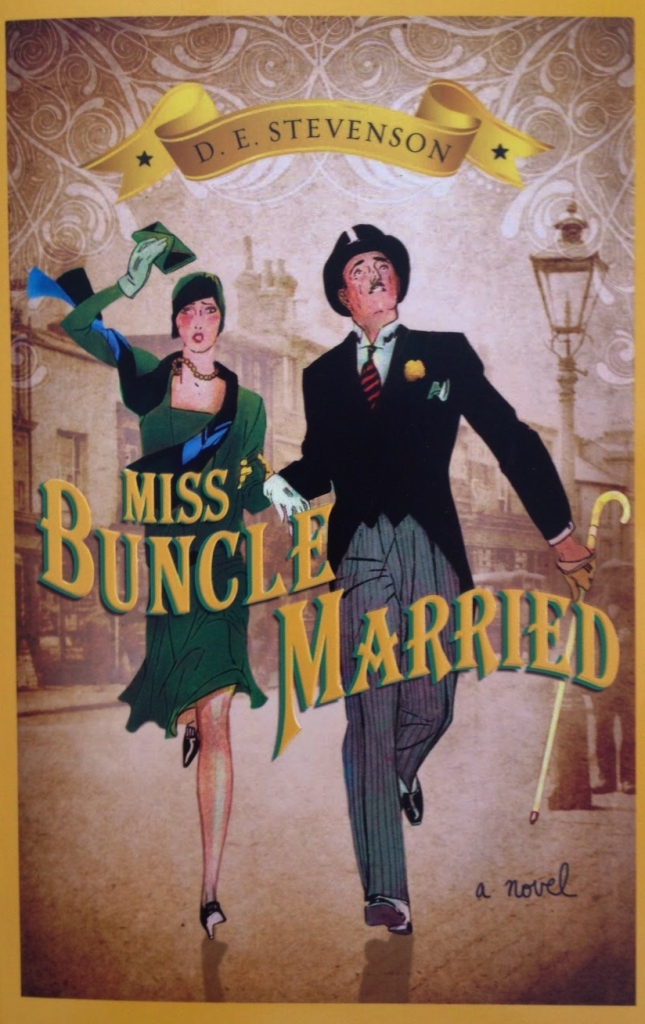
miss buncle married d e stevensonMiss Buncle Married by D.E. Stevenson ~ 1936. This edition: Sourcebooks, 2012. Softcover. ISBN: 978-1-4022-7253-3. 330 pages.

My rating: 6/10.

Readable enough, with a few reasonably memorable moments, but not quite up to the original Miss Buncle’s Book to which this is the sequel. Definitely recommended to those who enjoyed the first Miss Buncle book, and anyone who’s a D.E. Stevenson aficionado, but perhaps not the best place to start with this author. As I explore her works – she’s a very new author to me – I am struck by the wide variance in quality of her plots and prose.

*****

And now for something completely different!

The literary hoopla of Canada Reads 2013 is just over, and my tolerance for angsty Canadiana has been tested fairly stringently. Ending up rather unexpectedly “on the road” for several days this week, I grabbed, on my way out the door, something much more in the way of “light” reading than the sincere Canada Reads candidates: Miss Buncle Married, by D.E. Stevenson.

I had ordered this one, along with Miss Buncle’s Book, and Mrs. Tim of the Regiment, from Book Closeouts just after Christmas, with some of my Christmas “buy yourself a nice book” money. I’d opened the box, briefly admired the crisp new softcovers – that lovely “new book smell”, and the physical pleasure of handling crisp, clean and unworn pages – a very different pleasure from that of handling older books with their unknown histories and traces of prior readers – signatures on the flyleaf, dog-eared pages, marginal notes, the odd old letter, business card, receipt etc. used as a bookmark – now wouldn’t that make a grand post? – the things found in secondhand books!

Oi! I’ve gone completely off track. What was I posting about? Ah, yes. Miss Buncle Married. So, what I started out to say was that D.E. Stevenson was again at the forefront of my awareness, after my recent windfall of a lovely stack of her vintage paperbacks, and after sharing that news of my good luck with my husband, and pressing Mrs. Tim upon him as a “try this author, she’s rather amusing” recommendation, Miss Buncle seemed a logical choice for a light diversion for hotel room reading.

I haven’t yet had a chance to read the first Mrs. Tim myself, though I did read and enjoy one of the follow-up books to that one some time ago, Golden Days: Further Leaves from Mrs. Tim’s Journal, so I’m interested to see what my husband’s reaction will be. I suspect he’ll return a tactful “it was all right”, which, I regret to report, is all that I’m I’m able to give to my own D.E. Stevenson of the moment.

Miss Buncle Married was merely “all right”. It certainly wasn’t an improvement on the original. And though my expectations weren’t terribly inflated, as Miss Buncle’s Book was a pleasant diversionary read and not much more, I was disappointed at how slight this next one turned out to be, despite its hefty 330 pages of physical presence.

Middle-aged (“nearing forty”) though perpetually young-at-heart (in other words, slightly gauche and secretly insecure) Miss Barbara Buncle, after her unexpected success as an author, has married her publisher, Mr. Arthur Abbott. Though the two are deeply in love, and the married state is most satisfactory to both of them, there are thorns becoming most evident in the rose garden of their new life together. An active round of teas, dinners and bridge parties has become the norm, and peaceful evenings by their own fire are few and far between. Neither Barbara nor Arthur want to say anything, each believing the other to be well suited with the social whirl, and, when the penny drops, the two decide that the only thing to do is to move house, to a fresh location, where they can establish themselves anew in a more congenial lifestyle.

After much to-ing and fro-ing, Barbara finds a lovely though exceedingly rundown house in the village of Wandlebury, and she occupies herself for months with the restoration of Archway House and the creation of the ideal habitat for herself and her beloved Arthur. In the meantime, she becomes deeply enmeshed in local happenings. She inadvertently becomes privy to the will of the village’s most wealthy woman, makes friends with the outspoken artist next door and his precocious children, and meets a kindred spirit in the person of young Jeronina Cobbe, the potential recipient, all unbeknownst to her and everyone else except for Barbara and the local lawyers, of the riches to be distributed in the aforementioned will.

There are, of course, numerous twists and turns to the narrative before everyone ends up in a state of bliss, with all dilemmas nicely straightened out, and much optimism for the future.

I felt that Miss Buncle Married started out quite strongly, with much promise, and sadly faded as it went along. It settled into a predictable and very clichéd romance involving Jeronina – Jerry – and Arthur Abbott’s nephew Sam, with every development of their courtship and romantic setbacks telegraphed loud and clear.

Not a bad book, but definitely not as wonderful as it might have been. D.E. Stevenson has her moments of brilliance, but in this case those ran out early on.

I am wondering what the third book in the Miss Buncle saga, The Two Mrs. Abbotts, will be like. Though not eagerly awaiting it, I do look forward to acquiring it at some point once it becomes available, as I hear that it is due to be re-released in softcover by Sourcebooks in 2014.

And here, from Shelf Love, is a much more thoughtful review than my rather scatterbrained assessment  – I plead lack of sleep during this very hectic week – of Miss Buncle Married:

Shelf Love: Miss Buncle Married

Read Full Post »

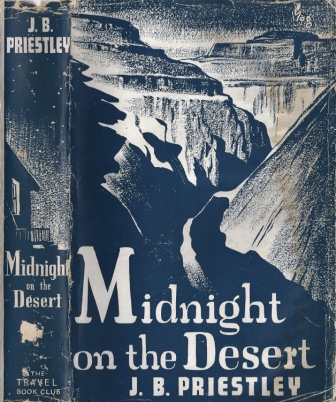
Midnight on the Desert: chapters of autobiography by J.B. Priestley ~ 1937. This edition: Readers’ Union & William Heinemann Ltd., 1940. Hardcover. 312 pages.

My rating: 9.5/10. Extremely hard to classify this book, but I found it completely engaging. The time theories near the end were completely over my head, but I appreciated Priestley’s enthusiasm nonetheless.

*****

I had expected a travel book of sorts, and Midnight on the Desert could certainly fall under that classification, but it is also so very much more. An examination of what it means to be a writer and an artist; a critique of the state of the world in politics, religion, philosophy, architecture and the performing arts; an ode to nature; a manifesto for seeking the good in the world and overcoming adversity and “doing one’s part”; a record of observation by a keen and analytical observer.

I have been spinning out my reading of this marvelously unexpected gem, and have been racking my brains over how best to convey what this unique work is all about and why I found it so compelling. Words do not come easily to me, which is why I’m a reader and not a writer, aside from these attempts at distilling the essence of what I find on the printed page. Perhaps I will let Priestley speak for himself.

First, the “set-up”.

Let me begin with what I can remember quite clearly. It was the end of my stay on the ranch in Arizona, last winter…There was the usual accumulated litter of letters and odd papers to be gone through, and most of it to be destroyed. But that was not all. I had decided during the evening to burn certain chapters, many thousands of words, of the book I had been writing…Yes, thousands and thousands of words would have to go, along with the rubbish; good words, all arranged to make sound sense, and with a cash value in the market, and representing, too, something more than money – time, precious and priceless time, of which, they say, only so much is allotted to each of us. I dare not wait for morning. Midnight was the hour for such a deed.

The first chapter starts with an appreciation and evocation of a place dear to the author’s heart, a small writer’s hut at the edge of the desert on a guest ranch in the Mojave Desert, where Priestley had spent the better part of the winter. He describes the beauty and majesty of the still, clear desert night, and then branches of in a dozen different directions in a sort of free association of ideas – random – oh, yes! – but most clear and sensible – he never loses us in his side trips though we fetch up back at the beginning a mite breathless and dazed at the speed and scope of our journey.

The papers are not yet set alight, though the fire is lit and is roaring in the wood stove, but we are far away now from the desert, back in England, getting ready to set sail for America, at the beginning of this particular trip. The Atlantic is crossed, New York attained, and Priestley is off.

I told myself severely that for once I must take New York quietly, as just another city. I had some work to do – to produce my play – but I must do that work as calmly as if I were at home in London. (I overlooked the fact that it is quite impossible for me to produce a play calmly anywhere; for that mad old witch, the Theatre, tolerates no calmness…)

… All other cities … seem in retrospect like mere huddles of mud huts. Here .. be Babylon and Nineveh in steel and concrete, the island of shining towers, all the urban poetry of our time … I would hurry down these canyons and gulfs they call avenues, cry out as one magnificent vista of towers crowns another, hold my breath at nightfall to see the glittering palaces in the sky, and wonder how I can ever again endure the gloomy and stunted London …

… There is a deep inner excitement, like that of a famished lover waiting for his mistress, that I cannot account for – not when it outlasts the mere novelty of arrival, and goes on week after week … I would begin to feel empty inside. It would be impossible for me to sit still and be quiet. I must go somewhere, eat and drink with a crowd, see a show, make a noise. Time must not merely be killed, but savagely murdered in public. In this mood, which has never missed me yet in New York, I feel a strange apprehension, unknown to me in any other place. The city assumes a queer menacing aspect … I begin to fancy that perhaps it is waiting for some other kind of people – chromium-plated giants without dreams or tenderness – to come along and claim it …

.. I feel like a midget character moving in an early scene of some immense tragedy, as if I had had a glimpse in some dream, years ago, of the final desolation of this city, of sea-birds mewing and nesting in these ruined avenues. Familiar figures of the streets begin to move in some dance of death. That baker outside the Broadway burlesque show, whose voice has almost rusted away from inviting you day and night to step inside and see the girls, now seems a sad demon croaking in Hell. The traffic’s din sounds like the drums in the March to the Gallows of a Symphonie Fantastique infinitely greater, wilder, more despairing than Berlioz’. Yes, this is all very fanciful, of course, the literary mind playing with images; yet the mood behind it, that feeling of spiritual desolation, that deepening despair, are real enough…

That was the distillation of, let’s see, four pages or so, and the man can keep it up indefinitely. He turns the same sort of passionate stream-of-consciousness writing to everything he observes and experiences. Further along in the book we are treated to similar digressions on The Theatre and the experience of working as a novelist-dramatist taking the written word to the stage, and about the challenges of being an author in general, and the quest to both satisfy the inner urge to record and create, and to fulfill the ever-difficult goal of please one’s readers.

Give us, please, you cry, the real world, not some triviality taking place in a pretty-pretty imaginary world, no mere escape stuff. Certainly, madam; certainly, sir. Now what is happening in this real world? The Communists and Fascists are demonstrating and counter-demonstrating, preparing for a fight; the economic system of our fathers is breaking down; Europe is bristling with armaments and gigantic intolerances, Asia is stirring out of her ancient dream, America is bewildered and bitter; one kind of civilization is rapidly vanishing and God-knows-what is taking its place; some men are marching in column of fours, shouting slogans, and making ready to kill and be killed; some men – many of them in exile because their minds are honest and not without distinction – are arguing in a melancholy circle; other men are lining up in hope of finding a little bread, a little work, a little peace of mind.

And Priestley goes on:

But no, no, no, this will not do, you tell us: you want a novel, a fiction to take you out of yourselves, not a newspaper, a fat pamphlet, a slab of propaganda. After all, private life goes on; men still fall in love, women fall out of it; there are entertaining quarrels between the Smiths and the Robinsons; young men are suddenly promoted and girls are given fur coats and diamond bracelets; and there is still plenty of comic stuff about – oh, uproariously comic stuff. This being so, get on with your novel, and don’t give yourself airs, don’t come over the propagandist, the gloomy prophet, over us.

… You may be sure that whatever he [the author] decides, he will be blamed. He may succeed in displeasing everybody. Lucky enough in other respects, I have been unlucky in this. Some years ago, because I had long cherished the plan and was now in the mood to work it out, I wrote a long, comic, picaresque, a fairy-tale sort of novel, called The Good Companions. I am neither prouder nor more ashamed of having written it than I am of having written any of the other books and plays under my name. But it happened to achieve an astonishing popularity. Since then – and this s an exact statement – I do not think I have met or corresponded with five-and-twenty persons who have not blamed me, either for having written this particular novel, or for not having written a lot of other novels just like it. One party denounces me as a hearty, insensitive lowbrow. The other party asks what the devil I mean by turning myself into a gloomy highbrow … I am condemned – and for a long term, it seems – to offend all round … No wonder, then, my new novel needed some thinking out. I was not bored on those trains …

Travelling by train, observing every fellow human being he comes across, from baggage car attendant to well-preserved and painted elderly matron sharing the dining room, Priestley goes off on more tangents, such as the difficulties of being an American woman, never being allowed to drop your eyes from your goal of “keeping up” for a moment; then looking out the window, asit were, to the American landscape itself and the need for painters, writers and poets to develop to capture its unique quality – the processes of developing a regional form of the arts, true to the physical space which inspires the artists.

Odes to the great physical beauty of the American West are in this book – the deserts and mountains, the Grand Canyon, the stark glories of rock and sand and rivers carving out their otherworldly sculptures. Priestley is in love with this aspect of America, and he sings his praises most eloquently well.

What a fascinating book; what a full book. One to read right through without stopping; one to tackle in small bits, to digest and mull over and agree with and occasionally refute. Not all that much autobiography, despite the tag on the title, but many insights into what went on in the mind of this deeply creative and opinionated man.

An excellent read; a grand glimpse into the mind of a master writer.

Read Full Post »

man & nature efb 2012

Thinking of T.S. Eliot tonight, because of the way his poetry has been showing up in my reading lately. I’ve just finished reading Hugh Walpole’s The Joyful Delaneys, and was intrigued by the snippet of Eliot verse on the frontispiece, so I searched it out. It’s from a play, The Rock, written and performed in 1934. I’ve gone through the verses and highlighted those which I found the most compelling; the entire work is 21 pages long, so it is a bit lengthy to include in its entirety here.

The Rock was performed as a pageant to raise money for the building of new churches in London. It speaks to mankind’s relation to God, about the implications of a world lived without religion, and, more to the point, what it means to build a church. The famous “Choruses” are spoken by bands of workmen. The Rock is strongly pro-religion with anti-fascist/anti-communist overtones, in reaction to the looming shadow of the totalitarian regimes building in Europe, and the rumblings of the coming Second World War.

The entire text can be found here: T.S. Eliot – The Rock

Even taken out of context with the whole work, many of these verses are memorable.

*****

The Eagle soars in the summit of Heaven,

The Hunter with his dogs pursues his circuit.

О perpetual revolution of configured stars,

О perpetual recurrence of determined seasons,

О world of spring and autumn, birth and dying!

***

Where is the Life we have lost in living?

Where is the wisdom we have lost in knowledge?

Where is the knowledge we have lost in information?

***

I journeyed to London, to the timekept City,

Where the River flows, with foreign flotations.

There I was told: we have too many churches,

And too few chop-houses. There I was told:

Let the vicars retire. Men do not need the Church

In the place where they work, but where they spend their

Sundays.

In the City, we need no bells:

Let them waken the suburbs.

I journeyed to the suburbs, and there I was told:

We toil for six days, on the seventh we must motor

To Hindhead, or Maidenhead.

If the weather is foul we stay at home and read the papers.

In industrial districts, there I was told

Of economic laws.

In the pleasant countryside, there it seemed

That the country now is only fit for picnics.

And the Church does not seem to be wanted

In country or in suburbs; and in the town

Only for important weddings.

***

The world turns and the world changes,

But one thing does not change.

In all of my years, one thing does not change.

However you disguise it, this thing does not change:

The perpetual struggle of Good and Evil.

***

The desert is not remote in southern tropics,

The desert is not only around the corner,

The desert is squeezed in the tube-train next to you.

The desert is in the heart of your brother.

***

The voices of the Unemployed:

No man has hired us

With pocketed hands

And lowered faces

We stand about in open places

And shiver in unlit rooms.

Only the wind moves

Over empty fields, untilled

Where the plough rests, at an angle

To the furrow. In this land

There shall be one cigarette to two men,

To two women one half pint of bitter

Ale. In this land

No man has hired us.

Our life is unwelcome, our death

Unmentioned in “The Times.”

***

What life have you if you have not life together?

There is no life that is not in community,

And no community not lived in praise of God.

***

And now you live dispersed on ribbon roads.

And no man knows or cares who is his neighbour

Unless his neighbour makes too much disturbance,

But all dash to and fro in motor cars,

Familiar with the roads and settled nowhere.

Nor does the family even move about together.

But every son would have his motor cycle,

And daughters ride away on casual pillions.

***

In the land of lobelias and tennis flannels

The rabbit shall burrow and the thorn revisit,

The nettle shall flourish on the gravel court,

And the wind shall say: “Here were decent godless people:

Their only monument the asphalt road

And a thousand lost golf balls.”

***

When the Stranger says: “What is the meaning of this city?

Do you huddle close together because you love each other?”

What will you answer? “We all dwell together

To make money from each other”? or “This is a community”?

And the Stranger will depart and return to the desert.

О my soul, be prepared for the coming of the Stranger,

Be prepared for him who knows how to ask questions.

О weariness of men who turn from God

To the grandeur of your mind and the glory of your action,

To arts and inventions and daring enterprises.

To schemes of human greatness thoroughly discredited.

Binding the earth and the water to your service,

Exploiting the seas and developing the mountains,

Dividing the stars into common and preferred.

Engaged in devising the perfect refrigerator,

Engaged in working out a rational morality,

Engaged in printing as many books as possible,

Plotting of happiness and flinging empty bottles,

Turning from your vacancy to fevered enthusiasm

For nation or race or what you call humanity;

Though you forget the way to the Temple,

There is one who remembers the way to your door:

Life you may evade, but Death you shall not.

You shall not deny the Stranger.

***

But it seems that something has happened that has never happened before:

though we know not just when, or why, or

how, or where.

Men have left God not for other gods, they say, but for no god;

and this has never happened before

That men both deny gods and worship gods, professing first

Reason,

And then Money, and Power, and what they call Life, or Race,

or Dialectic.

The Church disowned, the tower overthrown, the bells up-

turned, what have we to do

But stand with empty hands and palms turned upwards

In an age which advances progressively backwards?

***

T.S. Eliot ~ 1934

Read Full Post »

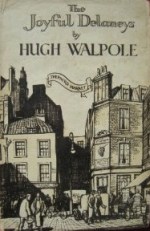
Tthe joyful delaneys hugh walpolehe Joyful Delaneys by Hugh Walpole ~ 1938. This edition: Doubleday, Doran & Co., 1940. Hardcover. 401 pages.

My rating: 9.5/10.

Lost the half point because of the too-convenient wrap up of the ending. A very minor complaint!

What an enthralling read this was. Much better than expected.

*****

2013 is going to be  good reading year, if this omen is correct. The very first 2013 book, an ancient copy of one of Hugh Walpole’s London novels, The Joyful Delaneys, has been lurking on the edges of my awareness for at least ten years, possibly more. It was purchased at a library book sale, and its tattered condition, many interior stamps – Tulameen and Princeton had enthusiastic librarians! – and dog-eared and marked pages testify to its one-time popularity. This copy at least has been very well read.

Just not by me, until the last few days. The Joyful Delaneys was one of the lonely oddities left behind after my recent tidying of the bedroom bookshelves –  books which are sometimes the sole representatives of their author’s literary line in my collection, books I’m not quite sure about – stay or go? – will I really read this one again? – and books I haven’t read yet, but truly mean to, someday…

On January 1st, 2013, I finally picked up The Joyful Delaneys with the stern instruction to myself to just read this already and decide once and for all if it’s a keeper or a pass-along. Settling down with a mood of grim purpose to that self-imposed task, I was immediately surprised by the very first lines:

‘Happy New Year!’ Fred Delaney said, standing in the doorway and smiling at the in-no-way beautiful person of Mr. Munden.

He had switched on the electric light, and the illumination revealed Patrick Munden lying half in, half out of the bedclothes. No, he was not beautiful, his thin pointed face unshaven, his black hair spread about the pillow, his lean body protected from the cold by pyjamas, grey with blood-red stripes, by no means so fresh as they should be. The light pressed on Munden’s eyes and he opened them, stared wildly about him, then, cursing, buried his face in the pillow.

‘Happy New Year!’ Delaney said again.

‘What the hell–‘

Promising, no? And the serendipitous timing! A book opening with New Years Day, being read by me on New Years Day! A complete and utter unplanned coincidence. Surrendering to the moment, I settled down to my suddenly-not-so-tedious-seeming read. And was rewarded by its general excellence, much more so than I deserved for my previous neglect. Why, oh why, hadn’t I read this one earlier?!

Here’s a bit more, continuing the snippet from the first page.

‘Eight-thirty. You asked me as a special favour to call you.’

Munden raised his head and stared at Delaney. It was not a bad-looking face. The blue eyes were good, the forehead broad and clear, the chin finely pointed. He looked clever and peevish and hungry. He stretched himself, his open pyjama jacket showing a chest skeletonic and hairy. He rubbed his eyes with a hairy wrist.

‘Oh, it’s you, is it? Let me sleep, can’t you?’

Delaney watched him with genial good temper.

‘I’m doing you a favour. You said last night it would be the greatest of your life. You have to see the editor of something or other at ten sharp.’

‘He can go to hell. Turn the light off and let me sleep.’

‘You said I was to drag you out of bed if necessary–that your whole life depended on your getting there at ten.’

‘Well, it doesn’t. Let me sleep, can’t you?’

‘All right. But I’ll leave the light on . . .’

‘No, don’t go.’ Munden sat up, blinking. ‘How damnably fresh you look! It’s revolting. You were up till three, I don’t doubt–‘

‘I was,’ Delaney said cheerfully. ‘I don’t need a lot of sleep.’

‘Well, I do. . . . Oh, blast! Why did I ever tell you anything about it?’

‘You were very serious. Most earnest. You said you must begin the New Year properly.’

‘Speaking of which, can you lend me a fiver?’ Munden asked. ‘Only for a week.’

‘Afraid I haven’t got such a thing,’ Delaney said, laughing.

‘Hang it all, I paid you the rent only a week ago–‘

‘Thanks very much. But those are the terms, you know. If you don’t pay you go. Although we’d hate to lose you.’

Munden sighed.

‘Look in the trousers, old man, will you? They’re hanging over the chair. See if there’s anything there.’

Delaney looked in the trousers and found half a crown, some coppers, a lipstick and a half-filled packet of cigarettes. He laid these things on the dressing-table.

‘You don’t use lipstick, I hope, Patrick?’

‘No, of course not. What do you think I am? How much is there?’

‘Two and ninepence halfpenny.’

‘I’ll make them advance something on the two articles. You wouldn’t like to buy a Chrysler, would you?’

‘A Chrysler? Whatever for?’

‘It’s a marvellous bargain. Ponsonby’s only had it a year and simply not used it at all. He’d let you have it for one-fifty and I’d get a commission.’

Delaney laughed. ‘We go round in our Morris–just as we always have–same old family, same old Morris.’

Munden looked at him with curiosity. ‘I don’t understand you, Fred. You own this house; every bit of it is let to people who pay their rent. You’re none of you what I’d call extravagant and yet you never have any cash.’ He stared resentfully. He went on: ‘You’re a horrid sight–so cheerful and clean and bright. You’re all like that. I ought to hate the lot of you. So unintellectual too. You never read a book, have horrible bourgeois politics, believe in things, in England, beautiful virginal girls, Dickens, cricket, football. . . . Oh, God! You’re vile! I don’t know why I go on living here.’

*****

It seems like I’ve recently been reading authors who have been quite taken with T.S. Eliot – most recently Rumer Godden (in Take Three Tenses: A Fugue in Time) and Diana Wynne Jones (in Fire and Hemlock); here is a third. Hugh Walpole begins this beguiling novel with this quotation from Eliot’s The Rock:

When the Stranger says: ‘What is the meaning of this city ?
Do you huddle close together because you love each other?’
What will you answer? ‘We all dwell together
To make money from each other’? or ‘This is a community’?
And the Stranger will depart and return to the desert.
O my soul, be prepared for the coming of the Stranger,
Be prepared for him who knows how to ask questions.

The answer, ultimately, is that the community wins over commerce, at least in this one instance, at least for a while. But there is a lot of ground to cover before this satisfactory state of affairs comes to pass.

The Delaneys – Frederick and Meg, and grown children Stephen and Kitty – are the financially struggling owners of one of the last houses in their corner of London’s Mayfair – Shepherd Market – which has not been pulled down and built over or converted into modern flats. The house has been in the family two hundred and fifty years; this year, 1934, looks very much like it will see the Delaneys rousted from residence at last.

A precarious existence is made possible by the renting of rooms to a number of similarly situated people – the random waifs and strays, the elderly and the dispossessed of the former upper classes who are now very much down on their luck. A pair of the Delaney tenants, Dodie and ‘Smoke’ Pullet, have exhausted every financial avenue, and are preparing to give notice. Smoke mulls over his bleak future possibilities with Fred, including that of the ultimate escape – suicide.

‘You’ve no idea, old boy, of the kind of life that Dodie and I’ve been leading in the last year. We’ve cadged deliberately on everybody we know. We’ve angled for meals, been everywhere and anywhere with the chance of getting something for nothing. We’ve spent days and nights with the most awful people to be safe for food and drink. It can’t go on for ever…

…Unless something happened Smoke would do just as he said. And perhaps it would be the best thing for him. That was the real problem at the heart of the trouble. There was no place in this present world for the Smoke Pullets unless there was a World War again–then they would be admirable.

Before 1914 they had played a very necessary part; they were a real need in English life and had been so for centuries. They had been the Squire and the Squire’s son; some property, possibly a seat in Parliament, beneficent, tyrannical, understanding in their country community, conforming, traditional, safe and sound. So it had been since the Wars of the Roses; from Agincourt 1415, say, until Serajevo 1914. And now, within the space of twenty years, they had become only a burden, and a wearisome burden at that. There was no future of any kind for Smoke and he without a leg which he had lost in the service of his country. Probably a nice gas-oven would be the best thing.

But Fred Delaney can’t stay grim for long. Along with the pervasive background atmosphere of despair there are plenty of opportunities for love and laughter. He and Meg have long enjoyed what might be termed an “open” marriage, though Meg has not taken advantage of her freedom as her spouse most definitely has. The two deeply and truly love each other, but Fred has indulged his physical desires for other women regularly through the years. Meg knows this, and has made her peace with it, and now at long last is in her turn preparing to indulge in a little fling with an old flame from her youth who has re-entered her life, and who has confessed a lifelong infatuation with Meg, despite his own married state.

Fred is currently pursuing a beautiful though frigid socialite; Kitty makes the acquaintance of a young man clerking in an antique shop; Stephen falls in love with the sixteen-year-old daughter of a dissipated gambler. 1934 promises to be an emotionally charged year in the tight-knit Delaney family enclave, even before their house woes escalate, which they soon do.

Hugh Walpole skilfully weaves together these story strands and half a dozen others into this increasingly absorbing saga. His characters step off the page in living, breathing colour; his descriptions are better than photographs, including as they do sounds and smells and tastes and emotions as well as vivid visual descriptions; he skilfully plays on our feelings by including us as benign fellow voyeurs sharing a god’s-eye view of his fantastical world.

Why has Walpole fallen out of favour? (Or has he? I don’t hear his name much, or see his works in the second-hand book shops.)

I’ve only read a few other things by him, a book I’ve owned for some time, which I’ve just re-read, and which I’m intending to review in the next day or two, Hans Frost, plus a book of short stories which I can’t recall seeing around recently (must be packed away) called A Head in Green Bronze. Hugh Walpole wrote so many more!

The Joyful Delaneys was very, very good. Amusing, thought-provoking, wonderfully evocative of the time and place. I was completely absorbed in the story, much to my surprise. I quite literally growled at any interruption of my rare reading times these past two days, and even sent the teens off to town in my precious car last night, with movie, snack and gas money liberally provided, so I could have a few hours of peace and quiet to finish the book off, even though I had to put aside some “real” work to do so.

Anybody who will name a fictional dachshund “Endless” has my full approval. Hugh Walpole definitely goes onto the 2013 look-for list.

One last note: the dustjacket image above is not from my own copy. Mine is a faded, stained and threadbare, green cloth-bound volume. I couldn’t bring myself to scan it – it’s too terribly tired.

Read Full Post »
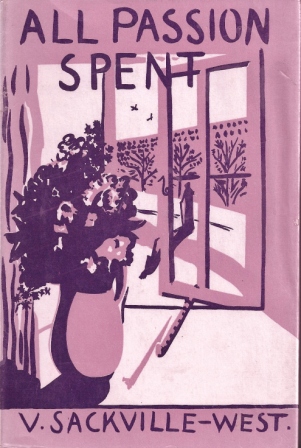
All Passion Spent by Vita Sackville-West ~ 1931. This edition: Hogarth Press, 1965. Hardcover. 297 pages.

My rating: 8.5/10. Excellent. This book nudges me to remember that I should read more of Vita’s literary work. Her garden writing is already personally much prized, and frequently referred to in my “working” plant nursery library.

*****

An unusual piece of literary fiction about an elderly woman’s examination of her life, and her subsequent emancipation from the expectations of others. The emotional freedom thus obtained only lasts for a very short time, but the satisfaction it engenders both in the protagonist and the reader is quite glorious.

Often classified as an example of feminist literature – the Virginia Woolf parallels and comparisons are de rigueur – this novel transcends that earnest label and is also a very fine piece of story-telling, full of keen observation and humour. Vita Sackville-West was undeniably cynical, but stopped shy of coming across as bitter, at least not in this small gem of a tale.

*****

Henry Lyulph Holland, first Earl of Slane, had existed for so long that the public had begun to regard him as immortal. The public, as a whole, finds reassurance in longevity, and, after the necessary interlude of reaction, is disposed to recognize extreme old age as a sign of excellence. The long-liver has triumphed over at least one of man’s initial handicaps: the brevity of life. To filch twenty years from eternal annihilation is to impose one’s superiority on an allotted programme. So small is the scale upon which we arrange our values. It was thus with a start of real incredulity that City men, opening their papers in the train on a warm May morning, read that Lord Slane, at the age of ninety-four, has passed away suddenly after dinner on the previous evening. “Heart failure,” they said sagaciously, though they were actually quoting from the papers; and then added with a sigh, “Well, another old landmark gone.” That was the dominant feeling: another old landmark gone, another reminder of insecurity. All the events and progressions of Henry Holland’s life were gathered up and recorded in a final burst of publicity by the papers; they were gathered together in a handful as hard as a cricket ball, and flung in the faces of the public, from the days of his “brilliant university career,” through the days when Mr. Holland, at an astonishingly early age, had occupied a seat in the Cabinet, to this very last day when as Earl of Slane, K.G., G.C.B., G.C.S.I., G.C.I.E., etc. etc. – his diminishing honours trailing away behind him like the tail of a comet – he had drooped in his chair after dinner, and the accumulation of ninety years had receded abruptly into history. Time seemed to have made a little jump forward, now that the figure of old Slane was no longer there with outstretched arms to dam it back …

In Lord Slane’s imposing London house, his elderly widow – of no slight age herself – eighty-eight – contemplates his dead face with “thoughts which would have greatly surprised her children”, while downstairs in the drawing-room the six Slane “children” – rather elderly, with grandchildren of their own – wait for their mother’s inevitable breakdown, and tentatively feel each other out as to how best to arrange for “wonderful Mother’s” immediate future, for of course she will now need to be “stowed away; housed, taken care of.”

When Lady Slane refuses to be “cared for” and instead makes her own arrangements for her future without familial consultation, her offspring are at first shocked, and then, in most cases, highly resentful. Herbert, Carrie, Charles and William are stiff with disapproval; only the awkward family outsider Edith has an inkling that her mother might have more backbone and brain than the others realize; while Kay is most keenly interested in distancing himself from any conflict or fuss; he enjoys his bachelor existence in his flat crowded with his collection of compasses and astrolabes.

Lady Slane distributes her jewelry, her only private asset, with little regard as to fairness; rather she seems faintly amused at the egotistical frailties this gesture reveals among her offspring and their spouses. With only a small pension as income, she rents a small house in Hampstead which she has secretly been desiring to reside in for the past thirty years, to live alone with her elderly French maid, Genoux, who has been with her since her marriage some seventy years ago. She intends to limit her visitors severely:

“I am going to become completely self-indulgent. I am going to wallow in old age. No grandchildren. They are too young. Not one of them has reached forty-five. No great-grandchildren, either; that would be worse. I want no strenuous young people, who are not content with doing a thing, but must needs know why they do it. And I don’t want them bringing their children to see me, for it would only remind me of the terrible effort the poor creatures will have to make before they reach the end of their lives in safety. I prefer to forget about them. I want no one about me except those who are nearer to their death than to their birth.”

But Lady Slane’s life is not destined to be one of solitude, for she soon attracts a small group of friends, of “followers”. Three elderly men find their way into her life and add richness and a strange variety to her waning days. Mr. Bucktrout, owner of her house, Mr. Gosheron, the builder who has renovated it for her, and millionaire art collector Mr. FitzGeorge, who has retained a deep infatuation with Lady Slane from the time many years ago, when she was the wife of the Viceroy of India (one of Lord Slane’s many prominent postings) and FitzGeorge himself merely one of many anonymous young men who enjoyed the hospitality of the Regency, presided over by the young and very beautiful Deborah Slane.

These three men, along with Genoux and an unexpectedly appearing great-granddaughter, Lady Slane’s namesake Deborah, bring both confusion and reconciliation to Lady Slane’s mind and soul as she strives to put the meaning of her long life into a final context.

The novel ends with Lady Slane’s death, but that is in no way a tragedy, merely an inevitable ending which is kinder than it might have been, and happier than Lady Slane had once anticipated it might be.

*****

Vita Sackville-West portrays her characters with occasional affection and continuous insight mixed with irony. All Passion Spent is short in pages, but dense in thought-provoking passages and situations; love or despise the characters as we may, we find many parallels, often unexpected, between this upper-class “lady” with few “real” problems, and our own less exalted lives. Who has not denied personal ambition at some time or another? Made that difficult compromise between desire and duty? Wished to distance themselves from tiresome people, and be allowed, at the end of one’s days, to sit against the garden wall in the sun and muse?!

Of course, most of us have no Genoux to care for our less delectable functions, to wash and dress us, and minister to our ever-more-demeaning physical failings. If there was one sour note in all of this – and there are several, but this is the main one, to my mind – it was the thoughtless assumption by Lady Slane of Genoux’s infinite capacity for servitude; there is a brief moment of realization and appreciation, but after seventy years together, the servant-mistress position is still firmly in place, with selfishness a prominent quality in Lady Slane’s refusal to fully appreciate Genoux’s parallel existence and to consider her needs and her long-denied desires, whatever those may be.

Very evocative description of the Hampstead house and garden, and of the daily rituals of the elderly Lady Slane as she realizes her last ambition.

A book to re-read. Not without flaws, but those are outweighed by the many excellences of the writer’s narrative and descriptive skills.

Read Full Post »

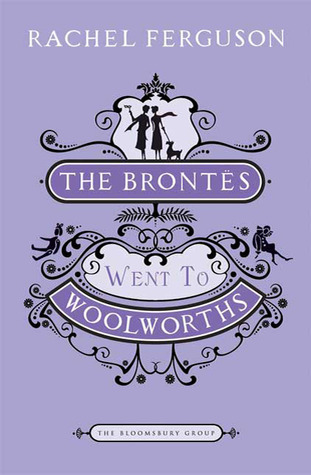
The Brontës Went to Woolworths by Rachel Ferguson ~ 1931. This edition: Bloomsbury, 2010. Softcover. ISBN: 978-1-60819-053-9. 188 pages.

My rating: 7.5/10. Cleverly imagined, if a bit high-strung. I found it rather a sad story, behind the relentlessly bright chatter of the heroines.

*****

How to start with this one? Well, first off, I must confess that I had a truly difficult time finding my stride here. I started reading one night when I was, admittedly, very tired, and made it to Chapter 5, about twenty-five pages in, when I gave up in utter dismay. What was this frenetically paced, brittle, self-complimentary mess all about, anyway? And who in their right mind would recommend it?!

A few days later, in a much less sleep-deprived state of mind, I tried again, starting from the very beginning, a thing I seldom do – most books get one chance and one chance only – but I really wanted to see what this one was all about, because I’d heard it praised so highly be several other bloggers whose tastes I often share: ShannonJenny, and Simon Savidge, to name just a few.

*****

Three fatherless sisters and their recently widowed mother live an upper middle-class life in the London of the time between the two World Wars. The eldest, Deirdre, is an aspiring novelist with a day job as a newspaper writer. Middle sister Katrine is a drama student, and young Sheil (not short for Sheila, by the way, but rather named for the Scottish birthplace of her father) is a schoolgirl under the tutelage of an earnest governess, Miss Agatha Martin.

The three sisters, as well as their gently witty mother, Mrs. Carne, are doing the best they can after the death of their obviously beloved father and husband. They have created a vivid fantasy world which runs parallel to their real world; they make no distinction between the real and the imagined in their conversations with each other, and the reader is thrown into the melee with few only a few clues to go by that this is not all as it seems. I sympathized with the sober governess Miss Martin, who continually tried to make sense of the nonsense, until finally giving up in dismay and fleeing to a more traditional, if bleaker, refuge as a parish worker, two-thirds of the way through the story

Imaginary members of the Carne circle are Dion Saffyn, based on a real-life figure of a pierrot entertainer glimpsed during a summer holiday, and his family, and the imaginary Ironface, a childhood doll, who has morphed into the snobbish wife of a member of the French nobility. Even the family’s raffish terrier, Crellie, leads a double existence as the Pope, with some off-putting doggish habits and tendencies.

But the most elaborate of the characters the Carnes have created is a take-off on the very real Judge Herbert Toddington, “Toddy” as they familiarly style him, ever since Mrs. Carne’s jury duty brought the elderly justice into their focus. When Deidre meets the real Judge Toddington, through his wife Lady Mildred’s attendance at a charity bazaar which Deidre is covering for her newspaper, fantasy becomes something much more solid.

All of the nonsense and make-believe are, it seems to me, a way for the four Carnes to deal with their deep grief at the loss of their fifth member. Deidre makes no secret of her interest in placing Toddy in the role of an auxiliary “man of the family”, as she has felt her own fulfillment of that position extremely difficult.

The fairy tale aspect of the story has its sobering moments, brought into focus by the confused governess Miss Martin, who cannot cope with the continued “weirdness” of her charge, the sisters, and Mrs. Carne, who plays along with the rest of the family in their complex game. Once Miss Martin flees in despair, a replacement, Miss Ainslie, is reduced to confusion in her turn, being soundly snubbed when she seeks to play along.

And that brings me to the only thing I did not like about the Carne family, once I allowed myself to enter their story: their extreme snobbishness. I realize that this was a commonplace trait of people in their position and their time, but it bothered me that they were so scornful in attitude to people like their governesses, not giving them any sort of explanation as to the goings on with the imaginary characters, and relentlessly shutting them out of the game. And when Katrine falls in love with a truly good man of a decidedly lower social class, her elder sister advises her to harden her heart, which Katrine obediently does – “It just wouldn’t do” seems an acceptable reason to deny what seems like true love.

The Brontës come into the story in a rather mysterious way towards the end of the book, and if you make it that far their appearance will make sense, as you’ll have suspended your considerable disbelief and will be enjoying the hectic ride which this novel takes you on.

I ended up liking this book much more than I thought I would from my initial experience with it. It will be given a permanent position on my shelf, though I would like to read some of the author’s other novels before I allow myself to claim any sort of Rachel Ferguson fandom.

Often compared to classics such as I Capture the Castle (Dodie Smith, 1949), and Cold Comfort Farm (Stella Gibbons, 1932), I will admit a certain resemblance, but feel this novel is not as sincere as the first, and not as satirical as the second. It is in the same genre, though – young heroines muddling their way into their inevitably adult lives.

Recommended, with reservations. Not for everyone, and may take a few tries to fully engage.

Read Full Post »

« Newer Posts - Older Posts »