Archive for the ‘1930s’ Category

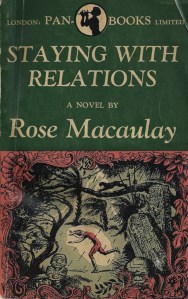
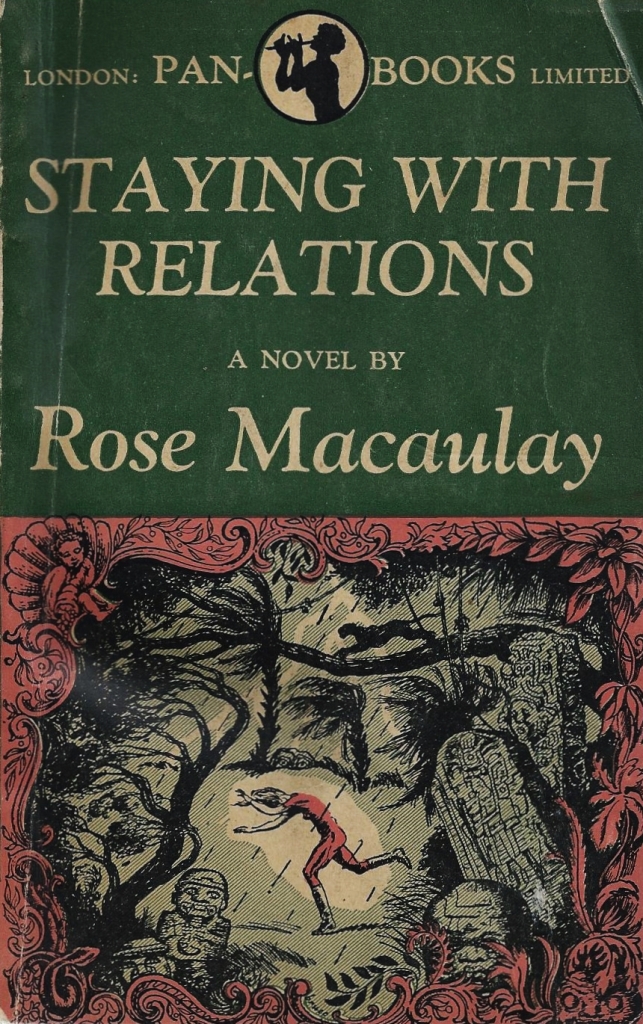
staying with relations rose macaulay 001Staying with Relations by Rose Macaulay ~ 1930. This edition: Pan, 1947. Paperback. 224 pages
Provenance: The Book Man, Chilliwack, February 2014.

My rating: 7/10

What did I just read?

My fourth encounter with the brilliant but unsettling fiction of Rose Macaulay – the others so far being Crewe Train, The Towers of Trebizond, and The World My Wilderness.

Of these, The World My Wilderness was closest to being a “plausible” story; the others were decidedly surreal. One cannot apparently read Macaulay on complacent auto-pilot; she takes a straightforward narrative and gives it the occasional twist sideways, just enough to catch the reader off guard.

Un-credited poem, one would then assume to be by Rose Macaulay herself, on frontispiece page.

Un-credited poem, which I assume to be by Rose Macaulay herself, on frontispiece page.

Among other disconnects from reality on this latest addition to my small Macaulay collection, it was the mention of tigers in the Central American jungle that caused me my greatest bemusement. I could handle all of the other scenarios – the luxuriantly roccoco villa built upon an ancient Mayan temple/Spanish monastery, the sophisticated love lives of the family of English step-brothers, -sisters and cousins living lives of lazy pleasure financed by their older relations, the American con-man with his uncanny knowledge of hidden treasure and his bizarre plot to attain such – but the tigers threw me off my stride.

At first I thought they were merely hypothetical tigers, and that the man referencing them was harking back to years spent in India, but they popped up again (figuratively speaking), apparently as a threat as “real” as the stalking jaguars which lurk in the overgrown Guatemalan forest. Had to stop and do a bit of research, it bothered me so much, and no, there do not appear to be actual tigers endemic to this region of the world. Such a relief! – I thought not, but there was that tiny bit of niggling doubt…

Okay, I’m going off on a strange tangent. Well, perhaps rightly so. This is a rather odd and slightly unsatisfactory tale.

It starts off conventionally enough. This is what the back cover of my old Pan paperback says:

Staying with Relations is about a family who live in a baroque, Maya mansion in the heart of the Central American forest. A young woman novelist goes from England to visit her relatives in Guatemala. Theft, kidnapping and hunting for treasure left there long ago by Spanish priests occur. There is an earthquake; a girl is lost in the jungle while escaping from kidnappers; unexpected aspects of the characters of the dramatis personae emerge. Rose Macaulay has enjoyed in this book the three pleasures of relating adventures, describing exotic scenery, and writing about people…She wrote this book largely as compensation for not having, in a tour of Central America, reached Guatemala and seen its ancient temples buried in jungle…

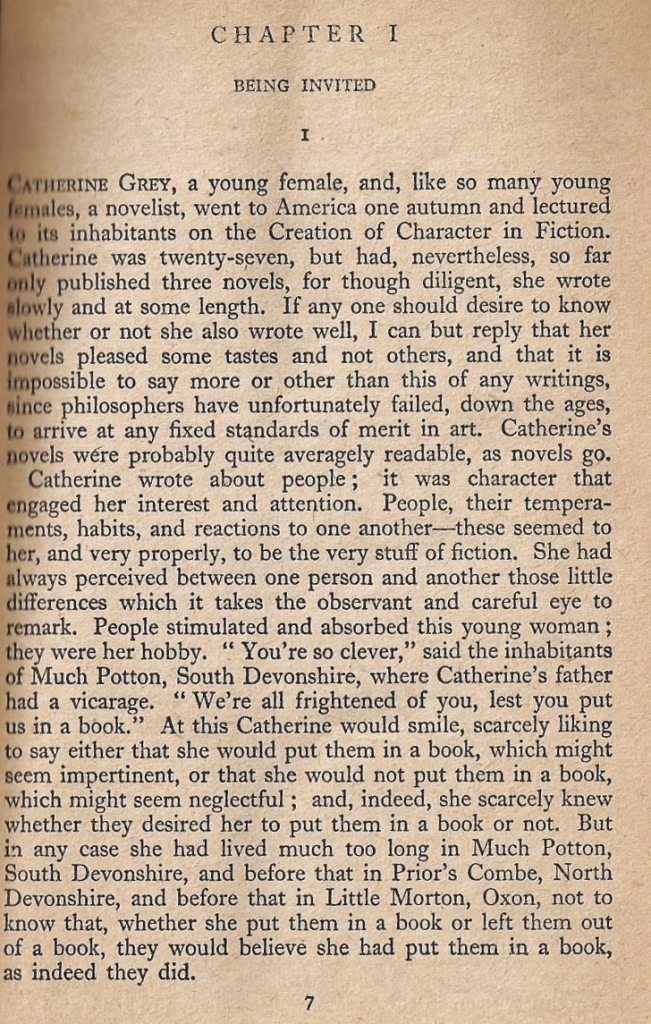
Macaulay dips her pen deeply into the satirical ink well; she jabs away at herself as much as at her invented characters, being continually cutting about the phenomenon of the English woman novelist and her apparently universal habits. Well, the writer should know.
staying with relations rose macaulay excerpt 001 (2)

Once we get this sort of thing out of the way, the novel proceeds on its way detailing the adventures of the not particularly sympathetic cast of characters. Though Catherine-the-lady-novelist at first seems to be the main character, with the action viewed through her eyes, the point-of-view increasingly shifts until we realize, with something of a shock, that we don’t really know any of these people at all. And certainly not Catherine!

As Macaulay puts her puppets through their paces, one strains to see what her intent is; what is she really going on about? And I wish I could say that I figured this out for myself, but I must give credit elsewhere. It was a comment by Simon at Stuck in a Book , in a discussion of The World My Wilderness, that clicked on the light:

‘Reliable’ is just another word for ‘consistent’, really, and Macaulay does seem to write in a consistently dry, almost satirical style, pursuing a similar theme in each novel – albeit a theme so broad that she could have written two thousand novels and never needed to approach it from the same angle twice.  It is dangerous to summarise thus (and others may have said this before me…) but I believe Macaulay’s broad theme across her novels is: ‘What does it mean to be civilised?’

Once one views the novel with this thought in mind, it all begins to make much more sense. Macaulay is continually discussing, both by the dialogue of her characters and her scene setting, the difference between the “barbarians” and the “civilized” folk. No conclusion is committed to, but the concept of “civilization” trumps all of the other scurryings to and fro which make up the conventional skeleton of the story.

I enjoyed this book as much as one can when one feels as if the author is speaking rather over one’s head. As a dramatic fiction it is as unnervingly just off normal in the same way as something like Evelyn Waugh’s satirical novel The Loved One is, or his slyly funny Decline and Fall. (Though Waugh is rather more accessible, in my opinion; Macaulay can be downright obscure, giving her readers very little help at all.)

I should probably quit now, having not really talked about the plot or any of the details of the story, and digging myself deeper with every sentence into a situation which I am going to have a hard crawling back out of. A veritable tiger-pit of a post, as it were!

For those who are already Macaulay aficionados, Staying with Relations will be a most interesting read. But I wouldn’t start here for my first introduction to this unique novelist. Perhaps try Crewe Train instead; it is just as satirically twisted but there are less characters to keep track off, and a more clearly defined heroine. Who is also, now that I come to think of it, “staying with relations”…



Read Full Post »

case of the shoplifter's shoe erle stanley gardner 001The Case of the Shoplifter’s Shoe by Erle Stanley Gardner ~ 1938. This edition: Pocket Books, 1945. Paperback. 230 pages.

My rating: 6/10

Checking out several of the websites dedicated to Erle Stanley Gardner and his lifework, I made a quick count of the Perry Mason titles listed and came up with an incredible 85+, dating from 1933 to 1969, with several published posthumously – ESG died in 1970 – all with names prefixed The Case of –  the Fan Dancer’s Horse, the Black Eyed Blonde, the Drowsy Mosquito, the Crying Swallow, the Vagabond Virgin… you get the drift.

Add to these the numerous other short stories published in the pulp fiction periodicals of the first half of the 20th Century, and the books written under various pseudonyms – A.A. Fair, Kyle Corning, Charles M. Green, Carleton Kendrake, Charles J. Kenny, Les Tillray, Robert Parr – plus various novelettes, compilations and non-fiction articles, guides and memoirs, and suddenly the designation “prolific” seems to not be quite accurate enough. This guy was hyper-prolific.

And with that comes the all-too-understandable label of the “formula” writer, which there is no doubt applies accurately here.

I had once or twice dipped into ESG’s mysteries – or perhaps more accurately, “procedurals” – but they never really took. However, using the excuse of the Century of Books project and the serendipitous acquisition of this wartime issue Pocket Book – “Share this book with someone in uniform” requests a blurb on the back cover; “Books are Weapons in the War of Ideas” on a front endpaper – I decided to give Gardner one more chance, to see if I dismissed him too readily before.

Nope. Still not a fan. Though I can see the appeal, and it wasn’t a chore to read, exactly. Just a bit boring, and not very “deep”, even for something of this “light entertainment” genre.

Here’s the plot description of this particular episode in the ongoing adventures of Perry Mason, lawyer and self-styled investigator and champion of the wrongly-accused:

Perry Mason’s chance encounter with the benign looking, white-haired shoplifter, Sarah Breel, involved him in one of the strangest murder cases of his career. The mysterious disappearance of Mrs. Breel’s brother, of five valuable diamonds, and then of Sarah Breel herself, set Mason to some investigating that didn’t please the police. Then Mrs. Breel reappeared, victim of an automobile accident, with an unaccounted-for blood stain on her shoe, and a gun in her bag. When Austin Cullens, who knew about the diamonds, was found murdered by a bullet from this gun, the police discovered that in addition to a broken leg, Mrs. Breel was suffering from amnesia, and Perry Mason became attorney for the defense with a client who could not – or would not – give him any clues at all.

Luckily Mr. Mason has a wide circle of dedicated helpers who are willing to go to any lengths to assist our fearless investigator, such as his luscious secretary Della Street, pet detective Paul Drake, and tame doctor Charles Gifford, all of whom go above and beyond at the mere crook of Perry Mason’s finger.

Several bodies pop up, a hysterical woman or two, a cool sophisticate with a secret, stray gamblers and jewel thieves, to supply the story with a lavish amount of pinkish herrings and some sketchy side plots which are never really developed. It all ends in a big courtroom scene, where Perry Mason hypnotizes his opposition with his keen wit and suddenly revealed secrets.

Yawn.

I’m sticking with Rex Stout and his creations Nero Wolfe and Archie Goodwin for my fallback formula mystery/investigator stories. (And even those are rather uneven, I’ll readily admit.)

The Perry Mason saga has its merits, not least of all the snippets of period detail, the slang and the clothes and the food and the drink and the MANY references to tobacco products throughout – these people went through a lot of the Demon Leaf – no wonder the men all have hoarsely sinister voices and the women husky whispers.

I had a giggle at the descriptions of the meals, too, and a bit of a blush for Della Street’s forthright concern for her lovely figure. Here are Della and Perry bantering as they sit down for an unplanned lunch at a department store tea room, where they’ve gone to shelter from a sudden rain storm.

“Well, Mr. Mason, since you’re buying the lunch, I’m going to make it my heavy meal.”

“I thought you were going on a diet,” he said, with mock concern.

“I am,” she admitted, “I’m a hundred and twelve. I want to get back to a hundred and nine.”

“Dry whole wheat toast,” he suggested, “and tea without sugar, would…”

“That’ll be fine for tonight,” she retorted, “but as a working girl, I know when I’m getting the breaks. I’ll have cream of tomato soup, avocado and grapefruit salad, a filet mignon, artichokes, shoestring potatoes, and plum pudding with brandy sauce.”

And she does.

Aha! – that’s it! Nero and Archie have rather better sounding food!

Now I’m just being silly…

Well, that’s that for Erle Stanley Gardner. I doubt I’ll be seeking any more of these out, though I’ll happily read them in anthologies and if stuck somewhere with no other reading matter handy.

Onward.

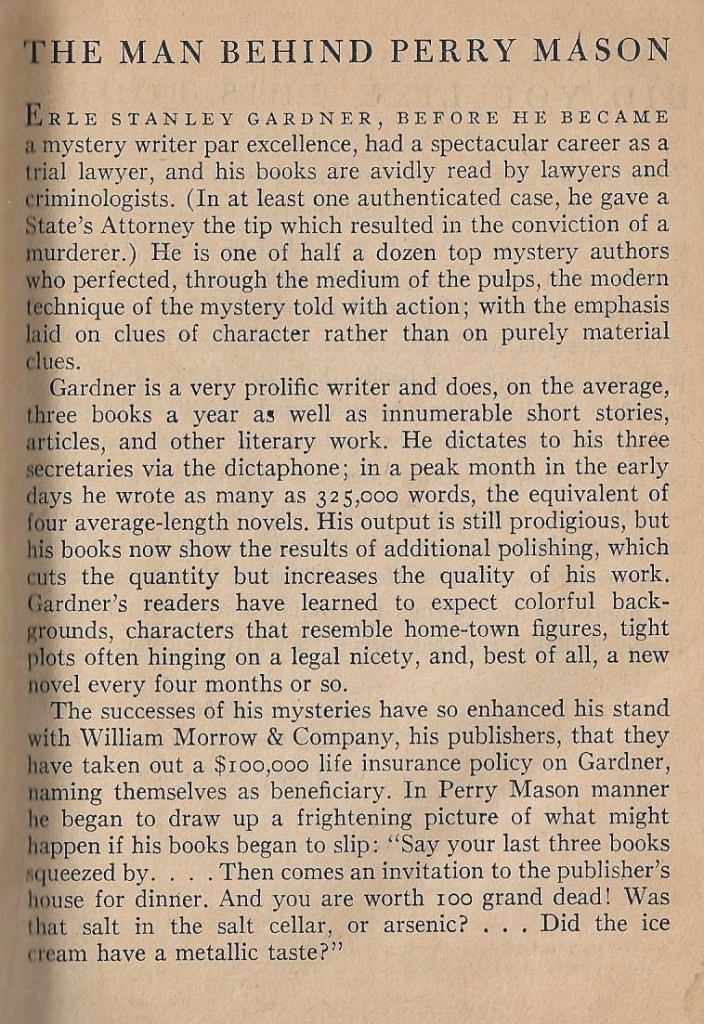
One last thing. Here is the page scan from my old Pocket Book with the publishers being all clever and smugly humorous about their best-selling author:

case of the shoplifter's shoe author bio erle stanley gardner 001


Read Full Post »

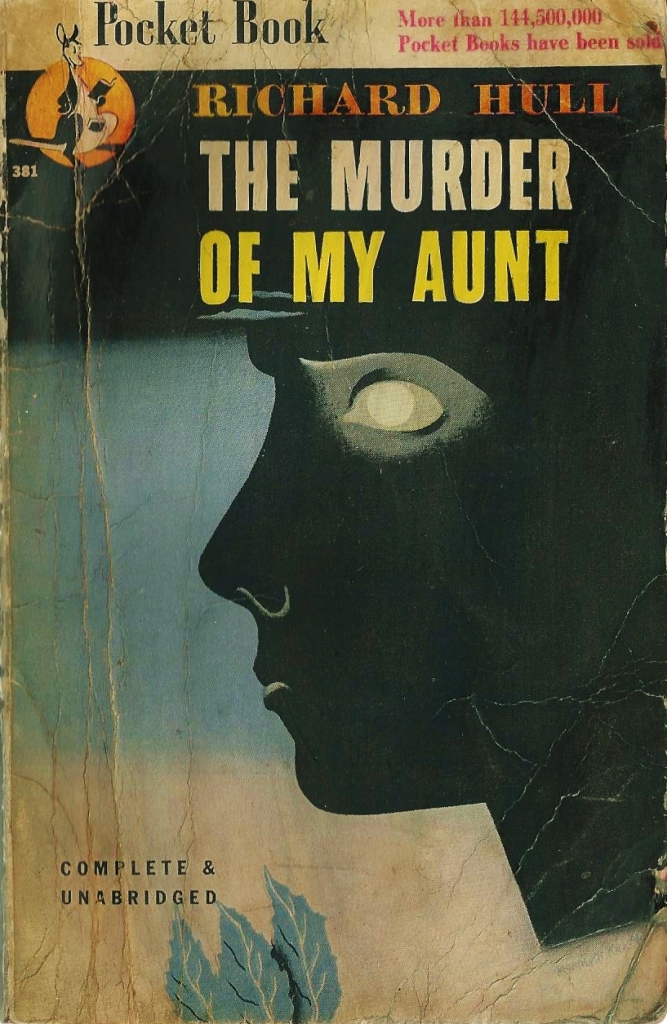
the murder of my aunt (v2) richard hullThe Murder of My Aunt by Richard Hull ~ 1934. This edition: Pocket Books, 1946. Paperback. 184 pages.

My rating: 8.5/10

Absolute piffle, but great fun. If I might be so bold, I propose this as a “must read” for lovers of vintage crime fiction and Wodehousian-style humour alike. A deliciously nasty little tale which defies fitting neatly into its possible genres in much the same way as its narrator dodges attempts to save him from himself.

Edward Powell has been raised by his aunt since the unfortunate (and apparently scandalous) double demise of his parents when he was but a wee tot. Childless Aunt Mildred is happily established at the family estate in rural Wales, but Richard has a hankering for a more sophisticated lifestyle, and is increasingly impatient with his aunt’s attitude that he should find an occupation and become self-supporting, rather than relying on her support.

Now, as spinster Aunt Mildred has no other heirs, Edward can one day expect to inherit her estate, which he fully intends to dispose of as quickly as possible, to facilitate departure for some place more appealing to his sensibilities. Perhaps the Riviera…

But pesky Aunt Mildred looks to be good for quite a few more years. What if her nephew were to hasten her inevitable demise, combining it with a spot of revenge for all of her patronizing comments regarding his dilettante leanings?

As Edward attempts to bring about the “accidental” demise of his sole relative, he confides all in great detail to his private journal, which he keeps locked up between episodes of writing in a small safe in his bedroom. A safe which his aunt has given him. (Hint: Richard isn’t as bright as he thinks himself.)

And never doubt that Aunt Mildred may have a few tricks up her own sleeve…

A nice fast read, and a fine vintage diversion for a quiet evening or a blustery day.

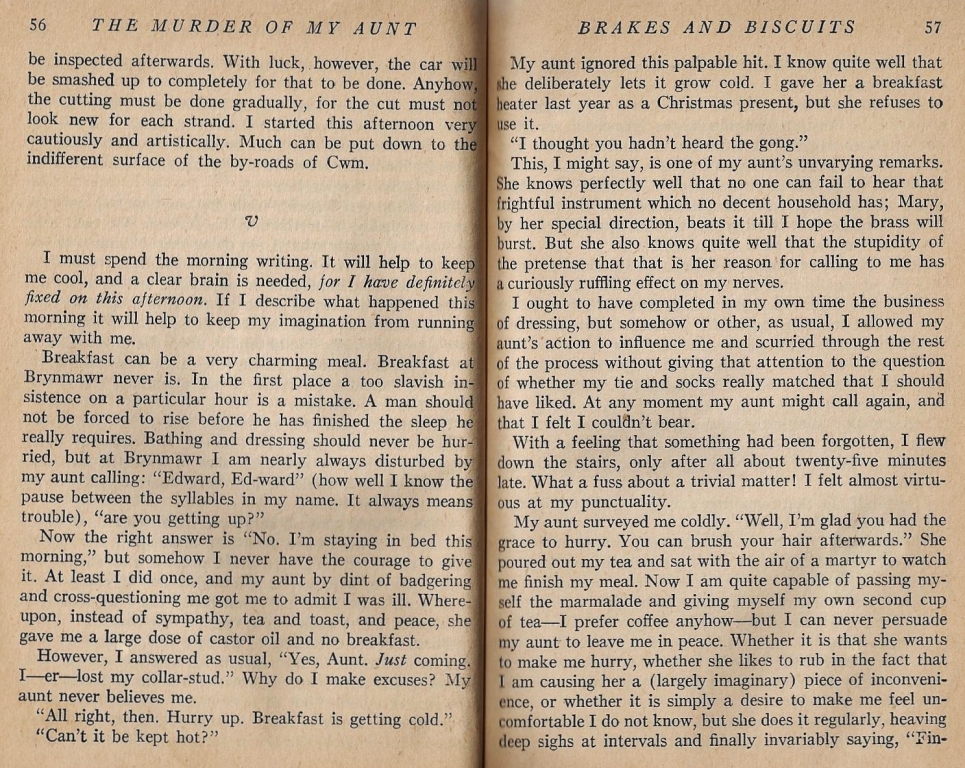
Here’s a sample. (Click the image to enlarge in a new window.)

the murder of my aunt excerpt richard hull 001


Read Full Post »

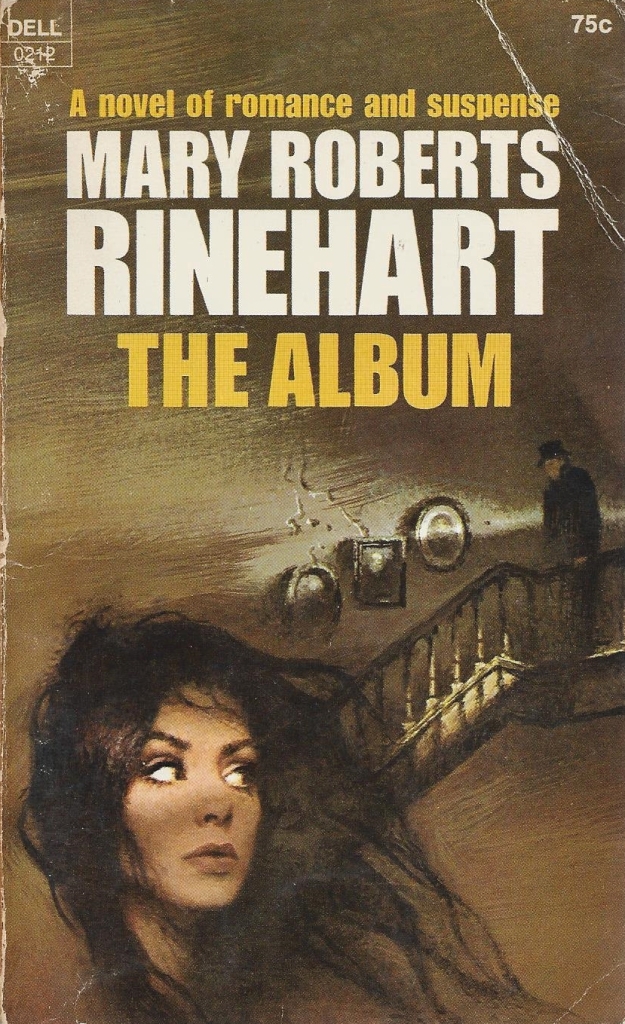
the album mary roberts rinehart pb 001The Album by Mary Roberts Rinehart ~ 1933. This edition: Dell, 1971. Paperback. 311 pages.

My rating: 5/10

There was a lot to like about this convoluted domestic drama, but it almost didn’t get its 5, for it just went on for too darned long. The length was redeemed by its passages of quite decent writing, and by the sweet love story of the narrator, which added an aura of hope to a supremely nasty tale.

So, Mary Roberts Rinehart.

She’s always sort of been there on the fringes of my reading consciousness. I have a handful of her murder mysteries (The Yellow Room, The Episode of the Wandering Knife, The Swimming Pool) which, over a period of years, regularly make the trip in to my mom’s place to provide some light reading for my book-a-day elderly parent. I recently read and reviewed one of her early melodramas, “K”, which I enjoyed, and I’ve just sought out and purchased a vintage hardcover version of her very early (1908) murder mystery, The Circular Staircase, the novel which established her career as a phenomenally best-selling mystery writer long before Agatha Christie entered the game. I once had a very handsome early edition of her very first book, 1906’s The Man in Lower Ten, which I gave away in one of those later-regretted merciless shelf purges; as I poke around exploring Rinehart a little deeper I do so wish I’d kept that one around, though I see it’s not as horribly expensive as it could be to replace if I so wish. Now that I’ve finally started paying attention, it seems that MRR is everywhere.

A case in point is this 1971 reissue of a much earlier novel which I happened upon recently at a local charity book sale. The Album is mostly murder mystery, but it is also the tale of a young woman’s emotional awakening, as the horrifying events she becomes embroiled in shock her into an awareness of her own situation and trigger her to defy the convention of her quiet and dismally unfulfilled life.

The Album was first published as an 8-part serial in The Saturday Evening Post in 1933. I could not find a record of what the author received for this work, but a similar serializations of The Wall in 1936 netted her a cool $65,000; not bad at all for the midst of the Depression! Mary Roberts Rinehart is well-known for being the highest paid writer of her era in the United States; she was hugely popular.

The Album is narrated by 28-year-old Louisa (Lou) Hall, a self-proclaimed “hopeless spinster” living with her widowed mother and a number of household servants – including a full-time chauffeur – in a stately house on a secluded side street of a large American city. The other four residences echo the Hall home in architectural detail and in the quiet wealth of the occupants. In the outside world, things are moving at breakneck speed, but the occupants of Crescent Place live in a manner of a generation before. “Out there” women are happily pursuing careers and enjoying their emancipation from staid Victorian roles; in the Crescent time stands still. The house is the sole female focus; the correct technique of ironing of the damask tablecloths and the micro-management of the servants whilst preserving large portions of the day for such peaceful pursuits as taking tea with like-minded neighbours, pasting pictures in albums, and purely decorative sewing has been elevated to a high art. Matriarchs rule in several of the Crescent Place homes, but whereas the men of the households are at least able to daily escape into the real world to pursue their careers and recreations, the daughters are kept well under the collective maternal thumbs. Though the superficial picture is peaceful, the emotions held in check behind the masks of duty are ever closer to eruption.

One afternoon the peace of the Crescent is shattered – forever, though the residents don’t know that quite yet – by the hysterical screaming of Lou’s next door neighbour. Dutiful spinster daughter Emily Lancaster, slave of an elderly invalid mother, has obviously had a severe shock; she collapses insensibly at Lou’s feet. She has just discovered her mother brutally murdered; five blows from a hatchet have suddenly severed Mrs. Lancaster from her iron grip on the household reins. The window of murderous opportunity was narrow. Mrs Lancaster was alone only for a few moments while Emily was in her bedroom changing her dress and feeding her canary; the second Lancaster daughter was showering and out of hearing; elderly Mr Lancaster was out, the servants were in the kitchen together. No stranger has been observed in the neighbourhood – the collective eyes of the Crescent residents, master and servant alike, are keen to any such intruder. Obviously an inside job, by someone familiar with the Lancaster household’s habits. But who could it have been? The discovery that Mrs Lancaster has been hoarding a small fortune in gold bars under her bed adds a sinister twist, especially when the strongbox key the murdered woman habitually wears around her neck proves to be missing.

More murders and attempted murders follow, and as the list of potential suspects shrinks through sheer attrition, the tabloids go wild with speculation, and dark family secrets are reluctantly revealed.

It is inevitable that Mary Roberts Rinehart is compared to her across-the-Atlantic contemporary, Agatha Christie, and the comparison is apt. Both writers liked to mix romance with their crime; both attempted to write “psychological” thrillers on occasion; both were good at fabricating intricately choreographed plots; both were inconsistent in providing clues to their readers; both loved the hidden identity reveal at the last moment, and the implausible motive.

The Album is a very uneven effort, and the narrator’s continual “if I had but known” refrain starts to grate slightly after the first few instances. Clues are mysteriously hinted at; some are proved to be vitally important while others are mentioned once and never again. The residents of the five houses act in the silliest of ways – first locking up their homes against the mysterious axe murderer and then wandering about alone in the night, which is handy for the furthering of the plot, but fatal for several of the key characters. Secret lives and hidden identities abound, and only in some cases are these fully developed; we are left hanging more than once.

On the plus side are some nicely competent policemen who continually just miss being in the right place at the right time – and who are not held up to scorn by the narrator and author, a pleasant change from the usual bumbling officials – and a creative use of truth serum which reveals key plot points.

The prototypically feminist Mary Roberts Rinehart accompanies her mystery with a strong critique of outmoded views on the roles of women. Both the oppressed daughters and their oppressing elders are held up to the light and analyzed and scolded by their creator for being complicit in their state of being. The daughters get the most sympathy, and are provided (in several cases) the opportunity to move away from their oppression into the light of the modern world; there is no question as to what the author thinks her characters should be doing with their lives.

The novel’s main fault (like this review!) is that it was ultimately just a bit too long. It took forever to get through, and I kept having to set it down because the sheer multitude of detail was getting in the way of my keeping the plot(s) straight in my head.

The murderer and the many secrets were revealed at the end, but by that time I was rather blasé about the whole thing; only my interest in the narrator’s romance and the well-deserved thrill she got from casting off her overbearing mother’s oppressive hand kept me engaged; the crimes faded into the background and the most horrifying details left me yawning.

An interesting read, and one that left me thinking favourably of pursuing more of this writer’s work, though it will definitely be a while before I will willingly read this particular title again. It’s going on the pile to go to town to visit Mom today, and it should keep her occupied for at least a day or two – a definite point in favour!

Read Full Post »

Three “relationship” novels read this month with varying degrees of enjoyment. All three are much discussed elsewhere, so I feel justified in giving them each what amounts to a very arbitrary micro-review. Of these three I doubt I will be returning to The Mistress of Nothing or Letter from Peking. Miss Pettigrew, however, will immediately be moving onto the keeper shelf.

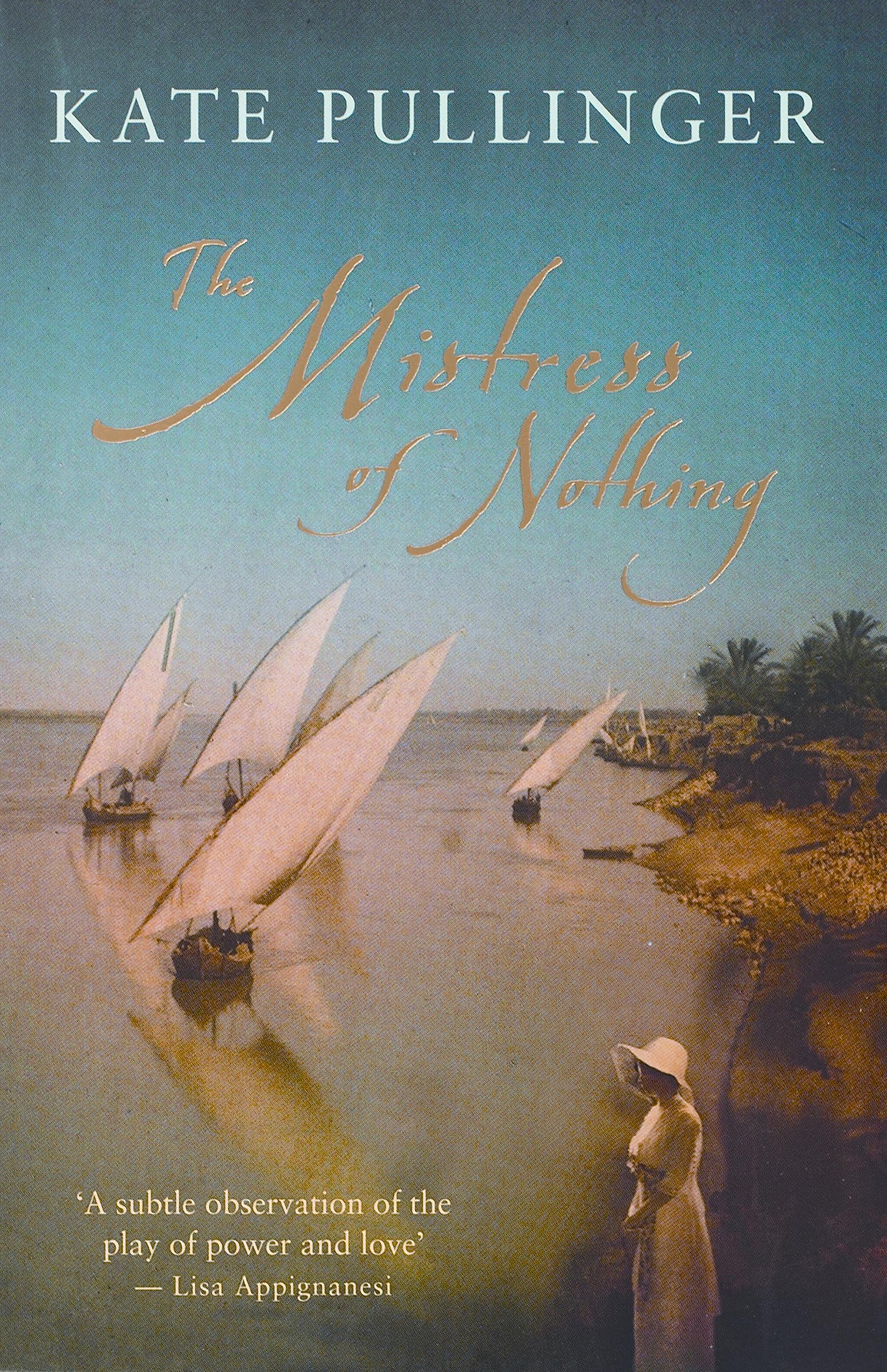
the mistress of nothing kate pullingerThe Mistress of Nothing by Kate Pullinger ~ 2009.

This edition: McArthur & Co., 2010. Softcover. ISBN: 978-1-55278-868-4. 248 pages.

My rating:  6ish/10.  (Mostly for the first half of the book, which was quite engrossing, and the fact that it sent me away curious to learn more about the real Lady Duff Gordon. The last half deteriorated to a 3 or maybe, generously, a 4.)

This book won the 2009 Canadian Governor General’s Award for Fiction, to which I can only say that it must have been a quiet year in publishing.

Somewhere as I did a bit of internet research on the author and the novel, I read that Kate Pullinger worked on this for ten years. I’m assuming that it was very much a peripheral project, though I also saw that she received an Author’s Society grant to travel to Egypt for her research, and a series of Fellowships from the Royal Literary Fund. I personally think that the author should also have spent some time working on how to write a convincing bedroom scene, because the sexy bits in this one were blush inducing for all the wrong reasons, reading as though they’d been grafted into a reasonably serious historical novel from something much more slight and bodice-ripperish.

Based closely on Lady Duff Gordon: Letters From Egypt, edited by Lady Duff Gordon’s mother, Sarah Austin, and daughter, Janet Ross, and published in several volumes between 1865 and 1875, The Mistress of Nothing is, first and foremost, well researched. It is also beautifully written for the most part, making the latter plot and stylistic inconsistencies all the more glaring.

Lucie, Lady Duff Gordon was well known for her beauty and sparkling wit and moved in the highest social circles in England, though she and her husband were, relatively speaking, not all that wealthy. Lady Duff Gordon was a noted scholar, and specialized in translations of German literature. She was also doomed to an early death, for she had at some point contracted tuberculosis, and, soon after the birth of her third child, was told she must leave England for a warmer, dryer climate. Travels to South Africa and then to Egypt brought some respite, and The Mistress of Nothing follows the Egyptian sojourn which ended in Lady Duff Gordon’s death in Cairo in 1869. She was 48.

The Mistress of Nothing provides an intriguing if superficial portrait of Lady Duff Gordon, but the focus of the novel is on another genuine character, her personal maid, Sally Naldrett. Sally accompanied her mistress on her travels, and on the trip to Egypt was Lady Duff Gordon’s sole companion, as limited finances precluded anything resembling an entourage.

When the two women reached Egypt, they were fortunate in acquiring an Egyptian dragoman/factotum, one Omar, who by all reports was a devoted and efficient assistant and of great aid in every way possible. At some point Sally and Omar developed an even closer relationship; Sally became pregnant and gave birth to Omar’s child, a development unrealized by Lady Duff Gordon until the actual birth. Her Ladyship reacted in an extreme manner, refusing to have anything  to do with Sally and stating that the child was to be given to Omar’s family (he was already married to an Egyptian woman) and that Sally was to return to England. Sally ended up marrying Omar – under Muslim law he was permitted multiple wives – but there was no reconciliation between her and her mistress, and Sally disappears from Lady Duff Gordon’s narrative, though she was very much still present at least on the fringes of the household for quite some time before Lady Duff Gordon’s eventual demise. Omar stayed on, and retained his position in the household as well as Lady Duff Gordon’s good graces, being recommended by her to serve in the Prince of Wales’ household after her death.

All of this is true to the historical record, and quite fascinating it is, too. It’s very easy to see why Kate Pullinger decided to elaborate on the real life framework of this dramatic trio of personalities; the story as it stands is enthralling.

Where the fictional treatment starts to unravel is where the real life letters leave off and Pullinger’s pure invention takes over. Once the (fictionalized) virginal Sally discovers the joy of sex with Omar, the narrative changes from an interesting examination of expatriate life in 1860s Egypt to a mushy pastiche of Sally’s (imagined) thoughts and emotions and Pullinger’s inventive fabrication of what Sally gets up to once cut adrift from her once-benevolent employer. Though willing to go along with the tale, I was unwillingly lost along the way, and closed the book with a feeling of deep disappointment. It was so close to being such an excellent read…

Well, I see the above got longer than the promised micro-review, though I really didn’t say too much; it’s a largish topic and there are all sorts of things I could say about the fascinating character of Lady Duff Gordon, and the roles of women in the 19th century, and class distinctions, and the vast gap between mistress and servant despite their years of physical intimacy, and the political situation in Egypt and the whole aristocratic British person living abroad thing. But others will have said it already, so I will (and not a moment too soon – the morning typing time is running out) move on to the next book on my list.

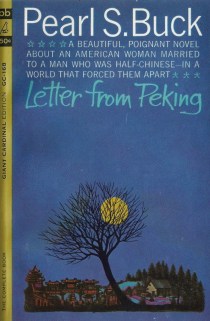
letter from peking pearl s buckLetter From Peking by Pearl S. Buck ~ 1957.

This edition: Cardinal, 1964. Paperback. 218 pages.

My rating: 3/10

Pearl S. Buck was a prolific writer, with a number of excellent novels to her credit – The Good Earth, The Living Reed, Peony – and a whole slew of other stuff. Some of which, sadly, is not very good at all. Like this one, which sounded promising, started out not too badly, and slid downhill fast.

This might have made a decent short story, but Pearl S. Buck, by dint of much repetition and needlessly florid meanderings, padded it out into a novel.

Here’s the gist of it.

An American woman, happily married for twenty years to a half-Chinese, half-American man, leaves China with her twelve-year-old son at the start of the Communist government takeover. Her husband, due to an extreme sense of duty, remains behind in his job. (He’s the head of a Chinese university; you know already from this that it’s not going to end terribly well, what with the whole Cultural Revolution thing on the horizon.)

Back in America, the woman settles into her family home in rural Vermont, which has been conveniently waiting for her in perfect order all these years, complete with faithful (if gruff) hired man. A letter arrives. Her husband has been pressured to take on a Chinese wife, to prove his loyalty to his country. The woman puts off answering it. The son runs into issues with his mixed race ethnicity. Much emotion ensues. The woman talks. A lot. Both to herself and to anyone else who will provide a shoulder to cry on. The son decides “enough of this already, Mom’s micromanaging my life. No more confidences.” More tears.

Then the woman, all on a sudden whim, decides to track down her father-in-law, and finds him in the most unlikely circumstance, living in a small shack under the protection of a local big-wheel landowner, having lost his memory but still being cognizant enough of things to insist on dressing himself in Chinese silk gowns, of which he apparently has a whole closet full. (The father-in-law lived in China many years, and left after the death of his Chinese wife – the heroine’s husband’s mother – which was highly unpleasant. She was a revolutionary activist, and was  put up against a wall and shot. Instant martyr stuff.)

Not one but two prospective suitors materialize. “Divorce your husband and marry again!” Oh, what to do, what to do???! By the time it all sort of resolved itself (sort of) I no longer cared.

Heroine is a deeply unpleasant woman, for all of her heartfelt moanings in this first-person monologue. She is a complete and utter snob, self congratulating herself on her amazing superiority in embracing the Chinese culture of her beautiful husband – long passages on how physically gorgeous mixed-race people are – while those around her are so gosh-darned bigoted. She insists that the good old days in China were absolutely wonderful; the peasants were happy; her servants loved her; her beautiful life was so fulfilling. Why did those nasty Commies have to ruin everything? In the meantime she bosses her son around, patronizes the Vermont people who fulfill all of the roles her Chinese peasants used to, and puts off dealing with her husband’s crucial issue. Eventually she gives permission for him to take on a wife-in-absence, giving her yet another lowly person to mercilessly critique.

By the end I hoped that neither of the suitors ended up with her; they seemed nice fellows. And I wished her new daughter-in-law best of luck, and rejoiced for her sake that the son had decided to move far, far away.

Over the years I’ve read a lot of Pearl S. Buck, and enjoyed most of it. This one, as you may have gathered, not very much.

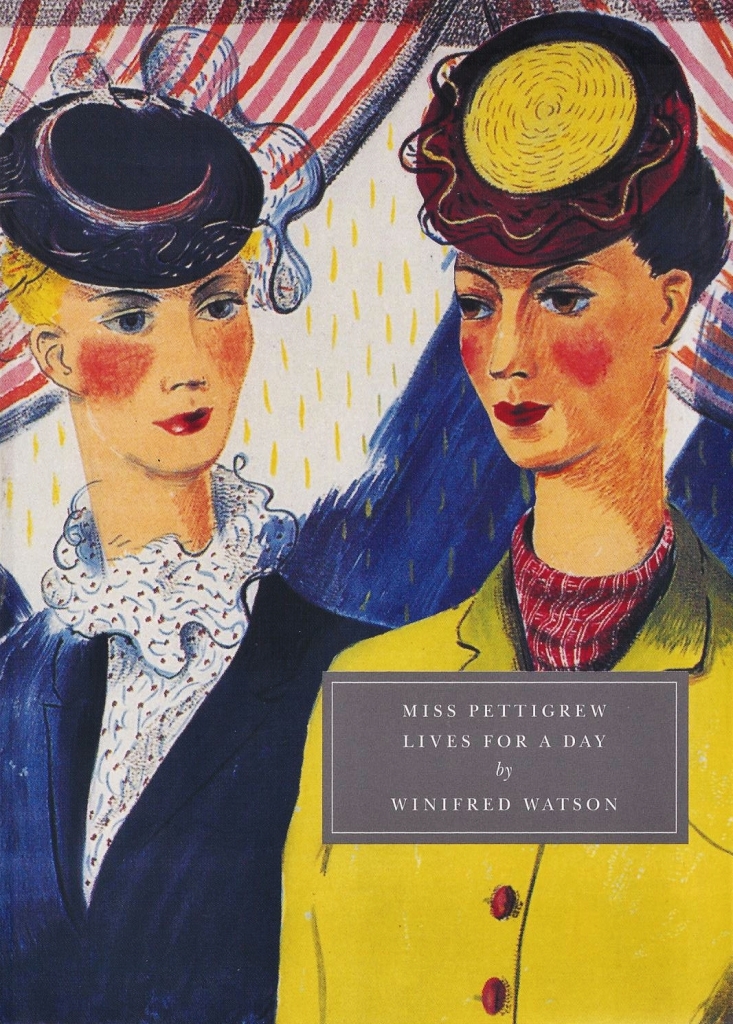
miss pettigrew lives for a day winifred watson 001Miss Pettigrew Lives for a Day by Winifred Watson~ 1938.

This edition: Persephone Press, 2000. Softcover. ISBN: 978-1-906462-02-4. 234 pages.

My rating: 8/10

What a relief to turn to this playfully frivolous novel after Pearl Buck’s dismal thing.

Middle-aged Miss Pettigrew, supremely inefficient governess, is on her uppers. Down to her last shilling, she knocks on the door of one Miss LaFosse, following up a lead from an employment agency.

Miss Pettigrew is welcomed in and definitely proves herself useful, but in a most unanticipated way. Dashing young men, cocktails, nightclubs…ooh, la la! Miss Pettigrew has never experienced such a whirl as she does in this utterly life-changing day.

That’s all I’m going to say. A whole lot of fun, this light and airy novel. If you haven’t already experienced this silly, happy thing, seek it out immediately, and enjoy!

Read Full Post »

TO A YOUNG WRETCH

(Boethian)

As gay for you to take your father’s ax
As take his gun – rod – to go hunting – fishing.
You nick my spruce until its fiber cracks,
It gives up standing straight and goes down swishing.
You link arm in its arm and you lean
Across the light snow homeward smelling green.

I could have bought you just as good a tree
To frizzle resin in a candle flame,
And what a saving it would have meant to me.
But tree by charity is not the same
As tree by enterprise and expedition.
I must not spoil your Christmas with contrition.

It is your Christmases against my woods.
But even where, thus, opposing interests kill,
They are to be thought of as opposing goods
Oftener than as conflicting good and evil;
Which makes the war god seem no special dunce
For always fighting on both sides at once.

And though in tinsel chain and popcorn rope
My tree, a captive in your window bay,
Has lost its footing on my mountain slope
And lost the stars of heaven, may, oh, may
The symbol star it lifts against your ceiling
Help me accept its fate with Christmas feeling.

OLYMPUS DIGITAL CAMERA

And here, to bookend “Christmas Trees”, as it were, is Robert Frost’s commentary on a tree that was cut down. This poem was sent out as his Christmas greeting  to his friends in 1937, and was included in A Witness Tree, published in 1942.

The subtitle “Boethian” refers to the Roman philosopher Boethius and his belief that humans often fail to recognize evil as part of a divine whole; we see only the immediate occurrence, and not its part in the greater scheme of things.  In this instance, Frost relates the immediate evil – the cutting down of the tree – to the greater thing, that of the celebration of the Christmas festival.

Read Full Post »

land below the wind agnes newton keith

The edition pictured is the more recent reissue of the book. My own paperback copy is too tattered to share; I do need to replace it, as it’s one to keep and re-read.

Land Below the Wind by Agnes Newton Keith ~ 1939. This edition: MacFadden, 1964. Paperback. 270 pages.

My rating: 9/10

I do enjoy an interesting memoir, and, having read several of Agnes Newton Keith’s later accounts of an eventful life, namely Three Came Home (a description of Agnes Keith’s three years in a Japanese prison camp in Borneo with her husband and young son, 1942-45) and Bare Feet in the Palace (everyday and political doings in the Philippines, where her husband worked for the U.N. Food and Agriculture Organization, 1953-56), I have long been on the lookout for her first literary accomplishment, this worldwide bestseller, Land Below the Wind.

I was particularly interested in this memoir because Agnes Keith credits it with helping save her son’s life while in the prison camp in Borneo. The book had been translated into Japanese prior to the war, and the commandant of the camp had read it and greatly enjoyed it, apparently appreciating Agnes Keith’s favourable descriptions of the Asian world. He would occasionally call Agnes into his office and chat with her on things literary, rewarding her with treats for young George – a biscuit, a banana, and on at least one occasion medical supplies normally unavailable to the internees. For this she was labelled a “collaborator” by some of her fellow internees; In Three Came Home, Keith justifies her conciliatory attitude to the Japanese officers as doing the best she could to ensure the survival of her child. So I was rather curious as to what the appeal of Land Below the Wind was, to see what chord it might have struck which was strong enough to influence a prison camp overseer some years later.

Land Below the Wind is indeed a most readable and a happily positive book, a description of Agnes’ introduction to life as the wife of a British civil servant in then-North Borneo (now known as Sabah) in the 1930s, when that country, “seven days by steamer from Singapore and Hong Kong”, was a British Protectorate, and Harry Keith its Conservator of Forests and Director of Agriculture, a position he had already held for ten years when he brought his new American wife out to the tropics with him. After four years living and travelling in North Borneo, one of only twenty or so European women attached to the seventy or so European men in the North Borneo Civil Service (men were not permitted to marry until they had served eight years in their posting, which accounts for the disparity in numbers of the sexes) Agnes published this book, and it became an immediate bestseller, after winning the coveted Atlantic Monthly $5000 Prize for Best Non-Fiction book published in 1939.

The book is entrancing, certainly because of the descriptions of the local residents, the tropical surroundings, the native flora and fauna, and also for its gentle mocking of the delicate social structure built up around the Protectorate bureaucrats and their spouses and unspoken rules of etiquette.

In Sandakan there is a game played with visiting cards. Every married woman has a small card box with her name lettered on it, planted at the entrance to her garden path. Spiders and lizards live in this box and in the wet season a very small snake, so care must be taken in opening the door not to snap off the end of the lizard’s tail or flatten the snake in the hinge. At intervals, among the lizard’s droppings, if you remember to open the box, various cards will appear. These you scrutinize, forget about, and some days later find under the ash tray. You then disinter your own and husband’s cards, stealthily approach the friend’s card box, and offer a return sacrifice to his lizards. The rule as to who drops the first card is as mystifying and inexplicable as the use of a subjunctive clause, and I have never really understood either of them. The rule has something to do with the sex, length of domicile, and matrimonial alliances of the parties involved, but the whole thing is best enjoyed if regarded as a game. The really important rule is to remember that when calling on the person you should not meet him in the flesh.

Sometimes newcomers do not understand about this game, or play it with a different set of rules in the outer world from which they come. this creates an impasse in social relations, for not until the first round of cards can people meet in person. The impasse continues until someone quietly hands the newcomer a printed slip containing the laws of the Medes, the Persians, and the Game of Cards.

North Borneo in the 1930s was a very active place, with lots going on, and constant coming and going both throughout the countryside and to the various islands, and frequent contact with the “outside” world, but there was still enough “first contact” type experience within living memory to give the Europeans the thrill of realizing that their immediate predecessors, instead of being matter-of-factly greeted by the natives as just another lot of government officials, might well have perished under mysterious and tragic circumstances. This was, after all, a country where head-hunters had stalked the hills only a generation ago. People still occasionally disappeared without a trace, and there were corners of the jungle not yet penetrated by Europeans, where traditional culture presumably survived in isolated pockets.

Agnes Newton Keith plays down the Noble White Man and Backwards-and-Possibly-Scary Native scenario, except where to make a point about White Man’s attitudes (good and bad) and fundamental dependence on the good nature of their Native co-workers, fellow officials, and yes, servants and jungle guides and local shopkeepers and business owners. For its era, an even-minded account of life in a relatively newly colonized land, of course from the point of view of one of the colonizers.

An enjoyable book, and though I could easily go on, I will stop here. Agnes Newton Keith was an interesting woman and an accomplished writer, and I enjoy reading her for her sense of humour, readiness to criticize herself when she pulls a real bloomer, and for her deep appreciation and vibrant descriptions of the places she finds herself occupying, whether North Borneo government villa or prison camp grass hut. Good stuff.

Read Full Post »

I’m still playing a bit of catch-up with reviews of books I’ve read throughout the year, and didn’t write about right away, but which I want to talk about before I tuck them away. Tonight I’m going to zip off some short reviews of some short easy books, the kind one can read quickly through in a few hours. Lit-light, for those times when you need something undemandingly different from your own possibly bothersome real world.

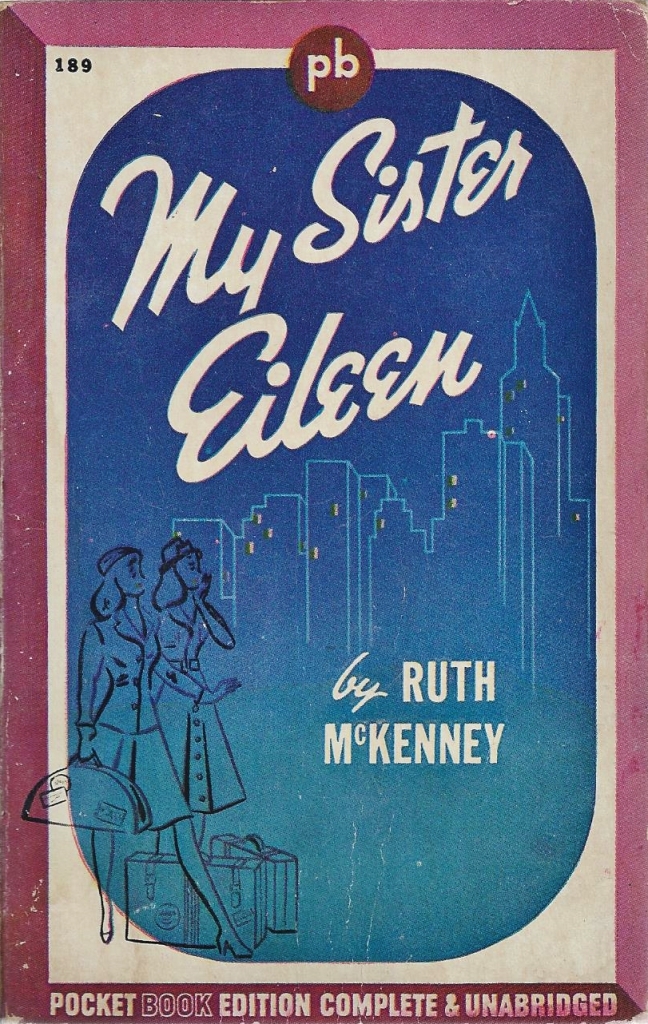
my sister eileen ruth mckenney 001My Sister Eileen by Ruth McKenney ~ 1938.

This edition: Pocket Books, 1942. Paperback. 142 pages.

My rating: 7.5/10

This frothy memoir was found among the stacks and stacks of vintage Pocket Books at Kelowna’s Pulp Fiction/Robbie Rare Books. The author was new to me, but a bit of internet research showed that she was a well-known journalist in the 1930s, 40s and 50s, with a sideline in humorous memoir, novel and travel writing. This very book, My Sister Eileen, as much about Ruth as it about her younger sister, is a an absolutely charming autobiographical account of growing up in Indiana and then Ohio, and of the two sisters going off to try their luck in New York City. The memoir caught the attention of the public, and it brought its author popular success, being made first into a Broadway play, then into a movie, and finally, in 1953,  into a very successful – 500 + performances – musical, Wonderful Town, starring Rosalind Russell, with music by Leonard Bernstein. A long way from Ohio, oh yes indeed.

I’m not much for laughing out loud while reading, but Ruth McKenney triggered more than a few giggles, as she and Eileen adventure together through their young girlhood, watching much-too-adult movies from behind the brims of their hats, failing dismally at piano and elocution lessons, being traumatized by summer camp, learning how not to swim with the Red Cross, and having a life-altering encounter with Noel Coward. A French pen pal brings romance into Ruth’s life, or so she supposes. She’s not quite sure because no one can translate his handwriting. First jobs give much scope for both girls broadening their horizons, and while Ruth does well for herself on the staff of a newspaper – printer’s devil at fourteen and onward and upward from there – Eileen struggles with the finer points of waiting tables at a posh tea room. Dreadfully dire beaux, a rather more happy (though short) encounter with Randolph Churchill, in America on a lecture tour, and a shipful of Brazilian future-admirals bring romance in the sisters’ lives.

My only complaint is that this sparkling little book is much too short. But there appear to be others, continuing the story, which I may well be searching out, though they are in much shorter supply than this bestselling first installment.

In later years Ruth McKenney’s life was to take a tragic turn. Her beloved sister was killed in an automobile accident only four days before the stage play inspired by her opened on Broadway, and on Ruth’s 44th birthday her husband committed suicide. She stopped writing, and faded into obscurity. A 2003 interview with Ruth’s daughter, Eileen Bransten, was published in the The New York Times, and gives a brief but lovingly poignant character portrait of this talented and ultimately unlucky woman.

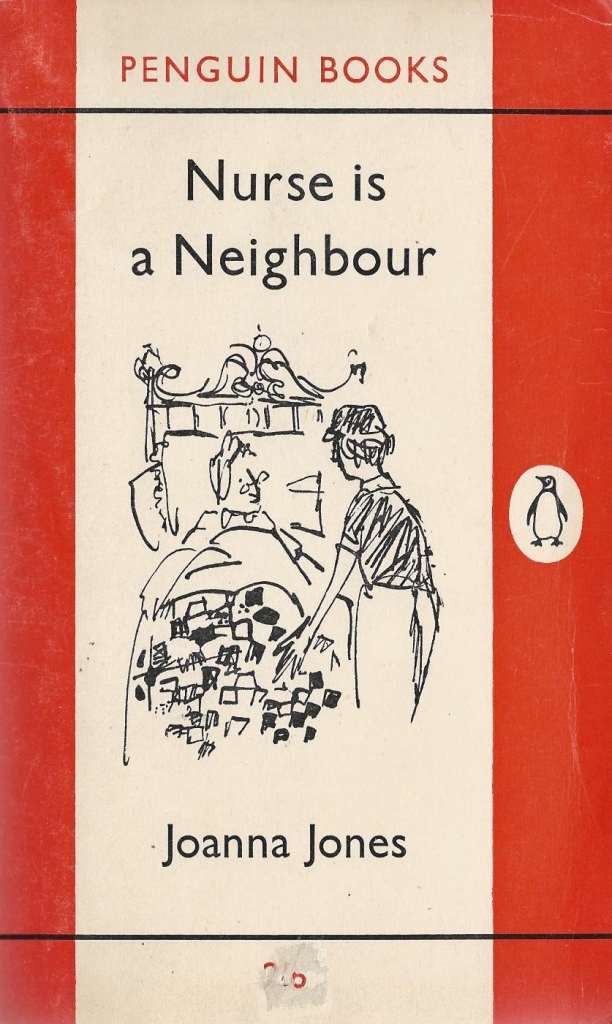
nurse is a neighbour joanna jonesNurse is a Neighbour by Joanna Jones ~ 1958.

This edition: Penguin, 1961. Paperback. 159 pages.

My rating: 5.5/10.

Crossing the pond to England, we hear from a rural district nurse, Joanna Jones, who tells of her work with a wryly sarcastic tone more than a little reminiscent of Monica Dickens at her most scathing. While not up to Dickens’ stellar level for this type of memoir, the writing here is competent enough to make this a smooth and easy read, and the details of Nurse Joanna’s life prompt us to forgive her frequently critical comments of all those around her.

Joanna has taken over her posting from a long-time Nurse Merrick, who is now well into her eighties, but still active and alert and very much keeping an eye on her young replacement. Nurse Merrick is not beyond giving some good advice when she thinks it needed, and Joanna tries to bear this in good grace, though it obviously rankles just a little now and again. Joanna also brings along to her cottage her elderly mother who is suffering from what seems to possibly be Alzheimer’s Disease (though the term is never used, I’m supposing that it was not in common usage in the 1950s), a progressive dementia which complicates Joanna’s life immensely, though she appears to cope with grace, humour, and much patience.

A very short, very anecdotal memoir, and an interesting glimpse into the state of British health care just as the National Health Program was being implemented; the protests of doctors and not a few patients as to the unwarranted interference of The State into the state of their medical care is rather familiar what with the United States’ “Obamacare” making the news these days.

Nurse is a Neighbour is quite readable, but I thought it was just missing that elusive special appeal which would make it a must-read. Joanna Jones wrote a second book of memoirs, Nurse on the District, and her books were the basis of a now-forgotten 1963 comedy film, Nurse on Wheels. Neither calls out to me for urgent investigation.

So if I wouldn’t go so far as to recommend this book as worthy of seeking out, I will repeat that it was a pleasant short read for a cold autumn afternoon’s tea break, in to warm up after digging in the garden and raking leaves.

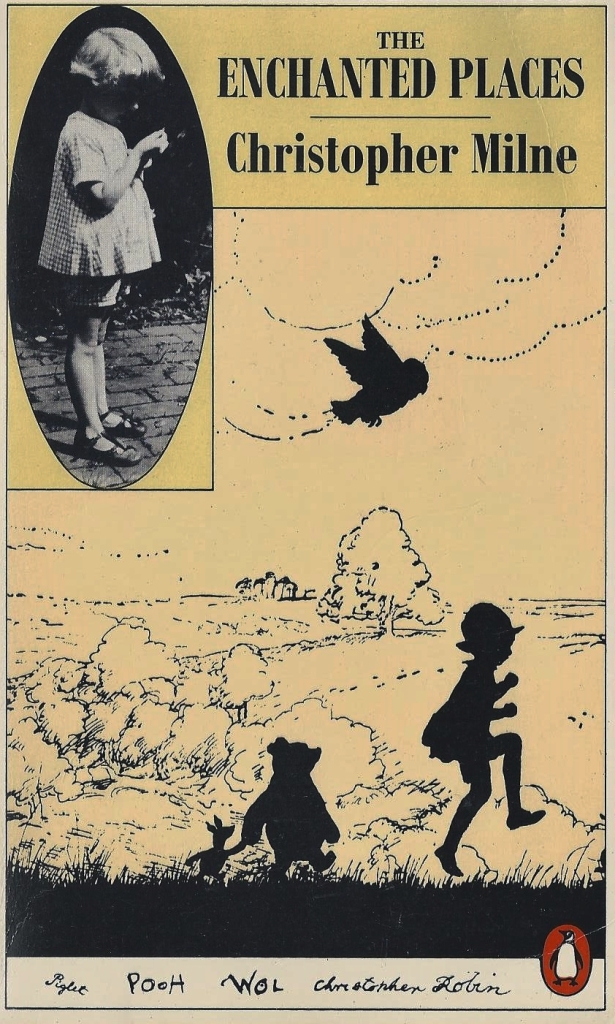
the enchanted places christopher milne 001The Enchanted Places by Christopher Milne ~ 1974.

This edition: Penguin, 1976. Paperback. ISBN: 0-14-003449-8. 183 pages.

My rating: 7/10.

I completely missed Winnie-the-Pooh in my own childhood; I can’t recall even being aware of such a character, though I’m sure A.A. Milne’s classic was readily available even in our rural British Columbia ranching community. Early childhood reading consisted mostly of a vast quantities of fairy tales, and of course the ubiquitous Little Golden Books. Beatrix Potter was just barely represented by a single non-Warne edition which consisted of Potter’s immortal text, but someone else’s dreadfully inadequate illustrations. I loved that one for the story alone – oh, brave, foolish Peter! –  and even today could probably reel off the entire thing from memory. But definitely no Pooh, in any way, shape or form.

I remedied that with my own children, of course, but Pooh never really took hold. Grilling them just now as to early childhood favourites, they mentioned Richard Scarry, the Dr. Seuss books, Beatrix Potter (hurray!) and, my daughter’s absolute favourite for a long, long period of her toddlerhood, The Poky Little Puppy. They do remember Pooh, but not with anything like dedicated fondness. Interesting.

Oh well, moving on, then. I myself do remember the Christopher Robin stories from that time of endless reading aloud, and I definitely appreciated the world of the Hundred Acre Wood, so when this memoir by the real Christopher Robin crossed my path, I read it with genuine curiousity.

In this slender volume (I found out later it is but the first of three, the following ones being The Path Through the Trees and The Hollow on the Hill, taking Christopher Milne into his adult years) the memoirist seeks to provide a sort of

…(C)ompanion to the Pooh books. In the first chapters I have attempted a picture of the Milne family life, the family life that both inspired and was subsequently inspired by the books…

For it is very evident from reading Christopher’s reminiscences that his life was indeed greatly influenced by his becoming a very well-known public figure indeed. His parents sought to shelter him from much of the publicity which his fictional counterpart attracted, but Christopher tells of his uneasy awareness that the fatherly gaze was often a bit too analytical for comfort, and then there was that rather awkward provision of new toys with an eye to story development possibilities…

The early half of the book was very much concerned with descriptions of the physical places which inspired the Pooh stories, and I must say that my interest faltered here and there, not being a true-blue devotee, but as Christopher (the real Christopher) grows up and begins to venture out into the broader world, the narrative becomes much more interesting, in an introspective, self-examining sort of way.

A.A. Milne, from Christopher’s restrained yet gently fond description of his father, seems to have been a man with a certain amount of reserve, a certain at-a-distance quality with his young child. He expressed his interest and attention through his writing rather than with much hands-on attention, and one gets the idea that Christopher in later years was very aware of how this had formed his own rather buttoned-up personality. An alone and one would think an occasionally lonely child, was young Christopher. And vaguely troubling is his mother’s insistence on the long locks and feminine attire; she was sorely disappointed that he had not been born a girl, reports Milne, and he muses about her motivations and their effect on his acceptance by his young peers.

I finished this memoir feeling just a little melancholy for that long-ago child’s sake, though it is comforting to see that he did manage to move on and break away from the heavy-though-benevolent burden of his past. I will be looking for the next two memoirs, to find out, in best story-telling tradition, “what happened next.” And, for my upcoming Century of Books, I intend to revisit Pooh himself, with his real-life owner’s story in mind.

Read Full Post »

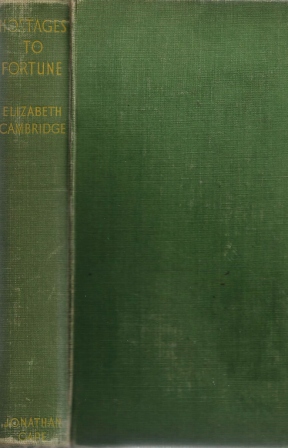
hostages to fortune elizabeth cambridge 001Hostages to Fortune by Elizabeth Cambridge ~ 1933. This edition: Jonathan Cape, 1933. Hardcover. 304 pages.

My rating: 10/10. Not only met but exceeded all of my expectations.

He that hath wife and children hath given hostages to fortune; for they are impediments to great enterprises, either of virtue or mischief.

~Francis Bacon

I loved this book on so many levels; I suspect it will be high on my “most memorable books of 2013” list. Not only is it beautifully written, but the themes of marriage, motherhood and personal fulfillment struck very close to home; I couldn’t help but recognize many parallels with my own experience, which (of course!) is not unique, as Elizabeth Cambridge so eloquently demonstrates.

*****

Catherine lay still. Through the slats of the blind she could see the hard white light of early morning; the bars were like a ladder. Black, white, white, black … was the white the rungs of the ladder or was it the space between? A white ladder or a black ladder?

Water splashed. The voice of the newcomer, hoarse and uncertain, rose and fell, broken by deep, sobbing breaths.

A girl. An anti-climax. A girl … after all that! Oh well, William would be pleased. A ‘nice little girl’. That was nurse, standing up for another woman.

‘Can I see her?’

‘Not yet. I’m just giving her a bath.”

Catherine closed her eyes. She wondered if being born hurt as much as giving birth. Somebody pulled up the blind and opened the window. Instantly the room filled with the smell of slaked dust. It had been raining in the night, but the morning was windless, damp, and fresh. An early tram clashed and rattled down the hill, the overhead wires sang as it passed. Out in the Sound a tug hooted. The tide must be falling now … all down the coast over miles of brown rocks, the gulls screaming in the pale June morning.

A girl. But who wanted girls, now, in the middle of a war? Catherine had never believed in the equality of the sexes. Women simply did not have the same chance as men. Nature had seen to that. If you wanted to produce a human being at all, it was common sense to want to produce the kind of human being that was going to have the best time.

Best time? The expression was the wrong one. Surely? What did she mean by the best time?

… She opened her eyes. Nurse was standing over her, the baby held upright against her shoulder, like the bambino on a Della Robbia plaque.

Catherine stared. So that was her baby. Baby? Babies were sleepy, amorphous, unconvincing and ugly. This creature was not amorphous, it was not even ugly. It stared at life with bright, unwinking eyes. Its underlip was thrust out, tremulous, indignant.

‘My word,’ Catherine thought. ‘That’s not a baby. It’s a person.’

And with that delicate little epiphany, the stage is set for the years to come of Catherine’s motherhood. The girl child, Audrey, is eventually followed by two more siblings, Adam and Bill, and through it all, the tedious business of ministering to infant needs, the small heartaches and exquisite joys of mothering toddlers, small children, increasingly independent and opinionated school children, teenagers, Catherine finds herself secure in that attitude, that these are, above all, persons, not merely extensions of herself or William, though of course there are glimpses of genetic imprint which for a moment here or there stand out and give sharp pause.

This is an episodic novel in which “nothing ever happens”, but it is a beautifully observed and documented series of vignettes of family life, with a view to the broader scene in which it is set. It reminded me most strongly of another book that has a similar tone and an equally well-depicted mother, Margery Sharp’s 1935 novel Four Gardens, another hidden gem of a book which I wish would receive the same attention from modern re-publishers of almost-lost small literary treasures.

These women are, of course, more than “just mothers”, but their maternity is an inescapable part of their lives, and though it does not define them, it forms their lives in various unforeseen ways, and their emotional and intellectual responses to their motherhood are well worth considering. Elizabeth Cambridge’s Hostages is said to be semi-autobiographical; Margery Sharp was childless; but both writers have identified and played upon a strong chord of shared experience which resonates with me, a person (and mother) of several generations later, living in a very different time and place.

I am having a hard time putting into words the deep appeal this book had for me; not only regarding the subject matter but how strongly the author’s voice came through. I will therefore leave it, at least for now, with a strong recommendation, and links to other reviews.

Hostages to Fortune is extremely readable, frequently very amusing, thoroughly thought-provoking, and occasionally poignant. An excellent book. Other readers agree; I don’t believe I’ve seen a single negative review.

Here is an excerpt from Claire at The Captive Reader‘s post. Please click over and read the whole review; she says much more.

Cambridge gives us a very ordinary, unremarkable story about ordinary, unremarkable people, just trying to do their best as they move through the years.  The focus is primarily on Catherine, mother and wife, who begins as a not unusually selfish young woman, concerned with her writing aspirations and her husband and, eventually, her babies.

…(S)howing a … mature marriage, I was incredibly impressed by the portrait of Catherine and William’s union through the years.  The novel begins during the First World War, with Catherine giving birth to Audrey while William is away.  When he returns, invalided out, they settle in the country and William begins his stressful work as the local doctor.  With William running about the countryside at all hours and Catherine struggling to manage at home with first one, then two, then three children, both spend the early years of their marriage frazzled, pressed for time, patience, and money.  They go through phases where they don’t particularly like one another, where they can’t even remember what they used to like about the other, where they question why they ever thought marriage was a good idea.  But, in the end, they are partners and, however distant they may have felt over the years, they shared the same vision and values.  They can respect the work the other has done over the years and, year by year, that brings them closer together…

…(T)his is truly a novel about parenting, about the limits of control.  Catherine’s greatest struggle is learning that she cannot give her children everything she’d dreamed or planned for them.  That she must “not grab nor claim, nor try to insist on what they do and what they are.”  There comes a point where, if you’re going to keep them close and on good terms, you have to let go rather than attempt to orchestrate their lives for them.  And you have to resign yourself to the fact that the fates they chose for themselves will be different than the ones you planned for and that they will potentially achieve much less than what they’re capable of…

Hostages to Fortune is a thoughtful novel full of well drawn characters and relationships, presented with admirable simplicity.  I was so taken with it, was so easily able to relate to not just Catherine but also William and their children, that I’d say it is now probably one of my favourite Persephones…

And a few more links:

A Window to My Soul – Hostages to Fortune

Heavenali – Hostages to Fortune

Fervent thanks to Persephone Press for re-publishing this novel. Here’s hoping that many more forgotten books which still speak to us today will continue to be brought back into circulation, and to garner the attention which they so richly deserve.

Read Full Post »

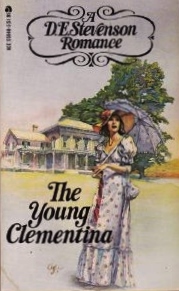
the young clementina d e stevensonThe Young Clementina by D.E. Stevenson ~ 1935. Original/alternate titles: Divorced From Reality and Miss Dean’s Dilemma. This edition: ACE, 1975. Paperback: 0-441-95048-5. 320 pages.

My rating: 9/10.

Completely met expectations, up to and including the blush-inducing ending, which lost the story its single “you’ve got to be kidding!” point. Golly, D.E. Stevenson often bobbles in those last few pages, doesn’t she?!

Well, really, the ending’s not that bad. Just…hmm…maybe just a little bit rushed? And a little too good to be true? But hey! – that’s why I’ve come to quite adore D.E. Stevenson. This story in particular is escape literature at its delicious, romantic, improbable, suspend-your-disbelief for hundreds of pages, period-piece-vintage best.

Okay, here’s a brief overview of the set-up of this novel. It’s very nicely done indeed; one of the author’s melodramatic (versus her more placid and thoughtful) minor masterpieces.

I wonder how a hermit would feel if he had spent twelve years in his cell and were called back to the world to take up the burden of life with its griefs and worries and fears; if he had passed through the fire of rebellion and achieved resignation; if his flesh had been purged by sleepless nights and his mind had found the anodyne of daily work. Would he feel afraid of the world, afraid of the pain awaiting him, afraid of his own inadequacy to deal with his fellow men after his long, long years of solitude? Would he refuse to listen when the world called, when his conscience whispered that his duty lay outside his cell, or would he gird up his loins and go forth, somewhat reluctantly, into the world which had turned its back upon him for twelve years?

My mythical hermit is standing at the parting of the ways, and so am I. Two roads are open to me, one lonely but well known, peaceful and uneventful; the other full of dangers and difficulties which I cannot foresee…

Our narrator is middle-aged Charlotte Dean, inhabitor of a dreary London flat, efficient and self-effacing librarian at a quiet geographical library – repository of “any book that adds to the geographical knowledge of the world” – recluse from that very world. Her only friend, aside from her kind employer, Mr. Wentworth, and her dedicated charwoman, Mrs. Cope, is her diary, in which she records her daily doings as she has done from childhood.

Ah, childhood. Happy days, indeed, when Charlotte was the beloved child of the Parsonage in green and flowery rural Hinkleton, running wild with her bosom friend, Garth Wisdon, equally beloved child of the Manor. Charlotte and Garth were inseparable, and their friendship was not at all disturbed by the advent of Charlotte’s small sister, Clementina – “Kitty”, as she was soon named. Not then, not in childhood. But as the years passed and friendship ripened to something deeper, Kitty had her part to play in the dissolution of the bonds that held Charlotte and Garth together…

The Great War tore Garth away from Hinkleton, and upon his return it is, unexpectedly, Kitty who becomes the new lady of the Manor, while Charlotte remains at home to care for her failing father, and then creeps off to London when his death leaves her alone and penniless.

For some strange reason Charlotte and Kitty are no longer the close friends that they were in childhood, and Garth openly sneers at his once-beloved “Char”. She meets them only occasionally, and so is rather surprised to be asked to act as godmother to her young niece Clementina  – named after her vivacious mother – and to visit at Hinkleton Manor for the occasion. But Garth is still dismissive and sarcastic, and Kitty disturbingly self-centered and complaining, so Charlotte returns to her quiet life with no thought but to regain her hard-won peace of mind, and to leave the dead past buried.

Then, twelve years after her flight to London, Charlotte’s world is turned topsy-turvy by the dramatic re-entry of Kitty into her life, and she faces the dilemma referred to at the start of the story…

For another look at the story, and an enthusiastic recommendation, a visit to Fleur Fisher‘s review will be in order.

I greatly enjoyed this grandly melodramatic and deeply romantic tale. Most engaging and deeply readable, and for that I’ll even forgive the rushed and too, too predictable “surprise” ending, my one perennial gripe with this author’s style. She builds up her story wonderfully well, rockets it along in fine style, and then chops it off with a hurried ending, almost every single time. Grrr. (And do please ignore this complaint; it’s a very minor one, and in no way puts me off reading these books with genuine enjoyment.)

I can see why this novel is so highly thought of by D.E. Stevenson devotees; she’s in fine form throughout. I do believe this one has just been re-released on July 2, 2013, so it should be readily available, just in time for your summer reading pleasure. Here’s the Amazon.com link, which includes an excerpt of the first chapter.

And I’ll say once more, this is a very vintage romance, written in the 1930s, with all of the expected clichés. It is, perhaps, even a bit old-fashioned for its time; it rather reads like something out of the closing years of the century before. With that in mind, enjoy!

Read Full Post »

« Newer Posts - Older Posts »