Archive for the ‘1930s’ Category

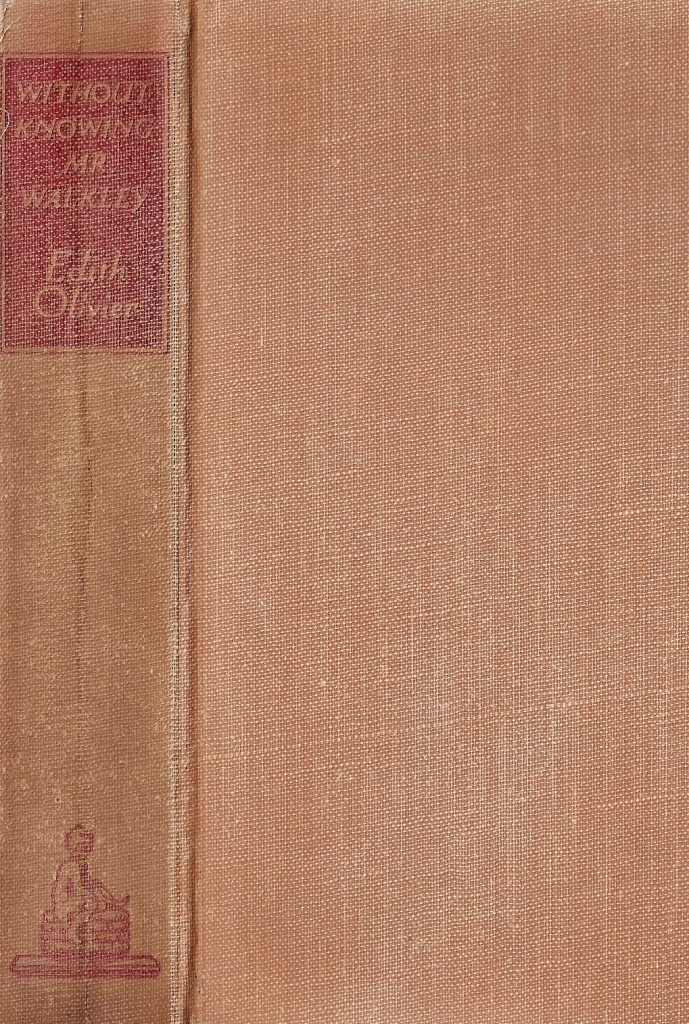
without knowing mr walkley edith olivier 1938 001Without Knowing Mr. Walkley: Personal Memories by Edith Olivier ~ 1938. This edition: Readers’ Union, 1939. Hardcover. 320 pages.
My rating: 9.75/10

I must say I was initially discouraged from taking up this gentle memoir by the mysterious (to me at least) reference to “Mr. Walkley”.

Edith Olivier I already had a nodding acquaintanceship with, as being the author of a number of highly regarded (though long out of print) 1920s’ and 1930s’ novels, among them The Love Child, Night Thoughts of a Country Landlady, and The Seraphim Room, as well as biographies and reports of interesting occurrences in her native Wiltshire and farther afield. But who was Mr. Walkley? Should I know this name? It didn’t ring a single tiny chime.

Luckily Miss Olivier’s first paragraph of her memoir proper set my mind at ease, and this reference is the first and last concerning the titular character, which is slightly odd (I had expected to hear more about Mr. Walkley, seeing as he features so prominently in the title), but completely indicative of the style of this meandering, stream-of-consciousness, very anecdotal, and utterly delightful book.

For your reading pleasure, here is an extended sample of the first section of Edith Olivier’s “personal memories” set down on paper. There is an eight-page italicized preamble to happily work through first, describing the setting of her first childhood home, Wilton Rectory, a pattern repeated as the settings change throughout the memoir, to Salisbury Close and Fitz House, and back to Wilton.

I used to say that if I died without knowing Mr. Walkley, I should have lived in vain. And now – I have. Or  rather, Mr. Walkley died without knowing me. He was The Times Dramatic Critic when I was in the schoolroom, and in those days it was my passionate desire to become an actress. The idea was grotesque. My father thought a professional actress was as improper as a Restoration Play, and an actor was almost as bad. My brother Alfred, in spite of his irresistible charm, was never really forgiven for having preferred the stage to his seat at the bottom of the Infants’ Class in Dr. Marks’s school for Burmese Princes in Rangoon. Alfred was on his way to a post in the Burmese Civil Service, and he was put to learn the language in this humble position, when a travelling company came to the town. It was too much. He was ‘off with the raggle-taggle gipsies’ and he went through India with them, returning at last to go on to the London stage. My father minded this so much that my own secret desire was never even mentioned, and Mr. Walkley remained my one link with the world of my dreams. It was through his eyes alone that I saw most of the plays of those days, for we seldom went to London, and our only ‘theatre’ was an occasional visit to Salisbury of Mr. Benson’s Shakespearian Company. It is true that I was present at Mrs. Patrick Campbell’s first appearance on the stage, but that took place at Wilton when Lord Pembroke had invited Ben Greet’s Company to play As You Like It in the Park. It had been played there once before, when Shakespeare himself was one of the actors. It is curious that as a girl I saw so few plays, for we all loved acting. Even now I have never seen a pantomime, though I have acted in more than one; but my father never imagined that his children could enjoy what would have bored himself, and a provincial pantomime did not attract him.

It would be unfair both to him and to the theatrical profession to suggest that the stage was my father’s only taboo where his children were concerned. He saw little of them when they were small, but when they grew up, he liked them always about him. Mrs. Morrison called us the Four and Twenty Blackbirds, and said that Papa liked to think that whenever he wanted to open the pie, the birds were all there, ready to begin to sing. It is true that though he always sat alone in the study, he liked us within call. He hated anyone in the house going out to parties. The coming and going worried him. He was truly conservative. As the family party had been yesterday, so he wished it to be to-day, and to-morrow, and so on ad infinitum.

He could not therefore approve of any proposed career for his daughters, and this objection extended to matrimony. He was not actually opposed to the institution in itself, for had he not himself twice married, and entirely happily? But in the case of his children, and more especially of his daughters, his standard was too high. He had an instinctive, sub-conscious prejudice in favour of Archbishops of Good Family as husbands for them, and by ill chance, none of these presented themselves. When my eldest sister fell fatally in love with a young naval officer of blameless character, her engagement was one of those things of which it is not fitting to speak in the family circle; and she only succeeded in marrying the young man at last, by the unfailing courage and determination which persisted through four years of opposition.

I rather shared my father’s fancy for the unattainable in bridegrooms; and the consequence of the various ‘inhibitions’ (as they call them to-day) which he laid upon our youthful ambitions, has been for me a happy life spent, not upon the stage or in any of the other professions which presented themselves, not as a wife, mother, mother-in-law, and grandmother (the fate of most of my friends), but as a lifelong inhabitant of Wiltshire, which is in my eyes, the most beautiful of the English counties…

If Edith Olivier’s father was something of a stern Victorian-era patriarch, it doesn’t appear to have soured Edith’s disposition, as her references to both of her parents are both clear-sighted and loving, and the family seems to have lived in quite admirable domestic harmony, stage-struck brothers and pining-for-matrimony sisters being the exception to the father-knows-best rule. One rather gathers that there was quite a lot of rather mild, what-he-doesn’t-know-won’t-grieve-him goings-on amongst the children of the family as they entered into their adult years, for the Reverend Dacres Olivier was exceedingly occupied with his duties as Rector of Wilton, and later as Canon of Salisbury Cathedral, and his family lived a somewhat separate life, though entwined throughout with predictable rhythm of the Anglican church year.

Without Knowing Mr. Walkley is broad in scope, touching briefly but most intriguingly on Edith’s childhood, on the memorable people she came into contact with – from rustic villagers to the brightest of the Bloomsbury set – Siegfried Sassoon and Rex Whister were intimates, as was Cecil Beaton – and on vivid recollections of the Great War years, including memorable descriptions of troops assembling on Salisbury Plain.

Edith was deeply involved in establishing the Women’s Land Army corps, and received an Order of the British Empire for her services in this regard, and this memoir touches on the difficulties faced with convincing the Wiltshire farmers to accept female workers in place of the men gone off en masse to war.

Edith was also highly tuned in to what one might call the “spiritual world” – in the non-church sense – being very open to the idea of visions from times past and supernatural manifestations, and experienced her own time travel episode among the derelict standing stones of Avebury.

I was deeply pleased when, after reading this memoir, I discovered that others have also found much to admire in this very obscure little volume.

If my description Without Knowing Mr. Walkley at all interests you, please visit the following for much more, including extensive quotes and much background information on this fascinating woman and her very full life.

I will leave you with an image of Edith Olivier, photographed by her friend Cecil Beaton. This was taken before a pageant at Wilton, in 1939. Edith is representing Queen Elizabeth I. (And I must mention that at this time she was also Mayor of Wilton. She was the first woman to serve on the town council, and was then elected its first female mayor, holding the position from 1938 to 1941.)
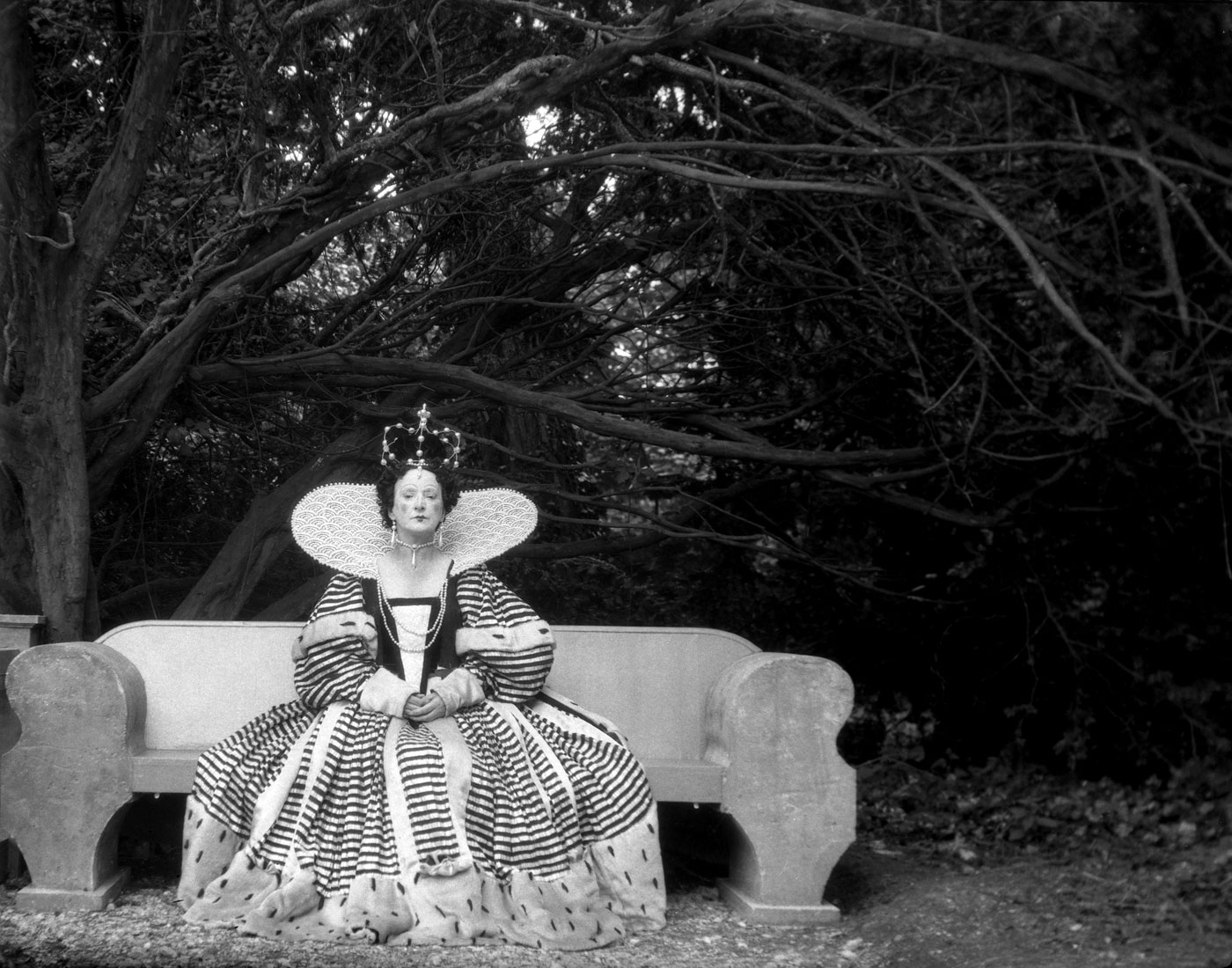
edith-olivier-as-queen-elizabeth cecil beaton


Read Full Post »

Some months ago I was intrigued enough by this post by the my fellow Margery Sharpite Rebecca Rose, aka GenusRosa, to seek out from antiquarian booksellers in England all three of Ethel Armitage’s garden journals, published in 1936, 1939, and 1946.

I am overdue in my thanks; these books are things of joy to the reader-gardener, being that perfectly balanced sort of garden writing which delights by its personal asides and anecdotes as much as by its descriptions of garden flora.

Without further ado, a Valentine’s Day observation from (one might assume) 1935 or thereabouts, from Ethel Armitage’s first book, A Country Garden, 1936. Engravings by John Farleigh enhance this first edition, published by Country Life Books.

Birch Trees - engraving by John Farleigh - from A Country Garden by Ethel Armitage, 1936

Birch Trees – engraving by John Farleigh – from A Country Garden by Ethel Armitage, 1936


14th. One hears that valentines are coming into fashion again, though none came this way, nor would it really be very suitable if they did.

But valentine or no valentine, the day brings a certain excitement with it, for the birds are supposed to pair, though many of them have anticipated the date and evidently gone off to Gretna Green. The rooks have been busy for some little time, and their nests look as transparent and draughty as ever. How terrified the young birds must be perched up so high; how frightened they must feel when the wind blows strong and, all day long, they sway from side to side! One can only hope they do not realize their peril when a brother or a sister is jerked from the nest and disappears into space. Probably all they are able to think about is food, and it is not until later on they grow wise and wear sleek black coats and sit in Parliament dealing out justice to the bad rooks who do not conform to the law.

Almost every year a pair attempts to build in one of our trees, but whenever this happens the other rooks come and tear the nest to pieces. We should very much like to have rooks here, but it is evidently against their policy, or else we are not considered worthy to possess a rookery. We prefer to think the rooks have a town planning scheme of their own, and that we are scheduled as an area unsuitable for building purposes, than that our characters are at fault in this matter.

After all a valentine did arrive. It came by the second post, and is a book on garden pests, and though most interesting in its way, we fear it makes no mention of the pests from which we suffer most, such as sheep and chickens and pigs, and even cows, all of which have, from time to time, visited us. Two goats once passed through the garden and, though their owner declared they possessed the very highest pedigree and were extremely particular about their food, they removed all the Brussels sprouts and a large fuchsia bush before they were hurried out. One year thirteen young pigs – truly an unlucky number except for the pigs – accounted for all the spring cabbages, and after them several ducks came and flattened out most of the lettuce.

But the worst pest we ever had was a bull.

At the end of a beautiful, but very hot summer day, we had gone out into the garden, partly to enjoy the cool of the evening and partly to do a little much needed weeding. Happening to look up from my task I saw a large red bull coming slowly up the little drive; as I hurried into the house I shouted the dire news to B., who was in another part of the garden, and just heard his answer of ‘oh rot’, as I slammed the front door.

The bull, most fortunately, turned on to the lawn, and from the windows could be seen browsing on-of all things -the roses. He tore two bushes from the ground, but not caring much about their flavour or the thorns, left them lying on the grass. In the meantime B., having gained the house, was telephoning to the bailiff, who, before much more damage was done, sent help, and, as they say in the news- papers, a capture was effected.

But that visit had rather far-reaching consequences, for the two rose bushes had been given by an elderly cousin whose taste in plants did not always coincide with ours. Unluckily she suspected this, so when she came to see us she always took particular care to inspect any plant she had sent. Now, how could she possibly be told that her two especial roses had been destroyed by a bull; why should he have selected those and no others? It was altogether too tall a story: one could not even expect her to believe it.

So when, the following week, she came, some quite unconvincing tale was invented, and was told in so halting a manner that, from the very first moment, it was obvious she believed it to be untrue. Since then there has been a distinct coldness towards us, and we have received neither plants nor anything else.

So we hope this new book will give some hints as to the best way of keeping bulls and other beasts of prey out of the garden.


Indeed.

Happy Valentine’s Day to you all, dear fellow readers. May this day bring you some sort of suitable treat, whether book, flower, message from a friend (or lover!); something delicious and to your taste, whatever it may be.

Read Full Post »

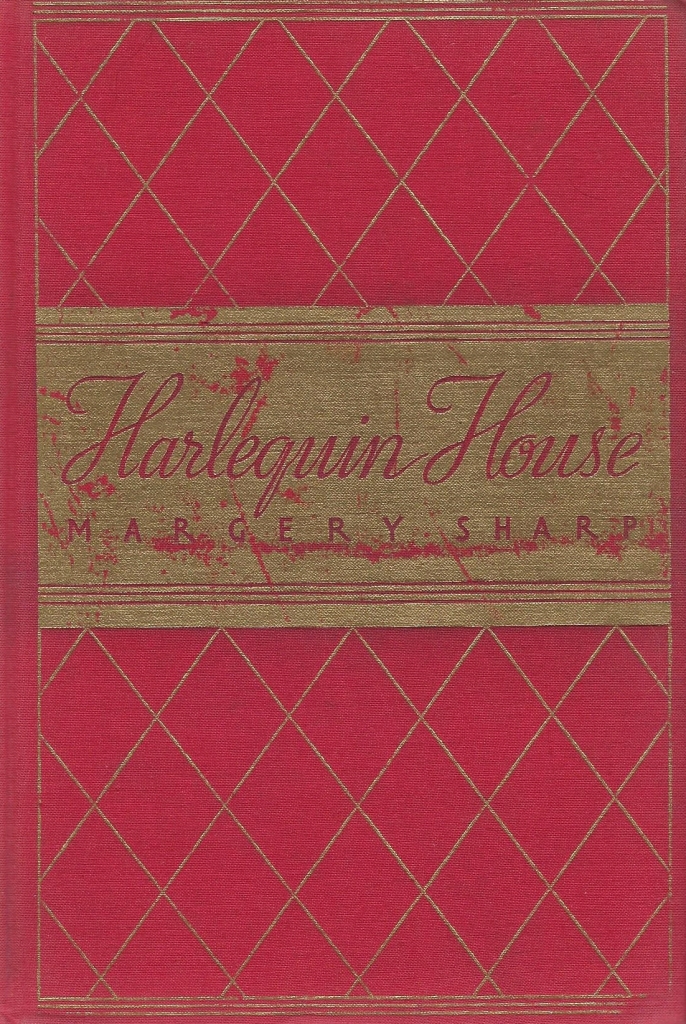
Scan0001Harlequin House by Margery Sharp ~ 1939. This edition: Little, Brown & Co., 1939. Hardcover. 311 pages.

My rating: 8.5/10

Here, as promised, is my contribution to Margery Sharp Day. Click over to Fleur in her World for a round-up posts, and loads of links to more reviews by a wide assortment of readers.

The first American edition’s front flyleaf description is fulsome – if slightly misguided – in its chirpy promotion of this admittedly light novel as a uniformly cheery romp.

(Background info: The Nutmeg Tree, published in 1937, was one Margery Sharp’s most popularly successful books. The publishers were obviously hoping for another “just like it”; one suspects they were a bit bemused by Harlequin House, which is nothing at all like its immediate predecessor, and did their best to spin it to the reading public with much reference to the previous bestseller.)

The Nutmeg Tree, a novel about a slightly unmoral woman named Julia, made a quiet appearance in the summer of 1937. Before the year was out The Nutmeg Tree was cracking faces that hadn’t smiled since 1929.

Readers cried for more. Harlequin House is the answer. Harlequin House is a mischievous, prancing and romantic novel about young Lisbeth who had her own way of accomplishing her ends.

Circumstances led to Lisbeth’s living in a Bohemian apartment in London. She lived with her brother Ronny, who was nearly as delightful as she, but needed reforming. Helping Lisbeth in this mission was one Mr. Partridge, middle-aged, gentle enough, but not averse to expressing his displeasure with civilization in a number of – well, slightly illegal – ways.

Lisbeth got a job with a firm called Wanted Women, Mr. Partridge donned kilts and helped promote The Bonnie Scotland Tea Rooms, and Ronny, when pressed, drew legs and lingerie for advertisements. Then an attractive young American named Lester Hamilton entered their lives.

Readers are going to call Harlequin House as gay, as blithe, as delightful as The Nutmeg Tree.

This book was written and published just as World War II was looming, and though the tone is frothy enough – one might even go so far as to call it somewhat hectic – there are enough glimpses of the darkness of the times to give one pause here, to consider the situation of those soon to be heading into the terrible days of what we now know was World War II.

But this is a happy occasion – the celebration of the 110th anniversary of Margery Sharp’s birth – and I will therefore drop the darker sub-themes of this tale to look instead at the wickedly humorous top story of an unlikely trio of housemates and their six months of sharing a shabby flat in a less-than-posh London neighbourhood.

Middle-aged, plump, and more than slightly common Mr Partridge is the real hero of this tale, even though his two young upper class companions, the winsomely lovely (and utterly moral) Lisbeth Campion and her handsome, lapsed-from-morality younger brother Ronny (just out of jail, having served five months of a six month sentence for “unwittingly” peddling cocaine in nightclubs catering to the era’s Bright Young Things), may seem more immediately picturesque and worthy of our interest.

Our story opens in the seaside resort town of Dormouth Bay, with our unlikely hero, sedate (at first glance) Mr. Partridge strolling along enjoying the sunshine and the flowers. Here, I can’t resist. Let’s let Margery tell it her way for a page or so. Here comes Mr. Patridge, strolling along the cliff-top park path laid out by the civic bodies of Dormouth Bay for the pleasure of citizens and visitors alike.

The walk along their top was bounded on one side by a row of equally white palings, on the other by a stretch of perfectly-kept lawn adorned with moon- or star-shaped flower-beds. The beds made patterns on the lawn, the flowers made patterns in the beds, geometry and horticulture clasped hands. Upon all these things the sun, as Mr. Partridge sallied forth on the second afternoon in July, shone brightly down. (It had to: Dormouth Bay boasted a higher average of sunshine than any other town on the south coast.) The sea lapped gently in a neat blue crescent. A passing schoolchild stopped to pick up a paper bag and deposit it in a box marked LITTER. Every object in sight conformed un- hesitatingly to either natural or municipal orders. Only Mr. Partridge was lawless.

His very presence on those lawns, at that hour, was a scandal. Already three infuriated subscribers had clamoured in vain at the door of his twopenny Library in Cliff Street; already two widows and a maid were facing the prospect of a lonely evening unsolaced by literature. One of them, who had just discovered the works of Miss E. M. Dell, and who had hastened back for more, rattled the knob with such violence that the BACK SHORTLY notice fell to the ground. This would have annoyed Mr. Partridge had he known, for he considered the phrase “Back shortly” to be the commercial equivalent of the social “Not at home” – something to be accepted without question, and with a good grace. In this, as in so much else, he was of course wrong. It was part of his lawlessness.

He did not look lawless. In height he was five foot four, in shape oval. His attire was inconspicuous – pepper-and-salt trousers, black alpaca jacket, panama hat – except about the feet. Mr. Partridge wore brown-and-white shoes, the white brilliantly pure, the brown chocolate-dark, and scarlet socks; and these added a peculiar touch of frivolity to his whole appearance. They were the single outward sign that the scenery of Dormouth Bay had for once fallen down on its job.

Mr. Partridge strolled across the grass and approached one of the star-shaped parterres. From its margin sprouted three notice boards. Two were municipal, bearing the injunctions “Please do not pick,” “Please keep off the beds”; on the third, donated by the Dormouth Bay Rose-Growers Association, it said, “A rose by any other name would smell as sweet. Shakespeare, Romeo and Juliet, Act II, Scene II, l. 43. D. B. R.-G. A.” Mr. Partridge read all three, took out his penknife, and stepped between the bushes to cut a button-hole. In the centre of the bed he paused indeed, but it was memory, not conscience, that suspended his hand upon a Scarlet Glory. He had just remembered that it was the tenth anniversary of his wife’s death. Regretfully but firmly Mr. Partridge spared the bud and selected a white Frau Karl Drushki instead…

Adorned with his stolen flower, Mr. Partridge proceeds to make acquaintance of an elderly maiden lady, an aunt by appearance and by occupation, and, shortly thereafter, of the niece of the aunt, the lovely Lisbeth Campion, who has been sent off to Dormouth Bay in charge of her aunt in order to remove her from the temptations of London whilst her newly acquired fiancé is off in the Middle East doing something militarily important.

For Lisbeth, orphaned as a small child and passed from aunt to aunt until old enough to fend for herself, has so far been able to maintain her innocence (as it were) in the wicked city through a combination of stern personal morals and just plain good luck.

Her younger brother Ronny, on the other hand, has not been so fortunate. Equally as charming and attractive as his sister, he is not nearly as self-regulating, and has fallen afoul of the law by becoming involved in a cocaine-trafficking scandal. Off to jail with Ronny, and off to the safety of Dormouth Towers Hotel with Lisbeth, where she is engaged in her continual occupation of looking placidly lovely while resisting the blandishments of a whole string of susceptible young men, who continually fall at her feet in hopeful adoration.

Lisbeth’s placidity is on the surface only, for under her smooth brow there resides a formidable brain, and within her finely molded bosom, a loyal heart. Secretly loyal to Ronny, whom she has been told by the horrified aunts to forget forever, and to her sturdy intended, whose emerald engagement ring resides in the hotel safe, and whose picture is cherished under Lisbeth’s pillow.

Through a series of convolutions of plot, Mr. Partridge, Lisbeth and the newly out-of-jail Ronnie convene one night in London, and set up house together. Ronny to recover his inner poise after the ordeal of his jail term (not all that awful, as he spent it in the infirmirary, having broken his ankle early on in his stay), and Mr. Partridge and Lisbeth united in an effort to find a useful occupation for Ronny, to get him on a (legally) independent footing before Lisbeth’s coming marriage.

Of course there are many twists and turns before all is sorted out, and Lisbeth’s dedication to her fiancé is sorely tested by the entrance into her life of a friendly young American connected with the film business.

Another sample of Margery-ism, and then I will leave you with the promise that everything eventually works out to the satisfaction of (almost) all concerned.

All in all, this is one of the minor novels in the Sharp canon, but it is chock full of things such as the passage I am about to transcribe. Worth reading if one can find it, and a quick trip to ABE shows ten copies available, priced (before shipping) from $5 to $60 – quite a bargain, relatively speaking, for a Margery Sharp title of this vintage. I wouldn’t start with this particular book if you’re brand new to this writer’s charms – go with something like The Nutmeg Tree (happily very easy to come by, with 115 copies on ABE, starting at a mere $1) which is even better than the Harlequin House flyleaf blurb makes it out to be – but for those of you who’ve already fallen for her this might be worthy of consideration.

Happy Birthday, Margery! A bouquet to your memory, in thanks for the many hours of pleasure you have given to your readers.

Here’s Mr. Partridge and Ronny, while Lisbeth is out on a job, earning the money to keep the establishment going. (Mr. Partridge contributes his share as well; Ronny is the weak link in the tripartite chain.)

 “(Y)ou’re a good-for-naught,” said Mr. Partridge, with conviction. “You have to be kept and cosseted and looked after as though you were a pet dog. You let your sister work for you, and never do a hand’s turn, and sit there eating corned beef like a blooming Duke. You make me tired.”

Ronny continued to munch, and to fix Mr. Partridge with his extraordinarily candid gaze. He was not abashed, but neither was he annoyed.

“It wasn’t I,” he pointed out, “who came and hooked on to Lisbeth. It was Lisbeth who came and hooked on to me.”

“I know,” admitted Mr. Partridge impatiently. “That was her foolishness. That’s what women are like. That’s why they want protecting, so to speak, from themselves. And it’s the man’s place to protect ’em. You ought never to have let her do it.”

Ronny shook his head.

“You don’t know Lisbeth. Once she got on my trail she’d have followed me to the North Pole. If I were to go out into the night this minute, she’d be after me again.”

There was so much truth in this that Mr. Partridge could not answer it. Ronny present was a nuisance; Ronny absent would be an even greater one. He was a fair problem. . .

“The fact is,” continued Ronny, as though following this thought, “I’m superfluous. I’m not one of those great hefty fellows who can mend roads, I haven’t much brain, and I’m not particularly well educated; and now I’ve got a sort of tin can tied to my tail as well. It’s no wonder I can’t get a job, with all this unemployment about. I oughtn’t to get a job. I ought to be tucked into a nice lethal chamber with an asbestos wreath.”

“Why asbestos?” asked Mr. Partridge, interested in spite of himself.

“So that it could be used again for the next candidate. The classic British mixture of sentiment with economy. I’m thinking of it, of course,” explained Ronny, pushing back his chair and giving the project his full attention, “as a Government job. A new branch of the Civil Service – Undesirable Cremations. Or – making it a private matter – I could just put my head in the gas oven and turn on the tap. But that would upset Lisbeth.”

“You’re right there,” agreed Mr. Partridge. “And I must say I shouldn’t care for it myself.”

This concession appeared to cheer Ronny up. He reached for a piece of bread-and-butter, spread an excessive quantity of jam on it, and made himself a sandwich. He had many innocent tastes. He was innocent – as Mr. Partridge dimly realized – fundamentally: as innocent as a lamb in a field, or a bird in the hedge, or a snow-drop in a wood. It was rather his misfortune than his fault that he could not live on grass or worms or dew, but needed corned beef and bread, to say nothing of overcoats and bedding …

“You ought to have been a bulb,” said Mr. Partridge, thoughtfully. “Or some kind of a vegetable.”

“A forked radish,” agreed Ronny. “But what can I do?”


Read Full Post »

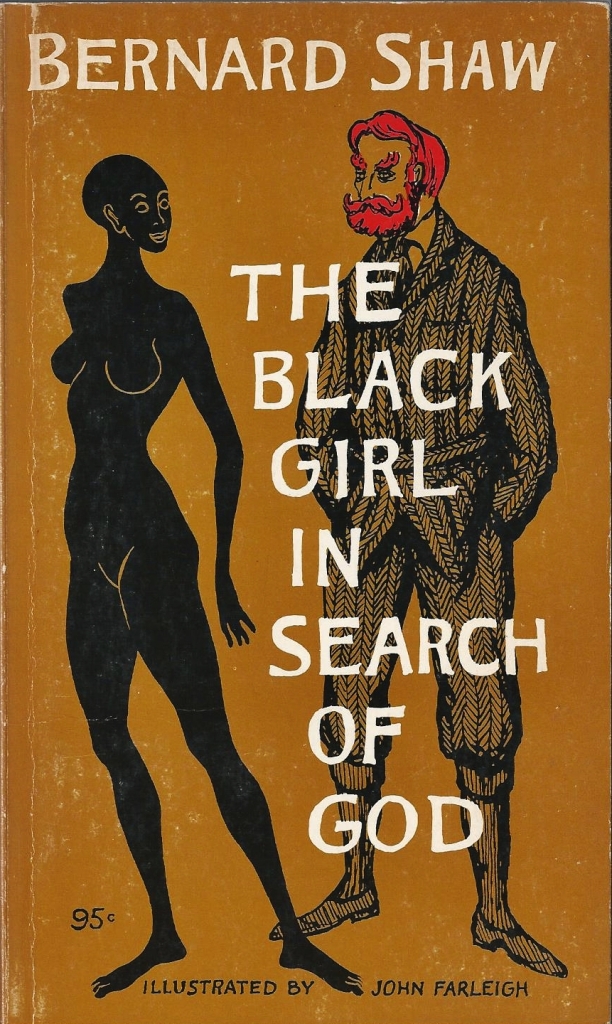
black girl in search of god george bernard shaw 001The Adventures of the Black Girl in her Search for God by George Bernard Shaw ~ 1933. This edition: Capricorn Books, 1959. Contains original illustrations by John Farleigh, and detailed Afterword by the author. Paperback. 96 pages.

My rating: 10/10

My last book read of the 2014 Century of Books project, and a fitting end to a year packed full of occasionally surprising, always thought-provoking, and frequently entertaining reading. Unexpected finds such as this have me looking forward to what future surprises I will doubtless discover among the dusty old tomes of yesteryear.

This is a red-hot coal of a satirical allegorical tale. It’s as relevant today  – perhaps even more so – as when it was published between the world wars, when all of the established “truths” were up for questioning.

“Where is God?” said the black girl to the missionary who had converted her.
“He has said ‘Seek and ye shall find me'” said the missionary.

The black girl, a fine creature, whose satin skin and shining muscles made the white missionary folk seem like ashen ghosts by contrast, was an interesting but unsatisfactory convert; for instead of taking Christianity with sweet docility exactly as it was administered to her she met it with unexpected interrogative reactions which forced her teacher to improvize doctrinal replies and invent evidence on the spur of the moment to such an extent that at last she could not conceal from herself that the life of Christ, as she narrated it, had accreted so many circumstantial details and such a body of homemade doctrine that the Evangelists would have been amazed and confounded if they had been alive to hear it all put forward on their authority. Indeed the missionary’s choice of a specially remote station, which had been at first an act of devotion, very soon became a necessity, as the appearance of a rival missionary would have led to the discovery that though some of the finest plums in the gospel pudding concocted by her had been picked out of the Bible, and the scenery and dramatis personae borrowed from it, yet the resultant religion was, in spite of this element of compilation, really a product of the missionary’s own direct inspiration. Only as a solitary pioneer missionary could she be her own Church and determine its canon without fear of being excommunicated as a heretic.

But she was perhaps rash when, having taught the black girl to read, she gave her a bible on her birthday. For when the black girl, receiving her teacher’s reply very literally, took her knobkerry and strode off into the African forest in search of God, she took the bible with her as her guidebook…

This synopsis by Albert Williams condenses the high points well:

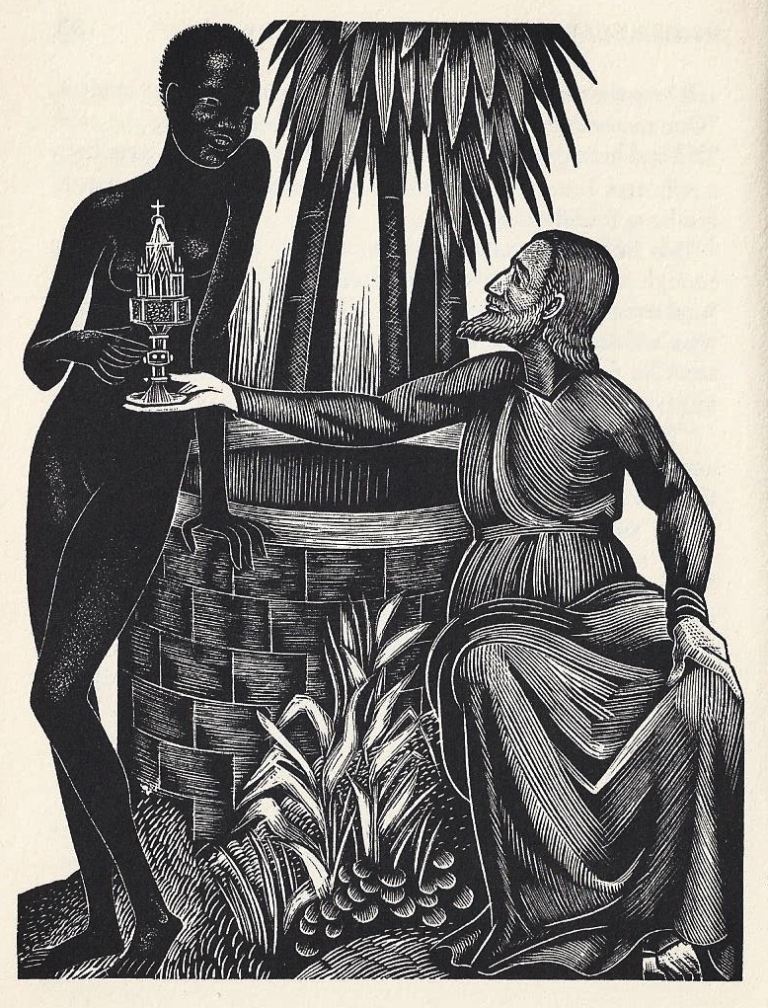
(A) Candide-like fable about an African woman who has the audacity to question the heavenly father missionaries have taught her to worship. Armed with a decaying Bible and a Zulu fighting stick, this “interesting but unsatisfactory convert” sets off through the jungle to learn why God made a world with evil. In a deceptively genial prose style that sometimes recalls Rudyard Kipling and Lewis Carroll while it skewers the hypocrisies of European colonialism, Shaw recounts his heroine’s encounters with a procession of would-be god figures: an Old Testament deity demanding suffering and sacrifice; various prophets and preachers, from Peter and Ecclesiastes to Pavlov and Shaw himself; a Muslim who insists on male superiority because “God made Man before he made Woman” (“Second thoughts are best,” replies the girl); and Jesus, reduced from being a teacher to sitting as an artist’s model. Written in South Africa in 1932, the novella was banned in Shaw’s native Ireland and attacked by churchmen as subversive (“They are quite right from their point of view,” Shaw responded); it attacks the racist and sexist underpinnings of religious dogma and prophesies the emergence of feminism and multiracialism (in the end the girl tames and weds a Shavian Irish socialist).

Have any of you read this one?

Brilliantly subversive stuff, whether one personally agrees or disagrees with Shaw’s agnostic premise. For what it’s worth (in case any of you were worried 😉 ), Jesus himself comes off quite well, though Shaw denies his deity. I can see why this received such a scalded response by the churchmen of the time.

Farleigh’s illustrations are perfect. I want to get my hands on an early hardcover copy of this one, for its sheer physical beauty as much as for its smouldering content.

black girl god illustration 1 gb shaw john farleigh 001


Read Full Post »

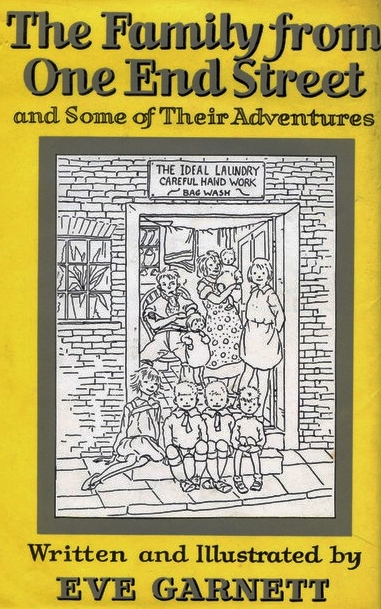
the family from one end street eve garnett 1937The Family From One End Street and Some of Their Adventures by Eve Garnett ~ 1937. This edition: Frederick Muller, 1949. Illustrated by the author. Hardcover. 212 pages.

My rating: 8.5/10

A cheerful period piece of a book, illustrated by the author.

Mrs. Ruggles was a Washerwoman and her husband was a Dustman. “Very suitable, too,” she would say, though whether this referred to Mr. Ruggles himself, or to the fact that they both, so to speak, cleaned up after other people, it was hard to decide…There were a great many Ruggles children – boys and girls, and a baby that was really a boy but didn’t count either way yet.

The seven Ruggles children, from twelve year old Lily Rose doorstepping down through Kate, twins James and John, Josiah (after his father, and both called “Jo” for everyday), Margaret Rosie, and baby William, get into the expected scrapes, and find their way out of them in various ingenious ways.

Anecdotal chapters follow the children in turn, and together give an amusing portrait of between-the-wars London through the eyes of a poor-but-respectable working class family.

Homeschooler “living books” note: Much in the line of Eleanor Estes and Elizabeth Enright, this might well work as a read-aloud to attentive children, or as a good read-alone for thoughtful and competent middle grade and older readers, if they are interested in “family stories” from “long ago.” Nicely complex in structure and vocabulary; developing early readers might have some trouble deciphering some of it, but confident readers should be able to power through.

Charming and diverting, for the problems are quite genuine, the adventures are sometimes poignant (and also frequently quite funny), and they always seem to come right in the end.

Pleasant adult read for its historical interest and distinctive narrative voice. I’ll repeat: this is definitely a period piece.

Wikipedia provides some background context:

Garnett was commissioned to illustrate Evelyn Sharp’s 1927 book The London Child and the work left her “appalled by conditions prevailing in the poorer quarters of the world’s richest city”. She determined to show up some of the evils of poverty and extreme class division in the United Kingdom, especially in contemporary London. To that end she worked on a 40-foot mural at the Children’s House in Bow, completed a book of drawings with commentary called Is It Well With The Child? (1938), and both wrote and illustrated a story book that dealt with the social conditions of the English working class, which was exceptional in children’s literature.

That book, The Family from One End Street, was rejected by several publishers who deemed it “not suitable for the young”, but eventually published by Frederick Muller in 1937. It won the second annual Carnegie Medal from the Library Association, recognising the year’s outstanding children’s book by a British subject. (It beat Tolkien’s The Hobbit among others.) For the 70th anniversary of the Medal, it was named one of the top ten Medal-winning works, selected by a panel to compose the ballot for a public election of the all-time favourite. It is regarded as a classic, having remained in print to the present day.

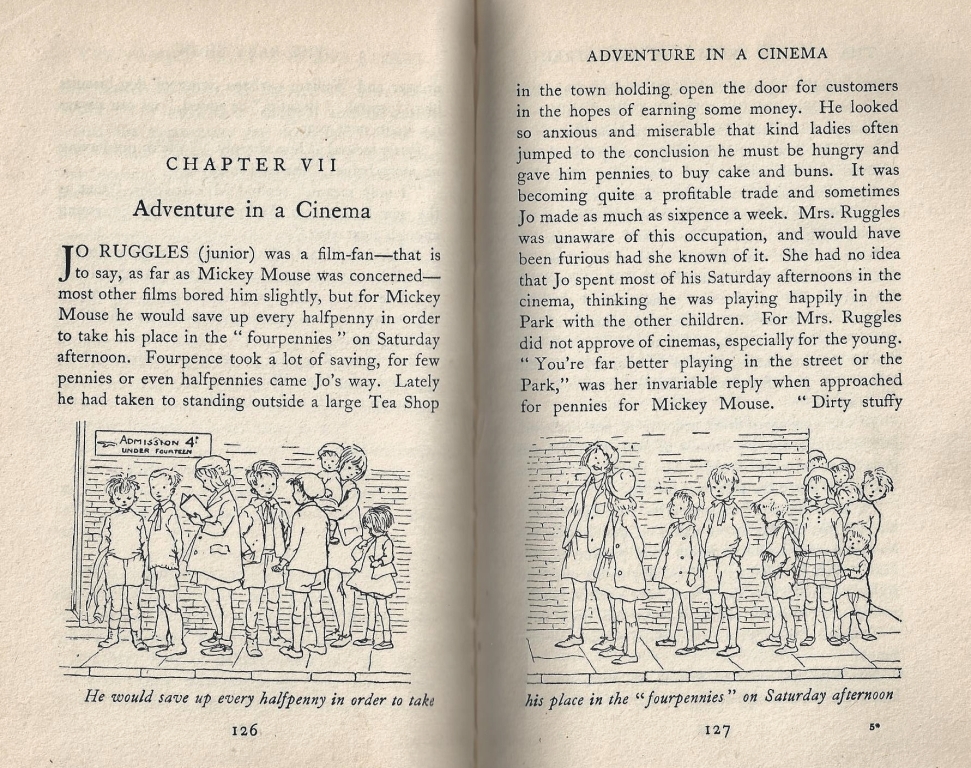
the family from one end street excerpt eve garnett 001

A random page scan from The Family From One End Street, by Eve Garnett, 1937.

little britches ralph moodyLittle Britches: Father and I Were Ranchers by Ralph Moody ~ 1950. This edition: University of Nebraska Press, 1991. Softcover. ISBN: 0-8302-8178-1. 260 pages.

My rating: 7/10

In 1906 the Moody family – Mother, Father, and five children, with Ralph the second oldest at 8 years old – moved from New Hampshire to Colorado, where it was hoped that the clean air and a healthy outdoor life would help Father recover from a lung ailment acquired while working in a dusty woolen mill. This turns out to be galloping tuberculosis, and you just know it’s not going to end well, especially when you note that the sequel to Little Britches is titled Man of the Family.

Gloomy foreboding aside, I’ll return to the installment under discussion. Promised a thriving ranch, the family finds instead a derelict three-room house set on skids in the middle of a cactus-infested field, with not a decent fence or sound outbuilding in sight. They almost head back to New Hampshire then and there, until Mother proclaims, with a sob in her voice, that the Good Lord led them there, and there they shall remain.

Needless to say there are many challenges, but a small and thriving ranch is indeed established, with young Ralph, in the throes of hero worship for the local cowboys he has just encountered, participating to his utmost alongside his competent and hardworking through constantly ailing father.

A diverting enough tale, mostly autobiographical, with some creative license applied by the author. Young Ralph seems to have been a rather accomplished child for an 8-year-old; he excels at everything he tries, though frequently not without a lesson-teaching setback or two. Father is continually having to spank him soundly, and of course (this being an inspirational type tale), young Ralph is grateful for his correction, for naturally Mother and Father know best.

Sometimes a bit preachy, but nevertheless an effortless and engaging read. This book and its sequels, Man of the Family (1951), The Home Ranch (1956), Mary Emma & Company (1961), The Fields of Home (1953), Shaking the Nickel Bush (1962), The Dry Divide (1963) and Horse of a Different Color (1968), were the result of a creative writing course taken by Ralph Moody at the age of 50, and are composite portraits of events and characters from his childhood and later years.

These books are beloved of many “religious-minded” homeschoolers, for their emphasis on moral fortitude and godly behaviour. Though Ralph fell aside from the narrow way many times, he was always able to boost himself back up by his bootstraps, with the help of an occasional inspirational visit to the back of the barn with Dad and a willow switch, or a less-physically-painful session with Mother and the family Bible.

Ralph Moody’s agenda as a writer was simple and sincere. As he said in a 1967 interview in the New York Times Book Review: “My goal in writing is to leave a record of the rural way of life in this country during the early part of the twentieth century, and to point up the values of that era which I feel that we, as a people, are letting slip away from us. ”

Fair enough. Mostly very good, this book, and perhaps I am being overly critical regarding all of the corporal punishment the author so enthusiastically reports.

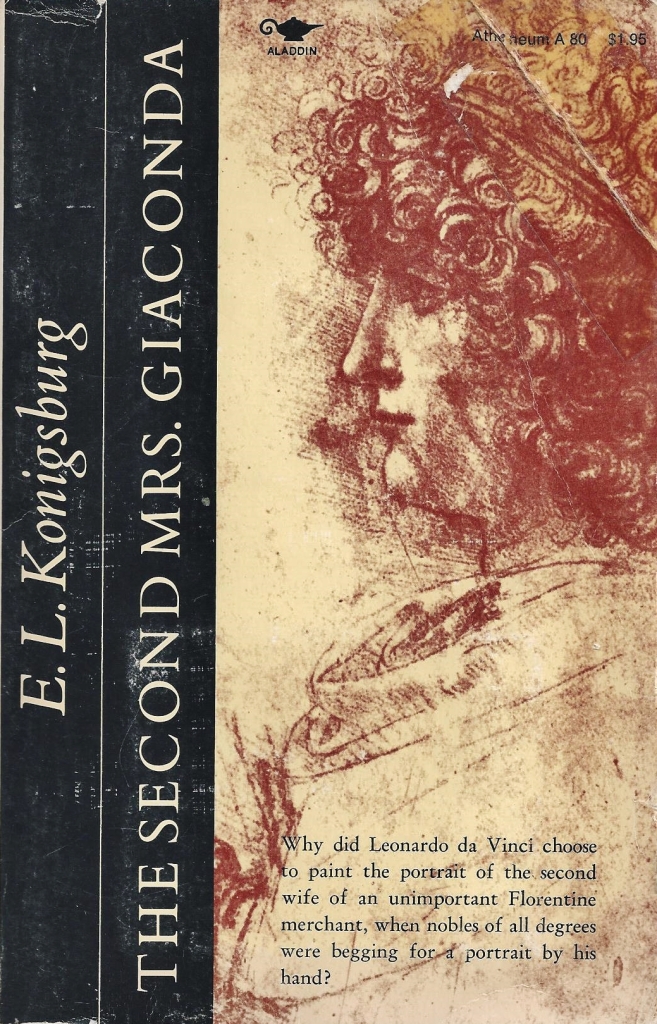
the second mrs giaconda e l konigsburg 001The Second Mrs. Giaconda by E.L. Konigsburg ~ 1975. This edition: Aladdin, 1980. Softcover. ISBN: 0-689-70450-X. 138 pages.

My rating: 4.5/10

Why did Leonardo da Vinci choose to paint the portrait of the second wife of an unimportant Florentine merchant, when nobles of all degrees were begging for a portrait by his hand?

Great question, regarding the enigmatic “Mona Lisa.” Too bad the author never really answers it.

I quite like a lot of Elaine Lobl Konigsburg’s work, for though she was of the “problem novel” school of juvenile writer, her books for the most part contain a lot of humour, and are never preachy. The “educational” bits are generally unobtrusively incorporated into the tale, with the final product being entirely pleasing.

Sadly, The Second Mrs. Giaconda, despite its perennial inclusion on juvenile reading lists due to its Leonardo da Vinci theme, is to my mind something of a dud, being written exclusively in “tell, don’t show” mode. A great shame, because this writer was capable of doing so much more, and the subject is chock full of potential.

The novel gives an overview of life in Renaissance Italy through the eyes of Leonardo da Vinci’s young apprentice Gian Giacomo de’ Caprotti, known to his familiars as Salai. Giacomo/Salai was a real historical personage, and he is mentioned in da Vinci’s journals with intriguing frequency, from his entry into the household as a child of 10, in 1490, to his inclusion as a beneficiary of a house and half of da Vinci’s garden property in da Vinci’s will.

Leonardo da Vinci refers to Salai as a “liar, thief, mule-head, glutton”, and includes mention of his apprentice’s numerous failings, but obviously something happens during their time together to turn the tables completely. What was it? Konigsburg fabricates her version of their joint story referring to da Vinci’s actual journal entries, and in this case her creative license feels forced, as she incorporates Salai’s fancied involvement in all of da Vinci’s personal and professional relationships, in particular with Leonardo’s great patron, the immensely powerful Duke of Milan, and his wife Beatrice d’Este.

None of this has anything to do with the Mona Lisa, and the “second Mrs Giaconda” shows up only very briefly in the very last chapter, with her portrait painted as something of a slap in the face to Beatrice’s jealous sister Isabella, and the whole project completely engineered by the cunning Salai.

Here, courtesy of ever-handy Wikipedia, is some more of a rundown on the plot of this novel. :

The son of a poor shoemaker, Salai is a cutpurse caught in the act by the master, whose grasp and visage he mistakes for the hand and face of God. Leonardo takes him as an apprentice, at no fee, and practically as a servant. Salai remains a scoundrel who moves from petty theft to selling his master’s sketches, and later to selling his audiences.

Princess Beatrice comes to Milan and marries Il Moro, the duke, who had hoped to marry her beautiful older sister Isabella d’Este. He continues to wait on his beautiful mistress Cecilia Gallerani, the subject of a Da Vinci portrait that is already famous. “She’s small and dark and perfectly plain”, Salai says when he first sees Beatrice; when they meet by accident, she is “trying to get the sun to make me blond and beautiful”. They discover a shared taste for mischief. To Leonardo she laments, “Could I but gain my husband’s love, I know that I could disguise this plain brown wrapping.” He asks what she has “to give him that Cecilia has not” and she volunteers her “sense of fun”.

Salai and even Leonardo often visit Beatrice and she becomes the toast of Milan —assisted by the visits. They come to consider her “our duchess” but she does win her husband’s love. Isabella visits and envies her sister for “the intellectuals, the gifted, the skilled craftsmen; the very elements who were drawn naturally to Beatrice.”

Beatrice grows into a political role and becomes a collector of clothing, jewels, etc., and no longer a companion to Salai. She [eventually] conveys insight regarding the master’s talent, and admonishes Salai to take some responsibility for that. To achieve great art, Leonardo needs “something wild, something irresponsible in his work”, and Salai must help.

The merchant Giaconda and his wife appear only in the last of nineteen chapters, visiting the studio during the master’s absence. [In the meantime], Beatrice has approved Leonardo’s The Last Supper and died in childbirth. Milan has been conquered by the French and Leonardo has moved to Mantua. Duchess Isabella of Mantua (sister of Beatrice) has been frustrated for years seeking her portrait by Leonardo, which delights Salai. “Sooner or later she would come to realize that here was one prize that was just out of reach of her jeweled pink fingers.” Spurred by [thoughts of] Beatrice and Isabella, the irresponsible Salai determines to persuade Leonardo to paint Lisa [Giaconda]…*

…and the rest, as they say, is history.

Got all that?

If it all seems a bit flat, despite its convolutions, it is, especially as reported by Konigsburg.  I thought this little historical fiction highly contrived and not particularly interesting, despite its achievement of the Best Book of the Year (1975) for Young Adults Award from the American Library Association.

*All of the quotations in the Wikipedia excerpt are taken from Konigburg’s novel, not Leonardo’s journal.


Read Full Post »

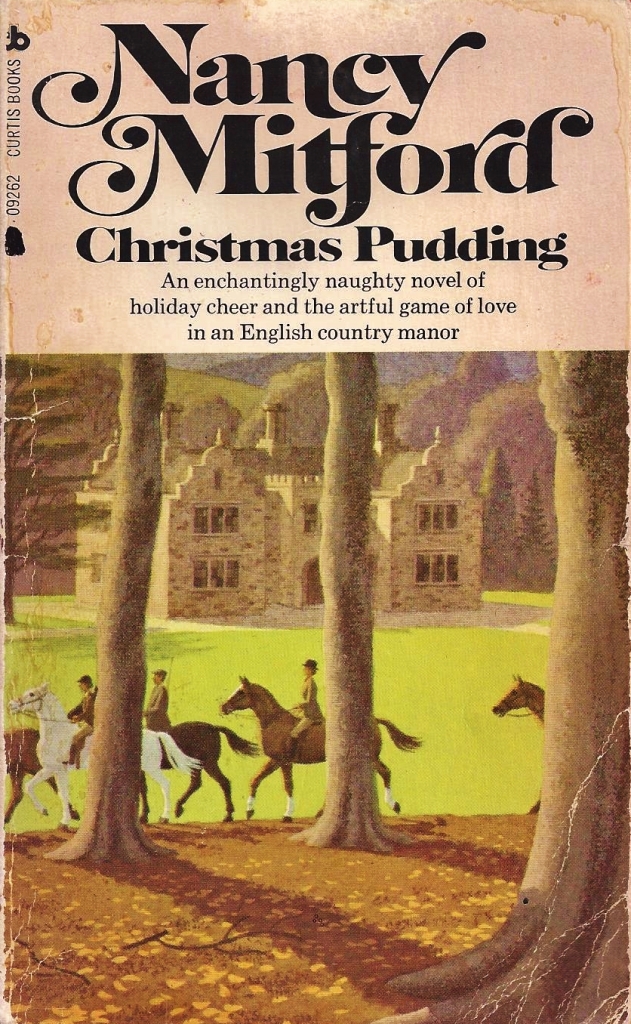
christmas Pudding by Nancy Mitford 001Christmas Pudding by Nancy Mitford ~ 1932. This edition: Curtis Books, 1973. Paperback. 238 pages.

My rating: 5.75/10

I had to go back to April to double-check my rating of the earlier companion piece to this very minor entry into the satirical humour, between-the-wars, Brit Lit canon, Miford’s 1931 Scottish grouse moor-set Highland Fling. I see I rated it at 5.5, which is, on further reflection, quite generous. Christmas Pudding therefore gets an also-generous 5.75/10.

This is Very Light Fiction, and not quite up to Wodehousian standards, which one would assume was the author’s goal. There is a certain flair for humorous phrasing which gives a strong hint of what the Mitford would later accomplish to a higher degree in her most critically, popularly and financially successful books, the semi-autobiographical The Pursuit of Love, Love in a Cold Climate, The Blessing, and Don’t Tell Alfred.

Christmas Pudding is a romantic farce, with the expected eclectic cast of characters, most taken out of their usual urban habitats and tossed together into close proximity in the isolation of a country house Christmas. Here are the major characters, and a glimpse of the set-up:

  •  Paul Fortheringay, recently published author of Crazy Capers – a grim tragedy of a novel despite its name – is devastated when instead the “serious” book he has laboured over with such care is received as a humorous satire. “Funniest book of the season!” the critics bray. Paul is not amused. How to salvage his writerly self-esteem? Perhaps with a work of unmistakeable sincerity, such as a biography of a hitherto-neglected literary personage? But all the obvious subjects are already well written up, so Paul decides on an obscure pre-Victorian poetess, Lady Maria Bobbin, whose diaries and letters are rumoured to be still extant and sitting in dusty preservation at the country estate of Compton Bobbin.
  • Walter and Sally Monteath, the penniless yet well-born young couple at the centre of Highland Fling’s hectic action, have recently been blessed with a baby girl. Still on the brink of financial disaster, the couple (now with child and nanny) are most ready to accept any offer of hospitality over the holidays, graceful sponging on wealthier acquaintances being their speciality.
  • Middle-aged but very well preserved Amabelle Fortescue, retired and rather well-invested ex-demimondaine, moves in the better circles and includes such Bright Young Things as Walter and Sally among her chums. Paul is also a pal. Amabelle has decided to do something different this Christmas, and has taken Mulberrie Farm as her temporary abode, an amusing departure from the London whirl-of-gaiety norm.
  • Next door to Mulberrie Farm we have the sedate estate of Compton Bobbin (aha!), inhabited by hunting-mad Lady Bobbin, the unchallenged matriarch of her meek household and the terror of the countryside at large. Also in residence are her daughter Philadelphia, beautiful, bored, listless and waiting for something – anything! – to rescue her from her bleak existence in the rural purdah dictated by her mother, and young Roderick – Bobby – Bobbin, down from Eton for the hols. Bobby is an oldish sort of young man; he is rather well acquainted with our Amabelle, without his mother’s knowledge, of course.
  • Michael Lewes, of the diplomatic service, presently stationed in Cairo, but coming back to England for Christmas, which he will be spending as a guest of the Bobbins. Michael has long been in love with Amabelle, and persists in asking her for her hand in matrimony, to her continual good-natured refusal.
  • Major Stanworth is another neighbour Mulberrie Farm. A widower, he’s a rather good sort, hearty and cheerful and, as it turns out, at a stage in life where some womanly consolation for his single state is welcome.

Plot in a paragraph:

Paul writes to Lady Bobbin asking permission to go through Lady Maria’s papers. Lady Bobbin gives a brief but forceful “No!” Hang on, says Amabelle, when Paul bemoans the situation to her, I know the young Bobbin heir. So Paul is dispatched to Compton Bobbin under guise of being Bobby’s holiday tutor, the plan being that while he pretends to be closeted with young Bobby in academic solitude, he will in reality be working on his biography of Lady Maria, leaving Bobby free to go a-visiting on the quiet at Mulberrie Farm. Paul sees Philadelphia, and his heart goes thump-thump, as does Michael Lewes’ heart, which is open for consolation after yet another gentle put-down by Amabelle. Philadelphia, suddenly the focus of two sets of admiring male eyes, perks up marvellously. Major Stamworth’s more mature charms appeal to Amabelle, and hers to him; a romance quietly blossoms in the most unlikely way. Scads of Bobbin relations descend for Christmas on Compton Bobbin, as do a number of Amabelle’s friends on Mulberrie Farm, including Walter and Sally, who are just sort of there in the tale, though they don’t really play a major part in the intrigues. Will Paul have his cover blown? Will Bobby’s deception be revealed to his bossy mum? Will Philadelphia go for money, good nature and sterling worth (Michael) or poverty, hot passion and the literary arts (Paul)? Will urbanite Amabelle and country gentleman Major Stanworth get together for good and walk arm in arm off into the rural sunset?

I thought that Christmas Pudding, Mitford’s second published novel, was perhaps a more polished piece than Highland Fling, with its young author settling down a bit and finding it easier to maintain a narrative strand of sorts. (Well, not that young, really, for when I do the math I see that Nancy Mitford was 28 years old when Christmas Pudding was published, which surprised me rather – it reads as though she were 19 or thereabouts, with its frequently cheeky “Let’s shock the elders!” tone.)

Though the book is set during the holiday season, one can’t really call it a “Christmas book” in the heart-warming, nostalgic, feel-good sense; the smiles it engenders are just a little too cynical, though there is a rather funny episode Christmas morning which I think will stick with me, concerning one of the wee children roistering about the country house where most of the characters are staying.

At about five o’clock in the morning Master Christopher Robin Chadlington made a tour of the bedrooms, and having awoken each occupant in turn with a blast of his mouth organ, announced in a voice fraught with tragedy that Auntie Gloria had forgotten to put a chocolate baby in his stocking. “Please might I have a bit of yours?” This quaint ruse was only too successful, and Christopher Robin acquired thereby no fewer than fourteen chocolate babies, all of which he ate before breakfast. The consequences, which were appalling, took place under the dining-room table at a moment when everybody else was busily opening the Christmas post. After this, weak but cheerful, young Master Chadlington spent the rest of the day in bed practising on his mouth organ.

Forgive me, for I laughed out loud at this passage.

“Weak but cheerful.” Oh, indeed! That could well describe this frothy little novel.

P.S. – Young Christopher Robin has a sister named Wendy. I know some of you will deeply appreciate that tidbit. 😉

Read Full Post »

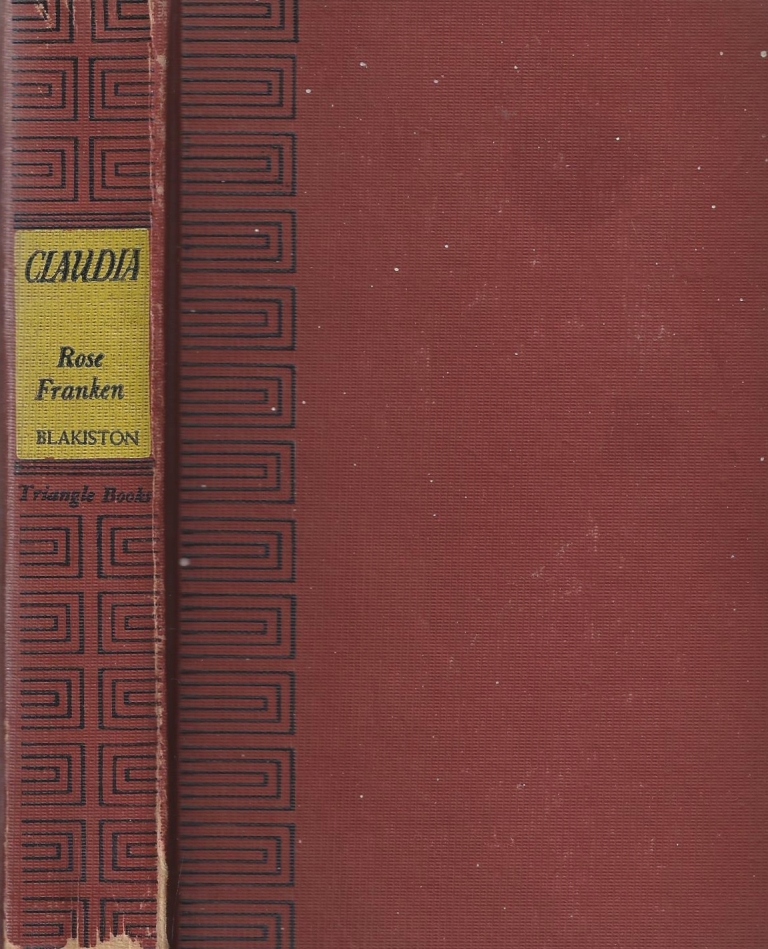
claudia rose franken 1938 001Claudia by Rose Franken ~ 1938. This edition: Blakiston, 1939. Hardcover. 305 pages.

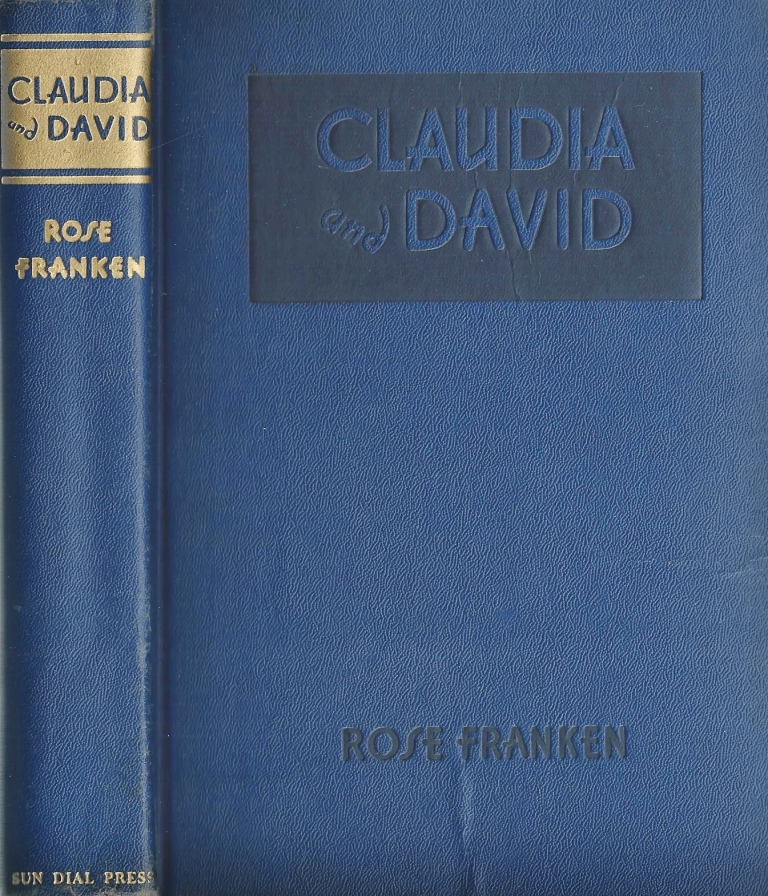
Claudia and David by Rose Franken ~ 1939. This edition: Sun Dial Press, 1940. Hardcover. 307 pages.

claudia and davis rose franken 1938 001My rating on both of these: Withheld for the time being. I’m not quite sure if I found these appalling or charming. Both, really. But which one is the strongest response will have to wait until I’ve re-read these, and perhaps explored a little more of the Claudia saga. (I think I may just have revealed which way I’m leaning.)

*****

This summer I acquired three of the Claudia novels – I believe there were something like eight in total – by Rose Franken, a highly successful American playwright and novelist. (An extended biography is here.)

I’m not sure what I was expecting – likely something fairly “deep”, as I had an idea that Franken was something of an “intellectual” writer – but it certainly wasn’t what I found.

These books – if the two I’ve just read are any indication; I set aside Young Claudia for future reference – are pure tweak-your-heartstrings sentimental tosh.

Our heroine Claudia is perilously close to being…hmm…how can I put it?….rather silly is fairly polite…but I could forgive her that because she was a young, young thing (just 17, or maybe 18) when she was matrimonially snapped up by the brusquely outspoken (and seven years older) rising young architect David.

Claudia has mild aspirations to go on the stage, but marriage to dashing and forceful David ultimately seems like a better idea. Who could resist being wooed by being constantly called a “young idiot”? Not our Claudia!

David has some manly notions regarding his teenage wife, including keeping her close to home – they may be struggling financially, but no wife of his is going out to work, because that would reflect on his ability to be the breadwinner. Who cares if she’s bored to tears and clawing at the wallpaper in her tiny apartment? A woman’s place is in the home, or at least his woman’s place is there, because David says so, dammit.

David, to be frank, is a bit of a jerk, even though he proves time and time again to have a heart of gold under his gruff exterior. (Uh-huh, he really does. Because Rose Franken tells us so, over and over and over.) He is constantly telling Claudia how dumb she is, and she agrees with him, and then silly little wifey comes up with some stunningly obvious solution to whatever the issue-of-the-chapter is, or has a brush with death, and David shows a glimpse of human emotion and then we’re off to the next episode. (Can you say “formula”, dear readers?)

Oh yeah, and David occasionally spanks Claudia, “hard enough to hurt”, and she likes it, because she realizes that she needs to be punished for daring to bruise David’s incredibly tender ego by having occasional ideas of her own. Argh.

Franken plays us like a piano, up and down the keyboard, tinkle-tinkle-tinkle, great big crescendo and then soft pause, and on to the next. These novels started out as story collections – Claudia first appeared in Redbook in the 1930s – and the structure is classic women’s-magazine-short-story, each chapter being a complete episode, arranged in chronological order with the same characters reappearing and new ones being added as we go along.

I haven’t really told you much about what actually happens in these absolutely fluffy light novels, and I’m not going to in any detail, because I think you can guess. Honeymoon period, quarrels, making up, financial difficulties, Great Big Breaks, life-threatening illnesses, babies (and life-threatening childbirth complications – Claudia walks the knife edge, because she’s always on the brink of dying, which gives David an opportunity to display that glimpse of human emotions and gruff tenderness referred to earlier), a little bit of mental and physical spousal abuse, servant issues, house issues, yadda yadda yadda.

But you know what? The saga is actually rather sweet, and occasionally quite funny, and horribly addictive – I absolutely gobbled these up.

Go figure.

I’m wondering if any of Rose Franken’s non-Claudia novels are a little deeper, because she’s a decent enough writer, and occasionally she whams the wifehood/motherhood thing right on the button.

I found a fun review of the Claudia books here, at Blue-Hearted Bookworm. Go take a look, because you’ll end up snorting with laughter, especially if you’ve already made the acquaintance of Claudia.

Here’s a brief excerpt:

I first discovered the Claudia novels (in one volume, The Claudia Omnibus) while browsing in my undergraduate library when I was, like Claudia, just 18. I stood there in the aisle and read for a while, then replaced the book. My Tough & Cool Inner Bookworm and I curled my (our?) lip contemptuously and thought: “What shit.” It was almost time for my next class, so I left the building.

Here’s the strange part: I was back in that same spot the very next day, surreptitiously enjoying another chapter! I’d read with an eye on the page and an eye on whoever might be walking by. I was in constant danger of being discovered; even back then, anyone who wanted to find me knew that the library was the perfect place to look…

I so get this, because it’s exactly how I felt. “What shit.” <Turns page to next installment.>

Don’t say we didn’t warn you. 😉

Read Full Post »

the american flags kathleen norris 1936

First edition Doubleday dust jacket illustration from 1936. (Not my copy, which is the 1937 Sun Dial Press edition.) The illustration emphasizes the “we Flaggs are united in our happy prosperity” in comparison to Miss Fitzpercy’s solitary advancement.

The American Flaggs by Kathleen Norris ~ 1936. This edition: The Sun Dial Press, 1937. Hardcover. 403 pages.

My rating: Parts of this were an easy 10, but other parts not so much. This might change on further mulling over, but right now I think a 6.5/10 is a fair assessment of the reading experience as a whole.

A beautiful young woman with a troubling family background (deserted by father, mother a not very successful writer/poetess, three siblings who moon about wasting their days and ignoring the squalor of their shabby rented bungalow situated in a subdivided California orchard on the outskirts of San Francisco) makes the acquaintance of a wealthy local family, the Flaggs.

The Flagg way of living is gracious to the extreme, and our heroine, Penelope Fitzpercy, who has come to see if she can sell an heirloom embroidery sampler to the family matriarch, is treated with unexpected courtesy and grace. She catches the eye of handsome and impulsive Jeff Flagg, who proceeds to woo Penelope with overwhelming enthusiasm. Much to her own surprise, she resists Jeff’s advances, out of a combination of pride in knowing that the Flaggs suspect her of having her eye on a rich husband and honest reluctance to marry someone she doesn’t truly love.

Back and forth the romance goes, until one tragic night in which Jeff almost dies in an accident, and Penelope is begged by the Flagg family members gathered around Jeff’s bed of pain to marry him, so he can die in peace at having attained his heart’s desire.

Needless to say Jeff makes a stunning recovery, and Penelope is trapped in a marriage which she never wanted. A chance for an annulment is secretly offered to her by Jeff’s grandmother, but Penelope refuses, mostly because she is too proud to back down from the promise she made to Jeff upon their hasty midnight marriage.

Jeff is a most definitely spoiled rich kid; he proceeds to squander his parents’ generous allowance, and becomes caught up in drink and gambling, while Penelope feebly wrings her hands in despair. When Jeff carelessly abandons her on the night of their baby’s birth, Penelope is rescued and comforted by Jeff’s cousin Tom, and the two, already friendly, enter into an emotional relationship which is emotionally if not physically a breaking of Penelope’s marriage vows.

When Penelope and Tom announce that they wish to marry after Penelope divorces Jeff, the rest of the family joins together in an agitated plea that Penelope give Jeff yet another chance, until the family matriarch unexpectedly speaks out in Penelope’s support.

What follows is an agony of indecision by Penelope, who thought she knew what she wanted…

I picked this up recently in one of my favourite used book shops, The Final Chapter in Prince George, thinking from my brief browse that it was something of a family comedy, a humorous romp, albeit a rather sustained one, at 400 pages plus. This initial assessment turned out not to be the case; this novel is at heart a serious sort of thing, and I closed it feeling like I’d just been subjected to an mesmerizingly earnest sermon by a preacher with a fine way with words but very little sense of humour.

Let me elaborate.

The finest thing about this book by the super-prolific Kathleen Thompson Norris (80-some books published from 1911 to 1959, according to her Wikipedia biography) is that it is decidedly readable, at least in the set-up phase, which takes up the first few hundred pages. (The last few hundred suffer from a certain amount of repetition and going on and on and on, rather like this post is starting to do! Must be catching…)

The author sets a wonderfully detailed scene, and her characters are, for the most part, believably flawed and therefore human enough to hold our interest, though as the tale progresses we note that many stay completely one-dimensional, while others – the very obviously “chosen” ones – are allowed an extreme degree of personal development, to support and justify author’s increasingly obvious point-of-view.

There is a goodish dose of melodrama early on, quite nicely handled; this was a point in favour.

What I didn’t care for was the way in which the author fast-forwarded her ending, taking us from agonizing, hyper-detailed moral dilemma to it’s-all-better-now without providing much in the way of explanation. She merely asks us to take on faith the idea that everyone has been able to pull themselves together and reach a higher moral plane, once the “correct” decisions have been made.

“A happy life is a reward for correct moral behaviour.”  I feel like a real heel sneering at this noble ideal, but in this case it just felt too easy, and rather ruined the last part of the book for me.

Though I must say that I quite liked the final scene which was an unexpected reconciliation between the heroine and her high-principled but perhaps not quite-so-perfect-as-once-assumed grandmother-in-law.

Would I read another Kathleen Norris book?

I do believe I would, though from the plot descriptions of several others which I’ve just discovered and from quick browses through the Project Gutenberg offerings by the author, I see a strong similarity of theme: Young woman decides to seek happiness over old-fashioned moral duty, has a spiritual awakening, and realizes that the old ways are the best.

There were a few places here and there in The American Flaggs where the chiming of church bells came through loud and clear, though they quickly subsided; the preaching was more implied than open, but it was definitely there.

For a portrait of a particular time and place, California just after the turn of the 20th Century, this was a fascinating snapshot, and I hugely enjoyed the details of the setting, as well as the author’s pull-no-punches descriptions of the Fitzpercy family’s lazy housekeeping and messy, messy lives.

Period snobbishness is evident throughout as well, and a version of a feudal class system. There are servants in abundance in the Flagg enclave, going about their duties meekly and modestly, and they are accepted as part of the background support system, with only a very few – the butler, the housekeeper – being named and given speaking roles.

Even the indigent Fitzpercys hold that they are somehow higher than servant class. Early on Penelope bemoans the fact that though she and her mother and sisters are of a higher social status than those who stoop to menial labour they are much worse at keeping their surroundings clean and neat, but this thought doesn’t seem to inspire a prolonged effort to raise the standard of living by washing a few dishes and sweeping the floor.

Towards the end of the story, after Penelope has her epiphany and her chance at a remade life, her humbling herself is made obvious by the mention that she is now on almost equal terms with her Mexican cook-housekeeper, though she retains an edge of unquestioned social superiority.

A rather decent discussion on what it is to be American takes place near the end of the book, balancing the theoretical rejection of “American values” by some of the more outspoken Fitzpercys and their bohemian friends early on. The Flaggs are held up to scorn for their strong patriotism and holding to tradition, but events go to show (and here is the author obviously trotting out her own pet theory) that the melting pot of America and the moral American standard upheld by the united Flaggs is more truly good than any nonsense of “communism” coming from Russia, or of the ways of those troublesome Italians and Germans making headlines in the newspapers.

Grand stuff in a highly opinionated period-appropriate sort of way!

I’d never heard of this author before, but I’m sure I’ll be noticing her in future, much as I now see Gene Stratton-Porter and Frances Hodgson Burnett and Mary Roberts Rinehart here, there and everywhere. She shares qualities with these others who were her contemporaries, a mix of (generally) positive and (occasionally) negative which makes for an unusual and vaguely unsettling reading experience. Not a great writer, but decidedly an accomplished one in this particular genre.


Read Full Post »

susan and joanna elizabeth cambridge 1935 001Susan and Joanna by Elizabeth Cambridge ~ 1935. This edition: Jonathan Cape, 1935. Hardcover. 348 pages.

My rating: 8/10 on a re-read.

When I read Susan and Joanna first time round earlier this year I remember feeling a bit put out by the events of the ending (I thought that the author pulled her punches somewhat and drew back from where she could have gone with it), but upon the re-read, already knowing how the climactic final scene actually ends, I was able to approach the story with a slower reading pace and a more balanced view.

I liked it rather better the second time round; Elizabeth Cambridge packs a lot into her novels; perhaps too much to really absorb in that first eager reading, when one is mostly concerned with finding out what will happen next and reads quickly, passing over the finer points without proper appreciation.

I know I have at least one reader who is keen to peruse a detailed account of this novel; I am wondering how much of the plot I should divulge, because chances of people actually finding this book to read themselves are slim. (Coming back to add – it’s a non-issue now – I’ve found an online version! Link down below, at the end of the post.)

This is a very rare novel by this writer. Her stellar Hostages to Fortune which has been reprinted often enough to remain in broad circulation is much better known and much easier to find. Susan and Joanna is not as compelling a read as HTF, but it is very good in its own way; I think it is a great shame that it is so scarce. Such is too often the way with these older writers; one of their books receives the full reprint and promotion treatment (and usually because it is a very worthwhile representative of the author’s output) while the rest of the titles languish in out-of-print oblivion.

Susan and Joanna is a deeply rural book; a good half of it takes place on a farm, the rest in a small village and in the surrounding countryside. Though the two main locations featured – the farm of Node and the village of Bract – are purely fictional, the setting is of a particular region of England, among the Midland Downs. Though Cambridge does not dwell in an undue degree upon descriptions of the scenery, she manages to portray the physical beauty of the landscape with great sympathy and clarity. One feels that this novel is a tribute to an area she knew very well, and loved very deeply.

Motherless Susan has been raised in the proper fashion – that is, off to boarding school from an early age – by her introvert father, a lawyer who gets through life by arranging things to function with the least possible disturbance to himself. Now Susan is twenty and at last back at home “for good”, but neither she nor her father have yet found their rhythm. They walk delicately around each other, being careful not to raise any subjects which might lead to an excess of emotion or potential household turmoil.

Susan has never been trained for – or indeed shown any inclination for –  an actual job or “career.” She is poised for the next step in her life, but hesitates on the brink. Marriage is an obvious and socially acceptable choice, and Susan has indeed considered marriage to the most suitable local candidate, Garry, nephew of the owner of the large farm Node, Miss Laura Coppen, the village’s aristocratic grande dame. Susan has been friendly with Garry since childhood and their relationship is now ripening into something deeper. Each meeting of the two is imbued with speculation, by Susan and Garry themselves, and by the deeply interested onlookers of this rural microcosm they all reside in.

But there is something which holds her back. Garry is just too easy-going and avoiding-of-trouble; he tends to slip through life allowing others to make his decisions for him. Even his growing conviction that Susan would make a suitable mistress at Node owes something to his grandmother’s approval of Susan’s impeccable manners, good breeding, and undoubted personal charm. Susan senses that Garry’s admiration and easygoing courtship of her is more superficial than deep; Garry doesn’t give it all that much thought himself, until forced to by Susan’s ultimate rejection of his advances.

Bruised by Susan’s unexpected refusal, Garry turns to the third member of their childhood-friends triumvirate, vicarage daughter Joanna. Joanna is emphatically Susan’s opposite in every essential way. Apple of her mother’s eye, Joanna has been encouraged to strive after success from babyhood, and her already self-assured nature combined with hard-won scholastic success makes her thoroughly impatient with wishy-washy Susan. “Naturally bossy” well describes Joanna, and Susan puts up with her patronization with good grace, though she is well aware of how much contempt her erstwhile friend actually holds her in.

Upon Garry’s proposal, something of a rebound impulse triggered by hurt pride, Joanna sets aside her career ambitions and agrees to take on Garry and Node instead, a move inspired not just by affection for Garry, but a sense of one-upmanship towards Susan. Joanna can’t help but feel that she has scored a major point in an unspoken rivalry that has persisted since the two were young.

Susan meanwhile meets and is courted by a rising young pathologist; she marries him and has a child. Upon her husband’s departure on a temporary posting in Canada, Susan moves back to Bract with her baby, and she and Joanna start to rebuild the structure of their never very strong but now sadly deteriorated friendship into something much more mature and mutually rewarding.

Joanna’s marriage to Garry and her new position in the rural hierarchy has led to a certain amount of emotional turmoil and occasional strife as the general local consensus is that the vicarage daughter has gotten rather above herself, putting herself in the shoes of the now-dead Miss Laura. Meanwhile Susan is viewed with benevolent patronage. No one has seen her husband; the unspoken assumption among the majority of the villagers is that she has been abandoned by this mythical man, and has sought unwed-mother refuge in her childhood home.

We follow Susan and Joanna through the first years of their very different marriages fraught with very different challenges. The two women’s lives have diverged greatly but are now running parallel, with life-altering consequences to both of them, and those in their closest circles.

What a richly written novel this rather somber story makes. Elizabeth Cambridge sketches her characters at first with the utmost artistic economy, adding layers of detail as the story progresses, until we fully understand what makes each person tick.

Cambridge’s depiction of the rural atmosphere is also utterly believable, and her observations regarding the animals so pervasive and important in such a setting equal her insights into the minds and motivations of the human inhabitants.

A criticism I read on a recent Persephone forum regarding Elizabeth Cambridge’s style was that nothing much happens in her books; they are merely a series of personal observations and not very dramatic domestic events. Quite true, when one steps back and looks at the format of the novels with an analytical eye. But the events are such that we can completely relate to them from our own mostly not very dramatic lives.

Personal relationships, love affairs, marriage, the birth of children, death, social structures and constantly changing and evolving outside events affecting private lives; these are all viable topics for discussion, and their fictional treatment when well handled – as they are in the case of this writer – can lead one into greater insights of one’s own emotional life and personal responses to the shared everyday human events which never truly change, no matter what the calendar year reads.

What a good writer she was; what a dreadful shame it is that five of her six novels are so very rare.

But look at what I have found!

Here is a scanned complete version of  Susan and Joanna, from Hathi Trust. It may be read online, or downloaded as page by page pdf files, if one is so inclined to do so. (And has hours of time to dedicate to the project!)

Reading from a screen is never quite as conducive to true enjoyment as sitting back with the actual book in one’s hands, but it is certainly better than no access to the material at all; I hope that this link brings pleasure to those others of you who are on a quest for more of Elizabeth Cambridge’s fine yet almost forgotten novels of the 1930s.

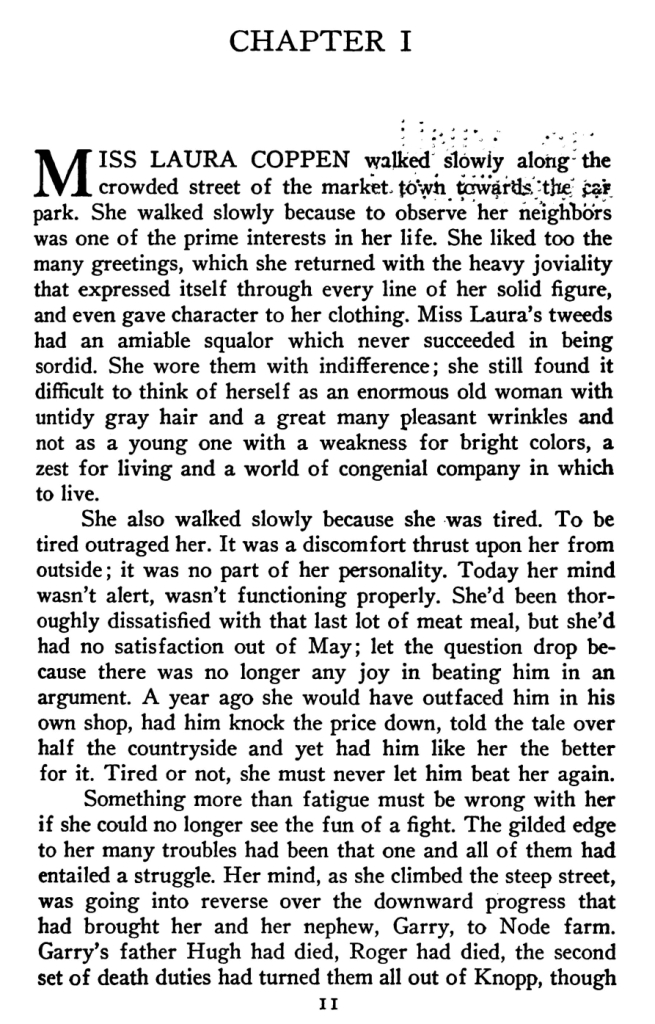
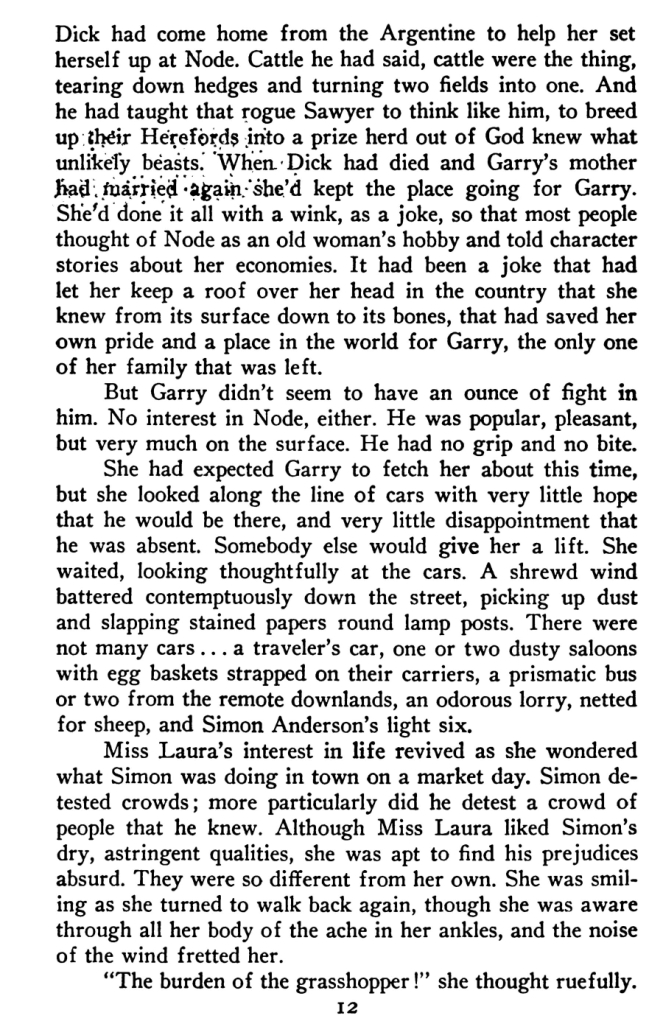
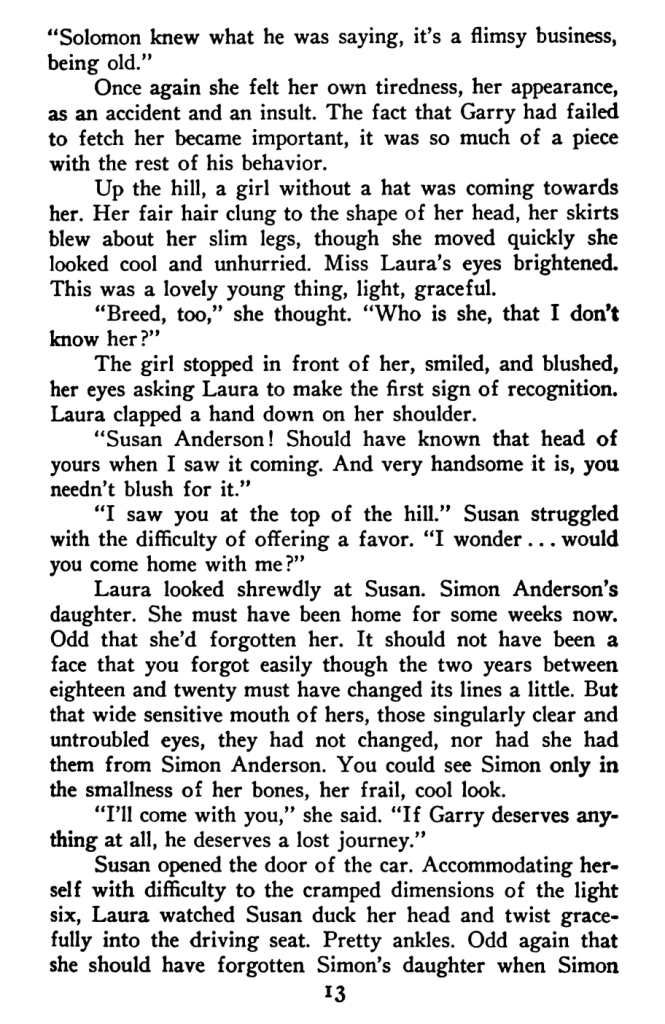
First three pages below, by way of being a teaser if you are considering whether you’d like to bother following up on this one.

?????????????????????????????????????????????????????????????????????????????????????????????????????????????????????????????????????????????????????????

Read Full Post »

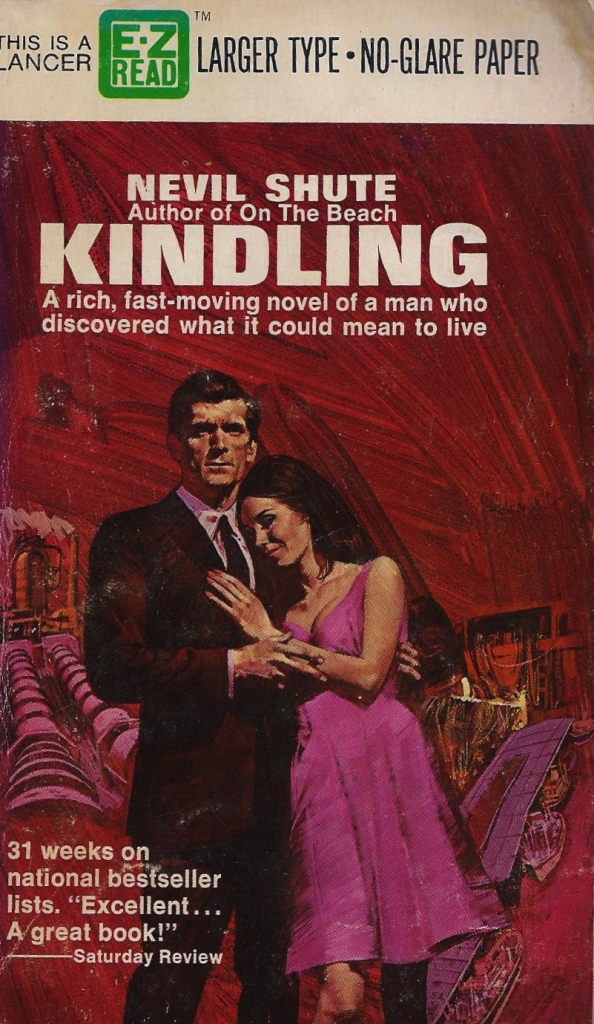
kindling nevil shute 001Kindling by Nevil Shute ~ 1938. Original British title: Ruined City. This American edition: Lancer, 1967. Paperback. 319 pages.

My rating: 6.5/10

I’m starting to fall out of the routine of posting, what with springtime’s long days and the utter luxury of being able to spend long hours out in the garden. The sabbatical year is going well, aside from the anticipated pinch of much less cash flow.

(For those of you who don’t know my back story, I generally operate a small specialty plant nursery and this year have shut up shop in order to refocus and take care of some outstanding personal farm and garden jobs which can only be properly tackled in the spring. I’m starting to think two years off might be even better, as there is no way I’ll get everything on The List finished this time round…)

Well, I’ve still been reading, though at a slower rate, and mostly in bed at night, so I notice I’ve been gravitating towards slighter novels, the kind one can finish off in an evening or two. No complicated sagas in the springtime! The brain is much too full of other stuff to make sense of anything too challenging.

Which makes Nevil Shute quite a good choice, as one can’t call books such as this last read, Kindling, at all complex. If anything, it was a bit too simplified, and I found myself occasionally annoyed at how briefly the author touched on some major plot developments, and how he introduced some promising characters and then dropped them cold, never to be seen again.

It is the mid-1930s, in England, and the long agony of the worldwide financial depression is grinding away at the status quo. It has even started affecting the very wealthy business class, who are, by and large, dealing fairly well with the money market difficulties, though those lower in the hierarchy are losing their grip.

Competently keeping his feet at the top of a shifting pile of lesser men, we have the successful, middle-aged merchant banker, Henry Warren, who deftly keeps in order a whole puppet show of various enterprises, handling staid English investors and dramatic Balkan politicians with absolutely level-headed aplomb. This involves frequent long nights in London, and many trips abroad, and Henry seems never to be home at the same time his wife is, what with the two of them leading fully separate lives and only meeting infrequently when their respective circles of activity brush against each other.

Serious problems are brewing, and not only on the home front, though things there have imploded with a sullen bang. Mrs. Warren has become romantically involved with a wealthy Arab sheik, and the gossip has surpassed the whisper stage. Henry is reluctantly forced to take notice, especially when he finds himself staying at the same French hotel as his wife and her lover. A divorce is the inevitable solution, after Henry’s ultimatum of a new sort of arrangement of reduced jet-setting and poshly-cushioned rural solitude for his wife is spiritedly rejected.

Henry sets his lawyers to work getting his divorce tidied up, and goes back to his wheeling and dealing, pausing only briefly to mull over the reasons behind the failure of his marriage. The major thing being, he concludes, that his wife’s financial independence has made it too easy for her to neglect the homemaking aspect of things. When a wife is dependent upon her husband financially, Henry muses, she has much more incentive to dedicate herself to her job, which is the home and family, while the husband’s half of the deal is to provide the money and the house.

He always felt helpless in his dealings with Elise. In most marriages, he thought, the economic tie must make things easier: the wife had her job for which she drew her pay; she could not lightly give it up. Both husband and wife then had to work, he in the office and she in the home. With Elise it was different. She had her own money – plenty of it; a dissolution of their marriage would mean no material loss to her, no unavoidable discomfort. She was not dependent on her job for her security, therefore she took it lightly…

But though he seems to recover quite quickly from the shock of the failure of his marriage, Henry Warren is riding for a fall. His overworked physique is about to let him down, and when it does, it is in quite an unexpected way. Henry ends up an incoherent patient in an overcrowded hospital in a depressed small city which has lost its only industry, that of a shipyard, some five years before. He is assumed to be an indigent wanderer, and, once he has recovered from abdominal surgery, he plays along with the charade, for he has become interested in how desperate the straits are of an entire community of unemployed men, and of how the progression of their loss of hope has affected them and their families.

If only one could bring back industry to the town, he muses…

What follows is a description of how Henry Warren manages to arrange financing to reopen the shipyard, which requires some intricate and not-quite-above-board dealings with the afore-mentioned Balkan politicians, and some at-home clever negotiations to bring some British investors into the deal.

But Henry has let his emotion in this case override his common sense, and has resorted, for the very first time in his financial career, to some shady practices which won’t stand up to investigation. And he has inadvertently made an enemy, who is in possession of a damning set of documents…

Of course there is a love interest, this time a properly womanly woman, the utter opposite of the ex-Mrs. Warren, who has departed the scene to live with her “black” paramour.

One of the sticky bits in this novel, even greater than the casual sexism, was the offhand racism exhibited throughout. The Arab lover is referred quite commonly as being “black”, and “a n*gger”, and Henry notes the “swarthiness” and the “olive texture” of Prince Ali Said’s skin, which “darkens to brown” – one would assume with a hidden blush? – when Henry lightly insults him. And the Jews in Henry’s circle get much the same treatment, though here and there one is given the nod as a “good man” despite his Jewishness and the associated stereotypes of appearance and behaviour this implies.

This aspect of Shute’s writing, even given its “era expectedness”, was a hurdle I had to crawl labouriously over, but once I made up my mind to go on, I found myself quite taken up in the story of Henry Warren’s new obsession, that of the rehabilitation of a town and its population. Henry puts the philanthropic desires of his heart before the sensible qualms of his brain, and in stepping out of bounds in a completely uncharacteristic way, makes himself an unlikely hero.

I mostly bought into it, and though the author’s philosophical soapbox was evident throughout, he told an engaging enough tale that I was held until it was all told out. Not much in the way of nuances here; we are told throughout exactly how we are expected to react and think, and I found myself meekly following Shute’s direction, though I gave myself a little shake when it was all over, to get myself tuned back in to the here-and-now.

I think “vintage” is an apt summation of the experience as a whole. The details of the financial planning are rather intriguing, being based on Nevil Shute’s own involvement in establishing a pre-war aircraft factory, which was, after many set-backs, successful.

One final note, and this on the cover. The story is set in the 1930s, and there are no passionate embraces with lightly clad women within. Henry Warren’s post-marital love affair is carried out with the strictest decorum, and though he does associate with an exotic Corsican dancer during some of his Balkan scheming, that relationship is apparently quite platonic. So the cover art is mostly imaginary, and obviously designed to catch the eye of the jaded businessman, who is (I suspect) the intended audience for Shute’s masculine romances.


Read Full Post »

« Newer Posts - Older Posts »